Saturday, 5 November 2016

Clinton and ISIS Both Funded By the Same Money, Says Assange


River to Sea Uprooted Palestinian   
The views expressed in this article are the sole responsibility of the author and do not necessarily reflect those of the Blog!

What does it take to bring Hillary Clinton to justice?

November 03, 2016
by Pepe Escobar for RT
Virtually the whole planet holds its collective breath at the prospect of Hillary Clinton possibly becoming the next President of the United States (POTUS).
How’s that humanly possible, as the (daily) Bonfire of The Scandals – relentlessly fed by WikiLeaks revelations and now converging FBI investigations – can now be seen from interstellar space?
It’s possible because Hillary Clinton, slouching through a paroxysm of manufactured hysteria, is supported by virtually the whole US establishment, a consensual neocon/neoliberalcon War Party/Wall Street/corporate media axis.
But History has a tendency to show us there’s always a straw that breaks the camel’s back.
This could be it – as revealed by WikiLeaks; March 2, 2015, the day when https://wikileaks.org/podesta-emails/emailid/41841
John Podesta wrote, “we are going to have to dump all those emails.”
That happened to be the exact same day it was revealed Hillary Clinton had used a personal http://www.nytimes.com/2015/03/03/us/politics/hillary-clintons-use-of-private-email-at-state-department-raises-flags.html?_r=0 email server as Secretary of State.
Yet this reveals only part of the puzzle. There’s got to be a response to Podesta’s email – which WikiLeaks may, or may not, leak in the next few days before the election. If the back and forth clearly shows intent (to mislead), then we’ve got a 100% smoking gun: the whole Clinton (cash) machine narrative – according to which Hillary just deleted “personal” emails – crumbles like the ultimate House of Cards.
Moreover, that would unveil what was from the start the privileged Clinton machine strategy: to thwart the subsequent internal State Dept. and FBI investigations.
As far as the Clinton machine is concerned, an interlocking influence peddling pile up is the norm. John Podesta also happens to be the founder of the Center for American Progress – a George Soros operation and prime recruiting ground for Obama administration officials, including US Treasury operatives who decided which elite Too Big To Fail (TBTF) financial giants would be spared after the 2008 crisis. DCLeaks.com, for its part, has connected Soros Open Society foundations to global funding rackets directly leading to subversion of governments and outright regime change (obviously sparing Clinton Foundation donors.)
Exceptional bananas, anyone?
The perfectly timed slow drip of WikiLeaks revelations, for the Clinton machine, feels like a sophisticated form of Chinese torture. To alleviate the pain, the relentless standard spin has been to change the subject, blame the messenger, and attribute it all to “evil” Russian hacking when the real source for the leaks might have come straight from the https://www.rt.com/news/365164-assange-interview-wikileaks-russia/ belly of the (Washington) beast.
At the Valdai discussion club last week, it took President Putin
http://valdaiclub.com/events/posts/articles/vladimir-putin-took-part-in-the-valdai-discussion-club-s-plenary-session/ only a few sentences to debunk the whole Clinton machine narrative with a bang:
“Another mythical and imaginary problem is what I can only call the hysteria the USA has whipped up over supposed Russian meddling in the American presidential election. The United States has plenty of genuinely urgent problems, it would seem, from the colossal public debt to the increase in firearms violence and cases of arbitrary action by the police. You would think that the election debates would concentrate on these and other unresolved problems, but the elite has nothing with which to reassure society, it seems, and therefore attempt to distract public attention by pointing instead to supposed Russian hackers, spies, agents of influence and so forth.
I have to ask myself and ask you too: Does anyone seriously imagine that Russia can somehow influence the American people’s choice? America is not some kind of ‘banana republic’, after all, but is a great power. Do correct me if I am wrong.”
Reality, though, continues to insist on offering multiple, overlapping banana republic instances, configuring a giant black hole of transparency.
Anthropologist Janine Wedel has been one of the few in Clinton-linked US mainstream media
http://www.huffingtonpost.com/entry/clintons-latest-email-scandal-why-it-deserves-scrutiny_us_58177d54e4b08301d33e0cdb?24hp9z9vxqa6y9zfr acknowledging how Bill Clinton, while Hillary was Secretary of State, perfected his version of “philantro-capitalism” (actually a money laundering “pay to play” racket), a practice “by no means confined to the Clintons”.
And the racket prospered with inbuilt nuggets, such as Hillary being http://www.independent.co.uk/voices/hillary-clinton-wikileaks-email-isis-saudi-arabia-qatar-us-allies-funding-barack-obama-knew-all-a7362071.html perfectly aware that prime Clinton Foundation donors Qatar and Saudi Arabia were also financing ISIS/ISIL/Daesh.
Huma, the Fall Princess
Now, less than a week before the election, we have come to the crucial juncture where the WikiLeaks revelations are merging with the FBI investigations – all three of them.
this WikiLeaks bombshell; Peter Kadzik, who’s now in charge of the Department of Justice (DOJ) probe into the 650,000 emails found on the laptop shared by Clinton’s right-hand woman Huma Abedin and her estranged, pervert husband Anthony Wiener, is a Clinton asset.
Not only Kadzik was an attorney for Marc Rich when he was pardoned by Bill Clinton; Podesta – as also revealed by WikiLeaks – thanked Kadzik for keeping him “out of jail”; and it was Kadzik who gave Podesta a secret heads up https://wikileaks.org/podesta-emails/emailid/43150#efmABWAB8ACiACqACvADUADXAIF on the Clinton email investigation.
The Clinton machine, starring a self-described virtuous Madonna, is actually a pretty nasty business.
Huma and her family’s close connections to Saudi Arabia – and the Muslim Brotherhood – are legendary (that includes his brother Hassan, who works for Sheikh Yusuf al-Qaradawi). Podesta, by the way, is a handsomely remunerated lobbyist for Saudi Arabia in Washington; that’s part of the Clinton Foundation connection.
Yet now, with Huma in the spotlight – still maintaining she didn’t know all those emails were in her and Wiener’s laptop – it’s no wonder Hillary has instantly downgraded her, publicly, to “one of my aides”. She used to be Hillary’s ersatz http://www.vanityfair.com/news/2016/01/huma-abedin-hillary-clinton-adviser “daughter”; now she’s being framed as The Fall Princess.
And that brings us to the intersection of those three FBI investigations; on Hillary’s Subterranean Email Server (in theory closed by FBI’s Comey last summer); on the Clinton Foundation; and on Wiener’s sexting of minors. The FBI has been investigating the Clinton Foundation for over a year now. Let’s try to cut a long story short.
Follow the evidence
Last July, the DOJ – under Clinton/Obama asset Loretta Lynch – decided not to prosecute anyone on Emailgate. And yet FBI director Comey – who nonetheless stressed Hillary’s “extreme carelessness” – turbo-charged his no-denial mode on another investigation, as in the FBI “sought to refocus the Clinton Foundation probe.”
Soon we had Clinton Foundation FBI investigators trying to get access to all the emails turned over in the Emailgate investigation. The East District of New York refused it. Very important point; up to 2015, guess who was the US attorney at the East District; Clinton/Obama asset Lynch.
Enter an extra layer of legalese. Less than two months ago, the Clinton Foundation FBI investigators discovered they could not have access to any Emailgate material that was connected to immunity agreements.
But then, roughly a month ago, another FBI team captured the by now famous laptop shared by Huma and Wiener – using a warrant allowing only a probe on Weiner’s sexting of a 15-year-old girl. Subsequently they found Huma Abedin emails at all her accounts – from Humaabedin@yahoo.com to the crucial huma@clintonemail.com. This meant not only that Huma was forwarding State Dept. emails to her private accounts, but also that Hillary was sending emails from the “secret” clintonemail.com to Huma at yahoo.com.
No one knew for sure, but some of these emails might be duplicates of those the Clinton Foundation FBI investigators could not access because of the pesky immunity agreements.
What’s established by now is that the metadata in the Huma/Wiener laptop was duly examined. Now picture both teams of FBI investigators – Clinton Foundation and pervert Wiener – comparing notes. And then they decide Huma’s emails are “relevant”.
Key questions apply; and the most pressing is how the emails were deemed “relevant” if the investigators could only examine the metadata. What matters is that Comey certainly was made aware of the content of the emails – a potential game-changer. That’s why one of my sources https://sputniknews.com/columnists/201610311046920348-clinton-fbi-november-surprise/insists his decision to go public came from above.
The other key question now is whether the DOJ – via Kadzik? – will once again thwart another investigation, this time on the Clinton Foundation. Senior, serious FBI agents won’t take that – massive euphemism – kindly. The FBI has been on the Clinton Foundation for over a year. Now, arguably, they are loaded with evidence – and they won’t quit. Winning the presidency now seems to be the least of Hillary Clinton’s Bonfire of Scandals’ problems.

River to Sea Uprooted Palestinian   
The views expressed in this article are the sole responsibility of the author and do not necessarily reflect those of the Blog!

Lebanon Elects New President: Opportunities for Russia-Lebanese Cooperation


Lebanon Elects New President: Opportunities for Russia-Lebanese Cooperation
ANDREI AKULOV | 04.11.2016 | WORLD

Lebanon Elects New President: Opportunities for Russia-Lebanese Cooperation

On November 1, General Michel Aoun, the 81-year old retired general, former army commander and the head of New Patriotic Movement, was elected by parliament new president, ending a two-and-a-half-year power vacuum. The Lebanese presidency is reserved for a Maronite Christian in the country’s sectarian power-sharing system.
According to Lebanon’s unwritten «National Pact» of 1943, the President of the republic is always a Maronite Christian, the Prime Minister is always a Sunni Muslim, and the speaker of parliament is always a Shi‘a (Shiite) Muslim. Bilateral dialogues between opposing factions have helped reduce popular tensions among political parties and their respective Sunni and Shiite supporters.
Since former President Michel Suleiman stepped down in May 2014, Lebanon has been without a head of state as the fractured parliament had failed more than forty times to elect a new leader. Aoun will be Lebanon’s 13th president since the country gained independence from France in 1943. His election means Lebanon will remain a stable country amid the tumultuous events in the Middle East.
In his inaugural speech, the president-elect vowed to increase bilateral cooperation with the Syrian government led by Bashar Assad on fighting terrorism. He also asserted that developing the capabilities of the Lebanese armed forces was his top priority, until it became a military able of protecting its own land.
President Aoun insisted that Lebanon must stay out of regional conflicts and follow an independent foreign policy in accordance with its interests. He also promised a preemptive fight against terrorism, in reference to Sunni Muslim jihadists, who have staged suicide attacks against Shi’ite targets and the army in Lebanon, and said camps hosting some 1.5 million Syrian refugees must not become militant hideouts.
The country is hit by the influx of more than one million Syrian refugees in addition to hundreds of thousands of displaced Palestinians.
The new Lebanese president supports the government of President Bashar Assad in Syria. It’s important that now the leaderships of Russia and Lebanon have similar views on the most pressing problem of the Middle East.
Russia is expected to be among the countries the new president will visit in the immediate future. After all, the USSR was one of the first countries to recognize Lebanon as an independent state. Moscow was a mediator and a stabilizing force when Lebanon was hit by the 1975-1990 civil wars.
According to Amal Abu Zeid, a member of the Lebanese political bloc Change and Reform, Russia and Lebanon will continue to maintain «strategic and promising» relations. There are prospects for cooperation on developing the oil and gas deposits recently discovered in Lebanon.
In 2013, Russia and Lebanon inked a memorandum of understanding on energy cooperation. Construction industry also presents opportunities for lucrative projects.
Former Lebanese prime minister and Future Movement leader MP Saad Hariri, expected to take office as new prime minister in a few days, visited Russia on October 4. During the meeting, Russian Foreign Minister Sergey Lavrov expressed «support» for Hariri’s efforts to end the deadlock related to the election of the head of state, stressing that the former PM is «playing an important role» regarding the domestic situations in Lebanon.
It was not the first time Lebanese ranking politicians visited Russia to solicit its help in overcoming the political deadlock. Last April Mr. Hariri visited Moscow to meet Russian President Vladimir Putin and ask Russia to mediate and help Lebanon find a way out of presidential impasse. After the talks, he said «We value the large role played by Russia in the region, and we look for you to have a role in Lebanon too».
With the Syrian civil war at its doorstep. Lebanon desperately needs a stronger military. Lebanese Finance Minister Ali Hassan Khalil visited Moscow in June to ask for military aid to bolster Lebanon’s efforts to fight terrorism. Lebanon has asked Russia to supply his country with Kornet anti-tank missile systems and T-72 main battle tanks and cannons.
Russia’s military aid may be especially welcome. In early March 2016, Saudi Arabia suspended its long-awaited aid package that Lebanon desperately needs to combat the terrorist groups trying to enter the country from Syria. The Lebanese Army has been using the same equipment since the early 80s. Their main armored vehicles are the M-113 APC and the M-60 MBT.
The Russia’s military operation in Syria was a crucial factor to protect Lebanon from being flooded by extremist groups invading it from Syria. Actually, Russia prevented the inevitable – the invasion of Lebanon by Islamic State forces. With the new president in office, Lebanon can join the coalition of Syria, Iran and some other actors supporting the Syrian legitimate government.
Russia and Lebanon are on the same page when it comes to the fight against jihadis and the situation in Syria. The election of Michel Aoun opens new opportunities for the Russia-Lebanon bilateral relations.

River to Sea Uprooted Palestinian   
The views expressed in this article are the sole responsibility of the author and do not necessarily reflect those of the Blog!

Frank Zappa on American Democracy...


River to Sea Uprooted Palestinian   
The views expressed in this article are the sole responsibility of the author and do not necessarily reflect those of the Blog!

Sayyed Nasrallah: Berri is the Major Guarantee in Difficult Times, We Trust Aoun


Hezbollah Secretary General Sayyed Hasan Nasrallah confirmed Friday that Hezbollah was honest since the very beginning adding that the party had spared no effort towards the facilitation of the election of Michel Aoun as Lebanon’s president after two years and a half of presidential void.
During a memoSayyed Nasrallah during a memorial ceremony honoring Martyr Leader Mostafa Shehaderial ceremony honoring Martyr Leader Mustafa Shehade held on Friday, Sayyed Nasrallah said that after the accomplishment of the presidential election there is a chance to say that “we in Hezbollah faced a lot of injustice and false accusations during the past two and a half years, and I hope those who lied to reevaluate their stances.” “We were honest since the first beginning in our endorsement to Michel Aoun as President and we spared no effort for the achievement of this election and we never changed our stance in this regard.”
For those who claimed that Hezbollah didn’t want Aoun as a President and that we were lying and we wanted the persistence of void in the country, Sayyed Nasrallah said Hezbollah does not deceive or lie. “Those also didn’t spare any regional or international pretext to accuse us of it, starting from the nuclear program to the Syrian crisis, but all developments proved they were the liars.”
“October 31 had come to light and rebuffed all their claims and what we wanted happened. It was clear that there’s no relation between the nuclear or the Syrian issues with the presidential elections. Even Iran and Syria had always wanted for this election to be a Lebanese issue only and who wanted it to be on a foreign agenda were those who accused us of so.” Sayyed Nasrallah addressed those who claimed that they embarrassed Hezbollah by endorsing Aoun as president took credits of their last-minute stance, “Why hadn’t you embarrassed us two and a half years ago?” thus proving Hezbollah’s choice was the rightful one since the beginning of the presidential paralysis.


Honoring ceremony for Martyr Mostafa Shehade

Hezbollah’s S.G. assured that what’s between Hezbollah and President Aoun was nothing but trust, “we don’t have any bargains or deals with him over presidency.” “We trust this man and we have confidence in him as an independent and patriot man who doesn’t follow any foreign agenda,” Sayyed Nasrallah pointed.
Concerning the Parliament session the was held on October 31 to elect a new president, Sayyed Nasrallah said that Speaker Nabih Berri shall be credited for the way he administered the session with his wisdom and conscience despite his political position. His eminence hailed Berri as a “statesman who safeguards Lebanon” and the “major guarantee in difficult times.”
Sayyed Nasrallah also thanked Marada Leader Suleiman Franjieh for being a faithful ally. “He was highly committed to us and our choice and he could have been elected as President if he wanted so but he preferred to be honest with us as an ally.”
His eminence then called on all parties to cooperate with the new President for the welfare and benefit of the country in the midst of conflicts and dilemmas surrounding us.
Concerning the formation of a new government, Sayyed Nasrallah said Hezbollah didn’t name Saad Hariri for premiership to form the new government but rather offered all possible facilities for his nomination. However, he said that Hezbollah’s bloc would take a clear stance on the formation of the new Cabinet Saturday, after its meeting with PM-designate Hariri.
Hezbollah leader said the party won’t take part in any Cabinet that Speaker Nabih Berri decides to boycott. “During past years while new governments were being formed, we were always keen that the FPM party, whom we are dedicated to alliance with it, that it takes its share in a just way, so we had stalled the formation of governments for their sake,” Sayyed Nasrallah pointed out, adding that “if Speaker Berri decides not to participate in the upcoming government we will boycott it too. And even the FPM should do so.”
His eminence also said that Speaker Berri was the official negotiator on behalf of both Hezbollah and his own Development and Liberation bloc regarding the designation of the new Cabinet’s portfolios. He said the Lebanese are before a new phase thanks to the Lebanese army, people and several other factors, adding that Hezbollah is keen that the Cabinet be formed and wants it to be productive.
Sayyed Nasrallah rebuffed the Saudi fake propaganda claiming that the Yemenis had fired a Ballistic rocket at Mecca as a big sarcastic lie, wondering “Who would believe that those Yemenis who are being killed every day could do so?”
Hezbollah’s Secretary General offered his condolences to Martyr Shehade’s family, wife, daughter and sons over his martyrdom. His eminence hailed the martyr for living a life that was full of Jihad and sacrifices in addition to his strength and stiffness throughout carrying his Jihadi job as a leader in Hezbollah ranks. “In times when some sides bet on a conflict between Hezbollah and the Syrian army (Fethullah massacre), Martyr Shehade managed to refute this conspiracy with his wisdom and conscience,” Sayyed Nasrallah assured.
Related Videos

Related Articles

River to Sea Uprooted Palestinian   
The views expressed in this article are the sole responsibility of the author and do not necessarily reflect those of the Blog!

U.S. Elections “November Chaos”: What You’re Not Being Told

Global Research, November 04, 2016

trump-clinton
The FBI’s October surprise has thrown the 2016 election into November chaos.
But an examination of the trigger mechanism behind this event reveals a deeper layer of manipulation by the media and financial interests behind the election.
This is the GRTV Backgrounder with your host James Corbett.  
This Global Research TV report includes an interview with Prof. Michel Chossudovsky.

RELATED ARTICLES


River to Sea Uprooted Palestinian   
The views expressed in this article are the sole responsibility of the author and do not necessarily reflect those of the Blog!

SYRIAN WAR REPORT – NOVEMBER 4, 2016: GOVT FORCES REPEL FIERCE MILITANT ATTACK IN ALEPPO

The Syrian army and the National Defense Forces (NDF) advanced along the Aleppo-Hama highway and seized the two hills – Tell Bazam and Tell Masin – north of the recently liberated town of Souran. Strategically, this offensive may allow the army and the NDF to flank the militant-controlled areas with the center in Latamanah. This strategy could lead to a success if the government forces are able to advance further to the north and to take control of Morek.
The government forces continued military operations in Western Ghouta, targeting Jabhat Fatah al-Sham (formerly Jabhat al-Nusra, the Syrian al-Qaeda branch) and its allies in the town of Khan al-Sheih. Earlier this week, the government forces made an attempt to make an agreement with the militants to allow them to withdraw from the city to the province of Idlib. However, this idea resulted in a falure and lead to further escalation in the area. Yesterday, the army and the NDF seized a key farms northeast of Khan al-Sheih and deployed in a striking distance from the militant stronghold.
The army’s Tiger Forces, the Desert Hawks Brigade and Hezbollah successfully repelled a fiercest attack by the al-Nusra-led militant alliance, Jaish al-Fatah, in western Aleppo on November 3. Both sides suffered some casualties and Jaish al-Fatah used at least 2 car bombs in an attepmt to break the government forces’ defenses. Pro-militant sources report that the ‘opposition’ has destroyed some 4 units of military equipment belonging to the army. At least 1 infantry fighting vehicle and 1 battle tank belonging to Jaish al-Fatah were destroyed. On November 4, the humanitarian took place in the city. However, firefights are ongoing.
The ISIS-linked media outlet Amaq released a footage of an explosion of Russian Mi-35 multi-role combat helicopter near the village of Huwaysis, northwest of Palmyra. the Mi-35 was delivering a humanitarian aid in the area when it was downed because of a technical failure. ISIS militants targeted the landing site with an anti-tank guided missile. The incident took place on November 3. The Mi-35’s crew (2 men) survived the incident and returned safely to the Russian Khmeimim Airbase in the province of Latakia.
Russia’s state-of-the-art frigate Admiral Grigorovich, armed with Caliber missiles, set off to the Mediterranean Sea from the port of Sevastopol on November 3. The frigate will join the Russian naval task force off the coast of Syria.

Related Articles
River to Sea Uprooted Palestinian   
The views expressed in this article are the sole responsibility of the author and do not necessarily reflect those of the Blog!

فرنجية للداخلية نصف التوافق


ناصر قنديل

ـ إذا كان التزام رئيس الجمهورية بمعادلتَيْ إجراء الانتخابات في موعدها ووفقاً لقانون جديد في خطاب القَسَم قد تكفل بتبديد أغلب الهواجس التي رافقت التفاهم بين التيار الوطني الحر وتيار المستقبل وفتحت طريق إنجاز الاستحقاق الرئاسي بقبول الرئيس سعد الحريري السير بالعماد ميشال عون ممراً إلزامياً لرئاسة الجمهورية، ففتح رئيس الجمهورية بهذا الالتزام الطريق لتولي الرئيس سعد الحريري رئاسة الحكومة الجديدة، بنسبة عالية من التوافق والأيدي الممدودة، فإنّ التأكيد على أنّ المهمة الرئيسية للحكومة الأولى للعهد ستكون وضع قانون جديد للانتخابات النيابية، والذهاب إلى الانتخابات على أساسه، يجب أن يطبع شكل الحكومة وتكوينها من جهة، ويستكمل ما أنجزه رئيس الجمهورية لطي صفحة خلافات ما قبل الانتخابات الرئاسية من جهة أخرى.

ـ يُفترض من باب الوفاء والأصول واللياقات برئيس الحكومة سعد الحريري أن يشكل إسناد وزارة الداخلية في الحكومة، طلباً أخلاقياً يتقدّم به الرئيس المكلف من رئيس الجمهورية، من باب أنّ سير الحريري بالعماد عون لرئاسة الجمهورية ترتّب عليه التخلّي عن ترشيح فرنجية الذي كان ورطة لفرنجية تصدّعت بسببها علاقات وتحالفات كثيرة، ومنها علاقة فرنجية برئيس الجمهورية، وطالما لم تتمّ أيّ عملية ترميم للصدوع المرافقة لمسار المعركة الرئاسية قبل حسمها، فإنّ تشكيل الحكومة مناسبة لتلتئم الجراحات وتطوى الصفحات، كيف وأنّ الرئيس نبيه بري قد سلّف الحريري ديناً كبيراً، وهو يقول إنه مدين له بتوصيف يجمع المجاز والتورية والطباق والجناس. والرئيس الحريري يعلم أنّ مشاركة الرئيس بري في الحكومة المكلفة بإنجاز قانون انتخابات وإجراء الانتخابات مشروط على العتبة بمبدأ أخلاقي هو عدم التخلي عن فرنجية، والدخول معاً، وقد جعله الرئيس بري عنوان تصويته المخالف في الانتخابات الرئاسية، وليس الرئيس بري مَن يبيع حليفاً، والمنصب الوزاري الذي يمكن أن يشكل فرقاً ويطوي صفحة هو المنصب السيادي الأول في الحكومة في الطائفة التي ينتمي إليها الرئيس ميشال عون والنائب فرنجية، وقبول الرئيس بالتخلي عن هذا المنصب لفرنجية هو خير رسالة يوجّهها الرئيس للمّ الشمل من جهة، ولتأكيد أنّ التفاهم الذي ربطه مع القوات اللبنانية، ولاحقاً ربط تياره وتيار الرئيس الحريري والقوات، لا يتضمّن تقاسماً مسبقاً للمقاعد الوزارية المسيحية بين التيار الوطني الحر والقوات.

ـ الجهد الذي بذله حزب الله لفتح طريق أحادي للرئاسة هو طريق يوصل العماد ميشال عون إلى بعبدا، وتّرتب عليه أكثر من الاتهامات التي تحمّلها حزب الله، التصدّع في بيئة تحالفاته الاستراتيجية، وأهمّها التحالف مع فرنجية، ما يجعل مبادرة رئيس الجمهورية لتكريم فرنجية رسالة وفاء بالنيابة عن حزب الله لفرنجية، ورسالة وفاء من الرئيس لحزب الله. وهذه المبادرة بحقيبة سيادية ترتبط بمهمة سياسية تحتاج تقديم التطمينات من الرئيسين عون والحريري لمخالفيهم وعلى رأسهم الرئيس بري بأن لا تفاهمات تطال مستقبل الانتخابات ولا قانون الانتخابات ولا موعد إجرائها، وليس أكثر من إسناد وزارة الداخلية لفرنجية يحقق هذا الهدف.

ـ فرنجية للداخلية مشهد عرس وطني يكتمل، بعد مشهد تسمية الرئيس بري للرئيس الحريري لتشكيل الحكومة، وقبله تصويت القوميين والبعث للرئيس عون، بحيث لم يبق أحد خارج التوافق الذي يفترض أن تشكل الحكومة إطاره السياسي، ولو توسّعت مقاعدها لتشمل أوسع ألوان الطيف السياسي الذي تمثل في مجلس النواب وفي هيئة الحوار الوطني، لتكون مرحلة الإقلاع بتشكيل الحكومة سريعة ولا تستدعي تفاهماً مسبقاً على تفاصيل قانون الانتخاب أو على التفاصيل الإجرائية المتصلة بها. فضمانات الرئيسين عون والحريري هي بحتمية موافقتهما وتوقيعهما أيّ مشروع قانون انتخابي وأيّ قرار يتصل بالانتخابات. وربما تكون ضمانة الرئيس بري متحققة بإسناد وزارة المالية لمن يسمّيه لهذه الحقيبة إحياء لما اتفق عليه في الطائف، بجعل هذه الحقيبة للطائفة الشيعية كضمان للشراكة في السلطة التنفيذية، عبر حتمية توقيع وزير المالية على جميع المراسيم، لتصير تسمية فرنجية وزيراً للداخلية ضماناً للجميع وإكمالاً لعقد التوافق.

Related videos

Related Articles

River to Sea Uprooted Palestinian   
The views expressed in this article are the sole responsibility of the author and do not necessarily reflect those of the Blog!

Friday, 4 November 2016

SYRIAN WAR REPORT – NOVEMBER 3, 2016: EGYPTIAN OFFICERS ARRIVE IN SYRIA


Over 2,500 militants have been killed and wounded in western Aleppo since the start of Al-Nusra-led attempt to break the government forces’ defenses in the area on October 28, according to sources in the Syrian military. Considering that the total striking force deployed by Jaish al-Fatah coalition for the operation was about 5,000 fighters, it’s clear why the militant coalition failed to achieve its military goals.
An infighting allegedly started between Harakat Nour al-Din al-Zenki  and Fastaqim Kama Umirt militant groupsin Salaheddine and Al-Ansari Mashhad areas in Aleppo city on November 2.  Nour al-Din al-Zenki   stormed Fastaqim Kama Umirt checkpoints and arrested dozens of Fastaqim Kama fighters including their commander ‘Istakem kma Oumrt’. At least 1 militant was reported dead and 25 injured as result of the clashes. The conflict among ‘moderate rebels’ reportedly appeared because Fastaqim Kama Umirt was considering a possibility to leave Aleppo through corridors set up by the Syrian and Russian military.
The Russian general staff has announced that President Vladimir Putin had ordered a humanitarian pause in Aleppo from 9am to 7pm on November 4.
“Considering that our American colleagues were unable to separate the opposition from terrorists, we are addressing all militant leaders directly, urging them to cease hostilities and leave Aleppo with their arms,” General Valery Gerasimov, the chief of the Russian General Staff said, adding that “Two corridors will be opened, from which Syrian troops and weapons would be pulled back.” Six additional corridors will be opened for civilians.
A group of Egyptian officers allegedly arrived in Syria on November 1 in order to learn from Russian military advisers that are embedded with government troops at the battle against terrorists across the country. The development took place amid the ongoing expansion of military cooperation between Russia and Egypt. In October 2016, Russian airborne troops arrived Egypt to participate in a joint military drill with the host country. The drill was codenamed “Defenders of Friendship 2016”.

River to Sea Uprooted Palestinian   
The views expressed in this article are the sole responsibility of the author and do not necessarily reflect those of the Blog!

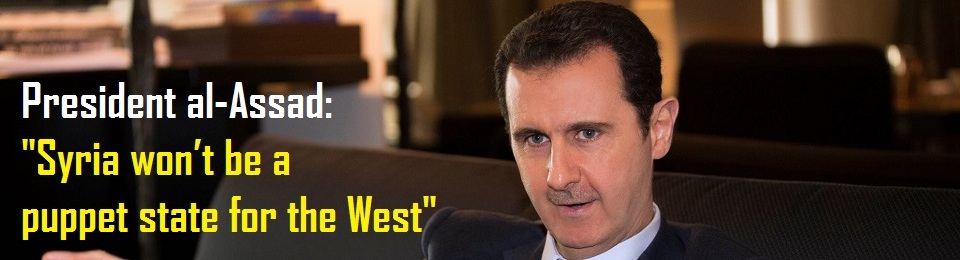
President al-Assad: “United States and its Western allies are to blame for failure of latest ceasefire”

Bashar al-Assad -Paris Match-990x260-HOME
(Damascus, 3/11/2016) ~ President Bashar al-Assad asserted that the United States and its Western allies are to blame for the failure of latest ceasefire, because terrorism and terrorists are for them a card they want to play on the Syrian arena.
In an interview given to the Serbian newspaper Politika, President al-Assad said that Russia is very serious and very determined to continue fighting the terrorists, while the Americans base their politics on a different value as they use the terrorists as a card to play the political game to serve their own interests at the expense of the interests of other countries in the world.
President al-Assad pointed out that Western countries wanted to use the humanitarian mask in order to have an excuse to intervene more in Syria, either militarily or by supporting the terrorists.
Following is the full text of the interview:

assad-usa-media-20161103-2-1200
Question 1: Mr. President, why has the latest Syria ceasefire failed? Who is to blame for that?
President Assad: Actually, the West, mainly the United States, has made that pressure regarding the ceasefire, and they always ask for ceasefire only when the terrorists are in a bad situation, not for the civilians. And they try to use those ceasefires in order to support the terrorists, bring them logistic support, armament, money, everything, in order to re-attack and to become stronger again. When it didn’t work, they ask the terrorists to make it fail or to start attacking again. So, who’s to blame? It’s the United States and its allies, the Western countries, because for them, terrorists and terrorism are a card they want to play on the Syrian arena, it’s not a value, they’re not against terrorists. For them, supporting the terrorists is a war of attrition against Syria, against Iran, against Russia, that’s how they look at it. That’s why not only this ceasefire; every attempt regarding ceasefire or political moving or political initiative, every failure of these things, the United States was to be blamed.

Question 2: But which country is supporting terrorism? Saudi Arabia? Qatar?
President Assad: Saudi Arabia, Qatar, Turkey…
Journalist: Turkey?
President Assad: Because they came through Turkey with the support of the government, direct support from the government.
Journalist: Directly?
President Assad: Direct support from the government, of course.
Journalist: With money or with armament?
President Assad: Let’s say, the endorsement, the greenlight, first. Second, the American coalition, which is called “international coalition,” which is an American. They could see ISIS using our oil fields and carrying the oil through the barrel trucks to Turkey under their drones…
Journalist: This is the Syrian oil?
President Assad: In Syria, from Syria to Turkey, under the supervision of their satellites and drones, without doing anything, till the Russians intervened and started attacking ISIS convoys and ISIS positions and strongholds. This is where ISIS started to shrink. So, the West gave the greenlight to those countries like Turkey, Saudi Arabia, and Qatar, and actually those countries, those governments are puppets; puppets to the West, puppets to the United States, they work as puppets, and the terrorists in Syria are their proxy, the proxy of those countries and proxy of the West and the United States.

Question 3: But money for marketing this oil, who has the money? Turkey?
President Assad: In partnership between ISIS and Turkey. Part of the money goes to ISIS because this is how they can make recruitment and pay salaries to their fighters. That’s why ISIS was growing before the Russian intervention, it was expanding in Syria and in Iraq. And part of the money is going to the Turkish government officials, mainly Erdogan himself and his family.
Journalist: Erdogan himself?
President Assad: Of course, of course. They were directly involved in this trade with ISIS.

Question 4: Mr. President, do you believe the Russians and Americans can ever agree over Syria? Can Russia and the USA be partners in the war against terrorists in Syria?
President Assad: We hope, but in reality, no, for a simple reason: because the Russians based their politics on values, beside their interest. The values are that they adopt the international law, they fight terrorism, and the interest that if you have terrorists prevailing in our region, that will affect not only our region but Europe, Russia, and the rest of the world. So, the Russians are very serious and very determined to continue fighting the terrorists, while the Americans based their politics on a different value, completely different value, their value is that “we can use the terrorists.” I mean the Americans, they wanted to use the terrorists as a card to play the political game to serve their own interests at the expense of the interests of other countries in the world.

Question 5: The situation about bombing the Syrian Army near the airport in Deir Ezzor… How did the American air attack on the Syrian Army happen? Was it a coincidence or not?
President Assad: It was premeditated attack by the American forces, because ISIS was shrinking because of the Syrian and Russian and Iranian cooperation against ISIS, and because al-Nusra which is Al Qaeda-affiliated group had been defeated in many areas in Syria, so the Americans wanted to undermine the position of the Syrian Army; they attacked our army in Deir Ezzor. It wasn’t by coincidence because the raid continued more than one hour, and they came many times.
Journalist: One hour?
President Assad: More than one hour. There were many raids by the Americans and their allies against the Syrian position. At the same time, they attacked a very big area; they didn’t attack a building to say “we made a mistake.” They attacked three big hills, not other groups neighboring these hills, and only ISIS existed in Deir Ezzor. There is no… what they called it “moderate opposition.” So, it was a premeditated attack in order to allow ISIS to take that position, and ISIS attacked those hills, and took those hills right away in less than one hour after the attack.
Journalist: ISIS attacking Syrian position after American…?
President Assad: Less than one hour, in less than one hour, ISIS attacked those hills. It means that ISIS gathered their forces to attack those hills. How did ISIS know that the Americans would attack that Syrian position? It means they were ready, they were prepared. This is an explicit and stark proof that the Americans are supporting ISIS and using it as a card to change the balance according to their political agenda.
Journalist: And after that, America said sorry, huh?
President Assad: They said they regret, they didn’t say sorry. [laughs]

Question 6: Mr. President, who is responsible for the attack on the Red Cross convoy near Aleppo, and what weapons were used for the destruction of the Red Cross convoy?
President Assad: Definitely the terrorist groups in Aleppo, because those are the ones who had an interest. When we announced the truce in Aleppo, they refused it. They said “no, we don’t want a truce.” They refused to have any convoys coming to eastern Aleppo, and that was public, it’s not our propaganda, it’s not our announcement, they announced it. And there was a demonstration by those militants to refuse that convoy. So, they have interest in attacking that convoy, we don’t have. It wasn’t in an area where you have Syrian troops, and at the same time there were no Syrian or Russian airplanes flying in that area anyway. But it was used as part of the propaganda, as part of the narrative against Syria in the West; that we attacked this humanitarian convoy, because the whole war now in Syria, according to the Western propaganda, is taking the shape of humanitarian war. This is the Western mask now; they wanted to use the humanitarian mask in order to have an excuse to intervene more in Syria, and when I say intervene it means militarily or by supporting the terrorists.
Journalist: This is like the situation in former Yugoslavia, in the war in Yugoslavia, also in the war in Bosnia and Herzegovina, in the war in Kosovo, humanitarian problems.
President Assad: It’s a different era, maybe, a different shape, but the same core, what happened in your country, and what’s happening now in our country.

Question 7: And the Western propaganda spoke about the problem of using the chemical weapons and the barrel bombs.
President Assad: The same, to show that you have a black-and-white picture; very very bad guy against very very good guy. It’s like the narrative of George W. Bush during the war on Iraq and on Afghanistan. So, they wanted to use those headlines or those terms in their narrative in order to provoke the emotions of the public opinion in their countries. This is where the public opinion would support them if they wanted to interfere, either directly through military attacks, or through supporting their proxies that are the terrorists in our region.

Question 8: I see the news in the last days, the Amnesty International condemned a terrorist group for using the chlorine, the chemical weapons in Aleppo.
President Assad: In Aleppo, exactly, that happened a few days ago, and actually, regardless of these chemical attacks, we announced yesterday that the terrorists killed during the last three days more than 80 innocent civilians in Aleppo, and wounded more than 300. You don’t read anything about them in the Western mainstream media. You don’t see it, you don’t hear about it, there’s nothing about them. They only single out some pictures and some incidents in the area under the control of the terrorists just to use them for their political agenda in order to condemn and to blame the Syrian government, not because they are worried about the Syrians; they don’t care about our children, or about innocents, and about civilization, about infrastructure. They don’t care about it; they are destroying it. But actually, they only care about using everything that would serve their vested interests.

Question 9: And now, your army… you are the supreme commander of Syrian military forces. Your army now has not any chemical weapons?
President Assad: No, we don’t. Since 2013, we gave up our arsenals. Now, no we don’t have. But before that, we have never used it. I mean, when you talk about chemical weapons used by the government, it means you are talking about thousands of casualties in one place in a very short time. We never had this kind of incidents; just allegations in the Western media.

Question 10: Mr. President, when do you think the Syrian war will end?
President Assad: When? I always say less than one year is enough for you to solve your internal problem, because it is not very complicated internally. It’s becoming more complex only when you have more interfering by foreign powers. When those foreign powers leave Syria alone, we can solve it as Syrians in a few months, in less than one year. That’s very simple, we can, but providing that there’s no outside interference. Of course, that looks not realistic, because everybody knows that the United States wanted to undermine the position of Russia as a great power in the world, including in Syria. Saudi Arabia has been looking how to destroy Iran for years now, and Syria could be one of the places where they can achieve that, according to their way of thinking. But if we say that we could achieve that situation where all those foreign powers leave Syria alone, we don’t have a problem in solving our problem.
How? First of all, by stopping the support of the terrorists by external countries like the regional ones like Turkey, Saudi Arabia, and Qatar, and by the West, of course, mainly the United States. When you stop supporting terrorists in Syria, it won’t be difficult at all to solve our problem.

Question 11: Mr. President, is it true that Syria is the last socialistic country in the Arab world?
President Assad: Today, yes. I don’t know about the future, how is it going to be. We are socialist, but of course not the closed type.
Journalist: Humane socialism, because your government is supporting the education with the subvention, like the Swedish-type socialism.
President Assad: I don’t know a lot about the Swedish-type, but let’s say that in Syria, we have an open economy, but at the same time we have a strong public sector, and that public sector played a very important role in the resilience of the Syrian society and the government during the war. Without that public sector, the situation would have been much more difficult. So, we’re still socialist, and I think the war proved that the socialism system is very important for any country, taking into consideration that I’m talking about the open socialism, that could allow the freedom of the public sector to play a vital role in building the country.

Question 12: And your big companies… this is the state companies or private companies?
President Assad: We have both. But usually in such a situation, the public sector always plays the most important part. As you know, the private sector could feel the danger more and could suffer more and in some areas could quit the whole arena, the economic arena, because of the insecurity. So, that’s why you have to depend in such a situation more on the public sector, but still the private sector in Syria plays a very important part beside the public.

Question 13: And you have very very tolerance atmosphere with other churches, Christians, Muslims, and…
President Assad: It’s not tolerance, actually; they are part of this society. Without all different colors of the society – Christians, Muslims, and the different sects and ethnicities – you won’t have Syria. So, every Syrian citizen should feel fully free in practicing his rituals, his traditions, his beliefs. He should be free in order to have a stable country. Otherwise you won’t have Syria as a stable country. But I wouldn’t call it tolerance. Tolerance means like we accept something against our will; no, Muslims and Christians lived together for centuries in Syria, and they integrate in their life on daily basis, they don’t live in ghettos.

Question 14: No separate schools for Muslims, for Christians, young people, no?
President Assad: No, no. You have some schools that belong to the church, but they are full of Muslims and vice versa. So, you don’t have, no. We don’t allow any segregation of religions and ethnicities in Syria, that would be very dangerous, but naturally, without the interference of the government, people would like to live with each other in every school, in every place, in every NGO, in the government, that is the natural… That’s why Syria is secular by nature, not by the government. The Syrian society has been secular throughout history.

Question 15: And, Mr. President, it’s been one year since Russian air forces took part in the Syrian war, how much has Russia helped you?
President Assad: Let’s talk about the reality. Before the Russian interference, ISIS was expanding, as I said. When they started interfering, ISIS and al-Nusra and the other Al Qaeda affiliated groups started shrinking. So, this is the reality. Why? Of course, because it’s a great power and they have great army and they have great firepower that could support the Syrian Army in its war. The other side of the same story is that when a great country, a great power, like Russia, intervene against the terrorists, in coordination with the troops on the ground, and in our case, it’s the Syrian Army, of course you’re going to achieve concrete results, while if you talk about the American alliance, which is not serious anyway, but at the same time they don’t have allies on the ground, they cannot achieve anything. So, the Russian power was very important beside their political weight on the international arena, in both ways they could change the situation, and they were very important for Syria in defeating the terrorists in different areas on the Syrian arena or battlefield.

Question 16: Is the Syrian society divided by the war today?
President Assad: Actually, it’s more homogenous than before the war. That could be surprising for many observers because the war is a very deep and important lesson for every Syrian. Many Syrians before the war didn’t tell the difference between being fanatic and being extremist, between being extremist and being terrorist. Those borders weren’t clear for many, because of the war, because of the destruction, because of the heavy price that affected every Syrian, many Syrians learned the lesson and now they know that the only way to protect the country and to preserve the country is to be homogenous, to live with each other, to integrate, to accept, to love each other. That’s why I think the effect of the war, in spite of all the bad aspects of any war like this war, but this aspect was positive for the Syrian society. So, I’m not worried about the structure of the Syrian society after the war. I think it’s going to be healthier.

Question 17: And a question about the American presidential elections; who would you like to win in USA presidential elections, Trump or Hillary?
President Assad: I think in most of the world, the debate about this election is who’s better, Clinton is better or Trump. In Syria, the discussion is who’s worse, not who’s better. So, no one of them, I think, would be good for us, let’s say, this is first. Second, from our experience with the American officials and politicians in general, don’t take them at their word, they’re not honest. Whatever they say, don’t believe them. If they say good word or bad word, if they were very aggressive or very peaceful, don’t believe them. It depends on the lobbies, on the influence of different political movements in their country, after the election that’s what is going to define their policy at that time. So, we don’t have to waste our time listening to their rhetoric now. It’s just rubbish. Wait for their policies and see, but we don’t see any good signs that the United States is going to change dramatically its policy toward what’s happening in the world, let’s say, to be fair, or to obey the international law, or to care about the United Nation’s Charter. There’s no sign that we are going to see that in the near future. So, it’s not about who’s going to be President; the difference will be very minimal, each one of them is going to be allowed to leave his own fingerprint, just personal fingerprint, but doesn’t mean change of policies. That’s why we don’t pin our hopes, we don’t waste our time with it.

Question 18: Mr. President, the last question: The relation between Serbia and Syria, do you have any message for people in Serbia?
President Assad: I think we didn’t do what we have to do on both sides in order to make this relation in a better position, before the war. Of course, the war will leave its effects on the relation between every two countries, that would be understandable, but we have to plan for the next time because your country suffered from external aggression that led to the division of Yugoslavia and I think the people are still paying the price of that war. Second, the war in your country has been portrayed in the same way; as a humanitarian war where the West wanted to intervene in order to protect a certain community against the aggressors form the other community. So, many people in the world believe that story, the same in Syria; they use the same mask, the humanitarian mask.
Actually, the West doesn’t care about your people, they don’t care about our people, they don’t care about anyone in this world, they only care about their own vested interest. So, I think we have the same lessons, may be a different area, we are talking about two decades’ difference, maybe different headlines, but actually the content is the same. That’s why I think we need to build more relations in every aspect; cultural, economy, politics, in order to strengthen our position, each country in his region.

Question 19: But Syrian government, you and Syria’s state, supporting Serbia in the problem of the Kosovo?
President Assad: We did, we did, although the Turks wanted to use their influence for Kosovo, in Kosovo’s favor, but we refused. That was before the war, that was seven or eight years ago, and we refused, in spite of the good relation with Turkey at that time. We supported Serbia.
Journalist: Mr. President, thank you for the interview, thank you for your time.
President Assad: Not at all. Thank you for coming to Damascus.
assad-usa-media-20161103-3

SOURCES:
Syrian Arab News Agency
Submitted by SyrianPatriots
War Press Info Network at:
https://syrianfreepress.wordpress.com/2016/11/03/assad-serbian-politika/
~

River to Sea Uprooted Palestinian   
The views expressed in this article are the sole responsibility of the author and do not necessarily reflect those of the Blog!