Showing posts with label Israeli Crimes. Show all posts

Tuesday, 23 November 2021

Banning of Palestinian NGOs: How Israel Tries to Silence Human Rights Defenders

 November 22, 2021

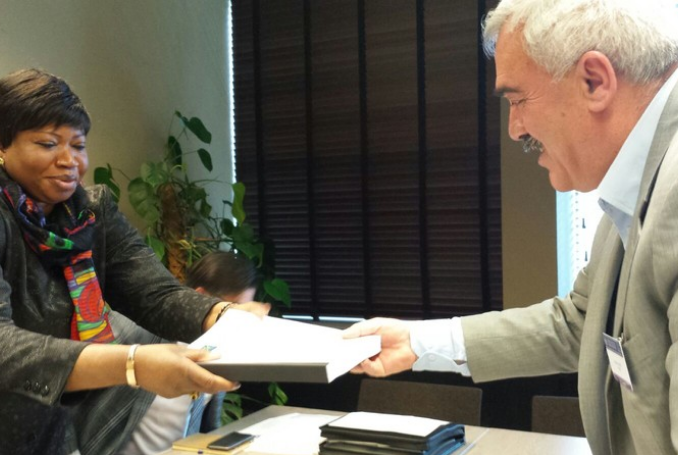
Al-Haq director Shawan Jabarin hands evidence of Israeli crimes in Gaza to ICC prosecutor Fatou Bensouda in November 2015. (Photo: via Al-Haq)

By Ramzy Baroud & Romana Rubeo

On October 21, Israeli Defense Minister Benny Gantz announced the issuance of a military order designating six prominent Palestinian human rights groups as ‘terrorist organizations’. Gantz claimed that they are secretly linked to the Popular Front for the Liberation of Palestine (PFLP), a socialist political group that Israel considers, along with most Palestinian political parties, ‘a terrorist organization.’

The Palestinian organizations included in the Israeli order are Addameer Prisoner Support and Human Rights, Al-Haq, the Bisan Center for Research and Development, Defense for Children Palestine, Union of Agricultural Work Committees (UAWC) and the Union of Palestinian Women’s Committees.

Considering the significance of these organizations in Palestine and their global networks among like-minded civil society organizations, the Israeli decision provoked a public outcry. One of the many statements of condemnation was a joint statement by rights groups, Amnesty International (AI) and Human Rights Watch (HRW), in which they called Gantz’s move an “appalling and unjust decision”, which represents “an attack by the Israeli government on the international human rights movement.”

Strong Words, but No Actions

AI and HRW, which have documented Israeli human rights violations of Palestinians for many years, fully understand that the ‘terrorist’ designation is consistent with a long trajectory of such unlawful moves:

“For decades, Israeli authorities have systematically sought to muzzle human rights monitoring and punish those who criticize its repressive rule over Palestinians. While staff members of our organizations have faced deportation and travel bans, Palestinian human rights defenders have always borne the brunt of the repression. This decision is an alarming escalation that threatens to shut down the work of Palestine’s most prominent civil society organizations.”

Equally important in the world’s leading rights groups’ statement is that it did not fail to highlight that the “decades-long failure of the international community to challenge grave Israeli human rights abuses and impose meaningful consequences for them has emboldened Israeli authorities to act in this brazen manner.”

True to form, the international community did react to Gantz’s decision, albeit it was the kind of ineffectual reaction, which persisted in the realm of rhetoric that is rarely followed by substantive action.

A joint statement by UN experts called the Israeli decision “a frontal attack on the Palestinian human rights movement, and on human rights everywhere”.

Michelle Bachelet, United Nations High Commissioner for Human Rights, criticized the “arbitrary” decision by Israel and warned of the “far-reaching consequences as a result,” in terms of work, funding and support for the targeted organizations.

Many governments around the world also condemned the Israeli move and echoed the sentiment conveyed by UN experts. Even the US expressed its ‘concern’, though, using the same typically cautious and non-committal language.

US State Department spokesman, Ned Price, told reporters on October 23, in Washington, that his country “believe(s) respect for human rights, fundamental freedoms and a strong civil society are critically important to responsible and responsive governance.” Instead of an outright condemnation, however, Price said that the US will “be engaging our Israeli partners for more information regarding the basis for these designations.”

However, like other governments, and certainly unlike AI and HRW, Price made no link between the Israeli decision of October 21 and numerous other past practices targeting human rights and civil society groups in Palestine and, more recently, in Israel as well. Also worth noting is that the supposed link between such organizations and the socialist PFLP is not new.

The following are a few examples of how Israel has attempted to silence some of these organizations, which, eventually were declared to be ‘terrorist.’

Raids, Arrests and Death Threats

Addameer – In December 2012, the Israeli army raided the headquarters of Addamer in Ramallah, confiscating laptops and a video camera. The offices of the Union of Palestinian Women Committees were also raided by Israeli occupation forces on the same day. The organization is one of the six now designated by Israel as ‘terrorist.’

In September 2019, Addameer’s offices were raided, once again. The Israeli military raid at the time, however, did not generate as much attention or outrage, despite the accompanying violence, let alone the blatant violation of human rights. Then, Al-Haq – also one of the other six effectively banned Palestinian groups – issued a statement warning that “the private property of human rights organizations in occupied territory is especially protected under Article 46 of the Hague Regulations (1907).”

Expectedly, such legal constraints mattered little to Israel.

Al-Haq – Al-Haq’s staff have faced many restrictions throughout the years. Shawan Jabarin, the General Director of Al-Haq, has been banned from travel on various occasions, starting in 2006.

In March 2009, Jabarin was prevented by Israel from traveling to the Netherlands to receive an award on behalf of his organization. Again, in November 2011, this time, Jabarin was now allowed to travel to Denmark.

The Israeli obstacles began taking even more sinister turns when, in March 2016, Jabarin began receiving death threats over the phone. These anonymous calls began arriving “in the context of increasing harassment of Al-Haq and its members, amid their recent work at the International Criminal Court (ICC) seeking justice for human rights violations being committed in the Occupied Palestinian Territories,” the Front Line Defenders website reported.

Defense for Children International-Palestine – In July, and again August 2021, Israeli forces raided Defense for Children International – Palestine (DCIP) offices in Al-Bireh, in the occupied West Bank. They seized computers, hard drives and other material, alleging a link between the organization and the PFLP.

This allegation had already been advanced in 2018, when UK Lawyers for Israel (UKLFI) persuaded Citibank and the Arab Bank PLC to stop providing banking services to DCIP, providing what they defined as “evidence of the close ties” to the PFLP.

While it is true that the recent Israeli measures against Palestinian NGOs are a continuation of an old policy, there are fundamental differences between the growing perception of Israel, now, as an apartheid state and the misconstrued perception of the past, namely Israel as an oasis of democracy.

Even international entities and groups that are yet to brand Israel an apartheid state are becoming familiar with the Israeli government’s undemocratic nature.

A ‘Tectonic Shift’

In December 2019, and after years of haggling, the ICC resolved that “there is a reasonable basis to proceed with an investigation into the situation in Palestine, pursuant to Article 53(1) of the (Rome) Statute.” Despite intense Israeli and western pressure, the last hurdle in the way of the investigation was removed last February, as the ICC has finally approved the Prosecutor’s request to open legal proceedings regarding war crimes in the occupied Palestinian territories, including Gaza.

This legal milestone was cemented by major declarations, one made by Israel’s own rights group, B’tselem, in January, and another by HRW in April, both slamming Israeli policies in Palestine – not just the occupied territories – as ‘apartheid’.

This critical change in the international legal position regarding Israel’s new, unflattering status, was boosted by Israel’s own violent actions in East Jerusalem, Gaza and throughout Palestine in May. Unlike previous wars, the May events have shifted sympathy mostly towards Palestinians, who are fighting for their freedom, homes and other basic human rights.

The change was also notable within the US government itself, which is unprecedented by any account. An increasing number of US lawmakers are now openly critical of the State of Israel, due to a radical change in the US public opinion and, again, unprecedently, they are not paying a heavy price for it as was often the case in the past due to the great influence of the Zionist lobby in Washington.

“The shift is dramatic; it’s tectonic,” the BBC, on May 21, quoted US pollster, John Zogby, as saying. “In particular, younger generations are considerably more sympathetic to the Palestinians – and that age gap has been on full display with the Democratic Party,” the BBC noted.

Israel’s losses are not just sentimental or political, but economic as well. Last July, the international ice cream giant Ben & Jerry’s decided to stop selling its products in illegal Jewish settlements while pinpointedly condemning Israeli occupation, a move that was described by Amnesty as “legitimate and necessary”. A few months later, the sports clothing manufacturer, Nike, followed suit, announcing that it will end the sale of its products in Israeli stores starting May 2022, although it did not justify its decision based on political reasoning.

While Israel continues to lash out at its critics, it no longer seems to behave according to a centralized strategy.

Lacking a strong leadership after the dethroning of former Prime Minister Benjamin Netanyahu and the formation of a diverse ‘unity government’, the new Israeli government does not seem capable of holding back international criticism of its conduct in occupied Palestine. The notion that everything that Israel does is justifiable as a form of ‘self-defense’ is simply no longer a strong selling point. The May war is the perfect example of this assertion.

In the case of the banned NGOs, for example, aside from sending a representative from the Israeli intelligence agency, Shin Bet, and another from the Israeli Foreign Ministry to Washington on October 25 with “relevant intelligence” to justify its decision, Tel Aviv continued to carry out the same policies that further exposes its apartheid in the eyes of the international community.

Indeed, on October 27, Israel announced the construction of thousands of new housing units in illegal Jewish settlements, in its first such move during the presidency of Joe Biden.

A perfect illustration of the frantic nature of the Israeli response came on October 29, when the Israeli envoy to the United Nations, Gilad Erdan, during his speech at the General Assembly, tore into pieces a report issued by the UN Human Rights Council illustrating Israeli ongoing violations of international law.

“The Human Rights Council attacked and condemned Israel in 95 resolutions compared to 142 resolutions against the rest of the world,” Erdan said. “This distorted and one-sided report’s place is in the dustbin of anti-Semitism,” he ranted.

Branding Israeli Apartheid

We may be at the cusp of a fundamental change in terms of Israel’s relationship with the international community. While Tel Aviv continues to heavily invest in its apartheid infrastructure, the international community is slowly, but clearly, becoming aware that Israel’s apartheid status is a permanent one. The successive statements by B’Tselem, HRW, the joint HRW-Amnesty statement condemning the de facto outlawing of the Palestinian NGOs and, again, the ICC investigation are all indicative of this growing awareness.

The question remains – will Israel be able to use its power, influence and leverage in Western societies to force the world to accept and co-exist with a full-fledged apartheid regime in Palestine? And if yes, then, for how long?

The South African apartheid example showed that, despite decades of apartheid and initial acceptance, if not support, by western societies of legalized racial separation in South Africa, the pendulum eventually turned. Even before the formal end of apartheid in that country in 1994, it was becoming clear that the days of the racist regime of Pretoria were numbered. That realization was possible because of the growing international awareness, especially at grassroot, civil society level, of the evil of apartheid.

A similar scenario seems to be evolving in the case of Israeli apartheid in Palestine as well. A critical mass of support for Palestinian rights is being constructed around the world, thanks to the Boycott, Divestment and Sanctions (BDS) movement and hundreds of pro-Palestine civil society groups all around the globe.

For years, Israel seemed keen on countering the influence of Palestine’s solidarity around the world using a centralized strategy. Large sums of money were dedicated, or pledged, towards that end, and a partly government-controlled company was even established, in 2017, to guide the Israeli global campaign. Much of this has amounted to very little, however, as BDS continues to grow, and the conversation on Palestine and Israel is gradually changing from that of a political ‘conflict’ into recognition of Israeli racism, apartheid and utter disregard of international law.

Of course, it will take more time, more decided effort and, certainly, more sacrifices on the part of Palestinians and their supporters to expose Israeli apartheid to the rest of the world. Now that Israel seems to have accepted that there is little it can do to reverse this brand, it is accelerating its colonial efforts, while hunkering down for a long fight ahead.

The onus is now on the international community to force Israel into dismantling its apartheid regime. Though it is ultimately the people who liberate themselves, international solidarity is essential to the process of national liberation. This was the case in South Africa, and will surely be the case in Palestine, as well.

– Ramzy Baroud is a journalist and the Editor of The Palestine Chronicle. He is the author of five books. His latest is “These Chains Will Be Broken: Palestinian Stories of Struggle and Defiance in Israeli Prisons” (Clarity Press). Dr. Baroud is a Non-resident Senior Research Fellow at the Center for Islam and Global Affairs (CIGA) and also at the Afro-Middle East Center (AMEC). His website is www.ramzybaroud.net

– Romana Rubeo is an Italian writer and the managing editor of The Palestine Chronicle. Her articles appeared in many online newspapers and academic journals. She holds a Master’s Degree in Foreign Languages and Literature and specializes in audio-visual and journalism translation.


River to Sea Uprooted Palestinian   
The views expressed in this article are the sole responsibility of the author and do not necessarily reflect those of the Blog!

Sunday, 21 November 2021

“It Is Fun to Shoot Palestinians”: Six Former Israeli Soldiers Speak Up

 Nov 21, 2021

Source: Al Mayadeen

By Rasha Reslan

Six Israeli occupation soldiers recall the atrocities they committed onscreen in a staggering reality that reflects the severity of the situation in al-Khalil from one angle; a reality that amounts to crimes against humanity.


Six ‘former’ soldiers recall the atrocities they committed in al-Khalil

“Soldiers really like shooting rubber bullets.” 

“It is fun.”

“Everyone high fives.”

“You are awesome, you got him”

The New York Times Op-Docs has lately obtained a short documentary “Mission: Hebron” by the Israeli Director and ‘former’ Israeli soldier Rona Segal.

It is the first time in recent years that a documentary film sheds the light on part of the Palestinians’ daily sufferings in occupied al-Khalil “Hebron”; a staggering reality the public has rarely been allowed to see. 

Source: Human Rights Defenders Group

Al-Khalil is considered the largest city in the occupied West Bank and the only one in which Israeli settlers reside so close to the Palestinians, thus exacerbating their sufferings. 


Palestinians face severe movement restrictions as Israeli occupation forces are constantly present and committed to long-standing efforts to expel them notably from the Old City. 

The short documentary in its six chapters frames Israeli atrocities in al-Khalil

Six Israeli occupation soldiers, all of whom joined the army at the age of 18, describe their so-called “mission” in al-Khalil. They were “tasked with protecting and guarding Israeli settlers.” These soldiers, who were barely adults, were given complete control of the Palestinians’ lives in the city.


The six ‘former’ soldiers describe their “mission” in a studio setting based on the “duties defined in their military guidebook”; the Israeli settlers in al-Khalil are “guarded and protected” using a variety of strategies, whilst making the lives of Palestinian civilians unbearable.

Looking back, the soldiers recall their confusion, embarrassment, and hatred.

They told their atrocities onscreen in a renewed perspective of the severity of the situation on the ground in al-Khalil, which amounts to a crime against humanity; a crime of apartheid and persecution.

Main “mission”

“Your only mission is to guard and protect the Israeli settlers in Hebron [al-Khalil].”

With the Israeli soldiers making it clear that their mission was to protect and guard the Israeli settlers, by all means, it becomes clear that the increasing and aggravating Israeli settlers’ violence against Palestinians is done with the explicit support of the Israeli occupation authorities. Meanwhile, Israeli soldiers are ordered to turn a blind eye and even guard the perpetrators. 

Settlers’ violence against Palestinians includes damaging private property, stone-throwing, and physical violence, as well as attacks on activists and journalists.

Such attacks have become increasingly common in recent years, and they are carried out with impunity.

One of the Israeli soldiers testified that a security coordinator from among the Israeli settlers is the one who would give them orders, not their military command. In many cases, Israeli occupation soldiers provide the perpetrators with escort and backup. But, when the Israeli soldiers don’t join the attack, “the illegal settlers can turn against the soldiers, thus becoming their enemies”, according to the soldiers’ confessions.

“If you shoot a Palestinian, you get a pizza and a coffee from the settlers;” this is by far one of the most disturbing elements in the “mission”. The settlers’ ‘affection’ can turn into hatred if settlers are prohibited from conducting extreme assaults against Palestinians. At this point, the once cherished soldiers turn into “traitors” and “Nazis”.

“A sterile route free of Palestinians”

 “A sterile route is a route that is free of Palestinians.”

In a racist comment, one of the ‘former’ Israeli soldiers affirms that there are routes that are “sterilized of Palestinians.”

Israeli occupation forces in al-Khalil forbid Palestinians from walking on large sections of what was before the occupation the city’s main thoroughfare, as part of the Israeli army’s policy of making those areas “sterile” of Palestinians.

On his account, the Coordinator of the Human Rights Defenders Group Imad Abu Shamsieh told Al Mayadeen English that the Israeli occupation has placed more than one hundred checkpoints with metal and electrical gates, surveillance cameras, reinforced concrete barriers, and inspection outposts in the “sterile” routes.

He also divulged that around 525 Palestinian shops have been completely closed in 2000 due to an Israeli occupation’s military court decision.

Furthermore, Abu Shamsieh tersely stated that Palestinian vehicles, including ambulances, have been banned from the “H2 area” since October 2000.

The human rights activist went on to say that “the Israeli occupation forces impede local and international journalists from entering the H2 area and sterile routes. Simultaneously, I, along with a group of Palestinians in al-Khalil, decided to document the Israeli war crimes which occur on daily basis targeting Palestinian men, women, and children.”

“Since 2010, we started to film the Israeli occupation’s atrocities against Palestinians under the initiative ‘Capturing Occupation Camera Project in Palestine.'”

“We are a group of around 30 young Palestinian volunteers exposing and documenting human rights and international law violations in Palestine,” Abu Shamsieh told Al Mayadeen English.


Strip searches

One of the Israeli soldiers boldly stated that the strip searches’ official aim is “to stop and search every Palestinian,” but implicitly, the searches are actually aimed at humiliating the Palestinians, with no legal justifications whatsoever.

“When you frisk someone you pick out on the street, it requires touching the person,” one soldier said.

A group of Palestinian men may be targeted for strip searches just because they might have Hollywood’s stereotypical racist image of “terrorists” in the mind of the occupier. The searches are not performed to find guns, but to humiliate the Palestinians or create “friction” among them.

“The idea is to bring the friction to them, so that they’ll keep their heads down.”

Because of the proximity of the Israeli settlements in the city, Palestinians are surrounded by a large military presence and are randomly subjected to routine and offensive searches, harassments, and beatings.


Patrols

“The idea of the patrol is to patrol.”

The ‘former’ Israeli soldiers attested that they walked around Palestinians’ houses, storming them whenever they felt like it.

“Ok, soldiers again.” 

Field Palestinian Researcher Manal al-Jaabari from al-Khalil told Al Mayadeen English that Palestinian children in al-Harika, a district in al-Khalil, are exposed to Israeli terrorism on a daily basis.

“In al-Harika, which is adjacent to “Kiryat Arba”, the Israeli occupation forces break into Palestinian houses whenever a stone is thrown at the fence, and children are interrogated inside their homes. Sometimes the Israeli soldiers drag them to the streets and place them in front of the surveillance cameras,” she added.


The young researcher emotionally states that the Israeli soldiers incite young Israeli settlers at Jaber Neighborhood to assault Palestinian children their age.

The Israeli occupation forces claim that they are hit by stones to arrest or detain Palestinian children for hours, al-Jaabari confirmed to Al Mayadeen English.

“Many children in the vicinity of schools, particularly in the southern area near checkpoints, are arrested and detained for long periods. They are sometimes beaten or insulted and left hungry and thirsty before being handed over to the al-Khalil Coordination and Liaison Office if they are under the age of 13.”


Source: Human Rights Defenders Group

Above this age, they are arrested and subjected to an investigation at the Israeli occupation’s police station, then they are transferred to an Israeli court or they are fined at least one thousand shekels before being released.


At checkpoints, it’s all about “eeny, meeny, miny, moe”

While Israeli checkpoints impede the daily life of Palestinians in the city, the ‘former’ Israeli soldiers confess that a checkpoint is a kind of roadblock.

“You spread tire spikes, stop the cars, and cause a huge traffic.” 

“Sometimes it’s for no reason.”

It is just one episode, and what has been documented by the Palestinian Human Rights Defenders Group is far more tragic. 

Abu Shamsieh told Al Mayadeen English that his camera caught the cold-blooded execution of martyr Abdel Fattah al-Sharif in 2016 at one of the Israeli occupation’s checkpoints. 

The human rights defender affirmed that al-Sharif’s case is only one of many Israeli war crimes.


He also disclosed to Al Mayadeen English that Israeli settlers have regularly run over Palestinian children as young as five.

Abu Shamsieh affirmed that he was subjected to acts of harassment, restrictions on his freedom of movement, abductions, long periods of arbitrary detention usually under administrative detention orders, and illegal searches of his home and office, not to mention death threats.

Detentions: “Everyone’s a suspect” 

According to the soldiers’ confessions, every Palestinian is a suspect, and the detention process includes putting any Palestinian “in a post with a soldier and then keep them hanging.”

The ‘former’ soldiers testify that Israeli soldiers blindfold and handcuff the Palestinians who had been arrested randomly.


Source: Human Rights Defenders Group

Like all Palestinian cities and villages, al-Khalil too witnesses random arrests of Palestinians on a daily basis, including children as young as 10.

Israeli occupation forces’ violent repression of protests has also involved the arrest and detention of Palestinian demonstrators.


Another ‘Mission’: Targeting Journalists

On his part, a field Palestinian journalist from al-Khalil Sari Jaradat told Al Mayadeen English that the Israeli occupation forces deliberately prevent Palestinian and international journalists from covering the current events in order to hide their daily crimes that affect all aspects of life in the city.

“About a week ago, an occupation officer told me: ‘if you get shot by our bullets, we will not bear any responsibility.’” 

“They had a prior intention of targeting me in order to prevent me from doing my job, and I sustained a total of five injuries from live bullets while covering their crimes, not to mention the dozens of detentions, arrests, coverage prevention, and obstruction of movement,” Jaradat added.

Jaradat commented on the Blue Wolf program and the installation of face-scanning cameras in al-Khalil, saying that these cameras will lead to the suppression of freedom most notably the freedom of the press, which is already limited.

“The Israeli occupation soldiers will enact any laws they desire to prevent Palestinian journalists from carrying out their work,” he added.

The systematic oppression of Palestinians has been partially mirrored in the “Mission” and utterly manifested in the heartfelt testimonies of Sari, Imad, and Manal. Yet, what is happening in Palestine, and most notably in al-Khalil, cannot be documented or summed up in a film, a chapter, or a shot.

Read More: Olive Harvest Season: Another Palestinian Struggle against “Israel’s” Eco-Terrorism 


River to Sea Uprooted Palestinian   
The views expressed in this article are the sole responsibility of the author and do not necessarily reflect those of the Blog!

An Open Letter from Palestine to Miss South Africa

 November 14, 2021

Lalela Mswane, Miss South Africa 2021. (Photo: video grab)

By Haidar Eid

Dear Ms. Lalela Mswane,

We don’t know each other. I only know that you are Miss South Africa and just heard of your name two days ago when the media reported that you will represent South Africa at the Miss Universe pageant on the ruins of the ethnically cleansed village of Um Al-Rashrash in apartheid Israel. I assume you don’t know enough about the suffering of the Palestinian people as a result of Israel’s occupation colonization and apartheid in Palestine. I myself spent six years in South Africa where I got my Ph.D. degree and even citizenship.

Even before the end of the apartheid system in 1994, we, Palestinians, wholeheartedly supported the struggle in South Africa and played a role in the Boycott, Divestment and Sanctions (BDS) movement that formed one of the major pillars of the struggle to bring apartheid down. Nelson Mandela made it absolutely clear on more than one occasion that without the support of the Palestine liberation organization, among other national liberation movements, the end of the racist regime would have been delayed.

I live in the Gaza concentration camp which has been under a medieval siege imposed by apartheid Israel since 2007. But even before that, Israel had occupied it since 1967. As a result of Israel’s racist policies, our children suffer from malnutrition; the 2 million people living in the strip do not have access to electricity, clean water, medicine, and hundreds of other items that Israel does not allow. Over the last decade, the country you are visiting has launched four massive wars on Gaza killing more than 4000 civilians, including hundreds of women and children, and destroying hundreds of buildings, factories, roads, and schools.

A UN fact-finding mission, headed by none other than your own Richard Goldstone, has labeled these massacres “war crimes and possible crimes against humanity.” And anti-apartheid activists, including the likes of Desmond Tutu and Ronnie Kasrils, have told us that what we are going through in Palestine is “far far worse than apartheid.” Moreover, two mainstream human rights organizations, Human Rights Watch and Israel’s most respected human rights organization, Btselem, issued two damning reports last year calling Israel an apartheid state that discriminates not only against the residents of Gaza and the West Bank but also against its own third-class Palestinian citizens.

Ms. Mswane, allow me to ask you this question. How would you have felt if a Palestinian woman decided to join a similar contest in South Africa in the 70s and ’80s of the last century? How would you have responded if a similar contest was held in Sofia town, for example? And how would the South African people have reacted to the participation of Palestinians in concerts and sports games in apartheid South Africa?

You must have heard of the tens of beautiful women incarcerated in Israeli dungeons without charge or trial, simply for the mere reason of speaking out against occupation and apartheid. Our women, like South African women before them, are at the receiving end of a multi-tiered system of oppression and expect solidarity from their Black sisters.

I am an associate professor of literature;  I teach hundreds of female students who come from refugee camps and whose parents and grandparents are also refugees. My students have one message when I told them that a South African woman is coming to apartheid Israel; they asked me to write this message and appeal to you to refrain from violating our BDS guidelines and stand on the right side of history. I am certain you will not disappoint them.

Nelson Mandela’s much-quoted sentiment that “(South African) freedom is incomplete without the freedom of the Palestinians” is decorating the walls of refugee camps in the Gaza Strip where millions of refugees are waiting for the day of their return to the towns and villages which were ethnically cleansed in 1948 by racist gangs ruling the country you are visiting. We are only asking you to make the right decision that thousands of artists, writers and cultural figures–including Miss Malaysia and Miss Indonesia– have made – to stand against apartheid Israel.

Sincerely Yours,

Haidar Eid

Besieged Gaza, Occupied Palestine


River to Sea Uprooted Palestinian   
The views expressed in this article are the sole responsibility of the author and do not necessarily reflect those of the Blog!

Olive Harvest in Palestine: Could Oil Become Tears?

November 18, 2021

A view from an olive grove during olive harvesting by Palestinian farmers in Nablus, Erst Bank on October 13, 2021. While Palestinian farmers living in the West Bank welcome the olive harvest season with joy, in some areas the joy gives way to anxiety due to the threat of attack by Jewish settlers. Photo by Issam Rimawi. Anadolu
Yousef M Aljamal | Al Jazeera Media Institute
Yousef M. Aljamal is a researcher in Middle Eastern Studies and the author and translator of a number of books.

Yousef M. Aljamal

Settlers uproot olive trees in Bethlehem – Middle East Monitor

It would not be an exaggeration to say that olive trees are like children to Palestinians.


O
live trees and harvests have an exceptionally important place in Palestinian culture, especially in villages where farming is the main source of income for Palestinian families. Palestinians and especially farmers have always looked at olive trees as a national symbol that should be kept and protected as it speaks of the thousands of years of their history in Palestine. This special importance has been expressed in the Palestinian culture, through oral history, songs, and poetry.

Late iconic Palestinian poet Mahmoud Darwish famously spoke of the relationship that connects Palestinians and Israeli soldiers with olive trees.

To Palestinians, olive trees are sacred

These soldiers, these modern soldiers

Besiege her with bulldozers and uproot her from her lineage

of earth.

They vanquished our grandmother who foundered,

Her branches on the ground, her roots in the sky.

She did not weep or cry out. But one of her grandsons

Who witnessed the execution threw a stone

At a soldier, and he was martyred with her.

The Palestinians will remain in Palestine as long as olives remain
The largest and oldest olive tree defying the occupation

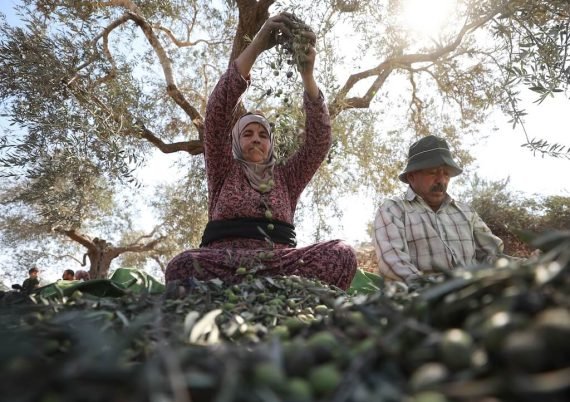
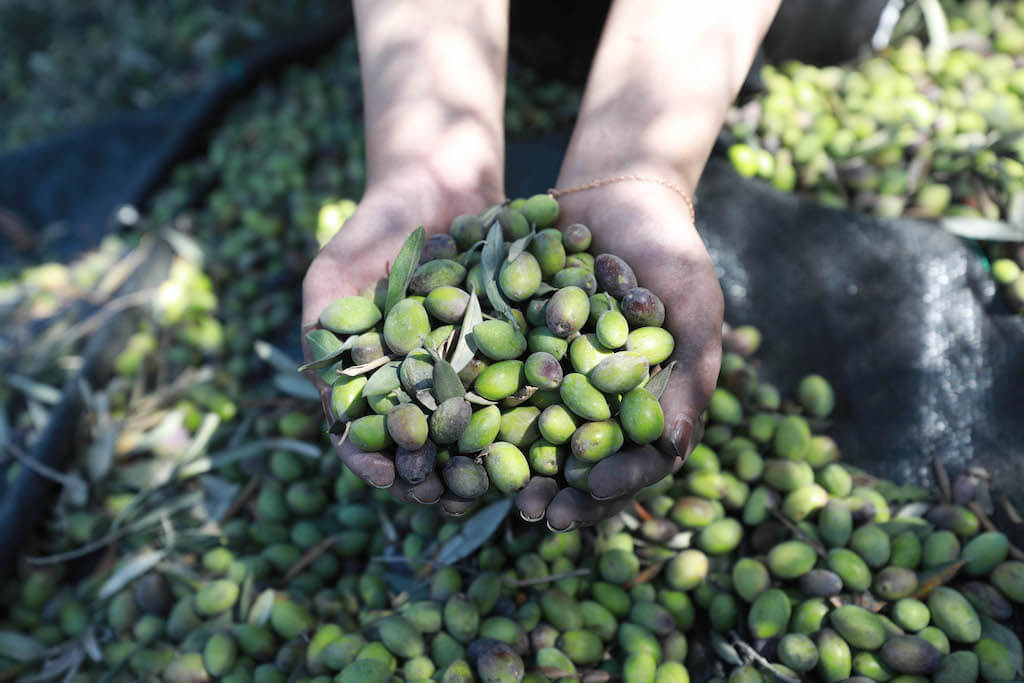
Olive harvest in Palestine sees the gathering of families where all members for days participate in picking the olives. The olive harvest in Palestine starts after it rains for the first time in autumn – an indication that olives are ripe and ready to be picked. This usually happens every year in early October and lasts for a couple of weeks. In the Gaza Strip, some people use the expression “The cross has materialized,” to declare the start of the olive harvest season. The expression has its roots in the city’s oral history which saw conversions to Christianity following the worship of stars and fire in the past.

According to legend, a priest came to Gaza asking people to convert to Christianity after all Palestinian cities had converted except for Gaza. He told the locals that they would be saved from drought and that it would rain if they did so. The people of Gaza, being rebellious throughout history, refused to convert unless the priest prayed to God and caused it rained. According to the story, the priest prayed, and it rained, and as a result, the people converted and used the expression “the cross had materialized” to express the fact that the priest’s promise had come true.

During the olive harvest in Palestine, families come together to eat meals prepared quickly such as tomatoes and potatoes baked over a fire as everyone is busy collecting and pressing olives.

During the olive harvest in Palestine, families come together to eat meals prepared quickly such as tomatoes and potatoes baked over a fire as everyone is busy collecting and pressing olives. While men and women engage in picking olives, children gather to help as well – taking part in the harvest gives them a sense of identity and responsibility. As the olives are being picked, Palestinians sing traditional songs that they have heard their parents and grandparents sing, generation after generation.

One of these traditional songs tells the story of an exchange between a Palestinian father and son. Using rhyme and rhythm, the song goes,

You can get what you want from me (O olive tree), really our heart has been connected to the olive tree since we were young

My heart is connected to her [the olive tree], don’t talk like Al-Farazdaq [famous Arab poet], I am flying in the sky as if I am a pilot.

Palestinians take part in an olive collecting event in Beita village of Nablus, West Bank, on October 10, 2021. Israeli forces took measures during the event. Photo by Issam Rimawi. Anadolu Agency.

It would not be an exaggeration to say that olive trees are like children to Palestinians.  When my family wanted to tear down our house to build a new one, my aunt resisted the idea because we had to cut down two olive trees my grandfather planted some 35 years ago. My aunt cried when they cut the trees, and all our attempts to save them by planting them elsewhere didn’t succeed. Although we planted new olive trees later, my aunt would always speak of the two olive trees her father had planted, alongside which she grew up in our Gaza refugee camp.

Palestinian author Sarah Ali once wrote, “If a Palestinian bulldozer were ever invented (Haha, I know) and I were given the chance to be in an orchard in Haifa for instance, I would never uproot a tree an Israeli planted. No Palestinian would. To Palestinians, the tree is sacred, and so is the land clasping it.”

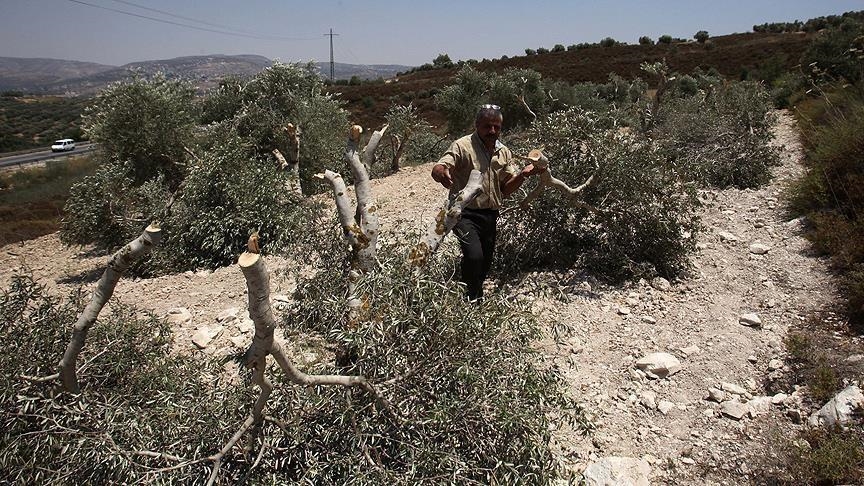
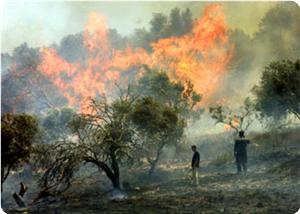
Today, the scene of olive harvest in Palestine is not only about family gatherings, traditional songs, and family bonds. The olive harvest in Palestine is about proving a connection to the land, a battle to maintain existence on the land as Israeli settlers – day and night – burn hundreds of olive trees as part of their ongoing attacks against Palestinians. Attacks that include stoning Palestinian cars, and burning Palestinian houses (with families inside), mosques, and churches.

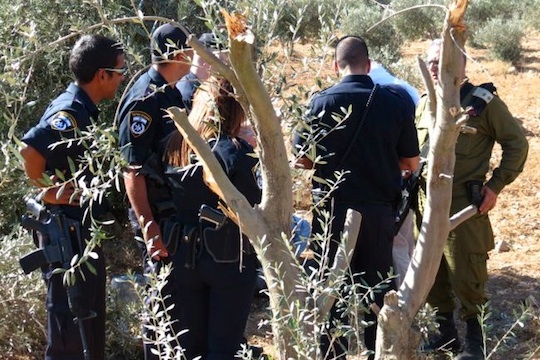
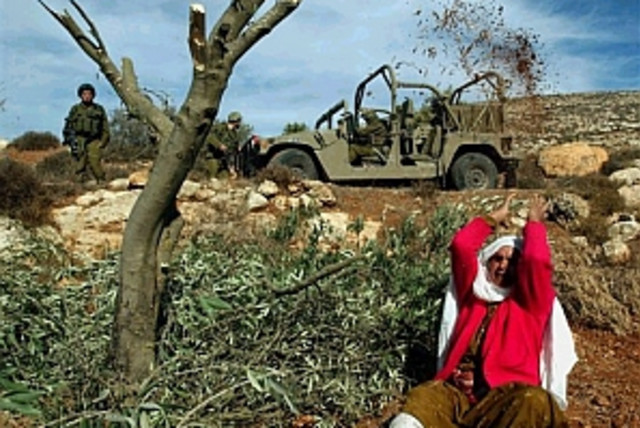
These very Israeli settlers also move the olive trees they uproot to decorate the entrance of settlements built on Palestinian lands in order to prove their claimed connection to the land. The image of Palestinian Mahfoza Oude hugging an olive tree as a group of Israeli soldiers attempted to uproot it speaks of the Palestinians’ relationship with olive trees and the land.

Most of the olive trees the settlers uproot are older than the state of Israel, which was only declared in 1948 on the ruins of Palestinian cities and villages. These olive trees stand as a striking reminder to settlers of the history of Palestine, which has always been a land of peaceful religious co-existence, where a person like my mother, who was born in Bethlehem, the city where Jesus was born, still says “The cross has materialized” to mark the start of the olive harvest, without even realizing its meaning.

Although the situation for Palestinians is very grim on the ground, the increasing international solidarity for the Palestinian people – and their olive trees which attest to their history on this land – will continue to preserve this existence and culture.


P
alestinian poet Tamim al-Barghouti said in one of his poems that a state that was built on enmity towards olive trees would not survive in the Levant.

Plant an olive tree, because we're here to stay.
Planting olive trees in Palestine — The Land of Canaan Foundation
Israeli settlers uproot hundreds of Palestinian olive trees in occupied  West Bank during harvest season
Israeli settlers destroy olive trees, raze farmland in West Bank
The war on the Palestinian olive harvest - +972 Magazine
Israeli occupation costs Palestine economy $6.9 billion a year: Report -  Economy - Business - Ahram Online
Arboricide in Palestine - olive orchard destroyed
Israeli bulldozers uproot olive trees west of Bethlehem | Days Of Palestine
Palestinian farmers inspect the damage to their olive trees that were allegedly was cut down by Israeli settlers. (Issam Rimawi - Anadolu Agency )
Settlers, hands off the olive trees - The Jerusalem Post

It is true. Darwish said, “If the olive tree knew [what was happening to] its planter, its oil would become tears.” The ongoing Palestinian commitment to the land, represented by planting more olive trees as Israeli settlers uproot hundreds of them, is telling that a future solution that ignores Palestinians and their connection and claim to the land is unlikely to see the light.

The future must unequivocally include the Palestinians. All Palestinian refugees and their descendants should be able to have breakfast on their lands which always has abundant olive oil. No more olive trees should ever be uprooted just because some Israeli settlers have decided to rewrite history.

MORE ON THIS TOPIC:


River to Sea Uprooted Palestinian   
The views expressed in this article are the sole responsibility of the author and do not necessarily reflect those of the Blog!