Showing posts with label multiculturalism. Show all posts

Saturday, 4 December 2021

Russia’s Greatest Weapon is not a Weapon

 December 03, 2021

by Dmitry Orlov, posted with permission of the author

An ultimately very healthy but in the meantime very unpleasant realization is gradually dawning in West—an insight that is simply shocking, that fundamentally alters their picture of the world: that the stronger becomes the hurricane of woke transformations that is raging there, the more attractive Russia becomes for hundreds of millions of Europeans and Americans. What is Russia’s most powerful weapon? Is it nuclear? Is it hypersonic (or “hydrosonic,” as per Trump)? Cybermagic, perhaps? No, Russia’s most powerful weapon is its values. And it grows stronger and more dangerous every day, in direct proportion to the intensifying fire of multiculturalism and political correctness that is raging in Europe and in America.

A recent article in The National Interest summarized various American authors who claim that the Kremlin is gradually developing its strategy of soft power and using it to successfully fight the West, splitting it and undermining it from within. What is the cause of their paranoid hysteria? Could it be that they have accidentally discovered who their true enemy is, and that it is… they themselves?

The simplest and most effective way to knock a geopolitical adversary out of the game is to impose on it a system of values ​​that will split its society and lead the most active part of its population to occupy public buildings, to erect barricades and to support a pretender to the throne that is immediately given support and recognition by the country’s enemies. This is how all color revolutions of the late 20th and the early 21st centuries have been done: broadcast some propaganda, recruit some activists, help them to organize, provide some clandestine financial support, and then at some point this human mass, confident in their strength and their righteousness, surges through the police barriers and goes on to create history by overthrowing some faux-democrat petty tyrant, clearing the path for the next faux-democrat petty tyrant to be installed, with the country growing weaker, poorer and more disordered with each iteration. The process starts with the conversion of some significant part of the target population to “universal human values” with secular proselytizing of the “one true democratic faith.”

To the extent that this could be called a game, the West had a huge head start in it. The tools for fighting the “evil empire” have been honed for half a century. In the course of fighting the Cold War, radio stations, foundations, newspapers and magazines, parties and communities, publishing houses and TV channels have been created. Virtually all of them were then repurposed from fighting against the USSR to fighting against Russia. Collapse of the USSR, it was foolishly thought, was but a first step toward destroying Russia and absconding with its crude oil, natural gas, metal ores, fertile farmland and other natural treasures. And then, just in time, new, internet-based forms of influence appeared, completely controlled from America. For a time, the combination of a huge head start and the newly weaponized internet technologies seemed overwhelming.

But then something miraculous took place.

For a long time the USSR struggled mightily to propagandize socialist ideas in the United States and in Western Europe—to no avail. In the US, from its inception as a quintessential pirate colony, centuries of being conditioned to think that good persons are good by virtue of having goodly quantities of bounty and loot in their coffers has rendered people immune to socialist values. Meanwhile, Europe—its western half after the defeat of Nazism and in its eastern after the demise of Soviet communism—have been reduced to American satrapies where American propaganda reigns supreme and ceaselessly paints Russia as backward, corrupt, despotic and generally evil. No amount of broadcasting by Russia Today and no amount of toil by Russian internet trolls would ever be able to reprogram the consciousness of a Western person. But then suddenly Russia was awarded the supreme prize, giving it attractiveness, charm and influence no one could have dreamed of.

What has suddenly transformed the situation was mass insanity into which the West has been plunged. This group madness has destroyed much of what is infinitely dear to a very significant, if not overwhelming, part of Western civilization. Those conditional “conservatives”—normal people who do not want to be forced to be ashamed of their skin color, heterosexuality, respect for religion, generally accepted morality, and so on, are now humiliated, discriminated against and persecuted by the newest crop of toxic lefties.

Here is a lovely quote from an article in the Daily Beast: “…The Kremlin intends to attract Western converts with… bigotry—turning Russia into the land of ultimate political incorrectness, the world’s anti-woke capital.” Never mind the spurious claim of Kremlin’s intent to make Russia attractive; that is akin to blaming a beauty pageant contestant for being beautiful. Never mind the spurious claim of bigotry when it comes to opposing the West’s gender dysphoria and other psychiatric symptoms; there is a perfectly valid counterclaim of a society-wide psychiatric disorder that has plenty of biological science to back it up. What’s important is that the world has flipped to its mirror image: no longer is the United States “the land of the free and the home of the brave,” Russia now is, in the eyes of the Americans themselves! No longer is it Ivan sighing enviously while dreaming of American blue jeans, Coca-Cola and rock-and-roll; it is John who is wildly jealous of the absence of black-on-white racism, dumbed-down high school curricula, laughable yet lethal accusations of sexual harassment and a rainbow of public toilets.

Russia itself could never have achieved such a high level of attractiveness merely by using its propaganda machinery (all one and a half TV channels of it). It arose by itself when traditional (i.e., white heterosexual Christian) Europeans and Americans began to compare the surrounding Bedlam with Russia’s naturalness and orderliness. And then there spontaneously arose in them a very simple feeling: to hell with past grievances; it is the future which we must make livable for ourselves and our children. In the past, Russia was an adversary, but that past ended thirty years ago, and in the present Russia is safe, secure and happier than ever while we are burning in Hell and have no idea what to do about it. But at least we have Russia to hold up as a positive example.

It must also be understood that there are no other candidates for this role. There is no LGBT insanity, sexual harassment mania or violent reverse racism in North Korea, or Iran, or Saudi Arabia, or China, but these examples are all far too exotic and come with toxic baggage of their own. What the persecuted white Western Christian conservative heterosexual male needs is a normal European country, full of white people, comfortable for living in, but without any of the things he hates. What other options are there? It is not a competition if there is just one contestant.

And thus we have come to the point where Russia—in all seriousness and without any irony or puffery whatsoever, really—has become the light of the world, a shining city set upon a hill, a beacon of hope, a bastion of righteousness and free spirit and the symbol of a truly free world. This is an almost magical transformation: it was able to win this exalted status outright without even playing the game. It did the barest minimum in standing its ground and in preventing a smallish faction of foreign-controlled traitors and fools from destroying their country. Theirs has remained a wholesome world of brave, masculine men, of attractive, feminine women and of their above-average, non-gender-confused children. In their world, rewards and privileges are based on merit, corrupt politicians and businessmen spend years in jail, and respect for traditional ethics and religious faith is mandatory. In their world, all of history is permanently theirs: none of it will ever be forgotten, falsified or erased—all thousand-plus years of it, including life under the Golden Horde, the serfdom, great victories of the Russian Empire, the revolutionary terror, collectivization, Stalin’s purges, the defeat of Nazism, the destruction of Western colonialism throughout Africa and Asia, the conquest of space, the national humiliation of Gorbachev’s and Yeltsin’s puppet regimes and Russia’s rebirth under Putin.

It is a world to which more and more people in the West want to escape to, leaving behind a landscape blighted by leftist vandalism and enforced repentance for the crime of being of a certain race or of daring to exhale carbon dioxide. They do not wish to subject themselves to the unholy inquisition which doles out punishments to those who remain unenthusiastic about and unsupportive of sexual perversity, gender dysphoria, the destruction of traditional families and the brainwashing of youth. Even if they cannot escape, they can take comfort in knowing that a more normal and less damaged alternative reality exists, and they can secretly sympathize with it.

What makes this transformation particularly remarkable is that ten years ago Russia’s soft power barely existed. At that time, a small but vocal opposition demonstrated in the center of Moscow, chanting “We need a different Russia.” But now hundreds of millions of French, Germans, Americans and others in the West are chanting what amounts to “We need a different West.” To the abject horror of their political elites they look to Russia—the country of extreme political incorrectness—with longing, delight and hope. These people are self-organizing into parties, uniting like-minded people in much greater numbers than the Communist International had ever been able to gather. In many countries they already exert a very significant influence on the political agenda. The more the pandemic of woke madness rages, the greater their influence will become. When this conflagration of mass insanity finally burns itself out, it is Russia that will have the civilizational seed stock with which to re-fertilize the devastated cultural landscape of the West.

In the meantime, this is already shaping up to be a Russian century. This level of soft power is something beyond anyone’s wildest dreams; it is is Putin’s judo mastery taken to the nth level. In judo, one directs one’s opponent’s own force against him; here, the opponent is directing his own power against himself while the judo master merely stands back and watches, nodding in approval. In every country that the liberals attempt to reformat to their liking, Russia automatically gains millions of fans, forcing any possible geopolitical confrontation with Russia to fade into the background before the neutralizing force of a great commonality of traditional values. Remaining passive and risking nothing, Russia has gained a myriad ways to turn the geopolitical situation to its advantage.

For a very long time the West had monopolized the dominant discourse, but now Russia has gained control of it. Needless to say, this does not go down well with those who have been accustomed to uncontested dominance. They react hysterically: by throwing around groundless accusations and insults, staging provocations, imposing toothless yet self-defeating sanctions… They will try anything that they think might help to defer the moment when they will be forced to admit the horrible truth: that they have checked themselves into an insane asylum in Hell and they can’t check out. Meanwhile, all Russia has to do is to wait patiently for the fires of Hell to consume them and to burn themselves out; because they always do. Their desperate thrashing about and threatening Armageddon is for Russia to ignore.

[Based loosely on a text by Aftershock’s SKonst published as «Страна крайней политической некорректности»: как Россия обрела «мягкую силу» во всём мире]


River to Sea Uprooted Palestinian   
The views expressed in this article are the sole responsibility of the author and do not necessarily reflect those of the Blog!

Friday, 3 December 2021

Lavrov gives press conference after OSCE Ministerial Council in Stockholm

 December 02, 2021

Russian Foreign Minister Sergei Lavrov holds a press conference after the 28th OSCE Ministerial Council in Stockholm on Thursday, December 2. The annual OSCE Ministerial Council, chaired by Sweden, takes place on December 2-3. The ministers are expected to discuss security issues in the OSCE area and review the organisation’s activities.


Please forward the video.


River to Sea Uprooted Palestinian   
The views expressed in this article are the sole responsibility of the author and do not necessarily reflect those of the Blog!

Saturday, 6 November 2021

Foreign Minister Sergey Lavrov’s interview with Rossiya 24, Moscow

 November 05, 2021

Foreign Minister Sergey Lavrov’s interview with Rossiya 24, Moscow

Foreign Minister Sergey Lavrov’s interview with Rossiya 24, Moscow, November 1, 2021

Question: Not so long ago, you said that Russia would not use ideology-based rules in its international diplomatic practices. What examples can you give to explain this to a layman in matters of politics?

Sergey Lavrov: It’s simple. Ideally, any society should obey generally accepted rules that have proved their efficacy and sensibility.  Speaking about international life, the United Nations Charter is a book of collectively and universally coordinated rules. Later, when new members joined the UN, they accepted these rules in their entirety, without any exemptions, because UN membership requires that the Charter be ratified without any reservations. These rules are universal and mandatory for all.

With the age of multipolarity now dawning – and its emergence is an objective fact – new centres of economic growth, financial power and political influence have come into being. The multitude of voices is louder at the UN. A consensus or a vote are required in a situation where new solutions or rules have to be developed based on the UN Charter. In both cases, this work involves conflicting opinions and the need to defend one’s position and prove it is correct. Truth springs from argument and this is what this collective work is all about.

Conscious of the fact that its arguments are increasingly vulnerable because its policy is aimed at slowing down the objective formation of a polycentric world fully in keeping with the UN Charter, the collective West thinks it more beneficial for itself to discuss current issues outside of universal organisations and make arrangements within its inner circle, where there is no one to argue with it. I am referring to the collective West itself and some “docile” countries it invites from time to time. The latter are needed as extras and create a semblance of a process that is wider than a purely Western affair. There are quite a few such examples.

Specifically, they are pushing the idea of a “summit for democracy.” This summit will take place in December at the invitation of US President Joe Biden. To be sure, we will not be invited. Neither are the Chinese on the list of invitees. The list itself is missing as well. Some of our partners are “whispering in our ear” that they have been told to get ready: supposedly an invitation is in the pipeline. Asked, what they would do there, they reply that theirs will be an online address, after which a final statement will be circulated. Can we see it? They promise to show it later. So we have here the “sovereign” and his “vassals.”

The Summit for Democracy seeks to divide people and countries into “democracies” and “non-democracies.”  Furthermore, my colleagues from a respected country have told me that they could infer from the invitation they had received that the democratic countries that were invited to attend were also divided into “fully” and “conditionally” democratic. I think the Americans want to have the biggest possible crowd to show that the Washington-led movement has so many followers. Watching who specifically gets invited and in what capacity will be quite amusing. I am certain that there will be attempts to reach out to some of our strategic partners and allies, but I do hope that they will remain faithful to the obligations they have in other frameworks instead of taking part in artificially concocted, one-off unofficial summits.

The same applies to the initiative Germany and France proposed two or three years ago. I am referring to the idea of an Alliance of Multilateralists. Asked, why should it be formed – after all, the United Nations, where all sovereign states are represented, stands at the pinnacle of multilateralism – they gave rather an interesting answer.   According to them, there are many conservatives at the United Nations, who hinder the genuine multilateral processes, while they are the “forerunners,”   they want to lead the van and show others with their example how to promote multilateralism. But this prompts the question: Where is the “ideal” of multilateralism? Allegedly, it is personified by the European Union, a paragon of “effective multilateralism.” Once again, they understand multilateralism as the need for the rest to accept the Western world’s leadership along with  the superiority of Western “values” and other things western. At the same time, multilateralism, as described on the US dollar  (E pluribus unum) and as embodied in the United Nations, seems  inconvenient, because there is too much diversity for those who want to impose their uniform values everywhere.

Question: Is this a constructive approach?

Sergey Lavrov: Of course, not! Let me reiterate that this is how they understand the serious processes that are unfolding across the world against the backdrop of the emerging multilateralism and multipolarity. The latter, by the way, were conceived by God, for He created all men equal. And this is what the US Constitution says, but they tend to forget its formulas, when it comes to geopolitics.

There are other examples. The Dutch and the British are pushing the idea of a Global Partnership on Artificial Intelligence. Why not do this at UNESCO? Why discuss this outside the organisation that was specifically created for dealing with new scientific achievements and making them available to mankind? There is no reply.

There are several competing partnerships, and the Media Freedom Coalition formed by Canada and Britain is one of them. The French, together with Reporters without Borders, promote the Information and Democracy Partnership. Once again, not everyone is invited to join it. Several years ago, Britain held the Global Conference for Media Freedom.

Question: Russia was not invited to attend, was it?

Sergey Lavrov: At first, there was no invitation, but then we reminded them that if this was a “global forum,” it was right to hear opposing points of views. But they did not invite us all the same.

Examples of this kind are not in short supply. Talking about these matters, there are mechanisms within UNESCO, which is fully legitimate and competent to deal with these issues. However, it gives a voice to others who may have a different view on media freedom compared to that of our Western colleagues. I think that this sets the international community on a path that is quite destructive, just like the attempts to “privatise” the secretariats of international organisations.

The Organisation for the Prohibition of Chemical Weapons (OPCW) is a case in point, since people from Western and NATO countries are fully in control of its Technical Secretariat. The Chemical Weapons Convention (CWC) states that everything must be done by consensus. However, the Technical Secretariat obediently tolerates gross violations of the Convention. The Western countries vote for their decisions, which is completely at odds with the CWC, and claim that executing these  is the Secretariat’s duty. By arrogating the right to pinpoint who is to blame for using chemical weapons, the Technical Secretariat takes over the functions of the UN Security Council.

The West has now instructed the Technical Secretariat to crack down on Syria, where many shady things and outright provocations took place over the past years. We exposed them and held news conferences in The Hague, where the OPCW has its headquarters, as well as in New York. We showed that the Technical Secretariat was being manipulated with the help of destructive and extremist NGOs like the White Helmets. I would like to note that we are starting to hear statements along these lines from heads of certain respected organisations. For example, some senior executives of the UNESCO Secretariat have come forward with the initiative to promote “values-based multilateralism.”

Question: And they are the ones who define these values, aren’t they?

Sergey Lavrov: Probably. The UNESCO leadership also represents a Western country and NATO. There is no doubt about this.

We do know that at the end of the day, behind all this talk on building consensus and having regard for the opinion of all countries, the collective West will set the tone. This has already happened more than once. The way the West views “values-based multilateralism” will shape its negotiating position.

At the same time, there is an effort to promote a “human rights-based” approach. If we look at the challenges the world is currently facing, there is security, including food security, as well as ensuring livelihoods and healthcare. This is also related to human rights. The right to life is central to the Universal Declaration of Human Rights, but it is being trampled upon in the most blatant manner, just like the socioeconomic rights. The United States has yet to join the International Covenant on Economic, Social and Cultural Rights, and has only signed the International Covenant on Civil and Political Rights that the West is seeking to emphasise. Lately they have been focusing on the ugliest ways to interpret these rights, including on transgender issues and other abnormal ideas that go against human nature itself.

Question: You mentioned the humanitarian aspect, which is very important. The border crisis in Belarus. Refugees from Syria and other Middle Eastern countries trying to enter the EU are being deported peremptorily. It is a serious crisis, and the problem has grown in scale. It concerns the border with the EU, which claims to respect human rights and the humanitarian rules. Can Russia mediate the settlement of this conflict? Can we influence the situation at all? And would there be any point?

Sergey Lavrov: I don’t think that mediation is needed here. I do not see any violations of international law or obligations by Belarus. I have access to information about these developments, just as all the other stakeholders. According to this information, those who do not want to live in Belarus are trying to enter the EU from the territory of Belarus. Demanding that President Alexander Lukashenko and the Belarusian law enforcement agencies stop this would be contrary to international law, especially humanitarian law. The hysterical claims made in some EU countries that Belarus, supported by Russia, is deliberately encouraging these flows of refugees are unseemly for serious politicians. This means that they are aware of their helplessness, including in terms of international law, which is why they are growing hysterical.

Here is a simple example. You have said that the EU does not want refugees to enter its territory. I believe that it is not the EU but individual countries that do not want this. The situation is different across the EU in terms of the positions of individual countries and regions. There is no unity on this matter. Poland and Lithuania are pushing the refugees eager to enter their territory back to Belarus. I wonder how this is different from the recent developments in Italy. Former Interior Minister Matteo Salvini refused to allow refugees to disembark in Italy. He argued that there were several other EU countries along their route where they could request asylum. Salvini is likely to face trial for endangering the lives of those refugees, who had fled from the dire, catastrophic conditions in their home countries. What is the difference between the behaviour of the Baltic states and Poland and the decision for which the former minister is about to  stand trial?

There are many other examples of double standards here, but just take a look at the identity of those refugees fleeing to Europe. They are Syrians, Iraqis and, recently, Afghans. People from the Sahel-Sahara region in Africa are trying to enter Europe via Libya.  As we list the countries from which illegal migrants are exporting instability, we should not forget the reason behind the collapse of their home countries. This collapse has been brought about by Western adventurism. A  case in point is the US adventure in Iraq, where tens of thousands of NATO troops and  contingents of other countries eager to please Washington were later stationed in a cover-up ploy . Look at the aggression against Libya, and the failure of the 20-year-long war trumpeted as a mission to restore peace in Afghanistan. They attempted to do the same in Syria. As a result, several million people have been uprooted and are now trying to enter Europe from Lebanon, Jordan and Turkey. This is our Western partners’ style. They regard any situation from a historical and chronological angle that suits them best. They launched devastating bombing attacks on Libya and Iraq. But after both countries were reduced to ruins, they urged everyone to assume a shared responsibility for the fate of refugees. We asked, why this should be a “shared responsibility?”After all, it was them who created the problem in the first place. They replied: “Let bygones be bygones.” There is no point looking back, they have awakened to the problem, and now it rests with us. Ukraine is another remarkable example of the logic of forgetting historical embarrassments.

QuestionI would be remiss not to ask you about Ukraine. The situation there is escalating. Not so long ago, an officer, a Russian citizen,from the Joint Centre for Control and Coordination (JCCC) on Ceasefire and Stabilisation in Southeastern Ukraine was detained (in fact, kidnapped) on the demarcation line. The Ukrainian military have become increasingly active in the grey zone. With that in mind, how much longer can the Normandy format dialogue continue? Is a ministerial meeting being planned? How productive will this dialogue be?

Sergey Lavrov: I would like to revisit the diplomatic tactics of cutting off inconvenient historical eras and periods. How did it all begin? In our exchanges with our German or French colleagues who co-founded the Normandy format and the February 2015 Minsk agreements, they unfailingly maintain a “constructive ambiguity” with regard to who must comply with the Minsk agreements. We keep telling them: What ambiguity is there? Here, it is clearly written: Kiev, Donetsk and Lugansk must enter into consultations and agree on a special status, an amnesty and elections under the auspices of the OSCE. This is clearly stated there. They say they know who plays the decisive role there. We reply that we do not know who else plays the decisive role there except the parties whom the UN Security Council has obliged to act upon what they signed. To their claims that we “annexed” Crimea, we say that, first, we did not annex Crimea, but rather responded to the request of the Crimean people, who had come under a direct threat of destruction. I remember very well the Right Sector leaders saying that Russians should be expelled from Crimea, because they would never speak, think, or write in Ukrainian. Everyone back then was telling me that it was a figure of speech. It was not. Recently, President of Ukraine Vladimir Zelensky confirmed this when he said: If you think you are Russian, go to Russia. This is exactly the ideology proclaimed by the Right Sector immediately after the EU-guaranteed settlement document had been trampled upon in the morning by the same people who had signed it on behalf of the opposition with President Viktor Yanukovych. When you remind them of Russophobia, which instantly manifested itself among the putschists who seized power as a result of the coup, they say no, it is a thing of the past. They propose starting the discussion with the fact that the sanctions were imposed on us. This is an unsavoury approach.

I am disappointed to see such a decline in the Western negotiating and diplomatic culture. Take any hot item on the international agenda and you will see that the West is either helpless or is cheating. Take, for example, the alleged poisoning of blogger Alexey Navalny. This is a separate matter.

Returning to Ukraine and the Normandy format, indeed, the situation has escalated. There are attempts to create a provocative situation, to provoke the militia into responding and to drag Russia into military actions.

The Bayraktar drone incident is nothing short of a mystery. The Commander of the Armed Forces of Ukraine said that this weapon was indeed used, while the Defence Minister claimed that nothing of the kind had happened. I think they are now pondering options to see which one will work better for them: either to show how tough they are having started bombing in direct and gross violation of the Minsk agreements, or to say that they are complying with the Minsk agreements and to propose to get together in the Normandy format. We do not need a meeting for the sake of holding a meeting. They are sending mixed messages through characters like Alexey Arestovich (he is some kind of a semi-official adviser), or head of the presidential executive office Andrey Yermak, or Denis Shmygal, or President Zelensky himself. But they follow the same logic: the Minsk agreements should not and must not be fulfilled, because this will destroy Ukraine. Nothing could be farther from the truth. The Minsk agreements were created as a result of 17-hour-long talks precisely in order to preserve Ukraine’s territorial integrity. Initially, having proclaimed their independence, the new republics were even unhappy with us for encouraging them to find common ground with Kiev. Whatever the new authorities may be, Ukraine is our neighbour and a fraternal nation. After signing the Package of Measures for the Implementation of the Minsk Agreements in Minsk, the Russian Federation convinced representatives of Donetsk and Lugansk to sign this document as well.

Accusing us of destroying Ukraine’s territorial integrity is unseemly and dishonest. It is being destroyed by those who are trying to make it a super-unitary state while reducing the languages ​​of ethnic minorities, primarily Russian, to the status of token tools of communication, and making education in Russian and other languages nonexistent​. This is a neo-Nazi approach to society building.

As you may be aware, in April 2014, immediately after the Crimea referendum, former US Secretary of State John Kerry, former EU High Representative for Foreign Affairs and Security Policy Catherine Ashton, Acting Foreign Minister of the new regime in Ukraine Andrey Deshchitsa and I met in Vienna. We agreed on one page of a “dense” text to the effect that the United States, the EU and Russia welcomed the Kiev authorities’ plan to hold a nationwide dialogue on federalisation with the participation of all regions of Ukraine. It was approved. Truth be told, this document did not go anywhere, but it remains open information. It was made available to the media. That is, back then, neither the United States nor the EU wanted to make a “monster” out of Ukraine. They wanted it to be a truly democratic state with all regions and, most importantly, all ethnic minorities feeling involved in common work. Up until now, the Ukrainian Constitution has the linguistic and educational rights of ethnic minorities, including the separately stated rights of Russian speakers, enshrined in it. Just look at the outrageous things they are doing with the laws on education, languages ​​and the state language. There is a law recently submitted by the government titled On State Policy during the Transition Period. It does more than just cross out the Minsk agreements. It explicitly makes it illegal for Ukrainian political, diplomatic and other officials to fulfil them. The Venice Commission of the Council of Europe recently came up with a positive opinion about this law, which did not surprise us. This decision does not say a word about the fact that this law undermines Ukraine’s commitments under the Minsk agreements and, accordingly, Kiev’s obligations to comply with the UN Security Council resolution.

Question: If I understood you correctly, a ministerial meeting cannot even be prepared in this atmosphere.

Sergey Lavrov: Our German and French colleagues have been saying all the time: let’s preserve “constructive ambivalence” as regards who must observe the Minsk agreements. An EU-Ukraine summit took place literally two days after the telephone conversation of the President of Russia, the Chancellor of Germany and the President of France, when Vladimir Putin said such law-making was unacceptable, including the destructive draft law on a transitional period. Following the summit, President of the European Commission Ursula von der Leyen, President of the European Council Charles Michel and President of Ukraine Vladimir Zelensky signed a statement a good quarter of which is devoted to the crisis in southeastern Ukraine. The top-ranking EU officials and the Ukrainian President officially stated that Russia bears special responsibility for this crisis because it is a party to the conflict. We immediately asked Berlin and Paris: so which is it: constructive ambivalence or this position? We were told that we shouldn’t be surprised because from the very beginning of the crisis in 2014 they proceeded from the premise that we ought to do all this. If that is the case, what was the point of signing the Minsk agreements?

Now they are trying to draw us in, citing President Vladimir Putin, who promised to organise the Normandy format at least at the ministerial level. We are not avoiding meetings. But promising to instruct Russian officials to work on this process, President Putin said that first we must fulfil on what we agreed in Paris in December 2019. The Kiev authorities were supposed to do everything the sides agreed upon then. They did not move a finger to implement the Steinmeier formula, determine a special status for Donbass, fix it permanently in the Ukrainian legislation and settle security issues.

A draft of this document was prepared when the parties gathered for this summit in Paris in December 2019. Its first item was an appeal by the Normandy format leaders for the disengagement of troops and withdrawal of heavy artillery along the entire contact line. President Zelensky said he could not agree to do this along the entire contact line and suggested doing it in three points only. Even the German and French participants were a bit perplexed because the aides of the presidents and the Chancellor coordinated the text ahead of the summit. Eventually, they shook their heads and agreed to disengagement in three points. Ukraine has not carried out this provision so far. Its conduct was indicative: it did not want to adopt a radical measure that would considerably reduce the risks of armed clashes and threats to civilians.

With great difficulty, the parties agreed on special measures in the summer of 2020. They signed a Contact Group document stating that any fire must not immediately trigger reciprocal fire. Otherwise, there will be an escalation. After each shelling, a commander of a unit that was attacked was supposed to report to the supreme commander. Only after his approval, the commander of the unit could open reciprocal fire. The republics included this provision in their orders but Ukraine flatly refused to fulfil it. Then, several months ago, it was persuaded to accept it and went along with this, implementing what was agreed upon a year ago. However, recently the Commander-in-Chief of the Armed Forces of Ukraine said that none of this was required: if you hear a shot, even into the air, you can go ahead and bomb the civilian population.

Question: Let’s move on to Central Asia, if you don’t mind. The Taliban coming to power is a daunting challenge to Russia and the post-Soviet Central Asian countries, which are our former fraternal republics. Are we ready to take up this challenge and how can we help our neighbours in Central Asia?

Sergey Lavrov: We saw it coming one way or another all these years while the Americans were trying to “stimulate” agreements between the Afghans. This was done, I would say, not too skilfully. I’m not hiding my assessment. The agreement that was concluded with the Taliban in Doha without the involvement of then President Ashraf Ghani was the last “diplomatic victory” as it was portrayed by the previous US administration. On the one hand, it gave rise to a hope that the Taliban would now be amenable to talks. On the other hand, there were many skeptical assessments, because the Taliban agreed to create some kind of common government bodies in exchange for a complete withdrawal of all foreign troops by May 1, 2021. Former President Ghani was outright unhappy with this since he realised that if this agreement was fulfilled, he would have to share power. Under all scenarios, he was unlikely to remain the number one person in the new Afghan government. So, he did his best to slow down the process. As a result, the Americans stayed longer. According to a number of US political analysts, this happened because Washington failed to withdraw its troops by the agreed deadline. The Taliban then decided they were free from any commitment to form a government of national accord.

However, this is a thing of the past, and we believe that the United States and those who stayed there for 20 years promising to make a model country out of Afghanistan must now get directly involved, primarily financially, to avert a humanitarian disaster. In this sense, we want to preserve historical continuity with its causal relationship.

An event that we held recently in Moscow with the participation of Afghanistan’s neighbours and other leading countries of the region and the SCO and CSTO-sponsored events that took place not so long ago in Dushanbe were aimed at urging the Taliban to deliver on their promises and the obligations that they made and assumed when they came to power. First of all, this is to prevent the destabilisation of neighbouring countries and the spread of the terrorist and drug threat from Afghanistan and the need to suppress these threats in Afghanistan itself, to ensure the inclusive nature of government in terms of ethnopolitical diversity and to be sure to guarantee, as they said, Islam-based human rights. This can be interpreted fairly broadly, but, nevertheless, it provides at least some benchmarks in order to get the Taliban to make good on its promises.

Humanitarian aid must be provided now. I see the Western countries making their first contributions. The issue is about distributing this aid. Many are opposed to making it available directly to the government and prefer to act through international organisations. We see the point and are helping to reach an agreement with the current authorities in Kabul to allow international organisations, primarily humanitarian organisations, to carry out the relevant activities. Of course, we will do our fair share. We are supplying medicines and food there. The Central Asian countries are doing the same. Their stability is important to us, because we have no borders with our Central Asian allies, and we have visa-free travel arrangements with almost all of them. In this regard, President Putin told President Biden in Geneva in June that we are strongly opposed to the attempts to negotiate with the Central Asian countries on the deployment of the US military infrastructure on their territory in order to deliver over-the-horizon strikes on targets in Afghanistan, if necessary. They came up with similar proposals to Pakistan as well, but Pakistan said no. Uzbekistan has publicly stated that its Constitution does not provide for deployment of military bases on its territory. Kyrgyzstan has also publicly, through the mouth of the President, announced that they do not want this.

Knowing the pushy nature of the Americans, I do not rule out the possibility of them continuing to come up with the same proposal from different angles. I heard they are allegedly trying to persuade India to provide the Pentagon with certain capabilities on Indian territory.

Refugees are issue number two, which is now being seriously considered. Many of them simply came to Central Asia on their own. These countries have different policies towards them and try in every possible way to protect themselves against these incoming flows. In Uzbekistan, special premises for the refugees have been allocated right outside the airport, from where they are flown to other countries and they are not allowed to enter other parts of the Republic of Uzbekistan. Our Tajik neighbours are doing the same. They are also being pressured to accept refugees. They want to set up holding centres under strong guarantee that after some time the refugees will be relocated. The West rushed to beg the neighbouring countries to accept tens of thousands of refugees, each claiming that it was a temporary solution until the West gives them documents for immigration to Western countries.

Question: But it turned out it was for the long haul …

Sergey Lavrov: Thankfully, no one has agreed to that, at least not to the numbers the West was talking about. Of course, some refugees relocated there, and proper arrangements must be made with regard to them. The West said they needed “two to three months” to issue documents for these people and it was necessary to save them, since they collaborated with the coalition forces. But if you collaborated with these Afghans on the ground for a long time and employed them as translators and informants, you surely ran background checks on them. If, after they had worked for you for so long you were still unable to decide whether you could trust them or not, why are you then “dumping” them onto the Central Asian countries, which are our allies? This issue remains open.

As you may be aware, we have come up with a proposal for the UN to convene a conference to address the Afghan people’s pressing humanitarian needs. I think the message was taken, so we expect a more specific response will come.


River to Sea Uprooted Palestinian   
The views expressed in this article are the sole responsibility of the author and do not necessarily reflect those of the Blog!

Saturday, 25 September 2021

Political Declaration adopted during the first ministerial meeting of the Group of Friends in Defense of the Charter of the United Nations, New York, September 23, 2021

 SEPTEMBER 24, 2021

Political Declaration adopted during the first ministerial meeting of the Group of Friends in Defense of the Charter of the United Nations, New York, September 23, 2021

https://www.mid.ru/en/foreign_policy/news/-/asset_publisher/cKNonkJE02Bw/content/id/4865844

1. We, representatives of Algeria, Angola, Belarus, Bolivia, Cambodia, China, Cuba, the Democratic People’s Republic of Korea, Equatorial Guinea, Eritrea, Iran, the Lao People’s Democratic Republic, Nicaragua, the State of Palestine, Russia, Saint Vincent and the Grenadines, Syria, and Venezuela, met at the ministerial level, in New York, on the sidelines of the High-Level Week of the 76th Session of the General Assembly of the United Nations, in order to undertake an assessment of recent developments in the international arena, including of challenges and threats to the Charter of the United Nations, which underpins multilateralism, and to exchange views on existing, new, and emerging issues of collective concern and common interest.

2. We recall the declaration adopted on 06 July 2021, in New York, at the ambassadorial level, and reaffirm that the Charter of the United Nations and its purposes and principles remain timeless, universal, and that they are all indispensable not only for preserving and promoting international peace and security, the rule of law, economic development and social progress, as well as all human rights for all, but also for achieving a more peaceful, prosperous, just and equitable world, and a system based, precisely, on the rules contained in that universal and legally binding instrument that constitutes an exceptional achievement for humankind and a true act of faith on the best of humanity.

3. We vow to spare no effort in preserving, promoting and defending the prevalence and validity of the Charter of the United Nations, which, in the current international juncture, has a renewed and even more important value and relevance. In this regard, we express our resolve to expand the work of our Group of Friends beyond the United Nations Headquarters, in New York, particularly at the Offices of the United Nations in Geneva, Nairobi and Vienna, as well as at the Headquarters of other UN Specialized Agencies, in order to advance our joint efforts for ensuring the respect and adherence to the Charter of the United Nations, in both its letter and spirit.

4. We express our serious concern at the growing resort to unilateralism, in detriment not only of multilateralism, but also of international cooperation and solidarity, which must be deepened now more than ever, including in the context of the COVID-19 pandemic, in order to forge collective, inclusive and effective solutions to the common challenges and threats of a 21st century of interconnectedness. Hence, while renewing our firm commitment with a reinvigorated multilateralism that shall have the United Nations at its centre, we convey our support to nations and peoples subjected to unilateral and arbitrary approaches that violate both the purposes and principles enshrined in the Charter of the United Nations and the basic norms of international law, and renew our call for the full respect to the inalienable right of peoples to self-determination, as well as the territorial integrity and political independence of all nations.

5. We invite those members of the international community that are committed with the purposes and principles enshrined in the Charter of the United Nations, with the prevalence of legality over force, with the values of dialogue, tolerance and solidarity, as well as with an effective and inclusive multilateralism, in which all regions and all size of States are equal and engaged alike, to consider joining our Group of Friends and/or endorsing this Declaration at their earliest convenience, as part of our common efforts to advance our common agenda and to ultimately keep delivering on the promise of the Charter of the United Nations and ensuring that no one is left behind.


New York, 23 September 2021


River to Sea Uprooted Palestinian   
The views expressed in this article are the sole responsibility of the author and do not necessarily reflect those of the Blog!

Wednesday, 11 August 2021

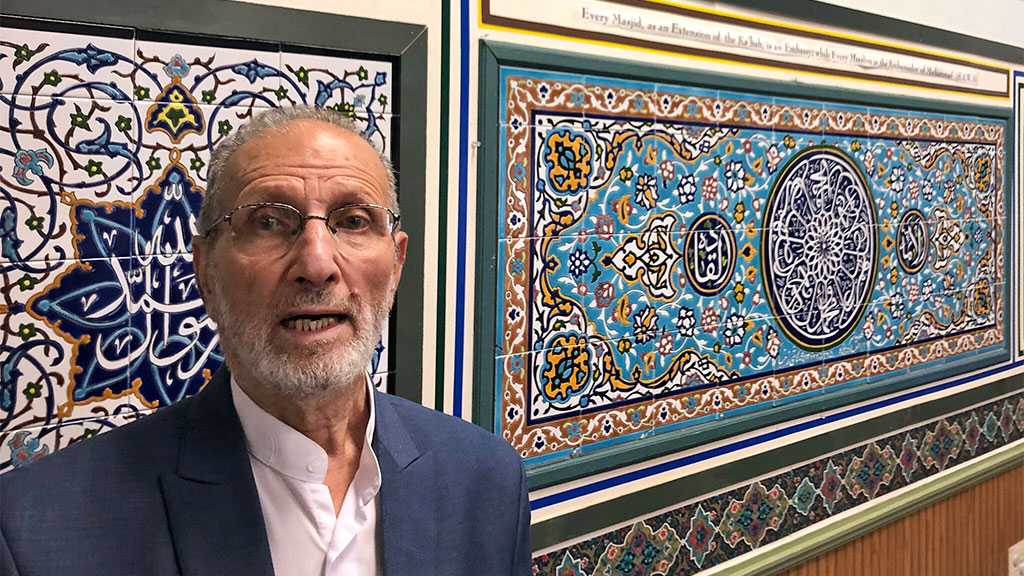
Islamophobic or Blindly Malicious? US Seizes Quranic Tiles from Iran for Virginia Mosque

August 10, 2021

Islamophobic or Blindly Malicious? US Seizes Quranic Tiles from Iran for Virginia Mosque

By Staff, Agencies

Among the weirdest news a person might hear is that an enemy combats a religion’s culture and civilization.

It is either an aspect of Islamophobia, which is highly unlikely, or a blind maliciousness that the US custom authorities confiscated a set of Iranian tiles to be used in construction of a new mosque in Virginia, demanding they “must be shipped backed to Iran or destroyed.”

The tiles, which are adorned with Quranic verses, were shipped in June from the Iranian city of Qom, to be used in construction of the Manassas Mosque in northern Virginia.

However, they were confiscated at Dulles International Airport after they were deemed to violate sanctions on Iran, the mosque’s imam Abolfazl Nahidian said on Tuesday.

The tiles were a gift and he paid no money for them, but custom authorities at the airport blocked him from claiming them citing the sanctions, he told a news conference at the mosque.

A letter from Customs and Border Protection informed the mosque that the tiles must be either shipped back to Iran or destroyed, the Associated Press cited him as saying.

Destroying the tiles, which are adorned with Quranic verses, “is the same as destroying verses of the Quran, or the whole Quran itself”, Nahidian said.

The mosque is now asking the Biden administration to release the custom-made tiles.

Nahidian said he has received other tile shipments throughout the years without incident, including one shipment that arrived eight months ago. He has led the mosque for nearly three decades.

The Biden administration is locked in a standoff over the US return to a 2015 nuclear deal with Iran, showing an aversion to remove the most draconian sanctions which its predecessor imposed on the Islamic Republic.

Biden has admitted that Washington was wrong to abandon the nuclear agreement, but he is showing an urge to retain some aspects of the sanctions as leverage to pressure Iran.

Food, medicine and other humanitarian supplies are purportedly exempt from the sanctions that Washington imposed on Tehran after former president Donald Trump walked away from the international deal over Iran’s nuclear program.

But the US measures targeting everything from oil sales to shipping and financial activities have deterred any dealing with Iranians – including humanitarian activities.


River to Sea Uprooted Palestinian   
The views expressed in this article are the sole responsibility of the author and do not necessarily reflect those of the Blog!

Wednesday, 25 November 2020

Flying Dragon, Crashing Eagle

 Flying Dragon, Crashing Eagle

November 23, 2020

by Pepe Escobar and first posted at Asia Times

Four geoeconomic summits compressed in one week tell the story of where we stand in these supremely dystopian times.

The (virtual) signing of RCEP in Vietnam was followed by the equally virtual BRICS meeting hosted by Moscow, the APEC meeting hosted by Malaysia, and the G20 this past weekend hosted by Saudi Arabia.

Cynics have not failed to note the spectacular theater of the absurd of having the Top 20 – at least in theory – economies discussing what is arguably the turning point in the world-system linked to a beheading-friendly desert oil hacienda with a 7th century mentality.

The Riyadh declaration did its best to lift the somber planetary mood, vowing to deploy “all available policy tools” (no precise details) to contain Covid-19 and heroically “save” the global economy by “advancing” global pandemic preparedness, vaccine development and distribution – in tandem with debt relief – for the Global South.

Not a peep about The Great Reset – the Brave New World scheme concocted by Herr Schwab of Davos and fully supported by the IMF, Big Tech, transnational Big Capital interests and the oh so benign Prince Charles. Meanwhile, off the record, G20 sherpas moaned about the lack of real global governance and multiple attacks on multilateralism.

And not a peep as well about the real life vaccine war between the expensive Western candidates – Pfizer, Moderna, AstraZeneca – and the much cheaper Russia-China versions – Sputnik V and Sinovac.

What seems to be the case is that any agenda – sinister or otherwise – fits the one-size-fits-all vow by the G20 to provide “opportunities of the 21st century for all by empowering people, safeguarding the planet, and shaping new frontiers.”

The House of Xi

At the G20, President Xi Jinping did not waste the chance – after RCEP, BRICS and APEC – to once again emphasize China’s priorities: multilateralism, support for WTO reform, ample international cooperation on vaccine research and production.

But then, in tandem with reducing tariffs and facilitating the trade of crucial medical supplies, Xi proposed a global health QR code – a sound way to restore global travel and trade: “While containing the virus, we need to restore the secure and smooth operation of global industrial and supply chains.”

Predictably, there were howls about neo-Orwellian intrusion, comparing the QR code with the exceptionally misunderstood Chinese credit system. Herr Schwab’s Great Reset in fact proposes something similar, with even more neo-Orwellian overtones, disguised under an innocent “Covid Pass” app, or highly secure “health passport”.

What Xi has proposed amounts to just a mutual recognition of health certificates, issued by different nations, based on nucleic acid tests. No gene altering vaccines coupled with nanochips. These QR codes, incorporated to health apps, are already used for domestic travel in China.

Chinese officials have made it very clear that Beijing has been working as the representative of the Global South inside the G20. That’s multilateralism in action. And the multilateralist drive extends from RCEP – signed between 15 nations – to the brilliant Sun Tzu maneuver of China now accepting even the Comprehensive and Progressive Agreement for Trans-Pacific Partnership (CPTPP), the successor of the Obama-promoted and Trump-detonated TPP.

This revival – a case of Make TPP Chinese Again – can be envisaged because Beijing not only has mastered how to contain Covid-19 but is also recovering in lightning speed. China will be the only major economy growing in 2020 – de facto leading the world to a tentative post-Covid paradigm.

What the APEC meeting made crystal clear is that with East Asia graphically hitting the economic limelight, as seen with RCEP, much vaunted US “leadership” inevitably diminishes.

APEC promoted a so-called Putrajaya Vision 2040, condensing an “open, dynamic, resilient and peaceful” Asia-Pacific all the way to 2040. That neatly ties in with the three accumulated five-year Chinese plans all the way to 2035, approved last month at the CCP plenum in Beijing.

The emphasis, once again, is on multilateralism and an open global economy.

Few are more capable to capture the moment than Professor Wang Yiwei at the Institute of International Affairs at Renmin University, who wrote the best Chinese book on the Belt and Road Initiative (BRI). Wang stresses how China is in a period of “strategic opportunity” and is now “the most powerful leader of globalization”. China’s emphasis on multilateralism will “activate the connectivity and vitality of a trade platform like RCEP”.

Stranger than fiction

Now compare all of the above with Trump at the G20 tweeting about the election dystopia and privileging golfing instead of discussing Covid-19 containment.

And then there’s

The Elements of the China Challenge, the new 74-page delusional epic concocted by the office of secretary Mike “We Lie, We Cheat, We Steal” Pompeo.

Diplomatic howls comparing it with the notorious George Kennan “long telegram” that codified the containment of the USSR in the Cold War are nonsense. Chinese Foreign Ministry reaction was more to the point: this was concocted by some “living fossils of the Cold War” and is doomed to end up “being consigned to the dustbin of history”.

President Xi Jinping, at RCEP, BRICS, APEC and the G20, concisely laid out the Chinese case: multilateralism, international cooperation on multiple fields, an open global economy, due representation of Global South’s interests.

As we wait for a set of imponderables all the way to January 20, 2021, perhaps an angular approach to what may lie ahead for the world economy is best offered by fiction.

Enter Billions, season 5, episode 2, dialogue written by Andrew Ross Sorkin.

Axe: “You know they call us traders ‘gamblers’. The world’s economy is one big casino, fueled by a giant debt bubble and computer driven derivatives. And there’s only one thing better than being a gambler at a casino.”

Wags: “That’s being the house.”

Axe: “That’s right. There’s a systemized machine out there, sucking capital from localities and injecting it into the global markets, where it can be used to speculate and manipulate. And if something goes wrong there are bailouts and bail-ins, federal aid and easing. Where the government doesn’t hunt you down, but instead gives you a nice soft net to land in.”

Wags: “That’s your answer to the fireside chat: You want to become a bank.”

Axe: “I want to become a bank.”

Wags: “In order to rob it?”

Axe: “In order that I don’t have to.”

River to Sea Uprooted Palestinian   
The views expressed in this article are the sole responsibility of the author and do not necessarily reflect those of the Blog!

Wednesday, 24 June 2020

White Privilege and Racism Debate: a British East European point of view

Source
June 22, 2020
by Nebojša Radić for The Saker Blog

White Privilege and Racism Debate: a British East European point of view
In this country[1]I am regarded as White and therefore, privileged – it seems.
People in the streets and on television say that Whites should kneel and apologise.
Really?
How come I find myself in this bizarre situation?
How did I get here?
How did a refugee from warn-torn socialist Yugoslavia turned fisherman in the South Pacific become a privileged White male?
Did I miss anything?
Is it something I did?
Something I said?
No, it’s not something I did or said. It has nothing to do with me.
Except that… it has everything to do with me and there is no-one to speak out for me!
So, there you go now, hear my voice.
I was born in Yugoslavia, the most multicultural country in Europe. Through the non-allied movement, it had many links with third-world countries and we used to call Africans: braća crnci, Black Brothers. I grew up in Belgrade listening to African American blues musicians such as BB King, Jimi Hendrix, John Lee Hooker and Blind Lemon Jefferson, playing basketball to better the likes of Michael Jordan and Magic Johnson! It was only in the late 90s that I noticed that the footballer Edson Arantes do Nascimento better known as Pele was black! And I remember watching him play for the first time in Sweden 1970! It took me thirty years or perhaps, ten years of living in an English-speaking country to think of the great football magician in terms of race.
In the early nineties, like many of my countrymen (and women, yes), I fled the war. I found myself in Nelson, New Zealand where a friend of a friend operated a fleet of fishing boats. I learnt the trade and a couple of years later, upon graduation, I could tell ALL the commercial fish species in the South Pacific. Filling the many forms of the New Zealand immigration service and later of the government, I identified as a Pakeha, the Maori term for white people and, apparently, also for a pig. Pakeha or Caucasian, that was the choice I had. At the same time, for most the Yugoslav immigrants in Aotearoa,[2], I was naš – ours. I was just one of us, ex-Yugoslavs and we all spoke naški – our language. We never bothered (very wisely) to call it Serbian, Croatian, Bosnian or…
Locals struggled to tell us apart the same as we struggled to tell the English from the Dutch or the Maoris from the Pacific Islanders (nota bene: the great rugby player, Jonah Lomu was of Tongan origin, an Islander – not a Maori[3]).
While in Nelson, down very South, a good friend of mine Kit Carson, a farmer, wood turner and artist taught me an important lesson. We were barbequing some meat near the Tahunanui beach when Max said that as an Irish-born immigrant, Kit wasn’t a real Kiwi. The already well-aged and proud son of Joyce, Beckett, Heaney and a very long line of Celtic storytelling alchemists stood up from his chair with a drink in his mighty rugged hand and roared:
– You were born in this country, Max, but I chose to come here out my own free will. I am much more of a New Zealander than you will ever be!
Thus, spoke Kit Carson, Down Under Below, raising his glass to a thunderous – slaintè!
On the day the New York twin towers fell, I left Aotearoa[4] and moved to Britain (this country?). I now live in Cambridge, a multi-cultural city with a peculiar town and gown historical (class, racial?) divide.
For the immigration service and the government here, I am White, the other White, mind you. The official government web page lists those options:
One of the home nations[5] or Irish (Kit Carson!), Gypsy or Irish Traveller (Tyson Fury, the boxer) or any other White background. You can also belong to mixed ethnicities or declare yourself to be Jewish, Indian, Pakistani, Bangladeshi, Chinese or of any other Asian background. You can be AfricanCaribbean or of any other Black background. You could be Arab too (Dr Ali Meghji[6])![7]
So, all Europeans are other Whites. Nigel Farage however, the prominent and outspoken British politician, does not complain about his French, Italian or German and not even Greek neighbours. He just does not recommend living next door to a bunch of Romanians!
At the same time, ‘Go home Poles’ graffiti compete with Banksy’s excellent artwork, anti-Russian hyper-hysteria (you don’t really want me to give you any links for this one) and the already metastatic anti-Serbian bias (uh, where shall I start with links…) that I have been exposed to over these 30 years.
Nine in ten of my conversations that started with where are you from originally? and continued with me saying I am from Serbia, ended right there – in embarrassment and silence. A sure sign that my interlocutors were educated on the topic by alphabet soup corporations (CNN, BBC… ESPN, CIA?) rather than history or any other books. While I do not expect people to have read all the novels by the Nobel laureate Ivo Andrić or seen the films of multiple Palme d’Or winner Emir Kusturica, to have ever found themselves trapped in one of the Marina Abramović arty installations, to have understood the principles of Nikola Tesla’s coil and wireless transmission of electricity or even watched Novak Đoković play tennis, it would be nice if they could make a small mental effort to move beyond the “murderous Serbs” stereotype and the likes of Milošević, Karadžić and Mladić.
So, the western political correctness pill may pretend to be covering Muslims, Blacks and Jews but it does not cover the others, with special reference to Eastern Europeans (our subject).
I can inform you, for instance, that there is no such a thing as an East European accent.[8] Same as there is no such a thing as a Western European accent. The geographical Eastern Europe features languages that belong to different groups : Finno-Ugric, Greek, Romance, Slavic and Albanian among others. Native speakers of these language do not and cannot possibly have the same English accents. Again, is there such a thing as a Jewish, African or Muslim accent?
For instance,
  • Talking to a woman wearing a burka you ask leisurely: Oh, is that a Muslim accent that I hear, darling?
  • Talking to Shaquille O’Neal during a pick-up basketball game you say: Where does your accent come from? West Africa, perhaps? or,
  • Talking to a rabbi who happen to be dressed as a rabbi: Interesting accent that you have – Semitic isn’t it?
(Nota bene: do NOT try any of these techniques at home)
East European is not an ethnicity. East Europeans as a compact group do not exist linguistically, culturally оr religiously and they are no different from Western Europeans in that respect. East European is a prejudiced political, cold war denomination for marginalised white (other) people.
My ancestors fought the Ottoman Turks for centuries not to be enslaved or taken away by the Janissaries. As my name is not Muhammed and I am a Christian, grandad seems to have done well. Now both the descendants and victims of the British Empire slave traders tell me I should apologise. Uh, let me see…
Is racism, as we now know it, not a construct of Western European maritime imperial nations, of genocide, slave trade and slavery?
Where I come from we learnt about these sinister exploits at school. We were told about what happened to the American Indians, the Aborigines, the Mayas and the Incas, the Africans abducted from their ancestral homes, enslaved and shipped to the new brave world. We knew about the East India Company, the British concentration camps in South Africa, Churchill’s racism and crimes, the utter high-tech barbarism visited upon the civilian populations of Hiroshima, Nagasaki and Dresden.
This was all common knowledge among people outside the Anglo-Saxon imperial reach.
The British Empire is racist, you now tell me? No kidding.
The American fathers of the exceptional nation were slave owners? Say no more.
The Empire committed atrocities with the ‘excuse’ that their victims we not really human.[9] If they now, suddenly accepted the humanity of the colonised, exploited and murdered peoples, their minds would blow and disintegrate along with all of their cherished ethical, religious principles and civilised posturing.
But let’s go back to our topic, my Eastern European predicament. I am White, remember? Other White but still – sort of, White! To be better represented, I might want to join forces with the other Asians and the other Africans perhaps? So much for an identity crisis of the Others (capitalised though, mind you)!
I don’t think I am either privileged or responsible for racial tensions. I support human rights and equality and will not kneel or beg for forgiveness.
One day, when I return to the Balkans I may lay down and die of shame for what we allowed to happen to my generation and my country in those mountains. But I will not kneel. Not here, not now, not ever!
So, East Europeans are other Whites. We are not privileged and we often find ourselves at the receiving end of prejudice and intolerance. Do not paint us thus, with the old, stained, black & white brush. There are too many dirty brushes around us already… and so many wonderful colours.
Nebojša Radić is a native of Belgrade, Serbia. He has published fiction, essays and academic work in English (nom de guerre Sam Caxton), Serbian and Italian. He is Associate Professor at the University of Cambridge in the UK. Nebojša has two PhDs, one in Creative Writing from the UEA in Norwich and one in fish chucking form Talley’s Fisheries in Nelson, New Zealand.
Cambridge, UK
  1. No-one ever says in Britain, England, the UK… 
  2. New Zealand is officially bilingual and this is the Maori name. Aotearoa translates as The Land of the Long White Cloud
  3. Advice based on personal experience acquired on the deck of a 15 metre-long fishing trawler at high sea during a storm: never call a Maori an Islander – BIG difference! 
  4. Maori for New Zealand – The Land of the Long White Cloud
  5. English, Northern Irish, Scottish or Welsh. 
  6. https://www.ethnicity-facts-figures.service.gov.uk/ethnic-groups 
  7. My enunciations have been accused many times over of possessing such a dubious quality. 
  8. Churchill was a ‘racist’ and comparable to Hitler, says academic.”

River to Sea Uprooted Palestinian   
The views expressed in this article are the sole responsibility of the author and do not necessarily reflect those of the Blog!