Uprooted Palestinians are at the heart of the conflict in the M.E Palestinians uprooted by force of arms. Yet faced immense difficulties have survived, kept alive their history and culture, passed keys of family homes in occupied Palestine from one generation to the next.
Angry Moroccans against the butchers of the Palestinian children and those normalizing the savagery in the garb of lucrative military deals on Monday took to the streets in several cities across the country to protest Rabat’s normalization of ties with the Zionist regime and recent military agreements signed between the two sides.
The protesters, including activists and ordinary people, took part in large-scale protests in the cities of Oujda, Berkane, Ben Slimane, Beni-Mellal and Oulad Teima on Monday.
The demonstrators chanted vociferous anti-‘Israel’ slogans, calling for an end to normalization of relations between Rabat and Tel Aviv and voicing their support for the Palestinian cause.
The Moroccan police, however, foiled a similar protest by pro-Palestinian groups in the capital Rabat on Monday, using brute force, according to reports.
The demonstrations protested under the banner of “The Moroccan Front to Support Palestine and against Normalization”, denouncing recent bonhomie between the ‘Israeli’ occupation regime and Morocco.
They also condemned the visit of Benny Gantz, the Zionist war minister, to Morocco and rejected any collaboration with “the enemies of the Palestinian people.”
The pro-Palestine demonstrators said any cooperation with the Tel Aviv regime constitutes a threat to Morocco and the whole region.
Gantz visited Rabat last week, his first known visit to one of the Arab states that normalized ties last year, during which the two sides signed a military agreement and a pact that would see the occupation regime sell drones and weapons to Morocco.
In a statement, Gantz said that the agreement was “very significant and will allow us to exchange ideas, enter joint projects and enable ‘Israeli’ military exports here.”
Morocco, the United Arab Emirates, Bahrain and Sudan signed agreements to normalize relations with Tel Aviv in 2020 as part of the so-called ‘Abraham Accords’, brokered by the previous US administration.
The normalization deals sparked widespread protests in these countries, pointing to the overwhelming divide between the rulers and the people, and have also been condemned by all Palestinian political factions, who have termed it a betrayal of their cause.
Monday’s protests coincided with the International Day of Solidarity with the Palestinian People, an annual day dedicated to expression of solidarity with the oppressed people of Palestine.
On the International Day of Solidarity with the Palestinian people, factions call on the Palestinian Authority to stop all relations with “Israel,” and stress that resistance is the only way to end the occupation.
The Committees called on the PA to stop all relations, agreements, and negotiations with the Israeli occupation.
On the occasion of the International Day of Solidarity with the Palestinian people, the Popular Resistance Committees in Palestine considered that the decision to partition the land represents Western and international complicity “that will not legitimize the usurpation of Palestine by the criminal Zionist enemy entity.”
The 29th of November marks the International Day of Solidarity with the Palestinian People that the UN celebrates every year.
It also coincides with the day the UN General Assembly adopted Partition Resolution No. (181) which called for the partition of Palestinian lands to accommodate the occupation’s expansionist goals, forcefully separating the land into “Arab and Jewish states”.
The Committees considered that the partition plan “laid the foundations for the largest mass expulsion and displacement of the Palestinian people in history.”
In a statement, the Committees affirmed that the only feasible way to uproot “Israel” is through resistance in all its forms.
It called on the Palestinian Authority to stop all relations, agreements, and negotiations with the Israeli occupation, as well as withdraw its recognition of it.
In the same context, the Popular Front for the Liberation of Palestine considered that ending the occupation could only come through the escalation of the struggle against “Israel,” and called for unifying the Arab stance against normalization.
For its part, the Palestinian Freedom Movement urged the Palestinian authority to harmonize with and acknowledge the magnitude of international solidarity that supports Palestinians and rejects the occupation.
Moreover, the Global Campaign to Return to Palestine celebrated the occasion through a series of projects and activities in support of the Palestinian people and their steadfastness in their land.
The International Day of Solidarity with the Palestinian people is considered an opportunity to draw attention to the Palestinian cause that remains unresolved and the fact that Palestinians have not obtained their inalienable rights, despite numerous international resolutions.
November 20th marks World Children’s Day that was adopted by the United Nation; it is a universal day devoted by the international community to entrench promotion, respect and protection of child’s rights according to the 1989 Convention on the Rights of the Child.
This occasion comes this year in difficult circumstances that aggravated the difficult conditions children endure in the occupied Palestinian territory (oPt). Children form 45% of the Palestinian society; 42% in the West Bank and 48% in the Gaza Strip; they are affected by both the continued Israeli occupation, which violates their human rights, and by the Palestinian internal division that impeded all attempts to enact laws that are more equitable to them.
The Israeli occupation commits multi-layered violated against children, either by directly harming them like what happened in the Israeli aggression on the Gaza Strip in May 2021 when 59 children were killed and 632 were wounded while 8 children were killed in the West Bank since the beginning of the year. Also, children face arrests as there are 200 children arrested in the Israeli prisons in 2021. In addition, children suffer from the Israeli tightened restrictions on the freedom of movement due to the permanent and temporary checkpoints and the settlers’ attacks against civilians under IOF’s protection.
The Palestinian internal division is one of the main reasons behind the outgrowing suffering of the Palestinian child as the disruption of the Palestinian Legislative Council was a great obstacle in the way of enacting laws that are more equitable to children, particularly the victims of domestic violence.
In 2020, PCHR documented cases of domestic violence, where children were the victims; the latest of which was the rape of a 5-year-old girl from Rafah by her uncle. Children suffer from violence that has lately increased due to the outbreak of coronavirus, which has negatively affected the economic, social, and living conditions.
A study published by the Ministry of Women’s Affairs shows that 270,000 children were subject to different forms of mental, physical, and verbal violence while 10% of female children were exposed to cyber violence
The deterioration of economic and social conditions increased child labor to 3% according to the Palestinian Central Bureau of Statistics: 4% in the West Bank and 1% in the Gaza Strip.
As part of its concern of further deterioration of children’s conditions, PCHR Calls upon:
The international community, by virtue of their contractual obligations, to hold the Israeli occupation responsible and pressure it to end the closure and respect the Palestinian child’s rights in accordance with international conventions, particularly the 1948 Fourth Geneva Convention.
The Palestinian government to establish clear, fair, impartial, and transparent mechanisms to protect children in the oPt, including establishing a safe shelter for children exposed to violence.
The Palestinian President to adopt the Domestic Violence Protection Bill into law and to harmonize domestic laws with international conventions, in particular the Convention on the Rights of the Child.
The police and public prosecution to exert more efforts for the prosecution of those committing domestic violence crimes and take all the necessary legal proceedings against them regardless of any excuses or justifications.
The governmental bodies to reconsider the policies taken over the years pertaining to children and to take lessons learned from the current experience that has led to this catastrophic situation, which requires governmental bodies’ to mainstream children’s rights across their policies.
The civil society and human rights organizations to work continuously on raising the awareness of the Palestinian society on the forms of violence children are exposed to and the mechanisms to end it.
Palestinian protesters mark Land Day in the Umm Al-Hiran village in the Wadi Atir area of the Negev (Naqab) desert (AFP)
Ghada Karmi is a former research Fellow at the Institute of Arab and Islamic Studies, University of Exeter. She was born in Jerusalem and was forced to leave her home with her family as a result of Israel’s creation in 1948. The family moved to England, where she grew up and was educated. Karmi practised as a doctor for many years working as a specialist in the health of migrants and refugees. From 1999 to 2001 Karmi was an Associate Fellow of the Royal Institute of International Affairs, where she led a major project on Israel-Palestinian reconciliation.
For Palestinians, Land Day continues to be an inspiration and a tribute to the just struggle of an unbowed people for their land
The centrality of the struggle for land has always been fundamental to understanding the Israeli-Palestinian conflict.
It is at the heart of two major events whose anniversaries fall due on 30 March. The first, Land Day, commemorates the surge of Palestinian resistance to the takeover of their land by Israel in 1976; and the second marks the start of the Great March of Return in 2018, when thousands of Palestinians in Gaza demonstrated for the right of refugees to return to their confiscated lands in Israel.
From the start the Zionist movement was predicated on the acquisition of an empty territory on which to establish a state exclusively for Jews. Since no such land was available in the Palestine of the time, it had to be carved out, first by purchase, and later by war.
The land-grabbing journey
As Jewish immigrants began to arrive in the country in increasing numbers after 1917, Zionist organisations such as the Jewish National Fund and the Palestine Jewish Colonisation Association set about buying Palestinian land, provided it was untenanted at the time of purchase.
Today, Israel’s settlements have meant that Palestinian ownership of West Bank and East Jerusalem land has shrunk to under 13 percent
Many Arab landowners living outside Palestine, in addition to a minority of Palestinian peasants, sold them land. These sales were mainly motivated by economic necessity, since the Zionist organisations had access to foreign funds unavailable to Arabs.
Years of intense Zionist effort, however, yielded disappointing results. By 1947, and despite their funding and connections to powerful supporters of Zionism, these organisations had acquired no more than a meagre 6.7 percent of Palestine’s land.
But this disappointment was soon reversed by the Arab-Israeli war of 1948. In that war Israel captured 78 percent of Mandate Palestine, taking large swathes of Palestinian land, mostly untenanted thanks to population flight and expulsions in the war.
After 1948 the new Israeli state swiftly enacted a series of laws designed to acquire more Palestinian land by pseudo-legal means. These included the 1950 Absentee Property Law, permitting the state to take over Palestinian land and property in their owners’ absence; and soon after, the 1953 Land Acquisition Law, which introduced a new category of “state lands” and “closed areas”.
This had the effect of making the state the majority owner of the land, which was to be permanently out of the reach of its previous Palestinian owners.
Subsequent events up to and including the 1967 Arab-Israeli war, that put Israel in occupation of the rest of Palestine, have been stages on the same land-grabbing journey. Today, Israel’s settlements have meant that Palestinian ownership of West Bank and East Jerusalem land has shrunk to under 13 percent. That is set to diminish further as the settlement process continues with further land loss.
Palestinian children hold up pictures of keys, symbolising the homes they left behind (AFP)
This is the background to the dramatic protests of Land Day in 1976. Their trigger at the time was the Israeli government’s plan to expropriate thousands of dunums of Arab land in the Galilee to build Jewish industrial villages. In line with the Israeli government’s 1975 “Galilee Development Plan” to expand Jewish settlement, it would accelerate Judaisation of what was a majority Arab area.
A turning point
On 30 March a general strike was called, and widespread demonstrations in Arab towns erupted from the Galilee to the Negev. Thousands marched in protest, while solidarity demonstration were held in the Occupied Territories and the Palestinian refugee camps in Lebanon.Land Day: A potent symbol of the Palestinian struggle
Unexpected at the time from what had been a largely quiescent Arab population, Israel was alarmed and deployed thousands of police, army units and tanks to quell the protests. Six Arabs were killed, hundreds wounded, and hundreds more arrested.
Land Day, as it became known, was a turning point. It was the first time since 1948 that the Arabs in Israel acted as a national collective, refusing to accept the theft of their land after years of control by Israel’s military rule. Land Day was an expression of national pride and self-confidence. It marked the assertion of an Arab presence that Israel’s politics could no longer ignore, and the starting point for Arab political participation in Israel.
From that time to this, Land Day has been commemorated annually by Palestinians everywhere. In 2018 it was marked by the start of another great Palestinian protest over land. The Great March of Return saw 30,000 Palestinians in Gaza demonstrate near the Israeli separation fence of electrified barbed wire and sensors. It was a peaceful protest, demanding the right of refugees to return to their lands and an end to the blockade of Gaza. Intended to last from 30 March to 15 May, Nakba Day, the same protests took place every Friday.
A double heroism
As in 1976 Israel retaliated with murderous violence. Between 30 March and 15 May 2018 an estimated 110 protesters were killed, and 13,000 wounded by a combination of sniper fire and drones. By the time the March of Return was halted by Hamas in December 2019, 214 people had been killed, and 36,000 wounded. Of these, 1,200 needed long term rehabilitation following bone infections and limb injuries. Israeli soldiers seemed to be using a “shoot-and-maim” policy, deliberately targeting the legs of protestors to cause maximum disability.
Land Day marked the assertion of an Arab presence that Israel’s politics could no longer ignore
Gaza’s health system, damaged by years of blockade, understaffing, and equipment and power shortages, has been unable to cope with the toll of so many injured. Yet that did not stop Palestinian youth braving death and injury each week for nearly two years, and creating a new Palestinian legend to commemorate on 30 March.
Israel never changed course in the face of that double Palestinian heroism celebrated on Land Day. It went on to build “Development towns” for Jews, 26 by 1981, with the effect of altering the Galilee’s demography in favour of Jews.
In Gaza, likewise, the blockade continues, and Israel’s pretext of its brutality as self-defence against the Great March of Return has been accepted by many Western governments. Its programme of Palestinian land theft goes on undisturbed.
But for Palestinians on 30 March, Land Day continues to be an inspiration, and a tribute to the just struggle of an unbowed people for their land.
The views expressed in this article belong to the author and do not necessarily reflect the editorial policy of Middle East Eye.
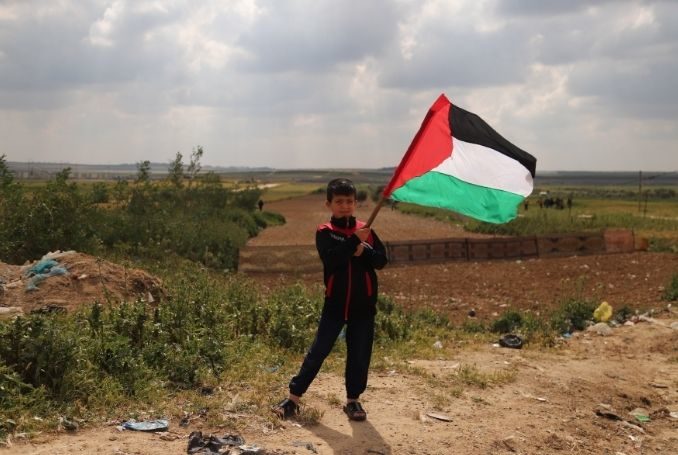
A child raising a Palestinian flag on Land Day. (Photo: Fawzi Mahmoud, The Palestine Chronicle)
“In 2019 I went to Palestine twice,” wroteIbtisam Barakat, “one time with Palestine Festival of literature in April.” When an officer informed her at the border that she didn’t exist in Israeli records, Barakat started to cry. She “cried for two weeks nonstop. Nothing and no one could stop [her], not even a delicious falafel sandwich.” All that time, recalled the Palestinian-American poet, she “ate falafel and cried.”
On Land Day 2021, Barakat’s words are more relevant than ever. Forty-five years ago, on March 30, 1976, Israeli police murdered six Palestinian protestors as they were calling attention to the Israeli government’s expropriation of thousands of dunums of Palestinian land. Since then, notes Yara Hawari, March 30 has been commemorated as Land Day.
An important “event in the Palestinian collective narrative,” explains Hawari, it incorporates resistance to colonization, in particular “colonial policies of erasure,” efforts by Israelis to erase all Indigenous presence on the land. Indeed, since 1948, Palestinians have defied those policies with characteristic sumud (resilience), both by holding fast to a collective narrative that incorporates individual perspectives.
When Barakat returned to Palestine, an officer asked why she was coming back a second time in one year. At the time, she had no idea how to reply. “Now,” she explains, she knows “the world was going to change and the universe knew that I needed to see Palestine twice in a year” before it became impossible. “Seeing my Palestine or not seeing my Palestine is a spiritual experience for me,” she says, thereby calling attention to her individual refusal to be erased that is in turn part of a collective experience.
On March 30, 2018, Palestinians in Gaza began a series of weekly demonstrations that would last for months, resulting in a staggering number of deaths and injuries from Israeli snipers that drew the attention of the media. What did not get covered so much were the cultural aspects of the rallies—storytelling, cooking traditional dishes, performing dabke, and even weddings took place—thereby passing down traditions to a younger generation.
“What is largely missing from the discussion on Gaza is the collective psychology behind this kind of mobilization,” writes Ramzy Baroud, “and why it is essential for hundreds of thousands of besieged people to rediscover their power and understand their true position, not as hapless victims, but as agents of change in their society.”
In the same way that Barkat worked through her grief at being told of her non-existence, so Palestinians on a collective scale have maintained a narrative that resists the official story. As Baroud explains,
“For 70 years, Palestinians have embarked on that journey of recreation of the self. They have resisted, and their resistance in all of its forms has molded a sense of collective unity, despite the numerous divisions that were erected among the people. The Great March of Return is the latest manifestation of the ongoing Palestinian resistance.”
Two years later, in 2020, the spread of Coronavirus added to ongoing problems. In order to provide a safe space to commemorate the day, Samidoun: Palestinian Solidarity Network issued a virtual call to action:
“Mark Palestine Land Day (Yawm Al-Ard), a day of remembrance for six Palestinian citizens who were murdered by Israelis while protesting the Israeli government’s expropriation of thousands of dunums of their land. March together online on the second anniversary of the Great March of Return.”
Thanks to donations from Russia and the UAE, Gaza recently initiated a vaccine program in an effort to confront the virus pandemic and break the cycle of deaths.
According to Hawari, Land Day commemorates ongoing resistance, but it also “reminds us how the domination of space is an integral aspect of the Zionist settler-colonial project.” Moreover, she points out, “settler-colonial states the world over are in a constant process of colonizing more and more indigenous land while squeezing indigenous peoples into as little space as possible.”
In order to steal more land, colonists in both Israel and North America developed the myth of the vacant land. For example, on March 8, 1969, Golda Meir reportedly asked: “How can we return the occupied territories? There is nobody to return them to.”
Propaganda around the Indigenous in North America sounds much the same. As Steven Salaita tweeted: “you’ll never understand Zionism without a concomitant understanding of Manifest Destiny,” a phrase devised in 1845 to explain that the United States was destined—by God, its advocates believed—to expand its territory across the entire North American continent.
“Of all myths associated with American Indians,” explains Dina Gilio-Whitaker (Colville Confederated Tribes), “no myth is as pervasive as the myth of the vanishing Indian.”
In my American history classes, there would invariably be the student who said that Native people no longer exist, despite the fact that just by looking around the classroom that student might have reached a different conclusion. Nevertheless, because dominant society has been “indoctrinated with the idea of the vanishing Native their whole lives,” Gilio-Whitaker asserts, “the assumption that there is no such thing as real Natives anymore is like a software program constantly running in the background.”
To these deniers, the “real Indians were the ones who dressed in buckskins and hunted buffalo and deer for their living, and didn’t speak English,” Gilio-Whitaker notes, and, in reality, they have “been gone a long time.”
Despite all of the efforts to deny their existence, which makes it all the easier to steal land and resources, both Palestinians and Indigenous people in the States are still around. The commemoration of Land Day attests to that, as do efforts on the part of Native Americans to make their presence known.
Quoting Gerald Vizenor, a citizen of the White Earth Nation, Roxanne Dunbar-Ortiz calls attention to his notion of “survivance”:
“Survivance is an active presence: it is not absence, deracination, or ethnographic oblivion, and survivance is the continuance of narratives, not a mere reaction, however pertinent. Survivance stories are renunciations of dominance, the unbearable sentiments of tragedy, and the legacy of victimry” (An Indigenous Peoples’ History of the United States, 2014, p. 217).
Decades after their displacement, the Palestinians long for a place, a homeland that could provide them with grounding to affirm that they exist. In the introduction to Nakba: Palestine, 1948 and The Claims of Memory (2007), Ahmad Sa’di and Lila Abu-Lughod write that “making memories public affirms identity, tames trauma, and asserts Palestinian political and moral claims to justice, redress, and the right to return” (p.2).
Memory, then, “continuance of narratives” as Vizenor calls it, serves as an expression of the need to officially exist. Manifested in events like Land Day, alternative histories affirm what happened in the past but also what should be done in the present to assure that all formerly oppressed peoples have a future.
– Benay Blend earned her doctorate in American Studies from the University of New Mexico. Her scholarly works include Douglas Vakoch and Sam Mickey, Eds. (2017), “’Neither Homeland Nor Exile are Words’: ‘Situated Knowledge’ in the Works of Palestinian and Native American Writers”. She contributed this article to The Palestine Chronicle.
Palestinian farmers say they face constant threats while working on family lands due to Israel’s annexation policies
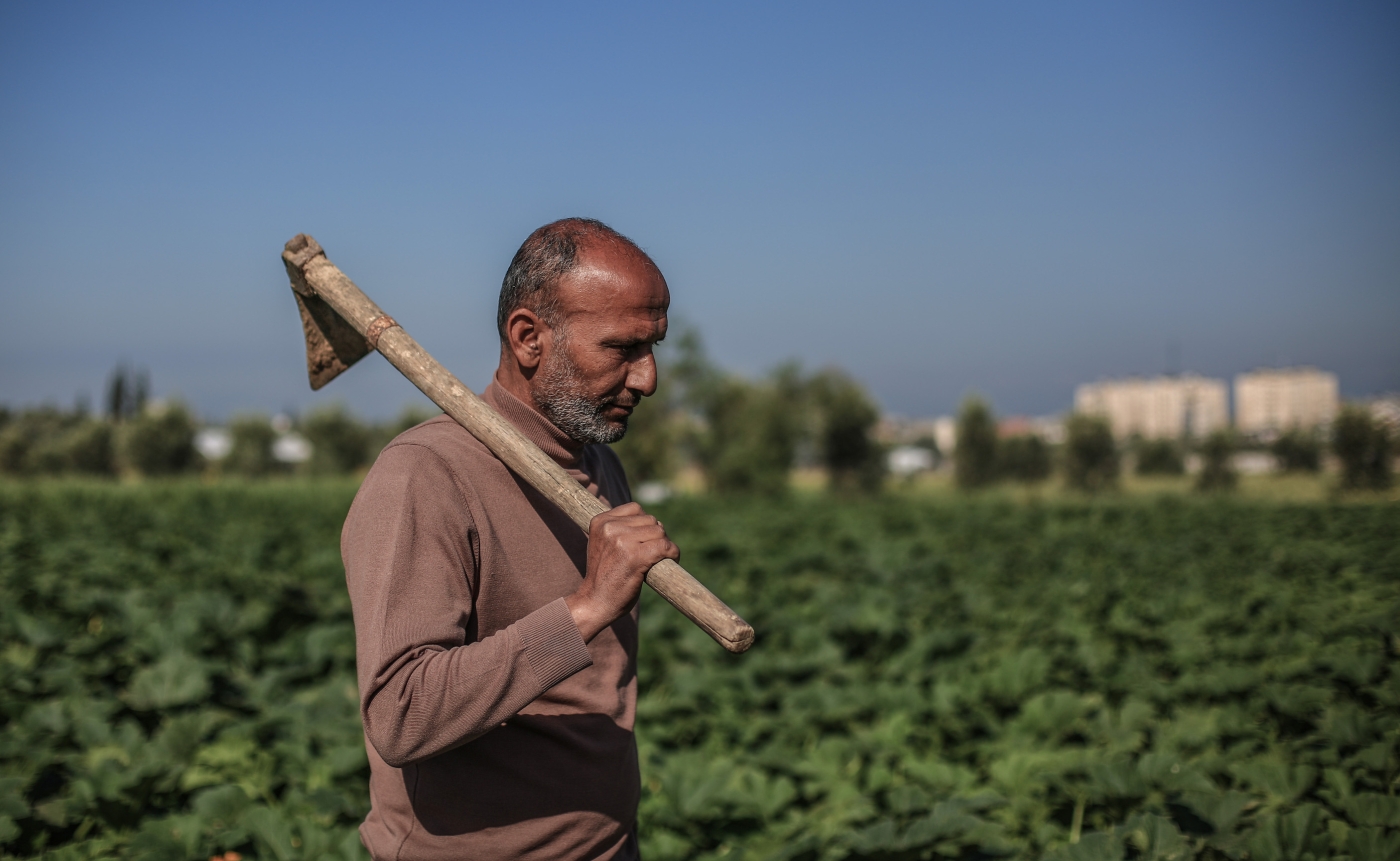
Iyad Abughleiba, a Palestinian farmer, finds it increasingly difficult to work on his land in the Gaza Strip due to Israel’s annexation policies. (MEE/Sanad Latifa)
On 30 March 1976, six Palestinians were killed by Israeli forces as hundreds of Arab citizens in the occupied territory took to the streets to protest Israel’s expropriation and occupation of Palestinian lands.
The event became known as the Land Day and a symbol of national struggle that unites Palestinians around the world.
Forty-five years later, Palestinians say that not much has changed, as Israel continues its policy of annexation.
Middle East Eye met with Palestinian farmers and land owners in the Gaza Strip, who have been unable to access hundreds of dunums of land belonging to their families due to Israel’s restrictions and annexation policy.
Land theft normalised
Iyad Abughleiba, 49, a Palestinian who owns agricultural land in the eastern central Gaza Strip, says that farmers find it increasingly difficult to work in the blockaded enclave as Israel continues to “normalise land theft”.
Since age 15, he and his brothers would help their father cultivate the family lands. When his father passed away, the siblings inherited the lands and continued to work as farmers.
“My grandfather had owned more than 400 dunums of land. But over the years, and with every Israeli decision or new policy, the lands have been gradually shrinking. Today we only have 25 dunums left,” Abughleiba told MEE.
‘Our safety depends on the Israeli soldiers’ mood. You could be killed at any moment’
– Iyad Abughleiba, Palestinian farmer
Although Israel dismantled its settlements in Gaza in 2005 and withdrew its forces and settlers from the enclave, it still controls vast areas of land in the northern and eastern perimeter of the Strip.
“Israel’s disengagement from the Gaza Strip is the biggest lie. They are controlling every inch of the Strip – the land, the sea, and can you hear that noise? They are also controlling the air,” Abughleiba said as an Israeli drone buzzed at low altitude above his land.
“Like the majority of Palestinians, our grandparents lost most of their lands in Gaza and the West Bank during the [Palestinian] Nakba. But land theft did not stop here.”
The Nakba, meaning the “disaster, catastrophe or cataclysm”, marks the partition of Mandatory Palestine in 1948 and the creation of Israel. At least 750,000 Palestinians were displaced from their homes that year. A further 280,000 to 325,000 fled their homes in territories captured by Israel in 1967.
Following its disengagement from the Gaza Strip in 2005, Israel established a “buffer-zone”, a military no-go area that stretches across the Strip’s borders with Israel. The first reference to a buffer-zone in the Strip appeared in the Oslo Accords in 1993, which mentioned a 50-metre wide area along the enclave.
Today, it extends to more than 300 – 2,000 metres inside the Strip.What is the Nakba? Day of catastrophe for Palestinians, explainedRead More »
“When Israel first established the buffer zone, we lost part of our lands. Then when they expanded it in 2009, we lost another part. This is how they gradually annex more parts of our lands every now and then,” Abughleiba explained.
Abughleiba is always on high alert while farming, even though it’s been a couple of years since Israel last annexed parts of his family’s lands.
“Even if the rest of our lands is still accessible, we are always cautious due to threats of crops being bulldozed or shots being fired at us whenever we are working.
“In 2008, the Israeli forces bulldozed our lands, uprooting dozens of olive trees and destroying a water well. In 2014, during the war on Gaza, they did it once again,” he said.
Gaza farmers and landowners bear the brunt of Israel’s policies, facing periodic bulldozing of lands, flooding of crops, and shooting by Israeli forces stationed adjacent to their lands.
“After they bulldozed our lands, we planted them again and still insist on coming back to them because they are our only source of living.
“But after all, our safety depends on the Israeli soldiers’ mood. You could be killed at any moment.” Abughleiba told MEE.
‘Modernised’ methods to steal land
Um-Emad is a Bedouin woman who was expelled from her family’s land in Beersheba during the Palestinian Nakba in 1948.
The 79-year-old lives in a small room in her sons’ house, built in the middle of their agricultural land in the eastern Bureij, in the central Gaza Strip.
For Um-Emad, living on agricultural lands is part of her family’s heritage.
‘I can never imagine my life away from our land. One metre of this land is worth a thousand apartments elsewhere.’
– Um-Emad, 79, Gaza resident
“I can never imagine my life away from our land. One metre of this land is worth a thousand apartments elsewhere,” she told MEE as she sat on the ground of her room overlooking the fields.
“If I have to leave my land in Gaza, then it has to be to my family’s land in Beersheba. That is the only place I can leave to before I die.”
Um-Emad, who was evicted to Gaza at gunpoint when she was six years old during the Nakba, thinks that Israel intends to make Palestinians pay a high price for sticking to their lands, while facilitating their migration from the Gaza Strip and the West Bank.
For years, Israel has been implementing an annexation plan in the West Bank that was accelerated following the announcement of former US president Donald Trump’s “deal of the century”, in January 2020.
As a result, dozens of families across the West Bank and East Jerusalem have been evicted and displaced.
According to rights groups, Israel’s annexation of Palestinian lands constitutes a flagrant violation of international law, and “can have no effect on the legal status of the territory, which remains de jure occupied”.
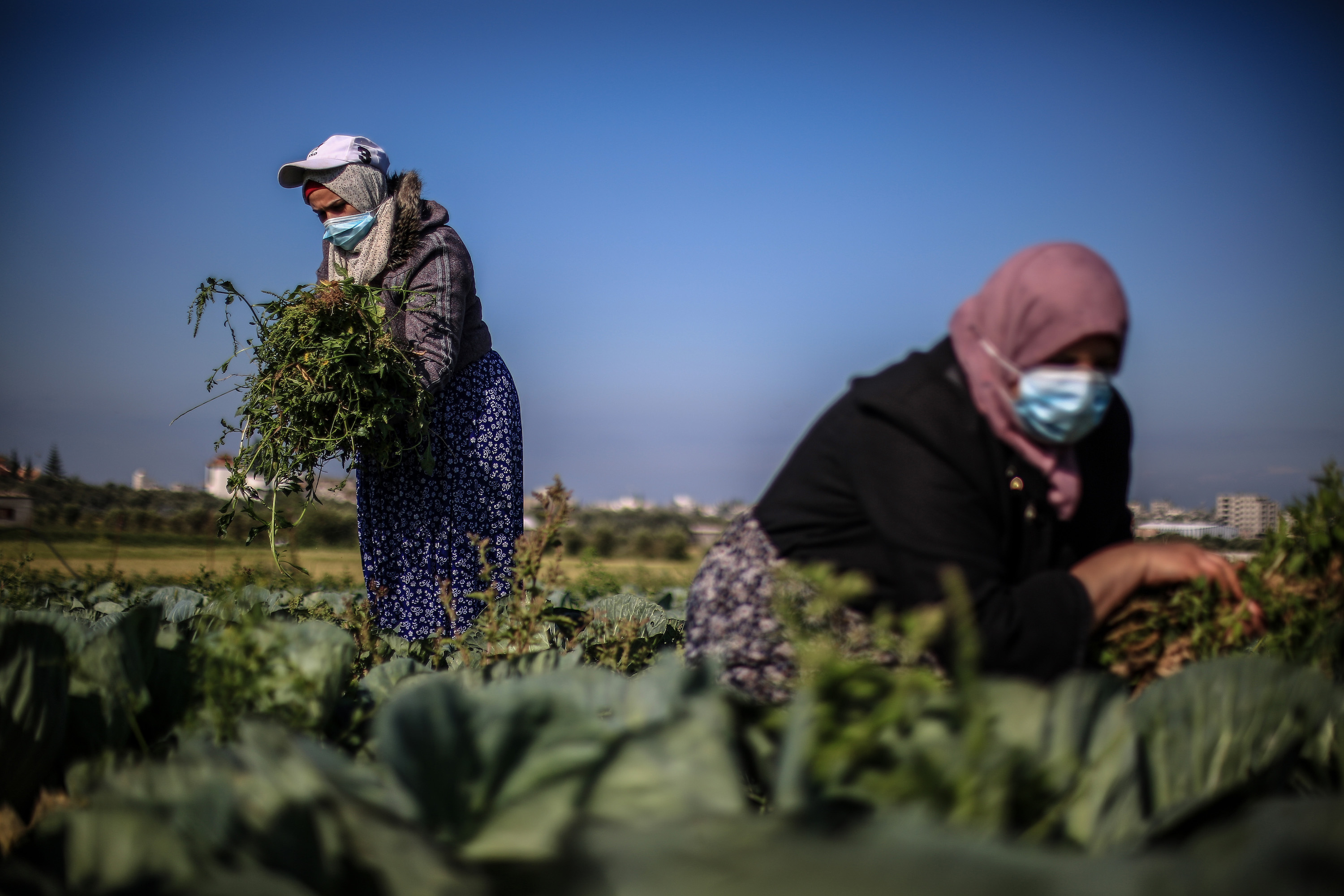
Palestinian farmers work in the fields in the Gaza Strip (MEE/Sanad Latifa)
“Israel today implements a systematic policy of forcing Palestinian residents in the Gaza Strip and the West Bank to migrate and leave their lands.
“The occupation does this both softly and by force. They make Palestinians believe that living in Europe with better life standards is a dream, and thus make thousands of youth leave in search for a better life, in order to make room for [Israeli] settlers.
“We are being forced to abandon our lands, but I would rather be buried here before selling one centimetre of my family’s land,” he said.
‘Every day is Land Day’
Jalal Abujlala, 47, depends mainly on his agricultural land in the eastern central Gaza Strip for living.
But with the remaining area of land after annexation by the buffer zone, the father of eight children can barely cover his family’s expenses, which include the tuition fees for his daughter who’s attending university to study medicine.
‘I always tell (my children) about our stolen lands, and that one day we will regain them back’
– Jalal Abujlala, 47, Gaza farmer
“A large part of our lands was annexed by the Occupation during the Palestinian Nakba and also due to the establishment of the Israeli buffer zone. Now the remaining area can only provide the life’s necessities,” said Abjlala.
“I can see my family’s annexed lands in the occupied territory from here. Sometimes, I approach a bit and take my children to see them. I always tell them about our stolen lands, and that one day we will regain them back,” he said.
“You would think that cultivating in this land is safe since it is not very close to the Israeli borders. But in fact, it does not have to be close in order for the farmers to be hurt,” he continued, recalling memories from Israel’s military attack on Gaza in 2014, where artillery shells targeted vast areas of agricultural lands.
“Owning a land in our country comes with no guarantees. At any moment you are threatened with bulldozing or eviction and annexation.”
For Abujlala, Israel’s measures in the Gaza Strip and the West Bank are similar to the event that sparked the Land Day demonstrations in 1976.
“History repeats itself. The Land Day happens everyday in Palestine.”
يُعدّ يوم 1/8/1882 في التاريخ الحديث نقطة الانطلاقة الفعلية من قبل العدو اليهودي باتجاه اغتصاب أرضنا في فلسطين. ففي ذلك التاريخ أنشأت حركة «أحباء صهيون» أول مغتصبة يهودية على أرض فلسطين.
إلا أنّ الإعلان الأبرز عن ذلك التوجه الاغتصابيّ كان على إثر تأسيس المنظمة الصهيونية العالمية بتاريخ 29/08/1897، وعقدها لمؤتمرها الأول في مدينة بازل السويسرية، وكانت أبرز مقرراته إقامة «وطن قومي لليهود» على أرضنا في فلسطين.
باشرت الحركة الصهيونية نشاطها لتستفيد من اندلاع الحرب العالمية الأولى وتوقيع اتفاقية سايكس – بيكو التقسيمية بتاريخ 16/05/1916، فاستحصلت بتاريخ 02/11/2017 على ذلك الوعد المشؤوم من وزير خارجية بريطانيا – آنذاك – آثر بلفور بإقامة الوطن القومي اليهودي المزعوم.
بطبيعة الحال، تصدّى أبناء شعبنا في فلسطين للخطة اليهوديّة المعادية، وعقد المؤتمر الفلسطيني الأول في القدس بتاريخ 27/01/1919. وتلاه المؤتمر الشعبي الكبير في فلسطين بتاريخ 05/03/1919 الذي تقرّر فيه رفض الاحتلال البريطاني ووعد بلفور والهجرة اليهودية ِإلى فلسطين.
ويسجل التاريخ في 27/02/1920 خروج أول تظاهرة وطنية فلسطينية احتجاجاً على سلخ فلسطين عن سورية، فأعلن شعبنا الفلسطيني تمسكه بهويّته القومية وإصراره على البقاء موحداً مع محيطه الطبيعي.
وعلى الرغم من تقرير عصبة الأمم تم تنفيذ الاحتلال البريطاني لفلسطين بتاريخ 24/07/1922، إلا أنّ شعبنا الفلسطيني البطل استمرّ في رفضه ومقاومته لذلك الاحتلال حتى وصل إلى إعلان الثورة الشاملة بتاريخ 15/04/1936.
ولا نذيع سراً أنّ الحزب السوري القومي الاجتماعي الذي تأسّس في 16/11/1932 ليكون الخطة النظامية المعاكسة للمشروع اليهودي ولحركته السياسية المسمّاة بالحركة الصهيونية، كان واحداً من المشاركين في تلك الثورة، حيث لبّى القوميون الاجتماعيون نداء فلسطين، وقاتلوا دفاعاً عنها ضدّ العصابات اليهودية. فكان أن ارتقى في مدينة نابلس بتاريخ 23/09/1936 أول شهداء الحزب الرفيق حسين البنا إبن بلدة شارون في قضاء عاليه – جبل لبنان.
على الرغم من التصدي البطولي لأبناء شعبنا الفلسطيني في مواجهة مغتصبي الأرض، جاءت لجنة بيل لتعلن عن اقتراحها في 07/07/1937 للمرة الأولى بتقسيم فلسطين إلى دولتين تكون الأولى لأهل الأرض الأصليين والثانية لمغتصبيها من اليهود.
بدأت الحرب العالمية الثانية، فوضعت الحركة الصهيونية كلّ ثقلها للاستفادة من نتائجها في سبيل تحقيق هدف إقامة كيان الاحتلال، خاصة بعد إنشاء الأمم المتحدة بتاريخ 24/10/1945 لتكون الهيئة الدولية الجديدة التي ترعى مصالح الأمم المنتصرة في الحرب.
بتاريخ 02/03/1947 عاد مؤسس الحزب السوري القومي الاجتماعي أنطون سعاده من مغتربه القسري إلى لبنان، فكانت في استقباله حشود قدّرت بعشرات الآلاف من القوميين الاجتماعيين، فألقى خطابه الشهير المعروف بخطاب العودة الذي جاء فيه:
«ولعلكم ستسمعون من سيقول لكم إنّ في إنقاذ فلسطين حيفاً على لبنان واللبنانيين وأمراً لا دخل للبنانيين فيه. إنّ إنقاذ فلسطين هو أمر لبناني في الصميم، كما هو أمر شامي في الصميم، كما هو أمر فلسطيني في الصميم. إنّ الخطر اليهودي على فلسطين هو خطر على سورية كلها، هو خطر على جميع هذه الكيانات».
استمرّت الخطة المشؤومة في سيرها، فصدر قرار الأمم المتحدة رقم 181 بتاريخ 29/11/1947، والذي قضى بتقسيم فلسطين كما خطّط له أيام عصبة الأمم. ليتبع ذلك إعلان قيام كيان الاحتلال الإسرائيلي بتاريخ 15/5/1948.
ما كان هذا الإعلان أن يمرّ مرور الكرام، فانتفض كلّ من أحبّ فلسطين ليدافع عنها في مواجهة ذلك العدو الوجودي. ومجدّداً، واستجابة لنداء زعيم الحزب السوري القومي الاجتماعي أنطون سعاده تشكلت الفرق القوميّة للذوْد عن جنوب الأمة السورية، فكانت أولاها «فرقة الزوبعة الحمراء» التي تأسّست بتاريخ 21/5/1948 لتقاتل بقيادة الأمين الراحل مصطفى سليمان النبالي.
استولى المغتصبون اليهود نتيجة حرب العام 1948 على ما يقارب من 78% من أرض فلسطين، وقاموا بتهجير حوالي 85% من أهلها.
لم تكد تضع الحرب أوزارها حتى أعلن كنيست الاحتلال القدس عاصمة أبدية لكيان الاغتصاب اليهوديّ بتاريخ 23/01/1950. وتلا ذلك إصدار ما يُسمّى بقانون العودة بتاريخ 5/7/1950 الذي يبيح أرض فلسطين لكلّ يهود العالم.
تسارعت الهجرة اليهودية إلى أرض فلسطين المحتلة، وسعت حكومة الاحتلال إلى تهويد كلّ القرى والمدن الفلسطينية حتى تلك التي صمد فيها أهلها ورفضوا تهجيرهم رغم كلّ الضغوط التي تعرّضوا لها من قبل قوات الاحتلال.
من ضمن الأراضي المستهدفة بعملية التهويد كانت الأراضي التي تعرف باسم «المل» أو المنطقة رقم 9، وهي تقع ضمن قرى سخنين وعرابة ودير حنا، وتبلغ مساحتها 60 ألف دونم.
وكانت هذه الأراضي تحت سيطرة جيش الاحتلال البريطاني بين عامي 1942 و1944 حيث كان يستخدمها كمنطقة تدريبات عسكرية أثناء الحرب العالمية الثانية.
أبقى جيش الاحتلال الإسرائيلي على الوضع نفسه الذي كان سائدًا في أيام الاحتلال البريطاني، حتى جاء العام 1956 فقام بإغلاق المنطقة بهدف إقامة مخططات بناء مغتصبات يهودية ضمن مشروع تهويد الجليل.
نتيجة لطبيعته الاحتلالية والتوسعية، لم يكتفِ كيان الاحتلال بما احتله من أراضٍ في العام 1948، حتى بلغ أوجه في حرب العام 1967 التي تمكن خلالها من احتلال ما تبقى من أرض فلسطين والجولان وسيناء.
محطة جديدة يثبت فيها الحزب السوري القومي الاجتماعي أنه حزب فلسطين عبر تشكيل «جبهة الفداء القومي» بقيادة الأمين الراحل سامي خوري، والتي نفذت عمليات عدة ضدّ جيش الاحتلال كان أبرزها العملية البطولية التي نفذت في غور الأردن بتاريخ 17/03/1968 وأسر فيها الرفيق الدكتور عزمي منصور.
على الرغم من تحرير أجزاء من أرضنا القومية المحتلة خلال حرب تشرين التحريرية في العام 1973، إلا أنّ الصراع لم يتوقف، بل استمرّ في سبيل تحرير ما تبقى من أرض تحت الاحتلال ومنع تهويدها ومصادرتها.
وفي هذا الإطار عقد بتاريخ 29/07/1975 اجتماع في حيفا المحتلة حضره مبادرون لتنظيم حملة الاحتجاج على مصادرة الأراضي الفلسطينية بعد أن أعلنت سلطات كيان الاحتلال عزمها على مصادرة 21 ألف دونم من أراضي نحو 12 قرية فلسطينية. وقد ضمّ الاجتماع عدداً من رؤساء المجالس المحلية الفلسطينية وشخصيات وطنية مختلفة من مجاهدين وأطباء ومثقفين ورجال دين وفلاحين. وتقرّر في هذا الاجتماع تشكيل لجنة للدفاع عن الأراضي الفلسطينية.
بتاريخ 15/8/1975 دعت هذه اللجنة إلى عقد اجتماع شعبي موسّع في الناصرة المحتلة تقرّرت فيه الدعوة إلى مؤتمر شعبي عام للمطالبة بوقف مصادرة الأراضي. وصدر عن الاجتماع نداء موجه إلى الرأي العام يدعوه إلى المشاركة في الحملة ضدّ سياسة المصادرة، حيث وقع على هذا النداء آلاف المواطنين وجميع الهيئات الشعبية والمجالس المحلية الفلسطينية.
وعقدت لجنة الدفاع بعد ذلك عشرات الاجتماعات الشعبية في الجليل والمثلث، فكان أبرزها المؤتمر الشعبي العام الذي عقد في الناصرة المحتلة بتاريخ 18/10/1975، الذي عدّ أكبر مؤتمر شعبي يُعقد في فلسطين المحتلة بعد عام 1948 حتى ذلك الحين.
وفي هذا المؤتمر تقرّر إعلان الإضراب العام وتنظيم مظاهرات أمام كنيست العدو إذا لم تتراجع حكومة الاحتلال عن مخططات مصادرة الأراضي الفلسطينية وتهويدها. لكن سلطات الاحتلال تجاهلت ذلك وضربت بمطالب أبناء شعبنا الفلسطيني عرض الحائط.
استمرّ العدو المحتلّ في ممارسة أعمال التهويد، فصدر بتاريخ 13/02/1976 قرار بإغلاق منطقة المل (المنطقة رقم 9) ومنع أهلها من أبناء شعبنا الفلسطيني من الدخول إليها.
كما صدرت بتاريخ 1/3/1976 وثيقة متصرف لواء الشمال في ما يسمّى وزارة داخلية الاحتلال (وثيقة كيننغ) المتضمّنة مجموعة اقتراحات لاستكمال تهويد الجليل، حيث تضمّنت النقاط التالية:
1 ـ تكثيف الاستيطان اليهودي في شمال فلسطين المحتلة (منطقة الجليل).
2 ـ السعي لإنشاء حزب من أبناء شعبنا الفلسطيني يُعتبر «أخاً» لحزب العمل الإسرائيلي ويركز على المساواة والسلام.
3 ـ رفع التنسيق بين الجهات الحكومية الاحتلالية في معالجة مسائل أبناء شعبنا الفلسطيني.
4 ـ إيجاد إجماع «قومي يهودي» داخل أحزاب الاحتلال حول موضوع أبناء شعبنا الفلسطيني الصامدين داخل الأرض المحتلة.
5 ـ التضييق الاقتصادي على العائلات الفلسطينية عبر ملاحقتها بالضرائب وإعطاء الأولوية لليهود في فرص العمل، وكذلك تخفيض نسبة أبناء شعبنا الفلسطيني في التحصيل العلمي وتشجيع التوجهات المهنية لدى التلاميذ.
6 ـ تسهيل هجرة الشباب والطلاب من أبناء شعبنا الفلسطيني إلى خارج البلاد ومنع عودتهم إليها.
دعت لجنة الدفاع بالاشتراك مع لجنة رؤساء المجالس المحلية الفلسطينية إلى اجتماع موسّع عقد في الناصرة المحتلة بتاريخ 6/3/1976 وحضره أكثر من 70 مندوباً يمثلون مختلف القرى والتجمعات الفلسطينية في المثلث والجليل. وفي هذا الاجتماع اتخذ القرار التاريخي بإعلان الإضراب العام يوم 30 آذار عام 1976. لكن سلطات الاحتلال استمرت في تنفيذ مخططها التهويدي.
وبتاريخ 19/3/1976 أصدر وزير المالية في حكومة الاحتلال أمر مصادرة الأراضي الفلسطينية. وانكبّت حكومته على ممارسة شتى أنواع الترهيب بهدف ضرب وحدة أبناء شعبنا الفلسطيني ومنع نجاح الإضراب المقرّر.
وأشاعت حكومة الاحتلال أنه سيتمّ صرف كلّ العمال الذين يتغيّبون عن أعمالهم يوم 30 آذار 1976 من دون تسديد تعويضاتهم المستحقة. كما عمّمت على الدوائر بعدم إعطاء إجازات للعمال من أبناء شعبنا الفلسطيني في يوم الإضراب المحدّد.
كما عمدت حكومة الاحتلال إلى تعبئة قوات كبيرة من الشرطة وحرس الحدود والجيش، ومركزتها في القرى والمدن الفلسطينية.
لم تكتف حكومة الاحتلال بكلّ هذه التدابير الاستثنائية، بل بات وزير شرطتها في مدينة الناصرة المحتلة منذ تاريخ 29/03/1976 ليتابع شخصياً كلّ إجراءات القمع الاحتلالية، حتى وصف ذلك اليوم بأنه اليوم الذي لم يبق فيه جهاز في كيان الاحتلال إلا واشترك في محاولة إفشال الإضراب.
على الرغم من كلّ هذا الاستنفار العام لدى جميع أجهزة سلطات الاحتلال، قرّرت لجنة الدفاع عن الأراضي الفلسطينية والقوى الوطنية الأخرى الاستمرار في المواجهة وخوض صراع قاسٍ مع حكومة الاحتلال أقلّ ما يُقال فيه إنه صراع وجود بكلّ ما تحويه الكلمة من معنى.
وكما هو مقرّر، في يوم الثلاثين من آذار من العام 1976، عمّ الإضراب الشامل مدن وقرى الجليل والمثلث الفلسطينية. فصبّت سلطات الاحتلال جامّ غضبها على أبناء شعبنا الفلسطيني في محاولة بائسة منها لثنيه عن المضي في إضرابه. مما أدّى إلى اشتباكات مباشرة مع قوات الاحتلال كانت أشدّها ضراوة في قرى سخنين وعرابة ودير حنا.
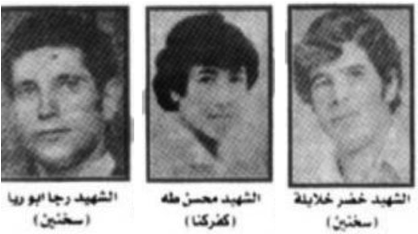
ارتقى نتيجة الصدامات البطولية مع قوات الاحتلال ستة شهداء: ثلاثة من سخنين هم خديجة قاسم شواهة ورجا أبو ريا وخضر خلايلة، وخير ياسين (من عرابة) ومحسن طه (من كفركنا) ورأفت علي زهيري (من مخيم نور شمس في الضفة الغربية واستشهد في الطيبة). هذا فضلاً عن 49 جريحاً ونحو300 معتقل. فيما أصيب من شرطة الاحتلال 20 شرطياً.
لا يختلف إثنان على أنّ يوم الأرض شكل علامة فارقة في تاريخ الصراع الوجوديّ بين أبناء شعبنا في فلسطين المحتلة وقوات الاحتلال. فكانت هذه واحدة من المحطات الأبرز في تاريخ المقاومة الوطنية الفلسطينية المستندة إلى إرادة شعبية موحدة تمكنت من قيادة مواجهات بطولية ضدّ المحتل اليهودي على الرغم من انعدام الموارد واختلال موازين القوة المادية.
يوم الأرض، نجمة مضيئة في تاريخنا القومي المليء بوقفات البطولة، يستمدّ شعبنا الفلسطيني منها روحه المقاومة، فكان في العام 2018 شرارة الانطلاق لمسيرات العودة التي انطلقت من قطاع غزة المحاصر باتجاه أرضنا الفلسطينية المحتلة عام 1948. فأراد أهلنا المقاومون في غزة، ومن ضمنهم رفقاؤنا في منفذية جنوب فلسطين، أن يجعلوا من هذا التاريخ – الثلاثين من آذار – تاريخاً محفوراً في الذاكرة القومية أنه تاريخ حياة التي لا يمكن أن تكون إلا وقفة عز فقط.
*عضو المجلس الأعلى في الحزب السوري القومي الاجتماعي.
Kabbalistic Balance
-
Kabbalistic Balance August 6 2026 ___________________________________ More
Vids! +BN Vids Archive! HERE! ___________________________________ Support
The Br...
Report on Beth Israel vigil 07-04-26
-
*1A Rights under combined attack from local government plus media*
Ann Arbor City Council is at it again. Right before the long 4th of July
weekend, they ...
-
Hello all,
It is with great sadness that I share with you the passing of our beloved
sister, Mother, and Grandmother, the individual that you all knew ...
Best Horror Podcast
-
Best Horror Podcast Introduction: Horror podcasts […]
The post Best Horror Podcast appeared first on Copper Shock Horror Podcast.
Ikhras Endorses Muntadhar Al-Zaidi
-
“Oh parties of banditry and sectarianism and corruption, we have come and
our goal is to destroy you.” Ikhras formally endorses Muntadhar al-Zaidi,
Iraqi j...
Prince Charles: Foreign Jews behind bloodshed in ME
-
In May, 2017, British Crown Prince Charles declined an invitation from
Zionist entity’s president Reuven Rivlin‘s to attend the 100th anniversary
of the no...
Palestinian Women – One for All, All for One
-
Honouring All Palestinian Women by Honouring Three: Hanin Zoabi, Ahed
Tamimi, Samah Sabawi Vacy Vlazna “Palestinian women have always stood side
by side ...
US’s Saudi Oil Deal from Win-Win to Mega-Lose
-
By F. William Engdahl Who would’ve thought it would come to this? Certainly
not the Obama Administration, and their brilliant geo-political think-tank
neo-...
-
*Mordechai Vanunu wins human rights prize of Brazilian Press Association *
* http://www.alternativenews.org/english/index.php/features/updates/7038-mordechai...
Abdul Aziz Rantissi:
"My ultimate wish, my God, is to attain martyrdom,"...God granted him his wish on April 17, 2004, at the hands of Israeli assassins.