Showing posts with label Land Day. Show all posts

Thursday, 1 April 2021

Land day: Israel’s programme of Palestinian land theft goes on undisturbed


Palestinian protesters mark Land Day in the Umm Al-Hiran village in the Wadi Atir area of the Negev (Naqab) desert (AFP)
Ghada Karmi is a former research Fellow at the Institute of Arab and Islamic Studies, University of Exeter. She was born in Jerusalem and was forced to leave her home with her family as a result of Israel’s creation in 1948. The family moved to England, where she grew up and was educated. Karmi practised as a doctor for many years working as a specialist in the health of migrants and refugees. From 1999 to 2001 Karmi was an Associate Fellow of the Royal Institute of International Affairs, where she led a major project on Israel-Palestinian reconciliation.

Ghada Karmi

30 March 2021 13:32 UTC | Last update: 

For Palestinians, Land Day continues to be an inspiration and a tribute to the just struggle of an unbowed people for their land

The centrality of the struggle for land has always been fundamental to understanding the Israeli-Palestinian conflict.

It is at the heart of two major events whose anniversaries fall due on 30 March. The first, Land Day, commemorates the surge of Palestinian resistance to the takeover of their land by Israel in 1976; and the second marks the start of the Great March of Return in 2018, when thousands of Palestinians in Gaza demonstrated for the right of refugees to return to their confiscated lands in Israel.

From the start the Zionist movement was predicated on the acquisition of an empty territory on which to establish a state exclusively for Jews. Since no such land was available in the Palestine of the time, it had to be carved out, first by purchase, and later by war.

The land-grabbing journey

As Jewish immigrants began to arrive in the country in increasing numbers after 1917, Zionist organisations such as the Jewish National Fund and the Palestine Jewish Colonisation Association set about buying Palestinian land, provided it was untenanted at the time of purchase.

Today, Israel’s settlements have meant that Palestinian ownership of West Bank and East Jerusalem land has shrunk to under 13 percent

Many Arab landowners living outside Palestine, in addition to a minority of Palestinian peasants, sold them land. These sales were mainly motivated by economic necessity, since the Zionist organisations had access to foreign funds unavailable to Arabs.

Years of intense Zionist effort, however, yielded disappointing results. By 1947, and despite their funding and connections to powerful supporters of Zionism, these organisations had acquired no more than a meagre 6.7 percent of Palestine’s land.

But this disappointment was soon reversed by the Arab-Israeli war of 1948. In that war Israel captured 78 percent of Mandate Palestine, taking large swathes of Palestinian land, mostly untenanted thanks to population flight and expulsions in the war. 

After 1948 the new Israeli state swiftly enacted a series of laws designed to acquire more Palestinian land by pseudo-legal means. These included the 1950 Absentee Property Law, permitting the state to take over Palestinian land and property in their owners’ absence; and soon after, the 1953 Land Acquisition Law, which introduced a new category of “state lands” and “closed areas”.

This had the effect of making the state the majority owner of the land, which was to be permanently out of the reach of its previous Palestinian owners.

Subsequent events up to and including the 1967 Arab-Israeli war, that put Israel in occupation of the rest of Palestine, have been stages on the same land-grabbing journey. Today, Israel’s settlements have meant that Palestinian ownership of West Bank and East Jerusalem land has shrunk to under 13 percent. That is set to diminish further as the settlement process continues with further land loss. 


Palestinian children hold up pictures of keys, symbolising the homes they left behind (AFP)

This is the background to the dramatic protests of Land Day in 1976. Their trigger at the time was the Israeli government’s plan to expropriate thousands of dunums of Arab land in the Galilee to build Jewish industrial villages. In line with the Israeli government’s 1975 “Galilee Development Plan” to expand Jewish settlement, it would accelerate Judaisation of what was a majority Arab area. 

A turning point

On 30 March a general strike was called, and widespread demonstrations in Arab towns erupted from the Galilee to the Negev. Thousands marched in protest, while solidarity demonstration were held in the Occupied Territories and the Palestinian refugee camps in Lebanon.Land Day: A potent symbol of the Palestinian struggle

Unexpected at the time from what had been a largely quiescent Arab population, Israel was alarmed and deployed thousands of police, army units and tanks to quell the protests. Six Arabs were killed, hundreds wounded, and hundreds more arrested.

Land Day, as it became known, was a turning point. It was the first time since 1948 that the Arabs in Israel acted as a national collective, refusing to accept the theft of their land after years of control by Israel’s military rule. Land Day was an expression of national pride and self-confidence. It marked the assertion of an Arab presence that Israel’s politics could no longer ignore, and the starting point for Arab political participation in Israel. 

From that time to this, Land Day has been commemorated annually by Palestinians everywhere. In 2018 it was marked by the start of another great Palestinian protest over land. The Great March of Return saw 30,000 Palestinians in Gaza demonstrate near the Israeli separation fence of electrified barbed wire and sensors. It was a peaceful protest, demanding the right of refugees to return to their lands and an end to the blockade of Gaza. Intended to last from 30 March to 15 May, Nakba Day, the same protests took place every Friday.

A double heroism

As in 1976 Israel retaliated with murderous violence. Between 30 March and 15 May 2018 an estimated 110 protesters were killed, and 13,000 wounded by a combination of sniper fire and drones. By the time the March of Return was halted by Hamas in December 2019, 214 people had been killed, and 36,000 wounded. Of these, 1,200 needed long term rehabilitation following bone infections and limb injuries. Israeli soldiers seemed to be using a “shoot-and-maim” policy, deliberately targeting the legs of protestors to cause maximum disability.

Land Day marked the assertion of an Arab presence that Israel’s politics could no longer ignore

Gaza’s health system, damaged by years of blockade, understaffing, and equipment and power shortages, has been unable to cope with the toll of so many injured. Yet that did not stop Palestinian youth braving death and injury each week for nearly two years, and creating a new Palestinian legend to commemorate on 30 March. 

Israel never changed course in the face of that double Palestinian heroism celebrated on Land Day. It went on to build “Development towns” for Jews, 26 by 1981, with the effect of altering the Galilee’s demography in favour of Jews.

In Gaza, likewise, the blockade continues, and Israel’s pretext of its brutality as self-defence against the Great March of Return has been accepted by many Western governments. Its programme of Palestinian land theft goes on undisturbed.  

But for Palestinians on 30 March, Land Day continues to be an inspiration, and a tribute to the just struggle of an unbowed people for their land.

The views expressed in this article belong to the author and do not necessarily reflect the editorial policy of Middle East Eye.

Related

Historical References:


River to Sea Uprooted Palestinian   
The views expressed in this article are the sole responsibility of the author and do not necessarily reflect those of the Blog!

Land Day 2021: Existence, Resistance, Resurgence

 March 30, 2021

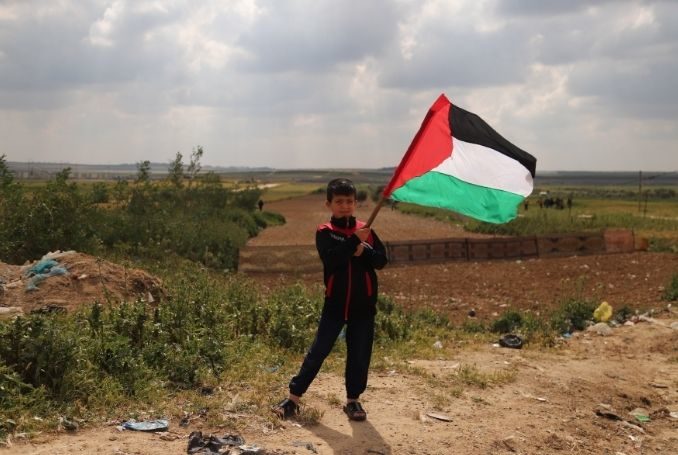
A child raising a Palestinian flag on Land Day. (Photo: Fawzi Mahmoud, The Palestine Chronicle)

“In 2019 I went to Palestine twice,” wrote Ibtisam Barakat, “one time with Palestine Festival of literature in April.” When an officer informed her at the border that she didn’t exist in Israeli records, Barakat started to cry. She “cried for two weeks nonstop. Nothing and no one could stop [her], not even a delicious falafel sandwich.” All that time, recalled the Palestinian-American poet, she “ate falafel and cried.”

On Land Day 2021, Barakat’s words are more relevant than ever. Forty-five years ago, on March 30, 1976, Israeli police murdered six Palestinian protestors as they were calling attention to the Israeli government’s expropriation of thousands of dunums of Palestinian land. Since then, notes Yara Hawari, March 30 has been commemorated as Land Day.

An important “event in the Palestinian collective narrative,” explains Hawari, it incorporates resistance to colonization, in particular “colonial policies of erasure,” efforts by Israelis to erase all Indigenous presence on the land. Indeed, since 1948, Palestinians have defied those policies with characteristic sumud (resilience), both by holding fast to a collective narrative that incorporates individual perspectives.

When Barakat returned to Palestine, an officer asked why she was coming back a second time in one year. At the time, she had no idea how to reply. “Now,” she explains, she knows “the world was going to change and the universe knew that I needed to see Palestine twice in a year” before it became impossible. “Seeing my Palestine or not seeing my Palestine is a spiritual experience for me,” she says, thereby calling attention to her individual refusal to be erased that is in turn part of a collective experience.

On March 30, 2018, Palestinians in Gaza began a series of weekly demonstrations that would last for months, resulting in a staggering number of deaths and injuries from Israeli snipers that drew the attention of the media. What did not get covered so much were the cultural aspects of the rallies—storytelling, cooking traditional dishes, performing dabke, and even weddings took place—thereby passing down traditions to a younger generation.

“What is largely missing from the discussion on Gaza is the collective psychology behind this kind of mobilization,” writes Ramzy Baroud, “and why it is essential for hundreds of thousands of besieged people to rediscover their power and understand their true position, not as hapless victims, but as agents of change in their society.”

In the same way that Barkat worked through her grief at being told of her non-existence, so Palestinians on a collective scale have maintained a narrative that resists the official story. As Baroud explains,

“For 70 years, Palestinians have embarked on that journey of recreation of the self. They have resisted, and their resistance in all of its forms has molded a sense of collective unity, despite the numerous divisions that were erected among the people. The Great March of Return is the latest manifestation of the ongoing Palestinian resistance.”

Two years later, in 2020, the spread of Coronavirus added to ongoing problems. In order to provide a safe space to commemorate the day, Samidoun: Palestinian Solidarity Network issued a virtual call to action:

“Mark Palestine Land Day (Yawm Al-Ard), a day of remembrance for six Palestinian citizens who were murdered by Israelis while protesting the Israeli government’s expropriation of thousands of dunums of their land. March together online on the second anniversary of the Great March of Return.”

Thanks to donations from Russia and the UAE, Gaza recently initiated a vaccine program in an effort to confront the virus pandemic and break the cycle of deaths.

According to Hawari, Land Day commemorates ongoing resistance, but it also “reminds us how the domination of space is an integral aspect of the Zionist settler-colonial project.” Moreover, she points out, “settler-colonial states the world over are in a constant process of colonizing more and more indigenous land while squeezing indigenous peoples into as little space as possible.”

In order to steal more land, colonists in both Israel and North America developed the myth of the vacant land. For example, on March 8, 1969, Golda Meir reportedly asked: “How can we return the occupied territories? There is nobody to return them to.”

Propaganda around the Indigenous in North America sounds much the same. As Steven Salaita tweeted: “you’ll never understand Zionism without a concomitant understanding of Manifest Destiny,” a phrase devised in 1845 to explain that the United States was destined—by God, its advocates believed—to expand its territory across the entire North American continent.

“Of all myths associated with American Indians,” explains Dina Gilio-Whitaker (Colville Confederated Tribes), “no myth is as pervasive as the myth of the vanishing Indian.”

In my American history classes, there would invariably be the student who said that Native people no longer exist, despite the fact that just by looking around the classroom that student might have reached a different conclusion. Nevertheless, because dominant society has been “indoctrinated with the idea of the vanishing Native their whole lives,” Gilio-Whitaker asserts, “the assumption that there is no such thing as real Natives anymore is like a software program constantly running in the background.”

To these deniers, the “real Indians were the ones who dressed in buckskins and hunted buffalo and deer for their living, and didn’t speak English,” Gilio-Whitaker notes, and, in reality, they have “been gone a long time.”

Despite all of the efforts to deny their existence, which makes it all the easier to steal land and resources, both Palestinians and Indigenous people in the States are still around. The commemoration of Land Day attests to that, as do efforts on the part of Native Americans to make their presence known.

Quoting Gerald Vizenor, a citizen of the White Earth Nation, Roxanne Dunbar-Ortiz calls attention to his notion of “survivance”:

“Survivance is an active presence: it is not absence, deracination, or ethnographic oblivion, and survivance is the continuance of narratives, not a mere reaction, however pertinent. Survivance stories are renunciations of dominance, the unbearable sentiments of tragedy, and the legacy of victimry” (An Indigenous Peoples’ History of the United States, 2014, p. 217).

Decades after their displacement, the Palestinians long for a place, a homeland that could provide them with grounding to affirm that they exist. In the introduction to Nakba: Palestine, 1948 and The Claims of Memory (2007), Ahmad Sa’di and Lila Abu-Lughod write that “making memories public affirms identity, tames trauma, and asserts Palestinian political and moral claims to justice, redress, and the right to return” (p.2).

Memory, then, “continuance of narratives” as Vizenor calls it, serves as an expression of the need to officially exist. Manifested in events like Land Day, alternative histories affirm what happened in the past but also what should be done in the present to assure that all formerly oppressed peoples have a future.

– Benay Blend earned her doctorate in American Studies from the University of New Mexico. Her scholarly works include Douglas Vakoch and Sam Mickey, Eds. (2017), “’Neither Homeland Nor Exile are Words’: ‘Situated Knowledge’ in the Works of Palestinian and Native American Writers”. She contributed this article to The Palestine Chronicle.

Related


River to Sea Uprooted Palestinian   
The views expressed in this article are the sole responsibility of the author and do not necessarily reflect those of the Blog!

Wednesday, 31 March 2021

Land Day: Palestinians mark the 45th anniversary

 Palestinian farmers say they face constant threats while working on family lands due to Israel’s annexation policies

Gaza farmer working on land MEE
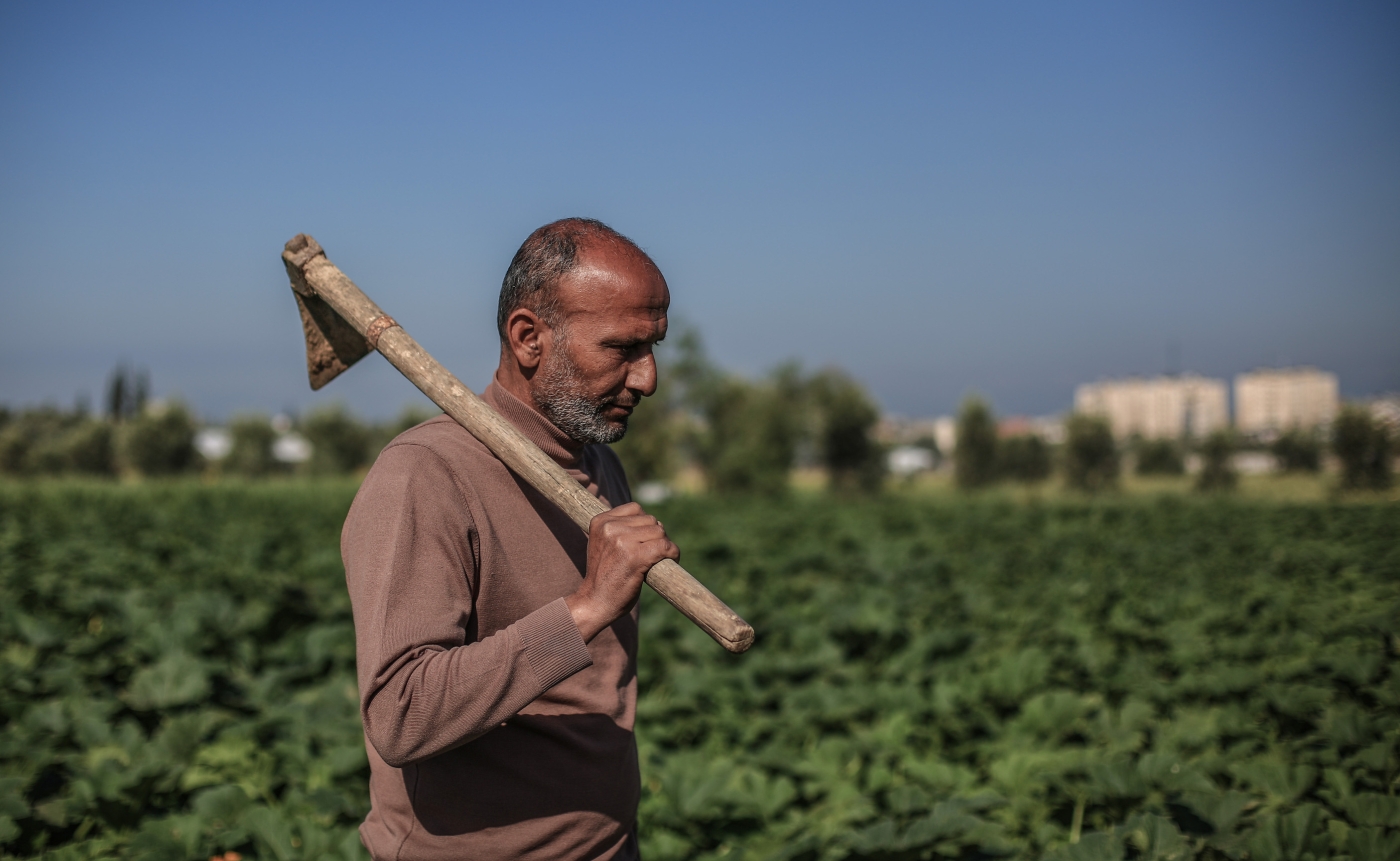
Iyad Abughleiba, a Palestinian farmer, finds it increasingly difficult to work on his land in the Gaza Strip due to Israel’s annexation policies. (MEE/Sanad Latifa)

By Maha Hussaini in Gaza Strip

Published date: 30 March 2021 12:22 UTC 

On 30 March 1976, six Palestinians were killed by Israeli forces as hundreds of Arab citizens in the occupied territory took to the streets to protest Israel’s expropriation and occupation of Palestinian lands.

The event became known as the Land Day and a symbol of national struggle that unites Palestinians around the world.

Forty-five years later, Palestinians say that not much has changed, as Israel continues its policy of annexation.

Middle East Eye met with Palestinian farmers and land owners in the Gaza Strip, who have been unable to access hundreds of dunums of land belonging to their families due to Israel’s restrictions and annexation policy.

Land theft normalised

Iyad Abughleiba, 49, a Palestinian who owns agricultural land in the eastern central Gaza Strip, says that farmers find it increasingly difficult to work in the blockaded enclave as Israel continues to “normalise land theft”.

Since age 15, he and his brothers would help their father cultivate the family lands. When his father passed away, the siblings inherited the lands and continued to work as farmers.

“My grandfather had owned more than 400 dunums of land. But over the years, and with every Israeli decision or new policy, the lands have been gradually shrinking. Today we only have 25 dunums left,” Abughleiba told MEE.

‘Our safety depends on the Israeli soldiers’ mood. You could be killed at any moment’

– Iyad Abughleiba, Palestinian farmer

Although Israel dismantled its settlements in Gaza in 2005 and withdrew its forces and settlers from the enclave, it still controls vast areas of land in the northern and eastern perimeter of the Strip.

“Israel’s disengagement from the Gaza Strip is the biggest lie. They are controlling every inch of the Strip – the land, the sea, and can you hear that noise? They are also controlling the air,” Abughleiba said as an Israeli drone buzzed at low altitude above his land.

“Like the majority of Palestinians, our grandparents lost most of their lands in Gaza and the West Bank during the [Palestinian] Nakba. But land theft did not stop here.”

The Nakba, meaning the “disaster, catastrophe or cataclysm”, marks the partition of Mandatory Palestine in 1948 and the creation of Israel. At least 750,000 Palestinians were displaced from their homes that year. A further 280,000 to 325,000 fled their homes in territories captured by Israel in 1967. 

Following its disengagement from the Gaza Strip in 2005, Israel established a “buffer-zone”, a military no-go area that stretches across the Strip’s borders with Israel. The first reference to a buffer-zone in the Strip appeared in the Oslo Accords in 1993, which mentioned a 50-metre wide area along the enclave. 

Today, it extends to more than 300 – 2,000 metres inside the Strip.What is the Nakba? Day of catastrophe for Palestinians, explainedRead More »

“When Israel first established the buffer zone, we lost part of our lands. Then when they expanded it in 2009, we lost another part. This is how they gradually annex more parts of our lands every now and then,” Abughleiba explained.

Abughleiba is always on high alert while farming, even though it’s been a couple of years since Israel last annexed parts of his family’s lands.

“Even if the rest of our lands is still accessible, we are always cautious due to threats of crops being bulldozed or shots being fired at us whenever we are working.

“In 2008, the Israeli forces bulldozed our lands, uprooting dozens of olive trees and destroying a water well. In 2014, during the war on Gaza, they did it once again,” he said.

Gaza farmers and landowners bear the brunt of Israel’s policies, facing periodic bulldozing of lands, flooding of crops, and shooting by Israeli forces stationed adjacent to their lands.

“After they bulldozed our lands, we planted them again and still insist on coming back to them because they are our only source of living.

“But after all, our safety depends on the Israeli soldiers’ mood. You could be killed at any moment.” Abughleiba told MEE.

‘Modernised’ methods to steal land

Um-Emad is a Bedouin woman who was expelled from her family’s land in Beersheba during the Palestinian Nakba in 1948.

The 79-year-old lives in a small room in her sons’ house, built in the middle of their agricultural land in the eastern Bureij, in the central Gaza Strip.

For Um-Emad, living on agricultural lands is part of her family’s heritage.

‘I can never imagine my life away from our land. One metre of this land is worth a thousand apartments elsewhere.’

– Um-Emad, 79, Gaza resident

“I can never imagine my life away from our land. One metre of this land is worth a thousand apartments elsewhere,” she told MEE as she sat on the ground of her room overlooking the fields.

“If I have to leave my land in Gaza, then it has to be to my family’s land in Beersheba. That is the only place I can leave to before I die.”

Um-Emad, who was evicted to Gaza at gunpoint when she was six years old during the Nakba, thinks that Israel intends to make Palestinians pay a high price for sticking to their lands, while facilitating their migration from the Gaza Strip and the West Bank.

For years, Israel has been implementing an annexation plan in the West Bank that was accelerated following the announcement of former US president Donald Trump’s “deal of the century”, in January 2020.

As a result, dozens of families across the West Bank and East Jerusalem have been evicted and displaced.

According to rights groups, Israel’s annexation of Palestinian lands constitutes a flagrant violation of international law, and “can have no effect on the legal status of the territory, which remains de jure occupied”.


Palestinian farmers in Gaza Strip
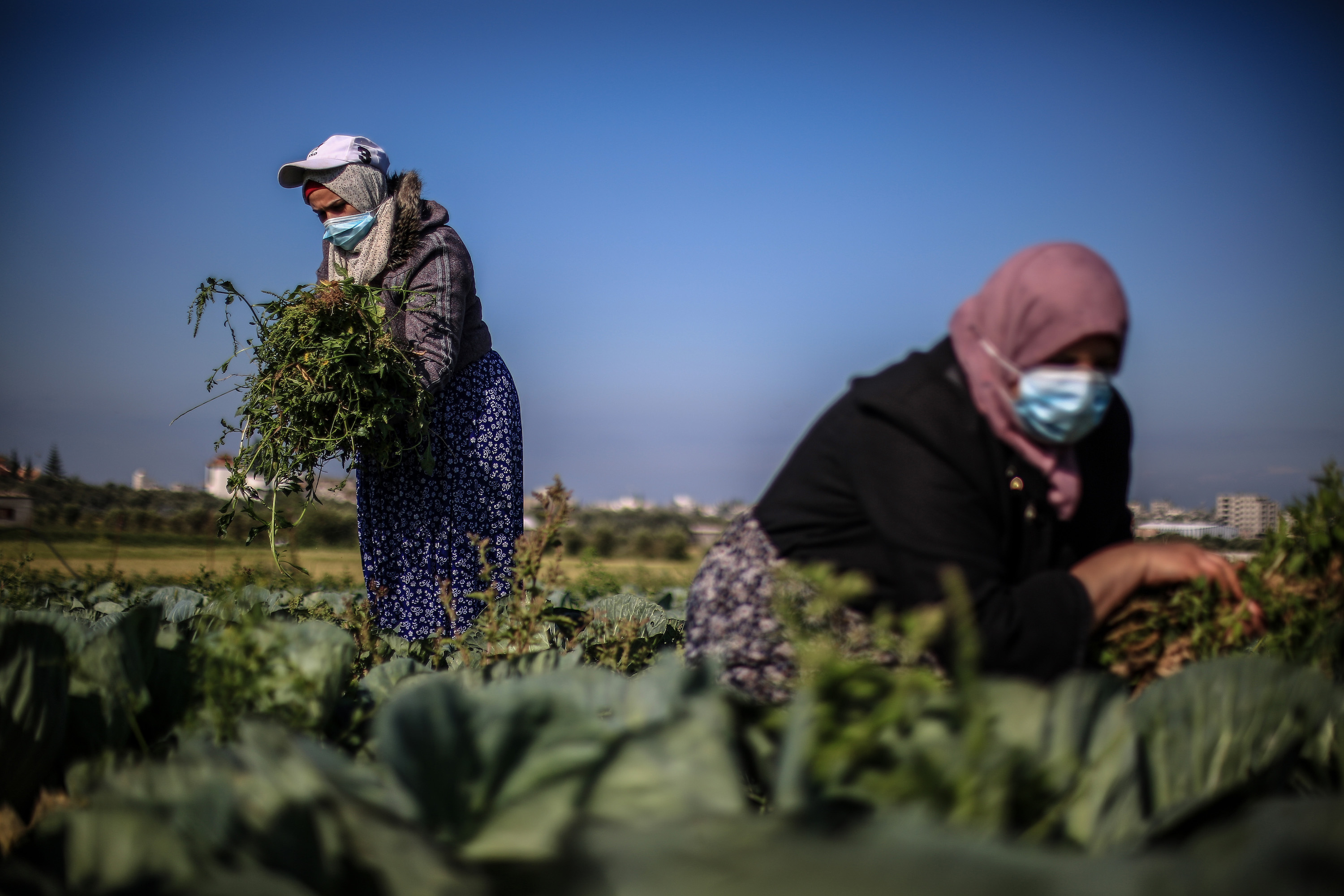
Palestinian farmers work in the fields in the Gaza Strip (MEE/Sanad Latifa)

“Israel today implements a systematic policy of forcing Palestinian residents in the Gaza Strip and the West Bank to migrate and leave their lands.

“The occupation does this both softly and by force. They make Palestinians believe that living in Europe with better life standards is a dream, and thus make thousands of youth leave in search for a better life, in order to make room for [Israeli] settlers.

“We are being forced to abandon our lands, but I would rather be buried here before selling one centimetre of my family’s land,” he said.

‘Every day is Land Day’

Jalal Abujlala, 47, depends mainly on his agricultural land in the eastern central Gaza Strip for living.

But with the remaining area of land after annexation by the buffer zone, the father of eight children can barely cover his family’s expenses, which include the tuition fees for his daughter who’s attending university to study medicine.

‘I always tell (my children) about our stolen lands, and that one day we will regain them back’

– Jalal Abujlala, 47, Gaza farmer

“A large part of our lands was annexed by the Occupation during the Palestinian Nakba and also due to the establishment of the Israeli buffer zone. Now the remaining area can only provide the life’s necessities,” said Abjlala.

“I can see my family’s annexed lands in the occupied territory from here. Sometimes, I approach a bit and take my children to see them. I always tell them about our stolen lands, and that one day we will regain them back,” he said.

“You would think that cultivating in this land is safe since it is not very close to the Israeli borders. But in fact, it does not have to be close in order for the farmers to be hurt,” he continued, recalling memories from Israel’s military attack on Gaza in 2014, where artillery shells targeted vast areas of agricultural lands.

“Owning a land in our country comes with no guarantees. At any moment you are threatened with bulldozing or eviction and annexation.”

For Abujlala, Israel’s measures in the Gaza Strip and the West Bank are similar to the event that sparked the Land Day demonstrations in 1976.

“History repeats itself. The Land Day happens everyday in Palestine.”


River to Sea Uprooted Palestinian   
The views expressed in this article are the sole responsibility of the author and do not necessarily reflect those of the Blog!

Tuesday, 31 March 2020

Land Day Report: Sharp Rise in Illegal Jewish Settlement Building in West Bank


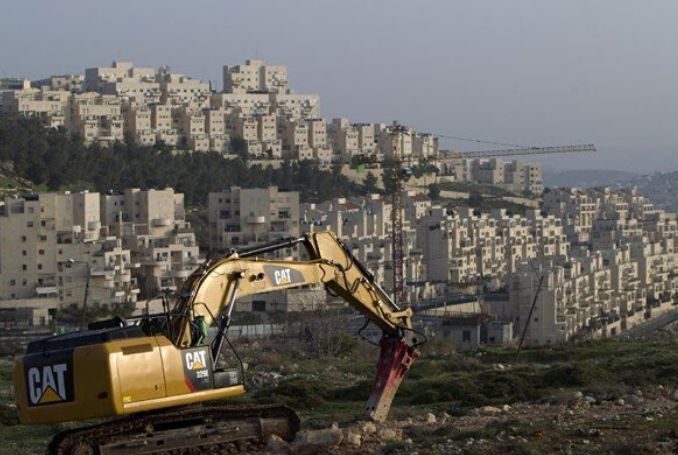
Israel is accelerating settlement expansion in the occupied West Bank. (Photo: File)

Newly-released statistics show a sharp rise in the building and expansion of illegal Israeli settlements in the occupied West Bank, including East Jerusalem, Quds Press reported on Sunday.
According to a report issued to mark Palestine Land Day today, the Palestinian Central Bureau of Statistics (PCBS) said that the number of Jewish settlements and outposts now stands at 448.
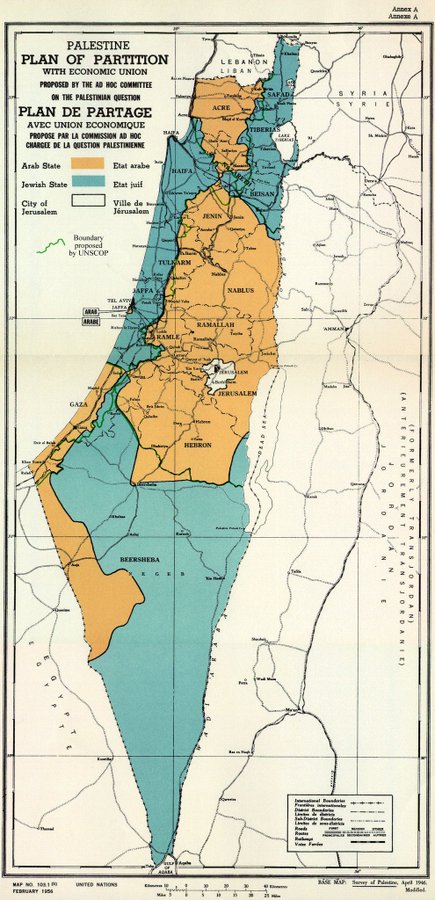
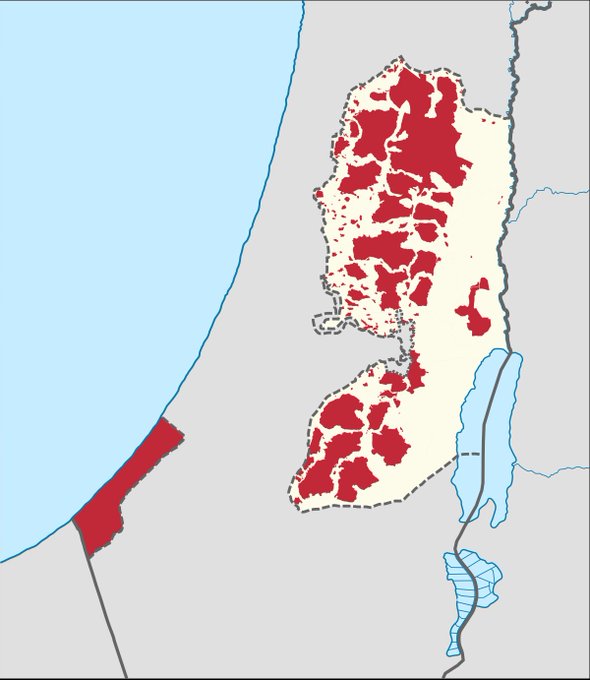
This one on the left is the 1947 partition plan of Palestine.

The one on the right is what is left of Palestine currently because of illegal Israeli settlements. Palestinians fully lost the North part btw and now they only have the red separated parts.


View image on TwitterView image on Twitter
This includes 150 settlements approved by the Israeli government, 26 outposts that are regarded as extensions of approved settlements and 128 outposts that have been built without the approval of the government.
In the report, the PCBS pointed out that the number of Israeli settlers in the occupied West Bank was 671,007 by the end of 2018. Furthermore, last year, the Israeli occupation authorities approved 8,457 new settlement units and 13 new outposts.
In the same period, the Israeli authorities demolished 678 Palestinian facilities, including 251 residential buildings, and issued 556 orders for Palestinians to stop work on building new homes or renovating older premises.
Under international law, Jewish settlements constructed in the Occupied Palestinian Territories constitute a violation of international law and are considered illegal.

(Palestine Chronicle, MEMO, Social Media)

River to Sea Uprooted Palestinian   
The views expressed in this article are the sole responsibility of the author and do not necessarily reflect those of the Blog!

Thursday, 19 September 2019

On Criticism of Palestinian Resistance

Palestinian Ghandi.jpg
The Oxford definition of ‘terrorism’  is: “the unlawful use of violence and intimidation, especially against civilians, in the pursuit of political aims.”    Although the term could apply to the belligerents in many wars, the term ‘terrorism’ takes on its everyday meaning when violence is perpetuated by the weak in resistance to the powerful.
What other form of resistance is available to an oppressed people?  One does not have to search hard to find a Jewish source begging for the peaceful resistance of a Palestinian Gandhi or King.
The request itself is odd, it invites a comparison to the conditions Gandhi and King fought, and is an implicit, although perhaps unintended,  admission that Israel represents another oppressive racist regime.
It takes chutzpah to complain about the form of resistance employed by the people you are oppressing. Why are the Palestinians obliged to meet violence with nonviolence? Certainly  you have to take your victims as they are.
Gandhi wrote about the uses of nonviolent resistance and King referred to Gandhi’s writings. For Gandhi and King nonviolence was not an end in itself, it was a strategy, a means to achieve a goal. Despite later deifications, neither Gandhi nor King was a saint,  they were leaders who employed non violent resistance because it was effective under their circumstances.
Both men were vastly outpowered by the brutal regimes they opposed. Nonviolence did not allow them or their followers  to escape injury or death, their battles required at least as much physical bravery as for any soldiers.
Both Gandhi and King deliberately provoked their enemies and then refused either to back down or to physically fight back. The decision to meet violence with nonviolent resistance was a powerful tool used to expose the brutality of the regime. The march to Selma would have amounted to little without the press. What they ‘achieved’ was  an unforgettably painful display of violence. To the extent nonviolence succeeded for King, it was because the ‘soldiers’ on the other side gave Americans a clear picture of the savagery to which blacks were subjected. It became increasingly difficult for those who had long averted their eyes to claim ignorance.
One reason the Palestinians are portrayed as ‘failing’ to meet the standard set  by Gandhi or King is that their use of the tactic of nonviolence has not attracted sympathetic coverage, it has not been effective enough in exposing Israel’s brutality. There are, of course, numerous examples of peaceful Palestinian resistance. One example is commemorated on ‘Land Day’ remembering the day in 1976 that Israel killed peaceful Palestinian protesters. Another occurred during the first intifada, as Neve Gordon writes in 972, when the “Palestinians adopted massive civil disobedience strategies, including daily protests” against Israel’s occupation. Israel responded with violence and  mass incarcerations. While they could easily provoke violence through peaceful protest, the Palestinians could not win the media nor shame the Israelis into change.
This, of course, begs the question of control of the media. King  was extensively covered in the media.  Do the Palestinians have access to the same?  At best, Haaretz might decry the proportionality of Israel’s violence, but will it explore the true meaning of Palestinian protest, both the original and the ongoing taking of their property and destruction of their society? Would  the international press do any better?
As I was writing this I realized that Palestinian nonviolent protests in Gaza have had perhaps a small effect on public opinion. The mainstream media in the US is universally favorable to Israel, but although they tried, the media was not entirely successful in creating sympathy for the  Israeli snipers. For example, The Guardian, in reporting that one year into the protest, the Israelis had killed 190 and wounded 28,000, noted that, “Children, journalists and medics have been killed, even when they were standing far back from the fence.”  Spin that one. Here’s an attempt by Eric Yoffe,  a self-described ‘liberal’ American Jew,  to justify killing protestors who had not killed a single Israeli.  “If 100 Jewish bodies were strewn across southern Israel, would the American left more readily forgive Israel’s defensive actions against an angry mob of tens of thousands propelled by the murderous, anti-Semitic terrorists of Hamas?”  This is simply a variation on the “I thought he was going to hit me so I hit him back first” defense. Perhaps the need to resort to such a  feeble rationale helps explain why we finally have a tiny Congressional support group for the Palestinians. Seventeen were so daring as to vote against an anti BDS bill.
Further, Israel has shown little sign that it is willing to change its basic  oppressive policies in response to any actions or restraint by the Palestinians. This is an interesting video in which Israeli ‘settlers’ are asked if they would move if told to do so by their government and knowing the move would mean peace in the region.  Their responses are variations on “No, I would not, it is my land.” Perhaps they are merely following the lessons of their religion.
In the story of Exodus, recounted annually even by many secular Jews at Passover, Moses unsuccessfully begs the Pharaoh for his peoples’ freedom. The lesson to be learned: Jewish liberation comes only after Egyptian civilians are subjected to terrible brutality.

River to Sea Uprooted Palestinian   
The views expressed in this article are the sole responsibility of the author and do not necessarily reflect those of the Blog!