Showing posts with label Bouazizi Revolution. Show all posts

Thursday, 11 June 2020

النسخة الأميركيّة من بو عزيزي ونهاية التاريخ

ينظر كثيرٌ من البشر عبر العالم، بمن فيهم نحن، للنظام الأميركي على انه النظام الأمثل والأكثر كفاءة ومقدرة على الإنتاج والإبداع وعلى رعاية المواطن صحياً واجتماعياً واقتصادياً، وهذه الرعاية لا تشمل المواطن الأميركي داخل بلادة فحسب، وإنما تمتدّ لترعاه أينما كان في العالم الفسيح، النموذج الأميركي لطالما بدا لامعاً وجاذباً، فهو مجتمع الفرص الفرص للأذكياء وأصحاب الحظ السعيد، مجتمع الحرية والمساواة والمواطنة. لقد كان لهذه الرؤية منظروها من أكاديميين وفلاسفة ورجال أعمال وسياسة ونجوم سينما، ولعلّ مَن يستحق أن يذكر من بين هؤلاء اليوم هو الفيلسوف الأميركي ذو الأصل الياباني فرنسيس فوكوياما الذي قدّم واحدة من أشهر وأقوى التعبيرات عن هذه الرؤيا من خلال نظريته التي شغلت أوساط الساسة والمثقفين في نهاية الألفية الراحلة والتي أسماها نهاية التاريخ.
رأى فوكوياما أنّ أنظمة الحكم عبر التاريخ الواضح والجلي قد أثبتت فشلها وتهافتها، من الأنظمة البدائية الرعوية المغرقة بالقدم وشيوخ الجماعات القبليّة مروراً بالملكيات الوراثية المطلقة المستبدّة أو الدستورية، إلى الأنظمة التي اعتمدت المشروعيّة الدينية الإلهية، وكذلك الأنظمة القوميّة والاشتراكيّة والشيوعيّة على أنواعها، فيما يرى أن النظام الراسخ والعصي على الزلل والفشل، إنْ هو إلا نظام الديمقراطية الليبرالية وفق النموذج الأميركي، فالديمقراطية الليبرالية تمثل لديه العقيدة (الايدولوجيا) الوحيدة الصالحة والعادلة والتي لا يمكن تجاوزها باعتبارها قد حققت حاجات الإنسان الفرد والمجتمع على حد سواء، لقد اعتبرها النظام الأكمل والذي لم ولن يأتي المستقبل بما هو خير منه، هذه القطعيّة المطلقة والتي تتسم بالمبالغة الشديدة لا تنسجم مع جميع نظريات التاريخ التي ترى أن للتاريخ حركة دائبة ودائمة لا تتوقف.
أعادني حادث مصرع جورج فلويد لأعود بذاكرتي إلى فوكوياما ونظريّته، ومع أن عمليات القتل والتنكيل بالسود وأبناء الأقليّات العرقيّة أمر يكاد أن يكون يومياً ودائم الحدوث، إلا أن عناصر ومستجدات غير محسوبة قد دخلت على خطوط مصرع جورج فلويد وأدّت إلى التداعيات المتدحرجة كما حصل في حادثة انتحار المواطن التونسي بوعزيزي والتي كانت عود الثقاب الذي أشعل الشارع التونسيّ المحتقن بسبب سياسات وفساد الرئيس الأسبق زين العابدين بن علي، هذه الأحداث ما لبثت أن انتشرت بسرعة إذ كان قد أعدّ لها على مدى سنوات بصمت، لتطبيق نظرية الفوضى الخلاقة التي أطلق عليها تعسفاً اسم الربيع العربي، وكما قال المثل الدارج إن (طابخ السم لا بدّ له من تناوله)، كان لا بدّ للغرب أن يضرس بحوامضه ومراراته، في أوروبا كانت البداية على شكل موجات من اللاجئين والهاربين من جحيم تلك الفوضى، وفي الولايات المتحدة التي ظنت أن المحيط الأطلسي سوف يقيها شرّ زوارق المهاجرين، جاء حادث مصرع جورج فلويد ليمثل عود ثقابها الذي أشعل موجة الاحتجاجات العابرة لكامل الولايات، وهو الأمر الذي لم يكن بحسبان مراكز دراساتها واستطلاعاتها ومجسّاتها الاستخباريّة أن تتوقعه وبهذا الحجم، وبهذا المقدار من العنف الذي يتهدّد النظام (النموذج) الأميركي برمّته لا الحزب الجمهوري والرئيس دونالد ترامب فقط، هكذا أصبح النظام النموذج والأكثر تفوقاً ومنعة على مستوى العالم عسكرياً واقتصادياً عاجزاً عن التعامل مع فوضى داخلية ستقوده حكماً إلى أن لا يبقى على حاله، وقد يكون من المبكر الحديث بالأماني عن أفول هذه الشمس الأميركيّة المحرقة التي لطالما اكتوينا بنارها ومعنا العالم أجمع، فإن ذلك يبقى أمنية عزيزة على قلوب شعوب وأمم كثيرة.
مصرع جورج فلويد وما تلاه من أحداث له جذوره التاريخية التي تعود إلى الأيام الأولى لاكتشاف العالم الجديد والطريقة التي تعامل بها المستكشف الأوروبي الأبيض مع أهل البلاد الأصليين، ولاحقاً مع مَن تمّ استجلابهم مصفّدين بسلاسل الحديد من أفريقيا للعمل في مزارع القطن التي تزود مصانع مانشستر الإنجليزية بالقطن الخام، فمع كل مظاهر الديمقراطية ونظريات المساواة والمواطنة وأدبيات الحرب الأهلية وتحرير الرقيق، فإن التفرقة العنصرية تجاه ما هو غير أبيض بقيت قائمة ومتجذّرة في أعماق النفس الأميركية البيضاء، وهي إذ تنعكس داخلياً باتجاه معاداة السود والأقليات، فإنها تنعكس خارجياً تجاه العالم بأسره (ربما مع بعض الاستثناءات تجاه أوروبا الغربية)، كما أن عمليات القتل والتنكيل بأبناء العرق الأسود من قبل الشرطة تحدث بشكل دائم، ولكنها تحدث أيضاً على يد العنصريين وعصابات متطرفة مثل كولوكس كلان والتي وإن تراجعت حيناً فإنها كامنة لتنقض حيناً آخر.
اعتقدت المؤسسة الأميركية في العقد الماضي أنها تستطيع تجاوز الاحتقان الشعبي أو تأجيله أو على الأقل التخفيف من حدته بوجود رئيس أسود في البيت الأبيض، ولعل رئاسة اوباما استطاعت بالفعل تأجيل ذلك الانفجار، ولكنها لم تكن قادرة على أن تحول دونه خاصة وقد ترافق ذلك مع كساد اقتصادي وتراجع في أسعار النفط، وانعدام الرؤية الجمعية الأميركية التي تستطيع معالجة مشاكل البطالة وتسريح العمال والموظفين وتراجع خدمات الرعاية الصحية والمجتمعية وافتقاد القدرة على تلبية حاجات الطبقات الفقيرة والمهمّشة، ثم جاءت جائحة كورونا لتزيد من الأزمة الاقتصاديّة تدهوراً، وانتشر الوباء وتصاعدت أرقام المصابين والموتى، فيما الرئيس الأميركي ينحو باللائمة على الصين، ولم تستطع المؤسسات والمراكز الطبية والصيدلانية أن تجد دواء أو لقاحاً للوباء، مع ذلك يرفع الرئيس ترامب من سقف أزمته بقرع طبول الحرب على الصين وإيران وفنزويلا وسيف العقوبات القصوى (قانون قيصر) على دمشق وما إلى ذلك من هوس سياسي على غير هذه الدول بمقبلات الأيام.
على أحد ما أن يخبر فرنسيس فوكوياما أنّ مصرع جورج فلويد، المواطن الأميركي الفقير والمهمش والمجهول، قد أثبت تهافت نظريته، فالتاريخ لم ينتهِ بعد، ولن ينتهي، وأن النظام الأمثل والأكمل الذي حدث عنه قد أخذ يتهاوى على وقع دماء الضحية، وسوف تحدث انعكاسات خطيرة وربما سريعة على الدول التي تستظل بتلك الحماية، ومنها دول عربية لذلك علينا نحن أن نتذكر أن في عالمنا العربي أنظمة من هذا النوع يحكمها ملوك وأمراء ورؤساء هم خارج التاريخ وخارج الجغرافيا، فضائياتهم التي تنقل الأخبار وهي في الحقيقة ليست إلا ترجمة أخبار من فوكس نيوز( FOX NEO ) إذ تصور للمشاهدين أن ما يجري في أميركا وكأنها معركة أولئك الحكام لا معركة النظام الأميركي، وهم لا يدركون متى يأتي الدور عليهم ويطيح بعروشهم وتيجانهم على أيدي شعوبهم المقهورة.
*سياسي فلسطيني مقيم في فلسطين المحتلة.

River to Sea Uprooted Palestinian   
The views expressed in this article are the sole responsibility of the author and do not necessarily reflect those of the Blog!

Saturday, 9 August 2014

ASSAD’S WALL: ARAB SPRING FORWARD; ARAB SPRING BACKWARD

mohamed-bouazizi-tunisie.jpg
ASSAD’S WALL

ARAB SPRING FORWARD ARAB SPRING BACKWARD
Nobody can deny the heart-rending story of Muhammad Bu’azeezi, the Tunisian young man, who, despite his secondary school education, was not able to find a job in his society and was relegated to peddling vegetables to support himself and his family.

Even his effort to hawk sundries met with failure when a Tunisian policewoman scuppered his enterprise with legalistic impediments that evolved into crass insult, a spit in the face and a last curse upon the memory of his father.

Efforts to immediately obtain redress were rebuffed by an insensate bureaucracy.  He burned himself to death in a public act that enraged the people of this North African country and brought about the much-ballyhooed Arab Spring.

I grew up in the United States during the middle Fifties onwards.  My father and mother sent me back to the Old Country every summer to spend time with relatives and to maintain my facility with the Arabic language.

During this time, the memory of Palestine was more than fresh – it was a scalding vision of British tyranny and an indictment of the Arab governments which fumbled their way into abject defeat at the hands of Jewish refugees from Nazi Europe who were backed by one of the world’s most sophisticated networks of disinformation known up to that time.

The propaganda machine that was to kite the libelous slogan, “Give the land without a people to the people without a land”, was a minor intimation of what was to come when the Western powers and the pre-Iron Age troglodytes of Arabia combined to destroy the Syrian Arab Republic. My father was an ardent nationalist and adored Jamaal ‘Abdul-Naasser, the Egyptian leader who accidentally donned the cloak of Pan-Arabism and found it to his liking.

gamal-abdel-nasser

All of us repeated the same mantra: “If the Arabs could only rid themselves of their tyrannical leaders and unify their ranks, the Zionist Entity would cease to exist”.  Nasser was the man who was going to galvanize Arab societies and break the back of imperialist schemes to keep the Arabs as backward as they obviously were.  The Egyptian leader was tall and handsome with the demeanor of the simple man speaking in an unadorned style.

But, Nasser failed miserably. The tyrannical leaders, on the other hand, succeeded in not only delivering a heart attack to him, but also in keeping the Arabs locked somewhere between the Stone Age and the Ice Age.

Enter the Arab Spring

No one could have predicted Bu’azzeezi’s act of self-immolation.  But, there were parties who had planned for the eventuality of an Arab popular outburst that would rock the foundations of their corrupt governments.

There were plans hatched since at least 2007 by the CIA, MI6, Mossad and the Saudi/Qatari Perso-phobes to expel the Ba’ath Party from Syria in as ignominious a manner as that self-same process in Saddam’s Iraq.

It had to wait, however, for the right moment when the gaskets, corks and stoppers were compromised by the pressure of demoniacal forces bursting out like a giant volcanic eruption, spewing fire that would sweep away every vestige of Arab nationalism, leaving the way open for a Dark Age, an Arab Winter of obsequious altar boys prone to every fetish nestled in the folds of the deviant Wahhabist brain.
 images (1)

Zaynul-‘Aabideen Bin ‘Ali, Tunisia’s former president-for-life,  a favorite of the French colonial regime in Paris, was ousted through self-exile.  He, like Idi Amin, was welcomed in Saudi Arabia, which at the time had established itself as the Club Med for despised autocratic presidents, traitors and avowed cannibals.
images (2)

His departure was met with jubilation in the streets of Tunisia.  Muhammad Bu-‘Azeezi’s slow, agonizing death had begun to deliver on its promise – it was like a Celtic rite of Spring or a fertility sacrifice – the burning wicker man to end the drought and bring forth the abundance of the earth.  As of today, the Tunisians are fortunate they have not started to feed off one another.

Mua’mmar Qadhdhaafi
 download (1)
The Libyan supremo, Pontifex Maximus and Messiah, did not have the opportunity to retire in Saudi Arabia where he would have been beheaded anyways.  He was the second casualty of the misnamed Arab Spring.

His death at the hands of a sociopathic ape-adolescent wielding the leader’s personal pistol followed by a post-mortem act of sodomy were repugnant acts no doubt celebrated in Washington D.C. by the Neo-Con flophouse proprietors in an animistic act of self-celebration worthy of their Nazi progenitors.

Libya, stands today for the proposition that the British and French, when bound together by a common purpose, can only engender chaos, at best, and the Void, at worst.  Libya is a monumental catastrophe nobody can treat.  It is a suppurating chancre promising blindness and an horrible death.

Husni Mubaarak

 images (3)

The long-serving Pharoah of Egypt, was probably flummoxed by the protests to end his reign during which he and his sons amassed a significant fortune.

Like the Tunisian and Libyan leaders, he too had sons ready to step in and continue the dynastic rule over his largely proletarian peoples who subsisted on fava beans, affordable hashish and the immortal, but false, Egyptian motto: “Egypt is the Mother of the Universe”.

Now too old to matter, and on the brink of a peaceful departure into the realms ruled by Osiris, he is preparing for the ultimate kiss-off to his beloved people: a pardon from President Al-Sisi and a probable hospice in Saudi Arabia where he can shrivel up, like a mummy, in the dry air of the pitilessly desiccating sands of Arabia. In truth, and I don’t say this in order to minimize Bu ‘Azeezi’s suffering or the reasons for his private auto da fe, his death has come to mean nothing more than failure – more failure for the Arab people.
Instead of being the start of a movement to bring Arabs together, it has highlighted the reasons why they cannot.  It has furthermore emblazoned the role of former imperialist powers and the servitude the Arabs were programmed to relive while under their tutelage. 

That is, until the imperialist powers came up against the Ba’ath Party of Syria and President Assad!
 download (2)

It was the chance of a lifetime….a lifetime spread over geological eons of time.  Finally, with Ben-Ali, Qaddafi and Mubarak gone, Assad would fall also, and so, with that, all the planning in Tehran for the Shi’i Arc across the Fertile Crescent, which,  like a Sword of Damocles, pendulously swung over the offered necks of the European Jews in order to finally end the charade and put to death the mythology of a God who metes out real estate lots like the president of Century 21.

All the ducks were in a row:  the trained agents provacateurs, a crackpot American ambassador willing to travel around Syrian cities to motivate traitors and anti-minoritarian activists, the propaganda factories to illustrate how juvenile delinquents in Der’ah could become heroes of the revolution, Saudi and Qatari money spent on arms to challenge the power of the Ba’ath Party and its huge ideological army.

It was all there.  How could it fail?  It’s NATO, right? The Arab Spring was exposed as a canard after Tunisia, Egypt and Libya fell into a doldrum of Islamist mismanagement followed by a riotous plunge into the unknown.  While some Syrians took the bait, most wanted to wait and see.  Syrians, more than any other people, know a lot about their own country and how it’s administered.

Syrians know it isn’t easy to dislodge the Ba’ath, especially when there are over 100,00 members!  All throughout the tissue of the Syrian state is the presence of an arrogant and proud Arab nationalism that sniffs out imperialist plots and works to unravel them.

The symbols of fire and ice, used so much in this article, are forces of nature that have come up against the Wall of Assad.  Like the Great Wall of China or Hadrian’s, it will stand the test of time.

NATO and its simian allies in Arabia will beat their collective heads against this wall, which, unlike Herod’s in occupied Jerusalem, is a real wall, in a real place and with a real purpose; where the promise of Arab unity still lives and whose glowering, terrifying eyes beam down on the hapless invaders raining annihilation, Greek Fire and Hell’s Ice, upon them. 

Read more 


River to Sea Uprooted Palestinian   
The views expressed in this article are the sole responsibility of the author and do not necessarily reflect those of the Blog!

Tuesday, 21 May 2013

Saudi vegetable seller dies after self-immolation

Published Sunday, May 19, 2013
 
A Saudi newspaper says a vegetable seller who set himself on fire in Riyadh after police confiscated his goods for standing in an unauthorized area has died.

The website for newspaper Sada reported that the man, identified only by the family name of Sureihi, died in hospital late on Friday.

The self-immolation emulated that of a street vendor in Tunisia, whose 2011 death inspired a series of uprisings in the region.

Family members were seen outside the hospital Saturday demanding answers about why police confiscated the man's goods. Witnesses say the family wants to know what led him to douse himself in gasoline and set himself ablaze on Thursday.

Saudi officials refused to comment. They did not disclose the man's name or age.

Despite Saudi Arabia's oil wealth, many of its people live in poor conditions. Protests in the conservative kingdom are repressed and rarely reported on in the media.

(AP, Al-Akhbar)

Related Articles


River to Sea Uprooted Palestinian  
The views expressed in this article are the sole responsibility of the author and do not necessarily reflect those of this Blog!

Sunday, 10 February 2013

The Splintered History of the Tunisian Left

A protester gestures to police during a demonstration near the Interior Ministry in Tunis on 8 February 2013. Tens of thousands of mourners chanted anti-Islamist slogans on Friday at the Tunis funeral of secular opposition leader Chokri Belaid. (Photo: Zoubeir Souissi - Reuters)
 
Published Saturday, February 9, 2013
 
The assassination of Chokri Belaid, a leader of Tunisia’s leftist Movement of Patriotic Democrats (MPD), raises many questions about not just Belaid’s party, but the Tunisian left as a whole.
 
The roots of the Tunisian leftist movement in all its variations go back to the Tunisian Communist Party, founded by the French in 1920.

With independence, the faction was gradually transformed into a Tunisian party, but despite its old roots, “the party did not spread in society for two central reasons,” according to Abdul-Jalil Bouqara, a historian specializing in the Tunisian left.

“The first was its position on independence following World War II. It rejected calls for independence, adopting the idea of coalition and unity between Tunisia and France under the leadership of the French Communist Party,” Bouqara explained. “This stance led Tunisians to abandon the party.”

“The second reason was its agreement on the partition of Palestine following the creation of the state of Israel,” he continued.

Despite attempts in the 1950s to “Tunisify” the party and adopt independence, it remained isolated until the beginning of the 1960s. Back then, a group of Tunisian students decided to establish a new leftist movement in France named “Afaq,” or “Prospects,” which adopted socialism and democracy.
In 1967, the new movement began aligning with the Maoist tradition, which was gaining ground worldwide. This new direction caused a split inside Afaq, prompting the creation of a splinter group called the “Patriotic Democrats,” which is where Belaid got his start.

Its activities were launched with the 1969 publication of al-Shola, or The Flame. One of its key figures in France and founder was Khaled al-Faleh.

Afaq’s leadership branded the group Stalinist, but this was a label that the Patriotic Democrats did not try to hide. Despite its leanings, the group called for abandoning socialism to concentrate on what it called back then, resistance against imperialist hegemony over Tunisia and the need for agrarian reform, due to MPD’s belief that a feudal class still owned most of the land.
The current became popular with students and began spreading in the Tunisian university scene. It was known for its radical positions and suffered from various splits. It ended up as a number of small groups whose influence was limited to some colleges and trade unions, especially teacher’s associations.

Attempts at Unification

When former Tunisian president Zine al-Abidine Ben Ali fled the country on 14 January 2011, several leftist parties began to practice their work in the open after years spent underground.

The most important of these groups was the Workers Party, which inherited the Afaq movement; its splinter, the Socialist Party; Belaid’s MPD who had led the Patriotic Democratic Current in universities; the Party for Patriotic Democratic Action; the New Left Party; the Progressive Struggle Party; the Radical Left Current (Trotskyist); and the Patriotic Democratic Party.

Despite this multitude of leftist groups, the left could only reap 5 of the 217 seats in the post-Ben Ali parliamentary elections.

The meager results in the elections prompted Belaid to commit to the unification of the Tunisian left, especially the patriotic-democratic family. Thus came Belaid’s initiative to unite the patriotic democrats in the Unified Democratic Nationalist Party.

The failure of this initiative convinced Belaid of the need to expand it to include all leftists, including the heirs of Afaq, namely the Workers Party, which was formerly accused by the Patriotic Democrats of being reformist.

This led to the Popular Front, which even included the Baath party’s two factions, the Syrian Baath and the Iraqi Baath.

Today, after the assassination of Belaid, the Tunisian left lost a leader who had resolutely strived to unite it, but the bullets put an end to his dreams.

This article is an edited translation from the Arabic Edition.


 Al-Nahda calls for rally after Tunisian opposition figure's funeral
 
River to Sea Uprooted Palestinian  
The views expressed in this article are the sole responsibility of the author and do not necessarily reflect those of this Blog!

Saturday, 9 February 2013

Fatwa in Egypt Permits Killing Morsi Opponents


Saad al-Katatni, head of the Egyptian Muslim Brotherhood's Freedom and Justice party, talks during a news conference next to former Egyptian foreign minister Amr Moussa (L) and Egyptian liberal politician Mohamed ElBaradei (R) after a meeting in Cairo, Jan. 31, 2013. (photo by REUTERS/Asmaa Waguih)


By: Mohammad Hisham Abeih Translated from As-Safir (Lebanon).

 
اقرا المقال الأصلي باللغة العربية
The assassination of prominent Tunisian opposition leader Chokri Belaid sent ripples across Egypt. That owes partly to the similar political circumstances in both countries, where Islamists are the ruling majority, but also because the assassination coincided with the issuance of a fatwa by an Al-Azhar cleric sanctioning the killing of National Salvation Front members who oppose the Muslim Brotherhood regime. Prominent among these are Constitution Party leader Mohamed ElBaradei, Popular Current Party head Hamdeen Sabahi and National Congress Party head Amr Moussa.

The cleric who issued the fatwa was Mahmoud Shaaban, who received a doctorate degree from the Faculty of Arabic and Islamic Studies. One of the most famous and controversial television preachers, he appears on the Salafist Al-Hafez satellite channel, which has become very popular over the past year. Shaaban uses frequent obscenities when he speaks about opponents of Egyptian President Mohammed Morsi.

Shaaban said in his fatwa that “what many do not know is that the National Salvation Front and its leadership, which is obviously only seeking power, must be killed according to the law of God.” He cited a hadith which says, “If a man takes an oath of allegiance to a leader, and puts his hand on his hand and does it with the sincerity of his heart, he should obey him as much as possible. If another man comes and contests him, then behead the other one.” He asked the opinion of senior scholars in Al-Azhar about Morsi’s opponents. This appeared to incite killing opponents of the regime.

All parties dissociated themselves from Shaaban’s fatwa. The presidency issued a statement saying that “the promotion and instigation of political violence by some is foreign to Egypt, as is sanctioning killing because of political differences by others who claim to speak in the name of religion. This is terrorism.” The statement added that the presidency “stresses its absolute rejection of hate speech falsely cloaked by religion.”

Egyptian Prime Minister Hesham Kandil said that he is examining ways to bring legal action against anyone who issues or promotes calls for fatwas that incite violence. He condemned “extremist” fatwas.

Members of the Islamic Studies Academy met yesterday [Feb. 7] with Al-Azhar Sheikh Ahmed al-Tayeb, who issued a statement rejecting the fatwa. He stressed his rejection of what he described as the false and incorrect understanding and use of religious texts. The academy warned that such views open the doors to sedition, chaos, killing and bloodshed. He stated that both killers and those who incite them are accomplices in sin and punishment, in this world and the afterworld. The Islamic Studies Academy urged Egyptians not to listen to such aberrant views, which are rejected by reason.
The al-Nour Party also denounced the fatwa. The party’s spokesperson, Nader Bakkar, demanded that Al-Azhar take a decisive stand against the issuer of the fatwa.

The interior ministry deemed the fatwa a public threat. Its spokesman said yesterday that Interior Minister Mohammed Ibrahim had ordered security chiefs to intensify patrols and provide 24-hour surveillance around the houses of opposition political figures ElBaradei and Sabahi.

ElBaradei tweeted, “When clerics issue a fatwa sanctioning killing in the name of religion and are not arrested, then bid farewell to the regime and its state.” He added, “How many crimes are being committed in the name of Islam?”

Sabahi chose to respond to the fatwa by participating in demonstrations scheduled to start today against the Brotherhood's rule, dubbed by the organizers as the “Friday of Dignity.”

For her part, Samar Foda — the daughter of prominent thinker Faraj Foda, who was assassinated in 1992 by Islamic groups at the height of takfiri activity — warned ElBaradei and Sabahi of assassination after the fatwa was issued. She wrote on Facebook: “ElBaradei and Hamdeen: They killed my father after sanctioning his blood through a fatwa. Do not underestimate what is happening and what they are saying. They are sick. They believe that they are protecting Islam.”

Ironically, Abboud al-Zumar — the leader in the Gamaa Islamiya and a former army officer implicated in the murder of former Egyptian President Anwar Sadat — rejected the fatwa, saying that “it is not acceptable to deal with political opponents with arms. This is unacceptable. Whoever resorts to assassination is using weak pretense.”

Shaaban, the issuer of the “deadly fatwa,” did not deny his statements. However, he added that he did not declare the National Salvation Front as infidels, but only called on the judiciary and ruler to apply the Prophet’s hadith. He expressed his willingness to appear before the public prosecutor for investigation. The public prosecutor quickly issued a decision referring a notice submitted by a lawyer to the Supreme State Security Prosecution that accused Shaaban of inciting the killing of opposition figures, which is a routine procedure usually taken by the Attorney General for all notices.
It is the second time a cleric from the Al-Hafez satellite channel has been referred to court. Abdullah Badr was sentenced to one year in prison and a 20,000 pound [$3,000] fine on charges of slandering the artist Elham Shahin. In the same case, a court ordered the suspension of the channel for 30 days. However, the TV owners appealed the decision and were able to continue broadcasting.


Read more:
River to Sea Uprooted Palestinian  
The views expressed in this article are the sole responsibility of the author and do not necessarily reflect those of this Blog!

Thursday, 7 February 2013

Tunisian opposition leader murdered, sparks nationwide protests


A picture taken on 29 December 2010 shows Tunisian lawyer and human rights activist Choukri Belaid speaking as he attends a meeting along with other lawyers in Tunis to express their solidarity with the residents of Sidi Bouzid. Belaid, a senior leader in Tunisia's left-leaning opposition Democratic Patriots party, was shot dead on 6 February 2013 in the morning, his brother told AFP. AFP PHOTO/FETHI BELAID
 
Published Wednesday, February 6, 2013
 
Updated 4:12pm: The murder of Tunisian opposition leader Chokri Belaid Wednesday morning sparked nationwide protests.

Belaid was shot dead a day after he had said on Tunisian Nessma TV that the leading Islamist party Ennahda had "given the green light for political assassinations."

Eight thousand protesters demonstrated outside the interior ministry in central Tunis on Wednesday chanting for the government to fall and for a second revolution.

Police were said to be firing warning shots and tear gas at demonstrators.
Protesters also stormed the Ennahda headquarters in Sidi Bouzid where 4,000 protesters were said to have gathered.
Thousands more demonstrated in cities including Mahdia and Sousse and protesters reportedly set fire to Ennahda offices in Monastir, a city on the central coast of Tunisia.
Belaid, a left-leaning politician and a harsh critic of the Tunisian government, was shot dead, with four bullets to his head and his chest, Wednesday morning near his car as he left his home in Tunis, his family said.

The video shows the blood stained street next to his car as the ambulances close the doors behind the politician.


"My brother was assassinated. I am desperate and depressed," Abdelmajid Belaid, brother of the dead leader, told AFP.

"I accuse ... [Ennahda leader] Rached Ghannouchi of assassinating my brother," he said.
Ennahda is an Islamist party currently leading the Tunisian government in a coalition with two other parties.

Belaid was seen as the party's top critic.

Ghannouchi on Wednesday rejected the accusation and denounced the murder of the secular opposition leader, saying the killers wanted a "bloodbath" in Tunisia.

"They want a bloodbath but they won't succeed" in creating one, Ghannouchi, whose party has been blamed for the murder, told AFP.

"We can only condemn this cowardly act, which is aimed at (undermining) the revolution and the stability of Tunisia," he added.

Prime Minister Hamadi Jebali denounced Wednesday the murder of Belaid as an "act of terrorism" against Tunisia.

"This is a criminal act, an act of terrorism not only against Belaid but against the whole of Tunisia," Jebali from the ruling Islamist Ennahda party told FM Radio Mosaique, promising to pursue all efforts to "immediately" arrest the murderer.

Tunisia President Moncef Marzouki denounced "the odious assassination" of his friend and opposition leader Chokri Belaid in a speech in front of Europe’s politicians Wednesday.

"This odious assassination of a political leader who I knew well and who was my friend ... is a threat, it is a letter sent that will not be received."

"We refuse this message and we will continue to unmask the enemies of the revolution," he said though Tunisia's path was "paved with hurdles," including "orchestrated verbal violence, burnt preachers" and the murder of Belaid.

Chokri Belaid was one of the top six "worldwide trending topics" on Twitter at the time of the writing of this article.
Many are calling this the first political assassination since the revolution.
Belaid's party was part of a coalition of parties which has emerged in opposition to the Tunisia government.

The country is witnessing a rise in violence fed by political and social discontent more than two years after the toppling of the former dictator Zine al-Abidine Ben Ali.

Several opposition parties and trade unions have accused the pro-Islamists of orchestrating clashes or attacks against them.
( Al-Akhbar, AFP)
 
River to Sea Uprooted Palestinian  
The views expressed in this article are the sole responsibility of the author and do not necessarily reflect those of this Blog!

Friday, 25 January 2013

Exploited and Misused: The Impossible Discourse of the ‘Arab Spring’


The 'Arab Spring' has become an Arab springboard for regional meddling and foreign intervention.

The 'Arab Spring' has become an Arab springboard for regional meddling and foreign intervention.
By Ramzy Baroud
Jan 23 2013 / 11:10 pm

A reductionist discourse is one that selectively tailors its reading of subject matters in such a way as to only yield desired outcomes, leaving little or no room for other inquiries, no matter how appropriate or relevant. The so-called Arab Spring, although now far removed from its initial meanings and aspirations, has become just that: a breeding ground for choosy narratives solely aimed at advancing political agendas which are deeply entrenched with regional and international involvement.

When a despairing Tunisian street vendor, Mohamed Bouazizi lit himself on fire on December 17, 2010, he had ignited more than a mere revolution in his country. His excruciating death had given birth to a notion that the psychological expanses between despair and hope, death and rebirth and between submissiveness and revolutions are ultimately connected. His act, regardless of what adjective one may use to describe it, was the very key that Tunisians used to unlock their ample reserve of collective power. Then-President Zine El Abidine Ben Ali’s decision to step down on January 14, 2011, was in a sense a rational assessment on his part if one is to consider the impossibility of confronting a nation that had in its grasp a true popular revolution.

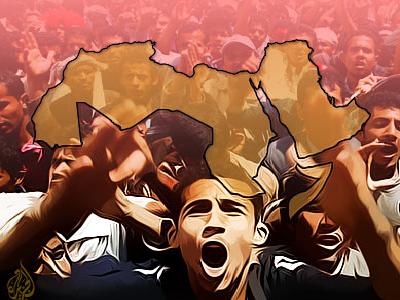
Egypt also revolted less than two weeks later. And it was then that Tunisia’s near-ideal revolutionary model became prey for numerous, often selective readings and ultimately for utter exploitation. The Egyptian January 25 revolution was the first Arab link between Tunisia and the upheavals that travelled throughout Arab nations. Some were quick to ascribe the phenomenon with all sorts of historical, ideological and even religious factors thereby making links whenever convenient and overlooking others however apt. The Aljazeera Arabic website still has a map of all Arab countries, with ones experiencing revolutionary influx marked in red.

Many problems have arisen. What tools, aside from the interests of the Qatari government, for example, does Aljazeera use to determine how the so-called Arab Spring manifests itself? And shouldn’t there be clear demarcations between non-violent revolutions, foreign interventions, sectarian tension and civil wars?

Not only do the roots and the expressions of these ‘revolutions’ vastly differ, but the evolvement of each experience was almost always unique to each Arab country. In the cases of Libya and Syria, foreign involvement (an all-out NATO war in the case of Libya and a multifarious regional and international power play in Syria) has produced wholly different scenarios than the ones witnessed in Tunisia and Egypt, thus requiring an urgently different course of analysis.

Yet despite the repeated failure of the unitary ‘Arab Spring’ discourse, many politicians, intellectuals and journalists continue to borrow from its very early logic. Books have already been written with reductionist titles, knitting linear stories, bridging the distance between Tunis and Sanaa into one sentence and one line of reasoning.

The ‘Arab Spring’ reductionism isn’t always sinister, motivated by political convenience or summoned by neo-imperialist designs. Existing pan-Arab or pan-Islamic narratives however well-intended they may be, have also done their fair share of misrepresenting whichever discourse their intellectuals may find fitting and consistent with their overall ideas. Some denote the rise of a new pan-Arab nation, while others see the ‘spring’ as a harbinger of the return of Islam as a source of power and empowerment for Arab societies. The fact is, while discourses are growing more rigid between competing political and intellectual camps, Arab countries marked by Aljazeera’s editorial logic seem to head in their own separate paths, some grudgingly towards a form of democracy or another, while others descend into a Hobbesian ‘state of nature’ – a war of all against all.

But reductionist discourses persist, despite their numerous limitations. They endure because some are specifically designed to serve the interests of certain governments – some with clear ambitions and others are simply trying to ride the storm. In the case of Syria, not a single country that is somehow a party in the conflict can claim innocence in a gory game of regional politics, where the price tag is the blood of tens of thousands of Syrians.

Western media continues to lead the way in language-manipulation, all with the aim of avoiding obvious facts and when necessary it misconstrues reality altogether. US media in particular remains oblivious to how the fallout of the NATO war in Libya had contributed to the conflict in Mali – which progressed from a military coup early last year, to a civil war and as of present time an all-out French-led war against Islamic and other militant groups in the northern parts of the country.

Mali is not an Arab country, thus doesn’t fit into the carefully molded discourse. Algeria is however. Thus when militants took dozens of Algerian and foreign workers hostage in the Ain Amenas natural gas plant in retaliation of Algeria’s opening of its airspace to French warplanes in their war on Mali, some labored to link the violence in Algeria to the Arab Spring. “Taken together, the attack on the U.S. embassy in Benghazi, Libya, the Islamist attacks on Mali, and now this Algerian offense, all point to north Africa as the geopolitical hotspot of 2013 — where the Arab Spring has morphed into the War On Terror,” wrote Christopher Helman, in Forbes, on Jan 18.

How convenient such an analysis is, especially when “taken together.” The ‘Arab Spring’ logic is constantly stretched in such ways to suit the preconceived understanding, interests or even designs of western powers. For example, it is now conventional media wisdom that the US is wary of full involvement in Syria because of the deadly attack on the US embassy in Benghazi. When seen from Washington, the Arab region appears less compound and is largely understood through keywords and phrases, allocated between allies and enemies, Islamists and liberals and by knee jerk reactions to anything involving Israel or Iran.

One only needs to compare media texts produced two years ago, with more recent ones. Whereas the first few months of 2011 were mostly concerned with individuals and collectives that had much in common with Mohamed Bouazizi – poor, despairing, disenfranchised, and eventually rebellious – much of the present text is concerned with a different type of discussion. Additionally there are almost entirely new players. The Bouazizis of Tunis, Egypt and Yemen remain unemployed, but they occupy much less space in our newspapers and TV screens. Now we speak of Washington and London-based revolutionaries. We juxtapose US and Russian interests and we wrangle with foreign interventions and barefacedly demarcate conflicts based on sectarian divisions.

“Arab awakening is only just beginning”, was the title of a Financial Times editorial of Dec 23. Its logic and subtext speak of a sinister interpretation of what were once collective retorts to oppression and dictatorships. “The fall of the Assads will be a strategic setback to Iran and its regional allies such as Hizbollah, the Shia Islamist state within the fragile Lebanese state,” the editorial read. “But that could quickly be reversed if Israel were to carry out its threats to attack Iran’s nuclear installations, enabling Tehran’s theocrats to rally disaffected Muslims across the region and strengthen their grip at home. It is easy to imagine how such a conflict would drag in the US, disrupt the Gulf and its oil traffic, and set fire to Lebanon.”

Note how in the new reading of the ‘Arab Spring’, people are mere pawns that are defined by their sectarian leanings and their usefulness is in their willingness to be rallied by one regional power or another. While the language itself is consistent with western agendas in Arab and Muslim countries, what is truly bizarre is the fact that many still insist on contextualizing the ever-confrontational US, Israel and western policies in general with an ‘Arab Spring’ involving a poor grocer setting himself on fire and angry multitudes in Egypt, Yemen and Syria who seek dignity and freedom.

Shortly after the Tunisian uprising, some of us warned of the fallout, if unchecked and generalized discourses that lump all Arabs together and exploit peoples’ desire for freedom, equality and democracy were to persist. Alas, not only did the reductionist discourse define the last two-years of upheaval, the ‘Arab Spring’ has become an Arab springboard for regional meddling and foreign intervention. To advance our understanding of what is transpiring in Arab and other countries in the region, we must let go of old definitions. A new reality is now taking hold and it is neither concerned with Bouazizi nor of the many millions of unemployed and disaffected Arabs.

- Ramzy Baroud (www.ramzybaroud.net) is an internationally-syndicated columnist and the editor of PalestineChronicle.com. His latest book is: My Father was A Freedom Fighter: Gaza’s Untold Story (Pluto Press).

River to Sea Uprooted Palestinian
The views expressed in this article are the sole responsibility of the author and do not necessarily reflect those of this Blog!

Tuesday, 15 January 2013

After Two Years, the Tunisian Revolution Betrayed?


Tunisian people wave national flags in front of the big clock as part of the festivities that mark the second anniversary of the uprising that ousted long-time dictator Zine El Abidine Ben Ali on 14 January 2013 in Tunis. (AFP - Fethi Belaid)
Published Monday, January 14, 2013
Tunisia – On the second anniversary of the Tunisian Revolution, Tunisian public opinion seems more divided than ever. It’s been a year since the Islamist al-Nahda movement and its allies came into power, but opposition parties are calling for a boycott of Nahda’s revolution celebrations.
Instead, the opposition has called for demonstrations in protest of a revolution they claim has been subverted, according to Hammam al-Hamami, the official spokesperson of the opposition Popular Front.

The main opposition parties are divided into two coalitions. One includes the Popular Movement, the Republican party, and the Social Democratic Path party. The second includes Call for Tunisia, the Socialist party, and the National Democratic Action party.
Despite fears of clashes between government and opposition supporters, both opposition coalitions organized a rally for 14 January 2013 on Bourguiba Street.

The second anniversary of the revolution comes amidst mounting social tensions. There are blocked streets and sit-ins at every corner. Almost no city has escaped protests, many of them demanding economic development and jobs.

In the Tunisia-Libya border town of Bin Kirdan, tear gas was fired at protesters and some demonstrators broke into al-Nahda’s headquarters. The town voted heavily for al-Nahda in the previous elections.

Dialogue and Accountability

The Wafa Movement, which split from the Nahda-allied Congress for the Republic (CPR), held a conference in which they called for holding corrupt figures in all sectors accountable.

Interim Tunisian President Moncef Marzouki called for a broad and comprehensive national dialogue. He received leaders of all major parties, including those believed to be close to the ousted regime.

All political parties welcomed the idea of an all-inclusive national dialogue, including the leader of al-Nahda Rashid Ghannouchi. He maintained that an inclusive dialogue is key to organizing transparent and fair elections. If parties fail to reach an agreement, he argued that this could lead to the “Somalization” or “militarization” of the country.

It is believed that Ghannouchi’s statement could pave the way for abandoning a draft law supported by al-Nahda that aims to exclude former regime officials from politics.
Most political and labor union forces condemned the draft law, arguing that it is inconsistent with the principles of human rights because it amounts to collective punishment. These forces called instead for fostering a process of transitional justice that would put corrupt figures on trial without delay.

The Government’s Responsibility

The opposition holds the government and al-Nahda responsible for the deteriorating economic situation in the country. They are calling for a dialogue on national priorities that would draw a clear road map to reassure Tunisian citizens on economic security.

Specifically, the opposition wants to see the establishment of a high commission that would schedule elections, promote a hands-off policy towards the judiciary, and address the demands of the revolution, including jobs and freedom of the press.

The government, however, does not share the opposition’s vision. Al-Nahda believes it is the subject of a multi-pronged conspiracy, at its heart are anti-Islamist economic lobbies and media outlets that seek to exaggerate the government’s mistakes.

This article is an edited translation from the Arabic Edition.

The Tunisian State is Crumbling

River to Sea Uprooted Palestinian
The views expressed in this article are the sole responsibility of the author and do not necessarily reflect those of this Blog!