Showing posts with label Orthodox churches. Show all posts

Tuesday, 9 November 2021

Deconstructing Islamophobia (alas, a necessary repost)

November 09, 2021

Deconstructing Islamophobia (alas, a necessary repost)

Foreword: almost exactly two years ago I wrote a column entitled “Deconstructing Islamophobia“.  Yesterday, I posted an article about immigration which, alas, generated a few truly idiotic comments about “The Muslims they… bla bla bla” which I initially planned to reply to, but which I simply deleted in utter disgust.  Here I need to clarify, I was not disgusted by anybody’s dislike (or even hatred) for Islam or Muslims, not at all, I was disgusted by the utter stupidity of the “arguments” invoked.  So I decided that before writing my next column about issues of immigration, I would repost my “Deconstructing Islamophobia” as a reply to all those who believe that ignorant hatred is a form of piety.  On a more personal note, I am particularly ashamed when I see some (not all, thank God!) of my fellow Orthodox Christians parrot exactly the lines which the National-Zionists want to inject into our collective minds.  These are the type of folks which can’t even understand the truisms I listed yesterday, including these two truly basic ones:

  • Being FROM a Christian/Muslim country and actually BEING Christian/Muslim are two totally different propositions and the former does not in any way imply the latter.
  • To be considered as an adherent of religion X requires, at the minimum,  a) being aware of its main teachings and b) living your daily life in according to at least the main precepts of this religion.

So, especially for (some of) my fellow Orthodox Christians, I will add this: how would you like it if some Muslim, Buddhist or Judaic blamed the Orthodox Church for the Papacy’s Inquisition or Crusades, or blamed Orthodoxy for the actions of Cromwell in Ireland?  And if you began protesting the ludicrous nature of such accusations, your accuser would reply “the Christians they… bla bla bla“!  You would be pretty disgusted, wouldn’t you?  So you want the non-Orthodox to understand how different our faith is from the Papacy or Cromwell’s Puritanism and their innumerable crimes, yet you steadfastly refuse to even admit that the Muslim world is at least as diverse as the Christian one, and has been so during its entire history!

But hey – Who needs education and knowledge when hatred and bigotry are seen as acceptable, even pious, substitutes, right?!

Well, I want to you know that I am personally ashamed of this bigotry masquerading a piety and while in the current prevailing political doxa most people will side with you, I shall never, no matter what labels (crypto-Muslim being the kindest I saw) you place upon me.  And please remember that: I reject your theses not because I defend Islam or Muslim, but because you are ignorant bigots.

With that out of the way, I invite the rest of my readers to (re-)discover my two year old analysis.

Andrei

***

Introduction: a short survey of the cuckoo’s nest

My initial idea was to begin with a definition of “Islamophobia” but after looking around for various definitions, I decided to use my own, very primitive definition. I will define Islamophobia as the belief that Islam (the religion) and/or Muslims (the adherents to this religion) represent some kind of more or less coherent whole which is a threat to the West. These are two distinct arguments rolled up into one: the first part claims that Islam (the religion) represents some kind of threat to the West while the second part claims that the people who embrace Islam (Muslims) also represent some kind of threat to the West. Furthermore, this argument makes two crucial assumptions:

  1. there is such thing out there as a (conceptually sufficient) unitary Islam
  2. there are such people with (conceptually sufficient) common characteristics due to their adherence to Islam

Next, let’s summarize the “evidence” typically presented in support of this thesis:

  1. The god of Islam is not the same god as the God of Christianity
  2. The Muslim world was created by the sword
  3. The Prophet of Islam, Muhammad, was an evil person
  4. Islam is incompatible with western democracy and represents a threat to what are referred to as “values” in the modern day West
  5. Muslims have treated Christians horribly in many different historical instances
  6. Muslims often turn to terrorism and commit atrocities
  7. Islam is socially regressive and seeks to impose medieval values on a modern world

There are more such as these, but these, I believe, are the main ones.

What is crucial here is to point out that this evidence relies both on theological arguments (#1 #4 #7), and historical arguments (#2 #3 #5 #6).

Finally, there is a most interesting phenomenon which, for the time being, we shall note, but only discuss later: the legacy corporate Ziomedia on one hand denounces Islamophobia as a form of “racism” but yet, at the same time, the very same circles which denounce Islamophobia are also the ones which oppose all manifestations of real traditional Islam. This strongly suggests that the study of this apparent paradox can, if carefully analyzed, yield some most interesting results, but more about that later.

Of course, all of the above is sort of a “bird’s eye” view of Islamophobia in the West. Once we go down to the average Joe Sixpack level, all of the above is fused into one “forceful” slogan as this one:

This kind of crude fearmongering is targeted at the folks who don’t realize that the USA is not “America” and who, therefore, probably don’t have the foggiest notion of what Sharia law is or how it is adjudicated by Islamic courts.

[I have lived in the USA for a total of 22 years and have observed something very interesting: there is a unique mix of ignorance and fear which, in the USA, is perceived as “patriotic”. A good example of this kind of “patriotism through ignorance” is in the famous song “Where Were You When the World Stopped Turning” by Alan Jackson which includes the following words: “I watch CNN but I’m not sure I can tell you the difference in Iraq and Iran, but I know Jesus and I talk to God“. Truth be told, the same song also asked in reference to 9/11 “Did you burst out with pride for the red, white and blue?“. Why exactly the massacre of 9/11 should elicit patriotic pride is explained as follows “And the heroes who died just doin’ what they do?“. Thus when the “United American Committee” declares that Sharia law is a threat to “America” the folks raised in this culture of fear and patriotism immediately “get it”. David Rovics hilariously described this mindset in his song “Evening News” where he says: “Evil men are plotting, to blow up Washington, DC, ’cause they don’t like freedom and democracy, they’re fans of the Dark Ages, they are all around, they’re marching from the desert sands, and coming to your town“. I have had the fortune of visiting all the continents of our planet (except Oceania) and I can vouch that this blend of fear+patriotic fervor is something uniquely, well, not “American” but “USAnian”.]

Having quickly surveyed the Islamophobic mental scenery, we can now turn to a logical analysis of the so-called arguments of the Islamophobes.

Deconstructing the phobia’s assumptions: a unitary Islam

Let’s take the arguments one by one beginning with the argument of a unitary Islam.

Most of us are at least vaguely aware that there are different Islamic movements/schools/traditions in different countries. We have heard of Shias and Sunni, some have also heard about Alawites or Sufism. Some will even go so far as remembering that Muslim countries can be at war with each other, and that some Muslims (the Takfiris) only dream about killing as many other Muslims (who, obviously, don’t share the exact same beliefs) and that, in fact, movements like al-Qaeda, ISIS, etc have murdered other Muslims in huge numbers. So the empirical evidence strongly suggest that this notion of a Muslim or Islamic unity is factually simply wrong.

Furthermore, we need to ask the obvious question: what *is* Islam?

Now, contrary to the hallucinations of some especially dull individuals, I am not a Muslim. So what follows is my own, possibly mistaken, understanding of what “core Islam” is. It is the acceptance of the following formula “There is no god but God and Muhammad is the messenger of God” or “lā ʾilāha ʾillā llāh muḥammadun rasūlu llā“. Note that “Allah” is not a name, it is the word “God” and “rasul” can be translated as “prophet”. There are also the so-called Five Pillars of Islam:

  • The Shahada or profession of faith “There is no god but God and Muhammad is the messenger of God“
  • The Salat or a specific set of daily prayers
  • The Zakat or alms giving
  • The Sawm or fasting
  • The Hadjj or pilgrimage to Mecca

That’s it! A person who fully embraces these five pillars is considered a Muslim. Or at least, so it would appear. The reality is, of course, much more complex. For the time being, I will just note that in this “core Islam” there is absolutely nothing, nothing at all, which could serve as evidence for any of the Islamophobic theories. Yes, yes, I know, I can already hear the Islamophobes’ objections: you are ignoring all the bad stuff in the Quran, you are ignoring all the bad stuff about spreading Islam by the sword, you are ignoring all the bad things Muhammad did in his life, you are ignoring the many local traditions and all the normative examples of the tradition (Sunnah and it’s Hadiths). Yeah, except you can’t have it both ways. You can’t say:

  1. Islam is inherently evil/dangerous AND
  2. use local/idiosyncratic beliefs and actions to prove your point!

If Islam by itself is dangerous, then it has to be dangerous everywhere it shows up, irrespective of the region, people, time in history or anything else.

If we say that sometimes Islam is dangerous and sometimes it is not, then what we need to look into is not the core elements of the Islamic faith, but instead we need to identify those circumstances in which Islam was not a threat to anybody and those circumstances when Islam was a threat to others.

Furthermore, if your argument is really based on the thesis that Islam is evil always and everywhere, then to prove it wrong all I need to do is find one, just ONE, example where Muslims and non-Muslims have lived in peace together for some period of time.

[Sidebar: while I was working on my Master’s Degree in Strategic Studies I had the fortune of having the possibility to take a couple of courses outside my field of specialization and I decided to take the most “exotic” course I could find in SAIS‘ curriculum and I chose a course on Sharia law. This was an excellent decision which I never regretted. Not only was the course fascinating, I had the chance of writing a term paper on the topic “The comparative status of Orthodox Christians in history under Muslim and Latin rule“. My first, and extremely predictable, finding was that treatment of Orthodox Christians by Muslim rulers ranged from absolutely horrible and even genocidal to very peaceful and kind. Considering the long time period considered (14 centuries) and the immense geographical realm covered (our entire planet from Morocco to Indonesia and from Russia to South Africa), this is hardly surprising. The core beliefs of Islam might be simple, but humans are immensely complicated beings who always end up either adding a local tradition or, at least, defending one specific interpretation of Islam. My second finding was much more shocking: on average the status of Orthodox Christians under the Papacy was much worse than under Muslim rule. Again, I am not comparing the status of Orthodox Serbs under Ottoman rule with the status of Orthodox Christians in modern Italy. These are extreme examples. But I do claim that there is sort of a conceptual linear regression which strongly suggests to us that there is a predictive (linear) model which can be used to make predictions and that the most obvious lesson of history is that the absolute worst thing which can happen to Orthodox Christians is to fall under their so-called “Christian brothers” of the West. A few exceptions here and there do not significantly affect this model. I encourage everybody to take the time to really study the different types of Muslim rulers in history, if only to appreciate how much diversity you will find].

Deconstructing the phobia’s assumptions: the “Muslim god” vs the “Christian God”

This is just about the silliest anti-Muslim argument I have ever heard and it come from folks inhabiting the far left side of a Bell Curve. It goes something like this:

We, Christians, have our true God as God, whereas the Muslims have Allah, which is not the God of the Christians. Thus, we worship different gods.

Of course, the existence of various gods or one, single, God does not depend on who believes in Him or who worships Him. If we can agree on the notion that God is He Who created all of Creation, and if we agree that both Christians (all denominations) and Muslims (all schools) believe that they are worshiping that God then, since there is only one real/existing God, we do worship the same God simply because there are not “other” gods.

I wonder what those who say that “Muslims worship another god” think when they read the following words of Saint Paul to the Athenian pagans: “For as I passed by, and beheld your devotions, I found an altar with this inscription, To The Unknown God. Whom therefore ye ignorantly worship, him declare I unto you” (Acts 17:23). What Saint Paul told them is that they ignorantly worship a god whom, in spite of that ignorant worship, Saint Paul declared to them. I submit that “ignorant worship” is not an insult, but a diagnosis of heterodoxy, and that such an “ignorant worship” can nonetheless be sincere.

The issue is not WHOM we worship, but HOW we worship (in terms of both praxis and doxa).

And yes, here the differences between Christians and Muslims are huge indeed.

In my 2013 article “Russia and Islam, part eight: working together, a basic “how-to”” I discussed the immense importance of these differences and how we ought to deal with them. I wrote:

The highest most sacred dogmatic formulation of Christianity is the so-called “Credo” or “Symbol of Faith” (full text here; more info here). Literally every letter down to the smallest ‘i‘ of this text is, from the Christian point of view, the most sacred and perfect dogmatic formulation, backed by the full authority of the two Ecumenical Councils which proclaimed it and all the subsequent Councils which upheld it. In simple terms – the Symbol of Faith is absolutely non-negotiable, non-re-definable, non-re-interpretable, you cannot take anything away from it, and you cannot add anything to it. You can either accept it as is, in toto, or reject it.

The fact is that Muslims would have many problems with this text, but one part in particular is absolutely unacceptable to any Muslim:

And in one Lord Jesus Christ, the Son of God, the Only-begotten, Begotten of the Father before all ages, Light of Light, Very God of Very God, Begotten, not made; of one essence with the Father, by whom all things were made

This part clearly and unambiguously affirms that Jesus-Christ was not only the Son of God but actually God Himself. This is expressed by the English formulation “of one essence with the Father” (ὁμοούσιον τῷ Πατρί in Greek with the key term homousios meaning “consubstantial”). This is *THE* core belief of Christianity: that Jesus was the the anthropos, the God-Man or God incarnate. This belief is categorically unacceptable to Islam which says that Christ was a prophet and by essence a ‘normal’ human being.

For Islam, the very definition of what it is to be a Muslim is found in the so-called “Shahada” or testimony/witness. This is the famous statement by which a Muslim attests and proclaims that “There is no god but God, Muhammad is the messenger of God”. One can often also hear this phrased as “There is no god but Allah, Muhammad is His prophet”.

Now without even going into the issue of whether Christians can agree or not that “Allah” is the appropriate name for God (some do, some don’t – this is really irrelevant here), it’s the second part which is crucial here: Christianity does not recognize Muhammad as a prophet at all. In fact, technically speaking, Christianity would most likely classify Muhammad as a heretic (if only because of his rejection of the “Symbol of Faith”). Saint John of Damascus even called him a ‘false prophet’. Simply put: there is no way a Christian can accept the “Shahada” without giving up his Christianity just as there is no way for a Muslim to accept the “Symbol of Faith” without giving up his Islam.

So why bother?

Would it not make much more sense to accept that there are fundamental and irreconcilable differences between Christianity and Islam and simply give up all that useless quest for points of theological agreement? Who cares if we agree on the secondary if we categorically disagree on the primary? I am all in favor of Christians studying Islam and for Muslims studying Christianity (in fact, I urge them both to do so!), and I think that it is important that the faithful of these religions talk to each other and explain their points of view as long as this is not presented as some kind of quest for a common theological stance. Differences should be studied and explained, not obfuscated, minimized or overlooked.

Bottom line is this: it is PRECISELY because Islam and Christianity are completely incompatible theologically (and even mutually exclusive!) that there is no natural enmity between these two religions unless, of course, some Christian or Muslim decides that he has to use force to promote this religion. And let’s be honest, taken as a whole Christianity’s record on forced conversions and assorted atrocities is at least as bad as Islam’s, or even worse. Of course, if we remove the Papacy from the overall Christian record, things looks better. If then we also remove the kind of imperialism Reformed countries engaged in, it looks even better. But even Orthodox rulers have, on occasion, resorted to forceful conversions and mass murder of others.

And here, just as in Islam, we notice that Christians also did not always spread their faith by love and compassion, especially once Christian rulers came to power in powerful empires or nations.

Deconstructing the phobia’s assumptions: Islam was spread by the sword

In reality the “Islam spread by the sword” is a total canard, at least when we hear it from folks who defend “democracy” but who stubbornly refuse to concede that 1) most democracies came to power by means of violent revolutions and that 2) just a look at a newspaper today (at least a non-western newspaper) will tell you that democracy is STILL spread by the sword. As for the USA as country, it was built on by far the biggest bloodbath in history. If anything, Sharia law and Islam could teach a great deal to the country which:

  1. spends more on aggression than the rest of the world combined
  2. has the highest percentage of people incarcerated (and most of these for non-violent crimes)
  3. whose entire economy is based on the military-industrial complex
  4. and who is engaged in more simultaneous wars of choice than any other country in history

So “Sharia Law Threatens America” is a lie. And this is the truth:

Was Islam really spread by the sword?

Maybe. But anybody making that claim better make darn sure that his/her religion, country or ideology has a much better record. If not, then this is pure hypocrisy!

Finally, I will also note that Christ said “My kingdom is not of this world: if my kingdom were of this world, then would my servants fight, that I should not be delivered to the Jews: but now is my kingdom not from hence” (John 18:36). In contrast, the Prophet of Islam established the first Islamic state in Medina. So when we compare Muhammad’s actions to Christ, a better comparison should be with the various Christian rulers (including Byzantine ones) and we will soon find out that the Christian Roman Empire also used the sword on many occasions.

Next:

Deconstructing the phobia’s assumptions: the Prophet of Islam was a bad man

You must have all sorts of stories about how the Prophet Muhammad did things we would disapprove of. I won’t list them here simply because the list of grievances is a little different in each case. I actually researched some of these accusations (about marrying young girls, or sentencing people to death for example) and in each case, there is a very solid Muslim defense of these incidents which is almost always ignored and which provides a crucial context to, at least, the better understanding of the incident discussed.

Since I am not a historian or a biographer of the Prophet Muhammad I don’t have any personal opinion on these accusations other than stating the obvious: I am not a Muslim and I don’t have to decide whether Muhammad was a sinful man or a infallible person (that is a purely theological argument). I will simply say that this ad hominem is only relevant to the degree that some Muslims would consider each action of their prophet as normative and not historical. Furthermore, even if they would consider each action of their prophet as normative, we need to recall here that we are dealing with a prophet, not a God-Man, and that therefore the comparison ought not to be made with Christ, whom Christians believe to be 100% sinless, but with a Christian prophet, say Moses, whom no real Christian will ever declare sinless or infallible. As for the Quran, let’s not compare it to just the New Testament but to all the books of the Bible taken together, including those who were eventually re-interpreted by the new religion of (some) Jews after the fall of Jerusalem: rabbinical/Phariseic Talmudism which found plenty of passages in its (deliberately falsified) “Masoretic” text of the Old Testament “Tanakh” (please see here if you don’t know what falsification I am referring to).

Finally, NO religious text worth anything is self-explanatory or “explains itself” by means of comparing passages. This is also why all major religions have a large corpus of texts which explain, interpret, expand upon and otherwise give the (deceptively simple looking) text its real, profound, meaning. Furthermore, most major religions also have a rich oral tradition which also sheds light on written religious documents. Whatever may be the case, simply declaring that “Islam is a threat” because we don’t approve of the actions of the founder of Islam is simply silly. The next accusation is much more material:

Deconstructing the phobia’s assumptions:Islam is incompatible with democracy

That is by far the most interesting argument and one which many Muslims would agree with! Of course, it all depends on what you mean by “democracy”. Let me immediately concede that if by “democracy” you mean this:
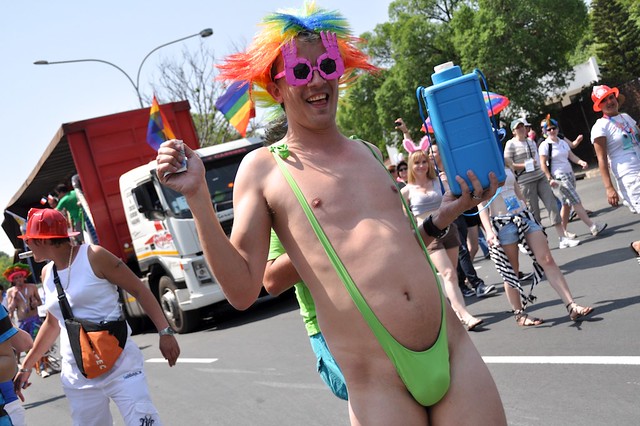
Then, indeed, Islam is incompatible with modern western democracy. But so is (real) Christianity!

So the so-called “West” has to decide what its core values are. If Conchita Wurst is an embodiment of “democracy” then Islam and Christianity are both equally incompatible with it. Orthodox Christianity, for sure, has not caved in to the homo-lobby in the same way most western Christian denominations have.

But if by “democracy” we don’t mean “gay pride” parades but rather true pluralism, true people-power, and the real sovereignty of the people, then what I call “core Islam” is not threat to democracy at all. None. However, there is also no doubt about two truisms:

  1. Some Muslim states are profoundly reactionary and freedom crushing
  2. Traditional Islam is incompatible with many modern “western values”

Still, it is also very easy to counter these truism with the following replies

  1. Some Muslim states are pluralistic, progressive and defend the oppressed (Muslim or not)
  2. Traditional Christianity is incompatible with modern “western values”

Again, Iran is, in my opinion, the perfect illustration of a pluralistic (truly diverse!), progressive and freedom defending Muslim state. I simply don’t have the time and place to go into a detailed discussion of the polity of Iran (I might have to do that in a future article), and for the time being I will point you to the hyper-pro-Zionist Wikipedia article (which nobody will suspect of being pro-Muslim or pro-Iranian) about the “Politics of Iran” which will show you two things: Iran is an “Islamic Republic” meaning that it is a republic, yes, but one which has Islam as its supreme law. There is absolutely nothing inherently less democratic about a Islamic republic which has a religion as its supreme law than a atheistic/secular republic which has a constitution as its supreme law. In fact, some countries don’t even have a constitution (the UK and Israel come to mind). As for the Iranian polity, it has a very interesting system of checks and balances which a lot of countries would do well to emulate (Russia for starters).

As for modern “western values”, they are completely incompatible with Christianity (the real, original, unadulterated thing) even if they are very compatible with modern western (pseudo-) Christian denominations.

So, now the question becomes: is there something profoundly incompatible between the real, traditional, Islam and the real, traditional, Christianity? I am not talking about purely theological differences here, but social and political consequences which flow from theological differences. Two immediately come to my mind (but there are more, of course):

  • The death penalty, especially for apostasy
  • Specific customs (dress code, ban on alcohol, separation of genders in various settings, etc.)

The first one, this is really a non-issue because while traditional, Patristic, Christianity has a general, shall we say, “inclination” against the death penalty, this has not always been the case in all Orthodox countries. So while we can say that by and large Orthodox Christians are typically not supporters of the death penalty, this is not a theological imperative or any kind of dogma. In fact, modern Russia has implemented a moratorium on the death penalty (to join the Council of Europe – hardly a moral or ethical reason) but most of the Russian population favor its re-introduction. Note that Muslims in Russia are apparently living their lives in freedom and overall happiness and when they voice grievances (often legitimate ones), they don’t have “reintroduce the death penalty” as a top priority demand.

The simple truth is that each country has to decide for itself whether it was the use the death penalty or not. Once a majority of voters have made that decision, members of each religion will have to accept that decision as a fact of law which can be criticized, but not one which can be overturned by any minority.

As for religious tribunals, they can be easily converted by the local legislature into a “mediation firm” which can settle conflicts, but only if both sides agree to recognize it’s authority. So if two Muslims want their dispute to be settled by an Islamic Court, the latter can simply act as a mediator as long as its decision does not violate any local or national laws. Hardly something non-Muslims (who could always refuse to recognize the Islamic Court) need to consider a “threat” to their rights or lifestyles.

An “Islamic Matrioshka”?!

As for the social customs, here it is really a no-brainer: apply Islamic rules to those who chose to be Muslims and let the other people live their lives as they chose to. You know, “live and let live”. Besides, in terms of dress code and gender differentiation, traditional Islam and traditional Christianity are very close.

Check out this typical Russian doll, and look at what she is wearing: this was the traditional Russian dress for women for centuries and this is still what Orthodox women (at least those who still follow ancient Christian customs) wear in Church.

Furthermore, if you go into a Latin parish in southern Europe or Latin America, you will often find women covering their heads, not only in church, but also during the day. The simple truth is that these clothes are not only modest and beautiful, they are also very comfortable and practical.

The thing which Islamophobes always miss is that they take examples of laws and rules passed by some Muslim states and assume that this is how all Muslim states will always act. But this is simply false. Let’s take the example of Hezbollah (that name means “party of God”, by the way) in Lebanon which has clearly stated on many occasions that it has no intention of transforming Lebanon into a Shia-only state. Not only did Hezbollah say that many times, but they acted on it and they always have had a policy of collaboration with truly patriotic Christians (of any denomination). Even in today’s resistance (moqawama) there are Christians who are not members of Hezbollah as a party (and why would they when this is clearly and officially a Muslim party and not a Christian one?!), but they are part of the military resistance.

[Sidebar: by the way, the first female suicide bomber in Lebanon was not a Muslim. She was a 18 year old from an Orthodox family who joined Syrian Social Nationalist Party and blew herself up in her car on an Israeli checkpoint (inside Lebanon, thus a legitimate target under international law!), killing two Israeli invaders and injuring another twelve. Her name was Sana’a Mehaidli]

A Hezbollah fighter respectfully picks up an image of the Mother of God from the ruins of a church destroyed by US-backed Takfiris

Recent events in Syria were also very telling: when the AngloZionist Empire unleashed its aggression against Syria and the “good terrorists” of al-Qaeda/al-Nusra/ISIS/etc. embarked in a wholesale program of massacres and atrocities, everybody ran for their lives, including all the non-Takfiri Muslims. Then, when the plans of the Axis of Kindness (USA, KSA, Israel) were foiled by the combined actions of Russia, Iran, Syria and Hezbollah, something interesting happened: the Latin Christians left, whereas the Orthodox Christians stayed (source). Keep in mind that Syria is *not* an Islamic state, yet the prospects of a Muslim majority was frightening enough for the Latins to flee even though the Orthodox felt comfortable staying. What do these Orthodox Christians know?

Could it be that elite traditionalist Shia soldiers represent no threat to Orthodox Christians?

Deconstructing the phobia’s assumptions: Islam generates terrorism

In fact, there is some truth to that too. But I would re-phrase it as: the AngloZionists in their hatred for anything Russian, including Soviet Russian, identified a rather small and previously obscure branch of Islam in Saudi Arabia which they decided to unleash against the Soviet forces in Afghanistan. From the first day, these Takfiris were federated by the USA and financed by the House of Saud. The latter, in its fear of being overthrown by the Takfiris, decided to appease them by internationally supporting their terrorism (that is all Takfiris have to offer, their leaders are not respected scholars, to put it mildly). Since that time, the Takfiris have been the “boots on the ground” used by the West against all its enemies: Serbia, Russia first, but then also secular (Syria) or anti-Takfiri Muslim states (Iran).

So it is not “Islam” which generates terrorism: it is western (AngloZionist) imperialism.

The US and Israel are, by a wide margin, the biggest sponsors of terrorism (just as the West was always by far the biggest source of imperialism in history) and while they want to blame “Islam” for most terrorist attacks, the truth is that behind every such “Muslim” attack we find a western “deep state” agents acting, from the GIA in Algeria, to al-Qaeda in Iraq to al-Nusra in Syria to, most crucially, 9/11 in New York. These were all events created and executed by semi-literate Takfiri patsies who were run by agents of the western deep states.

As far as I know, all modern terrorist groups are, in reality, “operated by remote control” by state actors who alone can provide the training, know-how, finances, logistical support, etc needed by the terrorists.

And here is an interesting fact: the two countries which have done the most to crush Takfiri terrorism are Russia and Iran. But the collective West is still categorically refusing to work with these countries to crush the terrorism these western states claim to be fighting.

So, do you really believe that the West is fighting terrorism?

If yes, I got a few bridges to sell all over the planet.

Conclusion: cui bono? the so-called “liberals”

There are many more demonstratively false assumptions which are made by the AngloZionist propaganda machine. I have only listed a few. Now we can look to the apparent paradox in which we see the western “liberals” both denouncing Islamophobia and, at the same time, repeating all the worst cliches about Islam. In this category, Barak Obama and Hillary Clinton are the most egregious examples of this hypocrisy because while pretending to be friends of Muslims, they got more Muslims killed than anybody else. For western liberals, Islam is a perfect pretext to, on one hand, cater to minorities (ethnic or religious) while pretending to be extremely tolerant of others. Western liberals use Islam in the West, as a way to force the locals to give up their traditions and values. You could say that western liberals “love” Islam just like they “love” LGBTQIAPK+ “pride” parades: simply and only as a tool to crush the (still resisting) majority of the people in the West who have not been terminally brainwashed by the AngloZionist legacy corporate propaganda machine.

Conclusion: cui bono? the so-called “conservatives”

Western conservatism is dead. It died killed by two main causes: the abject failure of National-Socialism (which was an Anglo plan to defeat the USSR) and by its total lack of steadfastness of the western conservatives who abandoned pretty much any and all principles they were supposed to stand for. Before the 1990s, the conservative movements of the West were close to fizzling out into nothingness, but then the Neocons (for their own, separate, reasons) began pushing the “Islamic threat” canard and most conservatives jumped on it in the hope of using it to regain some relevance. Some of these conservatives even jumped on the “Christian revival in Russia” theory (which is not quite a canard, but which is also nothing like what the Alt-Righters imagine it to be) to try to revive their own, long dead, version of “Christianity”. These are desperate attempts to find a source of power and relevance outside a conservative movement which is basically dead. Sadly, what took the place of the real conservative movement in the West is the abomination known as “National Zionism” (which I discussed here) and whose ideological cornerstone is a rabid, hysterical, Islamophobia.

Conclusion: cui bono? the US deep state

That one is easy and obvious: the US deep state needs the “Islamic threat” canard for two reasons: to unleash against its enemies and to terrify the people of the USA so that they accept the wholesale destruction of previously sacred civil rights. This is so obvious that there is nothing to add here. I will only add that I am convinced that the US deep state is also supporting both the Alt-Right phenomenon and the various “stings” against so-called “domestic terrorists” (only only Muslims, by the way). What the Neocons and their deep-state need above all is chaos and crises which they used to shape the US political landscape.

Finally, the real conclusion: rate the source! always rate the source…

Whom did we identify as the prime sources of Islamophobia? The liberals who want to seize power on behalf of a coalition of minorities, conservatives who have long ditched truly conservative values and deep state agents who want to terrify US Americans and kill the enemies of the AngloZionist Empire.

I submit to you that these folks are most definitely not your friends. In fact, they are your real enemy and, unlike various terrorists abroad who are thousands of miles away from the USA, these real enemies are not only here, they are already in power and rule over you! And they are using Islam just like a matador uses a red cape: to distract you from the real threat: National Zionism. This is true in the US as it is true in the EU.

Chechens in Novorussia

Most westerners are now conditioned to react with fear and horror when they hear “Allahu Akbar”. This is very predictable since most of what is shown in the western media is Takfiris screaming “Allahu Akbar” before cutting the throats of their victims (or rejoicing at the suffering/death of “infidels”).

Yet in the Donbass, the local Orthodox Christians knew that wherever that slogan (which simply means “God is greater” or “God is the greatest”) was heard the Ukronazis are on the run. And now we see Russia sending mostly Muslim units to Syria to protect not only Muslims, but everybody who needs protection.

Having a sizable Muslim minority in Russia, far from being any kind of threat, as turned to be a huge advantage for Russia in her competition against the AngloZionist Empire.

There are, by the way, also Chechens fighting on the other side in this conflict: the very same Takfiris who were crushed and expelled from Chechnia by the joint efforts of the Chechen people and the Russian armed forces. So, again, we have Muslims on both sides, the Takfiris now happily united with the Nazis and the traditionalist Muslims of Kadyrov protecting the people of Novorussia.

That is one, amongst many more, nuances which the Islamophobic propaganda always carefully chooses to ignore.

Should you?

The Saker


River to Sea Uprooted Palestinian   
The views expressed in this article are the sole responsibility of the author and do not necessarily reflect those of the Blog!

Monday, 11 October 2021

The Golden Age of America

 October 10, 2021

The Golden Age of America

By Walt Garlington for the Saker Blog

Mr Paul Gottfried gives us a standard line about the need to return to the Golden Age of the American republic at the end of a short book review he penned:

Since Janowski leaves his heuristic queries open, this reviewer feels free to note that the egalitarian democracy he so graphically describes represents a falling away from something much better. It is a denaturing of the constitutional republic upholding federalism and ordered liberty that marked America’s earlier phase. The United States was not always the quasi-tyranny it is now becoming. It started with a well-conceived political order, one that some Americans wish to return to.

But is this still really a tenable ideal and goal? What did the former English colonies gain from independence in 1776? Is it not the truth that the colonies lost nearly everything a traditional people would consider worth living for and exchanged it for never-ending political feuds and money-grabbing after that fateful year?

There is hardly anything of cultural value to speak of in the United States today. What lover of beauty 500 years from now will have any desire to watch Saturday Night Live or play Grand Theft Auto or own a Ford F-150 pickup truck? But the usual farming village or small city of artisans in Christian Europe was filled with cultural treasures, however externally poor those people may appear to modern eyes. Their life revolved firstly around the parish church: the Divine Liturgy – the union of Heaven with earth, morning and evening prayers, the feasts and fasts of the Church calendar, the holy days dedicated to our Lord and His Most Pure Mother, the patron saint of the parish church, the patron saint of each person in the parish, baptisms, etc.

Then there was the life of each family, whose members included those who lived long ago by virtue of their graves in the parish churchyard and by virtue of remembering those same members and others often in prayers for the departed. The family home was also a major part of the family itself, more often than not being the same place in which their forebears had lived for many generations, with the furniture, tools, etc., also being handed down from many years before. Entertainment too was handed down from many old hands: ballads and folk songs, communal dances and games, and so on.

Related to family life was the vocation of each person, for the children usually followed in the profession of one of their close kinsmen. And the members of these professions themselves often formed communities of their own, each with its own traditions.

For this peaceful and stable way of life, the English colonies in North America substituted something truly atrocious. They called it ‘liberty’, but it is nothing of the sort. It was an unleashing of the passions, which is slavery of the lowest and most degraded form, and manifests itself in the constant re-creation of the methods of production and the grasping after money and material goods. This kind of life undermines the well-being of society, breaks all the traditional bonds between people – within families and outside them, dissipates the societal virtues accumulated by the previous generations, and causes anxiety to abound. What occupation should I pursue? What college should I go to? Where should I live afterwards? Where can I go to make the most money? Such questions were largely unknown to our ancestors.

Compounding these problems, we now have a never-ending political drama that further erodes the influence of the Church, families, and other healthy traditions. In order to protect the ‘liberty’ we won through independence from Great Britain, we placed ourselves within an unending cycle of political elections and battles. There is hardly ever any rest from it. ‘The price of liberty is eternal vigilance’, we are taught here in the exceptional nation. Vicious, lengthy campaigns are waged to gain elected offices, and no sooner are these watchmen of our freedoms chosen than we turn our jealous Argus-eyes upon them to make sure they don’t encroach upon anything that is ours.

Politics in the old countries, and in the colonies before 1776, was much less volatile and imposed itself much less in daily life. Most officials held their positions by heredity, meaning little jostling and wrangling to obtain them. Likewise, many modern government functions were handled by kin-groups or churches: education of children, care for the poor, sick, and elderly, etc. When there was interaction with the government, it was usually not with a nameless bureaucrat but with the count or lord who lived in the village manor and whom they knew well – a man with whom the villagers received Holy Communion, who supplied their festivals with foodstuffs, in whose fields they worked at harvest-time.

The federalism and order liberty of the American constitutional republic hailed by Mr Gottfried above were merely the vestiges of a healthy pre-Modern Christian society. As the States began to fulfil the telos of their new republican creation, however, those forms faded away. Now we have no true communities, whether villages or cities, only atomized urban apartments and rural suburbs. Here we have no Christian life to speak of, but we may squeeze in a church service at the mega-church beside the interstate on Christmas Eve to keep Grandmother from nagging us. Here we have few family connections, save those that are mediated by social media, and which are further cheapened by our desire for views and likes of our posts related to family life.

This view can be confirmed by looking at the South, where old European attitudes lasted the longest in the US. In Dixie there were hereditary government offices (de facto rather than de jure); political elections were not all-consuming affairs (turnout was often very low at elections); ancestors were remembered; the Church calendar still played some role in determining the rhythm of life; families remained rooted in a particular place and home for generations. Some of this still holds true today, in a very weakened form.

New England has shown the opposite tendency. She has from the beginning been in a constant state of ferment, developing new religions, new industries, new political theories.

Some Southerners (this author included) are sometimes tempted to throw all the fault for the decay of old settled ways in the States entirely on New England, but that is dishonest, for the South also found ways to undermine them on her own: by repealing primogeniture laws, by disestablishing Christianity as the official religion of the Southern States, by extending the franchise to more and more people, by outlawing nobility.

The abnormality of post-1776 America is also reflected in the fact that Christian monasteries, one of the foundation stones for spreading and strengthening the Christian faith in the old countries of Asia, Africa, and Europe, are few in number in all regions. The vocation of total dedication to God has found shallow soil in the US, as Metropolitan Kallistos Ware says in his little book The Orthodox Church, because we are all of us – New England, South, Great Plains, and the rest – so preoccupied with improving our material condition that vows of poverty, chastity, and obedience are anathema to most. Only in a handful of the Spanish and French Roman Catholic communities that were later absorbed by the expanding American union were some scattered monasteries to be found, and the number of monasteries has been bolstered in recent years largely by the influx of immigrants from Orthodox and Roman Catholic countries.

From today’s vantage point, the days of the young American republic do look pleasant. But it is a deception, like a mirage in the desert. As soon as we look more closely at them, we see that the hollowness of present-day American life began with the separation from Great Britain in 1776, which was a separation from the whole stream of traditional Christian life and its replacement with the new idols of an all-engrossing political life (which is everywhere present and fills all things, to use the words the Orthodox Church uses in a prayer to the Holy Ghost) and economic upheaval and progress without end.

Thus, to good men like Mr Gottfried who pine for the by-gone days of the early American republic, we say, They are right to look to the past for a model of how to live, but they must go back further, before the federal constitution of 1787, and before the separation from Europe in 1776, and before even the Renaissance, when the Orthodox Church and family and neighbor were the sources of life, the only sources of a life that is worth living. Unless the peoples of the States rediscover those springs, life will continue to be parched and barren, and no paper constitution will be able to make it verdant and fruitful again.


River to Sea Uprooted Palestinian   
The views expressed in this article are the sole responsibility of the author and do not necessarily reflect those of the Blog!

Sunday, 18 July 2021

I just had what might be a good idea – you tell me!


I just had what might be a good idea – you tell me!

July 17, 2021

Dear friends,

To my surprise many (most?) of the comments I got yesterday were related to my question about whether to write about the history of the Russian Orthodox Church in the 20th century or not.  Thanks to all those who replied!  And the various comments have given me an idea which I want to run by you:

What if, instead of writing a 10’000 words essay (I am only slightly exaggerating!) about the history of the Russian Orthodox Church in the past 100 years (or more!) I did something much, much simpler?  Here is my idea:

It is my claim that 95% or more of so-called “Christian denominations” are Christian only in name and that this is empirically and logically provable! The *only* element required to be able to do so is a correct understanding of what the original Christians (at the time of Christ, His Apostles and the Fathers) adopted as their “criteria of truth”!  Once you (really) “get” “just” that it becomes comically simple to prove that modern “Christianity” has almost nothing in common with the original Christianity of Christ and the Church He Founded.

This is as true for the Latins, as it is for the MP or for the innumerable sects resulting from the Reformation.  Furthermore, I also note with horror that 95% or more of the people who sincerely think of themselves as “Christians” don’t even know the very basics of what Christianity is.  So the real problem is not that this or that off-shot of Christianity sincerely, but mistakenly, thinks of itself as “Christian”, the problem is that the overwhelming majority of those who seek to truly follow the commandments and teachings of Christ do not have the means to find out what these commandments and teachings are!

Yeah, yeah, I know, solo scriptura and all that!  Sounds good in theory, but in practice this is literally a chain-reaction like phenomenon in which the more the slogan solo scriptura is chanted, the more denominations result from this.  Not exactly what Saint Paul intended when wrote “One Lord, one faith, one baptism“…

So rather than dealing with lofty and subtle issues of Patristic teachings on ecclesiology or dogmatic anthropology, which would be a waste of time in our post-Christian societies, why don’t I “go minimal“?  What I am thinking is to start a series of short “Christian vignettes” dealing with basic but important issues: what is the purpose of our life? what is our nature? what is a “saint”? what is the “Church”?  What did Christ teach about His Church?  How did the Fathers deal with heresies and schisms?  What is the “symphony of power” and how is it different from the “caesaropapism” invented by western “theologians”? How did the Fathers deal with all the innumerable crises (persecutions, heresies, schisms, infiltrations by enemies. etc.) the Church of Christ faced in its history (especially since “there is nothing new under the sun” and we have no commandment to reinvent the wheel over and over and over again!)? etc. etc. etc.  Yes, one could write several PhD theses on any of those deceptively “simple” questions, but my goal would be to write a short vignette and maybe add a few useful links to some relevant text.

Again, I won’t be “going after” the Latins, the Sergianists or anybody else.  I will just present what I believe is the “real thing” and you can them compare and contrast it with whatever putatively “Christian” denomination at your own leisure (or not).

Believe me, when, for example, the Latins and the Orthodox use the exact same words (Virgin Mary, Church, grace, sin, redemption, tradition, authority, obedience, etc.) they appear to be using the same categories.  In reality they never do, because the meaning they give to these concepts are radically different.  So I would probably start with simply worded Orthodox definitions (understanding) of some basic concepts.

Here is my underlying view of the original of the Church: Christ very much came into the world to create an “organized religion”, in fact I would even describe it as *highly* organized (at least in theory, on the day to day parish life, not so much, alas!).  He created His Church.  Over the centuries, the external power, influence and authority of this Church in the world went through many ups and downs, and the fall of the entire West into schism and heresy resulted in the post-Christian society we live in today.  That original Church of Christ still exists today, but it is small, almost tiny.  But compared to the times of, Saint Maximos the Confessor, the Church of Christ is booming and doing great!  In fact, any QUANTITATIVE argument in defense of any faith is a logical and spiritual fallacy and was, therefore, never used by the Fathers.  It so happens that my life has lead me to this tiny “spiritual island” (the traditional image would be one of a vessel with Christ at its helm) which is in the world, but not of the world, and which truly (in its essence) is still the same, a-temporal, Church Christ founded 2000 years ago.  I want to share what I found there, if only to convincingly prove that that which is nowadays is commonly referred to as “Christianity” has nothing in common with the real thing.  What I propose to do is to begin my demonstration with the very basics.

My suggestion for a first such vignette?  The question of “how much is enough”, i.e. how big (# of followers or # of bishops) or small can the Church of Christ be to still qualify as the original Church of Christ?  Would one true Christian (however you defined this concept) on a desert island still be “The Church”?  How about 10 Christians and I will even toss in 4 deacons, 2 priests and even one bishop!  So “Church” or “no-Church”?  True, I did hint at the correct answer above, but I did not explain it.  So – interested or not?

Let me repeat here: the original Church, as created by Christ and His Apostles still exists today, this Church has lived through very different historical periods and it has therefore appeared to be externally changing.  And sometimes this Church did change.  Externally.  But in its essence, we know two things: that the Church of Christ is the Pillar and Foundation of Truth which will never and, in fact, cannot “change”, if only because “change” is something which happens over time, whereas the (real) Church is “outside time”.

The Latins call themselves “The Church” and even lapsed-Latins STILL call the Latin Church “The Church”.  Why?  Well, because of the Pope, of course!  What other religion can claim to be headed by this putatively “infallible” superstar with his Papamobiles and an opinion about everything, especially secular matters?! (note for non-Latins: Latins do NOT claim that the Pope is always right, but only when he speaks “officially”, in his quality of Pope, and on issues of faith and morality.  But still, this is a crazy notion, especially if one accepts the Augustinian/Thomistic views on original sin and salvation!).

“Infallibility” is another perfect example!  The original Christians have always believed that the True One Church of Christ is infallible in its essence being the Theandric Body of Christ filled with the Holy Spirit.  But while the ENTIRE CHURCH is infallible, no single individual, not even a saint, is infallible.  The Latins trasferred that which was always considered an attribute of the entire Conciliar Church into one man.  Do yes, both Christians and Latins speak of “infallibility” – but what we mean by that are diametrically opposed concepts!

The truth is that real Christianity is completely in-compatible with not only modern “values”, it is in direct contradiction with the vast majority of the tenets/beliefs/certitudes of our post-Christian world.  So all the forms of “Christianity” which “go with the times” and innovate are, by definition, axiomatically NOT Christian.  Again, that could be the topic of a short “vignette” which can demonstrate that in 2, max 3, paragraphs.

So I want to set the record strait: I only propose to restate present what I believe is a truly Christian understanding of issue/concept “X” and I leave you, the reader, the freedom to choose to accept or reject what I submit (like in an AA meeting!).  I could start with a vignette entitled “a Christian view of pragmatism” or “why are there so many religions?” or even “what is progress” or can dogmas change and, if yes, which ones?”.  I am really talking about the basic “building blocks” of the original Christianity.

So, rather than dealing with the Papacy, the MP or the innumerable Evangelical sects, I will simply present you with a short summary how of original Christianity was different.  Then, at least, you will be equipped to try to ascertain the degree of actual Christianity in your own denomination (or in the denominations you criticize if you are an agnostic/atheist).

Finally, I will place these “vignettes” in my “sandbox” for two reasons: first, this is probably not a topic most readers will be interested in; second these will be short, quickly written, items (“vignettes”) which do not fit into any other category (and I sure am not creating a new, separate, category for that).

So, good idea or goody idea?

Kindest regards to all,

The Saker

PS: one more idea I just had: I could ask a person (I trust does know real, Patristic, Christianity) for his/her “vignette” on this or that topic.  That would make this all much more interesting since different persons would present their understanding of these issue, not just one guy!

IMPORTANT PPS: speaking of “just one guy”.  Yes, I do have a formal (academic) education in Patristics (aka Traditional Orthodox Theology), but that still leaves me “just a guy”!  I have NO clerical title, NO blessing from anybody to teach (though, technically speaking, by Licentiate does give me that right, at least in a seminary) and I claim NO original insights whatsoever, nevermind anything even remotely resembling any “authority” of any kind.  I have received absolutely NO charisma whatsoever besides my baptism!   I am but a sinful layman, please never forget that, and never let me forget that either!


River to Sea Uprooted Palestinian   
The views expressed in this article are the sole responsibility of the author and do not necessarily reflect those of the Blog!

Wednesday, 14 July 2021

Article by Vladimir Putin ”On the Historical Unity of Russians and Ukrainians“

 July 13, 2021

Article by Vladimir Putin ”On the Historical Unity of Russians and Ukrainians“

http://en.kremlin.ru/events/president/news/66181

July 12, 2021

During the recent Direct Line, when I was asked about Russian-Ukrainian relations, I said that Russians and Ukrainians were one people – a single whole. These words were not driven by some short-term considerations or prompted by the current political context. It is what I have said on numerous occasions and what I firmly believe. I therefore feel it necessary to explain my position in detail and share my assessments of today’s situation.

First of all, I would like to emphasize that the wall that has emerged in recent years between Russia and Ukraine, between the parts of what is essentially the same historical and spiritual space, to my mind is our great common misfortune and tragedy. These are, first and foremost, the consequences of our own mistakes made at different periods of time. But these are also the result of deliberate efforts by those forces that have always sought to undermine our unity. The formula they apply has been known from time immemorial – divide and rule. There is nothing new here. Hence the attempts to play on the ”national question“ and sow discord among people, the overarching goal being to divide and then to pit the parts of a single people against one another.

To have a better understanding of the present and look into the future, we need to turn to history. Certainly, it is impossible to cover in this article all the developments that have taken place over more than a thousand years. But I will focus on the key, pivotal moments that are important for us to remember, both in Russia and Ukraine.

Russians, Ukrainians, and Belarusians are all descendants of Ancient Rus, which was the largest state in Europe. Slavic and other tribes across the vast territory – from Ladoga, Novgorod, and Pskov to Kiev and Chernigov – were bound together by one language (which we now refer to as Old Russian), economic ties, the rule of the princes of the Rurik dynasty, and – after the baptism of Rus – the Orthodox faith. The spiritual choice made by St. Vladimir, who was both Prince of Novgorod and Grand Prince of Kiev, still largely determines our affinity today.

The throne of Kiev held a dominant position in Ancient Rus. This had been the custom since the late 9th century. The Tale of Bygone Years captured for posterity the words of Oleg the Prophet about Kiev, ”Let it be the mother of all Russian cities.“

Later, like other European states of that time, Ancient Rus faced a decline of central rule and fragmentation. At the same time, both the nobility and the common people perceived Rus as a common territory, as their homeland.

The fragmentation intensified after Batu Khan’s devastating invasion, which ravaged many cities, including Kiev. The northeastern part of Rus fell under the control of the Golden Horde but retained limited sovereignty. The southern and western Russian lands largely became part of the Grand Duchy of Lithuania, which – most significantly – was referred to in historical records as the Grand Duchy of Lithuania and Russia.

Members of the princely and ”boyar“ clans would change service from one prince to another, feuding with each other but also making friendships and alliances. Voivode Bobrok of Volyn and the sons of Grand Duke of Lithuania Algirdas – Andrey of Polotsk and Dmitry of Bryansk – fought next to Grand Duke Dmitry Ivanovich of Moscow on the Kulikovo field. At the same time, Grand Duke of Lithuania Jogaila – son of the Princess of Tver – led his troops to join with Mamai. These are all pages of our shared history, reflecting its complex and multi-dimensional nature.

Most importantly, people both in the western and eastern Russian lands spoke the same language. Their faith was Orthodox. Up to the middle of the 15th century, the unified church government remained in place.

At a new stage of historical development, both Lithuanian Rus and Moscow Rus could have become the points of attraction and consolidation of the territories of Ancient Rus. It so happened that Moscow became the center of reunification, continuing the tradition of ancient Russian statehood. Moscow princes – the descendants of Prince Alexander Nevsky – cast off the foreign yoke and began gathering the Russian lands.

In the Grand Duchy of Lithuania, other processes were unfolding. In the 14th century, Lithuania’s ruling elite converted to Catholicism. In the 16th century, it signed the Union of Lublin with the Kingdom of Poland to form the Polish–Lithuanian Commonwealth. The Polish Catholic nobility received considerable land holdings and privileges in the territory of Rus. In accordance with the 1596 Union of Brest, part of the western Russian Orthodox clergy submitted to the authority of the Pope. The process of Polonization and Latinization began, ousting Orthodoxy.

As a consequence, in the 16–17th centuries, the liberation movement of the Orthodox population was gaining strength in the Dnieper region. The events during the times of Hetman Bohdan Khmelnytsky became a turning point. His supporters struggled for autonomy from the Polish–Lithuanian Commonwealth.

In its 1649 appeal to the king of the Polish–Lithuanian Commonwealth, the Zaporizhian Host demanded that the rights of the Russian Orthodox population be respected, that the voivode of Kiev be Russian and of Greek faith, and that the persecution of the churches of God be stopped. But the Cossacks were not heard.

Bohdan Khmelnytsky then made appeals to Moscow, which were considered by the Zemsky Sobor. On 1 October 1653, members of the supreme representative body of the Russian state decided to support their brothers in faith and take them under patronage. In January 1654, the Pereyaslav Council confirmed that decision. Subsequently, the ambassadors of Bohdan Khmelnytsky and Moscow visited dozens of cities, including Kiev, whose populations swore allegiance to the Russian tsar. Incidentally, nothing of the kind happened at the conclusion of the Union of Lublin.

In a letter to Moscow in 1654, Bohdan Khmelnytsky thanked Tsar Aleksey Mikhaylovich for taking ”the whole Zaporizhian Host and the whole Russian Orthodox world under the strong and high hand of the Tsar“. It means that, in their appeals to both the Polish king and the Russian tsar, the Cossacks referred to and defined themselves as Russian Orthodox people.

Over the course of the protracted war between the Russian state and the Polish–Lithuanian Commonwealth, some of the hetmans, successors of Bohdan Khmelnytsky, would ”detach themselves“ from Moscow or seek support from Sweden, Poland, or Turkey. But, again, for the people, that was a war of liberation. It ended with the Truce of Andrusovo in 1667. The final outcome was sealed by the Treaty of Perpetual Peace in 1686. The Russian state incorporated the city of Kiev and the lands on the left bank of the Dnieper River, including Poltava region, Chernigov region, and Zaporozhye. Their inhabitants were reunited with the main part of the Russian Orthodox people. These territories were referred to as ”Malorossia“ (Little Russia).

The name ”Ukraine“ was used more often in the meaning of the Old Russian word ”okraina“ (periphery), which is found in written sources from the 12th century, referring to various border territories. And the word ”Ukrainian“, judging by archival documents, originally referred to frontier guards who protected the external borders.

On the right bank, which remained under the Polish–Lithuanian Commonwealth, the old orders were restored, and social and religious oppression intensified. On the contrary, the lands on the left bank, taken under the protection of the unified state, saw rapid development. People from the other bank of the Dnieper moved here en masse. They sought support from people who spoke the same language and had the same faith.

During the Great Northern War with Sweden, the people in Malorossia were not faced with a choice of whom to side with. Only a small portion of the Cossacks supported Mazepa’s rebellion. People of all orders and degrees considered themselves Russian and Orthodox.

Cossack senior officers belonging to the nobility would reach the heights of political, diplomatic, and military careers in Russia. Graduates of Kiev-Mohyla Academy played a leading role in church life. This was also the case during the Hetmanate – an essentially autonomous state formation with a special internal structure – and later in the Russian Empire. Malorussians in many ways helped build a big common country – its statehood, culture, and science. They participated in the exploration and development of the Urals, Siberia, the Caucasus, and the Far East. Incidentally, during the Soviet period, natives of Ukraine held major, including the highest, posts in the leadership of the unified state. Suffice it to say that Nikita Khrushchev and Leonid Brezhnev, whose party biography was most closely associated with Ukraine, led the Communist Party of the Soviet Union (CPSU) for almost 30 years.

In the second half of the 18th century, following the wars with the Ottoman Empire, Russia incorporated Crimea and the lands of the Black Sea region, which became known as Novorossiya. They were populated by people from all of the Russian provinces. After the partitions of the Polish-Lithuanian Commonwealth, the Russian Empire regained the western Old Russian lands, with the exception of Galicia and Transcarpathia, which became part of the Austrian – and later Austro-Hungarian – Empire.

The incorporation of the western Russian lands into the single state was not merely the result of political and diplomatic decisions. It was underlain by the common faith, shared cultural traditions, and – I would like to emphasize it once again – language similarity. Thus, as early as the beginning of the 17th century, one of the hierarchs of the Uniate Church, Joseph Rutsky, communicated to Rome that people in Moscovia called Russians from the Polish-Lithuanian Commonwealth their brothers, that their written language was absolutely identical, and differences in the vernacular were insignificant. He drew an analogy with the residents of Rome and Bergamo. These are, as we know, the center and the north of modern Italy.

Many centuries of fragmentation and living within different states naturally brought about regional language peculiarities, resulting in the emergence of dialects. The vernacular enriched the literary language. Ivan Kotlyarevsky, Grigory Skovoroda, and Taras Shevchenko played a huge role here. Their works are our common literary and cultural heritage. Taras Shevchenko wrote poetry in the Ukrainian language, and prose mainly in Russian. The books of Nikolay Gogol, a Russian patriot and native of Poltavshchyna, are written in Russian, bristling with Malorussian folk sayings and motifs. How can this heritage be divided between Russia and Ukraine? And why do it?

The south-western lands of the Russian Empire, Malorussia and Novorossiya, and the Crimea developed as ethnically and religiously diverse entities. Crimean Tatars, Armenians, Greeks, Jews, Karaites, Krymchaks, Bulgarians, Poles, Serbs, Germans, and other peoples lived here. They all preserved their faith, traditions, and customs.

I am not going to idealise anything. We do know there were the Valuev Circular of 1863 an then the Ems Ukaz of 1876, which restricted the publication and importation of religious and socio-political literature in the Ukrainian language. But it is important to be mindful of the historical context. These decisions were taken against the backdrop of dramatic events in Poland and the desire of the leaders of the Polish national movement to exploit the ”Ukrainian issue“ to their own advantage. I should add that works of fiction, books of Ukrainian poetry and folk songs continued to be published. There is objective evidence that the Russian Empire was witnessing an active process of development of the Malorussian cultural identity within the greater Russian nation, which united the Velikorussians, the Malorussians and the Belorussians.

At the same time, the idea of Ukrainian people as a nation separate from the Russians started to form and gain ground among the Polish elite and a part of the Malorussian intelligentsia. Since there was no historical basis – and could not have been any, conclusions were substantiated by all sorts of concoctions, which went as far as to claim that the Ukrainians are the true Slavs and the Russians, the Muscovites, are not. Such ”hypotheses“ became increasingly used for political purposes as a tool of rivalry between European states.

Since the late 19th century, the Austro-Hungarian authorities had latched onto this narrative, using it as a counterbalance to the Polish national movement and pro-Muscovite sentiments in Galicia. During World War I, Vienna played a role in the formation of the so-called Legion of Ukrainian Sich Riflemen. Galicians suspected of sympathies with Orthodox Christianity and Russia were subjected to brutal repression and thrown into the concentration camps of Thalerhof and Terezin.

Further developments had to do with the collapse of European empires, the fierce civil war that broke out across the vast territory of the former Russian Empire, and foreign intervention.

After the February Revolution, in March 1917, the Central Rada was established in Kiev, intended to become the organ of supreme power. In November 1917, in its Third Universal, it declared the creation of the Ukrainian People’s Republic (UPR) as part of Russia.

In December 1917, UPR representatives arrived in Brest-Litovsk, where Soviet Russia was negotiating with Germany and its allies. At a meeting on 10 January 1918, the head of the Ukrainian delegation read out a note proclaiming the independence of Ukraine. Subsequently, the Central Rada proclaimed Ukraine independent in its Fourth Universal.

The declared sovereignty did not last long. Just a few weeks later, Rada delegates signed a separate treaty with the German bloc countries. Germany and Austria-Hungary were at the time in a dire situation and needed Ukrainian bread and raw materials. In order to secure large-scale supplies, they obtained consent for sending their troops and technical staff to the UPR. In fact, this was used as a pretext for occupation.

For those who have today given up the full control of Ukraine to external forces, it would be instructive to remember that, back in 1918, such a decision proved fatal for the ruling regime in Kiev. With the direct involvement of the occupying forces, the Central Rada was overthrown and Hetman Pavlo Skoropadskyi was brought to power, proclaiming instead of the UPR the Ukrainian State, which was essentially under German protectorate.

In November 1918 – following the revolutionary events in Germany and Austria-Hungary – Pavlo Skoropadskyi, who had lost the support of German bayonets, took a different course, declaring that ”Ukraine is to take the lead in the formation of an All-Russian Federation“. However, the regime was soon changed again. It was now the time of the so-called Directorate.

In autumn 1918, Ukrainian nationalists proclaimed the West Ukrainian People’s Republic (WUPR) and, in January 1919, announced its unification with the Ukrainian People’s Republic. In July 1919, Ukrainian forces were crushed by Polish troops, and the territory of the former WUPR came under the Polish rule.

In April 1920, Symon Petliura (portrayed as one of the ”heroes“ in today’s Ukraine) concluded secret conventions on behalf of the UPR Directorate, giving up – in exchange for military support – Galicia and Western Volhynia lands to Poland. In May 1920, Petliurites entered Kiev in a convoy of Polish military units. But not for long. As early as November 1920, following a truce between Poland and Soviet Russia, the remnants of Petliura’s forces surrendered to those same Poles.

The example of the UPR shows that different kinds of quasi-state formations that emerged across the former Russian Empire at the time of the Civil War and turbulence were inherently unstable. Nationalists sought to create their own independent states, while leaders of the White movement advocated indivisible Russia. Many of the republics established by the Bolsheviks’ supporters did not see themselves outside Russia either. Nevertheless, Bolshevik Party leaders sometimes basically drove them out of Soviet Russia for various reasons.

Thus, in early 1918, the Donetsk-Krivoy Rog Soviet Republic was proclaimed and asked Moscow to incorporate it into Soviet Russia. This was met with a refusal. During a meeting with the republic’s leaders, Vladimir Lenin insisted that they act as part of Soviet Ukraine. On 15 March 1918, the Central Committee of the Russian Communist Party (Bolsheviks) directly ordered that delegates be sent to the Ukrainian Congress of Soviets, including from the Donetsk Basin, and that ”one government for all of Ukraine“ be created at the congress. The territories of the Donetsk-Krivoy Rog Soviet Republic later formed most of the regions of south-eastern Ukraine.

Under the 1921 Treaty of Riga, concluded between the Russian SFSR, the Ukrainian SSR and Poland, the western lands of the former Russian Empire were ceded to Poland. In the interwar period, the Polish government pursued an active resettlement policy, seeking to change the ethnic composition of the Eastern Borderlands – the Polish name for what is now Western Ukraine, Western Belarus and parts of Lithuania. The areas were subjected to harsh Polonisation, local culture and traditions suppressed. Later, during World War II, radical groups of Ukrainian nationalists used this as a pretext for terror not only against Polish, but also against Jewish and Russian populations.

In 1922, when the USSR was created, with the Ukrainian Soviet Socialist Republic becoming one of its founders, a rather fierce debate among the Bolshevik leaders resulted in the implementation of Lenin’s plan to form a union state as a federation of equal republics. The right for the republics to freely secede from the Union was included in the text of the Declaration on the Creation of the Union of Soviet Socialist Republics and, subsequently, in the 1924 USSR Constitution. By doing so, the authors planted in the foundation of our statehood the most dangerous time bomb, which exploded the moment the safety mechanism provided by the leading role of the CPSU was gone, the party itself collapsing from within. A ”parade of sovereignties“ followed. On 8 December 1991, the so-called Belovezh Agreement on the Creation of the Commonwealth of Independent States was signed, stating that ”the USSR as a subject of international law and a geopolitical reality no longer existed.“ By the way, Ukraine never signed or ratified the CIS Charter adopted back in 1993.

In the 1920’s-1930’s, the Bolsheviks actively promoted the ”localization policy“, which took the form of Ukrainization in the Ukrainian SSR. Symbolically, as part of this policy and with consent of the Soviet authorities, Mikhail Grushevskiy, former chairman of Central Rada, one of the ideologists of Ukrainian nationalism, who at a certain period of time had been supported by Austria-Hungary, was returned to the USSR and was elected member of the Academy of Sciences.

The localization policy undoubtedly played a major role in the development and consolidation of the Ukrainian culture, language and identity. At the same time, under the guise of combating the so-called Russian great-power chauvinism, Ukrainization was often imposed on those who did not see themselves as Ukrainians. This Soviet national policy secured at the state level the provision on three separate Slavic peoples: Russian, Ukrainian and Belorussian, instead of the large Russian nation, a triune people comprising Velikorussians, Malorussians and Belorussians.

In 1939, the USSR regained the lands earlier seized by Poland. A major portion of these became part of the Soviet Ukraine. In 1940, the Ukrainian SSR incorporated part of Bessarabia, which had been occupied by Romania since 1918, as well as Northern Bukovina. In 1948, Zmeyiniy Island (Snake Island) in the Black Sea became part of Ukraine. In 1954, the Crimean Region of the RSFSR was given to the Ukrainian SSR, in gross violation of legal norms that were in force at the time.

I would like to dwell on the destiny of Carpathian Ruthenia, which became part of Czechoslovakia following the breakup of Austria-Hungary. Rusins made up a considerable share of local population. While this is hardly mentioned any longer, after the liberation of Transcarpathia by Soviet troops the congress of the Orthodox population of the region voted for the inclusion of Carpathian Ruthenia in the RSFSR or, as a separate Carpathian republic, in the USSR proper. Yet the choice of people was ignored. In summer 1945, the historical act of the reunification of Carpathian Ukraine ”with its ancient motherland, Ukraine“ – as The Pravda newspaper put it – was announced.

Therefore, modern Ukraine is entirely the product of the Soviet era. We know and remember well that it was shaped – for a significant part – on the lands of historical Russia. To make sure of that, it is enough to look at the boundaries of the lands reunited with the Russian state in the 17th century and the territory of the Ukrainian SSR when it left the Soviet Union.

The Bolsheviks treated the Russian people as inexhaustible material for their social experiments. They dreamt of a world revolution that would wipe out national states. That is why they were so generous in drawing borders and bestowing territorial gifts. It is no longer important what exactly the idea of the Bolshevik leaders who were chopping the country into pieces was. We can disagree about minor details, background and logics behind certain decisions. One fact is crystal clear: Russia was robbed, indeed.

When working on this article, I relied on open-source documents that contain well-known facts rather than on some secret records. The leaders of modern Ukraine and their external ”patrons“ prefer to overlook these facts. They do not miss a chance, however, both inside the country and abroad, to condemn ”the crimes of the Soviet regime,“ listing among them events with which neither the CPSU, nor the USSR, let alone modern Russia, have anything to do. At the same time, the Bolsheviks’ efforts to detach from Russia its historical territories are not considered a crime. And we know why: if they brought about the weakening of Russia, our ill-wishes are happy with that.

Of course, inside the USSR, borders between republics were never seen as state borders; they were nominal within a single country, which, while featuring all the attributes of a federation, was highly centralized – this, again, was secured by the CPSU’s leading role. But in 1991, all those territories, and, which is more important, people, found themselves abroad overnight, taken away, this time indeed, from their historical motherland.

What can be said to this? Things change: countries and communities are no exception. Of course, some part of a people in the process of its development, influenced by a number of reasons and historical circumstances, can become aware of itself as a separate nation at a certain moment. How should we treat that? There is only one answer: with respect!

You want to establish a state of your own: you are welcome! But what are the terms? I will recall the assessment given by one of the most prominent political figures of new Russia, first mayor of Saint Petersburg Anatoly Sobchak. As a legal expert who believed that every decision must be legitimate, in 1992, he shared the following opinion: the republics that were founders of the Union, having denounced the 1922 Union Treaty, must return to the boundaries they had had before joining the Soviet Union. All other territorial acquisitions are subject to discussion, negotiations, given that the ground has been revoked.

In other words, when you leave, take what you brought with you. This logic is hard to refute. I will just say that the Bolsheviks had embarked on reshaping boundaries even before the Soviet Union, manipulating with territories to their liking, in disregard of people’s views.

The Russian Federation recognized the new geopolitical realities: and not only recognized, but, indeed, did a lot for Ukraine to establish itself as an independent country. Throughout the difficult 1990’s and in the new millennium, we have provided considerable support to Ukraine. Whatever ”political arithmetic“ of its own Kiev may wish to apply, in 1991–2013, Ukraine’s budget savings amounted to more than USD 82 billion, while today, it holds on to the mere USD 1.5 billion of Russian payments for gas transit to Europe. If economic ties between our countries had been retained, Ukraine would enjoy the benefit of tens of billions of dollars.

Ukraine and Russia have developed as a single economic system over decades and centuries. The profound cooperation we had 30 years ago is an example for the European Union to look up to. We are natural complementary economic partners. Such a close relationship can strengthen competitive advantages, increasing the potential of both countries.

Ukraine used to possess great potential, which included powerful infrastructure, gas transportation system, advanced shipbuilding, aviation, rocket and instrument engineering industries, as well as world-class scientific, design and engineering schools. Taking over this legacy and declaring independence, Ukrainian leaders promised that the Ukrainian economy would be one of the leading ones and the standard of living would be among the best in Europe.

Today, high-tech industrial giants that were once the pride of Ukraine and the entire Union, are sinking. Engineering output has dropped by 42 per cent over ten years. The scale of deindustrialization and overall economic degradation is visible in Ukraine’s electricity production, which has seen a nearly two-time decrease in 30 years. Finally, according to IMF reports, in 2019, before the coronavirus pandemic broke out, Ukraine’s GDP per capita had been below USD 4 thousand. This is less than in the Republic of Albania, the Republic of Moldova, or unrecognized Kosovo. Nowadays, Ukraine is Europe’s poorest country.

Who is to blame for this? Is it the people of Ukraine’s fault? Certainly not. It was the Ukrainian authorities who waisted and frittered away the achievements of many generations. We know how hardworking and talented the people of Ukraine are. They can achieve success and outstanding results with perseverance and determination. And these qualities, as well as their openness, innate optimism and hospitality have not gone. The feelings of millions of people who treat Russia not just well but with great affection, just as we feel about Ukraine, remain the same.

Until 2014, hundreds of agreements and joint projects were aimed at developing our economies, business and cultural ties, strengthening security, and solving common social and environmental problems. They brought tangible benefits to people – both in Russia and Ukraine. This is what we believed to be most important. And that is why we had a fruitful interaction with all, I emphasize, with all the leaders of Ukraine.

Even after the events in Kiev of 2014, I charged the Russian government to elaborate options for preserving and maintaining our economic ties within relevant ministries and agencies. However, there was and is still no mutual will to do the same. Nevertheless, Russia is still one of Ukraine’s top three trading partners, and hundreds of thousands of Ukrainians are coming to us to work, and they find a welcome reception and support. So that what the ”aggressor state“ is.

When the USSR collapsed, many people in Russia and Ukraine sincerely believed and assumed that our close cultural, spiritual and economic ties would certainly last, as would the commonality of our people, who had always had a sense of unity at their core. However, events – at first gradually, and then more rapidly – started to move in a different direction.

In essence, Ukraine’s ruling circles decided to justify their country’s independence through the denial of its past, however, except for border issues. They began to mythologize and rewrite history, edit out everything that united us, and refer to the period when Ukraine was part of the Russian Empire and the Soviet Union as an occupation. The common tragedy of collectivization and famine of the early 1930s was portrayed as the genocide of the Ukrainian people.

Radicals and neo-Nazis were open and more and more insolent about their ambitions. They were indulged by both the official authorities and local oligarchs, who robbed the people of Ukraine and kept their stolen money in Western banks, ready to sell their motherland for the sake of preserving their capital. To this should be added the persistent weakness of state institutions and the position of a willing hostage to someone else’s geopolitical will.

I recall that long ago, well before 2014, the U.S. and EU countries systematically and consistently pushed Ukraine to curtail and limit economic cooperation with Russia. We, as the largest trade and economic partner of Ukraine, suggested discussing the emerging problems in the Ukraine-Russia-EU format. But every time we were told that Russia had nothing to do with it and that the issue concerned only the EU and Ukraine. De facto Western countries rejected Russia’s repeated calls for dialogue.

Step by step, Ukraine was dragged into a dangerous geopolitical game aimed at turning Ukraine into a barrier between Europe and Russia, a springboard against Russia. Inevitably, there came a time when the concept of ”Ukraine is not Russia“ was no longer an option. There was a need for the ”anti-Russia“ concept which we will never accept.

The owners of this project took as a basis the old groundwork of the Polish-Austrian ideologists to create an ”anti-Moscow Russia“. And there is no need to deceive anyone that this is being done in the interests of the people of Ukraine. The Polish-Lithuanian Commonwealth never needed Ukrainian culture, much less Cossack autonomy. In Austria-Hungary, historical Russian lands were mercilessly exploited and remained the poorest. The Nazis, abetted by collaborators from the OUN-UPA, did not need Ukraine, but a living space and slaves for Aryan overlords.

Nor were the interests of the Ukrainian people thought of in February 2014. The legitimate public discontent, caused by acute socio-economic problems, mistakes, and inconsistent actions of the authorities of the time, was simply cynically exploited. Western countries directly interfered in Ukraine’s internal affairs and supported the coup. Radical nationalist groups served as its battering ram. Their slogans, ideology, and blatant aggressive Russophobia have to a large extent become defining elements of state policy in Ukraine.

All the things that united us and bring us together so far came under attack. First and foremost, the Russian language. Let me remind you that the new ”Maidan“ authorities first tried to repeal the law on state language policy. Then there was the law on the ”purification of power“, the law on education that virtually cut the Russian language out of the educational process.

Lastly, as early as May of this year, the current president introduced a bill on ”indigenous peoples“ to the Rada. Only those who constitute an ethnic minority and do not have their own state entity outside Ukraine are recognized as indigenous. The law has been passed. New seeds of discord have been sown. And this is happening in a country, as I have already noted, that is very complex in terms of its territorial, national and linguistic composition, and its history of formation.

There may be an argument: if you are talking about a single large nation, a triune nation, then what difference does it make who people consider themselves to be – Russians, Ukrainians, or Belarusians. I completely agree with this. Especially since the determination of nationality, particularly in mixed families, is the right of every individual, free to make his or her own choice.

But the fact is that the situation in Ukraine today is completely different because it involves a forced change of identity. And the most despicable thing is that the Russians in Ukraine are being forced not only to deny their roots, generations of their ancestors but also to believe that Russia is their enemy. It would not be an exaggeration to say that the path of forced assimilation, the formation of an ethnically pure Ukrainian state, aggressive towards Russia, is comparable in its consequences to the use of weapons of mass destruction against us. As a result of such a harsh and artificial division of Russians and Ukrainians, the Russian people in all may decrease by hundreds of thousands or even millions.

Our spiritual unity has also been attacked. As in the days of the Grand Duchy of Lithuania, a new ecclesiastical has been initiated. The secular authorities, making no secret of their political aims, have blatantly interfered in church life and brought things to a split, to the seizure of churches, the beating of priests and monks. Even extensive autonomy of the Ukrainian Orthodox Church while maintaining spiritual unity with the Moscow Patriarchate strongly displeases them. They have to destroy this prominent and centuries-old symbol of our kinship at all costs.

I think it is also natural that the representatives of Ukraine over and over again vote against the UN General Assembly resolution condemning the glorification of Nazism. Marches and torchlit processions in honor of remaining war criminals from the SS units take place under the protection of the official authorities. Mazepa, who betrayed everyone, Petliura, who paid for Polish patronage with Ukrainian lands, and Bandera, who collaborated with the Nazis, are ranked as national heroes. Everything is being done to erase from the memory of young generations the names of genuine patriots and victors, who have always been the pride of Ukraine.

For the Ukrainians who fought in the Red Army, in partisan units, the Great Patriotic War was indeed a patriotic war because they were defending their home, their great common Motherland. Over two thousand soldiers became Heroes of the Soviet Union. Among them are legendary pilot Ivan Kozhedub, fearless sniper, defender of Odessa and Sevastopol Lyudmila Pavlichenko, valiant guerrilla commander Sidor Kovpak. This indomitable generation fought, those people gave their lives for our future, for us. To forget their feat is to betray our grandfathers, mothers and fathers.

The anti-Russia project has been rejected by millions of Ukrainians. The people of Crimea and residents of Sevastopol made their historic choice. And people in the southeast peacefully tried to defend their stance. Yet, all of them, including children, were labeled as separatists and terrorists. They were threatened with ethnic cleansing and the use of military force. And the residents of Donetsk and Lugansk took up arms to defend their home, their language and their lives. Were they left any other choice after the riots that swept through the cities of Ukraine, after the horror and tragedy of 2 May 2014 in Odessa where Ukrainian neo-Nazis burned people alive making a new Khatyn out of it? The same massacre was ready to be carried out by the followers of Bandera in Crimea, Sevastopol, Donetsk and Lugansk. Even now they do not abandon such plans. They are biding their time. But their time will not come.

The coup d’état and the subsequent actions of the Kiev authorities inevitably provoked confrontation and civil war. The UN High Commissioner for Human Rights estimates that the total number of victims in the conflict in Donbas has exceeded 13,000. Among them are the elderly and children. These are terrible, irreparable losses.

Russia has done everything to stop fratricide. The Minsk agreements aimed at a peaceful settlement of the conflict in Donbas have been concluded. I am convinced that they still have no alternative. In any case, no one has withdrawn their signatures from the Minsk Package of Measures or from the relevant statements by the leaders of the Normandy format countries. No one has initiated a review of the United Nations Security Council resolution of 17 February 2015.

During official negotiations, especially after being reined in by Western partners, Ukraine’s representatives regularly declare their ”full adherence“ to the Minsk agreements, but are in fact guided by a position of ”unacceptability“. They do not intend to seriously discuss either the special status of Donbas or safeguards for the people living there. They prefer to exploit the image of the ”victim of external aggression“ and peddle Russophobia. They arrange bloody provocations in Donbas. In short, they attract the attention of external patrons and masters by all means.

Apparently, and I am becoming more and more convinced of this: Kiev simply does not need Donbas. Why? Because, firstly, the inhabitants of these regions will never accept the order that they have tried and are trying to impose by force, blockade and threats. And secondly, the outcome of both Minsk‑1 and Minsk‑2 which give a real chance to peacefully restore the territorial integrity of Ukraine by coming to an agreement directly with the DPR and LPR with Russia, Germany and France as mediators, contradicts the entire logic of the anti-Russia project. And it can only be sustained by the constant cultivation of the image of an internal and external enemy. And I would add – under the protection and control of the Western powers.

This is what is actually happening. First of all, we are facing the creation of a climate of fear in Ukrainian society, aggressive rhetoric, indulging neo-Nazis and militarising the country. Along with that we are witnessing not just complete dependence but direct external control, including the supervision of the Ukrainian authorities, security services and armed forces by foreign advisers, military ”development“ of the territory of Ukraine and deployment of NATO infrastructure. It is no coincidence that the aforementioned flagrant law on ”indigenous peoples“ was adopted under the cover of large-scale NATO exercises in Ukraine.

This is also a disguise for the takeover of the rest of the Ukrainian economy and the exploitation of its natural resources. The sale of agricultural land is not far off, and it is obvious who will buy it up. From time to time, Ukraine is indeed given financial resources and loans, but under their own conditions and pursuing their own interests, with preferences and benefits for Western companies. By the way, who will pay these debts back? Apparently, it is assumed that this will have to be done not only by today’s generation of Ukrainians but also by their children, grandchildren and probably great-grandchildren.

The Western authors of the anti-Russia project set up the Ukrainian political system in such a way that presidents, members of parliament and ministers would change but the attitude of separation from and enmity with Russia would remain. Reaching peace was the main election slogan of the incumbent president. He came to power with this. The promises turned out to be lies. Nothing has changed. And in some ways the situation in Ukraine and around Donbas has even degenerated.

In the anti-Russia project, there is no place either for a sovereign Ukraine or for the political forces that are trying to defend its real independence. Those who talk about reconciliation in Ukrainian society, about dialogue, about finding a way out of the current impasse are labelled as ”pro-Russian“ agents.

Again, for many people in Ukraine, the anti-Russia project is simply unacceptable. And there are millions of such people. But they are not allowed to raise their heads. They have had their legal opportunity to defend their point of view in fact taken away from them. They are intimidated, driven underground. Not only are they persecuted for their convictions, for the spoken word, for the open expression of their position, but they are also killed. Murderers, as a rule, go unpunished.

Today, the ”right“ patriot of Ukraine is only the one who hates Russia. Moreover, the entire Ukrainian statehood, as we understand it, is proposed to be further built exclusively on this idea. Hate and anger, as world history has repeatedly proved this, are a very shaky foundation for sovereignty, fraught with many serious risks and dire consequences.

All the subterfuges associated with the anti-Russia project are clear to us. And we will never allow our historical territories and people close to us living there to be used against Russia. And to those who will undertake such an attempt, I would like to say that this way they will destroy their own country.

The incumbent authorities in Ukraine like to refer to Western experience, seeing it as a model to follow. Just have a look at how Austria and Germany, the USA and Canada live next to each other. Close in ethnic composition, culture, in fact sharing one language, they remain sovereign states with their own interests, with their own foreign policy. But this does not prevent them from the closest integration or allied relations. They have very conditional, transparent borders. And when crossing them the citizens feel at home. They create families, study, work, do business. Incidentally, so do millions of those born in Ukraine who now live in Russia. We see them as our own close people.

Russia is open to dialogue with Ukraine and ready to discuss the most complex issues. But it is important for us to understand that our partner is defending its national interests but not serving someone else’s, and is not a tool in someone else’s hands to fight against us.

We respect the Ukrainian language and traditions. We respect Ukrainians’ desire to see their country free, safe and prosperous.

I am confident that true sovereignty of Ukraine is possible only in partnership with Russia. Our spiritual, human and civilizational ties formed for centuries and have their origins in the same sources, they have been hardened by common trials, achievements and victories. Our kinship has been transmitted from generation to generation. It is in the hearts and the memory of people living in modern Russia and Ukraine, in the blood ties that unite millions of our families. Together we have always been and will be many times stronger and more successful. For we are one people.

Today, these words may be perceived by some people with hostility. They can be interpreted in many possible ways. Yet, many people will hear me. And I will say one thing – Russia has never been and will never be ”anti-Ukraine“. And what Ukraine will be – it is up to its citizens to decide.


River to Sea Uprooted Palestinian   
The views expressed in this article are the sole responsibility of the author and do not necessarily reflect those of the Blog!