Uprooted Palestinians are at the heart of the conflict in the M.E Palestinians uprooted by force of arms. Yet faced immense difficulties have survived, kept alive their history and culture, passed keys of family homes in occupied Palestine from one generation to the next.
The continuous settler takeover of Palestinian land has prevented Palestinians from developing and utilizing their resources and therefore significantly depleted their economy.
OCCUPIED WEST BANK, PALESTINE — Nearly 700 European firms have financial ties worth $255 billion with businesses actively involved in Israeli settlements, according to a new civil society report.
The Don’t Buy Into Occupation (DBIO) coalition is a joint project between 25 Palestinian and European non-governmental organizations investigating the business connections between companies operating in illegal Israeli settlements in the Occupied Palestinian Territories (oPT) and European financial institutions. The coalition’s latest research found 672 European financial institutions had relationships with 50 businesses participating in Israel’s settlement economy. Between 2018 and May 2021, major European firms provided loans and underwritings amounting to $114 billion to these businesses while investing $141 billion.
“The involvement of these corporations with the settlements — through investments, banking loans, resource extraction, infrastructure contracts, and equipment and product supply agreements — provides them with the indispensable economic oxygen they require to grow and thrive,” Michael Lynk, UN Special Rapporteur on the Situation of Human Rights in the Palestinian Territory Occupied since 1967, wrote in the report.
The findings
The DBIO coalition found that the top 10 creditors collectively gave $77.81 billion to businesses involved in the Israeli settlements. These firms are BNP Paribas, Deutsche Bank, HSBC, Barclays, Société Générale, Santander, ING Group, Commerzbank, UniCredit, and Crédit Agricole. And the top 10 investors — Deutsche Bank, Crédit Agricole, Government Pension Fund Global (GPFG), Investor AB, BPCE Group, Allianz, Swedbank, Legal & General, AB Industrivärden, and Alecta — contributed $67.22 billion.
The coalition reached out to 138 firms as well as three corporations highlighted in the report and additional businesses the coalition found to be heavily involved in the settlement economy. Booking.com, BNP Paribas, and HeidelbergCement and 21 financial institutions responded to the report’s results.
Replies varied, with some banks wanting to set up meetings to further discuss the findings while other institutions said they’ve already investigated human rights concerns with their business partners. The report’s authors declined to disclose with which institutions they are meeting, but DBIO said they plan to publish updates in the future.
“Some of them claim they did their human rights due diligence, but still decided to be involved in a settlement enterprise, which is quite against any of the suggestions or analysis of human rights experts,” Dr. Anna Khdair — a legal researcher at Al-Haq, a Palestinian human rights organization, and one of the report’s co-drafters — told MintPress News.
Other institutions said any ties to Israeli settlements are not within their sphere of decision-making because settlements are legal under Israeli law. While they are warranted by Israel, settlements are illegal under international law.
“So, we still have a lot of work to do to explain how the settlement enterprise actually works and how much it is connected to the Israeli economy, [while] Israel itself will not provide enough information or transparency about those links with the illegal settlement enterprise,” Khdair said.
Holding corporations accountable
The Palestinian-led Boycott, Divestment and Sanctions movement has experienced incredible mobilization recently. American ice cream maker Ben & Jerry’s made headlines over the summer after announcing it will stop selling in Israeli settlements. Two pension companies named in the DBIO report also recently divested from companies linked to the settlement enterprise. In July, Kommunal Landspensjonskasse (KLP), Norway’s biggest pension firm, divested from 16 companies involved in Israeli settlements.
“In KLP’s assessment, there is an unacceptable risk that the excluded companies are contributing to the abuse of human rights in situations of war and conflict through their links with the Israeli settlements in the occupied West Bank,” KLP said in a statement regarding their decision.
The businesses from which KLP divested are:
Ashtrom Group Ltd.
Electra Ltd.
Alstom SA
Bank Hapoalim
Bank Leumi
Israel Discount Bank
First International Bank Israel
Bezeq
Mizrahi Tefahot Bank
Altice Europe
Partner Communications
Cellcom
Delek Group
Paz Oil
Motorola Solutions
Energix Renewable Energies
In September, the Norwegian pension company GPFG announced it will stop working with Elco Ltd., Ashtrom Group Ltd., and Electra Ltd. because of their activities in the Israeli settlements. In the last decade, Deutsche Bank, HSBC, and Barclays have also divested from some companies involved in the settlements.
Nonetheless, Willem Staes, coordinator of the DBIO coalition, noted:
Despite the illegal nature of Israeli settlements under international law, European financial institutions continue to throw a financial lifeline to companies operating in the settlements. European financial institutions should take up their responsibility and follow the example of KLP and GPFG. They should end all investments and financial flows into Israeli settlements, and not buy into the Israeli occupation.
Even with these divestment decisions, however, the aforementioned firms still associate with settlement-entwined businesses. KLP is invested in eight companies involved in the settlement enterprise: Delta Galil Industries, FIBI, Matrix IT, Mivne Group, Rami Levy Chain Stores Hashikma Marketing 2006, Shapir Engineering and Industry, and Shufersal. GPFG still has business dealings with 34 companies linked to the settlements. These businesses are:
ACS Group
Atlas Copco
Bank Hapoalim
Bank Leumi
Bezeq
Construcciones y Auxiliar de Ferrocarriles (CAF)
Caterpillar
Cellcom
CNH Industrial
Delek Group
Delta Galil Industries
DXC Technology
Energix
CETCO Mineral Technology Group
Cisco Systems
Expedia
FIBI
General Mills
Hewlett Packard Enterprise (HPE)
Israel Discount Bank
MAN Group
Tripadvisor
Manitou
Shufersal
Siemens
Matrix IT
Mizrahi Tefahot Bank
Volvo Group
WSP GLobal
Motorola Solutions
Partner Communications
Paz Oil
Rami Levy Chain Stores Hashikma Marketing 2006
Terex
These ongoing financial relationships put into question the firms’ commitment to human rights.
Maha Abdallah, one of the co-drafters of the report and the International Advocacy Officer at Cairo Institute for Human Rights Studies, told MintPress News that the DBIO’s findings definitely contradict the institutions’ purported ethical responsibilities.
“These companies and financial institutions claim that they’re committed to human rights, but then we see the facts on the ground and the level of their involvement in the settlements,” Abdallah said. “So clearly these are all in violation of their responsibilities under international law and towards human rights standards.”
Al-Haq’s Khdair speculated, however, that the slow pull-out from the settlement enterprise may stem from fears of political backlash. “We saw how the reaction from [the] Israeli government towards Ben & Jerry’s’ decision was,” Khdair said. “So some companies would be wary of reputational risk and also see [divestment] as problematic for their shareholders. It’s a process of finding the right balance in terms of their gains and their goals.”
All 50 companies named in the report participate in at least one of the activities listed by the United Nations as criteria for inclusion in its database of companies operating in the Israeli settlements. Of the 50 companies implicated, 15 are American. These businesses are:
Airbnb
Booking Holdings
Caterpillar
CETCO Mineral Technology Group
Cisco Systems
CNH Industrial
DXC Technology
Energix
Expedia
General Mills
HPE
Motorola Solutions
RE/MAX Holdings
Terex Corporation
Tripadvisor
Israeli settlements crushing Palestine’s economy
More than 600,000 Israelis live in settlements across the oPT and 42% of the West Bank is under settlement control. Area C of the West Bank abounds with natural resources, but 68% of this region is reserved for Israeli settlements while only 1% is designated for Palestinian use.
The continuous settler takeover of Palestinian land has prevented Palestinians from developing and utilizing their resources and therefore significantly depleted their economy.
Restricted access to the Dead Sea, quarries and mines has led to an over $1 billion annual loss in revenue for Palestine, according to a 2015 policy brief from Palestinian thinktank Al-Shabaka. And companies’ exploitation of West Bank quarries is estimated at $900 million annually. The DBIO report authors write:
The exploitation of natural resources means that the Palestinian people are denied their right to self-determination and permanent sovereignty over their natural resources. By profiting from the depletion of Palestinian finite quarry resources, individual corporate actors may be held criminally liable for complicity in the crimes of appropriation, environmental destruction and the pillage of natural resources.
“There are conflicting interests even between different European institutions [each with] their [own] priorities,” Khdair said, explaining that the goals of foreign affairs units often clash with human rights entities in the EU.
“On the one hand, the EU has a very consistent approach and position on the illegality of settlements and all the associated violations that come along with it that undermine Palestinian rights,” Abdallah said. “But at the same time, we’re seeing that European businesses and financial institutions are still freely and without any consequences are being involved and active with the settlement enterprise.”
For Abdallah, European business activity in the settlements seems in stark contrast to the EU’s stated allegiances to the Palestinian cause. “We know what that means in reality,” Abdallah said. “It means giving them an economic lifeline allowing them to sustain themselves and expand and grow with time because these settlements, at the end of the day, rely on money in order to prosper and sustain and expand.”
Beirut – In Glasgow, during the football matches between the Rangers and Celtic, the famous derby of the Scottish football league, Celtic fans do not hesitate to show every act of solidarity possible with Palestine. Images of fans waving the Palestinian flag and wearing the kufiyah over their shoulders circulate social media platforms, in an act which has been a tradition in Scotland for decades.
On October 9, the ‘Israeli’ football team represnting the Zionist entity played against the Scottish national team for the World Cup qualifications. The match took place in Scotland. The Palestinian flag and kufiyah dominated the seats in the stadium. The event was a great chance to display activities in and outside the stadium to express empathy with the Palestinian Cause. Fans shouted slogans and held banners calling for the boycott of the “Israeli” entity, with “don’t play ball with the ‘Israeli’ apartheid” written on banners.
As the game started, jeering and booing were heard out loud whenever any of the “Israeli” players touched the ball. A winning goal at the last minutes made the scenario even better for the Scottish fans, who celebrate loudly in the face of the “Israeli” fans.
Fighting injustice and calling for independence, are the main common factors bringing the Scots and Palestinians together, as Scotland has been previously colonialized. In addition to the aforementioned, the Palestinian Cause has a popular and political support led by the Scottish National Party, which sees Palestine as a repetition of its experience of independence, following numerous demands for secession from the United Kingdom.
“We want Palestinians to know that we are thinking about them”, that’s how Scots comment on their pro-Palestine activities.
The Scottish people and the Palestinians share a common cause: injustice; both nations have faced suppression and oppression and they share the same values and retell the stories of their sufferings and the experiences they went through.
In a related notion, the Irish also support Palestine since they consider the Palestinian Cause a reflection of their own experience as they have resisted the British occupation for the right to self-determination.
With this being said, we understand the reason behind the empathy of the Scots and the Celtic with Palestine. The Celtic football club founder was an immigrant from Ireland who settled in Glasgow and came up with the idea of founding a football club.
The spokesperson of Celtic expresses the Scottish club’s solidarity with the Palestinian immigrants saying, “They are always welcome in their home”, since we are immigrants and we feel the situation they are in.
Besides, Ireland’s parliament has issued a law to consider all the “Israeli” annexation of Palestinian lands “illegal”. Later on, Irish deputies passed the law and it became official.
The Irish and Scottish are highly knowledgeable when it comes to the Palestinian Case. Not only this, but several activities had also been held in solidarity with oppressed people in different countries such as Africa, to condemn suppression, oppression and ethnic cleansing.
The Ministry of Information presented on Sunday a number of official documents that reveal early American efforts to end the boycott of ‘Israeli’ goods in Yemen.
The documents presented by the Ministry of Information revealed the US embassy’s request from the Saleh regime to end the economic boycott of ‘Israeli’ products and not to participate in anti-US-‘Israeli’ activities. They also revealed US-‘Israeli’ annoyance at boycotting their goods in Yemen, while confirming that the majority of American companies have a relationship with the Zionist entity.
A document issued by the Ministry of Foreign Affairs dated May 9, 1993 showed that the US State Department carried out a campaign of pressure on the authority to open the country to the goods of the Zionist enemy and the companies associated with it.
The Foreign Ministry’s document showed that the Assistant Undersecretary of the US State Department at the time, called for a “reconsideration of the boycott policy imposed on American companies that have a relationship with ‘Israel’, since most of the important American companies have a strong relationship with ‘Israel’. The companies complain about the conditions imposed by the boycott, which calls for proving the absence of a relationship with ‘Israel’, adding that this is contrary to US laws and deprives Yemen of benefiting from the investments of these companies.”
The brief meeting between Foreign Minister Abu Bakr al-Qirbi and the American ambassador in Sanaa, Thomas Krajeski, on Wednesday, June 1, 2005, showed that the US employed Saleh’s authority for lifting the Arab boycott system against the Zionist entity.
The document stated that the American ambassador conveyed a direct American directive to the authority to take a clear position on the Arab boycott conference, which takes place in the same month in the capital, Damascus. The document stated: “The ambassador made it clear that the US sees the futility of the boycott and the need to lift it, not only boycott of the second and third degree but rather the boycott of the first degree for companies that do business with [‘Israel’].”
The US ambassador said: “There is an increasing number of Arab countries that are working to violate the trade boycott system with [‘Israel’].”
The same document did not show at that time opposing the American pressures. The then foreign minister said that “the boycott system is fragile and there is no real boycott, as many Arab countries have opened commercial offices for ‘Israel’ on their lands,” as stated by al-Qirbi.
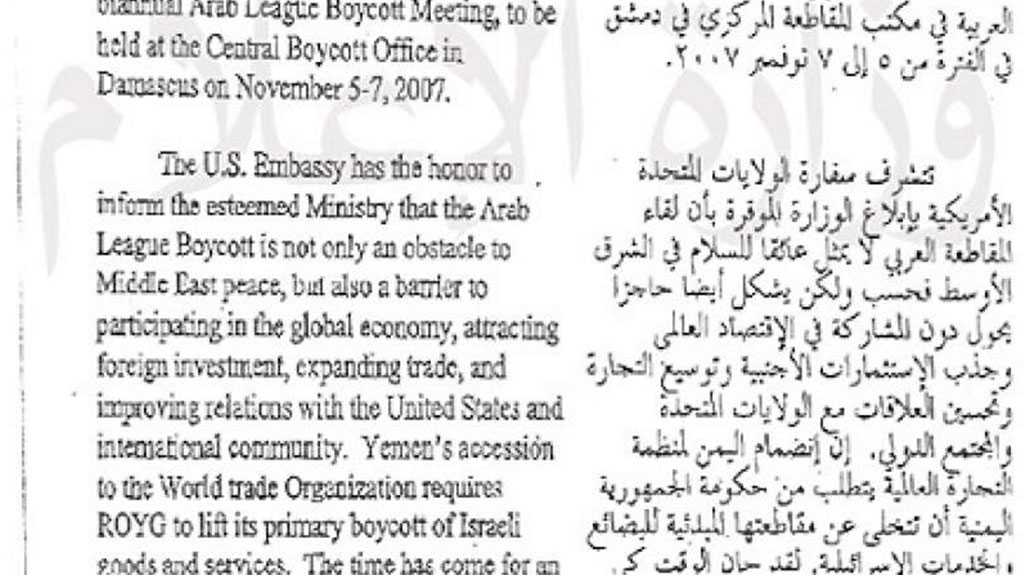
The documents include a memorandum classified under “Urgent” issued by the US Embassy in Sanaa on the 4th of November 2007 and addressed to the Ministry of Foreign Affairs. It stated a number of US directives to the former regime, chief among them: “Not to support or send representatives to the biannual boycott meeting held by the Arab League in the office of the Arab League in the Central District of Damascus.
The embassy memo stated: “The Arab boycott meeting not only represents an obstacle to peace in the Middle East, but also constitutes a barrier to participation in the global economy, attracting foreign investment, expanding trade, and improving relations with the United States and the international community. Yemen’s accession to the World Trade Organization requires that the government of the Republic of Yemen has to abandon its initial boycott of ‘Israeli’ goods and services.”
The same document also reveals that the US administration was implementing a wide campaign of pressure targeting the Arab countries whose people adhere to the boycott. “The time has come for the Arab League to take a decision to close the central district office in Damascus.”
The Ministry of Information, publishing these documents to the public opinion as evidence of the American guardianship imposed on Yemen prior to the September 21 revolution, called on the masses of the Yemeni people to commit to the weapon of economic boycott, which has a high effect on the US-Saudi enemies of the nation, and to continue supporting the Palestinian people and confronting aggression against our country until victory.
An online petition was recently sent to the British Government demanding sanctions against Israel. It said: “The Government should introduce sanctions against Israel, including blocking all trade, and in particular arms. Its disproportionate treatment of Palestinians and settlements that are regarded by the international community as illegal are an affront to civilised society.” 385,225 signed.
The Government promises a debate on the petition on 14 June. But its response includes this statement from the Foreign, Commonwealth & Development Office issued yesterday (my comments in italics):
The UK is firmly opposed to boycotts or sanctions against Israel. Our close and varied relationship means we are able to express clearly when we disagree.
HM Government has made its position on sanctions clear. While we do not hesitate to express disagreement with Israel whenever we feel it necessary, we are firmly opposed to boycotts or sanctions. We believe that open and honest discussions, rather than the imposition of sanctions or supporting anti-Israeli boycotts, best supports our efforts to help progress the peace process and achieve a negotiated solution.
• Open and honest discussion with Israel has never worked. You happily slap other nations with sanctions.
HM Government takes its export control responsibilities very seriously and operates one of the most robust arms export control regimes in the world. We consider all export applications thoroughly against a strict risk assessment framework. We continue to monitor the situation in Israel and the Occupied Palestinian Territories and keep all licences under careful and continual review as standard.
• Clearly your risk assessments aren’t strict enough.
The UK welcomed the recent announcement of a ceasefire in Israel and Gaza on 20 May, which is an important step to ending the cycle of violence and loss of civilian life.
During the Foreign Secretary’s visit to the region on 26 May he reiterated the UK’s firm commitment to the two-state solution as the best way to permanently end the occupation, deliver Palestinian self-determination and preserve Israel’s security and democratic identity. The UK will continue our intensive diplomatic efforts in the region, focussed on creating the conditions for a sustainable peace.
• The cycle of violence and loss of civilian life didn’t end after previous ceasefires. Israel continued ‘mowing the lawn’. Why are you committed to the two-state solution when you’ve allowed Israel to establish facts on the ground that make a viable Palestinian state impossible? What do you think a Palestinian state will look like when you eventually get around to recognising one?
Haven’t you yet understood that Israel doesn’t want peace until it has annexed the whole of Palestine and that your stance simply aids the Zionists’ criminal ambition? Haven’t you heard Israeli leaders repeated say they will never allow a Palestinian state? And by the way Israel has no “democratic identity”, it’s a deeply unpleasant ethnocracy.
Israel is an important strategic partner for the UK and we collaborate on issues of defence and security. Our commitment to Israel’s security is unwavering. The UK unequivocally condemns the firing of rockets at Jerusalem and locations within Israel.
We strongly condemn these acts of terrorism by Hamas and other terrorist groups, who must permanently end their incitement and rocket fire against Israel. We are also concerned by reports that Hamas is again using civilian infrastructure and populations as cover for its military operations.
• As long as we are a strategic partner of Israel we will never be trusted in the Middle East. We have no enemies in the region, not even Iran, so why provoke hostility? And given Israel’s track record how can anyone feel comfortable swopping defence and security secrets? You persistently accuse Hamas of incitement when it is the Palestinians who are under illegal military occupation and blockade.
You complain about Hamas firing garden-shed rockets but never condemn the Israelis for bombarding tightly-lacked Gaza with devastating state of the art ordnance deliberately mis-aimed to cause horrendous slaughter of civilians. Also check the definition of terrorist and consider whether it fits the Israeli regime better than Hamas.
We are clear that all countries, including Israel, have a legitimate right to self-defence, and the right to defend their citizens from attack. In doing so, it is vital that all actions are proportionate, in line with International Humanitarian Law, and are calibrated to avoid civilian casualties.
• Israel has no comprehension of “proportionate” and no right of self defence against the people it illegally occupies, murders and dispossesses. It has never complied with international Humanitarian Law, whereas the Palestinians have every right under international law to mount an armed resistance, makeshift though it is, against the occupier.
The UK is strongly opposed to the Boycotts, Divestment and Sanctions Movement against Israel, just as we oppose any calls for boycotts which divide people and reduce understanding.
• It is nonsense to claim the UK as a whole is opposed to sanctions against Israel. Only self-serving supporters of the apartheid regime oppose sanctions.
The UK position on evictions, demolitions, and settlements is longstanding and clear. We oppose these activities. We urge the Government of Israel to cease its policies related to settlement expansion immediately, and instead work towards a two state solution. Settlements are illegal under international law, and present an obstacle to peace.
We want to see a contiguous West Bank, including East Jerusalem, as part of a viable and sovereign Palestinian state, based on 1967 borders. Our position was reflected in our support for UN Security Council Resolution 2334 and we continue to urge Israel at the highest level to halt settlement expansion immediately.
• You may well oppose these things but that’s not enough. Haven’t you noticed – the Israelis don’t give a damn? What HM Government wants to see doesn’t matter to them. Their expansion programme is unstoppable except by applying firm and effective consequences. UNSCR 2334 was adopted four and a half years ago. It says Israel’s settlement activity constitutes a “flagrant violation” of international law and has “no legal validity”.
It demands that Israel stop such activity and fulfill its obligations as an occupying power under the Fourth Geneva Convention. Is Israel biting its nails thinking the sky is about to fall in on them? No, it laughs in the UN’s face. What has the British government and other members of the Security Council done in that time to concentrate Israel’s mind and ensure compliance?
We advise British businesses to bear in mind the British Government’s view on the illegality of settlements under international law when considering their investments and activities in the region. Ultimately, it will be the decision of an individual or company whether to operate in settlements in the Occupied Palestinian Territories, but the British Government would neither encourage nor offer support to such activity.
• Nevertheless you continually reward Israel for its crimes against humanity with favoured trading deals and special collaboration agreements.
We have also made clear our concerns about the increasing rate of demolitions and evictions of Palestinians. The UK is focused on preventing demolitions and evictions from happening in the first place through our legal aid programme, which supports Palestinians facing demolition or home eviction.
• The demolitions and evictions have been going on for 73 years. You haven’t in the least been focused on preventing them. And using UK taxpayers’ money to sustain Israel’s criminal policy is utterly gross.
As a strong friend of Israel, and one which has stood up for Israel when it faces bias and unreasonable criticism, we are continuing to urge Israel to not take steps such as these, which move us away from our shared goals of peace and security.
• Why are you “a strong friend” of this apartheid entity in the first place? You shame us all. Israel’s idea of peace and security is far removed from anyone else’s. It’s shocking to hear that you (implying we) “share” their goals.
The occupation will not end and peace will not be achieved by symbolic measures, but by real movement towards renewed peace negotiations which create a viable Palestinian state, living in peace and security side-by-side with Israel.
We will continue to press Israel and the Palestinians strongly on the need to refrain from taking actions, which make peace more difficult. And will continue to encourage further confidence building steps towards meaningful bilateral peace negotiations between the parties.
• What, more lopsided ‘negotiations’ overseen by the most dishonest broker on the planet? Are you SERIOUS? The occupation will end and peace will be achieved only when justice is done and seen to be done. International law has spoken. Now deliver it, please, instead of endless shaming us with your dangerous delusions.
The entire British Government would do well to recall George Washington’s wise words: “The nation which indulges towards another a habitual hatred or a habitual fondness is in some degree a slave… a passionate attachment of one nation for another produces a variety of evils.”
Yes, “slave” fits Israel’s stooges at Westminster admirably.
After working on jet fighters in the RAF Stuart became an industrial marketing specialist with manufacturing companies and consultancy firms. He also “indulged himself” as a newspaper columnist. In politics he served as a Cambridgeshire county councillor and member of the Police Authority. Now retired he campaigns on various issues and contributes to several online news & opinion sites. With a lifelong passion for photography he has produced two photo-documentary books, one of which can be read online at http://www.radiofreepalestine.org.uk.
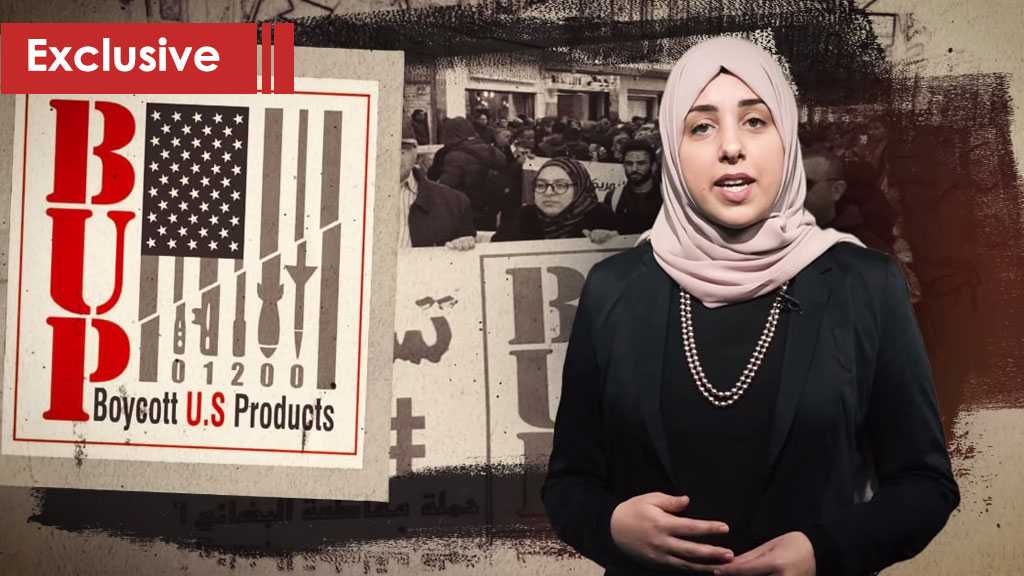
As part of shedding more light on one form of resistance that is able to cause pain to the nation’s enemy, Al-Ahed News managed to have an exclusive interview with the spokeswoman of Boycott US Products [BUP] organization, who underscored that the journey of boycotting begins with a person choosing not to make business with the US.
How did BUP start?
Boycotting has shown its effectivity in a number of causes throughout history; it’s a means for pressure on establishments, companies and governments, the spokeswoman explained. “As we witness the horrors of US military and economic hegemony against many countries around the world, we find ourselves between two choices: either to wallow in silence or assume the duty to take a stance and defend our homelands.”
The United States has enforced economic blockades and sanctions on countries, waged wars and carried out assassinations around the globe. An economic boycott is the way we chose to confront these brutal practices, Ms. Issa emphasized.
BUP participants, countries
We are a group of young people, intellectuals, media professionals and researchers. We share a common goal which is to defend our homelands and confront all unfair practices against us and the rights of our peoples, Ms. Issa said.
“We have several branches in a number of countries such as Sweden, Russia, Turkey, Lebanon, Tunisia, Iraq, Syria, Azerbaijan, Egypt and Saudi Arabia,” she added.
BUP goal
The US economy to America is what the jugular vein is to the human being: boycotting US products could affect the economy one way or another, which will on the first level enforce the US government to re-examine its practice against nations, the organization’s representative said.
“On another level, it will pressure the American people —as they do not care about their state’s foreign politics; their only concern is the state’s domestic politics and economy— for if we are able to affect the economy through boycott, this will raise awareness among the American people over their government’s aggressive foreign politics which are deemed criminal for their murderous nature.”
Perhaps this will lead the American people to pressure their government to change these policies that are now affecting their economy. “We certainly do not aim to punish a people for their government’s actions but the people must know the consequences of their government’s policies over other nations. We believe in humanity and that people can change the political track of their governments for their brothers/sisters in humanity especially that the American government misleads its citizens through its biased media, keeping them ignorant from the atrocities they commit and the suffering of other people,” she indicated.
Financial support
The organization depends on donations from businessmen who believe in its cause. It accepts donations from people who share its thoughts and empathize with its project.
People’s response
Ms. Issa was clear to point out that reactions vary from one person to another. Some believe in the goals of the movement but view them as impossible to reach. They are still under the effect of the media that the US is a “powerful country that cannot be overpowered nor defeated,” she said, noting that others care about American interest more than their own country.
However, there are people who share our faith and enthusiasm, eagerly working to achieve the goals of the boycott through active participation, Ms. Issa said.
“They reach out asking “What are American products?” “Give us a list with American products so that we start boycotting.” Such reactions push us to work harder as they increase our faith and fuel the project to continue. A journey of a thousand miles begins with a single step and the journey of boycotting begins with a person choosing not to make business with the US,” she concluded.
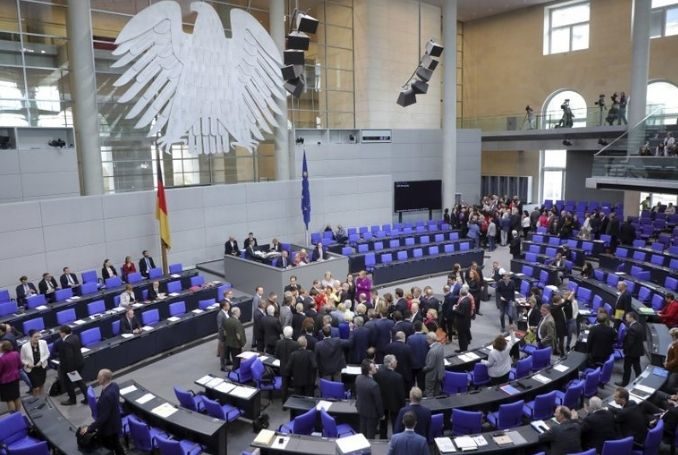
The Israeli newspaper Haaretz has run a fascinating long report this week offering a disturbing snapshot of the political climate rapidly emerging across Europe on the issue of antisemitism. The article documents a kind of cultural, political and intellectual reign of terror in Germany since the parliament passed a resolution last year equating support for non-violent boycotts of Israel – in solidarity with Palestinians oppressed by Israel – with antisemitism.
The article concerns Germany but anyone reading it will see very strong parallels with what is happening in other European countries, especially the UK and France.
The same European leaders who a few years ago marched in Paris shouting “Je suis Charlie” – upholding the inalienable free speech rights of white Europeans to offend Muslims by insulting and ridiculing their Prophet – are now queuing up to outlaw free speech when it is directed against Israel, a state that refuses to end its belligerent occupation of Palestinian land. European leaders have repeatedly shown they are all too ready to crush the free speech of Palestinians, and those in solidarity with them, to avoid offending sections of the Jewish community.
The situation reduces to this: European Muslims have no right to take offense at insults about a religion they identify with, but European Jews have every right to take offense at criticism of an aggressive Middle Eastern state they identify with. Seen another way, the perverse secular priorities of European mainstream culture now place the sanctity of a militarized state, Israel, above the sanctity of a religion with a billion followers.
Guilt by Association
This isn’t even a double standard. I can’t find a word in the dictionary that conveys the scale and degree of hypocrisy and bad faith involved.
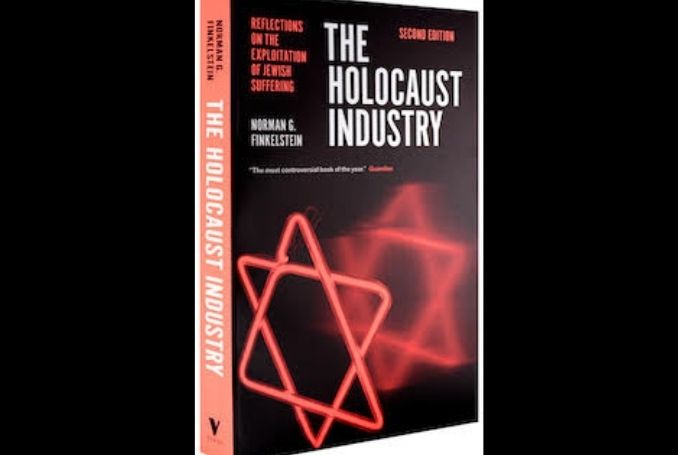
If the American Jewish scholar Norman Finkelstein wrote a follow-up to his impassioned book The Holocaust Industry – on the cynical use of the Holocaust to enrich and empower a Jewish organizational establishment at the expense of the Holocaust’s actual survivors – he might be tempted to title it The Antisemitism Industry.
In the current climate in Europe, one that rejects any critical thinking in relation to broad areas of public life, that observation alone would enough to have one denounced as an antisemite. Which is why the Haaretz article – far braver than anything you will read in a UK or US newspaper – makes no bones about what is happening in Germany. It calls it a “witch-hunt”. That is Haaretz’s way of saying that antisemitism has been politicized and weaponized – a self-evident conclusion that will currently get you expelled from the British Labour party, even if you are Jewish.
The Haaretz story highlights two important developments in the way antisemitism has been, in the words of intellectuals and cultural leaders cited by the newspaper, “instrumentalized” in Germany.
Jewish organizations and their allies in Germany, as Haaretz reports, are openly weaponizing antisemitism not only to damage the reputation of Israel’s harsher critics but also to force out of the public and cultural domain – through a kind of “antisemitism guilt by association” – anyone who dares to entertain criticism of Israel.
Cultural associations, festivals, universities, Jewish research centers, political think-tanks, museums, and libraries are being forced to scrutinize the past of those they wish to invite in case some minor transgression against Israel can be exploited by local Jewish organizations. That has created a toxic, politically paranoid atmosphere that inevitably kills trust and creativity.
But the psychosis runs deeper still. Israel, and anything related to it, has become such a combustible subject – one that can ruin careers in an instant – that most political, academic and cultural figures in Germany now choose to avoid it entirely. Israel, as its supporters intended, is rapidly becoming untouchable.
A case study noted by Haaretz is Peter Schäfer, a respected professor of ancient Judaism and Christianity studies who was forced to resign as director of Berlin’s Jewish Museum last year. Schäfer’s crime, in the eyes of Germany’s Jewish establishment, was that he staged an exhibition on Jerusalem that recognized the city’s three religious traditions, including a Muslim one.
He was immediately accused of promoting “historical distortions” and denounced as “anti-Israel”. A reporter for Israel’s right-wing Jerusalem Post, which has been actively colluding with the Israeli government to smear critics of Israel, contacted Schäfer with a series of inciteful emails. The questions included “Did you learn the wrong lesson from the Holocaust?” and “Israeli experts told me you disseminate antisemitism – is that true?”
Schäfer observes:
“The accusation of antisemitism is a club that allows one to deal a death blow, and political elements who have an interest in this are using it, without a doubt… The museum staff gradually entered a state of panic. Then of course we also started to do background checks. Increasingly it poisoned the atmosphere and our work.”
Another prominent victim of these Jewish organizations tells Haaretz:
“Sometimes one thinks, ‘To go to that conference?’ ‘To invite this colleague?’ Afterward, it means that for three weeks, I’ll have to cope with a shitstorm, whereas I need the time for other things that I get paid for as a lecturer. There is a type of ‘anticipatory obedience’ or ‘prior self-censorship.’”
Ringing off the Hook
There is nothing unusual about what is happening in Germany. Jewish organizations are stirring up these “shitstorms” – designed to paralyze political and cultural life for anyone who engages in even the mildest criticism of Israel – at the highest levels of government. Don’t believe me? Here is Barack Obama explaining in his recent autobiography his efforts as US president to curb Israel’s expansion of its illegal settlements. Early on, he was warned to back off or face the wrath of the Israel lobby:
“Members of both parties worried about crossing the American Israel Public Affairs Committee (AIPAC). Those who criticized Israeli policy too loudly risked being tagged as ‘anti-Israel’ (and possibly anti-Semitic) and confronted with a well-funded opponent in the next election.”
When Obama went ahead anyway in 2009 and proposed a modest freeze on Israel’s illegal settlements:
“The White House phones started ringing off the hook, as members of my national security team fielded calls from reporters, leaders of American Jewish organizations, prominent supporters, and members of Congress, all wondering why we were picking on Israel … this sort of pressure continued for much of 2009.”
He observes further:
“The noise orchestrated by Netanyahu had the intended effect of gobbling up our time, putting us on the defensive, and reminding me that normal policy differences with an Israeli prime minister – even one who presided over a fragile coalition government – exacted a political cost that didn’t exist when I dealt with the United Kingdom, Germany, France, Japan, Canada, or any of our other closest allies.”
Doubtless, Obama dare not put down in writing his full thoughts about Israeli prime minister Benjamin Netanyahu or the US lobbyists who worked on his behalf. But Obama’s remarks do show that, even a US president, supposedly the single most powerful person on the planet, ended up blanching in the face of this kind of relentless assault. For lesser mortals, the price is likely to be far graver.
No Free Speech on Israel
It was this same mobilization of Jewish organizational pressure – orchestrated, as Obama notes, by Israel and its partisans in the US and Europe – that ended up dominating Jeremy Corbyn’s five years as the leader of Britain’s leftwing Labour party, recasting a well-known anti-racism activist almost overnight as an antisemite.
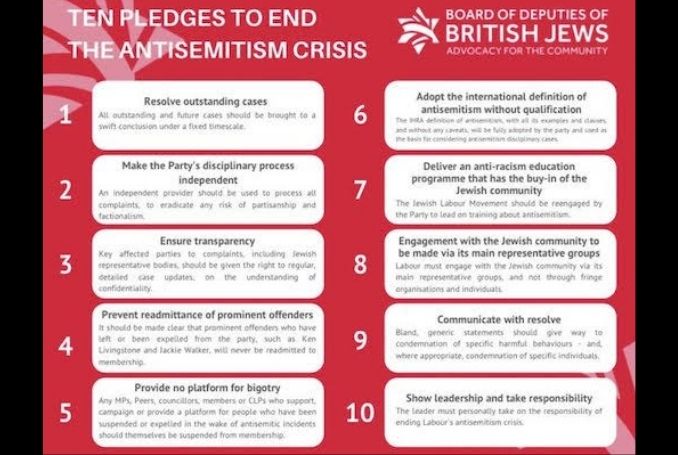
It is the reason why his successor, Sir Keir Starmer, has outsourced part of Labour’s organizational oversight on Jewish and Israel-related matters to the very conservative Board of Deputies of British Jews, as given expression in Starmer’s signing up to the Board’s “10 Pledges”.
It is part of the reason why Starmer recently suspended Corbyn from the party, and then defied the membership’s demands that he be properly reinstated, after Corbyn expressed concerns about the way antisemitism allegations had been “overstated for political reasons” to damage him and Labour. (The rightwing Starmer, it should be noted, was also happy to use antisemitism as a pretext to eradicate the socialist agenda Corbyn had tried to revive in Labour.) It is why Starmer has imposed a blanket ban on constituency parties discussing Corbyn’s suspension. And it is why Labour’s shadow education secretary has joined the ruling Conservative party in threatening to strip universities of their funding if they allow free speech about Israel on campus.
Two Types of Jews
But the Haaretz article raises another issue critical to understanding how Israel and the Jewish establishment in Europe are politicizing antisemitism to protect Israel from criticism. The potential Achilles’ heel of their campaign are Jewish dissidents, those who break with the supposed “Jewish community” line and create a space for others – whether Palestinians or other non-Jews – to criticize Israel. These Jewish dissenters risk serving as a reminder that trenchant criticism of Israel should not result in one being tarred an antisemite.
Israel and Jewish organizations, however, have made it their task to erode that idea by promoting a distinction – an antisemitic one, at that – between two types of Jews: good Jews (loyal to Israel), and bad Jews (disloyal to Israel).
Haaretz reports that officials in Germany, such as Felix Klein, the country’s antisemitism commissioner, and Josef Schuster, president of the Central Council of Jews in Germany, are being allowed to define not only who is an antisemite, typically using support for Israel as the yardstick, but are also determining who are good Jews – those politically like them – and who are bad Jews – those who disagree with them.
Despite Germany’s horrific recent history of Jew-hatred, the German government, local authorities, the media, universities and cultural institutions have been encouraged by figures like Klein and Schuster to hound German Jews, even Israeli Jews living and working in Germany, from the country’s public and cultural space.
When, for example, a group of Israeli Jewish academics in Berlin held a series of online discussions about Zionism last year on the website of their art school, an Israeli reporter soon broke the story of a “scandal” involving boycott supporters receiving funding from the German government. Hours later the art school had pulled down the site, while the German education ministry issued a statement clarifying that it had provided no funding. The Israeli embassy officially declared the discussions held by these Israelis as “antisemitic”, and a German foundation that documents antisemitism added the group to the list of antisemitic incidents it records.
Described as ‘Kapos’
So repressive has the cultural and political atmosphere grown in Germany that there has been a small backlash among cultural leaders. Some have dared to publish a letter protesting against the role of Klein, the antisemitism commissioner. Haaretz reports:
“The antisemitism czar, the letter charged, is working ‘in synergy with the Israeli government’ in an effort ‘to discredit and silence opponents of Israel’s policies’ and is abetting the ‘instrumentalization’ that undermines the true struggle against antisemitism.
Figures like Klein have been so focused on tackling criticism of Israel from the left, including the Jewish left, that they have barely noted the “acute danger Jews in Germany face due to the surge in far-right antisemitism”, the letter argues.
Again, the same picture can be seen across Europe. In the UK, the opposition Labour party, which should be a safe space for those leading the anti-racism struggle, is purging itself of Jews critical of Israel and using antisemitism smears against prominent anti-racists, especially from other oppressed minorities.
Extraordinarily, Naomi Wimborne-Idrissi, one of the founders of Jewish Voice for Labour, which supports Corbyn, recently found herself suspended by Starmer’s Labour. She had just appeared in a moving video in which she explained the ways antisemitism was being used by Jewish organizations to smear Jewish left-wingers like herself as “traitors” and “kapos” – an incendiary term of abuse, as Wimborne-Idrissi points out, that refers to “a Jewish inmate of a concentration camp who collaborated with the [Nazi] authorities, people who collaborated in the annihilation of their own people”.
In suspending her, Starmer effectively endorsed this campaign by the UK’s Jewish establishment of incitement against, and vilification of, left-wing Jews.
Earlier, Marc Wadsworth, a distinguished black anti-racism campaigner, found himself similarly suspended by Labour when he exposed the efforts of Ruth Smeeth, then a Labour MP and a former Jewish official in the Israel lobby group BICOM, to recruit the media to her campaign smearing political opponents on the left as antisemites.
In keeping with the rapid erosion of critical thinking in civil society organizations designed to uphold basic freedoms, Smeeth was recently appointed director of the prestigious free speech organization Index on Censorship. There she can now work on suppressing criticism of Israel – and attack “bad Jews” – under cover of fighting censorship. In the new, inverted reality, censorship refers not to the smearing and silencing of a “bad Jew” like Wimborne-Idrissi, but to criticism of Israel over its human rights abuses, which supposedly “censors” the identification of “good Jews” with Israel – now often seen as the crime of “causing offense”.
Boy Who Cried Wolf
The Haaretz article helps to contextualize Europe’s current antisemitism “witch-hunt”, which targets anyone who criticizes Israel or stands in solidarity with oppressed Palestinians, or associates with such people. It is an expansion of the earlier campaign by the Jewish establishment against “the wrong kind of Jew”, as identified by Finkelstein in The Holocaust Industry. But this time Jewish organizations are playing a much higher-stakes, and more dangerous, political game.
Haaretz rightly fears that the Jewish leadership in Europe is not only silencing ordinary Jews but degrading the meaning – the shock value – of antisemitism through the very act of politicizing it. Jewish organizations risk alienating the European left, which has historically stood with them against Jew-hatred from the right. European anti-racists suddenly find themselves equated with, and smeared as, fledgling neo-Nazis.
If those who support human rights and demand an end to the oppression of Palestinians find themselves labeled antisemitic, it will become ever harder to distinguish between bogus (weaponized) “antisemitism” on the left and real Jew-hatred from the right. The antisemitism smearers – and their fellow travelers like Keir Starmer – are likely to end up suffering their very own “boy who cried wolf” syndrome.
Or as Haaretz notes:
“The issue that is bothering the critics of the Bundestag [German parliament] resolution is whether the extension of the concept of antisemitism to encompass criticism of Israel is not actually adversely affecting the battle against antisemitism. The argument is that the ease with which the accusation is leveled could have the effect of eroding the concept itself.”
The Antisemitism Industry
It is worth noting the shared features of the new Antisemitism Industry and Finkelstein’s earlier discussions of the Holocaust Industry.
In his book, Finkelstein identifies the “wrong Jews” as people like his mother, who survived a Nazi death camp as the rest of her family perished. These surviving Jews, Finkelstein argues, were valued by the Holocaust Industry only in so far as they served as a promotional tool for the Jewish establishment to accumulate more wealth and cultural and political status. Otherwise, the victims were ignored because the actual Holocaust’s message – in contrast to the Jewish leadership’s representation of it – was universal: that we must oppose and fight all forms of racism because they lead to persecution and genocide.
Instead, the Holocaust Industry promoted a particularist, self-interested lesson that the Holocaust proves Jews are uniquely oppressed and that they, therefore, deserve a unique solution: a state, Israel, that must be given unique leeway by western states to commit crimes in violation of international law. The Holocaust Industry – very much to be distinguished from the real events of the Holocaust – is deeply entwined in, and rationalized by, the perpetuation of the racialist, colonial project of Israel.
In the case of the Antisemitism Industry, the “wrong Jew” surfaces again. This time the witch-hunt targets Jewish left-wingers, Jews critical of Israel, Jews opposed to the occupation, and Jews who support a boycott of the illegal settlements or of Israel itself. Again, the problem with these “bad Jews” is that they allude to a universal lesson, one that says Palestinians have at least as much right to self-determination, to dignity and security, in their historic homeland as Jewish immigrants who fled European persecution.
In contrast to the “bad Jews”, the Antisemitism Industry demands that a particularist conclusion be drawn about Israel – just as a particularist conclusion was earlier drawn by the Holocaust Industry. It says that to deny Jews a state is to leave them defenceless against the eternal virus of antisemitism. In this conception, the Holocaust may be uniquely abhorrent but it is far from unique. Non-Jews, given the right circumstances, are only too capable of carrying out another Holocaust. Jews must therefore always be protected, always on guard, always have their weapons (or in Israel’s case, its nuclear bombs) to hand.
‘Get out of Jail’ Card
This view, of course, seeks to ignore, or marginalize, other victims of the Holocaust – Romanies, communists, gays – and other kinds of racism. It needs to create a hierarchy of racisms, a competition between them, in which hatred of Jews is at the pinnacle. This is how we arrived at an absurdity: that anti-Zionism – misrepresented as the rejection of a refuge for Jews, rather than the reality that it rejects an ethnic, colonial state oppressing Palestinians – is the same as antisemitism.
Extraordinarily, as the Haaretz article clarifies, German officials are oppressing “bad Jews”, at the instigation of Jewish organizations, to prevent, as they see it, the re-emergence of the far-right and neo-Nazis. The criticisms of Israel made by the “bad Jew” are thereby not just dismissed as ideologically unsound or delusions but become proof that these Jews are colluding with, or at least nourishing, the Jew-haters.
In this way, Germany, the UK and much of Europe have come to justify the exclusion of the “wrong Jew” – those who uphold universal principles for the benefit of all – from the public space. Which, of course, is exactly what Israel wants, because, rooted as it is in an ideology of ethnic exclusivity as a “Jewish state”, it necessarily rejects universal ethics.
What we see here is an illustration of a principle at the heart of Israel’s state ideology of Zionism: Israel needs antisemitism. Israel would quite literally have to invent antisemitism if it did not exist.
This is not hyperbole. The idea that the “virus of antisemitism” lies semi-dormant in every non-Jew waiting for a chance to overwhelm its host is the essential rationale for Israel. If the Holocaust was an exceptional historical event, if antisemitism was an ancient racism that in its modern incarnation followed the patterns of prejudice and hatred familiar in all racisms, from anti-black bigotry to Islamophobia, Israel would be not only redundant but an abomination – because it has been set up to dispossess and abuse another group, the Palestinians.
Antisemitism is Israel’s “get out of jail” card. Antisemitism serves to absolve Israel of the racism it structurally embodies and that would be impossible to overlook were Israel deprived of the misdirection weaponized antisemitism provides.
An Empty Space
The Haaretz article provides a genuine service by not only reminding us that “bad Jews” exist but in coming to their defense – something that European media is no longer willing to do. To defend “bad Jews” like Naomi Wimborne-Idrissi is to be contaminated with the same taint of antisemitism that justified the ejection of these Jews from the public space.
Haaretz records the effort of a few brave cultural institutions in Germany to protest, to hold the line, against this new McCarthyism. Their stand may fail. If it does, you may never become aware of it.
Once, the “bad Jews” have been smeared into silence, as Palestinians and those who stand in solidarity with them largely have been already; when social media has de-platformed critics of Israel as Jew-haters; when the media and political parties enforce this silence so absolutely they no longer need to smear anyone as an antisemite because these “antisemites” have been disappeared; when the Jewish “community” speaks with one voice because its other voices have been eliminated; when the censorship is complete, you will not know it.
There will be no record of what was lost. There will be simply an empty space, a blank slate, where discussions of Israel’s crimes against Palestinians once existed. What you will hear instead is only what Israel and its partisans want you to hear. Your ignorance will be blissfully complete.
– Jonathan Cook won the Martha Gellhorn Special Prize for Journalism. His books include “Israel and the Clash of Civilisations: Iraq, Iran and the Plan to Remake the Middle East” (Pluto Press) and “Disappearing Palestine: Israel’s Experiments in Human Despair” (Zed Books). Visit his website www.jonathan-cook.net. He contributed this article to The Palestine Chronicle.
Another Epstein Class whistleblower ‘suicide’
-
“How US commerce secretary’s Epstein links were uncovered by British
whistleblower“ (Verity/Byrne/Milne):Andriesz suspected there was yet more
to find in t...
The Legendary Golem
-
The Legendary Golem October 3 2026 ___________________________________ More
Vids! +BN Vids Archive! HERE! ___________________________________ Support
The B...
The United States At A Crossroad
-
The United States At A Crossroad—An Analysis (16 Sept 2026) by Lawrence
Davidson Part I—Texas vs Minnesota Back in mid-May […]
Report on Beth Israel vigil 09-12-26
-
*Eat-a-Cheeseburger Day Approaches*
This year, EAC Day appears on Monday, September 21st. The date coincides
with the Jewish holiday called Yom Kippur. Cl...
-
Hello all,
It is with great sadness that I share with you the passing of our beloved
sister, Mother, and Grandmother, the individual that you all knew ...
Best Horror Podcast
-
Best Horror Podcast Introduction: Horror podcasts […]
The post Best Horror Podcast appeared first on Copper Shock Horror Podcast.
Ikhras Endorses Muntadhar Al-Zaidi
-
“Oh parties of banditry and sectarianism and corruption, we have come and
our goal is to destroy you.” Ikhras formally endorses Muntadhar al-Zaidi,
Iraqi j...
Prince Charles: Foreign Jews behind bloodshed in ME
-
In May, 2017, British Crown Prince Charles declined an invitation from
Zionist entity’s president Reuven Rivlin‘s to attend the 100th anniversary
of the no...
Palestinian Women – One for All, All for One
-
Honouring All Palestinian Women by Honouring Three: Hanin Zoabi, Ahed
Tamimi, Samah Sabawi Vacy Vlazna “Palestinian women have always stood side
by side ...
US’s Saudi Oil Deal from Win-Win to Mega-Lose
-
By F. William Engdahl Who would’ve thought it would come to this? Certainly
not the Obama Administration, and their brilliant geo-political think-tank
neo-...
-
*Mordechai Vanunu wins human rights prize of Brazilian Press Association *
* http://www.alternativenews.org/english/index.php/features/updates/7038-mordechai...
Abdul Aziz Rantissi:
"My ultimate wish, my God, is to attain martyrdom,"...God granted him his wish on April 17, 2004, at the hands of Israeli assassins.