Uprooted Palestinians are at the heart of the conflict in the M.E Palestinians uprooted by force of arms. Yet faced immense difficulties have survived, kept alive their history and culture, passed keys of family homes in occupied Palestine from one generation to the next.
How an “Educational farm” in Wadi Rababa is really another conquest for eradicating Palestinian heritage and agriculture at the hands of Israeli colonialism.
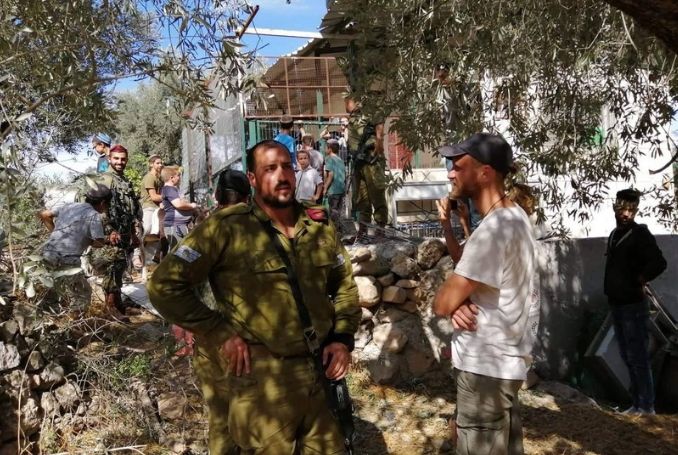
A fence was erected around the “educational farm” in Wadi Rababa
The Ir David Foundation, a right-wing organization in “Israel”, opened an “Educational farm” in Wadi Rababa, where the land is registered under the name of the “Israel” Nature and Parks Authority (INPA).
The farm, which opened in August, boasts attractions that allow visitors to learn about so-called “traditional agriculture.”
The funny part?
Many of the olive groves located in the adjacent neighborhoods of Abu Tor and Silwan neighborhoods that have been cultivated by Palestinians for years, are strategically left out of the farm in an attempt to replace the current traditions with a right-wing Jewish version.
Ir David, the supposed nonprofit organization whose funding mainly comes from transferred US funds in the form of nondisclosed donations, runs the site, and settles Jewish families in the neighboring Silwan.
Even some Israelis were taken aback by the brazen attack on the Palestinian land. A member of the left-wing Emek Shahveh organization commented by saying, ” The infuriating thing about what’s happening in the ‘Hinnom Valley’ is that in the name of development that masquerades as an ancient agricultural landscape, they are displacing the traditional Palestinian agriculture that has preserved the historic character of the place.”
National Park or Constructed Disaster?
In 1974, “Israel” bestowed the area around the Old City with national park status.
According to the INPA, development-related activity may be carried out anywhere in the area in order to protect the land and render it accessible to visitors.
Ahmed Somrin, whose family owns property in Abu Tor and Silwan, says they “clean up this land and pick the olives that are here every year.”
Somrin details how land near Silwan and Wadi el Joz that has been cultivated by his family for generations has been handed a landscaping order. Of course, owners of land are not permitted to interfere with “temporary gardening”.
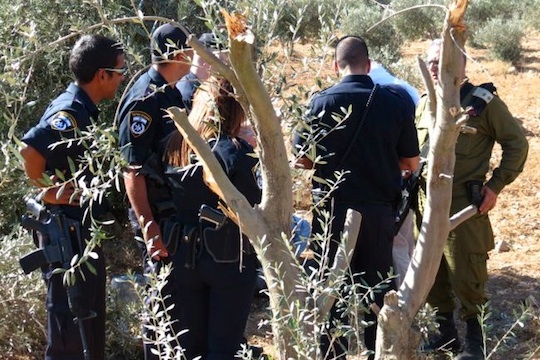
Since a recent court decision ruled that the INPA was permitted to enter the olive tree area in order to maintain and clean it as a “fire precaution,” the INPA recently entered Somrin’s property, and broke through a wall in the process.
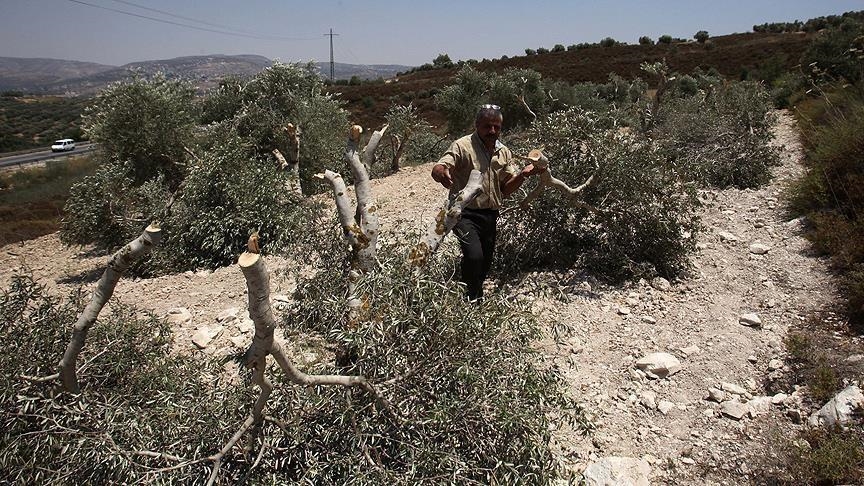
ICRC data revealed that “over the period of one year (August 2020 – August 2021) more than 9,300 trees were destroyed in the occupied West Bank.”
According to a study published in 2012 by the “Applied Research Institute Jerusalem” (ARIJ), Israeli occupation forces have uprooted 800,000 Palestinian olive trees in the West Bank since 1967.
Wall broken by INPA to access Ahmad Somrin’s olive grove.
“The Nature and Parks Authority built walls there and turned over the earth and put down red dirt and planted centuries-old trees from who knows where,” Somrin said.
“They want to change the face of it to make it look not like Arab land but like Jewish nature.”
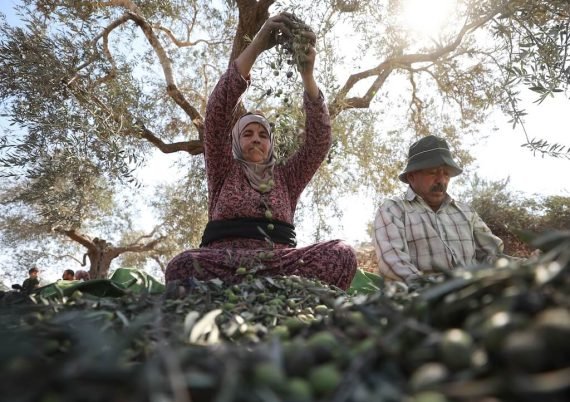
A view from an olive grove during olive harvesting by Palestinian farmers in Nablus, Erst Bank on October 13, 2021. While Palestinian farmers living in the West Bank welcome the olive harvest season with joy, in some areas the joy gives way to anxiety due to the threat of attack by Jewish settlers. Photo by Issam Rimawi. Anadolu
Yousef M. Aljamal is a researcher in Middle Eastern Studies and the author and translator of a number of books.
Olive trees and harvests have an exceptionally important place in Palestinian culture, especially in villages where farming is the main source of income for Palestinian families. Palestinians and especially farmers have always looked at olive trees as a national symbol that should be kept and protected as it speaks of the thousands of years of their history in Palestine. This special importance has been expressed in the Palestinian culture, through oral history, songs, and poetry.
Late iconic Palestinian poet Mahmoud Darwish famously spoke of the relationship that connects Palestinians and Israeli soldiers with olive trees.
These soldiers, these modern soldiers
Besiege her with bulldozers and uproot her from her lineage
of earth.
They vanquished our grandmother who foundered,
Her branches on the ground, her roots in the sky.
She did not weep or cry out. But one of her grandsons
Who witnessed the execution threw a stone
At a soldier, and he was martyred with her.
The Palestinians will remain in Palestine as long as olives remain
The largest and oldest olive tree defying the occupation
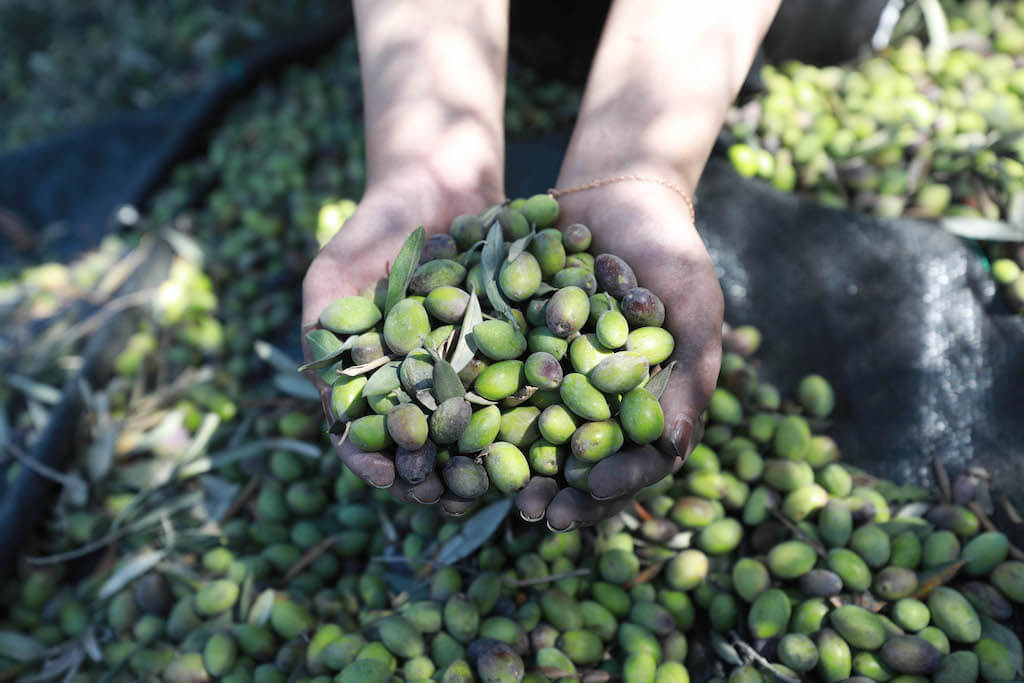
Olive harvest in Palestine sees the gathering of families where all members for days participate in picking the olives. The olive harvest in Palestine starts after it rains for the first time in autumn – an indication that olives are ripe and ready to be picked. This usually happens every year in early October and lasts for a couple of weeks. In the Gaza Strip, some people use the expression “The cross has materialized,” to declare the start of the olive harvest season. The expression has its roots in the city’s oral history which saw conversions to Christianity following the worship of stars and fire in the past.
According to legend, a priest came to Gaza asking people to convert to Christianity after all Palestinian cities had converted except for Gaza. He told the locals that they would be saved from drought and that it would rain if they did so. The people of Gaza, being rebellious throughout history, refused to convert unless the priest prayed to God and caused it rained. According to the story, the priest prayed, and it rained, and as a result, the people converted and used the expression “the cross had materialized” to express the fact that the priest’s promise had come true.
During the olive harvest in Palestine, families come together to eat meals prepared quickly such as tomatoes and potatoes baked over a fire as everyone is busy collecting and pressing olives.
During the olive harvest in Palestine, families come together to eat meals prepared quickly such as tomatoes and potatoes baked over a fire as everyone is busy collecting and pressing olives. While men and women engage in picking olives, children gather to help as well – taking part in the harvest gives them a sense of identity and responsibility. As the olives are being picked, Palestinians sing traditional songs that they have heard their parents and grandparents sing, generation after generation.
One of these traditional songs tells the story of an exchange between a Palestinian father and son. Using rhyme and rhythm, the song goes,
You can get what you want from me (O olive tree), really our heart has been connected to the olive tree since we were young
My heart is connected to her [the olive tree], don’t talk like Al-Farazdaq [famous Arab poet], I am flying in the sky as if I am a pilot.
Palestinians take part in an olive collecting event in Beita village of Nablus, West Bank, on October 10, 2021. Israeli forces took measures during the event. Photo by Issam Rimawi. Anadolu Agency.
It would not be an exaggeration to say that olive trees are like children to Palestinians. When my family wanted to tear down our house to build a new one, my aunt resisted the idea because we had to cut down two olive trees my grandfather planted some 35 years ago. My aunt cried when they cut the trees, and all our attempts to save them by planting them elsewhere didn’t succeed. Although we planted new olive trees later, my aunt would always speak of the two olive trees her father had planted, alongside which she grew up in our Gaza refugee camp.
Palestinian author Sarah Ali once wrote, “If a Palestinian bulldozer were ever invented (Haha, I know) and I were given the chance to be in an orchard in Haifa for instance, I would never uproot a tree an Israeli planted. No Palestinian would. To Palestinians, the tree is sacred, and so is the land clasping it.”
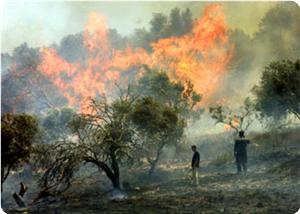
Today, the scene of olive harvest in Palestine is not only about family gatherings, traditional songs, and family bonds. The olive harvest in Palestine is about proving a connection to the land, a battle to maintain existence on the land as Israeli settlers – day and night – burn hundreds of olive trees as part of their ongoing attacks against Palestinians. Attacks that include stoning Palestinian cars, and burning Palestinian houses (with families inside), mosques, and churches.
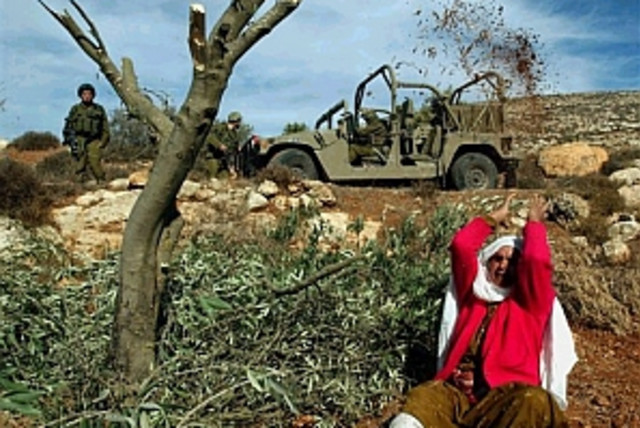
These very Israeli settlers also move the olive trees they uproot to decorate the entrance of settlements built on Palestinian lands in order to prove their claimed connection to the land. The image of Palestinian Mahfoza Oude hugging an olive tree as a group of Israeli soldiers attempted to uproot it speaks of the Palestinians’ relationship with olive trees and the land.
Most of the olive trees the settlers uproot are older than the state of Israel, which was only declared in 1948 on the ruins of Palestinian cities and villages. These olive trees stand as a striking reminder to settlers of the history of Palestine, which has always been a land of peaceful religious co-existence, where a person like my mother, who was born in Bethlehem, the city where Jesus was born, still says “The cross has materialized” to mark the start of the olive harvest, without even realizing its meaning.
Although the situation for Palestinians is very grim on the ground, the increasing international solidarity for the Palestinian people – and their olive trees which attest to their history on this land – will continue to preserve this existence and culture.
Palestinian poet Tamim al-Barghouti said in one of his poems that a state that was built on enmity towards olive trees would not survive in the Levant.
It is true. Darwish said, “If the olive tree knew [what was happening to] its planter, its oil would become tears.” The ongoing Palestinian commitment to the land, represented by planting more olive trees as Israeli settlers uproot hundreds of them, is telling that a future solution that ignores Palestinians and their connection and claim to the land is unlikely to see the light.
The future must unequivocally include the Palestinians. All Palestinian refugees and their descendants should be able to have breakfast on their lands which always has abundant olive oil. No more olive trees should ever be uprooted just because some Israeli settlers have decided to rewrite history.
Human rights NGOs, Qadiri attacked, Sheep farm dismantling, Settlement terror, Palestinian kidnapped, Palestinians injured, Olive trees set on fire
Israel’s Terrorism Against Human Rights NGOs
Since its founding in 1948, the “State of Israel” has promoted an intense campaign to erase Palestinian history, culture and resistance on all its fronts. Human rights organizations such as the Boycott, Divestment and Sanctions Movement (BDS) and activists around the world are the constant targets of this attack. Recently, “Israel” attacked the Palestinian human rights movement head-on, designating six non-governmental organizations (NGOs) as “terrorist groups” with the aim of silencing, restricting and interrupting the work they are doing. If human rights NGOs are “terrorists”, how should we identify the “State of Israel” guilty of violations of humanitarian law, war crimes, crimes against humanity and apartheid?
Watchdog: Nachshon repression unit attacked Qadiri
The Committee of Detainees’ and Former Detainees’ Affairs said members of Nachshon’s repression unit attacked Ya’qoub Qadiri, one of six Gilboa escapees, after his latest court hearing. His lawyer said more than 20 guards attacked him, threw him to the ground and stepped on his handcuffs, causing injuries to his right hand. The commission added that the Israel Prison Service (IPS) refused to send Qadiri to the prison clinic.
It added that the IPS also continues to hold Qadiri in solitary confinement in Rimonim Prison with Israeli dangerous criminal prisoners. His cell is not fit to live and is guarded around the clock.
‘Israel’ dismantles, confiscates Palestinian barn under construction in Hebron
Israeli occupation forces dismantled and seized an under-construction sheep barn in Palestine at Masafer Yatta in the city of Hebron in the occupied West Bank earlier on Monday. Local sources said earlier today that Israeli forces have escorted bulldozers into the area and have begun dismantling an under-construction barn owned by Palestinians before it is seized.
Soldiers dismantle a barn, kidnap a Palestinian, near Hebron
Israeli soldiers on Monday raided two communities near the town of Yatta, south of the southern West Bank city of Hebron, dismantled and confiscated a barn and kidnapped a Palestinian. Fuad al-Amour, the coordinator of the Protection And Steadfastness Committee in Masafer Yatta and the southern hills of Hebron, said several Israeli military vehicles invaded the village of Erfa’eyya, dismantled a barn and seized it.
B’Tselem: ‘Israel’ uses settler terror as a tool to steal Palestinian land
Israeli authorities are using settler terrorist attacks as “an important informal tool” to take over Palestinian land in the occupied West Bank, Israel’s B’Tselem said. In a report released Sunday, the major Israeli human rights group said the occupying state uses two main methods to steal Palestinian land in the West Bank: official annexation through its legal system and unofficial acts of intimidation and violence by the settlers. to drive native Palestinians from their homes. “The state fully supports and assists these acts of violence, and its agents sometimes participate directly in them,” the report said.
B’Tselem: Israel is embezzling West Bank land due to settler violence
The Israeli occupation government has used settler violence as “an important informal tool” to take over Palestinian land in the occupied West Bank, B’Tselem, a leading Israeli human rights group, has found. In a report released on Sunday, B’Tselem said Israel is using two complementary ways to confiscate Palestinian land in the occupied West Bank: official annexation through its judicial system and unofficial acts of intimidation and violence by the settler population.
Israeli settlers injure three Palestinians near Nablus
Israeli settlers on Monday attacked many Palestinian farmers near the village of Burqa, north of the northern West Bank city of Nablus, injuring three. Ghassan Daghlas, a Palestinian official who oversees Israel’s illegal colonialist activities in the north of the West Bank, said settlers attacked Palestinian farmers on their land near the Jenin-Nablus main road, throwing rocks at them. Daghlas added that a Palestinian identified as Nasser Hijja suffered a facial injury after a settler threw a stone at him.
Sources: Extremist settlers attack and injure Palestinians in Nablus
Israeli settlers on Monday attacked Palestinian farmers near the village of Burqa north of Nablus, in the northern occupied West Bank, injuring at least three people, according to local sources. Ghassan Daghlas, who monitors Israeli settlement activities in the north of the West Bank, said in a press statement that Israeli settlers stoned Palestinian farmers while on their land in the village of Burqa, injuring at least three people. One of the farmers was attacked in the face with a stone, another was injured after being hit on the head, while the third farmer was bruised.
At least 50 olive trees burned by Israeli settlers in Hebron
Israeli settlers on Monday set fire to more than 50 Palestinian olive trees in the town of Ash-Shuyukh northeast of Hebron, in the occupied southern West Bank, according to local sources activist Ahmad al-Halayqa. The activist reported in a press statement that settlers set fire to at least 50 mature olive trees and set up two mobile homes on Palestinian-owned land next to the illegal Israeli settlement of Asfar, in an apparent prelude to taking the land for the benefit of settlement expansion.
(Sources: Days of Palestine, Quds News Network, IMEMC, The Gaza Post)
Traditionally a festive season, this year’s olive harvest is once again overshadowed by Israeli vandalism and assaults, resulting in low yields due to the devastating impacts of the Israeli eco-terrorism.
The olive harvest season is yet another Palestinian struggle in the face of the colonial Israeli entity.
It could and should have been a seasonal family celebration. It could and should have been a peaceful encounter with nature. It could and should have been a harvest in the grove, where trees are tightly enrooted and extend as deep as Palestinian ancestors. It could and should have been the annual olive oil harvest season…
Instead, it is yet another Palestinian struggle in the face of a colonial Israeli entity.
“Israel” could not care less about mankind; would it care about an olive tree?” – Abed from the occupied West Bank.
Every year, the olive harvest takes place in Palestine in October and November. Unfortunately, it is not the usual harvest festival, as Palestinian farmers face a triple challenge, particularly in the occupied West Bank, according to a recent report published by the International Committee of the Red Cross (ICRC).
“My olives bear the brunt of Israeli aggression.” – A 60-year-old Palestinian woman from Salem village, east of Nablus city.
The triple challenge
The first is Israeli settlers, guarded by occupation forces, escalating their daily assaults against Palestinian farmers and their property. The second is “Israel” imposing access restrictions on farmers whose groves are located behind the separation barrier and close to Israeli settlements. The last is “Israel’s” acts of ecological terrorism that have long-lasting effects on climate.
“When I was a first-grader, I used to walk to school on footpath amid green plants at an olive orchid with my brother. As I became a freshmen student, the olive orchid was razed and an Israeli settlement was built in its place. “- Mohammad from Raba, a village in the West Bank village.
The nightmare season
To no one’s surprise, this harvest season too was disrupted by Israeli settlers, who physically assaulted farmers, vandalized or set fire to their trees, or harvested and stole their produce.
Last month, Israeli settlers committed daily assaults against Palestinians harvesting their olive season. In the West Bank, 365 Israeli settlers attacks were reported. This year, almost 8,000 olive trees have already been uprooted, although the season is not over yet.
“Life’s work disappeared in a second.”- Fouad from Raba.
“It’s like watching your children being cut down in front of you.”
Furthermore, ICRC data revealed that “over the period of one year (August 2020 – August 2021) more than 9,300 trees were destroyed in the occupied West Bank.”
“Here is what our eyes saw: a barren land, and dozens, perhaps even hundreds, of dead olive trees.” – Mona from the occupied West Bank.
“My uncle had a stroke at the sight of the trees being cut in front of him,” Mona added.
According to a study published in 2012 by the Applied Research Institute Jerusalem (ARIJ), Israeli occupation forces have uprooted 800,000 Palestinian olive trees in the West Bank since 1967.
In an exclusive interview for Al Mayadeen English, Lobby and Advocacy Director at the Union of Agricultural Work Committees (UAWC) Moayyad Bsharat said that the UAWC has organized a yearly campaign to help Palestinian farmers in their olives harvest season, adding that 250 volunteers from several Palestinian universities have participated in this year’s campaign.
Bsharat further stated that 95 Israeli attacks against Palestinians have been reported during the campaign.
He also commented on “Israel’s” decision to designate UAWC among five other Palestinian organizations as “terrorist”, saying, as a Palestinian agricultural institution, we have been subjected to persecution and incitement campaigns by Israeli organizations for more than ten years.
“The occupation and its settlers have a racist colonial project in the region, which is not restricted to plundering, confiscating, and occupying the land, but extends to uprooting the Palestinians entirely from it.”
“I mean, this classification presents “Israel” as a rogue entity against international law. If you review the Security Council’s definition of terrorism, you will find it embodied entirely in the occupation and its settlers. It is the one who kills children and women, arrests innocent civilians, and demolishes homes …”, he stressed.
“For us, the Israeli occupation’s decision is an intense expression of the size and importance of the work we are doing, and this is a renewed affirmation that we will pursue our mission and will not leave the Palestinian farmers who are facing the occupation on their own,” Bsharat concluded.
“I cannot enter my land”
“I have 20 Dunams of olive trees. I cannot enter my land. The Israeli occupation forces prevent us from passing; they assault us whenever they see us in the area. They steal our water and vandalize our trees. I am in constant fear of losing my land and my tress.”
Palestinian farmers are deprived of their basic right to access their land, except for a few days a year. Meanwhile, Israeli permit approval rates have been diminishing over the years. The year-round restrictive access regime in these areas, which impedes essential agricultural activities, has continued to have an impact on olive productivity and value.
According to the United Nations Office for the Coordination of Humanitarian Affairs (OCHA), the approval rate fell from 71% of applications in 2014 to 37% in 2019. The rate further declined in 2020 to 24%. Furthermore, the Israeli authorities issued new standing regulations in September 2019 that limit the number of days farmers can access their land.
No other income
Many Palestinian families rely on olive trees for their primary source of income, and vandalized trees mean less income and fewer opportunities for Palestinian families in general, and children in particular. The entire olive sector, including olive oil, table olives, pickles, and soap, is worth over $100 million per year, according to Oxfam International.
According to UN figures, olive trees cover approximately 48% of agricultural land in the West Bank and Gaza. Olive trees account for 70% of fruit production in Palestine and approximately for 14% of the Palestinian economy. 93% of the olive harvest is used to make olive oil.
“I don’t have any other income. I was counting on this harvest season to provide food to the table and to admit my son to college. After the Israeli settlers uprooted my olive trees, I cannot afford anything. My son just lost his hope of going to the university.”- Moaed from the West Bank.
West Bank trade remains largely isolated from global markets due to restrictions imposed on the movement of goods to, from, and within the occupied Palestinian territory, according to a July 2011 study by the UN Conference on Trade and Development (UNCTAD).
“My loss is so devastating to my family and my co-workers. I could not export our virgin olive oil because of the Israeli harsh restrictions. It is so hard for us to accept this nightmare.”- Zakaria from the occupied West Bank.
“We are the olive trees”
“Our relationship with the olive trees is untypical. It is not just a tree. It is part of my childhood memory,” explains a smiling Abed under an ancient 12-meter olive tree.
“Olive trees are a constant reminder that the danger is nearing us. The colonial entity aims to uproot our identities and construct a new identity which is different from ours”, Abed sighs.
In an exclusive interview for Al Mayadeen English, the young Palestinian man, speaking emotionally, added that “Israel” wants to erase his memories and banish him from existence, affirming that the Palestinian olive tree is a symbol.
“We are the olive trees. It symbolizes how the colonial Israeli entity wants to uproot Palestinians and expel them from their own land, just like it uproots an olive tree; “Israel” wants to kill me in the same way it kills an olive tree and builds a new future on our past”.
Abed commented on the famous photo of an old Palestinian woman holding onto an olive tree, by saying that this Palestinian woman is not holding onto the tree because it is a tree. “The olive tree symbolizes her childhood, her first love, her first family gathering, her roots, and her fear of being uprooted from her land.”
“The Olive tree is so important since it represents our Palestinian identity. It is directly related to our land, our steadfastness, and our resilience”.
“And just as they uproot our olive trees and we replant them, we will liberate Palestine and return to Palestine, all of Palestine,” he concluded.
Jewish settlers, backed by Israeli soldiers, harass Palestinian olive harvesters in the Occupied West Bank. (Photo: via Twitter)
Jewish settlers on Wednesday stole harvesting tools and olive crops from Palestinian lands in the northern occupied West Bank, according to the official Palestinian news agency WAFA.
Ghassan Daghlas, an official who monitors settler activities, told WAFA that residents of Qaryout village, south of Nablus, noticed that the olive harvest tools were missing.
The farmers used the tools to pick the olives in their lands located near the illegal Jewish settlement of Shavot Rahel were missing.
Daghlas added that the Palestinian farmers managed to stop the Jewish settlers who were stealing their crops and kick them out of their lands.
Jewish settlers intensify their assault against Palestinian farmers during the olive harvest season, considered one of the main sources of income for Palestinians. They often synchronize their raids and assaults with Israeli soldiers, who provide them with cover and protection.
Lawrence Davidson is professor of history emeritus at West Chester University in Pennsylvania. He has been publishing his analyses of topics in U.S. domestic and foreign policy, international and humanitarian law and Israel/Zionist practices and policies since 2010
Almost everyone in the West who is not a fan of Donald Trump—and if they are a fan, their sanity is to be doubted— assumes that U.S. President Joe Biden is now helping to save both the United States and the world. In some categories such as climate change, environmental regulation, economic reform favoring the poor and middle class, equal rights and, of course, combating the Covid-19 virus, they might have a point.
Nonetheless, it really saddens me to say that, at least in this author’s opinion, President Biden is not “the sharpest tack in the box.” That is, he is not the smartest guy in Washington, D.C. On the other hand, Joe has a strong point. He has the good fortune to have drawn together some very strong and progressive advisers on the domestic side of the political equation. It would also seem that, unlike his predecessor, Biden has the capability to actually listen to these people. He also has accommodated himself to the pressure put forth by true progressives such as Bernie Sanders.
The one exception to this wealth of good advice is on the other half of the job, in the area of foreign policy, in particular foreign policy toward the Middle East, and specifically policy toward the country of Israel. Here is where Joe has difficulty thinking straight and is out of luck with his chosen advisers.
To wit Andrew Bacevich of the Quincy Institute for Responsible Statecraft:
“Beneath a veneer of gender and racial diversity, the Biden national security team consists of seasoned operatives who earned their spurs in Washington long before Donald Trump showed up to spoil the party. So, if you’re looking for fresh faces at the departments of state or defense, the National Security Council or the various intelligence agencies, you’ll have to search pretty hard. Ditto, if you’re looking for fresh insights. In Washington, members of the foreign policy establishment recite stale bromides, even as they divert attention from a dead past to which they remain devoted.”
Part II—Analytical Shortcomings Nos. 1 and 1A: Policy Formulation toward Israel and the Palestinians
In the field of U.S.-Israeli relations, there are two areas where President Biden’s analytical shortcomings show themselves.
(1) The inability to formulate foreign policy that takes into account the behavior of the object of that policy.
President Biden says “my commitment to Israel is completely unshakable. As president, I’m going to continue our security assistance … and maintain Israel’s qualitative military edge. I’m not going to place conditions for the security assistance.” Essentially, this position abdicates U.S. national interests in favor of Israeli interests.
Here is a metaphor for such blind commitment. Think of how one adjusts attitudes toward friendships held over time. If you had a friend (we will refer to this friend as male) who, for whatever reason, evolved into a robber, would you give him a gun every year on his birthday? Would you do that because you remember he was a battered child and you think the arsenal you provide will make him feel secure and, hopefully, lead him to give up his criminal behavior? Or maybe you think he needs the gun because he lives in a bad neighborhood?
Biden believes that “Israelis wake up every morning facing an existential threat. That’s why we always have to be adamant that Israel must be able to defend itself.” But this is just a long-obsolete rationalization for spoiling your friend, who turns out to be head of the strongest gang on the block.
In the meantime, Biden points fingers at his predecessor for adopting exactly the same stance toward the Saudi Kingdom. Biden complained that “Donald Trump has given the government of Saudi Arabia a blank check to pursue a disastrous set of policies.”
(1A) The reverse side of this coin entails Joe Biden’s uninformed attitude toward the Palestinians. These are people who allegedly pose an “existential” threat to Israeli lives.
“The Palestinians need to end incitement in the West Bank and rocket attacks in Gaza. … No matter what legitimate disagreement they may have with Israel, it’s never a justification for terrorism.”
The truth is that it is the Palestinians who are under the “existential threat” and it is the Israelis who exercise massive violence against them, more often than not of a terroristic nature. When Palestinians resist Israeli oppression they are labeled terrorists, they are killed and their infrastructure is destroyed. When they do not resist, more and more of their land is taken. Volunteers must come from Europe to the West Bank so that farmers can harvest their olives without getting shot by Israeli settlers. Gaza is under blockade, not able to obtain basic supplies or vaccines. It should come as no surprise that “the death tolls in the Israel-Palestine conflict are lopsided, with Palestinians far more likely to be killed than Israelis. According to the Israeli human rights organization B’Tselem, which has compiled month-to-month fatality records, looking at the figures since 2005, 23 out of every 24 conflict deaths have been Palestinian.”
Biden also insists that the Palestinian Authority should “acknowledge, flat-out, Israel’s right to exist—period–-as an independent Jewish state and guarantee the borders.” Actually, the Palestinian Liberation Organization (PLO) did so in 1993. The Palestinian Authority suspended recognition in 2018 due to incessant theft of Palestinian land by Israel.
It appears that Joe Biden takes none of these facts into consideration. Is it because he does not know them? Such ignorance is certainly possible, though for a U.S. president it would be inexcusable. More likely, he has heard the Palestinian side, but cannot interpret it objectively because he is ideologically committed to the Israeli worldview.
President Biden has declared that “I am a Zionist. You don’t have to be a Jew to be a Zionist.” Commitment to Zionism is commitment to an ideology. Seeing the world on the basis of an ideology—any ideology—must distort your understanding. Thus, Biden’s view of the Palestinian-Israeli conflict becomes as lopsided as the conflict’s death toll.
Part III—Analytical Shortcoming No. 2: The BDS Movement
President Biden’s personal refusal to adjust U.S. policy to confront even those aspects of Israeli behavior he says he opposes—settlement activity and threats of annexation—carries over into his personal opposition to the Boycott, Divestment and Sanctions (BDS) Movement against Israel, active both in the U.S. and Europe. Just as his reasoning is often faulty when refusing to match policy to Israeli behavior, it is also faulty as to his opposition to BDS.
On the one hand, “Joe Biden will protect the constitutional right of our citizens to free speech.” On the other, the president “has been unequivocal in condemning calls in the United States to boycott, divest from, and sanction Israel.” In other words, Americans can say it, but in this case, Joe ain’t listening.
According to the president, “the BDS movement singles out Israel—home to millions of Jews—in a way that is inconsistent with the treatment of other nations, and it too often veers into anti-Semitism.”
It is obvious that in the case of the BDS campaign, Israel is “singled out.” However, this is not unusual or “inconsistent with the treatment of other nations.” It is quite consistent. Cuban Americans single out Cuba. Other groups single out China, or Russia, or Myanmar and the like. Does the president dismiss these defenders of human rights because of their single-country focus? Of course not. Thus, he is being a hypocrite when singling out BDS.
In the case of Israel, those involved in BDS are mostly victims of Israeli oppression (Palestinians) or Jews who are utterly disgusted with what the Zionists are doing in their name. Israeli actions, particularly in the Occupied Territories, are in clear violation of international law and human rights declarations, and this gives the BDS a solid legal grounding. So what is Biden complaining about? Nothing that he has seriously thought through. And, when pushed on this, he falls back on the charge of anti-Semitism. Yet, the suggestion that the BDS movement is anti-Semitic is just a red herring.
Here is another quite legitimate justification for Americans, and others in the West, to “single out” Israel for attention by supporting BDS. Israel is indeed unique in that through its agents—Zionist lobbies—it is powerful enough to divert the debate over the aims of foreign policy in relation to much of the Middle East. That is, these agents of a foreign power divert the debate away from what is in the best interests of the U.S. or this or that Western nation, toward the question what is in the best interest of Zionist Israel. As a result, billions of dollars, pounds, euros and other resources have been diverted into making Israel a supremely powerful apartheid state.
Can President Biden understand these arguments? No more than any other self-proclaimed Zionist. As a Zionist he must, if he is to stay ideologically consistent, let Israel off the hook for its crimes. Sometimes this blinkered way of thinking creates embarrassingly contorted positions.
Consider this emotional proclamation made by then Senator Joe Biden at the AIPAC (American Israel Public Affairs Committee) Policy Conference, on March 20, 2016.
“Singling out Israel, [either at the UN or by BDS] is wrong! It’s wrong! I know it’s not popular to say, but it’s wrong, because as the Jewish people know better than any other people, any action that marginalizes one ethnic and religious group imperils us all. It’s incumbent upon us, all of us, that we stand up against those who traffic in pernicious stereotypes, who seek to scare and divide us for political gain, because the future belongs to the bridge builders, not the wall builders.”
Let’s unpack this declaration. We start with the sentence “the Jewish people know better than any other people, any action that marginalizes one ethnic and religious group imperils us all.” It is correct that, given their history, many Jews should recognize Biden’s statement as true. But all those who are Zionists will make an exception for Israel. They must do so in order to avoid outright contradiction. Why so? Because Israel has posited both its identity and its security on the “marginalization of one ethnic and religious group,” namely, Palestinians. Maybe President Biden senses that there is some inconsistency here, but being a Zionist he dismisses it as justified. Addressing an AIPAC audience, of course, meant no one challenged him.
We move on to the next sentence. “It is incumbent that all of us to stand up against those who traffic in pernicious stereotypes.” When Israeli leaders and Zionists such as Joe Biden constantly refer to Palestinians who resist Israeli oppression as “terrorists,” they too are “trafficking in pernicious stereotypes.” It is a safe guess that Biden does not realize this.
Next sentence, “It is incumbent that all of us that stand up against those who … seek to scare and divide us for political gain.” I cannot think of a more apt description of what the Zionist/Israeli aim is here in the United States and the West in general—to scare us away from the defense of Palestinian rights and divide us when it comes to legitimate criticism of Israeli behavior, all done for political gain in the form of maintaining an extraordinary level of financial and military support of an apartheid state.
Finally, the last statement, “because the future belongs to the bridge builders, not the wall builders.” It is amazing that, given his immediate audience, Biden made this statement with a straight face. For he was addressing those infamous for building a wall that divides and isolates.
Essentially, this entire declaration by Joe Biden attributes to BDS all the negative characteristics that Israel in fact displays. As a self-declared, true-believer Zionist, he does this without any recognition of the deep irony his declaration contains.
Part III—Conclusion
How much history does Joe Biden, or his foreign policy advisers, know? For instance, do they know the history of Lyndon Johnson’s presidency? Lyndon Johnson could have gone down in U.S. history as a remarkably successful and progressive leader. He could have done this on the basis of his championing civil rights. But he was destroyed by the Vietnam War—a war fought by the U.S. because of ideological imperatives.
President Biden may well be faced with the same choices. He probably could go down in U.S. history as the 21st century’s first truly great president for all those reasons listed at the beginning of this essay. But these achievements may be diminished by adherence to obsolete and dangerous foreign policies in the Middle East. If he follows his current trajectory he will bury the 2015 Iran agreement—one of the most promising diplomatic achievements of the 21st century. He may linger on in that “forever war” in Afghanistan. He will let both the Israelis and the Saudis off the hook for their past and future abominations. And, he will sustain Israeli dominance in the region even as that country confirms itself as a rightist, racist threat to human rights and international law. Through all of this Joe Biden may lose his moment in history.
Another Epstein Class whistleblower ‘suicide’
-
“How US commerce secretary’s Epstein links were uncovered by British
whistleblower“ (Verity/Byrne/Milne):Andriesz suspected there was yet more
to find in t...
The Legendary Golem
-
The Legendary Golem October 3 2026 ___________________________________ More
Vids! +BN Vids Archive! HERE! ___________________________________ Support
The B...
The United States At A Crossroad
-
The United States At A Crossroad—An Analysis (16 Sept 2026) by Lawrence
Davidson Part I—Texas vs Minnesota Back in mid-May […]
Report on Beth Israel vigil 09-12-26
-
*Eat-a-Cheeseburger Day Approaches*
This year, EAC Day appears on Monday, September 21st. The date coincides
with the Jewish holiday called Yom Kippur. Cl...
-
Hello all,
It is with great sadness that I share with you the passing of our beloved
sister, Mother, and Grandmother, the individual that you all knew ...
Best Horror Podcast
-
Best Horror Podcast Introduction: Horror podcasts […]
The post Best Horror Podcast appeared first on Copper Shock Horror Podcast.
Ikhras Endorses Muntadhar Al-Zaidi
-
“Oh parties of banditry and sectarianism and corruption, we have come and
our goal is to destroy you.” Ikhras formally endorses Muntadhar al-Zaidi,
Iraqi j...
Prince Charles: Foreign Jews behind bloodshed in ME
-
In May, 2017, British Crown Prince Charles declined an invitation from
Zionist entity’s president Reuven Rivlin‘s to attend the 100th anniversary
of the no...
Palestinian Women – One for All, All for One
-
Honouring All Palestinian Women by Honouring Three: Hanin Zoabi, Ahed
Tamimi, Samah Sabawi Vacy Vlazna “Palestinian women have always stood side
by side ...
US’s Saudi Oil Deal from Win-Win to Mega-Lose
-
By F. William Engdahl Who would’ve thought it would come to this? Certainly
not the Obama Administration, and their brilliant geo-political think-tank
neo-...
-
*Mordechai Vanunu wins human rights prize of Brazilian Press Association *
* http://www.alternativenews.org/english/index.php/features/updates/7038-mordechai...
Abdul Aziz Rantissi:
"My ultimate wish, my God, is to attain martyrdom,"...God granted him his wish on April 17, 2004, at the hands of Israeli assassins.