Showing posts with label Media Silent on Yemen. Show all posts

Wednesday, 24 July 2019

The filigree blow dealt to the Arabian “Patriot” highlighted the critical shortcomings of the AN/MPQ-65 radar


July 23, 2019
The filigree blow dealt to the Arabian “Patriot” highlighted the critical shortcomings of the AN/MPQ-65 radar
Recent information about the successful use of a kamikaze drone from the “Samad-1/3” family (and, perhaps, the tactical “Quds” cruise missiles too) against at least two M903 launchers of the Arabian surface-to-air missile system “Patriot PAC-3” covering the fortified area of the ground forces of Saudi Arabia and Sudanese hired paramilitary forces in the border province of Marib (near the contact line between the forces of the “Arabian coalition” and the army divisions of the Houthi Yemeni insurgents) became a subject of heated debates in the western and Russian military-analytical communities.
All the piquancy of the event is not so much that this “surprise” was made by the missile units of the “Ansar Allah” grouping on July 4th 2019 (during the celebration of US Independence Day), but in the lack of any information about bringing the “Patriot” SAM system battery into full combat readiness, providing an azimuthal corrective turn of inclined M903 launching units in the direction of the coming means of air attack, which in our case is the “Samad” kamikaze drones or the “Quds” tactical missiles. The news agencies “Free News”, “Al-Masdar News”, and “Military-industrial courier”, with reference to informed sources in the operational staff of “Ansar Allah” and the air force of Saudi Arabia, reported about this.
The reasons for the “silence” of the Arabian “Patriot” lie in the technological “dumbness” of the AN/MPQ-53/65 radars.
On the basis of the aforementioned circumstance it is possible to immediately draw several fundamental and interesting conclusions that are capable of serving excellent service to the specialists of the General Staff of the Russian Armed Forces and the command of the Iranian Armed Forces in the development of various techniques of suppressing a SAM system from the family “Patriot PAC-2/3”. Considering the extremely difficult and almost unpredictable operational-tactical situation on the Yemen battlefield caused by sudden and high-intensity missile and artillery duels between the Houthis and the forces of the “Arabian coalition”, it is easy to assume that the multipurpose detection, illumination, and targeting radar station of AN/MPQ-53/65, which is a part of the “Patriot” that was subjected to a blow, was with a maximum share of probability on duty. Therefore, observation of the airspace over Yemen had to be carried out in the most missile-prone direction (for the purpose of the emergence of 8K14 operational-tactical ballistic missiles from the “Elbrus” complex, 9M79 “Tochka”, “Badr-1P”, and different types of cruise missiles and drones) in the azimuthal sector from +45° to -45 ° (an observation zone of 90 degrees), and in the elevation plane – from 1° to 73°.
At first sight, taking into account the awareness of the Arabian calculation of the “Patriot PAC-3” concerning the estimated flight trajectories of the Yemen operational tactical ballistic and cruise missiles, the MLRS AN/MPQ-53 (or its more modern modification AN/MPQ-65) had to be more than enough for the effective scanning of the assigned area of airspace and blocking any Houthi missile strikes; especially since the units of fire of the PAC-3 complexes can brag of the existence of the MIM-104F PAC-3MSE anti-missiles with the possibility of the over-the-horizon destruction of low-altitude hardly noticeable targets designated by the radar detecting E-3A planes, which the Saudi Arabian Royal Air Force has at its disposal. Nevertheless, virtuosos from the missiles units of “Ansar Allah” probed the technological shortcomings of the radars of the AN/MPQ-53/65 family and their working regime, then smashed to smithereens the myth made by the PR managers of Lockheed Martin and Raytheon about the highest level of survivability of PAC-3 during intensive massive missile strikes carried out by the enemy. What shortcomings can we talk about?
First of all, it is this rather big restriction on the minimum height of the targets accompanied during passage and “locked on” by AN/MPQ-53/65 radars, which totals 0.03 km (30m), while the illuminating and targeting radars 30H6E and 9C36 of the S-300PM1 and “Buk-M2” systems work on superlow-altitude objects operating at heights of 10-15m! This shortcoming is the peculiar “genetic disease” of stations from the MPQ-53 family connected to the minimum ray elevation angle of 1 degree, while the scanning elevation zone of other modern MLRS begins either with 0 degrees, or with negative indicators (-4 to -7 degrees): a bright example of this is the multi-height 96L6 detector and the low-altitude “Podlet-K1” detector installed on S-400 “Triumf” systems. Therefore, the drones and cruise missiles of the Houthis “sneaking” at the height of 15-20m could “bypass” the observation elevation zone of the MPQ-53. The situation could be saved by the radar detecting E-3A “Sentry” planes, which would give to “Patriot” a targeting calculation on the “Link-16” channel, but probably at that time no plane was carrying out combat duty.
Secondly, it is probable that at this time the Arabian “Patriot” calculation used the “sector search” mode for targets, when the phased array MPQ-53/65 passive scanning ray, guided by the 5161 ferrite phase shifters, processes only the most priority and missile-prone sectors (chosen by operators manually, according to the tactical situation) from the 32 provided by the software of the MPQ-53 radars and the AN/MSQ-132 command and control station. Such a mode could be chosen by the Saudis for work only against the “Ansar Allah” ballistic missiles, the descending trajectory arcs of which differ in their huge angles, while the low-altitude area appeared to be absolutely “unobservable”.
And lastly and thirdly, this is the inability of MLRS AN/MPQ-53/65 to work in the mode of an all-round radar detector (with 360-degree coverage of space in the azimuthal plane and the high frequency of updating information concerning the air situation thanks to the rotation of the antenna post), which the modern “Arabel” MLRS (a part of the SAMP-T surface-to-air missile system) or 50H6, which was added to the domestic new-generation SAM system S-350 “Vityaz”, are capable of. As a result, the absence in the structure of the “Patriot PAC-3” battery of an additional radar detector (for example, the mobile USA AN/TPS-75 “Tipsy” radar station) gave big difficulties for the command of the “Ansar Allah” missile brigades concerning activity in respect of creating difficult flight trajectories for the “Samad” drone and the “Quds” cruise missiles for the subsequent access to the AN/MPQ-65 radar in the side hemispheres (with angles of approach of more than 45 degrees) which do not enter the viewing field of the observation station any more; the result is evident.

River to Sea Uprooted Palestinian   
The views expressed in this article are the sole responsibility of the author and do not necessarily reflect those of the Blog!

Saturday, 11 May 2019

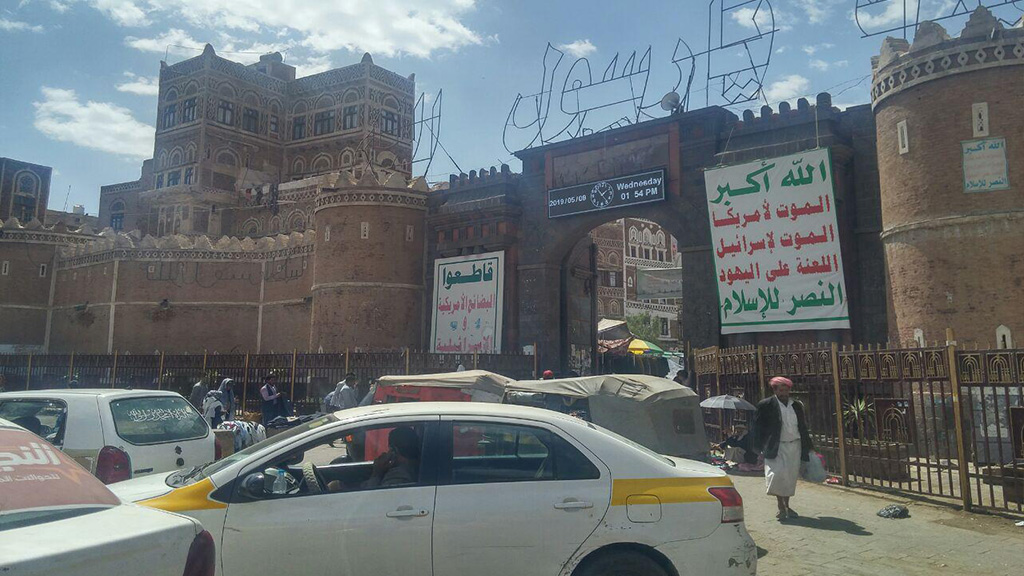
Ramadan in San’aa: Life Goes on despite Hiking Prices, Misery and Continued War


Sana’a – Mohammed Abdo, in his 50s, stands near a sesame stand negotiating its price in the old city of the capital Sana’a on Wednesday’s afternoon on the third day of Ramadan in Yemen.
Abdo expressed his shock at the sesame’s high price before he started to speak on how he used to welcome Ramadan in the past and how it became today after four successive years of the Saudi aggression on Yemen.
“Ramadan in the past was better than nowadays,” Abdo told al-Ahed. “We used to welcome Ramadan while living conditions were all right, but today the cost of living has increased.”
Abdo, who appears to be a farmer, comes from Dhamar province, 93 kilometers (58 miles) southern Sana’a. He said he is in the old city of Sana’a on a special visit and has bought some good ropes for his donkeys.
“I will travel back home now. I ask Allah to guide us, be kind to us and lift up His divine countenance upon us,” Abdo told al-Ahed.
The grand mosque in the old city of Sana’a is under heavy presence of worshippers who gather from all nearby neighborhoods to pray and share reading Quran.
There you will find elder people who know well the old days during which their grandfathers used to welcome Ramadan and the importance of the Ramadan lanterns.
However, to take pictures and interview them inside the mosque needs you to have a prior permission from the security belts of the city, something that takes a long process. Security forces declined our entry to interview them inside the mosque.
Miserable Ramadan
Walking between the city’s old souks, you will see people purchasing their requirements in large numbers as if there is no war nor a blockade, though public servants have been paid sporadically since late 2016 when the Saudi-backed government relocated Yemen’s Central Bank from Sana’a to Aden.
Most segments of society lost their jobs and resorted to work in another profession like Ali Sa’ad Taha, a newspaper vendor but now all he has is one paper on his right hand and on the other hand he carry plastic bags, his new profession.
Taha was passing on a pavement outside the old city of Sana’a as disappointment was clear on his face. The only official newspaper that he had was al-Thawrah, which he was looking for someone to buy.
“I rent an apartment near the Ministry of Defense since 15 years. My sole source of income is selling newspapers,” Taha told al-Ahed. “We now live in a miserable existence. I sell plastic bags as purchasing papers decreased.”
Grave’s Mud is better than this life
Ahmed Qaed, an elder merchant, stands with his son near their shop at the old city of Sana’a where they sell clothes. Qaed has a pessimistic view and think the earth’s interior is better than its surface.
“Ramadan in the past was perfect, but today grave’s mud is better than this life,” Qaed told al-Ahed, pointing out that Yemenis live in a crisis and everybody no longer thinks of the other.
“Everybody thinks of himself, we aren’t reassured, nor comfortable nowadays.”
We used to welcome Ramadan in the past while we were living in peace and security, Qaed said, and goods and foods were cheap.
We were welcoming Ramadan with jingles, but today it is hard to do so, Qaed adds.
Before the war, children of the old city of Sana’a neighborhoods used to gather in one house after sunset and begin running in the streets of the city with lanterns in their hands and sing songs welcoming Ramadan.
This Ramadan is the fifth that Yemenis fast while the Saudi war is ongoing. This war has changed their life and make it like a hell on earth.
With all of this, it’s hard to see a child in the streets of the old city of Sana’a commemorating these traditions or notice a father trying to revive these old habits.
Related Videos

River to Sea Uprooted Palestinian   
The views expressed in this article are the sole responsibility of the author and do not necessarily reflect those of the Blog!

Friday, 2 November 2018

American Woman Turns to Hunger Strike to Break Media Blackout on Yemen


Pamela Bennett | Yemen Hunger Strike
By Whitney Webb
Source
SAN FRANCISCO — In Yemen, 18 million civilians are now at the brink of starvation, including 5 million children. The situation in the country, widely considered to be the world’s worst humanitarian crisis, is entirely man-made – the sordid result of the Saudi Arabia/UAE coalition’s war to control the Middle East’s poorest nation, a war that deliberately targets civilian infrastructure and the civilian food and water supply. Despite the fact that these are clear war crimes, and despite the mass suffering it has inflicted on Yemen’s innocents, this effort continues to receive U.S. and U.K. support.
In the face of the enormity of this completely preventable crisis, some international activists have taken matters into their own hands, giving it their all in order to bring much-needed attention to the plight of the Yemeni people by sacrificing their own quality of life in a stunning and inspiring show of solidarity.
Pamela Bennett, an American woman living in San Francisco, has been on a hunger strike since October 8 in an effort to show solidarity with Yemenis facing famine and to raise awareness in the United States in particular about upcoming congressional efforts to reduce or end the U.S.’ role in the genocide currently occurring in Yemen. Bennett is not alone in her efforts, as a contact from her Facebook page, “Yemen Rising,” is also currently in the seventh day of his hunger strike. Bennett, however, is on her 23rd day.
Others had initially joined the hunger strike but had to end, some leaving for personal reasons while others were forced to stop after being hospitalized as a consequence of their participation. After some of the original hunger strikers had been hospitalized, Bennett began drinking juices and broth in addition to water in order to prevent major health complications.
As part of her bid to raise awareness about Yemen through the hunger strike, Bennett posts daily videos to Facebook discussing her experiences as a result of the hunger strike and her reasons for taking such a drastic step to raise awareness about the crisis in Yemen.

What Bennett hopes her hunger can accomplish

Bennett told MintPress that one of her main reasons for hunger striking for Yemen was that she was “enraged at how well the [Western] media has hidden this,” explaining:
I considered myself a quasi-activist, and I had no idea. I thought it [the humanitarian crisis] was a drought in Yemen or something when I even saw the rare post. When I discovered it was man-made, and that my own government was greatly responsible, I was frightened at how easily I was misled. I wanted action to combat that fear, so I thought of a strike.”
Another of Bennett’s motivations to start a hunger strike was:
How unfair it is for me to have food when millions of people, including pregnant women and children, don’t have any food because of corrupt people in my complicit media hiding what’s happening, and my culpable government preventing them from having good water and electricity with a blockade that decimated their economy, and bombs that destroy their world.”
AP_18110359966630_edited-1145x753.jpg
A doctor shows a photo of Fadl, an 8-month-old Yemeni boy taken in his last days before he starved to death, in this Feb. 10, 2018 photo at a hospital in Mocha, Yemen. Nariman El-Mofty | AP
She continued, stating:
I also felt that this action would keep my attention, and that of others, on the lack of food that most are suffering in Yemen, and would show solidarity with the Yemeni people. I can tell you, at [23] days now, it is much harder to distract myself than it was at the beginning, and I feel a tiny inkling of what millions are suffering at the hands of greedy people right now.”
However, it continues to be the glaring lack of coverage about the crisis in Yemen that has served as the main impetus for Bennett’s solidarity efforts. Bennett told MintPress:
I would not have to strike if the media did their jobs. I have not seen a fraction of the coverage needed on Yemen. I am sent photos, videos, and stories daily by the Yemeni people. Why would the Yemeni people be doing this if there was adequate coverage? As one Yemeni man put it, on feeling invisible in his suffering, ‘only God sees our tears.’”

Action from Congress?

At this moment in her hunger strike – now in its fourth week – Bennett stated that her immediate goal in continuing the strike was to raise awareness about current legislation in the U.S. Congress related to either reducing or ending the U.S.’ participation in the Yemen conflict, either by ending arms sales to the coalition or by ending the U.S. military’s role in the fighting and the coalition’s bombing campaign. In particular, Bennett is calling on U.S. citizens to contact their representatives, urging them to support Senator Bernie Sanders’ (I-VT) JR 54 that would end the U.S.’ role in Yemen as well as Rep. Ro Khanna’s (D-CA) HR 138that also calls for a U.S. withdrawal from Yemen. Another House bill, Rep. Jim McGovern’s (D-MA) JR 102, would restrict arms sales to the Saudi government.
If Americans step up and put enough pressure on their representatives and any one of these bills is passed, the U.S. may pull out. Bennett opined that, if the U.S. is forced to withdraw, “I think that there is every chance Saudi Arabia, the U.K. and the UAE will follow suit, with enough pressure.”

To join the effort

Any person interested in participating in the hunger strike alongside Bennett is urged to contact her either through her page “Yemen Rising” or her personal Facebook page. Bennett stated that water-only fasts are no longer encouraged and that all potential hunger strikers need to be in good health before beginning. She emphasized that the hunger strike is “a media campaign to combat media silence, [so please make] videos about what you are doing and why these actions are needed to spread the word.” She also noted that some people have done shorter-term solidarity fasts, anywhere from one day to one week, in order raise awareness.
For those looking to aid solidarity efforts in another way, Bennett stated that it is of the utmost importance for U.S. citizens to search online for “the contact sheets for senators and representatives, and email, call and write. And tell your friends to do the same.”

River to Sea Uprooted Palestinian   
The views expressed in this article are the sole responsibility of the author and do not necessarily reflect those of the Blog!