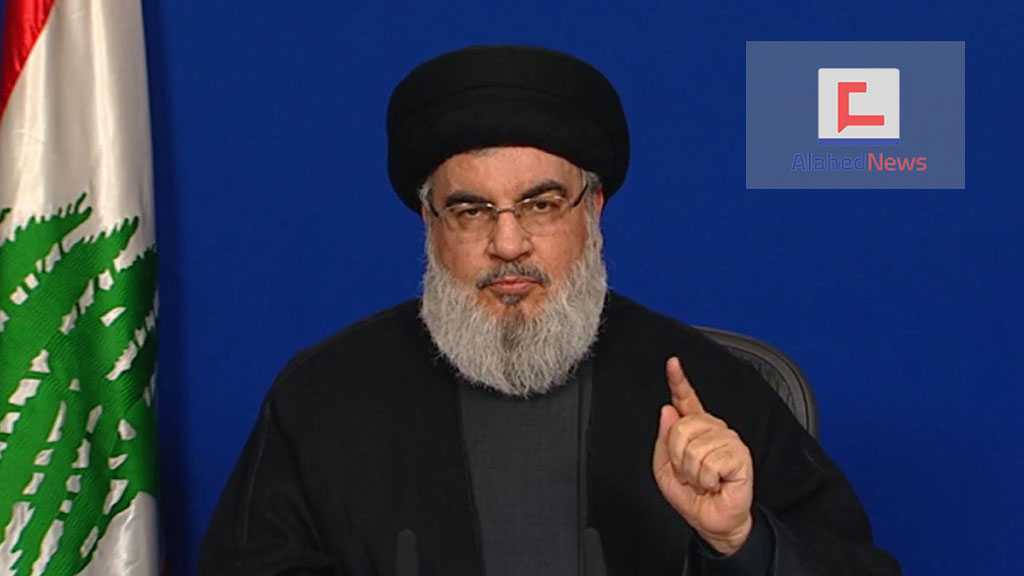
Hezbollah Secretary General His Eminence Sayyed Hassan Nasrallah’s speech on recent developments in Lebanon on 25-10-2019.
I seek refuge in Allah from the accursed Satan. In the name of Allah the Most Gracious the Merciful. Praise be to Allah, Lord of the Worlds, and prayers and peace be upon our Master and Prophet, the Seal of the Prophets, Abi al-Qassem Muhammad Bin Abdullah and his good and pure household and his good and chosen companions and all the prophets and messengers.
Peace and Allah’s mercy and blessings be upon you all.
Today, our homeland is going through a sensitive and critical situation, requiring us to speak responsibly and calmly.
This speech is not addressing any particular occasion or gathering. So there is no need to raise my voice. It also helps to speak calmly and accurately.
I will start with a very brief reminder about the position Hezbollah articulated last Saturday. Then I will offer an assessment about the positives of what has happened so far.
I will not stop at the negatives. I will talk about solutions as well as diagnose the nature of what is going on and point to some dangers. I will conclude with a clear position that I want to direct at the people and specifically and particularly at the supporters of the resistance.
On Saturday, a few days after the launch of the popular movement – I will call it the popular movement – I said that this is a popular movement that we respect. It is spontaneous, sincere, transcends sects and regions and expresses the people’s pain, woes and concerns. It is not subjugated to any party and embassy.
I can say that I respect the movement and the people who took to the streets more than any other person. I told them that we respect you, appreciate you, and more than that we understand you and applaud what you have done and the excellent results you achieved.
I also explained that Hezbollah cannot participate in this movement because if Hezbollah participates, its color will be clearly visible in all arenas and the movement will take another course. It will have a political dimension and will be linked to regional issues, regional conflicts and the likes.
It is in the interest of the movement to stay away from us and the parties. I also said that you can take to the street because you do not belong to any particular side, and are a variety of popular bodies. You can stay for a day, two, three, a week. Whether you fulfilled all your objectives or some of them, you can leave whenever you please. But if Hezbollah took to the streets, it cannot leave before achieving its goals.
Let me start with this clarification because throughout the rest of my speech I will be very careful with what I say due to some demons.
From the first day, some tried to say that Sayyed and the party threatened the demonstrators. Gulf and other foreign media outlets and some domestic ones exploited the allegations. There are some people who did not even hear the speech. I believe my text was clear. We cannot go down with you because if we do, if the day comes that we have to take to the streets to call for the same demands and goals, we will protest against the authorities and not the demonstrators.
In any case, I also wished that the demonstrators who share the brotherly position would avoid insults and cursing, vandalizing public and private property, and clashing with the army and security forces in order for your movement to succeed. We also asked the army and the security forces to tolerate the people. The most important point was that I wished you not allow political parties and factions to ride the wave of the movement and take it to another place that contradicts your goals, your pain, your aches and your real aspirations. This all happened on Saturday, of course, with other additions that do not need to be repeated.
From here I would like to move down the talking points:
The first point:
The positive achievements. Let us be fair. In the end, whatever happens in the country, must be employed for the benefit of the whole country and the entire Lebanese nation.
What happened in the past few days in general brought about great achievements, especially at the beginning of the movement. Unfortunately, these positive achievements were not explained to the people or even to the demonstrators, not even by those who claim to be leading the demonstrators.
I will try to quickly shed some light on some of these positives in order to use them as a foundation. These positive achievements must be used as a foundation and should not be forsaken. They must be preserved because they were created by the people as they protested night and day. These people disrupted their work and daily lives. They bore the sun and rain. Therefore, it is everyone’s responsibility to preserve the positive achievements that the popular movement recorded thus far, which serve everyone’s interests.
1- The movement managed to force the Lebanese government to agree on a budget free of taxes and fees and a deficit of zero point something. This is the first time in decades that Lebanon has a budget without taxes and fees. For the most part, there is nothing like this as far as I know.
There has been a budget deficit for many years. I will not hide this from you, but discussions that used to take place within the government regarding budgets that included taxes and fees were extensive.
Today the movement forced the government to release a budget without taxes and fees. This is not a small achievement. This is very important and very sizable.
Political factions joining the budget debate have always dreamed of reaching such an outcome.
This, of course, has repercussions for all people. The taxes and the value added tax – even on some amenities or on fuel, which was raised – would have affected every home and every family in Lebanon.
2- Due to the pressure of the popular movement, the reforms paper that the prime minister announced a few days ago was released. This reform paper is very important and unprecedented. It includes highly important demands. It is true that it falls short of expectations, hopes and ambitions. But it is the first advanced step.
Unfortunately, those who label themselves as being concerned with leading the movement, some media outlets and even some who present themselves as objective analysts and I respect them, absurdly ridiculed this paper. I cannot recall that this number of decisions and directions with timetables have been reached in one session and under the leadership of any Lebanese government, at any time.
Why would it be ridiculed? This is an achievement for the movement, and you are ridiculing it! There are some who consider themselves to be spokespersons for the popular movement or who lead the popular movement. These people are ridiculing the achievements of the popular movement. This by the way makes us suspicious.
No one in the whole world ridicules their achievements, not a popular revolution, not protesters and not even a resistance movement. On the contrary, they try to highlight their achievements to boost people’s morale so that they would remain on their path and give rise to a clear horizon and hope. But ridiculing the achievements in this way is not right.
This reform paper, I would like to tell the people, is not mere promises. Matters that relate to the government itself include decisions with timetables set for their implementation. Matters that need to be approved by parliament are considered bills that are to be sent to the parliament also in accordance with certain timetables.
One of the most important subjects that was raised was the law of the stolen asset recovery, which is a priority and which they are working on day and night.
Recovery of stolen assets: A set of decisions have been taken. A set of bills have been prepared and will be sent to the parliament.
I would like to tell you as Hezbollah and in cooperation with all the serious people, who will later express their positions – today I do not want to speak on behalf of anyone, never, I want to speak only on behalf of Hezbollah – this reform paper is for implementation. It is not ink on paper and will not be ink on paper. We and the rest of the serious people will not allow procrastination in the implementation of these decisions. This must be decisive. This has nothing to do with you staying on the streets or leaving. This is our responsibility, and later I will talk about an important positive achievement recorded by the movement.
Some of the results are: The movement forced government officials to start implementing what they promised and to engage in intensive sessions. Until now, they are discussing the draft law to recover stolen assets, the draft law on tax noncompliance and tax evasion, and the completion of bills related to the fight against corruption. And there is something that I will talk about shortly. All the parties in the government are determined to undertake a great effort to meet and implement its decisions within the specified deadlines.
3- One of the positive achievements recorded includes the raising of awareness among officials in the government. What does it mean to raise awareness? There is an atmosphere in the country where authorities, current officials and future officials who may come to power believe that they can do whatever they want, decide to do what they want with funds and taxes, continue with wasting of funds, corruption, failure and shortcomings and no one will hold them accountable. By the way, the last election was free and fair, and the whole world witnessed that it was free and fair. The electoral law was the best one ever applied. Yet these elections brought back the same factions, the same authorities and same officials. I am not judging them. I am only describing the reality.
There was a perception among officials that they can do what they want. However, the movement raised their awareness. And now the Lebanese people, for a moment in a movement that transcended sects and regions raised their voices in everyone’s face. This is a very important achievement. It will have great effects on the performance of officials in the next stage. And I am already seeing this clearly.
The second achievement has to do with the people. People are becoming confident again. The sectarian, regional and political divisions that plague the country led people to believe that there was no chance to launch a popular movement that transcends sects and regions. This latest experience restored the self-confidence of the Lebanese people and made them believe that the way they took to the streets today, they can do so again after a month, two months or after a year. This experience can be used as a foundation. And as I have said, it brought back hope and people’s confidence in themselves.
The next point: The movement also gave people an opportunity to speak freely. Put the insults aside, which are the negative aspects of this movement. Of course, some of the insults came out spontaneously, and others were directed. I have information and data on circulars issued by some forces asking the people to curse and insult so and so. However, there are people who were spontaneous. Apart from this negative aspect, the movement gave the people the chance to speak about their pains and aches in their own way using their own expressions, language and terminologies. This is what we should consider in the future when we want to sit down and decide on the goals of the movement that should be fulfilled. We should see the ordinary people, the poor, college students, the unemployed, who want to work, etc. We should gather everything these people said and say these are the goals of the movement. These goals are essentially socioeconomic demands. They stem from the people’s pains and poverty. They are talking about health, job opportunities, the environment and equality. They are talking about all these issues that we are hearing about directly across all regions and that are being expressed in different ways. There must be sincerity in order to achieve these goals. The positive achievement is that people from across all regions, have expressed these goals without fear and without barriers.
Among the other positive achievements but not the last is that the movement created an excellent climate in the country that opens the door for political factions that are serious about combating corruption and waste, working for reform, addressing economic and living conditions. This climate will make these factions, whether they are in the government today or might be in the government later, even more serious, bolder, more capable and ready to undertake more initiatives. Among those serious parties is Hezbollah.
Certainly, we took into consideration a range of complexities and difficulties when we acted in previous stages. This is not a secret to anyone. This climate will open the door for everyone who is serious and sincere. Now, everyone says that they want to fight corruption. They want to stop waste, and they want to serve the people. Well, go on. This climate will open this door. In addition to the reform paper, I would like to take this and use it as a foundation.
The reform or economic paper is a first step on the path that should be followed. There are proposals for laws in the parliament. My information says that the parliament will activate itself to approve these laws. Along with other political factions, we will push to speed up the endorsement of the stolen asset recovery law, anti-corruption laws, lifting of bank secrecy laws as well as constitutional and legal immunities for all civil servants so the judiciary would face no obstacles or complications to hold them accountable. We will also exert pressure to release the hand of the judiciary. This judiciary has to be fair and just. It should not act on reprisals and being selective. It should open all files related to corruption. Let the people hold accountable every politician, religious cleric, religious or political authority involved in cover ups. We are capable of heading towards this stage. There should also be more discussions, cooperation and dialogue to move the economy forward. There are prospects for some of the things I mentioned that could take place in the country as a result of some developments in the region. There is something in the reform paper that was endorsed that will definitely boost the economic situation.
I would like to conclude this part on a positive note. Yesterday, His Excellency the President opened the door to the popular movement. He called on them to engage in dialogue. I noticed direct distortion of his speech by some media outlets. The president did not say ‘I did not hear your demands and I want to hear your demands.’ The President said I want to hear your demands and concerns, and you hear our demands and concerns. Let us discuss. The media edited his words as usual. Today, His Excellency the President opened the door for dialogue and negotiations. I will get back to this point later. He opened the door for discussing a number of points. He did not limit the points that he wanted to discuss or negotiate on. No, on the contrary. Today, he is the head of the authorities, the custodian of the constitution and the first official in the country. If people cannot talk to him and negotiate with him, what do they do? What are they heading towards? We will also get back to this in a bit.
The second point: When we talk about the current situation, all of us should be looking for solutions. I want to be clear. To the people, political forces and everyone concerned, I offer advice and speak from a position of responsibility: any solution must be based on the principle of not falling into a vacuum, both within state institutions and government. Why? Because it is very dangerous. The vacuum that some people are calling for is dangerous. I will come back to this in a bit.
In light of the current difficult economic situation and financial crisis, a vacuum will lead to chaos. I am not concerned about the people with millions of dollars and hundreds of millions of dollars who are taking part in the movement. Those people do not know the meaning of hunger and pain. They do not know what it means not to be able to check your son into a hospital. They do not understand all these pains and aches that the people are talking about.
In light of the difficult financial and economic situation, the existing political tensions in the country and the region and in light of what might appear to be targeting from a regional and international level, a vacuum will lead to chaos. A vacuum will lead to collapse. After a while, if the country carries on like this, will it be able to pay pensions? A time might come when even the army, which is now being used as a security guard and a basis for preserving the unity of the country and civil peace, will not be able to get their salaries. A time might come when they won’t have money to eat. This is what will happen if we carry on like this and become consumed by a vacuum, chaos and tensions. The country is beginning to lose control. This means that the country may sink into chaos and insecurity. God forbid that there might be someone preparing for a civil war similar to what they did in a number of countries and neighboring states. So, I want to be careful and clear. We are open to any discussions, discussions with the President but not on the basis of any form of vacuum. A vacuum will be fatal.
On Saturday, I announced our position regarding your demand to overthrow the government and the Promise [the Lebanese President], early parliamentary elections which means the overthrow of the parliament. Some people also called for the resignation of ministers and deputies. They called on everyone to resign. This means heading towards a vacuum. So, our answer was that we do not accept the overthrow of the Promise, and we do not support the resignation of the government. Due to these circumstances, we do not accept early parliamentary elections because this is a complicated issue. Simply put, if one wants to be honest and transparent and cunning in politics, he would tell you that we agree on early political elections. You in the movement elect your representatives, come up with an electoral law and present it to us. We will transparently agree on it. Would you be able to agree on an electoral law? This is our country, and we know each other. Some want Lebanon as one constituency. Do you all want that? Some want the proportional representation system and others the majority system. Some want a sectarian electoral law. And others don’t. Others want the Orthodox law. We do not want to laugh at each other, and we do not want to waste time. When I said this, of course some people came out and accused us of protecting the authorities. There are failures and those who are corrupt. No, we are protecting the country from a vacuum, which will lead to chaos and collapse. We are looking to the distant future. Our religion, morality and our responsibility orders us to protect our people. We protect them through the resistance. That is where we pay taxes; blood, martyrs, children, dear brothers, men, women and children in massacres, money being lost, homes destroyed over our heads. All to free our land, all of Lebanon and not just the land of our supporters and people.
Also, in politics related to internal affairs. We are responsible for protecting the country. Now, we are paying taxes when we are being insulted and accused of defending failures and the corrupt. We are being accused of being against rightful demands. We are definitely not like that because these are also our demands. We are prepared to pay this tax. It is easier to pay this tax than the tax of blood. There are people who are ready to give their blood and dignity. We are ready to give our blood and dignity to protect our country and people. Hence, the main point is that any solution should not head towards a vacuum. Someone might say and it has been said before – some people I still consider as respected writers who present themselves as objective – said that Hezbollah should not say ‘we want to avoid a vacuum when they disrupted the country for two years and a half until President Michel Aoun was elected’. This is a wrong and unjust comparison. We did not take the country into a vacuum.
During the two and a half years, there was a government that was working and acting as the president. There was an existing parliament. All the roads were open. Factories, universities, schools and hospitals were working. Nobody was being humiliated on the roads. The farmers, construction work, commercial and passenger traffic were all working. Nothing was disrupted. The only thing missing was in Baabda Palace. There should have been a president there. He should have regained the powers given to him by the constitution. This did not exist. But his powers were at the government’s disposal. It is incorrect to say that we imposed a vacuum on the country for two and a half years. Yes, we disrupted the presidential elections. That is true. But this is completely different. This comparison is absolutely inaccurate.
I will continue and say, yesterday the President opened the door to the protesters. He asked them to select a leadership or delegates to represent them in case they did not have a leadership, or it was unclear. If you cannot choose one leadership, do what every protest in the world does. Every square chooses its leadership. There are platforms, squares and movements in various areas. Choose your representatives and agree on the demands that are consistent with the demands of the people and not with the whims of the political factions. Then go to the President and discus and negotiate with him. This does not mean that you leave the squares. No, never! Stay in the squares and negotiate using pressure from the people and the demonstration. There is no problem in this regard. This is if we continue to speak about the positive achievements. No one is suggesting negotiations so that people withdraw from the protests. No, people can go to their home or protest every day. There is no problem in this regard.
Up to this point we are still talking about the positive achievements recorded by the movement. This is the horizon. And this is our assessment and solution to what is happening. In this way, they can go to the negotiating table and state their position regarding the government, the economic situation, the protesters’ demands and whatever they want. Protesters should not allow anyone to politicize the movement.
The next point is cutting off roads. Let us also keep the country moving in a positive direction. I am not debating the principle. We recognize that blocking roads is a means of civil protest. Civil disobedience movements and protests usually resort to this means. In the past we blocked off roads. Yes, we blocked off roads to achieve demands. Maybe in the future, we cut off roads to fulfill righteous demands. I am not discussing the principle but the timing. After 9 days of blocking roads and now we are nearing the end of the month – the financial, economic and living situation – you heard the pain of the people. Today, people are saying that ‘the day I don’t work, I don’t have money to feed my children.’ You have prevented people from going to work for nine days. Not the protesters, regardless of their great numbers. You are locking the rest of the people who are not in the squares in their homes in all areas. You are denying them from food and work during this difficult living situation. It is impacting the overall economic situation, and there is something more serious than this.
What is happening today on some roads are roadblocks being set up. So far, they are unarmed. There are young people who are ready to beat, insult, curse and humiliate people. What is taking place on the roads is that people who want to pass with their cars are being insulted, cursed and humiliated. You can watch these on television. I am not accusing anyone. What is even more dangerous is asking people for their identification cards. What does this remind the Lebanese of? If the young people and the new generation do not remember, let them ask their parents what it means to start asking people for identification cards at roadblocks and checkpoints! Some streets turned into checkpoints where people are blackmailed. If a sick person wants to go to the hospital, I’ll open the road for you if you pay $50 or 100,000 L.L. A traveler wants to get to the airport, give me $100 and I will drive you there with my car. What do you call this? Civil disobedience? A protest movement? Honestly, I don’t want to hold anyone responsible. I am just saying. Go and conduct an opinion poll as you say you respect the popular base. If 50% of the popular will in Lebanon wants – I will not say 60% or 70% – to leave the roads closed, then leave them closed. But today the people want to open roads. I appeal to the protesters. Please, these people are your people. And this is your country. You are defending the poor, and you are the poor. Your demands are righteous. You have pains and aches, and you understand the pains and aches of others.
Take the initiative and open the roads. No one is suggesting that you leave the squares and arenas. On the contrary, double your numbers in the squares and arenas. Double the crowds and demonstrations. There is no problem. Even on the highway. Take part of the highway and leave the other part for the people to pass. Now who is responsible? Regarding this issue, I will not hold anyone responsible today. But I want to politely, lovingly and in a brotherly manner appeal to the people, the demonstrators and those who are blocking the roads to open the roads to the people so they can go about with their work, schools and universities and reach the hospitals. In any case, in the afternoon and at night, when they return from their work, schools and universities and go to demonstrate and protest and negotiate. There is no problem in this matter.
It is my duty to highlight another important point. Some people are create a certain atmosphere in the country by suggesting that someone in power or some political factions are pushing the army to clash with the demonstrators and to open fire at them. This is a lie. It is misleading and provocations. It is absolutely not true. The army is not required to disperse demonstrators and protesters in the squares. It is only required to protect them only. There was an army commander, as I recall in 2005, when the events in Lebanon took place in Martyrs’ Square. The protesters’ demands were not social. It was rather a huge political project. We all remember. He sent me and others, telling that there is someone asking him to disperse the protesters using force even if that led to shooting at them. You in Hezbollah, what do you think? We told him we absolutely reject that. Regardless of our assessment of this demonstration and this political project that was demonstrating in Martyrs’ Square, we rejected it. We know what it means to open fire at protesters because we came under fire in September 1993. Some of us were martyred and wounded. We were also shot at in Hay el-Sellom neighborhood. Unfortunately, under the same army commander who I spoke about, he shot at the youth and the people in al-Mshrafiya. They were calling for social demands. I am not demanding that their hand be firm in other places. The Lebanese army and the security forces must not fire at anyone.
This is a baseless accusation. Yes, it is the responsibility of the state if there is an attack on public property, blocking roads, attacks on people, roadblocks asking for identification. The state knows its responsibilities. I do not want to show them their responsibilities or hold them responsible. They know their responsibilities.
The next topic. We will talk about to the objectivity of the current movement. On Saturday, I said that this movement could be used as a basis. I would like to modify that. What started out as a popular, spontaneous, non-partisan movement made up of hardworking poor people and that was not exploited by embassies, is to a great percentage not like that anymore. I am not saying 100%. Today this movement with its daily activities, slogans and positions is no longer a popular and spontaneous movement. Let the young people who are going to the squares and arenas and taking part in the protests. I do not want to ask anything from them. As for the supporters of the resistance, I will talk to them in the end.
Today the movement is led by certain well-known parties, and I do not want to name them. The movement is being led by well-known political forces, different and well-known groups and figures. There are also certain people and institutions leading it. I will talk about this point in details in a bit. There is management, coordination and funding. No one should pretend that there is no funding. If you wanted to celebrate for three hours, you will need money. This is obvious. We have demonstrated, taken to the streets and protested in the squares. We know that in order to stay in the squares and arenas, you need to provide food, drink, medicine, media coverage, sound systems and phones. All this needs money. Do you agree that this is coming from the poor people? Of course not. There are certain parties that are funding. Who are they? I am not accusing anyone. But I hope from those who consider themselves to be leaders in the protest movement, let them explain to us just as they are requesting transparency. Huge sums of money are being spent in some squares. There are some poor squares. But there are other squares where we have lavish spending and very excellent opportunities.
So, go tell the people clearly that we have a funder X from country X or from embassy X or this rich person X or this institution X to see whether these people and embassies of countries who are spending money care for the interests of the Lebanese people. These wealthy people who are spending the money, this money which they have is it from corruption and suspicious deals or is it clean money? This poses a question at least, and I do not want to go into details today. But when it comes to funding, of course we have a big question. So, where is this money coming from? We as Hezbollah, when we organize any activity, I frankly say where the money comes from. I’m not shy, and I do not hide it. And some people condemn. This is not a problem. Tell us where this money came from. The demands that are being referred today are no longer the demands of the good-hearted people, the people who took to the streets spontaneously. Now we are hearing about toppling the regime. What does it mean toppling the regime in Lebanon? In Lebanon, do we have a regime like we have in other countries of the world? Anyway, toppling the regime, toppling the Confessional system is great. If this popular movement wants to topple the confessional system and end political sectarianism, we will be the first to stand with you.
Please come, sit down and put together peaceful, constitutional mechanisms to achieve this goal. But the people didn’t take to the streets for this purpose or to remove the government. Do people indeed what power vacuum?
If you asked people on the streets, do you want power vacuum? They would say no. We want to eat. We want to live. We want medicine. We want job opportunities. We want a clean environment. We don’t want anyone to humiliate us. We want a fair and just judiciary. We want security, stability and social justice. These are the demands. Then we have one of the main parties in the movement which is preparing a document and promoting it. The document is a request to the UN Security Council to place Lebanon under Chapter VII. Is this the demands of the protesters and the people protesting in the squares and arenas?
So, they took the demands to another place, reaching up to using some of the squares to describe the resistance as terrorists and to also take aim at the resistance’s weapons. Regardless of whether these demands are rightful or not, these are not the demands which were expressed by the people. All TV stations have archives. Let them go back to the archives of the spontaneous people and take a look at what their demands were. Did they put together a mechanism to achieve their demands? Did anyone discuss with them? Or were there people inciting them and pushing them into a kind of impulsive and collective emotional state.
Today, we have a movement where we have political factions and political parties and gatherings which are taking advantage of a popular wave to achieve goals. These goals differ from one group to another. I wanted to say this in order to refer to the next point. Now, a question to the protesters who have been on the street for nine days, don’t you want to achieve your goals? Yes. Is staying on the streets alone without doing anything else achieve the goals? Maybe it does, and maybe it doesn’t. Maybe it does, but it takes time. We protested in the Martyrs’ Square and Riad al-Solh before. At that time maybe people thought we were weak because we didn’t block roads. It is fine. We stayed for one week, two weeks, one year. In the end, we didn’t go to talks. Others closed their ears. They continued on the same path without caring about the country, and nothing happened. Today protesting by itself is not enough. It needs something else. This something else includes two parts. The first, are those in power ready to negotiate? Yes, they are. The second is you have to go and negotiate. Hasn’t the time come for this movement to appoint a leadership? Where is this leadership? Now, the people would use popular terms and say we are all the leaders in the movement. It’s OK you can say it when you are excited at the beginning. But when it comes to solutions, this is a mistake. The protesters, in anyway, in order to achieve their goals must decide who represents them so they would negotiate with those in power the goals they want to achieve.
Why don’t you appoint leaders? Is there a real leadership for the movement? I say to you yes. It is not visible. It is unclear and not announced. Why don’t they announce themselves? There are many different reasons why. I don’t want to talk about the reasons in order not to waste your time. They should say why. However, I know who the leadership of the protest movement is. There is not one leadership. There are parties, different gatherings and different figures. And we have people, individuals. Now, they assume themselves to be the leaders of the protests and the people to be the protesters. If I want to designate them because it is the duty of the protesters to know who they are following. When they are told to go down to protest, when they all told to block roads, when they are told to respond to the economic reforms paper or when they are told to respond to the initiative of His Excellency the President, are the people only responding by themselves or is there someone directing them from a political and administrative position and by the media? Of course, it is the second. It is not analysis. It is our information.
Now, for those groups who consider themselves to be leading the protesters – I’m going to be fair, the protesters have to know who is leading their movement. The people are the ones who make the effort, get tired, stand on the streets under the sun and in the rain. There is a group of people, which I know personally. They are nationalist people, clean, loyal and sincere. And they truly share the concerns of the people. Now, there is a lot of discussion regarding the percentage of this group and the impact it has on the movement. What this group claims and what is actually the case are debatable. There is another group which is made up of different well-known political parties. Some of them were in power and then stepped down. And some of them have been in power for decades. They have a history, their own projects, speeches, a past, external and internal links, etc.
There is a group that is represented by different gatherings and new political entities which have been formed recently. They participated in the parliamentary elections. They spent large sums of money in the recent parliamentary elections. Even though the proportional representation law was used, it secured a modest number of seats in Parliament. There is another group which includes individuals who are certainly linked to foreign embassies and foreign intelligence agencies. And here, the most important thing I want to say to you is that there are individuals and certain parties who consider themselves to be funding the movement and managing it. They are corrupt and actually some of the most corrupt individuals. Some who present themselves as people who want to fight corruption accuse me and Hezbollah of being corrupt. And they are the most corrupt people. Their files are in the judiciary. Some who are in the current political power who I am accused of defending are lawyers in the Lebanese judiciary. I don’t want to name them. They are now present among the leaders of the popular movement. There are people who have a political vendetta. Others are looking to settle political scores.
There are some who are looking for a popular position as a prelude to future elections. I have all the names of these groups, but there is not much time to name them. I just liked to raise this question not because I want to raise doubts. No, I want to tell the people that when you go to the squares with your pains and aches, you should see who you are entrusting your tears, pains, cries and everything you have accomplished and worked hard for. The demonstrators are the first concerned side to know who these people are or if these people are going to exploit the movement for personal or partisan goals. What are the guarantees that these people will not take the movement to serve foreign political projects? What are the guarantees? So far, I am not accusing anyone. I am asking for guarantees because there are fears and doubts.
I would like to address the protesters. When you accept the leaders of the movement, some of which do not have the audacity to announce his person, when you say that you want to fight corruption, failure and dereliction and accuse people of failing and corruption, do you want to replace a failure with another failure, a corrupt with another corrupt? There is no such thing in the world. Popular revolutions and popular protest movements have always presented clear leadership and alternatives. Then, the people check the alternative. If they find that it is fair, clean, patriotic and sincere, not associated with embassies, competent and able to provide better management and can help people to address their issues, has lived the people’s lives and an emperor who lives the emperor life, then the people would decide that this is our alternative. We are ready to protest all the way because our alternative is ready. We are not going to a vacuum, and we do not want to replace those we consider corrupt with who are absolutely corrupt. This is my question. This is a brotherly talk with you, with the demonstrators, with the people in the squares. And after that, say what you want. There is no problem.
I take great responsibility no matter what its burden and requirements are. I am ready for it. I also invite and suggest to those who consider themselves to be leaders in the movement to take the initiative now and to go to the Lebanese judiciary and see if they have files there or not. They should declare their readiness to go to the Lebanese judiciary if anyone accuses them of corruption and not to run away. There are rumors. Why are blocking roads? Because the officials want to escape. Why are you cutting off the airport road? Because they want to escape from the airport road. Do you want to insult people’s intelligence in this manner and with these absurdities? Reveal your true faces. If you are a party, say that you are a party. This is our president. These are our ministers and our deputies. Whoever is accusing us of corruption should come forward. And I’m ready to send them to the judiciary. Reveal. You are asking the ministers and the deputies to lift bank secrecy laws. Then lift the bank secrecy laws on yourselves. You are introducing yourselves as an alternative and that you don’t want to take the country into a vacuum, tell the people how much money you have. And if you have money and God has blessed you, tell the people where you got that money from. This is how we offer a decent alternative to which people pin their hopes on and their aspirations are fulfilled.
Then, we say yes there is a movement and there is a worthy, qualified and efficient leadership that can carry out reforms, fight corruption, end waste, imprison the corrupt, change the face of the country and take the economy out of the calamities it is in. If there is an alternative that is neither sectarian nor biased to a region and wants to work with a national mind and spirit, we are all ready to pledge allegiance to it. Present us with this alternative.
The next point is the point before the last. This is the last point followed by the conclusion. I really left this point to the end because from there I would like to address the resistance’s supporters, the environment I belong to and all the friends and allies of the resistance. This is the most sensitive point. I am the first person to say this is a spontaneous movement and is not subject to embassies or parties. The first day, the second and the third day. Many sides contacted me and asked. They were worried, and I told them there is nothing to worry about because this is a popular and spontaneous movement with rightful demands and good people. Yes, there was one concern which is someone might take advantage of this popular movement, including embassies, countries, regional situation, political parties and people who want to settle scores. These are possible. But so far there is nothing worrying. And I absolutely rejected the conspiracy theory. Not everything that happens in the country is a conspiracy. I had a couple of meetings. And the next day what I read in the newspapers had nothing to do with all the meetings. This means that all the meetings I had in the past week were hours-long discussions about the budget and the taxes, how we will bring resources, how we will lessen spending, the solutions, how we will activate the economic situation and the seriousness of the financial and economic situations. The second day, I read in the press that I was discussing the presidential elections and that President Michel Aoun’s health is frail. What is this nonsense and absurdity? It baseless.
In any case, I reject conspiracy theories. But in recent days, the information and data collection group – I repeat and say it is not an analysis – our information from more than one place say that the situation in Lebanon now is being targeted politically, internationally, and regionally by employing domestic parties. It is no longer a popular movement, popular protests about health, the environment, job opportunities, hunger, corruption. No, our information, data, indicators and evidence say otherwise. I do not want assert that this is the result. But isn’t this possibility enough? Doesn’t it put us in a state of doubt?!
I call on the Lebanese people since they are watching local channels to watch the western, Arabic and Gulf channels. Take a look at the articles, social networking sites, the electronic armies, the language and the incitement. Does it look spontaneous to you? Does it look like these are people? This was the case at the beginning, right, with my respect to everyone in the country. Now, it is no longer the case.
I want to warn. This happened in other countries. God willing, this is not being planned for in Lebanon. At the very least, I would like to tell the people to be aware that it might be a possibility. I think it’s more than a possibility. I think now it’s a lot more than a possibility. Don’t believe what the embassies say. Today the American ambassador and the embassies say no, we don’t want the overthrow of the government or for it to resign. What they say is not important. What they do is what is important. It is not important what they promise. What is important is what the CIA and the intelligence agencies are doing.
Look at what the “Israelis” and the “Israeli” media are doing. What are the “Israeli” pinning their hopes on. What does it mean when the “Israelis” bring some Lebanese people who are in the Zionist entity close to the border to show their solidarity with the protest movement? We the people of the resistance have the right to be sensitive towards this. So, no. I would sincerely like to express at least a fear. And anyone who would say that this fear does not exist, let them reassure us. I don’t fear for the resistance. I fear for the country. We are afraid for the country that someone might want to stir social tension, security tension and political tension and drag the country into a civil war. How many countries in the region are now in civil war? How many countries in the region? Regardless of the details of what is happening in Iraq, what is happening in Iraq today?
Look at the other countries. Do you want the same thing to happen in Lebanon? I am not trying to terrorize or scare anyone. The strongest party in Lebanon is the resistance. I am not threatening anyone. Anyone who wants to be afraid of the finger, let them be afraid. I am not threatening anyone. The strongest player in Lebanon is the resistance. We are not afraid for the resistance. We are afraid for the country. Today, there is a fear that someone is trying to target the country the country, how? The country meaning the state, the army, the people and the resistance. This is Lebanon’s immunity. This is the strength of Lebanon that is disturbing “Israel”. It is beginning to consider the resistance an existential threat. The resistance terrorized and humiliated “Israel”. This is the equation.
So, if they drove the country into chaos and civil war, there would be no state. The army would hence collapse like what happened. This means, the people would fight with one other. The resistance would be dragged also into it. Who benefits from this? I am not to trying to scare you. Write it down. Write down the time, hour and date. God willing, nothing of this will happen. God willing this is not being planned for, but I would like to assure you there is information, there are doubts here. There are suspicions. Some people in Lebanon in their own closed-door meetings were disappointed with everything. And they were pinning their hopes on one thing which is to have an American war with Iran, changing the face of the region and toppling the axis of resistance.
Closed-door meetings, they pinned high hopes on them. and these hopes are gone now. There is there is no American war on Iran. There is no war between the US and the axis [of resistance]. The Americans are packing up. You saw what they did in the east of the Euphrates and in the Gulf. You are listening to Trump’s speeches.
If this option no longer exists, let’s go to a something else. I want to warn against this. I would say yes. At the very least, the leadership of the protest movement has to reassure the Lebanese.
And frankly speaking, it is called upon to reassure the resistance that the country isn’t also a target because the resistance isn’t a goal in itself. The resistance protects the country and the people, the people’s dignity, happiness, lives, blood and honor.
I reach to the conclusion. I would like to address the supporters of the resistance. I am addressing the people of the resistance and even the people in general. I would like to refer to something which is of cultural and social nature. This is good by the way. It something good when the people take Imam al-Husain as an example for a revolution against the corrupt and the oppressors and supporting the oppressed. This is excellent. There are some people from different religious sects who told us that you are not in the camp of al-Husain in this protest movement. The camp of al-Husain in the different squares. Al-Husain’s camp today is there, and you are outside his camp. And they used this language and logic with us. For people to wonder and ask, there was no problem. But to talk in such a harsh way to people, this is unjust. Why? Because al-Husain, Ashura and Karbala were first of all rightful demands. Secondly, they were rightful slogans. Third, it was to support the oppressed. Fourth, which is also 1 and 2, is a clear, open, sincere, loyal and just leadership. It was a leadership that was ready to sacrifice itself, its children, sisters, families and money for the sake of the oppressed. That is Karbala. Karbala and Ashura mean the secured alternative, the trusted alternative. It is the alternative that you can entrust people’s lives, blood, money, dignities, families and future with.
Al-Husain presented himself as an alternative. Al-Husain wasn’t only the leader of a revolution, he presented himself as an alternative to the tyrannical, oppressive and unjust leadership. And when he went to Iraq, which pledged allegiance to him, he went there to be an Imam, a ruler and a government. When you talk about al-Husain and want to compare any movement with al-Husain, you have to talk about a rightful cause, rightful slogans, a clean, honest, just and loyal leadership which makes sacrifices and is also a qualified and trusted alternative. Bring me such a movement and today I’ll tell you at 5:07, me and all of Hezbollah will be soldiers in this movement and its leaders. We are ready to sacrifice our blood, our souls, our fortunes and our dearest people for the sake of achieving goals of this movement when we have al-Husain there. But if he doesn’t exist, put al-Husain aside. Let us talk about the developments, situations, threats, opportunities and the current challenges in our country.
After saying all this because before I said that if you want to protest, protest. If you don’t want to, don’t. That’s your business. On the first day, the 2nd day, we did not request from anyone to protest. And we did not prevent anyone from protesting. We did not prevent anyone. The people went down by themselves. Now, some people say Hezbollah is against the people. Others say that Hezbollah is behind this movement. I’m honest with you. We didn’t prevent anyone, nor did we tell anyone to go down. People went down at their own free will. Yes, on Saturday we requested from those who are members of Hezbollah not to go down because when I told the protest movement not to allow the political parties to take advantage and that Hezbollah’s open and clear participation with you would have an impact on the goals and demands of the movement – I have to be honest – so I told the members of Hezbollah, brothers and sisters, not to go down.
However, some of the supporters of the resistance, its friends and allies continued to be present in different areas and expressed their stances. Today, as a result of everything that has taken place – certain doors have been opened and people do not want to go through these doors as a result of the questions, the doubts and the fears and because some people considered that I have confused them. Some asked do you want us to go down or not. It reached appoint that someone on social media said: Sayyed if you don’t want to speak frankly, just sneeze once and that will mean go down. Two sneezes mean do not take to the streets. I honestly want to talk directly. I request from the supporters of the resistance to leave these squares, even the youth who recently went down to support the demands and to defend the resistance because we were not only cursed in some squares. It is not important if we were cursed. But when the resistance is accused of terrorism and the other squares remain silent and when the topic of the arms of the resistance is raised and the other squares also remain silent, some people felt it was their duty to go down and express another opinion. Of course, you have to take a look at the fairness of the media. When people accuse Hezbollah of terrorism, these outlets call them Lebanese civilians who are not affiliated with parties. They are not groups affiliated to political parties. But when young men and women defend their resistance, they are accused of being affiliated with parties that want to sabotage the popular movement. I request from these young men and women not to stay in these squares. There is no need for you to go down and defend the resistance. If we need to defend the resistance in the media, in politics, on the streets and in the squares and platforms, we can do this. We are up for it. We don’t want anyone to accuse us. Leave the squares to those who are convinced, and we respect all of the convictions and all the hopes. We respect all of their pains. And those who are convinced that this road will allow them to achieve their goals, we do not stand against them. I tell the supporters of the resistance very clearly and openly, we are not called upon, and there is no interest for us to be in these squares. Our interest lies staying away from them and to follow up. If positive achievements are made, we can build on that. But if there are, we follow up. We continue to monitor and strive to open all doors of dialog and talks because what we need is that we all focus on security, stability, peace, calm ways to address the situation and wisdom.
That is what I wanted to say today, of course, our friends and allies who we agreed with in strategic, if they could please listen to me very well. I call on them to think once again. I respect their choices. I understand their motivations. Of course, I don’t have any suspicions regarding them. Every person might have his own visions and calculations, but of the phase we have reached now and the performance we are seeing, especially if engaging into dialog with the President was rejected means that there is a big targeting of political nature in the country. I invite you to study, evaluate and make the decision you find appropriate.
I ask God Almighty to guide us to the correct diagnosis, the correct assessment and to the wise and correct position, to protect our country and our people, and to help the Lebanese people overcome this difficult stage to achieve their hopes, dreams and promising future. Peace and Allah’s mercy and blessings be upon you.
River to Sea Uprooted Palestinian