Uprooted Palestinians are at the heart of the conflict in the M.E Palestinians uprooted by force of arms. Yet faced immense difficulties have survived, kept alive their history and culture, passed keys of family homes in occupied Palestine from one generation to the next.
Russian Foreign Minister Sergei Lavrov holds a press conference after the 28th OSCE Ministerial Council in Stockholm on Thursday, December 2. The annual OSCE Ministerial Council, chaired by Sweden, takes place on December 2-3. The ministers are expected to discuss security issues in the OSCE area and review the organisation’s activities.
Joseph Biden, the 46th president of the United States, has asked Russian President Vladimir Putin for a meeting for the second time in six months. This would not be surprising: in the end, international tensions have reached a limit, and not only the most alarmist of experts, but also the most cautious of politicians have already started talking about the high probability of war
In such circumstances, responsible leaders of great powers are simply obliged to meet and seek compromises.
But this is the same Biden, whose team cried all the tears over Russian interference in the American elections and twice tried to organize the impeachment of the 45th US President Donald Trump, accusing the latter of surrendering American interests to Russia and working for Putin. Meanwhile, Putin and Trump had only one full-format meeting (in Helsinki, July 16, 2018, a year and a half before the expiration of Trump’s powers), and the rest — about five short conversations “on the sidelines” of various summits.
Relations between Russia and the United States had sunk to the freezing point even before Trump. At the same time, the 45th American president, although he negotiated more harshly, was still much more constructive than the 46th. Trump was inclined to seek a compromise, despite all the contradictions, because only a mutually acceptable compromise can ensure a long and lasting peace.
Biden, in a typical American manner, is trying to deceive a partner in the negotiation process, seeking only a truce – a postponement of confrontation for some time, during which the United States will try to solve its problems in order to take up the old with renewed vigor later.
That is why Biden’s team is begging for meetings with Putin, as if their ancient boss is afraid to die without telling Vladimir Vladimirovich something important. Pay attention to the diplomatic activity of the American president who does not always adequately perceive reality during the first year of his term:
* spring – activation of the US-European Union, an attempt to force the EU to go to a sharp deterioration in relations with Russia and abandon the SP-2; * summer – a sudden request for a meeting with Putin, insistence on its early organization, declared readiness to resolve the entire spectrum of controversial issues. In fact, absolutely empty and unacceptable hints for Russia about the readiness of the United States not to interfere if the Kremlin decides to restore its exclusive sphere of influence in the post-Soviet space by force, so that, as a reciprocal courtesy, Russia refuses an informal (but very problematic for the United States) alliance with China. The rest of the summer is devoted to spreading disinformation that Moscow is ready to negotiate with the United States at the expense of Beijing; * autumn — the formation of an anti-Chinese alliance of US vassals in the Asia-Pacific region and part of the European powers, followed by a sharp and persistent desire to organize a personal meeting between Xi Jinping and Biden (the meeting took place, was in vain, after which the United States began spreading disinformation that Beijing is ready to negotiate with Washington at the expense of Moscow); * winter — against the background of the sharp aggravation of the situation on the borders of Russia and Belarus that began in the autumn and an undisguised attempt to draw Russia into a war with the participation of Eastern European members of NATO and the EU, a new insistence on a personal meeting with Putin.
In my opinion, there is no need to have an outstanding intellect to see the “swing” on which the United States is trying to “rock” Russia and China in order to break their partnership (absolutely nullifying all attempts by the United States to regain the status of a global hegemon) and suppress Moscow and Beijing one by one and one by one. The United States offers everyone something unnecessary, but seriously binding their hands and requiring large resource costs, they try to link everyone with a regional war with their allies (who, however, are not in a hurry to drag chestnuts out of the fire for Washington), they inspire everyone that the partner has almost agreed to the American proposal and we must hurry to negotiate ourselves so as not to be made fools of.
The method is simple, has been used since ancient times and quite often led to success. The United States understands that neither Russia nor China want to win right now and annex the post-Soviet territories in Europe and Taiwan (respectively).
Moscow and Beijing would prefer to solve these problems peacefully and later. At this stage, the too clearly expressed intention to return the fallen imperial territories may not only limit the possibilities of cooperation between Russia and China to resist the military-political and financial-economic pressure of the United States, but also undermine the entire system of Eurasian unions built by them.
Therefore, the United States, in order to persuade Russia and China to make concessions in the negotiations, frighten both of them with an unnecessary regional war, while at the same time offering to negotiate and solve this problem. If someone gives up and starts at least discussing options, Washington will immediately provide a proof leak of information in order to persuade the second partner to make a concession, and then bargain with both from a favorable position to bring down the price.
Realizing all this, the Russian leadership is in no hurry to talk with Biden. Peskov, on behalf of the Kremlin, said that the exact date has not yet been determined. However, the Kremlin has agreed in principle to organize a videoconference before the end of the year. Why did they do that?
Every month (not to mention a year) without war, Russia and China strengthen and weaken the United States. If we hold out for two or three years, the war will become meaningless for the United States, because, by their own admission, after 2024 they do not see the possibility of defeating China militarily. Consequently, in two years, the opportunities for American blackmail will decrease sharply, and America’s allies, who are already unwilling to risk themselves because of the Washington games, will become even more thoughtful, it will be even more difficult to persuade them to demonstrative aggressive actions against Moscow and Beijing. A certain US deadline is approaching, we need to act already. Under these conditions, Washington, having lost hope of achieving its goal by peace, can really bet on provocation of war.
Any negotiations are a way to delay time. While they are preparing and while they are going, it is unprofitable for the United States to be unconstructive, which means they will try to keep their allies on a short leash. But vassal states are not trained dogs that can be set on an object or calmed down in one second, rocking the situation takes time (albeit a little). The solution suggests itself: as long as possible to delay the time in determining the date of negotiations, postponing them for later. As soon as it becomes impossible to pull further – to hold negotiations and try, without giving a single opportunity to interpret their outcome as a willingness to take seriously American proposals for the surrender of an ally, to involve the United States in the preparation of the next meeting by creating permanent expert groups in the areas.
Any diplomatic department is a complex bureaucratic machine that is extremely difficult to force to move simultaneously in two directions. If you give the task to begin diplomatic preparations for war, this apparatus will move in one direction, if you set the task of finding a compromise, then in another. At the same time, it will have a serious informational impact on both the international and domestic agenda. That is, even meaningless, but regular meetings of experts reduce (though not completely remove) the risk of fatal confrontation.
Russia’s actions indicate that the Kremlin clearly sees the threat and has chosen the right tactics. The agreement on the creation of expert groups was reached during the first meeting with Biden, with the organization of which they stretched out as much as they could. However, America countered this agreement by saying that the expert groups did not work. So, now Russian diplomats will point this out and demand more constructive.
The current meeting is also being delayed as much as they can, having already postponed it until the end of December. If it works out, then under the pretext of New Year’s holidays they will postpone it until the middle-end of January (however, this is unlikely, the United States is in a hurry). The current meeting will be held online: the coronavirus. Although he does not interfere with Putin and Biden’s meetings with other politicians, but in this case only online. And not because I don’t want to waste time on flights, knowing in advance that the negotiations will be in vain. The online mode does not allow the organization of fake leaks about the content of negotiations. This is not a face-to-face conversation (in the presence of only unknown and controlled translators, in an office protected from wiretapping) – everything is recorded, and by both sides.
Thus, Russia is trying to win one and a half to two months out of the 48 required. Will it be possible to win the world completely?
This question has no definite answer. On the one hand, time is running out, and with the approach of 2024, the United States has nothing to lose, and in the vassal countries designated by them for slaughter, there are their own war parties that (for personal gain) are ready to start even a losing war that destroys their states. On the other hand, the current authorities, who are now in charge of American consumables, are doing everything possible to get rid of the honorable mission of pointlessly dying for the interests of the United States. How strong will they have enough strength to continue maneuvering on the verge of a foul? How ready are Americans to increase pressure on the dependent elites of limitrophs? Where is the weak link ready to break: in Europe or in Asia and who is it (Ukraine, Taiwan, someone else)? We can only assume with more or less certainty.
Often the expected danger comes at all from where it is not expected or when they stopped waiting and relaxed.
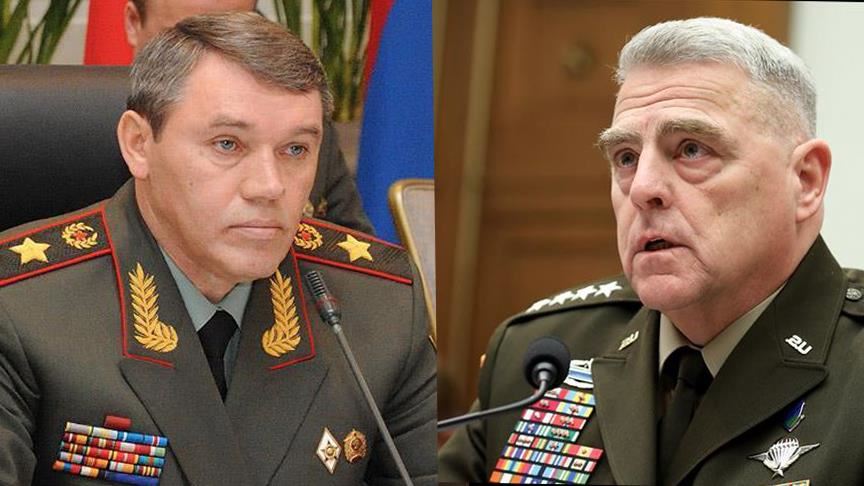
On Tuesday, 23 November, Russia’s most senior military general, Valery Gerasimov, had a “deconfliction” phone conference with US Chairman of the Joint Chiefs of Staff Mark Milley, in which the two discussed “pressing issues of international security.
” Actual details of what they discussed are not available; what is available is Western media speculation, which in recent days has included false reports of Russian troops massing on the Ukrainian border and supposedly getting ready to invade. What Western media has studiously ignored is an actual massing of Ukrainian troops on the borders of the Donbass region—the industrialized temporarily Ukrainian region that has been de facto independent since the Kiev putsch of 2014.
Following that putsch, and the refusal of the Donbass (along with Crimea) to recognize the new US State Department-installed Ukrainian government, the Ukrainians made attempt to recapture the Donbass by force. This attempt failed, and Kiev managed to avoid all-out defeat by signing the Minsk agreements of February 2015, but has clearly had no intention of ever fulfilling them. Instead, ever since then, Ukrainian forces have been shelling the no man’s land between Ukrainian-held territory (which is mostly open prairie) and Donbass (which is urbanized and thickly settled), killing small numbers of civilians and local militia members and causing considerable property damage. Although Western press has continuously reported on “Russian forces” in the Donbass, they are yet to present any evidence of it. And although Western press likes to describe the Donbass using the hackneyed epithet “war-torn” it is actually more prosperous and stable than the rest of the Ukraine, integrated into the Russian economy and essentially functioning as a Russian region.
Turning down Western media noise, a Russian military effort to capture the Donbass, never mind the rest of the Ukraine, is exceedingly unlikely. Russia already has everything it wants. Unlike Crimea which in its 2014 referendum produced a 97% vote for integration of the region into the Russian Federation with an 83% voter turnout, in a similar referendum in the Donbass (held against Moscow’s wishes) only 27.5% of the 74.87% who turned out voted in favor of joining the Russian Federation. Based on this result, Moscow chose to soft-pedal the Donbass situation, providing humanitarian aid and diplomatic support, granting Russian citizenship to those who want it and gradually integrating the region socially and economically. In other Ukrainian regions, were similar referendums to be held there, the level of support for joining Russia would in all likelihood have been even lower, and now, seven years later, would be lower still. From this, a conclusion can be drawn: other than Crimea (which was part of an independent Ukraine for just 23 years), none of the Ukraine was or is a candidate for inclusion within the Russian Federation. The Russians living there will receive some amount of Russian support and are, of course, welcome to move to Russia, but that is really it.
Having ruled out that which is exceedingly unlikely, let us turn to that which is quite likely; and that is a provocation in the Donbass staged by the authorities in Kiev and by their State Department, Pentagon and CIA handlers, designed to deflect the blame from the truly disastrous economic situation that is unfolding there in the hopes of being able to maintain political control of the situation. In blundering into the Ukraine and converting it into a sort of anti-Russian bulwark, the US gained a brazenly corrupt and unruly dependency. Unable to stop its inexorable slide into failed-statedom and political and social disintegration, the US is faced with the prospect of another Afghanistan-style rout, with desperate left-behinds running after US transport planes hastily taking off from Kiev’s Borispol Airport, after which point even the mental laggards who run the European Union will be forced to admit that American security guarantees are an utter joke and will start getting ready to walk into the Kremlin on their knees to kiss the gem-encrusted felt slipper.
Given this unwelcome scenario, the US is quite eager to control the optics and to make it look like it is all Russia’s fault. Since merely jumping up and down and screaming “The Russians are coming! The Russians are coming!” is no longer doing the trick, they are looking for something—anything!—that will make the Russians show up and put up even a tiny bit of a fight so that CNN and MSNBC can broadcast staged photos of a bloodied baby blanket and US Congress can then harrumph-harrumph about “Russian aggression” and impose sanctions on Russian baby blanket manufacturers. That “anything” is called a provocation, and what better place to stage it than the Donbass, which is an existing bleeding sore they’ve been picking away at for seven years now. Of course, they will do this in great trepidation of an escalation they would be unable to control, hence the hasty “deconfliction” conference with General Gerasimov: “Look, we go pew-pew, then you go pew-pew, then we declare hostilities over and toast each other with vodka and caviar; OK?”
Given that a provocation of some sort appears to be very likely, it is worth pondering what it would look like and what the outcome of it might be.
First, here is some background. The Ukraine (which is Russian for “borderland”) has always been less a country than a heterogeneous, endlessly disputed territory, tossed back and forth between Russia, Turkey, Poland, Austria, Germany and even, very briefly, Sweden. It mostly borders Russia (Crimea, Krasnodar, Rostov, Voronezh, Belgorod, Кursk and Bryansk regions). It also borders Belarus (short for “White Russia”) which is a whole lot like Russia. It has smaller borders with Poland, Slovakia, Hungary, Romania, Moldova and the unrecognized, Russian-defended Transnistria. It also borders Donetsk and Lugansk regions, collectively known as the Donbass, which is short for “Donetsk Coal Basin,” and which was formerly part of the Ukraine but de facto independent for the last 7 years and economically integrated with Russia.
Of these, the Ukraine, Belarus and Moldova were quite recently part of the USSR while the rest were part of the Warsaw Pact allied with the USSR. For most of them, those were the good days; for reasons incomprehensible to rapacious Western imperialists, Russia lavished a great deal of attention and investment on its ethnically heterogeneous periphery, not only building a great deal of social and industrial infrastructure and enterprises there but also staffing it all with relocated Russians. This, most Russians now realize, was a poor choice. This lesson is continuously reinforced by observing just how poorly the former Soviet republics have performed since they gained their independence. The Ukraine is a case in point, losing as much as a third of its population (exact numbers are impossible to ascertain) and steadily degenerating from a prosperous, highly developed region to the poorest one in all of Europe.
The Ukraine aspires to NATO and EU membership, but this prospect appears exceedingly unlikely since it is much more of a liability than an asset: destitute, bankrupt, politically unstable and not in control of its own government or its own territory—a failed state, essentially. Plus, the EU and NATO are themselves perhaps not too long for this world, the EU having recently lost the United Kingdom and NATO having just fabulously failed in Afghanistan, and not really capable of accepting new members. Sensing their own weakness, and projecting onto Russia their own instincts to engulf and devour all that they can, they automatically assume that Russia will exploit this weakness and reconquer the Ukraine and perhaps some other parts of Eastern Europe as well. But this is all it is—a projection, because the contemporary Russian project is something else entirely. Russia does periodically move its troops around its own territory, thereby keeping the West in a constant state of nervous agitation bordering on outright panic, but from the Russian perspective that is just a pleasant side-effect of regularly scheduled training exercises. There was a recent hysterical outburst in Western press over Russian tanks massed on the Belorussian border, for instance. Russia is always “about to invade,” on Tuesdays especially, but somehow never gets around to it.
That is not because Russia lacks the means or the opportunity; but it does entirely lack the motive. Does it need more land? Certainly not! Does it need a restive, alienated population that will then demand to be fed, hospitalized as needed and kept safe and warm all the while resisting assimilation? Not at all! Does it need the reputational losses from unprovoked aggression? Again, no. Quite the opposite, Russia is most eager to draw the line somewhere—a notional Great Wall of Russia, with the stable, economically liberal and socially conservative Orthodox/Moslem/Buddhist Russian World on one side and an alien, increasingly bankrupt, culturally degenerate, sexually deviant and permanently hostile Europe on the other. This will give Russia the peace and stability it needs to continue developing. The problem is that, because of the messy way in which the USSR broke up, many Russians were left stranded on the wrong side of previously insignificant borders, and this Great Wall has to remain porous, allowing Russians to filter back in.
A point can be made that Russia’s romance with Western Europe was always destined to end in tears. Russia’s cooperative, egalitarian instincts have been developed and perfected over many centuries within the Eurasian context of a relatively small population controlling a vast but difficult land with almost infinite but rather diffuse resources. In this context, cooperation rather than competition are keys to survival. These instincts have been wasted on little Eastern European fiefdoms that have spent an eternity squabbling over their tiny plots of land. Their history has conditioned them to only understand and respect subservience and domination, causing them to see Russian largesse as a weakness to be exploited. When the USSR suddenly vanished, they swiftly switched allegiance, forgetting their Russian, learning English and eagerly welcoming American and Western European financial swindlers and thieves to come and pick them clean. And now that they’ve been picked clean and Americans are leaving, they would perhaps be happy for Russia to “reoccupy” them and resume feeding them (if it were not for their wounded pride), but Russia will have none of it.
Within this overall context, each Eastern European country has its own unique fate. Most of them—specifically, Estonia, Latvia, Lithuania and Moldova—are simply too small and inconsequential to matter and have been left to wither away slowly, being of little interest to the West or to Russia. Belarus stands out in that it quickly joined a union state with Russia, but this has not saved it from some fateful dalliances with the West which almost ended in disaster in the summer of 2020 when a foreign-instigated astroturf insurgency threatened to overthrow the elected government and install a Western stooge by the name of Svetlana Tikhanovskaya, nicknamed the cutlet fairy. Since then, Minsk and Moscow turbocharged their integration process, producing the odd situation where the Belorussians feel free to poke their fingers in the eyes of Western leaders while hiding behind Russia’s broad back.
And then there is the Ukraine. It is the second-largest country in Europe by area—second only to Russia—and strategically located to be rather consequential. Ever since its independence, which it was awarded against the wishes of the majority of its population when the USSR was dissolved by a tiny group of conspirators, it has been ruled by a succession of swindlers and thieves who have continuously looted and robbed it until now it is a mere shadow of its former self, broken and destitute. This has made it an easy mark for Western geopolitical engineers who sought to fashion into a sort of anti-Russia, with the idea of preventing Russia from becoming an empire based on some flawed reasoning by the rabidly Russophobic Pole Zbigniew Brzeziński. Grand plans hatched by fools tend to misfire grandly, and this one is no exception. Instead of somehow containing Russia, it gave Russia everything it could ever want:
1. The fantastic level of Ukrainian political dysfunction that resulted from endless Western political meddling reduced the Ukraine from one of Russia’s major regional competitors to а major regional basket case and supplier of qualified Russian-speaking labor. The Ukraine once had strategically important industries that were essential for Russia’s military and civilian production, including large marine diesels, helicopter engines, rocket engines, aircraft building, shipbuilding and much else. All of these industries have now been relocated to Russia, often together with all of the blueprints and the technical expertise, and produce great value for both domestic consumption and export.
2. The 2014 putsch allowed Russia to return Crimea by undoing two mistakes—by Khrushchev, who gave it to the Ukraine in 1954, and by Gorbachev, who failed to get it back in 1991. It also allowed Russia to partially undo an older mistake—by Lenin, who gave the Donbass to the Ukraine in 1920. While the Donbass is strategically not too consequential, the return of Crimea provided numerous benefits. Coupled with the western enclave of Kaliningrad on the Baltic and new Russian hypersonic rockets, Crimea has allowed Russia to keep all of NATO’s European territory within its sphere of military dominance, providing an effective treatment for Europe’s congenital defect which causes it to periodically march on Moscow. Western sanctions imposed in response to Russian annexation of Crimea allowed Russia to claw back all of the disadvantages it incurred by joining the World Trade Organization, including bringing back agriculture and key manufacturing sectors, to find new, friendlier trading partners around the world, and to find ways to thrive within conditions of limited autarky. Crimea has also provided a very useful litmus test for political participation: automatically excluding anyone who would claim that Crimea is Ukrainian made it possible to effectively purge the ranks of all internal enemies and foreign agents. There are numerous other benefits as well, too many to mention.
3. The civil war in the Donbass, which is ongoing, gave Russia the opportunity to force through the Minsk agreements, whose implementation is mandated by the UN Security Council Resolution 2202 (2015), and which require the Ukraine to federalize, granting a high level of autonomy to its regions. This, in the Ukrainian context, equates with the end of the Ukrainian unitary state. Beyond that point, the Ukraine becomes a set of disparate, disconnected, foreign-dominated fiefdoms, each with its own pathetic little oligarchy, with Kiev retained as a purely symbolic capital and an ancient Kievan Russia museum and tourist attraction. The government in Kiev has resisted the implementation of the Minsk agreements, realizing full well that this would spell its end, but this is merely a postponement. The civil war also simplified any future anti-Nazi mop-up operation and war crimes tribunal. Whereas before various Ukrainian nationalists and krypto-Nazis might have been difficult to identify, it has forced them to not only stand up and be counted but also to commit crimes for which there is no statue of limitations, making it easy to permanently take them out of circulation when the time comes to clean the place up.
This, then, is the background to the current situation, bringing us to the present, in which the US seems to be cooking up something in a big hurry. First, the US sends the message that Kiev must fulfill the terms of the Minsk agreements. Second, the US claims that Russia is massing troops on the Ukrainian border, getting ready to invade. The Ukrainian military denies this fact. The US repeats their claim and also sends some more weapons to the Ukraine. As the Ukrainian military is still unsure what’s going on, they are summoned and told exactly what to think. And so, there is going to be a provocation. But Russia is certainly not interested in any sort of attack or invasion, so what do you suppose is going to happen? A reasonable battle plan is for the Ukraine to attack first, to preempt the Russian invasion and to take up defensive positions within the Donbass territory. That’s a brilliant plan, if I say so myself!
The most the Ukrainian military can do is launch an attack on the Donbass. Attacking Crimea across the isthmus would be stupid and pathetic; attacking Crimea from the water would be stupid and absolutely hilarious to watch. And so Donbass it has to be, again. It won’t take long for the Russians to respond using unidentified long-range precision artillery and demolish the Ukrainians’ supply lines, trapping them in cauldrons where they will run out of ammunition, food and fuel and gradually bleed out. This is what transpired before, in 2015, leading Kiev to sign on to the Minsk agreements, because their other choice was to lose their entire army. Except now there will not be another set of Minsk agreements, no terms of surrender, no cease fires and no safe corridors for withdrawal. There will just be death. To the Russians, these people are terrorists, and terrorists get to meet God before the rest of us.
And that, perhaps, may be the entire point. The US wants to close out the entire sorry Ukrainian saga, cut its losses, pull an Afghanistan and leave in a hurry, because it has a long list of countries it has to pull out of before the fuel and the money run out, and it badly needs to pick up the pace. Okinawa is on that list; Guam; Puerto Rico; Alaska. California. Texas. The Ukraine has been refusing to even start fulfilling the Minsk agreements, which start with military deescalation along the line of contact. What seems to be the problem? Perhaps, as the US has finally figured out, it has to do with the fact that the Ukraine has a military; if it no longer had any military of any sort at all, there would be nothing to deescalate and the problem would not exist. And so that may be the clever plan for the Ukraine: suicide by Russia. As an added bonus, there will be Russia to blame because, no doubt at all, it will have all been Russia’s fault. Sanctions against Russian baby blanket manufacturers are being drafted as we speak. American TV viewers will watch it, and they will like it. They will think, “Bad Russkies! America strong!”
“But what about the Ukraine?” you might be tempted to ask. Well, the correct answer to that question seems to be, “Nobody cares.” Seriously, looking at recent Ukrainian history, that seems to be the only answer that makes sense. The Americans certainly never cared, the Russians once cared but care less and less with each passing day, and the Ukrainians themselves don’t care either and have been making that point by voting with their feet. The European Union and NATO may care a great deal about having a large failed state in the middle of Europe, and they should, because that is probably just the beginning, but a very good start.
Rostislav Ishchenko develops his theme first posted here: Russian World as a global project into global multipolarity and covers why and how the West ran into a dead end, and where the multipolar situation may lead.
Please note it is a machine translation with some human assistance, and it is not a perfect document. It however makes his points clear enough, for the discussion on this massive global change.
Today we are in a unique situation – for the first time in the history of mankind, a global empire is breaking up.
Humanity is constantly living in an era of decay. At the same time, humanity is constantly living in an era of centralization. The dialectic of history works simply: the centers of disintegration and centralization are constantly changing places both horizontally (some states are weakening, others are strengthening) and vertically (against the background of a weakening center, power in the shires is always strengthening, and the weakness of the regions leads to the strengthening of the center). The art of leading a state is to correctly determine its internal and external state.
Accordingly, you need to move the control center of gravity from the regional level to the central level and back. In the field of foreign policy, in an era of weakness, try not to be too active in order to suffer as few losses as possible (and it is better not to lose anything at all), while at the time of strength, try to carefully acquire additional resources. Depending on the era, this resource can be nominated in terms of land, people, industrial power, market access, ideological leadership, information superiority, and other resources. As a rule, several interrelated factors from among the above play an important role.
The Empire of the Collective West
Today we are in a unique situation. This has never happened before in the history of mankind. For the first time, a global empire is breaking up. We used to call it the American world, because after the collapse of the USSR, the United States remained the only superpower for twenty or twenty – five years (who thinks so) and became a symbol of Western dominance. But in reality, it was the empire of the collective West.
The United States did not share the profits made by robbing the rest of humanity with Canada and Australia, New Zealand and South Korea, Japan and the EU out of a love of art or an innate desire for charity. It’s just that without the support of these vassal regimes, Washington was unable to manage the globalized world.
And, as has been known since classical feudalism, the vassal owes the master exactly the same amount as the master owes the vassal. If a prince or duke does not dress his retinue luxuriously, does not provide it with expensive horses and weapons, does not feed it to the brim and does not drink it to the point of drunkenness, then the retinue has every right to abandon such a leader and
look for a new master (the right to leave).
COMECON collapsed when the Soviet Union could no longer provide Eastern Europe with an additional resource.
In politics, these relations are expressed in a change of allies. For example, when the USSR could no longer provide Eastern Europe with an influx of additional resources (at the expense of its own population) The ATS and COMECON instantly disappeared in time and space, and their yesterday’s members lined up in NATO and the EU. Next in line were the Union republics, which fled the Union in full confidence that they were feeding Russia and would live better on their own. At the same time, the republics did not really think about any independence either. They took the queue “to the West” for Eastern Europeans, fully confident that they only need to join the EU and NATO and everything will be like in the USSR, only even more satisfying and better.
Some managed to join, some did not, but everyone was disappointed. And not at all because, as some think, the West did not want to feed freeloaders. The EU and the US were well aware of their responsibilities to their vassal countries, and they also understood that spending on their “weapons, horses, clothing, food and drink” would pay off by strengthening Western dominance around the world. The annexation of Eastern Europe and the post-Soviet states (except for Russia and the Asian republics) was supposed to significantly improve the geopolitical position of the West, strengthen its military capabilities and make its political and economic dictates insurmountable.
The sale of weapons to Eastern Europe was supposed to lead to the strengthening of Western dominance throughout the world.
When the West overestimated its strength
At first, it worked that way. The costs of maintaining Poland and demonstrating the success of the Baltic Tigers were more than repaid by predatory exploitation of Russia (in the 1990s, the West established direct or indirect control over most of Russia’s resources through local oligarchs) and outright piracy in the rest of the world (Iraq, Afghanistan, Yugoslavia, and after it Serbia).
Economically booming, China was unable to stand up to the collective West militarily. Russia seemed completely destroyed and only temporarily preserved the appearance of unity. At this point, the West overestimated its strength.
In any society, there are always different groups that see the purpose and meaning of existence and the direction of development of the corresponding society in different ways. And as long as there is an obvious external danger, these groups reject internal contradictions, rallying against the external enemy. If, for some reason, the authorities lose the ability to reconcile and balance internal contradictions, a catastrophe of the 1917 model occurs.
After the fall of the Berlin Wall, many in the West believed they had won the Cold War.
In the 1990s, the collective West believed in the “end of history”, that the world is forever Westernized, that the roles of governors and governed are assigned to different countries forever. Being in a state of euphoria, the Western left liberals launched an ideological offensive not only on the external front, but also on the internal one, trying to make their “tolerant new world” mandatory for everyone, not only in the conquered countries, but also among those who, in their opinion, “won the Third world war (cold war).”
As long as the leftists did not dig in, the resistance to their expansion in Western society was provided by certain marginal groups of conservatives, who were branded fascists by the” new left”. Broad strata of Western society were virtually untouched by the confrontation between these groups until the mid-noughties of the third millennium. Moreover, the main ideological expansion of the West was aimed at the development of “conquered territories”. It was there that the most “advanced” “public organizations” were created, spreading the propaganda of equality of norm and perversion to Western grants, even the advantages of perversion over the norm, because it “suffered for a long time”.
There, on the” new lands”, the” Soros funds ” and their many similarities worked. And left-liberal ideas, having fallen into the post-communist ideological void accustomed to the presence of a” leading and guiding ” people, were in the greatest demand. The additional appeal of these ideas was given by the fact that their local adherents, due to the support of Western funds, instantly became super-successful people against the background of the rapidly impoverished (in the 1990s) post-Soviet society.
The main ideological expansion of the West was aimed at the development of “conquered territories”, where the “Soros funds” and their numerous similarities worked.
It is difficult to say how all this would have ended if the West had had the wit and patience to wait, not to immediately cut the post-Soviet “chicken”, but to give the liberals the opportunity to demonstrate at least some success. Then it was inexpensive. But, having invested in a thin layer of people temporarily in power, the West decided that all the problems were solved. The elites will cope with educating the masses. And it was seriously mistaken.
Split in the Western family
I don’t know if Russia and China would have had a chance to stand up to the united West, which by the end of the 1990s was totally superior to them in all indicators, except for Chinese industrial growth (but it is not enough to grow quickly, you need to have time to grow), if the expansion of Western neolithic ideas would have remained exclusively external. But the left-wing liberals, sensing that they had significantly strengthened their positions due to external expansion, launched an offensive against conservatives inside the West. This was the beginning of the end, for” Every kingdom divided against itself will become desolate; and every city or house divided against itself will not stand ” (Matthew 12: 25).
The West faced several divisions at once. First, there were divisions between conservatives and liberals within each individual country. Second, there is a split between conservative Eastern Europe and liberal Western Europe within the EU. Third, a split has emerged between the European bureaucracy and national Governments.
Moreover, since the European bureaucracy came out from radical left-liberal positions, in the fight against it, even liberal national governments were forced to seek the support of conservatives, which weakened the position of liberals in each individual country.
An increasing amount of Western resources began to be directed not to maintain the hegemony of the West, but to the internal struggle of liberals for an ideological monopoly. The West has lost the ability to control planetary processes, but, being in euphoria, on the wave of success, it did not immediately notice this. When it noticed, it was too late. The divided Western society could no longer unite and was increasingly slipping into a state of cold, and then almost hot, civil war. The struggle between liberals and conservatives, like any struggle of roughly equal forces, began to devour almost all available resources, and the West began to feel resource hunger.
The struggle between liberals and conservatives began to devour almost all available resources, and the West began to feel resource hunger.
Since the opportunity to pay off the resource shortage at the expense of Russia and/or China was lost (the West thought it was temporary, but in fact it turned out to be forever), cannibalism had to be engaged: the stronger countries of the West began to redirect resources that had previously been used to support weaker and poorer countries in their favor. Immediately, the internal split deepened. In Europe, in addition to the division into West and East, there was a problem of “rich North” and “poor South”. These two parts of the EU had different views not only on the prospects of economic and financial policy of the European Union, but also set different foreign policy goals for themselves.
Divisions between the US and the EU, the US and Israel, the US and Turkey, Turkey and Israel, Israel and the EU, and the EU and Turkey have emerged and begun to deepen. Washington’s position began to weaken even in the traditionally loyal monarchies of the Arabian Peninsula.
Political laws are inexorable
The West is still trying to present a united front. In particular, the United States is forming an all-Western coalition against China and is trying to bind Russia’s forces in the European direction by forming a single pan-European anti-Russian front. In the statements of government officials, on the paper of signed agreements and according to the estimates of expert offices funded from Western budgets, it seems to work, but not so much in terms of the self-perception of the population of Western countries, which the press is increasingly forced to reflect with minimal objectivity.
The US is using NATO to form an all-Western coalition against China and Russia.
The collective West still retains a sense of civilizational unity, but in the face of growing resource scarcity, this cannot help it in any way. Still, the strong, in order to survive, is forced to withdraw resources from the weak. At the same time, even if the weak does not rebel, but allows themselves to be robbed to the end, the weakening of the West will progress at an increasing pace. On the example of Ukraine, Moldova, Bulgaria, and the former “Baltic tigers”, we see that sooner or later there comes a time when the robbed statehood loses the ability to support itself. Starting from this period, it is necessary either to pump additional resources into it just for the sake of preserving it, or to accept that it will de facto disappear, first as an economic unit, and then as a political one, which will reduce the amount of available resources, respectively aggravating the problem.
Today, the West is already clearly divided into three clusters: the American one (the main one, torn apart in the United States by the struggle of right-wing conservative Trumpists and left-wing radical Bidenites); the European one (whose economic interests require cooperation with Russia, but the ruling elites of most countries are afraid that they will not be able to retain power if they leave the American umbrella); and the Asia-Pacific one (which has already fallen into the sphere of Chinese economic influence, but does not want to admit it for the same reason that modern Europe does not want to break with America).
Historical experience shows that political laws are inexorable. If you try to slow down the development of natural processes, then the longer you delay, the more terrible the final catastrophe will be. In the 1990s, the West could still win, in the noughties conclude a compromise peace, being in a favorable position, in the tenth it was still possible to talk about a compromise, but the main bonuses were already received by Russia and China.
At this stage, the West can only count on a complete and unconditional surrender. Further delay will lead to the fact that there will be no one to capitulate. People, houses and cities will remain, but the western system will disappear.
In the 2010s, Russia and China already received the main bonuses.
Yet the United States is trying to continue playing the game of victory, and its allies have no strength to step out of the American shadow. Further decisions should be made in the next three to five years. Either the United States will risk starting a war against China (then it should be started as early as possible, since it may be too late), or they will have to admit defeat in the global confrontation. For the collective West, this will be a greater shock than the one that shook the Soviet sphere of influence during the collapse of the USSR. The wreckage of the collective West in the form of junior partners of the United States will start looking for new patrons even more frantically than the post-socialist countries did in the 1990s.
At this point, the question will arise: where is the new assemblage point, around whom will the new centralization take place?
The square trinomial and its political roots
So far, we believe that such an assemblage point can be the Russian-Chinese Eurasia based on the SCO, the EAEU, the CSTO and other structures created and being created by Russia and China. However, China, which is trying to protect itself against a sudden (but more than likely) collapse of Western markets, has recently taken several cautious steps to establish its own control over the Trans-Eurasian trade routes under Russian control. A possible clash of interests is in Africa and Latin America, where both powers are actively increasing their economic expansion.
The Russian-Chinese Eurasia based on the SCO, EAEU, and CSTO can become an assembly point.
Finally, while not yet obvious, but in the long run, the most dangerous contradiction is that the fragments of the collective West that fall into the Chinese sphere of influence (the Republic of Korea, Australia, and New Zealand), along with the Southeast Asian states already located there, have interests diametrically opposed to the interests of Europe that potentially falls into the Russian sphere of influence. Plus, India and Japan are too big a prize for Beijing and Moscow to allow each other’s sole influence there.
These contradictions are objective, and whether they can be overcome depends on the collective will of Russia and China. Today, we cannot say unequivocally that this will be achieved, if only because we do not know in what geopolitical conditions we will have to move on to building a “beautiful new world”. One thing is clear: Washington’s belated recognition of multipolarity in the form of a statement that there are three centers of power in today’s world (Russia, the United States, and China), although formally true, cannot satisfy anyone, because the dynamics of global processes are negative for the United States, and they will still try to change it, which means that the three-member structure will not be stable due to American opportunism.
In general, today the crisis is developing, the catastrophe of the collective West seems inevitable, but the subsequent catharsis does not promise peace.
Most of you must have heard it: the Taliban will organize a major celebration on September 11th to mark the liberation of Afghanistan from the US occupation and the creation of the new Afghan government. The Russians and the Chinese have been invited. As are the Pakistanis. Not sure about Iran (do you know?)?
The Afghan government could be called a “GITMO government” since 5 members are former GITMO hostages and one, the head of security/intel, is still on the FBI most wanted list.
Needless to say, the Taliban had nothing to do with 9/11. As for Bin-Laden and al-Qaeda they were somewhat involved, but only as “patsies”.
But the US government declared that the Taliban guilty and invaded Afghanistan.
Twenty years later, the Taliban are in total control and the US has probably executed one of the dumbest, worst and generally immoral military operation in history. And 20 years later, the US was totally defeated. Not by Russia. Not by China. Not by Iran. Not even by Venezuela. By the Afghans, after 20 years of warfare and trillions spent.
I have to agree with a Russian analyst who recently declared that “no, this is not even a “regular/normal” imperial collapse, this is the worst and most shameful imperial collapse in history”.
I fully concur.
As for what the Taliban will do this Saturday, it can’t even be called “spitting in Uncle Shmuel’s face”. It’s even more than that. Maybe we could speak of “urinating into Uncle Shmuel’s face” or some other even ruder metaphor showing both the total and utter contempt in which the Taliban hold not only the USA but the entire AngloZionist Empire AND somehow express the magnitude of the humiliation inflicted upon the USA.
I lack the words to come up with a suitable metaphor.
Can somebody come up with something sufficiently powerful?
Also, and especially for the MAGA folks out there:
CNN has reported that the entire “Ukie plan” to kidnap Russian PMCs was organized by the CIA and botched by the Ukies. The harcore Ukronazis are now accusing CNN of either being “duped by the FSB” or even for being used by Putin personally. Or both.
Anyway, what this goes to prove that Trump approved a clear terrorist attack against Russia. Either that, or he did not even know about it, which might be worse…
And you guys are seriously discussing his possible comeback?!?!
Get real!
I saw an interesting poll somewhere (sorry, don’t remember where exactly) which shows that 49% of US Americans feel safer than on 9/11 20 years ago and 41% feel less safe.
And that is the real outcome of this monumentally evil and stupid Neocon plan.
After 20 years of warfare, pompous self-aggrandizement, many thousands dead and maimed and trillions spent.
Nothing will ever wash off this shame from the awareness of folks in Zone B and even many in Zone A.
Finally, today the Ukronazis shelled the Donbass again, with howitzers and mortars. They were aiming at a water pumping station, miss and wounded/killed a couple. Either way, this is a warcrime. The Russians have declared that they have the designation of the unit which fired and the name of the commander who gave the order.
Which is all very predictable, since 1) US officials just visited the Ukraine 2) the CNN story is a HUGE scandal in the Ukie Rada and 3) Zelenskii is desperate to show that he might still be useful to the USA.
As for the Poles, they are fearing Russian invasion, so they put bared wire (I kid you not!) along their eastern border. Which remind me of a Russian joke: a man walks down the street minding his own business, when he sees a woman on a balcony screaming “help! he wants to rape me! help!!!” from the top of her lungs. The man looks up and says, “ma’am, calm down, I have no interest in you whatsoever and you are on the balcony while I am in the street” to which the woman replies, “yeah, maybe, but I can come down!“.
The Russian military is engaged in some large and serious, not fake, military maneuvers: 200’000 soldiers in both Russia and Belarus. Hence all the wet pampers in eastern Europe (especially in Poland – the “hyena of Europe” always was a cowardly animal).
The Poles have even predicted the date of the Russian invasion: tomorrow (not a joke)
I have terrible news for Poland, the Baltic statelets and the Ukraine: nobody in Russia has any need for you, or your land. Nobody. Oh, and, for your information: “defenses” like walls, barbed-wires or even trenches cannot stop a modern military, such crap would not even slow the Russians down.
Summary: both Biden and Zelenskii might get impeached or otherwise removed. That’s won’t solve anything for the US or the Ukraine, but sheer magnitude of their incompetence and stupidity makes such an outcome quite possible.
Not even in my most wildest and craziest dreams could I ever have imagined such a quick and total collapse of the Empire and of the USA. I have to pinch myself several times a day, each time I get the news
The United States dragged Europe into the Graveyard of Empires and used it as a shield in the face of its own burial.
Europe, under the guise of providing the conditions for ‘long-term’ security and stability in Afghanistan, entered the country, and the rest is history. Havoc, destruction, death, and misery infested the Southern Asian country, placing it among the world’s poorest.
A New Age Crusade
Following the September 11 attacks, the United States developed an interest in “combatting terrorism,” prompting the country known for “exporting democracy” to the rest of the world to launch what was called the “War on Terror”—an international military campaign whose goal was to eradicate terrorism abroad,
not for the safety of the populace, but rather for that of US soil.
The US, a NATO ally and core member state, did what any benevolent ally would do and dragged NATO into a multi-generational war in Afghanistan—the organization’s first commitment outside European territories.
The whole debacle started a week after 9/11, when President George W. Bush signed a resolution authorizing the use of force against those behind the attacks, followed by an October 7 announcement that the US and the UK started launching airstrikes in Afghanistan against Al-Qaeda and Taliban sites when demands for the extradition of Osama bin Laden went unanswered.
After the US ‘retaliation’ act, the Taliban announced they are ready for “Jihad”; alas, it was a short-lived dream.
The “Jihad” lasted barely over two months, as the group was defeated and its rule in the country was declared over after heavy air bombardment from the US and UK, with ground support from its allies, which included the Northern Alliance and other anti-Taliban militias and groups.
Now, the US did not get the man they came after; bin Laden fled the country. However, they did accomplish what they are always after—influence and power. Afghanistan became ruled by the US-backed Hamid Karzai, whom the western power saw as best-fitting to rebuild the war-torn country.
So, the United States had everything laid out the way it wanted it to be:
The European hand was forced into Afghanistan
The burden was basically split in half with Europe reaping fewer benefits
The US was in control of a geopolitically significant country
The US intimidating its regional foes, namely Russia, China, and Iran
A Mandated European Venture
Now back to Europe; how and why did the old continent join the war in Afghanistan?
In 2001, the UNSC-mandated International Security Assistance Force, which had the mission of re-instating a central authority in the country that was ruled by militias and the Taliban at the time, in addition to working on enhancing the capabilities of the Afghan National Security Forces, was deployed in Afghanistan.
The mission was not led by a certain country, as its leadership was rotational between its nations—the most prominent of which were the US, the UK, Germany, Canada, and France.
On August 11, 2003, NATO assumed the ISAF’s leadership. The mission’s goals were still the same; however, when seeing the current state of Afghanistan, it’s safe to say the mission failed miserably.
The ISAF’s European nations accounted for more than half the soldiers in Afghanistan. The countries that had little to nothing to do with the conflict led the invasion of a country that never did any harm to them; the US convinced them to partake in the conflict by raising national security concerns. If anything, failure in Afghanistan would have had way more political and financial repercussions for Europe than the United States, for refugees and terrorists could reach Europe a lot easier than they could North America.
Europe: The United States’ Hadrian’s Wall
Europe has been the main bearer of consequences whenever there had been a US-related flop anywhere in the Eastern hemisphere. Take the Syrian refugee crisis, for example. A US-sparked war on a Middle Eastern country resulted in hundreds of thousands of refugees flocking toward Europe. And, of course, extremists were among those who got into the continent, leading to an increase in terror attacks and national security threats.
This, alongside many other crises, is a fine testament to the US strategy that uses Europe as a shield. In the ongoing crisis and anticipation of the incoming influx of Afghan refugees, Greece took to reinforcing the European borders by building a wall. What this means is that the Syrian scenario will be replayed, as hundreds of dead children will wash up on shore in a failed attempt to flee their country.
The Europeans had little to say regarding invading Afghanistan, for the continent’s nations lacked coordination and had many domestic political issues. Had they been united in the European Union, Europe would have been able to properly alter the coalition and advocate for a much better international approach to the situation in Afghanistan—that would’ve been the best-case scenario for Europe. Obviously, on the ground, it was completely different.
Even the majority of Europeans disagree with using military force to defend a NATO ally from a hypothetical attack by Russia, according to a Pew Research Center report.
All that Europe gained from Afghanistan was more refugees, more dead soldiers, and wasted taxpayer money. Altogether, Europe lost nearly a thousand soldiers, gained hundreds of thousands of Afghan refugees and asylum seekers, and spent tens of billions of dollars. The UK and Germany, the second-largest troop-contributors, spent an estimated $30 billion and $19 billion respectively, over the course of the two-decade-long war—a portion of what Europe in its entirety paid to keep the war’s flame ablaze.
At the peak of the invasion of Afghanistan in 2011, the year the US had finally achieved its dream of killing bin Laden, there were 90,000 US troops in the country and 41,300 troops from NATO and its allies. The US and its allies did not equally bear the responsibility, for, as we must not forget, this wasn’t a European issue per se. It only became one after the US forced its hand to invade Afghanistan, yet Europe was bearing nearly half the burden.
The situation was incredibly frustrating for Europe, it was stuck in a self (mostly US)-made pit. The choice was between pulling out from Afghanistan and putting the US-European relations at risk, as well as its security and economy following the influx of Afghan refugees from Afghanistan to Europe, (which was not an option altogether), or staying in Afghanistan and putting up with the financial losses and human casualties.
How Europe was the Stalin to the Munich Agreement
To add insult to injury, the United States decided to withdraw from Afghanistan in February of 2020. This was the then-President Donald Trump signed the 2020 Doha Agreement to “end the war in Afghanistan” without consulting European allies—it came as a shock to them. Europeans objected to the decision to withdraw from Afghanistan in such a short period of time but to no avail; there was no reversing the decision.
Furthermore, when the Biden Administration took the decision to completely withdraw from Afghanistan ahead of the agreed-upon date—which had been previously postponed from May 1st as set by the Trump administration—his decision received criticism from all US allies. NATO officials, from Germany, the United Kingdom, France, and Italy, slammed Biden over this decision that was taken without any consultation.
Leaders all across Europe were in disbelief following the decision, even those who long-supported Biden saw it as a mistake and a miscalculation. There wasn’t any direct criticism, for it is known that would harm diplomatic relations; instead, leaders voiced their criticism behind the scenes. However, the storm is yet to come, as no NATO summits have taken place following the failure, which will most definitely redefine the future of US-EU relations.
How will European leaders react to this whole ordeal? Will they be silent in the face of the US abuse? There could be a change in the way Europe manages its external affairs, moving away from the United States and aiming for autonomy; but nothing is certain. One thing that is though, is the fact that even the Israelis do not trust the Americans due to their abandonment of Afghanistan and their allies there, meaning the US is prone to abandoning Europe and other allies in such ‘dire’ circumstances, rendering it unreliable. After all, the US got its troops out of Kabul right around its fall while leaving Europe and the rest of its allies stuck in the mud.
Josep Borrell, the EU’s foreign policy chief, went as far as calling for an independent army for the European Union in light of the growing panic amongst the Europeans out of fear of not being able to complete their evacuations before the United States does.
Even prior to this whole fiasco, Europe was considering forming an autonomous army. In 2018, French President Emmanuel Macron had warned that Europeans could not be protected without a “true, European army,” (before declaring that NATO was experiencing “brain death“) – an idea backed by German Chancellor Angela Merkel and the person who could be Germany’s next Chancellor, Armin Laschet. The idea of a European army did not seem too appealing for the UK, for it could be something that equates to NATO. Instead, they prefer a joint force to defend Europe in a case relying on the US was out of the window.
During the Trump administration, the rift between the US and Europe was at its vastest since the establishment of diplomatic ties and alliances between the two powers, but it seems that the Biden administration will be the straw that broke the camel’s back in the US-EU relations.
Afghanistan reminds us why it’s called the Graveyard of Empires, as the future of diplomacy between the two behemoths could crumble over its invasion.
Kabbalistic Balance
-
Kabbalistic Balance August 6 2026 ___________________________________ More
Vids! +BN Vids Archive! HERE! ___________________________________ Support
The Br...
Report on Beth Israel vigil 07-04-26
-
*1A Rights under combined attack from local government plus media*
Ann Arbor City Council is at it again. Right before the long 4th of July
weekend, they ...
-
Hello all,
It is with great sadness that I share with you the passing of our beloved
sister, Mother, and Grandmother, the individual that you all knew ...
Best Horror Podcast
-
Best Horror Podcast Introduction: Horror podcasts […]
The post Best Horror Podcast appeared first on Copper Shock Horror Podcast.
Ikhras Endorses Muntadhar Al-Zaidi
-
“Oh parties of banditry and sectarianism and corruption, we have come and
our goal is to destroy you.” Ikhras formally endorses Muntadhar al-Zaidi,
Iraqi j...
Prince Charles: Foreign Jews behind bloodshed in ME
-
In May, 2017, British Crown Prince Charles declined an invitation from
Zionist entity’s president Reuven Rivlin‘s to attend the 100th anniversary
of the no...
Palestinian Women – One for All, All for One
-
Honouring All Palestinian Women by Honouring Three: Hanin Zoabi, Ahed
Tamimi, Samah Sabawi Vacy Vlazna “Palestinian women have always stood side
by side ...
US’s Saudi Oil Deal from Win-Win to Mega-Lose
-
By F. William Engdahl Who would’ve thought it would come to this? Certainly
not the Obama Administration, and their brilliant geo-political think-tank
neo-...
-
*Mordechai Vanunu wins human rights prize of Brazilian Press Association *
* http://www.alternativenews.org/english/index.php/features/updates/7038-mordechai...
Abdul Aziz Rantissi:
"My ultimate wish, my God, is to attain martyrdom,"...God granted him his wish on April 17, 2004, at the hands of Israeli assassins.