Uprooted Palestinians are at the heart of the conflict in the M.E Palestinians uprooted by force of arms. Yet faced immense difficulties have survived, kept alive their history and culture, passed keys of family homes in occupied Palestine from one generation to the next.
On 17 September 2021 Iran has become a full member of the Shanghai Cooperation Organization (SCO). It is an extraordinary achievement and new beginning for US and wester sanction-badgered Iran. On the occasion PressTV interviewed me on what this great move might bring for Iran. See the transcript below.
PressTV Question:
1. Iran is finally a member of the SCO. It is said this solidifies a block to stand up to the West and US hegemony: will it be able to do that, and is the era of unilateralism over?
PK Reply:
First, my deepest and heartfelt congratulations for this extraordinary event – Iran the latest member of the Shanghai Cooperation Organization – SCO. Bravo!
Yes, this will definitely open new doors, prosperous doors with new relations in the East. SCO with the current membership covers close to 50% of the world population and accounts for about one third of the world’s GDP.
Being a member of this organization, will take a lot of pressure away in terms of western sanctions, western impositions, monetary manipulations via the US dollar as a remedy for payment. No more.
Iran is now free to deal in her own currency and in Yuan as well as in any currency of the SCO members, because western-type trade currency restrictions do not exist in SCO member countries.
This will drastically reduce the potential for US / western sanctions and will increase on the other hand, Iran’s potential to deal with the East, i.e., especially China and Russia; entering partnership agreements with these and other SCO countries, benefitting from comparative advantages. It may open-up a new socio-economic era for Iran.
Also, in terms of defense strategy – although SCO is not a military defense organization per se, but it offers strategic defense assistance and advice – and as such is a solidifying force for member countries. SCO also respects countries’ autonomy and sovereignty – and facilitates trade arrangements between member countries.
Having said this, Iran must not lose sight of potentially disrupting internal factors, like the so-called Fifth Columnists – those who will keep pulling towards the west, and they are particularly dangerous as infiltrates in the financial sector, Treasury, Ministry of Finance, Central Bank, and so on. They are everywhere, also in Russia and China. But internal Iranian awareness and caution will help manage the risks and eventually overwhelm it. Russia has gone along way in doing so. And so has China. And so will Iran. I’m confident.
Again, excellent momentum to celebrate. – Congratulations!
——-
2. Iran will also be part of the different regional bodies in neighborhood regions, including Eurasia, that could spontaneously break the “sanctions wall” and lead to diversified fruitful foreign relations. Does this mean the US sanctions will not be as effective?
PK Reply
Yes, absolutely. Regional bodies and trading arrangements within Eurasia – such as The Eurasian Economic Union – EAEU – has an integrated single market of 180 million people and a GDP of some 5 trillion dollars equivalent and growing. It covers eight countries of which 3 have observer status.
Other than trading with the members of the Eurasian Economic Union, the EAEU also has trading agreements as an entity with other countries, for example with Singapore. —
Then there is maybe the most important trade deal in world history, the ten ASEAN countries, plus China, as well as Japan, South Korea, Australia and New Zealand – but not the United States. Thus, no dealings in US dollars, no potential for US sanctions. This Trade Agreement is called The Regional Comprehensive Economic Partnership (RCEP). It was signed in November 2020 on the occasion of the annual summit of the 10-nation Association of Southeast Asian Nations (ASEAN).
RCEP countries have a combined GDP of US$ 26.2 trillion or about 30% of global GDP, and they account for nearly 28% of global trade (based on 2019 figures). Total population of RCEP countries is 2.3 billion, roughly 30% of the world’s inhabitants.
Negotiation of this trade deal took 8 years. The longest ever. And it will of course, take time to reach the full potential of integrating the sovereign countries economies. In contrast to the European Union, RCEP will to the utmost possible preserve each country’s sovereignty. This is important in the long-run, especially for conservation of national cultures, ideologies and national development strategies.
There maybe a good chance for Iran to negotiate early entry into the RCEP Agreement. It will definitely be a blow to US sanctions – and on the other hand a tremendous opportunity for diversification of markets, production and consumption.
Again, congratulations. Being a member of the SCO is an extraordinary achievement. As, I always say – the future is in the East.
Best of luck to Iran, with new partners and new friends.
—– Peter Koenig is a geopolitical analyst and a former Senior Economist at the World Bank and the World Health Organization (WHO), where he has worked for over 30 years on water and environment around the world. He lectures at universities in the US, Europe and South America. He writes regularly for online journals and is the author of Implosion – An Economic Thriller about War, Environmental Destruction and Corporate Greed; and co-author of Cynthia McKinney’s book “When China Sneezes: From the Coronavirus Lockdown to the Global Politico-Economic Crisis” (Clarity Press – November 1, 2020)
Peter Koenig is a Research Associate of the Centre for Research on Globalization. He is also is a non-resident Sr. Fellow of the Chongyang Institute of Renmin University, Beijing.
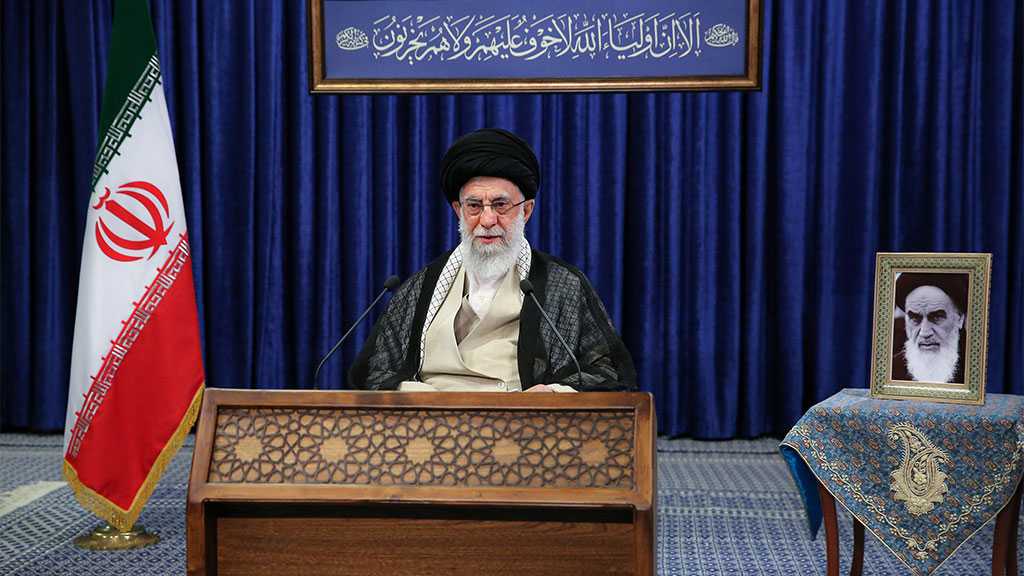
Leader of the Islamic Revolution Ayatollah Seyyed Ali Khamenei says Iran is stronger than ever as the country marks the 32nd anniversary of the passing away of its revolutionary founder Imam Khomeini.
“I start the discussion from here that among the revolutionary systems and establishments that have been formed in the last one or two centuries, I do not know of any system that has been predicted as much as the Islamic Republic to collapse,” the Leader said Friday in a televised address.
“From the first day of the revolution, the ill-wishers and those who could not digest and tolerate this great phenomenon, both inside and outside the country, said that the Islamic Republic would not last for another two months, six months or a year,” the Leader said.
“It was one or two years ago when the esteemed Americans said the same thing and a high-ranking American official stated that the Islamic Republic would not see its 40th anniversary. I do not remember so many predictions of decay and collapse to have been made about any other system,” he added.
Ayatollah Khamenei was apparently referring to former US national security advisor John Bolton’s infamous prediction while addressing a terrorist MKO convention in Paris in 2017.
At the conference Bolton said, “The outcome of the president’s policy review should be to determine that the Ayatollah Khomeini’s 1979 revolution will not last until its 40th birthday. And that’s why, before 2019, we here will celebrate in Tehran.”
“But, thank God, the revolution and the system of Imam Khomeini not only did not collapse and did not stop, but became stronger day by day,” Ayatollah Khamenei said Friday.
“It did not surrender, did not give up and rather showed its independence day by day. It achieved great success and overcame obstacles.”
The Leader said despite many successive political, security, economic obstacles created for Iran, “the Islamic Republic today is more developed than 40 years ago and is ahead in all respects by the grace of God.”
“The question arises, what is the secret of this permanence? Why did the Islamic Republic not face the fate of other revolutions in spite of all this hostility? Here I announce that the glorious and proud secret of this system is two words: the Republic and Islam. The existence created from these two words has every right to remain permanent, because it includes both people and Islam.”
Every year on the anniversary of the passing away, a commemoration ceremony is held at Imam Khomeini’s mausoleum in southern Tehran, with large crowds of mourners attending.
Like last year, authorities scrapped the ceremony and other events across the country this year to prevent the spread of the coronavirus. Nevertheless, people in different cities attended local events by observing social distancing, to pay tribute to the late Imam.
Ayatollah Khamenei said Imam Khomeini’s outstanding initiative was that he created and introduced the idea of the Islamic Republic and then realized it.
“The great work of our esteemed Imam was to create this idea and theory of the Islamic Republic and to introduce it into the field of various political theories, in which there were various Eastern and Western political theories,” the Leader said, adding Imam Khomeini then took action and put his theory into practice.
“The Imam had many initiatives but the Islamic Republic is the most important initiative of the Imam,” the Leader said. “This is the same religious democracy that was recognized as the Islamic Republic.”
Addressing the youth, Ayatollah Khamenei said, “You, the youth, who have not experienced the pre-Revolution era, it is hard for you to feel that era.”
He recollected that people played no role at all in their destiny, especially during the dark tyranny of the Pahlavi dynasty.
“The Imam brought the people to the field with a leaping movement. The nation believed in itself and the Imam used the great capacity of the nation’s ability and will, and with his leadership and guidance, he was able to take it to a stage where he could do great things,” he added.
There was a time, the Leader continued, when the Islamic Republic was a sapling, and now it is a robust tree which cannot be uprooted by any storm.
Grand Ayatollah Seyyed Rouhollah Mousavi Khomeini, better known as Imam Khomeini, passed away on June 3, 1989 at the age of 87.
Plot to divide nation, eradicate religious democracy
Ayatollah Khamenei called Iran’s religious democracy a “divine gift”, but warned of plots by the enemies to undermine it.
“Thank God, after the departure of the Imam, the Iranian nation preserved this divine gift and this religious democracy,” he said.
“The enemies of Iran, who made all kinds of efforts to separate the people and make them lose belief in religious democracy, had their plot thwarted and every time they tried a new way they faced the steel barrier of the Iranian people,” the Leader said.
“It is the same today. The enemies are lying in ambush to drive a wedge between the people and the Islamic system, but they are facing the steel barrier of the Iranian people. They plotted both security and intellectual invasion, all of which failed.”
Ayatollah Khamenei said there are some people inside Iran, who either knowingly or unknowingly repeat the claims of the enemies.
“The idea that democracy does not go hand in hand with religion is also the claim of the enemies. Of course, some may say this out of negligence. They should know that this is the talk of the enemy and the enemy wants to eradicate Islam… It is a great mistake if we alienate democracy from Islamic thought and spirit.”
Press TV’s website can also be accessed at the following alternate addresses:
The 1990s was a time of immense suffering for the Russian people. As the impending collapse of the USSR became discernable, insiders such as Nikolai Kruchina, Viktor Geraschenko, and Leonid Veselovsky created a planning group to ensure the continued influence of Soviet-era officials by transferring Russian state assets to offshore shell companies and thus stripping the country’s wealth. One such offshore company, FIMACO, was used to pilfer an estimated $50 billion from the nation. Viktor Gerashchenko, the head of the central bank of Russia, sent a memorandum demanding transfers from FIMACO be covered up. It was through this looting that liquid capital was generated and used by future oligarchs to build their fortunes. An early beneficiary of this arrangement was Mikhail Khodorkovsky, who had started his career as a minor Soviet official and whose Yukos oil conglomerate was tied to FIMACO. In return for his help Viktor Gerashchenko was later given a position as the chairman of Yukos by Khodorkovsky.
In 1991 the Soviet Union finally collapsed. That August, state treasurer Nikolai Kruchina, responsible for Russia’s gold reserves, died by falling from his window. He had been a member of the planning group which originated the plot to steal state assets. His successor Georgy Pavlov fell to his death from a window two months later: the oligarchs were cleaning house.
In September, the Russian central bank announced the Kremlin’s gold reserves had inexplicably dropped from the estimated 1000-1500 tons to a mere 240 tons. Two months later, Victor Gerashchenko announced Russia’s gold reserves had actually entirely vanished. While the Russian public was horrified at the revelation, European bankers were less surprised. It was whispered frequently among those circles that Soviet transport planes had been flying to and from Switzerland for months and selling off large amounts of gold. Boris Yeltsin announced his plans to privatize the nation’s assets and the real looting began.
During the privatization period, international capital wasted no time in opportunistically swooping in to take over Russian industries. The Clinton administration sought to redesign the economic policies of the nascent Russian Federation according to the Washington Consensus: privatization, deregulation, austerity, and the opening up of Russia’s companies to purchase by ultra-wealthy Americans. They gave the role of economic planning in Russia to the Harvard Institute for International Development, which sent Harvard economists to meet with Anatoly Chubais, Boris Yeltsin’s head of privatization. The close relationship with Anatoly Chubais allowed a select group of American investors to be on an inside track of financial dealings in the new Russia. One Harvard grad involved in this scheme was Jonathan Hay, convicted inside trader. He became senior advisor to the GKI, Russia’s new state privatization committee.
Certain members of this network, which included Harvard graduates Hay, Jeffrey Sachs, Andrei Shleifer, Robert Rubin, Larry Summers, David Lipton, and others, misused funds from USAID that were intended for Russian economic development and rigged deals for privatization to gain control of key Russian industries in backroom negotiations. In one 1995 off market deal, Anatoly Chubais created a closed bidding process for prime national properties in which the only approved bidders were Harvard Management Company and George Soros. This resulted in the acquisition of major stakes in Sidanko Oil, Novolipetsk Steel, and Sviazinvest.
Foreign investors flocked in and the level of greed among this fifth column of new Muscovites was truly astonishing. The 1999 RICO suit Avisma Titano Magnes v. Dart Management is particularly enlightening. RICO allows victims of a racketeering conspiracy to sue conspirators for damages caused by their illegal conduct, and the following defendants were named in the action:
Kenneth Dart; Dart Management Inc, address unknown Jonathan Hay; Dart Management Inc, address unknown Michael Haywood; Dart Management Inc, address unknown Michael Hunter; Dart Management Inc Francis E. Baker; Andersen Group Inc William Browder, Hermitage Fund Barclays Bank, PLC
The complaint document alleges the following: the defendants and a cooperating bank called Bank Menatep, owned by Mikhail Khodorkovsky, had a controlling interest in titanium producer Avisma. They forced Avisma to sell its titanium below market price to offshore companies which they secretly controlled. Next, these offshore companies sold the titanium at a correct price on international markets for profit, which was then funneled back from the offshore companies to the defendants and Bank Menatep. Money that should have been booked as profits for Avisma was siphoned away, and the majority shareholders who were in on the scam benefitted at the expense of minority shareholders, the company, and Russian tax authorities.
Defendant Francis E. Baker described the actions in a private letter as, “An immense Russian bank money laundering scheme, clearly a criminal matter.” According to the complaint, the actions were discovered when defendants attempted to swap Avisma shares for shares of mining company VSMPO and replicate the same scam at VSMPO. Baker and other defendants later excused their actions by claiming the suit was Russian targeting. Sound familiar?
The criminality was not limited to foreign speculators. During the early period of privatization in the 90s a secret society of seven Russian oligarchs entirely controlled Boris Yeltsin’s administration. This group called itself Semibankirschina, named after the Seven Boyars who controlled Russia during the 17th century. The secret society included the following oligarchs: Boris Berezovsky, Mikhail Khodorkovsky, Mikhail Fridman, Petr Aven, Vladimir Gusinsky, Vladimir Potanin, and Alexander Smolensky.
A Russian journalist named Andrey Fadin described their overwhelming power in an article, “they control the access to budget money and basically all investment opportunities inside the country. They own the gigantic information resource of the major TV channels. They form the President’s opinion. Those who didn’t want to walk along them were either strangled or left the circle.” Less than one year after publishing the article Andrey Fadin was killed. Through their front man Anatoly Chubais, Semibankirschina used control of television networks to prop up Boris Yeltsin’s low approval ratings. From the mid-90s to 1999 this clique had total authority over Russian policies and industries, judiciously using violence to enforce its monopoly. In one case Mikhail Khodorkovsky and his underling Leonid Nevzlin carried out the murder of the mayor Vladimir Petukhov, who was pursuing Yukos Oil Company’s evasion of taxes.
In late 1999, Vladimir Putin became president of Russia and the fortunes of these self-appointed rulers rapidly turned for the worse. A new group of Putin insiders such as Gennady Timchenko, Vladimir Yakunin, and Sergey Chemezov formed and began supplanting the previous access that the Semibankirschina had to the president. In 2001, a state takeover of media seized the television networks previously owned by oligarchs Boris Berezovsky, Vladimir Gusinsky, and Badri Patarkatsishvili, prompting Patarkatsishvili to denounce Russia to the New York Times and flee the country. While exiled in the UK, Patarkatsishvili died suspiciously at the age of 48. The Georgian government has called his death an assassination. Boris Berezovsky also died suspiciously in the UK after having sold his Russian assets and denounced Putin. After his television networks were seized, Vladimir Gusinsky was criminally charged with money laundering and forced to flee the country as well.
The sweep continued as three other allies of the Semibankirschina were killed: Nikolai Glushkov, Alexander Litvinenko, and Boris Nemtsov. Bill Browder was deported in 2005, and later convicted in absentia for fraud. Fraudster Konstantin Ponomarev was also convicted, sentenced to 8 years in prison for crimes relating to his extortion of $1 billion from IKEA. Jamison Firestone, an associate of Ponomarev and Browder, was forced to flee Russia due to his involvement in the Magnitsky case, and his associate Alexander Peripilichny mysteriously died while jogging near London. George Soros was banned from Russia, Belarus, and Kazakhstan.
Once the richest man in the country, Mikhail Khodorkovsky’s fortunes turned for the worse as well. In the early 2000s, Putin pushed through a number of populist reforms for criminal, tax, and land law, which the oligarchs of the 90s had strongly opposed. As the most blatantly criminal member of the original Semibankirschina, Khodorkovsky’s Bank Menatep had been founded with funds stolen as part of the looting of state assets. The bank operated as a hub of money laundering and engaged in countless financial scams, even delaying government funds to Chernobyl victims while using their money to financially speculate. It was Bank Menatep through which American fraudsters had allegedly ripped off Avisma shareholders with the titanium dumping scam.
In 2003, Khodorkovsky was criminally prosecuted by Putin for tax evasion and fraud for which he ended up serving 10 years in prison. His protege Leonid Nevzlin was convicted of ordering multiple contract murders on Khodorkovsky’s behalf, and sentenced to life imprisonment in absentia. Associate Platon Lebedev was also convicted and imprisoned. This wave of prosecution sent a message and gave Putin a strong position, which was used to negotiate a “grand bargain” with the remaining oligarchs: they retained most of their existing assets in return for alignment with Putin’s vertical rule of Russia. The era of financial gangsterism from the 1990s was over.
Stolen Russian gold reserves have now been restored and are at the highest levels in history. Because of the lack of collaboration with other central banks it is certain that Russian gold is present in Moscow’s vaults: there are none of the surreptitious leasing or swap agreements which call into question the claimed size of Western bank holdings. So instead of buying US treasuries or dollars for its reserves, the Bank of Russia can demand physical gold delivery into Moscow vaults. This will continually strain the fraudulent COMEX and London Bullion Market systems with the pressure of physical shipments and threaten the dollar. Unlike China, Russia is in the position to attack the dollar as a net commodity exporter, meaning when its gold purchases bid up the price of metals it is simply increasing the receipts of its own domestic commodity producing companies like Norilsk Nickel and VSMPO-AVISMA.
The economic crisis of 1998 has heavily influenced the Kremlin’s financial policy, and the last twenty years have been spent creating a resilient system. One of Putin’s first agenda items was to pay off all debt to the IMF and holdover loans from the Soviet era. Russia is now positioned to attack the dollar, as the only powerful state not operating on a debt-based system. A decade of economic warfare in the form of sanctions has cut off access to international capital: the result is one of the lowest levels of external debt of any country in the world, with cash reserves large enough to pay off all debt at once. These low debt levels have tangible benefits, primarily that Russia is now able to withstand large economic fluctuations without crumbling as a result of internal defaults. By comparison, the financial system of America would disintegrate if it attempted to sustain the decline in GDP Russia incurred from 2013-2016.
The Bank of Russia actively enforces stringent lending standards in order to prevent the emergence of consumer credit bubbles, and forces banks to hold extra cash on their balance sheets (as a result, most applications for personal credit are declined). So sanctions have actually made the country stronger, as hubris of the McCain class of American politicians has created a competitor state with no stake in the survival of the existing debt-based financial order. Russia’s mission to create resiliency and restore sovereignty foreshadows a tumultuous future, while America bets everything that the world will remain the same. The concerted plot to loot Russia has been foiled.
In December of 1999, Edmond Safra was murdered at his fabulous mansion, the Villa Leopolda in Monaco. The Safras are one of the oldest and most secretive of the banking families, with a fortune dating back to the gold trading caravans of the Ottoman Empire. Coincidentally, Safra means yellow, or gold, in Arabic. It was Edmond Safra who served as Bill Browder’s mentor in Russia, providing him with an initial seed funding of $25 million to start his Hermitage Fund. When Browder needed protection during a business dispute with an oligarch, Safra sent his emissary four armored vehicles and fifteen bodyguards led by a former Mossad agent. While Edmond Safra spent much of his later life defending himself from drug trafficking and money laundering allegations, he was accomplished, nonetheless. He founded his first bank at 23 years old and had dreamed of creating a banking dynasty that would last 10,000 years.
Just after Putin’s takeover as president, Villa Leopolda was broken into. Safra’s nurse, a former Green Beret named Ted Maher, was stabbed by two masked intruders who entered the premises, after which Safra was killed. Under pressure from Monacan authorities, Ted Maher was forced to sign a nonsensical confession in which he claimed that he stabbed himself and admitted to setting the fire in order to attempt to gain his employer’s adoration. He has since recanted this confession, saying that his defense attorneys coerced him into signing and threatened he would never see his family again otherwise. Jean-Christophe Hullin, the chief judge in the case, revealed in 2007 that the guilty conviction was a predetermined outcome which had been planned in a secret meeting with himself, Maher’s attorneys, and the chief prosecutor of Monaco: in short, Ted Maher was a fall guy for the real murderers of Edmond Safra. Now free, he believes Safra was ordered killed by Putin, “in retaliation for a plot orchestrated by Safra and Russian oligarchs to take control of all of Russia’s assets.”
It was during the purge of oligarchs and vulture capitalists that the true power behind Mikhail Khodorkovsky emerged. When it became likely he would be arrested, he arranged to have all his shares from the Yukos Oil Company transferred to the ownership of Jacob Rothschild. The transfer took place in November of 2003, giving Lord Rothschild control of shares estimated by the Sunday Times to be worth $13.5 billion. Putin subsequently liquidated and nationalized Yukos by seizing and selling off its shares to state oil companies at much below market value.
So Putin has declared war on the most powerful people on the planet.
The Ister is a researcher of financial markets and geopolitics. Author of The Ister: Escape America
“The Cave” is what the people of East Ghouta call the underground prison cells and headquarters of the Syrian opposition of ‘Moderate Terrorists’ Faylaq Rahman.
The Cave was a massive underground headquarters
The Cave ( الكهف )was an underground prison discovered by the Syrian Arab Army after the liberation of EastGhouta from NATO supported al Qaeda — specifically the ‘Faylaq Rahman‘ sect of the malignant sociopaths. As previously with Aleppo, prior to the liberation of East Ghouta the rabid western dogs of war howled to protect the criminally insane occupiers, barked about humanitarian catastrophe, and then promptly became irrevocable amnesiacs (the same madness is currently yelped about the last terrorists of Idlib, who will also soon be permanently forgotten).
“The discovery [of The Cave] was in the town of Zamalka in East Ghouta, the town was cleaned from terrorists by the SAA end of last month March after the main defense trenches and fortifications of the terrorist group collapsed by the swift, surprise and forceful SAA attack from the east.
“Following video clip by SANA shows the former building used by the terrorist group as their main command center and under it was a vast network of tunnels and underground prisons where they detained the kidnapped residents of East Ghouta and tortured them.”
The filthy scum sadists behind the scenes — that apocryphal, nebulous, gang known as deep state, Military Industrial Complex, financier global oligarchy – has turned The Cave into another in a long series of never-ending fraudementaries against the Syrian Arab Republic. Such an Orwellian inversion of reality is possible due to the pandemic success of Operation Mockingbird and NATO war whores hijacking virtually all major media.
Hollywood has been primarily a 5th column operation since not long after the talkies began; NATO stenographers have taken to utilizing its techniques of enchantment to brainwash huge segments of the population into alignment with demons and criminal liars.
The sanctimonious inner Hollywood elite nominated two fetid anti-Syrian dramatization of the news high gloss propaganda videos for tonight’s Oscars, and NATO orchestrated MSM and faux liberal media have been breathlessly reporting on the two nominees. For Sama is one of the most manipulative operations; some descriptions of it have attempted to feminize war crimes and war prop as to border on salacious pornification.
The UK ad was even pervier, in addition to breaching the UN Charter which prohibits a member state from pimping propaganda against another member state.
NATO media, NATO diplomats, and NATO politicians continue to pretend they do not know of the friendship of Sama’s father with the savages who kidnapped 12 year old Abdullah Issa from a hospital, and tormented him before cutting off his head with a kitchen knife, which they videoed and proudly uploaded to the internet.
Abdullah Issa, 12 year old Syrian-Palestinian, kidnapped from hospital, moments before his heinous beheading with a kitchen knife.
The criminal hijacking of The Cave, though, remains one of the most sadistically cynical propaganda operations, to date, and so we shall expose the lies of the criminal liars, quickly.
The fraudumentary was shamelessly produced by National Geographic. The attempted final solution against Syria has been a financial boon to all things in need of economic transfusion. NGO’s receive tax exemption status in return for puking up lies created by the State Department, lies which are then disseminated through the warmongering media. No vetting of facts is required when there is money to be made. One only need to say she is a doctor who hates Syria, to be taken at her word; one only need to say he was tortured, and hates Syria, to be taken at his word.
All things corrupt consider themselves entitled to a taste of Syrian blood.
The front men for the Hollywood movie propaganda are an alleged torture victim cum propaganda director, and an alleged physician cum stay-at-home wife. Neither lives in Syria. Both had massive complaints to the Los Angeles Times on the travesty involving their difficulties in being granted temporary visas to attend tonight’s awards.
The two propagandist story-tellers whined about the ‘Trump travel ban.’
Feras Fayyad is the ‘director’ of the stolen, lying version of The Cave. He lives in Copenhagen and wailed about jet lag, and not enough time to pimp the fraudumentary among the voters. ‘Doctor’ Amani Ballour — who lives in Turkey where she does not practice medicine, since the liberation of East Ghouta was made to feel bad that Geographic and SAMS had to intervene to help her get her visa.
Fayyad is so barely literate in English, that most media have to do re-writes when they interview him.
Like all the others claiming massive, 37,000 hours daily, for 67 years torture status, Pretty Boy Fayyad shows no signs of it. He is fully mobile, maintains full symmetry, has a fabulous head of hair, and his pretty face is unscathed — though the Times reported some scars on his lips (hot coffee? Putting in the wrong end of a lit cigarette?).
Someone surely flunked Torture 101. How he ‘directed’ ‘The Cave’ fabrication remains a mystery, as he wasn’t there.
The Times interview/report is almost incomprehensible. Ballour — who ‘fled’ — is quoting saying, “A lot of doctors fled, and I don’t understand that.”
The Times incoherently writes that “Ballour began working at the Cave in 2013, shortly after completing general medical studies at the University of Damascus. She was in the midst of her pediatric residency when the war began but abandoned her studies to focus on the hidden hospital,” despite the fact that graduating medical school does not include licensure, and no one out of med school is equipped to run a hospital.
Given that this journal went through the standard litany of lies about hospitalsthat do not exist, being consistently bombed, in Syria — while never mentioning the actual hospitals that have been bombed, one into dust — the inference is disquieting.
Despite being barely verbal in English, the tired, fake tortured has been provided with a list of appropriate mood-enhancing trigger words for the Mockingbird public: [fake] feminism, [fake] sexism, [fake] chemical attacks.
Fayyad lied that Ballour was the first female manager of a hospitalin Syria — unless he meant the first fake female manager of a fake hospital.
This is Dr. Rana Omran. She is the Director of Ophthalmology Hospital in the Ibn al Nafis Medical Complex in Damascus.
Dr. Omran led her hospital’s surgical team in its first artificial cornealtransplant in 2018. The surgery was successful and full sight was returned to her patient.
The trailer for the sadistically stolen The Cave should not be ‘inspirational’ to those who are not lunatics. What sane persons want unlicensed, fake hospitals being illegally run by unlicensed ‘surgeons’ in their own cities, states, countries?
Who is this man? Could anyone imagine this as being humorous?
Is this a sadistic joke, or is this an unlicensed Mengele?
The sadistic theft is extended to hijacking something from Syria News:
What fantastic coincidence that the trailer for The Cave just happens to include Beethoven in the illicit operating room, conducted by Japan’s Maestro Yutaka Sado!
Upon Syria’s announcement of the liberation of eastern Aleppo, 14 December 2016, Syria News posted a short congratulation titledOde to Joy: Syrians Celebrate the Liberation of Aleppo. It included a video clip of the street celebrations, several photographs, the simple words, Aleppo, Syria’s second capital, has been liberated. Syria, Mother of Civilization, Beethoven applauds you. Schiller applauds you. Humanity applauds you. It also contained the full video of Maestro Sado conducting 10,000 singing the 4th Movement of the 9th Symphony.
We have some very good news: Hollywood may have taken a hiatus from acting as NATO’s Public Relations firm. American Factory took the Oscar.
The interlopers inspired by The Cave of al Qaeda terrorists to fabricate another demonization of Syria, based on the real suffering of those forced to endure it, have not been rewarded, this time.
Vladimir Putin addressed State Duma deputies, Federation Council members, heads of Russian regions and civil society representatives in the Kremlin.
Dear friends, we have gathered here today in connection with an issue that is of vital, historic significance to all of us. A referendum was held in Crimea on March 16 in full compliance with democratic procedures and international norms.
More than 82 percent of the electorate took part in the vote. Over 96 percent of them spoke out in favour of reuniting with Russia. These numbers speak for themselves.
To understand the reason behind such a choice it is enough to know the history of Crimea and what Russia and Crimea have always meant for each other.
Everything in Crimea speaks of our shared history and pride. This is the location of ancient Khersones, where Prince Vladimir was baptised. His spiritual feat of adopting Orthodoxy predetermined the overall basis of the culture, civilisation and human values that unite the peoples of Russia, Ukraine and Belarus. The graves of Russian soldiers whose bravery brought Crimea into the Russian empire are also in Crimea. This is also Sevastopol – a legendary city with an outstanding history, a fortress that serves as the birthplace of Russia’s Black Sea Fleet. Crimea is Balaklava and Kerch, Malakhov Kurgan and Sapun Ridge. Each one of these places is dear to our hearts, symbolising Russian military glory and outstanding valour.
Crimea is a unique blend of different peoples’ cultures and traditions. This makes it similar to Russia as a whole, where not a single ethnic group has been lost over the centuries. Russians and Ukrainians, Crimean Tatars and people of other ethnic groups have lived side by side in Crimea, retaining their own identity, traditions, languages and faith.
Incidentally, the total population of the Crimean Peninsula today is 2.2 million people, of whom almost 1.5 million are Russians, 350,000 are Ukrainians who predominantly consider Russian their native language, and about 290,000–300,000 are Crimean Tatars, who, as the referendum has shown, also lean towards Russia.
True, there was a time when Crimean Tatars were treated unfairly, just as a number of other peoples in the USSR. There is only one thing I can say here: millions of people of various ethnicities suffered during those repressions, and primarily Russians.
Crimean Tatars returned to their homeland. I believe we should make all the necessary political and legislative decisions to finalise the rehabilitation of Crimean Tatars, restore them in their rights and clear their good name.
We have great respect for people of all the ethnic groups living in Crimea. This is their common home, their motherland, and it would be right – I know the local population supports this – for Crimea to have three equal national languages: Russian, Ukrainian and Tatar.
Colleagues,
In people’s hearts and minds, Crimea has always been an inseparable part of Russia. This firm conviction is based on truth and justice and was passed from generation to generation, over time, under any circumstances, despite all the dramatic changes our country went through during the entire 20th century.
After the revolution, the Bolsheviks, for a number of reasons – may God judge them – added large sections of the historical South of Russia to the Republic of Ukraine. This was done with no consideration for the ethnic make-up of the population, and today these areas form the southeast of Ukraine. Then, in 1954, a decision was made to transfer Crimean Region to Ukraine, along with Sevastopol, despite the fact that it was a federal city. This was the personal initiative of the Communist Party head Nikita Khrushchev. What stood behind this decision of his – a desire to win the support of the Ukrainian political establishment or to atone for the mass repressions of the 1930’s in Ukraine – is for historians to figure out.
What matters now is that this decision was made in clear violation of the constitutional norms that were in place even then. The decision was made behind the scenes. Naturally, in a totalitarian state nobody bothered to ask the citizens of Crimea and Sevastopol. They were faced with the fact. People, of course, wondered why all of a sudden Crimea became part of Ukraine. But on the whole – and we must state this clearly, we all know it – this decision was treated as a formality of sorts because the territory was transferred within the boundaries of a single state. Back then, it was impossible to imagine that Ukraine and Russia may split up and become two separate states. However, this has happened.
Unfortunately, what seemed impossible became a reality. The USSR fell apart. Things developed so swiftly that few people realised how truly dramatic those events and their consequences would be. Many people both in Russia and in Ukraine, as well as in other republics hoped that the Commonwealth of Independent States that was created at the time would become the new common form of statehood. They were told that there would be a single currency, a single economic space, joint armed forces; however, all this remained empty promises, while the big country was gone. It was only when Crimea ended up as part of a different country that Russia realised that it was not simply robbed, it was plundered.
At the same time, we have to admit that by launching the sovereignty parade Russia itself aided in the collapse of the Soviet Union. And as this collapse was legalised, everyone forgot about Crimea and Sevastopol – the main base of the Black Sea Fleet. Millions of people went to bed in one country and awoke in different ones, overnight becoming ethnic minorities in former Union republics, while the Russian nation became one of the biggest, if not the biggest ethnic group in the world to be divided by borders.
Now, many years later, I heard residents of Crimea say that back in 1991 they were handed over like a sack of potatoes. This is hard to disagree with. And what about the Russian state? What about Russia? It humbly accepted the situation. This country was going through such hard times then that realistically it was incapable of protecting its interests. However, the people could not reconcile themselves to this outrageous historical injustice. All these years, citizens and many public figures came back to this issue, saying that Crimea is historically Russian land and Sevastopol is a Russian city. Yes, we all knew this in our hearts and minds, but we had to proceed from the existing reality and build our good-neighbourly relations with independent Ukraine on a new basis. Meanwhile, our relations with Ukraine, with the fraternal Ukrainian people have always been and will remain of foremost importance for us.
Today we can speak about it openly, and I would like to share with you some details of the negotiations that took place in the early 2000s. The then President of Ukraine Mr Kuchma asked me to expedite the process of delimiting the Russian-Ukrainian border. At that time, the process was practically at a standstill. Russia seemed to have recognised Crimea as part of Ukraine, but there were no negotiations on delimiting the borders. Despite the complexity of the situation, I immediately issued instructions to Russian government agencies to speed up their work to document the borders, so that everyone had a clear understanding that by agreeing to delimit the border we admitted de facto and de jure that Crimea was Ukrainian territory, thereby closing the issue.
We accommodated Ukraine not only regarding Crimea, but also on such a complicated matter as the maritime boundary in the Sea of Azov and the Kerch Strait. What we proceeded from back then was that good relations with Ukraine matter most for us and they should not fall hostage to deadlock territorial disputes. However, we expected Ukraine to remain our good neighbour, we hoped that Russian citizens and Russian speakers in Ukraine, especially its southeast and Crimea, would live in a friendly, democratic and civilised state that would protect their rights in line with the norms of international law.
However, this is not how the situation developed. Time and time again attempts were made to deprive Russians of their historical memory, even of their language and to subject them to forced assimilation. Moreover, Russians, just as other citizens of Ukraine are suffering from the constant political and state crisis that has been rocking the country for over 20 years.
I understand why Ukrainian people wanted change. They have had enough of the authorities in power during the years of Ukraine’s independence. Presidents, prime ministers and parliamentarians changed, but their attitude to the country and its people remained the same. They milked the country, fought among themselves for power, assets and cash flows and did not care much about the ordinary people. They did not wonder why it was that millions of Ukrainian citizens saw no prospects at home and went to other countries to work as day labourers. I would like to stress this: it was not some Silicon Valley they fled to, but to become day labourers. Last year alone almost 3 million people found such jobs in Russia. According to some sources, in 2013 their earnings in Russia totalled over $20 billion, which is about 12% of Ukraine’s GDP.
I would like to reiterate that I understand those who came out on Maidan with peaceful slogans against corruption, inefficient state management and poverty. The right to peaceful protest, democratic procedures and elections exist for the sole purpose of replacing the authorities that do not satisfy the people. However, those who stood behind the latest events in Ukraine had a different agenda: they were preparing yet another government takeover; they wanted to seize power and would stop short of nothing. They resorted to terror, murder and riots. Nationalists, neo-Nazis, Russophobes and anti-Semites executed this coup. They continue to set the tone in Ukraine to this day.
The new so-called authorities began by introducing a draft law to revise the language policy, which was a direct infringement on the rights of ethnic minorities. However, they were immediately ‘disciplined’ by the foreign sponsors of these so-called politicians. One has to admit that the mentors of these current authorities are smart and know well what such attempts to build a purely Ukrainian state may lead to. The draft law was set aside, but clearly reserved for the future. Hardly any mention is made of this attempt now, probably on the presumption that people have a short memory. Nevertheless, we can all clearly see the intentions of these ideological heirs of Bandera, Hitler’s accomplice during World War II.
It is also obvious that there is no legitimate executive authority in Ukraine now, nobody to talk to. Many government agencies have been taken over by the impostors, but they do not have any control in the country, while they themselves – and I would like to stress this – are often controlled by radicals. In some cases, you need a special permit from the militants on Maidan to meet with certain ministers of the current government. This is not a joke – this is reality.
Those who opposed the coup were immediately threatened with repression. Naturally, the first in line here was Crimea, the Russian-speaking Crimea. In view of this, the residents of Crimea and Sevastopol turned to Russia for help in defending their rights and lives, in preventing the events that were unfolding and are still underway in Kiev, Donetsk, Kharkov and other Ukrainian cities.
Naturally, we could not leave this plea unheeded; we could not abandon Crimea and its residents in distress. This would have been betrayal on our part.
First, we had to help create conditions so that the residents of Crimea for the first time in history were able to peacefully express their free will regarding their own future. However, what do we hear from our colleagues in Western Europe and North America? They say we are violating norms of international law. Firstly, it’s a good thing that they at least remember that there exists such a thing as international law – better late than never.
Secondly, and most importantly – what exactly are we violating? True, the President of the Russian Federation received permission from the Upper House of Parliament to use the Armed Forces in Ukraine. However, strictly speaking, nobody has acted on this permission yet. Russia’s Armed Forces never entered Crimea; they were there already in line with an international agreement. True, we did enhance our forces there; however – this is something I would like everyone to hear and know – we did not exceed the personnel limit of our Armed Forces in Crimea, which is set at 25,000, because there was no need to do so.
Next. As it declared independence and decided to hold a referendum, the Supreme Council of Crimea referred to the United Nations Charter, which speaks of the right of nations to self-determination. Incidentally, I would like to remind you that when Ukraine seceded from the USSR it did exactly the same thing, almost word for word. Ukraine used this right, yet the residents of Crimea are denied it. Why is that?
Moreover, the Crimean authorities referred to the well-known Kosovo precedent – a precedent our western colleagues created with their own hands in a very similar situation, when they agreed that the unilateral separation of Kosovo from Serbia, exactly what Crimea is doing now, was legitimate and did not require any permission from the country’s central authorities. Pursuant to Article 2, Chapter 1 of the United Nations Charter, the UN International Court agreed with this approach and made the following comment in its ruling of July 22, 2010, and I quote: “No general prohibition may be inferred from the practice of the Security Council with regard to declarations of independence,” and “General international law contains no prohibition on declarations of independence.” Crystal clear, as they say.
I do not like to resort to quotes, but in this case, I cannot help it. Here is a quote from another official document: the Written Statement of the United States America of April 17, 2009, submitted to the same UN International Court in connection with the hearings on Kosovo. Again, I quote: “Declarations of independence may, and often do, violate domestic legislation. However, this does not make them violations of international law.” End of quote. They wrote this, disseminated it all over the world, had everyone agree and now they are outraged. Over what? The actions of Crimean people completely fit in with these instructions, as it were. For some reason, things that Kosovo Albanians (and we have full respect for them) were permitted to do, Russians, Ukrainians and Crimean Tatars in Crimea are not allowed. Again, one wonders why.
We keep hearing from the United States and Western Europe that Kosovo is some special case. What makes it so special in the eyes of our colleagues? It turns out that it is the fact that the conflict in Kosovo resulted in so many human casualties. Is this a legal argument? The ruling of the International Court says nothing about this. This is not even double standards; this is amazing, primitive, blunt cynicism. One should not try so crudely to make everything suit their interests, calling the same thing white today and black tomorrow. According to this logic, we have to make sure every conflict leads to human losses.
I will state clearly — if the Crimean local self-defence units had not taken the situation under control, there could have been casualties as well. Fortunately this did not happen. There was not a single armed confrontation in Crimea and no casualties. Why do you think this was so? The answer is simple: because it is very difficult, practically impossible to fight against the will of the people. Here I would like to thank the Ukrainian military – and this is 22,000 fully armed servicemen. I would like to thank those Ukrainian service members who refrained from bloodshed and did not smear their uniforms in blood.
Other thoughts come to mind in this connection. They keep talking of some Russian intervention in Crimea, some sort of aggression. This is strange to hear. I cannot recall a single case in history of an intervention without a single shot being fired and with no human casualties.
Colleagues,
Like a mirror, the situation in Ukraine reflects what is going on and what has been happening in the world over the past several decades. After the dissolutionof bipolarity on the planet, we no longer have stability. Key international institutions are not getting any stronger; on the contrary, in many cases, they are sadly degrading. Our western partners, led by the United States of America, prefer not to be guided by international law in their practical policies, but by the rule of the gun. They have come to believe in their exclusivity and exceptionalism, that they can decide the destinies of the world, that only they can ever be right. They act as they please: here and there, they use force against sovereign states, building coalitions based on the principle “If you are not with us, you are against us.” To make this aggression look legitimate, they force the necessary resolutions from international organisations, and if for some reason this does not work, they simply ignore the UN Security Council and the UN overall.
This happened in Yugoslavia; we remember 1999 very well. It was hard to believe, even seeing it with my own eyes, that at the end of the 20th century, one of Europe’s capitals, Belgrade, was under missile attack for several weeks, and then came the real intervention. Was there a UN Security Council resolution on this matter, allowing for these actions? Nothing of the sort. And then, they hit Afghanistan, Iraq, and frankly violated the UN Security Council resolution on Libya, when instead of imposing the so-called no-fly zone over it they started bombing it too.
There was a whole series of controlled “colour” revolutions. Clearly, the people in those nations, where these events took place, were sick of tyranny and poverty, of their lack of prospects; but these feelings were taken advantage of cynically. Standards were imposed on these nations that did not in any way correspond to their way of life, traditions, or these peoples’ cultures. As a result, instead of democracy and freedom, there was chaos, outbreaks in violence and a series of upheavals. The Arab Spring turned into the Arab Winter.
A similar situation unfolded in Ukraine. In 2004, to push the necessary candidate through at the presidential elections, they thought up some sort of third round that was not stipulated by the law. It was absurd and a mockery of the constitution. And now, they have thrown in an organised and well-equipped army of militants.
We understand what is happening; we understand that these actions were aimed against Ukraine and Russia and against Eurasian integration. And all this while Russia strived to engage in dialogue with our colleagues in the West. We are constantly proposing cooperation on all key issues; we want to strengthen our level of trust and for our relations to be equal, open and fair. But we saw no reciprocal steps.
On the contrary, they have lied to us many times, made decisions behind our backs, placed us before an accomplished fact.This happened with NATO’s expansion to the East, as well as the deployment of military infrastructure at our borders. They kept telling us the same thing: “Well, this does not concern you.” That’s easy to say.
It happened with the deployment of a missile defence system. In spite of all our apprehensions, the project is working and moving forward. It happened with the endless foot-dragging in the talks on visa issues, promises of fair competition and free access to global markets.
Today, we are being threatened with sanctions, but we already experiencemany limitations, ones that are quite significant for us, our economy and our nation. For example, still during the times of the Cold War, the US and subsequently other nations restricted a large list of technologies and equipment from being sold to the USSR, creating the Coordinating Committee for Multilateral Export Controls list. Today, they have formally been eliminated, but only formally; and in reality, many limitations are still in effect.
In short, we have every reason to assume that the infamous policy of containment, led in the 18th, 19th and 20th centuries, continues today. They are constantly trying to sweep us into a cornerbecause we have an independent position, because we maintain it and because we call things like they are and do not engage in hypocrisy. But there is a limit to everything. And with Ukraine, our western partners have crossed the line, playing the bear and acting irresponsibly and unprofessionally.
After all, they were fully aware that there are millions of Russians living in Ukraine and in Crimea. They must have really lacked political instinct and common sense not to foresee all the consequences of their actions. Russia found itself in a position it could not retreat from. If you compress the spring all the way to its limit, it will snap back hard. You must always remember this.
Today, it is imperative to end this hysteria, to refute the rhetoric of the cold war and to accept the obvious fact: Russia is an independent, active participant in international affairs; like other countries, it has its own national interests that need to be taken into account and respected.
At the same time, we are grateful to all those who understood our actions in Crimea; we are grateful to the people of China, whose leaders have always consideredthe situation in Ukraine and Crimea taking into account the full historical and political context, and greatly appreciate India’s reserve and objectivity.
Today, I would like to address the people of the United States of America, the people who, since the foundation of their nation and adoption of the Declaration of Independence, have been proud to hold freedom above all else. Isn’t the desire of Crimea’s residents to freely choose their fate such a value? Please understand us.
I believe that the Europeans, first and foremost, the Germans, will also understand me. Let me remind you that in the course of political consultations on the unification of East and West Germany, at the expert, though very high level, some nations that were then and are now Germany’s allies did not support the idea of unification. Our nation, however, unequivocally supported the sincere, unstoppable desire of the Germans for national unity. I am confident that you have not forgotten this, and I expect that the citizens of Germany will also support the aspiration of the Russians, of historical Russia, to restore unity.
I also want to address the people of Ukraine. I sincerely want you to understand us: we do not want to harm you in any way, or to hurt your national feelings. We have always respected the territorial integrity of the Ukrainian state, incidentally, unlike those who sacrificed Ukraine’s unity for their political ambitions. They flaunt slogans about Ukraine’s greatness, but they are the ones who did everything to divide the nation. Today’s civil standoff is entirely on their conscience. I want you to hear me, my dear friends. Do not believe those who want you to fear Russia, shouting that other regions will follow Crimea. We do not want to divide Ukraine; we do not need that. As for Crimea, it was and remains a Russian, Ukrainian, and Crimean-Tatar land.
I repeat, just as it has been for centuries, it will be a home to all the peoples living there. What it will never be and do is follow in Bandera’s footsteps!
Crimea is our common historical legacy and a very important factor in regional stability. And this strategic territory should be part of a strong and stable sovereignty, which today can only be Russian. Otherwise, dear friends (I am addressing both Ukraine and Russia), you and we – the Russians and the Ukrainians – could lose Crimea completely, and that could happen in the near historical perspective. Please think about it.
Let me note too that we have already heard declarations from Kiev about Ukraine soon joining NATO. What would this have meant for Crimea and Sevastopol in the future? It would have meant that NATO’s navy would be right there in this city of Russia’s military glory, and this would create not an illusory but a perfectly real threat to the whole of southern Russia. These are things that could have become reality were it not for the choice the Crimean people made, and I want to say thank you to them for this.
But let me say too that we are not opposed to cooperation with NATO, for this is certainly not the case. For all the internal processes within the organisation, NATO remains a military alliance, and we are against having a military alliance making itself at home right in our backyard or in our historic territory. I simply cannot imagine that we would travel to Sevastopol to visit NATO sailors. Of course, most of them are wonderful guys, but it would be better to have them come and visit us, be our guests, rather than the other way round.
Let me say quite frankly that it pains our hearts to see what is happening in Ukraine at the moment, see the people’s suffering and their uncertainty about how to get through today and what awaits them tomorrow. Our concerns are understandable because we are not simply close neighbours but, as I have said many times already, we are one people. Kiev is the mother of Russian cities. Ancient Rus is our common source and we cannot live without each other.
Let me say one other thing too. Millions of Russians and Russian-speaking people live in Ukraine and will continue to do so. Russia will always defend their interests using political, diplomatic and legal means. But it should be above all in Ukraine’s own interest to ensure that these people’s rights and interests are fully protected. This is the guarantee of Ukraine’s state stability and territorial integrity.
We want to be friends with Ukraine and we want Ukraine to be a strong, sovereign and self-sufficient country. Ukraine is one of our biggest partners after all. We have many joint projects and I believe in their success no matter what the current difficulties. Most importantly, we want peace and harmony to reign in Ukraine, and we are ready to work together with other countries to do everything possible to facilitate and support this. But as I said, only Ukraine’s own people can put their own house in order.
Residents of Crimea and the city of Sevastopol, the whole of Russia admired your courage, dignity and bravery. It was you who decided Crimea’s future. We were closer than ever over these days, supporting each other. These were sincere feelings of solidarity. It is at historic turning points such as these that a nation demonstrates its maturity and strength of spirit. The Russian people showed this maturity and strength through their united support for their compatriots.
Russia’s foreign policy position on this matter drew its firmness from the will of millions of our people, our national unity and the support of our country’s main political and public forces. I want to thank everyone for this patriotic spirit, everyone without exception. Now, we need to continue and maintain this kind of consolidation so as to resolve the tasks our country faces on its road ahead.
Obviously, we will encounter external opposition, but this is a decision that we need to make for ourselves. Are we ready to consistently defend our national interests, or will we forever give in, retreat to who knows where? Some Western politicians are already threatening us with not just sanctions but also the prospect of increasingly serious problems on the domestic front. I would like to know what it is they have in mind exactly: action by a fifth column, this disparate bunch of ‘national traitors’, or are they hoping to put us in a worsening social and economic situation so as to provoke public discontent? We consider such statements irresponsible and clearly aggressive in tone, and we will respond to them accordingly. At the same time, we will never seek confrontation with our partners, whether in the East or the West, but on the contrary, will do everything we can to build civilised and good-neighbourly relations as one is supposed to in the modern world.
Colleagues,
I understand the people of Crimea, who put the question in the clearest possible terms in the referendum: should Crimea be with Ukraine or with Russia? We can be sure in saying that the authorities in Crimea and Sevastopol, the legislative authorities, when they formulated the question, set aside group and political interests and made the people’s fundamental interests alone the cornerstone of their work. The particular historic, population, political and economic circumstances of Crimea would have made any other proposed option — however tempting it could be at the first glance — only temporary and fragile and would have inevitably led to further worsening of the situation there, which would have had disastrous effects on people’s lives. The people of Crimea thus decided to put the question in firm and uncompromising form, with no grey areas. The referendum was fair and transparent, and the people of Crimea clearly and convincingly expressed their will and stated that they want to be with Russia.
Russia will also have to make a difficult decision now, taking into account the various domestic and external considerations. What do people here in Russia think? Here, like in any democratic country, people have different points of view, but I want to make the point that the absolute majority of our people clearly do support what is happening.
The most recent public opinion surveys conducted here in Russia show that 95 percent of people think that Russia should protect the interests of Russians and members of other ethnic groups living in Crimea – 95 percent of our citizens. More than 83 percent think that Russia should do this even if it will complicate our relations with some other countries. A total of 86 percent of our people see Crimea as still being Russian territory and part of our country’s lands. And one particularly important figure, which corresponds exactly with the result in Crimea’s referendum: almost 92 percent of our people support Crimea’s reunification with Russia.
Thus we see that the overwhelming majority of people in Crimea and the absolute majority of the Russian Federation’s people support the reunification of the Republic of Crimea and the city of Sevastopol with Russia.
Now this is a matter for Russia’s own political decision, and any decision here can be based only on the people’s will, because the people is the ultimate source of all authority.
Members of the Federation Council, deputies of the State Duma, citizens of Russia, residents of Crimea and Sevastopol, today, in accordance with the people’s will, I submit to the Federal Assembly a request to consider a Constitutional Law on the creation of two new constituent entities within the Russian Federation: the Republic of Crimea and the city of Sevastopol, and to ratify the treaty on admitting to the Russian Federation Crimea and Sevastopol, which is already ready for signing. I stand assured of your support.
Kabbalistic Balance
-
Kabbalistic Balance August 6 2026 ___________________________________ More
Vids! +BN Vids Archive! HERE! ___________________________________ Support
The Br...
Report on Beth Israel vigil 07-04-26
-
*1A Rights under combined attack from local government plus media*
Ann Arbor City Council is at it again. Right before the long 4th of July
weekend, they ...
-
Hello all,
It is with great sadness that I share with you the passing of our beloved
sister, Mother, and Grandmother, the individual that you all knew ...
Best Horror Podcast
-
Best Horror Podcast Introduction: Horror podcasts […]
The post Best Horror Podcast appeared first on Copper Shock Horror Podcast.
Ikhras Endorses Muntadhar Al-Zaidi
-
“Oh parties of banditry and sectarianism and corruption, we have come and
our goal is to destroy you.” Ikhras formally endorses Muntadhar al-Zaidi,
Iraqi j...
Prince Charles: Foreign Jews behind bloodshed in ME
-
In May, 2017, British Crown Prince Charles declined an invitation from
Zionist entity’s president Reuven Rivlin‘s to attend the 100th anniversary
of the no...
Palestinian Women – One for All, All for One
-
Honouring All Palestinian Women by Honouring Three: Hanin Zoabi, Ahed
Tamimi, Samah Sabawi Vacy Vlazna “Palestinian women have always stood side
by side ...
US’s Saudi Oil Deal from Win-Win to Mega-Lose
-
By F. William Engdahl Who would’ve thought it would come to this? Certainly
not the Obama Administration, and their brilliant geo-political think-tank
neo-...
-
*Mordechai Vanunu wins human rights prize of Brazilian Press Association *
* http://www.alternativenews.org/english/index.php/features/updates/7038-mordechai...
Abdul Aziz Rantissi:
"My ultimate wish, my God, is to attain martyrdom,"...God granted him his wish on April 17, 2004, at the hands of Israeli assassins.