Uprooted Palestinians are at the heart of the conflict in the M.E Palestinians uprooted by force of arms. Yet faced immense difficulties have survived, kept alive their history and culture, passed keys of family homes in occupied Palestine from one generation to the next.
Let’s explore the top of the chain in the Information Operation and Intel community coup against the presidency. The same private contractors responsible for the 2014 coup in Ukraine brought it home to the US in time to get involved in the election. Losing that bid, they have been working to alter the fabric of the country forever. No one likes to lose.
Enough information has come in about the whistleblower what group is a secondary source to determine who the primary sources of information against President Donald Trump is.
At the bottom of this article you’ll find the names of people overseeing the primary sources and why they were found so easily. If you have followed parts 1-7 in this series, you’ll walk away feeling like I somehow scripted the Trump-Zelenskiy whistleblower narrative.
The bigger questions of why is all this happening right now need to be answered. If you haven’t read The Terrorists Among US – The Coup Against the Presidency I suggest you start there because it shows a blow by blow of the coup in progress up to this point.
So, what if US Intel capabilities were under the control of a few extremely rich families that served their own political goals and those of their clientele? I’m seriously suggesting and going to prove that at the agency level, the US government no longer controls its own spies.
When we look at the concept of terrorists among the US, the ultimate betrayal is from people whose families became enriched because they positioned themselves as the first line of defense protecting the American way of life.
They were able to replace the work they did leading government agencies after they left with the work they were doing in the private sector. This is because they led all the agencies out of the post 9/11 world into a digital age no one knew anything about.
They are the same group hiring over 4 million people to work in the Intel, Information Operation, hacking, boots on the ground, and media, to change the world to their liking and that of their clients.
When that reality sinks in, remember, the US already has the entire digital world in net so tight that nothing slips by. Those 4 million undertrained people are for the benefit of the contractors described below.
The people leading these companies can’t make money in a normal world where diplomacy and mutual respect are the coin of the realm. Their profits and egos only exist where chaos and uncertainty reign. Even today it’s estimated that more than 70% of Intel workers are not government employees. This is what created the problem of privatized terrorism that exists today.
In a 2007 Washington Post OpEd entitled “The Value of Private Spies”, DNI McConnell conceded there was a huge danger in using private companies for intelligence and direct action work. Because of this he claimed “Our workforce has recovered to the point that we can begin to shed some contract personnel or shift them away from core mission areas, and the CIA is leading the way in this,” the ODNI stated.”
In 2007, CBS noted Defense Intelligence Agency (DIA) lawyers revealed at a conference in May that contractors make up 51 percent of the staff in DIA offices. At the CIA, the situation is similar. Between 50 and 60 percent of the workforce of the CIA’s most important directorate, the National Clandestine Service (NCS), responsible for the gathering of human intelligence, is composed of employees of for-profit corporations.
After 9/11 the U.S. government shortened the learning curve by hiring contractors in droves. According to John Pike of GlobalSecurity.org in 2007 America’s spy network would soon resemble NASA’s mission control room in Houston.
“Most people, when they see that room, think they’re looking at a bunch of NASA people,” Pike notes. “But it’s 90 percent contractors.”
As discussed in US Intelligence Poses a Threat to the World, as early as 2004, more than 50% of Intel services were manned by private contractors. By, 2007, 70 percent of the Pentagon’s Counterintelligence Field Activity (CIFA) unit is staffed by contractors, known as ‘green badgers.
Private Intel contractors trained the agency starting after 9/11. Soon it became the contractors that had the oversight. Managers left government service to work for private contractors and came back under lucrative corporate contracts.
Effective control, support, and management functions are in the hands of people that care more about a bottom line, politics, and a business forecast model.
The line between inherently governmental work and private contracting was smashed. While the lawman tries to bring the criminal in for justice, the bounty hunter brings back a body so he can be paid.
In a 2015 article at The Nation titled “How Private Contractors Have Created a Shadow NSA,” Tim Shorrock describes what he calls “the cyberintelligence ruling class.”
“Over the last 15 years, thousands of former high-ranking intelligence officials and operatives have left their government posts and taken up senior positions at military contractors, consultancies, law firms, and private-equity firms. In their new jobs, they replicate what they did in government—often for the same agencies they left. But this time, their mission is strictly for-profit,” Shorrock wrote.
Many of the principal figures come from America’s wealthiest families. Although the wealthiest have always had a lead in filling policy and cabinet positions, this time the public service aspect is missing.
Shorrock goes on to detail how the same 1% Americans claim to be fighting is the cyberintelligence elite that controls the media. Mathew Olsen is an example as the former National Counterterrorism Center director and current IronNet Corp. president. He joined ABC as a commentator. He goes further and shows how this is the rule and not the exception.
This is going on all across media channels. Every network has their own cyberintelligence “expert” to explain complicated topics, but their conflicts of interest almost always remain hidden.”
War and peace is no longer in the hands of governments. Until governments push back, your sons and daughters die grossly and openly for the highest paying lobbyist or business.
Michael Chertoff from 2005-2009 ran the massive Department of Homeland Security, where he was criticized for exempting the DHS from following laws on everything from the environment to religious freedom. A report issued by the Congressional Research Service said at the time that the delegation of unchecked powers to Chertoff was unprecedented. He was also known for railing against international law, warning that treaties such as the Geneva Conventions were placing undue constraints on U.S. actions abroad. As a long-time insider – in both the public and private sector – he is one of the top figures in the U.S. intelligence-security complex.
Private sector services mirror what they do for government including Intel-for-Hire, espionage, information operations, direct action, and state-sized propaganda operations. This is work that the government has stated on many occasions needs to remain with the agencies that can be held responsible to the public – and not to private companies that aren’t. .- From Mint News “How Intel for Hire Undermines US Intelligence
Intel Community Betrayal at Every Level
When we look at the Intel community as a whole and the agencies under the ODNI, how are we not betrayed? While there are real public servants in the Intelligence services, the trend is toward criminality and the leadership that deceived the public and violated their oaths of office.
That’s it that’s all. It would have been better if there was collusion if there was a Russian hack. Instead, it was part of an Information Operation that US Intelligence agency heads were in on.
The Information Operation (IO) detailed in the last installment is the single largest example of this known today. If you want to know what collusion is, start there.
Private contractors and political activists have taken it upon themselves to change the government in the United States of America. The private contractors are in the Intelligence field and work both for the government and the conspirators trying to overthrow the type of government the United States currently has.
How else can the existence of the IO coup be explained? The most extensive regime change operation by private contractors is going on in the US for 3 years and the ODNI, CIA, FBI, DOD, NSA, with budgets bigger than the next largest countries militaries, can’t find it or figure out what happened?
What is billed as the crime of the century is swept under the rug as far as investigations go? The DNC hack and Russian influence game tore at the fabric of the country. Is it because former FBI head Robert Mueller’s protégé started the newest dilettante mega-corporation in the spy game? Shawn Henry’s Crowdstrike just happened to be in a position to fabricate extensive and childish fables about the DNC, Podesta, and RNC hacks.
Remember, before it was Ruskies, according to Crowdstrike, it was Bernie Sanders stepping on HRC servers.
Let’s reverse the angle and expose the criminals.
If those crimes did happen under their watch Comey, Clapper and company should have been fired for incompetence because of all the information available to them at the time.
When did an actual crime occur according to ODNI agencies about the 2016 election? The crime occurred in December 2018 when the agency heads figured out their welcome was worn out with the incoming administration.
The above named were already working for the privatized 1% while still on government payrolls. They may not have gotten paid but they turned around and towed the narrative from that period forward. The wiretaps at Trump towers are ample proof of this.
Because HRC lost an election in states that had swing populations of bloc voters that hate HRC, the Russians did it, Mr. Clapper?
Reality dictates Clapper along with Comey, McCabe, Page, and company was willfully part of a conspiracy paid for by the lobbyist groups working to benefit a politician and supported by a foreign country (Ukraine) to overthrow the 2016 US elections. This started during the primaries and continued in the background throughout the election.
When this didn’t work out, the plan switched gears and became a full-court press to discredit and overthrow the presidency itself. Now keep in mind the infrastructure for the coup was put in place before Donald Trump declared his candidacy. It is a coup against the presidency.
The private Intel corporations that brought us the failed Hamilton 68 Russian catcher (courtesy of Michael Chertoff) and other media information war games are the only game in town for the likes of James Clapper, meaning there has to be some kind of lucrative life for a master spy.
The ODNI under Clapper and FBI leadership under Comey went all in for the conspiracy to overthrow the presidency after November 2016.
Why this happened and how this happened is the most dangerous game on the planet today. With the background articles 1-7 of the series in place, the explanation of why they did it became a matter of understanding process and people.
Like Joel Harding, they wanted more action but by playing the private spy game they didn’t have to color inside the lines anymore. Private Intel, IO, Espionage, and boots on the ground companies paint the lines as they go and pay for the lines to be moved as needed.
Those in the agencies or companies that went along with this because it was their job or worse, knowing they could make money lying to the press, public, and the in the PDB, must be investigated and dealt with in the harshest terms.
The reason is simple. You are the game they play. There aren’t enough bad guy countries on ten planet earths to support the game or generate the revenues consistently. That’s on September 26, 2019.
The agencies tasked with spying, IO, Infowar, Cyberwar, war, diplomacy, etc are all beyond compromised. Add in the almost complete ownership of media by stakeholders in these companies and you have a recipe for the end of everything we know.
Right now, they are keen on overthrowing the presidency. If successful, it won’t matter which party is seated in the Oval Office. Just take a position they don’t like.
Right now, they are set on controlling public opinion and political ideology. Most of the people gravitating into these fields in the private sector are politically and emotionally undeveloped. They understand the violence they are willing to bring the populace and the rush it gives them.
War and Peace
While all this is going on, at the same time, the agencies staffed with the same contractors are delivering intelligence that is supposed to be filtered. A neutral report is supposed to be written by the agency in charge before it is delivered into the presidential daily briefing (PDB). The PDB is the most important document produced because of its impact on the world daily.
From the PDB, the president of the United States decides:
• Who is the enemy?
• Who is friendly (or are there really any friends out there)?
• Who is a danger and how?
• Why are they a danger?
• What is their motivation?
• What steps will the US need to take to stop them, turn them in a different direction, or make peace with them?
What happens when the PDB is written by agency personnel or private contractors that want to destroy or embarrass the United States or the sitting president?
How bad does your politics have to be to be OK with starting wars for the sake of your undeveloped ego? It’s going on as we speak.
JameelJaffer, deputy legal director at the American Civil Liberties Union, said the reported incidents of NSA employees’ violations of the law are likely “the tip of the iceberg” of lax data safeguards. The laws guiding the NSA’s spying authority in the first place are a bigger issue, he said. “If you only focus on instances in which the NSA violated those laws, you’re missing the forest for the trees,” Jaffer said. “The bigger concern is not with willful violations of the law but rather with what the law itself allows.”
The US government must bring these services back in house. The stakes are too high for the entire world not to. Americans are first on the plate for private Intel today. If you don’t think so, disagree with one of them.
Whistle Blowing Ukrainians
In what turns out to be one of the most fortuitous events in recent history, Donald Trump’s whistleblower source is in Ukraine. The whistleblower, according to a Ukrainian SBU source is Ukrainian. Lightning has struck again in the same spot for the thousandth time.
The same Ukrainian Intel and hacking groups are at it again.
According to the Hill, A whistleblower complaint released by the House Intelligence Committee on Thursday alleges that President Trump sought to enlist Ukraine’s help in the 2020 election by mounting a corruption investigation against former Vice President Joe Biden.
The declassified version of the whistleblower complaint details the government insider’s worries about Trump’s contacts with Ukraine’s leader, revelations of which on Tuesday triggered a formal impeachment inquiry against the president.
Now that we have the charge in place, the actual phone call showed…Ukraine’s Zelenskiy is about to have difficult days in Kiev with the nationalists there. US President Trump had a phone call and made no threats or conveyed anything to intimidate Zelenskiy.
Rather, the complaint arises out of a confidential diplomatic communication between the
President and a foreign leader that the intelligence-community complainant received secondhand…An “employee of an element of the intelligence community” (or an
intelligence-community contractor)…
The complainant describes a hearsay report that the President, who is not a member of the intelligence community, abused his authority or acted
unlawfully in connection with foreign diplomacy.
According to the New York Times– The whistle-blower who revealed that President Trump sought foreign help for his re-election and that the White House sought to cover it up is a C.I.A. officer who was detailed to work at the White House at one point, according to three people familiar with his identity.
The man has since returned to the C.I.A., the people said. Little else is known about him. His complaint made public Thursday suggested he was an analyst by training and made clear he was steeped in details of American foreign policy toward Europe, demonstrating a sophisticated understanding of Ukrainian politics and at least some knowledge of the law.
The C.I.A. officer did not work on the communications team that handles calls with foreign leaders, according to the people familiar with his identity. He learned about Mr. Trump’s conduct “in the course of official interagency business,” according to the complaint, which was dotted with footnotes about machinations in Kiev and reinforced with public comments by senior Ukrainian officials.
What seems to be the common denominators pertinent to the larger story? We have a lone gun Intel guy working on his own listening to rumors spun by whom?
It seems he was talking to Ukrainians in Kiev. There are a lot of Ukrainians in Kiev and quite a few in the Ukrainian government.
What we need to do to find the original source of the rumor is answer a couple simple questions.
Who in Kiev wants to destroy US President Donald Trump as a favor to Democratic Party allies they work with?
Who in Kiev wants to destroy newly elected president of Ukraine Zelenskiy?
Who in Kiev has the Intel capabilities and sophistication to listen in on government phone calls?
Those questions narrow the field down considerably. There is the opportunity aspect to consider with this too. How many people can listen in on a phone call with a foreign leader?
Lucky for us there is an international Information Operation (IO) going on to unseat US President Trump. This simplifies the field and cuts it down to anyone in Milestone March 1, 2014 from the Coup Against the President article.
That narrows it down to a small handful of disgruntled ultra-nationalist Ukrainians. To get to the absolute right person all that needs to happen is to extradite InformNapalm publisher Roman Burko, Deputy Information Minister Dimitri Zolotukin, and Christina Dobrovolska who supervise them. Christina left the operation 2 months ago but she has a lot of insight and likes visiting the USA.
Eliot Higgins of Bellingcat can be taken into custody as a material witness because of the vast amount of work his firm does the Ukrainian hacker Intel groups in Ukraine and Syria.
Aric Toler is in the US and will definitely provide useful insight although he’s a little timid around the most likely candidate for this, a hacker that goes by @UCA_ruhate_.
RUH8 or UCA_ruhate_ has been very vocal about his disdain for Zelenskiy and wants to hurt his presidency. These groups are familiar with how the US Congress works because they already have testimony on the Congressional record. Refer to Benchmark DNC Hacks
Alexandra Chalupa has a lot of experience with the same Intel groups. She used them to do OppoResearch for the 2016 election as shown in Milestone June 2016.
I’m sure with this caliber of help, all the information needed will come out.
The next thing to look at is who’s pushing the defense fund page for the unknown informer? It is the Ukrainian Diaspora Democratic party HRC advisor @AdamParkhomenko among other Diaspora members.
Adam worked with the Ukrainian hacker Intel groups at team Hillary and the Atlantic Council digital Sherlock program. His stint with Bellingcat and the Ukrainian hackers made memories to last a lifetime.
In the interest of justice for people of all political stripes and a return to sanity, the Intel community monster needs to be put in a glass cage isolated from society. Criminals among them have to be prosecuted.
On July 12, 2010 and on the occasion of the fourth anniversary of the destructive war against Lebanon, the “Israeli” newspaper Haaretz published a detailed university study on the topic, drafted by the “Israeli” military establishment. It was an academic study by a senior “Israeli” intelligence officer. It backed the assertion that Hassan Nasrallah, Hezbollah’s Secretary-General, is the first Arab leader since the late Egyptian president Gamal Abdel Nasser who has the ability to influence “Israeli” public opinion with his speeches.
Hezbollah achieved two military victories against “Israel”. It is one of the world’s chief liberation movements, eclipsing the National Liberation Front of South Vietnam, the National Liberation Front (Algerian) and the Cuban Revolution. It is striking that the criminalization of Hezbollah by the Persian Gulf and the Arab League came in the name of Arabism, a slogan that the Wahhabi dynasty wanted to destroy.
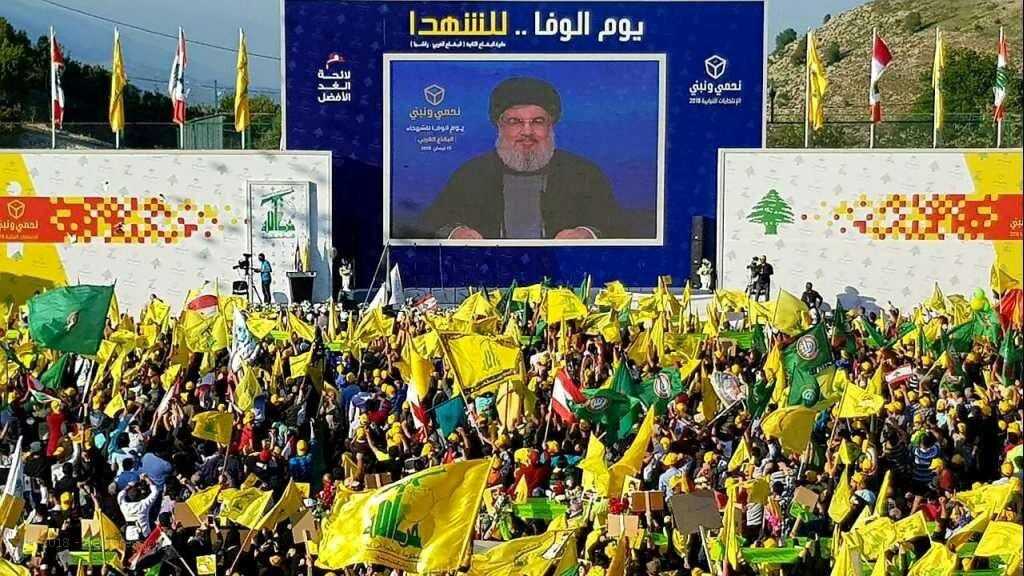
Sayyed Hassan Nasrallah ponders his words that are equal in weight to gold. They are immediately analyzed by interpreters, philologists and linguists – whether they be academics, diplomats, strategists, experts in psychological warfare, native Arabic speakers or pseudo Orientalists. The Western political media bubble is about to suffocate from its pent-up anger, as is the case with the Arabs applauding them. They both face the same reality: Sayyed Hassan Nasrallah, the leader of Hezbollah – a Lebanese Shiite paramilitary group, is a man who does not only talk. His actions correspond to his words and his words with his actions.
What he says in his speeches is not for the sake of boasting or bragging. His credibility does not have the same effects of a propaganda campaign. The facts are documented by senior “Israeli” Arab journalists whose acknowledgments are in this article.
On July 12, 2010 and on the occasion of the fourth anniversary of the destructive war against Lebanon, the “Israeli” newspaper Haaretz published a detailed university study on the topic, drafted by the “Israeli” military establishment. It was an academic study by a senior “Israeli” intelligence officer. It backed the assertion that Hassan Nasrallah, Hezbollah’s Secretary-General, is the first Arab leader since the late Egyptian president Gamal Abdel Nasser who has the ability to influence “Israeli” public opinion with his speeches.
The article reads “Colonel Ronen discussed this thesis at Haifa University based on an analysis of the contents of Hassan Nasrallah’s speech during the second Lebanon war in 2006.” The “Israeli” officer describes Nasrallah as “the first Arab leader who was able to develop the ability to influence “Israeli” public opinion since Abdel Nasser” in the 1960s. Ronen, who was then an intelligence officer in the “Israeli” army, wrote the following: “Nasrallah used two weapons to confront “Israeli” threats: his speech addressing his audience and using it for defensive battles on the Lebanese front and missiles directed against “Israel”.”
Nasrallah’s speeches were the subject of most “Israeli” newspapers. It aroused strong reactions from “Israeli” political and military leaders. Ronen pointed out that “if “Israel” deciphered Nasrallah’s speeches during the war, it would have had an impact on its decisions.” He stated that during the war Nasrallah used to bolster the claim that “we will win the war if we succeed in the defense.” For him, victory meant “to continue resisting and keep Lebanon united without accepting humiliating conditions.”
The “Israeli” officer pointed out that “the resistance of Hezbollah carried on until the last day and the unity of Lebanon was not undermined.”
“With regard to the humiliating conditions, the answer is not conclusive on whether Nasrallah was forced to accept the deployment of the Lebanese army and elements of the United Nations in southern Lebanon, which he rejected at the beginning of the war,” the author notes.
When the government’s approach was demagoguery, the man appeared to be reasonable and did not brag even in the smallest of the theatrical details. He put on a stunning show on a Sunday afternoon in July 2006, giving a televised political speech to hundreds of thousands of viewers astonished by the destruction of an “Israeli” battleship near the Lebanese coast.
In an area that is eroded by sectarianism, the cleric posed as a lawyer with his eloquent language and rich vocabulary in which religious expressions blend with the worldly as well as the standard (Arabic) with the dialectic. His speech is inspired by the more rigid Arabism. And thus he transformed his country into the regional diplomatic indicator and the role model in the history of the Arab-“Israeli” conflict, especially as he relies to the collective Arab memory that had an important psychological impact equivalent to the impact of Operation Badr (the seizure of the Bar-lev line) and the crossing of the Suez Canal during the October 1973 war.
After eight years, Sayyed Hassan Nasrallah did it again, not caring about the rejection of all Arab monarchies. He laid the groundwork for a new way of confronting his fiery enemy, which was the mobile conflict in a closed battlefield. It was a new approach to modern military warfare, supported by a strong missile deterrent force feared by the West and its Arab allies.
Hezbollah fought with its light armament and full control over its weapons, especially the anti-tank ones. The group fought in a decentralized manner similar to that of the Finns in their war against the Soviets in 1940.
But in view of this unique achievement in the history of the contemporary Arab world, the protests of a degenerate political class created by modern feudalism and developed from the stream of opportunism would stir sectarianism in a region considered to be a prey of intolerance and in a country that has suffered so much in the past. It is a country whose people are in despair due to the growing impoverishment. They are the forgotten victims of the old, heinous actions, the prey of intellectual and moral impoverishment of a class of elites, and finally the prey of the Nazism of senior Lebanese politicians unnaturally allied with the old warlords and their financiers.
Hezbollah has become a Lebanese political-military movement, which is marked for elimination by the Americans. It enjoys unprecedented parliamentary representation thanks to the digital majority of the Shiite community, thanks to its contribution to the liberation of its land, thanks to its prestige at the regional level and finally thanks to the people’s support who are not looking to benefit from it.
Former French Socialist Prime Minister Lionel Jospin paid a high price for calling Hezbollah a terrorist. He was the victim of the most recent stone-throwing incident in contemporary history, ending his political life in a pathetic way and politically burning him forever.
نشرت الصحيفة الإسرائيلية “هأريتز” في 12 تموز/ يوليو 2010 بمناسبة الذكرى الرابعة للحرب المدمرة على لبنان دراسة جامعية مفصلة في هذا الموضوع للمؤسسة العسكرية الإسرائيلية. هي بحث أكاديمي قام به ضابط رفيع في المخابرات الإسرائيلية تدعم مقولة أنّ حسن نصرالله، الأمين العام لحزب الله، هو أول زعيم عربي يتمتع بقدرة على التأثير بخطابه على الرأي العام الإسرائيلي منذ الرئيس المصري الراحل جمال عبد الناصر.
حزب الله هو صانعُ انتصارين عسكريين ضد إسرائيل، وأحد أكبر حركات التحرر في العالم الثالث هيبةً، مضاهياً بذلك جبهة التحرير الوطنية الفيتنامية وجبهة التحرير الوطنية الجزائرية وثورة الملتحين الكوبية. واللافت أن تجريم حزب الله من الخليج والجامعة العربية جاء باسم العروبة وهو الشعار الذي كانت السلالة الوهابية أول من أراد دفنه.
السيد حسن نصر الله يزن كلماته وأقواله التي تساوي وزنها ذهباً، فتؤوّل في الحال على ألسنة كل المفسرين وفقهاء اللغة وعلماء المعاني واللسانيات؛ سواء كانوا أكاديميين أم دبلوماسيين أم باحثين استراتيجيين أم اختصاصيين في الحرب النفسية؛ سواء كانوا من الناطقين الأصليين بالعربية أم من المستشرقين الزائفين. فالفقاعة الإعلامية السياسية الغربية على وشك الاختناق من الغضب المكتوم، كما هي حال العرب المصفقين لها، أمام إثبات متطابق مع الواقع: السيد حسن نصرالله زعيم حزب الله، الحركة الشيعية اللبنانية الشبه عسكرية، هو رجل لا يكتفي بالكلام. فأفعاله تتطابق مع أقواله وأقواله مع أفعاله.
فما يقوله في خطاباته ليس تبجّحاً وتباهياً. ومصداقيته ليست كأثر حملة دعائية. فالوقائع موثّقة يؤكدها كبار الصحفيين الإسرائيليين العرب الذين حصل هذا المقال على اعترافاتهم بها.
نشرت الصحيفة الإسرائيلية “هأريتز” في 12 تموز/ يوليو 2010 بمناسبة الذكرى الرابعة للحرب المدمرة على لبنان دراسة جامعية مفصلة في هذا الموضوع للمؤسسة العسكرية الإسرائيلية. هي بحث أكاديمي قام به ضابط رفيع في المخابرات الإسرائيلية تدعم مقولة أنّ حسن نصرالله، الأمين العام لحزب الله، هو أول زعيم عربي يتمتع بقدرة على التأثير بخطابه على الرأي العام الإسرائيلي منذ الرئيس المصري الراحل جمال عبد الناصر.
يقول المقال “إن العقيد رونين ناقش هذه الأطروحة في جامعة حيفا مستنداً إلى تحليل لمضمون خطاب حسن نصرالله خلال الحرب الثانية على لبنان في عام 2006”. يصف الضابط الإسرائيلي نصرالله على أنه “أول زعيم عربي استطاع تطوير قدرته على التأثير في الرأي العام الإسرائيلي منذ عبد الناصر” في الستينات. يكتب رونين، الذي كان وقتئذٍ في منصب ضابط المخابرات في الجيش الإسرائيلي، ما يلي “استعمل نصرالله لمواجهة التهديدات الإسرائيلية سلاحين: خطابه الذي توجه به لجمهوره وقاد به المعارك الدفاعية على الجبهة اللبنانية والصواريخ الموجهة ضد إسرائيل”.
كانت خطابات نصرالله موضوع غالب الصحف الإسرائيلية كما أنها أثارت ردود أفعال شديدة لدى القادة السياسيين والعسكريين الإسرائيليين. لقد أشار رونين إلى أنه “لو قامت إسرائيل بتحليل عقلاني لخطابات نصرالله خلال الحرب لكان أثر ذلك على قرارها”. وذكر بأن نصرالله كان يؤكد أثناء الحرب “بأننا سنربح الحرب لو نجحنا في الدفاع”. فالانتصار يعني بالنسبة له “الاستمرار في المقاومة وأن يبقى لبنان موحداً دون القبول بشروط مذلة”.
كما أشار الضابط الإسرائيلي إلى أن “مقاومة حزب الله استمرت حتى اليوم الأخير ووحدة لبنان لم تمسّ”. كما لفت النظر “إلى أنه بالنسبة للشروط المذلة فالجواب ليس قطعياً في أن نصرالله أجبر على القبول بانتشار الجيش اللبناني وعناصر الأمم المتحدة في جنوب لبنان، الشيء الذي كان يرفضه في بداية الحرب”.
في المنطقة التي يكون أسلوب الحكومة فيها هو الغوغائية، يظهر الرجل رزيناً غير متباهٍ حتى في أصغر تفصيل من التفاصيل المسرحية، فيقوم بالعرض المذهل بعد ظهر يوم أحد من شهر تموز/ يوليو 2006 معطياً الأمر في خطاب سياسي من على منبره التلفزيوني وأمام مئات آلاف المشاهدين المذهولين بتدمير بارجة إسرائيلية عائمة قرب السواحل اللبنانية.
في منطقة تتآكل بالطائفية البغضاء، يقف رجل الدين السيّد محامياً بلغته البليغة ومفرداته الغنية التي تتمازج فيها التعابير الدينية مع الدنيوية، والفصحى مع الدارجة، وبنغمة خطابه المستوحاة من روح العروبة الأكثر تشدداً. وهكذا دفع ببلده ليصبح المؤشر الدبلوماسي الإقليمي والمثل الأعلى في تاريخ الصراع العربي الإسرائيلي وخاصة أنه بارتدائه ثوب الذاكرة العربية الجماعية كان له أثر نفسي هام يعادل أثر عملية بدر (الاستيلاء على خط بارليف) وعبور قناة السويس في حرب تشرين الأول/ أكتوبر عام 1973.
أعاد السيد حسن نصرالله الكرّة بعد ثماني سنين غير آبهٍ برفض كل المملكات العربية تقريباً، فوضع الأسس لطريقة جديدة في مواجهة قوة عدوّه النارية، وهي الصراع المتنقل في ميدان مغلق، نهج جديد في القتال العسكري الحديث، مدعوم بقوة ردع صاروخية قويّة أمام ذعر الغرب وحلفائه العرب.
لقد قاتل حزب الله بعداده الخفيف وتحكّمه التام بسلاحه وخاصة ذلك المضاد للدبابات بطريقة لامركزية على طريقة الفنلنديين في حربهم مع السوفييت عام 1940.
لكن بالنظر إلى هذا الإنجاز الفريد في تاريخ العالم العربي المعاصر الذليل فإن احتجاجات طبقة سياسية مهترئة نشأت في لدن الإقطاعية الحديثة ونتجت عن تيار الانتهازية سيحرّك الشعور الطائفي في منطقة تعتبر فريسة للتعصب وفي بلد عانى الكثير في الماضي. هو بلد يقع شعبه فريسة اليأس نتيجة الإفقار المتزايد، فريسة نسيان ضحايا الأعمال الشائنة القديمة، فريسة الفاقة الفكرية والأخلاقية لفئة من النخبة، وأخيراً فريسة نازية كبار الساسة اللبنانيين المتحالفين بطريقة شاذة عن الطبيعة مع أسياد الحرب القدماء ومموّليها.
أصبح حزب الله حركة لبنانية سياسية-عسكرية، مطلوباً القضاء عليها أميركيا. وأصبح يتمتع بتمثيل برلماني لا سابق له بفضل الغالبية الرقمية للطائفة الشيعية، وبفضل إسهامه في تحرير أرضه، وبفضل هيبته على الصعيد الإقليمي وأخيراً بفضل الالتفاف الشعبي حوله دون أن يبحث عن أيّ استفادة من ذلك.
رئيس الوزراء الاشتراكي الفرنسي الأسبق ليونيل جوسبان، دفع من حسابه ثمناً باهظاً لتوصيفه حزب الله بالإرهابي، فكان ضحية أشهر حادثة رجم بالحجارة في التاريخ المعاصر، منهياً حياته السياسية بطريقة مثيرة للشفقة فاحترق سياسياً إلى الأبد.
Hezbollah is a social and political movement with a strong armed wing. It was formed in 1980s. Hezbollah’s creation was conditioned by the aspiration of the Shia population of Lebanon to meet the challenges of Israeli expansion and Western “new-style” colonialism.
The Hezbollah (“Party of God”) movement was formed in 1982 in Lebanon by a segment of the Shia community displeased with the secular, in their view, nature of the Amal moderate Shia party. There were also disagreements concerning whether Israel should be confronted using new organizational forms and methods of warfare. According to its General Secretary Hasan Nasrallah, since its formation, Hezbollah was a purely intra-Lebanese creation, relying on the support and aid from the Palestinian and Lebanese parties, while the support from Iran and Syria came later.
Since the very beginning, Hezbollah’s activities have been based on three principles. First, Islam is declared an ideological, doctrinal, and practical basis for the organization’s functions. Secondly, its main aim is the struggle against Israeli occupation of Lebanon and Palestine and against Zionist domination. Third, it recognizes the Iranian Shia thesis concerning the necessity of Vilayat-e-Fakih. This Shia doctrine asserts that during the era of the 12thGreat Reappearance of Imam Muhammad al-Mahdi the leadership over the Shia is transferred to high-ranking Shia clerics.
Structure and Decision Making
Hezbollah, as an organization, has a structure based on certain ideological principles and exists within the framework of a state, that has no actual influence on the movement’s activities. The party is led by the Shura Council consisting of 7 members (six spiritual leaders—ulemas—and one secular leader). The members are elected by the Central Council (Al-Majlis al-Markazis), consisting of the 200 most authoritative members of the movement. Shura Council elections consist of three phases. The first is the candidate selection (usually 70-80), both clerics and secular individuals who satisfy the criteria set by the top leaders. Those who pass this stage have the right to participate in the second stage. In other words, they become candidates for the Shura Council. As a rule, 10-15 people make it to the second round. The final phase consists of the direct election of the 7 Shura Council members.
Council decisions are final and religiously binding for all party members. They are adopted either unanimously or by the majority of votes. If there is a deadlock or a split within Shura Council, issues are decided by the party leader, whose decisions are final and obligatory on all administrative institutions, and cannot be challenged. This is how the principle of Vilayat-e-Fakih is observed and splits within the ruling elite are averted.
The actual operations of the party are conducted by the administrative executive apparatus, known as Shura Tanfiz. It consists of five councils:
Executive Council (oversight over political and organizational matters, including social, cultural, and educational activities);
Politburo (addresses intra-movement matters);
Parliamentary Council (concerns itself with Hezbollah activities in the Lebanese legislature);
Judicial Council (issues religious resolutions and carries out arbitration on matters of disagreement, relying on Islamic law); and
Jihad Council (directs the movement, including oversight, recruitment, training, equipment, security).
Each council is usually headed by a Shura Council member.
The movement General Secretary is Hasan Nasrallah, who is also the supreme commander of its armed formations. Leadership also includes his deputy, a spiritual leader who is also the supreme judge, some Lebanese legislators, the military formation commander for Southern Lebanon, and regional leaders of the organization. The Executive Council has various departments responsible for specific areas of activity: welfare, healthcare, information, press, finance, external communications, coordination.
Armed Formations and Their Peculiarities
Assessments of Hezbollah’s armed strength vary. Iran’s FARS news agency data from October 2016 put Hezbollah’s armed strength at no less than 65,000 troops, including reserves. Of them, 21,000 are professional soldiers with constant training. According to the 2017 Military Balance, currently 5-8 thousand Hezbollah troops are fighting in Syria.
Bekaa Valley: the commander’s responsibilities include control over arms shipments from Iran through Syria for the “Sheikh Abdallah” military camp that’s under joint command by the Hezbollah and the Syrian army. According to various sources, this region’s forces consist of at least 7 infantry battalions with 252 people each. Three of them are motorized.
South Beirut: according to various sources, this region includes at least two battalions of 252 troops, one of them motorized.
South Lebanon: after the Taif treaty of 1989, Hezbollah formations were reorganized and placed under a unified command. The current commander is responsible for Hezbollah military and Special Security formations and may also command Lebanese Army units in South Lebanon. This region includes at least 7 battalions of 252 troops each, five of them motorized.
Moreover, one should note the nontrivial fact of the existence of a full-scale, by Iranian, NATO, and Russian measures, tank regiment. In November 2016, near the city of al-Quiseir (Homs province, Syria), there was an inspection of Hezbollah equipment. The photos showed T-55, T-62, and some T-72 tanks, some 2S1 Gvozdika howitzers, BMP-1, and -2, M113 APCs with 14.5mm machine-guns, ZSU-57-2 SPAA. Most of this equipment apparently came from SAA arsenals and was obtained from the Lebanese Army and possibly Iran.
Of most interest are the hybrids assembled using Kvadrat (SA-6) SAM tracked chassis and Soviet-era KS-12 85mm and Ks-19 100mm AA guns. While their effectiveness against modern aircraft and drones is doubtful, they are useful as direct fire support against land targets. Other interesting weapons are the modern Kornet ATGMs mounted on quadricycles. These self-propelled ATGMs are able to effectively fight any modern tank, including Israeli.
By all appearances, this unit was formed to prosecute the war in Syria, where thousands of Hezbollah fighters are constantly on the front lines. The absence of direct fire support such as tanks and artillery undermines the success of operations. Therefore it’s logical to assume that Hezbollah decided to assemble an arsenal of its own armor and accompanying artillery to ensure battlefield success.
Being a fully-fledged political and military organization, Hezbollah understands that it is surrounded by enemies such as Israel and radical Sunni Islamists. Therefore having a tank regiment with experienced crews is of vital importance, as the unit represents a serious force by the standards of Lebanon and the adjacent countries. The prolonged civil war in Lebanon, the permanent stand-off with Israel, and now also the struggle against Sunni Islamists, in other words, the constant balancing on the edge between war and peace, makes the movement flexible in its command arrangements and able to quickly and appropriately react to emerging problems.
One can also draw the conclusion that the paramilitary wing of the Hezbollah, in spite of external attributes of a partisan movement, which it was 20-30 years ago, is gradually becoming a fully-fledged army with a training establishment, a command structure, and a logistical segment.
Cadre Selection and Training
The preparation of a future fighter starts at a very young age. Kids aged 6 are involved in discussions and as they grow, they receive more advanced political and religious preparation. A sample training regimen includes: Studying Koran, A day at the mosque, I love my country, How to run a household, Summer camp, I submit to my leader. Younger kids’ uniform, as a rule, includes blue shirts with epaulettes, white scarves, and pins with the image of Khomeini.
Older boys spend several weeks during the summer in camps in the south and in Bekaa Valley, where they train and acquire survival skills while obtaining more in-depth religious preparation and studying their native language and culture.
Then they transfer to the Imam al-Mahdi Scouts. One of the scouts’ missions is helping the poor. According to the Scouts head, if kids who lost their father or their brothers were left to their fate, they would withdraw inwardly and develop psychological problems such as aggression.
At the age of 17, those who excelled at the Scouts become members of Taabia, or the reserves.
At the same time, education does not seek to promote absolute hatred toward Israel, despite what Western journalists love to depict. The education system is first and foremost based on developing a national and religious identity, the context in which the Shia community of Lebanon exists.
In an interview provided by a Hezbollah fighter, it was noted that those who choose political independence become social pariahs. Such people can’t even visit their villages, given that the family and the society hate them.
Cadre troops are focused on combat training, and each receives a specialty such as an ATGM gunner, a sniper, or demolitions. Regular Hezbollah fighters undergo training in specialized camps in Lebanon, Syria, and Iran (under IRGC officer leadership). They conduct training for the rank and file and select outstanding individuals for special units. Some of them become commanders, others are selected for the Special Security Apparatus.
Taabia reservists are engaged in protecting villages and are selected from the Scouts. Cadre fighters and reservists undergo service in one of the districts: Israel-Lebanon border and the Litania river area—Nasr Brigade, north of Litania—Badr Brigade, Bekaa Valley—Haidar Brigade.
Each Hezbollah brigade in south Lebanon has a sector in northern Israel that it is supposed to occupy. Combat and special training in each brigade take into account local geography. One should also note that border terrain is fortified: there is a large-scale network of tunnels, bunkers, minefields. Using the tunnels, Hezbollah can concentrate large number of troops on the needed attack sector without being spotted and attacked from the air
Due to fighting in Syria, Hezbollah opted to conduct training courses with reservists lasting 60-90 days. Commanders are also sent to the battle zone to obtain experience. Intensive operations and unavoidable losses have forced commanders and troops to remain in the war zone (murabata) for longer than their rotation periods. For the reservists, it was 15 days a year. Before the Syrian war, the border with Israel was considered such a zone. Currently, the rotation period in the Syrian war zone is 20 days and may be increased if the situation demands it. This is considered optimum, as it allows for having trained and rested troops available in case of any escalation on Israel border, and in Syria.
Here’s an example of a news report regarding deployment of Hezbollah units from May 20, 2017. The Radwan special unit and others were fully withdrawn from Syria and replaced by the Badr Brigade which is stationed in the eastern and northern part of the Aleppo province. Aziz Brigade was withdrawn from the outskirts of Palmyra and al-Qaem Brigade temporarily replaced it there.
Moreover, the Radwan unit was brought to an elevated alert level and sent to south Lebanon (Litania river and Shebaa farms on Israel border). Al-Jalil Brigade, intended for operations in Galilee in case of war with Israel, remained on its permanent positions in south Lebanon. Nasr Brigade, which is directly under Hasan Nasrallah, remained in reserve.
The Radwan unit was named after the head of Special Security department Imad Mugniyeh (pseudonym al-Hadja Radwan) who was killed in 2008. The unit has much experience in raids and is the most prepared for urban warfare, which makes it irreplaceable in Syria. If there is a new war between Hezbollah and Syria, it will be in the first line of attack.
Military Doctrine. Specifics of Fighting in Syria
Hezbollah leadership reviewed its concept of operations after the start of the Syria war. Before the war, the emphasis was placed on defensive ops in built-up areas with small units to inflict maximum troop and equipment losses on the IDF while simultaneously shelling Israel using large numbers of short- and medium-range rockets.
In Syria, Hezbollah realized that it had to wage offensive ops in cities. Therefore it reconsidered its training system, increased its rocket arsenal, and provided more heavy weapons and recon systems.
The first operation where Hezbollah took offensive using large units was the battle for el-Quseyr in April-June 2013. Some 1200-1700 best-trained Hezbollah troops took part in the battle. They were divided into 17 detachments, with later division into teams of 3-5 troops. Prior to the attack, the command performed recon of the city and its approaches, then divided the city into 16 sectors, one for each detachment. Each region had its codename. During the battle, this allowed for command of forces using open channels of communication without the enemy being able to take any countermeasures. Hezbollah command undertook the direction of SAA tank and artillery units near the city. Considering that the city was in the Islamist hands for over a year and was well-fortified, the ratio of losses was nevertheless 5:1 in favor of Hezbollah. The battle showed that with proper organization, a fortified city can be effectively attacked by a small force.
As far as the military direction of Hezbollah units in Syria by Iran is concerned, it seems probable that Iran directs Hezbollah units down to battalion level (sometimes down to company) using IRGC specialists from the al-Quds Force. It can’t be ruled out that IRGC specialists coordinate Hezbollah and local self-defense forces like the Kataib Hezbollah and Asaib Ahl al-Haq. Units smaller than a battalion don’t warrant the provision of specialists. There is a need for a large number of trained cadres able to command and provide assistance. One of the factors influencing cooperation in this instance is the language barrier—Arabic in Lebanon, versus Farsi in Iran.
Hezbollah became one of the factors which allowed to turn around the war in Syria, since its troops were able to fight in cities. The SAA, in 2011-12 was organized along 1970-80 lines to fight combined arms battles mainly against Israel. New realities have shown that this army was unable to fight as small units in the cities. Moreover, the SAA has not fought for a long time. Its last significant operations took place in 1982. Therefore it had no commanders with urban warfare experience. Hezbollah, on the other hand, has constantly fought Israel since the moment of its creation. Generations of commanders have honed their skills in the years of clashes and battles with the IDF, causing it serious losses during the 2006 war. Israel was forced to retreat from south Lebanon, and Hezbollah’s reputation has risen to unprecedented heights.
Israel’s military command is worried about Hezbollah’s operations in Syria, since its paramilitary wing will now be able to wage offensive ops using heavy weapons and a huge number of short-, medium-, and long-range rockets.
The fact that Hezbollah has become akin to a regular army is confirmed by IDF’s rethinking of its approach to the fight against it. First, IDF is preparing for fighting big formations, up to a brigade, whose task will be invading Israel and capturing villages or military bases. Second, it is paying special attention to combating tunnels, including technical and psychological preparation of its troops to fight in tunnels.
Rocket Arsenal
The movement’s distinguishing characteristic is the enormous rocket arsenal which, by various estimates, contains between 50 thousand and 120 thousand weapons. And not merely an arsenal, but a whole system, from rocket part and fuel factories to storage facilities and camouflaged launch sites.
The existing land-based arsenal includes various short-range ballistic missiles, surface-to-surface missiles and multiple rocket launchers.
The existing land-based arsenal is reflected by the following table:
Click to see the full-size image
* –depending on the specific variant.
MRL – multiple rocket launcher
SSM – surface-to-surface missile
SRBM – short-range ballistic missile
Most of the weapons come from Iran and Syria. The possession of Scud-Ds is doubted, including doubts of the Western media. This system requires qualified personnel and specialized equipment, since the rocket uses liquid fuel.
To assess Hezbollah’s effectiveness, let’s look at the shelling of Israel in 2005. At the start, according to Nasrallah, there were over 12 thousand rockets. Official Israeli police reports noted 3770 rocket strikes on the country, including 901 strikes in the cities. Thanks to civil defense, only 44 were killed and 1384 were wounded. One is also tempted to note that Hezbollah mostly used rockets with ranges under 100km and small warheads, as no SRBM strikes were noted. This was due the small number of SRBMs and Israeli effort to destroy them, which was partly successful. Hits by 600-980kg SRBM warheads would have had catastrophic consequences on cities. The presence of SSMs proved a surprise for Israel. On July 14, 2006, Israeli corvette Hanit was hit by a Chinese-made C-802 SSM launched from the short. The ship’s air defense was turned off since nobody expected an SSM attack. 4 sailors were killed and the corvette was incapacitated for 3 weeks. The 165kg warhead most likely failed to explode, otherwise, the corvette would have sunk.
Having a large rocket arsenal made in Iran, PRC, and Syria, raises the question of whether Hezbollah has its own factories of rockets. If it does, they manufacture certain numbers. It’s been a long time since the last war with Israel. Launching a rocket after lengthy storage could be dangerous to its launch crew. It would seem that the war in Syria is being used to use up old Russian and Chinese rockets of which it has large numbers. The situation is more complex with SRBMs. They are very expensive to make. It would make no sense to establish their production on territory which at any moment could be bombed by Israel. With proper servicing, such rockets can be stored for up to decades. It’s likely that some assistance here is provided by Iranian civil and military specialists.
Building a rocket plant on the territory of another country is a whole different matter. In August 2017, Israeli media reported that Iranians are building a ballistic missile plant in north-west Syria. It is built near the coastal city of Banias, tens of kilometers from Tartus where the Russian base is located, and south of Hmeimim where Russian aircraft are based, protected by S-300 and S-400. Therefore the factory can be protected against Israeli strikes. According to experts, the plant will produce Fateh-110 rockets for the SAA and, possibly, Hezbollah.
The rocket arsenal has been modernized and expanded. At the start of the next war, Hezbollah will be able to launch 1500 rockets a day, instead of 200 in 2006, covering the whole territory of Israel and not only the border regions. There are reports that Hezbollah has Russian Yakhont SSMs obtained from Syria, instead of the unreliable C-802.
Therefore Hezbollah rocket arsenal is not a network of warehouses full of artisanal rockets, dangerous to own crews. It’s a whole range of industrially produced weapons capable of destroying land and naval targets at various ranges.
All of the above does not mean Hezbollah seeks war with Israel, whose leadership should be aware that if there is another war in south Lebanon, Israel’s civilians will face unprecedented threats.
Intelligence and Counter-Intelligence
Hezbollah’s Special Security department is responsible for both intel and counter-intel, and implements several missions, one of the most important being professionally carried out operations abroad at the behest of Shura Council. Imad Fayez Mughniyeh was a head of Special Security department until 2008 when he died in a car bomb blast in Kafr Sousa neighborhood of the Syrian capital, Damascus.
Responsibilities of the department’s head in Shura include overseeing the following departments:
National preventive security apparatus, which provides personal security to high-level spiritual leaders.
Internal security and intelligence apparatus, which tracks political and religious reliability of the Hezbollah members.
National central security apparatus, which observes, tracks, infiltrates, and if necessary eliminates military or political individuals or groups seeking to interfere with Hezbollah in Lebanon.
Foreign combat cells and intel apparatus. This department partly overlaps with the central security council, depending on types of requests received by cell leaders.
Imad Mugniyeh is the individual who made this department one of the most powerful secret services in the world. He was born in 1962 in the Tayr Debba village in south Lebanon. He started his career in the mid-1970s in the FATH organization. In 1977-82 he was a member of its intelligence and special units (Force 17, Unified Security Directorate, etc.). After an advanced course under IRGC instructors at the Imam Ali base in Bekaa province, he headed the personal security team for prominent Shia cleric Muhammad Hussein Fadlallah.
Before 2005, Hezbollah was to a large extent integrated into Lebanese intel services, including Amn al-Amn Main Directorate for Common Security which expanded its ability to carry out intelligence and counter-intelligence ops. After Hezbollah was accused of being complicit in the death of former Lebanese PM, Rafik Hariri in February 2005, Hezbollah members were forced to leave Lebanese secret services, which affects the movement’s intel work.
The Special Security department studies Iranian and Israeli experience. According to Israeli intel members, Hezbollah has a large agent network in the Israeli Defense Forces (IDF) and AMAN military intelligence. This opinion is supported by the presence of limited access Israeli MOD maps, manuals, and documents on captured Hezbollah members.
The movement’s intel successes are largely based on exploiting familial and criminal ties between Israeli and Lebanese Arabs, and the well-oiled cooperation between Hezbollah intel and Palestinian Authority armed formations. Moreover, Hezbollah intelligence often uses interrogations of captured officers and soldiers, and data obtained through recruitment of senior Israeli officers. For example, Hezbollah was able to recruit IDF Lt. Col. Omar el-Haiba, a Bedouin. This officer occupied a high post in the Western district HQ. He was one of the most capable Bedouin officers in the IDF. After a serious wound, he was disabled but nevertheless returned to the IDF and earned awards for his agitation among the Bedouins. This officer was arrested on suspicion of giving Hezbollah secret information on IDF forces on Lebanon border and the schedule of patrols. On June 18, 2006 a court martial sentenced him to 15 years in prison for espionage, contact with enemy agents, and drug trade.
Due to the secrecy regime in Special Security Apparatus, little is known about foreign terrorist and intel cells. As a rule, they become known only after major events. Hezbollah selects people for special ops from among its own special units. These people are believed to be well trained and prepared to die for the sake of the mission. Some of them are from Arab and Islamic organizations that have ceased to exist. All of Hezbollah’s special ops are handled by Special Security apparatus, with support from Iranian and Syrian intel and special ops forces, and from the IRGC.
Members of the overseas cells are thoroughly trained. They have knowledge and information about the country where they work. They speak the language of the country. This attracts less attention from civil and military authorities.
Infiltration unit equipment in includes Israeli or other military uniforms, depending on the mission. Units infiltrating Israel speak Hebrew, use Israeli weapons and equipment as camouflage, and are familiar with all types of weapons used in the region. Members of special infiltration units and members of the suicide units differ, among other things, by their uniforms. For example, Jihad Detachments wear green or black clothing, carry Semtex, C-4, or C-9 charges, and usually wear masks on operations.
The following Jihad Detachments are known:
Islambula Brigade: assassination of political activists.
Al-Quds Brigade: two units of suicide bombers consisting of 56 each, the Fathi Shkaki Company and the Ihye Ayasha Company.
On Imad Mugniye’s initiative, in the early ‘90s a special unit of Hebrew-speaking Lebanese Palestinians was formed. It had the task of eavesdropping on IDF army frequencies. Later, SSA sought to improve their language and professional skills at the Center of Islamic Science and Culture and its branches in Iran, Cyria, and Lebanon.
One should note that the Hezbollah units and controlled territories are targets of Israeli human intelligence efforts. Israeli Border Police (MAGAV) includes the YAMAS unit which camouflages its members to look like Arabs. During the 2006 war, Hezbollah counterintelligence located and destroyed an Israeli agent network in south Lebanon and Beirut. The network conducted espionage in Hezbollah HQ and transmitted this data to the IDF. Agents from among local population set up equipment to monitor Hezbollah military installations and used GPS devices to guide munitions, spread glow-in-the-dark powder around buildings and command centers, rocket warehouses and launch sites. Still, IDF and Israeli intel was not able to kill or capture a single senior Hezbollah official or destroy the command system, since the shelling of Israel continued no matter what.
The Media: Agitation and Propaganda
Hezbollah places particular importance on the media. It owns a satellite TV channel (al-Manar), four radio stations, and five newspapers. Without any doubt, Hezbollah’s image was to a large extent formed by al-Manar, which has been broadcasting since June 1991, and has gone satellite in 2000. It has become Hezbollah’s face to the world. The channel is unique, before its existence Arab media consisted of newspapers and radio stations. Experts believe its audience is second only to al-Jazeera. Al-Manar became the official channel of the movement, demonstrating accomplishments, particularly in the realm of fighting Israel. Its broadcasts consist mainly of news and political programs, broadcasts dedicated to the memory of martyrs, informational and entertainment shows. It is also unique in that it broadcasts in Hebrew for the Israeli population. While Western media depict the al-Manar as propaganda for a terror group, the channel does not broadcast any information on making bombs, executions of Israeli soldiers, blowing up of checkpoints, and other forms of cruelty.
Hezbollah radio stations al-Nour and al-Iman broadcast from southern Beirut. Al-Islam broadcasts in south Lebanon, and Sawt al-Mustad’afin broadcasts in the area of Bekaa river valley. There are also newspapers: Al-Bilad, al-Ahd, al-Muntalaq, al-Sabil, and Baquitou Allah.
The movement has a website, www.moqawama.org. Its content includes the most important news from Lebanon and the world, video addresses by movement leader, respecting the memory of martyrs, opinion polls, and memorable dates in the movement’s history. Agitation video broadcast by TV and web channels are of high artistic and directorial quality and take into consideration the preference of the audience and Arab mentality not only in Lebanon but the world.
Social Work
Even though the Hezbollah is known in Western media as a terror organization, it defies that label by the multifaceted aspect of its activities. Apart from fighting in Syria and against Israel, it is part of Lebanon’s legislature, provides education and medical services to the Lebanese. In 2000-2010 Hezbollah spent several billion dollars on humanitarian efforts in Lebanon. The organization builds kindergartens and schools, hospitals and clinics, and even supermarkets. Its fighters and their family members can take advantage of many services with major discounts. Education in Hezbollah-built schools is cheaper than in public schools. The poor obtain stipends. Of course, the education focuses on the Arabic language, Islam, and Shia traditions. But English language and physical sciences are also taught. These schools provide a very high level of instruction by ME standards.
The media also focus on those who fell for the freedom and independence of Lebanon. As a sign of respect for the martyrs, which is how Shia community views them, the funerals are attended by senior officials. They also participate in any funerals of people who perished in battle or in other circumstances. This is apparently due to Hasan Nasrallah’s having suffered a personal loss. His eldest son Hadi became a martyr during fighting in south Lebanon.
If the killed fighter had children, they are taken under care, receive education or jobs. In spite of financial problems, providing money for cadre soldiers and for the families of the dead is the top priority.
Mu’assasat Jihad al-Bina’ or the Fund for Sacred Struggle was founded by the Hezbollah in 1988. It quickly became one of the most visible NGOs in Lebanon. Although it is autonomous, its activities fall under the purview of the social services department of the movement. Its main aim is to “lessen the burdens faced by the poor families by relying on God’s aid in fulfilling their moral and Islamic obligations.” The Fund operates in southern districts of Beirut, Bekaa Valley, and south Lebanon. The fund provides more than half of population of those regions with water, helps farmers with procuring livestock, fertilizers, fuel. It carries out electrification of the most backward villages.
Mu’assasat al-Shahid, or the Martyrs’ Fund, supports the children of killed or captured fighters and civilians. It provides housing, jobs, and support for widows and runs a job placement office for the youth.
Lujnat Imdad al-Khomeini, or the Khomeini Support Committee, was formed right after Israeli aggression of 1982. It helps poor families, particularly those which suffered from Israeli occupation. The aid includes monthly benefits, food parcels, basic necessities, clothing, health services, and education. The committee provides medical assistance, including through medications, diagnoses, surgeries, and rehabilitation, to tens of thousands of patients a year. The financial and technical incapacity of the Lebanese government, particularly the Ministry of Health, forced the movement to take under the control of the Islamic Health Unit the hospitals of south Lebanon.
Hezbollah education department is headed by an office titled al-Ta‘bia’ al-Tarbawiyya, or the Education Directorate. It provides financial aid to needy Hezbollah members. Its expenditures are extremely important to the movement, because public schools suffer from lack of funds for construction and education technology.
The education department also provides needy students higher education in applied sciences, and religious studies in various institutions such as Technical Institute of the Great Prophet, the Technical Institutes of Sayyid Abbas al-Musawi, the Institute of Sayydat al-Zahra’, the Institute of Shaykh Raghib Harb, and the Islamic Shari’ah Institute.
Other types of aid include paying for textbooks and school materials, and part of the tuition in public and private schools.
Economic and Financial Activities
A variety of sources of funding—donations, business, and Iran’s support—ensure the party’s independence and economic stability. Its assets are held in the Saderat Bank of Iran or in other banks in accounts of front individuals, to prevent the US and the West from freezing its assets. The party is a huge corporation whose assets belong to the whole party, not just specific individuals.
The main sources of funding are:
Direct subsidies from Iran, no more than $100 million per year, though $200 million before the fall of oil prices.
Contributions by Shia community in and outside of Lebanon
Profits from economic and banking activity.
Income from smuggling, illegal sale of weapons and drugs, are not taken into consideration in this context
According to Pew Research Center and the World Factbook (CIA), Shia Muslims represent a high percentage in about 25 countries.
Click to see the full-size image
Total: approx. 200 million worldwide.
One should keep in mind that Pew data have often been criticized by Western experts and Shia diasporas for underestimating Shia numbers.
According to World Labor Organization, average salaries in these countries in 2016 were:
Click to see the full-size image
The Islamic concept of Zakat states that when it comes to deeds performed in God’s name, including supporting warriors waging jihad, the poor, or people propagating Islam, the average worker should contribute 2.5% of theirsalary.
Considering the multi-child families which are the rule in Muslim countries (one does not consider non-working wives and children), zakat may be paid by up to 10% of the community.
In this case, contributions by country look as follows:
Click to see the full-size image
Thus, the Shia diaspora may contribute no more than 1/5, or 120 million USD, for financing Hezbollah.
This calculation does not include income tax, since each country has a different tax law. One should also keep in mind that not all Shia in the West and Persian Gulf are supportive of Hezbollah’s military aid to Syria. For example, NGO surveys of Shia in the Persian Gulf states in the second half of 2013 suggests that the percentage of supporters fell to 30-50%. This is apparently due to the Hezbollah being given an image of the aggressor by the media of these countries, which can’t help but influence financing. After IS was proclaimed in 2014, India’s Shia issued a statement proclaiming readiness to send 30,000 volunteers to Iraq to fight radical Islam. There is no information concerning the Shia of India or neighboring countries providing aid for Syria.
More than 100,000 Lebanese have permanent residence in African countries, including 60,000 in Cote d’Ivoire, 25,000 each in Senegal and Sierra Leone, 16,000 in Nigeria, 6,000 in DRC, 5,000 each in Gabon and Cameroun. The majority of Lebanese in Africa are not Christians but Shia. They have concentrated control of much profitable business, which allows them not only live well but support their historical motherland. In 2008 alone, money transfers from African Lebanese exceeded $1 billion. It is difficult to assess Lebanese Shia affluence in Africa due to the never-ending financial crisis. Since it is Hezbollah that runs active social programs in Lebanon, one can assume the majority of remittances ends up on the organization’s accounts.
Overall, the movement collects no more than $500 million a year. It’s not much, considering it is waging a war in Syria and is financing the social sector of the whole country.
Why Hezbollah became a Middle East powerhouse and its transition to a quasi-state
After the IDF withdrawal from most of Lebanon in 1985, Hezbollah with active support from the IRGC began to create its own weapons arsenals, and the January 1989 Damascus-Tehran agreement allowed Hezbollah to restore its military infrastructure and resume operations in south Lebanon. Thus by 1991 Hezbollah became the leading Lebanese resistance force, operating in the country’s south against the IDF.
Starting in early ‘90s, Hezbollah began a transition away from being a purely paramilitary formation. In the summer of ’92, Iran’s leaders recommended Hezbollah transform itself from an openly extremist organization into an active Lebanese political force. Hezbollah reached an internal compromise between the “moderates” and “radicals”, established a ceasefire with Amal, and began active preparation for parliamentary elections. Hezbollah today acts as the leading political force in Lebanon and as a major Shia social and humanitarian organization (Lebanon has an estimated 2.5 million Shia out of 6.2 million total population). IDF withdraw from south Lebanon in 2006 was a huge victory in the eyes of the Arab world. Hezbollah has truly become a significant regional factor. Growing its influence in Lebanon and Syria and the region with Iran’s help, Hezbollah has become a base for recruitment, training, and preparation of volunteers for battling Israel and radical Sunni organizations. Hezbollah units often fight like regular army nits.
One of the reasons for the rise of Hezbollah’s regional influence is the strategic coordination between the Lebanese and Iraqi Shia, and also Syrian Alawites due to the continuous war in the Middle East. It’s important to note that the organization has proved its worth even in the darkest hours of Lebanon’s history, such as the many years of almost uninterrupted slaughter, but also during the perennial clashes with its external adversaries, even dangerous ones like Israel.
Opinions of Iran’s influence vary. Some experts claim Iran’s aid is so important that it fully affects all aspects of Hezbollah’s decision making process. Naturally, Iran’s authority as the leader of the Shia around the world is near-absolute. It also provides Hezbollah with tremendous military aid. Moreover, the movement has suffered losses in Syria, it’s most professional and best trained fighters have perished there, which weakens the organization. Therefore Hezbollah leaders have to show more flexibility and care in its dealings with Iran if differences of opinion arise.
The most likely explanation is that Hezbollah maintains considerable independence due to its exceptional political standing in the country, and of its nature as a strike force against Israel and Syria’s Sunni. Since the start of conflicts in Syria in 2011, Nasrallah tried to maintain neutrality. Hezbollah became involved only in 2013 when the situation grew out of control and there was a danger of combat spreading to Lebanon. Nasrallah stated in one of his announcements that” Iran should be viewed as the center of strategic influence in the region, as the model of a sovereign state which supports nations in their search for independence and as a force which helps countries and nations of the Middle East become stronger. Syria and Iran can’t force Hezbollah to act against its own plans. They can only argue with us and try to convince us.”
Since its independence, Lebanese government paid little attention to the problems of the southern parts of the country. Therefore Hezbollah has assumed the role of helping the poor and developing infrastructure not for self-promotion, but because it was an objective necessity. Practically since birth, a Lebanese Shia is under Hezbollah’s care. Kindergartens, clinics, schools, and institutions—all of that has been built and is financed by the movement. So it’s no surprise that the movement is hugely popular and service within its ranks is considered honorable.
One should especially note that today Hezbollah is more than a movement. Even though it has not declared sovereignty over part of the country, it has every attribute of a state. It has legislative, executive, judicial authority, institutions for the collection and distribution of taxes, its own education system, a military, intelligence and counter-intelligence, media—all of that exists and functions within the movement’s framework. Moreover, it has control over its subjects, the totality of information about them and, most importantly, it relies on their good will to work with the movement in some form. The concept of citizenship is not after all defined by a passport but by the individual’s willingness to associate to a state or a movement and be loyal to it.
Here’s what is written about it by one of Hezbollah’s ideologues and the deputy general secretary, sheikh Naim Kassem: “From the theoretical point of view, we are calling for an Islamic state, we are drawing others into that process, since only an Islamic state may facilitate the maximum of human happiness. But on the practical level this question depends on the free human choice, in addition to the Quran Ayat 2.257: There is no compulsion in religion. The correct way is quite separate from the false one. Whoever does not believe in idol worship but believes in God, has found a reliable foundation which cannot be crumbled. Verily, God is all-hearing and all-knowing.”
The victory of radical Sunni groups in Syria would mean the possibility of merciless annihilation of all other religious groups, following the Iraq scenario. After the US invasion of Iraq triggered a civil war and later the appearance of ISIS, which proved unspeakably cruel toward all other beliefs, it sent the message that in these conditions of ethnic and religious warfare, only paramilitary organizations like the Hezbollah can ensure their own survival.
Conclusion
Hezbollah’s popularity among Lebanese Shia is based on several factors: its military campaign against Israel, its wholly Lebanese nature, its role as a defender of the historically repressed Shia community, its religious nature and its wide range of social services.
Hezbollah has done more for the Shia community in Lebanon than the official government. Since the very start of its involvement in the war in Syria, the movement leaders that its fighters are defending Lebanon, Lebanese Shia, and Shia holy sites from the spread of extremist Sunni Islam, represented first and foremost by Jabhat al-Nusra and IS. According to Nasrallah, this was not a war of choice but of necessity.
Lebanese NGOs which carried out a survey in 2015 noted that 57% of respondents view the threat of radical Islam to Lebanon as real, and 80% view Hezbollah as making the life in Lebanon calmer. Lebanon today, just as the Middle East as a whole, is experiencing renewed inter-religious and inter-communal slaughter. People living in unstable and unpredictable countries are trying to find protection and support among their own national or religious community. Therefore it is no surprise that Hezbollah enjoys such unconditional support among the Shia of Lebanon and Syria, even if they don’t fully support the movement’s aims and mission.
Kabbalistic Balance
-
Kabbalistic Balance August 6 2026 ___________________________________ More
Vids! +BN Vids Archive! HERE! ___________________________________ Support
The Br...
Report on Beth Israel vigil 07-04-26
-
*1A Rights under combined attack from local government plus media*
Ann Arbor City Council is at it again. Right before the long 4th of July
weekend, they ...
-
Hello all,
It is with great sadness that I share with you the passing of our beloved
sister, Mother, and Grandmother, the individual that you all knew ...
Best Horror Podcast
-
Best Horror Podcast Introduction: Horror podcasts […]
The post Best Horror Podcast appeared first on Copper Shock Horror Podcast.
Ikhras Endorses Muntadhar Al-Zaidi
-
“Oh parties of banditry and sectarianism and corruption, we have come and
our goal is to destroy you.” Ikhras formally endorses Muntadhar al-Zaidi,
Iraqi j...
Prince Charles: Foreign Jews behind bloodshed in ME
-
In May, 2017, British Crown Prince Charles declined an invitation from
Zionist entity’s president Reuven Rivlin‘s to attend the 100th anniversary
of the no...
Palestinian Women – One for All, All for One
-
Honouring All Palestinian Women by Honouring Three: Hanin Zoabi, Ahed
Tamimi, Samah Sabawi Vacy Vlazna “Palestinian women have always stood side
by side ...
US’s Saudi Oil Deal from Win-Win to Mega-Lose
-
By F. William Engdahl Who would’ve thought it would come to this? Certainly
not the Obama Administration, and their brilliant geo-political think-tank
neo-...
-
*Mordechai Vanunu wins human rights prize of Brazilian Press Association *
* http://www.alternativenews.org/english/index.php/features/updates/7038-mordechai...
Abdul Aziz Rantissi:
"My ultimate wish, my God, is to attain martyrdom,"...God granted him his wish on April 17, 2004, at the hands of Israeli assassins.