Showing posts with label multipolar world. Show all posts

Saturday, 22 February 2020

Russian naval presence in Indian Ocean


By Nat South for The Saker Blog
I am interested in the way that narratives that shape individual events are crafted, curated and disseminated, because ultimately there is a tendency to focus mostly on specific events and ignore the wider context. Ultimately, we end up with being presented with a series of disjointed events, not really understanding the history or the detailed framing of these events. One such example would be “Russian ships are prowling around undersea cables”, in the tenor of overstating the Russian threat. Often, the complexity and background of the issue is left completely blank and important facets are blurred. At worst, we are simply presented with a series of ‘soundbites’ such as this stark example: “Russia invaded Crimea”.
The starting point for this naval oriented briefing is the widely reported incident between a U.S. Navy destroyer and a lightly armed Russian navy intelligence reconnaissance ship somewhere in “northern Arabian Sea”. The U.S. Fifth Fleet alleged that on January 9, a Russian Navy ship ‘Ivan Khurs’ (AGI),“aggressively approached” USS Farragut, an Arleigh Burke DDG (guided missile destroyer), “conducting routine operations in the North Arabian Sea”, (in the words of the U.S. Navy press release). Subsequently, Moscow dismissed Washington’s claims.
Note the tone of stating “aggressively approached”, not really a nuanced interpretation of events. What wasn’t mentioned the likelihood that this took place not far from the carrier, ‘USS Harry S. Truman’. No context whatsoever was provided by authorities on this incident. A classic example of a specific event being framed without any further details as to why and how it happened. Nothing mentioned on what took place before the video snippets that don’t make much sense. What is the wider context to this incident? (More on this specific incident later on in this article).
Without getting into details on the well-publicised Iran / U.S. tensions and U.S. naval deployment to the region, I would like to turn to other broader aspects touching upon the Russian naval presence in the region. In January, a series of articles appeared on the geopolitical aspects of the Indian Ocean, such as this on China’s increased presence , “the Russians are coming”, and this that gives an all-round Indian focused overview. Taking an excerpt from the latter:
“During the unipolar moment from 1991 till 2010s, Washington still felt comfortable in its position; however, over the last few years, the situation has changed dramatically.”
The most recent element in the turning point that shows the dramatic change would certainly be the late December trilateral naval exercise between Russia, Iran & China. The high-profile, three-day naval exercise took place in the Indian Ocean and Gulf of Oman and Arabian Sea. Although not a major strategic exercise, the naval drills conveyed a slight political undertone, particularly with the presence of the Chinese Navy. China’s regional policy remains the same, to engage with all countries in a cautious and balanced manner. This is reflected by the fact the PLAN also held joint naval exercises with Saudi Arabia in November 2019, with the practically the same theme of enhancing maritime security.
The Pentagon’s plan for continued domination of the sea lanes of the Indian Ocean as per Mahan Doctrine in a unipolar world, is started to be eroded by the presence of the Chinese People’s Liberation Army Navy, (PLAN). On paper, the numbers involved is very small compared to the overall U.S. Navy presence in the region. Yet, Chinese encroachment into a space seen by Washington as their turf is already enough of an issue to warrant increased attention in recent years. So far, this has resulted in the creation of dedicated military structures, namely the Indo-Pacific Command, (USINDOPACOM) in 2018 and the release in June 2019 of a US military strategy report specifically on the region.
On top of all of Washington’s angst, is also the presence of the Russian Navy in the region. So, are the Russians just coming to the region now? No. The only noticeable change of recent is the taking part in multi-national exercises, (in Iran and South Africa) jointly with the Chinese.
The Russian Navy has been an occasional visitor for two decades, limited to one combat ship with two support deploying to either bilateral exercises or simply showing the flag as part of naval diplomacy. Take for example the annual bilateral exercises between Russia with India since 2003, (INDRA), with Pakistan since 2014, (Exercise Arabian Monsoon). Both of which are aimed at: “increasing inter-operability amongst the two navies, developing common understanding and procedures for maritime security operations.” Both activities clearly underline the “naval diplomacy” being used by Russia, striking a balance between two significant opposing countries.
What is changing is the nature and format of other newer joint or multilateral exercises. A glimpse of this is the Army International Games “Depth-2019”, competition in July 2017 in Iran. The Black Sea Fleet based rescue tug “Professor Nikolai Muru”, (Project 22870), made a first-ever passage to the Gulf to participate in the event. Insignificant, in the greater scheme of things, probably yes, but interesting the Russian Navy did this.
Lastly let’s not forget that the Russian Navy had infrequently participated in the Horn of Africa anti-piracy missions, probably best remembered by an epic video of the Russian Navy dealing with a pirate boat. Conversely, the PLAN has been a more consistent participant of these types of missions for almost two decades. Nevertheless, as I write this, the Baltic Fleet based ‘Yaroslav Mudry’ is out in the region having recently called in to the Omani port of Salalah. It is in the Gulf of Aden as part of the latest Russian anti-piracy deployment to the Indian Ocean.
A first in the Southern Hemisphere took place in late November 2019 in Cape Town, when Russia and China held their first trilateral naval exercise with South Africa. Exercise ‘Mosi’ was the first time that three countries belonging to BRICS exercised together. Participants included a type 054A frigate Weifang (550) and Slava-class Project 1164 cruiser Marshal Ustinov (055) and the South African Valour class frigate ‘Amatola’.
9th January 2020
Back to the 9th January incident, reminiscent of the era of the Soviet Navy, when there were numerous ‘interactions’ of this kind on and below the waves. Any naval Cold War veteran is able to attest to this. An example of maybe hundreds of incidents and accidents is when the Soviet destroyer ‘Bravyy’ on 9th November 1970, while observing a NATO exercise, collided with the British aircraft-carrier HMS Ark Royal. Other notable incidents were the Black Sea “bumping incidents”, although the context for this was slightly different, taking place in home waters, involving both the USS Caron and the ‘USS Yorktown’, under the activity of “innocent passage and freedom of navigation”. An issue that still provokes intense debate and U.S. FONOP activities, (notably in the South China Sea) as mentioned in a previous article on the Arctic. A snapshot of this rationale for carrying out freedom of navigation voyages can be found in the introduction of a paper presented here.
I had a deja-vu feeling when I heard about this incident. It seems to me practically a re-run of the ‘USS Chancellorsville’ & ‘Admiral Vinogradrov’ incident back in June 2019. I see that many instant experts on Rule 15 have suddenly popped up on social media, hence this specific commentary.  Essentially several things could have done been done to avert this close call situation. The U.S. ship could have speeded up considerably to give the Russian ship more sea room to cross astern with plenty of space. There’s a lot more to this incident than just the videos extracts released by the U.S. Navy. However, this and the June 2019 incident needed to be contrasted with the shenanigans done in 60, 70s and also the 1988 Black Sea bumping incidents. Personally, this is pretty tame stuff in comparison.
The question is why this happens in this manner, (maybe due to saving face or not backing down). The carefully selected excerpts of videos, showing a fraction of the incident in question don’t help to understand the length, context or extent of the incident. The tetchy moments on who had ‘right of way’ (the nautical version of the Road Code – known as COLREGS) regarding the ‘Ivan Khurs’ close encounter with ‘USS Farragut’ can be regarded as just a “braggadocio” event aimed at media sensationalism. Well, not quite. There’s more the story than what it first seems.
As with the June 2019 incident, the U.S. ship was on the port side of the Russian vessel, considered to be a “Constant bearing, decreasing range” (CBDR) situation. Many arguments happened over whether the Ivan Khurs was in crossing situation or overtaking one, (was it 22.5 / 30 degrees angle? Essentially that’s a redundant point given the closeness and the continued CBDR situation, running out of safe sea space). A grey area well-known to mariners, hence the need to be quite clear in intentions from the outset. The video excerpts are equally unhelpful in determining the situation since some time must have passed between the video snippets.
The question that no one asked was why did both sides act early enough to avoid such close approach in the first place. It seems to me, in general one side was blatantly ignoring the CBDR situation and the finer points of Rule 15 or 17 COLREG, while the other won’t try or consider slowing down or bearing away from US ship. Essentially, a total farce where both sides seem to wind each up until the last minute, when finally, the U.S. destroyer actually opens up a bit the throttle. Given that it is a DDG, I’m sure that the USS Farragut has a higher speed than the ‘Ivan Khurs’, so the Russian ship can cross astern safely. Seemingly, neither budged and importantly both sides were basically ignoring parts of Rule 8 which sets out good seamanship practice, well before the Rule 15/17 situation arose, as both had each other on radar and visually for many nautical miles.
The other question is why did this incident occur? Essentially, eyeing each other for intel gathering. Scenario 1: I suspect it is the U.S. ship taking a keen interest, given the ‘Ivan Khurs’ is a probable newcomer to the waters, but was this was close to the area of the U.S. carrier operations. Scenario 2: Possibility of the USS Farragut either wanting to keep the Russian ship away from the U.S. carrier or maybe possibly deploying ASW array.
Of interest to note is the ad hoc presence of Russian AGIs and intelligence reconnaissance ships in the vicinity of U.S. carrier groups. This has been the case elsewhere, in the Eastern Mediterranean particularly, but seemingly a first for the Arabian Sea, (in many decades).
Summary
The Russian Navy is not the Soviet Navy in scope or numbers. As such the remaining current cold war era CCGs & DDGs that visit the region will gradually fade away, to be replaced by a smaller fleet of FFGs & corvettes; yet it will continue to visit the Indian Ocean. Although many pundits see this as a growing Russia’s return to the Indian Ocean as being relatively recent, when in fact it isn’t. So, the muted outcry by Washington of “the Russians are coming” is rather feeble and reveals a deep level of geopolitical insecurity. To paraphrase the Chinese delegate’s question at the Munich Security Conference recently, (see here):
“Do you really think the U.S. Navy presence in the Indian Ocean is so fragile it could be threatened by the occasional visit of Russian and Chinese warships?”
Seemingly yes.
Russia has a new limited strategic presence in the Middle East and Africa and the naval visits are part of the bigger picture. Russian presence will continue given the backdrop of the U.S. public wish for an expansion of a NATO footprint into Gulf & Iraq, adding to the ongoing presence in Afghanistan since 2001.
Russia also has defence-cooperation agreements with about 15 African countries. This is somewhat reflected in the port call make by the ‘Marshal Ustinov’, (en route to South Africa, including Egypt & Algeria, Equatorial Guinea and Cape Verde.
NB:The ‘Marshal Ustinov’ also called into Greece, Cyprus, Turkey (some are NATO countries).
By looking at the Russian Navy’s timid visits, the Indian Ocean is not a high priority regarding Russian maritime presence. Nevertheless, Russia has certainly stepped up its naval diplomacy in the region in different ways, making infrequent regular yearly visits to ports in the region, such as Pakistan, India and Sri Lanka and high-level working visits by heads of navies. Russia is also attentive to maintaining special relationships that it already has with countries like India and Pakistan.
Lastly, I cannot compare the minuscule presence of Russian Navy in region with that of the PLAN which is quickly building a larger force projection capability than the Russian VMF can realistically hope for these days. Let’s be frank, the Chinese PLAN is expanding considerably each year. 2019 alone saw another: 1 aircraft carrier, 1 LDP, 1 LHD & eight 7000t & two 13000t destroyers commissioned) plus 17 corvettes in one year!) The new tonnage must eye watering hard for the West to contemplate.
Further Reading
See this detailed article below I entirely agree with the author, as a civilian ex-mariner.
Extra information on the geopolitics of the Indian Ocean:
Indian Ocean: strategic hub or zone of competition? https://uwidata.com/7211-indian-ocean-strategic-hub-or-zone-of-competition/
An visual overview of both recent Chinese and Russian naval port visits in the Indian Ocean is presented on the blog Warvspeace.org

Nat South’s sideline is occasionally commenting on maritime & naval related subjects ,with a special interest in the polar regions.

River to Sea Uprooted Palestinian   
The views expressed in this article are the sole responsibility of the author and do not necessarily reflect those of the Blog!

Friday, 18 October 2019

عقوبات ترامب لن تغيّر الموازين وأميركا تفقد الهيمنة على العالم


أكتوبر 18, 2019

محمد صادق الحسيني

كل المؤشرات الميدانية بالجغرافيا كما بالسياسة تفيد بأن أميركا تفقد السيطرة على النظام العالمي رويداً رويداً والبداية من برّنا وبحرنا..!

وان قيام الرئيس الأميركي بفرض عقوبات على العديد من دول العالم لن يحوِّل الهزيمة الاستراتيجية الأميركية المدوية في غرب آسيا والتي كانت السبب الرئيسي وراء ذلك الى نصر. وذلك للأسباب التالية:

1- إن المشهد الذي نراه الآن، في شمال شرق سورية، ليس نتيجة لعدوان أردوغان على سورية ولعبه على الحبال، وإنما هو جزء من دلالات الهزيمة، التي تلقاها المحور الصهيوأميركي في مسرح عمليات الشرق الاوسط والذي يعتبر أردوغان حلقة من حلقاته. فلا ننسى أن جيش أردوغان ومرتزقته يستخدمون دبابات / إم 60/ الأميركية التي تم تحديثها في إسرائيل ومجموعها 460 دبابة.

2. إن الانسحاب الأميركي من شرق سورية هو أيضاً لم يكن نتيجة لقرار مزاجي اتخذه الرئيس الأميركي، وإنما هو قرار مدروس وانعكاس للهزيمة الاستراتيجية نفسها، المشار إليها أعلاه، ويندرج في إطار توجّهات ترامب لخفض الإنفاق العسكري الأميركي، على صعيد العالم.

وهذا يعني أن الانسحاب من سورية هو الخطوة الأولى لاستكمال الانسحاب من قواعد الجيش الأميركي كافة في المنطقة كلها، بما في ذلك تفكيك القاعدة العسكرية المقامة على أرض فلسطين والمسماة إسرائيل أو التخلي عنها في حال تعرّضها لهجوم مدمر .

1. وفِي هذا الصدد يجب التأكيد على ان الجانب الأميركي لم ولن يقدم أي ضمانات جديدة لـ إسرائيل بعد كل التطورات الدراماتيكية في شمال شرق سورية على وجه الخصوص، ذات البعد الاستراتيجي الدولي، والتي تؤذن ببدء عصر جديد، غير العصر الأميركي، يقوم على قاعدة العالم متعدّد الأقطاب.

2. وخير دليل على الهزيمة الاستراتيجية الأميركية في غرب آسيا هو ما نشرته صحيفة الإندبندنت البريطانية حول قيام الولايات المتحدة بسحب 50 قنبلة نووية / طراز B61 / من قاعدة انجرليك التركية، ونقلها الى قاعدة بوفيدزPowidz في بولندا /200 كم غرب وارسو / وقاعدة كونغالنيسيانو Michail Kongalniciano الرومانية الواقعة على بعد 30 كم إلى الشمال من ميناء كونستانسا الروماني الواقع على الساحل الغربي للبحر الأسود، حسب مصادر استقصاء صحافية متخصصة في هذا المجال.

3. اما دواعي ومسببات هذه الهرولة الأميركية، الى سحب قواتها من غرب آسيا وخفض نفقاتها العسكرية في هذه المنطقة من العالم، فتعود الى المأزق الاستراتيجي الأميركي الحقيقي والمتمثل في التحدي الاقتصادي والعسكري السياسي الصيني الروسي – وقريباً ستنضم إليهما الهند أيضاً – والمتمثل ليس فقط في النمو الاقتصادي الصيني الهائل وإنما في التقدم المرعب لصناعة السلاح الصينية الروسية ومعهما الهندية، والتي تستند الى قاعدة علمية – تكنولوجية تفتقر لها الولايات المتحدة، بسبب إهدار مواردها المالية في جبال طورا بورا افغانستان ورمال الكويت والعراق، في حروب عبثية بينما استثمر الثلاثي أعلاه موارده المالية في التطوير المعرفي العلمي التكنولوجي والذي هو قاعدة الصناعة الحديثة وعالم المستقبل.

وما إيران إلا مثال على نجاح هذه الاستراتيجية، العلم والمعرفة، والتي حوّلت الدولة الى دولة صناعية هامة وعملاق إقليمي في أربعين عاماً فقط.

1. كما لا بدّ أن نتذكر، في هذا السياق، أن أسباب القلق الأميركي من مواجهة العملاق الاقتصادي الصيني، ومعه روسيا والهند مستقبلاً، لا تقتصر على مظاهر القوة الاقتصادية الصينية الروسية الهندية الحاليّة وإنما تصل الى الخوف من الإمكانيات المستقبلية وعدم وجود أي فرصه، لا للولايات المتحدة ولا للاتحاد الأوروبي للإبقاء على سياسة الهيمنة على مقدرات العالم، كما كان عليه الوضع حتى الآن. اذ ان روسيا تمتلك 40 من احتياطات العالم اجمع من كل شيء، سواء النفط او الغاز او المعادن او الثروات الطبيعية الأخرى مثل الخشب… فإذا أضفنا الفائض المالي الصيني وما يعنيه ذلك من إمكانات استثمار هائلة مضافة اليها العقول والأسواق الهندية الى الثروات الروسية، فإننا لا بد ان نصل الى الحقيقة القائلة، بأن استمرار الولايات المتحدة في إنكار الهزيمة والحفاظ على مستوى انتشارها العسكري الحالي، على صعيد العالم، سوف يؤدي الى نهاية الولايات المتحدة بالضربة القاضية وليس بالتفكك التدريجي الذي توقعته مجلة ذي ناشيونال انترست الأميركية، قبل ايّام على موقعها الالكتروني، بتاريخ 12/10/2019، إذ توقعت أن يحصل ذلك في حدود عام 2045.

2. اذن فالأزمة أعمق من أن يحلها نائب الرئيس الأميركي، في زيارة عابرة الى تركيا، ولا هي قابلة للحل من خلال عدوان أردوغان على شمال شرق سورية، والذي من أهم مسبباته محاولة اردوغان إشغال جنرالات الجيش التركي في مشاكل حدودية للتغطية على قيامه باعتقال المئات من زملائهم والزجّ بهم في السجون خلال السنوات الثلاث الماضية.

وهذا يعني أن جوهر المأزق الأميركي هو جوهر بنيوي انعكس في صورة سلسلة هزائم، منذ بداية القرن الحالي وحتى اليوم، وكذلك الأمر في موضوع العلاقة الأميركية. فطبيعة الأزمة اكثر بنيوية من ان تكون أزمة او خلافاً بسبب موضوع محدد، مثل العدوان الأردوغاني على سورية او شراء منظومات الصواريخ الروسية او غير ذلك.

إنها أزمة خيارات تشير الى أن تركيا قد تكون بدأت تخط استراتيجية جديدة لتنجو بجلدها وتضمن مستقبلها بعيداً عن النهاية القاتمة للمعسكر الذي تنتمي له. وقد يكون هذ اهو السبب بالذات، الذي جعلها لم تعد محل ثقة الولايات المتحدة، التي ترى في التوجهات التركية الجديدة التفاهمات مع روسيا وايران حول سورية والسيل الجنوبي للغاز الروسي وشراء منظومات الصواريخ الروسية… قرائن وأدلة على أن تركيا لم تعد محل ثقة ولا بد من تدميرها.

وهذا ما يفسر سيل التهديدات الأميركية لها بفرض أقسى العقوبات عليها.

إنها السنن الكونية للتغيير.

ولن تجد لسنة الله تبديلا.

بعدنا طيبين، قولوا الله.

Related

River to Sea Uprooted Palestinian   
The views expressed in this article are the sole responsibility of the author and do not necessarily reflect those of the Blog!

Monday, 23 September 2019

World at a Crossroads and a System of International Relations for the Future

Source
September 21, 2019
World at a Crossroads and a System of International Relations for the Future
These days, the 74th session of the United Nations General Assembly opens up. So does a new international “political season”.
The session begins at a highly symbolic historical moment. Next year we will celebrate two great and interconnected anniversaries – the 75th Anniversary of the Victory in the Great Patriotic and Second World Wars, and the establishment of the UN.
Reflecting on the spiritual and moral significance of these landmark events, one needs to bear in mind the enormous political meaning of the Victory that ended one of the most brutal wars in the history of mankind.
The defeat of fascism in 1945 had fundamentally affected the further course of world history and created conditions for establishing a post-war world order. The UN Charter became its bearing frame and a key source of international law to this day. The UN-centric system still preserves its sustainability and has a great degree of resilience. It actually is kind of a safety net that ensures peaceful development of mankind amid largely natural divergence of interests and rivalries among leading powers. The War-time experience of ideology-free cooperation of states with different socioeconomic and political systems is still highly relevant.
It is regrettable that these obvious truths are being deliberately silenced or ignored by certain influential forces in the West. Moreover, some have intensified attempts at privatizing the Victory, expunging from memory the Soviet Union’s role in the defeat of Nazism, condemning to oblivion the Red Army’s feat of sacrifice and liberation, forgetting the many millions of Soviet citizens who perished during the War, wiping out from history the consequences of the ruinous policy of appeasement. From this perspective, it is easy to grasp the essence of the concept of expounding the equality of the totalitarian regimes. Its purpose is not just to belittle the Soviet contribution to the Victory, but also to retrospectively strip our country of its historic role as an architect and guarantor of the post-war world order, and label it a “revisionist power” that is posing a threat to the well-being of the so-called free world.
Interpreting the past in such a manner also means that some of our partners see the establishment of a transatlantic link and the permanent implanting of the US military presence in Europe as a major achievement of the post-war system of international relations. This is definitely not the scenario the Allies had in mind while creating the United Nations.
The Soviet Union disintegrated; the Berlin Wall, which had symbolically separated the two “camps,” fell; the irreconcilable ideological stand-off that defined the framework of world politics in virtually all spheres and regions became a thing of the past – yet, these tectonic shifts unfortunately failed to bring the triumph of a unifying agenda. Instead, all we could hear were triumphant pronouncements that the “end of history” had come and that from now on there would be only one global decision-making center.
It is obvious today that efforts to establish a unipolar model have failed. The transformation of the world order has become irreversible. New major players wielding a sustainable economic base seek to increase their influence on regional and global developments; they are fully entitled to claim a greater role in the decision-making process. There is a growing demand for more just and inclusive system. The overwhelming majority of members of the international community reject arrogant neocolonial policies that are employed all over again to empower certain countries to impose their will on others.
All that is greatly disturbing to those who for centuries have been accustomed to setting the patterns of global development by employing exclusive advantages. While the majority of states aspire to a more just system of international relations and genuine rather than declarative respect for the UN Charter principles, these demands come up against the policies desighned to preserve an order allowing a narrow group of countries and transnational corporations to reap from the fruits of globalization. The West’s response to the ongoing developments reveals true worldview of its proponents. Their rhetoric on liberalism, democracy and human rights goes hand in hand with the policies of inequality, injustice, selfishness and a belief in their own exceptionalism.
“Liberalism”, that the West claims to defend, focuses on individuals and their rights and freedoms. This begs the question: how does this correlate with the policy of sanctions, economic strangulation and overt military threats against a number of independent countries such as Cuba, Iran, Venezuela, North Korea or Syria? Sanctions directly strike at ordinary people and their well-being and violate their social and economic rights. How does the bombing of sovereign nations, the deliberate policy of destroying their statehood leading to the loss of hundreds of thousands of lives and condemning millions of Iraqis, Libyans, Syrians and representatives of other peoples to innumerable suffering add up to the imperative of protecting human rights? The reckless Arab Spring gamble destroyed the unique ethnic and religious mosaic in the Middle East and North Africa.
In Europe, the proponents of liberal concepts get along quite well with massive violations of the Russian-speaking population rights in a number of EU and EU-neighboring countries. Those countries violate multilateral international conventions by adopting laws that infringe language and education rights of ethnic minorities.
What is “liberal” about visa denials and other sanctions imposed by the West on residents of Russia’s Crimea? They are punished for their democratic vote in favour of reunification with their historical homeland. Does this not contradict the basic right of the people to free self-determination, let alone the right of the citizens to freedom of movement enshrined in international conventions?
Liberalism, or rather its real undistorted essence, has always been an important component of political philosophy both in Russia and worldwide. However, the multiplicity of development models does not allow us to say that the Western “basket” of liberal values has no alternative. And, of course, these values cannot be carried “on bayonets” – ignoring the history of states, their cultural and political identities. Grief and destruction caused by “liberal” aerial bombings are a clear indication of what this can lead to.
The West’s unwillingness to accept today’s realities, when after centuries of economic, political and military domination it is losing the prerogative of being the only one to shape the global agenda, gave rise to the concept of a “rules-based order.” These “rules” are being invented and selectively combined depending on the fleeting needs of the people behind it, and the West persistently introduces this language into everyday usage. The concept is by no means abstract and is actively being implemented. Its purpose is to replace the universally agreed international legal instruments and mechanisms with narrow formats, where alternative, non-consensual methods for resolving various international problems are developed in circumvention of a legitimate multilateral framework. In other words, the expectation is to usurp the decision-making process on key issues.
The intentions of those who initiated this “rules-based order” concept affect the exceptional powers of the UN Security Council. A recent example: when the United States and its allies failed to convince the Security Council to approve politicized decisions that accused, without any proof, the Syrian government of using prohibited toxic substances, they started to promote the “rules” they needed through the Organization for the Prohibition of Chemical Weapons (OPCW). By manipulating the existing procedures in flagrant violation of the Chemical Weapons Convention, they managed (with the votes of a minority of the countries participating in this Convention) to license the OPCW Technical Secretariat to identify those responsible for the use of chemical weapons, which was a direct intrusion in the prerogatives of the UN Security Council. One can also observe similar attempts to “privatize” the secretariats of international organizations in order to advance interests outside of the framework of universal intergovernmental mechanisms in such areas as biological non-proliferation, peacekeeping, prevention of doping in sports and others.
The initiatives to regulate journalism seeking to suppress media freedom in an arbitrary way, the interventionist ideology of “responsibility to protect”, which justifies violent “humanitarian interventions” without UN Security Council approval under the pretext of an imminent threat to the safety of civilians are part of the same policy.
Separately, attention should be paid to the controversial concept of “countering violent extremism”, which lays the blame for the dissemination of radical ideologies and expansion of the social base of terrorism on political regimes that the West has proclaimed undemocratic, illiberal or authoritarian. This concept provides for direct outreach to civil society over the head of legitimate governments. Obviously, the true goal is to withdraw counterterrorism efforts from beneath the UN umbrella and to obtain a tool of interference in the internal affairs of states.
The introduction of such new concepts is a dangerous phenomenon of revisionism, which rejects the principles of international law embodied in the UN Charter and paves the way back to the times of confrontation and antagonism. It is for a reason that the West is openly discussing a new divide between “the rules-based liberal order” and “authoritarian powers.”
Revisionism clearly manifests itself in the area of strategic stability. The US torpedoing first the ABM Treaty and now the INF Treaty (a decision that enjoys unanimous NATO members’ support) have generated risks of dismantling the entire architecture of nuclear arms control agreements. The prospects of the Treaty on Measures for the Further Reduction and Limitation of Strategic Offensive Arms (The New START) are vague – because the US has not given a clear answer to the Russian proposal to agree to extend the New START beyond its expiry date in February 2021.
Now we are witnessing alarming signs that a media campaign in the United States is being launched to lay the groundwork for abandoning the Comprehensive Nuclear Test Ban Treaty (which has not been ratified by the United States). This calls into question the future of this treaty, which is vital for international peace and security. Washington has embarked upon the implementation of its plans to deploy weapons in outer space, rejecting proposals to agree on a universal moratorium on such activities.
There is one more example of introducing revisionist “rules”: the US withdrawal from the  Joint Comprehensive Plan of Action on Iran’s nuclear program, a multilateral agreement approved by the UN Security Council that is of key importance for the nuclear non-proliferation.
Yet another example is Washington’s open refusal to implement unanimous UN Security Council resolutions on the settlement of the Israeli-Palestinian conflict.
In the economic field, the “rules” consist of protectionist barriers, sanctions, abuse of the status of the US dollar as the principle means of payment, ensuring competitive advantages by non-market methods, and extraterritorial use of US laws, even towards the United States’ closest allies.
At the same time, our American colleagues are persistently trying to mobilise all of their foreign partners to contain Russia and China. Simultaneously they do not conceal their wish to sow discord between Moscow and Beijing and undermine multilateral alliances and regional integration projects in Eurasia and Asia-Pacific that are operating outside of the US oversight. Pressure is exerted on those countries that do not play by the rules imposed on them and dare make the “wrong choice” of cooperating with US “adversaries”.
So, what do we have as a result? In politics, erosion of the international legal basis, growth of instability and unsustainability, chaotic fragmentation of the global landscape and deepening mistrust between those involved in the international life. In the area of security, blurring of the dividing line between military and non-military means of achieving foreign policy goals, militarization of international relations, increased reliance on nuclear weapons in US security doctrines, lowering the threshold for the use of such armaments, the emergence of new hotbeds of armed conflicts, the persistence of the global terrorist threat, and militarization of the cyberspace. In the world economy, increased volatility, tougher competition for markets, energy resources and their supply routes, trade wars and undermining the multilateral trade system. We can add a surge of migration and deepening of ethnic and religious strife. Do we need such a “rules-based” world order?
Against this background, attempts by Western liberal ideologues to portray Russia as a “revisionist force” are simply absurd. We were among the first to draw attention to the transformation of the global political and economic systems that cannot remain static due to the objective march of history. It would be appropriate to mention here that the concept of multipolarity in international relations that accurately reflects emerging economic and geopolitical realities was formulated two decades ago by the outstanding Russian statesman Yevgeny Primakov. His intellectual legacy remains relevant now as we mark the 90th anniversary of his birth.
As is evident from the experience of recent years, using unilateral tools to address global problems is doomed to failure. The West-promoted “order” does not meet the needs of humankind’s harmonious development. This “order” is non-inclusive, aims to revise the key international legal mechanisms, rejects the principle of collective action in the relations between states, and by definition cannot generate solutions to global problems that would be viable and stable in the long term rather than seek a propaganda effect within an electoral cycle in this or that country.
What is being proposed by Russia? First of all, it is necessary to keep abreast of the times and recognise the obvious: the emergence of a polycentric world architecture is an irreversible process, no matter how hard anyone tries to artificially hold it back (let alone send it in reverse). Most countries don’t want to be held hostage to someone else’s geopolitical calculations and are determined to conduct nationally oriented domestic and foreign policies. It is our common interest to ensure that multipolarity is not based on a stark balance of power like it was at the earlier stages of human history (for example, in the 19th and the first half of the 20th century), but rather bears a just, democratic and unifying nature, takes into account the approaches and concerns of all those taking part in the international relations without an exception, and ensures a stable and secure future.
There are some people in the West who often speculate that polycentric world order inevitably leads to more chaos and confrontation because the “centers of power” will fail to come to terms among themselves and take responsible decisions. But, firstly, why not try? What if it works? For this, all that is necessary is to start talks on the understanding that the parties should seek a balance of interests. Attempts to invent ones’ own “rules” and impose them on all others as the absolute truth should be stopped. From now on, all parties should strictly comply with the principles enshrined in the UN Charter, starting with the respect for the sovereign equality of states regardless of their size, system of government or development model. Paradoxically, countries that portray themselves as paragons of democracy actually care about it only as they demand from other countries to “put their house in order” on a West-inspired pattern. But as soon as the need arises for democracy in intergovernmental relations, they immediately evade honest talk or attempt to interpret international legal norms at their own discretion.
No doubt, life does not stand still. While taking good care of the post-WWII system of international relations that relies on the United Nations, it is also necessary to cautiously though gradually adjust it to the realities of the current geopolitical landscape. This is completely relevant for the UN Security Council, where, judging by today’s standards, the West is unfairly overrepresented. We are confident that reforming the Security Council shall take into account interests of the Asian, the African and the Latin American nations whilst any such design must rest upon the principle of the broadest consensus among the UN member states. The same approach should apply to refining the world trade system, with special attention paid to harmonizing the integration projects in various regions.
We should use to the fullest the potential of the G20, an ambitious, all-encompassing global governance body that represents the interests of all key players and takes unanimous decisions. Other associations are playing a growing role as well, alliances projecting the spirit of a true and democratic multipolarity, based on voluntary participation, consensus, values of equality and sound pragmatism, and refraining from confrontation and bloc approaches. These include BRICS and the SCO, which our country is an active member of and which Russia will chair in 2020.
It is evident that without collective effort and without unbiased partnership under the central coordinating role of the UN it is impossible to curb confrontational tendencies, build up trust and cope with common threats and challenges. It is high time to come to terms on uniform interpretation of the principles and norms of international law rather than try to follow the old saying “might goes before right”. It is more difficult to broker deals than to put forward demands. But patiently negotiated trade-offs will be a much more reliable vehicle for predictable handling of international affairs. Such an approach is badly needed to launch substantive talks on the terms and conditions of a reliable and just system of equal and indivisible security in the Euro-Atlantic and Eurasia. This objective has been declared multiple times at the top level in the OSCE documents. It is necessary to move from words to deeds. The Commonwealth of Independent States (CIS) and the Collective Security Treaty Organisation (CSTO) have repeatedly expressed their readiness to contribute to such efforts.
It is important to increase our assistance to the peaceful resolution of numerous conflicts, be it in the Middle East, Africa, Asia, Latin America or the post-Soviet space. The main point is to live up to the earlier arrangements rather than to invent pretexts for refusing to adhere to the obligations.
As of today, it is especially relevant to counter religious and ethnic intolerance. We urge all the nations to work together to prepare for the World Conference on Interfaith and Inter-Ethnic Dialogue that will be held in Russia in May 2022 under the auspices of the Inter-Parliamentary Union and the UN. The OSCE that has formulated a principled position condemning anti-Semitism should act with equal resolve toward Christianophobia and Islamophobia.
Our unconditional priority is to continue providing assistance to the unhindered formation of the Greater Eurasian Partnership, a broad integration framework stretching from the Atlantic to the Pacific that involves the member states of the Eurasian Economic Union (EAEU), the Shanghai Cooperation Organization (SCO), the Association of Southeast Asian Nations (ASEAN) and all other countries of the Eurasian continent, including the EU countries. It would be unwise to contain the unifying processes or, worse still, to put up fences. It would be a mistake to reject the obvious strategic advantages of the common Eurasian region in an increasingly competitive world.
Consistent movement towards this constructive goal will allow us not only to keep up the dynamic development of the national economies and to remove obstacles to the movement of goods, capital, labor and services, but it will also create a solid foundation of security and stability throughout the vast region from Lisbon to Jakarta.
Will the multipolar world continue to take shape through cooperation and harmonization of interests or through confrontation and rivalry? This depends on all of us. Russia will continue to promote a positive and unifying agenda aimed at removing the old dividing lines and preventing the appearance of new ones. Russia has advanced initiatives to prevent an arms race in outer space, establish efficient mechanisms for combating terrorism, including chemical and biological terrorism, and to agree upon practical measures to prevent the use of cyberspace for undermining national security or for other criminal purposes.
Our proposals to launch a serious discussion on all aspects of strategic stability in the modern era are still on the table.
There have been ideas floated recently to modify the agenda and update the terms. The proposed subjects for discussion vary between “strategic rivalry” and “multilateral deterrence.” Terminology is negotiable, but it is not terms but the essence that really matters. It is now much more important to start a strategic dialogue on the existing threats and risks and to seek consensus on a commonly acceptable agenda. Yet another outstanding statesman from our country, Andrey Gromyko (his 110th birth anniversary we mark this year) said wisely: “Better to have ten years of negotiations than one day of war.”


----


العالم في مفترق طرق ونظام العلاقات الدولية من أجل المستقبل


River to Sea Uprooted Palestinian   
The views expressed in this article are the sole responsibility of the author and do not necessarily reflect those of the Blog!

Thursday, 19 September 2019

Putin’s Multipolar Offer to Saudi Arabian Exceptionalism


Image result for Putin’s Multipolar Offer to Saudi Arabian Exceptionalism
Tim Kirby
September 18, 2019
Global Islamic Terrorism is universally recognized as today’s big threat and has been the justification for all sorts of changes, especially to life in the West after 9/11. The Islamic terrorists whom we are supposed to fear on a daily basis more or less believe in some form of Wahhabism, which grew up in and is spread from Saudi Arabia. Surprisingly the US and the Saudis have been and still are staunch allies. This makes little sense on the surface but Saudi exceptionalism extends to Russia as well. Russia and former parts of its territory have been some of the biggest victims of Wahhabism and still fight it to this day and yet President Putin just vowed to protect them from air threats via Russia’s top of the line equipment. So this raises the question by what logic would Russia want work with the Saudis who prop up the ideas that murder their citizens? The short answer is Multipolarity.
During the Cold War we saw two great powers with massive spheres of influence dividing the planet between themselves. This Bipolar (in the literal sense) structure forced everyone on America’s side to be Capitalist / Western-style Democratic and everyone on the USSR’s side to be Communist. So for every Communist revolution that succeeded Moscow’s sphere of influence grew while Washington’s shrank.
Now in the 21st century this dynamic is much different as the sole Hyperpower is fighting against any upstarts who challenge its status, which means that every nation that succumbs to the Washington status quo is a victory for Monopolarity, while any nation that begins to act on its own or under the influence of anyone besides the US/NATO/The West is a victory for Multipolarity.
This is why today, unlike during the Cold War Russia has a policy of being open to working with anyone who is willing to work with them regardless of ideology. Of course during the Cold War the US and the Soviet Union would work with countries outside their political theory of preference to some degree, but now Russia is free from the burdens of Communist ideology and is thus free to associate with anyone and Moscow is willing to work with anyone because any nation that rises up to a high level of sovereignty creates another crack in the monolith of Monopolarity.
This is why Moscow has been cooperating with Turkey who at times has been very aggressive towards them, shooting down a Russian plane, forcing their way into Syria and working against Assad’s and Russia’s interests in the region, and opening Turkish Universities across parts of the Former USSR challenging Russian cultural influence. These all sound bad, but Moscow has a bigger fish to fry and the upstart Turks, despite being in NATO are beginning to push for a more powerful sovereign pro-Turkish foreign policy, which is bad for Russia in doses, but on the whole is a huge stride towards a Multipolar World that Russia so desperately needs.
And this is the logic that applies to the Saudis. True the Saudi Wahhabism and loud inaction in terms of containing Wahhabism have lead to the deaths of many Russian-speaking people the world over, but the Multipolar mission takes precedence, thus Putin offered the Saudis to buy Russian S-400 systems because “Our (Russian) air defenses can protect you, like they do Turkey and Iran” and that “These kinds of systems are capable of defending any kind of infrastructure in Saudi Arabia from any kind of attack.”
Syria and Turkey are both major Multipolar victories so perhaps in Putin’s words there is a hint that Saudi Arabia could jump on the Other World Order’s boat by buying these defense systems. The S-400s in question could be used to defend against a local neighbor, but we could suppose that a massive surface-to-air set up would best be used to defend against NATO, who is the only serious missile launching threat.
To an extent it is very possible that this offer by President Putin to the parties indirectly responsible for a great deal of suffering in Russia could actually be an invitation to the Multipolar World.
Saudi Arabia has been very much the exceptional Arab nation in the Middle East when it comes to NATO’s actions, but nothing lasts forever. The Saudis have oil and little means to defend it, while at the same time maintaining an ideology that has been demonized by the Mainstream Media for almost 20 years, prepping the West with a casus belli when the time comes. The fear of Monopolar aggression could force the Saudis to buy into team Multipolarity.
See Also

River to Sea Uprooted Palestinian   
The views expressed in this article are the sole responsibility of the author and do not necessarily reflect those of the Blog!

Wednesday, 24 July 2019

Turkey’s Multipolar Turn: Ankara and Beijing Come to Terms on Uyghurs Issue


Global Research, July 23, 2019
China’s relationship to its ethnic minority Uyghur population has been the central issue driving a wedge between China and the Muslim world in recent years. However, the situation is already beginning to change before our eyes – Pakistan, Turkey and many nations throughout the Middle East have suddenly stopped calling the Uyghur education centers in Xinjiang “concentration camps,” while Turkish President Recep Tayyip Erdogan recently said that the Uyghurs live “happily” in Xinjiang. These are all indications of large-scale changes on the geopolitical map and the formation of new poles of cooperation.
Context
The Uyghurs (the second largest Muslim population in China after the Hui (回族) who number around 11 million) live in the Xinjiang Uyghur Autonomous Region (XUAR) in northwest China. The area became a part of the People’s Republic of China in 1949, after Mao Zedong led the country’s communist movement to victory over the Guomindang; Xinjiang has been a zone of political instability ever since.
The Uyghurs are indigenous Turkic people of Eastern Turkestan and Sunni Muslims. Western human rights organizations have recently been paying a great deal of attention to the Uyghurs in Xinjiang (e.g., Amnesty International’s 2013 report, Human Rights Watch’s 2018 report, reports from the Munich-based human rights organization World Uyghur Congress), while leading Western publications (CNN, BBC, Foreign Policy) have systematically criticized China’s policies in relation to the ethnic minority group.
The emergence of a number of articles criticizing China’s Xinjiang policies during the escalation of U.S.-China trade relations in 2018 can hardly be seen as a coincidence. For China, Xinjiang is a source of constant risk, since it has become a hub for radical Wahhabist strains of Islam [supported by foreign governments] which have begun to spread among the Muslim population. Most of the recent terrorist acts in China were committed by radicalized Uyghurs.
Assimilating the Uyghurs into Chinese society has been a very difficult process: their writing is based on the Arabic alphabet and their religion is rooted in Sunni Islam. While Sufism had traditionally been the central strain of Islam throughout Central Asia, in recent decades it has increasingly come under the influence of Salafist and Wahhabi tendencies under the influence of Saudi Arabia and in accordance with the USA’s plans to destabilize the region. The efforts of these countries have created a breeding ground for extremism and terrorism.
During the Arab Spring, Chinese authorities were seriously concerned about the possibility of regional destabilzation in Xinjiang as a result of the spread of radical Islam – at that time, Uyghur social networks were brought under direct control (This was accomplished via tools such as the JingWang Weishi app, which monitors photos, audio messagers and video materials online, and also has access to users private messages on WeChat). The Xinjiang region also has 20 million video cameras that can identify any person in the area in a remarkably short time (no more than 7 minutes). While all of this might seem draconian, such security policies are undoubtedly justified – over the past decade, a large number of Uyghurs have come under the influence of radical Islam, such as the East Turkestan Islamic Movement  (ETIM).
To fight the spread of this dangerous ideology and to better integrate the Uyghurs into Chinese society, the Chinese authorities opened special education centres that teach the basics of Chinese political culture, Chinese language and conduct a course on the history of the People’s Republic of China. The process is called “transformation through training” or “counterterrorism training.”
The Western media, using an investigation by Human Rights Watch as a basis, has called the centers “concentration camps” (seemingly confusing them with prisons for offenders in the province). Moreover, the Western media and various human rights reports have accused the Chinese authorities of resorting to torture in these institutions, although there is no clear distinction between prisons for criminal offenders and the education centres in the reports. There is the information in these reports that Uyghurs in the education centres are allegedly being forced to renounce Islam. In September 2018, the U.S. government was considering the possibility of imposing sanctions against high-ranking Chinese officials and companies over the alleged violations of the Uygher’s rights and the supposed detention and restriction of freedoms in the “camps.”
More than 20 countries, including Japan and the United Kingdom, have recently issued a joint statement condemning China’s mass detention of Uyghurs and other minorities in the Xinjiang region. In a letter to Michelle Bachelet, the UN High Commissioner for Human Rights, these 22 countries called for an end to “mass arbitrary detentions and related violations” and demanded Beijing grant UN experts access to the region.
The Conversation
✔@ConversationUK
Chinese officials have repeatedly termed the criticism of their treatment of Uyghurs in Xinjiang region as Western media politicising the issue.
37 countries, including Saudi Arabia, Pakistan, UAE, seem to agree with China’s position. http://bit.ly/2JSLdnR 

China is building a global coalition of human rights violators to defend its record in Xinjiang –…

A group of 37 countries, including North Korea, Russia and Saudia Arabia, signed a letter in support of China’s human rights record.
theconversation.com
See The Conversation’s other Tweets
The mass media has devoted numerous articles to the issue, describing how the Chinese authorities do not allow Uughurs to perform religious pilgrimage (hajj), and preventing them from fulfilling their obligations during Ramadan.
Concentration camp, prisons or education centers?
The training has only one purpose: to learn laws and regulations…to eradicate from the mind thoughts about religious extremism and violent terrorism, and to cure ideological diseases. If the education is not going well, we will continue to provide free education, until the students achieve satisfactory results and graduate smoothly.
—Speech by Chinese Communist Youth League Xinjiang Branch, March 2017
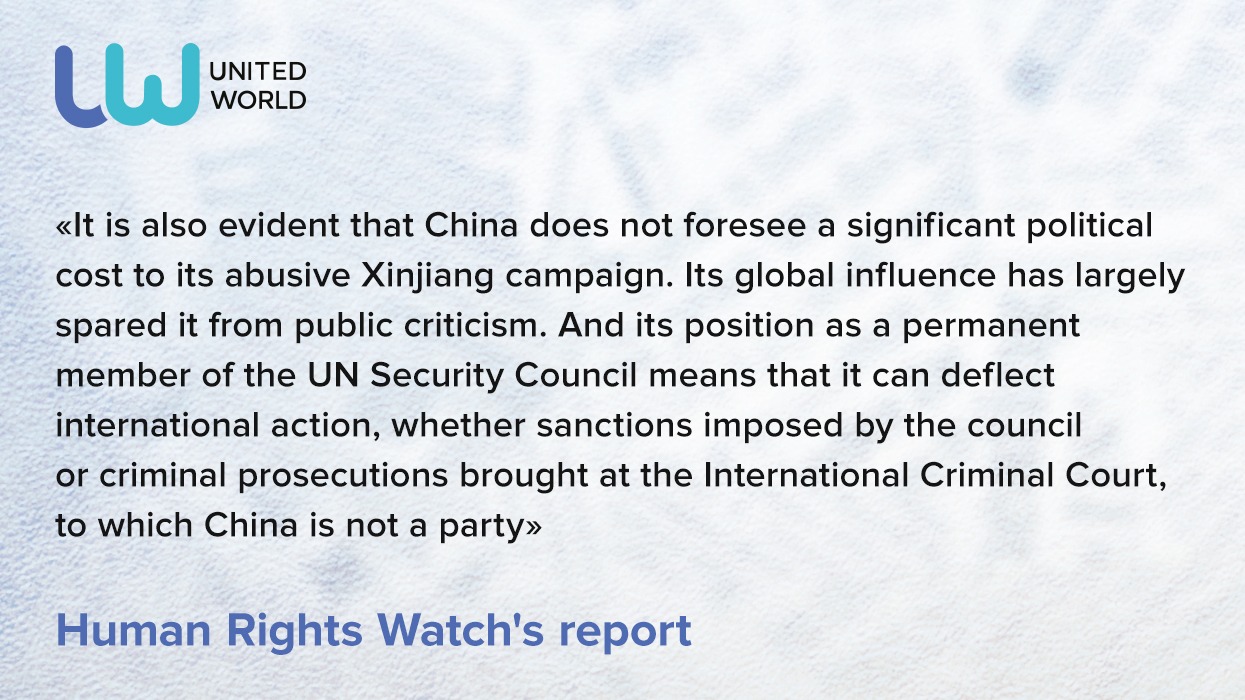
Human Rights Watch’s report of 9 September 2018 published a report entitled “Eradicating Ideological Viruses’, which describes the Chinese authorities’ policy on Uyghurs as a policy of destoying the and violating ‘fundamental rights to freedom of expression, religion, and privacy’, practicing  ‘torture and unfair trials’. HRW note that China’s policy is a violation of international law prohibiting discrimination.
The Human Rights Organization report recommends western governments impose sanctions against the secretary of the party, Chen Quango, and other high-ranking officials. “Party Secretary Chen Quanguo and other senior officials responsible for the Strike Hard Campaign should face targeted sanctions – through tools such as the US Global Magnitsky Act and visa protocols.”    The organization also concludes that in order to address the situation in Xinjiang, countries should tighten export control regimes to prevent the development of Chinese technology.
It is important to note that the materials devoted to the issue of the Uyghur population in China began to be actively published in Western media during the escalation of the ongoing trade war between China and the United States. Interestingly, Trump’s protectionist policy against the PRC was joined by globalist corporations and influence groups, which, unlike Trump, see China as a threat not only to the U.S. economy, but also to the liberal globalist doctrine. This has become particularly evident over the past two years as the relationship between Xi Jinping and Russian President Vladimir Putin grows closer, while Beijing’s “Belt and Road” initiative has increasingly shown China’s commitment to multipolarism.
It should be noted that, for China, the main goal in building education centers for the Uyghurs is to prevent the emergence of a domestic strain of radical Islam. China is in many ways an excellent breeding ground for the development of radical Islamic ideology,  which is useful for China’s enemies who want to weaken China by fermenting internal destabilization. According to Chinese authorities, the East Turkestan Islamic Movement in China is responsible for more than 200 terrorist attacks which have killed more than 160 people and injured more than 400.
In the absence of countermeasures such as education centres, radical Wahhabi ideas could easily spread among the Uyghur population, gradually creating a situation in China similar to the one which tore apart Syria.
With the trade war between the U.S. and China raging for more than a year, such a development would undoubtedly play into the hands of globalists opposed to China’s rising power and influence. New geopolitical strategies have emerged that pose a serious threat to globalism’s enemies without the need to resort to outright military conflict, such as using proxies to destabilize regions. It is no coincidence that Syria, a country that had no external debt before the war, became a target for terrorism.
What is really China’s policy?
Assimilation of the Uyghurs into Chinese society is gradually taking place on a large scale – for the majority of Uyghurs – Chinese has become a second or even first/native language. The Uyghurs have been granted privileges when it comes to entering universities and Chinese schools, as well as in starting up private businesses.
Uyghur children: “The population that is not there.”
One of the peculiarities of Xinjiang’s demographic picture is the conflict between China’s birth control measures (until the end of 2015/beginning of 2016, the “one family, one child” demographic law was in force, today it is the “one family, two children” demographic law) and Islamic tradition, especially in regard to polygamy which is practiced among Uyghurs and the simplicity of divorce measures, which also do not restrict women from remarriage and having more children.
This has resulted in a significant proportion of Xinjiang’s population not having official registration, i.e. citizenship, which naturally severely restricts their rights, access to education, medicine, legal earnings and travel both within and outside China. This environment of an illegal and unrecorded population deprived of legal status has become the basis for recruiting terrorists, Salafist jamaats and the spread of extremist ideology.
Possible solutions
To address the problem, the PRC needs to establish Confucian schools to integrate Uyghurs into PRC culture. In addition, an important step would be to establish Islamic education schools for the Uyghurs, where mullahs would teach the basics of Islam, which could be an important step in China’s fight against international terrorism.
The creation of Uighur integration centres into Chinese society in the Uyghur language could also be extremely effective. Such centres could be a cultural bridge to establishing a dialogue between two cultures with centuries-old histories.
It is crucial to counter Salafi and Wahhabi teachings with traditional Islam, and Sufism in particular. Chinese leadership has so far failed to significantly utilize this approach, despite that these traditional Islamic structures have already helped to stabilize some regions outside China, such as Turkey, Iraq, Syria and the Northern Caucasus in the Russian Federation.
Between Turkey and China
Turkey had heavily criticized China’s Uyghur policy until February 2019. In 2009, during the Uyghur riots in Urumqi in July, the Turkish government stated its disagreement with the Chinese authorities’ assessment of the situation: a member of the Justice and Development Party resigned from his post in the China-Turkey Interparliamentary Friendship Group, and the Minister of Industry and Trade called for a boycott on Chinese goods as a result.  After a series of protests in Ankara and Istanbul, Erdoğan himself condemned China’s policy towards the Uyghurs, calling it “genocide”. The situation was resolved some time later, but tensions between Turkey and China on the Uyghur issue remained until this year.
Interestingly, Turkey’s Kemalist faction, who are close to the Turkish military, have condemned the anti-Chinese position of the Turkish leadership for years. During a speech in Ürümqi (Xinjiang), Doğu Perinçek, the leader of the Vatan Partisi, argued that “the propaganda and lies aimed at China over the Xinjiang-Uyghur Autonomous Region target Turkey as well, because China’s friendship with Turkey is necessary to both our security and economy. Clearly conscious of this fact, we immediately took a decisive stance against the torrent of lies concerning the Xinjiang-Uyghur Autonomous Region.”
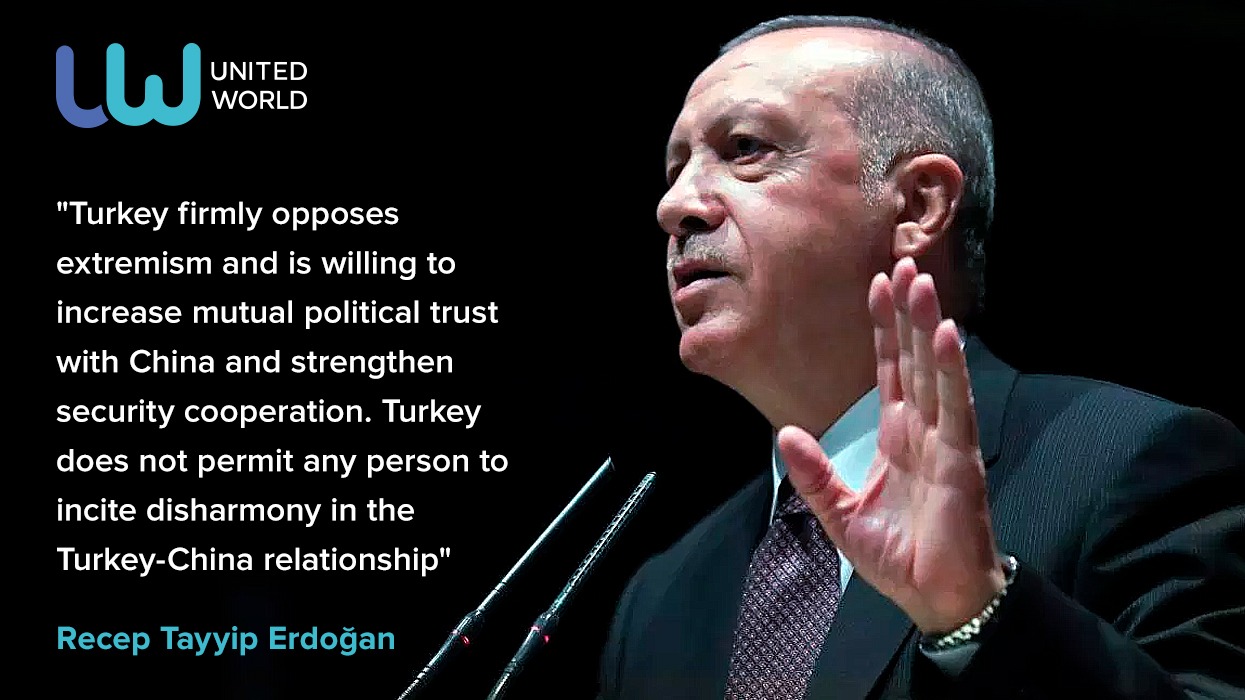
In July 2019, during his official visit to China, Erdogan admitted that the Uyghurs live happily in China.This was a radical change of position for the Muslim leader who had long criticized China’s policies. Erdogan, who is known for his support of some rather radical Islamic movements, in particular the Muslim Brotherhood, described Erdogan’s unexpected change of heart as a “betrayal.” However, only representatives of the Western media seemed to agree, as Erdoğan’s approval was quickly mirrored by other representatives of the Muslim world.
The globalist mass media has claimed that the reason Erdogan changed his position on the issue was predominantly economic.
In the period from 2013 to 2018, China invested 186.3 billion dollars in the framework of China’s Belt and Road Initiative (BRI). According to Morgan Stanley, Chinese investments in the BRI project will reach $1.3 billion by 2027. It is important to note that Turkey’s participation in the BRI is not only economic, but also ideological, as the country also increasingly orients itself toward a multipolar outlook.
Chinese political scientist Eric Li, in an article in Foreign Affairs, noted that the death of “globalism does not mean the end of globalization.” Today, China is developing and offering its partners a new vision of globalization – dialogue and partnership. This vision of globalization is devoid of the liberal dimension of a hegemon mediating between different cultures and states.
Turkey is moving away from its historic cooperation with the U.S., in part due to their support of Muhammed Fethullah Gülen’s anti government putsch three years ago. Turkey is joining the fight against globalism, a movement which is predominantly led by China. This reorientation is vividly demonstrated in Turkey’s deal with the Russian Federation to buy S-400 missile defense systems against Washington’s will. Die Welt called Ankara’s acquisition of the S-400s a de facto “refusal to support their allies in the West.” The publication notes that Turkey is currently reaching a “point of no return”, which may result in sanctions from the EU and the U.S., as well as the impossibility of purchasing F-35 fighter jets from the U.S. as planned.
Today, Turkey has the prospect to become a key player in the Chinese Belt and Road project, which has become the primary movement fighting globalist hegemony. Their participation could represent a significant step forward in the creation of a new, multipolar world.
*
Note to readers: please click the share buttons above or below. Forward this article to your email lists. Crosspost on your blog site, internet forums. etc.
All images in this article are from UWI

River to Sea Uprooted Palestinian   
The views expressed in this article are the sole responsibility of the author and do not necessarily reflect those of the Blog!