Showing posts with label Blackwater. Show all posts

Friday, 14 May 2021

Russia in the Middle East: From Arms to Mercenaries

BY ANTON MARDASOV

May 10, 2021

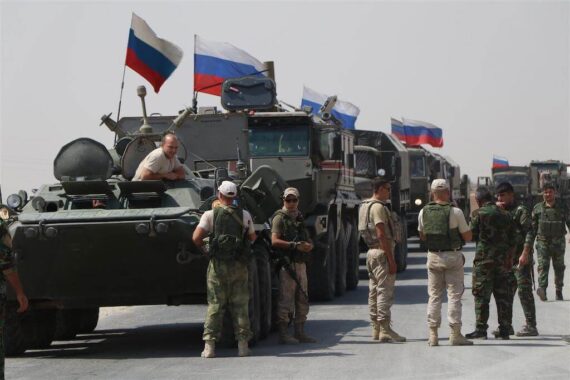
Russian military vehicles drive on the road as Russia makes a new military and logistic reinforcement of 30 vehicles to its military points in Kamisli, which is occupied by PKK terrorist organization on September 14, 2020. Photo by Samer Uveyd, Anadolu Images

The Kremlin’s successful “comeback” in the Middle East is explained by the fact that Moscow has become accustomed to appearing on the political scene only during crises, when conventional players seek a quick but often emotional resolution. Another obvious reason is the logic of the Russian authorities which have traditionally exploited different upheavals to gain greater political leverage inside the country.

In general, the Syrian war has enabled the Kremlin to make a quiet “comeback” in the Middle East. From the outset, Moscow managed to raise its contacts with key regional and extra-regional stakeholders to an unprecedented level, thus achieving a dialogue on an equal footing that had been sought by the Kremlin since the annexation of Crimea in 2014. Yet, many observers wonder whether Russia will be able to use these gains efficiently in the long term. This crucial question is still open-ended as the answer depends on the capabilities and consistent steps of the power vertical.

No arms sale windfall following the weapons tests in Syria

Experts in Moscow enjoy discussing how the war in Syria became a promotion campaign for Russia’s weaponry. The real-world evidence for this hypothesis, however, is somewhat scant. Despite Moscow testing a wide spectrum of weaponry and military hardware in Syria, this has not translated into an uptick of its military exports to the Middle East and Northern Africa, a region which occupies a special place for Russia to expand its military-technical cooperation with countries around the globe.

Taking into account that arms negotiations usually take two years to conclude, it was rather amusing to read various hot takes on the upsurge in Russia’s weapons sales only six months after the start of Moscow’s intervention in Syria.

VIDEO: Mercenaries Reborn: How Private Armies Violate Human Rights

Russia’s military exports demonstrated steady growth prior to 2013 but have been plateauing ever since. According to Russian President Vladimir Putin’s public statements, the volume of Russia’s military sales amounted to $15 billion in 2014, $14.5 billion in 2015, $15.3 billion in 2016, $15.3 billion in 2017, $16 billion in 2018, $13 billion in 2019 (the Defense Department puts the figure for this year at $15.2 billion), and around $13 billion in 2020.

In 2015-2020, Egypt, Algeria, and Iraq were the main importers of Russia’s weapons. All three countries began striking their bundle agreements (or negotiating over particular classes of weapons) with Russia before its intervention in the Syrian civil war.

The values of contracts might be subject to manipulation, so looking at the actual physical volume of deliveries could give us a more accurate picture. In 2015-2020, Egypt, Algeria, and Iraq were the main importers of Russia’s weapons. All three countries began striking their bundle agreements (or negotiating over particular classes of weapons) with Russia before its intervention in the Syrian civil war.

The exception to this rule includes some of the agreements between Russia and Saudi Arabia, Qatar, and the UAE. Those deals became media highlights due to the specifics of those countries’ relations with the U.S. But neither the sums of the contracts nor their assortment points at any sort of arms sale windfall.

Read: Orthodoxy and Russian Foreign Policy: A Story of Rise and Fall

With the Qatar blockade lifted, the hype around Middle Eastern countries racing to purchase Russian-made S-400 is subsiding. The interest in the Russian systems was fuelled by the Saudi-Qatari conflict and, more pertinently, by the S-400 radar’s ability to enable Doha to look deep into the neighboring Saudi territory. Another factor constraining sales of Russia’s weaponry is the U.S. sanction provisions contained in the Countering America’s Adversaries Through Sanctions Act (CAATSA) that was signed by Donald Trump in 2017.

The restrictions threw a wrench into Russia’s negotiations with Kuwait on the purchase of the T-90MS/MSK, which the Gulf country had already tested in 2014. As a result, Turkey’s purchase of Russian S-400 systems stands as Moscow’s only real breakthrough deal in the region since the start of the Syrian war.

Dialogue on equal footing

Russia’s policy towards the Middle East has a special characteristic which pro-Kremlin pundits like emphasizing. Moscow can simultaneously and to a large extent officially engage in talks with opposing parties, say, Israel and Iran, the U.S. and Hezbollah, Turkey and the PYD. Its neutral status that relies on multipolarity as a fairer way of dealing with other partners has helped Russia mount a “comeback” on the global stage and establish itself as an actor whose participation, as Putin stated back in 2003, was indispensable to tackling any global or regional problem.

Read: Biden-Putin Diplomacy: A Push-Me-Pull-You Game?

However, it would be a misconception to interpret such steps as Moscow’s desire to become a mediator or that it is interested in building a balanced architecture of regional security – it just seeks to present itself as a mentor.

Strategically speaking, Russia has pursued a “clinger” policy in recent years. Moscow has been trying importunately to interact with everyone in order to impose a “dialogue on an equal footing” on Washington, its principal rival.

The Kremlin seeks to bolster its position by playing the contradictions card and making the most of the lack of concordance among traditional allies; by gaining a firmer foothold in the countries at the apex of the crisis – Syria, Lebanon, Iraq; or by mediating the overdue policy to diversify political ties.

Read: Russia’s Changing Relationship with India: Arms Talk

Such tactics tend to be typical of non-state actors which do not have the means to secure themselves. The Kremlin has them in plentiful supply, both nuclear and non-nuclear ones. However, insufficient economic resources prevent Russians from winning unswerving loyalty – even that of their strategic allies, not to mention tactical ones.

Recipe for “success”

In the official propaganda, the emphasis is on exceptional strength which is devoid of significant economic power and which stems from the Soviet paradigm. The latter has defined the agenda promoted by the Kremlin and reinforced the familiar bugaboo of the external enemy against the image of upright state leadership.

Therefore, Putin, a politician who became a historic figure with the annexation of Crimea, could not simply put up with the sanctions imposed after 2014 or see Russia being compared to a besieged fortress. Although the image of the external enemy is indispensable to Russian officials’ speeches, it contradicts, first of all, the existing Western centrism of the Russian elite.

Read: Russian Expansionism under Vladimir Putin

Moreover, pretending to see a threat and moralizing are not tantamount to rule-setting on the world stage. After the Russian “comeback” in the Middle East, where it had to deal with numerous non-state and quasi-state actors, Moscow was forced to resort to parallel diplomacy given the inability of official departments to solve the foreign policy tasks assigned to them in an effective manner.

Hence, we have seen the involvement of the Chechen think tank (Kadyrov’s Muslim team) in the negotiations, the deployment of Prigozhin’s mercenaries to fulfill military tasks, and the engagement of military intelligence to get rid of undesirables. Naturally, special forces should coordinate such activities rather than the Foreign Ministry.

Formally, the Russian Foreign Affairs and Defense Ministries work very close and in tandem. Nevertheless, it has been clear since 2017 that security officials, and military and intelligence agencies, sidelined diplomats in the Syrian and later in the Libyan cases. Still, the key players were only too glad to let Moscow call the shots in Syria as Russia would have to shoulder the burden of the crisis settlement and the responsibility for the survival of Assad’s ossified regime.


River to Sea Uprooted Palestinian   
The views expressed in this article are the sole responsibility of the author and do not necessarily reflect those of the Blog!

Tuesday, 19 January 2021

SADAT: Blackwater… with a Turkish-Islamic Flavor!

 ARABI SOURI 

Turkish SADAT Mercenary and security company - Erdogan

The following is the English translation from Arabic of the latest article by Turkish career journalist Husni Mahali he published in the Lebanese Al-Mayadeen news site Al-Mayadeen Net:

All the opposition’s questions and inquiries remain unanswered as long as the ambiguity hangs over the entire activity and activities of the “SADAT” company.

Turkey has been witnessing for days, far from the interests of the global media, an exciting debate related to the defense philosophy that President Recep Tayyip Erdogan believes in, at least according to the opposition’s perception. The International Defense and Consulting Services Company, SADAT, announced a few days ago, on its official website: “Organizing special courses in the field of assassinations, bombings, raids, ambushes, and special operations.” This was preceded by a webinar in which some thinkers from Islamic countries participated, during which they discussed “the necessity for Islamic countries to have a joint force in order to rise to the level of superpowers in defending themselves.”

The discussion gained additional importance, because the founder and chairman of the company, Adnan Tanri Wardi, was until January of last year a personal advisor to President Erdogan, as well as a member of the Supreme Commission for Defense and Foreign Policy Affairs in the Republican Palace.

Before getting acquainted with the nature of this company and its various activities, it is necessary to introduce the man and his interesting personality, as he was the commander of the special units in the Chief of Staff before he was expelled from the army in 1996 because of his religious activities, and he was also, a friend of Erdogan, a lecturer at the War College about war gangs when the latter (Erdogan) was mayor of Istanbul in 1994, and the current defense minister, Hulusi Akar, was one of his students.

Retired General Tanry Wardi established his company, “SADAT” on February 28, 2012, after being acquainted with the activities of private American security companies, the most important of which was “Blackwater”, in Iraq, Afghanistan and Yemen, and before that, Africa and Latin America.

Turkish newspapers published more information about the activity of this company, but without any official response to these allegations and the inquiries and questions of members of parliament by the opposition parties, including Unal Cevikoz from the Republican people, and Aton Geray about the “Good Party”, who called on the government to reveal the secrets of the company’s activities and secrets inside Turkey, and in Syria, Libya and other places. The company announced after its founding in 2012 that among its goals is “to provide security services to the armies and security forces in countries friendly to Turkey.”

The head of the “Good Party”, Maral Akshanar, spoke about the secret training camps of the aforementioned company near the cities of Konya and Tokat in central Anatolia, “and appealed to President Erdogan” to reveal the reasons, objectives and activities of these camps. ” The press information talked more than once about the company’s officers training the various Syrian factions in guerrilla warfare and the various arts of war and fighting since its establishment, especially after the failure of the CIA project to train the militants of the moderate Syrian factions in camps for Turkey in the year 2013-2014.

Spokesmen for the opposition parties accused the company of secretly transferring weapons and combat equipment to the aforementioned factions, after they obtained them from various countries, including Serbia and Ukraine. Journalist Mehmet Ali Gular said in the Cumhuriyet newspaper that Adnan Tanri Wardi persuaded President Erdogan during Sochi’s discussions with President Putin in September 2018 to establish Turkish military observation points in the vicinity of Idlib, despite the objection of the military leadership.

Adnan Tanri Wardi rose to prominence after the failed coup attempt on July 15, 2016, after President Erdogan appointed him as his personal advisor, and it was said that he plays a major role in rearranging the affairs of the military establishment, after Erdogan canceled, by presidential decree, all military colleges and schools to replace them with The National Defense University which is headed now by a professor of Ottoman history close to him, and civilians close to Erdogan head the military colleges of the aforementioned university, which is joined according to criteria that will contribute in the medium and long term to the “Islamization of the military establishment.”

During the past period, opposition newspapers published a lot of news and articles about the company’s activities and the activities of its owner, who was said to have had a direct role in training members of the armed factions in Libya since 2013. He also played an important role in transporting Syrian mercenaries to Libya and supervising their movements there, which is the case also in Karabakh.

Member of Parliament for the Republican People Party, Unal Cevikoz, referred to the confessions of President Erdogan, who last year spoke about “sending various groups to fight in Libya,” and asked: “What are these various groups? What is the aforementioned company’s relationship with it? What is the number of its members? How much the Turkish state pays it? What are its special tasks in Libya or Syria or anywhere else if it exists?

This may explain the call of Aula Jalbka and Andre Hahn, members of parliament for the left party of the German government, to “follow up the activities of the mentioned company and its relations with the Turkish community and Islamic mosques in Germany,” and French President Macron did not hide his concern “about the Turkish secret activity among the Muslim communities in his country and in Europe in general. “

The sudden change in the internal system of the armed forces came at the end of last month, as the intelligence and internal security forces would be able to use whatever they want from the army’s weapons, to increase the suspicions of the opposition, which accused President Erdogan in the past of “working to form armed militias loyal to him directly to be used in emergency situations,” without the opposition parties and forces being able to confront Erdogan’s projects and plans as long as he controls the majority in parliament and controls all state facilities and apparatus, the most important of which are the army, intelligence, security, money, and the judiciary, and 95% of the state and private media.

Erdogan seeks to silence his opponents through financial fines imposed by government authorities on opposition newspapers, while the Supreme Council of Radio and Television decides to close television stations or impose heavy financial fines on them, under the pretext that they broadcast news that contradicts “the national interests of the nation and the Turkish state,” which means objection to his policies.

All of this explains President Erdogan’s attack on the leaders of the opposition parties and all those who oppose him, accusing them all of “terrorism, national treason, and espionage.” In turn, the security and judiciary will prosecute anyone who objects to this statement and charge him with insulting the President of the Republic, which carries a sentence of between one and three years in prison.

The opposition says that what the Turkish president aims to do is prevent his opponents on the right and left from talking about the secrets of Turkish activities, official and unofficial, in the military, security, and intelligence sectors abroad, especially in Syria, Libya, Iraq, Somalia, and in its neighboring countries, and now in Azerbaijan and Ukraine.

All the opposition’s questions and inquiries remain unanswered as long as the ambiguity hangs completely over the work and activities of the “SADAT” company. “There is no difference between it and the notorious American” Blackwater “company in Iraq and other Arab and African countries, said Ozkur Ozal, a spokesman for the CHP.

Aiton Girai, a member of parliament for the “Good Party”, expressed “his concern about the activities of the aforementioned secret company in Libya,” saying that it is there to achieve balance with the Russian “Wagner” company that supports General Haftar’s forces.

In all cases, and with the continued ambiguity that hangs over the activities of the aforementioned company, everyone knows that it has a very important role in serving the goals, plans, and projects of the Turkish President, both internally and externally, without anyone being able to go into the details, as long as the issue is related to the national security of Turkey, which only Erdogan defines its concepts and standards!

To help us continue please visit the Donate page to donate or learn how you can help us with no cost on you.
Follow us on Telegram: http://t.me/syupdates link will open Telegram app.


“بلاك ووتر”.. بنكهة تركيّة إسلاميّة!

حسني محلي

حسني محلي
المصدر: الميادين نت
18 كانون الثاني 15:48

تبقى جميع أسئلة المعارضة واستفساراتها من دون جواب، ما دام الغموض يخيم بالكامل على نشاط شركة سادات وفعالياتها.

قام الجنرال المتقاعد تانري واردي بتأسيس شركته

تشهد تركيا منذ أيام، وبعيداً من اهتمامات الإعلام العالمي، نقاشاً مثيراً له علاقة بفلسفة الدفاع التي يؤمن بها الرئيس رجب طيب إردوغان، على الأقل بحسب تصوّر المعارضة، فقد أعلنت الشركة الدولية للدفاع والخدمات الاستشارية “سادات” قبل أيام، عبر موقعها الرسمي على الإنترنت، “عن تنظيم دورات خاصة في مجال الاغتيالات والتفجيرات والمداهمات والكمائن والعمليات الخاصة”. وسبق ذلك ندوة عبر الإنترنت شارك فيها بعض المفكّرين من دول إسلامية، تم خلالها مناقشة “ضرورة أن يكون للدول الاسلامية قوة مشتركة حتى ترتقي إلى مستوى الدول العظمى في الدفاع عن نفسها”. 

واكتسب النقاش أهميّة إضافيّة، لأنّ مؤسّس الشركة ورئيس مجلس إدارتها، عدنان تانري واردي، كان حتى كانون الثاني/يناير من العام الماضي مستشاراً شخصياً للرئيس إردوغان، كما كان عضواً في الهيئة العليا لشؤون الدفاع والسياسة الخارجية في القصر الجمهوري.

وقبل الاطّلاع على ماهية هذه الشّركة وأنشطتها المختلفة، لا بدَّ من التعريف بالرجل وبشخصيّته المثيرة، فقد كان قائداً للوحدات الخاصة في رئاسة الأركان قبل أن يطرد من الجيش في العام 1996 بسبب أنشطته الدينيّة، وكان أيضاً، وهو صديق لإردوغان، محاضراً في الكلية الحربية حول حرب العصابات عندما كان الأخير رئيساً لبلدية إسطنبول في العام 1994، وكان وزير الدفاع الحالي خلوصي أكار من تلامذته. 

وقد قام الجنرال المتقاعد تانري واردي بتأسيس شركته “سادات” في 28 شباط/فبراير 2012، بعد أن اطلع على نشاط الشركات الأمنية الأميركية الخاصة، وأهمها “بلاك ووتر”، في العراق وأفغانستان واليمن، وقبلها أفريقيا وأميركا اللاتينية. 

ونشرت الصحف التركية المزيد من المعلومات عن نشاط هذه الشركة، ولكن من دون أن يرد أي مسؤول رسمي على هذه الادعاءات وعلى استفسارات وأسئلة أعضاء البرلمان عن أحزاب المعارضة، ومنهم آونال جاويكوز عن الشعب الجمهوري، وآيتون جيراي عن الحزب “الجيد”، اللذان ناشدا الحكومة للكشف عن خفايا أنشطة الشركة وأسرارها داخل تركيا، وفي سوريا وليبيا وأماكن أخرى. وقد أعلنت الشركة بعد تأسيسها في العام 2012 أنَّ من بين أهدافها “تقديم خدمات أمنية لجيوش وقوى الأمن في الدول الصديقة لتركيا”.

وتحدَّثت رئيسة الحزب “الجيد” مارال أكشانار “عن مخيمات تدريب سرية تابعة للشركة المذكورة قرب مدينتي قونيا وتوكات وسط الأناضول”، وناشدت الرئيس إردوغان “للكشف عن أسباب هذه المخيمات وأهدافها وفعالياتها”. وتحدّثت المعلومات الصّحافية أكثر من مرة عن قيام ضباط الشركة بتدريب عناصر الفصائل السورية المختلفة على حرب العصابات ومختلف فنون الحرب والقتال منذ تأسيسها، وخصوصاً بعد فشل مشروع المخابرات الأميركية في تدريب مسلحي الفصائل السورية المعتدلة في مخيمات خاصة بتركيا في العام 2013-2014. 

واتهم المتحدثون باسم أحزاب المعارضة الشركة بنقل الأسلحة والمعدات القتالية سراً إلى الفصائل المذكورة، بعد أن حصلت عليها من دول مختلفة، ومنها صربيا وأوكرانيا. وقال الصحافي محمد علي جوللار في صحيفة “جمهوريات” إن عدنان تانري واردي هو الذي أقنع الرئيس إردوغان خلال مناقشات سوتشي مع الرئيس بوتين في أيلول/سبتمبر 2018، بإنشاء نقاط المراقبة العسكرية التركية في جوار إدلب، على الرغم من اعتراض القيادات العسكرية على ذلك. 

وسطع نجم عدنان تانري واردي بعد محاولة الانقلاب الفاشلة في 15 تموز/يوليو 2016، بعد أن عيَّنه الرئيس إردوغان مستشاراً شخصياً له، وقيل إنّه يؤدي دوراً رئيسياً في إعادة ترتيب أمور المؤسسة العسكرية، بعد أن ألغى إردوغان بمرسوم رئاسي كل الكليات والمدارس العسكرية، لتحلّ محلها جامعة الدفاع الوطني، ويترأسها الآن بروفيسور في التاريخ العثماني مقرب منه، كما يترأس مدنيون مقربون منه الكليات العسكرية التابعة للجامعة المذكورة التي يتم الانضمام إليها وفق معايير ستساهم على المدى المتوسط والبعيد في “أسلمة المؤسسة العسكرية”. 

ونشرت صحف المعارضة خلال الفترة الماضية الكثير من الأخبار والمقالات عن نشاط الشركة وفعاليات صاحبها، الذي قيل إنّ له دوراً مباشراً في تدريب عناصر الفصائل المسلحة في ليبيا منذ العام 2013. كما أدى دوراً مهماً في نقل المرتزقة السوريين إلى ليبيا والإشراف على تحركاتهم فيها، وهو الحال أيضاً في كاراباخ. 

وأشار عضو البرلمان عن الشعب الجمهوري آونال جاويكوز إلى اعترافات الرئيس إردوغان الذي تحدث العام الماضي عن “إرسال مجموعات متنوعة للقتال في ليبيا”، وتساءل: “يا ترى، ما هي هذه المجموعات المتنوعة؟ وما علاقة الشركة المذكورة بها؟ وما هو عدد عناصرها؟ وكم تدفع الدولة التركية لها؟ وما هي مهماتها الخاصة في ليبيا أو سوريا أو أي مكان آخر إن كان موجوداً؟”.

وقد يفسر ذلك دعوة كلّ من آوللا جالبكا وأندريه هان، عضوي البرلمان عن حزب اليسار الحكومة الألمانية، “لمتابعة نشاط الشركة المذكورة وعلاقاتها بالجالية التركية والجوامع الإسلامية الموجودة في ألمانيا”، كما لم يخفِ الرئيس الفرنسي ماكرون قلقه “من النشاط السري التركي بين الجاليات الإسلامية في بلاده وأوروبا عموماً”.

وجاء التغيير المفاجئ في النظام الداخلي للقوات المسلّحة نهاية الشهر الماضي، إذ سيتسنى للمخابرات وقوى الأمن الداخلي استخدام ما تشاء من أسلحة الجيش، ليزيد من شكوك المعارضة التي اتهمت الرئيس إردوغان سابقاً “بالعمل على تشكيل ميليشيات مسلحة موالية له مباشرة لاستخدامها في الحالات الطارئة”، من دون أن يتسنى لأحزاب وقوى المعارضة أن تتصدى لمشاريع إردوغان ومخططاته ما دام يملك الأغلبية في البرلمان ويسيطر على جميع مرافق الدولة وأجهزتها، وأهمها الجيش والمخابرات والأمن والمال والقضاء، و95% من وسائل الإعلام الحكومي والخاصّ.

ويسعى إردوغان لإسكات معارضيه من خلال الغرامات المالية التي تفرضها السلطات الحكومية على صحف المعارضة، في الوقت الذي يقرر المجلس الأعلى للإذاعة والتلفزيون إغلاق محطات التلفزيون أو فرض غرامات مالية كبيرة عليها، بحجة أنها تبث أخباراً تتناقض مع “المصالح الوطنية والقومية للأمة والدولة التركية”، وهو ما يعني الاعتراض على سياساته.

 ويفسر كل ذلك هجوم الرئيس إردوغان على قيادات أحزاب المعارضة وكل من يعارضه، واتهامهم جميعاً “بالإرهاب والخيانة الوطنية والعمالة والتجسس”. بدوره، يلاحق الأمن والقضاء كل من يعترض على هذا الكلام، ويوجه له تهمة الإساءة إلى رئيس الجمهورية، التي تتراوح عقوبتها بين عام و3 أعوام في السجن.

وتقول المعارضة إن ما يهدف إليه الرئيس التركي هو منع معارضيه في اليمين واليسار من الحديث عن أسرار الأنشطة التركية، الرسمية منها وغير الرسمية، عسكرياً وأمنياً واستخباراتياً في الخارج، وبشكل خاص في سوريا وليبيا والعراق والصومال والدول المجاورة لها، والآن في أذربيجان وأوكرانيا. 

وتبقى جميع أسئلة المعارضة واستفساراتها من دون جواب، ما دام الغموض يخيم بالكامل على نشاط شركة “سادات” وفعالياتها. وقد قال آوزكور آوزال، المتحدث باسم حزب الشعب الجمهوري، “أن لا فرق بينها وبين شركة “بلاك ووتر” الأميركية السيئة الصيت في العراق ودول عربية وأفريقية أخرى”.

وعبّر آيتون جيراي، عضو البرلمان عن الحزب “الجيد”، “عن قلقه من فعاليات الشركة المذكورة السرية في ليبيا”، وقال عنها “إنها تتواجد هناك لتحقيق التوازن مع شركة “واغنر” الروسية التي تدعم قوات الجنرال حفتر”.

وفي جميع الحالات، ومع استمرار الغموض الذي يخيم على فعاليات الشركة المذكورة، يعرف الجميع أنَّ لها دوراً مهماً جداً في خدمة أهداف الرئيس التركي ومخططاته ومشاريعه على الصعيدين الداخلي والخارجي، من دون أن يتسنى لأحد الدخول في التفاصيل، ما دام الموضوع له علاقة بالأمن الوطني والقومي لتركيا، ولا يحدد أحد مفاهيمه ومعاييره إلا  إردوغان وحده!


River to Sea Uprooted Palestinian   
The views expressed in this article are the sole responsibility of the author and do not necessarily reflect those of the Blog!

Wednesday, 6 January 2021

A Pardoning Time of Year

 By Philip Giraldi

Source

Will the president do the right thing?
Julian Assange Pardon 89b36

The resistance to the apparent election of Joe Biden as President of the United States is continuing to play out. Current President Donald Trump is continuing to fight against the presumed results of the November national election with his final card appearing to be a vote in Congress when it reconvenes on January 6th to throw out the results due to fraud in certain key states. Many have noted how the registration and electoral processes in the United States, varying as they do from state to state, were and are vulnerable to fraud. That, plus some eyewitness testimony and technical analysis, suggests that possibly systematic fraud did take place but it is far from clear whether it was decisive. This is particularly true of the vote by mail option, which was promoted by leading Democrats and which empowered literally millions of new voters with only limited attempts made to validate whether citizens or even real people were voting.

Vote by mail is now one of several options that are appearing to be weaponized by the cash-rich Democrats in the state of Georgia, where two Senate races will be up for grabs in runoff elections on January 5th. If the Democrats obtain both, they will control the Senate through the Vice President’s role in presiding over the upper chamber where she has the tie breaking vote. That will mean that we the voters can expect some dramatic changes as the Democrats respond to their various constituencies with their well enunciated grievances.

In what may be its last weeks in office, the Trump Administration is also exploiting its executive power to pardon to reverse perceived injustices and to protect remaining allies, to include some family members. Trump is already on track to pardon more individuals than any preceding president with 90 pardons issued as of Christmas Eve and many more expected. One of his initial pardons was a notable example of a miscarriage of justice in the case of presidential national security advisor designate Michael Flynn, who was wrongly accused of collaborating with Russia. If anything, he was actually cooperating with a request that came from Israel, which Congress and the media apparently do not regard as wrongdoing.

Trump’s pardon of his daughter Ivanka’s father-in-law Charles Kushner is particularly controversial, as Kushner was a multimillionaire real estate developer and a leading Democratic Party donor when he was convicted in 2005 to two years in federal prison after he pleaded guilty to 18 counts, which included both tax evasion and making illegal campaign contributions. The tale of Charles Kushner is particularly unsavory because he reportedly sought revenge after he learned that his brother-in-law and former business partner was aiding federal authorities. Charles hired a prostitute to seduce his brother-in-law in a New Jersey motel room, making a recording of the encounter using a hidden camera that he then showed to his brother-in-law’s wife, who was, of course, Kushner’s own sister.

Kushner’s prosecution was directed by then-U.S. Attorney Chris Christie, who afterwards became a prominent Trump supporter and head of his transition team before being fired in 2016, apparently per orders originating with Jared Kushner. In a 2019 interview Christie explained “Mr. Kushner pled guilty. He admitted the crimes. And so what am I supposed to do as a prosecutor? I mean, if a guy hires a prostitute to seduce his brother-in-law, and videotapes it, and then sends the videotape to his sister to attempt to intimidate her from testifying before a grand jury, do I really need any more justification than that? I mean, it’s one of the most loathsome, disgusting crimes that I prosecuted. And I was U.S. attorney in New Jersey, so we had some loathsome and disgusting crime going on there.”

Charles Kushner is also a close friend and supporter of Israeli Prime Minister Benjamin Netanyahu, which might also be relevant to his pardon and I will leave any assessment of the ethics of the Kushner clan up to the reader. Nevertheless, the consequence of Jared’s ability to influence the president could be politically damaging as he reportedly has been responsible for many of the pardons that have already taken place and is now the conduit for new petitioners.

Another highly criticized Trump pardon has involved the four Blackwater mercenaries who massacred 19 Iraqis including 2 children firing from a helicopter into a crowded Nisour Square Baghdad in 2007. The president is reportedly very friendly with Blackwater founder and former president Erik Prince, whose sister Betsy DeVos is Education Secretary and also close to the president. But in any event Trump’s pardon record is different only in terms of magnitude from those of some of his predecessors as there have been some highly questionable pardons in the past, to include Marc Rich under Bill Clinton and Elliot Abrams under George W. Bush.

There remains a long list of possible candidates for Trump to sign off on, to include a possible self-pardon, and more pardons for family members Ivanka, Jared and two of his sons as well as his lawyer Rudy Giuliani. Other current and impending pardon recipients have been individuals who were involved in the Trump campaigns, to include Paul Manafort and Roger Stone. Pardons are a particularly attractive pre-emptive option currently as a number of leading Democrats have been calling for “truth commissions” and other forms of punishment of Trump supporters and officials.

The process of issuing presidential pardons will undoubtedly continue up until Inauguration Day on January 20th, but sources are uncertain whether Trump will be courageous enough to pardon the two individuals whose freedom would most definitely be sending a powerful message for integrity in government. They are Julian Assange and Edward Snowden. Both men’s names have been coming up frequently in the alternative media, together with the development of active lobbying groups that are seeking their freedom.

Assange, a journalist and founder of WikiLeaks, is currently languishing in a British prison, where he has been for twenty-one months, awaiting a decision on whether he will be extradited to the United States or not which will reportedly be decided on January 4th. The Department of Justice has claimed that he violated the Espionage Act of 1917 by receiving classified information from Chelsea Manning. Reportedly, Assange’s mental and physical health have deteriorated sharply as he is being held in solitary confinement with only short periods of exercise and without access to reading or writing material to occupy his time. The British judge appears to be completely unsympathetic to Assange and it is generally believed that she will order his extradition if he does not fortuitously die in prison before that could take place.

Snowden, meanwhile, is living in Russia and has been granted citizenship, a country to which he fled by way of Hong Kong in 2013, after revealing to journalists details of a vast and illegal surveillance program run by the National Security Agency (NSA) against American citizens, something he discovered while he was employed as a NSA contractor. He had attempted to raise his concerns with supervisors but was rebuffed and he eventually became a self-declared whistleblower and fled the country. He has repeatedly offered to return to the United States to face trial, but has also insisted that a fair hearing would be impossible under the current circumstances.

It should be observed that Snowden is absolutely correct to assume that he would be convicted both on grounds of espionage and of compromise of classified information. The federal court in Alexandria, where national security cases are usually tried, always finds for the government even if evidence is questionable or even non-existent. A recent conviction involved ex-CIA officer Jeffrey Sterling, who was sent to prison for 42 months even though it could not be demonstrated that he had actually done anything. The court concluded that “it had to be him.”

To be sure, revealing classified information is a serious matter, even though many former government employees would agree that much material that is classified does not actually damage national security if it is revealed. Frequently, classification is used to keep the government from being embarrassed or to shut down any revelation that it has acted illegally. Both Assange and Snowden would argue that they had acted appropriately in revealing war crimes, illegal acts and even violations of the Constitution as consequences of the so-called “global war on terror.” Assange, who regards himself as a journalist, published details of the Blackwater massacre of civilians committed by the crew of a helicopter gunship in Iraq and also was involved in the exposure of the Hillary Clinton emails. Snowden, as noted above, claims to be a whistle-blower and has sought protection under relevant laws in the United States, so far to no avail.

The illegal and otherwise unconscionable acts by various elements in the U.S. government that were exposed by Assange and Snowden include war crimes, so they are not trivial. Trump, having already done a “favor” to Blackwater, might be disinclined to pardon someone who exposed its mercenaries’ crimes. But there is nevertheless, as is often the case, an interesting aspect to the story that is worth paying attention to. Trump, as is widely conceded even by some Democrats, was targeted by the Deep State even before he was nominated, an effort to destroy his presidency that persisted for years through the completely contrived mechanism of Russiagate. Given that, it would behoove Trump to strike back in his waning days in office. Both Assange and Snowden exposed illegal activities and cover-ups by the Deep State, almost certainly to include the active participation of some of the very people who have sought to bring the president down. And they both may have more to say. If Donald Trump seriously seeks to strike a blow against his enemies, it would be both fitting and just to pardon both men on that basis alone. Let us hope that President Trump has both the wisdom and fortitude to take that step in his last days in office.


River to Sea Uprooted Palestinian   
The views expressed in this article are the sole responsibility of the author and do not necessarily reflect those of the Blog!

Friday, 11 September 2020

U.S. exploited 9/11 attacks to occupy Iraq and Afghanistan: Iraqi expert

By Saeed Kh. Mavedat

September 10, 2020 – 17:54

TEHRAN – The U.S. plans to invade Iraq and Afghanistan gained stream immediately after the September 11, 2001 attacks on civilian and military targets in the United States. An Iraqi expert tells the Tehran Times that the Americans “exploited” the attacks to occupy Iraq and Afghanistan.

The attacks, carried out by al-Qaeda, killed almost 3,000 American and foreign citizens and sent shock waves across the world. In the wake of the attacks, the U.S. administration sought to pave the way for a military response to al-Qaeda and those allegedly supporting it.

Addressing the American people on the same day at 9 pm, then-President George W. Bush said, “We will make no distinction between the terrorists who committed these acts and those who harbor them.”

Only a week after the 9/11 attacks, Congress passed a special law allowing President Bush to punish the people who had aided or abetted the 9/11 attackers. The law, which was passed on September 18, 2001, stipulates “that  the  President  is  authorized  to  use  all necessary  and  appropriate  force  against  those  nations,  organizations,  or  persons  he  determines  planned,  authorized,  committed, or  aided  the  terrorist  attacks  that  occurred  on  September  11,  2001, or  harbored  such  organizations  or  persons,  in  order  to  prevent any future acts of international terrorism against the United States by such nations, organizations or persons.”

A few weeks later, the U.S. led a coalition to overthrow the Taliban regime in Afghanistan, and two years later, the U.S. invaded Iraq under the pretext of countering terrorism.

Nearly two decades after the 9 /11 attacks, the U.S. is still bogged down in “endless wars” in the region, which yielded no results in terms of combating terrorism, according to Reza Alghurabi, an Iraqi expert who closely monitors the situation in Iraq and Iran.

In order to assess one of the U.S. post-9/11 wars in the region, the Tehran Times interviewed Alghurabi. He weighed in on the situation in Iraq in the aftermath of the U.S. invasion of the country. He also touched on the U.S.-Iran relations in Iraq since 2003.
The following is the full text of the interview:

Q: In the aftermath of the 9/11 attacks, the issue of “counterterrorism” became prominent in U.S. foreign policy and eventually, it became one of the reasons for the occupation of Iraq and Afghanistan. Do you think the United States really wanted to fight terrorism in Iraq? And if so, how successful was it? How do you assess the U.S. presence in Iraq in terms of the fight against terrorism since 2003?

A: In addition to leading to the emergence of the U.S. counterterrorism agenda and the introduction of new concepts in the field of terrorism and international law, the 9/11 attacks led to one of the largest U.S. military campaigns and military interventions in recent decades in the ever sensitive region of West Asia.
Regardless of any assessment of the truth of 9/11, Washington’s subsequent exploitation of it shows that the Americans behaved in a completely political and abusive manner that led to the occupation of Afghanistan and Iraq.

It was clear at the time that the terrorists were mostly Saudi nationals, and that if the United States was to be honest in its counterterrorism plan, it would have had to deal with the source of religious extremism in the region, which is the Saudi regime and some other countries whose religious muftis kept playing role in the death of thousands of people and the spread of extremism and violence by issuing hundreds of fatwas [religious decrees] and sending financial aid through charities after the occupation of Iraq.

Despite spending billions of dollars on the counterterrorism project since 2001, Washington has failed to fight terrorism, and the growing spread of extremism, violence, and terrorism in recent years in areas where the Americans themselves have been present was not only a sign of Washington’s failure to fight terrorism, but it also raised serious doubts about its direct role in the spread of terrorism and violence.

Iraq is clearly still grappling with terrorism 17 years after [the American occupation], and from 2003 to 2011, when U.S. troops were officially present in Iraq, violence was widespread in the country and the United States failed to contain it.

Q: How many human rights violations did the United States commit in the years following the occupation of Iraq? In terms of human rights violations, can Abu Ghraib prison be compared to Guantanamo?

A: While the U.S. was present in Iraq as an occupying force, numerous reports were published by Western and American think tanks on individual and organized ill-treatment of prisoners. Some of the initial information was released by U.S. troops themselves. Various forms of torture of prisoners, such as waterboarding in the United States itself, sparked controversy in the U.S. Congress.

U.S. human rights abuses were not limited to detainees. There were also numerous reports of civilians being harassed during house searches or checkpoints and street raids by soldiers and mercenaries of private security companies such as Blackwater. In this respect, there was no difference between Abu Ghraib and Guantanamo. Perhaps Abu Ghraib can be considered a worse case than Guantanamo because in this prison even young Iraqi girls were sexually tortured by the American military.

Q: How do you assess Iran-U.S. relations in Iraq after 2003? It is said that Iran had reached understandings with the United States during the occupation of Afghanistan and Iraq, but why did the United States turn these understandings into hostility and include Iran in the “axis of evil”?

A: Iran-U.S. relations have always been tense for the last four decades. After 9/11, the Americans took a more hostile stance against the Iranians. The use of the term “axis of evil” in reference to Iran by George W. Bush in 2002 indicated the adoption of an escalatory strategy against Iran. With the occupation of Iraq by the U.S., this country became the scene of confrontation between Tehran and Washington. Iran was concerned and dissatisfied with the full U.S. military presence in Iraq and the repeated threats by White House officials about the need for regime change in Iran. The Americans in Iraq were also reluctant to vacate the battlefield for Tehran. Therefore, Iraq has since become the scene of confrontation between the two axes.

The U.S. is a longtime enemy of Iran and the prospect of its troops being deployed along Iran’s borders as well as [U.S.] provocative actions were a source of potential and tense hostility that threatened any possible understanding.

RELATED NEWS


River to Sea Uprooted Palestinian   
The views expressed in this article are the sole responsibility of the author and do not necessarily reflect those of the Blog!

Wednesday, 10 June 2020

لن نسمح لقيصر واشنطن تهديد سوريا


على وقع احتدام الصراع الأميركي الروسي على امتداد حزام شرق المتوسط من بحر اللاذقية حتى جبل طارق قام الرئيس الروسي فلاديمير بوتين بإجراء مكالمة مطولة مع الرئيس المصري عبدالفتاح السيسي قبل أيام تطرق فيها الى الملف الليبي بشكل تفصيلي، لكنه تطرق أيضاً بالإجمال الى ما تعدّه واشنطن لكل من إيران وسورية ولبنان!
مصادر متابعة للسياسة الروسيّة وكذلك لما يجري في مطبخ صناعة القرار في حلف المقاومة اطلعت على أجواء تلك المكالمة فأوجزت لنا بخصوص الجزء المتعلق بإيران وسورية ولبنان، في المكالمة الهاتفية المذكورة أعلاه، بما يلي:
أولا: إن خطة العمليات التكتيكية الأميركية، التي يجري العمل على تنفيذها حالياً، خدمةً للهدف الأميركي الاستراتيجي، أوالمتمثل في إخراج روسيا من الشرق الاوسط، تهدف قبل كل شيء، الى زيادة الضغط وبكل الوسائل الممكنة على طهران، من مالية واقتصادية وعسكرية، عبر جماعات مسلحة، مرتبطة بأجهزة مخابرات لدول تابعة للولايات المتحدة، مجاورة لإيران، بهدف إيصال القيادة الإيرانية إلى أن لا طريق للخروج من المأزق سوى الخضوع للشروط الأميركية وتحجيم علاقاتها مع الصين وروسيا ووقف دورها «التوسّعي» في الشرق الاوسط، حسب التعبيرات الأميركية. وأضاف الرئيس الروسي انه لا يستبعد حدوث عمل استفزازي أكبر من ذلك بهدف رفع مستوى التصعيد، بين واشنطن وطهران.
ثانيا: وكذلك الأمر في سورية، فالهدف هو مواصلة الضغط المالي والاقتصادي، عبر تطبيق قانون قيصر، لحرمان الدولة السورية من حاضنتها الجماهيرية وخلق حالة من اليأس تدفع هذه الحاضنة الشعبية لمطالبة الدولة بتقديم تنازلات للطرف الأميركي «في سبيل وقف معاناة المواطنين»..!
كما أضاف الرئيس بوتين أن لديهم معلومات، تؤكد أن أطرافاً معينة في الإدارة الأميركية، تقوم بتشجيع «اسرائيل» على تكثيف عملياتها الجوية، في سورية بهدف زيادة الضغط على الحكومة السورية وإشعار المواطن السوري بعجز الدولة عن الدفاع عن أراضيها، مما يعزز الإيحاء المطلوب بعزلة الدولة عن الشعب، حسب الأوساط الأميركية المشار اليها أعلاه.
ثالثا: أما بخصوص لبنان، فقد أكد المصدر، أن الرئيس بوتين قد أبلغ الرئيس المصري أن نظرة الى وجوه المشاركين في التحركات الاحتجاجية، التي تشهدها المناطق اللبنانية كافية لمعرفة تابعيتهم الحزبية وبالتالي من يحرّكهم ومن يموّلهم، بينما تؤكد شعاراتهم المعادية لجهات لبنانية صديقة لروسيا مرةً أخرى أنهم يدورون في فلك المخطط الأميركي المعادي لروسيا في الشرق الاوسط.
وفي الوقت الذي لم يتطرّق الرئيس بوتين، بشكل مباشر، للطرف الذي يموّل ويحرّك الاحتجاجات في لبنان، فإنه (المصدر وليس الرئيس بوتين) يعتقد ان لدى القيادة الروسية معلومات تفصيلية حول التمويل الإماراتي والشبكة الميدانية الإماراتية المكلفة بإدارة عمليات الاحتجاج. وهي شبكة من اللبنانيين المرتبطين مع كبير المستشارين الاستراتيجيين السابق، للرئيس الأميركي ترامب، ستيف بانون، والذين يديرهم بشكل مباشر مجموعة من ضباط شركة أكاديمية، مقرّها أبوظبي، والتي كانت تسمّى بلاك ووتر حتى سنة 2007، حيث يشرف هؤلاء الضباط على جميع تفاصيل عمليات التوجيه والإمداد والتزويد للمنخرطين في عمليات التخريب التي يطلقون عليها اسم احتجاجات.
ويختم المصدر كلامه بالقول إنه غني عن الذكر ان محمد بن زايد شخصياً هو مَن يقوم بتمويل كل هذه النشاطات لحساب الطرف الأميركي – الإسرائيلي.
هذا وقد نقل المصدر فحوى تأكيد الرئيس بوتين في أن بلاده سوف تتصدّى لكل هذه المخططات بحزم شديد، من دون أن يفصح البتة للرئيس المصري، عن ماهية الوسائل التي ستستخدمها بلاده في عملية التصدي هذه.
لكن مصادرنا الخاصة تفيد بأن أطراف محور المقاومة باتت على يقين تام بأن مجموعة من الخطوات الجدية والعملياتية قد اتخذت لوأد المخطط الأمركي في مهده وأضافت نقلاً عن مصدر كبير معني بالخطط العملانية قوله:
«بأن لبنان وسورية أقوى من قيصرهم،..
وان ما لم يحصلوا عليه بالحرب والتآمر والفتن المتنقلة لن يحصلوا عليه بالعقوبات والضغوط المالية قطعاً…»
وطبقاً لمصادرنا الوثيقة الصلة بمصادر صنع القرار فقد أفاد مصدر أمن اقتصادي مختص بهذا الخصوص بما يلي:
أولا: لا خطر إطلاقاً على الوضع الاقتصادي السوري
ثانيا: سيطرة الدولة على الوضع الداخلي، اقتصادياً وسياسياً وعسكرياً جيدة جداً ومُحكَمة بالكامل
ثالثا: تم الاتفاق بين سورية وحلفائها على تأمين أي احتياجات مالية للدولة السورية من خلال الحلفاء
رابعا: لا داعي للقلق إطلاقاً وكل الأوضاع تحت السيطرة التامة
هذا في ما يخص سورية، وأما لبنان فيكفي القول بأن قوة لبنان لم تعُد في ضعفه، كما كان ما قبل تحوّله الى دولة مقاومة يُحسب لها الف حساب إن في المعادلة الإقليمية او في المعادلة الدولية، وهو ما يجعل اي رهان على استنزافه في حكم المستحيل ما دامت احتياطيات إيران البالغة أكثر من 189 مليار دولار تقف خلف مقاومته إذا ما جدّ الجد، فضلاً عن الصين وروسيا البالغة احتياطياتهما الى ما يفوق الـ 3 تريليونات دولار ونحو 600 مليار يورو ناهيك عن حجم الكتلة الذهبية الهائلة التي تتسلح بها دول الدفاع عن جبهة المقاومة ضد حرب أميركا الاقتصادية هذه..!
هذه هي جبهتنا الخلفيّة المترامية الأطراف والقوة
فهل يبلغنا المرجفون في المدينة من مروّجي «افيون» قيصر، ماذا تملك جبهة أميركا التي تحتضر على الهواء مباشرة وبالأسود والأبيض..!؟
إنها ساعة الخلاص التي تقترب، قيامتها نصراً مبيناً لنا وخسراناً مدوياً لهم.
بعدنا طيبين قولوا الله.

River to Sea Uprooted Palestinian   
The views expressed in this article are the sole responsibility of the author and do not necessarily reflect those of the Blog!

Saturday, 28 December 2019

US Congress Approves Legislation to Wage a Hybrid “Humanitarian War” on Venezuela?


The 50-page-long section of the bill that codifies legislation about Venezuela is titled ‘‘Venezuela Emergency Relief, Democracy Assistance, and Development Act of 2019’’ or ‘‘VERDAD Act of 2019’’
Global Research, December 27, 2019
Last December 16 both houses in the US approved the appropriation bill to be signed by president Trump. Aside from the mind-boggling amount of $1.4 trillion that was approved in total our interest was in looking at the details concerning Venezuela.
A press release issued by the organization Washington Office on Latin America (WOLA) is quite misleading in its over optimism suggesting that the appropriations bill “rejects the use of force in Venezuela and endorses a negotiated solution to the country’s crisis”. Another interpretation may be more realistic.
The full bill of 1773 pages includes a section about Venezuela. The first reference to the country is to state that “not less than $30 million shall be made available for democracy programs for Venezuela” and that the funds “shall be made available for assistance for communities in countries supporting or otherwise impacted by refugees from Venezuela, including Colombia, Peru, Ecuador, Curacao, and Trinidad and Tobago”. It is not possible to know if this is above the previously reported $52 million announced by Mark Green, the administrator of the US Agency for International Development (USAID) last September. To make it more confusing the same report states that this “is in addition to hundreds of millions of dollars already committed by the US to support the more than 4 million vulnerable Venezuelans who have fled the country’s crisis.”
The 50-page-long section of the bill that codifies legislation about Venezuela is titled ‘‘Venezuela Emergency Relief, Democracy Assistance, and Development Act of 2019’’ or ‘‘VERDAD Act of 2019’’.
The legislation co-sponsored by senators Robert Menendez and Marco Rubio, was introduced last April in the Senate, and later referred to the Committee on Foreign Relations. That same April self-appointed interim president Juan Guaidó staged (another) coup at La Carlota air base in eastern Caracas and called for the military to rise up against Maduro in the hope that the military would defect in mass and join him. The timing of the legislation and the attempted coup may have been carefully planned to coincide, but the coup never happened.Trump Has Venezuela in His Sights
Aside from the $30 million for democracy programs, the VERDAD Act authorises a whopping $400 million for fiscal year 2020 to carry out “humanitarian relief” activities such as humanitarian assistance to individuals and communities in Venezuela and humanitarian aid to Venezuelans and hosting communities in neighboring countries. The US Secretary of State is mandated to provide within 180 days an update to the Venezuela humanitarian assistance strategy in coordination with USAID. Aside from this proviso, the allocation of the expenditures is very vague and leaves the door open to any interpretation or act of faith. For instance, it is not obvious that humanitarian assistance from the US can be provided within Venezuela. What then?
The legislation with the misnomer VERDAD, which means TRUTH in Spanish, is a repetition of untruths to justify the need to provide humanitarian relief. It has the standard US government recognition for the president of the National Assembly Juan Guaidó who was “sworn in” (read, self-appointed) as interim president on January 23, 2019 following the “fraudulent” (read, not suitable to the US) election of May 20, 2018. It further states the US full support for the International Contact Group on Venezuela (European Union, France, Germany, Italy, Spain, Portugal, Sweden, the Netherlands, the United Kingdom, Ecuador, Costa Rica, and Uruguay), the OAS and the Lima Group (Argentina, Brazil, Canada, Chile, Colombia, Costa Rica, Guatemala, Guyana, Honduras, Panama, Paraguay, Peru, and Saint Lucia). Relevant comparison here is the almost 120 countries that have recognised the Maduro government.
Moreover, the VERDAD Act calls for “new presidential election in Venezuela that complies with international standards” (read, accepted by the US), with international observers like the OAS (read, the organization that contributed to the military coup in Bolivia), and boosting “independent media outlets” (read, corporate media). To carry out this activity the bill grants an extra $17.5 million to the office of the Secretary of State.
In a nutshell we can safely say that the US government will make large amounts of US tax payers money available for regime change in Venezuela under the guise of “humanitarian relief” for a crisis that the US government created to start with.
The VERDAD Act of 2019 has nothing new that we had not heard or reported before with the exception, perhaps, of the statement referred to by WOLA, “Nothing in this title [Title I – Venezuela Assistance] may be construed as an authorization for the use of military force.” But that does not give any reassurance to Venezuelans because in a Hybrid Warfare scenario it is very easy to create a situation where new conditions – likely fabricated under the pretence of national security – may be used on a whim to trigger a military intervention.
Indeed, a Hybrid Warfare uses some means that are readily recognisable such as infowar, discredit of leadership, recognition of an opposition, implementation of sanctions, financial and economic blockade, among others. These have all been utilised in the case of Venezuela, and the VERDAD Act spells them out with a dollar amount. But there are many other means of a Hybrid Warfare to achieve regime change that are not announced or perceptible, at least not until we see the resulting impact. For instance, the triggering of protests and riots, the arming of the opposition, acts of sabotage, promises of bribery for treason, and others.
If the US premises that Nicolas Maduro is a dictator and that there is no democratic process in Venezuela are false in order to justify its ideological goal, how can we trust Washington’s accountability process in the management of those funds appropriated for “humanitarian relief”? Wouldn’t it be more cost effective to end the sanctions? What if those funds are used to co-opt other governments in the region, the Lima Group countries, the OAS, or to create a paid mercenary group such as that proposed by private security firm Blackwater to topple Maduro?
The ultimate question is, is the US government using its legislative power to legitimize a Hybrid Warfare against Venezuela with the VERDAD Act of 2019?
*
Note to readers: please click the share buttons above or below. Forward this article to your email lists. Crosspost on your blog site, internet forums. etc.
Nino Pagliccia is an activist and freelance writer based in Vancouver. He is a retired researcher from the University of British Columbia, Canada. He is a Venezuelan-Canadian who follows and writes about international relations with a focus on the Americas. He is the editor of the book “Cuba Solidarity in Canada – Five Decades of People-to-People Foreign Relations” (2014). He is a frequent contributor to Global Research.
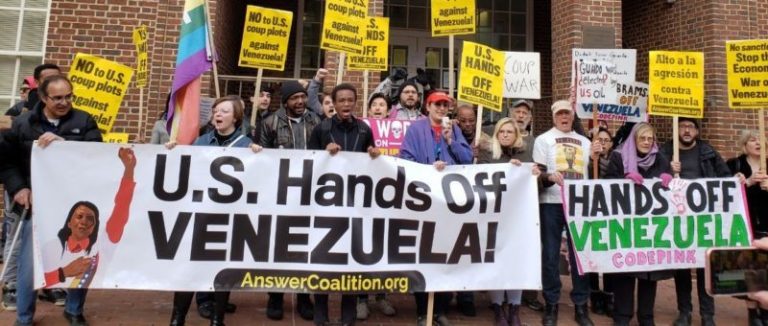
Featured image: Activists gather in front of the Venezuelan embassy in Washington, DC in March, 2019.The original source of this article is Global ResearchCopyright © Nino Pagliccia, Global Research, 2019

River to Sea Uprooted Palestinian   
The views expressed in this article are the sole responsibility of the author and do not necessarily reflect those of the Blog!