Showing posts with label Nagasaki. Show all posts

Tuesday, 25 August 2020

After Hiroshima and Nagasaki: U.S. and Australian Brutalisation of Women on the Japanese Mainland

August 24, 2020
After Hiroshima and Nagasaki: U.S. and Australian Brutalisation of Women on the Japanese Mainland

by A.B. Abrams for The Saker Blog

Over a year ago I published the book Power and Primacy: The History of Western Intervention in the Asia-Pacific, which was an attempt to fill what I saw as a gap in scholarship on the subject. I found that while several scholars had covered individual cases of Western powers intervening in the region, from David Easter and Geoffrey B. Robinson’s works on the Western-engineered coup and massacres in Indonesia of an estimated 500,000 to 3 million people[1] – to Bruce Cumings and Hugh Deane’s works on the Korean War, there were no major works assessing broader trends and consistencies in Western intervention. Power and Primacy was thus written to show the consistencies in Western designs towards the region and the means used to achieve them over a period of more than 70 years, from the Pacific War which began in 1941 to Western policies towards China and North Korea today.

This month marks the 75th anniversary of the dismantling of the Japanese Empire, and the famous declaration by General Douglas MacArthur that, with the region’s only non-Western military power and the world’s only non-Western naval power now defeated, ‘The Pacific is now an Anglo-Saxon lake.’ While the U.S. and its allies portrayed themselves as a benevolent and democratising force in the region, the darker aspects of East Asia’s time under the new hegemon, which starkly contradict this, have seen very little discussion or coverage. It is notable, for example, that after the Japanese Empire’s fall not only did living standards in southern Korea fall dramatically after it was placed under the rule of an American military government, but mass rapes, the use of comfort women, and serious human trafficking – the very things used by many to justify the American embargo on Japan which had started hostilities in 1941 – not only continued but were expanded under U.S. control. The government of Syngman Rhee, the Princeton-educated Christian radical the U.S. placed in power, killed 2% of its population at the most conservative estimate within five years, placing hundreds of thousands more in concentration camps and exercising a level of brutality not seen even under the Japanese Empire.

With Japan today having seen 75 uninterrupted years with tens of thousands of Western soldiers based on its territory, where they appear set to remain indefinitely, this is a suitable time to reflect on the nature of the relationship between the country and the West – which is very far from that of equal sovereign powers with shared goals and ideals. Evidence for this has ranged from massive involvement of American intelligence in the political process, including funding pro-Western political parties and supporting their election campaigns,[2] to the testimonies of multiple officials. Former Prime Minister Yukio Hatoyama, for example, noted regarding his country’s inability to reach a deal with Russia over the Kuril Islands due to an effective American veto over all major foreign policy decisions: “I think it represents a big problem that when making foreign policy decisions, Tokyo is always guided by the United States’ approach. Japan depends on America.” He further stated: “The Japanese media and government… always take America’s side. Tokyo is dependent on the US’ views … Japan will continue to side with America and the G7 countries.”[3] Prime Minister Ichiro Hatoyama, who in the 1950s had also sought to resolve the dispute with Moscow and sign a peace treaty on the basis that Japan would receive two of the four islands, was harshly threatened by the U.S. and was ultimately forced to concede to Washington’s demands not to go through with an agreement. Prime Minister Yoshiro Mori came to a similar conclusion regarding the country’s lack of effective sovereignty in an interview with Russian state media in 2018. [4]

Beyond these political indicators, however, are more human indicators of the nature of America’s place in post-war Japan which cannot be overlooked, and which contrast very strongly with portrayals in the vast majority of Western media including both documentaries and popular media. An extract from the book Power and Primacy, pages 66-69, given below, recently reached over 3 million viewers on social media and highlighted the true consequences for Japan’s population of subjugation by the United States. The full references are provided in the book itself. Perhaps most importantly, this is not presented as an isolated set of cases of U.S. and Western conduct towards an East Asian population placed under their power – rather it is part of a much wider trend which if anything was considerably more extreme in Vietnam and in both South and North Korea – the latter of which was briefly occupied by U.S. forces in 1950. An understanding of the past is key to comprehending the nature of Western involvement in the Asia-Pacific region today, which is why I found that this project was particularly essential now in light of the ‘Pivot to Asia,’ the North Korean nuclear crisis, the Trump administration’s recent ‘Tech War’ on China and other key events which have increasingly placed the region at the centre of determining the future of world order.

Text Start:

There was a far darker side to the U.S. and allied occupation of Japan, one which is little mentioned in the vast majority of histories – American or otherwise. When Japan surrendered in August 1945, mass rapes by occupying forces were expected… [despite setting up of a comfort women system which recruited or otherwise trafficked desperate women to brothels] such crimes were still common and several of them were extremely brutal and resulted in the deaths of the victims. Political science professor Eiji Takemae wrote regarding the conduct of American soldiers occupying Japan:

‘U.S. troops comported themselves like conquerors, especially in the early weeks and months of occupation. Misbehavior ranged from black-marketeering, petty theft, reckless driving and disorderly conduct to vandalism, assault, arson, murder and rape. Much of the violence was directed against women, the first attacks beginning within hours after the landing of advanced units. In Yokohama, China and elsewhere, soldiers and sailors broke the law with impunity, and incidents of robbery, rape and occasionally murder were widely reported in the press [which had not yet been censored by the U.S. military government]. When U.S. paratroopers landed in Sapporo an orgy of looting, sexual violence and drunken brawling ensued. Gang rapes and other sex atrocities were not infrequent […] Military courts arrested relatively few soldiers for their offences and convicted even fewer, and restitution for the victims was rare. Japanese attempts at self-defense were punished severely. In the sole instance of self-help that General Eichberger records in his memoirs, when local residents formed a vigilante group and retaliated against off-duty GIs, the Eighth Army ordered armored vehicles in battle array into the streets and arrested the ringleaders, who received lengthy prison terms.

The U.S. and Australian militaries did not maintain rule of law when it came to violations of Japanese women by their own forces, neither were the Japanese population allowed to do so themselves. Occupation forces could loot and rape as they pleased and were effectively above the law.

An example of such an incident was in April 1946, when approximately U.S. personnel in three trucks attacked the Nakamura Hospital in Omori district. The soldiers raped over 40 patients and 37 female staff. One woman who had given birth just two days prior had her child thrown on the floor and killed, and she was then raped as well. Male patients trying to protect the women were also killed. The following week several dozen U.S. military personnel cut the phone lines to a housing block in Nagoya and raped all the women they could capture there – including girls as young as ten years old and women as old as fifty-five.

Such behavior was far from unique to American soldiers. Australian forces conducted themselves in much the same way during their own deployment in Japan. As one Japanese witness testified: ‘As soon as Australian troops arrived in Kure in early 1946, they ‘dragged young women into their jeeps, took them to the mountain, and then raped them. I heard them screaming for help nearly every night.’ Such behavior was commonplace, but news of criminal activity by Occupation forces was quickly suppressed.

Australian officer Allan Clifton recalled his own experience of the sexual violence committed in Japan:

‘I stood beside a bed in hospital. On it lay a girl, unconscious, her long, black hair in wild tumult on the pillow. A doctor and two nurses were working to revive her. An hour before she had been raped by twenty soldiers. We found her where they had left her, on a piece of waste land. The hospital was in Hiroshima. The girl was Japanese. The soldiers were Australians. The moaning and wailing had ceased and she was quiet now. The tortured tension on her face had slipped away, and the soft brown skin was smooth and unwrinkled, stained with tears like the face of a child that has cried herself to sleep.’

Australians committing such crimes in Japan were, when discovered, given very minor sentences. Even these were most often later mitigated or quashed by Australian courts. Clifton recounted one such event himself, when an Australian court quashed a sentence given by a military court martial citing ‘insufficient evidence,’ despite the incident having several witnesses. It was clear that courts overseeing Western occupation forces took measures to protect their own from crimes committed against the Japanese – crimes which were largely regarded as just access to ‘spoils of war’ at the time by the Western occupiers.

As had been the case during the war, underreporting of rapes in peace- time due to the associated shame in a traditional society and inaction on the part of authorities (rapes in both cases occurred when Western militaries were themselves in power) would lower the figures significantly. In order to prevent ill feeling towards their occupation from increasing, the United States military government implemented very strict censorship of the media. Mention of crimes committed by Western military personnel against Japanese civilians was strictly forbidden. The occupying forces ‘issued press and pre-censorship codes outlawing the publication of all reports and statistics “inimical to the objectives of the Occupation.”’ When a few weeks into the occupation Japanese press mentioned the rape and widespread looting by American soldiers, the occupying forces quickly responded by censoring all media and imposing a zero tolerance policy against the reporting of such crimes. It was not only the crimes committed by Western forces, but any criticism of the Western allied powers whatsoever which was strictly forbidden during the occupation period – for over six years. This left the U.S. military government, the supreme authority in the country, beyond accountability. Topics such as the establishment of comfort stations and encouragement of vulnerable women into the sex trade, critical analysis of the black market, the population’s starvation level calorie intakes and even references to the Great Depression’s impact on Western economies, anti-colonialism, pan-Asianism and emerging Cold War tensions were all off limits.

What was particularly notable about the censorship imposed under American occupation was that it was intended to conceal its own existence. This meant that not only were certain subjects strictly off limits, but the mention of censorship was also forbidden. As Columbia University Professor Donald Keene noted: ‘the Occupation censorship was even more exasperating than Japanese military censorship had been because it insisted that all traces of censorship be concealed. This meant that articles had to be rewritten in full, rather than merely submitting XXs for the offending phrases.’ For the U.S. military government it was essential not only to control information – but also to give the illusion of a free press when the press was in fact more restricted than it had been even in wartime under imperial rule.

By going one step further to censor even the mention of censorship itself, the United States could claim to stand for freedom of press and freedom of expression. By controlling the media the American military government could attempt to foster goodwill among the Japanese people while making crimes committed by their personnel and those of their allies appear as isolated incidents. While the brutality of American and Australian militaries against Japanese civilians was evident during the war and in its immediate aftermath, it did not end with occupation. The United States has maintained a significant military presence in Japan ever since and crimes including sexual violence and murder against Japanese civilians continue to occur.”

Text End

For Full Manuscript of Power and Primacy

Facebook

For A. B. Abrams’ upcoming work, scheduled for publication in October 2018, titled Immovable Object: North Koreans 70 Years at War with American Power:

  1. ‘Indonesia’s killing fields,’ Al Jazeera, December 21, 2012. ‘Looking into the massacres of Indonesia’s past,’ BBC, June 2, 2016. 
  2. Weiner, Time, ‘C. I. A. Spent Millions to Support Japanese Right in 50’s and 60’s,’ New York Times, October 9, 1994. 
  3. ‘Stationing American troops in Japan will lead to bloody tragedy – ex-PM of Japan,’ RT, (televised interview), November 6, 2016. 
  4. ‘Ex-Japan FM: I Told Putin We Follow U.S. Policy as We’re Surrounded by Nuke States,’ Sputnik, May 22, 2018. 

River to Sea Uprooted Palestinian   
The views expressed in this article are the sole responsibility of the author and do not necessarily reflect those of the Blog!

Saturday, 8 August 2020

“Wipe the Soviet Union Off the Map”, 204 Atomic Bombs against 66 Major Cities, US Nuclear Attack against USSR Planned During World War II

When America and the Soviet Union Were Allies

By Prof Michel Chossudovsky

Global Research, August 04, 2020

To read this article in other versions, click: French, German, and Russian.

First published November 4, 2017. Revisions to the English Text, December 10, 2017

Author’s Note 

Since this article was first published in 2017, YouTube has decided to Censor the short video produced by South Front which is largely based on the declassified documents quoted in this article. 

US nuclear threats directed against Russia predate the Cold War. They were first formulated  at the height of World War II under the Manhattan Project when the US and the Soviet Union were allies.  

The plan to bomb 66 Soviet cities was “officially” formulated in mid-September 1945, two weeks after the formal surrender of Japan.  

Had the US decided NOT to develop nuclear weapons for use against the Soviet Union, the nuclear arms race would not have taken place. 

Neither The Soviet Union nor the People’s Republic of China would have developed nuclear capabilities as a means of “Deterrence” agains the US which had already formulated plans to annihilate the Soviet Union.

Flash Forward to 2020: Nuclear War is still on the drawing board of the Pentagon. In the post Cold War era, under Donald Trump’s “Fire and Fury”, nuclear war directed against Russia, China, North Korea and Iran is “On the Table”.

A one $1.2 trillion ++ nuclear weapons program, first launched under Obama, is ongoing. 

Michel Chossudovsky, August 4, 2020

***

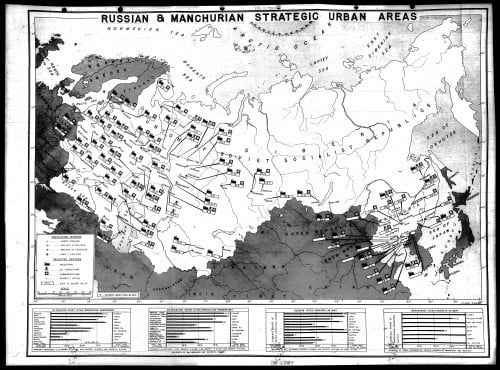
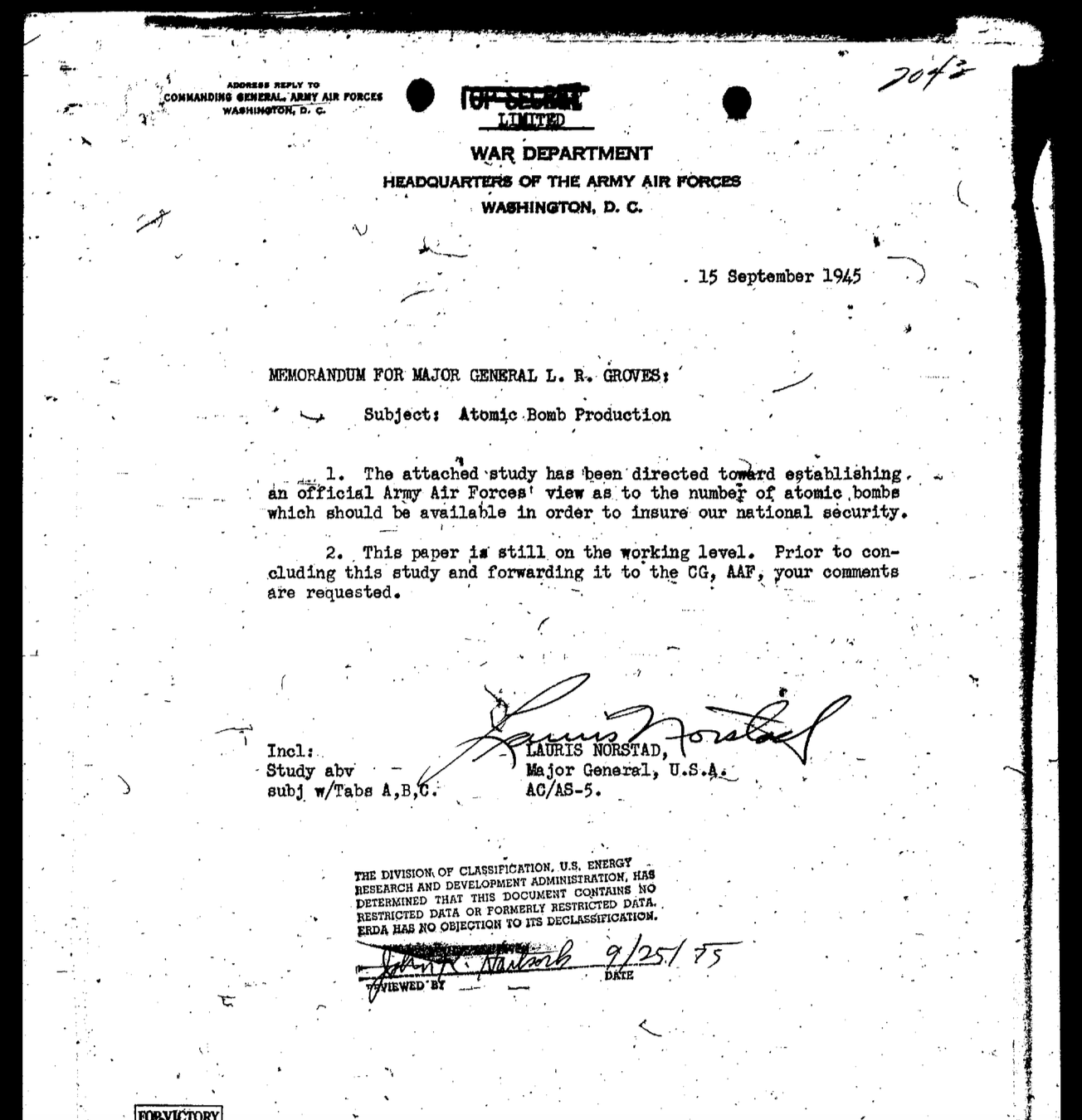
According to a secret document datedSeptember 15, 1945, “the Pentagon had envisaged blowing up the Soviet Union  with a coordinated nuclear attack directed against major urban areas.

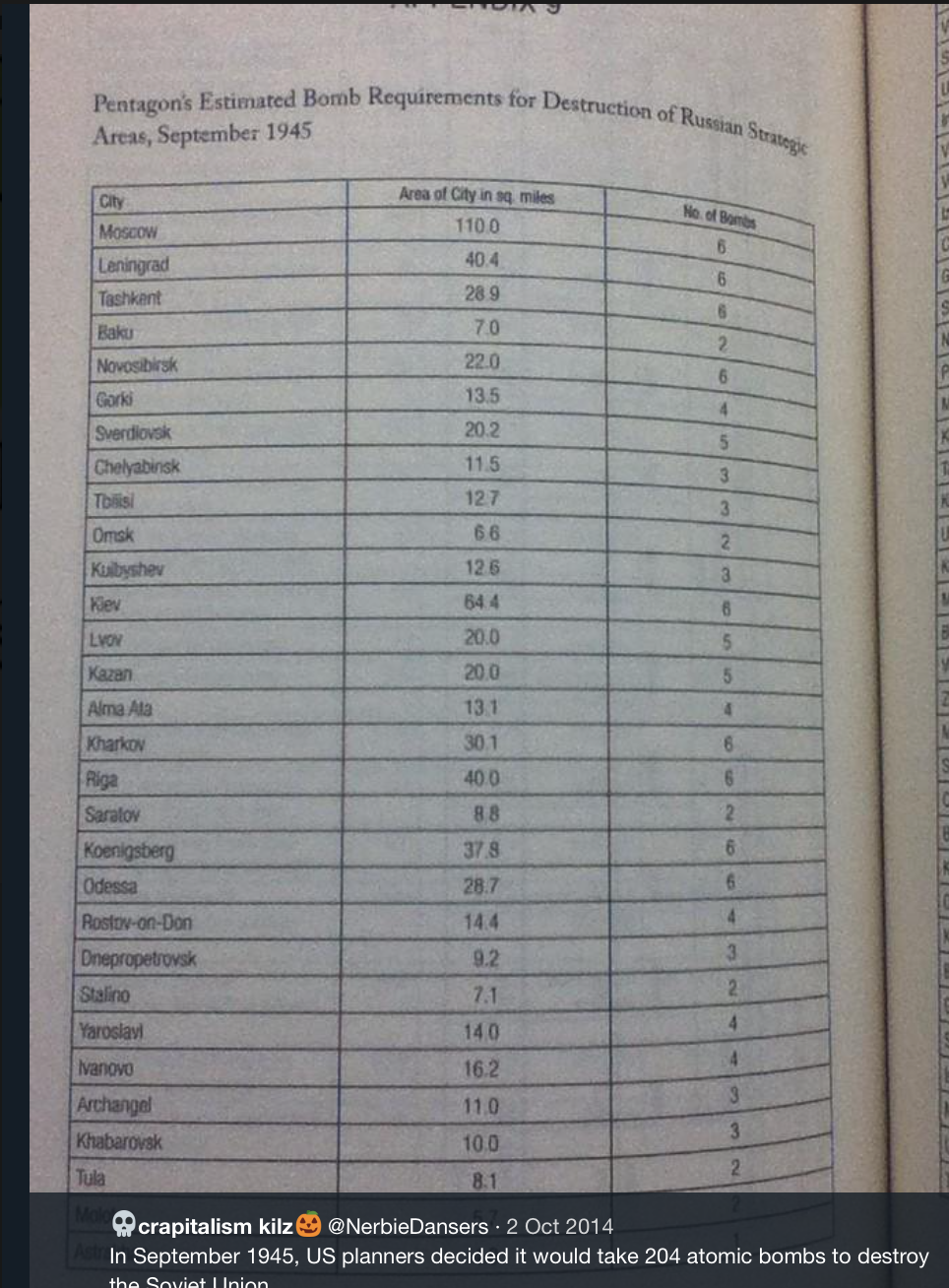
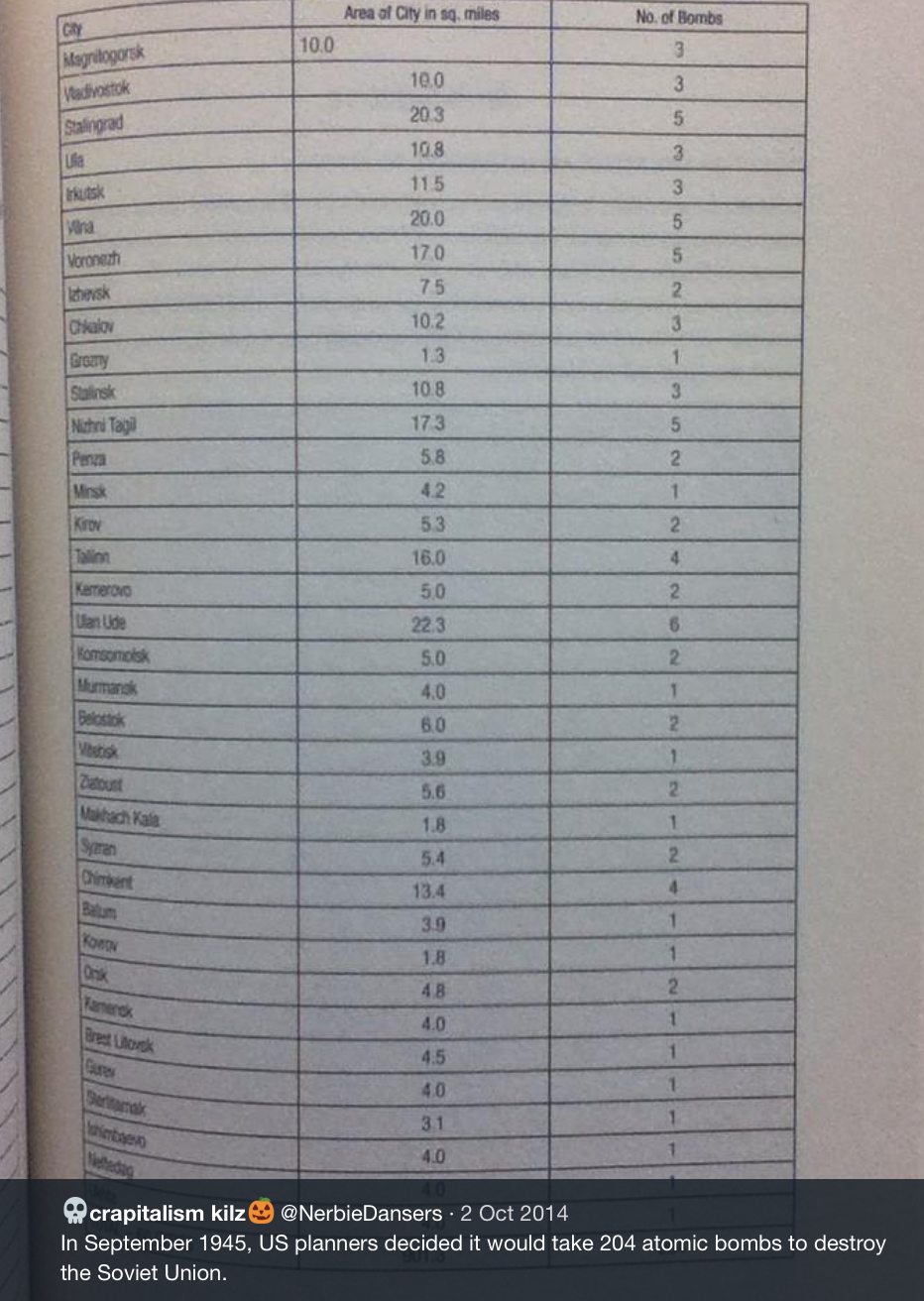
All major cities of the Soviet Union were included in the list of 66 “strategic” targets. The tables below categorize each city in terms of area in square miles and the corresponding number of atomic bombs required to annihilate and kill the inhabitants of selected urban areas.

Six atomic bombs were to be used to destroy each of the larger cities including Moscow, Leningrad, Tashkent, Kiev, Kharkov, Odessa.

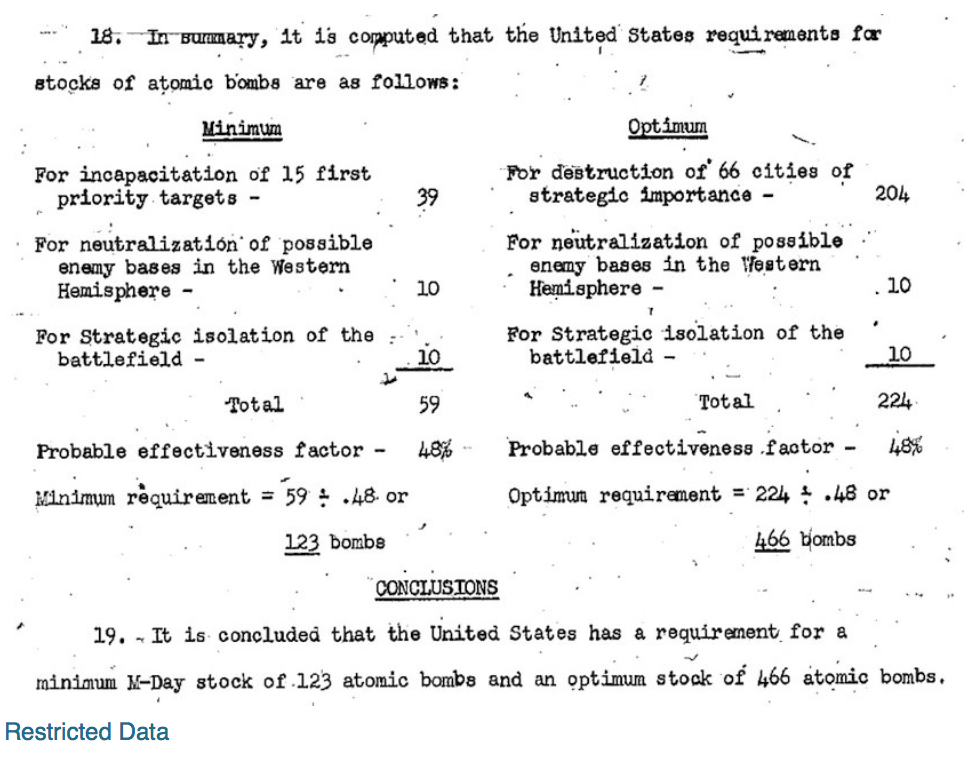
The Pentagon estimated that a total of 204 atomic bombs would be required to “Wipe the Soviet Union off the Map”. The targets for a nuclear attack consisted of sixty-six major cities.

To undertake this operation the “optimum” number of bombs required was of the order of 466 (see document below)

One single atomic bomb dropped on Hiroshima resulted in the immediate death of 100,000 people in the first seven seconds. Imagine what would have happened if 204 atomic bombs had been dropped on major cities of the Soviet Union as outlined in a secret U.S. plan formulated during the Second World War.

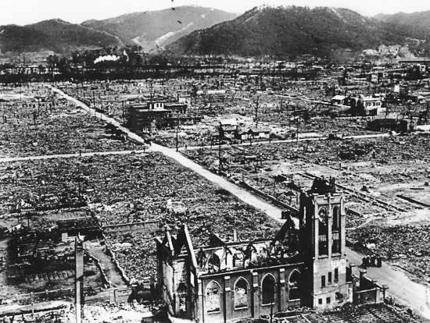
Hiroshima in the wake of the atomic bomb attack, 6 August 1945

The document outlining this diabolical military agenda had been released in September 1945, barely one month after the bombing of Hiroshima and Nagasaki (6 and 9 August, 1945) and two years before the onset of the Cold War (1947).

Video produced by South Front

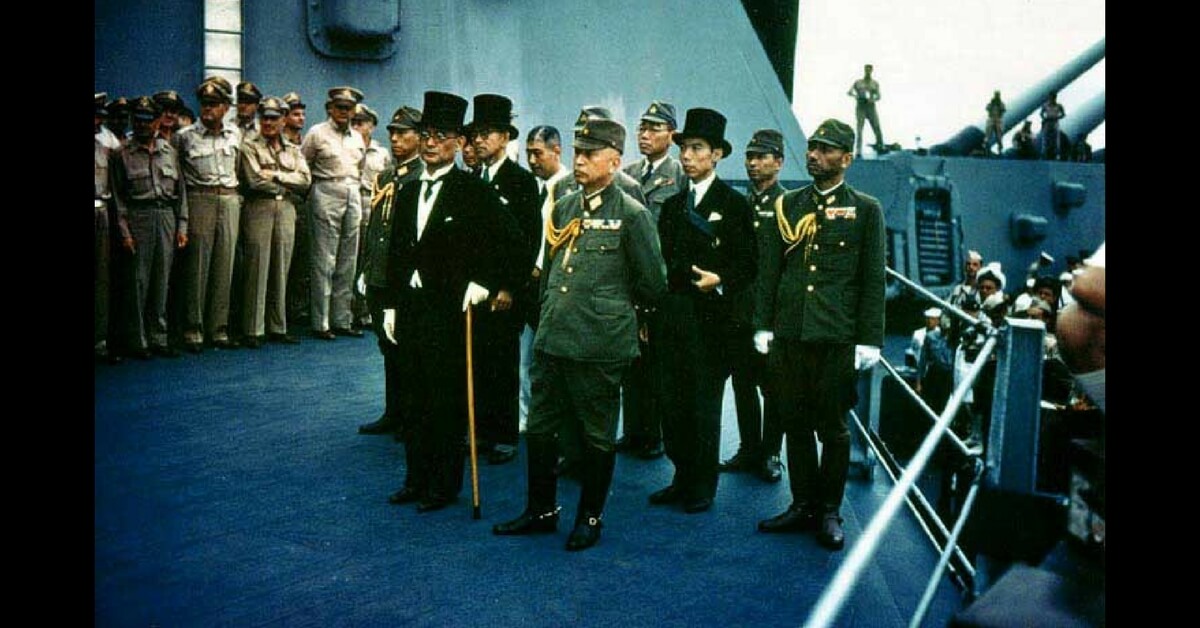
The secret plan dated September 15, 1945 (two weeks after the surrender of Japan on September 2, 1945 aboard the USS Missouri, see image below) , however, had been formulated at an earlier period, namely at the height of World War II,  at a time when America and the Soviet Union were close allies.

It is worth noting that Stalin was first informed through official channels by Harry Truman of the infamous Manhattan Project at the Potsdam Conference on July 24, 1945, barely two weeks before the attack on Hiroshima.

The Manhattan project was launched in 1939, two years prior to America’s entry into World War II in December 1941. The Kremlin was fully aware of the secret Manhattan project as early as 1942.

Were the August 1945 Hiroshima and Nagasaki attacks used by the Pentagon to evaluate the viability of  a much larger attack on the Soviet Union consisting of more than 204 atomic bombs? The key documents to bomb 66 cities of the Soviet Union (15 September 1945) were finalized 5-6 weeks after the Hiroshima and Nagasaki bombings (6, 9 August 1945):

“On September 15, 1945 — just under two weeks after the formal surrender of Japan and the end of World War II — Norstad sent a copy of the estimate to General Leslie Groves, still the head of the Manhattan Project, and the guy who, for the short term anyway, would be in charge of producing whatever bombs the USAAF might want. As you might guess, the classification on this document was high: “TOP SECRET LIMITED,” which was about as high as it went during World War II. (Alex Wellerstein, The First Atomic Stockpile Requirements (September 1945)

The Kremlin was aware of the 1945 plan to bomb sixty-six Soviet cities.

The documents confirm that the US was involved in the “planning of genocide” against the Soviet Union.

Let’s cut to the chase. How many bombs did the USAAF request of the atomic general, when there were maybe one, maybe two bombs worth of fissile material on hand? At a minimum they wanted 123. Ideally, they’d like 466. This is just a little over a month after the bombings of Hiroshima and Nagasaki.

Of course, in true bureaucratic fashion, they provided a handy-dandy chart (Alex Wellerstein, op. cit)

Pentagon Plans to Destroy Dozens of Soviet Cities and the So-called Cold War

The Nuclear Arms Race

Central to our understanding of the Cold War which started (officially) in 1947, Washington’s September 1945 plan to bomb 66 cities into smithereens played a key role in triggering the nuclear arms race.

The Soviet Union was threatened and developed its own atomic bomb in 1949 in response to 1942 Soviet intelligence reports on the Manhattan Project.

While the Kremlin knew about these plans to “Wipe out” the USSR, the broader public was not informed because the September 1945 documents were of course classified.

Today, neither the September 1945 plan to blow up the Soviet Union nor the underlying cause of the nuclear arms race are acknowledged. The Western media has largely focussed its attention on the Cold War US-USSR confrontation. The plan to annihilate the Soviet Union dating back to World War II and the infamous Manhattan project are not mentioned.

Washington’s Cold War nuclear plans are invariably presented in response to so-called Soviet threats, when in fact it was the U.S. plan released in September 1945 (formulated at an earlier period at the height of World War II) to wipe out the Soviet which motivated Moscow to develop its nuclear weapons capabilities.

The assessment of the Bulletin of the Atomic Scientists mistakenly blamed and continue to blame the Soviet Union for having launched the nuclear arms race in 1949, four years after the release of the September 1945 US Secret Plan to target 66 major Soviet cities with 204 nuclear bombs:

“1949: The Soviet Union denies it, but in the fall, President Harry Truman tells the American public that the Soviets tested their first nuclear device, officially starting the arms race. “We do not advise Americans that doomsday is near and that they can expect atomic bombs to start falling on their heads a month or year from now,” the Bulletin explains. “But we think they have reason to be deeply alarmed and to be prepared for grave decisions.” (Timeline of the Doomsday Clock, Bulletin of Atomic Scientists, 2017)

IMPORTANT: Had the US decided NOT to develop nuclear weapons for use against the Soviet Union, the nuclear arms race would not have taken place. 

Neither The Soviet Union nor the People’s Republic of China would have developed nuclear capabilities as a means of “Deterrence” agains the US which had already formulated plans to annihilate the Soviet Union.

The Soviet Union lost 26 million people during World War II.

The Cold War List of 1200 Targeted Cities: 

This initial 1945 list of sixty-six cities was updated in the course of the Cold War (1956) to include some 1200 cities in the USSR and the Soviet block countries of Eastern Europe (see declassified documents below). The bombs slated for use were more powerful in terms of explosive capacity than those dropped on Hiroshima and Nagasaki.

Source: National Security Archive

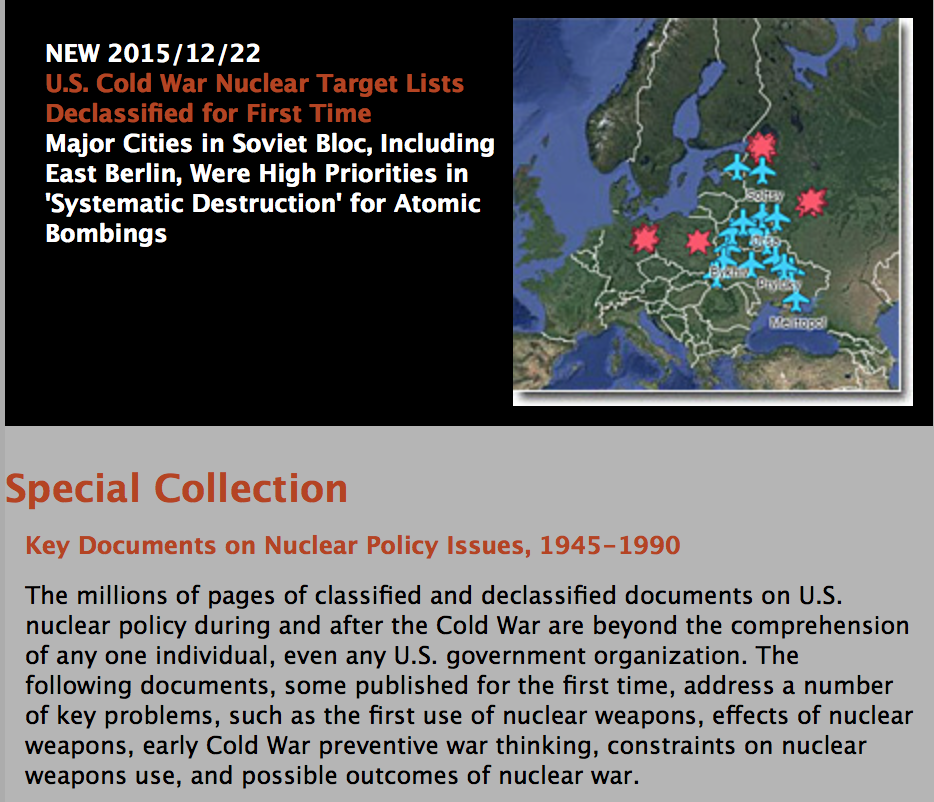
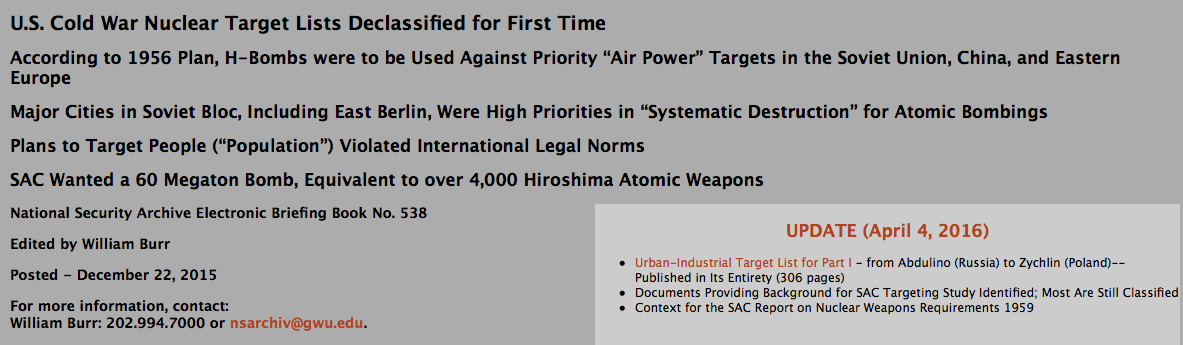
“According to the 1956 Plan, H-Bombs were to be Used Against Priority “Air Power” Targets in the Soviet Union, China, and Eastern Europe. Major Cities in the Soviet Bloc, Including East Berlin, Were High Priorities in “Systematic Destruction” for Atomic Bombings.  (William Burr, U.S. Cold War Nuclear Attack Target List of 1200 Soviet Bloc Cities “From East Germany to China”, National Security Archive Electronic Briefing Book No. 538, December 2015

Source: National Security Archive

Washington, D.C., December 22, 2015 – The SAC [Strategic Air Command] Atomic Weapons Requirements Study for 1959, produced in June 1956 and published today for the first time by the National Security Archive www.nsarchive.org, provides the most comprehensive and detailed list of nuclear targets and target systems that has ever been declassified. As far as can be told, no comparable document has ever been declassified for any period of Cold War history.

The SAC study includes chilling details. According to its authors,  their target priorities and nuclear bombing tactics would expose nearby civilians and “friendly forces and people” to high levels of deadly radioactive fallout.  Moreover, the authors developed a plan for the “systematic destruction” of Soviet bloc urban-industrial targets that specifically and explicitly targeted “population” in all cities, including Beijing, Moscow, Leningrad, East Berlin, and Warsaw.  Purposefully targeting civilian populations as such directly conflicted with the international norms of the day, which prohibited attacks on people per se (as opposed to military installations with civilians nearby).National Security Archive Electronic Briefing Book No. 538, December 2015

List of Cities

Excerpt of list of 1200 cities targeted for nuclear attack in alphabetical order. National Security Archive, op. cit.

From the Cold War to Donald Trump

In the post Cold War era, under Donald Trump’s “Fire and Fury”, nuclear war directed against Russia, China, North Korea and Iran is “On the Table”.

What distinguishes the October 1962 Missile Crisis to Today’s realities:

1. Today’s president Donald Trump does not have the foggiest idea as to the consequences of nuclear war.

2, Communication today between the White House and the Kremlin is at an all time low. In contrast, in October 1962, the leaders on both sides, namely John F. Kennedy and Nikita S. Khrushchev were accutely aware of the dangers of nuclear annihilation. They collaborated with a view to avoiding the unthinkable.

3. The nuclear doctrine was entirely different during the Cold War. Both Washington and Moscow understood the realities of mutually assured destruction. Today, tactical nuclear weapons with an explosive capacity (yield) of one third to six times a Hiroshima bomb are categorized by the Pentagon as “harmless to civilians because the explosion is underground”.

4.  A one trillion ++ nuclear weapons program, first launched under Obama, is ongoing.

5. Today’s thermonuclear bombs are more than 100 times more powerful and destructive than a Hiroshima bomb. Both the US and Russia have several thousand nuclear weapons deployed.

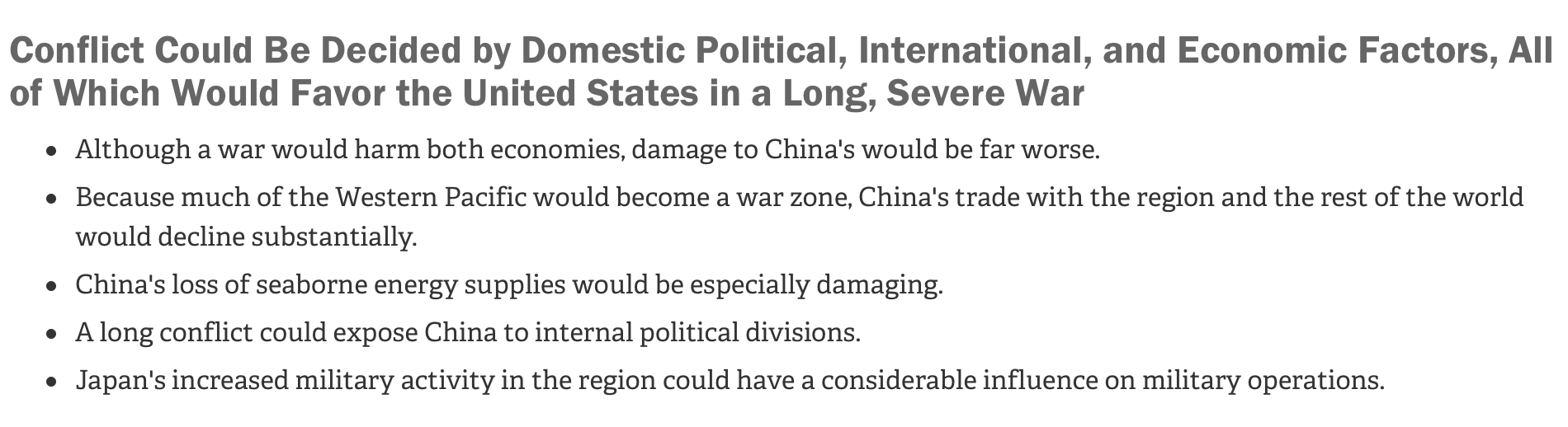
Moreover, an all war against China is currently on the drawing board of the Pentagon as outlined by a RAND Corporation Report commissioned by the US Army  

“Fire and Fury”, From Truman to Trump: U.S Foreign Policy Insanity

There is a long history of US political insanity geared towards providing a human face to U.S. crimes against humanity.

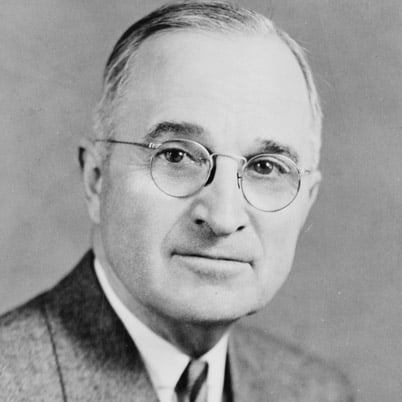
Truman globalresearch.ca

On August 9, 1945, on the day the second atomic bomb was dropped on Nagasaki, president Truman (image right), in a radio address to the American people, concluded that God is on the side of America with regard to the use of nuclear weapons and that

He May guide us to use it [atomic bomb] in His ways and His purposes”. 

According to Truman: God is with us, he will decide if and when to use the bomb:

[We must] prepare plans for the future control of this bomb. I shall ask the Congress to cooperate to the end that its production and use be controlled, and that its power be made an overwhelming influence towards world peace.

We must constitute ourselves trustees of this new force–to prevent its misuse, and to turn it into the channels of service to mankind.

It is an awful responsibility which has come to us.

We thank God that it [nuclear weapons] has come to us, instead of to our enemies; and we pray that He may guide us to use it [nuclear weapons] in His ways and for His purposes” (emphasis added)

The original source of this article is Global Research

Copyright © Prof Michel Chossudovsky, Global Research, 2020


River to Sea Uprooted Palestinian   
The views expressed in this article are the sole responsibility of the author and do not necessarily reflect those of the Blog!

Wednesday, 5 August 2020

Another Hiroshima is Coming…Unless We Stop It Now


River to Sea Uprooted Palestinian   
The views expressed in this article are the sole responsibility of the author and do not necessarily reflect those of the Blog!

Saturday, 4 July 2020

The U.S. Military Is the World’s Biggest Climate Destroyer. No to War and Occupation! No to Environmental Degradation

Emerging Dynamics of Antiwar and Climate Justice Movements
Global Research, July 03, 2020

Talk by Alison Bodine at the United National Antiwar Coalition National Conference held from February 21–23, 2020, at the People’s Forum in New York City.
*** 
To begin, I hope everyone has been able to see actions across Canada in solidarity with the people of Wet’suwet’en media and social media lately, footage and their hereditary chiefs who are standing against a fracked gas, or what they call a “natural” gas pipeline, up in northern British Columbia. This struggle is part of my talk today, however, the focus of what I wanted to say is about the importance of bringing the anti-war movement and the climate justice movement together or anti-war organizers and the climate justice movement together.
The Devastating Human and Environmental Impact of War & Occupation 
I want to start with just three short examples of the impact of war on the environment that I think are very important to remember. 
On January 24th, over a million people protested in Iraq. The streets were full in Baghdad of people demanding the U.S. Out of Iraq Now! It was incredibly inspiring.
Iraq is a country that has been devastated for 17 years by U.S. led war and occupation. Over a million people have been killed, not to mention the millions who were killed before the war began in 2003 when the U.S. and the United Nations Security Council imposed severe sanctions between 1991 and 2003. Iraq is a devastated country where the U.S. has set up 500 big and small military bases throughout 17 years of occupation, and deployed countless bullets, bombs, chemical weapons, depleted uranium and burn pits filled with toxic plastics, heavy military machinery and shells of weaponry.
No wonder people in Iraq were demanding U.S. Out of Iraq Now! Because of the devastation that has been brought upon them. But I wanted to further centre our discussion on climate justice by talking about one example of what climate devastation and climate justice means to people in Iraq.
In 2010, the International Journal of Environmental Research and Public Health wrote an article where they reported a 38-fold increase in leukemia, a tenfold increase in breast cancer, and an infant mortality rate eight times higher than in neighboring Kuwait, following what had then been seven years of U.S. war and occupation in Iraq. A big cause of this could be linked to the chemical weapons used, and especially to depleted uranium, which has a half-life of 4.5 billion years. According to a 2007 report by the U.N. Environment Program, between 1000 and 2000 metric tons of depleted uranium were fired into Iraq.
The city of Nagasaki is shown as a teeming urban area, above, then as a flattened, desolate wasteland following the detonation of an atomic bomb, below. Circles indicate the thousands of feet from ground zero.
Now I will bring it back home to the U.S. and Canada. In Canada, an Indigenous Dené nation community in the Northwest Territories became known as the “Village of Widows” because men of the population died of cancers that they developed when mining for uranium. This was the same uranium that was used in the bombs dropped on Hiroshima and Nagasaki. As well, the radium and the uranium mines in the community released tailings into the lake and landfills. The devastating effects of this are still experienced in the community today.
That brings us to what has been said many times, importantly, in this conference already, which is that the U.S. Department of Defense is the world’s largest polluter. We are talking about 1.2 billion metric tons of greenhouse gases emitted annually. That is the equivalent of 257 million cars on the road for a year.
In Canada, the Department of National Defence also makes an enormous contribution to greenhouse gas emissions. A portion of this is through the fueling of the warplanes of Canada and other imperialist countries. The government of Canada is often claiming that they are not participating in U.S.-led wars, but then refueling all the jets that are dropping the bombs. The Canadian military provided 65 million pounds of fuel to refuel aircraft used in the bombing of Iraq and Syria between 2014 and 2019. This is incomparable, of course, to the fuel consumption of the vehicles that any of us here in this room drive.
The Department of Defense in the United States is the largest institutional consumer of fossil fuels. In Canada, the Department of National Defence is the largest consumer of petroleum and Canada’s largest landholder.
This is added to the continued environmental and human impact of chemical and radioactive weapons such as Agent Orange and depleted uranium. Also, the military bases of the United States and its allies around the world persist in poisoning and in polluting.
Another topic to talk about that is important to the discussion about environment and war is military emissions, because specific sources of greenhouse gases are excluded from federal reduction targets due to their important role in “ensuring the national safety and security of all Canadians” — as Canada’s previous environment minister, Catherine McKenna, justified why the declared emissions of the Department of National Defence in Canada has never been counted in Canada’s emission reduction targets.
Military emissions are explicitly stated as excluded in the targets set by the 2015 United National Paris agreements. Under these agreements, countries are “required,” as much as the Paris agreements can “require” anything, to report on their military emissions. Still, countries are not obligated or encouraged to do anything to reduce them. In the international climate agreements that proceeded with the Paris agreement, the Kyoto Accords, military emissions were not even part of the discussion. Military emissions continue to be considered a so-called necessary expense for our planet.
Then, there is the issue of military budgets. For example, the world’s biggest military budget ever has been passed yet again in the United States recently. Instead of being spent on human and environmental destruction, this money could go towards climate justice, meaning health care, education, jobs, public transit, and more.
As Martin Luther King Junior said, and I think this is a good quote for us to use when talking about the environment and war,
“Our scientific power has outrun our spiritual power. We have guided missiles and misguided men.”
So, where is the technology that we need to save our planet earth now? 
The War at Home: Wet’suwet’en & the Struggle for Indigenous Rights 
The wars abroad by imperialist countries such as the U.S. and Canada are also carried out against people at home. And I think every once in a while, there are these escalated times when that reality can shake oppressed people and their very foundations. And that has happened with Indigenous people in Canada over the past few weeks.
There is a war against Indigenous people in Canada. There has been since the colonisation of Indigenous land. The Canadian state has the same roots as the United States of genocide, residential schools, and reservation systems. This history and the current reality of colonization are reflected in the mobilization of Indigenous and non-Indigenous people in solidarity with Wet’suwet’en today. 
It is important to understand that one year ago, the RCMP -the Canadian national police- first invaded the territory of the Wet’suwet’en people, and they kept a detachment there for an entire year. Then this January is when things escalated again because the RCMP moved further into the territory and cleared people off of a road to make way for the development of the Coastal GasLink pipeline, which is in violation of the demands of the Wet’suwet’en people. British Columbia is an unceded territory. No treaties, in 92 percent of the land, were ever signed. So hereditary chiefs and their system of governance are law in those unceded territories. 
The Coastal GasLink pipeline is fracked gas. There has been a lot of talk, specifically in the Province of British Columbia about how the Coastal GasLink pipeline is going to “replace coal for the world,” and at the same time, not have a big impact on greenhouse gas emissions. However, the impact of “natural gas” emissions can only be considered minor when you ignore the methane and poisons that are released when it is extracted and considering that when it is burned, Canada does not have to count those emissions targets. 
It is Time to Unite the Antiwar and Climate Justice Movement
That brings me to my final point, which is about bringing together the anti-war movement with the climate justice movement. One way to do this is by making sure “self-determination for oppressed nations, including Indigenous nations!” is always part of our demands. This has always been part of our demands within Mobilization Against War and Occupation (MAWO) and MAWO has consistently brought this demand to the cross-border movement that we would like to strengthen and build together, including with this conference. 
I think there are four strategies and demands that we need to bring into our antiwar, anti-pollution, and anti-imperialist movement. The first is that we must build a movement that is against imperialist war and occupation. Today, we live in what we in MAWO call “the new era of war and occupation,” which is the never-ending wars that started in 2001, that we are all coming together to organize against. This era is characterized by a campaign to regain hegemony in the Middle East, North Africa, and Latin America by capitalist countries that are facing a grave economic crisis and a rapid falling rate of profit. These countries are on the war path to gain new markets and resources, which means more killing of our planet. 
Secondly, self-determination for oppressed nations, as I said, must be part of our work, from Indigenous and Black people, to oppressed countries under attack and occupation. This important demand calls on us to have strategical unity against any occupation, domestic or international. We cannot just be talking about the U.S. occupying other countries but also what it means when there are oppressed nations within the U.S. and Canada borders.
Thirdly, we need to fight for a world without NATO and U.S. military bases, because of the environmental pollution and also because of the way that the United States uses these bases to increase their wars and occupations and consequently further ecological degradation.
Lastly, I think the environmental struggle ties into the movement against sanctions and blockades, which are war. These attacks do not allow countries to develop their economies or to use their resources for the good of their people. Sanctions and blockades enforce the hegemony of the world’s biggest corporations, which are also the world’s biggest polluters.
If we combine these four pillars, which bring together the war at home and abroad, this is how we can build an anti-imperialist movement, how we can move from just being against war to also being against imperialism. I think we cannot build an effective anti-war movement without centralizing and emphasizing the slogan of self-determination for all oppressed nations.
I will say that I think this slogan of self-determination for all oppressed nations is as important as “Workers of the world unite,” from Marx and Engels.
People of oppressed nations face war and occupation and the denial of self-determination, which unites them in the fight against imperialism. The common struggle that unites workers is their exploitation by the capitalist class and the denial of their rights.
Within the antiwar and the climate justice movement, we must also emphasize that we are building an international movement, one that is also internationalist in character. The struggles of people against massive resource extraction projects are similar in Standing Rock in North Dakota or the Amazon rainforest in Brazil. The struggle for a sustainable world requires international cooperation between oppressed people. It requires solidarity and, more importantly, unity across borders to become powerful and effective. 
There are many opportunities for antiwar activists to bring the antiwar movement to the climate justice movement. There were massive protests around the world in September 2019; over 9 million people participated in global climate strike actions. And I think we need to continue to take advantage of that mobilization on the streets. We need to strategically bring the antiwar movement and the environmental movement together. Fighting against war is fighting against the degradation of the environment and fighting for climate justice is fighting against war and occupation. We are in an era of history that these two causes have become two struggles for one purpose, to save our lives and the planet.
I think we are now facing the opportunity to build a better and sustainable world. We must not feel inactive or depressed about the climate crisis or endless wars and occupations around us. In the face of this devastation, we have no choice but to take up the call and fight back.
People marching on the streets today against climate change can also be very capable of understanding that it is not just a clean planet we are fighting for. It will not matter if we have a clean planet if the earth is still full of poverty and human suffering and wars and occupations. The antiwar and climate justice movement now more than ever has one cause: Save the planet.
United we will win!
*
Note to readers: please click the share buttons above or below. Forward this article to your email lists. Crosspost on your blog site, internet forums. etc.
First printed in Fire This Time Newspaper Volume 14, Issue 3–5: www.firethistime.net
Alison Bodine is a social justice activist, author and researcher in Vancouver, Canada. She is  the Chair of Vancouver’s peace coalition Mobilization Against War and Occupation (MAWO) and a central organizer with the grassroots climate justice coalition Climate Convergence in Vancouver, Canada. Alison is also on the Editorial Board of the Fire This Time newspaper. 
Featured image is from The GrayzoneThe original source of this article is Global ResearchCopyright © Alison Bodine, Global Research, 2020

River to Sea Uprooted Palestinian   
The views expressed in this article are the sole responsibility of the author and do not necessarily reflect those of the Blog!

Wednesday, 27 May 2020

The new cold war; The Industrial Dependence War:

May 25, 2020
The world does not need a new cold war, or does it?
The Cold War started before the hot war was over. It was put into motion when America dropped the ‘bomb’ and Stalin declared that the USSR should ramp up its efforts to have this technology as soon as possible. And even though the Soviet Atomic Bomb Project was initiated in 1942, the first Soviet test was conducted in 1949, four years after Hiroshima.
The blame here is not on Stalin. After all, if Stalin did not take this ‘pre-emptive’ move, the West was planning to take him down next. It’s quite likely that Stalin and the USSR were saved from a Western invasion by the nukes they developed.
If the USA had the wisdom to learn from history, it should have realized that the moment it revealed to the rest of the world that it has a new cutting-edge super weapon, a rival will come and demand to have the same. In retrospect therefore, the ‘Manhattan Project’ was the real underlying trigger point for initiating the Cold War.
With both the US and the USSR, and later on Britain and France and other nations becoming nuclear powers, overtly or secretively, the deterring effect of a major direct confrontation between superpowers became obvious, though not strong enough to prevent major regional conventional proxy and hybrid wars all over the globe.
Nations of the Middle East together with Korea, Vietnam and many others, cannot claim any benefit from the deterring effect of the Cold War, but perhaps the USA, Europe (including Russia) and even Cuba can.
Unlike the story that the West wishes to peddle to the rest of the world, America did not win the Cold War neither did the USSR lose it. In reality, this was a negotiated agreement that happened prior to the breakup of the USSR; not afterwards.
With all the fear, tension, nuclear pollution, waste and plundering of resources that the Cold War generated, the world community has by-and-large won it with flying colours. It did stop WWIII from eventuating and definitely did not allow for more A-Bombs to be dropped on more cities after Hiroshima and Nagasaki.
Upon the breakup of the USSR, the United States had an opportunity to change direction and embark on a trajectory of demonstrating good leadership and innovation in the international community. Instead it set about promoting and installing a self-declared New-World Order that rendered the USA the sole superpower, and at all costs, ensured it stayed that way by whatever means necessary.
Nearly thirty years on, there is definitely a new cold war underway even though no one wants to give it this name. The encroachment of NATO into Eastern Europe and stationing missiles in former Warsaw Pact countries, which resulted in the development of hypersonic Russian weapons, followed by America’s unilateral cancelation of the Intermediate-Range Nuclear Forces Treaty with Russia, China’s home-built aircraft carriers, not to mention fighter jets, state-of-the art weaponry and rising tension in the South China Sea are all indicative of a new cold war irrespective what name the media and politicians want to give it.
Enter COVID-19.
I will not argue for or against the numerous theories that make different readings about its nature, scope, extent of danger and what mileage some parties are allegedly trying to achieve from it. COVID-19 however did expose a previously unseen and unspoken-about form of cold wars; the industrial dependence war.
Growing up in the Middle East in the 1960’s, I clearly remember how the then Egyptian President Nasser took great pride in industrializing Egypt. As a matter of fact, when Egypt built its car-assembly plant under license from Italian manufacturer Fiat, the brand name given to Egyptian product was Nasr; meaning victory.
On a much larger scale of course, who could forget the insatiable desire for Chairman Mao to industrialize China? I remember going to a Chinese industrial expo in Beirut in 1973. The manufacturing of heavy machinery in China was still in its infancy, but the Chinese officials manning the expo, as well as local supporters of Communist China, could not hide their broad smiles and feelings of pride and rejoice seeing the Chinese achievements.
And long before any of this, the manner in which European nations were able to conquer the rest of the world and turn it into colonies was because Europe was technologically advanced and industrialized; otherwise nations like Britain and the Netherlands would have never been able to conquer and rule much larger nations like India and Indonesia.
Presently whilst it is still a guarantee of quality to see the words ‘Made in Germany’ on a manufactured product, there was a time not long ago when similar assurance came from labels such as ‘Made in England’, or ‘Made in Great Britain’.
Isn’t this what the industrial revolution was all about, or has the world forgotten?
When Asian products began to appear in the Western markets, their quality was shockingly inferior. They were competing on price and price only. Japan took the lead, and in a short time produced high quality goods, especially in the areas of photography, sound equipment and motor vehicles; and the rest is history.
The West often ridicules ‘totalitarian regimes’ and advocates the principles of capitalism, private enterprise, and recently globalism. These principles, alongside democracy, are considered sacrosanct. Criticizing them is tantamount to blasphemy and reflects tendencies of Communism and even Fascism.
For fairness, for as long as the Western nations had viable economies that were underpinned by highly developed industrial prowess, the above doctrines proved to be successful. However, it seems that the initial efforts behind the Western rise were forgotten and that Westerners in general expect on-going success to come effortlessly.
Western manufacturers were eventually unable to compete, and many of them either closed down or moved their manufacturing base to Asia.
The model that the West developed over the last three decades or so was structured on turning its economy into one that is based on finance and service. In almost no time at all, the concept of manufacturing took a backstep and was regarded as something that only developing nations need to do in order to develop their own economies. This in fact reflects a Western covert arrogant elitist supremist vision of manufacturing as being tantamount to slavery; something that should only be done in foreign cheap labour camps. And a new type of slavery did develop indeed. Sports shoes sold in the West for $200 a pair were manufactured in sweat shops in Asia by workers paid around $2 a day.
Western industrialists were drawn to the benefits of paying for manufacturing in Yuans and Rupees and selling the goods in Green Backs. And when an imported T-shirt bought from Asia for $1 gets sold in the West for $20, it makes its own humble contribution to the national economy, and it is little wonder therefore as to why Western governments were joyful to partake in the spoils, after all, such arrangements produced high GDP’s, albeit that they were not based on actual domestic productivity.
Once again, enter COVID-19.
All of a sudden, the West found that it was crippled and unable to provide its citizens with basic hygiene necessities any faster that it could import them from China. But importation meant having to compete with other importers, and ‘begging’ suppliers for priority status, and when all failed, shipments going to other clients were confiscated and hijacked.
In an instant, the Western economic giant found itself in dire need of the manufactured goods it had considered itself too superior to produce.
Unable to produce ventilators, unable to provide facial masks for its citizens; the repercussions of the downfall of Western de-industrialization have never before been made so obvious for all to see.
And when President Trump enacted the Defense Production Act to demand that 3M should produce more masks, the production had to be done in 3M’s factories in China. How ridiculous is this!
These revelations certainly indicate that the West may not only be dependent on China for imports of the above. Certainly, this should shock the West into urgently examining the multi-faceted vulnerable position it has put itself in.
COVID-19 has exposed the West as a paper tiger with dependence on China on multiple levels. But the real questions to ask are the ones that haven’t yet surfaced.
What other vital supplies does the West depend on China for? And if the West was unable to deal with COVID-19 -related supplies in peacetime, how will it be able to deal with supplying its citizens with basic needs in wartime?
What about food security? What about pharmaceutical security?
Fleets, aircraft carriers, air-forces and off-shore military bases do not put food on the tables of citizens in wartime.
And speaking of military hardware, how do we know for certain whether or not Western military hardware does not use imported components? After all, even in peacetime, the USA buys Russian-made rockets to put satellites into orbit because it is unable to manufacture its own. But what other simple commodities is America no longer able to produce? This begs the question of what would America have to rely on for China in wartime? Socks? Blankets?
What is interesting to note here is that whilst the West was scrambling to import its needed supplies from China, almost overnight Russia was able to reach self-sufficiency and even be able to extend aid to other nations. And when Italy was expecting to receive such aid from its EU and NATO allies, those allies were too inept to even be able to look after themselves, and the aid ended up coming from Russia. Russian aid included the USA, with little appreciation from the receiver.
With free economy and free enterprise considered sacred in the dictionary of Western modus operandi, Western governments can neither fill in the missing industrial gap nor coerce private companies to do so. Will the West reflect on where they went wrong with their once successful model? Such self-examination is unlikely to happen because any Western political party that evaluates and proposes solutions to this failure will be accused of Socialism and even Fascism. One of the biggest ironies here is that Western political rivals are only interested in making political scores against each other; scores that can get them elected. They are not at all necessarily interested in what is good for their nations.
The world certainly does not need a new cold war, but the West is unknowingly deeply engaged in one already. If lessons are to be learnt is for the future to reveal. COVID-19 did not trigger a war. It did however expose the reality of an existing and on-going war, a cold war, a war no one paid much attention to before, one not based on buildup of military arsenals, but rather one of industrial dependence; a war the West has already lost to China.

River to Sea Uprooted Palestinian   
The views expressed in this article are the sole responsibility of the author and do not necessarily reflect those of the Blog!