Showing posts with label Monroe Doctrine. Show all posts

Saturday, 27 March 2021

US, Israel, EU election farces or ‘Allies of sovereignty’

 Friday, 26 March 2021 2:02 PM  [ Last Update: Friday, 26 March 2021 2:02 PM ]

US Rep. Ilhan Omar (D-MN) (L) talks with Speaker of the House Nancy Pelosi (D-CA) during a rally with fellow Democrats before voting on H.R. 1, or the People Act, on the East Steps of the US Capitol on March 08, 2019 in Washington, DC. (AFP photo)
US, Israel & EU election farces or the ‘Allies of Sovereignty’ – Iran, China & Russia?
(Ramin Mazaheri is the chief correspondent in Paris for Press TV and has lived in France since 2009. He has been a daily newspaper reporter in the US, and has reported from Iran, Cuba, Egypt, Tunisia, South Korea and elsewhere. He is the author of ‘Socialism’s Ignored Success: Iranian Islamic Socialism’ as well as ‘I’ll Ruin Everything You Are: Ending Western Propaganda on Red China’, which is also available in simplified and traditional Chinese.)

By Ramin Mazaheri and cross-posted with PressTV

Mazaheri is the chief correspondent in Paris for Press TV.

Too bad the elections for European Parliament aren’t this year – we could have enjoyed all three tones of the chord of “liberal (aristocratic) democracy”.

The United States, the European Union and Israel – the triumvirate which dominates half the world and thinks it has the moral and intellectual right to rule the other half – obviously have incredibly flawed, domestically-denigrated and politically feckless elections. As time goes on the world can only be increasingly attracted to innovative alternative political models because this trio is so endemically dysfunctional.

In Israel voters just chose between the war criminal Benjamin Netanyahu or those who claim to be the colonizers who are the “sane” alternative. This election sham will likely need to be repeated for the fifth time in two years, but only a few thick Westerners ever claimed Israel is a democracy, anyway.

Thirty years after the United States penned the structures of the European Union – in a rush of Cold War euphoria and arrogance – there may not be elections which are as meaningless and uninteresting to the actual voting public as those for EU Parliament.

The United States’ recent election was as bad as anyone could have expected, and Americans themselves expected the worst more often than anyone. So I don’t know why France-raised US Secretary of State Antony Blinken thought the last months and years of American carnage and discontent would go unnoticed abroad?

When Blinken assumed a Parisian pose of oblivious nonchalance at the first China-US summit and tried to shame China for not being Western enough, China was ready: his counterpart, Yang Jiechi, delivered an impromptu, blistering, 17-minute critique of America which was redolent of Mao’s era.

In short, Yang’s rebuttal contained well-known and totally accurate critiques of America’s capitalist-imperialist and liberal democratic structures. From “massacring the people of other countries” to the obvious “slaughtering” of African-Americans and beyond, Yang listed a poisonous cornucopia of the inevitable social evils which arise from such outdated social structures.

China’s standing up to the new administration in Washington – and at the very first opportunity – will mark a sea change in geopolitical affairs. China knew it was going to be targeted – as a welcoming gift Biden placed sanctions on two dozen Chinese officials just prior to the landing of their diplomats – and they eagerly responded with, “Let’s fight – ideologically – because it’s clear you don’t have a solid leg to stand on anymore.”

Out with the ‘Axis of Evil’ and in with the ‘Allies of Sovereignty’

Yang’s speech clearly ends the era of the “Axis of Evil”, declared by George W. Bush in his 2002 state of the union address, which put Iran, Iraq and North Korea at the top of the list for allegedly being sponsors of terrorism. However, the actual policy of America was: whoever was not “with us” was an evil entity for being “against us”, and thus Bush II essentially declared at the point of a spear that it was now a unipolar world.

In a new column titled “Welcome to shocked & awed 21st century geopolitics” indispensable global journalist Pepe Escobar agreed that China’s hour-long diplomatic give-and-take meant that “21st century geopolitics will never be the same again”. He also noted that the unified, unbowed response to Yang’s speech by Iran, China and Russia amounted to an open “triple slap on the (US) hegemon” with a dueling glove.

So what is it which unifies this Asian triumvirate?

It’s a group whose essential demand is something which resonates universally, and which was the only logical and inevitable retort to those (the US, EU & Israel) who insist on a unipolar world: it’s an “alliance of sovereignty”, i.e. the right to resist a unipolar world where domestic affairs cannot be decided locally. The fundamental basis of this stance is anti-imperialism.

Sovereignty is what France denies to Africa, what the Monroe Doctrine still denies to Latin America, what Israel denies to the Middle East and what – it’s often poorly understood – Brussels denies to the southern and eastern members of its own bloc. Sovereignty is an essential demand in a world full of nations but it’s an illegitimate demand and even seditious blasphemy to assert, as Yang did, that, “Neither the United States itself nor the Western world represent international public opinion.”

Let the US and Israel continue to wave the bloody flag of World War II and perhaps dub Iran, Russia and China the “Axis of Evil II” all they want: As the Yellow Vests, Brexit and Trump illustrate, many of their own subjects are already painfully aware that national sovereignty is a human right which has become unbearably stifled in favor of 1%-er capitalist globalization.

The roles of the ‘Allies of Sovereignty’ get more and more openly declared

Obviously, once China gets involved militarily then it’s all over – there will be a global victory for sovereignty.

Russia got involved militarily in Syria — the US lacked the diplomatic credibility for a repeat of the Iraq & Afghanistan invasions, and they lacked the military supremacy, and they also blinked because they have lost faith in their own cause — and they were able to assure the sovereignty of Syria.

Iran is the most involved militarily: they take the most risks and remain the most at risk of assaults – this is perhaps the price to be paid for earning the partnership of those two much larger regions, both of which are big enough to be continents. Revolutionary Iran has won many regional countries if not outright sovereignty then at least temporary reprieves, measures of peace and, that most essential ingredient, hope. Iran deranges the West the most: there is no logical reason for Iran to be included with these two much larger powers except for the fact that Iran obviously punches way above its weight solely via decades of advanced political modernity, social merit and intelligent redistribution of its natural economic resources.

China and Russia are in a conundrum which was made clear in both Yang’s remarks and by Russia’s official response, which said that Moscow’s relationship with the EU, “has been destroyed by unilateral decisions made from Brussels”: China and Russia are trying to uphold a rights-based system of international law with a triumvirate who has no respect for it.

The United Nations – the fulcrum of this system – is totally irrelevant to Americans. Given the “you’re either with us or against us” worldview they openly declared – with all the subsequent violations of international law via illegal sanctions, via Guantanamo Bay, via pulling out of treaties like the JCPOA, etc. – Moscow and Beijing should have realized that “only unilateral decisions” has been the Western worldview for many years. The West will never say what China and Russia apparently want to hear: “You’re either with the United Nations or against us.”

Contrarily, Iran has far fewer expectations that the UN is an impartial body. Going back to the chemical weapons atrocities by Iraq more than three decades ago, Iran sees it is quite necessary to take risks because the “international community” – dominated by Western interests and democracy-gutting vetoes – so often don’t come to save the innocent until after the bullets have flown.

What is the “international community”? To many – like the US – it is nothing. To others – like China, Russia and France – it is worth saving and using, and largely because they can get enough of what they want. To many others – like Iran and countless other nations – it is not useful without major reforms first. But these analyses are all moot:

The concept of national “sovereignty” can and must exist before, during and after any discussion of how, what, who, where or when this “international community” is formally arranged – refusal to recognize this necessarily implies some sort of one-state/unipolar world. 

“Sovereignty” needs allies today, but the situation of “sovereignty” is not as dire as it was in 2002, (although a Yellow Vest will certainly disagree). In case the new Biden administration was wondering they now know: Beijing is not about to side with the Western triumvirate (or, more accurately, their 1% class) over their own sovereignty.

If pushed like Russia was in Syria, Beijing may even fight to protect the sovereignty of certain other nations, such as Iran. 

Geopolitics moves much slower than the average person may think, but for a plethora of enormous reasons which go far beyond a debate in Alaska – four years of the curtain-lifting outsider Donald Trump, the “no strings attached for bankers” fiscal policy disasters of QE and ZIRP, an unregulated private high finance sector, the disputed election of Joe Biden, the atrocious Great Lockdown decisions of the West, etc. – the unilateral world ordered by the West has wilted. What we now have is two camps which contain half the world.

What’s key to grasp is that what is truly “up for grabs” is the other half: Latin America and Africa. For centuries they have had no sovereignty – and the plunder of their wealth is what led to the West’s current success – and restoring it is the inevitable goal of the “Allies of Sovereignty”.

Were the Western triumvirate (and we can include a fourth note to that chord: many of the key members of the 54-nation English Commonwealth) not so bloody capitalist-imperialist they would be working to maintain the current status quo between China and the West which has been, ultimately, mutually-beneficial for both groups for several decades.

However, Beijing said the new administration of Joe Biden came to the first Sino-US summit to emit “a strong smell of gunpowder and drama” – China was clearly unimpressed, and they clearly know who their real allies are.

The views expressed in this article do not necessarily reflect those of Press TV.


Press TV’s website can also be accessed at the following alternate addresses:

www.presstv.ir

www.presstv.co.uk

www.presstv.tv


River to Sea Uprooted Palestinian   
The views expressed in this article are the sole responsibility of the author and do not necessarily reflect those of the Blog!

Thursday, 14 November 2019

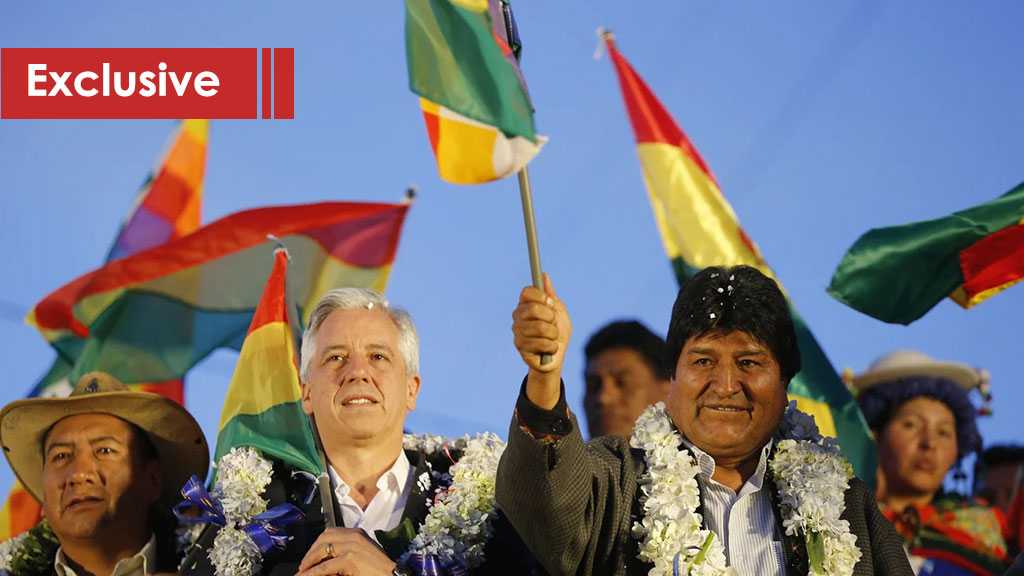
The Return of The Condor


The Return of The Condor
The wave of Color Revolutions sweeping the globe in recent years claimed its latest victim on Sunday. Bolivia’s Evo Morales, who was unwilling to subordinate his nation’s sovereign rights to US interests, was removed from office.
Numerous foreign officials – from the UK’s opposition leader, Jeremy Corbyn, to Venezuelan President Nicolas Maduro – described Morales’ departure as a coup d’etat.
The charge is not at all surprising. Morales, Bolivia’ s first indigenous president, was reelected three times since taking office in January 2006.
The consecutive electoral victories made him Latin America’s longest-serving democratic leader.
During his time in office, Bolivia enjoyed an unprecedented level of political and social stability, recording an economic growth rate of between 4% and 6%.
But following the latest elections in October, the opposition and regional US vassals began screaming bloody murder.
Amid allegations of fraud, the Washington-based Organization of American States [OAS] was mandated to carry out an audit of the election results.
Claiming irregularities, the OAS recommended that Bolivia hold fresh elections. Morales agreed, but just hours later, Bolivian military chiefs stepped into the fray and ‘asked’ the incumbent to resign.
Faced with a violent onslaught against his supporters in a country with an unstable ethno-political makeup, Morales put the wellbeing of the Bolivian people before his desire to remain in power and stepped down.
However, his resignation has not extinguished the possibility of further unrest. Bolivia remains vulnerable to a high risk of violence, as gangs roam capital La Paz to attack businesses and set property ablaze.
To what extent the situation escalates will depend largely on how far the victors of the revolution are willing to go in persecuting Morales supporters. And despite the mainstream narrative, there is no shortage of Bolivians who still see the former president as a champion of the poor, who ushered in a period of steady economic growth.
Meanwhile, in Washington, smothering that kind of sentiment is exactly what is required.
For those roaming the US halls of power, the departure of Morales brings them “one step closer to a completely democratic, prosperous, and free Western Hemisphere.”
With those words, President Donald Trump once again invoked the so-called Monroe Doctrine.
Swimming against the tide
Evo Morales was the last survivor of the ‘Pink Tide’, which ushered in left-wing governments across Latin America two decades ago, starting with the consecutive elections of Hugo Chavez in Venezuela and Lula da Silva in Brazil.
Among one of the main driving forces behind the rise of these progressive leaders is the very powerful anti-American sentiment in the region, which was instigated by bloody escapades like the infamous Operation Condor.
This US-backed action throughout the 1960s and ‘70s centered on economic warfare, political murders, coups and the sponsorship of brutal, far-right regimes in an effort to clear the American continent of all undesirables – or as Trump so eloquently put it, ‘free’ the Western Hemisphere.
In 2017, a tribunal in Rome convicted former heads of state and top security chiefs from Latin America over their involvement in atrocities committed during Operation Condor.
Among those officials were Bolivia’s former dictator, Luis Garcia Meza, and interior minister Luis Arce Gomez.
Interestingly, the court also exposed the involvement of current Trump administration whisperer and former US Secretary of State, Henry Kissinger.
One of the declassified documents admitted as evidence during the trial reveals that Kissinger not only encouraged the brutal repression in individual Latin American states, but also advised regimes to join their efforts.
“If there are things that have to be done, you should do them quickly,” Kissinger is quoted as saying during a June 1976 exchange with Argentina’s then-foreign minister, Admiral Cesar Guzzetti.
“We want you to succeed,” Kissinger said. “We do not want to harass you.”
Those struggling to understand the Trump administration’s foreign policy need to look no further than Henry Kissinger.
The former American diplomat devoted much of his career to advancing the Monroe Doctrine – Washington’s longstanding claim to the Western Hemisphere as an exclusive zone of US interests.
In his 2014 book, ‘World Order’, Kissinger defines the Monroe Doctrine as the US having “the right to intervene preemptively in the domestic affairs of other Western Hemisphere nations to remedy flagrant cases of wrongdoing or impotence.”
Bolivia’s Evo Morales – who criticized US intervention in Venezuela, spoke out against the blockade of Cuba, denounced the military coup in Honduras and applauded Edward Snowden’s revelations – was no doubt guilty of “wrongdoing” on the Kissinger scale.
But more importantly, perhaps, Morales had picked the wrong economic partners.
In February of this year, Bolivia chose a Chinese consortium to be its strategic partner on a new USD 2.3 billion lithium project.
The deal essentially handed Beijing a foothold in Bolivia’s huge untapped reserves of the prized electric battery metal.
Morales is guilty of other sins against US hegemony, too. He brought in Russian energy giant Gazprom for the development of a number of lucrative natural gas fields. The Russians have other massive investments in Bolivia, including the construction of a nuclear research facility. Moreover, Moscow had plans to build hydroelectric power stations and transportation networks.
The time had come to remind Morales and other Latin American states that the Monroe Doctrine was “alive and well” – as John Bolton had famously declared in April.
According to unconfirmed reports, the Bolivian opposition was flushed with millions of dollars from Washington ahead of the October polls.
The Caracas-based Telesur television network reported last month that leaked audio recordings involving Bolivian opposition leaders revealed a plot orchestrated and coordinated from the US embassy in La Paz to unseat the government there.
The recordings reportedly mention contacts between the opposition and hardline American senators Marco Rubio, Ted Cruz and Bob Menendez.
A message to Maduro
Morales’ exit will likely lead to significant changes in Bolivia’s geopolitical vector.
That means that Russia and China will have a much harder time securing contracts for gas exploration, lithium mining and arms sales.
But the coup in Bolivia is particularly bad news for Venezuela’s Nicolas Maduro. The success of the right-wing opposition in La Paz is undoubtedly intended to encourage and inspire their ideological counterparts in Caracas.
And as Maduro loses another friend on the Latin American stage, the message from Washington to the government in Caracas is clear: you may have won a battle against the US-led push to oust you from power, but the war is ongoing.
Related Videos
Related Articles

River to Sea Uprooted Palestinian   
The views expressed in this article are the sole responsibility of the author and do not necessarily reflect those of the Blog!

Friday, 27 September 2019

DONALD TRUMP: ‘FUTURE BELONGS TO PATRIOTS NOT GLOBALISTS’


Donald Trump: 'Future Belongs To Patriots Not Globalists'
On September 24, US President Donald Trump made his third address to the United Nations. Many said that the adress was ‘ordinary’ for Trump. Some parts of the adress are inspiring, while others raise concerns.

Donald Trump at the United Nations General Assembly (full transcript):

Madam President, Mr. Secretary General, world leaders, ambassadors, and distinguished delegates:
One year ago, I stood before you for the first time in this grand hall. I addressed the threats facing our world, and I presented a vision to achieve a brighter future for all of humanity. Today, I stand before the United Nations General Assembly to share the extraordinary progress we have made.
In less than two years, my administration has accomplished more than almost any administration in the history of our country. America is so thrilled. [Laughter] I did not expect that reaction, but that’s okay. [Applause] America’s economy is booming like never before. Since my election, we have added $10 trillion in wealth. The stock market is at an all-time high in history, and jobless claims are at a 50-year low.
Comment: Mr. Trump is right and his ill-wishers cannot deny this. It is important to note that the successes of the US economy took place amid the decline of the global economy. The economic strategy of the Trump administration was designed to support the US national industry and demonstrated own effectiveness. The US nation is lucky that in the current condition the US leader is patriot Trump rather than some creature of the global capital.
African American, Hispanic American, and Asian American unemployment have all achieved their lowest levels ever recorded. We have added more than 4 million new jobs, including half a million manufacturing jobs. We have passed the biggest tax cuts and reforms in American history. We have started the construction of a major border wall, and we have greatly strengthened border security. We have secured record funding for our military, $700 billion this year and $716 billion next year. Our military will soon be more powerful than it has ever been before. In other words, the United States is stronger, safer, and a richer country than it was when I assumed office less than two years ago. We are standing up for America and the American people.
We are also standing up for the world. This is great news for our citizens and for peace-loving people everywhere. We believe that when nations respect the rights of their neighbors and defend the interests of their people, they can better work together to secure the blessings of safety, prosperity, and peace. Each of us here today is the emissary of a distinct culture, a rich history, and a people bound together by ties of memory, tradition, and the values that make our homelands like nowhere else on Earth. That is why America will always choose independence and cooperation over global governance, control, and domination. I honor the right of every nation in this room to pursue its own customs, beliefs, and traditions. The United States will not tell you how to live or work or worship. We only ask that you honor our sovereignty in return.
Comment: Since the very start of the presidency, Mr. Trump has demonstrated that for him such words are not just a colorful rhetoric needed to cover destructive US actions towards other states. However, the life is not rainbows and unicorns. Washington has been demonstrating double standards in its foreign policy for a very long time.
From Warsaw to Brussels to Tokyo to Singapore, it has been my highest honor to represent the United States abroad. I have forged close relationships and friendships and strong partnerships with the leaders of many nations in this room.
Our approach has always yielded incredible change. With support from many countries here today, we have engaged with North Korea to replace the specter of conflict with a bold and new push for peace. In June, I traveled to Singapore to meet face-to-face with North Korea’s leader, Kim Jong Un. We had highly productive conversations and meetings. We agreed that it was in both countries’ interest to pursue the denuclearization of the Korean peninsula. Since that meeting, we have seen a number of encouraging measures that few could have imagined a short time ago. The missiles and rockets are no longer flying in every direction. Nuclear testing has stopped. Some military facilities are already being dismantled. Our hostages have been released. And as promised, the remains of our fallen heroes are being returned home, to lay at rest in American soil. I would like to thank Chairman Kim for his courage and for the steps he has taken, though much work remains to be done. The sanctions will stay in place until denuclearization occurs. I also want to thank the many member states who helped us reach this moment, a moment that is actually far greater than people would understand—far great. But for, also, their support and the critical support that we will all need going forward, a special thanks for President Moon of South Korea, the Prime Minister Abe of Japan, and President Xi of China.
In the Middle East, our new approach is yielding great strides and very historic change. Following my trip to Saudi Arabia last year, the Gulf countries opened a new center to target terrorist financing. They are enforcing new sanctions, working with us to identify and track terrorist networks, and taking more responsibility for fighting terrorism and extremism in their own region. The UAE, Saudi Arabia, and Qatar have pledged billions of dollars to aid the people of Syria and Yemen, and they are pursuing multiple avenues to ending Yemen’s horrible, horrific civil war.
Ultimately, it is up to the nations of the region to decide what kind of future they want for themselves and their children. For that reason, the United States is working with the Gulf Cooperation Council, Jordan, and Egypt to establish a regional strategic alliance so that Middle Eastern nations can advance prosperity, stability, and security across their home region.
Comment: These remarks once again demonstrate that the US president is supporter of the traditional system of the international relations. At the same time, the colorful phrase about the right of “the nations of the region to decide what kind of future they want for themselves and their children” is used to hide anti-Iranian intentions and efforts to create and strengthen an anti-Iranian coalition that would include Jordan and Egypt. The goal of this coalition would be to counter Iranian influence and in some cases even to meddle the Iranian internal political situation.
Thanks to the United States military, and our partnership with many of your nations, I am pleased to report that the bloodthirsty killers known as isis have been driven out from the territory they once held in Iraq and Syria. We will continue to work with friends and allies to deny radical Islamic terrorists funding, territory, or support or any means of infiltrating our borders.
The ongoing tragedy in Syria is heartbreaking. Our shared goals must be the de-escalation of military conflict along with a political solution that honors the will of the Syrian people. In this vein, we urge the United Nations–led peace process to be reinvigorated. But rest assured, the United States will respond if chemical weapons are deployed by the Assad regime.
Comment: Mr. Trump demonstrates a dramatic shift of the US position towards the conflict in Syria. He does not repeat the ‘Assad must go’ mantra and says that the conflict should be settled through “political solutions”. The President also avoids to mention the supposed US support to the Syrian opposition. Even, the cornerstone of the US public agenda in the Syrian conflict, “chemical weapons”, is used just as a warning in for the case if such weapons “are deployed”. This stance is in contrary to the stance of the Obama administration and the Trump administration during its first two years.
I commend the people of Jordan and other neighboring countries for hosting refugees from this very brutal civil war. As we see in Jordan, the most compassionate policy is to place refugees as close to their homes as possible, to ease their eventual return to be part of the rebuilding process. This approach also stretches finite resources to help far more people, increasing the impact of every dollar spent.
Every solution to the humanitarian crisis in Syria must also include a strategy to address the brutal regime that is fueled and financed in the corrupt dictatorship in Iran. Iran’s leaders sow chaos, death, and disruption. They do not respect their neighbors or borders, or the sovereign rights of nations. Instead, Iran’s leaders plunder the nation’s resources to enrich themselves and to spread mayhem across the Middle East and far beyond. The Iranian people are rightly outraged that their leaders have embezzled billions of dollars from Iran’s treasury, seized valuable portions of the economy, and looted the religious endowments, all to line their own pockets and send their proxies to wage war. Not good. Iran’s neighbors have paid a heavy toll for the regime’s agenda of aggression and expansion. That is why so many countries in the Middle East strongly supported my decision to withdraw the United States from the horrible 2015 Iran nuclear deal and reimpose nuclear sanctions.
The Iran deal was a windfall for Iran’s leaders. In the year since the deal has been reached, the military budget grew nearly 40 percent. The dictatorship used the funds to build nuclear-capable missiles, increase internal repression, finance terrorism, and fund havoc and slaughter in Syria and Yemen. The United States has launched a campaign of economic pressure to deny the regime the funds it needs to advance its bloody agenda. Last month, we began reimposing hard-hitting nuclear sanctions that have been lifted under the Iran deal. Additional sanctions will resume November 5, and more will follow. We are working with countries that import Iranian crude oil to cut their purchases substantially. We cannot allow the world’s leading sponsor of terrorism to possess the planet’s most dangerous weapons. We cannot allow a regime that chants “Death to America” and that threatens Israel with annihilation to possess the means to deliver a nuclear warhead to any city on Earth. We just cannot do it. We ask all nations to isolate Iran’s regime as long as its aggression continues, and we ask all nations to support Iran’s people as they struggle to reclaim their religious and righteous destiny.
This year, we took another significant step forward in the Middle East in recognition of every sovereign state to determine its own capital. I moved the U.S. Embassy in Israel to Jerusalem. The United States is committed to a future of peace and stability in the region, including peace between the Israelis and the Palestinians. That aim is advanced, not harmed, by acknowledging the obvious facts. America’s policy of principled realism means that we will not be held hostage to old dogmas, discredited ideologies, and so-called experts who have been proven wrong, over the years, time and time again.
Comment: These remarks were expected. They were based on Trump’s vision of Israel as the key US ally in the Middle east. However, attempts to link the relocation of the US embassy to Jerusalem with the commitment to the “future of peace and stability in the region, including peace between the Israelis and the Palestinians” are surprising. It is unclear how the peace and stability could be achieved through these actions. Nonetheless, Trump once again demonstrated himself as the supporter of hard realpolitik principles and direct actions.
This is true, not only in matters of peace, but in matters of prosperity. We believe that trade must be fair and reciprocal. The United States will not be taken advantage of any longer. For decades, the United States opened its economy, the largest by far on Earth, with few conditions. We allowed foreign goods from all over the world to flow freely across our borders. Yet other countries did not grant us free and reciprocal access to their markets in return. Even worse, some countries abused their openness to dump their products, subsidize their goods, target our industries, and manipulate their currencies to gain unfair advantage over our country. As a result, our trade deficit ballooned to nearly $800 billion a year. For this reason, we are systematically renegotiating broken and bad trade deals. Last month, we announced a groundbreaking U.S.-Mexico trade agreement.
Comment: The strengthening of protectionism policies is generally consistent with Trump’s economic doctrine. Trump focuses on the revision of unfair, “broken and bad” trade deals. If Trump is re-elected, further protectionist measures in the field of the US foreign trade should be expected.
Just yesterday, I stood with President Moon to announce the successful completion of the brand-new U.S.-Korea trade deal. This is just the beginning. Many nations in this hall will agree that the world trading system is in dire need of change. For example, countries were admitted to the World Trade Organization that violate every single principle on which the organization is based.
Comment: The fact that the World Trade Organization does not work is an open secret. The organization de-facto does not pursues goals declared during its creation. Trump is right that the WTO violates “every single principle on which the organization is based.” It is important to note that the WTO gained its current form thanks to actions and policy of the previous US administrations, which were shaped by supporters of the globalists. These very powers were interested in the current state of the WTO. However, the US president that demonstrates different approaches, focusing on protectionism, the national economic development and the rationale nationalism, is not interested in such a state of the WTO.
While the United States and many other nations played by the rules, these countries use government-run industrial planning and state-owned enterprises to rig the system in their favor. They engaged in relentless product dumping, forced technology transfer, and the theft of intellectual property. The United States lost over 3 million manufacturing jobs, nearly a quarter of all steel jobs, and 60,000 factories after China joined the WTO. We have racked up $13 trillion in trade deficits over the last two decades.
But those days are over. We will no longer tolerate such abuse. We will no longer allow our workers to be victimized, our companies to be cheated, and our wealth to be plundered and transferred. America will never apologize for protecting its citizens. The United States has just announced tariffs on another $200 billion in Chinese-made goods, for a total so far of $250 billion. I have great respect and affection for my friend President Xi, but I have made clear that our trade imbalance is just not acceptable. China’s market distortions and the way they deal cannot be tolerated.
As my administration has demonstrated, America will always act in our national interests. I spoke before this body last year and warned that the UN Human Rights Council had become a grave embarrassment to this institution, shielding egregious human-rights abusers while bashing America and its many friends. Our ambassador to the United Nations, Nikki Haley, laid out a clear agenda for reform, but despite reported and repeated warnings, no action at all was taken. So the United States took the only responsible course: We withdrew from the Human Rights Council and we will not return until real reform is enacted.
For similar reasons, the United States will provide no support and recognition to the International Criminal Court. As far as America is concerned, the ICC has no jurisdiction, no legitimacy, and no authority. The ICC claims near-universal jurisdiction over the citizens of every country, violating all principles of justice, fairness, and due process.
Comment: Trump once again declares his vision of the United States as an independent sovereign state, which should be governed exclusively by the people of the United States through democratic procedures. He rejects the globalism and demonstrates that he is well aware of the nature and specifics of the processes that take place in a number of international bodies – for example, in the Human Rights Council and the International Criminal Court. He names the forces that dominate these organizations – the global bureaucracy and the associated global capital – the globalists aiming to establish the so-called New World Order. Trump makes it clear that he is a fierce opponent of this concept.
WE WILL NEVER SURRENDER AMERICA’S SOVEREIGNTY TO AN UNELECTED, UNACCOUNTABLE GLOBAL BUREAUCRACY. AMERICA IS GOVERNED BY AMERICANS. WE REJECT THE IDEOLOGY OF GLOBALISM, AND WE EMBRACE THE DOCTRINE OF PATRIOTISM. AROUND THE WORLD, RESPONSIBLE NATIONS MUST DEFEND AGAINST THREATS TO SOVEREIGNTY NOT JUST FROM GLOBAL GOVERNANCE, BUT ALSO FROM NEW FORMS OF COERCION AND DOMINATION.
Comment: These words are the culmination and the very essence of the address. Globalists will not forgive this. The next US presidential race is expected to be even tenser than the previous one. Trump could be described as a controversial person. But in this very case, he seems to be an island of sanity and a clear vision surrounded by oligarchic clans advocating globalism and the New World Order.
In America, we believe in energy security for ourselves and for our allies. We have become the largest energy producer anywhere on the face of the Earth. The United States stands ready to export our abundant, affordable supply of oil, clean coal, and natural gas. OPEC and OPEC nations are, as usual, ripping off the rest of the world, and I don’t like it. Nobody should like it. We defend many of these nations for nothing, and then they take advantage of us by giving us high oil prices. Not good. We want them to stop raising prices; we want them to start lowering prices. They must contribute substantially to military protection from now on. We are not going to put up with it, these horrible prices, much longer. Reliance on a single foreign supplier can leave a nation vulnerable to extortion and intimidation. That is why we congratulate European states such as Poland for leading the construction of a Baltic pipeline so that nations are not dependent on Russia to meet their energy needs. Germany will become totally dependent on Russian energy if it does not immediately change course.
Here in the Western Hemisphere, we are committed to maintaining our independence from the encroachment of expansionist foreign powers. It has been the formal policy of our country since President Monroe that we reject the interference of foreign nations in this hemisphere and in our own affairs. The United States has recently strengthened our laws to better screen foreign investments in our country for national-security threats. We welcome cooperation with countries in this region and around the world that wish to do the same. You need to do it for your own protection.
The United States is also working with partners in Latin America to confront threats to sovereignty from uncontrolled migration. Tolerance for human struggling and human smuggling and trafficking is not humane. It is a horrible thing that is going on, at levels that nobody has ever seen before. It is very, very cruel. Illegal immigration funds criminal networks, ruthless gangs, and the flow of deadly drugs. Illegal immigration exploits vulnerable populations and hurts hardworking citizens and has produced a vicious cycle of crime, violence, and poverty. Only by upholding national borders, destroying criminal gangs can we break the cycle and establish a real foundation for prosperity.
We recognize the right of every nation in this room to set its own immigration policy in accordance with its national interests, just as we ask other countries to respect our own right to do the same, which we are doing. That is one reason the United States will not participate in the new Global Compact on Migration. Migration should not be governed by an international body, unaccountable to our own citizens. Ultimately, the only long-term solution to the migration crisis is to help people build more hopeful futures in their home countries. Make their countries great again.
Comment: Trump’s United States would continue demonstrate the rationale protectionism and isolationism and defend the right of the nation to decide what kind of future it wants for itself.
Currently, we are witnessing a human tragedy as an example in Venezuela. More than 2 million people have fled the anguish inflicted by the socialist Maduro regime and its Cuban sponsors. Not long ago, Venezuela was one of the richest countries on earth. Today, socialism has bankrupted the oil-rich nation and driven its people into abject poverty. Virtually everywhere, socialism or communism has been tried. It has produced suffering, corruption, and decay. Socialism’s thirst for power leads to expansion, incursion, and oppression. All nations of the world should resist socialism and the misery that it brings to everyone. In that spirit, we ask the nations gathered here to join us in calling for the restoration of democracy in Venezuela. Today, we are announcing additional sanctions against the repressive regime, targeting Maduro’s inner circle and close advisers.
We are grateful for all of the work the United Nations does around the world to help people build better lives for themselves and their families. The United States is the world’s largest giver in the world by far of foreign aid. But few give anything to us. That is why we are taking a hard look at U.S. foreign assistance. That will be headed up by Secretary of State Mike Pompeo. We will examine what is working, what is not working, and whether the countries who receive our dollars and our protection also have our interests at heart. Moving forward, we are only going to give foreign aid to those who respect us and, frankly, are our friends. We expect other countries to pay their fair share for the cost of their defense.
The United States is committed to making the United Nations more effective and accountable. I have said many times that the United Nations has unlimited potential. As part of our reform effort, I have told our negotiators that the United States will not pay more than 25 percent of the UN peacekeeping budget.
Comment: The US president just mocked international bodies in his unique style. He declared support to their actions, but said that he would not give them money.
This will encourage other countries to step up, get involved, and also share in this very large burden. We are working to shift more of our funding from assessed contributions to voluntary so that we can target American resources to the programs with the best record of success. Only when we each of us does our part and contributes our share can we realize the United Nations’ highest aspirations. We must pursue peace without fear, hope without despair, and security without apology.
Looking around this hall, where so much history has transpired, we think of the many before us who have come here to address the challenges of their nations and of their times. Our thoughts turn to the same question that ran through all of their speeches and resolutions, through every word and every hope. It is the question of, what kind of world will we leave for our children and what kind of nations they will inherit. The dreams that fill this hall today are as diverse as the people who have stood at this podium, and as varied as the countries represented right here, in this body, are. It really is something. It really is great, great history.
There is India, a free society over a billion people, successfully lifting countless millions out of poverty and into the middle class. There is Saudi Arabia, where King Salman and the crown prince are pursuing bold new reforms. There is Israel, proudly celebrating its 70th anniversary as a thriving democracy in the Holy Land. In Poland, the great people are standing up for their independence, their security, and their sovereignty.
Comment: The list of ‘successful and democratic’ nations named by Mr. Trump is especially interesting and funny. He said that India is “a free society over a billion people, successfully lifting countless millions out of poverty and into the middle class”. But he somehow forgot to mention that India is the state with one of the highest levels of social inequality. In fact, India is in the list because it’s the main regional competitor of China, the US is draining brains from the Indian nation, and India is a prospective market for the US industry, mainly the military industrial complex.
Saudi Arabia and Israel are the united Middle Eastern family of the traditional US allies. Their economies are incorporated into the US economy.
As to Poland, this state is currently one of the main political and economic competitors of Germany within the EU and thus the US ally. At the same time, Washington sees Poland as a deterrent force against Russia. Besides this, Poland has been acting as an agent working in interests of the Anglo-Saxon world in Europe.
Many countries are pursuing their own unique visions, building their own hopeful futures, and chasing their own wonderful dreams of destiny, of legacy, and of a home. The whole world is richer. Humanity is better because of this beautiful constellation of nations, each very special, each very unique, each shining brightly in its part of the world. In each one, we see also promise of a people bound together by a shared past and working toward a common future.
As for Americans, we know what kind of future we want for ourselves. We know what kind of a nation America must always be. In America, we believe in the majesty of freedom and the dignity of the individual. We believe in self-government and the rule of law. We prize the culture that sustains our liberty, a culture built on strong families, deep faith, and fierce independence. We celebrate our heroes, we treasure our traditions, and, above all, we love our country. Inside everyone in this great chamber today, and everyone listening all around the globe, there is the heart of a patriot that feels the same powerful love for your nation, the same intense loyalty to your homeland, the passion that burns in the hearts of patriots and the souls of nations has inspired reform and revolution, sacrifice and selflessness, scientific breakthroughs and magnificent works of art.
Our task is not to erase it, but to embrace it—to build with it, to draw on its ancient wisdom, and to find within it the will to make our nations greater, our regions safer, and the world better. To unleash this incredible potential in our people, we must defend the foundations that make it all possible. Sovereign and independent nations are the only vehicle where freedom has ever survived, democracy has ever endured, or peace has ever prospered. And so we must protect our sovereignty and our cherished independence above all. When we do, we will find new avenues for cooperation unfolding before us. We will find new passion for peacemaking rising within us. We will find new purpose, new resolve, and new spirit flourishing all around us, and making this a more beautiful world in which to live.
Together, let us choose a future of patriotism, prosperity, and pride. Let us choose peace and freedom over domination and defeat. Let us come here to this place to stand for our people and their nations.
Comment: These are great words. Nonetheless, we kindly ask Mr. Trump to reveal the list of nations that would have a right able to achieve this “future of patriotism, prosperity, and pride”, according to his vision.
Forever strong, forever sovereign, forever just. Forever thankful for the grace and the goodness and the glory of God. Thank you, God bless you, and God bless the nations of the world. Thank you very much.
***
In the end, it is also interesting to note that Mr. Trump has almost fully ignored the so-called ‘Russian threat’ in his address. He mentioned Russia once when talked about the US interests in the European energy market and the German-Russian relations. However, there was no criticism aimed against Russia in general. Furthermore, the US President fully ignored the Ukraine question demonstrating his real stance towards the conflict.
Over the past days, the Trump administration has sent signals that it is not going to fund Ukraine just because it’s allegedly engaged in the “war with Russia”. Furthermore, Washington demonstrates that it is not interested in the further escalation of the situation in the region.

River to Sea Uprooted Palestinian   
The views expressed in this article are the sole responsibility of the author and do not necessarily reflect those of the Blog!

Monday, 8 April 2019

What Monroe Doctrine?


What Monroe Doctrine?

What Monroe Doctrine?


Because there is a presidential election coming up next year, the Donald Trump Administration appears to be looking for a country that it can attack and destroy in order to prove its toughness and willingness to go all the way in support of alleged American interests. It is a version of the old neocon doctrine attributed to Michael Ledeen, the belief that every once in a while, it is necessary to pick out some crappy little country and throw it against the wall just to demonstrate that the United States means business.
“Meaning business” is a tactic whereby the adversary surrenders immediately in fear of the possible consequences, but there are a couple of problems with that thinking. The first is that an opponent who can resist will sometimes balk and create a continuing problem for the United States, which has a demonstrated inability to start and end wars in any coherent fashion.
This tendency to get caught in a quagmire in a situation that might have been resolved through diplomacy has been exacerbated by the current White House’s negotiating style, which is to both demand and expect submission on all points even before discussions begin. That was clearly the perception with North Korea, where National Security Advisor John Bolton insisted that Pyongyang had agreed to American demands over its nuclear program even though it hadn’t and would have been foolish to do so for fear of being treated down the road like Libya, which denuclearized but then was attacked and destroyed seven years later. The Bolton mis-perception, which was apparently bought into by Trump, led to a complete unraveling of what might actually have been accomplished if the negotiations had been serious and open to reasonable compromise right from the beginning.
Trump’s written demand that Kim Jong Un immediately hand over his nuclear weapons and all bomb making material was a non-starter based on White House misunderstandings rooted in its disdain for compromise. The summit meeting with Trump, held in Hanoi at the end of February, was abruptly canceled by Kim and Pyongyang subsequently accused Bolton and Secretary of State Mike Pompeo of making “gangster-like” demands.
The second problem is that there are only a few actual casus belli situations under international law that permit a country to attack another preemptively, and they are usually limited to actual imminent threats. The current situation with Venezuela is similar to that with North Korea in that Washington is operating on the presumption that it has a right to intervene and bring about regime change, using military force if necessary, because of its presumed leadership role in global security, not because Caracas or even Pyongyang necessarily is threatening anyone. That presumption that American “exceptionalism” provides authorization to intervene in other countries using economic weapons backed up by a military option that is “on the table” is a viewpoint that is not accepted by the rest of the world.
In the case of Venezuela, where Trump has dangerously demanded that Russia withdraw the hundred or so advisors that it sent to help stabilize the country, the supposition that the United States has exclusive extra-territorial rights is largely based on nineteenth and early twentieth century unilaterally declared “doctrines.” The Monroe Doctrine of 1823 and the Roosevelt Corollary of 1904 de facto established the United States as the hegemon-presumptive for the entire Western Hemisphere, stretching from the Arctic Circle in the north to Patagonia in the south.
John Bolton has been the leader in promoting the Monroe Doctrine as justification for Washington’s interference in Venezuela’s politics, apparently only dimly aware that the Doctrine, which opposed any attempts by European powers to establish new colonies in the Western Hemisphere, was only in effect for twenty-two years when the United States itself annexed Texas and then went to war with Mexico in the following year. The Mexican war led to the annexation of territory that subsequently became the states of California, New Mexico, Nevada, Utah, Arizona and Colorado. In the same year, the United States threatened war with Britain over the Oregon Territory, eventually accepting a border settlement running along the 49th parallel.
Meanwhile the march westward across the plains continued, forcing the Indian tribes back into ever smaller spaces of open land. The US government in the nineteenth century recognized some Indian tribes as “nations” but it apparently did not believe that they enjoyed any explicit “Monroe Doctrine” rights to continue to exist outside reservations when confronted by the “manifest destiny” proponents who were hell bent on creating a United States that would run from the Atlantic to the Pacific Ocean.
The Roosevelt Corollary of 1904 amended the Monroe Doctrine, making it clear that the United States believed it had a right to interfere in any country in the western Hemisphere to maintain good order, which inevitably led to exploitation of Latin American nations by US business conglomerates that could count on a little help from US Marines if their trade agreements were threatened. In 1898, Washington became explicitly imperialist when it defeated Spain and acquired effective control over Cuba, a number of Caribbean Islands and the Philippines. This led to a series of more than thirty interventions by the US military in the Caribbean and Central America between 1898 and 1934. Other states in the region that were not directly controlled by Washington were frequently managed through arrangements with local autocrats, who were often themselves generals.
Make no mistake, citing the Monroe Doctrine is little more than a plausible excuse to get rid of the Venezuelan government, which is legitimate, like it or not. The recent electrical blackouts in the country are only the visible signs of an aggressive campaign to destroy the Venezuelan economy. The United States is engaging in economic warfare against Caracas, just as it is doing against Tehran, and it is past time that it should be challenged by the international community over its behavior. Guns may not be firing but covert cyberwarfare is total warfare nevertheless, intended to starve people and increase their suffering in order to bring about economic collapse and take down a government to change it into something more amenable to American interests.

River to Sea Uprooted Palestinian   
The views expressed in this article are the sole responsibility of the author and do not necessarily reflect those of the Blog!

Saturday, 6 April 2019

FINALLY, GUAIDO TO BE STRIPPED OF IMMUNITY; SYRIA REDUX


Image result for elliott abrams
(Photo Credit: Codepink.org) Elliott Abrams, a Zionist katsa neo-con slug has been tasked with overthrowing the legitimate president of Venezuela. This “ojete chingado” was convicted of lying to Congress back in the days of the Iran-Contra scandal and should have had his career terminated but for the fact that he is the kind of rodent loved by Washington’s neo-con cabal of murdering Zionist sociopaths.
People are finally realizing that the situation in Venezuela is the same as that of Syria in 2011.  It is becoming increasingly clear that die-hard, entrenched Zionist neo-cons in Washington will not give up on their insane crusade to make the Zionist Apartheid State both unassailable and durable.  Maduro has taken our advice, evidently, and is studying the Syrian model closely.  The Russians, who are committed to Maduro’s survival, are also giving him advice based on the rich records they have of the war in Syria and their own involvement.  They have told him to stay put and control the streets.
In Syria, the so-called “peaceful” demonstrations were not enough to oust the sitting government in Damascus.   Dr. Assad stayed put.  The street demonstrations in both Der’ah and Homs transmogrified into a full-blown insurrection complete with Islamist fanatics, foreign mercenaries and, even direct assistance from NATO countries.  Some of you might remember the “Shpionshiffe” Merkel sent to the coastline of Turkey in order to monitor the movements of the SAA to help the terrorists to destabilize Syria.
I don’t believe the U.S. will follow that program for several reasons.  The first is that Gulf nations which had the ability to fund the arrival of tens of thousands of mercenaries to fight alongside the Syrian terrorists are no longer on speaking terms and are unlikely to try their hand again at regime change.  Both Saudi Arabia and Qatar are at odds with one another over terrorism support and relations with Iran.  The scenario in Venezuela is distant in both geography and politics.  If Elliott Abrams thinks he’s going to get a repeat of the disastrous intervention in Venezuela, he is in for a tough awakening.
Add to this the prospect of another insurrection against a sitting president when that president has the support of the Russian Federation.  Again, Abrams would be foolish not to consider again the disgraceful failure of the U.S. under Obama to effectuate a clean ouster of Dr. Assad.  It would be even more ignominious for the U.S. to fail in a country located well within the borders of the Monroe Doctrine, like Venezuela.
We must also remember that most Latin American countries are loath to invite the U.S. to invade a nation in South America.  Memories of the tragic death of Salvador Allende in Chile, with the blood-stained hands of the United States all too visible, remain a formidable disincentive for any Latin American president, even Bolsinaro, to contemplate accommodation with Washington.  Other incidents of Yanqui involvement include Cuba, Mexico and Nicaragua.  The U.S. simply cannot afford another debacle in its own backyard.  Supporting the CONTRAS was egregious enough in Nicaragua,  what with the surreptitious Iranian deal-making that brought the U.S. into international disrepute;  imagine the fallout if the U.S. were to engage the services of something like FARC to help topple President Maduro.  But, FARC is in the Maduro camp.  There is no Saudi Arabia or Qatar to finance the arrival of religious fanatics from the four corners of the world to help to unseat the legitimate president of Venezuela.  Elliott Abrams is looking into Nietsche’s darkest abyss.  And it’s staring back at him.
Maduro is clearly feeling better.  His Constituent Assembly has ordered Guaido’s immunity removed on the recommendation of the Chief Justice of the Supreme Court.  It is obvious the upstart Yanque stooge is going to be arrested finally for treason.  The U.S. has repeatedly warned Maduro that arresting Guaido would cross a red line.  Abrams has said it.  So has Bolton.  And so have Pence and Pompeo.  Yet, it appears the Americans have talked themselves, once again, into a corner.  With all sanctions imposed on Venezuela, what is there left for Washington to do?  Invasion?  Surgical strikes on infrastructure?  They did all that in Syria and where did that get them?  In Libya, the Americans nihilistically bombed the country into pure devastation, destroying the nation with the highest standard of living in all Africa.  Hillary Clinton, shrieked with joy after telling the world that Qaddafi was dead.  And now, the Yanquis, and their miserable frog and limey allies are trying to pick up the pieces of one of history’s most reprehensible acts of political gluttony.  The U.S. cannot afford another disaster like that.  Or can it?
Oh, Europe will be aghast at the arrest of Guaido.  The Europeans will pontificate and self-congratulate themselves for their own civility.  They will tsk-tsk at Mr. Maduro, who, just like Dr. Assad, will blow his nose at the mentally corrupt hypocrites, like Macron, May and Merkel, all of them, descendants of the European barbarians who colonized the world with their toxic philosophies of greed and rapine – the same doctrines which led to the infamous creation of that metastatic, cancerous tumor known to my readers as the Zionist Entity.
Maduro stands with the Palestinian people.  That should be reason enough for well-meaning countries to stand up and fight to keep him in power.
Note to readers:  Until the Russians sell the S-400 to Turkey and Turkey begins to receive and deploy the systems, little will happen in Syria.  There is simply a scarcity of news.  .

River to Sea Uprooted Palestinian   
The views expressed in this article are the sole responsibility of the author and do not necessarily reflect those of the Blog!