Showing posts with label Trade War. Show all posts

Tuesday, 5 October 2021

Sitrep: China. Is. Dead. Serious.

 October 04, 2021

Escalation?  Continuation of “Sitrep : China. Is. Dead. Serious.”

By Chris Faure for the Saker Blog

China will not be conquered again, even if every last Chinese has to join the fight.

In the past four days, China has sent first 28, then 29 fighters and bombers near Taiwan. (Taiwan itself reports different numbers). Then, the US announced on Sunday that this is provocative. So, China called the statement irresponsible and sent a massive number of 59 fighters and bombers near Taiwan in a ‘take that!’ move.

https://www.globaltimes.cn/page/202110/1235639.shtml

But first, why would China militarily get involved in Taiwan, as it is their own territory under the 1992 Consensus for “one-China”? Taiwan is clearly China’s internal affair.  What are their red lines?

  • Taiwan declaring a flash independence (they cannot really because they are umbilically connected to the mainland)
  • Internal turmoil inside Taiwan as we saw in Hong Kong
  • Taiwan may make a non-legal military alliance with another country
  • And any violation of the 1992 consensus.

None of these conditions are currently present, but we will need expert advice on the 1992 consensus. I do not know de jure how close Taiwan is to that red line. De facto the Taiwan announcement that they are preparing for war is completely provocative.

Currently China is not threatening, she is using her air force to deliver very strong warnings that the conditions are approaching red lines.

Lets look at Global Times. Bear in mind that the Global Times is not a bullhorn for Chinese people. It is for the dissemination of information to western people. That is its function. 

https://www.globaltimes.cn/page/202110/1235638.shtml

The Take Aways are:

– Time to warn Taiwan secessionists and their fomenters: war is real:

“The secessionist forces on the island will never be allowed to secede Taiwan from China under whatever names or by whatever means, and, the island will not be allowed to act as an outpost of the US’ strategic containment against China. “

– “The strategic collusion between the US and Japan and the DPP authorities is becoming more audacious, and the situation across the Taiwan Straits has almost lost any room for maneuver teetering on the edge of a face-off, creating a sense of urgency that the war maybe triggered at any time.”

Sunday, further Global times writing appeared, by a GT voice, warning the EU (GT voice should indicate to us that this is unified among the Chinese people).

EU warned not to play with fire on Taiwan question. https://www.globaltimes.cn/page/202109/1235387.shtml

The Take Aways are:

– China will reconsider the European trade agreement.

“If the EU simply wants to develop normal economic and trade relations with the Taiwan island, its unusual emphasis on the latter’s role in its Indo-Pacific strategy should be viewed with suspicion. Some European politicians may think that playing the “Taiwan card” will draw more attention and could help pressure the mainland to make more concessions. But confusing the right and the wrong on China’s bottom line is a dead end.

The Chinese mainland’s position on the Taiwan question remains clear and resolute. All exchanges with the island must be handled in strict accordance with the one-China principle. They cannot exceed the scope of normal nonofficial cooperation and exchange.”

So, this is where we stand in this face-off and more analysis will follow.

October 05, 2021

Escalation? Continuation of “Sitrep : China. Is. Dead. Serious.”

by Chris Faure for the Saker Blog

Continuation of “Sitrep : China. Is. Dead. Serious.”

Let’s take a look at what China overcame in our near history.

  • The NED and similar organizations’ sponsored “Color Revolutions” in Hong Kong, Tibet, and Xinjiang all collapsed. We can also be sure that this escalation that we see now is not really about Taiwan. Taiwan is playing its role, like the dissidents in Hong Kong did.
  • The Trump Trade War collapsed and his focus on tariffs is now taking a tremendous toll on the US West Coast Ports.
  • The western propaganda war on China is collapsing because of the efforts of blogs like The Saker Blog and many others that took up writing about this.
  • The economic war is collapsing. For this, we have to follow Michael Hudson who details the butt-hurt Soros types who cannot make China dance to their tune. China has done massive work so that they do not have monopolies and internal destabilization by ‘too big to fail types’.
  • The return of Meng Wanzhou as a figure of national pride, which was a very delicate operation if one follows all of the plane routes during the sensitive exchange. Meng was exchanged for two worthless Canadian spies. There is another theory and this is that Canada tumbled to pay back the US for not including them in AUKUS.
  • The idea that the Chinese are not soldiers. They are that now because they have to be. * More about this following.

Let’s see what China gained in our near history

  • The pride, persistence, and trust of the citizens.
  • Major developments in space, like their own space station (slated to be a launching platform for? For what really? I do not know but the west has declared space a warfighting domain.) Most nations are welcome to come and hook up their own module, but the western world is not. This is a little payback for not allowing Chinese astronauts on the international space station.
  • A top US general, Milley, is so fearful of China that he called his counterpart in the late days of the Trump administration and told them that the US will not attack. (General Miley called to deliver a madman message–we have a madman at the helm and he may send nukes your way, so don’t do anything to give him an excuse. The poor general also had to deliver a contradicting message–at the same time, America is not falling apart; everything is hunky-dory and the well-oiled machine is running smoothly. ) (I know this has been taken out of perspective by almost everyone, but I am thankful, no matter that he may be a sniveling idiot. He did the rest of the world a favor).
  • China is in the process of destroying the dollar hegemony slowly but surely with Russia already having done its part and divesting from the dollar in their sovereign wealth fund. This deserves an analysis all by itself. Needless to say, China is launching its digital Renminbi, or Digital Currency Electronic Payment, commonly referred to as E-CNY, a central bank digital currency issued by China’s central bank, the People’s Bank of China. It is the first digital currency to be issued by a major economy. The digital RMB is legal tender and has equivalent value with other forms of CNY, such as bills and coins.
  • The fight against a virus called Covid.
  • China is now exceeding the US in almost all economic metrics, although they still refer to themselves as the 2nd major economy.

And at this stage, China makes major military flights near Taiwan.

A few statements:

  • China has no interest in military action against Taiwan
  • Taiwan has no real desire for military action against China (it would be somewhat like swatting a fly for China and will be over in an hour whichever method China chooses).
  • Here is Taiwanese Foreign Minister warning that his country is preparing for war with China.  He asks Australia for help and Australia’s 60 minutes distributes the war propaganda.
  • https://www.abc.net.au/news/2021-10-04/taiwan-preparing-for-war-with-china/100511294.
  • Is the US interested in a war against China over Taiwan? We simply do not know.

What do we know?

Taiwan is a smaller copy of the economic miracle of China and there is no question of its economic success and high tech ability. But China mainland purchases over 40% of Taiwan’s production in both high-tech and agricultural products.

By studying Taiwan’s financial reports, MintPress has ascertained that the semi-autonomous island of 23 million people has, in recent years, given out millions of dollars to many of the largest and most influential think tanks in the United States.

It is then easy to conclude that with this revolving door, the US decided that Taiwan is an easy ingress to their hope for regime change in China itself (stated publicly by Mike Pompeo) and the AUKUS deal started the new range of increased provocations: It looks like any of the old color revolution tactics or initiatives, just now with an added threat.

This one, could end up in a hot war with both Russia and China.

Taiwan will not have a referendum for independence, because independence is not a done deal for the Taiwanese people. The ruling class fears that such a referendum will not be successful. We all know the ‘call to democracy’ and we all know that this is invoked over and over by hegemonic powers to justify their own excesses. Well today, Taiwan’s Tsai is invoking ‘a call to democracy’ via an article in Foreign Affairs Magazine. China is not impressed as she knows as well as you and I, what that really means. https://www.globaltimes.cn/page/202110/1235658.shtml

China’s interest is peace and security in the region, which is now being called Indo-Pacific. Martyanov says this terminology is hegemon speak, and I’m inclined to agree with him. It used to be Asia Pacific. I so hope someone can draw me the borders (even a dash line) where the Indo pacific and the Asia Pacific exists. Wikipedia, instead of being obscurantist as usual, this time gives the plot away.

The term first appeared in academic use in oceanography and geopolitics. Scholarship has shown that the “Indo-Pacific” concept circulated in Weimar Germany, and spread to interwar Japan. German political oceanographers envisioned an “Indo-Pacific” comprising anticolonial India and republican China, as German allies, against “Euro-America”.[2] Since 2010s, the term “Indo-Pacific” has been increasingly used in geopolitical discourse. It also has “symbiotic link” with the Quadrilateral Security Dialogue, or “Quad”, an informal grouping of in the region, comprising Australia, Japan, India, and the United StatesIt has been argued that the concept may lead to a change in popular “mental maps” of how the world is understood in strategic terms. https://en.wikipedia.org/wiki/Indo-Pacific

Martyanov says that the US has clear dominance in submarine capability and he also says that escalation is something that is very hard to predict. Here we see escalation toward war, with the US using probably the only card that they have to play, trying to kick off an ocean-wide domination conflict on the shipping lanes of communications, with probably the only weapon that they have left, submarines to try and consolidate at least something of US economy and influence across the world. Right here the issue of escalation becomes complex. Russia will not stand out of this and what happens when the Zircons start flying? How soon until Japan, Australia and Taiwan are demolished? We will leave this here for professional analysts to opine.

With that as a backdrop, let’s return to China, specifically the general belief that the Chinese are not born soldiers. That is true, yet the difference is that they prefer to solve problems non-kinetically. (Which is 100% fine with me!) But, they have other abilities, one of which is that they do not give up. The Saker has often said that morale is the greatest weapon of a military force. In this case, I would add to that: preparedness. Again Martyanov said that this thinking on the dominance of sea-lanes is not new. Well, China knows that as well, and they have prepared.

Every school child and university student in China now goes through military training. For the school kids, it is part of the initiative by the Chinese leaders to relieve the school kids from absurd requirements for STEM learning and to get them outside to take part in healthy play and strengthen them physically.

Every city has a local militia and they are armed to the teeth and drill and practice continually. This alone is estimated at 1 million feet on the ground (from Chinese sources).

If kinetic action breaks out in their own backyard, they have the numbers and home team advantage.

Following are some comments from our China correspondents. I don’t have the necessary 2 sources plus another for these, but I put them here to give you an idea of the chat.

China is known to be able to set together production lines very quickly. In these comments, this one is comical and says that China is mass producing nuclear warheads like they crank out paper lanterns. The only thing on earth that is faster is the US money machine.

It may be a comical comment, but the underlying issue here is that the average Chinese person has no doubt that China will, and is able to build whatever is necessary, any war materiel of any kind, to withstand kinetic action.

Is this meaningful in discussing this escalation? I would say yes.

More comments:

If you think a war against China (and Russia – we have to call in Russia at this stage) will be a perpetual war, kindly think again. This is not a win or a lose – it is total destruction of the one that fires the first shot or shoots the first missile or positions the first submarine to destabilize sea-lanes.

This represents the average Chinese and their chat and it is not the type of barroom soldier chat. These are ordinary people.

China is a merit nation and very serious. One can expect precision and ruthlessness. You may want to believe that the Chinese are not born warriors or you may want to believe that they cannot innovate. You can believe what you want, but take a look at these comments:

They do not believe in surgical strikes should anyone attack them. They believe in pounding the source of the attack and whatever is around it, into oblivion. They have their own history as a template.

Btw, does this remind you of the Russians, who said that any strike on Russia will not only take out the strike, but also the platform where the strike comes from? The interaction between Russia and China militarily has grown tremendously as well, but again, this is another analysis.

I expect full-on military readiness as the Chinese military has been on a readiness footing for about a year now.

An outstanding question is how unified Asia is around China. Again we come up against Martyanov’s principle of escalation and this is really difficult to predict.

There is the old saying that goes like this: Do not march on Moscow!. We need to add one. Do not militarily threaten Baba Beijing!. It does not matter how for how long, they do not count their own possible dead, but they will stay the course.

Can we hope for level heads in Washington DC? Realism tells us that we have to hope for the best, but prepare for the worst. China is doing that.


River to Sea Uprooted Palestinian   
The views expressed in this article are the sole responsibility of the author and do not necessarily reflect those of the Blog!

Saturday, 13 February 2021

China newsbrief and sitrep

 Source

February 09, 2021

By Godfree Roberts – selected from his extensive weekly newsletter : Here Comes China

You can get it here:  https://www.herecomeschina.com/#subscribe


Power of Siberia gas pipeline from Gazprom. com

Russia ramps up natural gas supplies to China via Power of Siberia mega-pipeline

“The export of gas to China through the Power of Siberia gas pipeline continues to grow. Supplies regularly exceed Gazprom’s daily contractual obligations,” the company said in a statement, adding that the volume of gas delivery last month “was 2.9 times higher than in January 2020.”


Next up, What the People say.

Says subscriber Frans Vandenbosch, “If I have to describe China in one word, then I would say ‘intense’. Western companies are sheltered workshops, they do not know what real competition is. They should benchmark China to know what real harsh competition looks like.”  Adds Josh Gardner, “Online retail in China is cut-throat. Comparing Taobao with Amazon is like comparing ballet to rugby.”

——————————-

This blog fairly reflects the stance of Chinese people on the long running trade war.  Although it contains some hubris, there is no question that the person in the street is convinced that China will be victorious.

China is establishing an invincible position in its trade war. It will switch many of its exports from the US to BRI countries and move the industries that produce goods for export to the US to the industrial parks in BRI countries to avoid US tariffs and reduce labor costs.

“In the long run, China’s Belt and Road initiative (BRI) will bring economic growth to developing countries and expand China’s market there. It will enable China to switch lots of its exports from the US to those countries. Moreover, BRI will enable China to move the industries that produce goods for export to the US to the industrial parks built by BRI in those countries to avoid US tariff hikes and reduce labor costs. China will thus establish its invincible position in its trade war with the US.”  Read more about the Plan for Long-term Victory


And where is Jack Ma? 

“Ant Group Co. is planning to turn itself into a financial holding company overseen by China’s central bank, responding to pressure to fall fully in line with financial regulations, according to people familiar with the matter.

Chinese regulators recently told Ant, which is controlled by billionaire Jack Ma, to become a financial holding company in its entirety, subjecting it to more stringent capital requirements, the people said. Ant, in response, has submitted to authorities an outline of a restructuring plan, they said.”

The video is worthwhile watching for background, even though it is from the Wall Street Journal.

Jack Ma made the unforgivable error of criticizing in public.  Rule one in China – don’t make the other guy lose face while there are methods to bring problems to the attention of the authorities.   In reality, he seemed to have been absolutely right, and Ant Group was immediately used as a case in point, where the financial regulators fixed their own errors.  This of course led to Ant Group having to disclose their real business as one of the biggest lenders in China, besides their vast technology footprint.  Given what happened in the US with behemoths such as Google and Twitter and large de-platforming, I do not blame the Chinese authorities one bit for having decided that no-one should have this much power.


Now that we’ve found Jack Ma who was busy restructuring his Ant Group, more on China’s credit market. 

China’s credit market got big fast because credit services fit traditional practices. Despite its reputation as a “nation of savers,” Chinese society has traditionally been heavily reliant on debt, facilitated through a long tradition of private and informal borrowing and lending. In this system, instead of concepts like “credit,” access to loans depended on renqing, “human sentiments.” Read full article $→


So, you want to join the CCP?  It is not that easy.

“Next year the Chinese Communist Party (CCP) turns 100. Since its founding in 1921, the CCP has grown from a small cabal of Marxist intellectuals into the world’s second-largest political party, behind only the Bharatiya Janata Party in India. One of the reasons for the CCP’s success has been its cultivation of human capital—any organization is only as good as its people.

Ahead of the Party’s centenary, understanding its longevity requires an understanding of its members. While the Party is frustratingly opaque about internal operations, its human resources division, known as the Organization Department, does publish annual data on membership. After the 2019 numbers were released in June 2020, MacroPolo scoured open source databases to compile the most complete public dataset on CCP membership.”    Read more …


Belt and Road

The Sinocentric bloc of Turkey, Iran and Pakistan could leave America’s ally India isolated and weak. The only three Muslim states with significant military capacity and economic potential participating in the $2 trillion BRI will promote Chinese influence from the Indian Ocean to the Black Sea.  Read full article $→

$10 billion for MENA (Middle-East & North Africa)’s Five BRI Projects): Egypt–Cairo’s New Administrative Capital & CBD; Turkey–The Hunutlu Thermal Power Plant; Jordan–Attarat Oil Shale Power Plant; UAE–Hassyan Clean Coal Power Plant; Lebanon–National Music Conservatory. MENA has 578 million people and 60% of world’s oil, 45% of its gas.Read full article $→


We end this week with some debunkery:

BUNK: Curbs on Mongolian Language Teaching Prompt Large Protests in China

DEBUNK: As a minority Chinese (Manchurian) with his mother side hailing from Hulun Buir, Inner Mongolia, I can say from my own experience that this is FAKE NEWS at its best. The truth is, in the Mongolian language primary education system, Mandarin has been taught and used since my mother can remember. The only change this time is to replace some locally created Mandarin language textbooks with national, official Mandarin language textbooks.

Yes, both of them are Mandarin textbooks. Yet New York Times and its FAKE journalists can’t wait to cook up new FAKE news completely distorting the truth. Shame on the New York Times and its FAKE news journalists! A bit of background for your information:

In Inner Mongolia, where half of my relatives are from, two primary education systems operate in parallel: one in Mandarin, one in Mongolian. Chinese Mongolians can opt for either one and most Chinese Mongolians so far opted for the one in Mandarin – the Mandarin system is of much better education quality due to better human recourse on teachers, and the kids won’t need another ‘prep-year’ before formal university when they attend a university program being taught in Mandarin. In contract, the ones who chose the Mongolian system, despite continuous government fundings to ensure it’s operational, still have to endure the less quality of education.

And this leads to life-long differences in career development and social mobility between two groups of students. There are law-required quota for these Mongolian-taught students in top Chinese universities, including THU and PKU. However, the truth is that these students often find their university coursework beyond their capability, and the fail rate is much higher than the Mongolian students taught in the Mandarin system.

So should the regulators allow those Mongolian-taught Chinese Mongolian students to rot and remain disadvantaged for life? Or should the regulators find ways to improve the education quality they receive? I know the US of A has chosen the former one for its Black, Latino, and Native American’ citizens’.

But this is the PEOPLE’S Republic of China. We agreed we shall advance together. Let’s never forget: Fabricating fake news to create hatred and conflicts between the native populations has always been a standard colonial conquest tactic and has been practiced by the western imperialists for centuries. Chang Wanyan

BUNK: British broadcasting regulator Ofcom has revoked China Global Television Network’s (CGTN) licence  because it is “controlled by the Chinese Communist Party and therefore disqualified from holding a broadcast licence under UK.” Ofcom criticized CGTN’s coverage of the Hong Kong protests as in “serious breach of fairness and privacy rules”. (Ofcom also banned Iran’s PressTV). Read full article →

All Posts

DEBUNK: CGTN says, “In early 2020, manipulated by extreme right-wing organizations and anti-China forces, Ofcom launched an investigation into CGTN’s broadcasting license in the UK. We provided detailed explanations to Ofcom in a proactive and cooperative manner, proposed transferring CGTN’s broadcasting license and sought a constructive solution. However, Ofcom disregarded CGTN’s reputation as a professional international media organization and its 18-year good record of broadcasting in the UK, and made a final ruling, based on the so-called political nature of CGTN and related Chinese media organizations, to refuse the transfer and to revoke CGTN’s broadcasting license.We believe that the continued broadcasting of CGTN’s television news service to a British audience is in the public interest of the UK. We comply with the laws and regulations of every country and provide news and information to an international audience with diverse and balanced perspectives, and will continue to promote understanding, communication, trust and cooperation”.  Read full article →


This represents but a fraction of what is included in the Here Comes China newsletter. If you want to learn about the Chinese world, get Godfree’s newsletter here: https://www.herecomeschina.com/#subscribe


River to Sea Uprooted Palestinian   
The views expressed in this article are the sole responsibility of the author and do not necessarily reflect those of the Blog!

Sunday, 14 June 2020

Economic Cycles and Coronavirus

June 13, 2020
Economic Cycles and Coronavirus‘’The years since the 1970s are unprecedented in terms of their volatility in the price of commodities, currencies, real estate, and stocks. There have been 4 waves of financial crises: a large number of banks in three, four or more countries collapsed at about the same time. Each wave was followed by a recession, and the economic slowdown which began in 2008 was the most severe and most global since the great depression of the 1930s … Bubbles always implode, since by definition they always involve non-sustainable increases in the indebtedness of a group of borrowers and/or non-sustainable increases in the price of stocks/shares … Debt can increase much more rapidly than income for an extended period …’’ But ‘’… when eventually the rate of their indebtedness slows the ‘day of reckoning’ occurs, when there isn’t enough cash to pay the interest on outstanding loans the bust is inevitable.’’ (1)
Interestingly enough 1971 was the year when Nixon took the world off the gold standard, which had been in effect since 1944. At a stroke this was probably the most destabilizing event since the Wall Street Crash of 1929. But the full effects didn’t filter through the system until the decades beginning in the 1960s. The problem was the fact that the US economy had undergone a metamorphosis from being a surplus trading nation to being a deficit nation. Earlier, in 1944 to be exact, it was agreed at the Bretton Woods conference that a new trading system needed to be constructed, this in order to overcome the problems of the inter-war trade wars which had led to mutual impoverishment. The new global trade architecture was to be based upon a hierarchy of hard currencies, the British pound, the French Franc, the Italian Lira et cetera all aligned at a fixed rate of exchange with the US dollar which was to be convertible with gold at $35 per ounce.
The system worked for a while but excess US expenditures – namely the imperial expeditions in Korea and Indo-China, as well as a bloated system of some 800 military bases stationed in areas all over the world, and add in the social expenditures of the LBJ administration in the US, all of which meant that abundant US$s were turning up all over the place, particularly in Europe and Japan. Holders of these surplus greenbacks sought conversion into either their own currencies or the universal equivalent – gold. This gave rise to a run on gold since the US was required to honour the arrangement of convertibility. In its turn this led to a serious depletion of US gold reserves which necessitated the US (and by implication involve the rest of the world) to unilaterally suspend the gold standard. Henceforth US trading partners would, whether they liked it or not, take dollars which they were assured were as good as gold (a ridiculous proposition). This was described by the French politician Valery Giscard D’Estaing as an ‘Exorbitant Privilege’ and of course he was perfectly correct. At this point the Triffin Dilemma/Paradox kicked in. But I have covered this elsewhere (See The Rise and Fall of Empires).
It should be understood that booms and busts have always been normal in a capitalist economy. Two eminent political economists have put forward their explanation of this phenomenon as follows.
Karl Marx (1818-1883) explained that capitalists would try to boost their profits in new and more productive technology to save labour costs. In a letter to his close compatriot and friend – Friedrich Engels – he wrote: ‘’All of you note that from reasons I no longer have to explain, that capitalist production moves through certain periodical cycles.’’ He particularly identified the rate of profit to be the independent variable in capitalist production; this variable gave rise to a number of other dependent variables such as employment and unemployment, investment decisions, stock market booms and slumps, and capitalist companies borrowing monies by issuing shares/stocks or borrowing directly from banks. They also began to issue bonds as did governments. Thus the role of finance capital was enormously enhanced.
Joseph Schumpeter (1883-1950) reckoned that when capitalism went into a crisis or slump, it made much of the old equipment or plant obsolete. Other capitalists then began to turn to the new technology to gain advantage, so capitalist slumps led to innovations. Schumpeter called this process ‘creative destruction’. So a cycle of new technology would start after a major slump. But this new technology would not be developed until the profits cycle moved into upswing. Then there would be a take-off of the new technology. The next downward wave would mean a setback to the new technology cycle and an even worse situation for capitalists depending on the old technology. Finally, in another new upswing for profits, the new technology would take over as the dominant force. In the next downswing the new technology would become mature and capitalists would look for new systems and the whole process would restart.
These cycles, however, would very much vary in duration from fairly short-term business restocking, to longer term business cycles, property cycles, profit cycles and into longer and more profound upheavals which may have matured over decades. The Kondratiev cycle being a prototype which has lasted for at least 60 years. Nikolai Kondratiev himself was a Soviet economist who was able to identify such cycles. Four such waves were identified from the late 1700s and four complete waves were identified by Kondratiev. Such waves were occasioned by the usual boom-bust cycle but essentially these cycles were pushed forward by the production and diffusion of new technologies and the operationalization of new modes of production. From water powered, steam powered, electrification, Fordist organized production, and digital communications and computerization of the entire economy. These were the ongoing means of production, although the class nature of the capitalist system did not change.
Unfortunately Kondratiev found himself on the wrong side of the Stalinist nomenklatura and was arrested for suggesting that the US would not necessarily collapse in the great recession of ’29. Heresy! He was arrested and did 8 years in one of those grim Soviet prisons, and finally taken out and was shot by firing squad in 1938. These were grim times.
In recent years, however there has been a new development feature which has been exacerbated during crisis situations involving that part of the economy indicated by the acronym FIRE (Finance, Insurance and Real Estate) and its growing importance in the economy in both qualitative and quantitative terms.
Finance as it is referred to has always been part of the general economy. But it was always in a sense the junior partner to industry and subordinate as such. Its role was to support the productive sector in terms of credit and liquidity, but the relationship has now become almost inverted. Value producing Industry is now relegated to the second tier of the economy and finance now runs the show.
‘’To maintain the semblance of vitality Western capitalism has become increasingly dependent on expanding debt levels and on the expansion of fictitious capital … fictitious capital is made up of financial assets that are only symbols of value, not real values. For example company shares that are traded like goods and services do not in the same way embody value. They are tokens which represent part ownership of a company and the potential of a distribution of future profits in the form of dividends. The paper or electronic certificate itself is not a genuine value that can create more value. Rising share/stock prices are often presented as the evidence of a healthy economy, but the amount of money that a share/stock changes hands says nothing definitive about the value of the company’s assets or about its productive capacity. On the contrary, it is when real capital stagnates that the amount of fictitious capital tends to expand.’’(2)
Turning to financialisation proper and its genesis. This phenomenon was enabled through the holy trinity of privatisation-liberalisation-deregulation. This was a political/economic project which began to take root in the 1970s but came into full fruition in the 1980s led by Margaret Thatcher and Ronald Reagan. At both the political and economic level radical theorists such as those ensconced at the Chicago University department of Economics became the crucial protagonists in a movement led by Milton Friedman and which was to become known as the Chicago School. Its impact was profound. This insofar as it signalled the end of one epoch and the beginning of another.
‘’The expansion of the financial sector is the most recognisable aspect of financialisation. However a more telling part for how the workings of the economy change is the adoption of financial activities by the non-financial corporate sector, by the wider industrial economy. The core feature of financialisation is the fusion of industry with financial activity. (My emphasis -FL) Troubled financial firms turn to financial activity in order to raise cash and/or shore up profitability.
These activities start with raising debt to fund business operations working at sub-par profitability. They extend into financial engineering where buying and selling shares or acquiring companies take precedence over productive investment and organic growth in the underlying businesses. Financial services companies are often helpful in conducting these activities. The drive-through comes from the non-financial businesses that are obliged to pursue financial activities when their original productive ones are less profitable and remunerative.’’ (3)
The hegemon of deregulated finance had thus assumed a seemingly unstoppable momentum from the late 20th century, through to the 80s and 90s until the early 21st century. It has been a process whereby financial markets, financial institutions, and financial elites gain greater influence over economic policy and economic outcomes. It has impacted on the economy producing deep-going changes, not necessarily for the better. But its principal raison d’etre has been to elevate the significance and practice of rent-seeking activities relative to the real value-producing sector. Economic rent is essentially parasitic involving the tapping into those income streams which are producing real value. These consist inter alia of – banks, credit agencies, investment companies, brokers and dealers of commodities and securities, security and commodity exchanges, insurance agents, buyers, sellers, lessors, lessees and so forth – has now reached such a level that it has become larger, more ubiquitous, and profitable than productive industry.
In contemporary terms financial institutions had been involved in the acquisition of economic rent. This consisted of little more than a parasitic claim on real value as was produced in the production process. To cite a simple example. Parking meters don’t produce any new value, they merely transfer existing value from the motorist to whoever is collecting the meter charges. Other examples are rent from land, patents and copyrights, monopolistic pricing and so forth. This situation was initially outlined by David Ricardo (1772-1823) who argued that ‘’The interest of the landlord is also opposed to the interest of every other class in society – namely, capitalists and workers. Ricardo’s animus toward the land-owning classes was in part based upon this theory of economic rent as outlined in his definitive work, The Principles of Political Economy and Taxation first published in 1817. It was a theme that Keynes took up 2 centuries later with his recommendation of the early ‘euthanasia’ of the ‘rentier’ and the rentier class. The views of Ricardo and Keynes were unfortunately disregarded, and to this day, in the UK at least, the Monarchy, landed aristocracy and rentier class are still very much a power in the land. (The UK never had its bourgeois revolution, or rather it did in the civil war between Parliament and the King – 1642-49. Cromwell and Parliament won, and Charles 1 had his head chopped off in 1649, but there was a restoration whereby his son Charles 2 was brought back from France to claim the throne of England.)
But I digress.
The whole process of financialisation was to divert income from the real value-producing sector of the economy and transferring it through various rental manipulations to the financial sector. Needless to say this would purposely result in inequality and stagnant and/or falling wage levels.
Thus from 1970 onwards this part of the economy has grown from almost nothing to 8% of US Gross Domestic Product (GDP). This means that one dollar in every ten is associated with finance. In terms of corporate profits finance’s contribution now represents around 40% of all corporate profits in the US. This is a significant figure and, moreover, it does not include those overseas earnings of companies whose profits are repatriated to their countries of origin.
Finance operates at different levels in the economy: through changes in the structure and operation of financial markets, changes in the behaviour of nonfinancial corporations, and changes in economic policy
The increasing pervasiveness of finance in the contemporary world economy and its ever-expanding role in overall economic activities, and in addition to its ongoing growth in profitability, are the indicators of growth and spread of financialisation. Given the historical record, however, it seems highly probable that this financial ascendency will not be permanent and the whole house of cards will eventuate into a collapse into debt-deflation and a long period of economic depression.
The template for contemporary financial operations can be described from activities of Investment banks like Goldman Sachs as well as run-of-the-mill commercial banks. Of course, as stated, these venerated institutions do not create value as such; they are purely rent-extractive. Commercial banks can and do make loans out of thin air, debit this loan to the would-be mortgagee who then becomes a source of permanent income flow to the bank for the next 25 years. At a more rarefied level Goldman Sachs is reputed to make year-on-year ‘profits’ by doing – what exactly? Nothing particularly useful. But then Goldman Sachs is part of the cabal of central banks and Treasury departments around the world. It is not unusual to see the interchange of the movers and shakers of the financial world who oscillate between these institutions. Hank Paulson, Mario Draghi, Steve Mnuchin, Robert Rubin, and most recently from the IMF to the ECB, Madame Lagarde … on and on it goes.
This system now moves into ever more vertiginous levels of instability. But this was the logical consequence of deregulation. Regulation involves additional costs, but the last thing financial markets want is an increase in costs: ergo, deregulation. But this was to be wholly expected. As a result the history of regulation is that new types of institutions are developed that exist outside the scope of regulations, e.g., money-market funds were developed as a way to pay interest on demand deposits. The offshore market developed to avoid the costs that domestic banks incur in the form of reserve requirements and deposit insurance premiums; the offshore branches of US banks – i.e., the Eurodollar market – could pay higher interest rates than their domestic branches. The whole institutional structure – its rules, regulations and practises were deregulated, and finance was let off the leash. Thatcher, Reagan, the ‘Big Bang’ had set the scene and there was no going back: neoliberalism and globalization had become the norm. From this point on, however, there followed a litany of crises mostly in the developing world, but these disturbances were in due course to move into the developed world. Serial bubbles began to appear.
Ever mobile speculative capital was to move from one financial debacle to the next leaving a trail of wreckage and destruction in its wake. But, hey, that was someone else’s problem. The Savings and Loans crisis 1980’s and 90’s, Long Term Capital Management, 1998, dot.com bubble 2000/2001 and the property market bust in 2008 where the precursors of the current and even deeper blow-out.
But contrary to popular mythology – ‘this time it’s different’ – any boom and bust has an inflexion point where boom turns to bust. This is when buyers incomes, and borrowers inability to extend their loans could no longer support the rise in the price level. Euphoria turned to panic as borrowers who once clamoured to buy were now desperate to sell. 2008 had arrived. The same financial drama of boom and bust was to repeat itself. In the initial euphoria property prices went up but the market became oversold. At this point house prices and the prices of attendant derivatives – e.g. Mortgaged Backed Securities (MBS) – began to stall. The incomes and borrowing of would-be purchasers could no longer support the ever-rising property asset prices. The cycle had reached its inflexion point, now the whole thing went into reverse. Everyone was frantic to sell, prices collapsed. Some – a few – made money, quite a few lost monies. Investors were wondering what had happened to their gains which they had made during the up phase. Where had all that money gone? In fact the ‘gains’ were purely fictional as were the losses. Such gains/losses which had appeared then simply disappeared like a will ‘o’ the wisp. The gains and losses were never there in the first place given as an accounting identity they were balanced.
One would have thought that past experience would have chastened investors into a more conservative frame of mind. But no. Whenever there was a sniff of something for nothing the mob starts to move like Wildebeest on the plains of the Serengeti, an unstoppable stampede. Even such luminaries as Sir Isaac Newton perhaps one of the greatest scientific minds of his day who lost a cool £20000.00 on the South Sea Bubble lamented in 1720 that ‘’I could calculate the movement of heavenly bodies but not the madness of the people.’’ I suppose you could see this as being yet of another instance of human irrationalism – a recurring theme and instances in human nature, of which sadly there have been many.
And what has all of this to do with Coronavirus? Well everything actually. I take it that we all knew that the grotesquely overleveraged and dangerously poised world economy was heading for a ‘correction’ but that is rather an understated description. Massive downturn would be more accurate. This was already baked into the cake prior to the COVID-19s emergence and warnings were duly given and then routinely ignored. We are now left with a combination of a dangerous pandemic crisis combined with a huge financial and economic correction. The world was a combination of a unprecedently bloated paper money bubble and a rampant and virulent pandemic virus. Anticipated consequences can only be imagined.
NOTES
(1) Manias, Crashes and Panics – Kindelberger and Aliber – P.1/2 – 6th Edition 2011.
(2) Phillip Mullan – Creative Destruction – p.22
(3) Mullan – Ibid, – p.22/23
*A note on fictitious capital:
Fictitious capital is a by-product of capitalist accumulation. It is a concept used by Karl Marx in his critique of political economy. It is introduced in chapter 25 of the third volume of Capital. Fictitious capital contrasts with what Marx calls “real capital”, which is capital actually invested in physical means of production and workers, and “money capital”, which is actual funds being held. The market value of fictitious capital assets (such as stocks and securities) varies according to the expected return or yield of those assets in the future, which Marx felt was only indirectly related to the growth of real production. Effectively, fictitious capital represents “accumulated claims, legal titles, to future production’’ and more specifically claims to the income generated by that production.
The moral of the story is that it is not possible to print wealth or value. Money in its paper representation of the real thing, e.g., gold, is not wealth it is a claim on wealth.

River to Sea Uprooted Palestinian   
The views expressed in this article are the sole responsibility of the author and do not necessarily reflect those of the Blog!

Thursday, 4 June 2020

Global Capitalism, “World Government” and the Corona Crisis

By Prof Michel Chossudovsky
Global Research, June 03, 2020
Global Research 1 May 2020
When the Lie Becomes the Truth There is No Moving Backwards
In the councils of government, we must guard against the acquisition of unwarranted influence, whether sought or unsought, by the military-industrial complex.
The potential for the disastrous rise of misplaced power exists, and will persist. (President Dwight D. Eisenhower, January 17, 1961)
***
The World is being misled concerning the causes and consequences of the corona crisis.
The COVID-19 crisis is marked by a public health “emergency” under WHO auspices which is being used as a pretext and a  justification to triggering a Worldwide process of economic, social and political restructuring. 
Social engineering is being applied. Governments are pressured into extending the lockdown, despite its devastating economic and social consequences.
What is happening is unprecedented in World history. 
Prominent scientists support the lockdown without batting an eyelid, as a “solution” to a global health emergency.
Amply documented, the estimates of the COVID-19 disease including mortality are grossly manipulated. 
In turn, people are obeying their governments. Why? Because they are afraid? 
Causes versus solutions?
The closing down of national economies applied Worldwide will inevitably result in poverty, mass unemployment and an increase in mortality. It’s an act of economic warfare. 
Stage One: Trade War against China
On January  30, 2020 the WHO Director General determined that the coronavirus outbreak constitutes a Public Health Emergency of International Concern (PHEIC). The decision was taken on the basis of 150 confirmed cases outside China, First cases of person to person transmission: 6 cases in the US, 3 cases in Canada, 2 in the UK.
The WHO Director General had the backing of the Bill and Melinda Gates Foundation, Big Pharma and the World Economic Forum (WEF). The decision for the WHO to declare a Global Emergency was taken on the sidelines of the World Economic Forum (WEF) in Davos, Switzerland  (January 21-24).
One day later (January 31) following the launch of the WHO Global Emergency, The Trump administration announced that it will deny entry to foreign nationals “who have traveled in China in the last 14 days”. This immediately triggered a crisis in air transportation, China-US trade as well as the tourism industry. Italy followed suit, cancelling all flights to China on January 31.
The first stage was accompanied by the disruption of trade relations with China as well as a partial closedown of export manufacturing sector.
A campaign was immediately launched against China as well ethnic Chinese. The Economist reported that
“The coronavirus spreads racism against and among ethnic Chinese”
“Britain’s Chinese community faces racism over coronavirus outbreak”
According to the SCMP:
“Chinese communities overseas are increasingly facing racist abuse and discrimination amid the coronavirus outbreak. Some ethnic Chinese people living in the UK say they experienced growing hostility because of the deadly virus that originated in China.”
And this phenomenon is happening all over the U.S.
Stage Two: The Financial Crash Spearheaded by Fear and Stock Market Manipulation
A global financial crisis unfolded in the course of the month of February culminating in a dramatic collapse of stock market values as well as a major decline in the value of crude oil.
This collapse was manipulated. It was the object of insider trading and foreknowledge. The fear campaign played a key role in the implementation of the stock market crash. In February, roughly $6 trillion have been wiped off the value of stock markets Worldwide. Massive losses of personal savings (e.g. of average Americans) have occurred not to mention corporate failures and bankruptcies. It was a bonanza for institutional speculators including corporate hedge funds. The financial meltdown has led to sizeable transfers of money wealth into the pockets of a handful of financial institutions.
Stage Three: Lockdown, Confinement, Closing Down of  the Global Economy
The financial crash in February was immediately followed by the lockdown in early March. The lockdown and confinement supported by social engineering was instrumental in the restructuring of the global economy. Applied almost simultaneously in a large number countries, the lockdown has triggered the closing down of the national economy, coupled with the destabilization of trade, transport and investment activities.
The pandemic constitutes an act of economic warfare against humanity which has resulted in global poverty and mass unemployment.
Politicians are lying. Neither the lockdown nor the closing down of national economies constitute a solution to the public health crisis.
Who Controls the Politicians?
Why are politicians lying?
They are the political instruments of the financial establishment including the “Ultra-rich philanthropists”. Their task is to carry out the global economic restructuring project which consists in freezing economic activity Worldwide.
In the case of the Democrats in the US, they are largely concerned in opposing the reopening of the US economy as part of the 2020 election campaign. This opposition to reopening the national and global economies is supported by “Big Money”.
Is it opportunism or stupidity. In all major regions of the World, politicians have been instructed by powerful financial interests to retain the lockdown and prevent the re-opening of the national economy.
The fear campaign prevails. Social distancing is enforced. The economy is closed down.  Totalitarian measures are being imposed. According to Dr. Pascal Sacré
… in some countries, patients can leave hospital by agreeing to wear an electronic bracelet. This is only a sample of all the totalitarian measures planned or even already decided by our governments in favor of the coronavirus crisis. It goes much further, it’s limitless and it affects a good part of the world, if not the whole world.
.
The “Herding Instincts” of Politicians
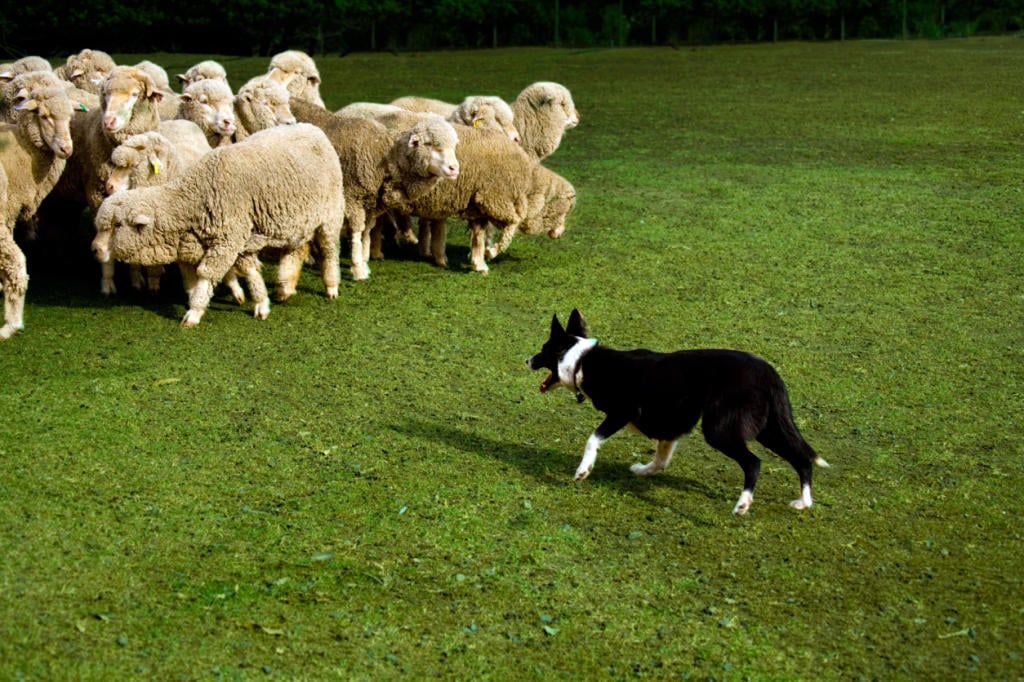
Are corrupt governments acting like “police dogs” with “herding instincts” going after their sheep.
Is “the herd” too scared to go after their “government”?
The analogy may be simplistic but nonetheless considered relevant by psychologists.
“Some breeds of dogs [corrupt politicians] have herding instincts that can be brought out with the right training and encouragement [bribes]. …. teach your dog [political proxy] basic obedience and see if it [he, she] displays herding tendencies. … Always look for a trainer who uses reward-based training methods [bribes, personal gain, political support, accession to high office]” (How to Teach Your Dog to Herd)
But there is another dimension. Politicians in high office responsible for “convincing their herd” actually believe the lies which are being imposed upon them by higher authority.
The lie becomes the truth. Politicians endorse the consensus, they enforce “social engineering”, they believe in their own lies.


It’s Not an Epidemic, It’s An Operation
US Secretary of State Mike Pompeo  (slip of the tongue) tacitly admits in a somewhat contradictory statement that the COVID-19 is a “Live Exercise”, an “Operation”:
“This is not about retribution,… This matter is going forward — we are in a live exercise here to get this right.”
To which president Trump retorted “you should have told us”.
Those words will go down in history.


Geopolitics
Let us be under no illusions, this is a carefully planned operation. There is nothing spontaneous or accidental. Economic recession is engineered at national and global levels. In turn, this crisis is also integrated into US-NATO military and intelligence planning. It is intent not only upon weakening China, Russia and Iran, it also consists in destabilizing the economic fabric of the European Union (EU).
“Global Governance”


A new stage in the evolution of global capitalism is unfolding. A system of  “Global Governance” controlled by powerful financial interests including corporate foundations and Washington think tanks oversees decision-making at both the national and global levels. National governments become subordinate to “Global Governance”. The concept of World Government was raised by the late David Rockefeller at the Bilderberger Meeting, Baden Germany, June 1991: “We are grateful to the Washington Post, The New York Times, Time Magazine and other great publications whose directors have attended our meetings and respected their promises of discretion for almost 40 years. … It would have been impossible for us to develop our plan for the world if we had been subjected to the lights of publicity during those years. But, the world is now more sophisticated and prepared to march towards a world government. The supranational sovereignty of an intellectual elite and world bankers is surely preferable to the national auto-determination practiced in past centuries.” (quoted by Aspen Times, August 15, 2011, emphasis added) .In his Memoirs David Rockefeller states: .“Some even believe we are part of a secret cabal working against the best interests of the United States, characterizing my family and me as ‘internationalists’ and of conspiring with others around the world to build a more integrated global political and economic structure, one world if you will. If that is the charge, I stand guilty, and I am proud of it.” (Ibid) .The Global Governance scenario imposes a totalitarian agenda of social engineering and economic compliance. It constitutes an extension of the neoliberal policy framework imposed on both developing and developed countries. It consists in scrapping “national autodetermination” and constructing a Worldwide nexus of pro-US proxy regimes controlled by a “supranational sovereignty” (World Government) composed of leading financial institutions, billionaires and their philanthropic foundations. .The 2010 Rockefeller Foundation’s  “Scenarios for the Future of Technology and International Development Area” produced together with Global Business Monitoring Network, GBN) had already outlined the features of  Global Governance and the actions to be taken in relation to a Worldwide Pandemic.  The Rockefeller Foundation proposes the use of scenario planning as a means to carry out “global governance”..
The Report envisages (p 18) a simulation of a Lock Step scenario including a global virulent influenza strain:
.
“LOCK STEP: A world of tighter top-down government control and more authoritarian leadership, with limited innovation and growing citizen pushback In 2012, the pandemic that the world had been anticipating for years finally hit. Unlike 2009’s H1N1, this new influenza strain—originating from wild geese—was extremely virulent and deadly. Even the most pandemic-prepared nations were quickly overwhelmed when the virus streaked around the world, infecting nearly 20 percent of the global population and killing. 8 million in just seven months”
It is worth noting that this simulation was envisaged in the year following the 2009 H1N1 Swine flu Pandemic, which was revealed to be a totally corrupt endeavor under the auspices of the WHO in liaison the Big Pharma which developed a multibillion dollar vaccine program.


By Prof Michel Chossudovsky, May 02, 2020 

“World Government”
Instructions are transmitted to national governments worldwide.  The fear campaign plays a crucial role in building acceptance and social submission to this “supranational sovereignty of an intellectual elite and bankers”..Global governance establishes a consensus which is then imposed on “sovereign” national governments Worldwide, described by David Rockefeller as “national auto-determination practiced in past centuries”.  Essentially, this is an extended form of “regime change”..Thousands of politicians and officials must be convinced and/or bribed for this operation to succeed. It’s an unsubtle form of “political arm twisting” (while respecting “social distancing”)..The decision to close down the global economy with a view to “saving lives” has not only been accepted as a means to combating the virus, it has been sustained by media disinformation and the fear campaign.
People do not question the consensus, a consensus which borders on the absurd.
.
Global Capitalism and “The Economic Landscape”
The crisis redefines the structure of the global economic landscape. It destabilizes small and medium sized enterprises Worldwide, it  precipitates entire sectors of the global economy including air travel, tourism, retail trade, manufacturing, etc. into bankruptcy.  The lockdown creates famine in developing countries. It has geopolitical implications.
The Pentagon and US intelligence are involved. The corona crisis affects to conduct of US-NATO led wars in the Middle East including Syria, Iraq and Afghanistan and Yemen. It is also used to target specific countries including Iran and Venezuela.
This engineered crisis is unprecedented in world history. It is an act of war.
The lockdown triggers a process of disengagement of human and material resources from the productive process. The real economy is brought to a standstill. Curtailing economic activity undermines the “reproduction of real life”. This not only pertains to the actual production of the “necessities of life” (food, health, education, housing) it also pertains to the “reproduction” of  social relations, political institutions, culture, national identity. At the time of writing, the lockdown is not only triggering an economic crisis, it is also undermining and destroying the very fabric of civil society not to mention the nature of government and the institutions of the state (crippled by mounting debts), which will eventually be privatized under the supervision of Big Money creditors.
There are conflicts within the capitalist system which are rarely addressed by the mainstream media. Billionaires, powerful banking and financial institutions (which are creditors of both governments and corporations) are waging an undeclared war against the real economy. Whereas the Big Money financial and banking establishment are “creditors”, the  corporate entities of the real economy which are being destabilized and driven into bankruptcy are “debtors”.
Bankruptcies
This diabolical process is not limited to wiping out small and medium sized enterprises. Big Money is also the creditor of  large corporations (including airlines, hotel chains, hi tech labs, retailers, import-export firms, etc.) which are now on the verge of bankruptcy.
The global financial establishment is not monolithic. It is marked by divisions and rivalry. The dominant Big Money faction seeks to destabilize its competitors from within. The results of which would be a string of  bankruptcies of regional and national banking institutions as well as a process of global financial consolidation.
In the US, numerous retailers, airlines, restaurant and hotel chains filed for Chapter 11 bankruptcy in February. But this is just the beginning. The big gush of bankruptcies will occur in the wake of the lockdown (“The New Normal”). And at the time of writing, the financial establishment is relentlessly pressuring (corrupt) national governments to postpone the lifting of the lockdown. And the governments are telling us that this is to “protect people against the virus”.
Canada’s province of Alberta which is largely dependent on oil revenues is bankrupt.
“Countries that represent over 50 per cent of the world’s global GDP are closed for business. Economists looking for historical comparisons mention the 1929 stock crash, the 1974 economic crisis or the 2008 recession. But they admit that these all fall short of the toll that this pandemic could have.” (Wired News UK, April 29, 2020
In Britain, recent reports state (It’s very British”) “we do not know how many have gone bankrupt”.
A chunk of Britain’s business landscape may have already been permanently erased, as some 21,000 more UK businesses collapsed in March alone than the same month a year ago, according to data gathered by the Enterprise Research Centre, a group of university researchers.
What these reports fail to mention are the unspoken causes: a fear campaign on behalf of the creditors, instructions by corrupt governments to close down the economy, allegedly to “save lives”, which is a big lie. Lives are not being saved, and they know it.
The coronavirus crisis “has ground U.S. business to a halt”. National economies are destabilized. The objective of Big Money is to weaken their competitors, “pick up the pieces” and eventually buy out or eliminate bankrupt corporations. And there are many to choose from.
Global Finance Capitalism
The interests of Big Money (global financial interests) overlap with those of Big Pharma, Big Oil, the Defense contractors, etc. Major banking institutions in the US including JP Morgan Chase, Bank of America, Citigroup, Wells Fargo, State Street Co. and Goldman Sachs, are investing in the war economy including the development of nuclear weapons under Trump’s 1.2 trillion dollar nuclear weapons program (first established under Obama). 
The ultimate objective of “Big Money” is to transform nation states (with their own institutions and a national economy) into “open economic territories”. That was the fate of Iraq and Afghanistan. But now you can do it without sending in troops, by simply ordering subservient proxy governments integrated by corrupt politicians to close down their economy on humanitarian grounds, the so-called “Responsibility to Protect” (R2P) without the need for military intervention.
Impossible to estimate or evaluate. More than half the global economy is disrupted or at a standstill.
Let’s be clear. This is an imperial agenda. What do the global financial elites want? To privatize the State? To own and privatize the entire planet?
The tendency is towards the centralization and concentration of economic power. Heavily indebted national governments are instruments of Big Money. They are proxies. Key political appointments are controlled by lobby groups representing Wall Street, The Military Industrial Complex, Big Pharma, Big Oil, the Corporate Media and the Digital Communications Giants, etc.
Big Money in Europe and America (through Washington Lobby groups) seek to control national governments.
In what direction are we going? What is the future of humanity? The current corona crisis is a sophisticated imperial project, which consists in Worldwide domination by a handful of multibillion dollar conglomerates. Is this World War III? Global capitalism is destroying national capitalism.
The unspoken intent of global capitalism is the destruction of the nation state and its institutions leading to global poverty on an unprecedented scale.
The following citation by Lenin dated December 1915 at the height of the First World War pointed with foresight to some of the contradictions which we are presently facing. On the other hand, we should understand that there are no easy solutions and that this crisis is intended to reinforce imperialism and the clutch of global capitalism:
“There is no doubt that the development is going in the direction of a single World trust which will swallow up all enterprises and all states without exception. But the development in this direction is proceeding under such stress, with such a tempo, with such contradictions, conflicts and convulsions not only economical, but political national, etc. etc — that before a single world trust will be reached, before the respective financial national capitals will have formed a “World Union” of ultra imperialism, imperialism will explode and capitalism will turn into its opposite.
(V. I. Lenin, Introduction to Imperialism and World Economy by N, Bukharin, Martin Lawrence, London, printed in the US, Russian Edition, November 1917)
How to reverse the tide. The first priority is to repeal the lie.
In this regard, it is unfortunate that many people who are “progressive” (including prominent Left intellectuals) are –despite the lies–  supportive of the lockdown and closing down of the economy as a solution to the public health emergency. That’s the stance of the Democratic Party in the US, which goes against common sense.
Truth is a powerful weapon for repealing the lies of the corporate media and the governments.
When the Lie Becomes the Truth There is No Moving Backwards
Without the fear campaign and media propaganda, the actions taken by our governments would not have a leg to stand on.
“Social Distancing” does not prevent the financial elites from providing instructions to corrupt politicians.
On the other hand, “social distancing” combined with confinement is being used as a means of social subordination. It prevents people from meeting as well as protesting this so-called New World Order.
Organization, Truth and Solidarity are essential to reversing the tide. The first step of a worldwide movement is “counter-propaganda”.

Related articles


By Prof Michel Chossudovsky, May 03, 2020


By Prof Michel Chossudovsky, April 25, 2020The original source of this article is Global ResearchCopyright © Prof Michel Chossudovsky, Global Research, 2020

River to Sea Uprooted Palestinian   
The views expressed in this article are the sole responsibility of the author and do not necessarily reflect those of the Blog!