Uprooted Palestinians are at the heart of the conflict in the M.E Palestinians uprooted by force of arms. Yet faced immense difficulties have survived, kept alive their history and culture, passed keys of family homes in occupied Palestine from one generation to the next.
So those evil vodka-soaked Russians are deploying their forces right near the Ukrainian border and are about to attack. Right?
Well, today I want to begin by sharing a few very basic maps with you. First, here is a map of Russia with her military districts:
The most important thing to understand is that the city of Moscow is located in the middle of the Western Military District which, in other words, means that Moscow is located on in frontier/border/boundary (приграничный) MD.
During the Cold War, the Ukraine used to be considered a 2nd strategic echelon territory (see here for a detailed discussion of how the Soviet forces were structured) and Moscow was far away from any conceivable frontline.
Nowadays, the entire Ukraine is de facto NATO controlled territory. In other words, the capital of Russia is located less than 300 miles from the Russian border with the Ukraine (see map)
Here is another very revealing factoid: during the 90s, Russia did not have a single division-size fully manned unit deployed west of Moscow. Now Russia has fully reactivated her famous 1st Guards Tank Army as the strategic reserve for the Western Military District.
What do you think brought about this rather dramatic change?
Might that not have something to do with the fact that NATO forces are now within the driving distance (on a tank, nor car) to Moscow’s suburbs?
And I won’t even go into the distances between the NATO forces in the 3B and Saint Petersburg (less than 100 miles).
And, in the light of the maps above, what do you think the Russians, any Russian, would make of the NATO verbiage: “we will never move (politically) NATO to the east, but now we had to, we will never deploy NATO forces to the east, but now we had to, we will not deliver lethal weapons to the Ukraine, but now we had to, we will not accept (de jure and de facto) the Ukraine in NATO, but now had to, etc. etc. etc.“.
The truth is that the Empire has been preparing a war against Russia since at least the mid 90s and that these preparations dramatically accelerated in the past seven years.
Which makes me wonder, what did the leaders of the Empire expect the Russians to do? Move all their forces back into the Central Military District so as to not frighten the 3B+PU? Seriously?
The truth of the matter is much simpler: in case of war, the three western military districts (Northern, Western and Southern) would all three find themselves in the first strategic echelon.
BTW – the Northern Military District has now been augmented with the Northern Fleet Joint Strategic Command (Объединённое стратегическое командование Северный флот) with a status equal to a military district which could haev been called “Arctic Military District”). Its official designation now is “joint strategic territorial formation of the Russian Armed Forces performing the task of a military district“. Its forces would also play a key role in northern Europe and the northern Atlantic.
In case of war, Russian military districts become “fronts”, that is “unified commands of operational and strategic troops (forces) of the armed forces in the continental theater of operations” which is militaryspeak for an independent military force capable of waging a full-scale combined arms war. Please keep in mind that these fronts would also have, when needed, the support of rear military districts and units/forces of the strategic reserve.
So what does all this mean?
It means that while western politicians spent the past 30 years or so slowly encircling Russia, Russian force planners successfully reformed the Soviet/Russian armed forces (which were in a terrible shape in the 90s and in a very uneven shape during most of the 80s) into a military capable of taking on all of NATO at once and quickly and very painfully defeat it.
Remember all those super-dooper weapons Putin mentioned in 2018 which were initially dismissed as “bad cartoons” by western “specialists” and which are now mostly deployed? You cannot understand their real role and significance unless you also take into account the reform (I would even say redesign) of the Russian armed forces in the last decade or so. If you want a quick refresher on this topic, please see this analysis I wrote in 2016, that is two years BEFORE Putin unveiled the new Russian weapons systems!
Here is the key element to remember when considering what could happen next: should it come to a real, full-scale, shooting war between Russia and the West, ALL of these weapons systems and forces will be available to the Kremlin and most of them probably will be used in the very early phases of this war. And I am not only taking about Iskander missiles or Bastion/Bal coastal defenses, I am also talking about the First Guards Tank Army which is such a powerful formation that there is literally no western equivalent to it. Such heavy armored formation have such the forces and means of destruction which would make it possible to carry out an operational breakthrough of the enemy’s front and while the same time reliably overcoming of the entire operational depth of enemy defense. During WWII and the Cold War such formation were called “Shock Armies” (ударная армия). If you look at the entire order of battle of NATO forces they simply don’t have anything even comparable to such a force.
And so, yes, of course, NATO commanders are frightened by what they see, this is true, and quite understandable. What is not understandable is why these delusional idiots created the condition which left Russia no other choice than to be ready to fight a full scale war in Europe, including a nuclear one.
And what do they want the Kremlin to do now? To dismantle these forces or send them back behind the Urals maybe?
I will simply end here with a few questions which don’t seem to bother the western “specialists” (LOL!) very much:
How completely out of touch with reality can western leaders be?
Last time around, Russia lost about 27 million people, including a full 3rd of the population of Bielorussia. Does anybody in Europe seriously expect the Russians to forget that?
Does anybody in Europe seriously expect the Russians to trust a single word western leaders say?
Does anybody in Europe seriously doubt the determination of the Russians not to allow yet another European surprise attack?
And, finally, does anybody in Europe seriously doubt the outcome of a war against Russia?
Andrei
PS: Russian Defense Minister Shoigu just reported that in November the USAF used 10 strategic bombers coming in from both the east and the west to rehearse nuclear strikes on Russia and that they changed course only 20km from the Russian airspace.
إلى متى نستمر في بيع الأوهام، ونحن نشهد واقع هذه الأمة يتراجع، سواء محلياً، أو إقليمياً، أو دولياً؟
في خطابه، في الذكرى الـ 34 لانطلاق حركة “الجهاد الإسلامي”، دعا الأمين العام للحركة زياد نخالة إلى وحدة الصف الفلسطيني، والتراجع عن أوهام السلام التي اختلقها العدو الإسرائيلي، والابتعاد عن الغمغمة السياسية. وفي هذه الدعوة الأخيرة بلسمٌ لجراح متعدّدة، يعاني جرّاءها الشعبان الفلسطيني والعربي منذ عقود، لأن الغمغمة السياسية هي الحاجز الأخطر بين الحق وأصحابه وبين التاريخ الحقيقي الذي يجب أن يُدرَّس للأجيال وبين ما يدرسونه اليوم من نصوص تُولي اهتماماً لمشاعر أصحاب الشأن والقرار، بدلاً من إيلاء الاهتمام للوطن وسلامته وتعزيز أُسس قوته ومنعته.
الغمغمة السياسية
مرّت، منذ أيام، ذكرى حرب تشرين التحريرية، لكنْ لم تُكتب حقيقة تلك الحرب ومجرياتها، إلى حدّ اليوم، ولم يتمَّ التوصل إلى الاستنتاجات العلمية والمؤكَّدة، والتي تسمي الأشياء بأسمائها، على الرَّغم من أن اتفاقات “سيناء 2″، واتفاق كامب دافيد، وزيارة السادات للقدس المحتلة، دكّت إسفيناً في جسد العالم العربي، ما زلنا نشهد تداعياته الخطيرة ونعيش تبعاته على الأجيال، من دون أن يتمكن أحد من عكس هذا التيار، والإقلاع من جديد في اتجاه مُغاير مقاوم.
وفي الإطار نفسه، حقّق اتفاق أوسلو للعدو الصهيوني ما لم يتمكن من تحقيقه خلال عقود، وأفشل ذاك الاتفاق عمليةَ سلام كانت مبنية على أُسس سليمة ووَفق إجماع وتنسيق عربيين، ومكّن الصهاينة من خوض معركة علاقات عامة بعشرات الدول لمصلحتهم، وفتحَ الأبواب لهم من جانب بلدان لم تكن لتعترف بالكيان الصهيوني لولا الاتفاق الفلسطيني معه. ومع ذلك، لا تنص الكتب المدرسية أو غيرها على حقيقة ما جرى ويجري، ولا تُسَمّي الأشياء بأسمائها، ولا توجِّه اللوم إلى من يستحقون. وهنا، أستذكر قول الله، عز وجل، “يا أهل الكتاب لِمَ تَلْبِسُون الحقَّ بالباطل وتَكْتُمون الحقَّ وأنتم تَعْلَمون”. لكنْ، هذه المرة، تشملنا هذه الآية حين نغمغم ولا نفصح عن الحقيقة.
أن يلبس الحق بالباطل؛ أي أن يغمغم الحق، أو أن يكتمه، وكلاهما خطرٌ على الحقيقة وقول الصدق، لأن الحقيقة هي التي تهدي إلى القرار السليم، وهي التي تختصر الطُّرُق، وتستثمر الوقت، بدلاً من هدره وإضاعته، أو ما زال البعض يعتبر أن أشخاصاً ما وسمعتهم ومكانتهم أهم من التاريخ وأهم من الأوطان؟ لا قيمة يجب أن تعلو فوق قيمة الوطن وقول كلمة الحق، من أجل مصلحة الوطن وإعلاء شأنه، لأن الكلَّ موقَّتون وعابرون، إلاّ الأوطان والحقائق الناصعة المرتبطة بها.
هناك من يعرضون بعض أحداث تاريخنا بصدق شفوياً، وحين نطلب منهم أن يسجّلوا ما قالوه، يقول البعض منهم: لن يصدّقنا أحد، لأن كل ما نقرأه مخالف للحقائق التي نعرفها بعمق ونتحدث بشأنها.
إلى متى نستمر في بيع الأوهام، ونحن نشهد واقع هذه الأمة يتراجع، سواء محلياً، أو إقليمياً، أو دولياً؟ ومتى سنمتلك الجرأة الأكيدة على أن نؤيّد ما قاله السيد زياد نخالة، وفحواه أن “المشروع الرسمي الفلسطيني”، وأُضيفُ إليه “المشروع الرسمي العربي”، هما أقصرُ من قامات الشهداء، وأقلّ كثيراً من تضحيات الأسرى والجرحى، على امتداد أرض هذا الوطن العربي الكبير، في كلّ أقطاره”؟
في الوقت الذي تنشغل أغلبية دول العالم بإعادة حساباتها بشأن موقعها، إقليمياً ودولياً، والدور الذي يمكن لها أن تؤدّيه أو تطوّره في أحداث تعيد تشكيل العالَم من جديد، نجد الكتلة العربية مبعثرةَ الجهود بين مع من يريد أن يَستبدل بالسيد الأميركي السيدَ العثماني، “كالمستجير من الرمضاء بالنار”، وبين من يعقد آمالاً على الأوهام، التي يسوّقها له الكيان الصهيوني، فيرتمي في حِضنه سراً أو علانية، غيرَ متّغظ من مآل الأمور في دول عقدت آمالها على العلاقة بهذا الكيان، فلم يكتفِ بالغدر بها، بل سخّر كلّ علاقاته وإمكاناته ليُقنع دولاً أخرى باتخاذ خطوات، وبناء سدود، تنغّص عليها مصدر الحياة الذي ترتوي من نسغه. وبين هذا وذاك دول عربية تمتثل لقرارات هي في العمق ضدها، بقدر ما هي ضدّ الأخ الشقيق، لأنها تكرّس الفرقة والانقسام والعزلة، في الوقت الذي يدرك أعداء العرب، قبل حكام العرب، أن فتح حدودهم والتعاون والتنسيق بينهم هي طريق الخلاص الوحيد لهم جميعاً.
البعض، في عالمنا العربي، مزهوّ بانكسار الولايات المتحدة في أفغانستان، وتراجُع الدور الغربي في الإقليم والعالم، بينما ما زال بعض مَن يراهنون على السيد الغربي يتوسّلون كلمة منه يعتقدون أنها قادرة على تغيير مصائرهم ومصائر أوطانهم. وهؤلاء يذكّرونني ببداية الحرب على سوريا، حين احتفل بعض المأجورين بدعوة أوباما الرئيسَ الأسد إلى أن يرحل، معتقدين أن كلمته قَدَرَ لن يتمكّن أحد من تغييره. وفي كِلتا الحالتين الرهان هو على الآخر: إمّا أن ينكسر، وإمّا أن يشكّل منقذاً، ولا هو بباعث الحياة في بلداننا إن انكسر، ولم ولن يشكّل منقذاً لمن لا يعمل ويضحّي، ويُسرع الخطى في بناء وطنه.
مع التسليم طبعاً بأنّ الغرب بعد أفغانستان ليس كما قبلها، وأنّ القطب الغربي يشهد حالة تفكّك وتراجع، يقابلها صعود متسارع للصين وروسيا والهند وإيران، ومنظومات تفكير تؤمن بعالم متعدّد الأقطاب، وبإعادة النظر في العلاقات الدولية، وتقف ضدّ التدخّل في شؤون الدول. وعلى الرغم من ذلك كلّه، فإنّ الوحش الغربيّ المتربّص بالعرب اليوم جاثمٌ على الضفة الأخرى من المتوسّط، حالمٌ بإعادة بناء الإمبراطورية العثمانية على أُسس تنظيم “الإخوان المسلمين” للوصول إلى أهدافه. فالخطر اليوم الذي يهدِّد سوريا والعراق وليبيا وتونس والجزائر، وحتى مصر واليمن ودول الخليج، كما يهدِّد إيران وأرمينيا وعدداً من دول آسيا الوسطى، هو الخطر العثماني الإخواني، الذي يحاول مراكمة أوراقه من خلال ألاعيبه الخبيثة، قبل أن تنكشف نِيّاته الحقيقية. والخوف هو من الانتظار إلى أن تصبح نياته واضحة للجميع، فيكون قد تمدّد واحتلّ وتمركز، واستخدم أدواته ضدّ البلدان والشعوب.
لقد أصبح واضحاً اليوم أنّ الخطر العثماني والخطر الإسرائيلي على أمتنا صنوان. لكن الأخطر من كلّ شيء، بالنسبة إلى هذه الأمة، هو عدم وضوح الرؤية، وعدم الاقتناع بأنّ عوامل القوة أو الضعف تنبع من الداخل، ولا يمكن لأيّ قوّة، مهما عَتَت، أن تنال من بنيان صلب متماسك يُحْسن صانعوه الدفاع عنه. كما أصبح واضحاً أنّ كلّ ادعاءات العثماني بشأن الحرص على فلسطين والذَّود عنها هي ادّعاءات كاذبة من أجل ذرّ الرماد في العيون، بينما يتعاون مع الصهيوني في شبكة علاقات سياسية واقتصادية وعسكرية، تمتدّ من الشرق الأوسط إلى القوقاز وآسيا الوسطى.
مصيبتان كُبْرَيان في تاريخنا العربي هما الخيانة والغمغمة السياسية، والسبب الكامن وراء الاثنتين هو عدم الصدق مع الذات والآخر، وعدم المكاشفة الصريحة، وعدم الجرأة في إعلاء كلمة الحقّ والوطن. لا شكّ في أنّ الوقت أصبح متـأخراً جداً، وأنّ إعادة البناء تتطلّب وقتاً وجهداً وتفكيراً نيّراً وغيرَ تقليديّ. لكن، هل هناك أيّ خِيار آخر متاح من أجل مستقبل أفضل لأُمّة تهدّدها تطوّرات الأحداث في العالم بأن تُبقيَها خارج التاريخ؟
General Mark Milley, America’s highest-ranking military officer, has recently gone public with a revelation of his: the world is no longer unilateral (with the US as the unquestioned world hegemon) or bilateral (as it was with the US and the SU symmetrically balancing each other out in an intimate tango of mutual assured destruction). It is now tripartite, with three major powers—the US, Russia and China—entering a “tripolar war.” That is the exact term he is reported to have used at the Aspen Security Forum on November 3, 2021.
This seems strange, since neither Russia nor China is eager to attack the US while the US is in no condition to attack either of them. The US has just got defeated in a two-decade conflict against a fourth-rate adversary (Afghanistan, that is) in the most humiliating way possible, abandoning $80 billion of war materiel and forsaking thousands of its faithful servants in a hasty withdrawal that amounted to a rout. It is about to suffer a similar fate in Syria and Iraq. Its navy just got humiliated in a minor skirmish with the Iranians over an oil tanker. Clearly, the US is in no shape to attack anyone.
So what could Milley possibly mean? He may not sound smart, but he is the most powerful man at the Pentagon. Of course, Milley-Vanilley could just be lip-sinking to some stupid music coming out of the White House (which is currently stocked with some choice imbeciles). This would make sense, since throughout his career Milley carefully avoided anything that smacked of actual military action and therefore carried within it the possibility of defeat, instead choosing to concentrate on such things as producing a report on the impact of climate change on the U.S. military.
Here is Milley captured during one of his prouder moments, standing next to Russia’s General Valery Gerasimov, who saw combat—and victory—as commander during the Second Chechen War. Gerasimov then authored Russia’s hybrid war doctrine (the Gerasimov Doctrine), which allows strategic and political objectives to be achieved through nonmilitary means but with military support and military-style secrecy, discipline, coordination and control. In comparison, our General Milley is something of a cardboard cutout general, with a string that makes his lower jaw move up and down leading to some place within the Washington swamp of political think tanks and defense industry lobbyists.
The Gerasimov Doctrine bears an uncanny resemblance to the Chinese doctrine of unlimited war, indicating that Russia and China have harmonized in their defensive strategies. These doctrines are designed to amplify China’s and Russia’s natural advantages while placing the US at a maximum disadvantage. It is not immediately clear whether Milley is capable of understanding such matters; quite the opposite, it is likely that his job security and career path critically depended on his inability to understand anything above his pay grade. Nevertheless, since he happens to be the mouthpiece for the whole ungodly mess, we need to at least try to take his words at face value and try to think of what his “tripolar war” could possibly mean.
The Russian hybrid war doctrine and the Chinese unlimited war doctrine both give an advantage to countries with strict, centralized control structures (China and Russia, that is) while severely disadvantaging the US, which has a diffuse and internally conflicted power elite split up between two parties and among lots of competing government agencies and private entities with lots of opportunities for both internal and external espionage, infiltration and media leaks.
Russia’s advantages are in advanced weapons against which the US has no countermeasures, such as hypersonic missiles and radio warfare systems, and in a huge and only partially explored resource base, of energy resources especially. China’s advantage is in a huge and highly disciplined workforce that produces a vast array of products which the US must continuously import to prevent its entire economy from shutting down because of supply chain disruptions. On the other hand, both China and Russia find themselves at a disadvantage in facing the large and well-oiled machine the US has developed for its habitual meddling in the affairs of other nations and the undermining of their natural sovereignty. An array of mechanisms, from cultural exports to ad campaigns associated with popular brands to social media initiatives designed to corrupt the minds of the young, exists in order to exert US influence on other nations.
The Chinese and the Russian responses to this threat are almost diametrically different: whereas China builds firewalls and uses strict social controls to contain the threat, Russia’s strategy is to allow the foreign infection to run wild and to let their nation’s innate immune system create antibodies against it and neutralize it. Russia draws its red lines at outright bought-and-paid-for enemy propaganda, inciting armed rebellion, advocacy of terrorism, propaganda of sexual perversion among children, etc. In this way, Russia can not just compensate for this disadvantage but turn it to its own advantage: while the West is becoming increasingly undemocratic and authoritarian with its endless political correctness, social biodiversity requirements and the pursuit of better living through non-reproductive mating, hormone therapy and genital mutilation, Russia remains a free land with a wholesomely conservative social outlook that is quite attractive to people all over the world and is becoming increasingly attractive to many people in the West as they become painfully aware of the wages of sin.
Why concentrate on hybrid/unlimited war instead of an outright nuclear or conventional military conflict between the US and China and/or Russia? That is because both conventional and nuclear military conflict between any of these three nations is an insane, suicidal choice, while those in charge of defining military strategy are specifically not selected for their suicidal tendencies. Neither Russia nor China is known for their wars of aggression, and while the US is extremely well known for its homicidal, violent tendencies (having carried out 32 bombing campaigns on 24 countries since World War II), it is fundamentally a bully, only picking on weak countries that pose no threat. Based on publicly available information, both Russia and China are now quite far ahead of the US in weapons development, to a point where any possible direct US attack on either of them would be self-disarming at best and suicidal at worst.
In the best case scenario, the US launches an attack which is successfully repelled: bombers and rockets shot down, ships sunk, US military bases and port facilities destroyed, possibly US command and control centers also destroyed, as quite pointedly promised by Putin. The US then lays prostrate and at the mercy of its opponents. If its cooperation still leaves something to be desired, some combination of deplorables, despicables, imponderables and indecipherables will be organized just enough to make a bloody mess of what’s left of US government structures and power elites, which will then be replaced with an international peacekeeping force (as an optimistic case) or just left to persist in durable disorder, misery and international isolation.
The worst case scenario is the tired old mutual assured destruction, nuclear winter and end of life on Earth, but it is unlikely for a number of reasons. First, of the US nuclear deterrent triad only the submarine component remains viable, and even it is quite tired. None of the Minuteman missiles has been successfully tested in a long time, and these are ballistic missiles which, once the boost phase is over, follow a perfectly predictable inertial trajectory, making them easy targets for Russia’s new air defense systems. Of the Minutemen that manage to get out of their silos and launch in the general direction of Russia or China, it is unknown how many of their nuclear payloads would actually detonate since these are all quite old and haven’t been tested in a long time either. The US no longer has the ability to make new nuclear charges, having lost the recipe for making the high explosive needed to make them detonate. But that may be a moot point, since at this point no ICBM is likely to be able to penetrate Russian air defenses. As far as Chinese air defenses, it is notable that Russia and China have integrated their early warning systems and China now has four divisions of Russian S-400 Triumph air defense systems and is planning to add more.
Turning to the airborne part of the US nuclear triad, its mainstay is still the Boeing B-52 Stratofortress, the youngest of which is almost 60 years old. It cruises at 260 knots at an altitude of 34000 feet and is the opposite of stealthy, making it easy to shoot down at a stand-off distance of several hundred kilometers. Since this makes it perfectly useless for dropping bombs, all that remains is cruise missiles, which fly at a positively poky 0.65 Mach, again making them easy targets for modern air defenses. There are also some newer stealth bombers—very few and, it has turned out, not too stealthy, putting them essentially in the same category as the Stratofortress, and the cruise missiles they can launch are also those same old subsonic ones.
Lastly, there are the strategic nuclear submarines, which are the only part of the US nuclear triad that is still viable. They remain effective as a deterrent, and they do have the ability to get up close to launch a sneak attack with a good chance that at least a few of the missiles will get through the air defenses, but they can’t possibly hope to get around the inevitability of retaliation which will cause unacceptable, fatal damage to the continental US. This makes them useless as an offensive weapon.
Add to this Russia’s updated nuclear doctrine, according to which any attack against Russian sovereign territory or Russian sovereign interests, whether conventional or nuclear, would open the door to a nuclear retaliation, launched upon warning, and Putin’s solemn promise to counterattack not just against the locations from which a strike is launched but against the centers of decision-making. Considering that Russian missiles are hypersonic and will reach their targets before those of the US reach theirs, and that Russia has the means to shoot down US missiles while the US is unable to shoot down Russian ones, if the US were to launch an attack, those who launched it would be dead before they could find out whether their attack succeeded in causing any damage at all or whether they had just suicided themselves for nothing. All of this adds up to an inevitable conclusion: under no circumstances will the US attack either Russia or China, using either conventional or nuclear weapons.
There are experts who are of the opinion that a world war could spontaneously erupt at any moment without anyone wishing it to do so, just as the world slid into World War I due to a confluence of unhappy accidents. But there is a big difference: the military and civilian leaderships of the warring sides in World War I did not have hypersonic missiles pointed directly at their heads. They thought that the war would be fought far away from their palaces, headquarters and stately mansions. They were, in some cases, quite wrong, but that was their thought originally: why not test our industrial prowess while sacrificing the lives of several million useless peasants?
Now the situation is quite different: any substantial provocation is an automatic self-destruct trigger and all sides know this. Of course, there will be minor provocations such as the US Navy steaming around in the Taiwan Strait or the Black Sea close to the shores of Crimea, but then they do have to earn their keep somehow. In turn, the Russians and the Chinese will periodically up the ante a little bit by shooing them away with a harshly worded radio message or a few shots fired across their bows. But both sides know just how careful they have to be because any serious error will require immediate deescalation and may entail major loss of face. And that, as the saying goes, would be worse than a crime: it would be a mistake.
The provocations of which the US is still capable are likely to grow more and more feeble over time. The US has lost the arms race against both Russia and China and is unlikely to ever catch up. On the other hand, neither Russia nor China is the least bit likely to attack the US. There is no reason to do so, given that they can get what they want—a gradual fading out of US influence—without resorting to large-scale military action. Maintaining a strong defensive posture while projecting power within their expanding spheres of interest would be quite enough for either of them. Thus, all that’s left for the US is hybrid warfare: financial warfare in the form of sanctions, aggressive dollar-printing and large-scale legalized money laundering, informational warfare played out on the internet, medical warfare using novel pathogens, drugs and vaccines, cultural warfare in the form of promoting and defending conflicting systems of values and so on, with military activities limited to the use of proxies, fomenting putsches and civil wars, actions of private military companies and so on.
If Milley is pinning his hopes on being able to provoke a conflict between China and Russia, he is likely to be disappointed. These two very large neighboring countries are synergistic. China has tremendous productive capacity for producing all manner of finished goods but has limited natural resources, is insular and has limited capacity for interacting with the rest of the world except through trade and commerce. Russia, on the other hand, has virtually limitless natural resources but, with a smaller though highly educated population spread out across a vast and somewhat inhospitable terrain, is forced to concentrate its efforts on certain strategically important sectors such as energy and food exports, high-tech weapons systems, nuclear energy, vaccines and energy-intensive products such as fertilizers, plastics and metals where their access to cheap energy provides them with a competitive advantage.
One of Russia’s major strengths is a culturally ingrained ability to understand people from other cultures and to maintain cordial relations even across great cultural divides and enemy lines. Russia has a unique ability to offer stability and security, both through careful diplomacy and by offering advanced defensive weapons systems. The Chinese have been aggressively buying into economies around the world, investing in major infrastructure projects to further their trade, but are sometimes found lacking in diplomatic finesse and in their understanding of local sensibilities, alienating their partners by directly demanding a controlling share in their investments. The Russians, on the other hand, understand that you have to at least kiss a girl before offering to pay her college tuition.
Such finesse tends to be interpreted as weakness by certain Westerners who, over the course of many centuries of fratricidal warfare and genocidal colonialism, have been conditioned to only respect brute force and to understand relationships only in terms of dominance or submission. With the sudden departure of the US from the world stage, many smaller European nations are now actively looking for a new master to lord over them. Both the Chinese and the Russians are likely to leave them disappointed; while Chinese commerce and Russian security (including energy security) will be on offer, they will be on their own and forced to earn their own keep and their oaths of fealty will fall on deaf ears. The Eastern Europeans especially might find it impossible to ingratiate themselves back into the Russian world; the Russians have had their fill of them and their duplicitousness. Their other option will be to go to work for the Chinese.
Russia and China complement each other and are more likely to work with each other rather than against each other in their dealings with each other and with the rest of the world. This is certainly not the case with the US, vis-à-vis either China or Russia. During the 1990s and the naughts, while China was rapidly transforming into the world’s manufacturing hub while Russia was recovering from the setback it had been dealt by the Soviet collapse, the US was able to position itself as the world’s indispensable consuming nation, redirecting a lion’s share of the world’s resources and manufactured products to feed its appetites in exchange for printed dollars (continuously expropriating the world’s savings while exporting inflation) and using the threat of military action against anyone who would challenge this arrangement. But now the situation is different: most of China’s trade is now not with the US but with the rest of the world, Russia is fully recovered and developing slowly but surely, the share of the US in the world’s economy has shrunk, the appetite for printed dollars in the form of US government debt has declined greatly, and as to its former full-spectrum military dominance, see above.
And yet General Milley wishes to fight a tripolar war against two poles that won’t fight each other and aren’t spoiling for a fight with the US either; they just want the US to pack up, go home and no longer darken the horizons around Eurasia. As I took pains to explain above, the US is in no position to challenge either or both of them in an all-out military conflict, or to risk engaging them in a way that runs a major risk of provoking one. What can a giant, sprawling, lavishly funded, corrupt and dysfunctional bureaucracy do under such circumstances in order to justify its existence? The answer is, I believe, obvious: engage in petty mischief, a.k.a. hybrid warfare, but in doing so it finds itself, as I have already explained, at a disadvantage.
The list of petty mischief is long and makes for tedious reading. The best that can be done with it is to make comedy with it. Take, for instance, the imbroglio, worthy of Boccaccio’s Decameron, of Tikhanovskaya the cutlet fairy and phantom president of Belarus, who recently joined the club of bogus replacement leaders, alongside Juan Random Guaidó, phantom president of Venezuela, having failed to seize power from deeply entrenched Byelorussian president Lukashenko, and who is now cooling her heels in neighboring Lithuania. Having recognized the abject failure of Tikhanovskaya’s power grab, the Petty Mischef Department attempted to organize a scandal around a Byelorussian sprinter during the Tokyo Olympics, whose name is… Timanovskaya! You see, they thought that nobody would notice the single-character substitution. The ploy failed, and Timanovskaya is now cooling her heels in neighboring Poland.
There have been other, much larger-scale attempts at petty mischief, similarly ham-handed and similarly spectacular in their failure.
1. There was the attempt to force the entire world to submit to a relentless inoculation campaign (in the works since 2009) in the course of which an interplay between genetically engineered pathogens and genetically engineered vaccines against them would be used to make fabulous profits for Big Pharma while simultaneously selectively genociding the population of certain unfriendly or otherwise undesirable countries. End result: China has largely fought off the pathogen and has produced its own vaccine while Russia has produced several vaccines, the most popular of which has been proven safe and effective and has been turned into a major profit center by being exported to 71 countries and earning Russia more export revenue than arms exports.
Meanwhile, not only are Western vaccines proving less than 50% effective (much less than that for Johnson & Johnson) but thousands of people are actually dropping dead or becoming severely ill from them. Most alarmingly, young, freshly vaccinated athletes are dropping dead from heart attacks right in the middle of a game—dozens of them! The only possible response to this by the authorities—the only one they are capable of—is to double down, requiring everyone to get vaccinated again and again. The marketing strategy of “if our product makes you sick, we’ll give you more of it” is hardly ever effective and, in due course, it is producing open rebellion in many places, shutting down entire industries and generally playing havoc with societies and economies. Mission accomplished!
2. There is an ongoing attempt to force countries around the world to pay a carbon tax for their carbon emissions while those nations that engage in the cargo cult of building solar and wind generation capacity are exempted from it. Lots of expensive climate models kept supercomputers humming and international climate conferences were convened, at which people could wring their hands and wallow in maudlin self-pity over the ever-looming imaginary climate catastrophe. But then came a major complication: both Russia and China managed to turn the situation to their advantage. In the case of China, the case is simple: what allows China to manufacture and export products which the rest of the world loves to import is its use of coal and just a temporary reduction in the use of coal was sufficient to demonstrate that any such constraints would hurt the US through supply chain disruptions more than they would hurt China.
In the case of Russia, the situation is even simpler: from the point of view of carbon dioxide emissions, Russia is the greenest country on earth, deriving the largest share of its electricity from carbon-free nuclear and hydro and low-carbon natural gas. It also has 20% of the world’s forests which, in case of global warming and increased atmospheric carbon dioxide concentrations, would spread rapidly north across the tundra toward the Arctic circle, soaking up prodigious amounts of carbon dioxide. Thus, the US, and the rest of the West with it, have negotiated themselves into a cul de sac of their own creation, being forced to cause damage to their economies by pursuing misguided decarbonization policies which nobody would have asked them to pursue otherwise. Again, mission accomplished!
3. Yet another attempt at petty mischief is in the area of human rights and democracy. The notion of individual human rights was rather successfully deployed against the USSR, warping the minds of several generations of Russian intelligentsia into being ashamed of their own country (and almost completely unaware of much ghastlier crimes against humanity carried out by the collective West). The Chinese, on the other hand, were barely swayed from their traditional (be it Confucian or Communist) perspective that balances privileges against responsibilities and leaves very little room for such frivolous notions as individual universal rights. But in recent decades the Russians have managed to claw their way back to a more balanced understanding of their own history and a greater awareness of the multiple atrocities perpetuated by those who would criticize them. The rank hypocrisy of those who would use such tactics has also become glaringly obvious through such outrages as the illegal imprisonment of Julian Assange and the exile of Edward Snowden.
The story of Maria Butina, a spectacular individual who is now a member of the Russian parliament, has also made an impression. She was falsely accused of being a foreign agent based on the now discredited Steele Dossier which Hillary Clinton’s camp had concocted in order to slander Donald Trump. Butina was imprisoned for 18 months, spending much of that time in solitary confinement (a treatment that equates to torture). She was forced to plead guilty to a bogus charge before a kangaroo court judge before being released and allowed to return to Russia. She described her ordeal in a best-selling book and anybody who has read it has absorbed, along the way, an important message: there is simply no such thing as the American justice system. A major reason why Butina had been singled out for such treatment had to do with her last name, which differs by just one character from Putin’s: there’s that single-character substitution again! With a name so similar to that of that horrible dictator Putin, of course she’d be found guilty! I wouldn’t be surprised if there is a certain dim-witted miscreant ensconced in the bowels of the CIA or the State Department who comes up with these harebrained ideas by actually scanning documents for similar-sounding names.
As far as democracy, the concept is valuable but applies differently to each nation, based on its unique values and traditions, but the image of it served up in the US, where about half the electorate feels that they were cheated during the last presidential election, or the EU, which is lorded over by unelected pompous nobodies at the European Commission, or the way it was misapplied in Afghanistan, Iraq and other nations invaded and destroyed by the West, has done much to discredit the concept. Joe Biden, who is now working on convening a virtual assemblage of nations he deems democratic, making a list and checking it twice, making sure to exclude anyone he doesn’t deem sufficiently democratic, is too senile to grasp the simple fact that he has lost any right to appeal to the concept of democracy given the way he got elected and what he’s done to Afghanistan.
The image I will leave you with is of a transport plane piloted by the demented Joe Biden and co-piloted by that giggling twit Kamala Harris, with some number of leaders from supposedly democratic nations (who have failed to absorb the lesson of Afghanistan) clinging to its landing gear, and with General Millie-Vanillie sitting in the cargo hold cleaning his gun, getting ready to fight World War III against both Russia and China.
Rostislav Ishchenko develops his theme first posted here: Russian World as a global project into global multipolarity and covers why and how the West ran into a dead end, and where the multipolar situation may lead.
Please note it is a machine translation with some human assistance, and it is not a perfect document. It however makes his points clear enough, for the discussion on this massive global change.
Today we are in a unique situation – for the first time in the history of mankind, a global empire is breaking up.
Humanity is constantly living in an era of decay. At the same time, humanity is constantly living in an era of centralization. The dialectic of history works simply: the centers of disintegration and centralization are constantly changing places both horizontally (some states are weakening, others are strengthening) and vertically (against the background of a weakening center, power in the shires is always strengthening, and the weakness of the regions leads to the strengthening of the center). The art of leading a state is to correctly determine its internal and external state.
Accordingly, you need to move the control center of gravity from the regional level to the central level and back. In the field of foreign policy, in an era of weakness, try not to be too active in order to suffer as few losses as possible (and it is better not to lose anything at all), while at the time of strength, try to carefully acquire additional resources. Depending on the era, this resource can be nominated in terms of land, people, industrial power, market access, ideological leadership, information superiority, and other resources. As a rule, several interrelated factors from among the above play an important role.
The Empire of the Collective West
Today we are in a unique situation. This has never happened before in the history of mankind. For the first time, a global empire is breaking up. We used to call it the American world, because after the collapse of the USSR, the United States remained the only superpower for twenty or twenty – five years (who thinks so) and became a symbol of Western dominance. But in reality, it was the empire of the collective West.
The United States did not share the profits made by robbing the rest of humanity with Canada and Australia, New Zealand and South Korea, Japan and the EU out of a love of art or an innate desire for charity. It’s just that without the support of these vassal regimes, Washington was unable to manage the globalized world.
And, as has been known since classical feudalism, the vassal owes the master exactly the same amount as the master owes the vassal. If a prince or duke does not dress his retinue luxuriously, does not provide it with expensive horses and weapons, does not feed it to the brim and does not drink it to the point of drunkenness, then the retinue has every right to abandon such a leader and
look for a new master (the right to leave).
COMECON collapsed when the Soviet Union could no longer provide Eastern Europe with an additional resource.
In politics, these relations are expressed in a change of allies. For example, when the USSR could no longer provide Eastern Europe with an influx of additional resources (at the expense of its own population) The ATS and COMECON instantly disappeared in time and space, and their yesterday’s members lined up in NATO and the EU. Next in line were the Union republics, which fled the Union in full confidence that they were feeding Russia and would live better on their own. At the same time, the republics did not really think about any independence either. They took the queue “to the West” for Eastern Europeans, fully confident that they only need to join the EU and NATO and everything will be like in the USSR, only even more satisfying and better.
Some managed to join, some did not, but everyone was disappointed. And not at all because, as some think, the West did not want to feed freeloaders. The EU and the US were well aware of their responsibilities to their vassal countries, and they also understood that spending on their “weapons, horses, clothing, food and drink” would pay off by strengthening Western dominance around the world. The annexation of Eastern Europe and the post-Soviet states (except for Russia and the Asian republics) was supposed to significantly improve the geopolitical position of the West, strengthen its military capabilities and make its political and economic dictates insurmountable.
The sale of weapons to Eastern Europe was supposed to lead to the strengthening of Western dominance throughout the world.
When the West overestimated its strength
At first, it worked that way. The costs of maintaining Poland and demonstrating the success of the Baltic Tigers were more than repaid by predatory exploitation of Russia (in the 1990s, the West established direct or indirect control over most of Russia’s resources through local oligarchs) and outright piracy in the rest of the world (Iraq, Afghanistan, Yugoslavia, and after it Serbia).
Economically booming, China was unable to stand up to the collective West militarily. Russia seemed completely destroyed and only temporarily preserved the appearance of unity. At this point, the West overestimated its strength.
In any society, there are always different groups that see the purpose and meaning of existence and the direction of development of the corresponding society in different ways. And as long as there is an obvious external danger, these groups reject internal contradictions, rallying against the external enemy. If, for some reason, the authorities lose the ability to reconcile and balance internal contradictions, a catastrophe of the 1917 model occurs.
After the fall of the Berlin Wall, many in the West believed they had won the Cold War.
In the 1990s, the collective West believed in the “end of history”, that the world is forever Westernized, that the roles of governors and governed are assigned to different countries forever. Being in a state of euphoria, the Western left liberals launched an ideological offensive not only on the external front, but also on the internal one, trying to make their “tolerant new world” mandatory for everyone, not only in the conquered countries, but also among those who, in their opinion, “won the Third world war (cold war).”
As long as the leftists did not dig in, the resistance to their expansion in Western society was provided by certain marginal groups of conservatives, who were branded fascists by the” new left”. Broad strata of Western society were virtually untouched by the confrontation between these groups until the mid-noughties of the third millennium. Moreover, the main ideological expansion of the West was aimed at the development of “conquered territories”. It was there that the most “advanced” “public organizations” were created, spreading the propaganda of equality of norm and perversion to Western grants, even the advantages of perversion over the norm, because it “suffered for a long time”.
There, on the” new lands”, the” Soros funds ” and their many similarities worked. And left-liberal ideas, having fallen into the post-communist ideological void accustomed to the presence of a” leading and guiding ” people, were in the greatest demand. The additional appeal of these ideas was given by the fact that their local adherents, due to the support of Western funds, instantly became super-successful people against the background of the rapidly impoverished (in the 1990s) post-Soviet society.
The main ideological expansion of the West was aimed at the development of “conquered territories”, where the “Soros funds” and their numerous similarities worked.
It is difficult to say how all this would have ended if the West had had the wit and patience to wait, not to immediately cut the post-Soviet “chicken”, but to give the liberals the opportunity to demonstrate at least some success. Then it was inexpensive. But, having invested in a thin layer of people temporarily in power, the West decided that all the problems were solved. The elites will cope with educating the masses. And it was seriously mistaken.
Split in the Western family
I don’t know if Russia and China would have had a chance to stand up to the united West, which by the end of the 1990s was totally superior to them in all indicators, except for Chinese industrial growth (but it is not enough to grow quickly, you need to have time to grow), if the expansion of Western neolithic ideas would have remained exclusively external. But the left-wing liberals, sensing that they had significantly strengthened their positions due to external expansion, launched an offensive against conservatives inside the West. This was the beginning of the end, for” Every kingdom divided against itself will become desolate; and every city or house divided against itself will not stand ” (Matthew 12: 25).
The West faced several divisions at once. First, there were divisions between conservatives and liberals within each individual country. Second, there is a split between conservative Eastern Europe and liberal Western Europe within the EU. Third, a split has emerged between the European bureaucracy and national Governments.
Moreover, since the European bureaucracy came out from radical left-liberal positions, in the fight against it, even liberal national governments were forced to seek the support of conservatives, which weakened the position of liberals in each individual country.
An increasing amount of Western resources began to be directed not to maintain the hegemony of the West, but to the internal struggle of liberals for an ideological monopoly. The West has lost the ability to control planetary processes, but, being in euphoria, on the wave of success, it did not immediately notice this. When it noticed, it was too late. The divided Western society could no longer unite and was increasingly slipping into a state of cold, and then almost hot, civil war. The struggle between liberals and conservatives, like any struggle of roughly equal forces, began to devour almost all available resources, and the West began to feel resource hunger.
The struggle between liberals and conservatives began to devour almost all available resources, and the West began to feel resource hunger.
Since the opportunity to pay off the resource shortage at the expense of Russia and/or China was lost (the West thought it was temporary, but in fact it turned out to be forever), cannibalism had to be engaged: the stronger countries of the West began to redirect resources that had previously been used to support weaker and poorer countries in their favor. Immediately, the internal split deepened. In Europe, in addition to the division into West and East, there was a problem of “rich North” and “poor South”. These two parts of the EU had different views not only on the prospects of economic and financial policy of the European Union, but also set different foreign policy goals for themselves.
Divisions between the US and the EU, the US and Israel, the US and Turkey, Turkey and Israel, Israel and the EU, and the EU and Turkey have emerged and begun to deepen. Washington’s position began to weaken even in the traditionally loyal monarchies of the Arabian Peninsula.
Political laws are inexorable
The West is still trying to present a united front. In particular, the United States is forming an all-Western coalition against China and is trying to bind Russia’s forces in the European direction by forming a single pan-European anti-Russian front. In the statements of government officials, on the paper of signed agreements and according to the estimates of expert offices funded from Western budgets, it seems to work, but not so much in terms of the self-perception of the population of Western countries, which the press is increasingly forced to reflect with minimal objectivity.
The US is using NATO to form an all-Western coalition against China and Russia.
The collective West still retains a sense of civilizational unity, but in the face of growing resource scarcity, this cannot help it in any way. Still, the strong, in order to survive, is forced to withdraw resources from the weak. At the same time, even if the weak does not rebel, but allows themselves to be robbed to the end, the weakening of the West will progress at an increasing pace. On the example of Ukraine, Moldova, Bulgaria, and the former “Baltic tigers”, we see that sooner or later there comes a time when the robbed statehood loses the ability to support itself. Starting from this period, it is necessary either to pump additional resources into it just for the sake of preserving it, or to accept that it will de facto disappear, first as an economic unit, and then as a political one, which will reduce the amount of available resources, respectively aggravating the problem.
Today, the West is already clearly divided into three clusters: the American one (the main one, torn apart in the United States by the struggle of right-wing conservative Trumpists and left-wing radical Bidenites); the European one (whose economic interests require cooperation with Russia, but the ruling elites of most countries are afraid that they will not be able to retain power if they leave the American umbrella); and the Asia-Pacific one (which has already fallen into the sphere of Chinese economic influence, but does not want to admit it for the same reason that modern Europe does not want to break with America).
Historical experience shows that political laws are inexorable. If you try to slow down the development of natural processes, then the longer you delay, the more terrible the final catastrophe will be. In the 1990s, the West could still win, in the noughties conclude a compromise peace, being in a favorable position, in the tenth it was still possible to talk about a compromise, but the main bonuses were already received by Russia and China.
At this stage, the West can only count on a complete and unconditional surrender. Further delay will lead to the fact that there will be no one to capitulate. People, houses and cities will remain, but the western system will disappear.
In the 2010s, Russia and China already received the main bonuses.
Yet the United States is trying to continue playing the game of victory, and its allies have no strength to step out of the American shadow. Further decisions should be made in the next three to five years. Either the United States will risk starting a war against China (then it should be started as early as possible, since it may be too late), or they will have to admit defeat in the global confrontation. For the collective West, this will be a greater shock than the one that shook the Soviet sphere of influence during the collapse of the USSR. The wreckage of the collective West in the form of junior partners of the United States will start looking for new patrons even more frantically than the post-socialist countries did in the 1990s.
At this point, the question will arise: where is the new assemblage point, around whom will the new centralization take place?
The square trinomial and its political roots
So far, we believe that such an assemblage point can be the Russian-Chinese Eurasia based on the SCO, the EAEU, the CSTO and other structures created and being created by Russia and China. However, China, which is trying to protect itself against a sudden (but more than likely) collapse of Western markets, has recently taken several cautious steps to establish its own control over the Trans-Eurasian trade routes under Russian control. A possible clash of interests is in Africa and Latin America, where both powers are actively increasing their economic expansion.
The Russian-Chinese Eurasia based on the SCO, EAEU, and CSTO can become an assembly point.
Finally, while not yet obvious, but in the long run, the most dangerous contradiction is that the fragments of the collective West that fall into the Chinese sphere of influence (the Republic of Korea, Australia, and New Zealand), along with the Southeast Asian states already located there, have interests diametrically opposed to the interests of Europe that potentially falls into the Russian sphere of influence. Plus, India and Japan are too big a prize for Beijing and Moscow to allow each other’s sole influence there.
These contradictions are objective, and whether they can be overcome depends on the collective will of Russia and China. Today, we cannot say unequivocally that this will be achieved, if only because we do not know in what geopolitical conditions we will have to move on to building a “beautiful new world”. One thing is clear: Washington’s belated recognition of multipolarity in the form of a statement that there are three centers of power in today’s world (Russia, the United States, and China), although formally true, cannot satisfy anyone, because the dynamics of global processes are negative for the United States, and they will still try to change it, which means that the three-member structure will not be stable due to American opportunism.
In general, today the crisis is developing, the catastrophe of the collective West seems inevitable, but the subsequent catharsis does not promise peace.
Tehran – Iranians are celebrating the 42nd anniversary of the seizure of the US embassy in Tehran by Iranian students and the closure of the American spy den, which acted as a central nervous system for espionage, and interference.
The leader of the Islamic Revolution, Imam Khomeini described this event as the second revolution. This day also coincides with the anniversary of Imam Khomeini’s exile from the country in 1964 and the beginning of the Islamic renaissance in Iran. Imam Khomeini led the revolution and returned to the country in 1979. The revolution of the Iranian people triumphed under his leadership.
This day also commemorates the martyrdom of dozens of Iranian school and university students who perished at the hands of the Shah’s regime during a march in front of the University of Tehran.
This year’s anniversary of the closure of the American spy den in Tehran coincides with another blow dealt to the US in international waters when the Islamic Revolutionary Guard prevented American pirates from stealing Iranian oil.
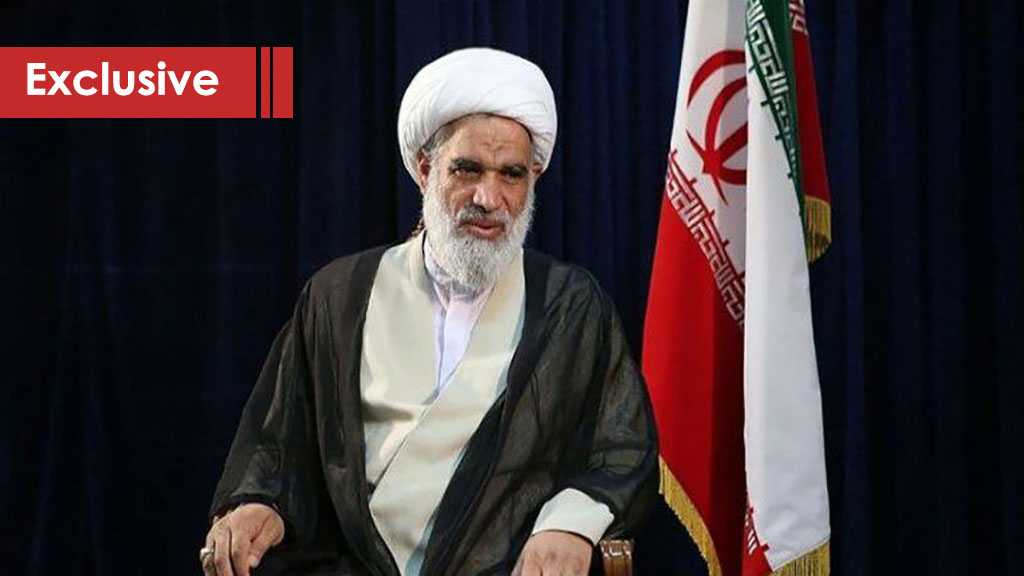
On this occasion, Al-Ahed news website sat down with a member of the Presidency of Iran’s Assembly of Experts, His Eminence Ayatollah Sheikh Abbas Al-Kaabi, who confirmed that the discourse of the Islamic Revolution presented a model for civilized jihad in the face of arrogance. This discourse, which was initiated by the honorable Imam Khomeini and continued by the Grand His Eminence Imam Sayyed Ali Khamenei is based on several elements:
1st element: Transforming weaknesses of the nation into strengths at all levels – cultural, economic, political, social, scientific, technical, defense and military
2nd element: Turning enemy threats into opportunities for development and civilization at all levels
3rd element: The cognitive view of power as a means of creating civilization not creating and producing power in order to dominate other human beings
4th element: Emphasis on the value system that starts from monotheism, justice, and human dignity and continues to consolidate the principles of ethics, development, science, religious governance of the people, and effective political participation in the light of values and morals
5th element: Removing the obstacles by combating tyrants, aggressors, corrupters, and the arrogant
6th element: Interaction with the Islamic awakening movement, restoration of nation-building and rooting the culture of resistance and the creation of civilization
7th element: The establishment of principles and values and the preservation of Islamic belief and knowledge in order to create an Islamic way of living that is compatible with Islamic values within the Islamic nation
8th element: The fight against backwardness and moving towards scientific development among the sons of the Islamic nation
9th element: Combating strife within the nation and emphasizing the strategy of unity among its sons
10th element: Focusing on the scientific and religious reference for the people of the nation in line with the requirements of the age and time
11th element: Knowledge and subordination to the righteous and intellectual leadership to create victory after victory in the face of global arrogance
12th element: Creating a new general structure for the nation and overthrowing structures, organizations, and administrative frameworks of global arrogance in international relations
13th element: Supporting independence, freedom, and movement towards achieving justice and development for Islamic peoples and countries in the face of hegemony, influence, and penetration of global arrogance
14th element: Focusing on interreligious and intercultural dialogue in the framework of monotheism, justice, and human dignity
Ayatollah Al-Kaabi concluded by saying: These 14 elements need the rise and resistance of the sons of the nation against the global arrogance system at all levels.
The discourse of the Islamic Revolution in the light of the ideas of Imam Khomeini and Imam Khamenei today created glory for the nation as well as an uprising and a movement of resistance against global arrogance. Today, we are stronger than ever, and global arrogance and its puppets in the region are weaker than ever. We are living in an era of great victories and the nation’s children pioneering resistance against global arrogance.
Abdul Aziz Rantissi:
"My ultimate wish, my God, is to attain martyrdom,"...God granted him his wish on April 17, 2004, at the hands of Israeli assassins.