Showing posts with label administrative detention. Show all posts

Friday, 2 May 2014

312 Palestinians Kidnapped By Israeli terror state army In April

freedom_strike.jpg
http://imemc.org/article/67694
The Ahrar Center for Detainees Studies and Human Rights issued its monthly report revealing that the Israeli army kidnapped 312 Palestinians in different parts of the occupied West Bank, occupied Jerusalem, and the besieged Gaza Strip.

Ahrar said the army carried out dozens of invasions into the occupied territories, and kidnapped the 312 Palestinians, mainly after breaking into their homes and properties, and violently searched them causing excessive property damage.

Most of the arrests have been carried out in the Hebron District, as the soldiers kidnapped 94 Palestinians, followed by Jerusalem, 92 Palestinians, Nablus, 36, Bethlehem, 21, Jenin, 18, Ramallah, 16, Gaza Strip, 15 including 11 kidnapped near the border fence, Qalqilia, 10, Salfit, 7, Tulkarem, 2, and one in Tubas.

Ahrar added that the army kidnapped four Palestinian women in April, and released two of them later on.
Mariam Barghouthi, from Ramallah, and Samira al-‘Akel, from Hebron, are still imprisoned, while Tahani Abu Mayyala and Hanin Abu Aisha, from Hebron, were released.

“There are 21 Palestinian women who are still imprisoned by Israel”, Ahrar stated.

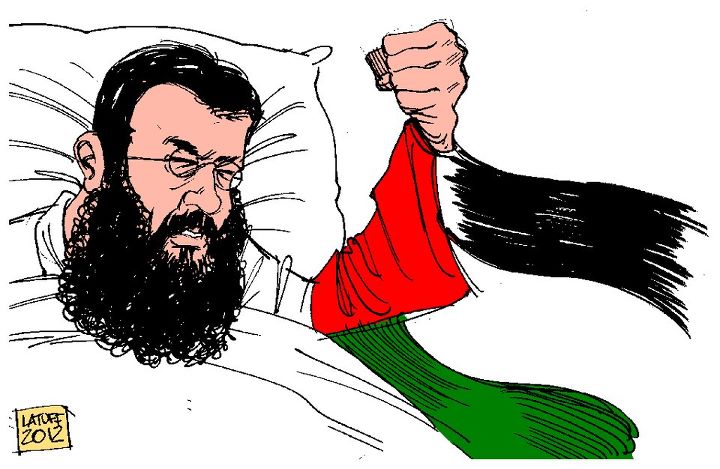
Head of the Ahrar Center, Fuad al-Khoffash, stated that April witnessed the beginning of one of the strongest hunger strikes by Administrative Detainees, held with charges or trial, and that the detainees are determined to continue their strike.

Al-Khoffash added that the striking detainees are subject to constant attacks and harassment in an attempt to force them to end their strike, while many have been moved into solitary confinement, and are denied the right to family visits.

River to Sea Uprooted Palestinian   
The views expressed in this article are the sole responsibility of the author and do not necessarily reflect those of the Blog!

Wednesday, 20 February 2013

Israeli Court Rules Issawi Must Stay in Custody, Protesters Clash with IOF

Local Editor

An Israeli court ordered on Tuesday that Palestinian hunger striker Samer Issawi should remain in jail, as tens of protesters clashed with occupation forces in Ramallah.
Samer Issawi
As Issawi’s lawyer requested Issawi’s release at a magistrate's court in Jerusalem, Israeli military prosecutor opposed the request.
The Palestinian prisoner, who has been on hunger strike since August, had entered the court in a wheelchair surrounded by armed guards.

Asked by the judge about his condition, Issawi "replied in a weak voice that he suffers pains and is facing death," the lawyer Jawad Bulous told Ma'an news agency.

Shortly after the judge announced Issawi would remain in prison until the next hearing in one month, his mother had a break down.
Hundreds of Palestinians in Israeli jails declared a one-day fast on Tuesday in solidarity with Issawi and three other prisoners on hunger strike.

The Palestinian Prisoner Club, which looks after the welfare of inmates and their families, said 800 prisoners were taking part in the day-long fast.
The issue of Palestinian prisoners who had been held in Israel jails without trial has touched off clashes between occupation forces and protesters who have been asking for granting the prisoners their minimum rights.

Meanwhile on Tuesday, Israeli occupation forces clashed with protestors outside Ofer detention center near Ramallah.

The rally in solidarity with hunger-strikers marched towards the Israeli prison from Birzeit, Beitunia and Ramallah.

Occupation forces fired tear gas at protesters and youths responded by throwing stones at military forces.

At least 18 people were slightly injured, Ma’an quoted witnesses as saying. Journalists at the scene said occupation forces deliberately targeted them with smoke bombs and sound grenades.
For its part, an occupation army spokeswoman said approximately 150 Palestinians “rioted”, claiming they hurled rocks and firebombs at Zionist forces, “who responded with riot dispersal means."
Source: Agencies
20-02-2013 - 10:12 Last updated 20-02-2013 - 10:12
River to Sea Uprooted Palestinian  
The views expressed in this article are the sole responsibility of the author and do not necessarily reflect those of this Blog!

Monday, 28 January 2013

Charge or Free Amer Issawi!

by Mahmoud El-Yousseph
Friday, January 25th, 2013

samer_al-Issawi

Hunger striker Samer Issawi, 33 years old, has been on hunger strike for over 184 days now, protesting the injustice of his detention and that of all the other Palestinian political prisoners. Like other Palestinian political prisoners, Samer Issawi’s indefinite detention without charges or trial is inhumane and an Israeli facade to continue to persecute the Palestinian people and those who dare to stand against Israel’s brutal occupation of Palestine and its crimes against the Palestinian people.

Issawi was previously sentenced to 30 years by Israel in 2002 and was among freed Palestinian prisoners who were released in October 2011 under a prisoner exchange deal between Hamas and Israel after he had served 11 years. However, this time Israel reneged and rearrested him eight months later, as it did in previous prisoner exchange deals. Such as in the case of Palestinian prisoners of Ziad Abu Ain in 1983 and Hanaa Shalabi in 2011.

Eight months after his 2011 release, Israel violated the terms of the swap deal and rearrested Issawi under Mickey Mouse charges (administrative detainee). Administrative detention is a procedure that allows the Israeli military to hold prisoners indefinitely on secret evidence without charging them or allowing them to stand trial. According to Aldemeer, a Palestinian Human Rights watch dog group, there are 25 members of the Palestine National Council, including the Speaker of the Parliament, who are among 5,000 Palestinians held captive in Israeli dungeons. These include 6 women, 166 children and 320 “administrative detainees.”

Since the year of 2000, the Israeli occupation authority issued over 20,000 administrative detentions orders. Palestinian held prisoners often boycott the Israeli military courts, as they view them as sham courts that are used by the Israeli occupation army and Israeli intelligence as a cover of illegal detention based on “secret” files and lack of indictment.

Basic element of democracy requires Israel to either charge or free Samer Issawi and other administrative detainess. Under a democratic system of government you are innocent until you are proven guilty. Not guilty till you’re proven innocent. So, if you are a Palestinian living under Israeli occupation, forget about the rules of law, as it does not apply to you.

Last December, Israeli guards assaulted Samer Issawi during a court hearing for the whole world to see when he tried to greet his family in a Jerusalem court, while the prisoner’s hands and feet were cuffed.

Issawi who assigned to Israel’s Ramleh prison was briefly hospitalized when his heart dropped to 36 beats/minute. That did not stop the guards and Israeli forces from assualting Issawi again as he tried to address the media. The guards dragged him by hands and feet to court’s detention room.

To add insult to the injury, Israeli forces raided Issawi’s home town North of Jerusalem on the day he was beaten in court and arrested his sister, Shireen without any charges, other than defending her brother’s right to freedom. Shireen who is an attorney is telling the world now to “stand by my brother beofore it’s too late!”

To make his voice heard, and challenge his illegal detention and inhumane treatment, Issawi went on an open-ended hunger strike until death or freedom. As of this writing, Issawi is on his 183th day. He is currently in a very critical condition due to an acute vitamin B-12 deficiency. Also, he suffered from neural and muscular problems, lost control of his limbs, got vision problem and blood vomiting.

Last December, Amer lost consciousness for 48 hours after he was give “medicine.” This is clearly very critical and inhumane treatment. Israel should be held accountable for this flagrant violation of human rights.

From a personal experience and from someone who lobbied for 18 months for his brother’s freedom from an Israel concentration camp in south Lebanon in 1980s, I do know that writing, challenging Israel publicly does make a difference. So, I do urge all people of conscience who read this to have their voice be heard and be counted, as I did few days ago. Yes, I did get a response back and not a death threat, a visit by DHS or the FBI : These two officials hold the highest two political ranks in Israel.

Write to the President and prime Minister of Israel:
Email: Israel’s Prime Minister Benjamin Netanyahu : pmo.heb@it.pmo.gov.il ; media@pmo.gov.il

Email: President of the state of Israel Mr. Shimon Peres: public@president.gov.il
Fax: +972-2-5664838 ; +972-2-5887225 (You can send via free fax)


Subject: charge or free Amer Issawi
Dear President/Prime Minister,
For the love of peace, please use your power to prevent injustice!


Mahmoud El-Yousseph
Retired USAF Veteran
Feedback: elyousseph6@yahoo.com

River to Sea Uprooted Palestinian  
The views expressed in this article are the sole responsibility of the author and do not necessarily reflect those of this Blog!

Wednesday, 11 July 2012

Palestinian footballer freed after 92-day hunger strike

Palestinian football player Mahmoud Sarsak is greeted by supporters as he arrives in an ambulance at the al-Shifa hospital in Gaza City on 10 July 2012. (Photo: AFP – Mahmud Hams)
Published Tuesday, July 10, 2012

The longest Palestinian hunger striker in history was released from an Israeli jail on Tuesday following 92 days without food in protest at his detention.

Mahmoud Sarsak greeted family and well-wishers in Gaza after three years in Israeli custody without charges or trial.

During his hunger strike, the 25-year-old member of the Palestinian national soccer team shed nearly half his weight. He ended the fast last month as part of a deal for his release.

Sarsak is currently being treated at Shifa Hospital in Gaza, a spokesperson for the Palestinian prisoners’ rights group Addameer confirmed to Al-Akhbar.

Sarsak's case received international attention with the world football body FIFA throwing its support behind the Palestinian player.

Three other Palestinians remain on hunger strike in Israeli jails, the most severe of whom is Akram Rikhawi, who has been refusing food since April 12

In a joint statement released last Thursday, Addameer and Physicians for Human Rights-Israel (PHR-Israel) warned that Rikhawi's health was deteriorating rapidly.

The statement said a PHR-Israel doctor had discovered an "alarming deterioration of Akram’s asthma, which continues to be unstable," adding that he believed "Akram has been given very high doses of
steroids as treatment, which can cause severe long-term and irreversible damage."

Rikhawi is currently serving a nine-year sentence for supporting suicide bombers, a charge he allegedly confessed to after being tortured.

Addameer said during his interrogation Rikhawi had been stripped naked and put in a room with dogs to scare him into confession.

Over 2,000 Palestinian prisoners in Israeli jails went on a mass hunger strike earlier this year to protest Israel's draconian administrative detention policy, as well as harsh conditions imposed on them during imprisonment.

The policy, dating back to the British mandate era, allows Israel to detain Palestinians indefinitely without charge or trial.

Amnesty International and Human Rights Watch have condemned the policy as a violation of international humanitarian law.

The mass strike ended in May when Israel agreed to stop the practice of indefinite detention without charge.

But Israel breached that agreement the following month by renewing the detention of Hassan Safadi for another six months.

Safadi had previously been on a hunger strike for 71 days before renewing his campaign 20 days ago in protest at his continued detention.
(Al-Akhbar, AP)
  • Sarsak Defeats "Israel: Three Months on Hunger Strike, Soccer Star to Freedom
River to Sea Uprooted Palestinian  
The views expressed in this article are the sole responsibility of the author and do not necessarily reflect those of this Blog!

Sunday, 10 June 2012

Umm Mahmoud: “We, mothers, are constantly crying over our children.”

by Roy Bard
Sunday, June 10th, 2012

An interview with the family of detained Palestinian footballer and hunger striker Mahmoud Al-Sarsak:


On July, 22, 2009, Palestinian National Team soccer player, Mahmoud Al Sarsak, bid farewell to his family as he had finally obtained an Israeli permit allowing him to cross Erez checkpoint in the north of Gaza and enter the West Bank. The 22-year-old player, at the time, was heading to Balata Refugee Camp to join the Palestinian National Soccer Team and to train there. The overwhelming happiness that overcame the young Palestinian athlete as he was issued the permit, describes his mother Khaldiya Shalabi, has turned into a curse of misery for him and his family.

Mahmoud was detained and has imprisoned without charge or trial since the. In protest Mahmoud joined the recent prisoner’s hunger strike, and has now gone over 80 days without food.
According to Ma’an:
After 80 days on hunger strike, Mahmoud al-Sarsak is at immediate risk of death and must be hospitalized immediately, an independent doctor said Wednesday.
Until Wednesday, Israel’s prison service had refused to allow independent doctors to visit al-Sarsak, who is being held at Ramle prison clinic.
Physicians for Human Rights – Israel were able to send a doctor to visit al-Sarsak on Wednesday after petitioning an Israeli court for access…..
Al-Sarsak, a professional soccer player, has experienced extreme loss of muscle tissue and drastic weight loss. The 25-year-old is frequently losing consciousness and suffers memory lapses, the doctor said. He is also at risk of pulse disruptions that are endangering his life.
Whilst Ramzy Baroud notes that:
Palestine’s soccer ranking at 164th in the world is testament not to any lack of passion for the game, but to the constant Israeli attempts at destroying even that national aspiration.
The examples of Israeli war on Palestinian soccer are too many to count, although most of them receive little or no media coverage whatsoever.
On June 8th a solidarity demo was held outside the UK Department of Culture, Media and Sport (DCMS) in London to try and raise Mahmoud’s profile.

River to Sea Uprooted Palestinian  
The views expressed in this article are the sole responsibility of the author and do not necessarily reflect those of this Blog!

Thursday, 7 June 2012

Thaer Halahleh: Making His Own Palestinian Destiny

Thaer Halahleh narrowly skirted death when Israel agreed to a deal that ended his 78-day hunger strike (photo: AFP -Gali Tibbon)
Published Wednesday, June 6, 2012

Thaer Halahleh narrowly skirted death when Israel agreed to a deal that ended his 78-day hunger strike, returning home on Tuesday night after languishing behind Israeli bars without charge for over two years.

“I had been in detention for 25 months, and in solitary confinement for 78 days, which is the hunger strike period,” Halahleh, his speech frail after the ordeal, told Al-Akhbar.

There was concern Israel would renege on its promise – as it has so often done in 64 years of its occupation of Palestine – and renew Halahleh's detention once again.

“I threatened the authorities with going on a silent hunger strike in case they didn't release me,” he said.
Israel has already renewed dozens of administrative detention sentences despite having made a deal with 2,000 Palestinian hunger strikers, pledging their release at the end of their current terms.
The Jewish state has also maintained a prohibition on family visits to a number of detainees, again in violation of the deal.

Halahleh's hunger strike has left him weak and thin, but is on the road to recovery.
“I am at al-Khalil hospital and staying there to take the necessary tests. Although I still feel pain when I eat sometimes, I am getting better,” he said.

Thaer, whose name means “rebel”, expressed deep joy at seeing his family, including his two-year-old daughter, Lamar, whom he barely knows thanks to Israel's stringent restrictions on family visits.
“I want to spend time with my only daughter who still doesn't know me and refused to acknowledge my presence until now,” he said bitterly, demonstrating deep resentment at the Israeli occupiers that robbed him of two years of his daughter's life.

But despite winning his own freedom, Halahleh could not contain the sadness at the thought of the many friends he left behind.

“I am overwhelmed with happiness and I am so glad to see my family again with their warm welcome. At the same time, I feel sad to have left my fellow detained brothers who hold the same mission,” he said.

Israel's draconian administrative detention policy dates back to the British mandate era of historic Palestine.

The policy enables Israel to detain Palestinians indefinitely without charge, and without disclosing the evidence supposedly gathered against them.

Human rights groups, including Amnesty International and Human Rights Watch, have slammed the policy as a violation of international humanitarian law.

Hundreds of Palestinians languish in Israeli prisons under the policy, which is just one of the many injustices Palestinian people suffer from under Israeli rule.

Halahleh described the inhumane conditions of the Israeli prison.

“The conditions in the jail were extremely harsh. They aren't fit for a human to live in. I was under the grip of the [Israeli] occupation which has all the means to provoke and pressure me.”

Halahleh has spent much of the past 15 years behind Israeli bars. The first time the 33-year-old was arrested by the Israeli occupation army was just before his senior year in high school.

Due to his frequent arrests and time spent in prison, Halahleh only managed to study for one year at Hebron University. He later managed to open a used furniture store.

He expressed hope in returning to his studies and continuing his furniture store business.

“I still haven't graduated from university. I think I will pursue my Quran and Islamic Sharia studies which I had started before I was detained. I will also handle the management of the furniture store I own,” he said.

Halahleh wrote the following to his daughter on the final days of his hunger strike, concerned that his non-violent resistance to Israeli occupation would take his life.

”My Beloved Lamar, forgive me because the occupation took me away from you, and took away from me the pleasure of witnessing my firstborn child that I have always prayed to God to see, to kiss, to be happy with. It is not your fault; this is our destiny as Palestinian people to have our lives and the lives of our children taken away from us, to be apart from each other and to have a miserable life.”
The letter describes the pain that Palestinian people must endure, and the misery Israel is bent on imposing upon them. But in Halahleh's case, his strength won him his freedom.

River to Sea Uprooted Palestinian  
The views expressed in this article are the sole responsibility of the author and do not necessarily reflect those of this Blog!

Friday, 1 June 2012

"Israel" Breaks Hunger Strike Deal, Renews Administrative Detention

Local Editor
Once again, "Israel" doesn't fulfill its promises. Weeks after more than 2000 jailed Palestinian ended their hunger strike in protest of "Israel's" policy of administrative detention, prison authorities extended the detention of eight administrative detainees.

Osama Maqbul, lawyer for the solidarity institute for human rights, announced Wednesday that "Israeli" intelligence requested that the detainees, including MP Muhammad Bader, be held for months.
Bader was detained last March, the Nablus-based group stated.

Maqbul identified the other detainees as Husam Muhsen al-Ruza, Muhammad Ali Sadek Abu al-Rab, whose terms were extended for three months, and Rashad Ahmad Abdo whose detention was extended for six months.

The lawyer added that "Israeli" forces changed the detention status of two prisoners from Beit Ummar to administrative detention. They were identified as Muhammad Said Baaran, for six months, and Alaa Fahmi Zaakik, for four months.

Ahmad al-Bitawi, a researcher in the institute, said "Israel" has also renewed the administrative detention of Sheikh Falah Nada, 57, for six months. Nada is a Hamas member from Ramallah.

He also said that "Israel" has renewed the detention of Aziz Harun Kayed, the former under-secretary-general of the Palestinian cabinet, 10th government.

Meanwhile, the mother of the prisoner Mahmoud Sarsak , who has been on hunger strike for 80 days ago, urged international community to move to prevent the martyrdom of her son; who has lost the hearing and visual abilities.

On Monday, Palestinian officials said the Egyptian-brokered deal that ended a mass hunger strike by Palestinian prisoners in "Israeli" jails has failed to meet hopes that "Israel" would change its policy of detention without trial.

In the two weeks since some 2,000 inmates agreed to end their hunger strike, more than 25 prisoners have either been rearrested after their release or had their six-month detention terms renewed.

The new detention figures, relating to Palestinians suspected of security offenses, are largely in line with past statistics during a two-week time frame, the officials said.

Under the deal, "Israel" agreed to reduce solitary confinement and increase family visits.

River to Sea Uprooted Palestinian  
The views expressed in this article are the sole responsibility of the author and do not necessarily reflect those of this Blog!

Wednesday, 16 May 2012

Empty Stomach Warriors: A History Lesson

 
A girl holds a portrait of a Palestinian held in an Israeli jail during celebrations after a deal to end a prisoners hunger strike was agreed, in the West Bank city of Ramallah 14 May 2012. (Photo: Reuters - Ammar Awad)

Published Tuesday, May 15, 2012

Hunger strikes like the one that ended Monday have long been the only way for Palestinians held captive by Israel to secure improvements to harsh prison conditions.

More than 15 major indefinite hunger strikes have been organized by the Palestinian captive movement in Israeli jails in the 45 years since the occupation of the West Bank and Gaza Strip began.
Decisions to stage “strategic” hunger strikes – as the prisoners refer to them, to distinguish them from the smaller-scale strikes they hold regularly - are taken in full knowledge of the suffering and danger they entail for the participants. But they have proven to be the prisoners’ sole means of partially alleviating the suffering of a different order which is inflicted on them on a daily and growing basis.
Conditions for Palestinians in the jails of “the only democracy in the Middle East” have never been determined by considerations of human rights. They have largely been the outcome of a constant struggle pitting the defenseless inmates, determined to continue their struggle for freedom and dignity behind bars, against an occupation authority for which brutal incarceration is an integral part of the broader system of repression.

In a world which tacitly colludes with the occupation by disregarding its crimes, it is unsurprising that this struggle goes largely unreported by the media. It only makes the news at major junctures, when the prisoners force themselves on the domestic and regional agenda by declaring a war of wills, with only their empty stomachs as weapons.


This weapon was first employed effectively in 1969, in a hunger strike in Ramleh prison which lasted 11 days and set a precedent. Large-scale hunger strikes have been held around once every three years since. They have invariably focused on variants of the same demand: the improvement of worsening prison conditions to a level consistent with the prisoners’ human dignity.
 

Veteran former inmates recall how prisoners in the 1970s were subject to forced labor – at times being made to do work for the Israeli military such as sewing tarpaulins – forbidden from speaking to each other in prison yards, and routinely meted out brutal and humiliating treatment from guards. They are acutely conscious that it was only the hunger and pain they suffered in successive strikes which brought about incremental gains – from the right to have spoons to eat their meals with, to the demands raised by the prisoners in their latest hunger strike.

At times they have paid with their lives, as in the 32-day hunger strike at Nafha prison in 1980. Three inmates – Rasem Halaweh, Ali al-Jaafari, and Ishaq Maragheh – died during attempts by prison administration to force-feed them with fluid injected through tubes inserted into their nostrils.

Veterans consider this to have been one of the hardest-fought and toughest of all Palestinian prisoners’ hunger strikes because of the draconian measures the Israeli prison service took in an attempt to break it, apparently fearing the precedent it would set if it succeeded. But the prisoners’ determination proved stronger, and a number of gains were achieved. These included improved conditions such as being provided with beds to sleep on (they had previously had to sleep on cell floors), and also recognition of the prisoners’ organizational structures, and by extension their right to deal with the prison authorities via representatives of their own choosing.


The most high-profile hunger strike after Nafha was at Juneid prison in 1987, which also extended to other detention centers. It resulted in prisoners establishing their right to longer outdoors-time and access to radio and television.
 

The “mother of battles” waged by Palestinian prisoners was the rolling hunger strike they launched in September 1992. It took months to plan and coordinate, and was taken up in succession by captives in all the main prisons, numbering around 7,000 in total. Street protests in support of the prisoners rapidly gained momentum, sparking what the media dubbed at the time as the “prisoners’ intifada.” During the 17 days of the hunger strike, Israeli occupation forces killed 17 Palestinian protesters in clashes in the West Bank, Gaza Strip and East Jerusalem. One of the striking prisoners, Hussein Obeidat, also lost his life due to health complications.

Among the notable gains achieved was the right for prisoners to embrace their young children for five minutes during family visits, and also to continue their academic studies by correspondence, and to use fans to alleviate the summer heat in their cells.

It was clear to the captive movement at the time that it would be a struggle to hold on to these important gains. Having been forced to yield in the face of the prisoners’ resolve, the Israeli prison service proceeded to gradually but systematically renege on its undertakings. It withdrew, or effectively cancelled, many of the entitlements prisoners had achieved, taking advantage of the conducive political climate and conditions over the years that followed.

Thus, by the time of the outbreak of the Second Intifada in 2000, prison conditions had worsened steadily, and they have continued to deteriorate. The Israeli government itself ordered harsh measures against prisoners as a means of applying pressure and extortion during the course of the protracted prisoner exchange negotiations conducted after the Palestinian resistance captured Israeli soldier Gilad Shalit.

Whenever a decision is taken to go on hunger strike, the leaders of the various political groups to which the inmates belong appoint a special committee to prepare for and organize the protest, and define and prioritize demands and tactics. Known as the “struggle committee,” it determines the parameters of the protest and the minimum terms for ending it. Once the strike is announced, the committee takes charge of leading it and negotiating with the prison authorities on behalf of the prisoners, and it alone can call an end to the strike.


Former prisoners who have been on open hunger strike say they always knew their lives were on the line, despite the measures they learnt to take to maintain their health for as long as possible. Captives who join hunger strikes are, for example, told to take regular doses of salt to keep up their blood pressure and drink plenty of water to maintain body fluid levels. It is also important to keep movement minimal to preserve calories and avoid sudden exertions which could cause vertigo.
 

Yet these measures do not spare hunger strikers from intense suffering. This is compounded by the foul smell which begins to be emitted from the gut around the fifth day, accompanied by severe pains in the joints and a growing sense of weakness. The feeling of actual hunger diminishes as the stomach atrophies. With time, other symptoms start to appear, with severe weight loss setting in after the first week. After the second week the body starts tapping energy from the liver and muscles.

According to medical observations, hunger strikers enter a critical phase in their fifth week, as muscle paralysis sets in, also affecting the eyesight, and it becomes difficult even to swallow water. Subsequently, the senses dull and weaken before being almost completely lost. Then, internal bleeding begins, along with the struggle against death.

There is no precise medical prognosis for how long someone can survive without food. But observations of hunger strikers suggest that a young, healthy adult of medium weight would expect to start losing consciousness on day 55 of a hunger strike, and be in a critically life-threatening condition from day 60. Statistics suggest it would be highly unlikely for a hunger striker to survive 75 days.


Prior to the latest Palestinian prisoners’ hunger strike, one of the longest in modern times was the 1981 protest by Irish Republican Army (IRA) prisoners jailed by Britain, led by the militant and poet Bobby Sands. They began a rolling hunger strike in March that year to demand recognition as political prisoners rather than common criminals. Sands died after 66 days, and his comrades continued the protest. Nine of them lost their lives before the hunger strike was called off in October after the British government acceded to the prisoners’ demands. Sands became an icon of the Irish republican movement, his funeral attended by more than 100,000 people. Palestinian detainees Thaer Halahleh and Bilal Thiab were on the 77th day of their hunger strike when Monday’s deal was announced.

This article is an edited translation from the Arabic Edition.

River to Sea Uprooted Palestinian  
The views expressed in this article are the sole responsibility of the author and do not necessarily reflect those of this Blog!

Tuesday, 15 May 2012

Empty Stomach Warriors: Tasting Victory

Photo Blog by Dylan Collins

Yesterday, 14 May 2012, as the largest and longest mass hunger strike in history ended its 28th consecutive day, rumors of an Egyptian brokered deal finalizing the end of the strike began to soar.
At approximately 7:30, mainstream news agencies began reporting aspects of a deal reached, under Egyptian auspices, between Israeli authorities and Palestinian prisoner representatives in Israel’s Ashkelon prison. In exchange for ending their momentous hunger strike movement, prisoners will be granted several of their long sought after objectives (read: basic prisoner rights), such as the allowance of family visits, the release of all detainees in solitary confinement, and the charge or subsequent release of all administrative detainees.

News of the deal spread like wildfire, and within minutes hundreds began flocking to Ramallah’s central Clock Square in order to celebrate the end of the strike, the attainment of basic rights, and the assurance that their loved ones will live to see another day.

The hunger strike began in conjunction with Palestinian Prisoners’ Day, 17 April 2012, when a group of approximately 1400 prisoners began an open-ended hunger strike in protest against Israel’s exploitive use of administrative detention, a method which enables Israeli authorities to detain anyone (read: Palestinians) indefinitely without charges or trials, in addition to its habitual mistreatment of Palestinian prisoners. The latest figures from Addameer estimate the group of hunger striking prisoners to have been upwards of 2,000 people at the time of last night's deal.


(Photo: Dylan Collins)

(Photo: Dylan Collins)

(Photo: Dylan Collins)

(Photo: Dylan Collins)

(Photo: Dylan Collins)

(Photo: Dylan Collins)

(Photo: Dylan Collins)

(Photo: Dylan Collins)

(Photo: Dylan Collins)

(Photo: Dylan Collins)

(Photo: Dylan Collins)

River to Sea Uprooted Palestinian  
The views expressed in this article are the sole responsibility of the author and do not necessarily reflect those of this Blog!

Monday, 14 May 2012

Palestinian Prisoners Mulling End to Hunger Strike under Egypt Deal

Palestinian prisoners' familiesPalestinian officials said thousands of prisoners on hunger strike in Israeli jails are weighing to end their hunger strike under an Egyptian mediated deal.

“A deal could be reached tonight, but it should be presented to prisoners in the Israeli jails, possibly Monday morning, for endorsement before an official announcement,” said a Palestinian official, speaking on condition of anonymity, on Sunday.

“The prisoners are looking at the deal that was agreed in Cairo, only the prisoners can decide,” said a Palestinian source close to the Egyptian-brokered negotiations with Israel. "It's the leaders of the prisoners who have the key, to say yes or no."

Some 1,550 Palestinian prisoners are on hunger strike, including two detainees who on Monday entered their 76th day without food demanding that the Zionist entity ends both solitary confinement and the use of administrative detention, a procedure under which suspects can be held indefinitely without charge.

Late on Sunday, a source confirmed to AFP that a deal regarding their demands had been hammered out in Cairo.

On Monday, Palestinian prisoners minister Issa Qaraqaa told Voice of Palestine radio that the Israeli occupation had reportedly accepted three key prisoner demands -- not renewing existing administrative detention orders, ending solitary confinement and permitting relatives from Gaza to visit detainees.

He said he believed the hunger strike could end as early as Monday, if the concessions were formally adopted by the Israeli occupation and accepted by the prisoner leadership.

Source: AFP
14-05-2012 - 15:06 Last updated 14-05-2012 - 15:06
River to Sea Uprooted Palestinian  
The views expressed in this article are the sole responsibility of the author and do not necessarily reflect those of this Blog!

Thursday, 10 May 2012

Historic Hunger Strikes: Lightning in the Skies of Palestine

By Richard Falk


May 8 2012

There is ongoing militant expression of Palestinian resistanceto the abuses of Israel’s 45 years of occupation and de facto annexation of the West Bank and East Jerusalem, and five year blockade of Gaza taking the form of a series of hunger strikes. Recourse to this desperate tactic of courageous self-sacrifice is an extreme form of nonviolence, and should whenever and wherever it occurs be given close attention.

Palestinians have protested by hunger strikes in the past but failed to inspire the imagination of the wider Palestinian community or shake the confidence of Israeli officialdom. Despite the averted gaze of the West, especially here in North America, there are some signs that this time the hunger strikes have crossed a historic threshold of no return.


These strikes started by the individual exploit of a single person, Khader Adnan, at the end of 2011. Dragged from his home in the village of Arraba near Jenin by a night raid by dozens of Israeli soldiers, humiliated and roughed up in the presence of his two and four year old daughter, carried away shackled and blindfolded, roughly interrogated, and then made subject to an administrative decree for the eighth time in his young life, Adnan’s inner conscience must have screamed ‘Enough!’ and he embarked on an open-ended hunger strike. He continued it for 66 days, and agreed to take food again only after the Israeli authorities relented somewhat, including a pledge not to subject Adnan to a further period of administrative detention unless further incriminating evidence came to the surface. Upon release, Adnan to depersonalize his ordeal insisted on visiting the families of other Palestinians currently under administrative detention before returning to his own home.


He has spoken out with firm gentleness and invited persons of conscience everywhere to join in the struggle to induce Israel to abandon administrative detention, and the accompanying violations of Palestinian human rights. Khader Adnan’s open letter to the people of the world is reproduced below to convey the tone and substance of his struggle.


Supporters of Hana Shalabi
Following Adnan, and inspired by him, was Hana Shalabi, a young Palestinian woman subject to a similar abusive arrest, accompanied by humiliations associated with her dress and sexual identity. Shalabi was from the villange of Burqin also near Jenin, and had been released a few months earlier in October 2011 as part of the prisoner exchange that was negotiated to obtain the release of the sole Israeli captive, Gilad Shalit. She had seldom strayed from her family home prior to the re-arrest on February 16, 2012, and her life was described as follows by her devoted sister, Zahra: “The four months between October and February were trouble-free days, bursting with dreams and ambitions. Hana loved to socialize and meet with people. She was busy with getting her papers in order to register for university, with her eyes set on enrolling at the American University in Jenin.

She wanted to get her driver’s license, and later buy a car. She went on a shopping spree, buying new carpets and curtains for her bedroom…and she dreamed of getting married and of finding the perfect man to spend the rest of her life with.” It is little wonder that when arrested in the middle of the night she reacted in the manner described by Zahra: “She was panicking, and kept repeating over and over again that she was not going with the soldiers because she didn’t do anything.”


Shalabi Gets Freedom… In Gaza

As with Adnan, Shalabi was released after she was in critical condition, but in a vindictive manner, being sent to live in Gaza for three years, thereby separated from her family and village, which were her places of refuge, love, and nurturing. She also made it clear that her experience of resistance was not meant for herself alone, but was intended to contribute to the struggle against prison abuse and the practice e of administrative detention, but even more generally as engagement in the struggle for Palestinian rights, so long denied. The example set by Adnan and Shalabi inspired others subject to similar treatment at the hands of the Israelis arrest and prison service. Several Palestinians detained by administrative detention decrees commenced hunger strikes at the end of February, and as many as 1650 others, and possibly more, initiated a massive hunger strike on Palestinian Prisoner’s Day, April 17ththat is continuing, and has been named ‘the battle of empty stomachs.’ The main battlefield is the mind of the oppressor, whether to give in and seem weak or remain firm and invite escalating censure, as well as Palestinian militancy, should any of those now in grave condition die.
 

The latest news suggests that Bilal Diab and Thaer Halahleh, continuing their hunger strike that started on February 28th of this year, are clinging to life by a thread. A few days ago they were both been finally transferred to civilian hospitals. Mr. Halahleh after the 70th day without food announced that he was no longer willing even to drink any water or accept further medication.


As might be expected the voices of concern from the international community have been muted and belated. The International Committee of the Red Cross has finally expressed in public its concern for the lives of these strikers. The UN Envoy to the Middle East, Robert Serry, never someone outspoken, acknowledged a few days ago in a brief and perfunctory statement that he was‘deeply troubled’ by the danger to these hunger strikers, as if such a sentiment was somehow sufficient to the outrages being inflicted.
More persuasively, several human rights NGOs, including Physicians for Human Rights--Israel have been reminding Israel of its obligation to allow family visits, which prison authorities have repeatedly denied, despite it being an accepted tenet of medical ethics that is affirmed in Israel’s Patient’s Rights Law.


On May 7, 2012 the Israel’s High Court of Justice denied urgent petitions for release from administrative detention filed on behalf of Mr. Diab and Mr. Halahleh. The Court in a classic example of the twisted way judges choose to serve the state rather than the cause of justice declared: “Hunger strikes cannot serve as an element in a decision on the very validity of administrative detention, since that would be confusing the issue.” Would it be so confusing to say that without some demonstration of evidence of criminality rejecting such a petition amounts to imposing a death sentence without even the pretensions of ‘a show trial’ that relies on coerced confessions? Israel’s highest judicial body leaves no doubt about their priorities by invoking anti-terrorism as a blanket justification, saying that Israel “should not have to apologize for securing its own safety.”


Other reports that the Israeli government has yet to feel pressure from European governments to act in a more humanitarian manner in response to these hunger strikes, but is worried that such pressure might come soon.


After remaining silent for a long time, Robert Serry, the UN Envoy to the Middle East, a few days ago timidly issued a public statement saying that he was ‘deeply troubled’ by the near death condition of the Mr. Diab and Mr. Halahleh.


On a wider canvas, the hunger strikes are clearly having some effect on Israeli prison policy, although it is not clearly discernible as yet. The Israeli Public Security Minister, Yitzhak Aharonovitch, convened a meeting in which he voiced the opinion that Israeli reliance on administrative detention was excessive, and should be reduced. There is also some discussion with officials of the Israeli Prison Service and a committee representing some of the April 17thprisoners on a series of demands relating to prison conditions.


The following demands have been articulated by the April 17th hunger strikers, under the banner of ‘The Prisoners Revolution’:


1. Ending the Israeli Administrative detention and solitary confinement, in which Palestinians were imprisoned for more than ten consecutive years, in solitary cells that lack basic human necessities of life.


2. Allowing family visits to those from the Gaza Strip due to political decisions and unjust laws, such as the so-called "law of Shalit.


3. Improving the livelihood of prisoners inside Israeli Jails and allowing basic needs such as a proper health treatment, education and TV channels and newspapers.


4. Putting an end to the humiliation policy carried by the Israeli Prison Service against Palestinian prisoners and their families, through humiliating naked inspection, group punishment, and night raids.


**********

April 30 2012

Khader Adnan’s Open Letter to the Free People of the World

In the name of Allah, Most Compassionate, Most Merciful,*

* Praise be to Allah, and peace and blessings be upon the Messenger of
Allah.*

Dear free people of the world.

Dear oppressed and disenfranchised around the globe.

Dear friends of our people, who stood with me with a stern belief in freedom and dignity for my people and our prisoners languishing in the Occupation's prisons.

Dear free women and men, young and elderly, ordinary people as well as intellectual elites everywhere -
I address you today with an outpouring of hope and pain for every Palestinian that suffers from the occupation of his land, for each of us that has been killed, wounded or imprisoned by the state of terror, that denies anything beautiful in our lives, even the smile of our children and families. I am addressing you in my first letter following my release - praying it will not be the last - after Allah granted me freedom, pride and dignity.

I was an "administrative detainee"in the jail of occupation for four months, out of which I have spent 66 days on hunger strike.

I was driven to declare an open-ended hunger strike by the daily harassment and violation of my people's rights by the Israeli Zionist occupation. The last straw for me were the ongoing arrests, the brutal nighttime raid on my house, my violent detention, during which I was taken to the "Mavo Dotan" settlement on our land occupied 1967, and the beatings and humiliation I was treated to during arrest interrogation. The way I was treated during the interrogation at the Jalameh detention center, using the worse and lowest verbal insults in the dictionary.

After questioning, I was sentenced to imprisonment under administrative detention with no charges, which proves mine and others' arrests serve only to maintain a quota of prisoners, to harass us, to restrict our freedom and to undermine our determination, pride and dignity.

I write today to thank all those who stood tall in support of my people,with our prisoners, with Hana al-Shalabi and with myself. I call on you to stand for justice pride and dignity in the face of occupation. The assault on the freedom and dignity of the Palestinian people is an assault on free people of the world by a criminal occupation that threatens the security, freedom and dignity of all, no matter where. Please, continue in exposing this occupation, boycotting and isolating it internationally. Expose its true face, the one that was clearly exposed in the attack of an Israeli officer on our Danish cohort. Unlike that attack, the murder our people is a crime that goes by unspoken of and slips away from the lens of the camera.

Our prisoners are dying in silence. Hundreds of defenders of freedom are on hunger strike inside the prisons, including the eight knights, Bilal Diab and Thaer Hlahalh, who are now on their 61stday of hunger strike, Hassan Safadi, Omar Abu Shalal, Mahmoud Sarsak, Mahmoud Sarsal, Mohammad Taj, Jaafar Azzedine (who was arrested solely for standing in solidarity with myself) and Ahmad haj Ali. Their lives now are in great danger.

We are all responsible and we will all lose if we anything happen to them. Let us take immediate action to pressure the Occupation into releasing them immediately, or their children could never forgive us.Let all those free and revolutionary join hands against the Occupation's oppression, and take to the streets – in front of the Occupation's prisons, in front of its embassies and all other institutions backing it around the world.

With deep appreciation,

*Khader Adnan *

++++

Having followed these hunger strikes for several months, I am convinced that these individuals subject to administrative detention are ordinary persons living a normal life, although chafing under the daily rigors and indignities of prolonged occupation. Israeli commentary tends to divert humanitarian concerns by branding these individuals as ‘terrorists,’ taking note of their alleged affiliation with Islamic Jihad. Adnan who is obviously preoccupied with his loving family, a baker by profession, working in his village, does not seem a particularly political person beyond the unavoidable political response to a structure of domination that is violent, cruel, and abusive. The language of his Open Letter is one that exhibits moral intensity, and seeks support for the Palestinian struggle for a sustainable peace with justice. It has none of the violent imagery or murderous declarations found in Al Qaeda’s characteristic calls for holy warfare against the infidels.

I was impressed by Hana Shalabi’s sister’s response when asked about the alleged connection with Islamic Jihad. Zahra responded to the question with a smile saying, ‘She’s not really Islamic Jihad. She doesn’t belong to any faction. When Israel imprisons you, their security forces ask which political faction you belong to. Hana chose Islamic Jihad on a whim.’ Even if it was than a whim, for a religious person to identify with Islamic Jihad it does not at all imply a commitment to or support for terrorist tactics of resistance. Zahra asks rhetorically, ‘Does she have missiles or rockets? Where is the threat to Israel? ..Why can’t we visit her? She has done nothing.’ And finally, ‘I would never place my enemy in my sister’s position…I would not wish this on anyone.’

Israel has by vague allegations of links to terrorist activities tried its best to dehumanize these hunger strikers, or to dismiss such actions as the foolish or vain bravado of persons ready to renounce their lives by their own free will. But their acts and words if heeded with empathy, their show of spiritual stamina and sense of mission, convey an altogether different message, one that exhibits the finest qualities that human beings can ever hope to achieve. Those of us who watch such heroic dramas unfold should at least do our best to honor these hunger strikers, and not avert our eyes, and do our utmost to act in solidarity with their struggles in whatever way we can.

We cannot now know whether these hunger strikes will spark Palestinian resistance in new and creative ways. What we can already say with confidence is that these hunger strikers are writing a new chapter in the story line of resistance Sumud, and their steadfastness is for me a Gandhian Moment in the Palestinian struggle.

River to Sea Uprooted Palestinian  
The views expressed in this article are the sole responsibility of the author and do not necessarily reflect those of this Blog!