Showing posts with label De Gaulle. Show all posts

Thursday, 25 November 2021

In Memory of JFK: The First U.S. President to be Declared a Terrorist and Threat to National Security

 November 22, 2021

By Cynthia Chung for the Saker Blog

In April 1954, Kennedy stood up on the Senate floor to challenge the Eisenhower Administration’s support for the doomed French imperial war in Vietnam, foreseeing that this would not be a short-lived war.[1]

In July 1957, Kennedy once more took a strong stand against French colonialism, this time France’s bloody war against Algeria’s independence movement, which again found the Eisenhower Administration on the wrong side of history. Rising on the Senate floor, two days before America’s own Independence Day, Kennedy declared:

“The most powerful single force in the world today is neither communism nor capitalism, neither the H-bomb nor the guided missile – it is man’s eternal desire to be free and independent. The great enemy of that tremendous force of freedom is called, for want of a more precise term, imperialism – and today that means Soviet imperialism and, whether we like it or not, and though they are not to be equated, Western imperialism. Thus, the single most important test of American foreign policy today is how we meet the challenge of imperialism, what we do to further man’s desire to be free. On this test more than any other, this nation shall be critically judged by the uncommitted millions in Asia and Africa, and anxiously watched by the still hopeful lovers of freedom behind the Iron Curtain. If we fail to meet the challenge of either Soviet or Western imperialism, then no amount of foreign aid, no aggrandizement of armaments, no new pacts or doctrines or high-level conferences can prevent further setbacks to our course and to our security.”[2]

In September 1960, the annual United Nations General Assembly was held in New York. Fidel Castro and a fifty-member delegation were among the attendees and had made a splash in the headlines when he decided to stay at the Hotel Theresa in Harlem after the midtown Shelburne Hotel demanded a $20,000 security deposit. He made an even bigger splash in the headlines when he made a speech at this hotel, discussing the issue of equality in the United States while in Harlem, one of the poorest boroughs in the country.

Kennedy would visit this very same hotel a short while later, and also made a speech:

Behind the fact of Castro coming to this hotel, [and] Khrushchev…there is another great traveler in the world, and that is the travel of a world revolution, a world in turmoil…We should be glad [that Castro and Khrushchev] came to the United States. We should not fear the twentieth century, for the worldwide revolution which we see all around us is part of the original American Revolution.”[3]

What did Kennedy mean by this? The American Revolution was fought for freedom, freedom from the rule of monarchy and imperialism in favour of national sovereignty. What Kennedy was stating, was that this was the very oppression that the rest of the world wished to shake the yoke off, and that the United States had an opportunity to be a leader in the cause for the independence of all nations.

On June 30th, 1960, marking the independence of the Republic of Congo from the colonial rule of Belgium, Patrice Lumumba, the first Congolese Prime Minister gave a speech that has become famous for its outspoken criticism of colonialism. Lumumba spoke of his people’s struggle against “the humiliating bondage that was forced upon us… [years that were] filled with tears, fire and blood,” and concluded vowing “We shall show the world what the black man can do when working in liberty, and we shall make the Congo the pride of Africa.”

Shortly after, Lumumba also made clear, “We want no part of the Cold War… We want Africa to remain African with a policy of neutralism.[4]

As a result, Lumumba was labeled a communist for his refusal to be a Cold War satellite for the western sphere. Rather, Lumumba was part of the Pan-African movement that was led by Ghanaian President Kwame Nkrumah (who later Kennedy would also work with), which sought national sovereignty and an end to colonialism in Africa.

Lumumba “would remain a grave danger,” Dulles said at an NSC meeting on September 21, 1960, “as long as he was not yet disposed of.”[5] Three days later, Dulles made it clear that he wanted Lumumba permanently removed, cabling the CIA’s Leopoldville station, “We wish give [sic] every possible support in eliminating Lumumba from any possibility resuming governmental position.”[6]

Lumumba was assassinated on Jan. 17th, 1961, just three days before Kennedy’s inauguration, during the fog of the transition period between presidents, when the CIA is most free to tie its loose ends, confident that they will not be reprimanded by a new administration that wants to avoid scandal on its first days in office.

Kennedy, who clearly meant to put a stop to the Murder Inc. that Dulles had created and was running, would declare to the world in his inaugural address on Jan. 20th, 1961, “The torch has been passed to a new generation of Americans.

La Resistance

Along with inheriting the responsibility of the welfare of the country and its people, Kennedy was to also inherit a secret war with communist Cuba run by the CIA.

The Bay of Pigs set-up would occur three months later. Prouty compares the Bay of Pigs incident to that of the Crusade for Peace; the Bay of Pigs being orchestrated by the CIA, and the Crusade for Peace sabotaged by the CIA, in both cases to ruin the U.S. president’s (Eisenhower and Kennedy) ability to form a peaceful dialogue with Khrushchev and decrease Cold War tensions. Both presidents’ took onus for the events respectively, despite the responsibility resting with the CIA. However, Eisenhower and Kennedy understood, if they did not take onus, it would be a public declaration that they did not have any control over their government agencies and military.

Further, the Bay of Pigs operation was in fact meant to fail. It was meant to stir up a public outcry for a direct military invasion of Cuba.

On public record is a meeting (or more aptly described as an intervention) with CIA Deputy Director for Plans Richard Bissell, Joint Chiefs Chairman Lyman Lemnitzer, and Navy Chief Admiral Burke basically trying to strong-arm President Kennedy into approving a direct military attack on Cuba. Admiral Burke had already taken the liberty of positioning two battalions of Marines on Navy destroyers off the coast of Cuba “anticipating that U.S. forces might be ordered into Cuba to salvage a botched invasion.”[7] (This incident is what inspired the Frankenheimer movie “Seven Days in May.”)

Kennedy stood his ground.

“They were sure I’d give in to them,” Kennedy later told Special Assistant to the President Dave Powers. “They couldn’t believe that a new president like me wouldn’t panic and try to save his own face. Well they had me figured all wrong.”[8]

Incredibly, not only did the young president stand his ground against the Washington war hawks just three months into his presidential term, but he also launched the Cuba Study Group which found the CIA to be responsible for the fiasco, leading to the humiliating forced resignation of Allen Dulles, Richard Bissell and Charles Cabell. (For more on this refer to my report.)

Unfortunately, it would not be that easy to dethrone Dulles, who continued to act as head of the CIA, and key members of the intelligence community such as Helms and Angleton regularly bypassed McCone (the new CIA Director) and briefed Dulles directly.[9]

But Kennedy was also serious about seeing it through all the way, and vowed to “splinter the CIA into a thousand pieces and scatter it to the winds.”

* * *

There is another rather significant incident that had occurred just days after the Bay of Pigs, and which has largely been overshadowed by the Cuban fiasco in the United States.

From April 21-26th, 1961, the Algiers putsch or Generals’ putsch, was a failed coup d’état intended to force President de Gaulle (1959-1969) not to abandon the colonial French Algeria. The organisers of the putsch were opposed to the secret negotiations that French Prime Minister Michel Debré had started with the anti-colonial National Liberation Front (FLN).

On January 26th, 1961, just three months before the attempted coup d’état, Dulles sent a report to Kennedy on the French situation that seemed to be hinting that de Gaulle would no longer be around, “A pre-revolutionary atmosphere reigns in France… The Army and the Air Force are staunchly opposed to de Gaulle…At least 80 percent of the officers are violently against him. They haven’t forgotten that in 1958, he had given his word of honor that he would never abandon Algeria. He is now reneging on his promise, and they hate him for that. de Gaulle surely won’t last if he tries to let go of Algeria. Everything will probably be over for him by the end of the year—he will be either deposed or assassinated.”[10]

The attempted coup was led by Maurice Challe, whom de Gaulle had reason to conclude was working with the support of U.S. intelligence, and Élysée officials began spreading this word to the press, which reported the CIA as a “reactionary state-within-a-state” that operated outside of Kennedy’s control.[11]

Shortly before Challe’s resignation from the French military, he had served as NATO commander in chief and had developed close relations with a number of high-ranking U.S. officers stationed in the military alliance’s Fontainebleau headquarters.[12]

In August 1962 the OAS (Secret Army Organization) made an assassination attempt against de Gaulle, believing he had betrayed France by giving up Algeria to Algerian nationalists. This would be the most notorious assassination attempt on de Gaulle (who would remarkably survive over thirty assassination attempts while President of France) when a dozen OAS snipers opened fire on the president’s car, which managed to escape the ambush despite all four tires being shot out.

After the failed coup d’état, de Gaulle launched a purge of his security forces and ousted General Paul Grossin, the chief of SDECE (the French secret service). Grossin was closely aligned with the CIA, and had told Frank Wisner over lunch that the return of de Gaulle to power was equivalent to the Communists taking over in Paris.[13]

In 1967, after a five-year enquête by the French Intelligence Bureau, it released its findings concerning the 1962 assassination attempt on de Gaulle. The report found that the 1962 assassination plot could be traced back to the NATO Brussels headquarters, and the remnants of the old Nazi intelligence apparatus. The report also found that Permindex had transferred $200,000 into an OAS bank account to finance the project.

As a result of the de Gaulle exposé, Permindex was forced to shut down its public operations in Western Europe and relocated its headquarters from Bern, Switzerland to Johannesburg, South Africa, it also had/has a base in Montreal, Canada where its founder Maj. Gen. Louis M. Bloomfield (former OSS) proudly had his name amongst its board members until the damning de Gaulle report. The relevance of this to Kennedy will be discussed shortly.

As a result of the SDECE’s ongoing investigation, de Gaulle made a vehement denunciation of the Anglo-American violation of the Atlantic Charter, followed by France’s withdrawal from the NATO military command in 1966. France would not return to NATO until April 2009 at the Strasbourg-Kehl Summit.

In addition to all of this, on Jan. 14th, 1963, de Gaulle declared at a press conference that he had vetoed British entry into the Common Market. This would be the first move towards France and West Germany’s formation of the European Monetary System, which excluded Great Britain, likely due to its imperialist tendencies and its infamous sin City of London.

Former Secretary of State Dean Acheson telegrammed West German Chancellor Konrad Adenauer directly, appealing to him to try to persuade de Gaulle to back track on the veto, stating “if anyone can affect Gen. de Gaulle’s decision, you are surely that person.”

Little did Acheson know that Adenauer was just days away from signing the Franco-German Treaty of Jan 22nd, 1963 (also known as the ÉlyséeTreaty), which had enormous implications. Franco-German relations, which had long been dominated by centuries of rivalry, had now agreed that their fates were aligned. (This close relationship was continued to a climactic point in the late 1970s, with the formation of the European Monetary System, and France and West Germany’s willingness in 1977 to work with OPEC countries trading oil for nuclear technology, which was sabotaged by the U.S.-Britain alliance.

The Élysée Treaty was a clear denunciation of the Anglo-American forceful overseeing that had overtaken Western Europe since the end of WWII.

On June 28th, 1961, Kennedy wrote NSAM #55. This document changed the responsibility of defense during the Cold War from the CIA to the Joint Chiefs of Staff and would have (if seen through) drastically changed the course of the war in Vietnam. It would also have effectively removed the CIA from Cold War military operations and limited the CIA to its sole lawful responsibility, the collecting and coordination of intelligence.

By Oct 11th, 1963, NSAM #263, closely overseen by Kennedy[14], was released and outlined a policy decision “to withdraw 1,000 military personnel [from Vietnam] by the end of 1963” and further stated that “It should be possible to withdraw the bulk of U.S. personnel by 1965.” The Armed Forces newspaper Stars and Stripes had the headline U.S. TROOPS SEEN OUT OF VIET BY ’65.

It would be the final nail in the coffin.

Treason in America

Treason doth never prosper; what is the reason? Why, if it prosper, none dare call it treason.”

– Sir John Harrington

By Germany supporting de Gaulle’s exposure of the international assassination ring, his adamant opposition to western imperialism and the role of NATO, and with a young Kennedy building his own resistance against the imperialist war of Vietnam, it was clear that the power elite were in big trouble.

On November 22nd, 1963 President Kennedy was brutally murdered in the streets of Dallas, Texas in broad daylight.

With the assassination of Ngo Dinh Diem, likely ordained by the CIA, on Nov. 2nd, 1963 and Kennedy just a few weeks later, de facto President Johnson signed NSAM #273 on Nov. 26th, 1963 to begin the reversal of Kennedy’s policy under #263. And on March 17th, 1964, Johnson signed NSAM #288 that marked the full escalation of the Vietnam War and involved 2,709,918 Americans directly serving in Vietnam, with 9,087,000 serving with the U.S. Armed Forces during this period.

The Vietnam War would continue for another 12 years after Kennedy’s death, lasting a total of 20 years for Americans, and 30 years if you count American covert action in Vietnam.

Two days before Kennedy’s assassination, a hate-Kennedy handbill was circulated in Dallas accusing the president of treasonous activities including being a communist sympathizer.

Text Description automatically generated

On November 29th, 1963 the Warren Commission was set up to investigate the murder of President Kennedy.

The old Congressman Hale Boggs of Louisiana was a member of that Warren Commission. Boggs became increasingly disturbed by the lack of transparency and rigour exhibited by the Commission and became convinced that many of the documents used to incriminate Oswald were in fact forgeries.

In 1965 Rep. Boggs told New Orleans District Attorney Jim Garrison that Oswald could not have been the one who killed Kennedy.[15] It was Boggs who encouraged Garrison to begin the only law enforcement prosecution of the President’s murder to this day.

Nixon was inaugurated as President of the United States on Jan 20th, 1969. Hale Boggs soon after called on Nixon’s Attorney General John Mitchell to have the courage to fire J. Edgar Hoover.[16]

It wasn’t long thereafter that the private airplane carrying Hale Boggs disappeared without a trace.

Jim Garrison was the District Attorney of New Orleans from 1962 to 1973 and was the only one to bring forth a trial concerning the assassination of President Kennedy. In Jim Garrison’s book “On the Trail of the Assassins”, J. Edgar Hoover comes up several times impeding or shutting down investigations into JFK’s murder, in particular concerning the evidence collected by the Dallas Police Department, such as the nitrate test Oswald was given and which exonerated him, proving that he never shot a rifle the day of Nov 22nd, 1963.

However, for reasons only known to the government and its investigators this fact was kept secret for 10 months.[17] It was finally revealed in the Warren Commission report, which inexplicably didn’t change their opinion that Oswald had shot Kennedy.

Another particularly damning incident was concerning the Zapruder film that was in the possession of the FBI and which they had sent a “copy” to the Warren Commission for their investigation. This film was one of the leading pieces of evidence used to support the “magic bullet theory” and showcase the direction of the headshot coming from behind, thus verifying that Oswald’s location was adequate for such a shot.

During Garrison’s trial on the Kennedy assassination (1967-1969) he subpoenaed the Zapruder film that for some peculiar reason had been locked up in some vault owned by Life magazine (the reader should note that Henry Luce the owner of Life magazine was in a very close relationship with the CIA). This was the first time in more than five years that the Zapruder film was made public. It turns out the FBI’s copy that was sent to the Warren Commission had two critical frames reversed to create a false impression that the rifle shot was from behind.

When Garrison got a hold of the original film it was discovered that the head shot had actually come from the front. In fact, what the whole film showed was that the President had been shot from multiple angles meaning there was more than one gunman.

When the FBI was questioned about how these two critical frames could have been reversed, they answered self-satisfactorily that it must have been a technical glitch…

There is also the matter of the original autopsy papers being destroyed by the chief autopsy physician, James Humes, to which he even testified to during the Warren Commission, apparently nobody bothered to ask why…

This would explain why the Assassination Records Review Board (ARRB), reported in a July 1998 staff report their concern for the number of shortcomings in the original autopsy, that “One of the many tragedies of the assassination of President Kennedy has been the incompleteness of the autopsy record and the suspicion caused by the shroud of secrecy that has surrounded the records that do exist.” [emphasis added]

The staff report for the Assassinations Records Review Board contended that brain photographs in the Kennedy records are not of Kennedy’s brain and show much less damage than Kennedy sustained.

There is a lot of spurious effort to try to ridicule anyone who challenges the Warren Commission’s official report as nothing but fringe conspiracy theory. And that we should not find it highly suspect that Allen Dulles, of all people, was a member and pretty much leader of said commission. The reader should keep in mind that much of this frothing opposition stems from the very agency that perpetrated crime after crime on the American people, as well as abroad. When has the CIA ever admitted guilt, unless caught red-handed? Even after the Church committee hearings, when the CIA was found guilty of planning out foreign assassinations, they claimed that they had failed in every single plot or that someone had beaten them to the punch, including in the case of Lumumba.

The American people need to realise that the CIA is not a respectable agency; we are not dealing with honorable men. It is a rogue force that believes that the ends justify the means, that they are the hands of the king so to speak, above government and above law. Those at the top such as Allen Dulles were just as adamant as Churchill about protecting the interests of the power elite, or as Churchill termed it, the “High Cabal.”

Interestingly, on Dec. 22nd, 1963, just one month after Kennedy’s assassination, Harry Truman published a scathing critique of the CIA in The Washington Post, even going so far as to state “There is something about the way the CIA has been functioning that is casting a shadow over our historic position [as a] free and open society, and I feel that we need to correct it.[18]

The timing of such a scathing quote cannot be stressed enough. Dulles, of course, told the public not to be distressed, that Truman was just in entering his twilight years.

In addition, Jim Garrison, New Orleans District Attorney at the time, who was charging Clay Shaw as a member of the conspiracy to kill Kennedy, besides uncovering his ties to David Ferrie who was found dead in his apartment days before he was scheduled to testify, also made a case that the New Orleans International Trade Mart (to which Clay Shaw was director), the U.S. subsidiary of Permindex, was linked to Kennedy’s murder. Col. Clay Shaw was an OSS officer during WWII, which provides a direct link to his knowing Allen Dulles.

Garrison did a remarkable job with the odds he was up against, and for the number of witnesses that turned up dead before the trial…

This Permindex link would not look so damning if we did not have the French intelligence SDECE report, but we do. And recall, in that report Permindex was caught transferring $200,000 directly to the bankroll of the OAS which attempted the 1962 assassination on de Gaulle.

Thus, Permindex’s implication in an international assassination ring is not up for debate. In addition, the CIA was found heavily involved in these assassination attempts against de Gaulle, thus we should not simply dismiss the possibility that Permindex was indeed a CIA front for an international hit crew.

In fact, among the strange and murderous characters who converged on Dallas in Nov. 1963 was a notorious French OAS commando named Jean Souetre, who was connected to the plots against President de Gaulle. Souetre was arrested in Dallas after the Kennedy assassination and expelled to Mexico, not even kept for questioning.[19]

What Does the Future Hold?

After returning from Kennedy’s Nov. 24th funeral in Washington, de Gaulle and his information minister Alain Peyrefitte had a candid discussion that was recorded in Peyrefitte’s memoire “C’était de Gaulle,” the great General was quoted saying:

What happened to Kennedy is what nearly happened to me… His story is the same as mine. … It looks like a cowboy story, but it’s only an OAS [Secret Army Organization] story. The security forces were in cahoots with the extremists.

…Security forces are all the same when they do this kind of dirty work. As soon as they succeed in wiping out the false assassin, they declare the justice system no longer need be concerned, that no further public action was needed now that the guilty perpetrator was dead. Better to assassinate an innocent man than to let a civil war break out. Better an injustice than disorder.

America is in danger of upheavals. But you’ll see. All of them together will observe the law of silence. They will close ranks. They’ll do everything to stifle any scandal. They will throw Noah’s cloak over these shameful deeds. In order to not lose face in front of the whole world. In order to not risk unleashing riots in the United States. In order to preserve the union and to avoid a new civil war. In order to not ask themselves questions. They don’t want to know. They don’t want to find out. They won’t allow themselves to find out.”

The American people would do well to remember that it was first John F. Kennedy, acting as the President to the United States, who was to be declared a terrorist and threat to his country’s national security.

Thus is it not natural that those who continue to defend the legacy of Kennedy should be regarded today as threat, not truly to the nation’s security, but a threat to the very same grouping responsible for Kennedy’s death and whom today have now declared open war on the American people.

This will be the greatest test the American people have ever been confronted with, and it will only be through an understanding of how the country came to where it is today that there can be sufficient clarity as to what the solutions are, which are not to be found in another civil war. To not fall for the trapping of further chaos and division, the American people will only be able to rise above this if they choose to ask those questions, if they choose to want to knowto want to find out the truth of things they dared not look at in the past for fear of what it would reveal.

Whenever the government of the United States shall break up, it will probably be in consequence of a false direction having been given to public opinion. This is the weak point of our defenses, and the part to which the enemies of the system will direct all their attacks. Opinion can be so perverted as to cause the false to seem true; the enemy, a friend, and the friend, an enemy; the best interests of the nation to appear insignificant, and the trifles of moment; in a word, the right the wrong, the wrong the right. In a country where opinion has sway, to seize upon it, is to seize upon power. As it is a rule of humanity that the upright and well-intentioned are comparatively passive, while the designing, dishonest, and selfish are the most untiring in their efforts, the danger of public opinion’s getting a false direction is four-fold, since few men think for themselves.”

-James Fenimore Cooper (1789-1851(

We must dare to be among the few who think for ourselves.


The author can be reached at https://cynthiachung.substack.com/

  1. David Talbot, “The Devil’s Chessboard,” pg 304 
  2. Ibid, pg 305 
  3. Ibid, pg 295 
  4. Ibid, pg 319 
  5. Ibid, pg 319 
  6. Ibid, pg 319 
  7. Ibid, pg 337 
  8. Ibid, pg 337 
  9. Ibid, pg 359 
  10. Ibid, pg 350 
  11. Ibid, pg 353 
  12. Ibid, pg 347 
  13. Ibid, pg 354 
  14. L. Fletcher Prouty, “The CIA, Vietnam, and the Plot to Assassinate John F. Kennedy,” pg xxxiv 
  15. Anton Chaitkin’s paper “Hoover’s FBI and Anglo-American Dictatorship” 
  16. New York Times, April 6, 1971, “Boggs Demands That Hoover Quit,” p. 1. 
  17. Jim Garrison’s “On the Trail of the Assassins” p. 116 
  18. David Talbot, “The Devil’s Chessboard,” pg 201 
  19. Ibid, pg 422 

River to Sea Uprooted Palestinian   
The views expressed in this article are the sole responsibility of the author and do not necessarily reflect those of the Blog!

Monday, 5 April 2021

Canadian Ties to U.S. Empire: Lester Pearson and the Myth of Canada as Peaceable Kingdom Part II


By Richard Sanders

Global Research, April 04, 2021

CovertAction Magazine 1 April 2021

All Global Research articles can be read in 51 languages by activating the “Translate Website” drop down menu on the top banner of our home page (Desktop version).

***

.

.

Read part I here:

***

Pearson was central to the constitutional coup that propelled him into power by orchestrating the toppling of Prime Minister John Diefenbaker (1957-1963).

John F. Kennedy had no love for Canada’s Progressive Conservative leader. “My brother really hated only two men in all his presidency,” said Robert Kennedy. “One was Sukarno [Indonesia’s left-wing president] and the other was Diefenbaker.” The central focus of JFK’s hatred for Diefenbaker was his defiant refusal to allow the U.S. to arm Canadian missiles with American nuclear warheads.[1]

Diefenbaker’s demise was orchestrated by a bevy of highly skilled experts in covert action from the CIA, State Department, White House and Pentagon, plus two successive U.S. ambassadors to Canada, America’s leading pollster (aided by the world’s best computer technology), and the U.S. Air Force general who then led NATO.

McGeorge Bundy, then Special Assistant for National Security Affairs, even bragged that acting U.S. Secretary of State “George Ball and I knocked over the Diefenbaker government….”[2]

As usual, these American coup artists relied on local compradors to aid their efforts in replacing an uncooperative ally.

Diefenbaker had to go and who could be better than Pearson to replace him? For decades, Pearson had proven himself as a stalwart supporter of U.S. imperial interests. Canadian co-conspirators included an RCAF commander, the air marshal who chaired Canada’s military chiefs of staff, Liberal power brokers and top newsprint journalists.

Although Pearson was America’s man in Ottawa, U.S. power brokers knew that he sometimes had to pander to a large swath of the Canadian electorate which had anti-American feelings.

To retain support from these voters, Pearson had to appear to be more critical of the U.S. than he really was. This was revealed by Walton Butterworth, the JFK-appointed U.S. Ambassador to Canada (1962-1968), in a secret telegram at the climax of the U.S. coup in early February 1963.

His once-secret message, recalling that “Diefenbaker first came to power on wave of anti-U.S. jingoism,” scorned him as an “undependable, unscrupulous political animal” who U.S. authorities had just “boxed … in.”

Butterworth noted that when Diefenbaker cried foul regarding the U.S. forceful intrusion into Canadian politics which soon resulted in Dief’s demise, “Pearson and other party leaders could not permit him [to] pose as [the] sole spokesman for Canadian nationalism; hence they had to protect their flanks and join chorus of protest at our ‘intrusion.’”[3] Butterworth continued with the following assessment of the quickly unfolding situation and what lay ahead with Pearson’s anticipated ascension to power:

“[W]e are forcing Pearson to go faster and further than he desires in the direction we favor. … [W]e are entering new phase in U.S.-Canadian relations. … We look forward to … greater Canadian realization of their need to cultivate good relations with us…. [W]e think we will wish [to] take more coolly appraising look at concessions we offer in return for their readiness to accommodate themselves to us…. [W]e do not want to buy same asset time and again as is now the case. We have reached point where our relations must be based on something more solid than accommodation to neurotic Canadian view of us and world. We should be less the accoucheur [midwife] of Canada’s illusions.”[4]

U.S. ambassador to Canada Walton Butterworth with JFK in the White House. [Source: Jfklibrary.org]

Within a few months after assuming power, Pearson’s government not only allowed the U.S. to arm Canada’s ground-launched Bomarc missiles, it announced Canada’s acquisition of “nuclear weapons for the Honest John missiles and CF-104 fighter aircraft in Europe and … the CF-101 (Voodoo) fighter aircraft in Canada.”[5]

Canada’s Bomarc missiles. [Source: legionmagazine.com]

So blatant was Pearson’s duplicity, that future prime minister Pierre Trudeau denounced him in 1963 as “a defrocked priest of peace.”  Trudeau revealed that Pearson reversed Liberal Party policy on nuclear weapons without consulting the national council,… its executive committee, … the parliamentary caucus or even with his principal advisors. The ‘Pope’ had spoken. It was up to the faithful to believe … [T]he Pentagon … obliged Mr. Pearson to betray his party’s platform … Power presented itself to Mr. Pearson; he had nothing to lose except honour. He lost it. And his whole party lost it with him.[6]

Coup in Brazil, 1964

When Brazil elected a left-wing party by a huge margin in 1960, the U.S. began coordinating a coup that ushered in years of military dictatorship.

The coup was justified by wild claims that Brazil’s elected officials might turn into communists. It was supported by Brazilian Admiral Carlos P. Botto who, having backed fascism during WWII, went on to work closely with the Anti-Bolshevik Bloc of Nations (ABN), and its leader Yaroslav Stetsko,[7] in creating the pro-fascist World Anti-Communist League.

Canadian officials, both Liberal and Tory, shared their rabid phobia about the rising popularity of communism in Latin America. After a 1961 government mission to South America, Progressive Conservative MP Pierre Sevigny told parliament that in Brazil, Canada had allies who want to cooperate with us and to prevent … the birth of subversive movements in that country where huge illiterate populations are living, which, if they were to be subjected to communist influence, could easily cause a social and economic revolution.[8]

The Liberals shared this right-wing mindset. “Canadian reaction to the military coup,” said historian Rosana Barbosa, “was careful, polite and allied with American rhetoric.”

Barbosa, a Brazilian-Canadian, says Pearson, who became prime minister the year before the coup, “did not publicly criticize the new regime. Pearson’s foreign policy … was supportive of the United States.”[9]

Pearson’s pro-coup stance was good for business, especially the Brazilian Power and Light Co. (Brascan), one of Canada’s biggest profiteers in Latin America. As revealed in Let Us Prey (1974), there was a revolving door between Brascan and the Liberal cabinets of St. Laurent, Pearson and Trudeau.

For example, Robert Winters, who held two cabinet posts under St. Laurent and was Pearson’s trade minister, became Brascan’s president. Winters praised Brazil’s coup regime, saying it “was dedicated to the principles of private enterprise” and “create[d] a climate friendly to foreign capital.”

Jack Nicholson, Brascan’s CEO in Brazil in the 1950s, held three cabinet posts under Pearson. Mitchell Sharp, whose career began under St. Laurent in 1947, held the trade and finance posts in Pearson’s cabinet.

After a stint as Brascan’s vice president, Sharp returned to politics and was appointed Trudeau’s foreign minister.[10] Another Brascan executive in Trudeau’s cabinet was Anthony Abbott,[11] who held three finance-related posts in the late 1970s.

[Source: coat.ncf.ca]

Invasion in the Dominican Republic, 1965

In February 1963, the Dominican Republic elected a pro-Castro government led by Juan Bosch, which lasted only seven months.

When a military junta seized power in a coup that September, expelling the elected president, Bosch’s supporters fought to regain control, and in April, led by Colonel Francisco Caamaño retook the National Palace. To prevent Caamaño’s forces from restoring a revolutionary government, the U.S. invaded with 20,000 Marines.

U.S. Marines in the Dominican Republic in 1965. [Source: pinterest.com]

Two weeks after the U.S Marine invasion, Canadian government representatives were approached by Caamaño, who asked for recognition. Pearson declined.

New Democratic Party (NDP) leader Tommy Douglas, the father of Canada’s free health-care system, asked Pearson what evidence he had from the U.S. “that the forces of Colonel Caamaño, which are seeking to re-establish the elected government … are indeed communist controlled and communist dominated.”

When Pearson replied that they “[c]ertainly … have communists in their … controlling group,” Douglas asked again for proof and Pearson said he could not assess the degree of their communist “infiltration.”[12]

It did not seem to occur to either that the legitimacy of pro-Bosch forces was its overwhelming popular support and that, if people wanted a communist government, they should be allowed to have one.

Pearson revealed his total bias in support of the U.S. invasion by saying that the coup regime was a legitimate “government” that had to protect “law and order” by stopping an “insurrection” by dangerous pro-Bosch forces.

In 2000, Liberals institutionalized this Pearsonian tradition of justifying U.S. invasions with humanitarian-sounding narratives by helping to create a deceptive UN doctrine called the “Responsibility to Protect” (R2P).

Chrétien’s foreign minister, Lloyd Axworthy, rallied support from mainstream peace, human rights and development activists for NATO’s illegal 1999 war against Yugoslavia.

In 2004, Prime Minister Paul Martin, Jr.’s, Liberal government used R2P memes to disguise Canadian ground troops used in the U.S.-led invasion, regime change and occupation of Haiti (the Dominican Republic’s neighbor), as if they were humanitarian “peacekeepers.”[13]

Supporting U.S. Nuclear War Policies

From the Cold War’s earliest days, Pearson was a strong voice for the idea that the moral forces of the “democratic West” had to amass a vast arsenal of weapons for a possible world war against “the totalitarian East.”

This, ironically, is why Pearson saw his key role in creating NATO as one of his most valuable gifts to global peace. From its inception in 1949, before the Soviets had tested a single atomic bomb, U.S. nuclear weapons have been a cornerstone of NATO’s “defense” policies. From the Soviet perspective, having been under attack by Western forces obsessed with its containment and annihilation since 1917, it responded to NATO’s creation by forming the Warsaw Pact in 1955.

By 1950, left-leaning peace groups around the world were busy supporting the Stockholm Peace Appeal. This petition campaign, promoted by the communist-led World Peace Congress, called for “the unconditional banning by all countries of the atomic weapon as an instrument of aggression and mass extermination of people.”

The appeal also asked governments to declare that they would “regard as a war criminal that government which first uses the atomic weapon against any country.” By February 1950, this “petition for peace,” bearing the signatures of 500,000 Canadians, was presented to government officials in Ottawa.

In a letter to a Vancouver newspaper to correct “a false report by an Ottawa reporter,” Rev. James Endicott, chairman of the Canadian Peace Congress, said “We are proud that this petition, which originated in Canada, was circulated to all countries in the world, gaining the endors[ment] of 450 million men and women.”[14]

Peace float built by Canadian Peace Congress in the 1950s. [Source: focusonsocialism.ca]

Not surprisingly, this successful campaign, which rallied widespread public opposition to NATO’s bellicose “first use,” nuclear-weapons policies, also enraged many Cold Warriors, including Lester Pearson.

In a March 1950 address to 500 civil servants about a week after Endicott’s letter was published, Pearson said Canada would “take every … measure to find and root out treason and sedition in our midst.”[15] (Sedition and treason carry penalties of 14 years and life imprisonment, respectively.)

Pearson’s speech, quoted in an Ottawa paper, singled out the Canadian Peace Congress for a moralizing rebuke:

“[B]e on guard against the more immediate menace of the individual who beneath the mask of loyal service to the country, or wearing the mantle of the Peace Congress has knowingly or unknowingly sold his soul to Moscow.”[16]

In response, Peace Congress activist Edith Holtom wrote to the paper, saying:

“If enough Canadians, including civil servants, would protest against selling the soul of Canada to American militarism, there would be no need for Mr. Pearson to refer to peacemakers as a menace…. [H]ow dare Mr. Pearson call a person a menace who joins … with thousands of others to warn our government of what might happen if changes are not made in policy-making?”[17]

Later, in a 1951 speech to the well-heeled Sudbury Chamber of Commerce and Kiwanis Club, Pearson branded the Canadian Peace Congress an agent of “foreign aggressive imperialism.”[18]

Besides the Liberals and Conservatives, the Co-operative Commonwealth Federation (CCF), forerunner of the NDP, also saw the Peace Congress as a menacing threat. The CCF executive forbade members from joining the Congress and threatened disciplinary action against CCFers who signed the Stockholm Appeal.[19]

Pearson had such contempt for the Congress that when 50 engineering students made a coup-like effort to destroy its University of Toronto chapter, he said in their support:

“If more Canadians were to show something of this high-spirited crusading zeal, we would very soon hear very little of the Canadian Peace Congress and its works. We would simply take it over.”[20]

Imperialist Pro-NATO Propaganda

Pearson was groomed for political power by another loyal Canadian servant of imperial interests—Mackenzie King, who had appointed him foreign minister in 1948.

King’s ascent to power had been aided by his work as “labor adviser” for billionaire John D. Rockefeller, Jr., America’s anti-union, robber baron who financed fascism and collaborated with the Nazis.[21]

From his unelected cabinet post, Pearson was well-placed to guide his gullible boss. An example of Pearson’s early, pro-U.S. advice occurred in 1946, when King was considering whether to take Canada along a middle path between the hardened Cold War extremes of the U.S. and the USSR. To convince King that he should hitch Canada securely to America’s anti-Soviet wagon, Pearson wrote a memo telling him that without some fundamental change in the Soviet state system and in the policies and views of its leaders, the USSR is bound to come into open conflict with western democracy.[22]

With this prediction, said historian Joe Levitt, “Pearson seemed to be asserting that a war with the Soviet Union was virtually inevitable.” Levitt noted that, “Pearson may have worded the memo … to play on … King’s fears of the Soviet Union” so that he would bow to U.S. demands for greater military access to Arctic regions claimed by Canada.[23]

[Source: coldwarteamprojectfall2014]

Pearson’s fear-mongering was clear from his very first speech to Parliament: “There is no doubt that fear has gripped the world again,” he said, “fear arising primarily out of … the brutal domination of revolutionary communism, based on the massive and expanding militarism of totalitarian Russia.”[24]

Pearson’s anti-Red hyperbole knew few bounds and smacked of ethnic hatred: “[T]he crusading and subversive power of communism,” he claimed, “has been harnessed by a cold-blooded, calculating, victoriously powerful Slav empire for its own political purposes.”[25] (Emphasis added.)

To Pearson and other Cold Warriors, the world was torn apart by a battle between pure good and utter evil. Describing these mortal foes in 1951, he said “there are two sides whose composition cuts across national and even community boundaries.” These forces, led by the U.S. and USSR, Pearson said, represented “freedom vs. slavery.”[26]

Anti-communist leaflet. [Source: pinbalking.blogspot.com]

Pearson also warned that a war between freedom and slavery would take place for one of only two reasons. World War III, he said, would result from an accident, or “a deliberate and controlled explosion brought about by the calculated policy of the hard-faced despots in the Kremlin, men hungry for power and world domination.”[27]

Hypocrisy and Doublethink: “Free Europe” vs. “Free Quebec”

Pearson’s bombast also exaggerated Soviet control over what he slurred as their “completely servile” “puppet regimes.”[28] When discussing nonaligned Yugoslavia, he referred to the “unquestioning and slavish obedience that the Kremlin demands.” With regard to Bulgaria, Hungary, Czechoslovakia and Poland, and “the subjugation of states by soviet communism,” Pearson spoke of “communist pressure to liquidate every element of national independence and every trace of opinion or feeling which is not abjectly subordinate to Soviet Russia.”[29]

But Pearson was blind to the subservience of Canada and its NATO allies to the U.S. Pearson had such faith in Western morality that he declared in 1959 that “western democratic governments have no aggressive or imperialistic designs.” Similarly, he said “Americans … are perhaps the least imperialistically minded people that have ever achieved great power in the world.”[30]

As Canadian Dimension magazine founder, Cy Gonnick, explained in 1975, “Canada’s role, as devised by Pearson, was to assist the United States to achieve its goals, which were by definition the same as Canada’s.” Canadian servility to the U.S. was summed up by a top Pearson colleague: “We can tell our neighbour when we think he is wrong,” said John Holmes, Canada’s chargé d’affaires in Moscow in 1947-1948 and a top bureaucrat at external affairs (starting in 1953 into the 1960s), “but we know that in the end we will, in our own interest, side with our neighbour right or wrong.”[31]

In a speech in Vancouver in 1948, Pearson expressed faith that “democracy” in the U.S.-led “free world” had, by its treatment of the global poor, proven “its superiority as a form of government and a way of life.” Pearson then boiled everything down to the West’s existential struggle with evil. In one corner of the globe was America’s “free, expanding progressive democracy.” In the other, was the USSR’s “tyrannical and reactionary communism.”[32]

The so-called free world countries, said Pearson, being “strong, healthy and progressive,” had to “protect themselves from the threat of a sudden attack by an aggressor communist state.” Pearson also believed the U.S.-led free world must “remove the menace of aggressive communism, at home … [and] abroad.”[33]

To “remove” the Red Menace, Pearson said Canada and other “free” nations had to “pay tribute” to the U.S. by foregoing their own independent foreign policies. He outlined this strategy to the elitist Empire Club of Canada and Toronto’s equally affluent Canadian Club by saying:

“we must recognize and pay tribute to the leadership being given and the efforts being made by the United States in the conflict against Communist imperialism, and realize that if this leadership were not given we would have little chance of success in the common struggle. Secondly, we must never forget that our enemy gleefully welcomes every division in the free democratic ranks and that … there will be times when we should abandon our position if it is more important to maintain unity in the face of the common foe.”[34]

Vive le Ukraine Libre

The hypocrisy of Cold War “doublethink”[35] is illustrated by Pearson’s indignant reaction to Charles de Gaulle’s “Vive le Québec libre” speech in 1967. During his visit to Montréal for Canada’s centenary celebrations, the French president’s allusion to an independent Quebec outraged Prime Minister Pearson. De Gaulle’s reference to a “free Quebec” was nothing compared to the onslaught of “free Ukraine” propaganda that Canada had beamed at the USSR for the previous 15 years.

Under Pearson’s guidance, CBC International broadcasts had long provoked ethnonationalist schisms in the USSR. From its very first Ukrainian-language program, on Canada’s 85th birthday (July 1, 1952), the CBC’s Voice of Canada had collaborated with Canada’s far-right Ukrainian émigrés to drive a political wedge into the USSR.

Canada’s Cold War propaganda broadcasts were part of a U.S.-led political/psychological warfare campaign to exploit internal Soviet conflicts and to foment the break-up of that extremely multicultural country.

Canada’s mass media decried de Gaulle’s call for a free Quebec. In covering the French president’s speech, most newspapers across Canada quoted from Pearson’s speech at a huge July 31, 1967 rally of anti-Soviet Ukrainian youth on Parliament Hill.[36] (See photo.)

This rally of 1,500 uniformed, anti-communist Ukrainian youth marching in formation, was organized by the Ukrainian Canadian Congress (UCC).[37]

It had been created by King’s government in 1940 to unify Canada’s right-wing Ukrainian groups. While the UCC regularly meddled in Soviet politics by demanding a “free Ukraine,” it was happy to be used as a backdrop for Pearson to condemn de Gaulle’s meddling in Canadian politics.

In 1967, Pearson used 1,500 uniformed Ukrainian youth as a backdrop to decry de Gaulle’s “Vive le Québec libre” speech and to praise Canada’s “two founding races.”  Another speaker, Yuri Shymko, helped lead the Ukrainian youth movement which still glorifies Stepan Bandera as a hero. During WWII, Ukrainian scouting troops recruited for Bandera’s fascist army and for the Waffen SS Galicia. These formations took part in killing Poles and Jews, and collaborated in the Nazi invasion of the USSR which killed 27 million Soviet citizens. [Source – Ukraine: A Captive but Unconquerable Nation, Bulletin of the World AntiCommunist League, June 1969; diasporiana.org.au]

In Pearson’s speech, he acknowledged only “two founding races and languages and cultures in Canada, British and French.” Ignoring Canada’s genocide of First Nations, he also left out Britain’s conquest of New France in 1760. “In our country,” Pearson claimed, “we have required neither revolution nor civil war nor outside intervention to settle our differences.”[38]

These amnesic state myths were echoed by Yuri Shymko, who told the crowd:

“Canada is one of the few countries of the world that can proudly and justly say it has maintained throughout its young history the principle that men of all races and nationalities shall live and prosper in peace, liberty and equality.”[39]

Shymko was described in 1967 news stories as “a leader of the Ukrainian Youth Organization.” Then 26, he went on to become a member of parliament. Shymko continues to lead Ukrainian nationalists who glorify Stepan Bandera, a WWII fascist leader whose armed forces massacred Jews, Poles and communists.[40]

Pearson’s “Full-Spectrum” Anti-Red Crusade

Pearson believed that Western civilization’s global war against communism had to be fought on all fronts, using weapons from all fields of culture. To amass the arsenal needed for this full-spectrum war, Pearson tailored his rhetoric to suit his audience. To his allies in Canada’s old boys’ clubs, he said the anti-communist struggle has not yet become a shooting war, except in Korea, but … goes on in the field of economics, finance, and public opinion, and extends far beyond any military or even political operation.

“Strength,” he reminded this wealthy audience of corporate movers and shakers from the Empire Club of Canada and Toronto’s Canadian Club, should not “be interpreted in military terms alone, but has also its economic, financial and moral aspects.”[41]

In 1952, Pearson became chancellor of his alma mater, Victoria College. In his speech, he focused on the need to fight the Reds using “intellectual and spiritual weapons”:

“It would be a mistake to believe we can … defeat communism by force. Among other things, communism is an idea. No idea, however perilous or noxious, as communism is, can be killed by bayonets or even by an atomic bomb. As an idea, it must be resisted by intellectual and spiritual weapons….”[42]

To fight his Cold War crusade against communism, Pearson often wielded Christian rhetoric. For instance, when promoting the creation of NATO in early 1949, he said “Canada should not remain aloof” because aggressive forces outside Canada allied to subversive forces within it … [could] lead the world into war between totalitarian Communism and the Christian democratic way of life.[43]

Comic promoting alleged Soviet plot to take over Canada. [Source: pinbalking.blogspot.com]

Having absorbed a zeal for imperialism thanks to the influence of his family, church and literature, Pearson grew to equate anti-communism  with “spiritual faith” and “Christian morality.” These he saw as “the basis for the individual and for society.”[44]

Lester Pearson at a conference in San Francisco in 1945 held by what subsequently became the UN. [Source: thediscoverblog.com]

Within his black-and-white universe, the Cold War’s rivals were engaged in a mythic, existential battle between the evil darkness of totalitarian communism and the pure, radiance of civilized Western capitalism. This cartoon ethos left no room for grey areas in between. Canadians had to either embrace the enlightened “free world,” or be damned and condemned as diabolical Reds.

In one parliamentary polemic, Pearson contrasted the “dark practice of government through tyranny and ignorance” behind “the shadow of the iron curtain,” with the glowing “human spirit” that made Europe the “fountainhead of light and progress” for “a thousand years.” Pearson’s melodramatic tropes shone when he said Europe’s “light still burns, and that eventually it will help lift the darkness that now surrounds it.”[45]

Pearson and other Cold Warriors had zero-tolerance for communism. Their anti-Red phobia was akin to the “one-drop rule” that dominated the most racist societies. Apartheid regimes in South Africa and the U.S. institutionalized the hatred of their power elites in social systems that disempowered those alleged to have even a single drop of black African blood in their veins. Similarly, Cold Warriors like Pearson were intolerant of individuals, groups and foreign leaders said to be “tainted” by the dreaded “Red” political blood; “Pinkos” could not be tolerated. In the 1960s, it was known in Canada’s peace/anti-war movement that Pearson was a jingoistic Liberal war hawk, this is no longer the case. His image is now all but completely rehabilitated.

Despite his role in leading Canadian complicity in U.S./NATO-led wars and coups, Pearson is now heralded as an icon of peace by many Canadians who view themselves as progressives. This whitewashed invocation of Canada’s Pearsonian tradition is nowhere stronger than among the torchbearers of the Liberal Party.

For example, in 2017, when Canada’s current deputy prime minister, Chrystia Freeland, was foreign minister, she called Pearson a “Canadian icon” who promoted “peace, democracy, human rights, and the rule of law around the world.”[46]

Her statement was made at a media event staged to celebrate the 60th anniversary of Pearson’s Nobel Peace Prize. This commemoration was co-sponsored by Canada’s Department of Global Affairs and Pearson College in British Columbia.

Pearson College is a private, government-funded[47] boarding school for teens that is part of the prestigious United World College (UWC) movement. Alumni from its eighteen colleges on four continents have included youth who ended up becoming heads of state, CEOs, venture capitalists, religious and military leaders, celebrity artists, actors, powerful members of the Fifth Estate and Cold War Liberal hawks like Freeland herself.

As a precocious teen, Freeland’s Russophobic, anti-communist ideologies were strengthened by her two-year attendance at the UWC’s Adriatic College in Italy. She had already been ingrained in these belief systems by powerful influencers in her anti-Soviet Ukrainian-Canadian community and her family.[48] These included Freeland’s maternal grandfather, Mikhailo Khomiak, who was given safe haven in Canada after working as Nazi Germany’s leading Ukrainian-language news propagandist in WWII.[49]

Mikhailo Khomiak (to the right of the man smoking and immediately behind woman in headdress) with Nazi press administrator Emil Gassner, who is on the right, looking away. [Source: peoplesvoice.ca]

Canada’s Pearson College was the second of eighteen elite, international schools in the UWC network that was established by anti-communist admirers and military leaders of NATO’s Defense College in Paris.[50]

Statue of Lester Pearson on Parliament Hill in Ottawa. [Source: waymarking.com]

But the exaltation of Pearson as Canada’s most noble peace hero is not limited to the halls of government power or such elitist, pro-NATO institutions as Pearson College.

Remarkably, Pearson is now regarded with tremendous respect even by leading forces in Canada’s mainstream peace movement. For example, Canada’s largest and best-known peace organization, Project Ploughshares, has effectively buried Pearson’s role as a vociferous Cold War-monger and helped to construct the mythology that now surrounds and protects his name.

Although Ploughshares has for 45 years done much exemplary work, including the documentation of Canada’s military exports, it has also helped to reverse the much-deserved, negative reputation that Pearson once had in the peace movement.

Mandated by, and accountable to, the Canadian Council of Churches, Ploughshares has received considerable financial support from this country’s largest religious bodies and from Canadian governments, both Liberal and Conservative alike. (Since 1999, Ploughshares has received at least $2.4 million in grants and contracts from the federal government.[51])

Ploughshares’ obfuscation of Pearson’s imperialist, pro-war record is expressed in its internet presence. Of the 40 articles that reference Pearson within Ploughshares’ website,[52] none mention his promotion of U.S. coups and wars. Instead, the majority invoke his name in a positive light by mentioning the government-established Pearson Peacekeeping Centre, which trained military personnel from 1994 to 2013.

Only one article contains even a passing critique of Pearson’s prowar legacy by briefly mentioning his role in arming Canadian missiles with U.S. nuclear warheads.[53]

This 2009 article was written by then-retired Ploughshares co-founder Ernie Regehr who, two years later, accepted the UN Association of Canada’s “Pearson Peace Medal.” This award is given annually to a Canadian who has contributed to those causes to which Lester B. Pearson devoted his distinguished career: aid to the developing world; mediation between those confronting one another with arms; succour to refugees and others in need; equal rights and justice for all humanity; and peaceful change through world law and world organization.[54]

The Ploughshares website highlights Regehr’s receipt of this medal at the very top of a special webpage called “Milestones,” which lists the group’s greatest achievements. The only photo on this page shows Regehr receiving the medal from Canada’s Governor General during a pomp-filled ceremony at his palace-like mansion in Ottawa.[55] It also notes that the Pearson Peace Medal had been received by Ploughshares’ other co-founder, Murray Thomson, 21 years earlier from another governor general.

Ploughshares’ “Milestones” page also notes that Regehr accepted the World Peace Award from the World Federalists of Canada.[56] The first recipient of this award was Lester Pearson himself in 1972.

The World Peace Award (in 2001) and the Pearson Peace Medal (in 2017) were bestowed upon Lloyd Axworthy,[57] who was the Liberal’s Minister of Foreign Affairs and International Trade during Canada’s active participation in the NATO bombing of Yugoslavia in 1999. Axworthy, who—like Freeland—carries on the Pearsonian war-hawk tradition, oversaw the export of billions of dollars’ worth of Canadian weapons systems to the U.S. and dozens of other countries. He, like Pearson, has received considerable praise in the pages of Ploughshares’ website.

Despite Pearson’s long career of promoting the multifarious crimes of empire, his status as a Canadian peace-cult hero seems unlikely to be revoked anytime soon. Still glorified by the corporate media, politicians of all stripes, and even the peace movement, Pearson remains a seemingly irremovable fixture in the mythology of Canada, “the peaceable kingdom.”

However, as the foreign affairs bureaucrat, diplomat and political leader who spearheaded the warmongering, social phobia of extreme anti-communism in post-war Canada, Pearson will eventually be widely recognized as a godfather of the Cold War and an ideological patriarch of its hate-filled propaganda.

*

Note to readers: please click the share buttons above or below. Forward this article to your email lists. Crosspost on your blog site, internet forums. etc.

Richard Sanders is an anti-war activist and writer in Canada. In 1984, he received an MA in cultural anthropology and began working to expose Canada’s complicity in U.S.-led wars. In 1989, he founded the Coalition to Oppose the Arms Trade (COAT), which led to a 20-year municipal ban on Ottawa’s arms bazaars.

Notes

[1] Richard Sanders, “A Plot ‘Made in the U.S.,’” Press for Conversion! Issue 43, January 2001, pp. 23-25. http://bit.ly/Cda-Coup ; Richard Sanders, “1962-1963, Canada: ‘Knocking Over’ Dief the Chief”
https://coat.ncf.ca/our_magazine/links/issue43/articles/1962_1963_canada.htm; CIA Fingerprints: The Americans behind the Plot to Oust John Diefenbaker
https://coat.ncf.ca/our_magazine/links/issue43/articles/cia_fingerprints.htm; Key Quotations on the events of January 1963
https://coat.ncf.ca/our_magazine/links/issue43/articles/key_quotations_on_the_events.htm

[2] Ibid.

[3] Telegram from the Embassy in Canada to the Department of State, Ottawa, Feb. 3, 1963, 3 p.m., Foreign Relations of the United States, 1961-1963, Volume XIII, Western Europe and Canada.
https://history.state.gov/historicaldocuments/frus1961-63v13/d445

[4] Ibid.

[5] Ernie Regehr, “Canada and the nuclear arsenal,” in Canada and the Nuclear Arms Race, 1983, p. 109.

[6] Pierre Trudeau, Cité Libre, April 1963, cited by Walter Gordon, “Liberal leadership and nuclear weapons,” in Regehr 1983, ibid.

[7] Richard Sanders, “Yaroslav Stetsko: Leader of pro-Nazi Ukraine, 1941,” Cold War Canada, op. cit., p. 49. https://coat.ncf.ca/P4C/70/70_49.htm

[8] Pierre Sevigny, Hansard, Sept. 7, 1961, p. 8083. http://bit.ly/Sevigny64

[9] Rosana Barbosa, Brazil and Canada: Economic, Political, and Migratory Ties, 1820s to 1970s, 2017, pp. 8-9. http://bit.ly/Cda-Brazil

[10] Robert Chodos (ed.), Let Us Prey, 1974, pp. 14-17. http://bit.ly/Brascan

[11] Barry Buys, Canadians in Brazil, Brascan and Brazilian Development, 1996, p. 67. http://bit.ly/BuysBrascan

[12] Hansard, May 11, 1965, p. 1152. https://parl.canadiana.ca/view/oop.debates_HOC2603_02/75?r=0&s=3

[13] Richard Sanders, “R2P: Typecasting Canada as Hero in Theatres of War,” Press for Conversion!, Mar. 2007, pp. 11-12. http://bit.ly/RS-r2p

[14] James G Endicott, “That Peace Appeal,” letter, Vancouver News-Herald, Mar. 21, 1951, p. 4. https://www.newspapers.com/clip/72058532/the-vancouver-news-herald/

[15] “Our Duty to Root Out Treason, L.B. Pearson tells CS Group,” Ottawa Journal, Mar. 27, 1950, p. 8. http://bit.ly/Pearson-CPC

[16] Ibid.

[17] Edith Holtom, “A Peace Congress View,” Ottawa Citizen, Apr. 4, 1950, p. 32. http://bit.ly/Holtom

[18] Lester Pearson, “Communism and the Peace Campaign,” April 20, 1951, in John Price, Orienting Canada: Race, Empire, and the Transpacific, 2011, p. 230. http://bit.ly/antiCPC

[19] Anthony Mardiros, William Irvine: Life of a Prairie Radical, 1979, p. 229. http://bit.ly/BanNukes

[20] Reginald Whitaker and Gary Marcuse, Cold War Canada: The Making of a National Insecurity State, 1945-1957, 1996, p. 375.

[21] Richard Sanders, “Rockefeller Assoc,” Press for Conversion! Mar. 2004. http://bit.ly/JDR-2

[22] Joseph Levitt, Pearson and Canada’s Role in Nuclear Disarmament & Arms Control Negotiations, 1945-1957, 1993, p. 46. http://bit.ly/Levitt

[23] Ibid.

[24] Lester Pearson, Words and Occasions: An Anthology of Speeches and Articles Selected from his Papers, 1970, p. 82. http://bit.ly/LBP-70

[25] Ibid., p. 70.

[26] Lester Pearson, “Canadian Foreign Policy in a Two Power World,” Apr. 10, 1951. http://bit.ly/lp51

[27] Ibid.

[28] Lester Pearson, Hansard, Nov. 16, 1949.

[29] Ibid.

[30] Lester Pearson, Diplomacy in a Nuclear Age, 1959, p. 53.

[31] Cy Gonick, Inflation or Depression, 1975, p.87.

[32] Pearson 1970, op. cit., p. 75.

[33] Ibid.

[34] Pearson, Apr. 10, 1951, op. cit.

[35] “The power of holding two contradictory beliefs in one’s mind simultaneously, and accepting both…. To tell deliberate lies while genuinely believing in them, to forget any fact that has become inconvenient.” George Orwell, 1984, 1949, p. 220. http://bit.ly/1984-DT

[36] Author’s collection of news articles, Jul. 31-Aug. 3, 1967. http://bit.ly/freeQuebec

[37] Aya Fujiwara, Ethnic Elites and Canadian Identity: Japanese, Ukrainians, and Scots, 1919-1971, 2012. http://bit.ly/UCC1967

[38] Gordon Pape, “Full Acceptance of French a Requirement says Pearson,” Montreal Gazette, Aug. 1, 1967, p. 2. http://bit.ly/Aug1-1967

[39] “PM Stresses Political Unity to Ukrainians,” Calgary Herald, Jul. 31, 1967, p. 9. http://bit.ly/ch-67

[40] Richard Sanders, “Yuri Shymko: From Bandera youth leader, MPP and MP, to elder statesman,” Cold War Canada, op. cit., pp. 60-61.
https://coat.ncf.ca/P4C/70/70_60-61.htm

[41] Pearson, Apr. 10, 1951, op. cit.

[42] Pearson 1970, op. cit., p. 112.

[43] “Pearson Hits Progressive Conservatives,” Winnipeg Free Press, Feb. 5, 1949, p. 6. http://bit.ly/Christ-vs-Reds

[44] Pearson 1970, op. cit., p. 113.

[45] Lester Pearson, cited by B.T.R., “Need We Fight the Russians?” Ottawa Citizen, Nov. 16, 1949, p. 30. http://bit.ly/OC11-16-49

[46] Chrystia Freeland statement on the 60th anniversary of Pearson receiving the Nobel Prize for Peace, Dec. 10, 2017. http://bit.ly/Pearson-Icon

[47] Pearson College has received at least $14.18 million in government grants since 1995. (This figure, adjusted for inflation, is the value of these grants in 2021 dollars.)

Public Accounts of Canada, https://epe.lac-bac.gc.ca/100/201/301/public_accounts_can/pdf/index.html

$100,000 (2006-07) ($126,325 in 2021 dollars)

$4 million (1997-98) ($6.08 in 2021 dollars)

$5 million (1994-95) ($7.98 in 2021 dollars)

[48] Richard Sanders, “Getting them young: Instilling Ukrainian patriotism in children and youth,” Cold War Canada, op. cit., pp. 52-54. https://coat.ncf.ca/P4C/70/70_52-54.htm

[49] Richard Sanders, The Chomiak-Freeland Connection, March 2017.
https://coat.ncf.ca/research/Chomiak-Freeland/C-F1.htm

[50] Richard Sanders, “Pearson College and NATO’s United World Colleges,” Cold War Canadaop. cit., p. 8.  https://coat.ncf.ca/P4C/70/70_8.htm

[51] Richard Sanders, “Project Ploughshares and the myth of Canada’s noninvolvement in the Iraq War,” 2013. https://coat.ncf.ca/articles/Ploughshares-IraqMyth_Funding.htm

Richard Sanders, “Additional data on government funding of Project Ploughshares,” complied March 8, 2021. https://coat.ncf.ca/articles/Ploughshares-AddedFundingNotes.htm

[52] Google search of the Ploughshares website for the word “Pearson,” retrieved Mar. 6, 2021. https://www.google.com/search?q=site:https://ploughshares.ca+pearson

[53] Ernie Regehr, “Our Nuclear Ambivalence Must End,” Waterloo Region Record, 2009. https://ploughshares.ca/pl_publications/our-nuclear-ambivalence-must-end/

[54] Governor General David Johnston, “Presentation of the Pearson Peace Medal to the Honourable Lloyd Axworthy,” May 19, 2017. https://www.gg.ca/en/media/news/2017/pearson-peace-medal

[55] Milestones. https://ploughshares.ca/about-us/milestones/

[56] Murray Thomson, The Pearson Peace Medal Recipients http://www.unac.org/copy-6-of-new-page

[57] Lloyd Axworthy, The Pearson Peace Medal Recipients http://www.unac.org/copy-22-of-new-page

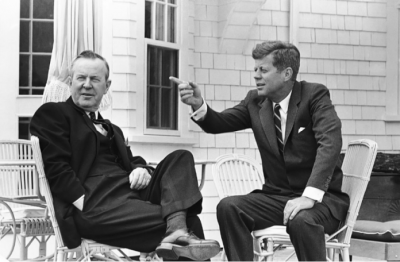
Featured image: Lester B. Pearson with John F. Kennedy. Pearson played a founding role in NATO (1949) and was former Canadian Secretary of State for External Affairs from 1948 to 1957. As leader of Canada’s Liberal Party from 1958 to 1968, he was Prime Minister from 1963 to 1968. [Source: natoassociation.ca]


River to Sea Uprooted Palestinian   
The views expressed in this article are the sole responsibility of the author and do not necessarily reflect those of the Blog!