Showing posts with label Seymour Hersh. Show all posts

Monday, 14 September 2020

By Jeremy Salt

Source

Assange secrets 9b5de

Why is it that so many journalists have turned their backs on Julian Assange? Why do so many abuse him instead of defending him?  He is, after all, a world historic figure who will be remembered centuries from now in the same way we remember Voltaire, Victor Hugo and Thomas Paine.  Thanks to technology, Assange has been able to do far more than they could ever imagine in advancing the ‘right to know’ component of human rights.  He has broken more real news than all the journalists who sneer at him put together,  so resentment could be one explanation.   They say Assange is ‘not a journalist’ when what they mean is that he is not a journalist like them.

The keywords here are mediation and control. ‘What lies behind the headlines’ has another meaning beyond what is really going on in politics. ‘What lies behind the headlines’ is also what goes on in newsrooms before you read your morning paper or watch the evening news bulletin.  

News is a product, like anything that comes off the factory floor.  The raw material comes in, is processed,  refined and polished before being placed on the sales shelf called ‘news.’   Millions of pieces of news flow into editorial rooms every day.  What you read or watch is only the tiniest fraction of this flood.  

What you read or see is what someone is choosing for you,  what someone thinks is ‘news’ compared to all the other items that never see the light of day,  what someone thinks you should know as opposed to what you might like to know.    

News in the mainstream is mediated from start to finish.  The reporter produces the raw product.  Whether it is a car crash or civil war, someone else will always see it differently but his or her particular version is the raw material submitted for processing.  Editors at the daily news conference decide if it deserves a place and where it should be placed, on page one, three or five,  at the top of the page or lower done,  under a one column or three column heading,  at the top of the nightly news bulletin or closer to the bottom.  

The editor has the final say.  He or she is the link between the board and the advertisers and has to deal with the pressure that might come from their direction when the story is a sensitive one.  Thus,  depending on the relationship between editor and the board/proprietor, an important story might not be published at all or might be shriveled to the point where it no longer seems important.

The decision made, an editor gets to work,  cutting,  reshaping, honing and polishing the story, maybe moving paragraphs around if he or she thinks they are not in the right order, until the product is ready to attract the attention of the reader/viewer, much as the male jackdaw lines the nest with silver paper to attract the attention of the female. There can be differences of opinion between the reporter and the editor along the way but in essence they are egotistical, not over truth or untruth or the public’s right to know, but over how the story should be written and presented.  

There is no unmediated news in the mainstream media.  It is the news as decided by reporters and editors,  from the choice of story to report in the first place to the end of the production line. There could be thousands of other news items you the reader or viewer might think are worthier of space and time that never see the light of day. 

What is happening around the world, therefore, is only what is reported as happening,  before being processed to meet editorial requirements.  If it is not reported it might as well not have happened,  beyond the impact within the immediate circle of where it did happen. Thus the media can make something happen or unhappen, according to the choices made in editorial rooms.

Control relates to control as exerted vertically,  from the board or proprietor down to the editor and then to the very bottom of the editorial chain.  Apart from the car crash, the rape or the robbery, there is a line that has to be protected when it comes to important political stories or stories that affect advertisers and the particular media outlet’s commercial interests.  There is always some flexibility,  depending on how tightly controlled the editorial line is from the top,  but the general political/social profile of the organization always has to be protected.  

If ‘news’ is to be defined as something we don’t know,  we could spend our entire lives reading books (and might be better off for it).  Much of the ‘news’ that is printed falls into the same category of what we don’t know but whether we really need or want to know it is another question. 

The endless goings-on of the Kardashian family might be a good example.   The definition of news has swung in the direction of ‘celebrity gossip’ and the celebrities have responded by providing editors with all the ‘news’ they might want to print,  but ‘news’ that many of ‘us’ (readers and viewers) would regard as trash. Of course, for the media to remain viable, the product has to sell and amidst all the Kardashian bottoms, that is the bottom line.

So mediation and control are two reasons the journalists abuse Assange.  Given the massive volume of material Wikipedia receives, he or his team have to exert some control and make decisions about how much they can upload within their technical capacity but what they do post is unmediated.  There are no cuts, no editing no polishing: the news comes to you in its raw state and you the reader can decide what to make of it, instead of someone telling you what to make of it. 

Another reason for disliking Assange is jealousy.  He has scooped all of these journalists who abuse him thousand times over,  by releasing sensational material that exposes the dirty secrets they would love to get their hands on.

In recent history only one reporter,  Seymour Hersh, without the technical ability to penetrate government vaults that Wikipedia’s sources have and relying entirely on his human sources,  has come anywhere close to what Assange has achieved.  Hersh is the greatest reporter of this age, or just about any age, a model of courage and the determination to dig for the truth, whatever the obstacles.

His fate is instructive. He broke the My Lai massacre in 1968, he exposed the Abu Ghraib prison torture in 2004  and he broke many other stories in between,  yet when he crossed the government-media line on Syria by exposing the falsity of the claim that the Syrian government was responsible for an alleged chemical weapons attack close to Damascus in 2013 his usual outlet, the New Yorker,  refused to publish. The story was handed to the Washington Post, which also turned it down.   The arguments that it did not meet their standards don’t deserve to be taken seriously.

Eventually, the  London Review of Books took the story on but when Hersh followed up with an account questioning the trans-Atlantic government and media line on the alleged role of the Syrian government in the alleged chemical weapons attack at Khan Sheikhun in April, 2017, the LRB declined to publish even though it had paid for the story. 

Subsequently,  Hersh had to publish in Germany (‘Khan Sheikhun Trump’s Red Line,’ Welt am Sonntag, June 25, 2017) and he now has no place anywhere in the mainstream print media of his own country.

Another reason for journalists disliking Assange is that in one way or another,  they are not free to write what they want.  They belong to institutions, ‘belonging’ defined as owned by them. They depend on them for their salaries and their careers.  Basically they are correct when they say ‘No-one tells me what to write.’  No one has to tell them because they already know what to write if they want to keep their jobs,  wherever they happen to work. 

Self-censorship is central to the practice of journalism in the mainstream.  No-one with an eye on their best interests is going to write something they know editors will throw in their face, not because it is badly written but because it goes against the editorial line.  They might be lucky enough to agree with the editorial line anyway but if they don’t they have to adjust, or look for a future in journalism elsewhere.

Thus, journalists have power,  the power and the money of the institution behind them.  Assange has no institution behind him.  Indeed, the institutions are all against him. A media which used him up has abandoned him.  The government of his own country, Australia, has not lifted a finger in his defense.

What Assange does have behind him is the power of the truth-telling that should be the core of journalism,  not the truth-tailoring and the acceptance of downright lies that characterizes much of mainstream journalism today.   So of course the journalists don’t like him, or should we say ‘journalists’, because who is doing the real work of journalism today,  they or Julian Assange?


River to Sea Uprooted Palestinian   
The views expressed in this article are the sole responsibility of the author and do not necessarily reflect those of the Blog!

Why The ‘Journalists’ Don’t Like Julian

 By Jeremy Salt

Source

Assange secrets 9b5de

Why is it that so many journalists have turned their backs on Julian Assange? Why do so many abuse him instead of defending him?  He is, after all, a world historic figure who will be remembered centuries from now in the same way we remember Voltaire, Victor Hugo and Thomas Paine.  Thanks to technology, Assange has been able to do far more than they could ever imagine in advancing the ‘right to know’ component of human rights.  He has broken more real news than all the journalists who sneer at him put together,  so resentment could be one explanation.   They say Assange is ‘not a journalist’ when what they mean is that he is not a journalist like them.

The keywords here are mediation and control. ‘What lies behind the headlines’ has another meaning beyond what is really going on in politics. ‘What lies behind the headlines’ is also what goes on in newsrooms before you read your morning paper or watch the evening news bulletin.  

News is a product, like anything that comes off the factory floor.  The raw material comes in, is processed,  refined and polished before being placed on the sales shelf called ‘news.’   Millions of pieces of news flow into editorial rooms every day.  What you read or watch is only the tiniest fraction of this flood.  

What you read or see is what someone is choosing for you,  what someone thinks is ‘news’ compared to all the other items that never see the light of day,  what someone thinks you should know as opposed to what you might like to know.    

News in the mainstream is mediated from start to finish.  The reporter produces the raw product.  Whether it is a car crash or civil war, someone else will always see it differently but his or her particular version is the raw material submitted for processing.  Editors at the daily news conference decide if it deserves a place and where it should be placed, on page one, three or five,  at the top of the page or lower done,  under a one column or three column heading,  at the top of the nightly news bulletin or closer to the bottom.  

The editor has the final say.  He or she is the link between the board and the advertisers and has to deal with the pressure that might come from their direction when the story is a sensitive one.  Thus,  depending on the relationship between editor and the board/proprietor, an important story might not be published at all or might be shriveled to the point where it no longer seems important.

The decision made, an editor gets to work,  cutting,  reshaping, honing and polishing the story, maybe moving paragraphs around if he or she thinks they are not in the right order, until the product is ready to attract the attention of the reader/viewer, much as the male jackdaw lines the nest with silver paper to attract the attention of the female. There can be differences of opinion between the reporter and the editor along the way but in essence they are egotistical, not over truth or untruth or the public’s right to know, but over how the story should be written and presented.  

There is no unmediated news in the mainstream media.  It is the news as decided by reporters and editors,  from the choice of story to report in the first place to the end of the production line. There could be thousands of other news items you the reader or viewer might think are worthier of space and time that never see the light of day. 

What is happening around the world, therefore, is only what is reported as happening,  before being processed to meet editorial requirements.  If it is not reported it might as well not have happened,  beyond the impact within the immediate circle of where it did happen. Thus the media can make something happen or unhappen, according to the choices made in editorial rooms.

Control relates to control as exerted vertically,  from the board or proprietor down to the editor and then to the very bottom of the editorial chain.  Apart from the car crash, the rape or the robbery, there is a line that has to be protected when it comes to important political stories or stories that affect advertisers and the particular media outlet’s commercial interests.  There is always some flexibility,  depending on how tightly controlled the editorial line is from the top,  but the general political/social profile of the organization always has to be protected.  

If ‘news’ is to be defined as something we don’t know,  we could spend our entire lives reading books (and might be better off for it).  Much of the ‘news’ that is printed falls into the same category of what we don’t know but whether we really need or want to know it is another question. 

The endless goings-on of the Kardashian family might be a good example.   The definition of news has swung in the direction of ‘celebrity gossip’ and the celebrities have responded by providing editors with all the ‘news’ they might want to print,  but ‘news’ that many of ‘us’ (readers and viewers) would regard as trash. Of course, for the media to remain viable, the product has to sell and amidst all the Kardashian bottoms, that is the bottom line.

So mediation and control are two reasons the journalists abuse Assange.  Given the massive volume of material Wikipedia receives, he or his team have to exert some control and make decisions about how much they can upload within their technical capacity but what they do post is unmediated.  There are no cuts, no editing no polishing: the news comes to you in its raw state and you the reader can decide what to make of it, instead of someone telling you what to make of it. 

Another reason for disliking Assange is jealousy.  He has scooped all of these journalists who abuse him thousand times over,  by releasing sensational material that exposes the dirty secrets they would love to get their hands on.

In recent history only one reporter,  Seymour Hersh, without the technical ability to penetrate government vaults that Wikipedia’s sources have and relying entirely on his human sources,  has come anywhere close to what Assange has achieved.  Hersh is the greatest reporter of this age, or just about any age, a model of courage and the determination to dig for the truth, whatever the obstacles.

His fate is instructive. He broke the My Lai massacre in 1968, he exposed the Abu Ghraib prison torture in 2004  and he broke many other stories in between,  yet when he crossed the government-media line on Syria by exposing the falsity of the claim that the Syrian government was responsible for an alleged chemical weapons attack close to Damascus in 2013 his usual outlet, the New Yorker,  refused to publish. The story was handed to the Washington Post, which also turned it down.   The arguments that it did not meet their standards don’t deserve to be taken seriously.

Eventually, the  London Review of Books took the story on but when Hersh followed up with an account questioning the trans-Atlantic government and media line on the alleged role of the Syrian government in the alleged chemical weapons attack at Khan Sheikhun in April, 2017, the LRB declined to publish even though it had paid for the story. 

Subsequently,  Hersh had to publish in Germany (‘Khan Sheikhun Trump’s Red Line,’ Welt am Sonntag, June 25, 2017) and he now has no place anywhere in the mainstream print media of his own country.

Another reason for journalists disliking Assange is that in one way or another,  they are not free to write what they want.  They belong to institutions, ‘belonging’ defined as owned by them. They depend on them for their salaries and their careers.  Basically they are correct when they say ‘No-one tells me what to write.’  No one has to tell them because they already know what to write if they want to keep their jobs,  wherever they happen to work. 

Self-censorship is central to the practice of journalism in the mainstream.  No-one with an eye on their best interests is going to write something they know editors will throw in their face, not because it is badly written but because it goes against the editorial line.  They might be lucky enough to agree with the editorial line anyway but if they don’t they have to adjust, or look for a future in journalism elsewhere.

Thus, journalists have power,  the power and the money of the institution behind them.  Assange has no institution behind him.  Indeed, the institutions are all against him. A media which used him up has abandoned him.  The government of his own country, Australia, has not lifted a finger in his defense.

What Assange does have behind him is the power of the truth-telling that should be the core of journalism,  not the truth-tailoring and the acceptance of downright lies that characterizes much of mainstream journalism today.   So of course the journalists don’t like him, or should we say ‘journalists’, because who is doing the real work of journalism today,  they or Julian Assange?


River to Sea Uprooted Palestinian   
The views expressed in this article are the sole responsibility of the author and do not necessarily reflect those of the Blog!

Wednesday, 13 November 2019

US Is the Source of, Not “Solution” to Syrian War

By Tony Cartalucci
Global Research, November 12, 2019
After the supposed US “withdrawal” from Syria – Western media outlets have causally reported on US troops now preparing to occupy Syria’s oilfields east of the Euphrates River.
Articles include carefully selected “experts” who avoid any mention of how illegal or indefensible the presence of US forces in Syria is to begin with, let alone any mention of “why” US troops are preparing to “claim” Syria’s natural resources.
The Guardian in its piece, “US plans to send tanks to Syria oil fields, reversing Trump troop withdrawal – reports,” illustrates a voluntary dereliction of due diligence in investigating or questioning Western actions in Syria.
One is left to assume what the US would claim as its excuse for remaining in Syria – likely based on a narrative of denying terrorist organizations such as Al Qaeda or the so-called “Islamic State” (ISIS) and their affiliates access to resources to “fund” their return to the region.
The most obvious and sustainable solution would be to transfer control of Syria’s oilfields to Syria itself. Syria has overcome terrorist organizations in all areas Damascus has now restored order to, and with the restoration of its oilfields and related industries, would be in an even better position to both rebuild the nation and defend against the very elements who destroyed it in the first place.
But this assumes that the US is interested in preventing the resurgence of terrorist organizations in the region – ignoring the fact that the US deliberately created them in the first place and deliberately used them to both trigger, then fuel the Syrian war from its very beginning in 2011.
The US is the Source of Syria’s War 
As early as 2007, real journalists warned of US plans to bolster opposition groups linked to terrorist organizations like Al Qaeda in a bid to undermine Iran and its ally Syria.
Pulitzer Prize-winning journalist Seymour Hersh in his 2007 New Yorker article, “The Redirection: Is the Administration’s new policy benefitting our enemies in the war on terrorism?,” would provide an ominous, but crystal-clear warning of what awaited both Syria and the wider region.
Hersh would warn:
The U.S. has also taken part in clandestine operations aimed at Iran and its ally Syria. A by-product of these activities has been the bolstering of Sunni extremist groups that espouse a militant vision of Islam and are hostile to America and sympathetic to Al Qaeda.
The article would mention the Muslim Brotherhood by name and described specific US support under what was then the Bush administration already being funnelled to the group in Syria.
The Brotherhood is an extremist front with direct ties to Al Qaeda and who were at the epicenter of the supposed “Arab Spring” in 2011. From 2011 onward – then under the Obama administration – US support continued in the form of both financial and military aid.
Articles like the New York Time’s, “Arms Airlift to Syria Rebels Expands, With Aid From C.I.A.,” would admit to billions of dollars worth of arms from the US flowing into Syria to fuel the destructive war.
Despite Western media claims that the Syrian conflict was being fought between the government and “moderate rebels,” the US State Department itself admitted that within the first year of fighting, Al Qaeda had already established a dominate position on the battlefield.
In an official statement on the State Department’s own website designating Al Qaeda affiliate – al-Nusra – a foreign terrorist organization, it was admitted:
Since November 2011, al-Nusrah Front has claimed nearly 600 attacks – ranging from more than 40 suicide attacks to small arms and improvised explosive device operations – in major city centers including Damascus, Aleppo, Hamah, Dara, Homs, Idlib, and Dayr al-Zawr. During these attacks numerous innocent Syrians have been killed.
If the US and its allies were providing billions of dollars worth of weapons and equipment to “moderate rebels,” who provided al-Nusra with even more weapons and equipment enabling it to dominate the battlefield?
The US – as it has done in virtually all other wars of aggression abroad – simply lied about the nature of those it was arming – having from the beginning and just as journalists like Seymour Hersh warned – deliberately armed and aided extremists to wage a proxy war of regime change against Syria.
Arsonists, Not Firefighters 
Nothing the US has done in regards to Syria has amounted to genuine efforts to end the conflict. Throughout the conflict the US continued to adjust its war propaganda to justify first its invasion and occupation of eastern Syria to “fight ISIS” – then to incrementally move toward justifying a direct US military intervention against the Syrian government itself with troops “serendipitously” already staged inside Syrian territory.
From 2015 onward in the wake of Russia’s intervention – direct US military intervention was taken off the table and the US occupation confined to eastern Syria where its unsustainable narrative regarding a Syrian “Kurdistan” withered.
Today – we find a US still attempting to justify its illegal and indefensible occupation of Syrian territory. Syria and its allies have attempted to provide Washington with a host of face-saving opportunities to withdraw and allow the conflict to finally end – returning peace and stability to the nation of Syria and its people.
The US continues to pose as part of a “solution” to the very Syrian crisis journalists like Seymour Hersh as early as 2007 revealed the US had deliberately engineered.
Just as an unrepentant arsonist would not be involved in efforts to extinguish the fire they started – the US cannot be involved in efforts to resolve a conflict it itself started – nor is the US at this point demonstrating any genuine desire to end the conflict.
Squatting on Syrian oilfields is yet another intentional tactic being used to draw the Syrian war out even longer – impeding the Syrian state’s access to its own resources needed to fuel the country and fund reconstruction.
Far from firefighters, the US is an unrepentant arsonist blocking firefighters from doing their job. US foreign policy has become so overtly malign that the Western media is unable to even address basic questions such as “why” the US is remaining in Syria – and doing so amid Syria’s oilfields.
Just as has been the case throughout the Syrian war, US machinations will be defeated by Syria and its allies patiently creating conditions on the ground in which current US policies are no longer tenable forcing Washington to fall back further still.
In the meantime, continued efforts to expose the truth of this war’s genesis and to prevent those who were responsible for it from attempting to prolong it further by posing as “peacemakers” and “protectors” is essential. If the US wants to pose as “peacemakers” and “protectors,” Syria and its allies may allow them to do so only to save face amid their total and otherwise unconditional departure from Syria.
*
Note to readers: please click the share buttons above or below. Forward this article to your email lists. Crosspost on your blog site, internet forums. etc.
Tony Cartalucci is a Bangkok-based geopolitical researcher and writer, especially for the online magazineNew Eastern Outlook” where this article was originally published. He is a frequent contributor to Global Research.
Featured image is from InfoRos

River to Sea Uprooted Palestinian   
The views expressed in this article are the sole responsibility of the author and do not necessarily reflect those of the Blog!

Tuesday, 11 September 2018

‘Resistance’ runs amok in the US Deep Throat War

‘Resistance’ runs amok in the US Deep Throat War
by Pepe Escobar (cross-posted with the Asia Times by special agreement with the author)

Bob Woodward’s book and the ‘resistance’ op-ed look increasingly like a sophisticated psy-ops scheme and a prelude for a ‘Deep State’ coup

We now live in a psy-ops world. The latest Deep Throat War in Washington bears all the elements of an epic of the genre. Fear: Trump in the White House, by Bob Woodward, who remains an associate editor at the Washington Post, will be released next week, on the 17th anniversary of 9/11.
This, in turn, will divert attention from the fact that the former, Bush era-coined Global War on Terror has metastasized into an all-American Rebels With A Cause special, featuring support for the “moderate rebels” al-Qaeda in Syria, former Jabhat al-Nusra, now Hayat Tahrir al-Sham.
In the wake of Fear, a Deep Throat surged out of nowhere in the form of an anonymous Op-Ed in the New York Times, which spilled the beans on Trumpian chaos in the White House.
Post-modern cynics were left wondering if this one-two walks and talks like a tie-in, it must be a tie-in. The Washington Post is the property of multi-billionaire Jeff “Amazon” Bezos and it has been on a permanent collision course with President Donald Trump.
And yet the Post may be seething now because Deep Throat, this time around, actually helped the competition. Adding insult to injury, the Times timed the release of its bombshell Op-Ed for the day after the Post’s strategic “leak” of Woodward’s book.
The heart of the matter is that the possible tie-in plays to the simple premise – extolling the role of a small “resistance” or the good guys. They are driven to protect “our values” and “our institutions” from dangerously chaotic Trump.
Post-truth cynics also cannot help being reminded of the historical precedence of a 1970s “resistance” – at the Nixon White House – who leaked to the press that “Tricky Dick” was out of control and was kept in check by true American patriots.
The current Deep Throat War is more like the case of a fractioned Deep State out for revenge on Trump via its media arm. The one-two tie-in – Woodward’s book and the “resistance” Op-Ed – looks increasingly like a sophisticated psy-ops – a prelude for a Deep State white coup.

All those creatures in the swampland

At the heart of the “resistance” is Russia. Trump, who was egged on by the divide-and-rule personal advice from Henry Kissinger since before the inauguration, essentially wants better relations with Russia to try to detach Moscow from the strategic partnership with Beijing.
Virtually everyone surrounding the president, not to mention most Deep State factions, are opposed to this.
And this brings me back to the “gutless”  Op-Ed, according to the Trump administration, by a “senior official,” according to the Times. It argued that  Trump was always against moves to counter proverbial Russian aggression before he finally acquiesced.
Now, compare it with Republicans on Capitol Hill, who forced the White House to impose even stronger sanctions on Russia. And yet they do not label themselves as “resistance.”
The anonymous “resistance” warrior has to be put in context with Trump’s basic instinct of trying, at least, to put together an Art of the Deal dialogue with North Korea and Russia.
This is seen by the mainstream media as a “preference for autocrats and dictators,” such as Russian President Vladimir Putin and North Korea’s leader, Kim Jong Un, over America’s “allied, like-minded nations.” Again, this sounds like something straight from the editorial pages of the Washington Post and the New York Times.
The arcane rules in Washington determine that whistleblowing should proceed only via two authorized forms. This involves a leak, as in Mark Felt, the original Deep Throat, to the Post, or leaking official documents, as in Daniel Ellsberg and the Pentagon Papers.
Digital smuggling, as in the Edward Snowden case, or receiving digital files from insiders, as in Julian Assange and WikiLeaks, is strictly off-limits.
The “resistance” bears no documents. Instead, the “resistance” warrior tries to make the case that Trump is not running the show as the real protagonists are anonymous functionaries who can be equally praised as “patriots,” according to the Times, or derided as “traitors,” or “TREASON?” as Trump tweeted.
Curiously enough, the site MyBookie lists the odds for the US president charging the “resistance” warrior with treason at 1-2, which is more likely than Trump being impeached by 2020 at 3-1.
Meanwhile, there is no debate whatsoever on the dire consequences of removing a sitting president – as alluded by the “resistance” warrior – because he’s unwilling to let US-Russia confrontation degenerate into a nuclear red alert.
It would be hard to dismiss the President when he says: “I’m draining the Swamp, and the Swamp is trying to fight back.”

Relieving the golden age of journalism

Now, compare all these post-truth, psy-ops creatures in this new swampland with a swampland of years gone by, masterfully depicted by Seymour “Sy” Hersh in his latest book Reporter.
No-nonsense living legend Sy describes himself as “a survivor from the golden age of journalism.” He seems to marvel at the fact he is just a guy from the Midwest who “began his career as a copyboy for a small news agency that covered crime, fires and the courts there.”
Roughly 11 years later, he was “a freelance reporter in Washington working for a small antiwar news agency” and “sticking two fingers in the eyes of a sitting president” by revealing “a horrific American massacre and being rewarded for it.”
Now, that has the merit of recovering the true meaning of “resistance” by documenting the story of a war gone wrong.
Sy may not be an epic writer in the Norman Mailer mold or wallow in the onomatopoeia orgy of an innovative Tom Wolfe. He is more like a Chicago streetfighter, packing myriad punches as quotes, many of them from anonymous players cultivated for decades on the basis of mutual trust. All the while, he would layer them into a vivid story – not a shadowy hagiography.
In this “I did it, my way” journey, we do get a walking, talking tour of the golden age of journalism, complete with the terrific step-by-step thriller of how Sy unveiled the My Lai massacre.
Even after all the prizes and accolades for one of the greatest scoops of the 20th century, it is poignant to know Sy “still wanted a newspaper job.” He got it – first at a magazine, The New Yorker, and then finally at The New York Times, “where I wanted to be” and “where my reporting would have [an] immediate impact.”
Sy conveys the excitement of his first trip as an on-off foreign correspondent, now forced to convert his legwork skills into writing on deadline. He was off to North Vietnam, “money belt tucked away, via Bangkok and Vientiane, where I was to be met by a North Vietnamese official and put on one of the irregular flights from Laos to Hanoi.”
When finally hired by the Times as a staff writer, his career “began with a roar – at the Paris peace talks.”
Sy later wrote a series of front-page stories about the CIA’s heroin ratline, an essential part of the agency’s covert ops in Southeast Asia. The ratline was first reported in a book by Alfred McCoy, then a graduate student at Yale and now a history professor at the University of Wisconsin.
Sy ended up receiving the proverbial CIA “visit,” someone from “the Agency’s so-called dirty tricks bureau.” It didn’t matter that he had quoted “a former CIA officer with years of experience in Vietnam as saying that McCoy’s work was “10% tendentious and 90% of the most valuable contribution I can think of.”
For the CIA, Sy was running amok.

Kissinger: more relevant than Watergate

It is enlightening to know how he “kept the hell away from the Watergate story” – even though he played tennis with Woodward “as Watergate moved from scandal to impeachment.”
One reason had to do with the fact that, in the end, the Post relied entirely on a single source, Deep Throat, while Sy was journalism’s Muhammad Ali, packing quotes verbal punches.
Another, more worrying, is that the Times editorial heavyweights “had been assured by Kissinger that the Post was making a big mistake.” Kissinger said: “The Post would be embarrassed.”
Sy was more interested in “a secret world in Washington” – code for Deep State machinations. But then in one of his reports, he finally got the message when senior editors advised him to “run it by Henry [Kissinger]. Sy was incredulous: “Run it by Henry and Dick [Helms]? They were the architects of the idiocy and criminality I was desperate to write about.”
The criminality ran deep. It included the secret bombing of Cambodia and the CIA’s covert ops to destroy Salvador Allende’s government in Chile (in his confirmation testimony to the Senate Foreign Relations Committee, Kissinger produced at best a qualified lie: “The CIA had nothing to do with the coup, to the best of my knowledge and belief.”)
Sy also exposed Kissinger’s secret talks in early 1971 in Islamabad with Pakistani president Yahya Khan, then the one and only go-between to arrange Nixon’s visit to China in early 1972. Khan’s army had slaughtered as many as three million people to suppress the secession in East Pakistan (now Bangladesh). Yet Kissinger had to remain mute to protect his prized messenger to Mao.
Chapter 14 of Reporter, titled Me and Henry, also details Kissinger “wiretapping friend and foe – especially his foes – in the bureaucracy.” Sy went all-out for what he qualifies as Kissinger’s “immorality and deceit” – at a time when he kept absolute control over US foreign policy. Kissinger “escaped any possible sanction” for his wiretapping with the threat that he would resign unless the Senate Foreign Relations Committee hearing canceled what he called a stain in his “public honor.”
The Price of Power, Sy’s book on Kissinger, published in 1983, ended up reconstructing in excruciating detail fours years of US foreign policy. It remains a must read. Kissinger’s reaction: “I haven’t read the book,” adding, “what you read is a slimy lie.”

The book on Cheney; bring it on

While Woodward over the years excelled as Washington prime hagiographer and court stenographer (now reconstructed as court smasher) Sy kept breaking major stories, few more devastating than torture in Abu Ghraib’s prison in Iraq in 2004. Sy painfully recognizes that Abu Ghraib did not change the course of the Iraq war, “just as the My Lai story had not ended the Vietnam War or its brutality.”
And the same applies to what really happened at the Obama administration’s killing of Osama bin Laden in 2011. The Deep State prevailed; Sy could not possibly publish this story in the US. It came out in 2015 in the London Review of Books.
The game-changer was bound to be Sy’s work-in-progress magna opus on Dick “Darth Vader” Cheney. Unlike Woodward on Trump, Sy perfectly understands the problem posed by “many hundreds of interviews…none cited by name”: a “book full of secrets” with players “still involved inside the intelligence and military communities posed a high risk of legal action.”
So he went back to the bin Laden story, where he shows how Pakistani intel was betrayed by the Obama administration: “The possibility that two dozen Navy SEALS could escape observation and get to bin Laden without some help from the Pakistani military and intelligence communities was nil, but the White House press corps bought the story.”
It will take the last of the greats from “the golden age of journalism” to write the definitive account of the Cheney regime – who reduced the entire White House press corps to mere puppets. This enterprise would convey what Fearis really about, not a fuzzy hatchet job taking sides in a still in progress establishment civil war.
In parallel, in the truth-is-fiction neo-Matrix world, “inconvenient” presidents are axed. In House of Cards, Frank Underwood is dead
– as decreed by the Netflix God.
So the stage will soon be set for House of Trump. Much to the chagrin of the “resistance.” Kevin Spacey might even get his old job back.

River to Sea Uprooted Palestinian   
The views expressed in this article are the sole responsibility of the author and do not necessarily reflect those of the Blog!

Tuesday, 17 April 2018

The War in Syria was a US Intervention Since "Day 1"

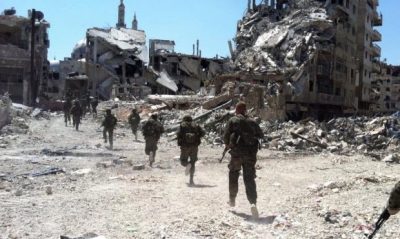
April 15, 2018 (Tony Cartalucci – NEO) – In the aftermath of US-led missile strikes on Syria, the Western media has attempted to continue building the case for “US intervention.”
However, before the first agitators took to the streets in Syria in 2011, the US was already involved.
The New York Times in its 2011 article, “U.S. Groups Helped Nurture Arab Uprisings,” would admit (emphasis added):
A number of the groups and individuals directly involved in the revolts and reforms sweeping the region, including the April 6 Youth Movement in Egypt, the Bahrain Center for Human Rights and grass-roots activists like Entsar Qadhi, a youth leader in Yemen, received training and financing from groups like the International Republican Institute, the National Democratic Institute and Freedom House, a nonprofit human rights organization based in Washington, according to interviews in recent weeks and American diplomatic cables obtained by WikiLeaks. 
The work of these groups often provoked tensions between the United States and many Middle Eastern leaders, who frequently complained that their leadership was being undermined, according to the cables. 
The financing of agitators from across the Middle East and North Africa (MENA) before the so-called “Arab Spring” was meant to stampede targeted governments from power – paving the way for US client states to form. Nations that resisted faced – first, US-backed militants – and failing that, direct US military intervention – as seen in Libya in 2011.
After the US funded initial unrest in 2011 – the US has armed and funded militants fighting in Syria ever since.
The same NYT would publish a 2013 article titled, “Arms Airlift to Syria Rebels Expands, With Aid From C.I.A.,” admitting (emphasis added):
With help from the C.I.A., Arab governments and Turkey have sharply increased their military aid to Syria’s opposition fighters in recent months, expanding a secret airlift of arms and equipment for the uprising against President Bashar al-Assad, according to air traffic data, interviews with officials in several countries and the accounts of rebel commanders. 

The airlift, which began on a small scale in early 2012 and continued intermittently through last fall, expanded into a steady and much heavier flow late last year, the data shows. It has grown to include more than 160 military cargo flights by Jordanian, Saudi and Qatari military-style cargo planes landing at Esenboga Airport near Ankara, and, to a lesser degree, at other Turkish and Jordanian airports.
As the proxy war the US waged against Damascus began to fail, multiple attempts were made to justify direct US military intervention in Syria as the US and its allies did in 2011 against the Libyan government.
This includes repeated attempts to enforce the “responsibility to protect” doctrine, multiple false-flag chemical attacks beginning with the Ghouta incident in 2013 and the emergence of the so-called “Islamic State” (ISIS) which helped the US justify the deployment of ground troops now currently occupying eastern Syria.
The notion of the US currently “contemplating intervention” in Syria attempts to sidestep the fact that the Syrian conflict itself – from its inception – has been a US intervention.
Long Before “Day 1” 
Even before the most recent attempt at US-led regime change in Syria, the US has pursued campaigns of violent subversion aimed at Syria and its allies.
In 2007, veteran journalist Seymour Hersh would write in his article, “The Redirection: Is the Administration’s new policy benefitting our enemies in the war on terrorism?,” that (emphasis added):
To undermine Iran, which is predominantly Shiite, the Bush Administration has decided, in effect, to reconfigure its priorities in the Middle East. In Lebanon, the Administration has coöperated with Saudi Arabia’s government, which is Sunni, in clandestine operations that are intended to weaken Hezbollah, the Shiite organization that is backed by Iran. The U.S. has also taken part in clandestine operations aimed at Iran and its ally Syria. A by-product of these activities has been the bolstering of Sunni extremist groups that espouse a militant vision of Islam and are hostile to America and sympathetic to Al Qaeda.
Hersh’s words would become prophetic when, in 2011, the US would begin arming and backing militants – many with overt affiliations to Al Qaeda – in a bid to destabilize Syria and overthrow the government in Damascus.
The article would also lay out preparations that – even in 2007 – were clearly aimed at organizing  for and executing a wider conflict.
Yet, published CIA documents drawn from the US National Archives illustrate how this singular agenda seeking to overthrow the government of Syria stretches back even earlier – by decades.
A 1983 document signed by former CIA officer Graham Fuller titled, “Bringing Real Muscle to Bear Against Syria” (PDF), states (their emphasis):
Syria at present has a hammerlock on US interests both in Lebanon and in the Gulf — through closure of Iraq’s pipeline thereby threatening Iraqi internationalization of the [Iran-Iraq] war. The US should consider sharply escalating the pressures against Assad [Sr.] through covertly orchestrating simultaneous military threats against Syria from three border states hostile to Syria: Iraq, Israel and Turkey. 
The report also states:
If Israel were to increase tensions against Syria simultaneously with an Iraqi initiative, the pressures on Assad would escalate rapidly. A Turkish move would psychologically press him further. 
The document exposes both then and now, the amount of influence the US exerts across the Middle East and North Africa. It also undermines the perceived agency of states including Israel and NATO-member Turkey, revealing their subordination to US interests and that actions taken by these states are often done on behalf of Wall Street and Washington rather than on behalf of their own national interests.
Also mentioned in the document are a variety of manufactured pretexts listed to justify a unilateral military strike on northern Syria by Turkey. The  document explains:
Turkey has considered undertaking a unilateral military strike against terrorist camps in northern Syria and would not hesitate from using menacing diplomatic language against Syria on these issues.
Comparing this signed and dated 1983 US CIA document to more recent US policy papers and revelations of US funding of so-called activists prior to 2011,  reveals not only continuity of agenda – but that attempts to portray the 2011 “uprising” as spontaneous and as merely exploited by the US are disingenuous.
Breaking the Cycle 
The current stalemate in Syria is owed to Russia’s involvement in the conflict. This began in 2013 when Moscow brokered a political deal preventing US military intervention then – and again in 2015 when the Russian military – upon Damascus’ request – built up a presence within the nation. Today, it is the threat of Russian retaliation that has hemmed in US options and plunged American special interests into increasing depths of desperation.
The recent missile strikes by the US and its tentative holdings in eastern Syria reflect geopolitical atrophy amid a conflict that was initially aimed at quickly stampeding the Syrian government from power back in 2011.
Washington’s inability to achieve its objectives leave it in an increasingly desperate position – attempting to reassert itself in the region or face the irreversible decline of its so-called “international order.” However, a desperate hegemon in decline is still dangerous.
Tony Cartalucci, Bangkok-based geopolitical researcher and writer, especially for the online magazine New Eastern Outlook”.


River to Sea Uprooted Palestinian   
The views expressed in this article are the sole responsibility of the author and do not necessarily reflect those of the Blog!