Uprooted Palestinians are at the heart of the conflict in the M.E Palestinians uprooted by force of arms. Yet faced immense difficulties have survived, kept alive their history and culture, passed keys of family homes in occupied Palestine from one generation to the next.
Srinagar, May 09 (KMS): When most parts of the world are observing Mother’s Day, today, thousands of Kashmiri women continue to wait for the return of their sons imprisoned in jails and subjected to enforced disappearance in custody by Indian troops in occupied Kashmir over the past 33 years.
A report released by the Research Section of Kashmir Media Service on Mother’s Day, today, said that the continued Indian state terrorism had resulted in the killing of 95,780 Kashmiris including women and children from 1989 to 9th of May 2021. As many as 22,926 women have been widowed by the Indian forces and 11,240 women were raped, disgraced or molested during the period.
Over one dozen women including 60-year-old resistance leader, Aasiya Andrabi, Fehmeeda Sofi, Nahida Nasreen, Shazia Akhter,Haseena Begum Saima and Insha Tariq are illegally facing detention in different jails including in India’s infamous Tihar Jail on false charges.
The report pointed out that the troops had subjected about 8,000 Kashmiris to custodial disappearance during the period and the mothers of majority of these disappeared people had been waiting for their return. Second Sunday of May is observed as Mother’s Day since 1914 as a result of continued efforts by Anna Jarvis, daughter of Ann Reeves Jarvis, a peace activist in, West Virginia, the United States, for her mother’s contributions towards the society.
Meanwhile, several mothers including Haseena Begum died whose son Syed Anwar Shah, a wall painter by profession, went missing on 21 July 2000, when arrested by Indian troops in Srinagar.
Mahtaba Begum hailing from Kashmir’s far-off village Karhama died while looking for her son who was arrested during a crackdown in 1990. Her son Mohammad Yaqub Khan was a laborer. Misra begum of Bemina’s boatman colony died in the desolation of her only son Shabbir Hussain Gasi who was arrested by Indian army on 21 January 2000. Hameeda Parveen died in 2012 after searching from pillar to post with the hope that her son would one day return to home. Details informed that her son, Abid Hussain, was a student.
Zoona Begum, hailing from Raj Bagh, whose son disappeared in May 1996 when he was detained after forces raided his house. Her son Imtiyaz Ahmad was a forester. Zoona died in 2011 while waiting for her son to return home.
Haleema Begum, hailing from Batamaloo area, died in February 2020. She struggled for the last 24 years in search of her son, Basharat Ahmad Shah, who was studying at Aligarh Muslim University, India. Basharat was arrested on 7 January 1990 by Indian CRPF from Sopore area.
65-year-old Rehti Begum reflects on her quiet life in Chaki Kawoosa village of Budgam, before her only son went missing. Begum said Muhammad Ramzan was detained in 1994 by the Indian army. He was never seen again.
“There is no one around with whom I can share my pain,” she says. Her husband died months after their son disappeared and she has since worked odd jobs. She searched for Ramzan for three decades, even as age took a toll on her health.
Meanwhile, International Forum for Justice Human Rights Jammu and Kashmir has said that while the world is celebrating Mother’s Day, today, nobody seems to be bothered about the state of Kashmiri mothers.
In a statement issued in Srinagar, IFJHRJK Chairman Muhammad Ahsan Untoo said that while there are celebrations going on around the world to honour the mothers, the Kashmiri mothers are longing to see their sons who have been imprisoned in Indian jails and subjected to enforced disappearances.
He said that the mothers in Kashmir have been inflicted enormous pain by the Indian state by killing and maiming their sons, and murdering and blinding their husbands.
He said that the so-called civilized world should wake up to the sufferings of Kashmiri mothers and address their issues.
Untoo said that over the last several years the sufferings of the Kashmiri mothers have increased manifold. They have been denied bodies of their sons and husbands, killed by the troops. He urged the world bodies including the United Nations, Human Rights Watch and Amnesty International and other bodies of women’s rights to take note of the sufferings of Kashmiri mothers.
Hurriyat AJK leader Abdul Majeed Mir in a statement said that Kashmiri mothers have nothing to observe the Mother Day as they have lost their sons to the brutal Indian troops.
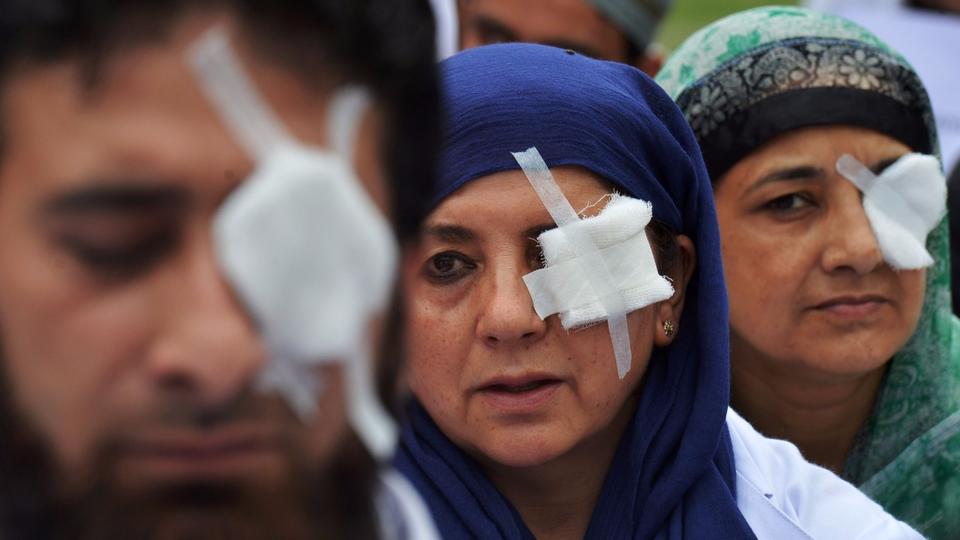
On 28 August 2020, Indian forces in Srinagar opened fire with “pellet guns” on a peaceful religious procession. More than forty people were wounded while several were blinded. As usual, Pakistan protested vehemently. As usual, Indians responded on Twitter with triumphalism and aggression — if you don’t want to get shot, they said, don’t come out on the streets. And as usual, the world watched in silence.
It was not always so. India first started using pellet-firing shotguns against the Kashmiris in 2010 but the matter only hit international prominence in 2016 when protests following the death of Burhan Wani resulted in thousands of injuries, the blinding of hundreds and the deaths of over 70 people. The Guardian, for example, published a story asking if Kashmir represented “the world’s first mass blinding.” Even Indians were rocked by a viral series of pictures showing the distorted faces of celebrities.
The storm of international condemnation resulted in India scaling back the use of pellet-firing shotguns but not abandoning the weapons. In August 2019, when protests erupted against the revocation of Article 370, the Kashmiris were again dispersed with shotguns. Subsequently, shotgun usage subsided but that was simply because there was an unprecedented months-long lockdown in Kashmir in which people were confined to their houses. But as recent events show, India has not given up on shotguns. They remain India’s weapon of choice to deal with the Kashmiris.
One of the many tragedies of Kashmir is that it often gets subsumed into a larger narrative about the “unfinished business of Partition.” This narrative imposes a geostrategic lens on the issue and leads to a reductive analysis about whether Kashmir belongs to either India or Pakistan, a debate which India then further muddies by trying to paint all Kashmiri opposition as Islamic terrorists, a debate which the rest of the world has long since learned to tune out.
Kashmiris are not just symbols of injustice: they are real people living real lives in terrible pain. They also have rights under international law, rights which are being consistently violated. Irrespective of how the territorial issue of Kashmir is eventually resolved, there is a human aspect to Kashmir which needs to be confronted now. This is not just a dry legal dispute to be debated in textbooks and seminars: India’s ongoing use of shotguns is a war crime.
Indian sources and by extension, many international sources — normally do not use the word “shotgun” to describe the weapons used by Indian forces in Kashmir. Instead, they use the term “pellet gun.” This is a misnomer. The term “pellet gun” is associated with the type of airguns used to shoot balloons at village fairs; that is, guns which fire individual pellets and must be reloaded after every shot. However, the guns used by Indian forces bear no resemblance to such weapons. Instead, Indian forces use standard 12 gauge pump-action shotguns, each of which can be loaded with up to four shotgun shells.
Admittedly, each shotgun shell is in turn loaded with up to 600 pellets. But that, by itself, is no excuse to refer to a deadly weapon as if it was a child’s toy. As Orwell advised many years ago, it is generally better to use plain words. To quote a group of English parliamentarians,”[The phrase ‘shotgun’ may better convey the violence which these weapons embody. These shots can mutilate and blind and have had an impact on hundreds of individuals caught in the crossfire.”
So far as international law is concerned, the position is very simple: there is no legal regime which permits a state to routinely disperse crowds of civilians by firing shotguns at them. This is true whether it is assumed that India has illegally occupied and annexed Kashmir (as per Pakistan), that Kashmir is “disputed territory” (as per the UN Security Council, the UNGA and the OIC); or whether one assumes that Kashmir is an integral part of India (as per the Government of India).
If we start with India’s contention that it exercises undisputed sovereignty over Kashmir, it follows that the Kashmiris are entitled to the full range of human rights afforded to them under international law (including the right not to be shot at random with shotguns). Of course, India may argue that (a) international law is only applicable to the extent enacted into domestic law; and (b) India’s independent judiciary has decided that the use of shotguns for crowd control does not violate Indian law. However, there are certain human rights obligations which cannot be ignored by any state, irrespective of domestic laws and domestic judges. Article 6(1) of the International Convention on Civil and Political Rights (ICCPR) is one such norm and states as follows:
“Every human being has the inherent right to life. This right shall be protected by law. No one shall be arbitrarily deprived of his life.”
The key word here is “arbitrary.” And in this context, it is important to examine the weapon itself which is being used.
The shotguns used by the Indian army are manufactured at the Ordnance factory in Ishapore. Till date, Indian authorities have refused to divulge information about them on national security grounds. However, reports suggest that the guns are crude copies of the American Mossberg 500 series which were originally used in World War 1 for close-quarter combat.
In Kashmir, Indian forces have been using No. 6 (300 pellets of 2.79mm each) and No. 9 (600 pellets of 2.30 mm each) cartridges. For such small pellets the key issue is the distance from which they are fired. If they are shot at a closer range, the pellets do not have time to disperse and instead travel in a high-speed clump behaving almost like a handgun bullet. This makes them incredibly harmful and they can penetrate tissue and even bone, causing serious damage. However, if they are fired from a distance, the pellets disperse haphazardly.
According to the Omega Research Foundation (ORF), an independent UK-based organisation that monitors military equipment, “the spread pattern specified by the pellet manufacturer is so inaccurate that even when security forces use the weapon to target protesters’ legs, pellets are still likely to hit areas of the body above the waist.” According to a spokesman for the ORF, “This weapon should not be used at all. No modification could make its use compliant with international human rights law and standards.”
In simple terms, there is no safe or legal way to use a shotgun for crowd control. At close quarters, a shotgun is lethal. When used from a distance, a shotgun is entirely arbitrary and indiscriminate. Either way, the result is unjustifiable cruelty.
International human rights law on policing and the use of lethal weapons is enunciated most clearly in two documents approved by the UN General Assembly, the Code of Conduct for Law Enforcement Officials (1973) and the Basic Principles on the Use of Force and Firearms by Law Enforcement Officials (1990). Each of these is now regarded as declaratory of the customary law.
The content of these two documents amounts to basic common sense: that the use of force should be limited to the extent necessary, that it should not be disproportionate, that it should be backed by law and that there should be an effective means of accountability if force is used. In relation to the use of deadly force, these principles require additional care and precision: intentional lethal force can thus only be used if there is an imminent danger of death or serious injury that cannot otherwise be averted. Finally, there is the principle of precaution: that all operations be “planned, prepared, and conducted so as to minimize, to the greatest extent possible, the recourse to lethal force’.
India’s use of shotguns for crowd control fails all of these tests. Shotguns are not just inherently indiscriminate weapons, but India’s usage of them is horrendously cruel. Human beings instinctively shudder when confronted with the prospect of being blinded. One reason why the world banned chemical weapons after World War I is because of the collective trauma of watching blinded soldiers shuffle past, each with their hand on the soldier in front. More recently, an international convention banning the use of blinding laser weapons was promulgated in 1998 precisely because there is a unique revulsion attached to the deliberate blinding of humans.
More importantly, India regularly uses shotguns against crowds even when there is no imminent danger of death or serious injury to Indian forces. In the most recent instance, for example, the people who were fired upon were not even protesting: they were simply taking out a religious procession. There is also no realistic possibility of accountability. Back in 2015, Amnesty International noted that over the previous 25 years, “not a single member of the security forces deployed in [Kashmir] has been tried for human rights violations in a civilian court.”
Finally, there has been no serious attempt by India to develop alternate means of crowd control. A committee was set up to examine such options as far back as 2016 but till date, shotguns remain the preferred option for Indian forces in Kashmir. And India’s insistence that it has no other option is absurd. There is no other country in the world besides India which uses shotguns for crowd control. And even within India, there is no other place besides Kashmir where shotguns are regularly and consistently used for crowd control.
When faced with such queries, Indian defenders retreat to different norms. Kashmir is not a normal civilian area, they argue. It is instead a warzone where Indian soldiers are confronted with an externally fomented Islamist insurgency. In short, they argue, India’s actions in Kashmir need to be judged using the laws of war, not the laws of peace.
But the problem for these defenders is that Indian actions in Kashmir fail even the laws of war.
The precise relationship between international human rights law and the laws of armed conflict is heavily debated. However, there is a broad consensus that the laws of war represent a specialized set of rules which take precedence over international human rights law, but only to the extent there is an actual conflict in terms of the applicability of the two sets of laws. Thus, the mere fact that there is an armed conflict does not by itself negate the applicability of international human rights law. In fact, the ICJ has specifically held that “the right not to arbitrarily be deprived of one’s life [under Art. 6 ICCPR] applies also in hostilities.”
In the case of Kashmir, there is no actual conflict between the two sets of laws. This is because India is not using shotguns to fight militants. Instead, it is using shotguns as a crowd control measure against civilians. The laws of war do not regulate the conduct of normal policing measures or the manner in which local administrations can control otherwise peaceful protests. In fact, to the extent a state is called upon during times of war to perform normal policing functions with respect to a civilian population, it must act in accordance with normal policing procedures. And as already noted, the established norms of policing do not permit states to disperse crowds by firing shotguns at them.
One of the most fundamental principles of the laws of war is the principle of distinction, i.e., that fighting states must always distinguish between combatants and civilians. Even if it is assumed that Kashmir is the site of an armed conflict, that only authorizes the Indian military to use deadly force against combatants, not civilians. Furthermore, the law of armed conflict recognizes a very bright and clear line between the two categories: civilians cannot be attacked in the same manner as combatants “unless and for such time as they take a direct part in hostilities.”
Participating in a protest against Indian occupation does not constitute taking “a direct part in hostilities.” That standard is only met when a specific act directly targets military operations or military capacity of a party to an armed conflict and is specifically designed to cause a certain, non-minimal level of harm to that party. Shouting slogans at a march does not qualify as taking a “direct part in hostilities.” Even throwing stones at soldiers does not qualify as taking a “direct part in hostilities.”
Another, equally fundamental principle of the law of armed conflict is the principle of proportionality. In simple words, this principle prohibits attacks against a military objective if the incidental loss of civilian life would be “excessive in relation to the concrete and direct military advantage anticipated.” Even if some people participating in demonstrations are also actively helping Kashmiri freedom fighters, the use of shotguns is still illegal. Indian forces have no way of knowing which protestors — if any — are also active in the Kashmiri resistance. It cannot therefore use weapons which kill, blind, and maim at random.
It is this arbitrary aspect of shotgun usage which is the biggest issue. When an Indian soldier fires a shotgun at a crowd of Kashmiris, the current SOPs stipulate that he should fire from a distance of at least 40-50 metres. At that distance, it is impossible to aim a shotgun with any degree of accuracy: one is only aiming at a mass of people, knowing full well that a certain number of them are likely to die, that a slightly greater number are likely to be blinded, and that an even greater number are likely to be injured. The usage of shotguns for crowd control is thus no different from rounding up protestors and blinding (or killing) an arbitrary number of them.
Collective punishment has a long and inglorious history. The word “decimate” comes from the Roman Army’s tradition of killing every tenth member of a mutinous cohort. Conquering armies in Europe were traditionally allowed three days of pillage after subduing a city while the Mongols preferred to build towers from the skulls of those foolish enough to resist. In more recent times, the Nazis during World War II regularly massacred entire villages in response to the killing of a single German (see, for example, the 1942 killing of 340 Czechs in response to the assassination of Reinhard Heydrich). It is precisely for this reason that collective punishment is clearly prohibited by both the Third and the Fourth Geneva Conventions of 1949 as well as the Hague Regulations of 1899 (all of which have been signed and accepted by India).
In theory, India could argue that Kashmir is not an “armed conflict” of the type to which the laws of war apply. However, that debate misses the point: what India has deliberately and consciously adopted as a state policy in Kashmir is so cruel and so inhumane that it would constitute a war crime even if that type of armed conflict existed. Furthermore, international human rights law and the laws of armed conflict do not exist in separate silos. As noted by the International Criminal Tribunal for Yugoslavia in the Tadic matter, “elementary considerations of humanity and common sense” mandated that “[w]hat is inhumane, and consequently proscribed, in international wars, cannot but be inhumane and inadmissible in civil strife.”
The Security Council has chosen to remain quiet for many years on Kashmir. But the fact that Kashmir is disputed has nothing to do with the human rights of the Kashmiris. Their human rights are undisputed. And it is time that the international community stopped turning a blind eye to India’s violation of those rights.
Srinagar, September 09 (KMS): Anuradha Bhasin Jamwal, the executive editor of Kashmir Times, in her fresh article has said that journalism in Indian illegally occupied Jammu and Kashmir has begun to succumb to pressures from the Indian government.
According to Kashmir Media Service, Anuradha Bhasin Jamwal in the article titled “Kashmiri Editors Can’t Use Fear as an Excuse for Their Continued Silence” writes, “When August 5, 2019, descended, with the gagging and muzzling of dissent, newspapers completely lost their voice, even as some continued to be printed in their truncated forms and with content that was out of sync with the existing situation of the time.”
The article further goes as: “Setting aside the arrests, torture and human rights violations, the absence of reporting on the impact of a stringent lockdown on the day-to-day lives of ordinary humans and the devastating blow to the health and education sector was so pervasive, it ended up legitimising the myth of ‘normalcy’ that the [Indian] government was labouring to showcase.”
Referring to the military siege imposed after August 5, last year, she says, “The Valley’s leading newspapers have chosen to keep their publications alive by killing news stories and burying all morals of journalism.”
“When a bevy of newspapers agree to fall in line, without a whimper, the going becomes even tougher for the rest, including weekly and monthly publications as well as freelancers, many of who are courageously struggling to speak out and facing risks;” she added
“It has been a tight-rope walk for media personnel in Jammu and Kashmir, particularly in the Valley, since last year. But despite the logistical impediments of operating without a communication system and in an intimidating climate of partial bans where journalists are criminalised or summoned repeatedly, many brave journalists have resisted all kinds of pressures to ensure that news about Kashmir does not absolutely spiral down the black-hole,” the article said.
Although, the article is lengthy, yet the main chunk is being given as under:
Kashmiri Editors Can’t Use Fear as an Excuse for Their Continued Silence
Anuradha Bhasin Jamwal
Tazia processions during Muharram in Kashmir have rarely been event-free in the last three decades. This year however marked a departure for another reason. As clashes erupted between mourners and the police in Srinagar on the ninth and tenth day of the Ashura on August 29 and 30, teargas shells and pellets were fired, slogans of Azadi were raised and stone-pelting broke the calm of the procession, the local newspapers responded with a conspicuous silence even as the scale of brutality surpassed those of previous incidents.
In the past, claims and counterclaims have been common after processions have gone awry. The recurrent cycle where the police and the locals blame the other for the provocation – effectively reducing the debate of whether police brutality preceded the sloganeering and stone-pelting or vice versa to a chicken and egg story – has come to occupy the columns of local newspapers in recent decades.
This year, the story all but disappeared – interestingly on the day that the world observes as the Day of Enforced Disappearances – instead papered by bold headlines of ‘Religious fervour’ of the Muharram processions. Evidently, many believed that the story didn’t merit any further coverage or was reduced to a footnote.
What was glossed over by the local newspapers, however, was splashed across social media on the evening of August 29 with appalling images of pellet riddled bodies and faces. The story figured prominently in some sections of the national and the international media the next day and was pursued by many others the day after that.
Since last year, particularly after the Jammu and Kashmir Reorganisation Bill was passed, Article 370 of the constitution was scrapped and a stringent lockdown accompanied the developments, local journalism has been in a state of stupor. While many professionals have struggled to keep the news alive and ward off any attempts to suppress the flow of information despite a communications blockade in place, multiple forms of intimidation and the launching of an Orwellian Media Policy 2020, the Valley’s leading newspapers have chosen to keep their publications alive by killing news stories and burying all morals of journalism.
For over a year, I have grappled with the question of ethics – whether as an editor of the newspaper Kashmir Times, I might be crossing the principled stand of commenting on the content and conduct of ‘rival’ newspapers, and thus held my peace.
But a race driven by purely material considerations is not my line of work. More importantly, when the actions of some affect a trend impacting journalism as a whole – and perilously so – it is important to speak out. In Jammu and Kashmir, the powerful dailies dictate the kind of journalism that the rest are obliged to follow, unless they choose to be out of sync with the rest and face consequences.
When a bevy of newspapers agree to fall in line, without a whimper, the going becomes even tougher for the rest, including weekly and monthly publications as well as freelancers, many of who are courageously struggling to speak out and facing risks.
Notable is the case of the editor of The Kashmir Walla, Fahad Shah, who was summoned by the Cyber Police and twice faced an interrogation for one particular report. I do not intend to take any high moral ground. As journalists, we go about the daily rigours of negotiating multiple challenges, including occupational hazards and deadlines for work, imperfectly. The excessive risks media professionals, particularly Kashmir based editors, are exposed also deserves acknowledgement. But when the very foundational principles of journalism stand compromised, there is a need for introspection. The idea behind writing this article is to initiate this much-needed debate.
Needless to say, it has been a tight-rope walk for media personnel in Jammu and Kashmir, particularly in the Valley, since last year. But despite the logistical impediments of operating without a communication system and in an intimidating climate of partial bans where journalists are criminalised or summoned repeatedly, many brave journalists have resisted all kinds of pressures to ensure that news about Kashmir does not absolutely spiral down the black-hole. The counter to the state’s narrative has made headlines in the national and international media due to their admirable efforts.
Are the pressures more exacting on local media organisations which have largely preferred to remain silent and submit to the powers that be over pursuing ethical journalism? The consideration of advertisements and finances apart, in July 2019, editors of two Kashmir based newspapers were grilled for several days by National Investigating Agency (NIA) as part of an investigation into a case of “terror funding”.
When August 5, 2019, descended, with the gagging and muzzling of dissent, newspapers completely lost their voice, even as some continued to be printed in their truncated forms and with content that was out of sync with the existing situation of the time. Setting aside the arrests, torture and human rights violations, the absence of reporting on the impact of a stringent lockdown on the day-to-day lives of ordinary humans and the devastating blow to the health and education sector was so pervasive, it ended up legitimising the myth of ‘normalcy’ that the government was labouring to showcase.
Even as editors were caught in a situation with a lack of choices, with two essentials vital for the existence of newspapers – local news and political comment – gone, the publications were reduced to mere shadows of their former selves. A year on, while some of this has been salvaged, the readers are judging the newspapers, not on the basis of what was reported but what was not.
The absence of the news on pellet gun injuries becomes an important case study in assessing the state of media in Kashmir and the interplay between journalism and its readers. What disappeared or appeared in a muted form on August 30, after the first day of the brutal crackdown on the Muharram processions, resurfaced, mostly apologetically on August 31, after the newspapers faced a severe backlash from Kashmiris on the social media.
One of the leading dailies, Greater Kashmir, in a report on August 30 titled ‘Ashura Today’, detailed the significance of Muharram procession in the opening paragraphs, and dismissed in two small paragraphs – which figured at the fag end of the report – that “the police used tearsmoke shells at Hamdania Colony Bemina” to disperse the procession leading to “injuries to mourners”. It also added that “The mourners alleged that metallic pellets were also fired on them. A couple of youth sustained pellet injuries.”
The Rising Kashmir blacked out the Muharram procession completely, neither carrying the ‘religious fervour’ associated with it, nor the disruptions to it. The Kashmir Reader published on August 30 dismissed in six small sentences a news item titled, ‘Restrictions in parts of Srinagar to prevent Muharram procession’, barely mentioning some barricades manned by police and CRPF. What was missing on August 30 found a cautious and guarded presence in print the next day. The criticism on social media surrounding the lack of coverage of pellet injuries by local newspapers brought the news into focus the next day, even though the report about the ‘religious fervour marking the 10th day Ashura procession’ dwarfed the violent scenes on the road.
The Greater Kashmir published, on August 31, the news titled, ‘Two dozen mourners injured as police use force to stop Muharram processions in Kashmir‘ and a strap that read, ‘Our men too received injuries: SSP Srinagar’. It said that two dozen mourners sustained injuries from police action and two youth sustained pellet injuries. It went on to mention:
The clashes started after police deployed in huge numbers in Zadibal tried to stop a large procession. The mourners in turn clashed with the police who restored to tear gas shelling and fired pellets. The police also lathi-charged the mourners.”
The rest of the news article (about nine paragraphs) was dedicated to the police version of the events.
The Rising Kashmir, in its edition of August 31, carried the Muharram story titled ‘Amid COVID-19 restrictions, curbs, Ashura observed in Kashmir‘ and straps that read, ‘Clashes reported in Zadibal areas, Police officer among several injured; Rich tributes paid to Hazrat Hussain (RA) and other Karbala martyrs’. The news, an overall round-up of various Muharram processions in Jammu and Kashmir and Kargil, also made a cursory reference to the violent happenings of the day by saying:
“Later in the day, mourners gathered at Kathimaidan and tried to come on the main road in shape of the procession. Police used tear smoke shells and disperse them.
A Police official said that the mourners resorted to stone pelting at Kathimaidan. A Selection Grade Constable Showkat Ahmed (1007/s) from Police Station Soura sustained head injuries.”
The Kashmir Reader on August 31 published a report ‘ Restrictions mark Ashura’ as its second lead story and a smaller box item under it, with a detailed news item titled ‘Mourners hit by pellets in eyes writhing in pain’. The report was based on the version of some eye-witnesses, a doctor, and pellet injured victims including a man who said, “I have forty pellets inside my eyes”.
Last year, the news about a protest in Soura, a locality in Srinagar, where hundreds of demonstrators had occupied a park with banners opposing the ‘abrogation of Article 370’ and an incident of violent clashes between protestors and security forces, was first broken by the BBC within days of the imposition of restrictions.
The Indian government responded to the report with an abject denial. Some Indian and foreign media organisations reported the same, one reported on how young men were using the mosque to mobilise the public in the area. Few others reported about young men being wounded by shotgun pellets and another reported that a young man had jumped into the Jhelum river that flows through the city to rescue himself. Some outlets also reported about cases of those who had been injured by pellet and were refusing to visit hospitals and were being treated by self-trained locality experts working with basic antiseptics and crude blades. The Indian state called these reports fake.
The handful of newspapers being printed from Srinagar maintained silent – they were cautious enough to even avoid reporting on the contested claims of both sides and instead cherry-picked ‘safer’ things to talk about. A contested incident about Kashmir and the controversy surrounding it, that garnered headlines in the foreign and national media, was not considered newsworthy enough in Kashmir.
They got away. Locked up in their homes with no internet connections or phones – probably also without any knowledge of the controversy or the incident – the readers made no public display of their disappointment.
What local newspaper organisations took for granted last year may no longer be possible. The overall shock and sense of fear that germinated last year has begun to wear off. The two days of coverage on the latest spree of pellet gunshots demonstrates that even a slight rebuff from readers and the general public is enough to compel media-houses to stop ignoring local voices and incidents.
This moral policing, however, has limitations. As long as involved readers expect the media to function and seek accountability with positive results, it may be fine. But at what point can this readership activism morph into mob-rage? In the last one decade, Kashmir’s media has dealt with its share of mobs setting newspapers on fire or disallowing selective journalists from entering certain areas on allegations of deliberate blacking out of the news of public protests and campaigns or human rights abuse.
When democratic spaces vanish, the dangers of a venomous and unstoppable mob are enhanced with a probable future of the thin line between reason driven criticism and irrational, vitriolic vengeance blurring. The only thing that can avert such a danger is a responsive media, guided purely by the principle of informing and enriching informed opinion. The realm of fear, real as it is, cannot be used as a perpetual excuse by editors of newspapers to defend their silence.
An unidentified editor of a Kashmir based newspaper was quoted in a report in The Telegraph on August 31, as having said, “the Kashmir dailies were ‘gradually reclaiming the space’ they had conceded last year after the clampdown.”
What can be reclaimed after they chose to turn a blind eye to the horrifying spectacle of over 200 injured men, many being sprayed with pellets on their bodies, faces and eyes?
According to the same report, another editor claimed the newspapers had been discreetly told to give the most extensive coverage to “developmental activities” by the government.
About two months ago, senior Indian journalist Ajaz Rashid, while researching about J&K’s new media policy, asked me whether journalists and editors would be willing to speak freely. I told him I had doubts about the latter. The editors who are part of the Editors Guild of Kashmir haven’t made a murmur as yet, and newspapers are carefully dropping anything that the government would be uncomfortable with. A day later, after trying to speak to some editors, he messaged back, “you were right. Either they don’t speak or speak little but do not want to be identified.”
Resisting what senior journalist Yusuf Jameel calls as the present moment of “Undeclared Censorship” requires not just overcoming fear but also searching for alternate models of revenue, without which the choice is either of ‘silence’ or of struggling to continue in keeping with the true spirit and ethics of journalism, at the risk of sagging circulation, downsized staff, poor quality of production and even the threat of closing down.
When the dictum comes ‘Fall in line or Perish’, the choice is not between survival and persecution, the choice is between saving a business enterprise or journalism which certainly cannot be reduced to a pamphlet fed on advertising.
Anuradha Bhasin Jamwal is the executive editor of Kashmir Times.
In one of his poems, Robert Frost says “good fences make good neighbours.” Yet in the 73 years of its existence, India has had border problems with all its neighbouring Asian states, while it allies are distant overseas states. Then on June 15 a unique battle occurred, medieval in practice, in Galwan Valley, Kashmir. The outcome of the battle was a direct result of India’s border policies with its neighbours. This writeup will only try to address two aspects. (ONE) Some of India’s border aspects as an indicator of (TWO) the type of political state entity within Asia, India may genuinely be.
IRON RODS IN DISPUTED AREAS: A number of questions arise here. Article 1 of the 1993 agreement between India and China states the following, among others: Neither side shall use or threaten to use force against the other by any means. Reading this legal 1993 document, use of iron rods cannot be anything but “use force against the other”, and so the question here is, was this use of force signaling a consistent three-year state-of-war on China’s Belt & Road Initiative infrastructure? Was this decision the result of war-gaming studies by the Indian army? Was this a type of Rules of Engagement imposed by India?
India is a modern responsible state in the world. Therefore, from its army’s war-gaming studies, was it India’s deliberate intention, for three years, to make null-and-void all border agreements, multiple times, by multiple Indian troops, on multiple occasions, at multiple points in the disputed areas? The Law’s ambit can be perceived both as the “Spirit of the Law”, and also the “Letter of the law.” Yet it seems strange, that no one in the Indian leadership understood that breaking the Spirit of any signed Agreement, signals non-peace, if not outright war, irrespective where a claimed border may be.
To be sure, I have a sneaky suspicion that irons were used continuously and blatantly, in the hope, that some exasperated and hotheaded Chinese border guard would open fire on Indian soldiers. Then Indian propaganda would immediately swing into outraged action, screaming how Chinese troops had fired upon innocent unarmed Indian troops without any provocation, thus delivering to India a propaganda coup. But China’s troops held an iron discipline and never took the bait, and yet feelings of intense revenge grew in their hearts, which they acted upon on June 15, within India’s Rules of Engagement.
Reading the news reports of the use of irons, it was possible to discern an unmistakable sub-text directed at an Indian audience, which reads something like this. “Look how clever the Indian troops are. They are not breaking any law. They are simply bending the rules to enforce India’s own national interest.”
It is remarkable that not a single Indian or Western writer has written to question the reason, why Indian troops did this in Disputed Areas for so long. Especially since in the very same Disputed Areas in October 1962, India lost 4,800 men killed, and 4,000 taken prisoners of war. One Indian POW, the uncle of a close friend, named Pascoal Rodrigues from Mangalore, Karnataka, was released in 1992, because India and China were in a state of war for 30 years.
To understand India’s actions, look at this video https://www.youtube.com/watch?v=-vBgycTUX20 filmed by Indian troops from the Bhutan-China border at Doklam in July 2017. The camera placement is exactly on the Bhutan-China border, looking down into Chinese territory, where 150 meters Forward, Chinese construction workers, inside China and building a road to the Bhutan border, are being beaten up. The Indian military were on Forward Policy deployment. Indian journalist Pravin Sawhney was quite precise this fighting occurred 150 metres inside China. Bhutan and India have no written defence agreement.
INDIA’S FORWARD POLICY: A layman’s way to describe this policy is, if your next door neighbour, consistently and willfully walked in front of your house, and far FORWARD of his own home, and you bump with one-another, when going into and out of your own house.
During India’s disastrous 1962 war against China, India started the fighting on October 10, with its Operation Leghorn. Ten days later on October 20 China responded overwhelmingly, and rapidly overran at least 43 Forward Posts on its territory, advanced about 60 kms to its own claim line, stopped, and returned back, possibly to negotiate and establish clear borders. Two senior Indian army officers, Lt Gen. Henderson Brooks and Brig. Preminder Bhagat, who were commissioned to write why the defeat occurred, wrote about how the Forward Policy, among other factors, contributed to the defeat. The 190-page Brooks-Bhagat Report was never published by India, though Indian army officers leaked a copy to Australian journalist Neville Maxwell, who used the report as the foundation, to write a book, called India’s China War (1970). Maxwell devotes about 86 enlightening pages to India’s Forward Policy.
The book is a treasure trove of historical information about British colonial border policy, a practice which post-1947 India continued for 73 years, as the new Hindu-dominated colonial overlord, upon all its neighbours.
The Brooks-Bhagat Report and Neville Maxwell’s 1970 book are two of the the main source texts for Wikipedia entries about India’s Forward Policy. Wikipedia explains the start of the Forward Policy in a very cryptic, and incomplete manner thus:
British author Neville Maxwell traces this confidence to Mullik (sic), who was in regular contact with the CIA station chief in New Delhi.[47].
Deciphering this passage, by using original texts, we understand that then Director of India’s Police Intelligence Bureau, Mr B.M. Malik, to give his correct name and designation, was the liaison between the Indian government and the CIA station chief in 1961, probably in New Delhi, from where the Forward Policy was thought up. This Forward Policy gave India the confidence to face China’s demands on their common border. B.N.Malik was a civilian, trusted by Prime Minister Jawararlal Nehru, because Malik also kept an eye out for coup attempts against Nehru. In 1962, this policeman also suggested on Indian army maps, to India’s generals, where troops should be placed. Malik was that powerful.
The wrong way to read Wikipedia, is to read it as a propaganda outlet. The correct way to read Wikipedia is, as a one-sided strategic information warfare outlet of the west and India, from which information gems can be gleaned. We have a second insight into how Indian troops were instructed under the Forward Policy and again I quote:
The Indian government maintained that the intention of the McMahon Line was to set the border along the highest ridges, and that the international border fell on the highest ridges of Thag La, about 3 to 4 miles (4.8 to 6.4 km) north of the line drawn by Henry McMahon on the treaty map.
Again using source texts, we understand, that the colonial British-era Henry McMahon Line border, which ran down in the valley, was deliberately interpreted by India as the starting point to claim the highest ridge (ThagLa Ridge) “3 to 4 miles” inside Chinese territory, as India’s real border. Indian troops were then issued maps to occupy that height, despite there being a perfectly good height feature overlooking the McMahon Line from inside India. About 2,886 Indian soldiers were killed in 1962, in the ThagLa Ridge-BomdiLa sector alone.
A Forward Policy is not a confidence building measure. A Forward Policy has tactical aspects, as a tripwire function, or with the intention to intimidate neighbouring states or opponents, and occupy their geographic areas, or seize their assets, if the opportunity arises. Some examples in history are:
—English privateer sloops, heavily gunned, holding up and looting Spanish galleons returning to Spain from the Americas.
—The Wild Weasel project that USA ran in Vietnam was a forward policy.
—Israel claiming the right to attack Iranian positions in Syria is a forward policy.
—US navy vessels claiming right of passage in the South China Sea is a forward policy.
Thus it is safe to say, that consistent practice of a Forward Policy, leads to consistent border instability, a breakup of border agreements and thus warfare.
CLAIM LINES & BORDER ISSUES:
During the 1947 partition, one simple formula was agreed upon by all parties thus. All Hindu majority provinces would go to India, and similarly Muslim majority areas to Pakistan. Kashmir is a Muslim majority territory. India occupied it claiming that the Hindu ruler had made a deal with India. At the same time, down south, on India’s Gujarat coast, the Muslim ruler of the princely states of Junagadh and Manavadar, wrote to join Pakistan, even though 80 percent of his subjects were Hindus. India sent in troops to take over the states, because of the Hindu majority. A clear case of “One Rule For Thee and Another Rule for Me.” Pakistan took the case to the United Nations, which decided that India must hold a vote, so that Kashmiris may choose either Pakistan or India. India never held the plebiscite, because it would loose the vote. The four clear parties to this Kashmir dispute, are Pakistan, India, China and the people of Kashmir.
India, Pakistan and Bangladesh as the former East Pakistan, have borders demarcated by the British in 1947. Indian border guards, claiming they are on Indian territory, have shot dead poor Bangladeshi farmers. What can poor Bangladesh do? Indian troops regularly enter Bhutan, Sikkim, and Nepal, claiming to “protect” these small states from China, but in reality to interdict China from the territory of these states, in a variation of the Forward Policy. Earlier this year, India issued new maps showing Nepalese territory as Indian areas, without consulting Nepal. Then, Indian border guards entering to occupy areas shown on their maps as Indian, have been shot dead by Hindu Nepalese border guards. India also economically blockades Nepal at will. Pakistan’s border with India in Kashmir is always hot, with artillery duels, sniper firing and regular death tolls.
India’s situation with China has its own characteristics. During the full span of the British raj, at different times, about 11 Claim Lines were announced, in north India, named after colonial officers, or geographers, who worked on them. e.g.The Johnson Line and the McMahon Line are two them. They are simply Claim Lines, not real borders, and appeared as lines on a map for administrative and negotiation purposes. In 1947, India issued a new Claim Line in places about 175 kms further into Tibet, than any previous British colonial administration had ever done before. This led Chairman Mao-Tse-Tung, to conclude that Hindu-majority India intended to seize all of Tibet. Since China does not agree to India’s claims, both states never finalised their borders for 71 years.
Many minor agreements were signed by India and China, e.g. for ending the 1962 war, for peace on the border 1993, but never comprehensive border agreements, like those between EU states where people can move freely through. The last iteration of inconclusive border talks are the grandly named “22nd Meeting Of The Special Representatives For Settlement of the India-China Boundary Question”, which was held on Dec 21, 2019, in New Delhi. Why 22 inconclusive meetings since 2005? Because India till 2020, has a weighty problem about whether the Peoples’s Republic of China has “sovereignty” or “suzerainty” over Tibet. Since 1949, China has concluded clear border agreements with 14 neighbouring states, but could get nowhere with India.
THALASSIC & TELLURIC STATES: To summarise, there is obviously a problem on the borders of all countries neighbouring India. Therefore, I use a simple set of ideas, or a theoretical lens, similar to a thinking tool, to better understand this situation. The Saker’s Anglo-Zionist empire framework, and writings about Ukraine vis-a-vis Russia was a useful starting point. There are however problems when it comes to India, because India is neither Anglo nor Zionist, and so other theoretical devices must be tried. Then I obtained an idea of the Telluric-Thalassic framework, from an article I read a long time ago, by a Russian writer. But for the life of me, I was unable to again relocate the article, or the name of the writer. The words Telluria and Thalassa, simply mean “land” and “sea” respectively.
The Telluric states idea corresponds roughly to British Geographer Halford Mackinder’s framework of the World Island states. i.e. All Asian landmass states. These states may include Russia, China, Iran and Pakistan among many, others, that have combined politically and militarily for common defence and treaty purposes. In official Chinese parlance, as propounded in Chinese media, Pakistan is officially China’s Iron Brother. India, despite being geographically in Asia, cannot be included in Telluria, because it has defence treaties with Thalassic states USA, Japan and Australia, and is not economically linked with either Central Asia, East Asia or South Asia, is not a member of China’s Belt and Road Initiative, or the Central Asia Regional Economic Cooperation Program, or even the Regional Comprehensive Economic Partnership, and in July 2020 Iran tossed out India from its Chabahar Port, Rail, and Gas Exploration Project. Its purchases of Russian weapons are predicated simply on the weak strength of the Indian currency.
The Thalassic states framework corresponds to Mackinder’s Rimland and Island states, which are geographically far away, and may be militarily, in opposition to, the Asian landmass. These states control the sea routes, with ships, nuclear weapons, and alliances, capable of laying waste to large areas of Asia. Among these Thalassic states are USA, and its First-Line allies UK, Canada, Australia and New Zealand, Japan, South Korea, Israel and the EU states. India is a loyal “also-ran” ally of Thalassa. Thus Thalassic India can be perceived, existing as a geographical Forward Policy practitioner, against Telluric states.
This framework can be set aside if impractical, and another theoretical tool is used instead, if the analytical situation warrants. It is not an idee fixe. But if the Telluric-Thalassic idea is valid, then a broad rethink, and rewrite may become necessary, about all the wars between Pakistan, India and China. Whether these wars were actually between a Telluric Pakistan and China, pitted against a Thalassic India.
CHINA’S KASHMIR BORDER POLICY WITH INDIA: China’s border policy with India over Kashmir is a very simple statement of 11 words, conveyed many times by Chinese leaders to India since 2010. It reads thus: China does not share a common border with India in Kashmir. Indian journalist Pravin Sawhney explains this policy very well. After listening to Sawhney, you will ask yourself whether south Asia’s lack of development in the last 71 years is the deliberate actions of a Thalassic India. For 71 years India had the opportunity to unite all south Asia in a common economic bloc, but neither recognised that leadership mantle, nor that responsibility. With China’s rise, India lost that opportunity for good. With China’s rise, India is now in the unenviable geographic position of a juicy sugarcane stalk, between hard Telluric and Thalassic rollers. India is strong today, only because it is connected economically, to the strong Thalassic states. As the economic strength of Thalassa wanes, so too does India’s power. We must watch, the many ways India’s western elites continue to hold this Thalassic position, even as they fool themselves that they are running with the Telluric hares, and hunting with the Thalassic hounds? —License CC, Translations Permitted.
10. —-Terehov, V, (16-01-2020) Update on Issues Stemming from Border Disputes between India and PRC…https://journal-neo.org/2020/01/16/update-on-issues-stemming-from-border-disputes-between-india-and-prc/
On August 5, 2019, the Indian parliament voted to brush aside the UN-protected status of Kashmir, as well as announce that all of disputed Kashmir was now Indian territory, and would be seized forcefully. Kashmir is also claimed by Pakistan and China. This parliamentary decision had the effect of alarms bells in Asian capitals, signaling, “To Arms, To Arms”.
Hasty military infrastructure construction began along India’s northern border, including two all weather roads aimed towards the Belt and Road Initiative (BRI) network in Tibet. Two military bases began to be constructed close to Karakoram Pass, and Lipulekh Pass, where the two roads end. The first road in Ladakh, the Darbuk-Daulat Baig Oldi road, along the west bank of the Shyok River, to the Karakoram Pass. The second road through Nepalese territory to Lipulekh Pass. Nepalese protests to India were ignored, or brushed aside, and construction continued. China understood very well, that under previously signed agreements between India and USA, India simply hands over control of those border bases to US troops, who may then at will, interdict the BRI in Tibet.
Pakistan media reported that a Ladakh domicile status has been given to 25,000 Hindutva political cadres, so that they may settle down along the Kashmir border with China. The purpose, to create Hindu settler facts-on-the-ground, in a majority Buddhist area of Ladakh, claimed by China. More Hindu cadres will join as time passes, if only for a career leg up in a failing Indian economy. A Domicile Certificate is a government authority stating that the holder is a bonafide Ladakh or Kashmir-born person. It is used in preferential government job quotas, recruitment quotas in bureaucracy, armed services, and preferential land and property, resettlement allocations. These 25,000, may then form ISIS-like kernels, to stage possible Satyagraha armed volunteer incursions into Tibet, supported by media coverage operations. Maxwell (1970) explains Satyagraha as the passive Indian civil disobedience movement against the British before 1947. Satyagraha were successfully used by India to take over Goa.
Two years before August 5, 2019, India had begun to create an offensive 85,000-man strike formation for its northern border with China. The words Telluria and Thalassa, simply mean “land” and “sea” respectively. Telluria corresponds to the states which occupy the Asian world island continent. Thalassa corresponds to the outlying island and rimland states, with large navies and economies that control the seas, and position themselves in opposition to Telluric states. See Part 1 for a broader explanation.
Early in 2020 new Indian-issue maps showed Nepali areas bordering China, as being in India. Telluria took notice, that after the fronts in Syria, Ukraine, Hong Kong in September 2020, and the South China Sea, Thalassic states were preparing a new war front against China’s province of Tibet. It is within this context, that Indian border troops were interdicting the BRI, by beating up Chinese construction workers.
Since India has shed UN protections, China responded in the first week of May 2020, by bringing up 200,000 troops to occupy the same disputed border areas, that India had refused to jointly demarcate, further making null and void, every single measly border agreement. Pakistan also brought up troops. This is the military and political background to the Galwan Valley entrapment. This report was compiled after going through about 250 items of information over six weeks, from Indian and Pakistani sources, including websites, news items and videos, too numerous to list in the references.
GALWAN’S SIGNIFICANCE: If Indian troops were to drive East through the Galwan valley, they could emerge directly onto the west Tibetan plateau at Aksai Chin, where a BRI road connects Lhasa with Sinkiang. On the other hand, if China occupies the heights at the mouth of the Galwan River, it can interdict the all-weather road on the west bank of the Shyok River, impacting the route north for Indian troops to Siachin Glacier and Karakoram Pass, and also enable a Telluric military advance west to Kargil, Jammu and Kashmir. The Galwan valley terrain itself is narrow, with the fast flowing Galwan River, fed in summer by melting snows from 60 degree slopes rising 2,000 to 3,000 feet. See this video https://www.youtube.com/watch?v=6sHyBRnArGE. Sun Tzu writes:
——-With regard to narrow passes, if you can occupy them first,
let them be strongly garrisoned, and await the advent of the enemy.
#8 Chpt 10 Narrow Passes, Terrain, Sun Tzu, The Art of War.
FIRST CONTACT: India made repeated requests, for Chinese troops to go back, and help defuse the situation. A border flag meeting was agreed upon by the respective army generals for June 6, 2020. Among one of the ultimatums that the Chinese general ostensibly made to his Indian counterpart, was that the Indian parliament should immediately reinstate Kashmir’s status as a UN-protected territory, otherwise China would occupy the entire Galwan Valley. The Indian general’s demands are not known, though a vacuous press release was issued. Since the Chinese troop movements in May, this is the first time, our attention is drawn to Galwan Valley. We are not aware what other lures were used to bait India’s attention to Galwan Valley. Sun Tzu says
——Hold out baits to entice the enemy.
Feign disorder and crush him.
#20, Chpt 1, Laying Plans. Sun Tzu, The Art of War.
CONTACT: On June 14, 2020, Chinese lookouts, one km away on the East bank of the Shyok River were rewarded with the sight of Indian troops mustering on the West bank, setting up camp along the Darbuk-Daulat Baig Oldi road. Pravin Sawhney used the word “Theek Thak” battalion to describe its strength. A Hindi word meaning a “good-ly” or “strong” battalion. A normal Indian infantry battalion has about 500 to 800 men. Pravin Sawhney, a former Indian army officer, has the greatest integrity of any Indian journalist I have seen. Chinese lookouts and helicopters carefully and repeatedly counted the Indian numbers, and photographed the movements, to note their weapons.
On June 15, at 5.00pm evening, the 16th Battalion, Bihar Regiment, began their foray by crossing the Shyok to the Eastern bank, at or near the mouth of the Galwan River. As they crossed, the Chinese lookouts noted and reported no firearms, says Sawhney. The short iron bars may have been up their sleeves, as expected. Predictably, India’s leadership had swallowed China’s bait, and ordered 16th Bihar to police the Galwan that night. Nightfall comes early in narrow mountain valleys. The temperature is freezing in June, with snow melt, and overflowing fast flowing streams and the rivers. Indian graphics show the battalion walked probably two kilometres into the valley. It was now approximately 7.00 to 9.00pm and dark, with only the snow on the top reflecting the starlight.
Well into the valley, they came across, what looked like, a few unarmed Chinese “construction workers”. Here the information gets positively surreal, a la Bollywoodesque. In the dark, the colonel-in-charge, with his Theek-Thak battalion around him, is said to have explained to the lowly Chinese construction workers, that “he was personally sent by Indian Prime Minister Narendra Modi to discuss the possibility of helicoptering a news film crew, either to Galwan Valley or the nearby Pangong Lake where Bollywood films are made, to show that All Is Well between China and India.”
At this point, many things happen all at once, the narrative is not complete, not precise. The Indian colonel and two men moved to attack the construction workers to beat them up, and are dispatched efficiently; these Chinese “construction workers” were actually special forces; an Indian radio message was sent that they were dead; simultaneously, sudden massive cold water flows, distracting and scattering Indian soldiers to the river banks; Chinese soldiers appear out of the dark; swinging sticks; Indians are unable to see the 6 inch nails on the sticks; Indians get close for hand-to hand combat with short iron rods; they are felled by the nails; Indians trying to escape the way they came from, are blocked, and felled. I am using my non-fiction skills in this para.
The estimated 400 to 600 Indian group had wrongly assumed they would beat, or maim, some construction workers in the dark, and return to camp mess the same night for dinner. For three years India had imposed a Rule of Engagement by iron rods, and no firearms in the disputed areas. Now China’s army kept to the same Rule of Engagement, with hand weapons of their own.
One Pakistani report said there were 300 Chinese soldiers engaged, but could have been more. A later report said the 300, were a small contingent from a 200,000-man special force, newly raised and trained in the use of medieval weaponry. Whatever the sequence of events, we may be certain that from both sides, about 700 to 900 healthy, able-bodied fighting men, were engaged for five hours that night, without a shot being fired. By 1.00am on June 16, it was all over. Thalassic India’s 16th Battalion, Bihar Regiment walked into a night-time trap and was annihilated. Annihilated simply means that a cohesive military force can no longer be fielded for war-fighting purposes, because its men were either killed, injured, missing, captured, run away, or incapacitated in battle. The Galwan Valley was fought over, now without UN protections to India, and fell into China’s hands. By any yardstick either imaginable or in the modern military archives, this was a truly unique and astounding battle, where melee and water weapons, were used to grind down an Indian group to nothing. Never hear of such an event before! Sun Tzu writes:
——Now in order to kill the enemy, our men must be roused to anger; that
there may be advantage from defeating the enemy, they must have their rewards.
#16 Chpt 2, Waging War, Sun Tzu, The Art of War.
In the days after, images of coffins, draped in the Indian flag, in south Indian churches began appearing only once on social media, and were immediately taken down, as fast as they were put up. Many of the dead were Christian soldiers from south India. Then two weeks later, YouTube showed mass funerals of Hindu soldiers.
WHAT WE DON’T KNOW: Military secrecy by both countries means we cannot know exact numbers, casualties, how water as a weapon was used, and how the battalion crossed the Shyok. Battles are recorded by winners, not the loosing side, and so, because their men did not return, we cannot expect the Indian side to know most details either. Weeks later, an Indian politician asked parliament whether 250 soldiers were killed, and an inconclusive response was given. The official Indian media line is “20 killed in a skirmish”. The truth may be something else.
The Chinese side will not release details, because Thalassa’s war on Tibet has yet to begin. Galwan was only the first of many hammer blows delivered to a Thalassic India.
Did satellites record the battle in infrared? Days later some daylight photos of the Galwan Valley appeared on an Australian website. It is possible some party, or country recorded the night battle. Nothing has been released as yet.
The puzzling aspect in all this was China’s 200,000-man special medieval weapons force. Are they real? Were they raised to combat India’s Hindutva and Satyagraha infantry formations, similar to military irregulars, like ISIS troops?
OBSERVATIONS:
A. Predictability: The predictability of Indian troop behaviour and movements in time, indicates the Indians had done this nightly beatings times before, and the Chinese army, learned and planned accordingly. This was not a random night patrol.
B. The 5.00pm start timing, indicates the Indian leadership, from Prime Minister Narendra Modi downwards, approved the night-time raids, or had knowledge of the night time actions on China’s BRI construction workers.
C. The baiting, entrapment and annihilation of a marauding Indian military group, had to have been war-gamed by the Chinese army, to find the optimum tactical location, conditions, military objective, and the desired strategic effect on the Indian leadership and polity, among others.
D. Words like “skirmish”, “face-off”, “20 killed”, are verbal disguises, presented to hide the true intentions of India, which cannot admit the raw truth. That a Thalassic India was the silent, stealthy border aggressor for some time.
E. Some Messages To India: We too have not used firearms. If you put your troops in our path, we are cunning enough to annihilate you, irrespective of what tricks you may want to play. We know what you are up to. We know you. Galwan Valley is back with us, try and take it from us.
F. Message To Thalassa: By this small victory, China threw down the gauntlet of war, in front of Thalassa’s stealthy preparations along India’s border, and the message was received loud and clear by both the Telluric and Thalassic states. “We are Ready for War” is China’s message. This very same message passed clear over the heads of all Indians.
G. It took six days for India to make a thunderous and sanctimonious media announcement, almost an admonishment, that in future all its soldiers must carry their individual weapons or firearms. But what else do modern soldiers normally carry?
H. It took 30 days, before Indian media announced the fact, that the Galwan “skirmish” (India’s terminology) was well planned by China long before June 15. It took India 30 days to realise this fact.
I. The defeat had the effect of psychologically stupefying into inaction, both the Indian elites as well as the Indian body politic, with its defence minister madly scrabbling in panic in international capitals for tactical weapons. This stupefaction, an intended and successful military objective, has bought Telluria a vital gap of time-space, so as to force India, into not bothering China, Pakistan, Nepal, Bangladesh and Iran, as they go about their preparations for the Telluric-Thalassic “skirmishes” ahead.
J. This battle was fought only after India unprotected itself, by unilaterally removing vital UN cover protections over Kashmir.
K. One could even make a case, that the intended effect of the “skirmish” was to remind India, of its 1962 defeat by China, which brought 58 years of peace on the China-India border, and thus to mentally re-condition India, exactly like Pavlov’s dog, not to meddle with China, for the next 58 years. —License CC, Translations Permitted.
References:
—-Galwan Valley
—-Sun Szu, The Art of War, 2014, Lionel Giles 1910 Translation. Word Cloud Classics, San Diego.
—-Maxwell, Neville, 1970 Jaico Books, Chapter 3 Forward Policy Pages 171-259. See this site to Download an e-book edition.
What may a war between India, Pakistan & China look like
The first question that must be asked is “Will a war occur or not?” This must be asked because a lot of people in the world, assume that an India-China war will not occur for good reason.
India is an Asian neighbour, with strong trade links with China, and neither China nor Pakistan see profit in invading India.
The words Telluria and Thalassa, simply mean “land” and “sea” respectively. Telluria corresponds to the states which occupy the Asian world island continent. Thalassa corresponds to the outlying island and rimland states, with large navies and economies that control the seas, and position themselves in opposition to Telluric states. See Part 1 for a broader explanation.
Exports from Telluric China to Thalassic India, are less than 2 percent (1.8 percent actually) of total China’s exports over all, while Indian imports from China amount to 60 percent of its total country imports, and include mundane items like fireworks for Hindu religious festivals, mobile phones, airconditioners, and electronic consumer items like plasma TVs. Financial earnings include income earnings to the Indian population from TicToc media, and income earnings from Bollywood blockbusters. A Bollywood blockbuster can earn three times more money in the China film market, as compared to total earnings in India. Thus swathes of Bollywood do not see economic sense in a war with China.
The Telluric states do not want a war on the southern borders of Asia, and especially instability in South Asia. China’s Belt and Road Initiative (BRI) is designed as a peaceful trading network. On the other had, Thalassic states see the BRI as a clear and present danger, to their sole control of world-wide trade, flows of money, and strength of their economy. Further, Thalassic India lends itself easily as a useful south Asian battering ram against the prosperous world island, and Indian racism against the Chinese is no small element in play here. More to the point, India’s elites, see themselves as being in the vanguard in the fight against Chinese ethnic peoples. After the India’s China war in 1962, pogrom attacks were begun against ethnic Chinese refugees in India, with small family businesses, from previous Civil wars in China. India began the 1962 war with Operation Leghorn on Oct 10, 1962. These Chinese people left India for Canada and USA taking their considerable fortunes with them.
But if a war occurs, what may it look like?
The Telluric militaries of China and Pakistan are interoperative, and Iran will also play a role. But Thalassic India has an agreement to let USA forces use their bases along with a Quad arrangement with Japan and Australia, and has the sympathetic interest of UK and France. On the other hand, think of this as Telluria’s one-in-a-100-year opportunity to stick it to a destructive Thalassic Indian state, in their midst in Asia.
WAR SEASON, TERRAIN & TIMING: Owing to flooding in the monsoon season, the bulk of past India-Pakistan wars in the northern riverine plains have occurred from the end of August , after the ground hardens for vehicles and armour movement.
However, Chinese troops train in, and are equipped for fighting in mountainous and cold areas. Two examples: In India’s China war of 1962, from Oct 20, to Nov 21. During the Korean war, in minus 30 degree conditions, from October 18, 1950 to December 24 1950, Chinese volunteer troops fought UN troops.
Since the first week of May 2020, Chinese troops have entered into all forward disputed border areas, shared with, or claimed by India. In the process they have chased away all Indian forces who previously used to make hay, occupying mountain tops kilometres deep into disputed territory, to have Chinese troops under their guns, under India’s own Forward Policy. In unison, Chinese and Pakistani troops have moved into border defensive points, to get into position before the end of August. All along the Pakistan border with India, Pakistani screening forces are being deployed to forward defensive positions, in the event of India expanding the Kashmir war into Pakistan territory, just like India did in the 1965 Kashmir war. If this war begins, it may become one continuous front of 2,000 kms, along India’s border with Pakistan and China. But what about the timing?
This year in 2020, a perfect concatenation of circumstances will arise, from the November US elections, to the January 3 anniversary of the assassination of Gen. Qasem Soleimani, and buildup of Thalassic navy forces in the South China Sea. Let us hope and pray that nothing happens.
FORCE NUMBERS & DOMAINS: These are only some of the relevant forces. China has brought up 200,000 men of Tibet’s western command, and a further unconfirmed 200,000 men of a special force, some of whom were used in the Galwan entrapment.
India has 45,000 men in Kashmir, and 85,000 men from a new strike formation especially for operations in Tibet. India has an unknown number of Hindutva and Satyagraha armed volunteer cadres. India has an average sex ration of 108.176 men to 100 females, with a 2011 gender ratio of 21,813,264 more males in rural, and 13,872,275 more males in urban areas, than Indian females. These numbers could be India’s volunteer resource base. China now sees Indian troops as a clear and present danger to the BRI in Tibet and Pakistan.
India is capable of fighting in the three domains of air, land and sea warfare. China can operate in the air, land, sea, space, cyber, and electronic warfare domains, six in all. Pakistan can operate in the air, land and sea domains. In the February 2019 Balakot attack, Pakistan successfully demonstrated an electronic warfare capability by jamming electronics on Indian jet fighters, so that pilots were unable to hear instructions from Indian ground control to return to base. Pakistan shot down two Indian jet fighters, while Indian defences shot down their own helicopter, killing seven airforce personnel, assuming it was a Pakistani copter trying to land commandos behind Indian lines. Thus Pakistan demonstrated a good electronics warfare component.
NUCLEAR: Pakistan, India and China possess nuclear weapons, but also their respective allies USA, UK, Israel, and Russia.
RULES OF ENGAGEMENT: What will be Rules of Engagement? We have an interesting example from the 2019 Indian Balakot air strike. Pakistan correctly read Thalassic India’s attack as an intention to establish new rules of engagement, where India stages a false-flag attack against itself, loudly and publicly blames Pakistan, then immediately proceeds to attack Pakistan, claiming a right of hot pursuit, exactly as Israel does with Palestinians and its Arab neighbours. Thalassic India would then go on to interdict the BRI network of the China-Pakistan Economic Corridor.
Telluric Pakistan responded by first informing Thalassa, it was prepared to escalate with nuclear weapons. Then immediately countered with its own rules of engagement which were “Indian attack times five”. This is how Pakistan imposed its own counter-rules of engagement. Using television bombs, Pakistani jets carried out five attacks on Indian Kashmir’s wooded areas, right alongside one Indian divisional military headquarters, one Indian brigade headquarters, and three other subsidiary army headquarters. The television bomb footage was then shown on TV and social media. No one was killed in the Indian attack on Balakot, and also no one was killed 24 hours later, in the five Pakistani attacks on the five Indian military headquarters. Interestingly, just before the Pakistan retaliatory bombing was to take place, Pakistani intelligence, discovered that Indian Chief of Staff, General Bipin Rawat, was present in the targetted divisional headquarters. So the Pakistanis hailed the Indian HQ via radio, to inform Gen Rawat of the attack on the HQ. The general and his entourage did a runner from the Divisional HQ, and a few minutes later a single television bomb hit the wooded area beside the HQ. One Indian attack to five responses will be the rule, to deter a Thalassic India.
INFORMATION WARFARE: This spectrum forms a peculiar component of warfare. Thalassic India has a formidable internal Edward Bernaysian tactical structure, pointed inwards, directed at fragmenting its own population, as well as for consumption by the western Bernaysian news networks. While a large segment of India’s strategic information warfare component, is projected on behalf of Thalassa by Wikipedia and similar Western main stream media (MSN). Bollywood is part of this information structure. India has an ineffective English language information warfare component that may affect Pakistan or China. Pakistan has the Urdu language, while China’s is Mandarin. Profound linguistic disconnect is present. Neither Pakistan nor China employ correspondingly similar Bernaysian information structures. It’s simply not present. However, both countries are no information slouches. All true propaganda is based on some truth. On the rare occasions when both countries put out information, everyone pays attention, and the results are devastating. I’ll narrate two examples.
Example A Pakistan: India, a few months ago, claimed that Pakistan had killed a lot of India army men in an attack in Kashmir, and so Indian media began baying for a retaliation on Pakistan. For four days Pakistani media was silent. Indian media read this silence as having won an information war walkover. Then Pakistan’s director of Inter Services Public Relations (ISPR), appeared on television, and gave a simple statement. He said something along the lines of: “The Indian army must be holding the funerals of their officers and soldiers, whom they claimed we killed, in the darkness of the night. Because, on Indian television, we have not seen any funerals taking place, to honour their dead.” This statement resulted in much laughter in social media, in both India and Pakistan, which squelched any further demand for war.
Example B China: When it does happen, China has a simple media image component, which has the effect of Tai Chi. During the start of the Covid19 situation, western media were happily prattling on about how the virus would only infect the Chinese people. China’s TicTok began putting out images of ordinary Chinese people keeling over prostrate in the street, roads bricked across, and communities isolated. The Thalassic information manager component were unaffected, and were in fact gleeful. The Western body politic however, in all countries, looking at these images, became deeply affected with dread about the virus, and began looking inwards, to realise the virus rampant among themselves.
KINETIC CONFLICT AREAS: Only two areas come immediately to mind. 1, Siliguri Chicken Neck and 2, Kashmir:
Siliguri Corridor: This is a goose-necked shaped piece of land, mostly alluvial plains, about 22 kms at it narrowest, and 60 kms long, between Bangladesh to the south, and Nepal, Sikkim and Bhutan to the north. By interdicting this heavily defended land corridor, China can separate seven north-eastern provinces from the rest of India. These provinces are Assam, Meghalaya, Arunachal Pradesh, Manipur, Mizoram, Nagaland, Tripura, and Bodoland. Arunachal Pradesh used to be part of Tibet.
Kashmir: China has a well stated policy which reads: “China does not have a common border with India in Kashmir.” It would be interesting to see how China prosecutes that policy. The bigger battle however may be against Pakistan.
Maxwell (1970) says that since 1947, India maintained two infantry divisions, and an armoured component based in Jhansi, dedicated to attack and seize the city of Lahore, in the event Pakistan reached out to take disputed Kashmir by force. This scenario occurred in the 1965 war when the single Jammu road, and Kashmir, was almost captured by Pakistan forces, when Lahore was attacked by India. Pakistan had to give up the attack on the Jammu Road, to save beautiful Lahore. But now in 2020, the Kashmiri people have been imprisoned in lockdown for one year, and something must be done about it. Thalassic India will field a greater number of military formations in front of Lahore and Bahawalpur, to divert Pakistani troops from Kashmir, by threatening the old game, to dismember Pakistan.
As of the last week of August 2020, political events across Iran, Pakistan, Nepal, Sikkim, Bhutan, Bangladesh and China — all Telluric states — are moving with breathtaking speed. India is stuck voluntarily between the hard Tellluric and Thallasic grinders. Therefore we must be patient and wait for the rain and flood season to end, to see what develops. —License CC, Translations Permitted.
References:
—–Sex ratio of India, March 18, 2020, Source: Ministry of Statistics and Programme Implementation, UN (World Population Prospects 2019)
Kabbalistic Balance
-
Kabbalistic Balance August 6 2026 ___________________________________ More
Vids! +BN Vids Archive! HERE! ___________________________________ Support
The Br...
Report on Beth Israel vigil 07-04-26
-
*1A Rights under combined attack from local government plus media*
Ann Arbor City Council is at it again. Right before the long 4th of July
weekend, they ...
-
Hello all,
It is with great sadness that I share with you the passing of our beloved
sister, Mother, and Grandmother, the individual that you all knew ...
Best Horror Podcast
-
Best Horror Podcast Introduction: Horror podcasts […]
The post Best Horror Podcast appeared first on Copper Shock Horror Podcast.
Ikhras Endorses Muntadhar Al-Zaidi
-
“Oh parties of banditry and sectarianism and corruption, we have come and
our goal is to destroy you.” Ikhras formally endorses Muntadhar al-Zaidi,
Iraqi j...
Prince Charles: Foreign Jews behind bloodshed in ME
-
In May, 2017, British Crown Prince Charles declined an invitation from
Zionist entity’s president Reuven Rivlin‘s to attend the 100th anniversary
of the no...
Palestinian Women – One for All, All for One
-
Honouring All Palestinian Women by Honouring Three: Hanin Zoabi, Ahed
Tamimi, Samah Sabawi Vacy Vlazna “Palestinian women have always stood side
by side ...
US’s Saudi Oil Deal from Win-Win to Mega-Lose
-
By F. William Engdahl Who would’ve thought it would come to this? Certainly
not the Obama Administration, and their brilliant geo-political think-tank
neo-...
-
*Mordechai Vanunu wins human rights prize of Brazilian Press Association *
* http://www.alternativenews.org/english/index.php/features/updates/7038-mordechai...
Abdul Aziz Rantissi:
"My ultimate wish, my God, is to attain martyrdom,"...God granted him his wish on April 17, 2004, at the hands of Israeli assassins.