Showing posts with label Morales. Show all posts

Tuesday, 13 July 2021

Demonize first, then kill: a note on the role of media and social networks in imperialist domination


Atilio A. Boron
Sociologist, political scientist, and journalist.

Atilio A. Boron

5 Jul 2021

Source: Al Mayadeen

“Propaganda is to democracy what violence is to dictatorship” – Noam Chomsky 

The sentence of the great American linguist offers a good starting point for these reflections that we intend to propose as inputs for a discussion as crucial as pressing. This is so because, according to experts in hybrid or Fifth-Generation Wars, the capacity to control consciences and hearts – or “minds and souls” to put it in a poetic form- has reached unmatched levels, unthinkable until a decade ago. The progress of neurosciences and political neuro-marketing has enormously increased the ability of the dominant classes and imperialist powers to control the beliefs, desires, and behavior of millions of people worldwide.


Visual search query image
Demonize first, then kill

The revolutionary advances in Artificial intelligence, the “Internet of Things”, communications technologies (5G), along with the unprecedented penetration of Social Networks and the mass media, have created a new battlefield in which popular movements of national liberation will have to wage their struggles. 

Unfortunately, this transition from conventional warfare to media and cyber warfare has only been recently acknowledged in its full effectiveness by the anti-imperialist forces, at a time it has been thoroughly used by the dominant powers of the international system, especially the United States government. Few examples would be more illustrative than the following to clarify our argument. At a hearing before the U.S. Senate Foreign Relations Committee earlier this century, a four-star general said that “in today’s world, the anti-subversive war is waged in the media, and no longer in the jungles or the decaying slums of the Third World.” Therefore, he concluded, “now the media and the social networks are our main operational theater.”  

Both Fidel and Chávez were precociously aware that the media oligarchies constituted one of the most serious threats hanging over the future of democracies and anti-imperialist struggles. Indeed, their uncontrolled power and nefarious role in the calculated processes of “de-education”, alienation and brutalization of the citizenry, became formidable bulwarks against the advancement of the anti-imperialist and anti-capitalist consciousness. Their complete abandonment of the journalistic function in favor of a propagandistic work also constituted a fortification to that end. This is proven day by day in Latin America by observing the news manipulation intended to cover up the crimes perpetrated by the Iván Duque regime in Colombia against peaceful protesters. This was also evident in the brutal repression launched by the Añez dictatorship in Bolivia, the acts of the Piñera government in Chile, and, today, the manipulation of the electoral institutes and the dominant circles to prevent the proclamation of Pedro Castillo as the new president of Perú.   

The negative role of media is also patent in press operations intended to “iron armor” information that is not supposed to be known by the public. For instance, the open links between the successive “narco-governments” in Colombia and the cocaine cartels; or the corruption of the Macri government in Argentina as proved in the Panama Papers were all carefully concealed by the hegemonic media. Moreover, nothing is said about the unjust, scandalous imprisonment of Julian Assange, one of the heroes of press freedom on a global scale.

As the writings of the imperial strategists recognized, the media and, more recently, “digital networks” have been key players in the destabilization of progressive or left-wing governments around the world. Wherever the empire, through its own troops, its cultural mercenaries, and its local henchmen, decides to attack, the media immediately occupies the vanguard positions. The demonization of the adversary and his government – let’s say leaders like Nicolás Maduro, Evo Morales, Bashar al Assad, Saddam Hussein, Muammar al Gadaffi, and Vladimir Putin – is the first step. Then, their methodical defamation and the disinformation applied on a large scale through the press, television, radio, and digital networks become crucial weapons in creating the climate of opinion required to be able to apply naked violence against those rulers. The “artillery of thought” seeks the demolition of the attacked population’s defense mechanisms. The end goal is to confuse it and make it doubt the integrity or patriotism of its rulers by presenting them to the public opinion as wicked monsters and their governments as infamous “regimes”, depicting them as ferocious police states that violate the most basic human rights. Under this storm of misinformation and “fake news”, many people will be led to think that perhaps their attackers are right and really want to free the people from the sway of their nasty oppressors. Even more, it is aimed at making them think that the pretense of “changing the world” is nonsense; – a childish illusion to build the paradise on earth that could only result in falling in the inferno. Once the cultural defenses of society are “softened” (equivalent to the bombings that prepare the way for the frontal assault) and the media battering ram has pierced the wall of social conscience poisoned it with hundreds of “fake news” and “post-truth”, and demoralized or at least confused the population and the cadres of the anti-imperialist social forces, then the ground will be ready for the final assault. It is the moment in which the imperialist forces launch an all-out attack displaying the full capacity of their arsenal to give the shot of grace to their demonized enemies: Saddam Hussein or Muammar Gadaffi, for instance. 

This is not only an account of the heartbreaking past but a description of today’s strategies that the US government applies worldwide. We should be aware of this and be prepared to start an adequate counter-offensive, and the broadcasting of the Al Mayadeen programs in English is a significant step in this direction.


River to Sea Uprooted Palestinian   
The views expressed in this article are the sole responsibility of the author and do not necessarily reflect those of the Blog!

Tuesday, 13 October 2020

CIA-Linked WaPo Endorses Biden/Harris

by Stephen Lendman (stephenlendman.org – Home – Stephen Lendman)

Most establishment media are lining up for Biden/Harris over Trump.

In 2016, the WSJ was an exception to the rule, calling Trump’s candidacy a “political disruption (that challenges a) broken Washington (that) needs to be shaken up and refocused…”

“(W)ho better to do it than an outsider beholden to neither political party?”

On Saturday, the Journal headlined:

“Trailing in the Polls and Time Running Out, Trump Looks for One More Comeback”

He defied pollsters in 2016. Can he do it again on November 3?

He accumulated lots of nicknames in office, mostly unflattering.

If he beats long odds a second time around next month, he’ll be a comeback kid twice over.

Newspaper endorsements once mattered, no longer as much with voters able to follow political and other news digitally.

According to The Hill, “research suggests that endorsements have greater importance with local races and local issues than at the national level.” 

“And newspaper endorsements don’t seem to help very much.” 

“When Donald Trump was the Republican presidential nominee in 2016, he received fewer endorsements from the editorial boards of the nation’s largest newspapers than any major party presidential candidate in (US) history. He won.”

The anti-Trump NYT endorsed Hillary in 2016, Biden/Harris this year.

In 2020, so did the Chicago Tribune and Sun Times, the LA Times, the Seattle Times, San Francisco Chronicle, Boston Globe, St. Louis Post-Dispatch, and numerous other broadsheets so far.

Many newspapers haven’t published an endorsement so far.

The CIA-linked Washington Post announced for Biden/Harris on September 28.

Calling Trump “the worst president of modern times,” WaPo reinvented Joe Biden like the NYT and other broadsheets.

Ignoring his long history of shilling for powerful interests at the expense of peace, equity, justice and the rule of law, WaPo defied reality saying:

Biden “is exceptionally well-qualified, by character and experience, to meet the daunting challenges that the nation will face over the coming four years (sic).”

He never met a US war of aggression he didn’t wholeheartedly endorse.

As US senator, one of his aides once said he directed his team “to think up excuses for new hearings on drugs and crime every week—any connection, no matter how remote.” 

“He wanted cops at every public meeting. You’d have thought he was running for chief of police.”

He co-sponsored the repressive 1984 Comprehensive Crime Control Act.

It abolished parole for federal prisoners convicted after November 1987, limiting how much time sentences could be reduced for good behavior, among other repressive provisions.

He once boasted about legislation he backed for mandating five years imprisonment without parole for anyone caught with crack cocaine “no bigger than a quarter.”

Racist contempt for people of color and the nation’s most disadvantaged drove his repressive war on drugs and war on crime — most offenses targeted no greater than misdemeanors too minor to matter.

He once argued that Roe v. Wade (a woman’s right to control her own body) “went too far.”

Throughout his public life, he one-sidedly supported privileged interests over public health and welfare.

Like the NYT, WaPo falsely claimed Biden “would restore decency, honor and competence to America’s government” — what he failed to do through his near-half century as US senator and vice president.

His record in office is polar opposite “offer(ing) a deep commitment to finding common ground in service to making government work for the greatest number.”

WaPo reinvented Kamala Harris. Calling her Biden’s “most qualified choice” for running-mate ignored her disturbing prosecutorial and political history — a figure disdainful of due process and equal justice under law.

On domestic and geopolitical issues, they offer no “positive vision,” as WaPo claimed, just the opposite.

Time and again, US presidential aspirants endorse peace and stability over endless wars.

If elected, longstanding dirty business continues like always before without missing a beat.

Belligerence Biden supported as US senator and vice president will carry over to the White House if elected.

How he and Obama operated destructively for eight years will continue with him as president and commander-in-chief.

I oppose aspirants for high office from both right wings of the one-party state.

At the same time, I fear Biden in the White House more than Trump.

The incumbent continued wars he inherited and wages them by other means on China, Russia, Iran, North Korea, Venezuela, Cuba, and Nicaragua.

His regime orchestrated Evo Morales’ ouster in Bolivia, fascist tyranny replacing him.

His failed color revolution attempt in Belarus continues.

So does his regime’s plot to undermine Russia’s Nord Stream 2 gas pipeline to Russia, along with falsely accusing the Kremlin of poisoning Navalny with novichok.

No matter who serves as US president or in high congressional posts, privileged interests are served exclusively at the expense of ordinary people everywhere.

It’s the American way, a fantasy democracy from inception, never the real thing.

VISIT MY WEBSITE: stephenlendman.org (Home – Stephen Lendman). Contact at lendmanstephen@sbcglobal.net.

My two Wall Street books are timely reading:

“How Wall Street Fleeces America: Privatized Banking, Government Collusion, and Class War”

Banker Occupation: Waging Financial War on Humanity”

Stephen Lendman

Stephen Lendman was born in 1934 in Boston, MA. In 1956, he received a BA from Harvard University. Two years of US Army service followed, then an MBA from the Wharton School at the University of Pennsylvania in 1960. After working seven years as a marketing research analyst, he joined the Lendman Group family business in 1967. He remained there until retiring at year end 1999. Writing on major world and national issues began in summer 2005. In early 2007, radio hosting followed. Lendman now hosts the Progressive Radio News Hour on the Progressive Radio Network three times weekly. Distinguished guests are featured. Listen live or archived. Major world and national issues are discussed. Lendman is a 2008 Project Censored winner and 2011 Mexican Journalists Club international journalism award recipient.


River to Sea Uprooted Palestinian   
The views expressed in this article are the sole responsibility of the author and do not necessarily reflect those of the Blog!

Monday, 11 May 2020

Venezuela: A Failed US Invasion in the Midst of a Pandemic

By Dr. Chandra Muzaffar
Global Research, May 08, 2020


In the midst of a massive global pandemic that has killed tens of thousands of people and wrecked economies all over the world leaving millions jobless, some terrorists and mercenaries allegedly backed by certain governments had on 3rd May 2020 attempted to invade the independent, sovereign state of Venezuela. Organised and trained in neighbouring Colombia, they had landed on the coast of Macuto close to the Venezuelan capital of Caracas. The invasion was foiled by the Venezuelan military and police with the support of the people. Several of the invaders were killed and a couple captured. The captured, both Americans, confessed on Venezuelan TV, that their aim was not only the overthrow of the legally constituted government but also the assassination of the president, Nicolas Maduro. Though the invasion has been thwarted, the captured Americans made it clear that the ouster of the Maduro government was an on-going operation.
It will be recalled that a year ago, in 2019, there was a coup attempt led by an opposition political leader which failed miserably. In April 2002, a coup against the then president, the late Hugo Chavez succeeded momentarily but the people through mass mobilisation restored Chavez to his seat of power. It was the most dramatic expression of genuine ‘people power’.
Coups against leaders who are determined to preserve the independence of their nation and defend the sovereignty of their people orchestrated and engineered by the Deep State in the United States often with the connivance of their allies in the region is the sad saga of Latin American politics. A number of governments have been subjected to this manipulation over the decades. One of the most infamous was the ouster of president Salvador Allende of Chile on the 11th of September 1973. The most recent was the overthrow of the president of Bolivia, Evo Morales in November 2019. There is no need to repeat that the Cuban revolutionary, Fidel Castro, was the target of numerous such attempts during his long stewardship all of which failed spectacularly.
Cuba, like Venezuela, is also the victim of all-encompassing economic sanctions initiated and imposed by the US. As a result, both economies and the people have suffered immensely. It is remarkable that in spite of the sanctions, both Cuba and Venezuela have managed to protect their people in the face of the coronavirus pandemic. Indeed they have done a million times better than the nation that has punished them with sanctions which incidentally has the highest number of fatalities and infections in the world. Cuba has not only maintained a low number on both scores but has also extended generous medical assistance by way of medical personnel and equipment to numerous countries including those in Europe to enable  them to fight the pandemic. In the case of Venezuela it is important to observe that as of 4th May it had only 10 deaths and 357 infections. Apart from help from Cuba, Venezuela has also benefitted from the supply of equipment and the cooperation of medical personnel from China and Russia.
The success of this cooperation is one of the factors that has emboldened president Maduro to propose at the recent virtual Summit of the Non-Aligned Movement (NAM) chaired by the president of Azerbaijan, Ilham Aliyev, that NAM help to organise the distribution of medical equipment and medicines among its member states. NAM he suggested could even set up an international humanitarian fund for this purpose — an idea first mooted by Chavez years ago. A humanitarian fund whose primary goal would be financing not only the purchase of medicines and equipment especially for NAM’s poorer members but also sponsoring doctors and nurses  if the need arises.
When NAM is directly involved in a concrete programme of this sort in an emergency situation, it would have a tangible role. The citizens of NAM would be able to identify with the movement. The Venezuelan proposal should be pursued until it becomes a reality. It is actual manifestations of cooperation that will bring people together in the post coronavirus era and establish the basis for a new just and compassionate global civilisation.
*
Note to readers: please click the share buttons above or below. Forward this article to your email lists. Crosspost on your blog site, internet forums. etc.
Dr Chandra Muzaffar is the President of the International Movement for a Just World (JUST). He is a frequent contributor to Global Research.
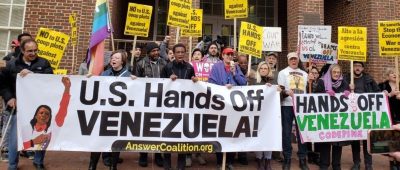
Featured image: Activists gather in front of the Venezuelan embassy in Washington, DC in March, 2019.The original source of this article is Global ResearchCopyright © Dr. Chandra Muzaffar, Global Research, 2020

River to Sea Uprooted Palestinian   
The views expressed in this article are the sole responsibility of the author and do not necessarily reflect those of the Blog!

Friday, 21 February 2020

Sitrep – Venezuela, Bolivia and Nicaragua


February 19, 2020


Chris Faure for The Saker Blog
While the Mena is exploding in tensions, the Empire is hungry and is not leaving these countries in Latin America any breathing room. Although it can be argued that the circumstances are different in each, there are certain commonalities that can be pointed out.
Venezuela
The Trump administration warned early in February of “impactful” measures on the government of Venezuela
First was a blanket set of sanctions on Venezuela’s state-owned airline CONVIASA. Why, you may ask? Well according to the administration, this airline is used to “shuttle corrupt officials.” We see the ‘rules based international order’ at work, as there is no evidence of corruption, but these days it seems as if one fights US sanctions, you must be corrupt. The rule of evidence for corruption now is resisting imperial sanctions. CONVIASA operates flight services to domestic destinations and throughout South America and the Caribbean.
The other notable event was that Guiadó went home to Venezuela on TAP, a Portugese airline, only to be ‘warmly welcomed’ by screaming Venezuelans beating him up. The Venezuelan Government suspended for 90 days the Portuguese airline, over what is formally declared as “some irregularities detected in Juan Guaido´s returning flight. The self-proclaimed ‘president’ returned to Venezuela after a tour of Europe and the United States on a TAP flight under a different identification, as Antonio Márquez, and his uncle was on the same flight, smuggling explosives.  Name change or no name change, he was still beaten up by Venezuelans.
Some good news is that the US Government’s case against the Venezuelan embassy protectors ended up in a hung jury, and the four protectors were not jailed. This was another failure in the open coup attempt on Venezuela.
The latest is that the US is placing more sanctions on Russia’s Rosneft Trading in relation to their quest for what they call “the opportunity for a transition of power” which the rest of us understand as color revolution and extraction of assets from a country working hard at their own sovereignty.
“Russia categorically repudiates unilateral restrictions, through which the US, which seeks global hegemony, is trying to make the whole world bend to its will. This has never influenced and will not influence Russia’s international policy, including its cooperation with the legitimate authorities of Venezuela, Syria, Iran and any other country,” the Russian Foreign Ministry said in a statement.
Nicaragua
In Nica, as the locals call it, the startup to regime change has commenced. The Grayzone reports that the US embassy and European Union are meeting with right-wing Nicaraguan opposition leaders and pressuring them to unite against elected leftist President Daniel Ortega in the lead-up to the 2021 election. https://thegrayzone.com/2020/02/07/nicaragua-opposition-support-us-eu-coalition/
Sanctions are rolling in and this one is similar to what we saw in Brazil, and now in Bolivia, where the rightist evangelicals (usually Christian Zionist) are being used as the pressure point aiming to unseat the Sandinistas.
Nicaragua, according to the Empire under the guise of the Donald Trump administration has declared the small nation of Nicaragua to be a supposed “national security threat,” and has imposed several rounds of aggressive sanctions on the country, with the aim of destabilizing its economy.
Bolivia
After the contested election and a coup d’état that saw Evo Morales being expelled as President as well as having to flee from his beloved country, snap general elections will be held in Bolivia on May 3rd, 2020.
The situation on the ground is still that of a coup d’état. The indigenous Bolivian population which Evo Morales brought into the light and gave opportunity to flourish economically, is under stress, pressure and still being murdered as we speak.
Few people know that as in Venezuela, we are dealing with another Western backed self-elected interim president in Bolivia – Jeanine Añez. On declaring herself interim president, she also undertook not to run for the position in forthcoming elections. That undertaking did not last long though and she is a candidate now.
As in Nicaragua, we are also dealing with rightist evangelicals being used for political power. “Evangelical preacher Chi Hyun Chung exposed this corruption after he placed third in the last election but didn’t make it onto the ballot. Chung reported that these groups were asking for payments of between one million and 1.5 million U.S. Dollars for the right to use their names. He called on electoral authorities to intervene to end the practice.”
But was this a Western backed coup and how do we know that it was? The easiest to see, is who the golpistas immediately made friends with.
Ollie Vargas states : “The Anez administration’s ties to the U.S. are openly admitted. Evident in the dramatic speed with which Morales’ progressive foreign policy was torn up. Full relations were re-established with the U.S. and Israel and USAID was brought in to ‘cooperate’ in the elections and other government functions. However, less known are Anez’s hiring choices. One of the first advisors to be brought in to her inner circle was Erick Foronda, who was chief advisor to the U.S. embassy in Bolivia for 25 years prior to taking on the role with Añez.
The cooperation continues as the electoral campaign gets underway. Following the footsteps of many Bolivian rightists, Añez is now contracting the services of CLS Strategies, a U.S. political consulting firm, to provide “strategic communications counsel” during the coming elections. CLS Strategies is the same firm used by the government in Honduras after that country’s coup against Manuel Zelaya.”


The golpistas are doing their best to ban any candidate from MAS. The MAS radio channels are being banned and the people are being scattered violently wherever they gather. Evo Morales is still a candidate and has declared his candidacy from Argentina, where he has safe harbor. But he is not running for President. The presidential front runner for MAS (Evo’s party, the biggest voting block in Bolivia and generally known as The Movement toward Socialism) is Luis Arce. He has just had a conference with Evo Morales in Argentina, to plan the election. It is generally accepted that even since Morales left, MAS still has the majority and will win a fair election. This is clearly not the era of fair elections and the lastest news in, is that MAS is declaring an emergency as both Evo Morales as well as Luis Arce will be banned from running, under some invented pretext by the electoral commission.  The real issue is, despite the coup or golpe in Bolivia, despite the exit of Evo Morales, MAS is still winning.
The golpistas have serious western support, and MAS is not standing down from their Movement toward Socialism. The police forces are brutal toward the indigenous, one has no idea what the defense forces are really doing and the expectation is that we will have another coup type event arise as tempers are hot.
In the cities, it feels as if the right is winning, yet in the indigenous rural areas, MAS has a clear lead. This is where it stands now and one has to keep in mind that the rural areas are not being polled thoroughly.  The rural areas are all MAS supporters as it is these people that received an economic opportunity under Evo Morales:


C:\Users\NIETZS~1\AppData\Local\Temp\lu5700hdiuj.tmp\lu5700hdix9_tmp_7613a400b6ddbfce.jpg

Summary : Now that we have seen the similarities between a coup starting in Nicaragua, the longer lasting meddling in Venezuela, and the similarities in the playbook for Bolivia, we can only go back to Harold Pinter’s Nobel Acceptance Speech for Literature, 2005.
“It never happened. Nothing ever happened. Even while it was happening it wasn’t happening. It didn’t matter. It was of no interest. The crimes of the United States have been systematic, constant, vicious, remorseless, but very few people have actually talked about them. You have to hand it to America. It has exercised a quite clinical manipulation of power worldwide while masquerading as a force for universal good. It’s a brilliant, even witty, highly successful act of hypnosis.
I put to you that the United States is without doubt the greatest show on the road. Brutal, indifferent, scornful and ruthless it may be but it is also very clever. As a salesman it is out on its own and its most saleable commodity is self love. It’s a winner. Listen to all American presidents on television say the words, ‘the American people’, as in the sentence, ‘I say to the American people it is time to pray and to defend the rights of the American people and I ask the American people to trust their president in the action he is about to take on behalf of the American people.’ It’s a scintillating stratagem.”
“Language is actually employed to keep thought at bay. “

PLEASE Tip The Saker Ammunition Chest To HELP Keep The Good Fight Alive!
Help us to hit back against the bombardment of MSM lies costing our communities, economies and livelihoods far, far too much.
Thanks to all those who have donated and continue on a monthly cycle! Your support and faith in fighting and resisting the Empire’s war with information and analysis is highly motivating and greatly appreciated!
We do not rely on any organizations, but rather private donations. Please give generously! TQ! The Saker


River to Sea Uprooted Palestinian   
The views expressed in this article are the sole responsibility of the author and do not necessarily reflect those of the Blog!

Sunday, 16 February 2020

Bolivia: An Election in the Midst of an Ongoing Coup

By Prof. Vijay Prashad
Global Research, February 14, 2020

On May 3, 2020, the Bolivian people will go to the polls once more. They return there because President Evo Morales had been overthrown in a coup in November 2019. Morales had just won a presidential election in October for a term that would have begun in January 2020. Based on a preliminary investigation by the Organization of American States (OAS) that claimed that there was fraud in the election, Morales was prematurely removed from office; the term for his 2014 presidential election victory did not end until January. Yet, he was told by the military to leave office. An interim president – Jeanine Áñez – appointed herself. She said she was taking this office only on an interim basis and would not run for election when Bolivia held another election. She is a candidate for the May 3 election. (For more information on what is happening in Bolivia, see this overview from Tricontinental: Institute for Social Research.)
Meanwhile, Morales has been in exile in Argentina. His party – the Movement for Socialism (MAS) – has candidates for the presidency and the vice presidency, but their party cadres and followers are facing a difficult time making their case to the people. Their radio stations have been blocked, their leaders arrested or exiled (or sitting in foreign embassies waiting for asylum), their cadre beaten up and intimidated.
The United Nations secretary-general’s personal envoy Jean Arnault released a statement on February 3 that expressed caution about the elections. The situation in Bolivia, Arnault said, is “characterized by an exacerbated polarization and mixed feelings of hope, but also of uncertainty, restlessness and resentment after the serious political and social crisis of last year.” This careful language of the UN needs to be looked at closely. When Arnault says there is “exacerbated polarization,” he means that the situation is extremely tense. When he asks that the interim government “outlaw hate speech and direct or indirect incitement to violence or discrimination,” he means that the government and its far-right followers need to be very careful about what they say and how much violence they use in this election.
On February 6, Morales spoke in Buenos Aires, where he urged an end to the violence so that the election could bring the fractured country together. He called for a national agreement between all sides to end the dangerous situation. In a pointed way, Morales called upon the government to respect diversity, noting that people wearing distinct clothes and wearing the signs of a certain political party were facing intimidation and violence. He meant the indigenous population of Bolivia, and the supporters of MAS; it is widely accepted that the violence has been coming from the far right’s paramilitary shock troops, and the intimidation has been coming from the government.
For instance, the Bolivian authorities have been routinely charging MAS leaders with sedition, terrorism, and incitement to violence. Morales faced these charges, along with dozens of important MAS leaders, most recently Gustavo Torrico who has been arrested. Matters are so bad that the UN’s special rapporteur on the independence of judges and lawyers, Diego García-Sayán, took to Twitter to express his concern at the “use of judicial and fiscal institutions for the purpose of political persecution. The number of illegal detentions grows.” This has not stopped Áñez, who says she will move her government to investigate at least 592 people who held high office in Morales’ 14 years in government. This means that the entirety of the MAS leadership will likely face harassment between now and the May 3 election.
US Interference
In 2013, Morales expelled the US government agency USAID; he accused USAID of working to undermine his elected government. Before that, Morales, as is his constitutional right, informed Salvador Romero – the head of the election agency (TSE) – that when his term ended in 2008, he would not be retained. This is a normal practice.
Romero went to the US Embassy to complain. He met with US Ambassador Philip Goldberg to complain about this and urged the US to do something. It was clear that Romero and Goldberg knew each other well. When Romero left his post at the TSE, the US establishment took care of him. He went to work at the National Democratic Institute in Honduras. The National Democratic Institute, based in Washington, is loosely affiliated with the US Democratic Party, and is part of the universe that includes the National Endowment for Democracy. These are all US government-funded agencies that operate overseas to “oversee” what is known as “democracy promotion,” including elections.
Romero essentially worked for the US government in Honduras during the first election after the US-instigated coup of 2009. During this election in 2013, violence against the supporters of Xiomara Castro, the candidate of the left-wing Libre Party, was routine. The day before the election, for instance, two leaders of the National Center of Farmworkers (CNTC) – María Amparo Pineda Duarte and Julio Ramón Maradiaga – were killed as they returned home from a training for Libre election workers. This was the atmosphere of this very tight election, which returned to power the US-backed conservative candidate Juan Orlando Hernández of the National Party. Romero, at that time, was quite pleased with the results. He told the New York Times then that “despite ‘the general perception of fraud,’” the election was just fine.
Right after the coup in November, Áñez brought Romero back to La Paz as the head of the election court, the TSE. He has his old job back. This would have made Bruce Williamson, the US charge d’affaires to Bolivia, very happy. The US has its man at the helm of the May 3 election in Bolivia.
And then Trump said he is sending USAID to Bolivia to help prepare the ground for the election. On January 9, the USAID team arrived to “give technical aid to the electoral process in Bolivia.” Technical aid. The phrase should give a reasonable person pause.
Ten days later, Trump’s legal adviser Mauricio Claver-Carone arrived in La Paz and gave a series of interviews in which he accused Morales of terrorism and creating instability. This was a direct attack at MAS and interference with Bolivia’s electoral process.
If the US intervenes in Bolivia, that is just “democracy promotion.”
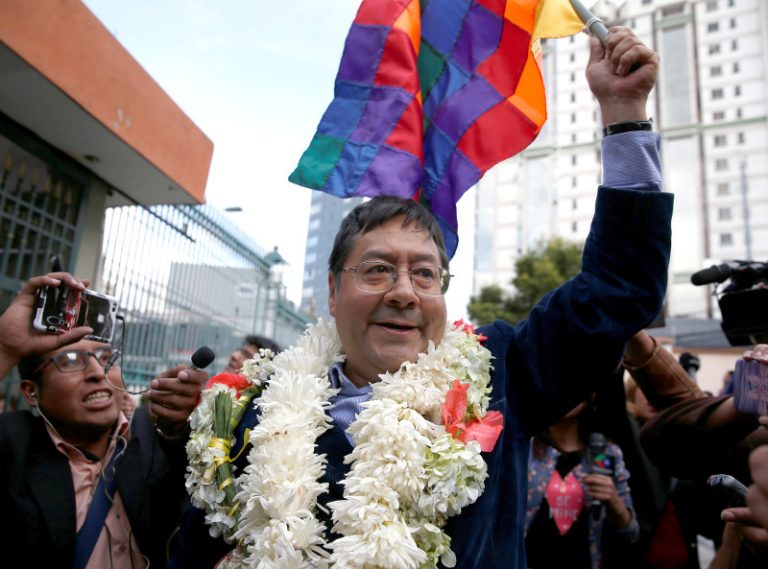
But even with the violence from the government and its fascistic paramilitaries, even with Romero at the helm of the TSE, even with USAID on the ground, and even with the shenanigans of Claver-Carone, MAS is fighting to win. The candidates for MAS are Luis Arce Catacora (president) and David Choquehuanca Céspedes (vice president). Catacora was the minister of economy and public finance under Morales and the architect of the administration’s economic success. Céspedes was the foreign minister in that government. He managed Bolivia’s policy of international sovereignty and is an important person to Bolivia’s indigenous and peasant movements. Early polls show that the MAS ticket is in first place.
*
Note to readers: please click the share buttons above or below. Forward this article to your email lists. Crosspost on your blog site, internet forums. etc.
This article was produced by Globetrotter, a project of the Independent Media Institute.
Vijay Prashad is an Indian historian, editor and journalist. He is author of Red Star Over the Third World(LeftWord, 2017) and the Chief Editor of LeftWord Books.

River to Sea Uprooted Palestinian   
The views expressed in this article are the sole responsibility of the author and do not necessarily reflect those of the Blog!

Sunday, 15 December 2019

Latin America: New Old Hot Point On Geopolitical Battlefield


Written and produced by SF Team: J.Hawk, Daniel Deiss, Edwin Watson
Latin America has long been regarded as the exclusive stomping ground of US economic interests, US military, and US intelligence services for much of the 19th and 20th centuries, to the point that the US public has grown to view meddling in its neighbors’ domestic politics as some sort of birthright which is still faintly rooted in the 19th century “white man’s burden” racialist policies. That the majority of Democratic Party presidential candidates supports the military coup in Bolivia, the escalating repressions in Chile, and the plundering of Brazil by the Bolsonaro regime is actually unremarkable in that regard. Such policies have long been the norm.
However, if one were to take a quick survey of recent developments in the “information battlefield” in the United States, one would be struck by the rapid elevation of Latin America to a place where direct US military action is needed. It is not just Trump who, in the aftermath of an apparently cartel-related murder of an American Mormon family in Mexico, “offered” Mexico the “help” of the US military in fighting the cartels. The latest boy-wonder of the US Establishment, “Mayor Pete” Buttigieg likewise allowed that he is “open” to the idea of sending US troops to Mexico. Neither of these statements was seen as in any way controversial by the mainstream media—even though the US public is broadly anti-war and skeptical of additional international entanglements, the Washington Establishment views the sovereignty of other countries as nothing more than legal fiction.
These politicians’ statements do not stand in isolation. Hollywood has long been “joined at the hip” with the US national security establishment and can always be relied upon to propagate the latest set of Washington talking points. While Russian villains remain the staple of US movies and video games, Latin America is gradually reclaiming its role as a battlefield and source of threats to the United States – a status it had lost after 9/11. There are now at least two currently running US TV series which specifically focus on direct US interventions in Latin America. America’s favorite CIA analyst Jack Ryan (who, it should be noted, became President on the pages of Tom Clancy’s novels after the rest of the US government was conveniently eliminated by a Boeing 747 flown into the Capitol  by a suicide pilot) is now bravely thwarting Russian plots in Venezuela. Going considerably further, Last Ship’s current season actually posits the emergence of Gran Colombia, a veritable Latin American empire which launches a Pearl Harbor-style surprise air raid which destroys the just-rebuilt US Navy with the assistance of a cyber-strike. In retaliation, the United States employs the full range of its conventional capabilities, starting with CIA covert operatives working with some modern equivalent of the Nicaraguan Contras whose connections to the drug cartels are not even concealed, and ending with US Marines landing on the shores of Latin American countries in order to “liberate” them from their own governments.
There are other indications that the US establishment is bracing for a major deterioration of the political situation “south of the border”, up to and including a major refugee crisis comparable to that which Europe has experienced. While Donald Trump has been roundly condemned for his immigration policies, particularly the deportations of Latin American refugees, the construction of a major barrier on the US-Mexico border, and the efforts to transform Mexico into a holding tank for refugees seeking admission into the United States, no senior Democratic Party politician or candidate has promised to reverse these policies.
The rekindling of interest in Latin America is a logical consequences of the drift toward a global multi-polar system. It means, first, a retrenchment in the Middle East due to the demonstrated power of Russia and China which has proved sufficient to thwart not only covert US plots but also overt uses of economic and military capabilities. This power transition has meant that even long-standing US allies such as Turkey and Saudi Arabia are adopting a multi-vector foreign policy no longer wholly centered on their relationship with the United States. It certainly does not help that the United States has proved of limited utility in resolving the many international conflicts and rivalries in that region, not only the obvious Iran-Saudi Arabia one, but also the lower-intensity Saudi Arabia—Turkey one. Since Russia is literally the only international power capable of credibly negotiating with each of these three regional rivals, its reputation as an honest broker backed up by non-trivial “hard power” has elevated its standing in the region to the detriment of the United States.
The second implication is an even closer binding of Latin American countries to the United States, with the remarkably compliant Organization of American States (OAS) which has never seen a military coup it did not like, serving as the overt instrument of control. Conversely, regional organizations which have proven resistant to US control such as the Bolivarian Alliance for the Peoples of our America-Trade between Peoples (ALBA-TCP) and  the Union of South American Nations (UNASUR), both of which actually condemned the coup in Bolivia in strong terms, will find themselves the target of US pressure. Post-coup Bolivia’s announced departure from both of these organizations is unlikely to be an aberration, particularly since it follows on the heels of Lenin Moreno’s Ecuador’s departure from ALBA in 2018. The remaining ALBA states include Cuba, Nicaragua, Venezuela (in addition to several small island states), all of which are continuing targets of US regime change policies.
UNASUR also appears headed for extinction. As many as six countries, Argentina, Brazil, Chile, Colombia, Paraguay and Peru, suspended their membership in 2018. Chile moreover launched PROSUR, an organization explicitly intended to target Venezuela, with the initial states invited to join the new organization being  Argentina, Brazil, Bolivia, Colombia, Chile, Ecuador, Uruguay, Paraguay, Peru, Guyana and Suriname, none of which can be described as pursuing policies contrary to US wishes.
The Trump Administration’s regional trade war that resulted in the launch of USMCA – a new trade pact by the US, Mexico and Canada intended to replace the North America Free Trade Association (NAFTA) is indicative of the future course of US policy. It’s doubtful that many in the region failed to note the new trade pact’s abbreviation is exactly the same as that of the US Marine Corps which has a long and dark history of invasions and occupations of Latin American states. Consistent with the plot of “Last Ship”, the US, Mexico and Canada will find themselves once again the final arbiter of trade arrangements in Latin America in the #MAGA era, an era that will not end with Trump.
Economic developments in countries that have suffered right-wing regime shifts in the last few years show the direction in which Latin America will evolve. In Brazil, Boeing was allowed to acquire the commercial aircraft division of EMBRAER which hitherto was able to compete, as an independent actor, against both Boeing and Airbus even in their own home markets. The move strengthens Boeing by making it more competitive against Airbus in certain niches that it lacked, and strips Brazil of a major industrial asset. Bolsonaro also aims to privatize another of Brazil’s economic “crown jewels”, the Petrobras energy firm which is all but guaranteed to fall into the hands of Washington-favored energy companies.  US interest in the lithium reserves in Bolivia and neighboring countries has also been well documented. Preventing Morales’ Bolivia from entering into a development deal with China was one of the main motives behind the coup. Like Bolsonaro’s Brazil, Moreno’s Ecuador is pursuing plans to allow oil drilling in the Amazon region.
The famed Argentinian revolutionary Che Guevara suffered a heroic death in Bolivia, attempting to mobilize an indigenous rebellion against the post-conquistador elite. The inevitable backlash to the ever more evident US efforts to ruthlessly exploit Latin America in order to compensate for the loss of influence and business elsewhere in the world means that the United States will find itself with several insurgencies and refugee crises not halfway around the world but in its own geopolitical backyard. Their intensity will eclipse the Cold War-era struggles.  Should the United States insist on pursuing its current course, it risks losing power and influence in Latin America in the same way  it did in the Middle East.


River to Sea Uprooted Palestinian   
The views expressed in this article are the sole responsibility of the author and do not necessarily reflect those of the Blog!

Saturday, 30 November 2019

US ‘Regime Changes’: The Historical Record


Global Research, November 29, 2019
First published on February 5, 2019
As the US strives to overthrow the democratic and independent Venezuelan government, the historical record regarding the short, middle and long-term consequences are mixed.
We will proceed to examine the consequences and impact of US intervention in Venezuela over the past half century.
We will then turn to examine the success and failure of US ‘regime changes’ throughout Latin America and the Caribbean.
Venezuela: Results and Perspectives 1950-2019
During the post WWII decade, the US, working through the CIA and the Pentagon, brought to power authoritarian client regimes in Venezuela, Cuba, Peru, Chile, Guatemala, Brazil and several other countries.
In the case of Venezuela, the US backed a near decade long military dictatorship (Perez Jimenez ) roughly between 1951-58. The dictatorship was overthrown in 1958 and replaced by a left-center coalition during a brief interim period. Subsequently, the US reshuffled its policy, and embraced and promoted center-right regimes led by social and christian democrats which alternated rule for nearly forty years.
In the 1990’s US client regimes riddled with corruption and facing a deepening socio-economic crises were voted out of power and replaced by the independent, anti-imperialist government led by President Chavez.
Image on the right: Venezuelan President Hugo Chávez in 2005 (Source: Public Domain)
The free and democratic election of President Chavez withstood and defeated several US led ‘regime changes’ over the following two decades.
Following the election of President Maduro, under US direction,Washington mounted the political machinery for a new regime change. Washington launched, in full throttle, a coup by the winter of 2019.
The record of US intervention in Venezuela is mixed: a middle term military coup lasted less than a decade; US directed electoral regimes were in power for forty years; its replacement by an elected anti-imperialist populist government has been in power for nearly 20 years. A virulent US directed coup is underfoot today.
The Venezuela experience with ‘regime change’ speaks to US capacity to consummate long-term control if it can reshuffle its power base from a military dictatorship into an electoral regime, financed through the pillage of oil, backed by a reliable military and ‘legitimated’ by alternating client political parties which accept submission to Washington.
US client regimes are ruled by oligarchic elites, with little entrepreneurial capacity, living off of state rents (oil revenues).
Tied closely to the US, the ruling elites are unable to secure popular loyalty. Client regimes depend on the military strength of the Pentagon — but that is also their weakness.
Regime Change in Regional-Historical Perspective
Puppet-building is an essential strategic goal of the US imperial state.
The results vary over time depending on the capacity of independent governments to succeed in nation-building.
US long-term puppet-building has been most successful in small nations with vulnerable economies.
Image below: U.S. President Dwight D. Eisenhower and Secretary of State John Foster Dulles, the advocate of the 1954 Guatemalan coup d’état that installed the right-wing dictatorship (Source: Public Domain)
The US directed coup in Guatemala has lasted over sixty-years – from 1954 -2019. Major popular indigenous insurgencies have been repressed via US military advisers and aid.
Similar successful US puppet-building has occurred in Panama, Grenada, Dominican Republic and Haiti. Being small and poor and having weak military forces, the US is willing to directly invade and occupy the countries quickly and at small cost in military lives and economic costs.
In the above countries Washington succeeded in imposing and maintaining puppet regimes for prolonged periods of time.
The US has directed military coups over the past half century with contradictory results.
In the case of Honduras, the Pentagon was able to overturn a progressive liberal democratic government of very short duration. The Honduran army was under US direction, and elected President Manual Zelaya depended on an unarmed electoral popular majority.Following the successful coup the Honduran puppet-regime remained under US rule for the next decade and likely beyond.
Chile has been under US tutelage for the better part of the 20th century with a brief respite during a Popular Front government between 1937-41 and a democratc socialist government between 1970-73. The US military directed coup in 1973 imposed the Pinochet dictatorship which lasted for seventeen years. It was followed by an electoral regime which continued the Pinochet-US neo-liberal agenda, including the reversal of all the popular national and social reforms. In a word, Chile remained within the US political orbit for the better part of a half-century.
Chile’s democratic-socialist regime (1970-73) never armed its people nor established overseas economic linkage to sustain an independent foreign policy.
It is not surprising that in recent times Chile followed US commands calling for the overthrow of Venezuela’s President Maduro.
Contradictory Puppet-Building
Several US coups were reversed, for the longer or shorter duration.
The classical case of a successful defeat of a client regime is Cuba which overthrew a ten-year old US client, the Batista dictatorship, and proceeded to successfully resist a CIA directed invasion and economic blockade for the better part of a half century (up to the present day).
Cuba’s defeat of puppet restorationist policy was a result of the Castro leadership’s decision to arm the people, expropriate and take control of hostile US and multinational corporations and establish strategic overseas allies – USSR , China and more recently Venezuela.
In contrast, a US military backed military coup in Brazil (1964) endured for over two decades, before electoral politics were partially restored under elite leadership.
Twenty years of failed neo-liberal economic policies led to the election of the social reformist Workers Party (WP) which proceeded to implement extensive anti-poverty programs within the context of neo-liberal policies.
After a decade and a half of social reforms and a relatively independent foreign policy, the WP succumbed to a downturn of the commodity dependent economy and a hostile state (namely judiciary and military) and was replaced by a pair of far-right US client regimes which functioned under Wall Street and Pentagon direction.
The US frequently intervened in Bolivia, backing military coups and client regimes against short-term national populist regimes (1954, 1970 and 2001).
Morales 20060113 02.jpg
In 2005 a popular uprising led to free elections and the election of Evo Morales, the leader of the coca farmers movements. Between 2005 – 2019 (the present period) President Morales led a moderate left-of-center anti imperialist government.
Unsuccessful efforts by the US to overthrow the Morales government were a result of several factors: Morales organized and mobilized a coalition of peasants and workers (especially miners and coca farmers). He secured the loyalty of the military, expelled US Trojan Horse “aid agencies’ and extended control over oil and gas and promoted ties with agro business.
The combination of an independent foreign policy, a mixed economy , high growth and moderate reforms neutralized US puppet-building.
Not so the case in Argentina. Following a bloody coup (1976) in which the US backed military murdered 30,000 citizens, the military was defeated by the British army in the Malvinas war and withdrew after seven years in power.
The post military puppet regime ruled and plundered for a decade before collapsing in 2001. They were overthrown by a popular insurrection. However, the radical left lacking cohesion was replaced by center-left (Kirchner-Fernandez) regimes which ruled for the better part of a decade (2003 – 15).
The progressive social welfare – neo-liberal regimes entered in crises and were ousted by a US backed puppet regime (Macri) in 2015 which proceeded to reverse reforms, privatize the economy and subordinate the state to US bankers and speculators.
After two years in power, the puppet regime faltered, the economy spiraled downward and another cycle of repression and mass protest emerged. The US puppet regime’s rule is tenuous, the populace fills the streets, while the Pentagon sharpens its knives and prepares puppets to replace their current client regime.
Conclusion
The US has not succeeded in consolidating regime changes among the large countries with mass organizations and military supporters.
Washington has succeeded in overthrowing popular – national regimes in Brazil, and Argentina. However, over time puppet regimes have been reversed.
While the US resorts to largely a single ‘track’ (military coups and invasions) in overwhelming smaller and more vulnerable popular governments, it relies on ‘multiple tracks’ strategy with regard to large and more formidable countries.
In the former cases, usually a call to the military or the dispatch of the marines is enough to snuff an electoral democracy.
In the latter case, the US relies on a multi-proxy strategy which includes a mass media blitz, labeling democrats as dictatorships, extremists, corrupt, security threats, etc.
As the tension mounts, regional client and European states are organized to back the local puppets.
Phony “Presidents” are crowned by the US President whose index finger counters the vote of millions of voters. Street demonstrations and violence paid and organized by the CIA destabilize the economy; business elites boycott and paralyze production and distribution… Millions are spent in bribing judges and military officials.
If the regime change can be accomplished by local military satraps, the US refrains from direct military intervention.
Regime changes among larger and wealthier countries have between one or two decades duration. However, the switch to an electoral puppet regime may consolidate imperial power over a longer period – as was the case of Chile.
Where there is powerful popular support for a democratic regime, the US will provide the ideological and military support for a large-scale massacre, as was the case in Argentina.
The coming showdown in Venezuela will be a case of a bloody regime change as the US will have to murder hundreds of thousands to destroy the millions who have life-long and deep commitments to their social gains , their loyalty to the nation and their dignity.
In contrast the bourgeoisie, and their followers among political traitors, will seek revenge and resort to the vilest forms of violence in order to strip the poor of their social advances and their memories of freedom and dignity.
It is no wonder that the Venezuela masses are girding for a prolonged and decisive struggle: everything can be won or lost in this final confrontation with the Empire and its puppets.
*
Note to readers: please click the share buttons above. Forward this article to your email lists. Crosspost on your blog site, internet forums. etc.
Award winning author Prof. James Petras is a Research Associate of the Centre for Research on Globalization.
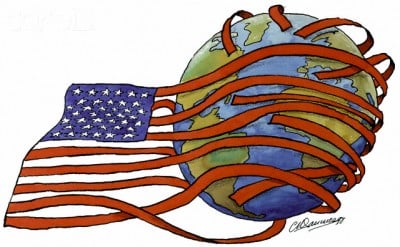
Featured image is from Images.com/Corbis

River to Sea Uprooted Palestinian   
The views expressed in this article are the sole responsibility of the author and do not necessarily reflect those of the Blog!