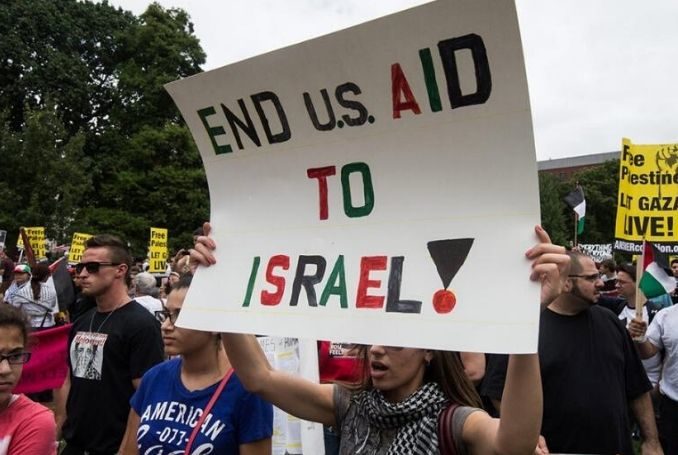
Uprooted Palestinians are at the heart of the conflict in the M.E Palestinians uprooted by force of arms. Yet faced immense difficulties have survived, kept alive their history and culture, passed keys of family homes in occupied Palestine from one generation to the next.
A protest against US military aid to Israel. (Photo: File)
– Jeremy Salt taught at the University of Melbourne, at Bosporus University in Istanbul and Bilkent University in Ankara for many years, specializing in the modern history of the Middle East. Among his recent publications is his 2008 book, The Unmaking of the Middle East. A History of Western Disorder in Arab Lands (University of California Press). He contributed this article to The Palestine Chronicle.
What a chamber of horrors the third millennium has been so far in the Middle East, without even a quarter of it having passed. Iraq, Syria and Yemen on a scale unimaginable even at the high point of imperialism in the 19th century. An estimated 300 children under five dying every day in Yemen from malnutrition, Palestinians shot dead in their occupied country every day, Lebanon and Syria slowly strangled by US sanctions, Iran threatened with military destruction and the revelation of yet another massacre by the US, in Syria, where “about” 70 women and children were killed at Baghuz by bombs dropped one after the other to make sure that no-one escaped.
There is no suggestion that anyone should be punished for yet another ‘mistake.’ This is where thousands of years of drawing up covenants to make the world a safer place have ended up: back where we started, the law of the jungle.
This is what the guardians of ‘western civilization’ have given to the world just in the past three decades:
Two wars on Iraq, the ‘cradle of civilization’ shattered by the cradle of a violent hamburger junk culture, millions killed or displaced. Libya, the most developed country in Africa, pulled up by its roots, uncounted thousands killed, the leader of its 1969 revolution slaughtered as Hillary Clinton cackled with glee like one of the witches around the cauldron in Shakespeare’s ‘Macbeth’. Syria torn to pieces, ancient cities and markets destroyed, and half a million killed. In Yemen, more than 230,000 dead, with 43 percent of prematurely born babies dying because of the lack of medical equipment and a genocidal famine – 75 percent of children are suffering from acute malnutrition – continuing even as fresh supplies of weaponry are dropped off in the Saudi kingdom by the US and Britain. Iran, Syria and Lebanon targeted with economic sanctions: in occupied Palestine, in Syria and in Iran the Zionist state continues its murderous march through history.
Not one of the global criminals responsible for these massive crimes against humanity has been punished. They play golf or roam the world picking up millions for their speaking engagements and their ‘philanthropic’ foundations. Not one word of contrition or remorse has been spoken by any of them for the lives they have ended or ruined. Not even the death of children has forced admission of guilt out of them. Others have been punished for lesser crimes but not this gang. They are completely remorseless.
Imagine the reaction if these crimes were committed in Europe and white people were being slaughtered or driven out of their homes, out of their countries and drowning in their thousands as they tried to escape across the seas.
Well, between 1939-45 it did happen and those responsible were hanged at Nuremberg. We have no Nuremberg now but we do have an International Criminal Court (ICC) which does punish the architects of war crimes and crimes against humanity – as long as their skin is the right color. With the exception of pale-skinned Balkan Serbs charged after the breakup of Yugoslavia, all those hauled before the ICC have been brown or black.
The tsunami of death and destruction which began rolling across the region when Napoleon landed in Egypt in 1798 shows no sign of receding. Almost no country from the Atlantic coast of West Africa down to the Arab Gulf has avoided being swamped by it and many have been swamped several times.
The prime beneficiary of all of the above in the past century has been the settler state implanted in Palestine after 1918. Israel is the heart and soul of US foreign policy. Indeed, US foreign policy is no more than the Stars and Stripes draped over the interests of the Zionist state.
Take Iran as an example. After the death of Ayatullah Khumayni, Presidents Rafsanjani and Khatami sought to repair relations with the US. They offered investment concessions, diplomatic rapprochement and a political pathway into a region of critical interest, central Asia. Iranian society is conservative and God-fearing, rather like the US itself, but as long as Rafsanjani and Khatami refused to drop Iran’s righteous defense of the Palestinians, nothing else counted. Even in the ‘moderate’ Khatami’s time, economic sanctions were tightened, paving the way for the election of the ‘hardliner,’ Mahmud Ahmedinejad.
The attempted strangulation of Iran and Syria through war, assassination and sanctions necessarily involves Lebanon, Hezbollah’s home base. Since the 1980s Hezbollah has successfully fought off all attempts by Israel – backed to the hilt by the US of course – to destroy it. Far from being weakened, Hezbollah has gone from strength to strength, militarily and as a Lebanese political party. The lesson learned by the US and Israel is just that they have to try harder, to tear Lebanon apart if that is what it takes to destroy Hezbollah.
The latest provocation through Israel’s agents took place in Beirut on October 14, in the predominantly Shia neighborhood of Chiyah, bordering predominantly Maronite Christian Ain Rummaneh, where the ‘bus massacre’ of 27 Palestinians on April 13, 1975, was the trigger pulled to start the civil war.
This time snipers positioned on rooftops shot at Amal and Hezbollah supporters as they moved towards the Palace of Justice in Al Tayouneh to hold a vigil calling for the removal of Tariq al Bitar as the judge appointed to investigate the Beirut port explosion on August 5, 2020, on the grounds that he is running a heavily politicized inquiry heading towards a preordained conclusion, that this was a crime committed by Hezbollah.
Holding Hezbollah or Syria responsible for the crimes they have not committed was first tried after the assassination of former Prime Minister Rafiq Hariri in 2005. Initially, four ‘pro-Syrian’ generals were imprisoned for four years before an international tribunal took over the prosecution and released them for lack of evidence. It immediately pointed the finger at Hezbollah, eventually finding one person, Salim Ayyash, guilty of “involvement” on the sole basis of tapped phone calls made through communications networks known to have been completely penetrated and manipulated by the Zionist state.
The tribunal cleared Hezbollah’s leadership. What this actually means is that if the leadership did not order the assassination, no senior figure in the movement would have carried it out. Nasrallah and Hariri had differences but a good working relationship and it is virtually unthinkable that Nasrallah would ever have sanctioned such a heinous act.
The only beneficiaries of this monstrous act were the US, Israel and their agents in Lebanon. Syria was embarrassed internationally and had to withdraw its remaining forces from the Bika’a valley. Lebanon was thrown into the chaos that gave birth to the rise of the anti-Syrian/pro-Saudi, US and Israel March 14 alliance.
Hezbollah produced intercepted reconnaissance footage showing that Israel had been tracking Hariri with drones wherever he went for years and was flying an AWACS plane and another reconnaissance aircraft over Beirut at the precise time of the assassination. One of its agents had been located at the scene of the killing only the day before. None of this circumstantial evidence was ever followed up by the tribunal. Israel and the US have shed buckets of blood in Lebanon over many decades, have between them committed the most atrocious crimes, but the tribunal never even considered them as suspects.
The snipers waiting on the top of apartment buildings in Tayouneh on October 14 killed seven people, one a woman shot dead in her own home. Not just on rooftops, however, but on the ground, the demonstrators were surrounded by militiamen waiting to ambush them with guns, knives and even rocks. Despite denials by Samir Geagea (Ja’ja), the head of the fascist/sectarian Maronite Christian Lebanese Forces (LF), the armed men were clearly LF and acting on his orders. Of the 19 arrested, several quickly implicated him.
Geagea is one of the most murderous individuals in Lebanese history, which says a lot given the bloody track record of many others. During the civil war (1976-1989) he killed rivals within his own Maronite Christian ranks as well as Palestinians and other enemies outside them. In 1994 he was sentenced to four life sentences for the assassinations of former Prime Minister Rashid Karameh (1987), National Liberal Party leader Dany Chamoun (1990), Falangist (Kata’ib) head Elias al Zayek (1990) and the attempted assassination of Defence Minister Michel Murr (1991). In 1978 he and Elie Hobeika, at the behest of Bashir Gemayel, then head of the Falangists, led 1200 men in an attack on the north Lebanon family home of Tony Frangieh, leader of the Maronite Marada (Giants) faction. Geagea was wounded and had to be taken away before Frangieh, his wife and three-year-old daughter were killed.
In the 1990 attack, Dany Chamoun’s wife and two of his sons were also killed. If there is any poetic justice in any of this shedding of blood – including entirely innocent blood – it lies in the 1982 assassination of Bashir Gemayel and the car bombing murder in 2002 of Elie Hobeika, Israel’s leading henchman in the Sabra and Shatila massacres of 1982.
Geagea himself served eleven years of four life sentences before being released under amnesty after the assassination of Hariri and allowed to take up the leadership of the LF. His brutality is a powerful weapon in the hands of Israel and the US, whose ambassador, Dorothy Shea, has been open in her interference in Lebanese politics.
US economic sanctions against Lebanon have one primary target, Hezbollah; one secondary target, Syria; and one-third target, Iran. How many Christians die defending ‘Christian Lebanon’ is not an issue for the US and Israel any more than the number of Muslims who die fighting them. All they want is the chaos that will further their ambitions. They tore Lebanon apart before and they will do it again, mercilessly, ruthlessly, callously, without a care for the innocent blood of thousands that will be shed.
Whatever cause Samir Geagea thinks he is serving, the piecemeal destruction of Lebanon, indeed of the entire Middle East, is primarily about the protection of Israel. However, Israel is not as safe as it used to be or it might think it still is. It is confronted by enemies who have not backed off one meter from the struggle to liberate Palestine. Israel has tried hard to destroy them. Up to now, it has failed, so it is getting ready to try again. While planning/contingency planning is a constant, Israel now appears to be actively preparing for a massive military strike that would target Iran’s nuclear plants and missile capacity.
In September the Zionist chief of staff, Avi Kohavi, said plans for such a strike had been “greatly accelerated.” The military has been given an additional $1.5 billion to buy aircraft, drones and ‘bunker buster’ bombs that would probably include the USAF’s new 5000 lb. (2,267 kg.) GRU-72 Advanced 5k Penetrator, which would be aimed at Iran’s underground nuclear installations. Anticipating a simultaneous war with Hezbollah, Israel has also been carrying out extensive military exercises in northern occupied Palestine, coordinated with all emergency civil services to deal with an expected crisis on the domestic front once the missiles start falling. Israel is clearly planning for a big war, and can be expected to throw everything into this attempt to crush its principal enemies once and for all.
Unlike the white settlers in South Africa, the Zionist leadership sees no writing on the wall, no indications that history is not on their side even as it builds up against them. No more than Netanyahu does Naftali Bennett have any intention of giving anything back to the Palestinians except the smallest fragments of municipal responsibility. Like Netanyahu, he sees no need to negotiate, no need to give anything away. Why would he, when in the last resort Israel even has nuclear weapons to destroy its enemies? This is the question to which there can be no answer until the day comes when Israel faces the reality that even its conventional weapons are not sufficient to destroy its enemies.
All appearances to the contrary, unlimited US economic and military support has been a curse for Israel. It has created the illusion of power. Israel is like a plant with shallow roots. Only as long as the US keeps watering it, can the plant thrive. There is no permanent, unbreakable bond between states and all appearances to the contrary, there never will be between Israel and the US. Slowly, Americans are waking up and Israel’s incessant pleading is already beginning to fall on deaf ears, as the public becomes more aware of Israel’s criminality and as congressmen and women (mainly women) are emboldened to speak out. The time may come when the US can no longer afford Israel. The time may come when public opinion has changed to allow a US government to treat Israel as it treats other states.
US economic and military aid has had the same effect on Israel as steroids have on a bodybuilder. The 97-lb weakling is now the neighborhood bully swaggering down the street with pumped-up muscles. He smacks people around or they run in fright but Hezbollah and Iran are not running. They are standing firm and preparing to defend themselves. In any case, in the next war, Israel will take damage it has never experienced before, to the point where so many Jewish Israelis will just want to get out that Israel as a Zionist state is likely to crumble from within and die of its own contradictions. Is this what it is going to take for peace to become possible?
President Biden should reset in the Marshall mode and concentrate on forging amity and cooperation while combating the real enemies of humanity
Following World War Two, Europe was reeling from the devastation of so many years of savagery that it seemed it might never recover. The casualty figures are staggering, with, in addition to the Soviet Union’s some 25 million, about seven millions were killed in each of Germany and Poland, and 800,000 in France, 1.7 million in Yugoslavia, and half a million in each of Austria, Italy and Greece. The majority of these people were civilians and the surviving citizens of all these countries were suffering gravely from the catastrophe, not the least hazard being actual starvation.
The United States had only a handful of civilian casualties and prospered greatly from the commercial demands of war. In consequence it was in a position of immeasurable economic and military ascendancy and fortunately was governed by an administration that, by and large, was sympathetic and prepared to be supportive in alleviating the misery of the countless millions in Europe who seemed to have nothing in their future but endless hardship.
President Truman and his State Department brought their considerable talents to bear and constructed a scheme whereby shattered Europe could be best assisted. As noted by the Historywebsite, the 1948 European Recovery Plan was “The brainchild of Secretary of State George C Marshall, for whom it was named.” It was “crafted as a four-year plan to reconstruct cities, industries and infrastructure heavily damaged during the war and to remove trade barriers between European neighbours — as well as foster commerce between those countries and the United States.” In its final essence it didn’t entail a great deal of actual sacrifice on the part of the U.S., and in fact benefitted the agricultural community and the economic furnace that had been so effective in winning the war.
Nevertheless it was based on good will, charitable feeling, and concern for humanity, as expressed by Marshall himself in June 1947 in a speech delivered at Harvard University where he declared “It is logical that the United States should do whatever it is able to do to assist in the return of normal economic health in the world, without which there can be no political stability and no assured peace. Our policy is directed not against any country or doctrine but against hunger, poverty, desperation, and chaos. Its purpose should be the revival of a working economy in the world so as to permit the emergence of political and social conditions in which free institutions can exist.”
If only there had been more Marshalls in later years, the world would be a better place. Certainly, the United States would be in a position of international economic supremacy — but it wouldn’t have invaded and almost destroyed Afghanistan and Iraq and blitzed Libya into an even worse shambles than it created further east.
And as the U.S.-Nato military alliance staggers out of Afghanistan, defeated but grovelingly defiant, it should be giving thought to what has happened in that benighted country and planning for the future on the basis of what it has learned. The problem is that Nato doesn’t seem to have learned anything by its absurd foray, and is indeed intent on widening its horizons in order to attempt to justify its existence. The best lesson from Nato’s Afghanistan debacle (and its eight month bombing fandango that destroyed Libya’s economic infrastructure and encouraged home-basing of terrorist groups where none had formerly dared set a foot) is that it would be globally beneficial if Nato were to disband, but we have to be realistic and accept that common sense will not prevail in that regard.
Along the same lines, it would be sensible for Washington to objectively assess the value of the vast number of U.S. military bases around the globe, and inform U.S., openly and without qualifications or caveats, exactly what benefit their existence is supposed to offer to the U.S. and to the rest of the world. But again the signs are not good, as indicated on August 16 when an anonymous White House official spoke about a visit to Singapore and Vietnam by Vice President Kamala Harris and told the Washington Post that in spite of the concurrent Taliban takeover in Afghanistan she would continue with her trip because “Given our global leadership role, we can and we must manage developments in one region while simultaneously advancing our strategic interests in other regions on other issues. The United States has many interests around the world, and we are well-equipped to pursue them all at the same time.”
When will they ever learn?
Does President Biden genuinely believe that his Administration is “managing developments” in Afghanistan? Why is he determined to continue pursuing the supposed strategic interests of the U.S. by deploying increasing numbers of troops and ships and planes and missiles all round the globe to confront China and Russia and provoke them to react against the “global leader”?
The Washington establishment may have heard or read the latest pronouncement from the European Union concerning the wider effects of the Afghanistan debacle, but unfortunately it is unlikely it will prompt an objective analysis. On August 19 Josep Borrell, the EU’s high representative for foreign affairs, affirmed to the European Parliament and the world at large that “this is a catastrophe… Let me speak clearly and bluntly: This is a catastrophe for the Afghan people, for Western values and credibility, and for the developing of international relations.”
What the rest of the world is waiting for is an alternative use of the word “reset” by the Administration in Washington. Instead of conducting another “reset” aimed at military domination and increasing confrontation with China and Russia, President Biden should reset in the Marshall mode and concentrate on forging amity and cooperation while combating the real enemies of humanity as a whole. An Economist/YouGov poll in early 2021 indicated that “Most Americans think of China and Russia as our country’s greatest enemies. Of the two, China is the most frequently mentioned threat, followed closely by Russia”, and it is disconcerting that the U.S. President appears to be making no effort whatever to reduce international tensions.
President Biden should reflect on the civilised declaration by General George Marshall that “our policy is directed not against any country or doctrine but against hunger, poverty, desperation, and chaos” and consider how much better a world he could help forge if he concentrated the mightiness of the United States against the challenges presented by so many desperate problems besetting the peoples of the world.
Imagine what a Marshall Plan could achieve today.
But it seems unlikely that the U.S. Administration will consider any such thing, and it is painfully evocative of the 1960s folk-song “Where have all the flowers gone” which contains the evocative phrase “When will they ever learn?” When, indeed?
With Federal Chancellor of Germany Angela Merkel at a news conference following Russian-German talks. Photo: TASS
With Federal Chancellor of Germany Angela Merkel at a news conference following Russian-German talks. Photo: TASS
(The formal transcript is not fully released yet, but this page will be updated as it gets released.)
Update: The formal transcript is now complete on this page.
President of Russia Vladimir Putin: Colleagues, ladies and gentlemen,
Today’s talks with Madam Federal Chancellor were traditionally constructive and business-like.
We had an in-depth discussion, including with the participation of the delegations, on the current state of Russian-German relations and their prospects and exchanged views on a wide range of issues.
As you are aware, this visit by Ms Merkel is special since she is about to step down as Federal Chancellor after the parliamentary elections in the Federal Republic in September. But I want to say right away that we will always be delighted to see Ms Merkel in Russia as a welcome guest.
The fact that Angela Merkel has been heading the government of the Federal Republic for as long as 16 years inspires respect. She has been leading one of the largest, leading European countries with confidence, and she is rightfully among the most authoritative European and world leaders.
Over many years of working side by side, we have developed a good business relationship. We maintained regular contacts and close communication, discussed pressing bilateral matters and strived to coordinate our positions on challenges of global politics.
Occasionally, of course, we saw thing differently, but our dialogue has always been candid and meaningful and was aimed at reaching compromises and solving the most complicated challenges.
Importantly, Germany is indeed one of Russia’s priority partners in politics and the economy.
Speaking about Russian-German trade and economic ties, I would like to note that despite the coronavirus pandemic, which remains a major hindrance to restoring our business contacts in full, mutual trade has begun to expand. In January-May, this figure reached almost 33 percent to exceed $21 billion. Counter capital investment has come close to the $30 billion mark.
Russian-German Economy and Sustainable Development years are being held in 2020–2022. Businesspeople and entrepreneurs of the two countries are communicating at numerous events held as part of this campaign, and a number of promising joint projects in trade, the manufacturing industry and agriculture are being discussed in the process.
We have major projects that everyone is aware of. They are being implemented, and we very much hope that we will have more of them.
Of course, many pressing issues of international politics were touched upon during today’s talks.
Due to the rapidly unfolding events in Afghanistan, we prioritised this issue. The Taliban now controls almost the entire territory of that country, including its capital. This is the reality, and we must proceed from this reality as we strive to avoid the collapse of the Afghan state.
It is imperative to put an end to the irresponsible policy of imposing outside values on others, to the desire to build democracies in other countries according to other nations’ “patterns” without regard to historical, national or religious specifics and totally ignoring the traditions of other nations.
We know Afghanistan, and we know it well enough to understand how this country functions and have had the opportunity to learn first-hand the extent to which trying to impose unusual forms of government or social life on it is counterproductive.
There has not been a single time when socio-political experiments of this kind succeeded. All they do is destroy states and degrade their political and social fabric.
At the same time, we see that the Taliban has already put an end to hostilities and is now seeking to ensure order, promising to guarantee safety for both local residents and foreign missions. I hope that this is how things will go.
The international community should keep a close eye on these developments with the UN Security Council playing a coordinating role.
There is one more point I wanted to make in this regard. We believe that it is essential at this point to prevent terrorists of all kinds from spilling over into Afghanistan’s immediate neighbours, including under the guise of refugees.
Among other international topics, we had a detailed discussion on promoting a settlement in southeastern Ukraine. As you know, Ms Merkel has done a lot to bring about a resolution to Ukraine’s internal crisis. She was at the origins of the Normandy Format, and we all worked together on ways of restoring peace in Donbass.
Unfortunately, so far we have not been able to accomplish this. Today, the Russian and German side expressed serious concern about the growing tension along the line of contact. We talked this over, and I hope that we follow up on this conversation in the nearest future. More than a thousand ceasefire violations have been reported since the beginning of August, and Donbass towns and villages face artillery fire every day.
Another matter of concern is that Ukraine has adopted a number of laws and regulations that essentially contradict the Minsk agreements. It is as if the leadership of that country has decided to give up on achieving a peaceful settlement altogether. In this connection, we ask Ms Federal Chancellor once again to exercise her influence over Ukraine, including during her upcoming visit to Kiev, to see that Ukraine honours its obligations.
Of course, we covered the situation in Belarus. Madam Chancellor touched on this issue as well. We believe that the differences in Belarusian society can only be resolved within the constitutional and legal framework and solely by the Belarusians themselves without any external interference.
When discussing the situation with the Iranian nuclear programme, Madam Chancellor and I expressed hope that once the new government in Iran has been formed, vigorous efforts to preserve the Joint Comprehensive Plan of Action will resume. I informed Madam Federal Chancellor of my recent telephone conversation with the newly elected President of Iran.
As you are aware, Ms Merkel is committed to promoting an intra-Libyan settlement. Last January, I also took part in the Berlin Conference on Libya, which was convened on the initiative of Madam Chancellor, and the decisions it adopted helped improve the situation on the ground.
We believe that the international community should maintain a dialogue with all influential political forces in Libya in order to retain and build on the positive achievements that have yet to come.
We shared our vision of the state of affairs in Syria with our German partners. The ceasefire is in force throughout most of the country; the ruined economy and infrastructure are being rebuilt, but the terrorist threat still persists. Due to the illegal sanctions imposed on Damascus and the coronavirus pandemic, the socioeconomic situation there remains challenging.
We attach great importance to UN Security Council Resolution 2585, which was approved in July, on providing comprehensive humanitarian assistance to Syria. This is largely the outcome of the agreements reached during the Russia-US summit held in Geneva in June. We hope that the European countries, including the Federal Republic, will join in the efforts to help the Syrian people.
I would like to close by once again thanking Madam Federal Chancellor for our productive joint work – not only during today’s talks, but also during the previous years. I said it before, and I will say it again: we will always be delighted to see Ms Merkel in Russia.
Thank you.
Federal Chancellor of Germany Angela Merkel(retranslated): Thank you.
President Putin, dear Vladimir, ladies and gentlemen,
Earlier today, at the beginning of my visit, I laid a wreath at the Tomb of the Unknown Soldier to honour the memory of the fallen and as a reminder that 80 years ago Nazi Germany attacked the Soviet Union.
Today, we are very pleased to know that there is a dialogue going on between our governments, and our dialogue is constructive. Of course, we talked about different views and approaches to our joint decisions.
With regard to the nature of our bilateral relations, it is important to highlight a number of positive developments. I would like to mention economic relations, namely, the Year of Germany in Russia, which Mr President mentioned, during which a large number of meetings have taken place. In addition, there is an economic initiative involving the 1,000 Trainees project, which makes it possible for thousands of young Russians to take internships at German enterprises. These are the relationships that are very gratifying to have.
But, of course, we discussed the very depressing situation with Alexei Navalny. From our perspective, his sentence and imprisonment in a correctional facility were based on a court ruling that the ECHR found unobvious and disproportionate. This is unacceptable to us. I once again demanded that the President of Russia release Alexei Navalny and stressed that we would continue to monitor this case.
I also said that we are disappointed to see three German NGOs that have done a lot of work as part of the Petersburg Dialogue for cooperation between civil societies included on the list of objectionable organisations. I would like to know if it is possible to take these organisations off the list and to have the Petersburg Dialogue continue as before. From my perspective, this would send a very important message.
We also talked about bilateral economic relations, which are moving forward. In this regard, of course, we talked about Nord Stream 2. I would like to emphasise that this is not a bilateral German-Russian project, but a project of European dimension, because companies from other countries are also part of it.
In this context, we talked about the document concluded between the United States and the Federal Republic of Germany, and Mr President and I emphasised that Georg Graf Waldersee would act as a highly experienced negotiator with regard to gas transit through Ukraine beyond 2024. This is his assignment. We bear certain responsibility in this regard despite the economic developments that need to be taken into account.
In this context, we also discussed relations between Russia and the EU. It became clear that Russia is interested in entering an exchange with the EU on the “Fit for 55” climate package with account taken of cross-border carbon regulation and other problems. And I also noted that I am in favour of this approach.
Afghanistan was also among the current issues that we discussed today. This is a very important issue. We exchanged views, and I emphasised that it is very unfortunate that the Taliban are back in power in the country. However, this is how things stand. I also said that Germany believes helping people who had worked with Germany over the 20 years of NATO operations and missions in Afghanistan is currently a priority. We need to provide them refuge and ensure their safety in Germany and to take as many people as possible to Germany over the next few days.
I asked the Russian side to raise during the talks with the Taliban the question of UN humanitarian aid in Afghanistan, to make sure that it can be provided. The people who helped us, including those who assisted the Bundeswehr and the federal police, should be able to leave Afghanistan.
We also discussed developments in Ukraine. The Normandy Format is the only political framework we have for discussing these contentious issues. Currently the situation is in a deadlock. Unfortunately, Ukrainian service personnel are dying on the line of contact. I have always advocated reviving this format and giving it more weight. The last meeting was in December 2019, in Paris, and the goals we set back then were achieved both by the separatists in the Donetsk and Lugansk regions, and by Ukraine.
I pointed out that I am ready to make further progress on this matter in the interest of the people of Ukraine, so that everyone can live in peace in Ukraine. This is what we stand for.
For us, the annexation of Crimea constitutes a violation of Ukraine’s territorial integrity, we will insist on this point, and I will continue supporting Ukraine’s territorial integrity.
Speaking of Belarus, I stated that I firmly condemn the use of people, refugees from other countries who find themselves in a dire situation, as a hybrid weapon of sorts. I am referring to the situation on the border between Belarus and Lithuania.
Of course, we discussed developments in Libya and Syria. On Libya, we need to implement the outcomes of the Libyan conference, which called for a proportionate and reciprocal withdrawal of foreign mercenaries, while empowering Libyan forces to shape a future for the country they want. On this issue, Germany and Russia have a number of points in common.
We also talked about the challenges posed by climate change. Both Germany and Russia have suffered from natural disasters. In Russia, Siberia, even north of the Arctic circle, was especially hard hit. For this reason alone, we are convinced that we need to fight climate change, which calls for close cooperation. The same applies to a number of other international matters.
I wanted to say that over the past 16 years I have been to Russia 16 times, which is to say that I was open to contact. Talks between us have not always been easy. There has been a lot of debate and controversy around them, including on the international stage, but I always sought compromise. I think that there is no alternative, at least no reasonable one, to dialogue and the exchange of opinion. This invariably requires a lot of work. Everything could have been a lot easier, but our dialogue should continue. I have no doubts about this.
Thank you.
Question (retranslated): Madam Chancellor, you said you spoke in support of Alexei Navalny and in favour of his release today. Here is a question for you, President Putin: what is needed to set Alexei Navalny free and what is needed to put an end to the persecution of Alexei Navalny’s supporters?
And a question for both of you. Today is the anniversary of the attempted poisoning of Alexei Navalny. He published an article in which he demands fighting corruption, since it is the root of all evil. What do you think about this proposal, Mr Putin? For example, he demands imposing sanctions on the oligarchs that are close to you.
Vladimir Putin: With regard to the person you just mentioned, he was not convicted for his political activities, but a criminal offense against foreign partners.
As far as political activity goes, no one should be using political activity as a front to carry out business projects, which, on top of that, violate the law. This is the first part of what I have to say to your question.
Second, with regard to non-systemic opposition in general. I don’t remember seeing in Western countries, Europe or the United States – Occupy Wall Street in the United States or the Yellow Vests in France – these people enjoying much support on their way to representative bodies, including parliament. We do not see anything like that. Moreover, when, following the US elections, people entered Congress with political demands, more than 100 criminal cases were brought against them. And judging by the charges brought against them, they are facing long prison terms anywhere from 15 to 20–25 years, maybe even more. To be completely objective, please pay attention to this side of the problem as well.
As for us, our political system is evolving, and all citizens of the Russian Federation have the right to express their opinions on political issues, form political organisations, and participate in elections of all levels. However, this must be done within the limits of applicable law and the Constitution. We will do our best to keep the situation in Russia stable and predictable. Russia exhausted its limit on revolutions back in the 20th century. We do not want revolutions. What we want is evolutionary development of our society and state. I hope that this will be so. As for the decision of the judicial authorities of the Russian Federation, please treat these decisions with respect.
Fighting corruption is critically important, but it should not be used as a tool in a political struggle. We, as well as you, are well aware that this toolkit is used to achieve political goals and is recommended for achieving political goals by the organisations that are in charge of activities by people of this kind. Indeed, fighting corruption is critically important in and of itself, and it is our top priority, and we will leave no stone unturned in our efforts to eradicate corruption in the broadest sense of the word.
Angela Merkel: I would like to emphasise that we have talked at length about the way we understand political systems and freedoms. I believe that the questions of good governance and fighting corruption are actually entwined.
Regarding Alexei Navalny’s call for more sanctions, I would like to say that today the European Union imposes sanctions in the face of the relevant facts but linking economic corruption to sanctions is never easy. Still, within the European Union we believe in the need to discuss these matters, since there is a genuine link between corruption and political activity, no matter where it takes place. This includes Germany, I believe. Fighting corruption requires independent courts, a free press, as well as non-profit organisations that refuse to play along.
Vladimir Putin: Overall, who should be fighting corruption? People who fully abide by the law themselves. This is an essential prerequisite for ensuring that these efforts are effective.
Question: Taking into consideration the ongoing developments in Afghanistan, what is your assessment of the 20-year operation by the US and its allies and its outcome? Can this be called a total failure and will it result in the US-led West to rethink its approach to imposing democracy on third countries?
I also have a question or rather a request for Madam Chancellor. You probably know that RT is preparing to launch a German-language channel, but unfortunately, the German authorities are doing everything they can to obstruct this project. First, the German banks were advised to close all RT accounts and not to open new ones. Now the German government is pressuring Luxembourg not to issue RT a broadcasting licence, and everyone knows this since the German media have been reporting on this issue.
Madam Federal Chancellor, please, help us enjoy freedom of expression.
Thank you.
Vladimir Putin: Regarding the operation in Afghanistan, it can hardly be described as a success. Quite the contrary, but concentrating on it for too long, emphasising this failure does not serve our interests.
We were interested in having stability in this country. But the situation is what it is. I think that many politicians in the West are beginning to realise what I just said in my opening remarks: you cannot impose political standards or behaviour on other countries and peoples, while ignoring their special nature, which includes the ethnic and religious structure and historical traditions. I think that eventually they will understand this, and this understanding will become the guiding principle in their realpolitik.
We saw what happened during the Arab Spring, now Afghanistan. However, it is important for our partners to make this rule universal and treat their partners with respect and be patient, whether they like something or not, they should still give these peoples the right to determine their future, no matter how long it may take them to bring democracy to their countries and regardless if they like what is happening in these countries or not. They must build neighbourly relations and respect each other’s interests in the international arena.
I think that this is the lesson we should learn from Afghanistan, and we should team up with our other partners – the United States and the European countries – we, that is Russia, must do whatever it takes to join our efforts today in order to support the Afghan people with the aim of normalising the situation in that country and establishing neighbourly relations with it.
Angela Merkel: With regard to Afghanistan, I would like to remind everyone about the starting point – the 9/11 attacks 20 years ago, in 2001. Back then, terrorist attacks on the United States were masterminded from Afghanistan. This started the fight against terrorism followed by NATO operations and missions.
The situation with terrorism in Afghanistan has improved since then, but the international community must fight the resurgence of terrorism in Afghanistan. With regard to the other project, that is, the Afghan people’s overall stance regarding their own future, we failed to achieve our goals; I am openly admitting this.
In December 2001, [German] Foreign Minister Joschka Fischer convened a conference with all Afghan representatives at the Petersberg hotel and urged Afghans to find a common shared solution. While trying to cooperate for development, we did not want to impose our position on the Afghan people, but we saw millions of happy girls who were allowed to go to school and empowered women. Many people find the current situation upsetting. However, it should be noted that the Taliban received more support than we would like. We will now need to talk with them and try to save the lives of the people who are now in harm’s way so they can leave the country, and we can continue to work for the benefit of Afghanistan.
It would be disappointing to see progress in these areas taper off. I hope we will find entities that can help Afghanistan find a path of its own, and that we will not be exposed to the threat of international terrorism.
As for RT, Germany did not put any pressure on Brussels or the decisions it made. In Germany, neither the federal government nor the state governments engage in matters like that.
Question(retranslated): Madam Federal Chancellor, the Minsk agreements are 6 years old now, but Ukraine remains divided, and you yourself said that people along the demarcation line in Donbass are dying. Following your talks today, are there any concrete plans to hold new talks at the heads of state or government level, or should we conclude that the Normandy format has failed?
And a question for you, Mr President. Once the Nord Stream 2 is completed, can you guarantee that gas transit across Ukraine will remain in place, and if so, will this arrangement remain in force after Ms Merkel leaves the post of chancellor?
Angela Merkel: With regard to the Minsk agreements: we have failed to achieve the goals that we wanted to achieve. But this is the format we have, including the trilateral contact group, and talks with the separatists in Donetsk and Lugansk regions.
So, this format needs to be handled with care, but progress is not as good as I would like it to be. However, if we identify an agenda, we can make arrangements for high-level meetings and talks. But we need to know what to discuss. During my visit to Ukraine, I will be pushing for identifying this agenda, because any minor progress can be decisive. However, this represents a very ambitious goal and a very challenging task. There are many inputs here. I still recommend this format, even though it is taking more time than we wanted, but we still need to avoid a dead end.
Vladimir Putin: I agree with the Federal Chancellor regarding the Minsk agreements and the Normandy format. We have no other tool to achieve peace, and I believe that it should be treated very carefully and with respect, despite the fact that we have so far failed to achieve the ultimate goals of the settlement.
The Minsk agreements are enshrined in a corresponding UN Security Council resolution, and in this sense, the Minsk agreements have become international law.
We are concerned that during the official talks and in their contacts with the media, the Ukrainian side says one thing, but inside the country it says something very different. In fact, and I want to emphasise this, it is enough to look at what the top public officials are saying, and they are saying that they are not going to comply with the Minsk agreements.
Today, I informed the Federal Chancellor that another draft law has been submitted by the Ukrainian government. If this law is adopted – please read it, it is not a classified document, it is probably available online – it means that Ukraine will, in fact, withdraw from the Minsk process unilaterally. Because it is not just that only certain things contradict the Minsk agreements, everything there contradicts the Minsk agreements. This will mean Ukraine’s de facto withdrawal from these agreements. I hope that during her visit, the Federal Chancellor will use some of her influence and exert some pressure on the Ukrainian authorities, and that this law will not be adopted.
Now, with regard to gas transit. Indeed, the Federal Chancellor has always advocated this approach. Always, mind you, even during construction, which is about to be completed. There are 44 or 45 kilometres left to go. (Addressing Alexei Miller.) How many, Mr Miller? 15? There are 15 more kilometres across the sea to go. We can safely assume that this project is nearing completion. But the Federal Chancellor has always raised the issue of continuing transit across Ukrainian territory even after the expiry of the transit contract.
The first thing I want to say in this regard. First, today this issue was raised again by the Federal Chancellor during the talks. I assured the Federal Chancellor that we will fully comply with our obligations under the transit contract even after she leaves the office of Federal Chancellor. Russia will fulfil all its obligations. We are doing so now and we will continue to do so going forward.
Next, Nord Stream 2. Some people claim the project is politically motivated. This is a fallacy or an attempt to mislead people. It is 2,000 kilometres shorter than the Ukrainian transit route. And it is a modern environmentally friendly system, and I mean it. It uses innovative equipment which, I believe, cuts carbon emissions into the atmosphere during the transit of our hydrocarbons to Europe by five times. We just need to be aware of it and know it. And it is much cheaper than transit across Ukraine.
However, we stand ready, and I’ll say it again, I have already said it publicly before and I want to make a point of it now, that we stand ready to transit gas across Ukraine beyond 2024. But we must understand the timeframe and volumes. And for this, we must know, and our European partners must tell us, how much they are willing to buy from us. This is obvious.
We cannot sign a transit contract if we have not signed supply contracts with our consumers in Europe. With the green agenda, which is already underway in Europe, we are wondering whether anyone will be buying gas from us altogether and, if so, how much. This needs to be discussed.
In any case, this is a purely business matter. I mean there is yet another component that is the technical condition of the pipeline system. To reiterate, we are not only willing to discuss this, we are really willing to get there. This is especially true of our supplies to Southern Europe. Consumption is on the rise, and I hope it will keep rising in the years ahead. Today, there is no other, more reliable source than Russian gas for German and other European consumers.
Question: Mr President, Ms Merkel,
You have been in close contact during the past 16 years: you have met and have spoken by phone. There have been ups and downs in relations between Russia and Germany during those 16 years. In general, what is your appraisal of the results achieved over 16 years and what is your vision of the future of Russian-German relations?
Vladimir Putin: The question is not quite pertinent. I would rather not appraise the performance of the Federal Chancellor, as only the German people can do this, including at the upcoming elections to the Bundestag.
Indeed, our relations have lived through different times. We just noted that we have taken different approaches to assessing various situations. Nevertheless, cooperation between us over these years, despite the difficulties we faced throughout this fairly lengthy period, has expanded and become more diverse.
Today, we talked about the economic aspect [of our relations]. The Federal Republic is our second largest trade and economic partner next to China – over $7 billion… We invested about $7.5 billion – it is even $9.5 billion – in Germany, while our German partners invested $18 billion [in our economy]. Importantly, German companies largely operate in the industrial sector. We appreciate this.
Today, Madam Chancellor put forth some concrete questions in connection with – I understand this, as I do the same on our behalf – the need to safeguard the interests of German businesses in the Russian market. This has to do with the level of domestic content and the like. All these are current issues. Generally, the quality of our relations has changed fundamentally, getting, of course, better. Hopefully, after the elections and the change of government, this trend will remain in place.
Angela Merkel: I believe that, despite different political systems, we need to keep communications channels open and exchange opinions. This is evidenced by the global situation and the history of relations between Germany and Russia. Our countries have lived through different periods, some of them terrible and some very pleasant.
Of course, during my term as chancellor, the political systems in our two countries have developed in different directions, so there are some vital matters that need to be discussed. All these differences notwithstanding, we have always managed to keep the negotiating channel open. I hope I have managed to contribute to this. I will always say that a failure to maintain dialogue is a poor choice.
Erdogan will not easily accept a second loss after the failure of his plan in Egypt, which may push him to maneuver and tactics in Tunisia.
The following is the English translation from Arabic of the latest article by Turkish career journalistHusni Mahali he published in the Lebanese Al-Mayadeen news site Al-Mayadeen Net:
With the difference between the “Brotherhood” of Egypt and the “Ennahda” of Tunisia, Ankara did not delay in responding to the positions of Tunisian President Kais Saied, and considered it “a coup against democracy and the will of the Tunisian people,” forgetting that these people elected Saied by 73% compared to 12% for the Ennahda candidate in the October 2019 elections.
With the noticeable decline in the tone of the attack, and Turkish President Recep Tayyip Erdogan’s attempts to calm down with President Saied through the mediation of Qatari Emir Tamim Al Thani, who called the Tunisian President (a day later the Saudi Foreign Minister traveled to Tunisia), everyone knows that Erdogan does not, and will not easily accept a loss again after losing Egypt.
Which may push him to maneuver and tactics (with statements by Ghannouchi, who admitted his party’s mistakes, and his willingness to dialogue with President Saied) after the failure of his plan in Egypt, ideologically, politically, and historically, when Sisi overthrew the “Brotherhood” Mohamed Morsi (in Egypt) on July 3, 2013, and then the military overthrew his ally Omar al-Bashir (in Sudan) in April 2019.
This explains the signs and messages sent by President Erdogan, eight years after the coup, for reconciliation with Sisi, who stipulated for this to stop all kinds of support for the “Brotherhood” and to stop interfering in the affairs of Arab countries, and this means first of all Libya, the neighboring country of both Egypt and Tunisia.
Everyone remembers the reactions of the Tunisian opposition to the secret visit paid by Rashid Ghannouchi to Istanbul on January 10, 2020, and his meeting with President Erdogan (a day before Fayez Al-Sarraj’s visit to Istanbul) without informing the Tunisian Parliament and President of the Republic Kais Saied of his visit in advance. The visit was the beginning of the dispute between Saied and Ghannouchi, who took positions in support of Erdogan’s policies in Libya, in exchange for a different position from President Saied, who is known for his nationalist positions.
The Tunisian opposition parties and forces at the time accused Ghannouchi and the leaders of “Ennahda” of obtaining financial support from Ankara and accused it of leaking information related to national security to foreign countries, and it meant Turkey and Qatar, the two countries that embrace all political Islam movements, support and finance them, civilly and militarily, especially after what It has been called the “Arab Spring”, which makes Tunisia’s developments more important to President Erdogan and his Qatari ally, Prince Tamim, and they coordinate together against Saudi Arabia and the UAE, and with them Egypt.
It seems clear that Egypt is very happy with what President Saied has done, this, of course, if it was not in advance in the picture of preparations to get rid of Ennahda and the effects of its rule over Tunisia over the past ten years, even if through weak alliances with other parties that Ennahda exploited to achieve its secret and public goals, including the travel of thousands of Tunisian youths to Turkey and from there to Syria to fight in the ranks of terrorist factions, including “ISIS” and “Al-Nusra” and the like. This is the case of thousands of citizens of other Arab countries, especially Saudi Arabia, when it was in the same trench with other Arab countries and Turkey to fight against the Syrian state, which is still a target for all regional moves, including Tunisia’s developments and their possible results.
The Gulf regimes rushed to provide billions of dollars in aid to President Abdel-Fattah Al-Sisi after his overthrow of the “Brotherhood” to prevent him from rapprochement with Damascus, especially since Riyadh, Manama, and Abu Dhabi declared the “Brotherhood” a terrorist organization, without this announcement preventing them from continuing coordination and cooperation with Doha. And Ankara to support the armed Brotherhood factions in Syria until June 2017, when these capitals, along with Cairo, severed diplomatic relations with Doha. The response came quickly from President Erdogan, who sent his army to Qatar to protect it from its Gulf sisters, and its tales are no less exciting than the tales of “One Thousand and One Nights.” Despite the Qatari reconciliation with Cairo, and Prince Tamim’s efforts to mediate between Sisi and Erdogan, the dispute between Doha and Abu Dhabi continues, and until Riyadh resolves its final position on this dispute, i.e. personal competition, and before that it was between the “young men” Mohammed bin Salman and Tamim Al Thani and they are all orbiting in the American orbit.
Although it is still too early to talk about the possible results of what President Kais Saied, who is backed by the army and security forces, did and will do, everyone knows that limiting the role of “Ennahda” and removing it from power will be reflected in one way or another on the potential developments in Libya, through the continuation of reconciliation efforts, with or without it. The armed factions, moderate and extremist, are all under the Turkish umbrella, and are closely monitoring the situation in Tunisia because repeating Egypt’s experience there will put these factions in the jaws of the Egyptian-Tunisian alliance, and it will be supported by European countries, the most important of which are France and Greece, and later from other countries that do not hide its annoyance with President Erdogan’s statements and actions of a religious and historical nationalist, ie Ottoman, character.
In this context, everyone knows that the practical successes that President Kais Saied and his political and military team will achieve in the way of quickly addressing Tunisia’s health, economic, financial and social crises which will determine the course of the next stage, and its repercussions on all regional and international accounts.
As was the case after Al-Sisi’s coup in 2013, most Western capitals, led by Washington, made phone calls to President Saied, and assured him, in quite similar terms, “the need to respect the constitution and constitutional institutions, the rule of law, to remain calm, and to avoid any resort to violence, in order to preserve the stability of the country,” without it occurring in the minds of these capitals to direct any criticism of the Gulf regimes, whose countries lack even constitutions, and where democracy has no place of expression, politically, socially and morally. Nor did the aforementioned capitals take any practical positions against President Erdogan, who took advantage of the failed coup on July 15, 2016, to get rid of all his enemies and opponents, and established an “authoritarian regime”, and this quote is of President Biden, before he became president at the end of 2019, also these aforementioned capitals did not make any move when Erdogan, in April 2017, changed the constitution and took control of all state agencies, facilities, and institutions, saying that he “derived his powers from the constitution,” which President Kais Saied said, with significant differences in content, performance, goals, and results.
In the end, the judgment remains for the Tunisian people, in all their categories, because it is they who will decide the fate of their country which seems that it was and still is an arena for hidden and open conflicts, as is the case in Libya, and to a lesser extent in Algeria and Sudan, and it is close to the arenas in which ISIS, Al-Qaeda, Boko Haram, and similar groups are active in Mali, Chad, Niger, Nigeria, Somalia. and Burkina Faso, for which the imperialist and colonial countries are drawing up a number of plans.
Ankara, in turn, established wide and varied relations with these countries after it opened its embassies in 45 African countries, President Erdogan visited a large number of them, in an attempt to compete with the traditional French, Italian, and other traditional European colonial roles, and he says, “His country did not colonize any of these countries.”
All this comes with accusations by the Turkish opposition to President Erdogan of “pursuing expansionist policies, militarily, politically, economically and intelligence,” not only in Arab and African geography but even in the Balkans, the Caucasus and Central Asia, “and where the Ottomans set foot,” as President Erdogan himself said. The past ten years have proven that he is serious about this issue, otherwise, the situation in Tunisia, and before that Egypt, would not be among his interests, and because defeat there would mean a retreat in other locations, foremost of which is Libya, and then Syria, from which it was the beginning, and with its loss, Erdogan loses Turkey.
To help us continue please visit the Donate page to donate or learn how you can help us with no cost to you. Follow us on Telegram: http://t.me/syupdates link will open the Telegram app.
إردوغان لن يتقبّل بسهولة خسارة ثانية بعد فشل مخططه في مصر وهو ما قد يدفعه إلى المناورة والتكتيك في تونس.
مع الفارق بين “إخوان” مصر و”نهضة” تونس، لم تتأخر أنقرة في الردّ على مواقف الرئيس التونسي قيس سعيّد، واعتبرتها “انقلاباً على الديمقراطية وإرادة الشعب التونسي”، ناسية أن هذا الشعب انتخب سعيد بنسبة 73٪ في مقابل 12٪ لمرشح “النهضة” في انتخابات تشرين الأول/أكتوبر 2019.
الحد من دور “حركة النهضة” وإبعادَها عن السلطة سينعكسان بصورة أو بأخرى على التطورات المحتملة في ليبيا
ومع التراجع الملحوظ في لهجة الهجوم، ومحاولات الرئيس التركي رجب طيب إردوغان التهدئة مع الرئيس سعيد عبر وساطة الأمير القطري تميم آل ثاني، الذي اتّصل بالرئيس التونسي (بعدها بيوم سافر وزير الخارجية السعودي إلى تونس)، فالجميع يعرف أن إردوغان لا، ولن يتقبّل بسهولة خسارة ثانية بعد خسارة مصر.
وهو ما قد يدفعه إلى المناورة والتكتيك (مع تصريحات الغنوشي الذي اعترف بارتكاب حزبه الأخطاء، واستعداده للحوار مع الرئيس سعيد) بعد فشل مخططه في مصر، عقائدياً وسياسياً وتاريخياً، عندما أطاح السيسي “الإخوَنجيَّ” محمد مرسي في 3 تموز/يوليو 2013، ثم أطاح العسكر حليفَه عمر البشير في نيسان/أبريل 2019.
ويفسّر ذلك الإشارات والرسائل التي بعثها الرئيس إردوغان بعد ثماني سنوات من الانقلاب، من أجل المصالحة مع السيسي، الذي اشترط من أجل ذلك وقف كل أنواع الدعم لـ”الإخوان”، والكفّ عن التدخل في شؤون الدول العربية، والمقصود بذلك أولاً ليبيا، البلد الجار لكل من مصر وتونس.
فالجميع يتذكر ردود فعل المعارضة التونسية على الزيارة السرية التي قام بها راشد الغنوشي لإسطنبول في 10 كانون الثاني/يناير 2020، ولقائه الرئيس إردوغان (قبل يوم من زيارة فايز السراج لإسطنبول) ومن دون أن يبلغ إلى البرلمان التونسي ورئيس الجمهورية قيس سعيد بزيارتَه مسبّقاً. وكانت الزيارة بداية الخلاف بين سعيد والغنوشي الذي اتَّخذ مواقف مؤيدة لسياسات إردوغان في ليبيا في مقابل موقف مغاير من الرئيس سعيد المعروف بمواقفه القومية.
واتهمت أحزاب المعارضة التونسية وقواها آنذاك الغنوشي وقيادات “النهضة” بالحصول على دعم مالي من أنقرة، كما اتهمتها بتسريب معلومات تخصّ الأمن الوطني إلى دول أجنبية، والمقصود بها تركيا وقطر، البلدين اللذين يحتضنان كل حركات الإسلام السياسي ويدعمانها ويموّلانها، مدنياً وعسكرياً، وخصوصاً بعد ما سُمّي “الربيع العربي”، وهو ما يجعل تطورات تونس أكثرَ أهمية بالنسبة إلى الرئيس إردوغان وحليفه القطري الأمير تميم، وينسّقان معاً ضد السعودية والإمارات ومعهما مصر.
ويبدو واضحاً أن مصر سعيدة جداً بما قام به الرئيس سعيد، هذا بالطبع إن لم تكن مسبقاً في صورة التحضيرات للتخلص من “النهضة” و آثار حكمها لتونس طوال السنوات العشر الماضية، ولو عبر التحالفات الضعيفة مع أحزاب أخرى استغلتها “النهضة” لتحقيق أهدافها السرية والعلنية، بما في ذلك سفر الآلاف من الشبان التونسيين إلى تركيا ومنها إلى سوريا للقتال في صفوف الفصائل الإرهابية، ومنها “داعش” و”النصرة” وأمثالهما. وهو حال الآلاف من مواطني الدول العربية الأخرى، وفي مقدمتها السعودية، عندما كانت في خندق واحد مع سائر الدول العربية وتركيا للقتال ضد الدولة السورية، التي ما زالت هدفاً لكل التحركات الإقليمية، بما فيها تطورات تونس ونتائجها المحتملة.
لقد استعجلت أنظمة الخليج تقديم مليارات الدولارات من المساعدات إلى الرئيس عبدالفتاح السيسي بعد إطاحته “الإخوان” لمنعه من التقارب مع دمشق، وخصوصاً أن الرياض والمنامة وأبو ظبي أعلنت “الإخوان” تنظيماً إرهابياً، ومن دون أن يمنعها هذا الإعلان من الاستمرار في التنسيق والتعاون مع الدوحة وأنقرة لدعم الفصائل الإخوانية المسلحة في سوريا حتى حزيران/يونيو 2017 عندما قطعت هذه العواصم، ومعها القاهرة، علاقاتها الدبلوماسية بالدوحة. وجاء الرد سريعاً من الرئيس إردوغان، الذي أرسل جيشه إلى قطر لحمايتها من شقيقاتها الخليجية، وحكاياتها ليست أقل إثارة من حكايات “ألف ليلة وليلة”. فعلى الرغم من المصالحة القطرية مع القاهرة، ومساعي الأمير تميم للوساطة بين السيسي وإردوغان، فإن الخلاف بين الدوحة وأبو ظبي ما زال مستمراً، وإلى أن تحسم الرياض موقفها النهائي حيال هذا الخلاف، أي المنافسة الشخصية، وكانت قبلها بين “الشابين” محمد بن سلمان وتميم آل ثاني، وهم جميعاً يدورون في الفلك الأميركي.
ومع أن الوقت ما زال مبكّراً للحديث عن النتائج المحتمَلة لما قام وسيقوم به الرئيس قيس سعيد، المدعوم من الجيش والقوى الأمنية، فالجميع يعرف أن الحد من دور “النهضة” وإبعادَها عن السلطة سينعكسان بصورة أو بأخرى على التطورات المحتملة في ليبيا، عبر استمرار مساعي المصالحة فيها، أو من دون ذلك. فالفصائل المسلحة، المعتدلة منها والمتطرفة، هي جميعاً تحت المظلة التركية، وتراقب الوضع عن كثب في تونس، لأن تكرار تجربة مصر هناك سيضع هذه الفصائل بين فكَّي التحالف المصري – التونسي، وسيكون مدعوماً من دول أوروبية، أهمها فرنسا واليونان، ولاحقاً من دول أخرى لا تُخفي انزعاجها من مقولات الرئيس إردوغان وتصرفاته ذات الطابعَين الديني والقومي التاريخي، أي العثماني.
وفي السياق، يعرف الجميع أن ما سيحقّقه الرئيس قيس سعيد وفريقه السياسي والعسكري من نجاحات عملية في طريق المعالجة السريعة لأزمات تونس الصحية والاقتصادية والمالية والاجتماعية، هو الذي سيحدّد مسار المرحلة المقبلة، وانعكاساتها على مجمل الحسابات الإقليمية والدولية.
فكما كان الوضع عليه بعد انقلاب السيسي عام 2013، أجرت أغلبية العواصم الغربية، وفي مقدمتها واشنطن، اتصالات هاتفية بالرئيس سعيد، وأكدت له، في عبارات متشابهة تماماً، “ضرورة احترام الدستور والمؤسسات الدستورية، وسيادة القانون، والتحلي بالهدوء، وتجنّب أيّ لجوء إلى العنف، حفاظاً على استقرار البلاد”، من دون أن يخطر في بال هذه العواصم أن توجّه أيّ انتقاد إلى أنظمة الخليج، التي تفتقر دولها حتى إلى الدساتير، وليس للديمقراطية فيها أي مكان من الإعراب، سياسياً واجتماعياً وأخلاقياً. كما لم تتخذ العواصم المذكورة أي مواقف عملية ضد الرئيس إردوغان، الذي استغل الانقلاب الفاشل في 15 تموز/يوليو 2016 فتخلص من جميع أعدائه ومعارضيه، وأقام “نظاماً استبدادياً”، والقول للرئيس بايدن، قبل أن يصبح رئيساً نهاية عام 2019. كما لم تحرّك العواصم المذكورة ساكناً عندما قام إردوغان، في نيسان/أبريل 2017، بتغيير الدستور، وسيطر على جميع أجهزة الدولة ومرافقها ومؤسساتها، قائلا إنه “استمدّ صلاحياته من الدستور”، وهو ما قاله الرئيس قيس سعيد، مع فوارق كبيرة في المضمون والأداء والأهداف والنتائج.
يبقى الحكم في النهاية للشعب التونسي، في كل فئاته، لأنه هو الذي سيقرر مصير بلاده. ويبدو أنها كانت وما زالت ساحة للصراعات الخفية والمكشوفة، كما هي الحال في ليبيا، وبنِسَب أقل في الجزائر والسودان، وهي قريبة من الساحات التي تنشط فيها “داعش” و”القاعدة” و”بوكو حرام”، ومجموعات مماثلة في مالي وتشاد والنيجر ونيجيريا والصومال وبوركينا فاسو، التي تضع من أجلها الدول الإمبريالية والاستعمارية عدداً من الخطط.
أقامت أنقرة بدورها علاقات واسعة ومتنوعة بهذه الدول بعد أن افتتحت سفاراتها في 45 دولة أفريقية، وزار الرئيس إردوغان عدداً كبيراً منها، في محاولة منه لمنافسة الأدوار الفرنسية والإيطالية والأوروبية الاستعمارية التقليدية، وهو يقول “إن بلاده لم تستعمر أياً من هذه الدول”.
يأتي كل ذلك مع اتهامات المعارضة التركية للرئيس إردوغان بـ”انتهاج سياسات توسُّعية، عسكرياً وسياسياً واقتصادياً واستخبارياً”، ليس فقط في الجغرافيا العربية والأفريقية، بل حتى في البلقان والقوقاز وآسيا الوسطى، “وحيث وطئت أقدام العثمانيين”، والقول للرئيس إردوغان نفسه. وأثبت السنوات العشر الماضية أنه جادّ في هذا الموضوع، وإلاّ لَما كان الوضع في تونس، وقبلها مصر، ضمن اهتماماته، ولأن الهزيمة هناك ستعني التراجع في مواقع أخرى، وفي مقدمتها ليبيا، ثم سوريا، التي كانت منها البداية، وبخسارتها يخسر إردوغان تركيا.
Kabbalistic Balance
-
Kabbalistic Balance August 6 2026 ___________________________________ More
Vids! +BN Vids Archive! HERE! ___________________________________ Support
The Br...
Report on Beth Israel vigil 07-04-26
-
*1A Rights under combined attack from local government plus media*
Ann Arbor City Council is at it again. Right before the long 4th of July
weekend, they ...
-
Hello all,
It is with great sadness that I share with you the passing of our beloved
sister, Mother, and Grandmother, the individual that you all knew ...
Best Horror Podcast
-
Best Horror Podcast Introduction: Horror podcasts […]
The post Best Horror Podcast appeared first on Copper Shock Horror Podcast.
Ikhras Endorses Muntadhar Al-Zaidi
-
“Oh parties of banditry and sectarianism and corruption, we have come and
our goal is to destroy you.” Ikhras formally endorses Muntadhar al-Zaidi,
Iraqi j...
Prince Charles: Foreign Jews behind bloodshed in ME
-
In May, 2017, British Crown Prince Charles declined an invitation from
Zionist entity’s president Reuven Rivlin‘s to attend the 100th anniversary
of the no...
Palestinian Women – One for All, All for One
-
Honouring All Palestinian Women by Honouring Three: Hanin Zoabi, Ahed
Tamimi, Samah Sabawi Vacy Vlazna “Palestinian women have always stood side
by side ...
US’s Saudi Oil Deal from Win-Win to Mega-Lose
-
By F. William Engdahl Who would’ve thought it would come to this? Certainly
not the Obama Administration, and their brilliant geo-political think-tank
neo-...
-
*Mordechai Vanunu wins human rights prize of Brazilian Press Association *
* http://www.alternativenews.org/english/index.php/features/updates/7038-mordechai...
Abdul Aziz Rantissi:
"My ultimate wish, my God, is to attain martyrdom,"...God granted him his wish on April 17, 2004, at the hands of Israeli assassins.