Friday, 14 July 2017

The Kurds: Washington’s Weapon of Mass Destabilization in the Middle East

Part I of the Three-Part Series

Global Research, July 14, 2017
The Rabbit Hole 13 July 2017
In this three part series, MintPress  and Global Research contributor Sarah Abed analyzes the role that some Kurdish factions have played throughout history in helping major powers create chaos in the Middle East – from the Kurdish uprising in Iraq in the 1960s to the ongoing conflict in Syria today.
SYRIA (Analysis)– Historical accounts of the Kurds have been a subject of mystery and perplexity for years, and have been seldom discussed by major Western media outlets until recently. Since the U.S. invasion of Iraq and the ongoing conflict in Syria, Kurds have been romanticized by mainstream media and U.S. politicians alike to justify a Western interventionist narrative in those countries. Ever since the U.S. invaded Syria, the U.S. and Israel have supported the semi-autonomous Kurdistan, with Israel purchasing $3.84 billion dollars worth of oil from them, a move that could have geopolitical and economic ramifications for both parties.
In 2015, the Financial Times reported that Israel had imported as much as 77 percent of its oil supply from Kurdistan in recent months, bringing in some 19 million barrels between the beginning of May and August 11. During that period, more than a third of all northern Iraqi exports, shipped through Turkey’s Ceyhan port, went to Israel, with transactions amounting to almost $1 billion, the report said, citing “shipping data, trading sources, and satellite tanker tracking.”
The sales are a sign of Iraqi Kurdistan’s growing assertiveness and the further fraying of ties between Erbil and Baghdad, which has long harbored fears that the Kurds’ ultimate objective is full independence from Iraq.
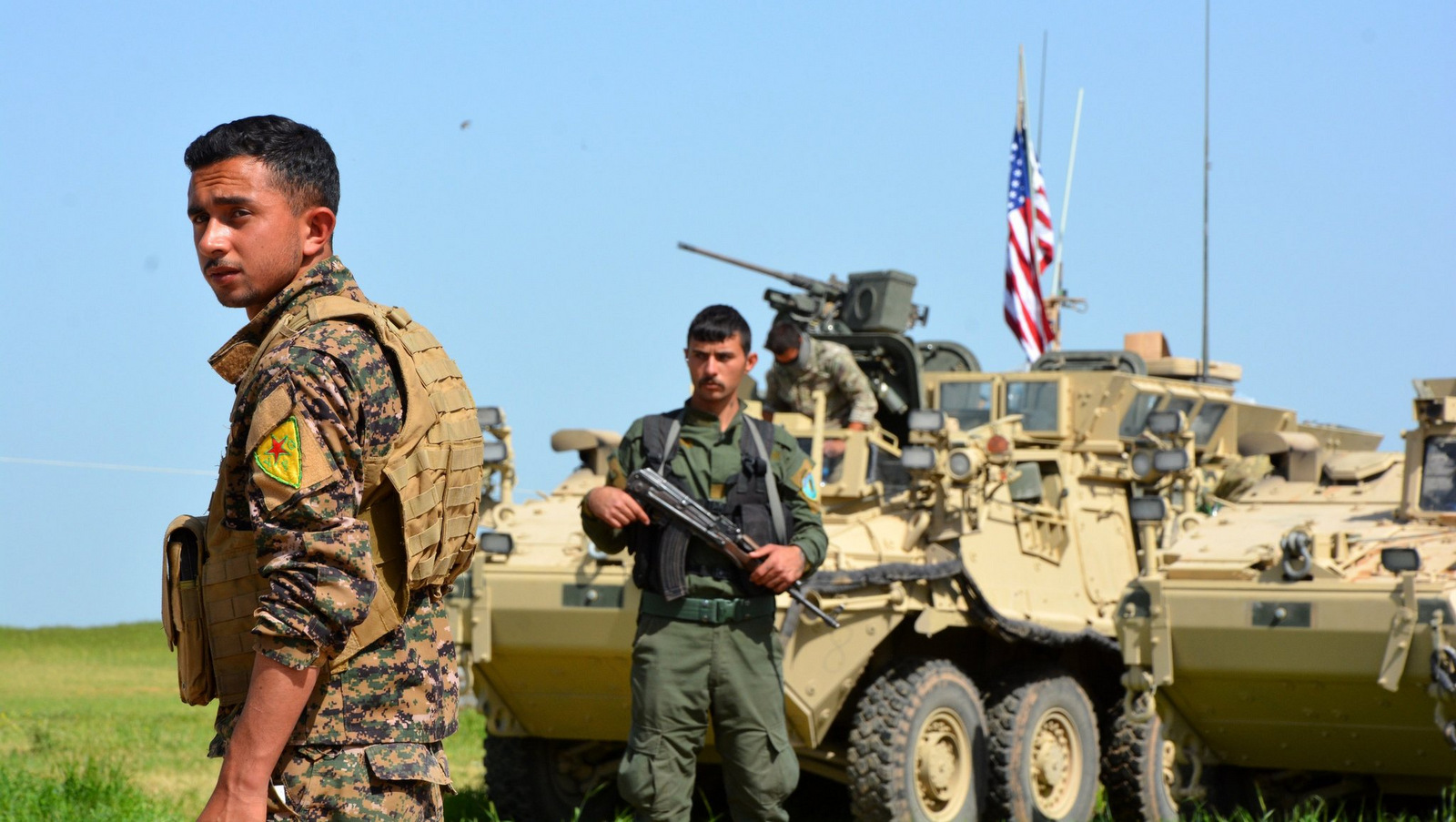
Kurdish fighters from the People’s Protection Units, (Y.P.G), stand guard next to American armored vehicles at the Syria-Turkey border, Apri, 2017. (Youssef Rabie Youssef/EPA)
In 1966, Iraqi defense minister Abd al-Aziz al-Uqayli blamed the Kurds of Iraq for seeking to establish “a second Israel” in the Middle East. He also claimed that “the West and the East are supporting the rebels to create [khalq] a new Israeli state in the north of the homeland as they had done in 1948 when they created Israel. Interestingly enough, history is repeating itself with their present-day relationship – the existence of which is only acknowledged in passing by either side for fear of retribution.
For much of the conflict in Syria, several Kurdish militias have become some of the U.S.-led coalition’s closest allies within the country, receiving massive amounts of arms and heavy weapon shipments, as well as training from coalition members. Kurdish militias also dominate the Syrian Democratic Forces (SDF), the U.S.-backed group best known for leading the coalition-supported offensive targeting the Daesh (ISIS) stronghold of Raqqa.The weapons that the United States has provided Kurdish and Arab fighters in the anti-Islamic State coalition include heavy machine guns, mortars, anti-tank weapons, armored cars and engineering equipment.
In May, U.S. President Donald Trump approved arming Kurdish militiamen in Syria with heavy weaponry, including mortars and machine guns. Within one month of Trump’s approval, 348 trucks with military assistance had been passed to the group, Anadolu added. According to the news agency’s data, the Pentagon’s list of weapons to be delivered to the group includes 12,000 Kalashnikov rifles, 6,000 machine guns, 3,000 grenade launchers and around 1,000 anti-tank weapons of Russian or U.S. origin.
The United States’ shipments included 130 trucks, with 60 cars passing on June 5, and 20 vehicles on June 12, per Sputnik News.
On June 17, Sputnik News reported that the United States is still supplying the Democratic Union Party (PYD) in Syria with ammunition to fight Daesh, delivering 50 truckloads in one day alone, according to Turkish media reports. Earlier in the day, the trucks reached the city of al-Hasakah in northwest Syria.
Both historical and modern day ties between Israel and the Kurds have brought benefits to both sides. In the past, Israel has obtained intelligence, as well as support, for a few thousand Jews fleeing Ba’athist Iraq. The Kurds have received security and humanitarian aid, as well as links to the outside world, especially the United States. The first official acknowledgment that Jerusalem had provided aid to the Kurds dates back to Sept. 29, 1980, when Prime Minister Menachem Begin disclosed that Israel had supported the Kurds “during their uprising against the Iraqis in 1965 to 1975” and that the United States was aware of this fact. Begin added that Israel had sent instructors and arms, but not military units.
Ethnic Kurdish Israelis protest outside the Turkish embassy in Tel Aviv, Israel, July 8, 2010.
The Kurds are the largest group of nomadic people in the world that have remained stateless since the beginning of time. This fact has allowed Western powers to use the “stateless” plight of the Kurdish people as a tool to divide, destabilize and conquer Iraq and Syria, where colonial oil and gas interests run deep.
The U.S.-led coalition of war criminals is using elements of Syria’s Kurdish population to achieve its goal of destroying the non-belligerent, democratic country of Syria, led by its popular, democratically-elected President Bashar al-Assad. Washington seeks to create sectarianism and ethnic divides in a country that, prior to the Western-launched war, had neither.
However, Kurdologists reject this characterization because it does not fit into their account of historical events that attributes a state to them at one point in time. Their estimated population is 30 million, according to most demographic sources. They also reject the idea that they are being used as pawns.
Responding to a question about where the autonomous administration would “draw the line” on U.S. support and the support of other superpowers, the co-leader of the Syrian Kurdish Democratic Union Party (PYD), Salih Muslim Muhammad, stated
“Our guarantee is our mindset. It depends on how much we educate and organize our people. If we defend our morals and ideology, then bigger powers cannot use us as pawns.”
Perhaps no other group of people in modern times has been as romanticized in the Western conscience as the Kurds. Consistently portrayed as “freedom fighters” who are eternally struggling for a land denied to them, the Kurds have been frequently utilized throughout history by other countries and empires as an arrow and have never themselves been the bow.
In today’s case, the Kurds are being used by NATO and Israel to fulfill the modern-day colonialist aim of breaking up large states like Iraq into statelets to ensure geopolitical goals. When nations are divided into smaller statelets, they are easier to conquer by foreign entities. This is a signature move that powerful imperialist nations use for the purpose of colonizing smaller and less influential nations. The Kurds have been utilized as pawns in this “divide and conquer” strategy throughout history and continue to allow themselves to be used by colonial powers.
Ultra-leftist opportunists or real revolutionaries?
In an article written in 2007, NPR senior news analyst Daniel Schorr stated that the Kurds of Iraq have a long history of being used as pawns in regional power struggles. Now, they are finding themselves in the middle of a contest between the United States and Iran for dominance in the Middle East.
In 1973, President Richard Nixon and Secretary of State Henry Kissinger had the CIA instigate a Kurdish uprising in northern Iraq against Saddam Hussein. The United States walked away from the rebellion when Saddam and the Shah of Iran settled their differences, leaving the Kurds to face their own fate. Interestingly, the Kurds seem to have developed amnesia by once again choosing to cooperate with Washington, which has repeatedly used them solely for its own benefit.
In the Gulf War over the Iraqi seizure of Kuwait in 1990, President George H.W. Bush appealed to the Kurds, as well as the Shiites in the south, to rise up in rebellion against Saddam.
A Kurd kisses a picture of United States President George W. Bush during celebrations in the streets of Sulaymaniyah, northern Iraq Wednesday April 9, 2003. (AP/Kevin Frayer)
Victorious in that war, the American military permitted Saddam to retain his helicopter gunships, which he used to retaliate against the Kurds, along with Shiites, by the hundreds. American public opinion eventually forced the administration to establish northern and southern no-fly zones to protect the two populations.
Kurdish loyalty to America has cost them quite a bit, and so it is with a certain narcissism that the Bush administration presumed to tell the allegedly autonomous Kurds what kind of relations they could entertain with other countries in the region, including American rival Iran. But the Kurds appear to be finding themselves in a contest between the U.S. and Iran for dominance in the Middle East yet again.
Andrew Exum, a former top Pentagon Middle East policy official who served as an Army Ranger, stated
”… this decision — to arm a group closely associated with a foreign terrorist organization, and one that has waged a decades-long insurgency against the Turkish state — will likely reverberate through U.S. relations with Turkey for decades to come.”
The Turkish government has long insisted that the Kurdish militia is closely linked to the Kurdistan Workers’ Party, a separatist group known as the PKK. That group is listed by Turkey, the United States and Europe as a terrorist organization.
A rough estimate found in the CIA Factbook sets the Kurdish population at 14.5 million in Turkey, 6 million in Iran, about 5 to 6 million in Iraq and less than 2 million in Syria, which adds up to close to 28 million Kurds in what they refer to as “Kurdistan” and adjacent regions.
However, other sources state that there are only about 1.2 million Kurds left in Syria due to the carefully calculated and planned imposed war by NATO and its Gulf Allies. Roughly the same number migrated to Germany during the past six years.
It’s important to differentiate between Kurdish people who have assimilated in the countries they now reside in and reject the idea of establishing an illegal Kurdistan and those who are power hungry and are allowing themselves to team up with the West and Israel to assist in the destabilization of the region. Some Kurdish people in Syria, especially those that reside in areas that are not controlled by the Kurds, such as Damascus, are loyal to the Syrian government and have stated that they voted for Assad in 2014.
This free and democratic election saw Assad win 88.7 percent of the popular vote over the other two nominees. In the beginning of the war in Syria, there were Kurds fighting in the Syrian Arab Army, who received arms and salaries just like their Syrian counterparts. There are a small number that are still in the Syrian Arab Army in the southern Syria.
But in northeastern Syria, many Kurds have defected to the U.S.-led SDF where arms, salaries, and training are provided by the U.S. Syrians consider the Kurds who have remained loyal to Syria as their fellow Syrian brothers and sisters and the descriptions of Kurdish treachery in this article do not apply to them.
The loosely-knit coalition of Syrian rebel groups known as the Syrian Democratic Forces (SDF), are armed, trained and backed by the U.S. The group is currently engaged in the early stages of battle in the ISIS stronghold of Raqqa, Syria.
Independence and disunity
An important thing to remember is that the ethnic marker “Kurd” refers to speakers of several different related, but distinct, languages. The two most important are Sorani in Iraq and Iran and Kurmanji in Syria, Turkey and smaller contiguous regions in Iraq and Iran. Sorani tends to use Arabic script, while Kurmanji uses Latin script, which shows how different they can be from one another.
Iraqi Kurdistan Regional Government (KRG) is predominantly made up of Sorani speakers, while the Kurdistan Workers’ Party (PKK), PYD and other nationalist groups in Syria and Turkey speak Kurmanji. This division naturally maps these divergent political expressions. It is not as simple as superimposing the KRG’s borders over the PYD and PKK-controlled territory.
On the other hand, Turkey does not contest Sorani speakers’ aspirations to the same extent as it does Kurmanji speakers. Encouraging the autonomy of the Iraqi Kurds should not entail the same problems for the Turco-American alliance as encouraging Syro-Turkish Kurdish nationalism would.
The quest for independence is intrinsic to Kurdish identity. However, not all Kurds envision a unified Kurdistan that would span the Kurdish regions of four different sovereign countries. Most Kurdish movements and political parties are focused on the concerns and autonomy of Kurds within their respective countries. Within each country, there are Kurds who have assimilated and whose aspirations may be limited to greater cultural freedoms and political recognition.
Kurd
Kurds throughout the Middle East have vigorously pursued their goals through a multitude of groups. While some Kurds established legitimate political parties and organizations in efforts to promote Kurdish rights and freedom, others have waged armed struggles. Some, like the Turkish PKK, have employed guerrilla tactics and terror attacks that have targeted civilians, including their fellow Kurds.
The wide array of Kurdish political parties and groups reflects the internal divisions among Kurds, which often follow tribal, linguistic and national fault lines, in addition to political disagreements and rivalries. Tensions between the two dominant Iraqi Kurdish political parties, the Kurdistan Democratic Party (KDP) and Patriotic Union of Kurdistan (PUK) escalated to a civil war that killed more than 2,000 Kurds in the mid-1990s.
Political disunity stretches across borders as well, with Kurdish parties and organizations forming offshoots or forging alliances in neighboring countries. Today, disagreements over prospects for Kurdish autonomy in Syria or Iraqi Kurds’ relations with the Turkish government have fostered tensions that have pitted the Iraqi KDP and its Syrian sister organization, the KDP-S, against the PKK and its Syrian offshoot, the PYD. Still, adversarial Kurdish groups have worked together when it has been expedient. The threat posed by Daesh has led the KDP-affiliated Peshmerga to fight alongside Syrian PYD forces.
Kurdish groups have, at times, bargained with not only their own governments but also neighboring ones – in some cases at the expense of their relations with their Kurdish brethren. The complex relationships among Kurdish groups and between the Kurds and the region’s governments have fluctuated, and alliances have formed and faltered as political conditions have changed. The Kurds’ disunity is cited by experts as one of the primary causes for their inability to form a state of their own.
The Kurds’ illegal, unjustified claims for autonomy
The West claims that the Kurds are one of the most moral and dignified forces in the Middle East fighting against Daesh. But if their focus is on defeating Daesh, as they claim, why are they committing genocide against Syrians in the process? Taking this into consideration, it is hard to justify the West’s persistent claim that armed Kurdish terrorist groups are trying to help Syria. The reality on the ground contradicts these empty compliments, which the West uses to save face while supporting these terrorist organizations. This false narrative was in fact used to arm the Kurds in Syria in order to create instability and division.
U.S.-backed, Kurdish-led Syria Democratic Forces raise their flag in the center of the town of Manbij after driving ISIS out of the area, in Aleppo province, Syria. (ANHA via AP)
It is strange that the Kurds would be so antagonistic towards Syrians, as the country has largely been welcoming for them. For example, reforms were made in Syria in 2012 to benefit the Kurds.
“President Assad issued a decree granting Arab Syrian citizenship to people registered as foreigners in the (governorate of Hassake),” said the SANA news agency.
The measure, which benefited about 300,000 Kurds, came a week after Assad tasked a committee with “resolving the problem of the 1962 census in the governorate of Hassake.”
In January 2015, SANA news reported that then-Syrian Prime Minister Dr. Wael al-Halqi said:
“the Kurds are a deeply-ingrained component of the Syrian society and Ayn al-Arab is part of Syria that is dear to the hearts of all Syrians.”
Al-Halqi’s affirmation came during his meeting with a Kurdish delegation which comprised Kurdish figures. He also urged all to discard violence and spread amity, reiterating that a solution to the Syrian crisis could be achieved “through national dialogue and consolidating national reconciliations,” indicating that dialogue will definitely be “under the homeland’s umbrella away from foreign dictates.”
In 2014, The Civil Democratic Gathering of Syrian Kurds said that the steadfastness of the people of Ayn al-Arab in the face of terrorists was a form of expression of the Syrian Kurds’ commitment to their affiliation to their homeland of Syria. The gathering’s Higher Council of Secretaries said that the steadfastness of Ayn al-Arab was cause for admiration and that attempts to transgress against the territorial integrity of Syria were parts of a plot to cause chaos and division and undermine the resistance axis.
These are just a few examples of the Syrian government’s attempts to unify all of those who live within the country’s borders. But even with these actions of good faith, the SDF has chosen to side with Syria’s enemies rather than work with the Syrian army.
A recent agreement – initiated and brokered by the U.S. between a Free Syrian Army (FSA) faction and the Kurdish-led SDF lays out conditions whereby U.S.-initiated negotiations would allow the FSA faction al-Muatasim Brigade to peacefully take over 11 villages in northern Syria that are controlled by the SDF. The general outlines of this unprecedented agreement were announced on May 10, stating that the U.S.-led coalition had delegated to al-Muatasim the task of being in charge of and administering the designated villages.
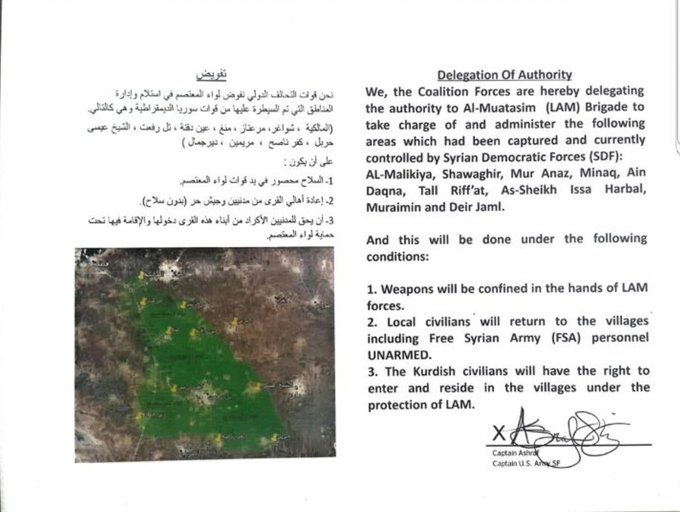
View image on Twitter
Al-Muatasim is known to be a strong ally of the U.S., which is why it was chosen to be in charge of the designated villages. This further proves the point that the U.S., SDF and FSA are still working together. Their cooperation is part of an effort to counter the progress being made by the Syrian Arab Army and its allies.
In Part II of MPN’s Sarah Abed analysis of the Kurds’ role in helping the U.S. and Israel destabilize the Middle East, she will explore more of their ties to Israel and other countries, as well as their links to Daesh.
Sarah Abed is an independent journalist and political commentator. Focused on exposing the lies and propaganda in mainstream media news, as it relates to domestic and foreign policy with an emphasis on the Middle East. Contributed to various radio shows, news publications and spoken at forums. For media inquiries please email sarahabed84@gmail.com.
All images in this article are from the author.
River to Sea Uprooted Palestinian   
The views expressed in this article are the sole responsibility of the author and do not necessarily reflect those of the Blog!

The biggest plot hole in #Russiagate is that nobody can even say what it is

Donald Trump and son Donald Trump Jr.
After months and months of shrieking about Russian hackers, Kremlin bots, RTpropaganda and urinating prostitutes, the dauntless crusaders for the Russiagate conspiracy theory are now crowing that they have at long last been vindicated by a new revelation that has nothing whatsoever to do with any of these things. Today’s Shocking Trump-Russia Revelation is that Donald Trump Jr. published his emails with a British tabloid reporter last year who claimed that the Russian government supported Trump over Clinton, and wanted to provide documents to the Trump campaign proving Clinton’s connections with the Kremlin.
Leaving aside the fact that no such documents ever surfaced, the fact that none of these manic Russiagaters seem to be remotely curious about their anointed queen’s Kremlin connections, the fact that it should surprise no one that Russia prefered Trump over the woman who wanted to set up a no-fly zone in an area where Russian military planes are conducting operations, the fact that the lawyer Trump Jr. met with is nowhere near the Kremlin power broker these people are pretending she is, and the fact that what Trump Jr. was doing is virtually identicalto what the Clinton camp was doing at the exact same time — leaving all of that aside — the single biggest plot hole in this Trump-Russia collusion narrative is that nobody has ever painted a clear picture of what specifically said collusion is meant to have looked like. The fact that Trump Jr.’s emails don’t fit with any part of the preexisting Russiagate narrative, don’t confirm anything the Russiagaters have been saying about what happened, and never manifested in any actual released documents of Clinton-Russia connections doesn’t seem to bother these people at all.
For pointing out the consistent failure of these tireless Russia conspiracy theorists to provide a clear, non-debunked, fact-based argument for their collusion narrative with enough evidence to satisfy our mandatory skepticism in a post-“Saddam has WMDs” world, I get called a Kremlin agent, a Russian bot, and, most recently, a “denier”, the latter used with the same tone you’d reserve for a Holocaust denier.
But what exactly is it that I’m denying? Nobody has ever been able to tell me what this collusion thing even looks like. The fastest way to get a Russiagater to block you on social media is to demand a specific, concrete narrative describing what this collusion is supposed to have looked like so that you can tell them what kinds of proof you would need in order to believe that it happened.
Try it. Press them. What exactly is the specific accusation here? How specificallydoes Trump Jr.’s email correspondence prove what Russiagaters have been saying for the last nine months, for example? Or how did the hacking collusion happen? Why would Russian hackers need to “collude” with Trump at all in order to help kill the campaign of a candidate whose election they already wanted to avoid? Why wouldn’t they just do it on their own? You won’t get a straight answer. At best you’ll get some vague, amorphous gibberish about smoke and fire, but if you press them about what this vague Trumpy-Putiny-smoke-fire-something-nothing thing is supposed to have looked like, you’ll get, at best, an accusation of being a Kremlin agent.
For this reason, the Russiagate argument is completely devastated before it ever gets off the ground. In order for there to be a debate, both sides need to clearly define their position. I can clearly point to the lack of solid evidence needed in a post-Iraq invasion world, while Russiagaters are unable to even articulate what specifically their alleged collusion is supposed to have looked like. It’s impossible to argue against something if the other party refuses to even define what you’re meant to be arguing against. This bad thinking is the only thing that keeps this debate going in political discourse.
There is no clearly-defined fact-based picture of what specifically Trump-Russia collusion is meant to look like, and there never will be. Unlike Watergate, which began as an investigation into a concrete burglary and then followed a logical series of investigations into interconnected factors up to President Nixon, Russiagate is an investigation of a person. It began with people disliking Trump, and then trying to find a crime to get him out of the way. That’s all this is, and that’s all it ever will be. We will never, ever see any hard evidence proving that Trump colluded with the Russian government; we will never even see a consensus fact-based argument about how specifically it is supposed to have happened. We will only ever get this vague, gaseous, Trumpy-Putiny-smoke-fire-something-nothing thing, because as long as the Russiagaters keep refusing to make a solid argument, it can never be fully obliterated for the fallacious nonsense that it is.

River to Sea Uprooted Palestinian   
The views expressed in this article are the sole responsibility of the author and do not necessarily reflect those of the Blog!

Kremlin derides new U.S. media buzz of ‘Russian meddling’ as bordering on TV soap opera

MOSCOW – The Kremlin has nothing to do with the correspondence of the U.S. president’s son, Donald Trump Jr., his alleged meeting with Russian attorney Natalya Veselnitskaya and believes that this story is another spin in the ongoing soap opera, Russian Presidential Spokesman Dmitry Peskov said on Wednesday.
“This story has nothing much to feed off of,” Peskov said after being asked whether this story could stoke U.S. suspicions regarding Russia’s alleged interference in the most recent U.S. presidential election.
“This is just another spin to the plot and it appeared immediately after the bilateral meeting [between the Russian and U.S. presidents],” he said. “On the whole, it definitely looks like a long-running soap opera, which can compete with the most successful TV-series currently aired in the United States, however, there is no sense drawing us into such soap operas as we are not taking part or playing any roles in it.”
The New York Times daily published a story last week claiming that in June 2016, then presidential candidate Donald Trump’s eldest son Donald Trump Jr., son-in-law Jared Kushner and campaign chairman Paul Manafort held a meeting with a Russian lawyer, who allegedly had connections to Russian authorities. According to the New York Times, some people linked to Russian ruling circles, as well as to a number of state companies, were among Natalya Veselnitskaya’s clients.
Peskov reiterated that the Kremlin “has absolutely nothing to do with this story, has never been in contact with this lawyer (Veselnitskaya) and, therefore, has nothing to say about it.”
The presidential spokesman dismissed as absurd allegations that Veselnitskaya reportedly acted on behalf of the Russian government during the meeting with Trump Jr. “How could a lawyer be possibly representing the Russian government at the official level?” Peskov said adding that an only exception is when a lawyer acts on behalf of the government in a court trial.
“But it was not about it [a court trial] in this given case, therefore such a statement on the issue is improper and absurd,” he said.
U.S. President Trump and his administration repeatedly denied allegations that Russian authorities meddled in last year’s US presidential election helping him to win the race. Moscow has also rebuffed such allegations on numerous occasions.
Related:‘Wild & overblown’: Lavrov blasts media hype over Trump Jr. meeting with Russian lawyerRT.com, July 12, 2017

River to Sea Uprooted Palestinian   
The views expressed in this article are the sole responsibility of the author and do not necessarily reflect those of the Blog!

Filmmaker With Links to Al-Qaeda Made CNN Syria Documentary, But Network Pretends He Doesn’t Exist

CNN has curiously diminished the role of a major contributor to its Peabody Award-winning documentary “Undercover in Syria,” ostensibly because that contributor is linked to the country’s al-Qaeda affiliate.

Radio Sputnik’s Loud and Clear spoke with Alternet’s Ben Norton about the documentary, where CNN sources its handlers, and how this speaks to the bigger issue of deep hypocrisy within the mainstream media concerning US foreign policy.
Norton co-wrote a recent article with Max Blumenthal entitled “CNN Hired Top al-Qaeda Propagandist for Award-Winning Syria Documentary and Wants to Cover Its Tracks,” which told the story of American “independent journalist” Bilal Abdul Kareem, who Norton says was able to gain access that proved deadly for other journalists because of his cozy relationship with terrorists.
“In summary, what’s going on is there’s an American who is very closely tied to al-Qaeda and other extremist groups, who has been accused by numerous sources of actually being a member Syria’s Al-Qaeda affiliate, Jabhat al-Nusra, and has lived in Syria for several years,” Norton explained.
Kareem “has created a small media cult following but has significant impact when it comes to the issue of Syria because he is the only English-speaking Western journalist in al-Qaeda-held territory in Syria.”
Norton said that other journalists who have attempted to enter territory held by al-Qaeda have often ended up kidnapped or killed, and claimed to personally know a journalist who was kidnapped by the extremists and who told him that she heard about Kareem’s involvement with al-Qaeda being discussed casually while she was being held in Idlib, where Kareem was based.

“The crux of it is, this is someone who is closely linked to, if not an outright member of, al-Qaeda. He has denied it of course, but there are a lot of ties and circumstantial evidence” to suggest this connection, Norton said. He noted that a colleague of Kareem’s who helped Kareem with his On The Ground News outlet was stripped of his British citizenship for alleged connections to al-Qaeda.
Norton said that it’s “no surprise” that corporate media outlets like CNN would work with Kareem, as they “fawn” over Syrian opposition groups and say “nothing positive about the Syrian government and its allies.”
“There are certainly problems with the Syrian government,” Norton allowed, “but this is one-sided propaganda. This is not just that rebel perspective that CNN is propagating, it is the perspective of extremist groups in rebel-held territory.”
In a video posted to Twitter in June, Kareem complained that CNN had not fully acknowledged his contributions to the documentary, saying that the network “barely mentioned my name! I’m telling you, somehow CNN must have forgotten that I was the one that filmed it, I guess they forgot that.”

“CNN has essentially distanced itself from him,” Norton said. “It hasn’t completely ignored him, but he’s always mentioned as a mere footnote. He is almost never mentioned in any of the official statements or speeches about the documentary, even though as he said himself, he played a crucial role in creating it. He was the videographer, he was actually on the ground.”
Though it is CNN that has this time reaped the rewards of Kareem’s connections, Norton said that corporate media outlets of all political leanings behave similarly when addressing the US’ movements in Syria.
“They’ve all been just as irresponsible when it comes to this issue. When it comes to US foreign policy and other countries and non-state actors that are enemies of the US government, there is a media uniformity with which they are all presented, and Syria has been no exception.”

River to Sea Uprooted Palestinian   
The views expressed in this article are the sole responsibility of the author and do not necessarily reflect those of the Blog!

SYRIAN WAR REPORT – JULY 13, 2017: GOVT FORCES PUT PRESSURE ON US-BACKED MILITANTS IN SOUTHERN DESERT

The Syrian Army and its allies have been attempting to capture the Abu Khashbah area in the eastern Damascus desert.
On Wednesday, government troops advanced in the area south of Ar-Ruhba in order to close and encircle the area controlled by US-backed militants south of the al-Seen military airbase.
If government troops liberate the Abu Khashbah area and clear the militant pocket west of it, they will significantly shorten the frontline in southeastern Syria and make another important step in the isolation of US-held garrisons at the border with Iraq.
There is no evidence that ISIS Top Leader Abu Bakr al-Baghdadi is still alive, according to US Army Lt.  Gen.  Stephen Townsend who currently commands the Combined Joint Task Force – Operation Inherent Resolve.  However, Townsend said that he cannot confirm that the top ISIS member is dead.  Since June, reports have been circulating that al-Baghadi was killed in a Russian air strike on an ISIS command post in the province of Raqqah in May.  Earlier this week, the Al Sumaria TV channel reported, citing its own source in Iraq, that ISIS had released an internal statement confirming the death of al-Baghdadi.
The US-backed Syrian Democratic Forces (SDF) have repelled ISIS counter-attacks in the eastern and western parts of the city of Raqqah.
The SDF found 3 tunnels and 4 VBIEDs abandoned by ISIS members and destroyed at least 3 vehicles.
Intense fighting continued in Old Raqqah as the SDF attempted to develop momentum in the area.  However, US-backed fighters have not been able to break ISIS defense lines.
The SDF faces especially fierce resistance by ISIS in the Diriyah area.
US-led coalition airpower destroyed a part of the Abbasi Historic Wall in the Old Raqqa area, according to local sources.  The site was a part of the ISIS defense.
The US-backed Jaysh Maghawir Al-Thawra militant group operating in southeastern Syria has refused to work alongside another US-backed faction – the SDF, according to pro-militant sources.  Jaysh Maghawir Al-Thawra has allegedly denied that it intends to redeploy to the Shadadi area in the northern Syrian province of Hasaka and to participate alongside the SDF in the expected US-backed advance on Deir Ezzor.
Earlier this month, reports appeared that the US is going to build a military garrison at Shadadi with the aim to use it as a foothold for the anti-ISIS operation in the province of Deir Ezzor.

Related Videos

Related Articles

River to Sea Uprooted Palestinian   
The views expressed in this article are the sole responsibility of the author and do not necessarily reflect those of the Blog!

أوقفوا تصفية قضية فلسطين بأيدي أبنائها


د. عصام نعمان

يوليو 10, 2017

ماذا بقي من فلسطين وقضيتها بعد نحو 70 عاماً من زرع الكيان الصهيوني في قلب عالم العرب؟

لم يبقَ منها سوى شعب منكوب شُرّد تحت كلّ كوكب، يعاني شظف العيش وانعدام الأمن والأمان وضمور مركزية القضية وانسداد أفق الحرية والخلاص الوطني من جهة، ومن جهة أخرى احتدام الصراع بين سلطتين تدّعيان تمثيل الشعب والقضية، واحدة في الضفة الغربية أضحت بعد اتفاق أوسلو للعام 1993 ذراع «إسرائيل» الأمنية في ما تبقّى من أرضٍ وشعب، وأخرى في غزة تكافح لإبقاء مليوني فلسطيني على قيد الحياة ونحو 370 كيلومتراً مربعاً من ترابها بمأمن من قضمٍ صهيوني زاحف على مستوى فلسطين برمّتها من النهر إلى البحر.

في إطار هذا المشهد الفلسطيني البائس، لا يفتأ أبناء القضية، ولا سيما مَن أضحى منهم ذا وظيفة وإمرة في كِلتا السلطتين، عن متابعة الصراع على أنقاض سلطة شكلية محبوسة في سجن الاحتلال الصهيوني بلغت أدنى درجات التناحر والتنابذ وقطع الأرزاق الذي هو من قطع الأعناق. فمن خفض رواتب الموظفين العاملين في قطاع غزة، الى إحالة آلاف منهم على تقاعد مبكر، الى فرض الضرائب على الوقود المخصّص لتوليد الكهرباء، الى تقليص المبالغ التي تُدفع شهرياً لتزويد القطاع بـِ 120 ميغاواط من التيار الكهربائي المستمَدّ من «إسرائيل»، الى خفض التحويلات الطبية الخارجية.

كلّ هذه العقوبات من أجل الضغط على حركة «حماس» في قطاع غزة التي تتمسّك بالسلطة وترفض تسليمها الى حكومة السلطة الأخرى في رام الله. وفيما تتهم سلطة محمود عباس سلطة «حماس» برعاية الانقسام الفلسطيني واتخاذ خطوات تقود الى الانفصال، تردّ «حماس» بأن إجراءات السلطة في رام الله غير أخلاقية وغير إنسانية ولا علاقة لها بإنهاء الانقسام.

«إسرائيل» تراقب المشهد المأساوي الفلسطيني بارتياح وغبطة. لكنها تراقب أيضاً بارتياب، لدواعٍ أمنية، ما يمكن ان يرافق تداعياته من تطورات سياسية تتناول العلاقات بين مصر و«حماس» من جهة و«حماس» وإيران من جهة أخرى. تتساءل:

ما سرّ هذا التقارب المستجدّ بين مصر و«حماس»؟ ماذا بعد فتح معبر رفح بين القطاع ومصر وتسليم أمر مراقبته إلى جماعة خصم محمود عباس اللدود محمد دحلان؟ وما ثمن موافقة «حماس» على كلّ هذه التحركات؟

«اسرائيل» لا يهمّها تراجع «حماس» عن مواقفها السابقة برفض إقامة دولة فلسطينية على خطوط وقف النار للعام 1967 واستعدادها تالياً للقبول بها حاليّاً؟ فحكومة نتنياهو تخلّت عن مشروع الدولتين وهي جادّة في تعميم الاستيطان على كامل الضفة الغربية كي لا يبقى لسلطة محمود عباس إلاّ بضع مناطق من الكثافة الفلسطينية.

ما يهمّ «إسرائيل» هو ألاّ يؤدّي التعاون السياسي والاقتصادي بين مصر و«حماس» الى فكّ ضائقة هذه الأخيرة ما يفضي تالياً الى تصليب إرادتها السياسية وتشجيعها على معاودة عملياتها القتالية ضدّ المستعمرات الصهيونية المحيطة بالقطاع. ثم مَن يدري، فلعلّ القاهرة التي تتحسّب لتداعيات فتح قناة بن غوريون بين البحر الأحمر والبحر المتوسط عبر صحراء النقب، قد تتفاهم مع «حماس» على مضاعفة عملياتها ضدّ «إسرائيل» لحملها على صرف النظر عن مشروعها المنافس لقناة السويس او لتأخير إنجازه في الأقلّ.

ثمة أمر آخر يُقلق «إسرائيل»:

هل يكون ثمن تخلّي «حماس» عن علاقتها التاريخية مع الاخوان المسلمين، وبالتالي عن قطر، قبول مصر بالتغاضي عن تنمية العلاقات بين «حماس» وإيران؟

أياً ما تكون المضاعفات الناجمة عن تحسّن العلاقة بين «حماس» ومصر، وتفعيل العلاقة بين «حماس» وإيران، فإنّ ثمة تحدّياً ماثلاً يستوجب معالجة سريعة وفاعلة. إنها مخاطر أن يُسهم الفلسطينيون، مسؤولين ومواطنين، بوعي أو من دون وعي، في تصفية القضية من خلال هذا الصراع، بل التناحر، المرير والمأساوي على السلطة بين مجموعة محمود عباس وحركة «حماس». إنّ القوى الوطنية الحيّة في الشعب الفلسطيني، المستقلة عن السلطتين المتصارعتين، مدعوةٌ الى التفكير والتدبير: التفكير في مقتضيات مواجهة هذا التحدّي المعضلة، وإقرار منهجية فعالة للمباشرة في المواجهة الوطنية المطلوبة.

أرى، في هذا المجال، أن تتوافق القوى الحيّة ذات المعرفة والخبرة على هيئة نوعية من أهل التفكير والتدبير تتولى بلا إبطاء وضع دراسة وثيقة معمّقة ومتكاملة لقضية فلسطين في واقعها ومرتجاها، واقتراح برنامج عمل مرحلي وآخر استراتيجي وبالتالي تنظيم مؤتمر وطني جامع يضمّ ممثلين عن القوى الحيّة في الوطن والشتات لمناقشة الدراسة الوثيقة والخروج بقرارات ومناهج فاعلة للعمل وواعدة بالأمل.

آن أوان الارتقاء الى مستوى الأخطار والتحديات التي تواجه الامة، وفي مقدّمها قضية فلسطين، واجتراح منهجية نوعية للعمل والكفاح تعيد وضعها في قلب الصراع ومسار التاريخ وتؤسس لمرحلة جديدة فارقة في حاضر الأمة ومستقبلها.


(Visited 31 times, 31 visits today)

River to Sea Uprooted Palestinian   
The views expressed in this article are the sole responsibility of the author and do not necessarily reflect those of the Blog!

Saudi Arabia: What's Really Behind Trump's Hypocrisy?

July 14, 2017 (Ulson Gunnar – NEO) – US President Donald Trump’s support came in no small part from those Americans who believe terrorism, and more specifically, “Islamic” terrorism pose an existential threat to the United States and the wider Western World.

It is curious then that President Trump’s first trip abroad was to Riyadh, Saudi Arabia, the sociocultural source code of the very extremism infecting both the Middle East and North Africa (MENA) as well as the wider, global extremism it inspires and fuels everywhere from Southeast Asia, western China and even in the streets of North America and Europe.
Far from a geopolitical gaff, US associations with Saudi Arabia and their mutual link and contribution to (not fighting against) terrorism is increasingly becoming an embarrassing, “open secret.”
It was the US Defense Intelligence Agency in a 2012 memo leaked to the public that revealed the creation of terrorist organizations like the Islamic State (referred to in the memo as a “Salafist principality”) were encouraged by “the West, Gulf countries, and Turkey.”
Leaked emails from former US Secretary of State and 2016 US presidential candidate Hillary Clinton would include direct references to Saudi Arabia and Qatar in regards to their complicity in arming the Islamic State. More specifically, both nations were accused of, “providing clandestine financial and logistic support” to the Islamic State.
While the US postures to the world as engaged in a global war on terrorism, it is clear that those nations in the Middle East cooperating closest with Washington are in fact those also perpetuating this seemingly endless war. Why?
It turns out that perpetual war is a lucrative affair in both terms of acquiring wealth and power. It is this equation of wealth and power that takes precedence, even at the expense of narrative continuity and political legitimacy.
Dollars, Oil and Arms
Was President Trump’s visit to Riyadh to deliver a stern warning regarding its extensive history of state sponsorship of terror? On the contrary. It was to seal an unprecedented weapons deal with Saudi Arabia amounting to an immediate $110 billion, and $350 billion over the next 10 years, according to the New York Times.
The New York Times also revealed the participants in the massive arms deal to include Lockheed Martin.

It was no surprise then that US policy think tanks like the Washington-based Center for Strategic and International Studies (CSIS) encouraged members to submit op-eds praising President Trump’s trip to prominent US and European media sources including The Hill.
The Hill’s op-ed, “Trump gets it right in Saudi Arabia,” for example, was penned by Anthony Cordesman, a CSIS member. His op-ed would conclude by passionately arguing:
This speech is the right beginning — in remarkably well crafted terms — and it deserves bipartisan and expert respect.
It is no surprise considering the sponsors who keep the lights on at CSIS and Mr. Cordesman in a job. The think tank’s most prominent corporate donors include Boeing, General Dynamics, Northrop Grumman and, most telling of all, Lockheed Martin. It is also sponsored by Saudi Aramco, the central nexus of the US-Saudi petrodollar network propping up what many think tanks call the US-led “international order.”
Governments that donate to CSIS include the United States and Saudi Arabia itself. Together, corporate and government donations account for over 60% (34% and 27% respectively) of CSIS’ overall funding, according to its 2016 annual report.
Of course, a man’s “opinion” of President Trump’s visit to Saudi Arabia, including a multi-billion dollar arms deal favoring Lockheed Martin, will be positive, when the organization he works for is funded directly by both Lockheed Martin and the government of Saudi Arabia.
It is an example of  how the media in the United States actually works and how special interests, not the “truth,” shape narratives and drive agendas in complete contradiction to reality and the best interests of the vast majority on the planet.
Threatening America’s “international order” are competitors that exist independent of or even opposed to Washington and its corporate partners both on Wall Street and in Riyadh.
This is why US President Trump praised Saudi Arabia, a nation that serves as a virtual model for the Islamic State, and condemned Iran whose forces have fought for 6 years against both the Islamic State and Al Qaeda affiliates who have flooded into Syria and Iraq.
Clearly, based on the fact that the US’ closest ally in the Middle East is also one of the worst human rights offenders on the planet and the premier sponsor of global terrorism, ideological and humanitarian concerns are strictly a rhetorical facade.
It was never about ideology, humanitarianism or truly fighting “terrorism.” It is not a matter of “good and evil.” It is as simple dollars and cents, Saudi riyals, oil and arms and maintaining hegemony across a region and upon a planet to prevent this wealth and influence from being usurped either by a competitor of equal footing or a general trend toward multipolar geopolitical decentralization.
The media is awash in politically-oriented rhetoric attempting to divide and distract the public along strictly political lines. The common denominator among all of this propaganda is the fact that all of the narratives, no matter how apparently contradictory, conveniently allow the singular agenda of amassing dollars, oil and arms in pursuit of global hegemony to move forward.
As this very simple reality is understood and acted upon by more people than pay into this prevailing political facade that perpetuates it, multipolar geopolitical decentralization will continue to incrementally replace this current US-dominated “international order.”
Ulson Gunnar, a New York-based geopolitical analyst and writer especially for the online magazine “New Eastern Outlook”.

River to Sea Uprooted Palestinian   
The views expressed in this article are the sole responsibility of the author and do not necessarily reflect those of the Blog!