Saturday, 2 December 2017

70th Anniversary of the Greatest Blunder Ever Committed by the United Nations

Seventy years ago today the United Nations adopted UN Resolution 181, which partitioned Palestine into an Arab state and a Jewish state. It was an act which led to 70 years of bloodshed and turmoil in the Middle East, and was the greatest blunder ever perpetrated by the UN.
Apparently the Trump administration is now intending to perpetuate the blunder. According to Vice President Mike Pence, Trump is now “actively considering” how to make good on his pledge to move the US embassy in Israel to Jerusalem.

River to Sea Uprooted Palestinian   
The views expressed in this article are the sole responsibility of the author and do not necessarily reflect those of the Blog!

U.S. Government Misusing Intelligence to Sell Conflict with Iran

6236849468_86e53e2a40_b
by Paul R. Pillar
Although nobody knows exactly where Donald Trump intends to go with his campaign of seeking confrontation with Iran, his administration already has provided disconcerting parallels with the techniques an earlier U.S. administration used in selling its launching of a war against Iraq. Among these techniques is the cherry-picking of intelligence not to inform policy-making or to enlighten the public but instead to inculcate false perceptions among the public and thereby to muster support for a policy already chosen.
The parallels have become even closer as the Trump administration has tried to get people to believe there is some sort of cooperation and common purpose between Iran and al-Qaeda. The president made this insinuation in his speech on Iran in October. Then his CIA director, Mike Pompeo, ordered a tendentious re-exploitationof already exploited documents captured in the raid at Abbottabad, Pakistan that killed Osama bin Laden. This time the purpose was to find any possible connection between bin Laden’s group and Iran. Pompeo took the highly unusual step of giving an advance look at the selected documents to an advocacy organization: the Foundation for Defense of Democracies (FDD), a leader of efforts to kill the agreement that limits Iran’s nuclear program.
FDD duly did its part in the insinuation by highlighting a single document that it depicted as suggesting some sort of Iranian assistance to al-Qaeda. This was despite the fact that the thrust of the Abbottabad documents as far as Iran is concerned is that Tehran was in conflict, not cooperation, with al-Qaeda. This remains the judgment of experts who follow the terrorist group closely. Even the very document FDD highlighted did not say what those highlighting it contended it said. It held no evidence of any Iranian assistance to al-Qaeda. This entire effort to manipulate public perceptions has been remarkably similar to the efforts by promoters of the Iraq War to use whatever scraps they could find to suggest that there was, in George W. Bush’s words, an “alliance” between the Iraqi regime and al-Qaeda that in fact never existed.
Cherry-Picking the Yemeni War
Now Colum Lynch and Dan De Luce at Foreign Policy report that the White House, in the latest bit of cherry-picking, “is pressing to declassify intelligence allegedly linking Iran to short-range ballistic missile attacks by Yemeni insurgents against Saudi Arabia.” Our antennae ought to be raised very high regarding the motives and reality lying behind anything that comes out of this attempt to manipulate public perceptions.
Imagine that, in a parallel universe that Donald Trump did not inhabit, the White House was sincerely trying to help the public understand whatever was the foreign policy problem at hand. The problem in this case is the Yemeni civil war, which originated with discontent among northern tribes about how their interests were treated by the central government. The education of the public would note that large-scale intervention led by Saudi Arabia—which has a long history of conflict with, and demographic and security concerns about, Yemen—turned the civil war into bigger carnage. An aerial assault by Saudi Arabia and its ally the United Arab Emirates, together with a Saudi-imposed blockade, has further turned Yemen into a humanitarian catastrophe.
Meanwhile, some Iranian assistance reportedly has gone from Iran to the principal northern tribe, known as the Houthis. By any reasonable account, the physical impact of any such aid is minor compared to the Saudi military offensive. The lesson to the public might note that the Houthis have been among the staunchest adversaries of al-Qaeda’s branch in Yemen. It might also note that the Houthis are allied with former president Ali Abdullah Saleh, who during more than three decades in power became known as America’s man in Yemen.
The Saudi air war has devastated Yemen. Is it any surprise that those now in power in the Yemeni capital of Saana (i.e., the Houthi-led coalition) would try to get off a few shots at Saudi Arabia in response? Should we even condemn this effort to strike back given the much bigger strikes in the other direction?
The Trump administration’s efforts to highlight this one facet of a much larger war serve two of its objectives. One is to continue its overall campaign to pin on Iran all blame for any mayhem in the Middle East. The other is to distract as much attention as possible from the indefensible U.S. support (which began during the previous administration) for the Saudi offensive against Yemen. Meanwhile, the cherry-picking conveys to the public a false impression of what the Yemeni war is all about and what has caused it to take its current shape.
Lynch and De Luce report that the effort by the Trump White House to make public cherry-picked intelligence about Houthi-fired missiles is intended to influence not just a domestic audience but also opinion at the United Nations. Here is yet another parallel with the selling of the Iraq War. Specifically, it evokes the presentation to the Security Council in February 2003 by Secretary of State Colin Powell, who—against Powell’s own better judgment and contrary to the judgment of the U.S. intelligence community—laid out some scraps intended to persuade people that the non-existent alliance between Iraq and al-Qaeda really existed.
Consequences
Such misuse of intelligence means foreign policy is being made on the basis of badly mistaken premises. The public sales job makes the misunderstanding all the worse, both because misperceptions are infused into a larger audience and because salesmen who are strongly committed to their cause—as was the case with the chief promoters of the Iraq War—come to believe their own propaganda.
The misuse also represents a subversion of the proper function of the intelligence agencies. Intelligence is supposed to inform policymakers to help them in making decisions they have not yet made. The agencies do not exist to be tools to sell to the public policy that already has been made.
The Trump administration is not the first to engage in such misuse, but the misuse fits a pattern of how Trump has handled other government departments and agencies. That pattern, featuring many fox-running-the-henhouse senior appointments, has been one of subverting rather than executing the mission of agencies.
Photo: Mike Pompeo (Gage Skidmore via Flickr).

River to Sea Uprooted Palestinian   
The views expressed in this article are the sole responsibility of the author and do not necessarily reflect those of the Blog!

Why Does the U.S. Support Saudi Arabia, A Country Which Hosts and Finances Islamic Terrorism?

First published in August 2014, this essay brings to the forefront Washington’s relentless support for Saudi Arabia, a State sponsor of terror, which has been waging since 2015 a war on the people of Yemen, tantamount to genocide.   
America Has Sold Its Soul for Oil
Why Does the U.S. Support a Country which was FOUNDED With Terrorism
A U.S. congressman for 6 years,  who is now a talking head on MSNBC (Joe Scarborough) says that – even if the Saudi government backed the 9/11 attacks – Saudi oil is too important to do anything about it:
This is not an isolated incident. It is a microcosm of U.S.-Saudi relations.
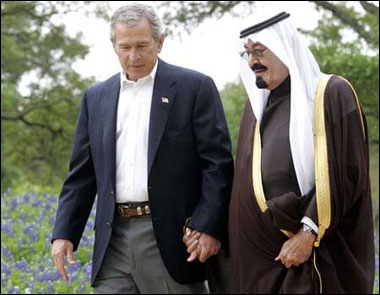
http://my2bucks.files.wordpress.com/2009/01/bush-saudi-hand-holding-1.jpghttps://i1.wp.com/i.huffpost.com/gen/7992/thumbs/s-BUSHANDSAUDIS-large.jpghttps://i1.wp.com/www.usnews.com/dbimages/master/10457/FE_DA_090409publicopinion.jpg

By way of background, former MI6 agent Alastair Crooke notes that Saudi Arabia was founded with terrorism:
One dominant strand to the Saudi identity pertains directly to Muhammad ibn ʿAbd al-Wahhab (the founder of Wahhabism), and the use to which his radical, exclusionist puritanism was put by Ibn Saud. (The latter was then no more than a minor leader — amongst many — of continually sparring and raiding Bedouin tribes in the baking and desperately poor deserts of the Nejd.)
***
Abd al-Wahhab demanded conformity — a conformity that was to be demonstrated in physical and tangible ways. He argued that all Muslims must individually pledge their allegiance to a single Muslim leader (a Caliph, if there were one). Those who would not conform to this view should be killed, their wives and daughters violated, and their possessions confiscated, he wrote. The list of apostates meriting death included the Shiite, Sufis and other Muslim denominations, whom Abd al-Wahhab did not consider to be Muslim at all.
***
Abd al-Wahhab’s advocacy of these ultra radical views inevitably led to his expulsion from his own town — and in 1741, after some wanderings, he found refuge under the protection of Ibn Saud and his tribe. What Ibn Saud perceived in Abd al-Wahhab’s novel teaching was the means to overturn Arab tradition and convention. It was a path to seizing power.
Ibn Saud’s clan, seizing on Abd al-Wahhab’s doctrine, now could do what they always did, which was raiding neighboring villages and robbing them of their possessions. Only now they were doing it not within the ambit of Arab tradition, but rather under the banner of jihad. Ibn Saud and Abd al-Wahhab also reintroduced the idea of martyrdom in the name of jihad, as it granted those martyred immediate entry into paradise.
***
Their strategy — like that of ISIS today — was to bring the peoples whom they conquered into submission. They aimed to instill fear. In 1801, the Allies attacked the Holy City of Karbala in Iraq. They massacred thousands of Shiites, including women and children. Many Shiite shrines were destroyed, including the shrine of Imam Hussein, the murdered grandson of Prophet Muhammad.
A British official, Lieutenant Francis Warden, observing the situation at the time, wrote: “They pillaged the whole of it [Karbala], and plundered the Tomb of Hussein… slaying in the course of the day, with circumstances of peculiar cruelty, above five thousand of the inhabitants …”
Osman Ibn Bishr Najdi, the historian of the first Saudi state, wrote that Ibn Saud committed a massacre in Karbala in 1801. He proudly documented that massacre saying, “we took Karbala and slaughtered and took its people (as slaves), then praise be to Allah, Lord of the Worlds, and we do not apologize for that and say: ‘And to the unbelievers: the same treatment.’”
In 1803, Abdul Aziz then entered the Holy City of Mecca, which surrendered under the impact of terror and panic (the same fate was to befall Medina, too). Abd al-Wahhab’s followers demolished historical monuments and all the tombs and shrines in their midst. By the end, they had destroyed centuries of Islamic architecture near the Grand Mosque.
***
With the advent of the oil bonanza — as the French scholar, Giles Kepel writes, Saudi goals were to “reach out and spread Wahhabism across the Muslim world … to “Wahhabise” Islam, thereby reducing the “multitude of voices within the religion” to a “single creed” — a movement which would transcend national divisions. Billions of dollars were — and continue to be — invested in this manifestation of soft power.
***
It was this heady mix of billion dollar soft power projection — and the Saudi willingness to manage Sunni Islam both to further America’s interests, as it concomitantly embedded Wahhabism educationally, socially and culturally throughout the lands of Islam — that brought into being a western policy dependency on Saudi Arabia, a dependency that has endured since Abd-al Aziz’s meeting with Roosevelt on a U.S. warship (returning the president from the Yalta Conference) until today.
***
The more radical Islamist movements were perceived by Western intelligence services as being more effective in toppling the USSR in Afghanistan — and in combatting out-of-favor Middle Eastern leaders and states.Why should we be surprised then, that from Prince Bandar’s Saudi-Western mandate to manage the insurgency in Syria against President Assad should have emerged a neo-Ikhwan type of violent, fear-inducing vanguard movement: ISIS?
Frontline notes:
Muhammad ibn Abd al-Wahhab, founder of “Wahhabism,” an austere form of Islam, arrives in the central Arabian state of Najd in 1744 preaching a return to “pure” Islam. He seeks protection from the local emir, Muhammad ibn Saud, head of the Al Saud tribal family, and they cut a deal. The Al Saud will endorse al-Wahhab’s austere form of Islam and in return, the Al Saud will get political legitimacy and regular tithes from al-Wahhab’s followers. The religious-political alliance that al-Wahhab and Saud forge endures to this day in Saudi Arabia.
By the 19th century, the Al Saud has spread its influence across the Arabian Peninsula, stretching from the Red Sea to the Persian Gulf and including the Two Holy Cities of Mecca and Medina.
***
By 1945, the U.S. urgently needs oil facilities to help supply forces fighting in the Second World War. Meanwhile, security is at the forefront of King Abd al-Aziz’s concerns. President Franklin Roosevelt invites the king to meet him aboard the U.S.S. Quincy, docked in the Suez Canal. The two leaders cement a secret oil-for-security pact: The king guarantees to give the U.S. secure access to Saudi oil and in exchange the U.S. will provide military assistance and training to Saudi Arabia and build the Dhahran military base.
U.S. presidents have been extremely close to the Saudi monarchs ever since.
The Progressive notes:
The ideology of the Saudi regime is that of ISIS even if the foreign policies differ,” California State University-Stanislaus Professor Asad AbuKhalil tells The Progressive.
***
Wahhabi Islam [the official ideology of the Saudi monarchy] is fully in sync with ISIS.”
But instead of isolating the Saudi regime from the global mainstream, President Obama paid a visit there earlier this year, meeting with King Abdullah. He reportedly did not discuss the regime’s dubious conduct.
“I can’t think of a more pernicious actor in the region,” British-Pakistani author Mohsin Hamid told me in an interview last year. “The House of Saud has exported this very pernicious form of militant Islam under U.S. watch. Then the United States comes in repeatedly to attack symptoms of this problem without ever addressing the basic issue: Where does it all come from? Who’s at the heart of this thing? It would be like saying that if you have skin rash because of cancer, the best option is to cut off your skin. It doesn’t make any sense.”
Yet, the United States continues with this approach.
Even establishment opinion is recognizing the dimensions of the Saudi problem.
“It can’t be exporting extremism and at the same time ask the United States to protect it,” Retired General (and onetime presidential contender) Wesley Clark recently told CNN.
“Al Qaeda, the Islamic State in Iraq and Syria, Boko Haram, the Shabab and others are all violent Sunni Salafi groupings,” Ed Husain of the Council on Foreign Relations recently wrote in the New York Times. “For five decades, Saudi Arabia has been the official sponsor of Sunni Salafism [another term for Wahhabism] across the globe.”
Such entities “have been lavishly supported by the Saudi government, which has appointed emissaries to its embassies in Muslim countries who proselytize for Salafism,” he adds.
***
Then-U.S. Secretary of State Hillary Clinton wrote in a December 2009 leaked diplomatic cable that entities in Saudi Arabia were the “most significant source of funding to Sunni terrorist groups worldwide.”
***
Yet the United States keeps mum because the Saudi monarchy serves U.S. interests. Due to its pivotal role in OPEC, it makes sure that crude oil prices don’t rise above a certain level. It is a key purchaser of American weapons. It invests in U.S. government bonds. And it has acted in the past as proxy for covert U.S. actions, such as funneling arms and funding to the Nicaraguan contras.
***
Until Saudi Arabia stops sponsoring the most reactionary brands of Sunni Islam, this U.S. ally will remain responsible for much of the mayhem in the Muslim world.
The Independent headlines “Iraq crisis: How Saudi Arabia helped Isis take over the north of the country”:
Some time before 9/11, Prince Bandar bin Sultan, once the powerful Saudi ambassador in Washington and head of Saudi intelligence until a few months ago, had a revealing and ominous conversation with the head of the British Secret Intelligence Service, MI6, Sir Richard Dearlove. Prince Bandar told him: “The time is not far off in the Middle East, Richard, when it will be literally ‘God help the Shia’. More than a billion Sunnis have simply had enough of them.”
***
There is no doubt about the accuracy of the quote by Prince Bandar, secretary-general of the Saudi National Security Council from 2005 and head of General Intelligence between 2012 and 2014, the crucial two years when al-Qa’ida-type jihadis took over the Sunni-armed opposition in Iraq and Syria. Speaking at the Royal United Services Institute last week, Dearlove, who headed MI6 from 1999 to 2004, emphasised the significance of Prince Bandar’s words, saying that they constituted “a chilling comment that I remember very well indeed”.
He does not doubt that substantial and sustained funding from private donors in Saudi Arabia and Qatar, to which the authorities may have turned a blind eye, has played a central role in the Isis surge into Sunni areas of Iraq. He said: “Such things simply do not happen spontaneously.” This sounds realistic since the tribal and communal leadership in Sunni majority provinces is much beholden to Saudi and Gulf paymasters, and would be unlikely to cooperate with Isis without their consent.
***
Unfortunately, Christians in areas captured by Isis are finding this is not true, as their churches are desecrated and they are forced to flee. A difference between al-Qa’ida and Isis is that the latter is much better organised; if it does attack Western targets the results are likely to be devastating.
***
Dearlove … sees Saudi strategic thinking as being shaped by two deep-seated beliefs or attitudes. First, they are convinced that there “can be no legitimate or admissible challenge to the Islamic purity of their Wahhabi credentials as guardians of Islam’s holiest shrines”. But, perhaps more significantly given the deepening Sunni-Shia confrontation, the Saudi belief that they possess a monopoly of Islamic truth leads them to be “deeply attracted towards any militancy which can effectively challenge Shia-dom”.
Western governments traditionally play down the connection between Saudi Arabia and its Wahhabist faith, on the one hand, and jihadism, whether of the variety espoused by Osama bin Laden and al-Qa’ida or by Abu Bakr al-Baghdadi’s Isis. There is nothing conspiratorial or secret about these links: 15 out of 19 of the 9/11 hijackers were Saudis, as was Bin Laden and most of the private donors who funded the operation.
***
But there has always been a second theme to Saudi policy towards al-Qa’ida type jihadis, contradicting Prince Bandar’s approach and seeing jihadis as a mortal threat to the Kingdom. Dearlove illustrates this attitude by relating how, soon after 9/11, he visited the Saudi capital Riyadh with Tony Blair.
He remembers the then head of Saudi General Intelligence “literally shouting at me across his office: ’9/11 is a mere pinprick on the West. In the medium term, it is nothing more than a series of personal tragedies. What these terrorists want is to destroy the House of Saud and remake the Middle East.’” In the event, Saudi Arabia adopted both policies, encouraging the jihadis as a useful tool of Saudi anti-Shia influence abroad but suppressing them at home as a threat to the status quo. It is this dual policy that has fallen apart over the last year.
Saudi sympathy for anti-Shia “militancy” is identified in leaked US official documents. The then US Secretary of State Hillary Clinton wrote in December 2009 in a cable released by Wikileaks that “Saudi Arabia remains a critical financial support base for al-Qa’ida, the Taliban, LeT [Lashkar-e-Taiba in Pakistan] and other terrorist groups.”
***
Saudi Arabia and its allies are in practice playing into the hands of Isiswhich is swiftly gaining full control of the Sunni opposition in Syria and Iraq.
***
For all his gargantuan mistakes, Maliki’s failings are not the reason why the Iraqi state is disintegrating. What destabilised Iraq from 2011 on was the revolt of the Sunni in Syria and the takeover of that revolt by jihadis, who were often sponsored by donors in Saudi Arabia, Qatar, Kuwait and United Arab Emirates. Again and again Iraqi politicians warned that by not seeking to close down the civil war in Syria, Western leaders were making it inevitable that the conflict in Iraq would restart. “I guess they just didn’t believe us and were fixated on getting rid of [President Bashar al-] Assad,” said an Iraqi leader in Baghdad last week.
***
Saudi Arabia has created a Frankenstein’s monster over which it is rapidly losing control. The same is true of its allies such as Turkey which has been a vital back-base for Isis and Jabhat al-Nusra by keeping the 510-mile-long Turkish-Syrian border open.
As we’ve extensively documented, the Saudis and the U.S. backed the radical “madrassas” in which Islamic radicalism was spread.
Indeed, the U.S. is backing the most radical Muslim terrorists in the world: the Salafis, who are heavily concentrated in Saudi Arabia, while overthrowing the more moderate Arabs.


River to Sea Uprooted Palestinian   
The views expressed in this article are the sole responsibility of the author and do not necessarily reflect those of the Blog!

israel Will Get ‘More Understanding’ from Trump’s Negotiators Because They’re All Observant Jews, Sharansky Says

First published in August 2014, this essay brings to the forefront Washington’s relentless support for Saudi Arabia, a State sponsor of terror, which has been waging since 2015 a war on the people of Yemen, tantamount to genocide.   
America Has Sold Its Soul for Oil
Why Does the U.S. Support a Country which was FOUNDED With Terrorism
A U.S. congressman for 6 years,  who is now a talking head on MSNBC (Joe Scarborough) says that – even if the Saudi government backed the 9/11 attacks – Saudi oil is too important to do anything about it:
This is not an isolated incident. It is a microcosm of U.S.-Saudi relations.
http://my2bucks.files.wordpress.com/2009/01/bush-saudi-hand-holding-1.jpg
https://i1.wp.com/i.huffpost.com/gen/7992/thumbs/s-BUSHANDSAUDIS-large.jpg
https://i1.wp.com/www.usnews.com/dbimages/master/10457/FE_DA_090409publicopinion.jpg

By way of background, former MI6 agent Alastair Crooke notes that Saudi Arabia was founded with terrorism:
One dominant strand to the Saudi identity pertains directly to Muhammad ibn ʿAbd al-Wahhab (the founder of Wahhabism), and the use to which his radical, exclusionist puritanism was put by Ibn Saud. (The latter was then no more than a minor leader — amongst many — of continually sparring and raiding Bedouin tribes in the baking and desperately poor deserts of the Nejd.)
***
Abd al-Wahhab demanded conformity — a conformity that was to be demonstrated in physical and tangible ways. He argued that all Muslims must individually pledge their allegiance to a single Muslim leader (a Caliph, if there were one). Those who would not conform to this view should be killed, their wives and daughters violated, and their possessions confiscated, he wrote. The list of apostates meriting death included the Shiite, Sufis and other Muslim denominations, whom Abd al-Wahhab did not consider to be Muslim at all.
***
Abd al-Wahhab’s advocacy of these ultra radical views inevitably led to his expulsion from his own town — and in 1741, after some wanderings, he found refuge under the protection of Ibn Saud and his tribe. What Ibn Saud perceived in Abd al-Wahhab’s novel teaching was the means to overturn Arab tradition and convention. It was a path to seizing power.
Ibn Saud’s clan, seizing on Abd al-Wahhab’s doctrine, now could do what they always did, which was raiding neighboring villages and robbing them of their possessions. Only now they were doing it not within the ambit of Arab tradition, but rather under the banner of jihad. Ibn Saud and Abd al-Wahhab also reintroduced the idea of martyrdom in the name of jihad, as it granted those martyred immediate entry into paradise.
***
Their strategy — like that of ISIS today — was to bring the peoples whom they conquered into submission. They aimed to instill fear. In 1801, the Allies attacked the Holy City of Karbala in Iraq. They massacred thousands of Shiites, including women and children. Many Shiite shrines were destroyed, including the shrine of Imam Hussein, the murdered grandson of Prophet Muhammad.
A British official, Lieutenant Francis Warden, observing the situation at the time, wrote: “They pillaged the whole of it [Karbala], and plundered the Tomb of Hussein… slaying in the course of the day, with circumstances of peculiar cruelty, above five thousand of the inhabitants …”
Osman Ibn Bishr Najdi, the historian of the first Saudi state, wrote that Ibn Saud committed a massacre in Karbala in 1801. He proudly documented that massacre saying, “we took Karbala and slaughtered and took its people (as slaves), then praise be to Allah, Lord of the Worlds, and we do not apologize for that and say: ‘And to the unbelievers: the same treatment.’”
In 1803, Abdul Aziz then entered the Holy City of Mecca, which surrendered under the impact of terror and panic (the same fate was to befall Medina, too). Abd al-Wahhab’s followers demolished historical monuments and all the tombs and shrines in their midst. By the end, they had destroyed centuries of Islamic architecture near the Grand Mosque.
***
With the advent of the oil bonanza — as the French scholar, Giles Kepel writes, Saudi goals were to “reach out and spread Wahhabism across the Muslim world … to “Wahhabise” Islam, thereby reducing the “multitude of voices within the religion” to a “single creed” — a movement which would transcend national divisions. Billions of dollars were — and continue to be — invested in this manifestation of soft power.
***
It was this heady mix of billion dollar soft power projection — and the Saudi willingness to manage Sunni Islam both to further America’s interests, as it concomitantly embedded Wahhabism educationally, socially and culturally throughout the lands of Islam — that brought into being a western policy dependency on Saudi Arabia, a dependency that has endured since Abd-al Aziz’s meeting with Roosevelt on a U.S. warship (returning the president from the Yalta Conference) until today.
***
The more radical Islamist movements were perceived by Western intelligence services as being more effective in toppling the USSR in Afghanistan — and in combatting out-of-favor Middle Eastern leaders and states.Why should we be surprised then, that from Prince Bandar’s Saudi-Western mandate to manage the insurgency in Syria against President Assad should have emerged a neo-Ikhwan type of violent, fear-inducing vanguard movement: ISIS?
Frontline notes:
Muhammad ibn Abd al-Wahhab, founder of “Wahhabism,” an austere form of Islam, arrives in the central Arabian state of Najd in 1744 preaching a return to “pure” Islam. He seeks protection from the local emir, Muhammad ibn Saud, head of the Al Saud tribal family, and they cut a deal. The Al Saud will endorse al-Wahhab’s austere form of Islam and in return, the Al Saud will get political legitimacy and regular tithes from al-Wahhab’s followers. The religious-political alliance that al-Wahhab and Saud forge endures to this day in Saudi Arabia.
By the 19th century, the Al Saud has spread its influence across the Arabian Peninsula, stretching from the Red Sea to the Persian Gulf and including the Two Holy Cities of Mecca and Medina.
***
By 1945, the U.S. urgently needs oil facilities to help supply forces fighting in the Second World War. Meanwhile, security is at the forefront of King Abd al-Aziz’s concerns. President Franklin Roosevelt invites the king to meet him aboard the U.S.S. Quincy, docked in the Suez Canal. The two leaders cement a secret oil-for-security pact: The king guarantees to give the U.S. secure access to Saudi oil and in exchange the U.S. will provide military assistance and training to Saudi Arabia and build the Dhahran military base.
U.S. presidents have been extremely close to the Saudi monarchs ever since.
The Progressive notes:
The ideology of the Saudi regime is that of ISIS even if the foreign policies differ,” California State University-Stanislaus Professor Asad AbuKhalil tells The Progressive.
***
Wahhabi Islam [the official ideology of the Saudi monarchy] is fully in sync with ISIS.”
But instead of isolating the Saudi regime from the global mainstream, President Obama paid a visit there earlier this year, meeting with King Abdullah. He reportedly did not discuss the regime’s dubious conduct.
“I can’t think of a more pernicious actor in the region,” British-Pakistani author Mohsin Hamid told me in an interview last year. “The House of Saud has exported this very pernicious form of militant Islam under U.S. watch. Then the United States comes in repeatedly to attack symptoms of this problem without ever addressing the basic issue: Where does it all come from? Who’s at the heart of this thing? It would be like saying that if you have skin rash because of cancer, the best option is to cut off your skin. It doesn’t make any sense.”
Yet, the United States continues with this approach.
Even establishment opinion is recognizing the dimensions of the Saudi problem.
“It can’t be exporting extremism and at the same time ask the United States to protect it,” Retired General (and onetime presidential contender) Wesley Clark recently told CNN.
“Al Qaeda, the Islamic State in Iraq and Syria, Boko Haram, the Shabab and others are all violent Sunni Salafi groupings,” Ed Husain of the Council on Foreign Relations recently wrote in the New York Times. “For five decades, Saudi Arabia has been the official sponsor of Sunni Salafism [another term for Wahhabism] across the globe.”
Such entities “have been lavishly supported by the Saudi government, which has appointed emissaries to its embassies in Muslim countries who proselytize for Salafism,” he adds.
***
Then-U.S. Secretary of State Hillary Clinton wrote in a December 2009 leaked diplomatic cable that entities in Saudi Arabia were the “most significant source of funding to Sunni terrorist groups worldwide.”
***
Yet the United States keeps mum because the Saudi monarchy serves U.S. interests. Due to its pivotal role in OPEC, it makes sure that crude oil prices don’t rise above a certain level. It is a key purchaser of American weapons. It invests in U.S. government bonds. And it has acted in the past as proxy for covert U.S. actions, such as funneling arms and funding to the Nicaraguan contras.
***
Until Saudi Arabia stops sponsoring the most reactionary brands of Sunni Islam, this U.S. ally will remain responsible for much of the mayhem in the Muslim world.
The Independent headlines “Iraq crisis: How Saudi Arabia helped Isis take over the north of the country”:
Some time before 9/11, Prince Bandar bin Sultan, once the powerful Saudi ambassador in Washington and head of Saudi intelligence until a few months ago, had a revealing and ominous conversation with the head of the British Secret Intelligence Service, MI6, Sir Richard Dearlove. Prince Bandar told him: “The time is not far off in the Middle East, Richard, when it will be literally ‘God help the Shia’. More than a billion Sunnis have simply had enough of them.”
***
There is no doubt about the accuracy of the quote by Prince Bandar, secretary-general of the Saudi National Security Council from 2005 and head of General Intelligence between 2012 and 2014, the crucial two years when al-Qa’ida-type jihadis took over the Sunni-armed opposition in Iraq and Syria. Speaking at the Royal United Services Institute last week, Dearlove, who headed MI6 from 1999 to 2004, emphasised the significance of Prince Bandar’s words, saying that they constituted “a chilling comment that I remember very well indeed”.
He does not doubt that substantial and sustained funding from private donors in Saudi Arabia and Qatar, to which the authorities may have turned a blind eye, has played a central role in the Isis surge into Sunni areas of Iraq. He said: “Such things simply do not happen spontaneously.” This sounds realistic since the tribal and communal leadership in Sunni majority provinces is much beholden to Saudi and Gulf paymasters, and would be unlikely to cooperate with Isis without their consent.
***
Unfortunately, Christians in areas captured by Isis are finding this is not true, as their churches are desecrated and they are forced to flee. A difference between al-Qa’ida and Isis is that the latter is much better organised; if it does attack Western targets the results are likely to be devastating.
***
Dearlove … sees Saudi strategic thinking as being shaped by two deep-seated beliefs or attitudes. First, they are convinced that there “can be no legitimate or admissible challenge to the Islamic purity of their Wahhabi credentials as guardians of Islam’s holiest shrines”. But, perhaps more significantly given the deepening Sunni-Shia confrontation, the Saudi belief that they possess a monopoly of Islamic truth leads them to be “deeply attracted towards any militancy which can effectively challenge Shia-dom”.
Western governments traditionally play down the connection between Saudi Arabia and its Wahhabist faith, on the one hand, and jihadism, whether of the variety espoused by Osama bin Laden and al-Qa’ida or by Abu Bakr al-Baghdadi’s Isis. There is nothing conspiratorial or secret about these links: 15 out of 19 of the 9/11 hijackers were Saudis, as was Bin Laden and most of the private donors who funded the operation.
***
But there has always been a second theme to Saudi policy towards al-Qa’ida type jihadis, contradicting Prince Bandar’s approach and seeing jihadis as a mortal threat to the Kingdom. Dearlove illustrates this attitude by relating how, soon after 9/11, he visited the Saudi capital Riyadh with Tony Blair.
He remembers the then head of Saudi General Intelligence “literally shouting at me across his office: ’9/11 is a mere pinprick on the West. In the medium term, it is nothing more than a series of personal tragedies. What these terrorists want is to destroy the House of Saud and remake the Middle East.’” In the event, Saudi Arabia adopted both policies, encouraging the jihadis as a useful tool of Saudi anti-Shia influence abroad but suppressing them at home as a threat to the status quo. It is this dual policy that has fallen apart over the last year.
Saudi sympathy for anti-Shia “militancy” is identified in leaked US official documents. The then US Secretary of State Hillary Clinton wrote in December 2009 in a cable released by Wikileaks that “Saudi Arabia remains a critical financial support base for al-Qa’ida, the Taliban, LeT [Lashkar-e-Taiba in Pakistan] and other terrorist groups.”
***
Saudi Arabia and its allies are in practice playing into the hands of Isiswhich is swiftly gaining full control of the Sunni opposition in Syria and Iraq.
***
For all his gargantuan mistakes, Maliki’s failings are not the reason why the Iraqi state is disintegrating. What destabilised Iraq from 2011 on was the revolt of the Sunni in Syria and the takeover of that revolt by jihadis, who were often sponsored by donors in Saudi Arabia, Qatar, Kuwait and United Arab Emirates. Again and again Iraqi politicians warned that by not seeking to close down the civil war in Syria, Western leaders were making it inevitable that the conflict in Iraq would restart. “I guess they just didn’t believe us and were fixated on getting rid of [President Bashar al-] Assad,” said an Iraqi leader in Baghdad last week.
***
Saudi Arabia has created a Frankenstein’s monster over which it is rapidly losing control. The same is true of its allies such as Turkey which has been a vital back-base for Isis and Jabhat al-Nusra by keeping the 510-mile-long Turkish-Syrian border open.
As we’ve extensively documented, the Saudis and the U.S. backed the radical “madrassas” in which Islamic radicalism was spread.
Indeed, the U.S. is backing the most radical Muslim terrorists in the world: the Salafis, who are heavily concentrated in Saudi Arabia, while overthrowing the more moderate Arabs.


River to Sea Uprooted Palestinian   
The views expressed in this article are the sole responsibility of the author and do not necessarily reflect those of the Blog!

UN votes to nullify israeli ‘jurisdiction’ over Jerusalem

Press TV – December 1, 2017
The United Nations General Assembly has voted to declare as null any Israeli measure to practice jurisdiction over Jerusalem al-Quds, days before US President Donald Trump decides whether he would relocate the US embassy to the occupied city.
In a rare show of unity against the Tel Aviv regime, 151 countries voted on Thursday to adopt a resolution that denounced Israel as the “occupying power” of the Jerusalem al-Quds, a city that is holy to Muslims, Christians, and Jews alike.
“Any actions taken by Israel, the occupying Power, to impose its laws, jurisdiction and administration on the Holy City of Jerusalem are illegal and therefore null and void and have no validity whatsoever,” read the resolution.
The UN members also urged Tel Aviv to show “respect for the historic status quo at the holy places of Jerusalem, including the Haram al-Sharif, in word and practice,” referring to a hill in Jerusalem al-Quds where the al-Aqsa Mosque is located.
Israel lays claim to the entirety of Jerusalem al-Quds as its “capital” while Palestinians want its eastern part as the capital of a future state for themselves.
The city has seen tensions since 2015, when the Israeli military introduced restrictions on the entry of Palestinian worshipers into the al-Aqsa Mosque — Islam’s third holiest site. Over 300 Palestinians have lost their lives at the hands of Israeli soldiers ever since.
Last year, it was reported that Israel has been omitting from the city’s maps significant Muslim and Christian holy sites and entire neighborhoods in the area while highlighting dozens of sites with dubious historical importance.
Only five countries — the US, Canada, the Marshall Islands, Micronesia and Nauru — opposed the Thursday resolution at the UN, which was also voted down by Israel’s UN envoy. Nine countries also abstained.
US embassy relocation
The strong-worded statement by the UN came days before Trump has to make up his mind over moving the US embassy from Tel Aviv to Jerusalem.
Since US Congress ruled in 1995 that the embassy be relocated from Tel Aviv, every president has deferred the tough decision. The act contains a clause that allows the president to renew a six-month waiver on the decision.
US Vice President Mike Pence says his boss, Donald Trump, is considering “when and how” to move the US embassy to Jerusalem al-Quds as a Friday deadline approaches.
Palestinians have warned that the potential relocation would fuel strong reaction in the region and deliver a death blow to any prospect of resolving the Israeli- Palestinian conflict.
River to Sea Uprooted Palestinian   
The views expressed in this article are the sole responsibility of the author and do not necessarily reflect those of the Blog!

UN General Assembly Calls on israeli Occupation to Withdraw from Syrian Golan


Munzer: Syria’s sovereignty over Golan is non-negotiable
New York, SANA-UN General Assembly on Thursday called on the Israeli occupation to withdraw from the occupied Syrian Golan into the line of June 4th, 1967 in line with UN Security council relevant resolutions.
The Assembly adopted a resolution entitled “the Syrian Golan,” submitted to it under the title “the State in the Middle East.”
The Assembly condemned Israel’s non-abidance by UNSC resolution No.497 issued in 1981, affirming that Israel’s decision, released on December 14th, 1981, to impose its laws and administration on Golan is null and void.
Earlier, Acting Chargé d’affaires of Syria’s permanent delegation to the UN Munzer Munzer said  that Israel still ignores international resolutions and refuses to give back the occupied Syrian Golan to Syria.
Munzer added that the Israeli occupation authorities are going on in their repressive policies in the occupied Syrian Golan and are preventing its citizens from building their homes on their lands inherited from their ancestors.
“Syria reiterates that its sovereignty on the occupied Golan is not subject to any negotiation or abandonment and does not fall by prescription,” Munzer stressed.
He added that the UN General Assembly has, since its 25th session held in 1970 till now, discussed the Situation in the Middle East and demanded Israeli entity to end its occupation of the Arab territories, noting that all Israeli procedures to impose its laws, regulations and authority over Jerusalem and the occupied Syrian Golan are illegitimate, illegal and null.
Munzer said that UN General Assembly’s resolutions go in line with UN Security Council resolutions No. 487 (1980) and 497 (1981) on the occupied Syrian Golan declaring the Israeli annexation of the Jerusalem and occupied Syrian Golan as null and void.
He added that today’s meeting coincides with the 100 anniversary of  Balfour Declaration issued by the British government whose devastating results on the Palestinian people and the whole region continue till the day as well as the passing of half a century over  the Israeli occupation of the Arab territories amid wide support and protection by some UN Security Council member states provided to the Israeli occupation authorities giving them the power to further strengthen their presence in the region, refuse to implement hundreds of UN  resolutions and commit crimes and violations of the humanitarian law.
Munzer referred to the Israeli failure to impose the Israeli identity on the people of the occupied Syrian Golan and its inhumane practices against them like arbitrary arrests, racial discrimination and tightening the siege on them.
He stressed the need to remind the international community of Syria’s Mandela, prisoner Sedqi al-Maqt who was re-arrested by the Israeli occupation forces in March 2017 after serving  27 years in the Israeli jails and sentenced him to 14 years in jail, urging the international community to spare no effort to release him along with prisoner Amal Abo Saleh and others inside the Israeli jails.
The Syrian diplomat said that the worst violation committed by the Israeli occupation authorities against the people of Golan is denying their human rights, including the right to meet and communicate with their parents, families and relatives in Syria the motherland over more than 50years and prevent patients who are unable to pay treatment costs from going to Damascus to receive free treatment at its hospitals.
More ironically, the Israeli occupation authorities prevent Golan people from their right to build homes and demolish those existed under the pretext of not having a license, not to mention the cultural and educational violations such as the exploitation of archeological sites and robbing their contents, imposing Israeli curricula to be taught at schools and expelling large number of teachers to be replaced by Israeli teachers.
He expressed astonishment over the international silence towards Israeli practices and measures, which encouraged the Israeli occupation authorities to continue its approach in providing all forms of support to the armed terrorist groups including Daesh and Jabhat al-Nusra, noting that Israeli forces, on November 3rd, 2017, transported hundreds of Jabhat al-Nusra terrorists to attack Hadar town claiming the lives of 17 civilians and injuring many others.
The Israeli support exceeded the aforementioned details to launch airstrikes against different sites in Syria, he added
Munzer said the UN still has a historic responsibility that is to correct things and point the compass in the right direction through taking immediate steps to end the Israeli occupation and force it to withdraw from the Arab territories including the occupied Syrian Golan till the line of June 4th, 1967 and abide by the UNSC resolution 242, 338, 497 and 2334.
This article was originally published by SANA –
RELATED VIDEOS

Related Articles
River to Sea Uprooted Palestinian   
The views expressed in this article are the sole responsibility of the author and do not necessarily reflect those of the Blog!

Who Is Muhammad bin Zayed?

02-12-2017 | 08:00
During a 2007 meeting with the US Under Secretary of State Nicholas Burns, Abu Dhabi’s crown prince and the de facto ruler of the United Arab Emirates gave his two cents on the ‘appeal’ of extremist groups.
MBZ
“I am an Arab, I am a Muslim, and I pray. And in the 1970s and early 1980s I was one of them,” Muhammad bin Zayed [MBZ] said.
Leaked US diplomatic cables published by Wikileaks later exposed the meeting’s disturbing exchanges.
All of the cables referring to MBZ were marked “secret” or “confidential”, and none left any doubt as to who the crown prince regards as his foes.
In the meeting that took place over 10 years ago – long before Hezbollah’s involvement in Syria – MBZ describes the Lebanese resistance group as being more dangerous than Al Qaeda.
He justified the claim by adding that Hezbollah “did a very tough job on “Israel” this summer”, in reference to the 2006 “Israeli” attack on Lebanon.
With all that in mind, it is hardly surprising that the UAE ended up playing a crucial role in bankrolling and aiding terrorist groups that attempted to overthrow the Damascus government – proving that MBZ was in fact “one of them”.
But this crown prince should not be confused for just another Daesh-supporting royal who desperately seeks the approval of Riyadh and Washington.
On the contrary, Muhammad bin Zayed wields enormous power, and his role in the Middle East is often understated.
The Seychelles meeting
Following the inauguration of US President Donald Trump in January of this year, the UAE’s Bin Zayed was among the first foreign leaders to be hosted at the White House.
This fact alone testifies to MBZ’s importance, not just in the Middle East, but on the world stage as well. And if one is to believe the Washington Post, his global reach is significant.
In April of this year, the paper reported that MBZ brokered a meeting between Blackwater founder Erik Prince and a Russian national close to Vladi¬mir Putin.
The encounter, which reportedly took place around January 11 in the Seychelles islands, was designed to establish a back-channel line of communication between the Kremlin and the Trump White House.

No, Muhammad bin Zayed wasn’t hoping to ease tensions between Washington and Moscow. He was exploring whether Russia could be persuaded to curtail its relationship with Iran, including in Syria.
The purported role of Erik Prince, who has close ties to the Trump administration, is also interesting.
Best known as the founder of a security firm that became a symbol of US abuses in Iraq, Prince has been building a private paramilitary empire across the Middle East in recent years.
In 2010, he was contracted by MBZ to put together a secret American-led mercenary army for the UAE.
Since then, foreign mercenaries operating under the umbrella of Prince’s Frontier Services Group [FSG] have popped-up in every country where the UAE is attempting to exert its influence, including Yemen, Libya, Somalia, South Sudan as well as Saudi Arabia.
In late November, a source cited by the UK’s Daily Mail revealed that American private security contractors were brought in to work for Saudi Arabia’s Crown Prince, Muhammad Bin Salman, and were “torturing” princes and billionaire businessmen arrested in MBS’s power grab.
“All the guards in charge are private security,” the source was quoted as saying. “They’ve transferred all the guys from Abu Dhabi. Now they are in charge of everything.”
If Erik Prince’s private little armies are indeed “in charge of everything”, then it is not too difficult to ascertain as to who is really calling the shots in Riyadh.
The mentee/mentor relationship
One of the region’s less talked about relationships is also one of its most important.
Earlier this year, the online portal Politico described the 56-year-old crown prince of Abu Dhabi and the 31-year-old crown prince of Saudi Arabia as the region’s “dynamic duo”, where the older MBZ tutors the younger MBS in the ways of the world.
“They appear to have a mentee/mentor relationship,” a Politico article reads.
As far back as 2015, MBZ’s man in Washington – the UAE’s ambassador to the US Yousef Al Otaiba – began laying the groundwork for Salman’s rise to the top.
Otaiba’s recently hacked emails reveal that he was promoting MBS among Washington’s political elites for years. Salman is now the Saudi king in everything but name.
According to the Intercept, “MBS is a project of the UAE.”
The Intercept cites one of Otaiba’s leaked emails in which the diplomat sums up Abu Dhabi’s relationship with Riyadh as one “based on strategic depth, shared interests, and most importantly the hope that we could influence them. Not the other way around.”
Testifying to MBZ’s “influence” in Saudi Arabia is the sheer fact that all his opponents in Riyadh have been completely sidelined by the rise of his “mentee”.
Some of the more prominent names on that list include Mohammed bin Nayef – the ex-crown prince who was removed as next in line to the throne in June and who MBZ compared to a monkey.
Meanwhile, the ousted Yemeni President Abd-Rabbu Mansour Hadi, who escaped house arrest in his home country, is now a prisoner in Riyadh over his enmity with the UAE.
The UAE-led coalition
The grotesque war in Yemen has dragged on for nearly three years now.
So far, tens of thousands have been killed, and the country is being ravaged by an outbreak of cholera.
This calamity is credited to Saudi Arabia’s Bin Salman, who started the war as defense minister in 2015.
More than two years later and the Saudis clearly lack the recourses to bring the war to a successful conclusion.
Legitimate military targets have been exhausted, and the indiscriminant bombing of civilians is drawing increasingly harsher international condemnation.
From a military standpoint, the so-called blockade is utterly useless as Yemen’s vast coastline and land border with Oman can never be completely sealed-off.
Moreover, there is no plausible scenario that would allow the Saudis to mount a successful ground invasion of northern Yemen where the Ansarullah movement is still capable of very stiff resistance.
Meanwhile, MBZ, who is described as a junior partner in the coalition bombing Yemen, has had far greater successes than his protégé in Riyadh.
The UAE now enjoys a considerable presence in southern Yemen, especially in Aden where it recently deployed a military brigade, tanks and other heavy armaments.
With the help of Erik Prince’s mercenaries, the Emirati-backed Aidarous al-Zubaidi – the former governor of Aden and leader of the newly formed Southern Transitional Council – has completely suppressed Abd-Rabbu Mansour Hadi’s influence and is fuelling a growing secessionist movement.
This brings MBZ one-step closer to fulfilling his goal of South Yemeni secession, which would translate into the creation of an Emirati protectorate, antagonistic towards the north.
The Emiratis have also extended their influence in the region surrounding the highly strategic Bab Al-Mandab Strait – a busy oil and gas route leading to Europe and North America.
Aside from colonizing the islands of Socotra and Abd al-Kuri, the UAE completed the construction of a naval base in the Eritrean port of Assab and is already building a second base in the nearby Somaliland port of Berbera.
As such, the UAE is the only actor in the world’s worst humanitarian catastrophe in living memory to record very significant geopolitical gains.
There are no Berlin Wall moments in the Middle East
MBZ’s gains in Yemen come amid his catastrophic failures in Syria where the terrorist scourge was unsuccessful in undermining Iran, Hezbollah and its regional allies.
These developments have given rise to a highly erratic and unpredictable Riyadh, new frontlines, new alliances and the strengthening of some old ones.
But despite all the noise and commotion, don’t hold your breath waiting for something dramatic like the fall of the Berlin Wall. In the Middle East there are many walls.
The war against Daesh was only one theater in a much wider geopolitical struggle. New theaters are opening up, and many of the old actors are still around.
Source: Al-Ahed
River to Sea Uprooted Palestinian   
The views expressed in this article are the sole responsibility of the author and do not necessarily reflect those of the Blog!