Uprooted Palestinians are at the heart of the conflict in the M.E Palestinians uprooted by force of arms. Yet faced immense difficulties have survived, kept alive their history and culture, passed keys of family homes in occupied Palestine from one generation to the next.
Moscow regards the legitimate Syrian opposition as a bigger threat than the YPG.
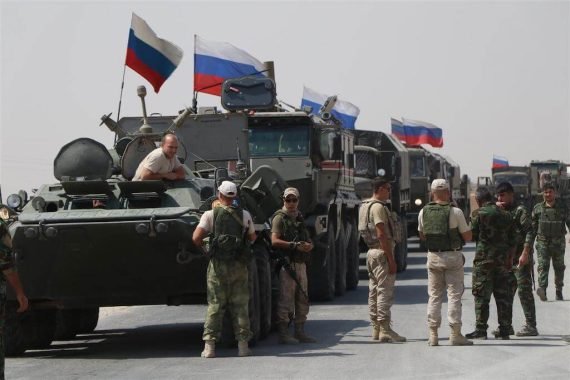
Russian military vehicles drive on the road as Russia makes a new military and logistic reinforcement of 30 vehicles to its military points in Kamisli occupied by YPG, Syrian branch of the PKK terrorist organization on September 14, 2020 Photo by Samer Uveyd, Anadolu Images
For years, the Turkish public criticized the U.S. administrations for their support of the YPG, the Syrian branch of the PKK terrorist organization, which poses a threat to Syria’s territorial integrity and a national security threat to Turkey. At the same time, Russia also tried to use the YPG as a card against Turkey in 2015 and early 2016, but later changed its position and declared its support for the territorial integrity of Syria, and acknowledged the threat the group poses against Turkey. However, in the end of 2019, Russia viewed the partial American withdrawal as an opportunity and re-changed its position again.
In this manner, in 2018, Russia withdrew from the Afrin region and opened the way for the joint Turkish-Syrian military operation of the Syrian National Army (SNA), the former Free Syrian Army (FSA), and the Turkish Armed Forces (TAF) against the YPG.
Moreover, Russia accepted to exclude YPG figures from the Syrian constitutional committee and signed several Astana resolutions which define the YPG as a threat to Syria’s territorial integrity. However, Russia changed its approach to the YPG following Turkey’s Operation Peace Spring and became – along with the U.S. – the new military protector of the YPG in Syria.
Why did Russia change its attitude towards the YPG? In order to understand this policy change, one should first analyze Russia’s overall Syria policy before Operation Peace Spring. No doubt, for Moscow, autonomy and federal governments or other forms of decentralized government are not a threat to the territorial integrity of a state since Russia itself is a federation. Nobody should expect Russia to oppose a federal system in Syria.
Therefore, Russia does not recognize the PKK and its Syrian branch, the YPG, as terror groups, and, in principle, does not oppose the YPG per se; however, Russia opposes the YPG’s current policies. For Moscow, the YPG’s partnership with the United States has been the main source of its distrust toward the organization. Moscow wants the YPG to quit working with the U.S. and cooperate with the Russia-backed Assad regime. Until Operation Peace Spring, all Russian charm efforts failed and the YPG remained loyal to the United States.
With Trump’s decision to withdraw from Syria, the YPG felt the urgent need to invite the Assad regime and Russia to provide military protection against Turkey and the Syrian Interim Government. The YPG’s request was seen by Moscow as a golden opportunity to gain extensive leverage. Russia wanted to fill the void and was further encouraged when U.S. CENTCOM officials decided to hand over their bases to the Russian military rather than seeing a further push by the Turkey-backed Syrian National Army.
With this momentum, Russia deployed its troops to Manbij, Ayn al-Arab (Kobane), Ayn Issa, Tal Tamr, Dirbasiyah, and Amudah along the front lines or the border region, and entered the towns of Tabqah and Raqqa. As Russia had troops in the YPG-held Tal Rifaat pocket since 2016, with this development, the YPG was on the verge of coming under full Russian military protection.
Moscow was expecting to enter the far east of Syria at the Iraqi border and the oil-rich region of Deir Ezzor in the southeast, but Trump’s decision to protect the oil hindered Russia from doing so. U.S. soldiers stayed in a strip in the east of the country and prevented Russia from entering. Since then, the YPG militants maintained a balancing act between Moscow and Washington as demonstrated by the visit of the PKK veteran and head of the political supreme body of the YPG, Elham Ahmad, to Moscow before heading to Washington.
Following the partial U.S. withdrawal and the new Russian protection of the YPG, Turkey signed two separate deals with the U.S. and Russia. The deal with the U.S. stopped the SNA-TAF advancement and canceled U.S. sanctions against Turkey in return.
The deal with Russia was more comprehensive. After Operation Peace Spring, the YPG invited the Assad regime and Russia to protect the front lines against a further push by the joint Turkish-Syrian forces, and Russia obligated itself under the terms of the deal to enforce a full withdrawal of all YPG forces from Tal Rifaat, Manbij, and an area extending 32 km from the Turkish border in the east of the Euphrates to the border with Iraq. The deal also foresaw joint Turkish-Russian patrols in a 10-kilometer-wide strip across the Turkish-Syrian border. Except for the joint patrols, Russia failed to deliver on any of the terms of the agreement.
Let alone keeping their promise, Russians have done the opposite and supported the YPG in its terror campaign against the Syrian Interim Government and Turkey. The YPG engaged in several attacks with various weapon systems against civilian-populated areas of the Syrian Interim Government such as Afrin, Azaz, Al-Bab, Jarablus, Tal Abyad, and Rasulayn.
The YPG used new models of Russian-supplied anti-tank guided missiles to target Turkish soldiers
The YPG used new models of Russian-supplied anti-tank guided missiles to target Turkish soldiers, infiltrated the front lines to kill SNA soldiers, and operated a network of cells in the areas of the Syrian Interim Government located in northern Syria. With these cells, the YPG could plant IEDs and attempt assassinations against the SNA, Syrian local politicians, and Turkish soldiers.
The YPG used the Russian-protected areas as a safe zone to conduct ranged artillery attacks against hospitals and civilian infrastructure. Yet, the most brutal of the YPG attacks were the constant car bomb attacks carried out in urban areas which randomly killed innocent civilians.
The YPG tries to maintain plausible deniability and rejects responsibility. However, car bombs intercepted at crossing points from YPG-held areas to the areas of the Syrian Interim Government, and the logic behind the attacks leave no doubt about who the perpetrators are. The YPG’s foreign backers, like the U.S., condemn the attacks without naming any suspect or culprit, or turn a blind eye to them entirely, like Russia.
For Moscow, the YPG’s systematic use of terror is a preferred tool to prevent the Syrian Interim Government from establishing a sustainable alternative to the Assad regime without getting into a confrontation with Turkey. The attacks are not conducted directly by Russia, but by the YPG, and the U.S. support and protection of the YPG shields Russia from Turkish criticism. The Turkish public focuses on the U.S. support of the YPG rather than the military protection Russia provides the YPG and its pragmatic attitude to the YPG’s terror campaign.
In fact, Russian policy shows that Moscow regards the legitimate Syrian opposition as a bigger threat than the YPG. For Russia, the Syrian Interim Government is a direct alternative to the Assad regime, and the YPG represents only a territorially limited pursuit of autonomy. Therefore, Russia prefers to protect the YPG in order to disrupt the Syrian Interim Government rather than implementing its obligations stemming from the Turkish-Russian agreement of 2019.
In fairness, it should be underlined that the Russian position regarding the YPG’s demand to establish an autonomous region in northeast Syria has changed in line with the Astana accords. In the negotiations between the Assad regime and the YPG, Moscow puts its weight behind the regime’s categorical rejection of autonomy. In line with the Astana agreements, Russia rejects the separatist agenda of the YPG on paper. While the U.S. actively supports the political ambitions of the YPG in Syria, Russia supports the military presence of the YPG only as a temporary tool.
All Global Research articles can be read in 51 languages by activating the “Translate Website” drop down menu on the top banner of our home page (Desktop version).
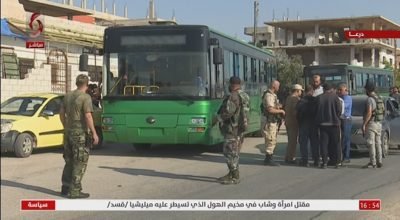
Today, a bus load Syrian Arab Army (SAA) soldiers has come under attack on the road to the west of Daraa, with reports of one killed and eight injured. Tuesday, a Russian-backed deal went into force in Daraa, ending months-long tension between the Syrian Arab Army (SAA) and local terrorists there. In late July, clashes of artillery began between the two sides. The city in the south of Syria, on the Jordanian border, had been in military conflict which held the civilian population in peril, resulting in residents fleeing the situation.
The Russian military police entered Daraa al-Balad neighborhood to evacuate terrorists who refused to lay down their arms and receive amnesty from the SAA. Terrorists on Tuesday night boarded buses to take them to Afrin in the north of Syria, as part of the deal. Those armed fighters who have received amnesty, and laid down their weapons, will remain in the city.
Once the terrorists are removed, the SAA will enter the area, and life will return to normal for the residents who had become hostages. Thousands of residents who had fled the fighting will be assisted by the SAA to return home, and government institutions such as medical care will be made available, and free public schools are set to resume in mid-September.
Daraa al-Balad neighborhood is home to about 40,000 people, and it had become a critical situation with extreme challenges getting access to food and power.
The UN Office for the Coordination of Humanitarian Affairs (OCHA) placed the number of internally displaced people in Daraa al-Balad area and surrounding areas in province at 38,000, including almost 15,000 women and over 20,400 children.
History of Daraa
Violence broke out in March 2011 in Daraa, which began the 10-year conflict in Syria. The SAA freed Daraa in 2018 in a Russian-brokered deal which saw terrorists and their families being evacuated to Idlib, and some remaining fighters worked out a deal with the SAA, by which they would peacefully man some checkpoints inside Daraa al-Balad, while the SAA would man other checkpoints. However, the deal fell apart over time because the fighters repeatedly targeted the SAA using snipers on motorcycles. By July, open fighting between the two-sides began.
Afrin today
Turkey occupies Afrin, and uses their militia, Syrian National Army (SNA) to keep the local population in subjugation. The SNA, despite its name, is not Syrian administered, but is under the Turkish military control, and are mercenaries following Radical Islam.War or Peace: Turkish backed Terrorists, Erdogan’s Decision on Idlib
Turkish charities operate in Afrin distributing food to Syrian Arabs who have been shipped in to displace the original population which was a mixture of Kurds, Christians and Arabs.
Turkey conducted Operation Olive Branch on Jan. 20, 2018, to clear Afrin from the militia known as YPG, who is part of the US-supported SDF militia who fought to defeat ISIS. By March 18 Afrin had been ethnically cleansed by Turkey.
Since 2016, Turkey has launched a trio of invasion operations across its border in northern Syria: Euphrates Shield in 2016, Olive Branch in 2018 and Peace Spring in 2019. The goal is to create a Turkish administered border swath, which Turkey originally tried to sell to the West as a ‘safe-zone’, but is actually a Muslim Brotherhood safe haven.
Recently, the SNA abducted a number of civilians in Afrin. The battalions named, “al-Jabha al-Shamiya” and the “Sultan Murad Division” have imposed a crippling siege on the locals as they have raided the citizens’ houses and kidnapped more than 30 civilians and took them to an unknown destination.
The sources added that the abducted persons have been exposed to the worst forms of abuse, torture and insults since they have demanded to restore their properties which have been seized by the Turkish occupation mercenaries.
History of ethnic cleansing in Afrin
The National Initiative for Afrin in the German city of Bonn stressed the coordination and unification of efforts working for Afrin and its people, and confronting the Turkish occupation and its mercenaries, and the safe and dignified return of the forcibly displaced residents of Afrin. This initiative aims to expose Turkey’s violations against residents of Syria’s Afrin to international institutions and human rights organizations participating in the initiative.
After Turkey’s invasion of northern Syria, the fighters it sent across the border to carry out the mission have documented their own war crimes. Videos posted online by soldiers of the Turkish-backed SNA showing summary executions, mutilation of corpses, threats against Kurds and widespread looting have struck terror into the population.
The ethnic dimension to many of the crimes has resulted in a mass exodus of Kurds and religious minorities from these once diverse borderlands, and created a dramatic demographic change.
Recep Tayyip Erdogan, the Turkish president, claimed his invasion of Syria was aimed at removing the Kurdish-led Syrian Democratic Forces (SDF), a group Turkey classifies as a terror organization for its links to the PKK, and YPG. Turkey has supported the operation with airstrikes, drones and artillery.
Since the invasion began, the SNA has captured a swathe of territory that was home to a large population of Kurds, and smaller numbers of Assyrians, Yazidis and Turkmen. The same area faced massive upheaval when ISIS swept across northern Syria. Tal Abyad was occupied by the terror group for more than a year before being recaptured by the SDF.
Christian families have all been forced to leave their homes as the SNA made public threats to kill them, referring to them as pigs and heathens. The SNA have uploaded their videos targeting Christians, and non-Sunni Muslims.
A widespread campaign of looting and confiscation of Kurdish property has made clear Turkey and their SNA militia want to keep Kurds out. Human Rights Watch said it had documented numerous examples of Kurdish homes being confiscated and their possessions looted.
A United Nations commission of inquiry found that “armed group members in Afrin committed the war crimes of hostage-taking, cruel treatment, torture, and pillage”.
More than 130,000 mostly Kurdish residents are still displaced from Afrin, living in camps in the SDF-held region of northeast Syria. Many of their homes are now occupied by Syrians from other parts of the country.
NATO has been criticized for allowing a member state, Turkey, to carry out large scale ethnic cleansing in Syria. However, since the war in Syria beginning in 2011 was a US-NATO project for ‘regime change’, NATO is not complaining to Turkey, who was their partner in the 10-year war.
Idlib today
On Tuesday, an explosion killed eight Al Qaeda terrorists, and wounded 10 others, in Idlib. The terrorists were meeting when the blast occurred. Russia and Turkey have a ceasefire deal in Idlib, but it does not cover Al Qaeda. According to the UN, all nations must fight Al Qaeda, wherever they are. However, Turkey occupies Idlib and supports the Al Qaeda branch there, Hayat Tahrir al-Sham.
Turkey currently hosts nearly 4 million Syrians; however, most of the Syrian refugees in Turkey today are Sunni Muslims. Erdogan plans to resettle the Syrian refugees in the border area under Turkish military occupation, and it will permanently alter the demographics. This area stretching from Idlib province to Afrin will become a safe haven for terrorists aligned with the Muslim Brotherhood and Al Qaeda.
*
Note to readers: Please click the share buttons above or below. Follow us on Instagram, @crg_globalresearch. Forward this article to your email lists. Crosspost on your blog site, internet forums. etc.
A video clip shared by local farmers from Ras Al-Ayn showing an inferno burning their livelihood before their eyes, hundreds of acres of wheat on fire just as the crop is due to harvest.
We’ve been reporting about these fires in areas of operation of the NATO’s Turkish (Orwellian-named) ‘Spring of Peace’ military operation in northern, and especially in northeastern Syria regions as well as in areas where remnants and sleeper cells of NATO-sponsored terrorists of ISIS and its affiliates are active in the south of the country.
Truly, hearing is not like seeing, any person with the least sense of humanity, especially citizens of all NATO member countries as these crimes are committed in their names with their tax money making them accomplices in the crimes, should be appalled of these scenes and should condemn these war crimes and call for the culprits to face justice.
We also Can’t Breathe because of the US brutality around the world.
Syria has officially filed a complaint to the NATO-dominated United Nations Security Council against these crimes committed by terrorists operating directly under the protection and sponsorship of the Turkish Army TSK of NATO, with the help of their US allies. But we all know the hapless mechanism of the United Nations and how only resolutions in favor of NATO countries are implemented, and under its Article 7 of its Charter when needed, the article that enforces the resolutions with military power.
Burning of wheat crops started earlier by the US-sponsored Kurdish separatist SDF and Asayish militias in Qamishli, Hasakah, when the farmers refused to sell their crops to Turkey for cheap and be paid in Turkish Lira, they were insisted on selling it to the Syrian state for the fair price offered to them by their government and in the Syrian Lira, therefore, the Kurdish separatists looted their crops and burned down what they couldn’t loot.
These war crimes are part of the Trump regime’s ‘Maximum Pressure’ official policy against countries that do not accept puppet rulers loyal to the US working against the interests of their own people, Syria has been on the Pentagon’s destabilizing and threats since 1956 and these destabilization efforts and threats only increased through the past decades reaching this month with the so-called ‘Caesar Act‘, a US regime of sanctions approved by the ‘democratically elected representatives of the US citizens to Congress’ and by the ‘democratically elected president’ in addition to the already draconian sanctions imposed earlier to suffocate the last breath the Syrian ordinary people can take.
This ‘economic terrorism’ act comes at the same time the whole world is calling on the USA and its European minions to lift off the sanctions, instead, the EU renewed their illegal inhumane unilateral sanctions against Syria for one more year earlier this month and the US Special Envoy to Syria James Jeffery gloating about the hardship this act is causing the Syrian people bragged: ‘The hardship the Syrian are living and the collapse of their national currency is the result of our policies.:
The US-led War of Terrorand Attrition Warit is waging against the Syrian ordinary people under the guise of ‘helping them out of oppression’, these lies should stop but we are very much aware and especially after we saw how the policy of sucking the life out of people and not allowing them to breathe is deeply rooted in the US culture, we are not betting much on their humanity rather on their fear of Karma, you will reap what you sow sooner or later and on Judgment Day there won’t be elections to manipulate or hide behind or any navy carriers protecting you, you’ll be called individually to stand naked before your creator and in front of all humans to answer for your crimes against others, including your silence to the crimes committed in your name by your politicians and military and with your money.
To help us continue please visit the Donate page to donate or learn how you can help us with no cost on you. Follow us on Telegram: http://t.me/syupdates link will open Telegram app.
Russia on Wednesday blamed Turkey for the recent deterioration of the situation in Syria’s Idlib de-escalation zone.
Russian Foreign Ministry spokeswoman Maria Zakharova said Moscow believes that the reason for the recent deterioration of the situation in Syria’s Idlib de-escalation zone is Turkey’s failure to comply with previous agreements.
“We see the reasons for the current deterioration in Turkey’s chronic failure to fulfil its commitments under the Sochi memorandum of September 17, 2018, and the transfer by Ankara of Turkey-controlled units of the so-called moderate armed opposition to northeastern Syria into the zone of Operation Peace Spring and to Libya,” Zakharova said at a weekly briefing in Moscow.
She stressed that Russia remains committed to the agreements reached earlier and is determined to continue working together with Turkey on Syrian conflict settlement.
Earlier in the day, Turkish President Recep Tayyip Erdogan accused Moscow and Damascus of attacking civilians in Idlib. The remarks of the Turkish president came amid the escalation of tensions in Idlib.
On November 26, Kurdish rebels from the so-called Afrin Liberation Forces announced that their forces had eliminated 5 Turkish-backed militants and injured 6 others in an attack near Tuweys in northern Aleppo. The killed and injured militants were reportedly belonging to the al-Waqqas Brigade, which is involved in Turkey’s Operation Peace Spring as a part of the Syrian National Army.
On November 27, Kurdish rebels launched at least 6 rockets at the Turkish-occupied town of Azaz. The shelling reportedly hit a prison run by Turkish proxies injuring at least 3 people.
On November 27 and 28, clashes between the Kurdish-dominated Syrian Democratic Forces and Turkish-led forces were ongoing near the village of Abduki in northern Raqqa. According to pro-Kurdish sources, the Syrian National Army advanced on their positions backed up by the Turkish Army. However, the attack was repelled.
Additionally, 2 Turkish soldiers were killed in a mortar attack that targeted their position in the vicinity of the town of Akcakale on the Syrian border, according to the Turkish Defense Ministry.
19 people were killed and 45 others were injured in a car bomb explosion in the Turkish-occupied town of Tell Halaf on November 26. The explosion took place at the town’s main market, which was crowded by civilians and Turkish-backed militants. Turkish sources immediately accused Kurdish armed groups of being behind the attack.
On November 26, unidentified warplanes carried out a series of airstrikes on oil tankers and facilities belonging to Turkish-backed militant groups north and northeast of Al-Bab, and near Jarabulus. On November 27, the Syrian army took responsibility for the attack and announced that it will take measures to put an end to oil smuggling from the eastern bank of the Euphrates to Turkey. Oil looted by US forces at the Syrian oil fields are being smuggled with help of the SDF/YPG leadership to Turkey through northern Aleppo and Iraq’s Kurdistan Region. It is unlikely that Damascus even with help from Iran and Russia will be able to kill this business in the near future. Nonetheless, efforts in this field could create some obstacles for the sides involved.
Despite all evidence to the contrary, the Syrian Democratic Forces kept their title unquestioned until the Turks invaded Syria, when they were suddenly transformed into ‘Kurdish forces’ who had been betrayed by the Americans. Which, of course, they always were
That wars end very differently to our own expectations – or our plans – was established long ago. That “we” won the Second World War did not mean the Americans would win the Vietnam war, or that France would vanquish its enemies in Algeria. Yet the moment we decide who the good guys are, and who the evil monsters whom we must destroy, we relapse again into our old mistakes.
Because we hate, loathe and demonise Saddam or Gaddafi or Assad, we are sure – we are absolutely convinced – that they will be dethroned and that the blue skies of freedom will shine down upon their broken lands. This is childish, immature, infantile (although, given the trash we are prepared to consume over Brexit, it’s not, I suppose, very surprising).
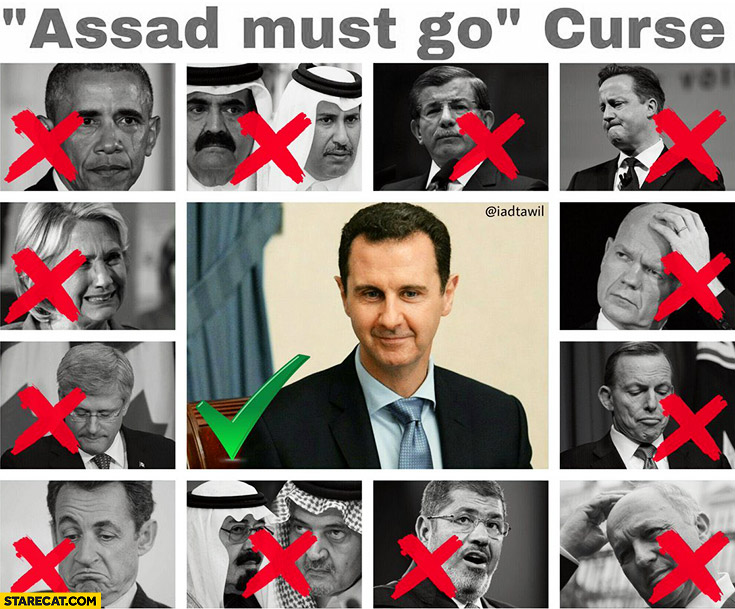
Well, Saddam’s demise brought upon Iraq the most unimaginable suffering. So too Gaddafi’s assassination beside the most famous sewer in Libya. As for Bashar al-Assad, far from being overthrown, he has emerged as the biggest winner of the Syrian war. Still we insist that he must go.
Still we intend to try Syrian war criminals – and rightly so – but the Syrian regime has emerged above the blood-tide of war intact, alive, and with the most reliable superpower ally any Middle East state could have: the Kremlin.
I despise the word “curate”. Everyone seems to be curating scenarios, curating political conversations or curating business portfolios. We seem to be addicted to these awful curio words. But for once I’m going to use it in real form: those who curated the story – the narrative – of the Syrian war, got it all wrong from the start.
Bashar would go. The Free Syrian Army, supposedly made up of tens of thousands of Syrian army deserters and the unarmed demonstrators of Darayya, Damascus and Homs, would force the Assad family from power. And, of course, western-style democracy would break out, and secularism – which was in fact supposed to be the foundation of the Baath party – would become the basis of a new and liberal Arab state. We shall leave aside for now one of the real reasons for the west’s support of the rebellion: to destroy Iran’s only Arab ally.
We didn’t predict the arrival of al-Qaeda, now purified with the name of Nusrah. We did not imagine that the Isis nightmare would emerge like a genie from the eastern deserts. Nor did we understand – nor were we told – how these Islamist cults could consume the people’s revolution in which we believed.
Still today, I am only beginning to learn how Syria’s “moderate” rebellion turned into the apocalyptic killing machine of the Islamic State. Some Islamist groups (not all, by any means, and it was not a simple transition) were there from the start. They were in Homs as early as 2012.
This does not mean that Syrian rebels were not brave, democratically minded figures. But they were mightily exaggerated in the west. While David Cameron was fantasising about the 70,000 Free Syrian Army (FSA) “moderates” fighting the Assad regime – there were never more than perhaps 7,000, at the most – the Syrian army was already talking to them, sometimes directly by mobile phone, to persuade them to return to their original government army units or to abandon a town without fighting or to swap the bodies of government soldiers for food. Syrian officers would say that they always preferred to fight the FSA because they ran away; Nusrah and Isis did not.
Yet now, today, as we report the results of the Turkish invasion of northern Syria, we are using a weird expression for Turkey’s Arab militia allies. They are called the “Syrian National Army” – as opposed to the Assad government’s original and still very extant Syrian Arab Army. Vincent Durac, a professor in Middle East politics in Dublin, even wrote last week that these Arab militia allies were “a creation of Turkey”.
This is nonsense. They are the wreckage of the original and now utterly discredited Free Syrian Army – David Cameron’s mythical legions whose mysterious composition, I recall, was once explained to British MPs by the gloriously named General Messenger. Very few reporters (with the honourable exception of those reporting for Channel 4 News) have explained this all-important fact of the war, even though some footage clearly showed the Turkish-paid militiamen brandishing the old Free Syrian Army green, white and black flag.
It was this same ex-FSA rabble who entered the Kurdish enclave of Afrin last year and helped their Nusrah colleagues loot Kurdish homes and businesses. The Turks called this violent act of occupation “Operation Olive Branch”. Even more preposterous, its latest invasion is named “Operation Peace Spring”.
There was a time when this would have provoked ribaldry and contempt. No longer. Today, the media have largely treated this ridiculous nomenclature with something approaching respect.
We have been playing the same tricks with the so-called “American-backed” Syrian Democratic Forces (SDF). As I’ve said before, almost all the SDF are Kurds, and they have never been elected, chosen, or joined the SDF democratically. Indeed there was nothing at all democratic about the militia, and its “force” existed only so long as it was supported by US air power. Yet the Syrian Democratic Forces kept their title unscathed and largely unquestioned by the media.
But when the Turks invaded Syria, to drive them from the Syrian-Turkish border, they were suddenly transformed by us into “Kurdish forces” – which they largely were – who had been betrayed by the Americans – which they very definitely were.
An irony, which is either forgotten or simply unknown, is that when fighting began in Aleppo in 2012, the Kurds helped the FSA grab several areas of the city. The two were fighting each other seven years later when the Turks invaded the “free” Kurdish borderland of Rojava. Even less advertised was the fact that the Turkish-FSA advance into Syria allowed thousands of Arab Syrian villagers to return to homes taken over by the Kurds when they set up their doomed statelet after the war began.
But the narrative of this war is now being further skewed by our suspension of any critical understanding of Saudi Arabia’s new role in the Syrian debacle.
Deny and deny and deny is the Saudi policy, when asked what assistance it gave to the anti-Assad Islamist rebels in Syria. Even when I found Bosnian weapons documents in a Nusrah base in Aleppo, signed off by an arms manufacturer near Sarajevo called Ifet Krnjic – and even when I tracked down Krnjic himself, who explained how the weapons had been sent to Saudi Arabia (he even described the Saudi officials whom he spoke to in his factory) – the Saudis denied the facts.
Yet today, almost incredibly, it seems the Saudis themselves are now contemplating an entirely new approach to Syria. Already their United Arab Emirates allies in the Yemeni war (another Saudi catastrophe) have reopened their embassy in Damascus: a highly significant decision by the Gulf state, although largely ignored in the west. Now, it seems, the Saudis are thinking of strengthening their cooperation with Russia by financing, along with the Emiratis and perhaps also Kuwait, the reconstruction of Syria.
Thus the Saudis would become more important to the Syrian regime than sanctions-cracked Iran, and would perhaps forestall Qatar’s own increasingly warm – if very discreet – relations with Bashar al-Assad. The Qataris, despite their Al-Jazeera worldwide empire, want to expand their power over real, physical land; and Syria is an obvious target for their generosity and wealth. But if the Saudis decided to take on this onerous role, the kingdom would at one and the same time muscle both Iran and Qatar aside. Or so it believes. The Syrians – whose principle policy in such times is to wait, and wait, and wait – will, of course, decide how to play with their neighbours’ ambitions.
But Saudi interest in Syria is not merely conjecture. Crown Prince Mohammed bin Salman remarked to Time magazine in August last year that “Bashar is going to stay. But I believe that Bashar’s interest is not to let the Iranians do whatever they want to do.” The Syrians and the Bahrainis are talking regularly about the post-war Levant. The Emirates might even negotiate between the Saudis and the Syrians. The Gulf states are now saying that it was a mistake to suspend Syria’s membership of the Arab League.
In other words, Syria – with Russian encouragement – is steadily resuming the role it maintained before the 2011 revolt.
This wasn’t what we in the west imagined then, when our ambassadors in Damascus were encouraging the Syrian street demonstrators to keep up their struggle against the regime; indeed, when they specifically told the protestors not even to talk or negotiate with the Assad government.
But those were in the days before two crazed elements emerged to smash all our assumptions, sowing fear and distrust across the Middle East: Donald Trump and Isis.
On October 29, a patrol of the Russian Military Police came under a mortar fire near the border village of Darbasiyah. The village is located just east of the Turkish-controlled town of Ras al-Ayn. The Russians were there to discuss with their Turkish counterparts the start of joint border patrols, which had been agreed in the framework of the Russia-Turkey ‘de-escalation zone’ deal on northeastern Syria.
Initial reports suggested that at least two Russian military personnel were injured in the attack. However, later, they were denied. Turkish-backed forces claimed that they did not fire at the Russians and pointed out that the Kurdish-led Syrian Democratic Forces may be interested in such an incident.
On October 28, Russian and Turkish military officials met in Ankara to discuss the implementation of the de-escalation zone agreement and lay down a plan for further joint actions in the region.
Units of the Syrian Army continued deployment along the Turkish border in a 90km-wide area from the eastern countryside of Ras al-Ayn to the city of al-Qamishly in northeastern Syria. According to Syria’s SANA, government forces entered at least 20 settlements in the area.
The Syrian Army is currently working to reinforce its positions along the entire border area west and east of Turkey’s Operation Peace Spring on the eastern bank of the Euphrates.
On October 28, Syria and Russia opened a floating bridge linking the two banks of Euphrates River in the province of Der Ezzor. The bridge links the towns of al-Mre’eyeh and Mrat. It was constructed thanks to assistance from and under protection of Russian forces.
Deir Ezzor governor Abdul Majid al-Kawakibi said that the bridge was constructed “in response to the needs and demands of the people in the governorate northern countryside”. The bridge will allow them “to communicate with the rest of governorate areas”.
Earlier, the US-led coalition destroyed all the bridges in the area. A part of them was destroyed in the framework of the coalition’s campaign against ISIS. Later, the destruction of the infrastructure was a tool of cutting off links between people in the US-controlled and government-controlled areas.
On October 28, US Secretary of Defense Mark Esper once again warned that the US is not going to abandon oil fields on the eastern bank of the river. According to him, the US will respond with “overwhelming force” to any group that would threaten the safety of US forces there.
“It’s a quadruple win. The U.S. performs a face saving withdrawal, which Trump can sell as avoiding a conflict with NATO ally Turkey. Turkey has the guarantee – by the Russians – that the Syrian Army will be in control of the Turkish-Syrian border. Russia prevents a war escalation and keeps the Russia-Iran-Turkey peace process alive. And Syria will eventually regain control of the entire northeast.”
This otherwise excellent summary overlooks two out of three members of the “Axis of Kindness”, including Israel and the KSA. Of course, later in his analysis Pepe does address these actors, and also includes Kuwait. Furthermore, a thorough discussion of what took place would have to also include China, Hezbollah, Yemen and the EU (well, the ones that matter, the UK and France. The rest are just voiceless colonies of the USA).
Most of the analyses of what just took place focused on the “what”. I will try to look into the “why” and the “how” of what just happened in Syria. Still, I don’t propose to make such a detailed analysis, but I do want to re-classify the actors in a somewhat different way: by their relative strength.
Actor
Theoretical Strength
The “Axis of Kindness”:United States+CENTCOM+NATO+Israel+KSA
by far the most powerful actor almost by any measure: a bigger military force then all the other actors combined (at least when looked at regionally), huge economic power (the dollar is still THE #1 currency on the planet), total control of the region (via CENTCOM) and quasi unconditional support from Europe (via NATO). Finally, Israel does pack a powerful military punch. This actor has only ONE weakness, but more about that later.
Iran+Hezbollah+Houthi+Shia forces in Iraq
in regional terms, Iran is the local superpower which can even successfully defy the Axis of Kindness forces (and has done so since the Islamic Revolution of 1979).
Russia+Syria
I placed Russia and Syria in the same group and I could have added Iran, but since I believe that Russia objectively has more power over the Syrian government than Iran, I think that it is important to put Russia and Syria together simply because Damascus cannot say “no” to Moscow, but could do so, at least in theory, to Tehran. Finally, Russia and Iran agree on the main issues, but have different visions for the future of the Middle-East. Thus this is another reason to look at them separately, even if not necessarily in opposition to each other. In military terms, Russia is very strong, then very vulnerable, then very strong again, it all depends on your level of analysis (see below)
Turkey+pro-Turkish factions in Syria
That one is a difficult one to classify. On one hand, Turkey does not have any regional allies (the Ottoman Empire left only hatred and deep resentment in its former colonies). For a while, the pro-Turkish factions, which were liberally showered with weapons, money, training, logistical support, etc, by the US and the KSA, but eventually these factions grew weaker and weaker until they reached a state of advanced impotence leaving Turkey pretty much alone (we will also look into that below).
The Kurds
For a while, they sure looked potentially powerful: not only did the Kurds have a pretty big military power (albeit mostly one restricted to infantry), they had the support of Axis of Kindness and, especially, Israel which saw any form of Independent Kurdistan as a great tool to weaken and even threaten Iraq, Turkey, Iran and Syria. Furthermore, the Kurds happened to control a lot of oil rich regions and they could always retreat in the mountainous areas if needed.
The Takfiris (i.e. the many and constantly name-changing franchises of what used to be called “al-Qaeda”).
In reality, the Takfiris really ought to be classified together with the Axis of Kindness since they have been the foot-soldiers/cannon-fodder for the AngloZionist since the 1980s (from Afghanistan then to modern day Syria). Nonetheless, we will consider them as distinct from the rest of the Axis of Kindness forces.
Of course, and just like any other taxonomy, this one is necessarily somewhat subjective and others might use different criteria or categories. Now let’s look at what I believe is the key to the control of the entire region: the ability to place “boots on the ground” or the lack of such an ability:
Actor
Ability to place boots on the ground
The “Axis of Kindness”:United States+CENTCOM+NATO+Israel+KSA
This is The One Big Weakness of the Axis of Kindness members: while they have huge armed forces, and even nuclear weapons, while they can deploy numerically very large forces, while they can (arguably) achieve air and naval supremacy/superiority pretty much anywhere in the region, they cannot follow up any of these options with a credible ground force. While this is always carefully obfuscated by the legacy AngloZionist propaganda, the US, Israeli and KSA ground forces are only capable of murdering civilians or primitive resistance forces en masse. But as soon as any of these militaries meets a halfway decent enemy force which is willing to fight on the ground, they are defeated (name me ONE meaningful victory of these Axis of Kindness forces in the last couple of decades or more!).
Iran+Hezbollah+Houthi+Shia forces in Iraq
The Iranians and their local allies (calling them “proxies” completely misses the real nature of the relationship between Iran and these regional forces!) are all capable of deploying very capable ground forces. In fact, they have all done so with tremendous success (especially Hezbollah). What Iran provides to this informal alliance is the capability to augment it with new, high-tech and modern weapons, including anti-shipping missiles, air defenses, ATGMs, communications, drones, etc. In terms of ground forces, this alliance is the #1 power in the region.
Russia+Syria
Both Russia and Syria have very competent and well-balanced forces deployed in Syria. However, truth be told, I believe that Hezbollah+Iran currently have even more military weight, at least in terms of ground forces in Syria. The thing to keep in mind is this: if only Russian forces existed inside Syria (Tartus, Khmeimin, plus assorted special units all over Syria) then Russia is definitely weaker than the Axis of Kindness. But if we assume that Russian forces outside Syria could (and probably would!) intervene to defend the Russian forces inside Syria, then we would have to flip much of this equation around and categorize Russia as even more powerful than the Axis of Kindness (I will explain in more detail why and how below).
Turkey+pro-Turkish factions in Syria
There can be no doubt that at the initiation of the international aggression against Syria, Turkey had a credible and powerful military. Then something went very wrong and with each new development (starting with the coup attempt against Erdogan) Turkey only got weaker and weaker. The country which dared to shoot down a Russian Su-24 eventually found itself in the humiliating position to have to ask for Russian help not once, but over and over again. The latest Turkish invasion of northern Syria has proven that, while the Turks can still beat the Kurds, that’s about all they can do, and even that not very well.
The Kurds
Frankly, I never believed in the chances of the Kurds for anything even remotely resembling an independent Kurdistan. Oh sure, my sympathies were often with the Kurds (at least in their struggle against Turkey), but I always knew that the notion of imposing some new (and very artificial) state against the will of ALL the regional powers was both naive and self-defeating. The truth is that the US and Israel simply *used* the Kurds if and when needed, and ditched them as soon as it became obvious that the Kurds outlived their utility. The best the Kurds will ever get is a regional autonomy in Iran, Iraq and Syria. Anything else is a dangerous pipe dream.
The Takfiris (i.e. the many and constantly name-changing franchises of what used to be called “al-Qaeda”).
Just like the Turks, the various Takfiris appeared as a formidable force when the aggression against Syria was initiated. And if the the US GWOT appeared to be a true blessing for the “good terrorists” (that’s, of course, all the terrorists in this region) it is because it was. Then something went very very wrong, and now they look as weak and clueless as the Kurds.
Now let’s sum this up. This is how the relative strength of these regional actors has changed since the initiation of the AngloZionist aggression against Syria:
Actor
Evolution of strength of each regional power
The “Axis of Kindness”:United States+CENTCOM+NATO+Israel+KSA
DOWN: from strongest to one of the weakest in the region
Iran+Hezbollah+Houthi+Shia forces in Iraq
UP: arguably the most balanced military force in the region
Russia+Syria
UP: in a process which only *looked* like sheer “good luck” Russia and Syria grew stronger and stronger with each passing year.
Turkey+pro-Turkish factions in Syria
DOWN: in sharp contrast to Russia, a weird process of what *looked* like sheer “bad luck” Turkey and its allies in Syria just seemed to get weaker and weaker with each passing year.
The Kurds
DOWN: the Kurds made the immense mistake of believing all the empty promises (often called “plan B”, “plan C”, “plan D”, etc.) made by the AngloZionists. Now all their dreams are over and they will have to settle for autonomy inside Iraq and Syria.
The Takfiris (i.e. the many and constantly name-changing franchises of what used to be called “al-Qaeda”).
DOWN: their situation is almost as bad as the one of the Kurds. Their sole advantage is that they are not linked to any one piece of land and that they can try to regroup somewhere else in the region (or even the world); never say never again, but it looks to me like this will not happen in the foreseeable future.
It is now time to try to make sense of all this and try answer the question of why one group of relatively strong actors had so much bad luck as to become weaker and weaker, while the weaker became stronger and stronger.
The first thing we need to agree upon is that irrespective of the public posturing, everybody is, and has been, talking to everybody else. This “conversation” could be official and public, or behind closed doors, or even by means of intermediaries and, last but not least, a state version of “body language”: by means of actions which send a message to the other party or parties. Still, while this is certainly true, it is the quality of the communications between the various parties which made all the difference. When, say, Netanyahu or Trump publicly proclaim they they don’t give a damn about anything at all (including international law) and that they reserve the right to threaten or even attack anybody, at any time, for any reason whatsoever, this is a very clear message to, say, the Iranians. But what is that message, really? It says a couple of things:
Resistance is futile because we are so much stronger than you and therefore
We don’t give a damn about you or your national interests and therefore
We are not interested in negotiating with you (or anybody else for that matter). Your only solution is to submit to us
This is really crucial. The USA and Israel have proclaimed their total superiority over the entire planet and, specifically, over every single actor in the Middle-East. Furthermore, their entire worldview and ideology is predicated on this very strong sense of military superiority. Ask any Israeli or US American what their countries will do if some coalition of local powers is successful in attacking them: they will reply something along the lines of “we will simply nuke all the friggin’ ragheads and sand-niggers – f**k them!”. This line is always delivered with a tone of absolute finality, a total certitude and the mental equivalent of “’nuff said!”.
Alas, for the Axis of Kindness, this is a completely counter-factual belief. Why?
First, the quick appeal to nukes is an implicit admission that there is something very wrong with the rest of the armed forces of the Axis of Kindness. Furthermore, the real regional powers all understand that it is not in their interest to give the US or Israel a pretext to use nukes. Thus, while, say, the Iranians sure have the means to strike Israel or any one of the many CENTCOM facilities in the Middle-East, they have been very careful to keep their counter-attacks below the dangerous threshold in which the legacy AngloZionist corporate media would be unable to conceal the magnitude of the disaster and demand that nukes be used (yes, if it comes to that, both the Israeli and the US media will demand nuclear strikes just as they cheered for every war of aggression ever committed by the USA and Israel).
Second, precisely because the US and Israel are unable to have real allies (they only have colonies run by comprador elites), they cannot operate successfully in a multi-lateral kind of relationship with other actors. The contrast between the US/Israel, on one hand, and Russia and Iran, on the other, could not be greater. Both Russia and Iran understand that having real allies is much more advantageous than having puppets. Why? Because in order to convince somebody to become your ally you absolutely have to offer that party something tangible as part of a compromise goal setting. When this is done, the weaker ally feels that it is defending its own interests and not the interests of a patron which might be unreliable or which might even backstab you.
Third, one of the best US experts on the theory of negotiations, Professor William Zartman, wrote in his seminal book “The Practical Negotiator” that
One of the eternal paradoxes of negotiations is that it allows the weak to confront the strong and still come away with something which should not be possible if weakness and strength were all that mattered (…). Weaker parties tend to seek more formal negotiating forums and to strengthen their hand through organizations (…). Weak states can afford erratic or irresponsible behavior more easily than stronger parties, particularly when the rules of regularity and responsibility favor the strong (…). Weak states do best by rewarding stronger states’ concessions rather than than by “hanging tough” and by opening high to indicate needs and to facilitate rewards (…). The tactics of toughness and softness vary according to the strength of the parties: under symmetry, toughness tends to lead to toughness and under asymmetry to softness, with weaker parties following the leader of stronger parties.
There is a lot to unpack here (and there is much more in this book which I highly recommend to everybody!).
First, let’s compare and contrast the Russia and US approaches to creating negotiation fora. The US cooked up the “Friends of Syria” forum which was most remarkable in two unique ways: first, in spite of calling itself “Friends of Syria” this group only contained a who’s who of Syria’s, Iran’s and Russia’s enemies (just like to “Friends of Libya” was a cornucopia of countries hostile to Libya). Secondly, the self-evident (and not really denied) purpose and function of this group was to bypass the UNSC. There is nothing new here, the US has been trying to replace the UN and its role in upholding international law with all sorts of gimmicks including “coalition of the willing” or appeals for a “rules-based international order”. Needless to say, with the possible exception of a few truly dim propagandists, all these tricks are designed to avoid the already existing international fora, beginning with the United Nations. Russia, in contrast, not only used the UN for all its (admitted limited) worth and succeeded in forcing the USA to accept resolutions on Syria (or the Ukraine for that matter) which the US did not want to agree to, but which they could not veto on political considerations. Not only that, Russia also created the Astana peace process which, unlike the US created fantasies, brought together different parties including parties hostile to each other. The most brilliant move of the Russians was to impose on all parties the notion that “those willing to negotiate are legitimate parties whose interests must be considered while those who refused to sit down are all terrorists“. Of course, the many al-Qaeda franchises tried to play the “rebranding game”, but this did not help: you can change names once every 24 hours if you want, but if you ain’t sitting down at the negotiating table you are a terrorist and, therefore, a legitimate target for Russian/Iranian/Syrian attacks. Once the Empire had to accept these terms, backed by a UNSC resolution, it became locked-in in a process which they could only stop by means of a military victory.
And here we come back to the boots on the ground issue. For all its combined military power, the Axis of Kindness does not have a ground force it can put on the ground. Whereas the Syrians, Hezbollah, Iran and Russia very neatly and most effectively (even if informally) agreed to the following assignment of tasks:
The Syrians will let the Russians reorganize their armed forces, especially a few elite units, and slowly, step-by-step liberate their lands.
The Iranians and Hezbollah will act like a fire-brigade and will directly support the Syrian operations with their own forces in crucial sectors of the line of contact.
The Russians will take control of the Syrian airspace and provide the Syrians, Iran and Hezbollah protection from AngloZionist missile and bomb strikes. Finally, Russian special operation forces will be engaged in high priority operations which are beyond Iranian or Hezbollah capabilities.
What was the biggest obstacle to the Syrian-Iranian-Hezbollah-Russian plans?
Turkey, of course. The Turks have always hated Assad (father and son) and their Neo-Ottoman delusions still give them a, shall we say, “special desire” to intervene beyond their own borders. Furthermore, Turkey also very much saw Syria as a contributing factor to their “Kurdish problem”. Finally, Turkey did have the kind of military which made it possible for it to threaten intervention or even intervene in Iraq and Syria (obviously not against Iran). Thus, what Russia needed to do was take Turkey out of the equation or, at least, weaken Turkey as much as possible. And that is exactly what Russia did.
For the Kremlin the shooting down of the Su-24 was tantamount to a declaration of war. Except that the Russians, quite aware of their relative weakness if compared to the US+NATO+CENTCOM+Turkey, wisely decided not to retaliate in kind and, say, strike Turkish military facilities. But Putin did promise “you won’t get away with just not selling us tomatoes” (Russia imposed an embargo on a number of Turkish export goods). Besides a number of political and economic sanctions, you can be sure that the Russians decided to use all their methods and means to weaken and destabilize both Erdogan personally and Turkey as a whole. Then, here is what happened:
On November 24th, 2015, Turkey shot down a Russian Su-24
In the next days, Russia closed down the north Syrian airspace, severed all contacts with the Turkish military, promised to shoot down any other Turkish aircraft attacking any target in Syria (regardless from what airspace) and imposed political and economic sanctions.
In December Putin ominously declared “Если кто-то думает, что, совершив подлое военное преступление: убийство наших людей — они отделаются помидорами, или какими-то ограничениями в строительной и других отраслях, то они глубоко заблуждаются” (“if somebody thinks that by committing a vile war crime they will get away with tomatoes or some type of restrictions in the construction and other industries, they are profoundly mistaken“).
In June 2016, Erdogan sent a letter to Russian President Vladimir Putin expressing sympathy and ‘deep condolences’.
On 15 July 2016, a coup d’état was attempted against Erdogan and almost cost him his life. By all accounts, Russia played some kind of behind-the-scenes role and saved Erdogan’s life and power.
Following the failed coup, Turkey embarked on a major re-alignment and cast its lot with Russia and Iran, even if that meant having to accept Assad in power in Syria.
What exactly Russia did behind the scenes (versions range from warning Erdogan to actually using Russian special forces to evacuate him in extremis) will probably remain a secret for many years, but neither does it really matter. All we know for sure, is that after the coup, Erdogan made a 180 and completely changed his tune. My personal belief is that the Russians used their covert means to entice the US and its Gulenist CIA puppets to try to overthrow Erdogan only to then foil their coup attempt. I find the two other main options (the US is fantastically stupid and incompetent and Russia is an amazingly lucky country) much harder to believe. But even if we accept these options, or some combination thereof, Russia still superbly played her cards (by, for example, using the pretext of Turkey’s downing the Su-24 to strongly beef up Russian air defense capabilities in Syria) and Turkey was removed as a “powerful hostile actor” from the Russian equation of the Middle-East.
After that, what was left was only a kind of “political and military mopping-op operation.
Russia repeatedly tried to make the Kurds realize that their strategy of fighting every single neighbor they had was a non-starter which will inevitably backfire. Alas for the Kurdish people, their leaders were either too delusional, or too corrupt, to understand this. In the meantime, Erdogan and the rest of the Turkish political establishment were adamant they Turkey would under no circumstances allow the Syrian (or Iraqi) Kurds to ever establish their own state.
[Sidebar: I really feel sad for the Kurds, but I also have to say that they really did it to themselves. This ought to be systematically studied, but their appears to be two kinds of small nations: those who are smart enough to play one big neighbor against the other while collaborating with both (say Kazakhstan or Mongolia) and then there are those who have no sense of history at all and who end up repeating the same mistakes over and over again like, say, the Poles or the Kurds. These nations always have a bloated sense of self-worth which leads them to act as if they were the big guys on the block and every time all they achieve is alienating all their truly big neighbors. Apparently, irrespective of the number of times these folks were smacked down by others in history, their narcissistic self-aggrandizement and, frankly, arrogance, gets them invaded, then invaded again and then invaded some more. You could say that they are born losers or that they “failed to learn the lessons of history”. Same difference, really]
For the Kremlin, the solution was obvious: use the Turks to force the Kurds to accept the inevitable but don’t let the Turks establish a permanent invasion force in northern Syria.
True, the Russians have voiced their rather flaccid disapproval of the Turkish operation and they called everybody to come back to the negotiation table. This is one rather rare example in which Russia’s rhetoric did not match her actions because in reality the Turkish operation would have been absolutely impossible if the Russians had not given Ankara an unofficial, but very trustworthy, go ahead beforehand. Furthermore, according to at least one report (which I find reasonably credible) the Russian Aerospace Forces even scrambled a pair of Su-35S to engage a Turkish pair of F-16 which, as soon as they saw what was about to happen, decided to make a run for their lives. Yet, in other instances, we know for a fact that F-16’s were used against Kurdish targets. It is pretty clear that the Russians not only told Erdogan what was acceptable and what was not, they also “fine tuned” the Turkish operation just so it would force the Kurds to negotiate while not making it possible for the Turks to establish any kind of meaningful presence in northern Syria.
What happened next was a domino effect. The Kurds tried to fight as best they could, but everybody realized that they were doomed. The US Americans, very predictably and, I would argue, very logically, also ran for their lives. Trump used this (totally true, but nevertheless pretext) to get out of Syria (at least officially) not only to protect US lives, but to also get out of the political quicksand which Syria has become for the Axis of Kindness.
Last but not least, the Israelis were absolutely livid, and for good reason: there is no doubt that they are the biggest losers in this entire process and they now find themselves in the situation of depending on a pretend superpower which cannot deliver anything of value (except loads of dollars which the Israelis spend on a lot of useless hardware). The recent events in the region have not only shown that US ground forces plainly suck, they have also show that US guarantees are worthless while US weapons systems are vastly over-rated.
Here we come to what I believe is the single most important development of this conflict: ALL the many Israeli plans for the region collapsed one after the other. Most pathetically, all the trips Netanyahu made to Russia to try to con the Russians into taking Israel seriously have failed. Why? Because the Russians have long understood that Israel is a paper tiger with impressive “roar” (aka the massive international Zionist propaganda machine known as the “western free media” among infants and dull people) but who is unable to follow up its loud roaring with anything more tangible. Yes, I know, the worse things go for the Israelis, the bigger their boastful propaganda becomes: after having promised that the “invincible IDF” conducted “hundreds” of strikes in Syria and Iraq they now make noises about having a “killing list” which includes Hassan Nasrallah. Right. As for their “hundreds” of airstrikes, they must be the most inept and poorly executed air campaign since the total failure of NATO’s air campaign in Kosovo. Ask yourself this basic question:
If the Israelis have been conducting “hundreds” of airstrikes in Syria – why have they not resulted in any tangible effects on the military situation on the ground?
After all, when the Russians intervened, they changed the course of the entire war. In fact, the (very small) Russian Aerospace task force in Syria reversed the course of that war.
Why did the Russian air campaign yield such truly phenomenal results and why did the Israel air campaign yield absolutely nothing (except some much needed psychotherapy for the many Zionists who suffer form what Gilad Atzmon brilliantly referred to as “pre-traumatic stress disorder”)?
The answer is simple: one was a real military campaign while the other was just “feel good” PR.
A very good example of Zartman’s thesis that “Weak states can afford erratic or irresponsible behavior more easily than stronger parties, particularly when the rules of regularity and responsibility favor the strong” can be found in the relative position of, on one hand, Iran, Hezbollah and the Houthis and, on the other, the US and Israel. Not that Iran or its allies have acted irresponsibly, they have not, but when they reacted, it was always with a double message: we don’t want war, but we are ready for it. But when the US engages in rather crude threats (just think of all the silly threats Trump has made during his presidency, including the most recent ones to wage war on Turkey if needed, not a joke, check here), these threats always end up further weakening the USA. It is a true blessing for Russia, Iran, Hezbollah and the Syrians that their enemies are not only so inept, but also so good at cornering themselves in the worst kind of situations. In the end, the US still managed to lose face, even if you were never told about it. What do I mean?
Just look at what just took place: Trump sent Erdogan such a crude and rude letter (he sounds like a 10 year old), which was so insulting to Erdogan that he not only tossed it in the trash bin, but he also made sure to tell his aides to “leak” to the media how Erdogan treated Trump’s silly threats and insults. Turkey also launched a full-scale invasion and clearly challenged the USA to do something about it. At this point, the two other “geniuses” in the White House (Pompeo and VP Pence) had to scramble to Ankara in what was clearly a desperate “damage control” mission, beg for a meeting, and then beg the Turks to agree to an entirely symbolic ceasefire which gave just enough time for the Kurds to agree to all the Syrian terms and to let the Syrian army take control of huge swaths of land without firing a single shot. Now here is the beauty of it all:
Pompeo and Pence demanded that Erdogan agree exactly to the kind of balanced outcome the Russians have been advocating all along! I am amazed that the Dem-media has not accused Pompeo and Pence of being Russian agents because what they just “demanded” and “obtained” from Turkey is exactly what Putin wanted
Of course, this was all wrapped in all sorts of threats and promises to wipe out this or that country (including Turkey, a NATO member state which could, in theory, invoke Art 5 and ask NATO to defend it against the USA! Of course, this would not happen as this would mark the end of NATO) and all the rest of the obligatory barking we always hear from the US when the “best military in world history” fails to achieve anything at all (even if Trump seriously claims that the US – not Russia – defeated the Takfiris the West has so lovingly been federating, supporting, I strongly believe, directing them for decades). Yes, Trump did the right thing when he declared that he wanted the US forces out of Syria, but let’s not be naive about that either: he did not order that because he is some great humanitarian, but because if the Turks, the Kurds, the Syrians or anybody else had taken a hard shot at the US forces in the region, this would have resulted in a bigger war which would certainly cost Trump his presidency.
Which brings us to the Russian task force in Syria. As I said, it is strong, then weak and then strong again. It all depends on your assumptions:
If we look just at the Russian task force in Khmeinim and Tartus, we see that it is protected by cutting edge Russian weapons systems including S-400s, Su-34s, Su-35S, EW stations, battle management stations, etc. This is more than enough to beat back a pretty powerful missile and/or bombing strike. In this case we can think of the Russian task force in Syria as very powerful and capable of dealing with many types of attack.
On the next level, however, it becomes obvious that the biggest weakness of the Russian task force in Syria has been, from day 1, its very small size. Irrespective of its sophistication, the Russian air defenses can be over-run by a determined attack by any combination of Axis of Kindness forces simply because at the end of the day, air defenses are always a part of a numbers game. Even in the best of cases, one Russian air defense missile can only engage one attacking missile or aircraft. For an attack to be successful, all the Axis of Kindness forces need to do is calculate how many missiles the Russians have, then shoot about 1.5x that number of (rather antiquated) Tomahawks, and once the Russians use up their stores, follow up with a second wave of missiles, this time modern and difficult to target ones. At this point the Russians would have to reply with only their AA artillery and their EW capabilities. Inevitably, there will come a point when they will be overwhelmed. In this scenario, Russia is the weaker party and the Russian task force is doomed in case of a sustained US/NATO/CENTCOM attack.
Finally, there is a third level which the AngloZionists have to consider: the Russians have made it pretty clear that in case of an attack on the Russian task force in Syria, Russia will use her strategic striking capabilities to protect her task force. Such measures could include: long range cruise missile attack and air strikes (possibly coming from the Iranian airspace). In this case, as my friend Andrey Martyanov explained many times, including in his article “Russia’s Stand-Off Capability: the 800 Pound Gorilla in Syria” which he concluded by the follow words:
“This simple, single operational fact shows precisely why for two years a relatively small Russian military contingent has been able to operate so effectively in Syria and, in fact, dictate conditions on the ground and in the area of its operations. The answer is simple—many adrenaline junkies are lowered in a cage into the water to face sharks, with only metal rods separating them and sharks’ deadly jaws. Yet, up there, in the boat one can always put a man with a gun which can be used in case of emergency to a deadly effect should the cage give. The Russian military contingent in Syria is not just some military base—it is the force tightly integrated with Russian Armed Forces that have enough reach and capability to make anyone face some extremely unpleasant choices, including the fact that it is Russia, not the US, who controls escalation to a threshold and that can explain a non-stop anti-Russian hysteria in US media since the outcome of the war in Syria became clear”
Here, again, we have the same stance as Iran’s: we don’t want war, but we are ready for it. One could say that the US stance is the polar opposite: we do want war (heck, we *need* it for political and economic reasons!), but we are completely unprepared for it (including psychologically).
Conclusion: remember all those who are now proven wrong!
Remember all the folks who predicted with absolute confidence that Russia was “selling out” Syria? They began their tune when Russia prevented a US attack on Syria by catching the US at its word and offering to remove all chemical weapons from Syria. Not only were these weapons useless, they were a prefect pretext for the Axis of Kindness to strike Syria. The US was livid, but had to accept. Well, all the “Putin/Russia is/are selling out” Syria immediately claimed that Russia was disarming Syria to make it easier for Israel to attack.
Yet, in reality, no (meaningful) Israeli attack ever materialized.
Then the same folks claimed that Russia “allowed” Israel to strike Syria, that the Russians turned off their S-300s/S-400s, etc, etc, etc.
Yet, in reality, the US pretty much gave up, while the Israelis claimed “hundreds” of sorties. Maybe they even did hit a few empty and therefore unprotected buildings, who knows?
Then there was the massive choir of trolls declaring that Russia would partition Syria. Yet, for all the convincing sounding arguments (at least to those who did not understand Russia or the Middle-East), one by one the various “good terrorists” strongholds fell to the Syrian military. Now more Syrian land has been liberated than ever before. As for the Turks, they can dream on about a bigger Turkey or about creating some kind of security/buffer zone, but they understand that they cannot do that if Russia and Syria both oppose this. In fact, Turkey has officially promised to respect the territorial integrity of Syria (see here, in Russian)
President of the Republic of Turkey, Recep Tayyip Erdogan and President of The Russian Federation, Vladimir Putin agreed on the following points:
1. The two sides reiterate their commitment to the preservation of the political unity and territorial integrity of Syria and the protection of national security of Turkey.
2. They emphasize their determination to combat terrorism in all forms and manifestations and to disrupt separatist agendas in the Syrian territory.
3. In this framework, the established status quo in the current Operation Peace Spring area covering Tel Abyad and Ras Al Ayn with a depth of 32 km will be preserved.
4. Both sides reaffirm the importance of the Adana Agreement. The Russian Federation will facilitate the implementation of the Adana Agreement in the current circumstances.
5. Starting 12.00 noon of October 23, 2019, Russian military police and Syrian border guards will enter the Syrian side of the Turkish-Syrian border, outside the area of Operation Peace Spring, to facilitate the removal of YPG elements and their weapons to the depth of 30 km from the Turkish-Syrian border, which should be finalized in 150 hours. At that moment, joint Russian-Turkish patrols will start in the west and the east of the area of Operation Peace Spring with a depth of 10 km, except Qamishli city.
6. All YPG elements and their weapons will be removed from Manbij and Tal Rifat.
7. Both sides will take necessary measures to prevent infiltrations of terrorist elements.
8. Joint efforts will be launched to facilitate the return of refugees in a safe and voluntary manner.
9. A joint monitoring and verification mechanism will be established to oversee and coordinate the implementation of this memorandum.
10. The two sides will continue to work to find a lasting political solution to the Syrian conflict within Astana Mechanism and will support the activity of the Constitutional Committee.
President of the Republic of Turkey, Recep Tayyip Erdogan and President of The Russian Federation, Vladimir Putin agreed on the following points:
1. The two sides reiterate their commitment to the preservation of the political unity and territorial integrity of Syria and the protection of national security of Turkey.
2. They emphasize their determination to combat terrorism in all forms and manifestations and to disrupt separatist agendas in the Syrian territory.
3. In this framework, the established status quo in the current Operation Peace Spring area covering Tel Abyad and Ras Al Ayn with a depth of 32 km will be preserved.
4. Both sides reaffirm the importance of the Adana Agreement. The Russian Federation will facilitate the implementation of the Adana Agreement in the current circumstances.
5. Starting 12.00 noon of October 23, 2019, Russian military police and Syrian border guards will enter the Syrian side of the Turkish-Syrian border, outside the area of Operation Peace Spring, to facilitate the removal of YPG elements and their weapons to the depth of 30 km from the Turkish-Syrian border, which should be finalized in 150 hours. At that moment, joint Russian-Turkish patrols will start in the west and the east of the area of Operation Peace Spring with a depth of 10 km, except Qamishli city.
6. All YPG elements and their weapons will be removed from Manbij and Tal Rifat.
7. Both sides will take necessary measures to prevent infiltrations of terrorist elements.
8. Joint efforts will be launched to facilitate the return of refugees in a safe and voluntary manner.
9. A joint monitoring and verification mechanism will be established to oversee and coordinate the implementation of this memorandum.
10. The two sides will continue to work to find a lasting political solution to the Syrian conflict within Astana Mechanism and will support the activity of the Constitutional Committee.
The key elements of this MoU are
USA out, Russia in
Syria’s borders cannot be changed
You can see the full press conference of Putin and Erdogan by clicking here.
Finally, this is the reaction of one of the worst AngloZionist propaganda outlets in Europe:
Title: The capitulation of the West
“Die Kapitulation des Westens” (The Capitulation of the West).
I can’t say that I disagree with their conclusion
Finally, does this “capitulation talk” not remind you of something else we have all seen recently?
Yes, of course, the Ukronazi “Ні капітуляції!” (no to the capitulation!).
Again, what does all that talk of “capitulation” strongly suggest?
If this is not a triumph of Russian diplomacy then I don’t know what this is!
And, just for those who disagree, let me throw in a rhetorical question:
If Putin is such a loser who “sells out” everything and who works with/for Israel and for Netanyahu specifically, if Russia is so weak and clueless, why is it that it is not the Russian people who are denouncing a “capitulation” but, instead, why are all the enemies of Russia freaking out about capitulating?
*******
And now, where do we go from here?
Actually, I am very cautiously optimistic since there is a huge difference between Russia and the USA: the USA needs constant wars simply in order to survive, whereas Russia needs peace to flourish. Now that the Russians are the biggest player in the Middle-East (well, with the Iranians, of course), they will use the fact that they have pretty good relationships with everybody, including (former?) enemies of Russia like the KSA or the UAE.
Of course, there shall be no peace between Israel and the rest of the Middle-East, if only because by its very nature Israel is a mortal threat to every country in the region, even for countries which currently eagerly collaborate with Israel (like the KSA). The only way for the long suffering Middle-East to finally live in peace again would be for the Zionist “occupation regime over Jerusalem to vanish from the arena of time” to use the famous, and often mistranslated, words of Ayatollah Khomeini. The current Iranian Supreme leader also clearly spelled out the only manner in which the Palestinian question can be solved peace will be achieved in the Middle-East:
“The Islamic Republic’s proposal to help resolve the Palestinian issue and heal this old wound is a clear and logical initiative based on political concepts accepted by world public opinion, which has already been presented in detail. We do not suggest launching a classic war by the armies of Muslim countries, or throwing immigrant Jews into the sea, or mediation by the UN and other international organizations. We propose holding a referendum with [the participation of] the Palestinian nation. The Palestinian nation, like any other nation, has the right to determine their own destiny and elect the governing system of the country.”
Both Iranian leaders are absolutely correct. There shall never be peace in the region as long as a crazed racist regime which has only contempt for the rest of the planet continues its slow motion genocide of the indigenous population of Palestine.
In the meantime, now that Syria, Russia, Iran, the Houthis, Hezbollah and the Shia forces in Iraq have successfully shown Uncle Shmuel the door out of Syria, the last Israeli plan (a “plan Z” perhaps) has now collapsed along with any hopes of creating an independent Kurdistan.
Israel is in no condition to take on such a powerful coalition. I would argue that even the US cannot win against this force, even if it still is capable of triggering a bloodbath (just like the Israelis did in 2006).
Of all the strategic collapses we have seen under the Obama and Trump presidencies, the loss of influence in the Middle-East is probably the biggest one of them all. This is a very positive development for the region and for the world. Now let’s just hope that whoever makes it into the White House in 2020 will understand that this is a done deal and will not try to make “the Empire great again” and reverse that course as any such attempts will result in a major regional war.
The Saker
PS: here is a video of the “best military in history” being pelted by stones and veggies by disgusted Kurds while the US forces evacuate in a hurry. Really says it all, doesn’t it? Feel the love
Nouvelles du front ukrainien, par Thierry Meyssan
-
Les États-Unis et la Russie veulent conclure la paix le plus vite possible
en Ukraine. Le problème n'est pas où l'on croit : il semble que les
straussiens ...
The man bankrupting America
-
“Go F*** Yourself, Scott: A Full Background Check on The Man Bankrupting
America, Human Skin Tag, Scott Bessent.“ (Blundell).In the same week,
different US...
Occult Utopia Of Jewish Golden Age
-
Occult Utopia Of Jewish Golden Age September 6 2026
___________________________________ More Vids! +BN Vids Archive! HERE!
________________________________...
And You Remain Impossible to Erase
-
There you are, the inspiring Imam, forever present in the conscience of the
honorable and the hearts of the loyal.
Father Dave Smith, Pray For (Mufti) Dr. Hassoun
-
Abducted by the terrorist regime in Syria in 2025, Sheikh Hassoun has been
sentenced to life in prison I spoke with Father Dave Smith, an Australian
Anglic...
Report on Beth Israel vigil 08-15-26
-
*Charlie Kirk and JFK*
John F. Kennedy was assassinated under questionable circumstances on
November 22, 1963, and Charlie Kirk fell on September 10 of la...
On The Road To International Anarchy
-
ON THE ROAD TO INTERNATIONAL ANARCHY— An Analysis (14 August 2026) by
Lawrence Davidson Part I — The Turn Toward […]
-
Hello all,
It is with great sadness that I share with you the passing of our beloved
sister, Mother, and Grandmother, the individual that you all knew ...
Best Horror Podcast
-
Best Horror Podcast Introduction: Horror podcasts […]
The post Best Horror Podcast appeared first on Copper Shock Horror Podcast.
Ikhras Endorses Muntadhar Al-Zaidi
-
“Oh parties of banditry and sectarianism and corruption, we have come and
our goal is to destroy you.” Ikhras formally endorses Muntadhar al-Zaidi,
Iraqi j...
Prince Charles: Foreign Jews behind bloodshed in ME
-
In May, 2017, British Crown Prince Charles declined an invitation from
Zionist entity’s president Reuven Rivlin‘s to attend the 100th anniversary
of the no...
Palestinian Women – One for All, All for One
-
Honouring All Palestinian Women by Honouring Three: Hanin Zoabi, Ahed
Tamimi, Samah Sabawi Vacy Vlazna “Palestinian women have always stood side
by side ...
US’s Saudi Oil Deal from Win-Win to Mega-Lose
-
By F. William Engdahl Who would’ve thought it would come to this? Certainly
not the Obama Administration, and their brilliant geo-political think-tank
neo-...
-
*Mordechai Vanunu wins human rights prize of Brazilian Press Association *
* http://www.alternativenews.org/english/index.php/features/updates/7038-mordechai...
Abdul Aziz Rantissi:
"My ultimate wish, my God, is to attain martyrdom,"...God granted him his wish on April 17, 2004, at the hands of Israeli assassins.