Uprooted Palestinians are at the heart of the conflict in the M.E Palestinians uprooted by force of arms. Yet faced immense difficulties have survived, kept alive their history and culture, passed keys of family homes in occupied Palestine from one generation to the next.
Investigative journalist Whitney Webb joins MIntCast to discuss Pegasus, Toka, and the global Israeli cyberspying network.
Edward Snowden has called it “the story of the year.” An Israeli spying company has been caught selling software to authoritarian regimes that have used it to surveil more than 50,000 people worldwide.
That company is NSO, founded in 2010 by former members of Unit 8200, the Israeli military’s notorious intelligence squad. Their product is called Pegasus, and it was sold to military, law enforcement, and intelligence agencies in 40 countries, among them some of the world’s worst human rights abusing governments.
On this “MintCast,” investigative journalist Whitney Webb joins Mnar Adley today to discuss Pegasus, Toka, and the global Israeli cyberspying network. Whitney Webb is a writer and researcher for the outlets Unlimited Hangout and The Last American Vagabond. She principally covers intelligence, technology, surveillance, and civil liberties. Between 2017 and 2020, she was also a senior investigative reporter for MintPress. Her latest article, “Meet Toka, the Most Dangerous Israeli Spyware Firm You’ve Never Heard Of,” was published by MintPress earlier this week.
Pegasus is able to attack the cellphones of targeted individuals without them realizing it, monitoring and recording their calls, texts and accessing other information stored on their devices. Dozens of human rights activists, nearly 200 journalists, several Arab royals, and more than 600 politicians are known to have had their communications spied on and compromised. Among those include French President Emmanuel Macron, Pakistani prime minister Imran Khan and president of Iraq, Barham Salih.
Close associates of the Washington Post journalist Jamal Khashoggi were also attacked and compromised just before his murder by Saudi operatives in 2018, strongly indicating that the information gleaned through Pegasus was crucial in this endeavor. NSO vehemently denied that their product was used in his assassination. Yet it also put out a statement insisting that it had no access to what its clients did with the software — two seemingly contradictory assertions.
The Pegasus story has made major waves in India, too, where it was revealed Prime Minister Narendra Modi had used it to spy on his political opponents in the run-up to the 2019 elections. The Indian Congress Party has accused the prime minister of committing treason. Also disclosed was that the government hacked the phone of a woman who accused the Chief Justice of India of raping her, a revelation undermining the entire justice system and the concept of a fair trial.
Yet a new MintPress News investigation asserts that Pegasus is merely the tip of the Israeli cyber spying iceberg and that another piece of software, Toka, is far more dangerous and outrageous. Toka markets itself as “a one-stop hacking shop for governments that require extra capability to fight terrorists and other threats to national security in the digital domain.” The company’s software is designed to infiltrate any device connected to the internet, not just smartphones.
Toka is a product of the Israeli national security state, having been co-founded by former prime minister, Ehud Barak, and was also designed by members of Unit 8200, leading Webb to suggest that it is a front for the Israeli government.
As part of the growing cooperation between the “Israeli” apartheid entity and the United Arab Emirates to face any type of Resistance, the two allies have shared intelligence and information related to Hezbollah’s cyber activities.
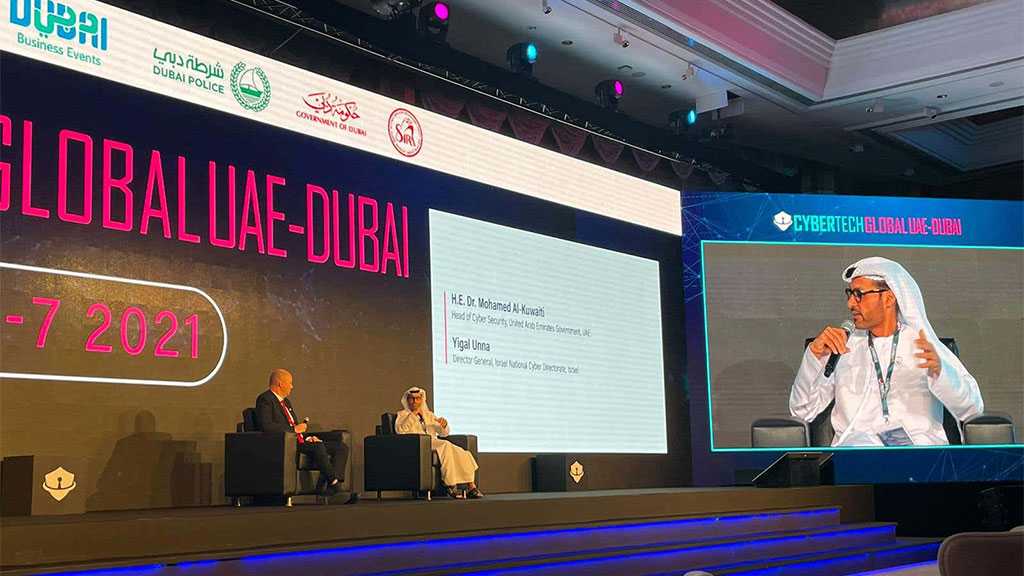
In an interview with Haaretz, the Gulf state’s head of cybersecurity Mohamed al-Kuwaiti said: “There’s good information-sharing between us – for example, the last attack that happened with Hezbollah, referring to a cyberattack by the so-called ‘Lebanese Cedar’ group in January.
According to Kuwaiti, the UAE was targeted as well. “In the case of Lebanese Cedar, it was first found by the private sector. And then through our cooperation, its findings were circulated and we searched and found some indications that this happened here, too. There’s more sharing on the side of the ‘Israeli’ partner, which allows us to share more on these aspects as well.”
In what Kuwaiti described as a sign of the close ties with “Israel”, Dubai is currently hosting a leading “Israeli” cyber conference – the first time it has been held outside the entity.
Though both the Emirati and “Israeli” officials refused to confirm that sensitive military intelligence was being shared on Iran, Kuwaiti stressed that “it doesn’t matter who’s attacking us. What we all need is to share information on defense mechanisms, the tactics, techniques and procedures used by attackers, patterns of attack and even the unique signatures that allow attribution.”
He further admitted that “there’s an increased threat because of the upgraded relationship with ‘Israel’.
There are those who don’t want to see this happen. However, this also created a lot of added-value for us,” he said.
“There are those who would love to bother us, or try to target us, to downgrade the relationship – and many of the incidents reflect this,” Kuwaiti added, explaining how the attacks targeted not just infrastructure but also more public online spaces. These include websites that suffered defacement attacks to alter existing content.
I have been going through my Asia Times archives selecting reports and columns for a new e-book on the Forever Wars – Afghanistan and Iraq. But then, out of the blue, I found this palimpsest, originally published by Asia Times in February 2014. It happened to be a Back to the Future exercise – traveling in time to survey the scene in the mid-1980s across Silicon Valley, MIT’s AI lab, DARPA and the NSA, weaving an intersection of themes, and a fabulous cast of characters, which prefigure the Brave New Techno World we’re now immersed in, especially concerning the role of artificial intelligence.
So this might be read today as a sort of preamble, or a background companion piece, to No Escape from our Techno-Feudal World, published early this month. Incidentally, everything that takes place in this account was happening 18 years before the end of the Pentagon’s LifeLog project, run by DARPA, and the simultaneous launch of Facebook. Enjoy the time travel.
In the spring of 1986, Back to the Future, the Michael J Fox blockbuster featuring a time-traveling DeLorean car, was less than a year old. The Apple Macintosh, launched via a single, iconic ad directed by Ridley (Blade Runner) Scott, was less than two years old. Ronald Reagan, immortalized by Gore Vidal as “the acting president,” was hailing the mujahideen in Afghanistan as “freedom fighters.”
The world was mired in Cyber Cold War mode; the talk was all about electronic counter-measures, with American C3s (command, control, communications) programmed to destroy Soviet C3s, and both the US and the USSR under MAD (mutually assured destruction) nuclear policies being able to destroy the earth 100 times over. Edward Snowden was not yet a three-year-old.
It was in this context that I set out to do a special report for a now-defunct magazine about artificial intelligence (AI), roving from the Computer Museum in Boston to Apple in Cupertino and Pixar in San Rafael, and then to the campuses of Stanford, Berkeley and MIT.
AI had been “inaugurated” in 1956 by Stanford’s John McCarthy and Marvin Minsky, a future MIT professor who at the time had been a student at Harvard. The basic idea, according to Minsky, was that any intelligence trait could be described so precisely that a machine could be created to simulate it.
My trip inevitably involved meeting a fabulous cast of characters. At MIT’s AI lab, there was Minsky and also an inveterate iconoclast, Joseph Weizenbaum, who had coined the term “artificial intelligentsia” and believed computers could never “think” just like a human being.
Joseph Weizenbaum. Source: Chatbots
At Stanford, there was Edward Feigenbaum, absolutely paranoid about Japanese scientific progress; he believed that if the Japanese developed a fifth-generation computer, based on artificial intelligence, that could think, reason and speak even such a difficult language as Japanese “the US will be able to bill itself as the first great post-industrial agrarian society.”
And at Berkeley, still under the flame of hippie utopian populism, I found Robert Wilensky – Brooklyn accent, Yale gloss, California overtones; and philosopher Hubert Dreyfus, a tireless enemy of AI who got his kicks delivering lectures such as “Conventional AI as a Paradigm of Degenerated Research.”
Meet Kim No-VAX
Soon I was deep into Minsky’s “frames” – a basic concept to organize every subsequent AI program – and the Chomsky paradigm: the notion that language is at the root of knowledge, and that formal syntax is at the root of language. That was the Bible of cognitive science at MIT.
Marvin Minsky at MIT Lab. Photo: Massachusetts Institute of Technology
At the MIT cafeteria, Minsky delivered a futurist rap without in the least resembling Dr Emmett Brown in Back to the Future:
I believe that in less than five centuries we will be producing machines very similar to us, representing our thoughts and point of view. If we can build a miniaturized human brain weighing, let’s say, one gram, we can lodge it in a spaceship and make it travel at the speed of light. It would be very hard to build a spaceship to carry an astronaut and all his food for 10,000 years of travel …
With Professor Feigenbaum, in Stanford’s philosophical garden, the only space available was for the coming yellow apocalypse. But then one day I crossed Berkeley’s post-hippie Rubicon and opened the door of the fourth floor of Evans Hall, where I met none other than Kim No-VAX.
No, that was not the Hitchcock blonde and Vertigo icon; it was an altered hardware computer (No-VAX because it had moved beyond Digital Equpment Corporation’s VAX line of supercomputers), financed by the mellifluously acronymed Pentagon military agency DARPA, decorated with a photo of Kim Novak and humming with the sexy vibration of – at the time immense – 2,900 megabytes of electronic data spread over its body.
The US government’s Defense Advanced Research Projects Agency – or DARPA – was all about computer science. In the mid-1980s, DARPA was immersed in a very ambitious program linking microelectronics, computer architecture and AI way beyond a mere military program. That was comparable to the Japanese fifth generation computer program. At MIT, the overwhelming majority of scientists were huge DARPA cheerleaders, stressing how the agency was leading research. Yet Terry Winograd, a computer science professor at Stanford, warned that had DARPA been a civilian agency, “I believe we would have made much more progress”.
It was up to Professor Dreyfus to provide the voice of reason amidst so much cyber-euphoria: “Computers cannot think like human beings because there’s no way to represent all retrospective knowledge of an average human life – that is, ‘common sense’ – in a form that a computer may apprehend.” Dreyfus’s drift was that with the boom of computer science, philosophy was dead – and he was a philosopher: “Heidegger said that philosophy ended because it reached its apex in technology. Philosophy in fact reached its limit with AI. They, the scientists, inherited our questions. What is the mind? Now they have to answer for it. Philosophy is over.”
Hubert Dreyfus. Source: Berkeley Campus News
Yet Dreyfus was still teaching. Likewise at MIT, Weizenbaum was condemning AI as a racket for “lunatics and psychopaths” – but still continued to work at the AI lab.
NSA’s wet web dream
In no time, helped by these brilliant minds, I figured out that the AI “secret” would be a military affair, and that meant the National Security Agency – already in the mid-1980s vaguely known as “no such agency,” with double the CIA’s annual budget to pay for snooping on the whole planet. The mission back then was to penetrate and monitor the global electronic net – that was years before all the hype over the “information highway” – and at the same time reassure the Pentagon over the inviolability of its lines of communication. For those comrades – remember, the Cold War, even with Gorbachev in power in the USSR, was still on – AI was a gift from God (beating Pope Francis by almost three decades).
So what was the Pentagon/NSA up to, at the height of the star wars hype, and over a decade and a half before the revolution in military affairs and the full spectrum dominance doctrine?
They already wanted to control their ships and planes and heavy weapons with their voices, not their hands; voice command a la Hal, the star computer in Stanley Kubrick’s 2001: A Space Odyssey. Still, that was a faraway dream. Minsky believed that “only in the next century” would we be able to talk to a computer. Others believed that would never happen. Anyway, IBM was already working on a system accepting dictation; and MIT on another system that identified words spoken by different people; while Intel was developing a special chip for all this.
Although, predictably, prevented from visiting the NSA, I soon learned that the Pentagon was expecting to possess “intelligent” computing systems by the 1990s; Hollywood, after all, already had unleashed the Terminator series. It was up to Professor Wilensky, in Berkeley, to sound the alarm bells:
Human beings don’t have the appropriate engineering for the society they developed. Over a million years of evolution, the instinct of getting together in small communities, belligerent and compact, turned out to be correct. But then, in the 20th century, man ceased to adapt. Technology overtook evolution. The brain of an ancestral creature, like a rat, which sees provocation in the face of every stranger, is the brain that now controls the earth’s destiny.
It was as if Wilensky was describing the NSA as it would be 28 years later. Some questions still remain unanswered; for instance, if our race does not fit anymore the society it built, who’d guarantee that its machines are properly engineered? Who’d guarantee that intelligent machines act in our interest?
What was already clear by then was that “intelligent” computers would not end a global arms race. And it would be a long time, up to the Snowden revelations in 2013, for most of the planet to have a clearer idea of how the NSA orchestrates the Orwellian-Panopticon complex. As for my back to the future trip, in the end I did not manage to uncover the “secret” of AI. But I’ll always remain very fond of Kim No-VAX.
Facebook, Google and Twitter are not neutral platforms.
They control the digital public square to aid the powerful – and can cancel any of us overnight
Palestinian critics say Facebook has become ‘another face of occupation’ (AFP/File photo)
There is a growing unease that the decisions taken by social media corporations can have a harmful impact on our lives. These platforms, despite enjoying an effective monopoly over the virtual public square, have long avoided serious scrutiny or accountability.
In a new Netflix documentary, The Social Dilemma, former Silicon Valley executives warn of a dystopian future. Google, Facebook and Twitter have gathered vast quantities of data on us to better predict and manipulate our desires. Their products are gradually rewiring our brains to addict us to our screens and make us more pliable to advertisers. The result, as we are consigned to discrete ideological echo chambers, is ever greater social and political polarisation and turmoil.
Western publics are waking up very belatedly to the undemocratic power social media wields over them
As if to underline the ever-tightening grip these tech corporations exert on our lives, Facebook and Twitter decided this month to openly interfere in the most contentious US presidential election in living memory. They censored a story that could harm the electoral prospects of Joe Biden, the Democratic challenger to incumbent President Donald Trump.
Given that nearly half of Americans receive their news chiefly via Facebook, the ramifications of such a decision on our political life were not hard to interpret. In excising any debate about purported corruption and influence-peddling by Biden’s son, Hunter, carried out in his father’s name, these social media platforms stepped firmly into the role of authoritarian arbiter of what we are allowed to say and know.
‘Monopoly gatekeeper’
Western publics are waking up very belatedly to the undemocratic power social media wields over them. But if we wish to understand where this ultimately leads, there is no better case study than the very different ways Israelis and Palestinians have been treated by the tech giants.
The treatment of Palestinians online serves as a warning that it would be foolish indeed to regard these globe-spanning corporations as politically neutral platforms, and their decisions as straightforwardly commercial. This is to doubly misunderstand their role.How Facebook threatens vulnerable Muslim communities Read More »
Social media firms are now effectively monopolistic communication grids – similar to the electricity and water grids, or the phone network of a quarter of a century ago. Their decisions are therefore no longer private matters, but instead have huge social, economic and political consequences. That is part of the reason why the US justice department launched a lawsuit last week against Google for acting as a “monopoly gatekeeper for the internet”.
Google, Facebook and Twitter have no more a right to arbitrarily decide who and what they host on their sites than telecoms companies once had a right to decide whether a customer should be allowed a phone line. But unlike the phone company, social media corporations control not just the means of communication, but the content too. They can decide, as the Hunter Biden story shows, whether their customers get to participate in vital public debates about who leads them.
The Hunter Biden decision is as if the phone company of old not only listened in to conversations, but was able to cut the line if it did not like the politics of any particular customer.
In fact, it is even worse than that. Social media now deliver the news to large sections of the population. Their censoring of a story is more akin to the electricity company turning off the power to everyone’s homes for the duration of a TV broadcast to ensure no one can see it.
Censorship by stealth
The tech giants are the wealthiest, most powerful corporations in human history, their riches measured in hundreds of billions, and now trillions, of dollars. But the argument that they are apolitical – aiming simply to maximise profits – was never true.
They have every reason to promote politicians who side with them by committing not to break up their monopolies or regulate their activities, or, better still, by promising to weaken controls that might prevent them from growing even more fabulously rich and powerful.
Social media algorithms help drive decisions on content removal (AFP/File photo)
Conversely, the tech giants also have every incentive to use the digital space to penalise and marginalise political activists who urge greater regulation either of their activities, or of the marketplace more generally.
Unlike their explicit deletion of the Hunter Biden story, which incensed the Trump administration, social media corporations more usually censor by stealth. That power is wielded through algorithms, the secret codes that decide whether something or someone appears in a search result or on a social media feed. If they desire, these tech titans can cancel any one of us overnight.
This is not just political paranoia. The disproportionate impact of algorithm changes on “left-leaning” websites – those most critical of the neoliberal system that has enriched social media corporations – was highlighted this month by the Wall Street Journal.
Wrong kinds of speech
Politicians increasingly understand the power of social media, which is why they want to harness it as best they can for their own ends. Since the shock of Trump’s election victory in late 2016, Facebook, Google and Twitter executives have regularly found themselves dragged before legislative oversight committees in the US and UK.
There, they are ritually rebuked by politicians for creating a crisis of “fake news” – a crisis that, in fact, long predated social media, as the deceptions of US and UK officials in linking Saddam Hussein to 9/11 and claiming that Iraq had “weapons of mass destruction” testify to only too clearly.
The online fate of Palestinians points to a future in which the already-powerful will gain ever greater control over what we know and what we are allowed to think
Politicians have also begun holding internet corporations responsible for “foreign interference” in western elections – typically blamed on Russia – despite a dearth of serious evidence for most of their allegations.
Political pressure is being exerted not to make the corporations more transparent and accountable, but to steer them towards enforcing even more assiduously restrictions on the wrong kinds of speech – whether it be violent racists on the right or critics of capitalism and western government policy on the left.
For that reason, social media’s original image as a neutral arena of information sharing, or as a tool for widening public debate and increasing civic engagement, or as a discourse leveller between the rich and powerful and weak and marginalised, grows ever more hollow.
Separate digital rights
Nowhere are ties between tech and state officials more evident than in their dealings with Israel. This has led to starkly different treatment of digital rights for Israelis and Palestinians. The online fate of Palestinians points to a future in which the already-powerful will gain ever greater control over what we know and what we are allowed to think, and over who is visible and who is erased from public life.
Israel was well-positioned to exploit social media before most other states had recognised its importance in manipulating popular attitudes and perceptions. For decades, Israel had, in part, outsourced an official programme of hasbara – or state propaganda – to its own citizens and supporters abroad. As new digital platforms emerged, these partisans were only too willing to expand their role.Facebook accused of censoring Palestinians under pretext of fighting hate speech Read More »
Israel had another advantage. After the 1967 occupation of the West Bank, Jerusalem and Gaza, Israel began crafting a narrative of state victimhood by redefining antisemitism to suggest it was now a particular affliction of the left, not the right. So-called “new antisemitism” did not target Jews, but related instead to criticism of Israel and support for Palestinian rights.
This highly dubious narrative proved easy to condense into social media-friendly soundbites.
Israel still routinely describes any Palestinian resistance to its belligerent occupation or its illegal settlements as “terrorism”, and any support from other Palestinians as “incitement”. International solidarity with Palestinians is characterised as “delegitimisation” and equated with antisemitism.
‘Flood the internet’
As far back as 2008, it emerged that a pro-Israel media lobby group, Camera, had been orchestrating covert efforts by Israel loyalists to infiltrate the online encyclopedia Wikipedia to edit entries and “rewrite history” in ways favourable to Israel. Soon afterwards, politician Naftali Bennett helped organise courses teaching “Zionist editing” of Wikipedia.
In 2011, the Israeli army declared social media a new “battleground” and assigned “cyber warriors” to wage combat online. In 2015, Israel’s foreign ministry set up an additional command centre to recruit young, tech-savvy former soldiers from 8200, the army’s cyber intelligence unit, to lead the battle online. Many have gone on to establish hi-tech firms whose spying software became integral to the functioning of social media.
Israeli Prime Minister Benjamin Netanyahu attends a 2019 cyber industry conference in Tel Aviv (AFP)
An app launched in 2017, Act.IL, mobilised Israel partisans to “swarm” sites hosting either criticism of Israel or support for Palestinians. The initiative, supported by Israel’s Ministry of Strategic Affairs, was headed by veterans of Israeli intelligence services.
According to the Forward, a US Jewish weekly, Israel’s intelligence services liaise closely with Act.IL and request help in getting content, including videos, removed by social media platforms. The Forward observed shortly after the app was rolled out: “Its work so far offers a startling glimpse of how it could shape the online conversations about Israel without ever showing its hand.”
Sima Vaknin-Gil, a former Israeli military censor who was then assigned to Israel’s strategic affairs ministry, said the goal was to “create a community of fighters” whose job was to “flood the internet” with Israeli propaganda.
Willing allies
With advantages measured in personnel numbers and ideological zeal, in tech and propaganda experience, and in high-level influence in Washington and Silicon Valley, Israel was soon able to turn social media platforms into willing allies in its struggle to marginalise Palestinians online.
In 2016, Israel’s justice ministry was boasting that Facebook, Google and YouTube were “complying with up to 95 percent of Israeli requests to delete content”, almost all of it Palestinian. The social media companies did not confirm this figure.
The Anti-Defamation League, a pro-Israel lobby group with a history of smearing Palestinian organisations and Jewish groups critical of Israel, established a “command centre” in Silicon Valley in 2017 to monitor what it termed “online hate speech”. That same year, it was appointed a “trusted flagger” organisation for YouTube, meaning its reporting of content for removal was prioritised.
Tech corporations are now the undeclared, profit-driven arbiters of our speech rights. But their commitment is not to open and vigorous public debate
At a 2018 conference in Ramallah hosted by 7amleh, a Palestinian online advocacy group, local Google and Facebook representatives barely hid their priorities. It was important to their bottom line to avoid upsetting governments with the power to constrain their commercial activities – even if those governments were systematically violating international law and human rights. In this battle, the Palestinian Authority carries no weight at all. Israel presides over Palestinians’ communications and internet infrastructure. It controls the Palestinian economy and its key resources.
Since 2016, Israel’s justice ministry has reportedly suppressed tens of thousands of Palestinian posts. In a completely opaque process, Israel’s own algorithms detect content it deems “extremist” and then requests its removal. Hundreds of Palestinians have been arrested by Israel over social media posts, chilling online activity.
Human Rights Watch warned late last year that Israel and Facebook were often blurring the distinction between legitimate criticism of Israel and incitement. Conversely, as Israel has shifted ever further rightwards, the Netanyahu government and social media platforms have not stemmed a surge of posts in Hebrew promoting anti-Palestinian incitement and calling for violence. 7amleh has noted that Israelis post racist or inciteful material against Palestinians roughly every minute.
News agencies shut down
As well as excising tens of thousands of Palestinian posts, Israel has persuaded Facebook to take down the accounts of major Palestinian news agencies and leading journalists.
By 2018, the Palestinian public had grown so incensed that a campaign of online protests and calls to boycott Facebook were led under the hashtag “FBcensorsPalestine”. In Gaza, demonstrators accused the company of being “another face of occupation”. Leila Khaled shutdown shows how corporate tech is enemy of free speechRead More »
Activism in solidarity with Palestinians in the US and Europe has been similarly targeted. Ads for films, as well as the films themselves, have been taken down and websites removed.
Last month, Zoom, a video conferencing site that has boomed during the Covid-19 pandemic, joined YouTube and Facebook in censoring a webinar organised by San Francisco State University because it included Leila Khaled, an icon of the Palestinian resistance movement now in her seventies.
On Friday, Zoom blocked a second scheduled appearance by Khaled – this time in a University of Hawaii webinar on censorship – as well as a spate of other events across the US to protest against her cancellation by the site. A statement concerning the day of action said campuses were “joining in the campaign to resist corporate and university silencing of Palestinian narratives and Palestinian voices”.
The decision, a flagrant attack on academic freedom, was reportedly taken after the social media groups were heavily pressured by the Israeli government and anti-Palestinian lobby groups, which labelled the webinar “antisemitic”.
Wiped off the map
The degree to which the tech giants’ discrimination against Palestinians is structural and entrenched has been underscored by the years-long struggle of activists both to include Palestinian villages on online maps and GPS services, and to name the Palestinian territories as “Palestine”, in accordance with Palestine’s recognition by the United Nations.
That campaign has largely floundered, even though more than a million people have signed a petition in protest. Both Google and Apple have proved highly resistant to these appeals; hundreds of Palestinian villages are missing from their maps of the occupied West Bank, while Israel’s illegal settlements are identified in detail, accorded the same status as the Palestinian communities that are shown.
New houses being built in the Nokdim settlement in the occupied West Bank on 13 October (AFP)
The occupied Palestinian territories are subordinated under the name “Israel”, while Jerusalem is presented as Israel’s unified and undisputed capital, just as Israel claims – making the occupation of the Palestinian section of the city invisible.
These are far from politically neutral decisions. Israeli governments have long pursued a Greater Israel ideology that requires driving Palestinians off their lands. This year, that dispossession programme was formalised with plans, backed by the Trump administration, to annex swathes of the West Bank.
Google and Apple are effectively colluding in this policy by helping to erase Palestinians’ visible presence in their homeland. As two Palestinian scholars, George Zeidan and Haya Haddad, recently noted: “When Google and Apple erase Palestinian villages from their navigation, but proudly mark settlements, the effect is complicity in the Israeli nationalist narrative.”
Out of the shadows
Israel’s ever-tightening relationship with social media corporations has played out largely behind the scenes. But these ties moved decisively out of the shadows in May, when Facebook announced that its new oversight board would include Emi Palmor, one of the architects of Israel’s online repression policy towards Palestinians.
Palestinians know only too well how easy it is for technology to diminish and disappear the voices of the weak and oppressed, and to amplify the voices of the powerful
The board will issue precedent-setting rulings to help shape Facebook’s and Instagram’s censorship and free speech policies. But as the former director-general of the justice ministry, Palmor has shown no commitment to online free speech. Quite the reverse: she worked hand-in-hand with the tech giants to censor Palestinian posts and shut down Palestinian news websites. She oversaw the transformation of her department into what the human rights organisation Adalah has called the Orwellian “Ministry of Truth”.
Tech corporations are now the undeclared, profit-driven arbiters of our speech rights. But their commitment is not to open and vigorous public debate, online transparency or greater civic engagement. Their only commitment is to the maintenance of a business environment in which they avoid any regulation by major governments infringing on their right to make money.
The appointment of Palmor perfectly illustrates the corrupting relationship between government and social media. Palestinians know only too well how easy it is for technology to diminish and disappear the voices of the weak and oppressed, and to amplify the voices of the powerful.
Many more of us could soon find ourselves sharing the online fate of Palestinians.
The views expressed in this article belong to the author and do not necessarily reflect the editorial policy of Middle East Eye.Jonathan CookJonathan Cook, a British journalist based in Nazareth since 2001, is the the author of three books on the Israeli-Palestinian conflict. He is a past winner of the Martha Gellhorn Special Prize for Journalism. His website and blog can be found at: http://www.jonathan-cook.net
The General Staff of the Iranian Armed Forces warned that cyber threats from any state, group or individual against Iran will be responded to decisively.
The General Staff of Iran’s Armed Forces on Monday issued a statement about the cyberspace international law.
According to the statement, the Iranian Armed Forces believe that the cyberattacks resulting in financial damages or harm to people amount to the use of force.
“If such operations affect the national vital infrastructures, including the defense infrastructures, they would naturally violate the principle of use of force, be it under the ownership of the government or the private sector,” it added.
The statement also emphasized that the Iranian Armed Forces will reserve the right of self-defense if the intensity of a cyberattack on Iran’s vital infrastructures reaches the threshold of a conventional armed attack.
It added that Iran would never start a conflict in the cyberspace, but warned that any violation of the guidelines and policies mentioned in the statement from any government, group and individual sponsored or directed by any state would allow the Iranian Armed Forces to give a vigorous response to the threats at any level.
In remarks in July, Iran’s Foreign Ministry spokesperson said Tehran reserves the right to resort to the cyberspace or any other means to respond to the cyberattacks launched by foreign governments and regimes.
“Iran reserves the right to take the appropriate and proportional reciprocal action at the appropriate time. We may employ any tool to defend ourselves against the cyberattacks, including the cyberspace or other weaponry. Moreover, we will do our utmost to prove the international responsibility of the country starting or facilitating such attacks, and to make them be held accountable for their illegal measures,” the spokesman said.
On July 21st, the UK’s Intelligence and Security Committee of Parliament (ISC) released a report specifically on Russia and the challenges it presents, as well as recommendations on how to deal with it. [pdf]
The ISC makes a number of points, mostly focused on the presumed Russian intervention in the UK political and economic life. They are:
Russian influence in the UK is the new normal. Successive Governments have welcomed the oligarchs and their money with open arms, providing them with a means of recycling illicit finance through the London ‘laundromat’, and connections at the highest levels with access to UK companies and political figures.
This has led to a growth industry of ‘enablers’ including lawyers, accountants, and estate agents who are – wittingly or unwittingly – de facto agents of the Russian state.
It demonstrates the inherent tension between the Government’s prosperity agenda and the need to protect national security. While we cannot now shut the stable door, greater powers and transparency are needed urgently.
The UK is a target for Russian disinformation. While the mechanics of our paper-based voting system are largely sound, we cannot be complacent about a hostile state taking deliberate action with the aim of influencing our democratic processes.
Yet the defense of those democratic processes has appeared something of a ‘hot potato’, with no one organization considering itself to be in the lead, or apparently willing to conduct an assessment of such interference. This must change.
Social media companies must take action and remove covert hostile state material: Government must ‘name and shame’ those who fail to act.
The UK needs other countries to step up with the UK and attach a cost to Putin’s actions. Salisbury must not be allowed to become the high water mark in international unity over the Russia threat.
The entire report is actually just a fraction, since there is a Classified Annex that contains most of the issues that are being discussed and are not available for open access.
Okay, so “What does Russia want?”, according to the ISC:
“The security threat posed by Russia is difficult for the West to manage as, in our view and that of many others, it appears fundamentally nihilistic. Russia seems to see foreign policy as a zero-sum game: any actions it can take which damage the West are fundamentally good for Russia. It is also seemingly fed by paranoia, believing that Western institutions such as NATO and the EU have a far more aggressive posture towards it than they do in reality. There is also a sense that Russia believes that an undemocratic ‘might is right’ world order plays to its strengths, which leads it to seek to undermine the Rules Based International Order – whilst nonetheless benefitting from its membership of international political and economic institutions.”
Russia, according to the report, also wishes to show that it is a “great power” no less than the former Soviet Union, and possibly even more so.
And the UK is a target since Russia “apparently” considers London as one of its top Western intelligence targets. That is primarily because of the good job that the UK has been doing in countering “Russian aggression.”
“This perception will have been reinforced by the UK’s firm stance recently in response to Russian aggression: following the UK-led international response to the Salisbury attack – which saw an unprecedented 153 Russian intelligence officers and diplomats expelled from 29 countries and NATO – it appears to the Committee that Putin considers the UK to be a key diplomatic adversary. The threat to the UK – and any changes to this following the actions taken in response to the Salisbury attack – is described in this Report, together with the action that the UK Intelligence Community is taking to counter those threats.”
The report provides several areas that need improvement in terms of the fight against Russia:
The Government Communications Headquarter (GCHQ) assesses that Russia is a highly capable cyber actor with a proven capability to carry out operations which can deliver a range of impacts across any sector. It’s allegedly been doing so since 2014, including GRU agents carrying out alleged phishing operations against UK government departments.
The spreading of disinformation (by which we mean the promotion of intentionally false, distorting or distracting narratives) and the running of ‘influence campaigns’ are separate but interlinked subjects. An influence campaign in relation to an election, for example, may use the spreading of disinformation, but may also encompass other tactics such as illicit funding, disruption of electoral mechanics or direct attacks on one of the campaigns (such as ‘hack and leak’). Equally, the spreading of disinformation is not necessarily aimed at influencing any individual outcome.
Whilst the Russian elite have developed ties with a number of countries in recent years, it would appear that the UK has been viewed as a particularly favourable destination for Russian oligarchs and their money. “What is now clear is that it was in fact counte-productive, in that it offered ideal mechanisms by which illicit finance could be recycled through what has been referred to as the London ‘laundromat’.
The report emphasizes that Russia currently poses a significant threat to the UK on a number of fronts – from espionage to interference in democratic processes, and to serious crime. It continues that the response needs to be combined from all UK security and intelligence agencies, government bodies, included with the ministers of government, as well as the ISC. This will require renewed doctrines, more and improved projects.
And this will not be an easy feat:
“As already noted, the Russian government is an accomplished adversary with well-resourced and world-class offensive and defensive intelligence capabilities. The well-publicised mistakes Russian operatives made in Salisbury, and later in trying to infiltrate the Organisation for the Prohibition of Chemical Weapons (OPCW), have led to public speculation about the competence of the Russian Intelligence Services (RIS), and the GRU in particular. Whilst these attacks demonstrate that the RIS are not infallible, it would be foolhardy to think that they are any less dangerous because of these mistakes. Indeed, the likelihood is that the RIS will learn from their errors, and become more difficult to detect and protect against as a result.”
Of course, none of this can be achieved without due support from international partners such as the US, NATO and others.
Russia, however, supposedly can’t rely on allies, at least not as much as the UK:
“By contrast to the West, Russia has traditionally been suspicious of building significant international partnerships. However, we note that in recent years it has been proactive in seeking ‘alliances of convenience’ across the world. This has included deepened defense and security co-operation with China, as a useful partner against the US (going so far as to conduct joint military exercises), increased influence in South America, and substantive engagement in several African countries, including widespread trade campaigns.”
It’s interesting to note that to motivate the need of the expanded campaign against Russia, the report is extensively using such terms as “open source studies”, including some mysterious “credible open source commentary”, and complains about the “fundamentally nihilistic” approach of Russia.
Indeed, if one translates the report wording from the mainstream propaganda language to the ordinary English, the British government and special services complain that they have not enough leverages of pressure and instruments to influence Russia and needs to expand clandestine, diplomatic and propaganda campaigns against Moscow. At the same time, London tries to demonize tactical successes of the Russian state to inform the English-speaking audience of its point of view through diplomatic channels and English-language state media like RT and Sputniknews.
Probably, the main point of the concern for London is that in the conditions of the crumbling neo-liberal narrative (due to the global economic crisis, the COVID-19 outbreak and a series of crises in base states for the Euro-Atlantic establishment), the Russian behavior on the international arena became attractive for the part of the European and American population, which is still not fully indocrinated by the mainstream propaganda.
The Russian side has already denied all the accusations provided by the report of the UK Intelligence and Security Committee. Maria Zakharova, the spokesperson for the Russian Foreign Ministry said that it has shown “nothing sensational” and is just “fake shaped Russophobia.”
In response to the report, the Kremlin spokesperson Dmitry Peskov made a statement:
“Russia has never interfered in electoral processes in any country of the world: not in the United States, not in Great Britain, or in other countries. We do not do it ourselves and do not tolerate when other countries try to interfere in our political affairs,” Peskov told reporters.
The head of the international committee of the Federation Council, Konstantin Kosachev, believes that by criticizing Russia, Britain is trying to regain its positions in European politics.
“I am convinced that the reason for the appearance of such an odious report is the attempts of the British authorities to regain the European palm at any cost … And why not lead in Russophobia? While in the European Union, London lost some of its brilliance against the background of the Young Europeans, competing with each other, which of them in exchange for European dividends could ruin relations with our country more abruptly,” he wrote on Facebook.
It’s unlikely that the Russian statements will convince anybody in the British establishment because the main goal of the report was not to find the truth but to set conditions for a further action against Moscow.
At the same time, the content of the entire report is quite funny as the side blaming Moscow for the supposed “fundamentally nihilistic” approach and simultaneously proposing employing various propaganda, intelligence and censorship methods against the alternative point of view. Such complains are only fueling this ‘Russia-styled fundamental nihilism’ among the audience, which still is able to have own critical point of view and like to check facts. This demonstrates a sad tendency of the falling level of competence among personnel (including agents, analysis and propagandists) of the Western special services. These agencies are now forced to be fully in the framework of the neo-liberal, minorities-ruled agenda employing the policy of ‘tolerance’ and ‘inclusivity’ promoted by the globalists. Apparently, personal details of particular personnel have become more important that their skills.
Since the very start of SouthFront work, our team has been repeatedly accused of intervening in various processes in the ‘democratic countries’ and spreading top-notch ‘disinformation’ on the highest level (including press briefings of the US Department of State and reports by the French Defense Ministry). And we are not going to stop on this. So, if you want to fuel some more ‘nihilism’ and coverage that disturb the Euro-Atlantic establishment and globalists, support our work.
The Throne Of Saint Jewry
-
The Throne Of Saint Jewry November 12 2026
___________________________________ More Vids! +BN Vids Archive! HERE!
___________________________________ Suppo...
Cracks in the foundations of Pax Judaica
-
World Jewry is terrified of the Kushner revelations from Cole as they
attack the foundations of Pax Judaica. We already know the basic facts of
the corrupt...
Report on Beth Israel vigil 09-12-26
-
*Eat-a-Cheeseburger Day Approaches*
This year, EAC Day appears on Monday, September 21st. The date coincides
with the Jewish holiday called Yom Kippur. Cl...
-
Hello all,
It is with great sadness that I share with you the passing of our beloved
sister, Mother, and Grandmother, the individual that you all knew ...
Best Horror Podcast
-
Best Horror Podcast Introduction: Horror podcasts […]
The post Best Horror Podcast appeared first on Copper Shock Horror Podcast.
Ikhras Endorses Muntadhar Al-Zaidi
-
“Oh parties of banditry and sectarianism and corruption, we have come and
our goal is to destroy you.” Ikhras formally endorses Muntadhar al-Zaidi,
Iraqi j...
Prince Charles: Foreign Jews behind bloodshed in ME
-
In May, 2017, British Crown Prince Charles declined an invitation from
Zionist entity’s president Reuven Rivlin‘s to attend the 100th anniversary
of the no...
Palestinian Women – One for All, All for One
-
Honouring All Palestinian Women by Honouring Three: Hanin Zoabi, Ahed
Tamimi, Samah Sabawi Vacy Vlazna “Palestinian women have always stood side
by side ...
US’s Saudi Oil Deal from Win-Win to Mega-Lose
-
By F. William Engdahl Who would’ve thought it would come to this? Certainly
not the Obama Administration, and their brilliant geo-political think-tank
neo-...
-
*Mordechai Vanunu wins human rights prize of Brazilian Press Association *
* http://www.alternativenews.org/english/index.php/features/updates/7038-mordechai...
Abdul Aziz Rantissi:
"My ultimate wish, my God, is to attain martyrdom,"...God granted him his wish on April 17, 2004, at the hands of Israeli assassins.