Showing posts with label OPEC. Show all posts

Saturday, 7 August 2021

Raeisi Takes Oath of Office as Iran’s 8th President

  August 6, 2021

By Staff, Agencies

After having his mandate endorsed by Leader of the Islamic Revolution His Eminence Imam Sayyed Ali Khamenei, Sayyed Ebrahim Raeisi has taken the oath of office to be officially inaugurated as the eighth president of the Islamic Republic of Iran.

The swearing-in ceremony was held at the Iranian parliament on Thursday afternoon, attended by high-ranking Iranian civil and military officials as well as a great number of foreign dignitaries from more than 70 countries.

The ceremony started with a speech by Iran’s Parliament Speaker Mohammad Baqer Qalibaf followed by an address delivered by head of Iran’s Judiciary Gholamhossein Mohseni Ejei.

After speeches were delivered by heads of the Judiciary and Legislature, Ebrahim Raeisi took to the podium to be sworn in as Iran’s eighth president following the Islamic Revolution of 1979.

During the oath-taking ceremony, Raeisi read out the text of the oath, which says, “I, as the President, upon the Holy Qur’an and in the presence of the Iranian nation, do hereby swear in the name of Almighty God to safeguard the official Faith, the system of the Islamic republic and the Constitution of the country; to use all my talents and abilities in the discharge of responsibilities undertaken by me; to devote myself to the service of the people, glory of the country, promotion of religion and morality, support of right and propagation of justice; to refrain from being autocratic; to protect the freedom and dignity of individuals and the rights of the nation recognized by the Constitution; to spare no efforts in safeguarding the frontiers and the political, economic and cultural freedoms of the country; to guard the power entrusted to me by the nation as a sacred trust like an honest and faithful trustee, by seeking help from God and following the example of the Prophet of Islam and the sacred Imams, peace be upon them, and to entrust it to the one elected by the nation after me.”

Addressing the inaugural ceremony, Iranian Parliament Speaker Mohammad Baqer Qalibaf first welcomed the Iranian and foreign guests of the ceremony.

Iran’s top diplomat then focused on the problems facing the country and the nation in his speech, especially economic problems, stressing the importance of taking decisive steps to solve people’s problems without bringing any excuses.

“We have entered a new phase of management in the country. The [Iranian] people, through their participation in the parliamentary and presidential elections, gave us the opportunity to solve people’s problems, particularly those problems that are nagging the underprivileged and middle classes, in order to prove that a Jihadi [strong and relentless] managerial system is the solution to all material and spiritual problems in the country,” he said.

Iran’s parliament speaker emphasized the importance of boosting the efficiency and accountability in the country to make progress during the new phase of governance, saying that all Iranian officials are duty-bound to restore the economic stability, hope and cheerfulness to the country and its people.

The administration shoulders the main responsibility in this regard because it possesses the highest executive capacities of the country, Qalibaf said, adding, however, that synergy and cooperation among all branches of the government will play a leading role in solving the country’s problems.

“We know that the enemy’s threats and sanctions have created difficulties in the country’s management, but there are also considerable God-given, popular, economic and international capacities that can help us overcome these challenges,” the top Iranian parliamentarian pointed out.

Addressing the ceremony, Mohseni Ejei expressed the readiness of the Judiciary to help the administration fight against corruption.

According to the Constitution, he added, the president is the highest ranking official in the country after the Leader and shoulders the responsibility to execute the Constitution except for those affairs relating to the Leader.

He wished success for the president in fulfilling such an important responsibility in cooperation with other branches of the government, the elite and the public.

He expressed hope that Raeisi would take swift steps to solve the people’s problems at the earliest, eliminate corruption and discrimination and amend complicated administrative structures.

“Iran’s Judiciary will be more serious than ever in the fight against corruption,” Mohseni Ejei said.

According to Seyyed Nezamoddin Mousavi, the spokesman for the Parliament’s presiding board, long lists of foreign officials and political figures have accepted Iran’s invitation to attend the event despite the COVID-19 pandemic.

More than 100 officials from 73 countries took part in Raeisi’s inauguration ceremony, including 10 heads of state, 20 parliament speakers, 11 foreign ministers and 10 ministers, as well as special envoys, deputy parliament speakers and chairmen of parliamentary commissions and parliamentary delegations.

A high-level delegation from the European Union [EU], led by the Deputy Secretary General of the European External Action Service Enrique Mora, has participated in Raeisi’s inauguration. Mora is accompanied by Stephan Klement, head of the EU delegation to the international organizations in Vienna, and Head of Task Force European Union Bruno Scholl.

Afghanistan’s President Ashraf Ghani is also taking part in Raeisi’s swearing-in ceremony.

A high-ranking delegation representing the Palestinian Hamas movement also arrived in the Iranian capital at dawn Thursday to attend the inauguration of president-elect Ibrahim Raeisi. The Hamas delegation is led by head of the movement’s political office, Ismail Haniyeh.

Syrian Parliament Speaker Hammouda Sabbagh is also present at new Iranian president’s inauguration ceremony, representing the Arab country’s President Bashar al-Assad.

The heads of 11 international and regional organizations and the representative of the UN chief; officials from the Inter-Parliamentary Union [IPU], including its President Duarte Pacheco; the Economic Cooperation Organization [ECO]; the Conference on Interaction and Confidence-Building Measures in Asia [CICA] and the D-8 Organization for Economic Cooperation also known as Developing-8 are also present at the event.

The Organization of the Petroleum Exporting Countries [OPEC]’s Secretary General Mohammed Sanusi Barkindo, President of Iraq’s semi-autonomous Kurdistan Region Nechirvan Barzani and Serbia’s Parliament Speaker Ivica Dacic are among the guests at the inauguration ceremony.

Some 170 domestic and foreign journalists have been invited to provide coverage of the event.

Related Video


Related Articles

River to Sea Uprooted Palestinian   
The views expressed in this article are the sole responsibility of the author and do not necessarily reflect those of the Blog!

Sunday, 11 July 2021

Saudi Arabia and the UAE: When crown princes fall out

Andreas Krieg

6 July 2021 

Dr. Andreas Krieg is an assistant professor at the Defence Studies Department of King’s College London and a strategic risk consultant working for governmental and commercial clients in the Middle East. He recently published a book called ‘Socio-political order and security in the Arab World’.

The growing divergence of interests between the two neighbours has created serious cracks in the thin veneer of their once-hailed ‘strategic entente’


Abu Dhabi Crown Prince Mohammed bin Zayed meets Saudi Crown Prince Mohammed bin Salman in Jeddah in 2018 (Bandar al-Jaloud/Saudi Royal Palace/AFP)

They were the Gulf power couple of the Trump era: the two crown princes and de facto rulers of the UAE and Saudi Arabia shook up the region, imposing their will on their neighbours.

Ever since Abu Dhabi strongman Mohammed bin Zayed (MBZ) took Mohammed bin Salman (MBS) under his wing in 2015, the latter did not seem bothered at being framed as the former’s protege. The notion in Riyadh was that Abu Dhabi’s model of authoritarian liberalisation could be one to emulate, bringing the kingdom from the Middle Ages into the 21st century. 

As MBS now sits more firmly in the driver’s seat in Riyadh, the honeymoon period between the crown princes is certainly over

But over the past two years, it has dawned on MBS’s inner circle that the assumed ally next door was not interested in creating win-win situations for both states. Rather, the UAE’s assertive zero-sum mentality – emboldened by former US President Donald Trump’s laissez-faire Middle East policy – often came at the expense of Saudi interests.

The rise of the UAE as arguably the most powerful Arab state over the past decade has only been possible because Abu Dhabi ruthlessly pursues its own interests, with little regard for Riyadh’s reputational struggle in Washington, security concerns in Yemen, urgent need for economic diversification and existential dependence on stable oil prices. 

Since 2019, the growing divergence of interests between the two neighbours has created serious cracks in the thin veneer of their once-hailed “strategic entente”. The relationship between Riyadh and Abu Dhabi in recent years has been underwritten by ideological synergies over the UAE’s grand strategic counterrevolutionary narratives, including securitising political Islam, the Muslim Brotherhood and civil society more widely.

While these synergies remain, the other factor that has traditionally sustained this bilateral relationship – the personal ties between MBZ and MBS – has suffered, as the leader-to-leader relationship has noticeably cooled since the election of US President Joe Biden

Buying political credit

While the two leaders previously cemented their “bromance” with joint hunting trips, official state visits and phone calls, according to press releases, MBS and MBZ have spoken only once since the Trump era came to an end. It became clear that under Biden, Washington would withdraw its carte blanche for Riyadh and Abu Dhabi to do as they pleased in the region. Both needed to buy credit with the new administration and the Democrats in Washington.

Instead of featuring as the bullies in the region, both MBS and MBZ needed to reframe their image as more constructive players, eager to support the Biden administration’s soft-handed regional policy of leading from behind.  

When Trump got elected in 2016, MBZ personally visited the Trump team in New York, lobbying for his protege MBS as the next king. Four years later, with a Democrat elected president, the UAE is noticeably trying to create distance between itself and the Saudi leadership. Any affiliation with MBS is seen as potentially tainting Emirati efforts to turn the country’s image around.


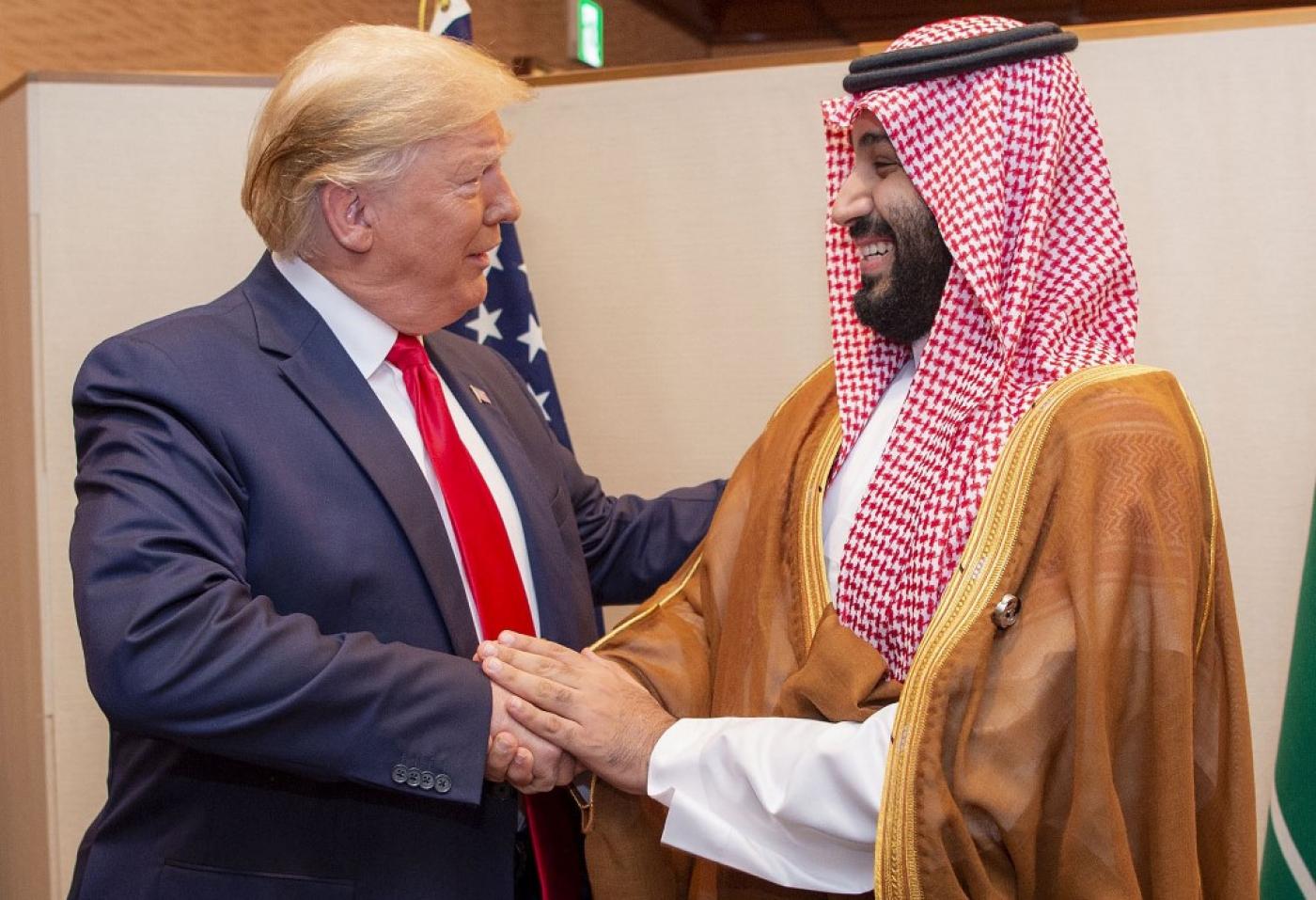
US President Donald Trump shakes hands with MBS at the 2019 G20 Summit in Osaka, Japan (Bandar al-Jaloud/Saudi Royal Palace/AFP)

Under pressure for its joint ventures with Moscow in Libya, its mercenary adventures in Yemen, and its rise as a force multiplier for China’s global information power, Abu Dhabi has demonstrated that its zero-sum mentality means it is willing to throw a “strategic ally” under the bus. 

The war in Yemen, which the UAE helped to frame as “Saudi-led”, was the first arena in which the Saudi leadership learned that Emirati policy was ruthless when it came to preserving the UAE’s interests, even at the expense of Saudi Arabia.

Some in MBS’s circles have, according to sources close to the palace, raised concerns that MBZ might have pushed Saudi Arabia into risky adventures in order to create a shield behind which the UAE could consolidate its gains in Yemen’s south.

While Saudi Arabia had to bear the operational and reputational burdens of the costly war against the Houthis, Abu Dhabi secured its foothold along Yemen’s strategically important coastline via its surrogate, the Southern Transitional Council.  

Left out in the cold

The UAE’s comet-like rise amid the regional power vacuum left by a disengaging US created the illusion in Abu Dhabi that, as the new middle power in the Gulf, it would not need to yield to anyone. The ongoing standoff between the UAE and Saudi Arabia within the Organization of the Petroleum Exporting Countries (OPEC) shows that Abu Dhabi is confident to stand its ground.

The UAE will not compromise on national interests, even if it comes to the detriment of Saudi Arabia, as with Abu Dhabi’s blatant ignoring of OPEC output quotas.

On the issue of the Qatar blockade, where MBZ led and MBS willingly followed, the UAE showed very little willingness to compromise. Although the reputational and political costs of the ongoing blockade continued to rise for both – especially in Washington – Abu Dhabi was willing to sustain it in the interests of its counterrevolutionary crusade.The Saudi-Emirati axis: United against Gulf unity

In the end, Saudi Arabia broke ranks and let pragmatism prevail. Ending the blockade was a first sign of Saudi leadership in the Gulf under MBS, which Riyadh viewed as a win-win opportunity for the blockading quartet and for Qatar. Abu Dhabi, on the other hand, was deeply concerned about the pace and depth of normalisation, which not only pressured the Emiratis to fall in line, but allowed MBS to reap the positive messages.

This was just the beginning. Left out in the cold time and again by its neighbour, Saudi Arabia has since embarked on its own more assertive strategy for diversification. The kingdom’s new economic policies, aiming to attract investments from multinationals based in the UAE, directly target the success story of Dubai, which has been in economic limbo since the start of the Covid-19 pandemic. 

The unhealthy nature of this competition means that it becomes ever-more difficult to create win-win situations. And as MBS now sits more firmly in the driver’s seat in Riyadh, the honeymoon period between the crown princes is certainly over.

As the gloves come off, MBS is eager to show that Abu Dhabi has been punching above its weight, and that there are limits to smart power in compensating for lack of size. Nonetheless, their relations remain underwritten by ideological synergies over fears of political Islam, the Muslim Brotherhood and civil society. It remains to be seen whether this is enough to prevent another Gulf crisis.

The views expressed in this article belong to the author and do not necessarily reflect the editorial policy of Middle East Eye.

This article is available in French on Middle East Eye French edition.


River to Sea Uprooted Palestinian   
The views expressed in this article are the sole responsibility of the author and do not necessarily reflect those of the Blog!

Thursday, 1 July 2021

China’s Communist Party – A 100-Year Legacy of Success and a Forward Vision

 June 30, 2021

China’s Communist Party – A 100-Year Legacy of Success and a Forward Vision

By Peter Koenig with permission and written for China’s Chongyang Institute of the Renmin University in Beijing – for the 100 Anniversary – 1 July 2021 – of China’s Communist Party.

The legendary Chinese success story goes hand-in-hand with the evolution of the Communist Party of China (CPC) and China’s Communist Revolution that began in 1945. The foundation of the CPC on 1 July 1921 signaled the end of some 200 years of China’s oppression by foreign powers, to western invasions and exploitation, grabbing China’s territories and especially her rich natural resources – and to gain trading advantages, including from the riches of China’s resources and crafts.

Background and History
About two centuries ago, foreign interferences were dominated by illegal Opium Trade that eventually culminated in two Opium WarsIn the 18th and 19th centuries Western countries, mostly Great Britain, exported opium grown in India to China. In turn, the Brits used the profits from opium sales largely to buy Chinese luxury goods, like porcelain, silk, and tea. These goods were in high demand in the west.

Much of this opium export was illegitimate and created widespread addiction throughout China, causing serious social and economic calamities. The wars were triggered by China’s attempting to suppress the trade, that grew tremendously from about 1820 onwards. In early 1839 the Chinese government confiscated and destroyed more than 20,000 chests of opium (chest = about 63.5 kg) — some 1,400 tons of the drug—that were warehoused at Canton, Guangzhou Province by British merchants. By 1838 imports had grown to some 40,000 chests annually.

In July 1839, British sailors killed a Chinese villager. The British government refused to turn the accused over to be judged in Chinese courts. The Brits did not wish its subjects to be tried in the Chinese legal system, and refused to turn the accused men over to the Chinese courts.

This conflict prompted the first Opium War (1839 – 1842), fought between the UK and the Qing dynasty (1644 to 1912), with the British objective to legalize the opium trade. This did not happen, which led to the Second Opium war (1856 – 1860), also called the Anglo-French war. But China did not win the wars and the nefarious addiction-causing trade continued for several more decades.

China’s British-forced war-concession to the winner, was to hand over the island of Hong Kong to British administration. In addition, China had to legalize the opium trade and concede a number of trading ports to the Brits, as well as opening travel for foreigners into China and granting residencies for Wester envoys to China. And an important concession for a predominantly Buddhist country was that China had to grant freedom of movement to Christian missionaries throughout China.

The wars and the resulting multiple concession of China, prompted an era of unequal treaties between China and foreign imperialist powers, aka, the UK, France, Germany, the United States, Russia and Japan. China was forced to concede many of her territorial and sovereignty rights. These encroachments on Chinese sovereignty weakened and eventually brought down the Qing dynasty, leading to a revolution on October 10, 1911, bringing the Kuomintang (KMT) to power. They are also referred to as the Chinese National Party and founded the Republic of China on 1 January 1912. 

The founder of the KMT and initial ruler of China after the 1911 revolution, Sun Yat-sen attempted to modernize China along western lines and values – which was not accepted by the Chinese people. The next couple of decades of KMT rule were rather chaotic times, during which Sun Tat-sen was unable to control China which fractured into many regions controlled by warlords. To strengthen its position and to gain back control of the country, the KMT was seeking alliance with the new fledgling Communist Party, forging the first United Front, but was still unable to control all of China. After Sun Yat-sen died in 1925, Chiang Kai-shek (1887–1975) took over and became the KMT strong man.

——–

The creation of the Communist Party of China on 1 July 1921, was deeply marked by the preceding history. One of the CPC’s key objective was that China would never again be dominated by wester colonial powers. The CPC became a force to be reckoned with, as it grew stronger by increased solidarity forged throughout communities and regions of China which all pursued the same goal – independence from foreign colonization and exploitation and the creation of a sovereign communist China, with a sovereign socialist economy.

With the support of the west, notably the UK and the United States, the KMT-led government of the Republic of China (ROC) entered in 1927 into a civil war with the forces of the CPC. The war was intermittent, but basically played out in two major phases, until 1949. The first phase can be described as a war of attrition. It lasted until 1937, when due to the Japanese invasion of China, KMT-CPC hostilities were put on hold. Instead, a KMT-CPC alliance fought and defeated the Japanese. This was also called the War of Resistance against Japanese Aggression(1937–1945).

The KMT – CPC civil war resumed with the victory over the Japanese forces, and entered its second, but most violent and decisive final phase from 1945 to 1949. This phase is also called the beginning of the Chinese Communist Revolution, during which the CPC gained the upper hand and finally defeated the Kuomintang on the Chinese mainland.

The leader of KMT (1928 – 1975), Chiang Kai-shek, fled the mainland and established himself and the KMT in what was originally called by her Portuguese discoverers in 1542, Ilha Formosa (“beautiful island”), located north of the Philippines and the South China Sea, some 180 km off the Southeastern coast of China.

In 1895 Formosa became “Taiwan” meaning “foreigners” referring to the early Chinese settlers on the island. Today Taiwan is again integral part of China, since the Treaty of San Francisco (WWII Allied Forces Peace Agreement with Japan, signed on 8 September 1951), when Japan ceased its occupation of Taiwan, returning the island back to China.

Though an integral part of China, Taiwan is still occupied by the KMT Regime, calling it the Republic of China or ROC, the name taken over from KMT’s reign over mainland China until their defeat by the CPC in 1949, which also marked the beginning of the new communist People’s Republic of China (PRC).

This internationally illegal control of Taiwan by the KMT has been going on since 1949, but especially for the last 50 years, when on 25 October 1971, the United Nations General Assembly recognized the PRC, led by the CPC, as “the only legitimate representative of China to the United Nations” and removed the representatives of the Chiang Kai-shek ROC regime of Taiwan from the United Nations. Nevertheless, today still 15 nations, including the Vatican, of the 193 UN member nations recognize Taiwan as the official China. Many of them would like to switch to the officially recognized CPC-led mainland China, but are coerced, predominantly by the US and the UK, not to do so.

Over the past several decades, the United States, the UK and other western allies have continually sought to destabilize China by interfering in Taiwan, meaning in China’s internal affairs. The latest such events include the US weapons sale for US$ 5 billion to Taiwan in December 2020, and earlier this year, the U.S. Ambassador to the Pacific Island of Palau (Palau being one of the states recognizing Taiwan), became the first US envoy to travel to Taiwan in an official capacity, since Washington cut formal ties with Taipei in favor of Beijing in 1979.

In addition, the US is promoting closer relations with Taiwan through the so-called Taipei Act, signed in April 2020, calling for strengthening trade relations and diplomatic ties between the US and Taiwan to bring Taiwan closer into “international space”, meaning politically distancing the island territory from the mainland.

This and other interferences of the US in China’s internal affairs, are attempts at disrupting peaceful co-existence with China. They include the US-provoked trade war with Beijing, during the last almost 4 years; the stationing of about 60% of the American Navy in the South China Sea; the Washington orchestrated interference in Honk Kong, seeking independence from Beijing; and wildly falsified accusation of Human Rights abuses of the Uyghurs in the officially known as the Xinjiang Uyghur Autonomous Region, in Northwestern China; as well as similar claims in Tibet. 

Thanks to the steadfast leadership of President Xi Jinping of the People’s Republic of China and of the Communist Party of China, these interferences are being dealt with carefully by Beijing, always trying to find diplomatic and non-belligerent solutions. China is a master in following the paths of non-aggression, while constantly creating and moving peacefully forward – always with the goal of achieving a multipolar world, where people of different nations, regions, races, roots, cultures and believes can prosper peacefully together.
——
Present – and Vision for the Future
Since the foundation of the Communist Party on 1 July 1921, China strove for total independence, and never surrendered to foreign invasions or attempts to influence China’s internal, as well as foreign relations policies. What the CPC has attained over the past 100 years is truly remarkable. It comprises not only maintaining internal solidarity, but also and foremost, people’s trust in the government, moving peacefully forward, becoming food, health and education-wise autonomous and self-sufficient and, not least, lifting 800 million people out of poverty. No other nation in the world has achieved such extraordinary objectives for their people’s well-being.

The CPC has today 91 million members. It is by far the largest single party in the world. In addition, thanks to her leadership, starting with Mao Tse Tung in 1949 and today by President Xi Jinping, China, with a population of 1.4 billion people, has become the second largest economy in the world in absolute terms, and since 2017 already the largest, assessed by the only real measure – the Purchasing Power Parity (PPP). This is an indicator of how much people can buy for their money. Within a few years, China is expected to surpass the currently largest economy, the United States, also in absolute terms.

This is, of course, representing a threat for the country that has declared itself as THE Empire of the world, controlling all vital essentials, like energy, food supply and the international monetary system – though faltering, but still dominated by the US-dollar. The self-styled empire is already crumbling. And Washington knows it. Its strongest asset, the US-dollar, is gradually being dismantled. The US-currency has been widely used throughout the world, almost exclusively, to buy vital goods and services, like energy, food and communication services, as well as for other international trade, but it is losing its weight in the international arena.

The reasons for this are both political and economic. On the economic front, the US have created by their 1913 Federal Reserve Act, a fiat currency without any backing, a currency of which the flow and money mass can be expanded at will. This allowed and still allows Washington to “print” money as per necessities, i.e. to finance extensive wars and conflicts around the globe and to accumulate debts that the US Treasury and Federal Reserve (the totally privately owned US Central Bank), will never be able to pay back.

The US-dollar has absolutely no backing whatsoever. When Washington abandoned in 1971 their self-designed so-called gold-standard (Bretton Woods Conference, 1944), the US-dollar became de facto the “new gold standard”, since the gold standard was based on the value of the US-dollar (US$35 / troy ounce, about 31 grams), instead of on a basket of currencies. Since everybody needed US dollars for their reserves, this gave the US Treasury free range to increase its money supply almost infinitely.

When the US, also at the beginning of the 1970s, negotiated with Saudi Arabia, head of OPEC (Organization of Petroleum Exporting Countries), that all hydrocarbons, petrol gas and coal, should be traded in US-dollars, it gave the US another dollar boost – printing freely dollars in abundance, because the entire world needed US-dollars to buy hydrocarbon energy. Even today about 84% of all energy consumed worldwide consists of hydrocarbons (2019 Forbes).

As a counter-measure, the US promised the House of Saud to always protect Saudi Arabia, and proceeded almost immediately building numerous military bases in Saudi Arabia, from which they are now waging different wars in the Middle East.

Due to this phenomenon of freely generating new US-dollars, creating new debt, the US is by far the most indebted country in the world, with currently US$ 49.8 trillion debt, compared with a 2020 GDP of about US$ 21 trillion (Debt – GDP ratio 2.3 = 237% debt over GDP).

There is another important component of US debt, called by the General Accounting Office (GAO), “Unfunded Liabilities”, US$ 213 trillion (all figures 16 April 2021: US Debt Clock – https://www.usdebtclock.org/current-rates.html). These exceptionally high ratios have undoubtedly also to do with incurred covid-debt.

Unfunded liabilities are debt obligations that do not have sufficient funds or assets set aside to pay them. These liabilities generally refer to the U.S. government’s debt-service (unpaid interest on debt), or pension plans and their impact on savings and investment securities, as well as  health-insurance and social support coverage for soldiers returning from wars.

These astronomical debt figures and an unbacked fiat currency are even further reducing worldwide confidence in the US-dollar. It is clear, the US debt will never be paid-off. The Federal Reserve Chair, Allan Greenspan (1987 – 2006), once answered to a journalist’s question, when will the US pay back her debt: Never. We just print new money. So, spoken, so it was and so it is.
—–

Today and for the last about 10 years the US-dollar has no longer a hydrocarbon trade monopoly, nor are other international contracts primarily established in US-dollars as used to be the case a couple of decades ago. China, Russia, Iran, Venezuela and others have stopped using the US-dollar and are trading in local currencies and increasingly in Chinese yuan.

Why? – Countries’ treasurers around the world started realizing that the dollar is a highly volatile fiat currency, based on nothing, as shown by the above figures. Equally important for the loss of trust in the US-currency is that dollar-denominated international assets and the US banking system are frequently used by Washington to impose draconian, illegal economic sanction on countries that do not follow Washington’s dictate, including blocking countries’ foreign placed reserve assets. These economic and political realities are signaling the end of the US-dollar hegemony.

The trend of diminishing trust in the US-dollar may increase when China rolls out her digital Renminbi (RMB = people’s money) or international Yuan (the terms RMB and Yuan are used interchangeably) which may be used for international trade without touching the international US-dominated SWIFT transfer and US banking system. The Chinese currency being backed by a strong and solid Chinese economy, confidence in the Chinese currency is growing rapidly. Already today, the Chinese currency’s use as an international reserve asset is increasing quickly.

While the US Federal Reserve (FED) is also contemplating a new digital currency, it is not clear to what extent it can be detached from the current dollar and its debt burden. In any case, with US international trade waning, and Chinese trade rapidly increasing, it will be very difficult, if not impossible, for a declining empire to catch up with China.

For example, in the first quarter of 2021, Chinas foreign trade (exports and imports) soared by 29.2%, with Exports jumping 38.7% from the year before, while imports climbed 19.3 percent in yuan terms, according to the General Administration of Customs (GAC).

If anything, these developments – plus the fact that China has been highly successful in overcoming the covid-crisis – within less than 6 months – and putting her industrial apparatus back on line, are testimony for a solid CPC leadership, a sound Chinese economy and fiscal policy. China is the world’s only major economy reporting economic growth in 2020, amounting to 2.3% according to the Wall Street Journal. It is what China calls “Socialism with Chinese Characteristics” – a feature demonstrating a spirit of constant creation and evolution of the CPC.
These facts will further enhance international trust in the Chinese economy, as well as in the Chinese way of seeking a more equal, more egalitarian and more just multipolar world, where nations may keep their national sovereignty over their internal and external political inclinations, their culture, national resources, monetary policies and foreign relations – and live peacefully together.
—-
CPC and the Chinese Vision

The New Silk Road, or Belt and Road Initiative (BRI), is President Xi Jinping’s brilliant brainchild. It’s based on the same ancient principles as was the original Silk Road, adjusted to the 21st Century, building bridges between peoples, exchanging goods and services, research, education, knowledge, cultural wisdom, peacefully, harmoniously and ‘win-win’ style. On 7 September 2013, President Xi presented BRI at Kazakhstan’s Nazarbayev University. He spoke about “People-to-People Friendship and Creating a better Future”. He referred to the Ancient Silk Road of more than 2,100 years ago, that flourished during China’s Western Han Dynasty (206 BC to 24 AD).

Referring to this epoch of more than two millenniums back, President Xi pointed to the history of exchanges under the Ancient Silk Road, saying, “they had proven that countries with differences in race, belief and cultural background can absolutely share peace and development as long as they persist in unity and mutual trust, equality and mutual benefit, mutual tolerance and learning from each other, as well as cooperation and win-win outcomes.”

President Xi’s vision may be shaping the world of the 21st Century. The Belt and Road Initiative is designed and modeled loosely according to the Ancient Silk Road. President Xi launched this ground-breaking project soon after assuming the Presidency in 2013. The endeavor’s idea is to connect the world with transport routes, infrastructure, industrial joint ventures, teaching and research institutions, cultural exchange and much more. Since 2017, enshrined in China’s Constitution, BRI has become the flagship for China’s foreign policy.

BRI is literally building bridges and connecting people of different continents and nations. The purpose of the New Silk Road is “to construct a unified large market and make full use of both international and domestic markets, through cultural exchange and integration, to enhance mutual understanding and trust of member nations, ending up in an innovative pattern with capital inflows, talent pool, and technology database”.

BRI is a global development strategy adopted by the Chinese Government. Already today BRI has investments involving more than 150 countries and international organizations – and growing – in Asia, Africa, Europe, the Middle East and the Americas. Since the onset of BRI in 2013, BRI investments have exceeded US$ 5 trillion equivalent.

BRI is a long-term multi-trillion investment scheme for transport routes on land and sea, as well as construction of industrial and energy infrastructure and energy exploration – as well as trade among connected countries. Unlike WTO (World Trade Organization), BRI is encouraging nations to benefit from their comparative advantages, creating win-win situations. In essence, BRI is to develop mutual understanding and trust among member nations, allowing for free capital flows, a pool of experts and access to a BRI-based technology data base.  At present, BRI’s closing date is foreseen for 2049 which coincides with the People’s Republic of China’s 100th Anniversary. The size and likely success of the program indicates, however, already today that it will most probably be extended way beyond that date. It is worth noting, though, that only in 2019, six years after its inception, BRI has become a news item in the West. Remarkably, for six years, the west was in denial of BRI, in the hope it may go away. But away it didn’t go. To the contrary, many European Union members have already subscribed to BRI, including Greece, Italy, France, Portugal – and more will follow, as the temptation to participate in this projected socioeconomic boom is overwhelming.

The BRI, also called Belt and Road, or One Belt One Road, is not the only initiative that will enhance China’s economy and standing in the world.

After decades of western aggressions, denigrations and belligerence towards China, in a precautionary detachment from western dependence, China is focusing trade development and cooperation on her ASEAN partners. In November 2020, after 8 years of negotiations, China signed a free trade agreement with the ten ASEAN nations, plus Japan, South Korea, Australia and New Zealand, altogether 15 countries, including China.

The so-called Regional Comprehensive Economic Partnership, or RCEP, covers some 2.2 billion people, commanding some 30% of the world’s GDP. This is a never before reached agreement in size, value and tenor.

The RCEP’s trade deals will be carried out in local currencies and in yuan – no US dollars. The RCEP is, therefore, also an instrument for dedollarizing, primarily in the Asia-Pacific Region, and gradually moving across the globe. Moving away from the dollar-based economies may be an effective way to stem against the western “sanctions culture”. China is soon rolling-out her new digital Renminbi (RMB) or yuan, internationally, as legal tender for inter-country payments and transfers. The digital RMB is primed to become also an international reserve currency, thereby further reducing demand for the US-dollar.

Orientation towards China’s internal economic development – so-called horizontal instead of vertical growth – is a strategy to develop local Chinese internal production and infrastructure to build up and enhance Chinese internal capacities and markets and bringing about wellbeing and a better equilibrium between China’s vast hinterland and China’s prosperous eastern coastal areas.

The future belongs to China
After two thousand years of western “white supremacy”, relentless exploitation, colonization, discrimination and outright enslavement of other colored people, other cultures, throughout the world, the time has come to turn the wheel – and to veer the future of mankind into a more peaceful, more just and more egalitarian world.

During the next hundred years and under the leadership of the Chinese Communist Party – China will guide the East into the era of the Rising Sun – prosperity and good health for all.

This new epoch will strive for a multi-polar world, with win-win trade relations, and bringing about new environmental, social and technological challenges, but also a new awakening for a social consciousness and solidarity. A key instrument for achieving major goals for human wellbeing is the Belt and Road Initiative, providing a steady flow of new ideas, creations, cultural exchange and mutual learning. The future focus may be on:

  • Renewable sources of energy, based mainly on hydro- and solar power, developed with cutting edge technologies, i.e. capturing solar power with a process of photosynthesis, producing high efficiency energy yields;
  • Increasing green areas in urban centers to bring about a balance of natural CO2 absorption and Oxygen production, aiming at zero pollution;
  • Protecting the world’s rain forests and water resources;
  • Keeping natural resources and public services – health, education, food supply, water and sanitation services, electricity, and public transport – in the public domain;
  • Promoting biological and multi-crop agriculture;
  • Developing Artificial Intelligence (AI) to help increase production and transport efficiency and to serve humanity; and
  • Adopting public banking as the primary means of socioeconomic development funding, Leading humanity to building a community with a shared future for mankind.

—–

Peter Koenig is a geopolitical analyst and a former Senior Economist at the World Bank and the World Health Organization (WHO), where he has worked for over 30 years on water and environment around the world. He lectures at universities in the US, Europe and South America. He writes regularly for online journals. He is also the author of Implosion – An Economic Thriller about War, Environmental Destruction and Corporate Greed; and  co-author of Cynthia McKinney’s book “When China Sneezes: From the Coronavirus Lockdown to the Global Politico-Economic Crisis” (Clarity Press – November 1, 2020).

Peter Koenig is a Research Associate of the Centre for Research on Globalization and a Non-resident senior fellow of Chongyang Institute for Financial Studies at Renmin University of China

皮特·凯尼格(Peter Koenig),世界银行前高级经济学家、中国人民大学重阳金融研究院外籍高级研究员(瑞士)


River to Sea Uprooted Palestinian   
The views expressed in this article are the sole responsibility of the author and do not necessarily reflect those of the Blog!

Tuesday, 23 February 2021

Al-Manar TV Channel, Al-Nour Radio Station Lament Al-Naqqash Death: He Disappeared amid Bad Need for His Revolutionary Vision

February 22, 2021
2183778

The Lebanese Communication Group (Al-Manar TV Channel and Al-Nour Radio Station) on Monday mourned the Lebanese and Arab struggler, Anis Al-Naqqash, who sculpted his name on the way to Palestine and defended its flag.

In a statement, the Lebanese Communication Group maintained that Al-Naqqash was the voice of right in face of oppression, adding that he passed away amid a bad need for his revolutionary vision necessary to confront the normalization and Arab disgrace campaigns.

The Lebanese Communication Group lamented Al-Naqqash as a companion of its voice and image that conveys and defends the causes of the oppressed, especially that of Palestine,offering deep condolences to his family and lovers and asking Holy God to grant him His Mercy along with the righteous martyrs and mujahidin (fighters).

Born on 1951, Al-Naqqash joined the ranks of Fatah movement in 1968. He was tasked with several missions in Lebanon, occupied territories and Europe as well. He played vital role in coordination between Palestinian revolution and revolution in Iran.

Al-Naqqash was among the first operatives who formed the Lebanese resistance against Israeli occupation in 1978. He witnessed the Lebanese civil war and documented its behind-the-scenes events.

In 1980, he was accused for being involved in a failed assassination attempt on the last Prime Minister of Iran under Pahlavi monarchy, Shapour Bakhtiar, in a court in Paris and was sentenced to life in prison. Al-Naqqash was freed on 27 July 1990, after being pardoned by President François Mitterrand.

He is well known for being a pro-resistance political analyst who opposes Western-backed Arab regimes. In the last years, he had run Beirut-based Al-Aman Network for Studies and Researches.

Source: Al-Manar English Website

Hezbollah Mourns Al-Naqqash: He Defended Palestinian Cause, Lebanese Resistance, Islamic Republic and Syria

February 22, 2021

Hezbollah mourned on Monday the mujahid, thinker, and major researcher Mr. Anis Al-Naqqash, who died on the same day of coronavirus, offering deep condolences to his family. friends and lovers and asking Holy God to grant him His Mercy along with the righteous martyrs.

In a statement, Al-Naqqash was one of the most important thinkers and researchers in our region and presented numerous researches and strategic studies, which enhanced the comprehensive confrontation with the Zionist enemy.

The statement mentioned that Al-Naqqash, spent long years of his life as a resistance fighter and carried the Palestinian cause in his heart and mind, mobilizing the free people everywhere to support it and defend its oppressed people.

He also defended forcefully the “honorable” resistance in Lebanon and its political ans well as military choices in various local and international forums, according to Hezbollah statement, which added that Al-Naqqash supported the Islamic Republic of Iran in face of the aggression and blockade and defended its values.

The statement, moreover, indicated that Al-Naqqash confronted the conspiracies which were devised in the context of the global terrorist war on Syria.

Born on 1951, Al-Naqqash joined the ranks of Fatah movement in 1968. He was tasked with several missions in Lebanon, occupied territories and Europe as well. He played vital role in coordination between Palestinian revolution and revolution in Iran.

Al-Naqqash was among the first operatives who formed the Lebanese resistance against Israeli occupation in 1978. He witnessed the Lebanese civil war and documented its behind-the-scenes events.

In 1980, he was accused for being involved in a failed assassination attempt on the last Prime Minister of Iran under Pahlavi monarchy, Shapour Bakhtiar, in a court in Paris and was sentenced to life in prison. Al-Naqqash was freed on 27 July 1990, after being pardoned by President François Mitterrand.

He is well known for being a pro-resistance political analyst who opposes Western-backed Arab regimes. In the last years, he had run Beirut-based Al-Aman Network for Studies and Researches.

Source: Hezbollah Media Relations (Translated by Al-Manar English Website)


Related Videos


Related Posts


River to Sea Uprooted Palestinian   
The views expressed in this article are the sole responsibility of the author and do not necessarily reflect those of the Blog!

Monday, 1 February 2021

What Wall Street fears

 January 30, 2021

What Wall Street fears

By The Ister for the Saker Blog

The origin of modern banking can be found in the early days of the gold trade. In the Middle Ages, goldsmiths accepted deposits of gold in return for paper notes, which could be exchanged for the deposits at a later date. Because these paper notes were more convenient for commercial use than physical metal, they were usually not redeemed for gold right away. The goldsmiths noticed their customers’ deposits could be used in the meantime to generate interest and began surreptitiously lending out the savings of their depositors. Over time fractional reserve banking developed from this tendency of lending out money in excess of the actual reserves being held.

Goldsmith became banker, and from this early monetary system, banking families emerged. Prior to the existence of modern financial institutions, these houses were the entities which could be relied upon for large amounts of credit. A reputable surname gave confidence to depositors that their gold was in good hands, and from the intergenerational accumulation of wealth grew large pools of loanable capital. As nobles required weapons and pay for their armies, the conflicts of medieval Europe were fueled by families such as the Medici, Fuggers, and Welsers. Today, it is the Federal Reserve which finances America’s enormous military and conquests abroad.

To truly understand banking, the concept of free markets must be cast aside. Just as oil is a strategic resource for the real economy capitalist, gold and silver are strategic resources for the financial capitalist. Physical bullion is the basis from which all other lines of credit extend; we know this because the same central banks which publicly proclaim gold to be a barbarous relic still feel the need to maintain enormous hordes in their vaults.

As in oil markets, pricing is not influenced primarily by a large number of producers and buyers but by concentrated cartel dynamics. So while we witness yet another energy battle between OPEC and Russia unfold, it should be understood that similar dynamics are at play in the upper echelons of the monetary world as bankers seek to fix prices and control physical bullion flows in a manner which is beneficial to their interests.

A key difference from oil is that while the pump leads to the refinery and the refinery to the end-user, bankers do not generally like to part with their gold. Accordingly, markets have been designed so that prices are determined not by physical delivery but by the trading of unbacked or fractionally backed “claims” on the underlying metal: certificates, ETFs, and futures. We can be certain that there is not enough physical bullion to cover all these paper metal claims, just like the medieval goldsmith did not hold his deposits in full.

These paper markets set the price, although bars rarely leave the vault

Where is the vault? While Fort Knox claims the largest holdings, the price is set by the London Bullion Market Association and CME Group which together account for around 70% and 20% of global trading volume respectively. The London Bullion Market began in 1850, when N. M. Rothschild and Sons and several other banking families created a cartel to oversee the operations of the global gold market, including the establishment of the “London good delivery” list which created trading standards for size, dimensions, shape and fineness of bullion; today trading on London markets requires a high purity and being between 350-450 ounces.

This domination of the world’s gold market was not achieved through peaceful means: look into the forces behind the conquest of Transvaal’s gold mines, for it bears a direct parallel to America’s invasions of oil-rich nations today. Another similarity with oil markets is that military interventions have a habit of “liberating” the target nation of their gold: just ask Muammar Gaddafi.

The price of such a strategic resource could not be determined by an open market, thus alongside good delivery standards the “gold fix” was established in 1919 and was held in the offices of New Court until 2004, when its operations were passed on to a cartel of bullion banks such JP Morgan and HSBC. Ever since, these banks have been investigated and convicted countless times of manipulating and spoofing the prices.

How do we know that there isn’t enough gold to cover physical deliveries? Back in the 1970s the dollar was under a lot of pressure and Western banks maintained secret gentlemen’s agreements not to request delivery of bullion. In 1971 Dutch central bank chief Jelle Zjilstra ignored these formalities and planned to convert $600 million of the Dutch dollar reserves to gold, prompting Federal Reserve chair Paul Volcker to fly out to the Netherlands and warn him: “you’re rocking the boat.” Shortly after Zijlstra refused Volcker’s pressure and continued with the purchase, the US decoupled from the gold standard.

Abandonment of the gold standard risked a reduction in dollar demand, so Nixon enlisted Wall Street scion Gerry Parsky to negotiate with oil exporting Arab nations. After discussion, the Saudi state agreed to sell oil priced exclusively in dollars and to invest the proceeds of oil sales in America.

To those who say dismissively that the dollar is now backed by “nothing,” I say it is backed by oil and the threat of the US military.

Look at the somber fates of those that tried to ditch the dollar for gold or the Euro: Libya in a state of permanent civil war; starving Syrians picking through landfills in search of food only miles from occupied wheat fields.

So maintaining confidence in our reserve currency requires the undermining of confidence in gold, as its reemergence would unnecessarily democratize the international monetary order. Confidence is undermined first by price suppression, which is accomplished by the manipulation of precious metals futures markets. While it would be hugely wasteful for a private individual or consortium to manipulate such a market with their own money, that is where the unlimited fiat available at central bank trading desks come in: and we know central banks are secretly trading precious metals futures due to leaked documents from CME Group.

Leo Melamed, chairman of CME Group and the putative father of modern commodity futures markets noted in his book Escape to the Futures that CME’s Globex system was inspired by the original London gold fix:

Sandner, Kilcollin and I were in London with the chairman of the Rothschild Bank seeking his advice on how to bring the “gold fix” to Chicago. From the heated debate that followed one would have concluded that Kilcollin knew more about the subject than the legendary Rothschilds, the people who had founded the concept ages before.

What we can see from this is that strategic commodities such as gold and oil are far from a free market: recall my previous article The Empire is Losing the Energy War which described how the Saudi state functions as a price-suppression weapon against Russia’s oil exports. This global commodity suppression schema allows the importation of the planet’s finite resources at a fraction of the true cost in return for theoretically unlimited currency. Recall Fed governor Kevin Warsh’s comments in December of 2011 when gold hit an all time high that banks were:

“finding it tempting to pursue financial repression- suppressing market prices that they don’t like”

There are signs, however, that the thin pool of physical bullion which exists to maintain confidence in paper markets is drying up. In March of 2020, CME Group had to relax its own requirement of 100oz bars to allow 400oz London good delivery bars to be shipped from overseas and used for trade settlement. Some would say: if price suppression exists then why has the gold price gone up over the last few years?

The middle ground between setting the price to very low or very high levels, say, $100 or $10,000, is that the prices are set high enough to minimize outflows from vaults, while at the same time using futures to hammer down the prices at psychologically important levels and initiating margin calls on those who are long gold using leverage. Those who have watched gold for a long time can attest to the sudden and inexplicable drops which originate in the futures market and which occur every time the gold price appears *just* ready to break out.

It’s a very complicated charade for the bullion bank cartel. Allow the price per ounce to go too low and you risk running out of the gold necessary to facilitate markets. At the same time, if the price rises too high it attracts international attention and risks gold reemerging in monetary policy. Notice how as soon as the supply shortages became apparent in March 2020 the bankers were forced to reset gold from $1230 to over $2000 in order to stem the outflows of physical delivery.

Putin is intentionally exacerbating this drought of physical gold in Western banks by expanding the Russian central bank’s purchases of gold. For the past few years Russia has been the number one global purchaser of bullion, having spent over $40 billion to bring Moscow’s reserves to the highest level in history: a sum close to the annual military budget because it is a strategic asset.

Just last week, Russia’s gold reserves passed its dollar reserves for the first time reaching a sum of $583 billion, highlighted by the central bank as part of Putin’s de-dollarization agenda. Given that purchases have grown at roughly 15% per year we can predict that even if the price does not rise, the value of these holdings will be around $1 trillion in three years. Read the anxious commentary about these purchases in Bloomberg and Forbes, and remember the nervousness in the business press when Germany demanded its gold back in 2013, which would only exist if behind-the-scenes physical gold flows were disjointed and there was internal muttering in the financial world as to whether the demand could be fulfilled.

To any who doubt that this is an overt move, in the pre-WW2 monetary system the mass accumulation of gold was well understood among central bankers as an aggressive act intended to starve competitor states of their ability to create credit. For example, French and American hoarding resulted in hyperinflation for Germany and forced Britain’s pound sterling off the gold standard.

Russia’s acquisition of precious metal is a direct threat to the financial system. How funny that the system is so fraudulent that it is an act of aggression to simply demand in physical form what one has paid for in full on an open market; an act which the designers of the system cannot protest lest they reveal their own bankruptcy. Just as it did in the 1920s, the hoarding of gold in the East will eventually limit the West’s ability to extend credit, it is simply unfolding on a longer time frame.

So why is a tiny stock like GameStop causing billionaire Leon Cooperman to cry on CNBC, and why is the SEC threatening small-time investors?

Simply, the financial markets are being revealed as a highly illiquid house of cards. Retail investors from Reddit began trolling short-sellers by rapidly buying small stocks and causing hedge funds to blow up from expensive margin calls. The losses are now estimated at around $70 billion, and as these small-time investors funnel their unemployment and stimulus checks into their aggressive trades they have fought wealthy investors in a more effective way than Occupy Wall Street ever did. They have now turned their eyes to the small and illiquid silver market…

Look at the fate of the Hunt brothers fortune: they were oil billionaires who tried to exercise their legal right to take physical delivery of a large volume of silver futures contracts and had CME pull the rug out from under them before it could be achieved. CME Group defeated the Hunt brothers by instituting Silver Rule 7 which limited the dollar amount of physical silver that an individual investor could buy. But how will that stop the hordes of young low net worth traders who are now telling one another to purchase physical bullion and intentionally strain the rigged silver market?

This arcane financial system is doomed to fail because it is based on ever-higher and more unstable abstractions of underlying wealth: CDOs squared and cubed, dark pool derivatives markets totaling trillions of dollars, and so on: all of which depends on the financial sector sucking as much money as possible out of a shrinking global economy through securitization. Now that people are demanding the underlying assets themselves, change is beginning.

What an interesting timeline: where Russia and unemployed youths have come to the same conclusion for how to defeat the banks.


The Ister is a researcher of financial markets and geopolitics. Author of The Ister: Escape America


River to Sea Uprooted Palestinian   
The views expressed in this article are the sole responsibility of the author and do not necessarily reflect those of the Blog!