Uprooted Palestinians are at the heart of the conflict in the M.E Palestinians uprooted by force of arms. Yet faced immense difficulties have survived, kept alive their history and culture, passed keys of family homes in occupied Palestine from one generation to the next.
Moscow regards the legitimate Syrian opposition as a bigger threat than the YPG.
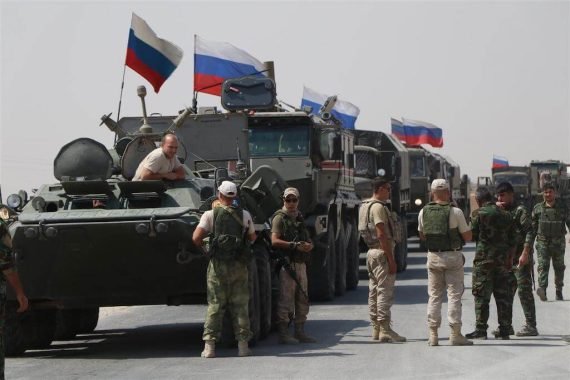
Russian military vehicles drive on the road as Russia makes a new military and logistic reinforcement of 30 vehicles to its military points in Kamisli occupied by YPG, Syrian branch of the PKK terrorist organization on September 14, 2020 Photo by Samer Uveyd, Anadolu Images
For years, the Turkish public criticized the U.S. administrations for their support of the YPG, the Syrian branch of the PKK terrorist organization, which poses a threat to Syria’s territorial integrity and a national security threat to Turkey. At the same time, Russia also tried to use the YPG as a card against Turkey in 2015 and early 2016, but later changed its position and declared its support for the territorial integrity of Syria, and acknowledged the threat the group poses against Turkey. However, in the end of 2019, Russia viewed the partial American withdrawal as an opportunity and re-changed its position again.
In this manner, in 2018, Russia withdrew from the Afrin region and opened the way for the joint Turkish-Syrian military operation of the Syrian National Army (SNA), the former Free Syrian Army (FSA), and the Turkish Armed Forces (TAF) against the YPG.
Moreover, Russia accepted to exclude YPG figures from the Syrian constitutional committee and signed several Astana resolutions which define the YPG as a threat to Syria’s territorial integrity. However, Russia changed its approach to the YPG following Turkey’s Operation Peace Spring and became – along with the U.S. – the new military protector of the YPG in Syria.
Why did Russia change its attitude towards the YPG? In order to understand this policy change, one should first analyze Russia’s overall Syria policy before Operation Peace Spring. No doubt, for Moscow, autonomy and federal governments or other forms of decentralized government are not a threat to the territorial integrity of a state since Russia itself is a federation. Nobody should expect Russia to oppose a federal system in Syria.
Therefore, Russia does not recognize the PKK and its Syrian branch, the YPG, as terror groups, and, in principle, does not oppose the YPG per se; however, Russia opposes the YPG’s current policies. For Moscow, the YPG’s partnership with the United States has been the main source of its distrust toward the organization. Moscow wants the YPG to quit working with the U.S. and cooperate with the Russia-backed Assad regime. Until Operation Peace Spring, all Russian charm efforts failed and the YPG remained loyal to the United States.
With Trump’s decision to withdraw from Syria, the YPG felt the urgent need to invite the Assad regime and Russia to provide military protection against Turkey and the Syrian Interim Government. The YPG’s request was seen by Moscow as a golden opportunity to gain extensive leverage. Russia wanted to fill the void and was further encouraged when U.S. CENTCOM officials decided to hand over their bases to the Russian military rather than seeing a further push by the Turkey-backed Syrian National Army.
With this momentum, Russia deployed its troops to Manbij, Ayn al-Arab (Kobane), Ayn Issa, Tal Tamr, Dirbasiyah, and Amudah along the front lines or the border region, and entered the towns of Tabqah and Raqqa. As Russia had troops in the YPG-held Tal Rifaat pocket since 2016, with this development, the YPG was on the verge of coming under full Russian military protection.
Moscow was expecting to enter the far east of Syria at the Iraqi border and the oil-rich region of Deir Ezzor in the southeast, but Trump’s decision to protect the oil hindered Russia from doing so. U.S. soldiers stayed in a strip in the east of the country and prevented Russia from entering. Since then, the YPG militants maintained a balancing act between Moscow and Washington as demonstrated by the visit of the PKK veteran and head of the political supreme body of the YPG, Elham Ahmad, to Moscow before heading to Washington.
Following the partial U.S. withdrawal and the new Russian protection of the YPG, Turkey signed two separate deals with the U.S. and Russia. The deal with the U.S. stopped the SNA-TAF advancement and canceled U.S. sanctions against Turkey in return.
The deal with Russia was more comprehensive. After Operation Peace Spring, the YPG invited the Assad regime and Russia to protect the front lines against a further push by the joint Turkish-Syrian forces, and Russia obligated itself under the terms of the deal to enforce a full withdrawal of all YPG forces from Tal Rifaat, Manbij, and an area extending 32 km from the Turkish border in the east of the Euphrates to the border with Iraq. The deal also foresaw joint Turkish-Russian patrols in a 10-kilometer-wide strip across the Turkish-Syrian border. Except for the joint patrols, Russia failed to deliver on any of the terms of the agreement.
Let alone keeping their promise, Russians have done the opposite and supported the YPG in its terror campaign against the Syrian Interim Government and Turkey. The YPG engaged in several attacks with various weapon systems against civilian-populated areas of the Syrian Interim Government such as Afrin, Azaz, Al-Bab, Jarablus, Tal Abyad, and Rasulayn.
The YPG used new models of Russian-supplied anti-tank guided missiles to target Turkish soldiers
The YPG used new models of Russian-supplied anti-tank guided missiles to target Turkish soldiers, infiltrated the front lines to kill SNA soldiers, and operated a network of cells in the areas of the Syrian Interim Government located in northern Syria. With these cells, the YPG could plant IEDs and attempt assassinations against the SNA, Syrian local politicians, and Turkish soldiers.
The YPG used the Russian-protected areas as a safe zone to conduct ranged artillery attacks against hospitals and civilian infrastructure. Yet, the most brutal of the YPG attacks were the constant car bomb attacks carried out in urban areas which randomly killed innocent civilians.
The YPG tries to maintain plausible deniability and rejects responsibility. However, car bombs intercepted at crossing points from YPG-held areas to the areas of the Syrian Interim Government, and the logic behind the attacks leave no doubt about who the perpetrators are. The YPG’s foreign backers, like the U.S., condemn the attacks without naming any suspect or culprit, or turn a blind eye to them entirely, like Russia.
For Moscow, the YPG’s systematic use of terror is a preferred tool to prevent the Syrian Interim Government from establishing a sustainable alternative to the Assad regime without getting into a confrontation with Turkey. The attacks are not conducted directly by Russia, but by the YPG, and the U.S. support and protection of the YPG shields Russia from Turkish criticism. The Turkish public focuses on the U.S. support of the YPG rather than the military protection Russia provides the YPG and its pragmatic attitude to the YPG’s terror campaign.
In fact, Russian policy shows that Moscow regards the legitimate Syrian opposition as a bigger threat than the YPG. For Russia, the Syrian Interim Government is a direct alternative to the Assad regime, and the YPG represents only a territorially limited pursuit of autonomy. Therefore, Russia prefers to protect the YPG in order to disrupt the Syrian Interim Government rather than implementing its obligations stemming from the Turkish-Russian agreement of 2019.
In fairness, it should be underlined that the Russian position regarding the YPG’s demand to establish an autonomous region in northeast Syria has changed in line with the Astana accords. In the negotiations between the Assad regime and the YPG, Moscow puts its weight behind the regime’s categorical rejection of autonomy. In line with the Astana agreements, Russia rejects the separatist agenda of the YPG on paper. While the U.S. actively supports the political ambitions of the YPG in Syria, Russia supports the military presence of the YPG only as a temporary tool.
“The former Free Syrian Army ‘moderate terrorist’ who bombed the city of Khan Al-Asal in Aleppo countryside with chemical weapons in 2013 is currently an official in the SDF Administration in Manbij!”
A leader in the US-sponsored Kurdish SDF separatist armed group in Manbij, Northern Syria, defects and exposes the relationship between ISIS, Al Qaeda, the FSA, and the SDF after his colleagues accuse him of dealing with the Syrian government.
In his firing back at his former colleagues, this Kurdish SDF leader exposes one of the main chapters of the so-called Syrian Chemical File, the file used relentlessly and repeatedly by the NATO member states at the United Nations Security Council to demonize the Syrian state and the Syrian armed forces accusing them, the victims, of using chemical weapons against their own people and in areas the Syrian Army has already won and is entering it in few hours. NATO members demonizing the victims, whitewashing the crimes of their own terrorists to justify their massive efforts in destabilizing Syria and effecting the regime change policy they and their regional minions have forever dreamt of.
This is part of the video released by this former leader of the Kurdish SDF where he speaks of his group’s connections with ISIS and with the FSA, naming, in particular, the person who carried out the bombing of Khan Al-Asal in 2013 who is currently an official in the SDF ‘Administration’ in the city of Manbij, transcript follows below:
Transcript of the English translation of the video:
I asked, “Jahid”, why did you act with us like this? You made us send Zaki Al-Hassan to a place and arrested him from there, and today you released Zaki Al-Hassan? He said: Zaki Al-Hassan is an intelligence officer with Haval Nahir, and it is not permissible for us to arrest Zaki Al-Hassan or dismiss him from work.
If Zaki al-Hassan is a prince of ISIS, and so you put him in a responsible position, we may not dismiss Zaki al-Hassan from his work or talk to him, who is one of the princes of ISIS, and at the same time, you accuse us of working for the regime.
It’s not only Zaki Al-Hassan, but I have also written down several names who work for you in the (SDF) Administration with your knowledge or without your knowledge:
There is Noura Al-Hamid from the village of Al-Qishla who used to work for ISIS at the Al-Furat Hospital and today, Noura Al-Hamid is a deputy in the Executive Council of the “SDF.”
There is Ali Al-Jamili, a leader in the “Jund Al-Haramain” during the days of the Free Army, Ali Al-Jamili, until this moment, is in the city of Manbij is bragging that he’s called ‘Chemical Ali’ because he was in Jund al-Haramain and he claims that he bombed the city of Khan al-Asal with chemical (weapon), and Ali al-Jamili is responsible for Religions affairs in the city of Manbij, and he has a son cadre in the Al-Jazeera region.
End of the transcript.
Longer version of the confession in Arabic:
The Syrian government has repeatedly called on the United Nations to investigate the chemical attack in the city of Khan Al-Asal in 2013, the first of a series of chemical attacks. The United Nations Secretary-General at the time Ban Ki-Moon agreed to send a team to investigate the attack but under the condition that they will just prove there was an attack without identifying the criminals behind it.
On the day the team was just leaving their hotel in Damascus heading to Khan Al-Asal in the north, they receive a phone call from the UN SG ordering them to investigate the infamous Ghouta chemical attack. Coincidences never happen in politics.
To help us continue please visit the Donate page to donate or learn how you can help us with no cost on you. Follow us on Telegram: http://t.me/syupdates link will open Telegram app.
With the defeat of ISIS and Nusra, the exposure of the ‘White Helmets’ and the various Chemical Weapons stunts, and with the collapse of ‘Rojava’, Washington is fast running out of options in Syria. Syria is winning, but the big power has not yet given up. Knowing that it is losing, it still acts to prolong the endgame and punish the Syrian people.
***
We are sitting at a joint military command center in Arima (northern Syria, just west of Manbij) with three Syrian Arab Army (SAA) colonels and two uniformed Kurd SDF ‘koval’ (comrades). There are Russians here too, but they do not enter our conversation. Yet even in the friendly chat, as we wait for permission to travel on to Manbij and Ayn al Arab (Kobane), some tensions are apparent.
Sharing coffee and food, both the SAA officers and the SDF comrades acknowledge they are fighting and dying together against an invading Turkish army and its proxy militias. The frontline is just a few kilometers away.
When I ask what differences there are between DAESH, Nusra and the ‘Free Army’, they all respond derisively. “There is no difference, it is a money game, the fighters go back and forwards depending on the pay rates”. “Any difference between groups in the numbers of foreigners?” I suggest. “No difference”, they repeat. SDF Comrade B passes me a recent video of ‘Free Army’ fighters at Tal Abiad, to the north-east, protesting conditions and demanding their return to HTS/Nusra controlled Idlib.
But we all know they fight for a different cause. The SAA officers are fighting for a liberated and united Syria, while the SDF comrades still dream of an independent ‘Kurdistan’ by cutting out parts of contemporary Turkey, Syria and Iraq.
Separatist Kurds collaborated with US occupation forces in pursuit of their ‘Rojava’ dream (western Kurdistan), even though Washington never really supported the project. Many Syrians see them as traitors. But the SAA is patient, dealing with one enemy at a time, and at the moment the enemy in north Syria is Erdogan.
The ‘Rojava’ dream is effectively dead. As both Afrin (in March 2018) and Manbij (in October 2019) demonstrated, no Kurdish militia can defend itself from Ankara, which correctly sees any ‘Rojava’ statelet as a stepping stone for the bigger game, a large slice of Turkey. Protection by US occupation forces could not last forever. Moreover, Kurdish groups have no exclusive historical claims over any parts of northern Syria. Many others live there. In much of north Syria Kurds are a small minority.
Despite these tensions a close, even affectionate relationship remains in the room. The SAA colonels are all older men, in their 40s and 50s, while the SDF comrades are younger men, around 30 years old. Colonel H offers more coffee to Comrade A while Comrade B tells of Kurdish conquests. “We lost 850 martyrs liberating Manbij”, he says, and “2,000 in Kobane”. And what about all those in your prisons? one of the colonels asks. “They are reformatories”, Comrade B replies.
*(Between Aleppo and Manbij there is a switch from checkpoints controlled by the Syrian Arab Army to those controlled by the Kurdish SDF, even though the SAA and Russia now secure most of these ‘SDF controlled’ areas)
What Comrade B does not say about the “liberation” of Manbij is that (1) the 2016 battle was effectively a transfer of the city from one US proxy (ISIS/DAESH) to another (SDF), and (2) there were very few Kurds in that mostly Arab city. After the major battles, many from surrounding areas fled to the city, swelling its population. A recent estimate puts its population at 700,000, of which 80% are Arab (Najjar 2019). Of the rest there are other non-Arab minorities, including Assyrians, Circassians and Armenians. There is no real social base for a separatist Kurd regime in Manbij.
Yet even after the departure of US occupation forces from this part of northern Syria, and even though the Syrian and Russian presence constrains Turkish ambitions, the SDF has been allowed to maintain its former administration of both the city and the region.
The bizarre and unsustainable nature of this regime is made apparent when Nihad Roumieh, my Syrian journalist colleague, asks one of the colonels to show us where we are. Colonel A happily rolls out a military map, with friend and enemy troop placements. The first thing apparent is that six Syrian armored units protect Manbij, to the north. Second, although Syrian forces have resumed control of more than 200km of the northern border, it is depressing to see how much of northern Syria remains occupied by Erdogan and his proxies.
The picture seemed even more grim when we later spoke with a Manbij councilor and his lawyer friend. They complained of many held in prison and tortured, under the SDF regime. They said there were only two Kurd villages in Manbij.
Nevertheless, it seems that a transition is taking place. Over November-December both Syrian and Russian flags were raised over previous SDF positions in Hassakah, Ayn al Arab, Jarablus and Tal Jemaa (Syrian Observer 2019; Semenov 2019; SOHR 2019), with suggestions that the SDF was involved in negotiations with Damascus “to reach conclusive solutions”. However, SDF leader Mazloum Abadi said that the group wanted “Syrian unity … [with] decentralized self-administration” including maintenance of the separate SDF militia (Syrian Observer 2019). Damascus is unlikely to accept such terms.
*
The claim for a Kurdish homeland in Syria is no indigenous movement, claiming the return of ancestral lands. Nor does the debate over Kurds as historical migrants (in Yildiz 2005) or long-standing inhabitants (Hennerbichler 2012: 77-78) resolve the question. While Kurdish languages are of Iranian origin, and the longer history passes through Mesopotamia (Iraq) and the Ottoman Empire, Kurds are certainly part of the native Syrian population. However at 1.5 million Syria hosts the smallest group in the region, with around 20 million in Turkey (Gürbüz 2016: 31) and another 6-8 million each in Iran and Iraq.
The idea of a ‘Rojava’ statelet in Syria has been compromised in three ways. First, the Kurdish groups in the north and north-east Syria are only one of several groups (amongst Assyrians, Circassians, Armenians and Arabs), and in some areas small minorities. Second, the Kurdish separatist movement in Syria has been over-determined by the politics of and migration from Turkey. ‘Rojava’ was seen as the stepping stone for a larger ‘Kurdistan’ project, driven from the north. Third, intervention by the imperial power raised separatist expectations and has damaged Kurdish relations with other Syrian groups.
In the longer history of Syria, a traditional refuge for minorities, there have been many Kurds, including famous personalities, who did not buy into the separatist dream.
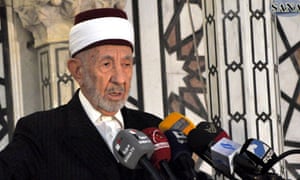
Sheikh Mohammad al Bouti
Two of them are buried inside the grounds of the Ummayad Mosque in Damascus: the 12th-century ruler Sala’addin and the Quranic scholar Sheikh Mohammad al Bouti (murdered by Jabhat al Nusra in 2013). Many Syrians of Kurdish origin embraced the idea of a wider identity. Before the 2011 conflict Tejel (2009: 39-46) classified Syrian Kurdish identities as comprising Arab nationalist, communist and Kurdish nationalist, with Syrian Kurd leaders Husni Za’im and Adib al-Shishakli campaigning for a non-sectarian ‘Greater Syria’.
The Turkish Kurd influence began early in the 20th century, as Kurdish culture was repressed by the post-Ottoman Turkish state. Turkish Kurds first took refuge in Syria, including in Damascus, after their failed rebellion in 1925. The very idea of a Syrian Kurdish party first came in 1956 from the Turkish refugee Osman Sabri; and another Turkish refugee Nûredîn Zaza, became president of that party (al Kati 2019: 45, 47).
There were multiple splits in subsequent years. The Democratic Union Party (PYD) emerged in the 1980s as a branch of the Kurdistan Workers Party (PKK), loyal to its leader Abdallah Öcalan, who in 1996 acknowledged that “most of the Kurds of Syria were refugees and migrants from Turkey and they would benefit from returning there” (in Allsop 2014: 231). Many of the claims about ‘stateless’ Kurds in Syria have to be read in light of this Turkish influx. However, Öcalan departed in 1998, as part of Syria’s Adana agreement with Turkey (al Kati 2019: 49-52).
The big powers, conscious of the potentially divisive role of separatist Kurds, have used them for decades, to divide and weaken Arab governments. US regional allies Israel and Iran (pre-1979) joined in, with the Shah in 1962 ordering his SAVAK secret police to help finance the Kurdish insurgency in northern Iraq, so as to undermine Baghdad. The Israelis joined in two years later. The CIA offered further help to the Barzani-led Kurds in 1972. One result was that Iraq was unable to join the Arab resistance against Israeli expansion in 1967 and 1973 because a large part of its military was deployed in northern Iraq (Gibson 2019).
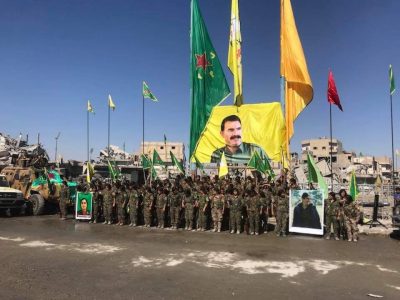
The US-led war on Syria in 2011 presented new separatist opportunities. Peoples Protection Units (YPG) were reactivated in 2012, at first with support from Damascus so that Syrians in the north could fight ISIS. However, the US occupation of parts of north and east Syria in late 2015 led to the reorganization of many YPG units into the US-sponsored ‘Syrian Democratic Forces’ (SDF) (Martin 2018: 96). These were sometimes referred to as a ‘Rojava’ force, while at other times the Kurdish component was played down.
According to one US military report in 2017 the SDF in Manbij was only 40% Kurd (Townsend in Humud, Blanchard and Nikitin 2017: 12), addressing the embarrassing reality that Manbij had a very small Kurdish population. In late 2016 US Col. John Dorrian, gave a higher overall Kurd estimate, saying that the SDF “consists of approximately 45,000 fighters, more than 13,000 of which are Arab” (USDOD 2016). Many of the latter came from the fragments of earlier US proxy militia in Syria.
Syrian Colonel Malek from Aleppo confirmed to me that the bulk of SDF members were always Kurdish, including many from Iraq and Turkey. The size of the non-Kurd and foreigner contingents varied according to the money on offer. A report from the London based International Centre for the Study of Radicalisation and Political Violence (ICSR) recognized that both the YPG and SDF ground forces remained largely arms of the Turkish PKK (Holland-McCowan 2017: 10).
The failure of the September 2017 separatist referendum in Iraq dealt a serious blow to the regional project. The KDP and PUK put aside their rivalry to hold an independence referendum (having already pushed for and gained federal status) even though it was not authorized by Baghdad. The proposal was said to have gained 92% approval, but was immediately rejected by the Iraqi Government and Army, which drove Peshmerga forces out of Kirkuk in just a few hours (Gabreldar 2018; ICG 2019). For the first time in decades the Iraqi Army took control of the NE region. Baghdad was showing a political will that had been lacking for many years.
In Syria, US forces did nothing to stop the YPG’s ethnic cleansing of non-Kurds in areas to which they laid claim. In October 2015, the western aligned group Amnesty International accused the YPG (just before the US rebranded them as the ‘Syrian Democratic Forces’) of forcibly evicting Arabs and Turkmens from areas they took after displacing ISIS. Amnesty produced evidence to show instances of forced displacement, and the demolition and confiscation of civilian property, which constituted war crimes (AI 2015). Similar accusations had come from Turkish government sources (Pamuk and Bektas 2015) but also from refugees who said that ‘YPG fighters evicted Arabs and Turkmens from their homes and burned their personal documents’ (Sehmer 2015; Al Masri 2015).
However, after the US forces became direct patrons of the SDF in late 2015, a UN commission, co-chaired by US diplomat Karen Koning AbuZayd, continued its quest to place most of the blame for abuses on Syrian Government forces. The Commission accused the YPG/SDF of forcibly displacing communities “[but only] in order to clear areas mined by ISIL”, and of forcible conscription, but “found no evidence to substantiate claims that YPG or SDF forces ever targeted Arab communities on the basis of ethnicity, nor that YPG cantonal authorities systematically sought to change the demographic composition of territories” (IICISAR 2017: 111 and 93).What Syria’s Kurds “Think” They are Fighting For Versus Reality
Nevertheless, in 2018 there were ongoing reports of the ethnic cleansing of Assyrian Christians from US-SDF held areas in NE Syria. Young men in the Qamishli area were reported to have been arrested and forcibly conscripted into Kurdish militia, alongside property theft by those same militias (Abed 2018). In 2019 the SDF were reported to have closed more than 2,000 Arabic-teaching schools in the Hasaka region (Syria Times 2019) and to have shot, killed, wounded and jailed displaced people who were trying to escape from al-Hawl Refugee Camp in South-Eastern Hasaka (FNA 2019). Nevertheless, once US forces created and adopted the Kurdish-led ‘SDF’, Amnesty International and the western media muted their earlier criticisms.
Washington in 2012 had looked favorably on the ISIS plan for a “Salafist principality”, so as to weaken Damascus (DIA 2012). In September 2016 US air power was used to attack and kill more than 120 Syrian soldiers at Mount Tharda behind Deir Ezzor airport, to help the terrorist group’s (failed) efforts to take over and threaten the city (Anderson 2017). But when Russia, Syria and Iraq began wiping out these Saudi clones, USA forces simply rescued their best commanders and replaced ISIS with a Kurdish-led ‘SDF’ (Anderson 2019: Chapters 5 and 7), once again to undermine and weaken Damascus.
But US occupation forces did not wait around to sponsor the ill-fated Rojava project. In October 2019 President Trump gave the order for a partial withdrawal from northern Syria. Former US diplomat Robert Ford had warned in 2017 that the US would abandon the SDF (O’Connor 2017). So, stripped of US military protection and their main source of arms and finance, the SDF was forced to rapidly put together a new alliance with Damascus and Russia, to prevent annihilation by Erdogan’s forces. The Turkish leader saw the Öcalan-led YPG/SDF as a stepping stone to its larger project in Turkey (Demircan 2019).
Western liberals complained the US was ‘betraying’ its Kurdish allies; but they placed too much faith in romantic myths. Ünver (2016), for example, presented separatist Kurds as recipients of unplanned opportunities in Syria’s “civil war” in an “age of shifting borders”, as though the big power were not once again using the ‘Kurdish card’ to divide and weaken both Iraq and Syria. Schmidinger (2018: 13, 16-17) tried to twist Syria’s historic diversity into an argument for the ‘Rojava’ sectarian division – instead of an inclusive unitary state. But, as has been said many times before, imperial powers never have real allies, only interests. Lebanese Resistance leader Hassan Nasrallah told Kurdish separatists in February 2018: “In the end they will work according to their interests, they will abandon you and they will sell you in a slave market.”
Meanwhile, with Washington’s blessing, Erdogan persists with his plan to control large parts of northern Syria, with the aim of settling many of the refugees in Turkey under a Muslim Brotherhood style regime, controlled by sectarian Islamist militia. Retired Syrian Major General Mohammad Abbas Mohammad told me that Turkey’s leader has not given up his ambition of becoming a modern-day ‘Caliph’ of Muslim nations, and is working to colonise Syrian minds with his constant Islamist slogans.
*
Nevertheless, with the help of its allies, Syria is winning the war. ISIS/DAESH and Nusra are virtually defeated, the ‘White Helmets’ and the Chemical Weapons stunts have been exposed and the Rojava myth has collapsed. But a Washington-driven economic war now targets all the independent countries of the region, aggravating the occupation and the terrorism.
Director of the Syrian Arab Army’s Political Department Major General Hassan Hassan, tells us that the US “has the power to destroy the world, many times over, but it has not been able to turn that power into capabilities.” That is why US wars are failing across the region.
While we are indeed heading for a multi-polar world, he says, we are not there yet. “Syria still faces the unipolar regime”. Erdogan, ISIS, Israel and the SDF are all “puppets” of this dying world order. Authorized by the US, Erdogan still wants to set up a Muslim Brotherhood region in north and east Syria. This is a dying and a “most dangerous” order, General Hassan says. “The US deep state knows that its unipolarity is failing, but that has not yet been announced. The new world system is born, but is not yet recognized. The US wants to prolong this conflict as long as possible, and to punish the Syrian people”.
(Crossing the huge Furat (Euphrates) river, from rural Manbij to rural Raqqa, north Syria)
In that transitional phase we see collaboration between the SAA and the SDF, the extraordinary anomaly of an SDF-run Manbij and the ongoing experiment of ‘Kobane’, the SDF controlled border town which Syrians call Ayn al Arab.
Traveling from rural Aleppo to rural Raqqa on the M4 highway we cross the Furat (Euphrates) river, a huge, semi-dammed expanse of fresh water which appears particularly sweet between two deserts. Turning north we arrive in Ayn al Arab, at the Turkish border, in less than an hour. Although Erdogan’s gangs are attacking Ayn al Issa, deeper inside Syria on the M4, there is no sign of fighting near Ayn al Arab itself. Major General Abbas says that Erdogan is aiming at narrow incursions, which can later be widened.
This small city of perhaps 45,000 people was evacuated during earlier fighting and still shows signs of great destruction, especially on the eastern and northern sides. Less than a tenth of the size of Manbij it is now said to have a majority of Kurds and the SDF comrades seem well organized. We are taken to their small headquarters, a three-story building, to await further security checks and an escort to one of their schools and one of their hospitals.
At the secondary school, as in the headquarters, they seem wary of a foreigner accompanied by an SAA Colonel and a Syrian journalist. That breaks down a little as I ask about their curriculum and the children, who have clearly gone through substantial trauma. The headmaster says they are developing programs to help students deal with their war experiences. The threat is not over, as Erdogan’s troops, including sectarian Islamist gangs, are only a few kilometers to the north.
The Kurdish nationalist curriculum has made a break with the centralized Arabic-based system set in Damascus. The headmaster explains that their syllabus is carried out 60% in the Kurdish language, 20% in Arabic and 20% in English. For children from Arab families the syllabus is 60% Arabic, 20% Kurdish and 20% English. They speak of four ‘nationalities’ in Kobane: Kurd, Arab, Yazidi and Christian. That is how they see it.
The management of the small hospital is also strongly Kurd nationalist. I ask where they get their support and they mention the Americans and some international NGOs. Of course, there is nothing from Ankara. “What about Damascus?” I ask. “Nothing and we want nothing”, says one of the managers.
That may be true for this hospital. However Syrian colleagues tell that most of the health centers in SDF controlled areas still get finance and supplies from Damascus. So not only is their security guaranteed by the Syrian state, so are most of their social services.
It remains to be seen how much Kurdish autonomy will remain, under a final political settlement. Federation is not part of the discussion, it is clear that Damascus sees that as a path which would dismember and weaken the country. While the SAA and the SDF jointly fight Erdogan’s gangs, Damascus has been calling on Arab leaders in the north and north east, who had collaborated with the US occupation force and the SDF, to return to the Syrian Arab Army. On the other side, SDF Commander General Mazloum Abdi opposes incorporation of the SDF into the SAA (Van Wilgenburg 2019) and wants to hold onto as much local administration as possible (Syrian Observer 2019). The continued US presence and sponsorship of SDF units in Hasaka, Qamishli and Deir Ezzor (Ahval 2019), serves to maintain the illusions of autonomy.
In the Russian media there is some pessimism about an SDF-Damascus reconciliation. One observer suggests that “Russia will eventually force most (if not all) of Turkey’s forces to leave Syria … [but Damascus] and the Syrian Kurds have opposing political and military goals that will not be easily reconciled” (Stein 2019).
However, Damascus has some other cards. The YPG/PKK/SDF grew its influence through US sponsorship and, as that declines, other voices in the north, including Kurdish voices, are likely to re-emerge, especially through the constitutional process in Geneva. Major General Abbas points out that there are now dozens of Kurdish parties in the north east (Syria Times 2018). Given the intransigence of the US-dependent SDF, Russia is said to be recruiting Syrian Kurd youth to a rival group (Duvar 2019), which is likely to be incorporated into the SAA.
In my view, there will likely be some accommodation of Kurdish nationalist demands at the cultural and local administrative levels, but alongside efforts to ensure this does not privilege Kurds above other Syrian groups. That should appear in the amended constitution. The old world order is dying and the new one is still being born. In this transitional world, Washington persists with its losing war, to divide and punish the Syrian people.
*
Note to readers: please click the share buttons above or below. Forward this article to your email lists. Crosspost on your blog site, internet forums. etc.
Dr. Tim Anderson is Director of the Sydney-based Centre for Counter Hegemonic Studies. He has worked at Australian universities for more than 30 years, teaching, researching and publishing on development, human rights and self-determination in the Asia-Pacific, Latin America and the Middle East. In 2014 he was awarded Cuba’s medal of friendship. He is Australia and Pacific representative for the Latin America based Network in Defence of Humanity. His most recent books are: Land and Livelihoods in Papua New Guinea (2015), The Dirty War on Syria (2016), Global Research, 2015, now published in ten languages; Countering War Propaganda of the Dirty War on Syria (2017) and Axis of Resistance: towards an independent Middle East (2019).
Gabreldar, Bushra (2018) ‘Kurdish independence in Iraq’, Harvard International Review , Vol. 39, No. 1, Athletic Diplomacy: the intersection of sports and culture (Winter 2018), pp. 7-9
Humud, Carla E.; Christopher M. Blanchard and Mary Beth D. Nikitin (2017) ‘Armed Conflict in Syria: Overview and U.S. Response’, Congressional Research Service, April 26, online: https://www.refworld.org/pdfid/591c08bc4.pdf
Kutschera, Chris (1994) ‘Mad Dreams of Independence: The Kurds of Turkey and the PKK’, Middle East Report, No. 189, The Kurdish Experience (Jul. – Aug., 1994), pp. 12-15
Martin, Kevin (2018) ‘Syria and Iraq ISIS and Other Actors in Historical Context’, in Feisal al-Istrabadi and Sumit Ganguly (2018) The Future of ISIS: Regional and International Implications, Brookings Institution Press
Mohannad Al-Kati (2019) ‘The Kurdish Movement in the Arab World: The Syrian Kurds as a Case Study’, AlMuntaqa , Arab Center for Research & Policy Studies, Vol. 2, No. 1 (April/May 2019), pp. 45-61
SOHR (2019) ‘Lens of SOHR monitors the rise of the Syrian flag and the flag of Syriac Military Council affiliated to “SDF”, in Tal Jemma north of Tal Tamr town’, 4 December, Syrian Observatory of Human Rights, online: http://www.syriahr.com/en/?p=149576
Tejel, Jordi (2009) Syria’s Kurds: History, Politics and Society, Routledge, New York
Ünver, H. Akin (2016) Schrödinger’s Kurds: Transnational Kurdish Geopolitics in the Age of Shifting Borders, Journal of International Affairs , Vol. 69, No. 2, Shifting Sands: The Middle East in the 21st Century (SPRING/SUMMER 2016), pp. 65-100
USDOD (2016) ‘Department of Defense Press Briefing by Col. Dorrian via teleconference from Baghdad, Iraq’, U.S. Department of Defense, 8 December, online:
On October 16, units of the Syrian Army entered the city of Raqqah for the first time since 2014. The Kurdish-led Syrian Democratic Forces (SDF) has controlled the city since 2017, when they with help from the United States seized it from ISIS. The Syrian Army reportedly established several observation posts in the area and continued deployment within the SDF-held area.
According to pro-government sources, government troops are also preparing to enter the Omar oil fields. A day earlier, on October 15, Syrian troops and Russian Military Police units started patrolling the contact line between Turkish-backed forces and the SDF near Manbij.
On October 16, US-led coalition forces withdrew from the Kharab Ashk military base where dozens of US and French troops had been deployed. US-led forces burned the base in order to destroy equipment that they were not able to evacuate.
The Turkish Army and Turkish-backed militants are developing their offensive on SDF positions. They captured thirteen villages west of Tell Abyad and made another attempt to secure Ras al-Ayn. According to pro-SDF sources, 49 Turkish-backed militants were killed in an SDF counter-attack in the town. SDF units employed US-supplied military equipment. Pro-Turkish militants captured a Humvee armored vehicle near the town.
There are also reports that the SDF and the Syrian Army jointly recaptured the villages of al-Ahras, al-Rihaniyah and Manajir from Turkish-led forces south of Ras al-Ayn. Nonetheless, this was a tactical development involving Turkish proxies only. It is not likely that government forces and the SDF will carry out large-scale joint operations attacking positions of the Turkish Army. The main reason is that such an attack may lead to a large-scale escalation in the region and even a limited open conflict between Syria and Turkey.
Nouvelles du front ukrainien, par Thierry Meyssan
-
Les États-Unis et la Russie veulent conclure la paix le plus vite possible
en Ukraine. Le problème n'est pas où l'on croit : il semble que les
straussiens ...
The man bankrupting America
-
“Go F*** Yourself, Scott: A Full Background Check on The Man Bankrupting
America, Human Skin Tag, Scott Bessent.“ (Blundell).In the same week,
different US...
Occult Utopia Of Jewish Golden Age
-
Occult Utopia Of Jewish Golden Age September 6 2026
___________________________________ More Vids! +BN Vids Archive! HERE!
________________________________...
And You Remain Impossible to Erase
-
There you are, the inspiring Imam, forever present in the conscience of the
honorable and the hearts of the loyal.
Father Dave Smith, Pray For (Mufti) Dr. Hassoun
-
Abducted by the terrorist regime in Syria in 2025, Sheikh Hassoun has been
sentenced to life in prison I spoke with Father Dave Smith, an Australian
Anglic...
Report on Beth Israel vigil 08-15-26
-
*Charlie Kirk and JFK*
John F. Kennedy was assassinated under questionable circumstances on
November 22, 1963, and Charlie Kirk fell on September 10 of la...
On The Road To International Anarchy
-
ON THE ROAD TO INTERNATIONAL ANARCHY— An Analysis (14 August 2026) by
Lawrence Davidson Part I — The Turn Toward […]
-
Hello all,
It is with great sadness that I share with you the passing of our beloved
sister, Mother, and Grandmother, the individual that you all knew ...
Best Horror Podcast
-
Best Horror Podcast Introduction: Horror podcasts […]
The post Best Horror Podcast appeared first on Copper Shock Horror Podcast.
Ikhras Endorses Muntadhar Al-Zaidi
-
“Oh parties of banditry and sectarianism and corruption, we have come and
our goal is to destroy you.” Ikhras formally endorses Muntadhar al-Zaidi,
Iraqi j...
Prince Charles: Foreign Jews behind bloodshed in ME
-
In May, 2017, British Crown Prince Charles declined an invitation from
Zionist entity’s president Reuven Rivlin‘s to attend the 100th anniversary
of the no...
Palestinian Women – One for All, All for One
-
Honouring All Palestinian Women by Honouring Three: Hanin Zoabi, Ahed
Tamimi, Samah Sabawi Vacy Vlazna “Palestinian women have always stood side
by side ...
US’s Saudi Oil Deal from Win-Win to Mega-Lose
-
By F. William Engdahl Who would’ve thought it would come to this? Certainly
not the Obama Administration, and their brilliant geo-political think-tank
neo-...
-
*Mordechai Vanunu wins human rights prize of Brazilian Press Association *
* http://www.alternativenews.org/english/index.php/features/updates/7038-mordechai...
Abdul Aziz Rantissi:
"My ultimate wish, my God, is to attain martyrdom,"...God granted him his wish on April 17, 2004, at the hands of Israeli assassins.