Showing posts with label humanitarian intervention. Show all posts

Thursday, 18 April 2013

Little Hamad wants to lead a BRICS mutiny against Russia & China !

FLC

"... It is time for the international community to overcome this obstacle and allow for a more effective humanitarian response in Syria, whenever and wherever it may be required. One way forward would be for key countries such as Brazil, South Africa, and India to support a more aggressive effort to ramp up the UN’s cross-border aid operations inside the country. Such an opportunity presents itself at the forthcoming 2013 BRICS summit in Durban next week. These countries should use their influence to secure a Security Council endorsement of this approach, principally by applying pressure on Russia and China..."

River to Sea Uprooted Palestinian  
The views expressed in this article are the sole responsibility of the author and do not necessarily reflect those of this Blog!

Friday, 5 April 2013

A Libyan Report Card

Via FLC

"... Given the calls for intervention in Syria, let's consider Libya, where a modest intervention was tried...., ...., .... Toppling an evil regime or stopping a war is a profoundly moral act. But taking moral responsibility for what happens next in a country is the hard part. Bosnia-Herzegovina, 18 years after the U.S.-led intervention and the Dayton Peace Accords, is a nasty, dysfunctional state. And Bosnia-Herzegovina has advantages that Libya and Syria simply do not have. It is next-door to the European Union and has a modern history of relatively strong institutional structures compared to much of the Middle East. Bosnia was in a relatively developed part of the Ottoman Empire; Libya and Syria were in much less developed parts. But because Washington tends to overestimate its own significance in terms of its ability to alter distant societies, the following pattern will continue to emerge: a terrible war resulting in calls for humanitarian intervention, an intervention in some cases, always followed by a blame game inside the Washington Beltway after the country has slipped back into tyranny or anarchy.
Meanwhile, here is a probability: Libya's relatively short history as a strong state is over. It will go on and on as a dangerous and weakly governed area between Tunisia and Egypt. Its considerable oil resources can internally generate revenue for armed groups and politicians both...."

Thursday, 28 March 2013

The puppet 'surprised'

Al-Khatib "Surprised" by US Refusal to Deploy Patriot in Syria
 
Local Editor
 
The head of the Syrian opposition coalition, Ahmad Moaz al-Khatib said on Wednesday he was “surprised” by a US decision to reject his demand for NATO to provide Patriot missile along the Turkish-Syrian border.
Ahmad Moaz al-Khatib
"There is an international will that the revolution does not come out victorious," Khatib, the head of the so-called “National Coalition”, said in Doha, Qatar.

"But the people that have defied injustice and tyranny will not stop," said Khatib, who still acts as the head of the coalition despite announcing his resignation on Sunday.

He told an Arab League summit on Tuesday that he had asked US Secretary of State John Kerry to extend the umbrella provided by Patriot anti-missile batteries positioned in Turkey to “protect” areas controlled by armed groups.

Khatib said he was waiting for a NATO response, in an address to Arab leaders after the League gave the opposition the sea of Syria.
Following Khatib demand, the US refused, saying the NATO was "not intending a military interference in Syria."

In Brussels, NATO chief Anders Fogh Rasmussen on Wednesday echoed the White House's position and said the alliance has "no plans to change the purpose of the coverage of the deployed Patriot missiles".
Source: AFP
28-03-2013 - 10:05 Last updated 28-03-2013 - 10:05

River to Sea Uprooted Palestinian
The views expressed in this article are the sole responsibility of the author and do not necessarily reflect those of this Blog!

Wednesday, 27 February 2013

US STATE DEPARTMENT’S “SYRIASLY” CAMPAIGN REACHES NEW LEVEL OF ABSURDITY


Posted on February 26, 2013 by Libya 360°

While the West and its Arab partners, the brutally autocratic regimes of Saudi Arabia and Qatar, are now admittedly funneling heavy weapons to Al Qaeda’s stronghold in Daraa, southern Syria, the US State Department and its extensive network of faux NGO’s funded by the same corporate-financier interests that write its policy, have rolled-out a front organization they call “Syriasly.”
 

Image: This fuax-human rights organization already screams biased, pro-Western propaganda with its Al Qaeda/French colonial green, red, and black logo, aping the so-called “Free Syrian Army’s” flag. That it is a campaign of “STAND” confirms without a doubt that it is manufactured propaganda, directly funded by the special interests who designed and are currently executing the assault on Syria.
#Syriasly is a campaign of STAND, the student-led movement to end mass atrocities. Born out of the fight to stop genocide in Darfur, Sudan, STAND is devoted to creating a sustainable student network that actively fights genocide and mass atrocities wherever they may occur. We envision a world in which the international community protects civilians from mass atrocities.
Sporting the French colonial colors that flew over Syria during its Western subjugation, and echoing the now defunct fraud that is the “Responsibility to Protect (R2P)” (and here) which lead to, not prevented, mass nationwide genocide in Libya in the wake of NATO’s brutal bombardment of the North African nation in 2011, “Syriasly” attempts to pose as “student-led.”
 
However, “Syriasly,” which claims to be a campaign of STAND, is merely a carbon-copy of other US State Department, corporate special interest fronts masquerading as human rights crusaders to manufacture consent for long-planned wars of profit and domination. Syria’s destruction was admittedly conspired by the US, Saudi Arabia, and Israel as far back as 2007. And if “Syriasly” sounds as hammy as the now disgraced “Invisible Children” front, which was promptly exposed as a Wall Street, AFRICOM propaganda campaign after is “viral” Kony 2012 film, but before its front man Jason Russell melted down in public while performing lewd acts, stark naked, that’s because STAND’s Syriasly campaign and Invisible Children both fall under yet another corporate special interest-run shell organization, “Resolve.”
 
Resolve’s partners include convicted criminal George Soros‘ Open Society-funded Human Rights Watch, the US State Department’s “Enough” Sudan propaganda front, the Soros Open Society, Time Warner, Unilever, Chevron, Deutsche Bank, Marathon Oil, Unilever, UN-funded “Refugees International (.pfd), and “Humanity United.”
 
Humanity United in turn boast partnerships with the BBC World Service Trust, the National Endowment for Democracy/Open Society/US State Department-funded Benetech, criminal financier George Soros’ Open Society Institute, and the NED-funded Solidarity Center which mobilized Egypt’s labor unions in 2011 just as the US-stoked unrest began to falter.
 
In other words, every organization involved interlocks with the vast corporate/foundation-funded imperial network masquerading as individual “human rights organizations” and benign NGOs. In reality this “civil society” network seeks to supplant national governments, and interface with global “institutions” like the IMF, World Bank, and the UN, all of which have been contrived by corporate-financier oligarchs. It is a modern day empire in the making.


This möbius strip of interrelated, co-funding and cross posting NGO’s and “activist” movements seeks to erect a curtain of humanitarian concern behind which their corporate sponsors can carry our their criminal enterprise with absolute impunity. Syria’s conflict was long-planned by corporate financier-funded think-tanks years before the term “Arab Spring” was coined. It was part of a geopolitical strategy not to endow the people of Syria with “democracy,” but to topple neighboring Iran and among other goals, reclaim its rich southern oilfields for the Anglo-Americans who controlled them before the Islamic Revolution.

Not only are absurd fronts like “Syriasly” an insult to the intelligence of the US State Department’s target audience, the promotion of corporate underwritten faux-human rights activism undermines real struggles to end verifiable injustice. The Syrian government, by all accounts, even “Syrian opposition” leader Moaz al-Khatib, is fighting Al Qaeda terrorists, not “pro-democracy” “freedom fighters.” The real genocide in Syria is the one CIA agent Robert Baer foreshadowed in 2007 in Pulitzer Prize-winning journalist Seymour Hersh’s New Yorker article, “The Redirection” where he stated:
“We’ve got Sunni Arabs preparing for cataclysmic conflict, and we will need somebody to protect the Christians in Lebanon. It used to be the French and the United States who would do it, and now it’s going to be Nasrallah and the Shiites”
Clearly the sectarian conflict Baer predicted, is now realized, and is far worse than even he imagined. And it is a conflict born out of Western, Israeli, and Saudi cash, weapons, and conspiring. If “Syriasly” wanted to make a difference, it could start by pointing out its very sponsors and associates conspired years ago to trigger this bloodbath in the first place, and that the key to stopping it is not invoking “Responsibility to Protect,” already willfully abused in Libya, but exposing the truth and demanding that the West and its regional allies cease and desist from their meddling in Syria and along its peripheries.

And since surely the frauds that constitute “Syriasly” will do no such thing, we must identify the corporate-financier interests driving this agenda – interests we most likely patronize on a daily basis, and both boycott and permanently replace them to erode the unwarranted influence they have used to both plan and execute this assault on Syria’s people.
 
River to Sea Uprooted Palestinian  
The views expressed in this article are the sole responsibility of the author and do not necessarily reflect those of this Blog!

Friday, 22 February 2013

NAVI PILLAY’S GROSS ABUSE OF POWER: SEEKING ARREST WARRANT FOR PRESIDENT ASSAD


Posted on February 20, 2013 by Libya 360°

UN Human Rights Commissioner Navi Pillay: “Pretext-maker” for Western Military Aggression

Ken Stone
 
Navi Pillay is up to her old tricks: she’s abusing her position as United Nations High Commissioner for Human Rights to provide a pretext for imperial aggression against Syria. Today, February 18, 2013, she repeated her call for Syrian President Bashar Al-Assad to be referred for investigation to the International Criminal Court (ICC) for the actions of his forces in trying to repel the western-back mercenary war against his country, which the UN says has killed almost 70000 in 22 months of fighting. And she went even further in calling for immediate action by the international community to end the killing, up to and including military intervention. 1 
 
What Pillay is seeking is an indictment (arrest warrant) against Assad so as to demonize the Syrian president and delegimitize his government in the eyes of western public opinion and to turn Assad into an international pariah in anticipation of a possible, full-scale, western, military but “humanitarian” intervention for regime change in Syria.

Pillay’s remarks of today represent an escalation in her crusade against the Syrian president and the steadfast support his government has enjoyed in the UN Security Council (UNSC) from both Russia and China, which are permanent members of the UNSC and, therefore, have veto powers. Previously, Pillay had made an effort to temper her condemnation of the Syrian president by linking it to a condemnation of the crimes against humanity perpetrated (and even filmed!) by the foreign-backed mercenaries. 2

For example, on Friday, January 25, 2013, on CNN’s International News broadcast at noon 3, she was interviewed from Davos, Switzerland, (at the World Economic Forum, where high-level technocrats scheme about running the world’s economy for the next year on behalf of the 1%) by anchor, Hala Gorani, on the question of alleged and widespread human rights abuses in Syria.

While videos of the unfortunate families of refugees fleeing Syria were flashed upon the screen, Pillay indicated that she was increasingly frustrated by the failure of Russia and China (“and several other states”) to allow the United Nations Security Council to refer the request by 58 member countries of the United Nations for an investigation into the alleged human rights abuses by both sides in Syria to the ICC.

The January 25th CNN interview was only the latest of similar interviews of Pillay by CNN 4 and other mainstream media outlets, following the issue of a proposed ICC investigation into human rights abuses in Syria. So, why is this crusade on Pillay’s part important to CNN? Why does she get so much air time in the West? The answer is that governments and corporate media in the West are counting on Pillay to provide the same kind of pretext for regime change in Syria that she provide against the Gaddafi government of Libya.

THE LIBYAN PRECEDENTS

Two very useful precedents for illegal, but so-called “humanitarian”, intervention by NATO were set by the United Nations in regards to Libya. The first was that the doctrine of the responsibility to protect was successfully invoked, for the very first time, as a legal grounds for over-riding the fundamental principle of national sovereignty as the basis of international law.

R2P holds that, if a government cannot protect the human rights of its own citizens, the international community may step in to do so. In the case of Libya, R2P was used to justify United Nations Resolution 1973, the motion that authorized NATO to create a no-fly zone over Libya. Resolution 1973 was perverted by NATO within hours into a full-blown military intervention for regime change in Libya that resulted in the deaths of thousands of Libyans, pogroms against black persons resident in Libya, the assassinations of Muammar Gaddafi and members of his family, massive infrastructure damage, the de facto partitioning of the country, and a failed state machine.

But the first precedent (above) could not have been realized without the fancy legal footwork executed in advance by the nimble Navi in demonizing Mouammar Gaddafi and his son, Saif, at the UN. The second precedent, then, was the initiative taken by the UN Human Rights Council, chaired by Pillay, in calling for an international inquiry into violence against civilians in Libya. This call for an inquiry led the International Criminal Court, acting in the interests of the US empire and other neo-colonial powers such as France, Italy, and Britain, to obtain an indictment against the late, former leader of Libya, Mouammar Gaddafi and his son, Saif, for alleged human rights abuses by the Libyan government against Libyan civilians. In fact, the entire bureaucracy of the United Nations was completely finessed by the Empire in using fabricated abuses of human rights of Libyan civilians as an excuse to delegitimize, unseat, and demonize the legitimate government of Libya so as to manoeuvre the National Transitional Council of Libya [NTC] (organized and supported by all of the western powers) into the position of being recognized internationally as the legitimate representative of the Libyan people. This manoeuvre, in turn, helped provide a further pretext for the NATO regime change operation in Libya.

The wholesale replacement of the official Libyan government representatives at the UN by those of the NTC was achieved in several rapid steps. First, on February 25, 2011, at an emergency meeting of the United Nations Human Rights Council (UNHRC), representatives of more than 70 human rights NGO’s (non-governmental organizations) were assembled in Geneva, Switzerland, on a petition initiated by UN Watch (a pro-Israeli NGO) and the National Endowment for Democracy (NED) to hear a litany of accusations of human rights violations on the part of the Gaddafi government by Dr. Soliman Bouchuiguir, who spoke for the Libyan League for Human Rights (LLHR).

The LLHR was closely tied to the NTC and had, in fact, some executive members in common with it. No evidence of the human rights abuses that the Libyan government was alleged to have committed against Libyan civilians was ever entered as evidence. Libya was a member of the UNHCR but its membership had been temporarily suspended prior to the emergency meeting.

Therefore, it was not allowed to answer the charges levelled by the LLHR, an organization directly connected to the western-backed opposition. Navi Pillay, as UN High Commissioner for Human Rights, chaired the meeting. She is quoted as saying, “The Libyan leader must stop the violence now.” And she pointed out that Libya was a member of the Human Rights Council and pledged to respect human rights, and was also a State party to various international human rights treaties. 5 It was also at this meeting that “a statement (was) delivered on behalf of all of the Council’s independent human rights experts (who) endorsed the High Commissioner’s call for an international inquiry into the violence, stressing that the international community should “act without delay” to protect civilians from serious human rights violations.” 6 The UNHCR report was duly forwarded to the Security Council which formally suspended Libya from its seat on the UNHRC.

Shortly following the emergency meeting, Libya was prevented from appointing a new ambassador to the United Nations, following the defection of its two representatives at the UN to the opposition. 7 Despite having gone over to the opposition, the two defectors were granted “courtesy passes” allowing them access to the Security Council chamber where they delivered anti-Gaddafi remarks.
Libya responded by naming former Nicaraguan Foreign Minister (under the revolutionary Sandinista government of the 1980′s) Rev. Miguel D’Escoto Brockman as its new Permanent Representative to the UN. D’Escoto Brockman had also served as a former Secretary-General of the UN General Assembly. However, his attendance at the UN was blocked by Susan Rice, US Ambassador to the UN, because he was on a tourist visa to the USA and not a diplomatic visa. D’Escoto Brockman rightly criticized UN Secretary General Ban Ki Moon of betraying the UN Charter and called the UN “a lethal weapon of the Empire.” 8

On March 28, 2011, Al Jazeera, the TV mouthpiece of the Qatari monarchy, an ally (with very deep pockets) of NATO in the Persian Gulf, first broadcast the Viagara libel. 9 In this narrative, which rivals the fantasies of the Kuwaiti incubator babies (a pretext for the First Gulf War) and of the Iraqi weapons of mass destruction (the pretext for the Second Gulf War), the Libyan government of Mouammar Gaddafi was accused of encouraging the mass rapes of Libyan civilian women by distributing the drug, Viagara, to its troops. There turned out to be no evidence whatsoever of this wild accusation.

But that did not prevent all the major mainstream media outlets of the West from repeating it. Nor did it deter Susan Rice and her boss, US Secretary of State, Hilary Clinton, from condemning Gaddafi. Finally, following the condemnation by Clinton, Luis Moreno-Ocampo, the chief prosecutor for the ICC at the time, issued an indictment (basically an arrest warrant) against Mouammar Gaddafi and his son, Saif, effectively turning them into pariahs and accused international war criminals.

There were three problems for the ICC and for Libyan civilians in indicting the Gaddafis, not the least of which was the lack of evidence. The other two were the ICC’s own record and the consequences of the Viagara libel. The ICC’s record was very sketchy to say the least. In his decade of tenure as chief prosecutor, twenty-nine Africans were indicted by Ocampo but only one was convicted and not on the original charges contained in the indictment.10 11 

 In every instance when the ICC, under his leadership, became involved with political leaders, the leaders indicted were always African and at odds with the foreign policy goals of the USA. It should be noted that the USA has not accepted the jurisdiction of the the court over its own citizens, who have immunity from ICC prosecution. In other words, the ICC is a one-way street along which the racist and neo-colonial goals of US foreign policy are driven in Africa, but the crimes of racism and neo-colonialism go unpunished. The ICC has never issued an indictment for war crimes or human rights abuses against the likes of George W. Bush, Tony Blair, Stephen Harper, Nikolas Sarkozy, and David Cameron, nor is it ever likely to do so.

Finally, the indictment issued for allegedly distributing Viagara to its troops was part of a racist campaign in the West suggesting falsely that the Gaddafi government had so little support among the people of Libya that the Libyan leader had to resort to hiring black mercenaries from Sub-Saharan Africa to retain his hold on power. The old shibboleth of black men raping light(er)-skinned women played very well, as would be expected, in the mainstream media of the USA, Britain, Canada, France, and other mainly white countries, where a latent pool of racism lays just below the surface of the consciousness of a certain part of the population and where an ersatz concern for the welfare of women is used as a rationale to wage war on foreign peoples, as in Afghanistan, and now in Mali. 12

The results for black Libyans (one-third of the total Libyan population) and the hundreds of thousands of black migrant workers resident in Libya were absolutely catastrophic, including mass arrests, beatings, thefts, kidnappings, torture, lynchings, and ethnic cleansing. For a thorough assessment of this chapter in NATO’s war of terror on Libya, please refer to Maximilian Forte’s excellent new book, Slouching Towards Sirte: NATO’s war on Libya and Africa, published by Baraka Books of Montreal.

NAVI PILLAY, the ICTR, and ICC

Pillay was not just complicit in paving the way for a NATO military intervention in Libya. She previously established her international credentials as a servant of the US Empire in the aftermath of a US-sponsored proxy war of conquest in Rwanda. As President of the International Criminal Tribunal for Rwanda, she exercised power on behalf of the US victors (and their ex-patriate Tutsi proxy warriors) by dispensing a sub-standard form of “justice” to the losers (officials and supporters of the former majority Hutu government) . For a comprehensive account of that war and the humanitarian tragedy it caused, please see Robin Philpot’s, Rwanda 1994: Colonialism Dies Hard 13 and Michel Chussodovsky’s “The US was behind the Rwandan Genocide. Rwanda: Installing a US Protectorate in Central Africa.” 14

Similarly, she served as a justice of the International Criminal Court at the Hague (alongside prosecutor Luis Moreno-Ocampo, mentioned above) dealing with a number of black leaders of countries who had run afoul of US foreign policy goals in Africa.

PILLAY AND WESTERN MILITARY INTERVENTION IN SYRIA

The Western-backed mercenary war for regime change in Syria began in early 2011. 15 It was formally funded at a meeting of the so-called “Friends of Syria” conference on April 1, 2012, in Istanbul, which was attended by Canadian Foreign Minister John Baird as well as representatives of about 70 countries. 16

What is less known, however, was that Canada was deeply involved in setting up the Friends of Syria group at a pre-conference meeting in Tunisia in December, 2011. 17 At the Istanbul conference, the participants established a division of labour regarding the mercenary war on Syria. The US committed to provide “communications equipment”, the absolute monarchs of Qatar and Saudi Arabia pledged vast sums of money, while Canada undertook to provide $8.5 million in humanitarian aid (to Syrian refugees) and in “opposition assistance.” 18

Sending mercenaries to fight for regime change within a sovereign country is a war crime, according to the Nuremberg Principles and the London Charter of 1945. It is also a violation of the very first article of the UN Charter. 19 As well, it amounts to interference in the internal affairs of a sovereign country, which sovereignty is the cornerstone of all international law. Even to threaten regime change in a sovereign country is a violation of Article 2 of the UN Charter. 20 Furthermore, all of the heinous crimes perpetrated by the western-backed mercenaries in Syria, some of which were videotaped by the mercenaries themselves for the entire world to see, and which include extralegal assassination of civilians, execution of military prisoners, destruction of civilian infrastructure, bombing public places (such as schools) and thereby killing and injuring civilians, and many more, are themselves violations of the Geneva Conventions on the conduct of war, not to mention the United Nations’ Universal Declaration of Human Rights.

At the same time as various western and Gulf states were waging this mercenary war on Syria, virtually all of them, including Canada, 21 had signed onto the UN and Arab League Six-Point Peace Plan for Syria which called for a Syrian-led, negotiated settlement of the crisis, notably without calling for the removal of Syrian President Assad. 22 Similarly, they had adopted a communiqué on June 1, 2012 in Geneva, advocating a political solution, involving the participation of the current government of Syria. 23 UN Special Envoys, Kofi Annan and Lakhtar Brahimi, were charged with facilitating the negotiated end of the crisis and engaged in shuttle diplomacy between Moscow, Iran, Egypt, Istanbul and many other capitals for many months. At the UN Security Council, Russia and China used their vetoes on at least three occasions to block further economic sanctions against Syria as well as resolutions authorizing a western military intervention in Syria.

As early as August 2011, Navi Pillay was engaged with the issue of human rights abuses in this theatre of war. Not surprisingly (given her track record), she completely ignored the UN Charter and international law and sided firmly with the western and Gulf states who were underwriting and organizing the undeclared mercenary war against Syria, while at the same professing support for the UN’s Six-Point Peace Plan. In August of 2011, she urged the Security Council to refer the issue of widespread human rights abuses in Syria to the ICC. 24

She repeated this call at the UN and in the media in December of 2011, several times more in 2012, and most recently in January of 2013, when, for example, she was interviewed by Hala Gorani on CNN. She also complained about the Russian and Chinese governments’ use of their Security Council vetoes to oppose resolutions targetting Syria. In her briefing to the UN General Assembly on February 13, 2012, for example, she stated her one-sided view that “the failure of the Security Council to agree on firm collective action appears to have emboldened the Syrian Government to launch an all-out assault in an effort to crush dissent with overwhelming force.” 25 And, in calling for the matter to be referred to the ICC for investigation, she unquestioningly and consistently has quoted the dubious casualty figures supplied by the foreign-backed Syrian opposition.26

We can now see why CNN and other western mainstream media are so interested in following the Navi Pillay story: as in Libya and Rwanda, where Navi Pillay was a player, the present narrative justifying western military intervention in Syria invokes the responsibility to protect the human rights of civilians, which allegedly cannot be guaranteed by the target government. Against the backdrop of ordinary civilians fleeing Syria in their hundreds of thousands (which did not occur before the start of the western-backed mercenary war), Navi Pillay is portrayed as being on the side of the angels.
Humanitarian intervention is a powerful tool in the West, where even people on the “left”, who should know better, fall for it. Take, for instance, the most recent petition by 58 countries to UN Secretary Ban Ki Moon to approach the Security Council to refer to the ICC an investigation into widespread human rights abuses in Syria. The petition was initiated behind closed doors by the USA and spearheaded at the United Nations by the UK, because of two issues. The first is the consternation (and surprise) of western states with the steadfast opposition of Russia and China at the Security Council to any such resolution, because those two veto-wielding powers learned the hard way, through their losses in Libya 27, that such an investigation would lead inexorably to an indictment by the ICC of President Assad and provide a pretext for a western military intervention in Syria. The second issue was that Syria never ratified the Treaty of Rome which established the International Criminal Court. Therefore, like the USA, its citizens cannot be prosecuted by it. These difficulties are formidable for the success of such a petition. Nonetheless, as in the case of Libya and Rwanda, creative sidestepping of the rule of international law is a specialty of legal counsellors of the empire such as Navi Pillay. The next few months will probably see her tirelessly working her tricks to achieve that end.

It should be noted, however, that the Syrian government responded directly to Pillay and the 58-country petition with a statement of its own on January 18, 2013, terming the initiative “the wrong approach.” 28 Instead, the Syrian government called, among other things, for an end to the foreign-backed mercenary war, the end of jihadist fatwas resulting in brutalities against civilians, and the lifting of sanctions.

The problems with the petition cited above did not faze the Canadians for Justice and Peace in the Middle East (CJPME). In its statement of January 15, 2013, 29 CJPME stated that it applauded the decision of 58 countries to ask the UN Security Council to refer the Syrian situation to the International Criminal Court (ICC) for investigation: ” ‘If the Security Council acts on the request, it will send a powerful signal to both the Syrian government and the opposition that war crimes and human rights violations cannot be committed with impunity,’ says CJPME President Thomas Woodley.” The statement also includes a reference to a report by Human Rights Watch that blames both the Syrian government and foreign-backed opposition with human rights abuses.

CJPME should know better. In fact, war crimes and human rights violations are committed continuously and with complete impunity by the western powers. The USA has invaded over sixty countries since the end of World War ll while the hands of the former colonial powers, stained in the blood of the people of Asia, Africa and Latin America, are once more reaching for the resources of Libya, Syria, and Mali. The continuing oppression of the Palestinian people is a due to western governments’ carte blanche attitude to Israeli aggression. Organizations such as Human Rights Watch, Amnesty International, the National Endowment for Democracy have all provided the human rights figleaf for western interventions in Iraq, Libya, Rwanda, and many other countries, by repeating and circulating allegations of abuses of human rights, which, after the fact, are proven to be false.

Another group that should know better is the Canadian Lawyers for International Human Rights (CLAIHR). Two days before Muammar Gaddafi was taken prisoner, sodomized, and executed by Libyan “rebels” with the assistance of Western special forces on the ground, 30 Jillian Siskind, President of CLAIHR, was writing in The Mark and giving video interviews about the fact that Canadians should be proud of our country’s participation in military operations, such as in Libya, relating to the responsibility to protect. She wrote: “Canadians and our government should be proud of our contribution to international peace and security – not just our participation in the collective action of R2P, which attempts to bring greater security and a safer future to populations whose rights have been trampled upon, but also our leadership role in the great effort that resulted in the R2P doctrine. The principles that we set forth have now been established as an international norm. On this 10th anniversary of R2P, we should be celebrating our contribution to international law…” 31

It appears that there is a sort of collective amnesia amongst some circles in the West regarding military interventions. The military interventions in Yugoslavia, Afghanistan, Iraq, Somalia, and Libya, in every case, made things worse for the majority of civilians: massive infrastructure destruction, deaths in five to seven figures, homelessness, lawlessness (and lack of personal security), partition and/or failed state status, ethnic cleansing, birth defects (due to the use of depleted uranium shells), long-lasting psychological problems for children, and a worsening standard of living for the target country’s general population. No matter how much a failure the last intervention was in protecting the human rights of the civilians in the target country, those amnesiacs, such as the Canadian Lawyers for International Human Rights, are always chomping at the bit to begin the next.
During a recent visit on the part of the executive committee of the Hamilton Coalition To Stop The War to the three sitting New Democratic members of parliament for Hamilton, one of the MP’s asked, “Can you not see any possible case in which the doctrine of the responsibility to protect would be justified?”

The head of the HCSW delegation replied that, given the unequal distribution of power in the contemporary world, military interventions can only be mounted with the backing of the great powers of the world, who, of necessity, will pick and choose where to intervene (or not to intervene) based on their own national interests.

As the current international struggle over Syria unfolds with greater rapidity and danger – Patriot missile batteries in Turkey (which enable NATO to create a back-door, no-fly-zone over Syria); an Israeli airstrike on a Syrian research facility; US and British special forces on the ground co-ordinating with the foreign-backed mercenaries; the presence of a large US naval fleet in the Eastern Mediterranean, including at least one Canadian frigate; unsubtle NATO threats to seize Syrian chemical weapons; the Iranian government assertion that it regards an attack on Syria as an attack on Iran – Canadians need to be wary of crass appeals to their genuine humanitarian instincts posed by the Syrian refugee crisis and widespread abuse of human rights in Syria.

Navi Pillay, pretext-maker for imperial aggression, is almost within reach of her presidential target in Syria. Don’t fall for her tricks.

Ken Stone is a veteran anti-war and anti-racist activist and Treasurer of the Hamilton Coalition to Stop The War. (www.hamiltoncoalitiontostopthewar.ca)
Notes
1 http://www.timeslive.co.za/thetimes/2013/02/18/probe-assad-for-war-crimes ;
2http://www.youtube.com/watch?v=NVWZDWlkq7g
http://www.youtube.com/watch?v=djnv4DgqYzg
http://www.youtube.com/watch?v=eOsVHxKAiX8
http://www.youtube.com/watch?v=lvL9IuuFkac
http://www.youtube.com/watch?v=dX4jzn1UgiA ;
3http://www.cnn.com/video/#/video/world/2013/01/25/idesk-intv-pillay-impact-of-syrian-civil-war.cnn ;
4http://news.blogs.cnn.com/2013/01/02/un-commissioner-60000-killed-in-syria-since-march-2011/ Pillay was previously interviewed on CNN on the subject of Syrian refugees on January 2, 2013;
5 UN News Centre, February 25, 2011,
http://www.un.org/apps/news/story.asp?NewsID=37626#.UQv7H2dA08A ;
6 ibid;
7Maximilian Forte, Slouching Towards Sirte: NATO’s war on Libya and Africa, Baraka Books, Montreal, 2012, page 248;
8ibid, page 249;
9ibid, page 253;
10http://www.thestar.com/news/world/article/1206605—international-criminal-court-prosecutor-reaches-end-of-his-term-with-mixed-record;
11 http://www.globalresearch.ca/waging-an-illegal-us-nato-led-war-on-syria-with-the-endorsement-of-international-criminal-law/5311556 ;
12http://www.thespec.com/news/world/article/879242–women-of-timbuktu-remembering-their-dance-steps . Thanks to the French military intervention in Mali, we are led to believe that the status of women has been restored in Mali. In Afghanistan, we have been told by the Harper government of Canada, that the status of women there has been improved by NATO occupation. Actually, the standard of living of all Afghans has dramatically deteriorated during the eleven-year-old war which has seen an increasing number of self-immolations by desperate Afghan women unable to provide for their children ;
13 http://www.taylor-report.com/Rwanda_1994/ ;
14 http://globalresearch.ca/articles/CHO305A.html
15 The western military intervention in Syria was actually planned as early as 2007. Please see chapter 14, “NATO and the Levant: Lebanon and Syria”, of M. D. Nazemroaya’s new book, The Globalization of NATO, published by Global Research, 2012;
16 http://www.cbc.ca/news/world/story/2012/04/01/world-syria-istanbul-conference.html ;
17 http://o.canada.com/2012/02/21/baird-to-attend-friends-of-syria-meeting-in-tunis/ ;
18 http://www.international.gc.ca/media/aff/photos/2012/04/01a.aspx?view=d ;
19 http://www.un.org/en/documents/charter/chapter1.shtml ;
20 ibid;
21http://www.thestar.com/news/canada/2012/06/30/canada_calls_for_solution_to_syrian_crisis_backs_un_plan_for_peace.html ;
22 http://www.un.org/News/Press/docs/2012/sc10583.doc.htm ;
23http://blog.unwatch.org/index.php/2012/07/01/full-text-action-group-for-syria-final-communique/ ;
24http://www.un.org/apps/news/story.asp?NewsID=40596&Cr=Syria&Cr1=&Kw1=navi+pillay+&Kw2=syria&Kw3=#.UQyIy2dA08A ;
25http://www.un.org/apps/news/story.asp?NewsID=41216&Cr=Syria&Cr1=#.UQyO5mdA08A ;
26 According to journalist Robert Fisk, the casualty figures jumped 15,000 in one week. Public lecture, Hamilton, Ontario, January 28, 2013;
27 Both Russia and China suffered from the overthrow of the Libyan government led by Muammar Gaddafi, not only in terms of the loss of their prestige in being hoodwinked by NATO’s abuse of UN Resolution 1973 (the no-fly-zone), but also in terms of business contracts and loans that were nullifed by the new Libyan government. Public lecture, Dr. Atif Kubursi, September 13, 2012, McMaster University, Hamilton, Ontario, Canada. Audio record: http://www.radio4all.net/index.php/program/63312; video record: http://www.youtube.com/watch?v=G6rvEpmRUkw&feature=youtu.be
28 http://www.sana-syria.com/eng/21/2013/01/18/462534.htm ;
29http://campaign.r20.constantcontact.com/render?llr=7zk64gcab&v=001rxOp_4aBK0qVHcF41BMcDE_eC-CzMClmzKN_u4-De_6uHuwI-25Gw6RiHuIQgjRAVCaMMPaax2H_2qHgTdJ7wmmEa9rgH-CAnm6YMjVxf_aEKT4usOY0VknWLsEn-zsZO4a6LCR2uSpcQB-W0oeOc-g7RD-cZkX-nWlaIShzuWplMbwjwBbkASmdjERXRt7erlVwI9B6tXhzCYktzEfHKUMSA0RskGeInaHcnBsWmdybD7Fa26i8MES1GO9L1KJkT-IIAQvClpAkjLIIxX-2C2AwMPiJVWfFK3QcijGFxhubUBXhRgSa0doWMtMRMa2V-b5-En391dtMtoTRILeVuWHGUCp50XSwGjeoHuKVuvRoXnZz3t4DPTdrVw5dQZPipaXR29IuUcE%3D ;
30 Maximilian Forte, in a radio interview with Phil Taylor on the “Taylor Report”, CIUT 89.5 (University of Toronto Radio, January 28, 2013) http://www.radio4all.net/responder.php/download/65993/73295/86423/?url=http://www.radio4all.net/files/anonymous@radio4all.net/16-1-SyriaMaliLibya.mp3;
31Jillian Siskind, The Mark, October 19, 2011. http://www.themarknews.com/articles/7072-canada-and-the-responsibility-to-protect/#.URMzrWdA08A.
River to Sea Uprooted Palestinian  
The views expressed in this article are the sole responsibility of the author and do not necessarily reflect those of this Blog!

Friday, 25 January 2013

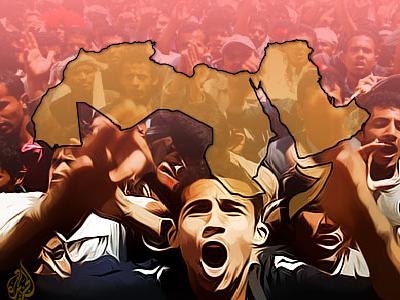
Exploited and Misused: The Impossible Discourse of the ‘Arab Spring’


The 'Arab Spring' has become an Arab springboard for regional meddling and foreign intervention.

The 'Arab Spring' has become an Arab springboard for regional meddling and foreign intervention.
By Ramzy Baroud
Jan 23 2013 / 11:10 pm

A reductionist discourse is one that selectively tailors its reading of subject matters in such a way as to only yield desired outcomes, leaving little or no room for other inquiries, no matter how appropriate or relevant. The so-called Arab Spring, although now far removed from its initial meanings and aspirations, has become just that: a breeding ground for choosy narratives solely aimed at advancing political agendas which are deeply entrenched with regional and international involvement.

When a despairing Tunisian street vendor, Mohamed Bouazizi lit himself on fire on December 17, 2010, he had ignited more than a mere revolution in his country. His excruciating death had given birth to a notion that the psychological expanses between despair and hope, death and rebirth and between submissiveness and revolutions are ultimately connected. His act, regardless of what adjective one may use to describe it, was the very key that Tunisians used to unlock their ample reserve of collective power. Then-President Zine El Abidine Ben Ali’s decision to step down on January 14, 2011, was in a sense a rational assessment on his part if one is to consider the impossibility of confronting a nation that had in its grasp a true popular revolution.

Egypt also revolted less than two weeks later. And it was then that Tunisia’s near-ideal revolutionary model became prey for numerous, often selective readings and ultimately for utter exploitation. The Egyptian January 25 revolution was the first Arab link between Tunisia and the upheavals that travelled throughout Arab nations. Some were quick to ascribe the phenomenon with all sorts of historical, ideological and even religious factors thereby making links whenever convenient and overlooking others however apt. The Aljazeera Arabic website still has a map of all Arab countries, with ones experiencing revolutionary influx marked in red.

Many problems have arisen. What tools, aside from the interests of the Qatari government, for example, does Aljazeera use to determine how the so-called Arab Spring manifests itself? And shouldn’t there be clear demarcations between non-violent revolutions, foreign interventions, sectarian tension and civil wars?

Not only do the roots and the expressions of these ‘revolutions’ vastly differ, but the evolvement of each experience was almost always unique to each Arab country. In the cases of Libya and Syria, foreign involvement (an all-out NATO war in the case of Libya and a multifarious regional and international power play in Syria) has produced wholly different scenarios than the ones witnessed in Tunisia and Egypt, thus requiring an urgently different course of analysis.

Yet despite the repeated failure of the unitary ‘Arab Spring’ discourse, many politicians, intellectuals and journalists continue to borrow from its very early logic. Books have already been written with reductionist titles, knitting linear stories, bridging the distance between Tunis and Sanaa into one sentence and one line of reasoning.

The ‘Arab Spring’ reductionism isn’t always sinister, motivated by political convenience or summoned by neo-imperialist designs. Existing pan-Arab or pan-Islamic narratives however well-intended they may be, have also done their fair share of misrepresenting whichever discourse their intellectuals may find fitting and consistent with their overall ideas. Some denote the rise of a new pan-Arab nation, while others see the ‘spring’ as a harbinger of the return of Islam as a source of power and empowerment for Arab societies. The fact is, while discourses are growing more rigid between competing political and intellectual camps, Arab countries marked by Aljazeera’s editorial logic seem to head in their own separate paths, some grudgingly towards a form of democracy or another, while others descend into a Hobbesian ‘state of nature’ – a war of all against all.

But reductionist discourses persist, despite their numerous limitations. They endure because some are specifically designed to serve the interests of certain governments – some with clear ambitions and others are simply trying to ride the storm. In the case of Syria, not a single country that is somehow a party in the conflict can claim innocence in a gory game of regional politics, where the price tag is the blood of tens of thousands of Syrians.

Western media continues to lead the way in language-manipulation, all with the aim of avoiding obvious facts and when necessary it misconstrues reality altogether. US media in particular remains oblivious to how the fallout of the NATO war in Libya had contributed to the conflict in Mali – which progressed from a military coup early last year, to a civil war and as of present time an all-out French-led war against Islamic and other militant groups in the northern parts of the country.

Mali is not an Arab country, thus doesn’t fit into the carefully molded discourse. Algeria is however. Thus when militants took dozens of Algerian and foreign workers hostage in the Ain Amenas natural gas plant in retaliation of Algeria’s opening of its airspace to French warplanes in their war on Mali, some labored to link the violence in Algeria to the Arab Spring. “Taken together, the attack on the U.S. embassy in Benghazi, Libya, the Islamist attacks on Mali, and now this Algerian offense, all point to north Africa as the geopolitical hotspot of 2013 — where the Arab Spring has morphed into the War On Terror,” wrote Christopher Helman, in Forbes, on Jan 18.

How convenient such an analysis is, especially when “taken together.” The ‘Arab Spring’ logic is constantly stretched in such ways to suit the preconceived understanding, interests or even designs of western powers. For example, it is now conventional media wisdom that the US is wary of full involvement in Syria because of the deadly attack on the US embassy in Benghazi. When seen from Washington, the Arab region appears less compound and is largely understood through keywords and phrases, allocated between allies and enemies, Islamists and liberals and by knee jerk reactions to anything involving Israel or Iran.

One only needs to compare media texts produced two years ago, with more recent ones. Whereas the first few months of 2011 were mostly concerned with individuals and collectives that had much in common with Mohamed Bouazizi – poor, despairing, disenfranchised, and eventually rebellious – much of the present text is concerned with a different type of discussion. Additionally there are almost entirely new players. The Bouazizis of Tunis, Egypt and Yemen remain unemployed, but they occupy much less space in our newspapers and TV screens. Now we speak of Washington and London-based revolutionaries. We juxtapose US and Russian interests and we wrangle with foreign interventions and barefacedly demarcate conflicts based on sectarian divisions.

“Arab awakening is only just beginning”, was the title of a Financial Times editorial of Dec 23. Its logic and subtext speak of a sinister interpretation of what were once collective retorts to oppression and dictatorships. “The fall of the Assads will be a strategic setback to Iran and its regional allies such as Hizbollah, the Shia Islamist state within the fragile Lebanese state,” the editorial read. “But that could quickly be reversed if Israel were to carry out its threats to attack Iran’s nuclear installations, enabling Tehran’s theocrats to rally disaffected Muslims across the region and strengthen their grip at home. It is easy to imagine how such a conflict would drag in the US, disrupt the Gulf and its oil traffic, and set fire to Lebanon.”

Note how in the new reading of the ‘Arab Spring’, people are mere pawns that are defined by their sectarian leanings and their usefulness is in their willingness to be rallied by one regional power or another. While the language itself is consistent with western agendas in Arab and Muslim countries, what is truly bizarre is the fact that many still insist on contextualizing the ever-confrontational US, Israel and western policies in general with an ‘Arab Spring’ involving a poor grocer setting himself on fire and angry multitudes in Egypt, Yemen and Syria who seek dignity and freedom.

Shortly after the Tunisian uprising, some of us warned of the fallout, if unchecked and generalized discourses that lump all Arabs together and exploit peoples’ desire for freedom, equality and democracy were to persist. Alas, not only did the reductionist discourse define the last two-years of upheaval, the ‘Arab Spring’ has become an Arab springboard for regional meddling and foreign intervention. To advance our understanding of what is transpiring in Arab and other countries in the region, we must let go of old definitions. A new reality is now taking hold and it is neither concerned with Bouazizi nor of the many millions of unemployed and disaffected Arabs.

- Ramzy Baroud (www.ramzybaroud.net) is an internationally-syndicated columnist and the editor of PalestineChronicle.com. His latest book is: My Father was A Freedom Fighter: Gaza’s Untold Story (Pluto Press).

River to Sea Uprooted Palestinian
The views expressed in this article are the sole responsibility of the author and do not necessarily reflect those of this Blog!

Wednesday, 2 January 2013

Will Syria Go on Offense at The Hague?

Franklin Lamb
Al-manar

A "legal intifada" appears likely for more than just the Palestinians
La Maison d’Avocats, Damascus


Even before the historic 139 to 8 vote of the UN General Assembly on November 29 of this year which opened up a plethora of legal remedies for Palestinians, a “legal intifada” -- to borrow a phrase from Francis Boyle, Professor of International Law and a longtime advocate of advancing resistance to the illegal occupation of Palestine through the rule of law -- has been taking form in this region.

The reasons include nearly seven decades of countless Zionist crimes against Muslims and Christians in occupied Palestine and far beyond. As Professor Boyle has suggested, the opportunities presented to the PLO by the lopsided UN vote “…can mean numerous available legal remedies ranging from the securing of a fair share of the gas deposits off the shores of Gaza, control of Palestinian airspace and telecommunications and, crucially, bringing the Zionist regime to account at the International Criminal Court and the International Court of Justice.

SyriaSyria too, currently under enormous pressure from international interference into the internal affairs of the country and the subject of an intense regime change project led by the US and France, has international legal remedies immediately available to it stemming from the actions of the US, UK, France and others in imposing on Syria’s civilian population one of the most severe and clearly illegal layers of sanctions. Were Syria and others to file an Application for an Advisory Opinion with the ICJ few in the international legal community have much doubt that targeting civilians economically and attempting to destroy the Syrian economy -- for no other purpose than to ignite rebellion -- would be considered a violation of international law at the International Court of Justice.
Granted there are some potential jurisdictional problems given that Syria has not yet accepted the Article 36 Compulsory Jurisdiction of the World Court, as provided in the Statute of the Court, and the strong campaign at the UN that would certainly be waged by the Obama Administration to challenge ICJ jurisdiction to hear a case on behalf of Syria and its civilian population, but they can be overcome. As a general rule, an Advisory Opinion requires a simple majority affirmative vote by the UN General Assembly or an Application by one of the designated UN Specialized Agencies. This might be a tough job to secure the former but it is doable with the latter. Moreover, should Syria accept the compulsory jurisdiction of the ICJ it could likely quickly resolve the issue of sanctions by claiming a legal dispute with one or more states that also accept CJ and are supporters of sanctions. For example, the UK, France and their NATO and Gulf allies.

Aspects of a possible filing at the International Court of Justice on the legality of US-led sanctions are currently being researched by seasoned international lawyers and academics, at various Western and International law centers. Supporting efforts being worked on include drafting amicus curie briefs on the issue of the legality of the US-led sanctions to be submitted to the Court, plans for securing the widest possible political support for challenging the US-led sanctions from among Non-Aligned Movement countries, international peace groups, NGO’s, pro-peace websites, bloggers, social media and online activists as well as organizing a skilled media center to disseminate information about the case including quickly publishing, in paperback book form, one of the key Annexes to be submitted to the ICJ upon filing the Application. This volume will present Syrian government and International NGO prepared data on the inhumane effects of the US led sanctions in all their aspects, including by not limited to children, the elderly and the infirm, plus the effects of the US-led sanctions on the Syrian economy generally, i.e. consumer goods, medical delivery systems, financial institutions, currency values and related aspects of the lives of the civilian population of Syria.

Were Syria, and others, to take the illegal and immoral US-led sanctions case to the World Court and other available venues, they would shift their diplomatic position from a defensive status to taking the offense. Such a bold initiative would advance accountability under international law and, because the ICJ would likely grant a Petition for Interim Measures of Protection, the US-led sanctions could be suspended during the course of the judicial proceedings. Obviously this lifting/freezing of the sanctions would immediately and directly inure to the benefit of the Syrian civilian population, including the half million Palestinian refugees in Syria as well as thousands from Iraq.

This would work in concert with the “THREE B’s”, to borrow a phrase from Russia’s top middle east envoy, Deputy Foreign Minister Mikhail Boganov, referring to Mr. Brahimi, Mr. Bogdanov, and Undersecretary William Burns, a former ambassador to Moscow, who would be urged to intensify their focus on achieving a diplomatic resolution of the Syrian crisis based on modified June 2011 Geneva formulation of a transition period leading to the 2014 elections.

Corte Internacional Justica (Tribunal de la Haya)According to several International lawyers surveyed between October and December, 2012, Syria clearly has the facts of the US sanctions case in its favor and there are ample solid legal theories to argue to and convince the World Court. Under the ICJ Statute, the Court must decide cases solely in accordance with international law. Hence the ICJ must apply:
(1) any international conventions and treaties;
(2) international custom;
(3) general principles recognized as law by civilized nations; and
(4) judicial decisions and the teachings of highly qualified publicists of the various nations. From this body of international law the International Court of Justice would find ample basis to support Syria's claims not only for the benefit of its civilian population but also to advance the rule of law in the global community.

The ICJ is made up of 15 jurists from different countries. No two judges at any given time may be from the same country. The court's composition is static but generally includes jurists from a variety of cultures. Among the Principles, Standards and Rules of international law that Syria may well argue to the World Court, may include but not be limited to, the following:

The US led sanctions violate international humanitarian law due to the negative health effects of the sanctions on the civilian population of Syria. This renders the sanctions illegal under international customary law and the UN Charter for their disproportionate damage caused to Syria's civilian population;

The US led severe sanctions regime constitutes an illegitimate form of collective punishment of the weakest and poorest members of society, the infants, the children, the chronically ill, and the elderly;
The US, France and the UK, as well as their allies, have violated the UN Charter by their imposition of severe economic sanctions and threats of military force. The United States, Israel, and some of their allies, regularly threaten Damascus with the "option" of a military strike. The ICJ has ruled previously that "A threat or use of force is contrary to Article 2, paragraph 4, of the UN Charter and fails to meet all the requirements of Article 51, is therefore unlawful". It has further ruled that "A threat of use of force must be compatible with the requirements of the international law applicable in armed conflict, particularly those of the principles and rules of humanitarian law, as well as with specific obligations under treaties and other undertakings which expressly deal with threats to members of the United Nations.”

Moreover, unilateral US sanctions, without the imprimatur of the United Nations are blatantly illegal under International Law because they are in fact multilateral and impose penalties on any country which opposes the sanctions or does not choose to participate in them;

The US led sanctions amount to an Act of War given their effects including hardships on the general public and that Syria therefore has a legal right to Self-Defense.

The US led sanctions, given their design and intent, constitute acts of aggression against Syria in violation of Article 2 (4) of the UN charter.

The indisputable facts of the US led sanctions case warrant the imposition by the ICJ of Restraining Orders designed to prevent any type of blockade or no-fly zones in Syria and the immediate cessation of the imposition of further economic sanctions against Syria, and also their efforts of securing more sanctions against Syria at the United Nations Security Council. The Restraining Orders, under the umbrella of Interim Measures of Protection, would presumably also seek to prohibit the US and its allies from the Persian Gulf region and elsewhere, from advocating aggressive military actions against Syria, including supplying funding, weapons, and jihadists, as well as Western “Special Forces” currently pouring into Syria from its northern border with Turkey and to negotiate with the Syrian government in good faith to end the current crisis.

Syria can legitimately claim, and would presumably argue at the ICJ and other international forums that the bi-lateral or multilateral economic sanctions, led by the US and its Gulf allies, Qatar and Saudi Arabia, are illegal, indeed criminal due to their assault on international humanitarian law and required state practice.

Syria could successfully argue, according to a recent survey of international lawyers conducted in Brussels and The Hague, as well as within Syria’s Maison d’Avocats, that the US led sanctions violate the international law principle of Non-intervention in the internal affairs of UN member states and that the stewards of these sanctions could themselves be subject to international sanctions plus compensatory and punitive damages for the benefit of their victims.

In summary, as Germany's Green Party, and increasingly, legal scholars and human rights organizations generally are insisting, sanctions against Syria’s civilian population fundamentally violate international law.

Should NATO sets up a no-fly zone and were to launch airstrikes against Damascus, it can and should immediately be sued at The Hague and if the situation deteriorates NATO can and should be held to account for targeting Alawites and Christians on the basis of the 1948 UN Convention on the Prevention and Punishment of the Crime of Genocide. All participating countries, 142 to date, are obliged to prevent and punish actions of genocide in war and in peacetime. Article 2 of the Convention defines genocide as any of the following acts committed with intent to destroy, in whole or in part, elements of a national, ethnic, racial, or religious group including killing members of the group, causing serious bodily or mental harm to members of the group, deliberately inflicting on the group conditions of life calculated to bring about its physical destruction in whole or in part.
Despite Syria’s strong case on both the facts and the law, and the diversity in structure and composition of the International Court of Justice, the International Tribunal has a few times over the years been criticized for favoring established powers. Under articles 3 and 9 of the ICJ Statute, the judges on the ICJ should represent "the main forms of civilization and principal legal systems of the world." This definition suggests that the ICJ does not represent the interests of developing countries. Nevertheless, the World Courts record has been by and large exemplary in applying principles, standards and rules of international law both in contested cases and advisory opinions and Syria has an excellent opportunity to protect its citizens, thwart US and Israeli designs on the region, and advance international accountability -- all to the inestimable benefit of all people and nations.

Syria, which the US and Israel and their allies are today working to keep off balance and on the defensive diplomatically, should consider immediately filing an application with the International Court of Justice, and use all other available international legal, political and humanitarian tribunals, to directly challenge and boldly confront the US led sanctions campaign against its people. The Syrian Arab Republic, by taking the offensive at the World Court and elsewhere, will help relieve the enormous pressures on its civilians and advance the principles, standards and rules of international law—for the benefit of all mankind.

Franklin Lamb is doing research in Damascus and can be reached c/o fplamb@gmail.com

River to Sea Uprooted Palestinian
The views expressed in this article are the sole responsibility of the author and do not necessarily reflect those of this Blog!