Showing posts with label Media. Show all posts

Sunday, 21 November 2021

How Saudi State Media Feeds Fake News to Israeli, Western Audiences

 November 15th, 2021

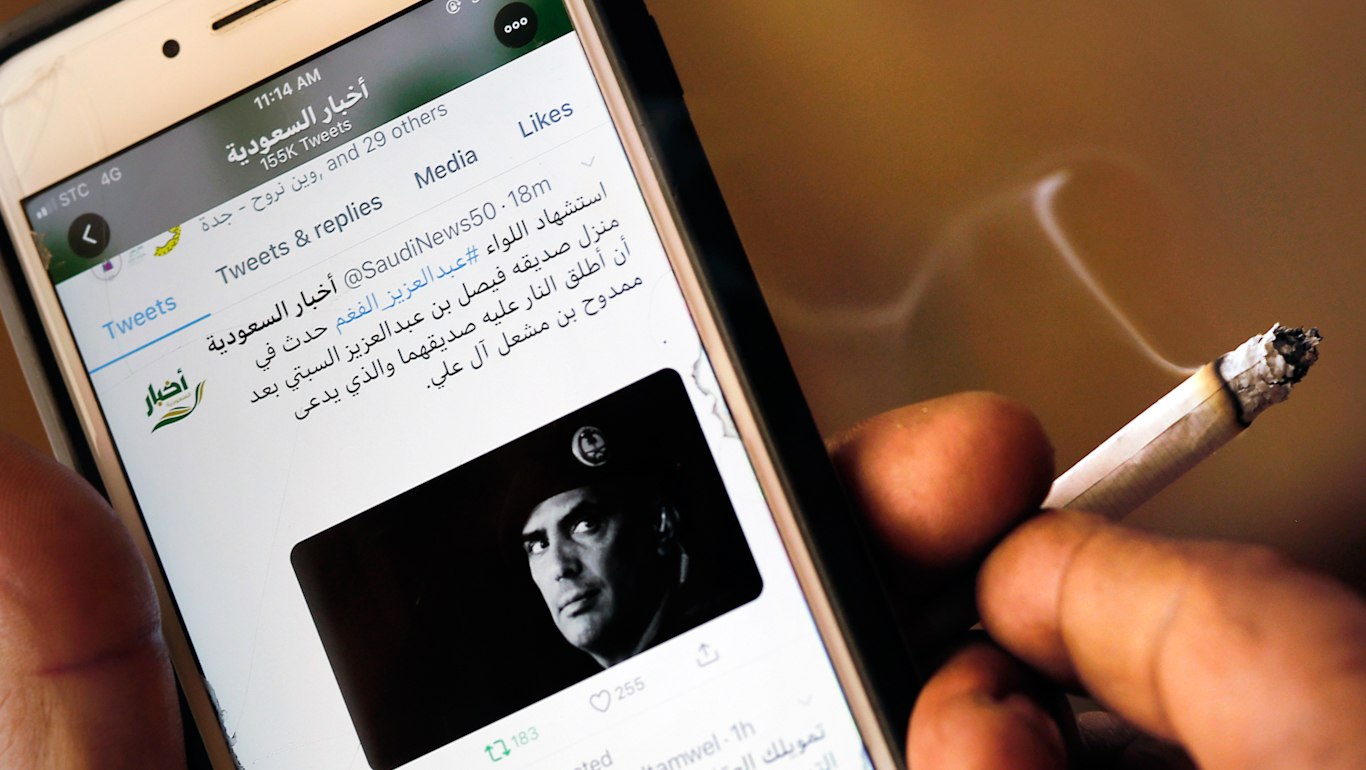
Saudi Media Feature photo
Unsubstantiated Saudi state media claims are very specifically designed to inflame tensions and to make the supporters of Hamas, Iran and Syria doubt their leaders and what may be going on behind the scenes.

by Robert Inlakesh

Source

RIYADH, SAUDI ARABIA — Saudi state media outlets have been found to repeatedly report information, lacking sources or supporting evidence, in order to attack their political opposition in the Middle East. This can range from stories about deserters from Hamas to the utterly absurd fictions regarding alleged assassinations of high-ranking Iranian officials, which, taken together, constitute a pro-Israel, pro-Washington psyop.

This Wednesday, Saudi state broadcaster Al-Hadath claimed that an Iranian ‘Islamic Revolutionary Guard Corps’ (IRGC) Commander named Seyyed Mustafa Javad Ghaffari had been kicked out of Syria by the country’s president, Bashar al-Assad, sparking speculation over a possible breakdown in relations between Tehran and Damascus. For Israeli and U.S. media, which have now taken the report at face value, it is an intriguing story. And it would be an interesting development, except for one small detail: there is not a shred of evidence to support the claims.

According to the original report on Al-Hadath, Commander Ghaffari had set up a “black market” by bypassing customs and smuggling goods into Syria; additionally, Ghaffari had allegedly admitted to storing weapons in prohibited areas inside of Syria. Later reports in Israeli media, quoted Saudi media as claiming that Assad had accused Ghaffari of violating Syrian sovereignty and hence had expelled him. In addition to this, the unnamed Saudi media source seemed to work off of the assumption that the Iranian commander was behind an attack on U.S. forces and their allies on October 20 at their al-Tanf base in Syria. According to Al-Hadath, Syria was unhappy specifically with the IRGC commander’s conspiring against the Israelis and U.S. forces that occupy their territory, owing to fears of being dragged into a regional war.

Not surprisingly, Saudi Arabia’s broadcaster used biased language, in what should have been a professional report, demonstrating instantly that the outlet, Al-Hadath, was coming at the report from the state’s propagandistic perspective. On its website, its report concludes:

The source viewed the exclusion of Mustafa Ghaffari, who is following in the footsteps of Qassem Soleimani by establishing the Syrian Hezbollah militia, as a blow to Soleimani’s vision and dream of establishing a land bridge between Iran and Lebanon.

So who is this source? We don’t have a name or even a title. All we know is that Al-Hadath calls them someone that is familiar with the Syrian senior leadership. Lacking any further information, it is reasonable to ask the following questions: How does an enemy state to both Syria and Iran manage to acquire such information first? If this source exists, they clearly chose an enemy state to leak this information to, so why not an American or Israeli media outlet with more credibility? And finally, is there really any such source?

I spoke to Seyyed Mohammed Marandi, Professor of English Literature and Orientalism at the University of Tehran, who says that the claims are “utter nonsense.” “All Iranian commanders are rotated, Hajj Javad isn’t the first,” Marandi explained. He also went on to say that “actually, the Iranian change in command happened weeks ago; if they [Saudi media] know so much why didn’t they say anything when it happened?”

A history of similar claims

Interestingly, this is far from the first time that such reports have emerged — reports that carry the potential to sow confusion and distrust amongst supporters of parties and nations that are enemies of Saudi Arabia.

On July 19, 2020, Saudi Arabia’s Al-Arabiya published claims that high-ranking Hamas officials had been caught spying on the Gaza-based movement, including a Commander of the al-Qassam Brigade’s elite naval wing, said to be named Mohammed Abu Ajwa, who they claimed fled to Israel via boat after spying for Israel since 2009. The source for these claims was again unnamed and the allegations were denied strongly by Hamas spokesman Hazem Qassem, who said that “the Al-Arabiya channel is promoting rumors that serve the aims of the occupation in destabilizing the home front in Gaza.” It is now 2021 and Israel has yet to even comment on these claims officially, which is strange considering that such a propaganda win for Israel would normally be weaponized by their political establishment. In addition to this, no one in Gaza has ever heard of this alleged commander.

As with the claims made about Syria expelling an IRGC Commander, there was a minuscule grain of truth to what was claimed. In the case of Syria’s “expulsion” of Iran’s commander, Javad Ghaffari did leave Syria weeks ago; and in the case of Hamas collaborators, the movement did arrest 16 individuals on the basis of spying for Israel. In fact, the report for Al-Arabiya quoted the Ministry of Information for Hamas, to substantiate its claims of Hamas members being arrested.

The Times of Israel even claimed that it was a big deal that “Hamas admits” one of its own fled to the Israeli side, after Hamas leader Mousa Abu Marzouk had stated as much, a fact already acknowledged to be true. This demonstrates the sensationalism of Israeli media at the time. During the interview quoted, conducted with Marzouk for Al-Mayadeen TV, the Hamas leader said:

They are isolated members. There is no connection between them. They are not commanders in the [Hamas military wing] Izz al-Din al-Qassam Brigades, nor are they commanders in Hamas… What the occupation claims, that they are commando officers or senior naval officers, is absolutely false.”
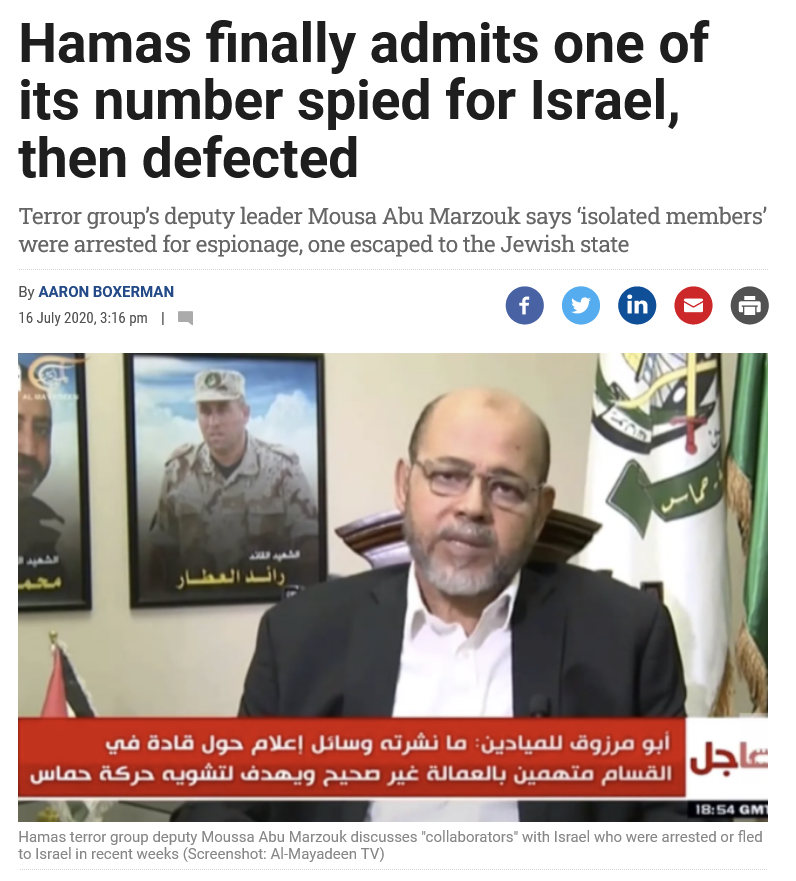
The Times of Israel, along with other Israeli media, was quick to parrot unsubstantiated Saudi claims

It is important to know that Hamas regularly arrests collaborators and sentences many of them to death. This is not uncommon, nor is it out of the ordinary for members of the group to be blackmailed by Israel to work for them. To become a member of Hamas is not a difficult task and its membership is wide-ranging inside Gaza.

An Iranian commander assassinated, or not really

Another example of bogus claims made by Saudi State TV is that of an Iranian commander being assassinated in Syria’s Eastern Deir Ezzor province in November of 2020. In this case, Al-Arabiya added sketchy details to a story built on weak foundations. The alleged assassination of an Iranian Quds force commander would have had serious implications, especially as some sources claimed that it came as a result of a U.S. coalition force bombing campaign.

At the time I tracked the report to its origin, discovering that the allegations had emerged from a Syrian-opposition media group, called “Step News Agency,” which published a report on the alleged incident on November 29, 2020. The article claimed that the agency’s reporter, Abdul Rahman al-Ahmad, who was said to have been based in the Eastern Deir Ezzor province of Syria “obtained information” that indicated a vehicle belonging to Iran’s elite Quds forces was targeted and destroyed. The car was, according to this report, targeted near the Salbi area, in the Suwaiya Desert, after having crossed into Syria from a designated area for militias, near the Al-Qaim crossing. The initial report noted only that two were said to have died in the attack, also claiming that the week prior to this, unidentified aircraft – suspected to have belonged to the U.S. coalition – had launched 10 raids on pro-Iranian militia sites.

Israeli media outlets then ran with the claims despite having nothing but the word of a single Syrian opposition journalist to go on. Israel Hayom News, for instance, cited developed claims from Syrian-opposition media that instead of two Iranians having been killed, it was “a logistics officer in the IRGC’s elite Quds Force,” as well as two other Iranians, who had been assassinated.

Al-Arabiya News then claimed to have obtained the identity of the commander, naming him as “Muslim Shahdan.” This was then published by the likes of the Daily Mail, which also repeated the claim made by the Turkish-based Anadolu Agency that there were now three IRGC members killed inside the car allegedly targeted in Deir Ezzor, Syria.

There was never any photographic evidence, witness testimony, approximate timing, video evidence, or any official confirmation of exactly where in Deir Ezzor this attack took place. There was no continuity through the various contradictory claims made by all the different media outlets and no one could even determine how many people actually died in the reported attack.

The story originated with Syrian opposition media groups, who have a clear anti-Iran agenda and have continued to peddle false claims of Iranian forces being killed in virtually every single Israeli attack on Syria, figures that Israel never clarifies and for which we never see proof. These groups claim to have sources in Syrian government-controlled areas, even naming those individuals occasionally. The question also must be posed in this case that if the Syrian government knows these journalists, how is it that they are still able to obtain sensitive information on military operations and casualties of individuals known only to a few to be in the country, in top-secret locations? Are we to believe that these unnamed sources are never identified and that in Syria anyone can know sensitive information about the government at any time without any questions asked? Also, how is it that these opposition journalists are the first people to report casualties, often before there is time for local medical staff to declare deaths?

There was then the story that was looped in with the alleged assassination attack, claiming that U.S. coalition forces attacked 10 Iranian sites in Abu Kamal, but according to the initial reports from Syrian opposition media, that had happened a week prior to the assassination. Israel Hayom and the Daily Mail failed to specify when the two separate attacks took place, making it seem as if it all had occurred on the same night. Again there are no specifics given here, just the repeated claims from Syrian opposition media.

The allegations that were made about weapons having been transported, in the car of the commander that was allegedly attacked, also seemed very unlikely. Why would an Iranian Quds Force commander be traveling in a car packed full of weapons and why do a weapons transfer in a regular car carrying a high-ranking commander in it? Why not just transport the weapons in trucks? These small details made the story seem less believable, especially when no one had been able to officially identify the two, three, or four Iranians said to have been killed.

As spokesman for Iran’s Foreign Ministry, Saeed Khatibzadeh, later told Iran’s Mehr News that these allegations were false, yet many Western media outlets failed to publish this information. Talking to a Syrian Arab Army military source at the time, I was also informed that they were “not aware of any such attack happening”.

Saudi media playing a pro-Israel, pro-Western agenda

The examples above demonstrate a clear pattern with the media of Saudi Arabia and the way in which their “unnamed sources” are taken at face value and repeated verbatim throughout Western and Israeli media. The claims clearly serve a political agenda, but not just any agenda.

Such claims are very specifically designed to inflame tensions and to make the supporters of Hamas, Iran and Syria doubt their leaders and what may be going on behind the scenes. They play on issues that are normally dealt with behind closed doors and it is well understood that the average consumer of news will not have the time or resources to dig into such stories with the intent of uncovering the truth.

Israeli officials have now twice traveled to Saudi Arabia in the past year, that we know of, not only raising suspicions of unofficial cooperation between Riyadh and Tel Aviv, but confirming that the Kingdom of Saudi Arabia is warming up to the idea of openly normalizing ties with Israel, while the closeness of the United States government to the Saudis has long been apparent. Hence for Saudi state media to run media operations, as a form of psychological warfare, against their political foe, is not much of a surprise. Yet, for outlets across the world to choose to regurgitate the claims made by Saudi media, verbatim and without any critical take, is a real indictment of them and demonstrates a lack of journalistic credibility on their part.


River to Sea Uprooted Palestinian   
The views expressed in this article are the sole responsibility of the author and do not necessarily reflect those of the Blog!

Saturday, 19 June 2021

With Bezos at the Helm, Democracy Dies at the Washington Post Editorial Board

 June 18th, 2021

By Alan Macleod

Source

In the Soviet Union, everybody was aware that the media was controlled by the state. But in a corporate state like the U.S., a veneer of independence is still maintained, although trust in the media has been plummeting for years.

WASHINGTON — The Washington Post’s glaring conflicts of interest have of late once again been the subject of scrutiny online, thanks to a new article denouncing a supposed attempt to “soak” billionaires in taxes. Written by star columnist Megan McArdle — who previously argued that Walmart’s wages are too high, that there is nothing wrong with Google’s monopoly, and that the Grenfell Fire was a price worth paying for cheaper buildings — the article claimed that Americans have such class envy that the government would “destroy [billionaires’] fortunes so that the rest of us don’t have to look at them.” Notably, the Post chose to illustrate it with a picture of its owner, Jeff Bezos, making it seem as if it was directly defending his power and wealth, something they have been accused of on more than one occasion.

There was considerable speculation online as to whether Bezos himself wrote the piece, so blatantly in his interest it was. Unfortunately, this sort of speculation has raged ever since the Amazon CEO bought the newspaper in 2013 for $250 million.

Undue influence

Being owned by the world’s richest individual does not mean that The Washington Post and its employees are rolling in dough themselves. Far from it: Bezos’ revolution at the newspaper, which has led to both increased pageviews and company value, has been largely based on simply squeezing workers harder than before. In an interview with the Columbia Journalism Review, management acknowledged that Post reporters are pushed to produce almost four times as many stories as their peers at The New York Times. Furthermore, the Post writes and rewrites the same story but from slightly different angles and with different headlines in order to generate more clicks, and thus more revenue. Thanks to new technology, reporters’ every keystroke is monitored and they are under constant pressure from management not to fall behind. The technique of constant surveillance is not unlike what hyper-exploited Amazon warehouse workers who wear GPS devices or Fitbit watches have to endure.

Bezos is currently worth a shade under $200 billion, with his wealth nearly doubling since the beginning of the coronavirus pandemic in 2020. With such a fortune to protect, the obvious solution is to acquire media outlets to control the narrative in the face of rising public disenchantment with rampaging inequality. Omar Ocampo, a researcher for the Program on Inequality and the Common Good at the Institute for Policy Studies, said that this is a common tactic among the super wealthy. “Billionaire ownership of major news outlets is but another tool the billionaire class deploys for the purpose of wealth defense. It gives them the power to set the terms of the agenda and influence public opinion in their favor,” Ocampo told MintPress.

But Bezos is far from the only senior figure with questionable connections. The company’s CEO, Frederick Ryan, was a senior member of the Reagan White House, rising to become the 40th president’s assistant and later the chairman of the Ronald Reagan Presidential Foundation. He later became CEO of Politico. In the Post’s announcement of the hiring move, they themselves noted that among Ryan’s biggest achievements at their rival outlet was “helping the news organization win a lucrative advertising deal with Goldman Sachs and host presidential debates before the 2008 and 2012 Republican primaries.”

Another neoconservative in a key position is Editorial Page Editor Fred Hiatt. Under Hiatt’s tenure, anti-establishment columnists like Dan Froomkin were let go and warmongers like the late Charles Krauthammer, Paul Wolfowitz, and David Ignatius moved in. “After being so wrong on such a huge story as the invasion of Iraq, hawkish ideologue Fred Hiatt should have been terminated as editorial page editor,” Jeff Cohen, former Professor of Journalism at Ithaca College and founder of media watchdog group Fairness and Accuracy in Reporting, told MintPress, adding:

In a decent media system, someone who has been so inaccurate on so many issues as Hiatt would not be in a powerful media position two decades later. Powerful voices in U.S. media often argue that society should be a ‘meritocracy’ — with advancement based on ability or achievement. Hiatt proves that the U.S. corporate media system is just the opposite — a ‘kakistocracy’ — where the unqualified and unprincipled rise to the top.”

Other highly questionable hires include Jerusalem correspondent Ruth Eglash, who spent seven years putting out content that was often indistinguishable from Israeli government propaganda. At the time of her hire, activists highlighted the conflicts of interest she had, given her husband’s job as a PR rep for the country. In November 2020, Eglash quit the Post to become chief of communications for the Israeli ambassador to the United States and United Nations. “My experiences as a journalist have afforded me a great instinct of how to better tell Israel’s unique story,” she said, adding “a strong U.S.-Israel relationship and showcasing Israel’s successes to the world has [sic] always been a passion of mine.”

At the center of the news cosmos

The Washington Post is among the most powerful, influential, and widely-read media outlets in the United States. Its position as the dominant newspaper in the nation’s capital reinforces its place as a thought-leading, agenda-setting publication. Whatever appears in the Post will likely be in the rest of the nation’s media, so authoritative is its reputation.

There are no more important pages than its editorial section, where its board comes together to lay out the collective wisdom of its most senior journalists and editors. Through its editorial page, the senior staff lay out the newspaper’s line to others and broadcast what they see as the correct position on the most pressing issues of the day. Hence, editorials are essentially instructions to their well-heeled and influential readers in D.C. and around the country on what to think about any given subject.

This is particularly troublesome as, despite the fact the newspaper presents itself as a defender of liberty and a champion of the people (its tagline is “Democracy Dies in Darkness”), the editorial board has represented the interests of the powerful over ordinary Americans on issue after issue. The following editorials are examples of this in action.

Could we be any more pro-war?

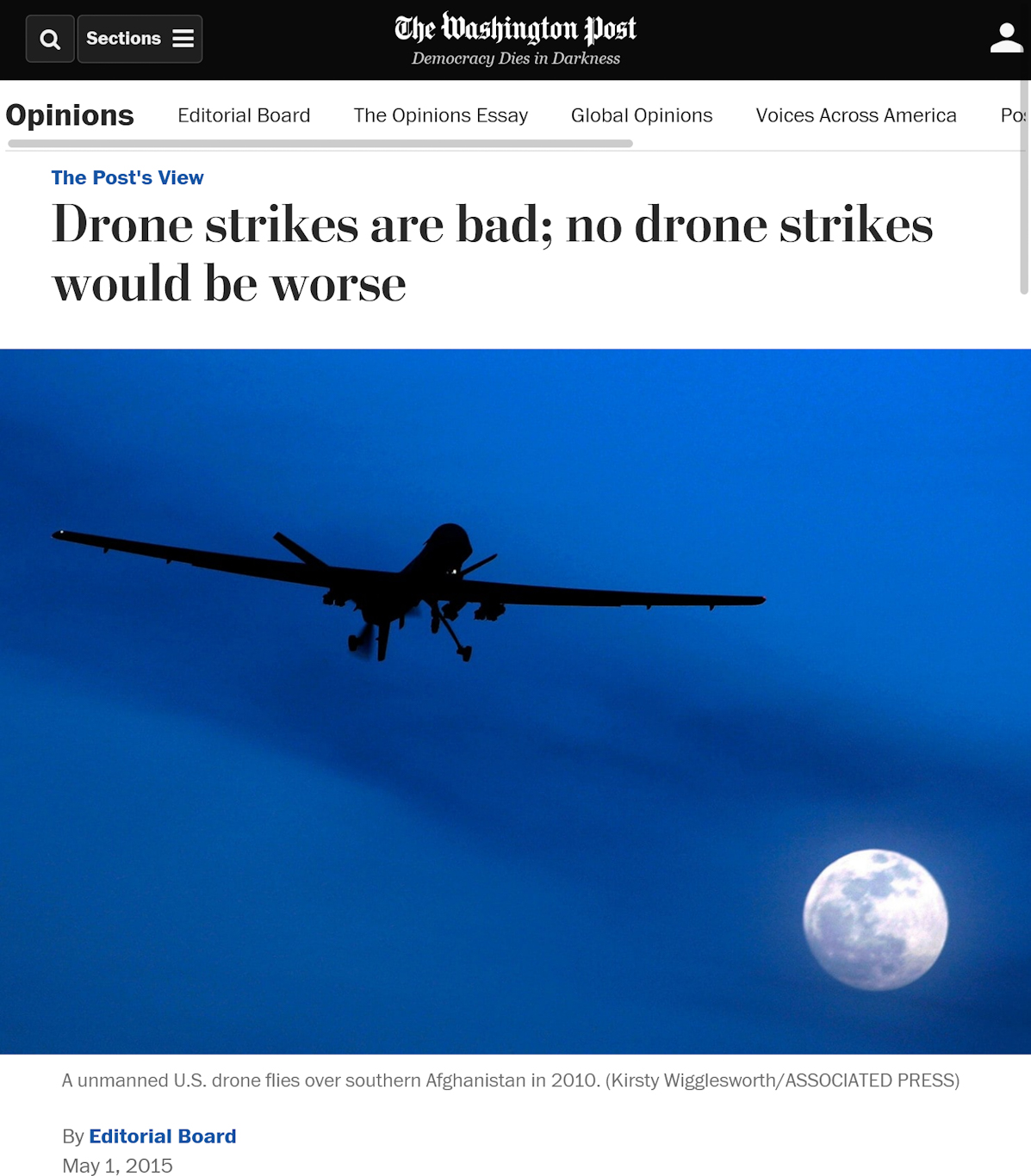
The Post’s editorial board has generally been extremely supportive of whatever conflicts the U.S. has started, and has consistently warned against ending the violence. In a 2015 editorial entitled “Drone strikes are bad; no drone strikes would be worse,” it balked at the idea of stopping the highly controversial bombing campaigns throughout the Middle East and North Africa. By that time, President Barack Obama was bombing seven countries simultaneously. Nevertheless, the Post argued that drones had successfully defeated Al-Qaeda and that the use of drone strikes “shouldn’t be up for review.”

In recent times, the rising newspaper of record has also been a driver of increased hostilities with China, describing Beijing’s military’s moves in the South China Sea as “provocations” against the U.S., spreading rumors about the COVID-19 virus’s origin, and demanding American companies like Apple “resist China’s tyranny” and begin to relocate their production facilities elsewhere to punish the Chinese government.

On Latin America too, the editorial board has proven to be extremely hawkish. It immediately endorsed a U.S.-backed far-right coup in Bolivia in 2019, insisting that “there could be little doubt who was ultimately responsible for the chaos: newly resigned President Evo Morales.” The Post condemned him for refusing to “cooperate” with “Bolivia’s more responsible leaders,” who were organizing his overthrow, and chastised him for using the word “coup” for what was going on. Morales, they concluded, was a victim of his own “insatiable appetite for power” and his inability to “accept that a majority of Bolivians wanted him to leave office.”

In 2002, the paper also supported a coup against Hugo Chavez, falsely claiming the Venezuelan president had ordered the shooting of thousands of demonstrators and absurdly asserting that “there’s been no suggestion that the United States had anything to do with [it].

The WaPo editorial board's less than subtle take
The WaPo editorial board’s less than subtle take on drone warfare

In more recent times, it has demanded more action to unseat Chavez’s successor, Nicolas Maduro, including supporting U.S. sanctions that have now killed over 100,000 people, according to a United Nations rapporteur. The Post’s justification in 2017 was that Maduro was on the verge of carrying out his own “coup,” “abolish[ing] the opposition-controlled legislature, cancel[ing] future elections and establish[ing] a regime resembling that of Cuba’s” — none of which has happened. In its efforts to oust the democratically-elected leader, the Post even aligned itself with Donald Trump and endorsed far-right coup leader Juan Guaidó as “Venezuela’s legitimate president,” a position some polls have suggested as little as 3% of Venezuelans hold.

The editorial board has expressed its desire to see regime change in leftist-controlled Nicaragua, too. President Daniel Ortega, it claims, is “taking a sledgehammer” to opposition against him, while it also demands that the U.S., which has done nothing but offer “mild verbal opposition” to his rule, do more. What happened to the U.S. of the 1980s, “which spent so much money and political capital to promote democracy in Nicaragua?” they ask sadly.

In reality, of course, the U.S. is currently trying to strangle Nicaragua’s economy through sanctions. And in the 1980s, Washington’s “democracy promotion” agenda included the funding, training and arming of fascist death squads who wrought havoc across Central America, killing hundreds of thousands in genocides from which the area may never recover. The architects of the violence were found guilty in U.S. courts, while the Reagan administration was tried and convicted by the International Court of Justice on 15 counts that amount to international terrorism. That the Post’s editorial board remembers that history as “promoting democracy” is particularly worrisome.

Fake news, fake newspapers

The Washington Post was the key supporter of fake news detection system “PropOrNot,” which was almost immediately exposed as a fake operation itself, forcing the newspaper to publicly distance itself from its own reporting. Yet it was the Post itself that perpetuated the most notorious and damaging fake news story of the 21st century: the Iraqi weapons of mass destruction hoax and Saddam Hussein’s fictional links to al-Qaeda.

In a highly influential editorial entitled “Irrefutable” the Post wrote that, after watching Secretary of State Colin Powell’s speech at the United Nations, “it is hard to imagine how anyone could doubt that Iraq possesses weapons of mass destruction… And [Powell] offered a powerful new case that Saddam Hussein’s regime is cooperating with a branch of the al-Qaeda organization that is trying to acquire chemical weapons and stage attacks in Europe.”

“No page was more crucial in propelling the disastrous U.S. invasion of Iraq than the Post‘s editorial page — which beat the drums for war in a couple dozen editorials in the six months leading up to the invasion,” Cohen told MintPress, adding:

The Post’s op-ed page was almost as cartoonishly wrong on Iraq, offering little dissent or corrective to the editorial page’s jingoism — especially in that pivotal media moment following Colin Powell’s error-filled U.N. speech. While the editorial page offered up its ‘Irrefutable’ verdict, the op-ed page’s liberal voice offered an embarrassing column, headlined ‘I’m Persuaded’.”

The Post played a major role in manufacturing consent for the deadliest war since Vietnam, publishing 27 editorials in support of an invasion. As with PropOrNot, it backtracked long after the dust had settled, apologizing for its role in amping the public up to accept that war. Yet to this day it continues to push for others.

Surveillance state champion

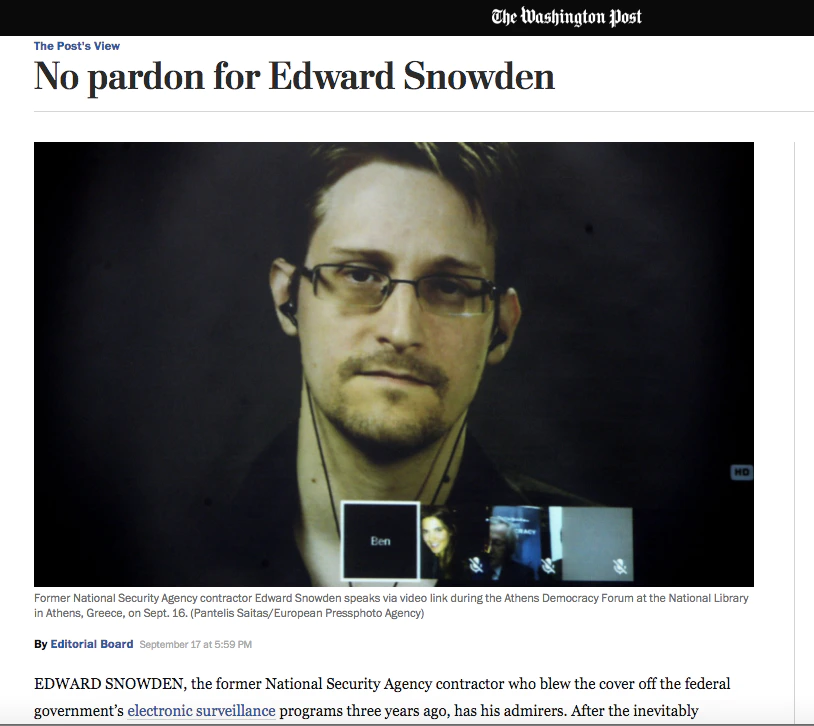
Despite telling its readers that “Democracy Dies in Darkness,” The Washington Post certainly has a negative opinion about those individuals who work to shine a light on illegal government activities. In 2016, its editorial board demanded “no pardon for Edward Snowden,” condemning his backers like filmmaker Oliver Stone and expressing outrage that Snowden had revealed that the U.S. was spying on Russia and carrying out cyberattacks against China. In its long denunciation, it insisted that the NSA’s massive surveillance operation against the American public resulted in “no specific harm, actual or attempted.” As such, the editorial board made history by becoming the first newspaper ever to call for the imprisonment of its own source, on whose back and information it won a Pulitzer Prize.

If Snowden was not worthy of defending, then it is no surprise that the Post’s editorial team expressed their delight when Julian Assange was dragged out of the Ecuadorian Embassy in London, declaring it a “victory for the rule of law.” “Julian Assange is not a free-press hero. And he is long overdue for personal accountability,” they wrote, spreading baseless conspiracy theories that the Australian publisher worked with Russia to hack American democracy.

WaPo Snowden
After relying on him as a source, the Post went after Snowden and any who dared to back him

The Ecuadorian government of Rafael Correa, which offered asylum to the Western dissidents, also came under fire. In 2013, the Post (falsely) labeled Correa an “autocrat” and “the hemisphere’s preeminent anti-U.S. demagogue.” They also directly threatened him, writing that, “If Mr. Correa welcomes Mr. Snowden, there will be an easy way to demonstrate that Yanqui-baiting has its price.”

Of course, the Post is now intimately linked with the national security state after Amazon signed a number of deals to provide intelligence and computing services to several three-letter agencies. In 2020, the Bezos-owned Amazon Web Services signed a new deal with the CIA worth tens of billions of dollars.

The editorial board has also gone up to bat for Immigration and Customs Enforcement (ICE) multiple times, insisting that it is “the wrong target for outrage,” presenting the agency as key in the battle against art theft and nuclear proliferation. “Abolishing ICE is not a serious policy proposal,” the board wrote in 2018, despite the fact that the U.S. survived without the agency perfectly well until its creation in 2003.

Attacking any pro-people policy

The Washington Post has aggressively attempted to beat back any new political movements challenging the establishment. Chief among them has been the one around Bernie Sanders, for whom the newspaper has reserved a special ire. In 2016, it famously ran 16 negative stories on Sanders in the space of 16 hours and has used its fact-checking page to relentlessly undermine him, sometimes to bizarre effect.

“Bernie Sanders keeps saying his average donation is $27, but his own numbers contradict that,” read the headline of one article, which detailed how his average donation was actually $27.89, not $27. It also gave his statement that six men (one of whom is Bezos) hold as much wealth as the bottom half of the world’s population “three Pinocchios” — the designation just below the most egregious lie. This was because, they argued, billionaires’ wealth is tied up in stocks, not money itself, and most people own essentially nothing. Why this disproved his assertion they did not explain. Going undisclosed is that both Bezos and the Post’s chief fact-checker Glen Kessler, who is the scion of a fossil fuel baron, would stand to lose a fortune if Sanders were elected.

Likewise, the Post’s editorial board did all it could to ensure Sanders was not elected in 2016, publishing editorials such as “Bernie Sanders’s fiction-filled campaign,” which defended big banks from Sanders’s attacks; “Mr. Sanders’s shocking ignorance on his core issue,” which presented Hillary Clinton as a more credible Wall Street reformer; and “Mr. Sanders peddles fiction on free trade,” which championed the long-discredited North American Free Trade Agreement as a jobs creator. Unsurprisingly, the editorial board was also a vociferous supporter of the Trans Pacific Partnership.

In 2020, the Post was no less hostile to Sanders, publishing an editorial headlined “We should pay more attention to the Democrats who pay attention to reality,” which stated that “Mr. Sanders promises unlimited free stuff to everyone; other candidates propose smarter, more targeted approaches.”

The Post’s higher-ups have been careful to oppose virtually every piece of progressive or pro-people policy proposals. Chief among them has been healthcare. The United States is alone in the developed world in not offering some kind of universal healthcare to its population. Its privatized system is multiple times more expensive than that of comparable countries and has the worst outcomes in the West. Yet the board has consistently scare-mongered its readers, claiming “Single-payer health care would have an astonishingly high price tag,” and attacking Medicare-For-All proponents running for office. “Why go to the trouble of running for president to promote ideas that can’t work?” it asked rhetorically, before going on to insist that moving towards a healthcare system like that of Canada, Japan or Western Europe does not meet a “baseline degree of factual plausibility.”

On education, it has been just as regressive. “There are consequences to making college free,” it warned readers. Chief among these would be that private universities would make less money, which, apparently should be a major concern. “Forgiving student loans the wrong way will only worsen inequality,” ran the headline of another editorial, in which the board pretended to be ultra-left elite-hating radicals, arguing that we should not make college free because Ivy League graduates would benefit the most (around one-third of the Post’s editorial team attended an Ivy League school). It also feigned a far-left position on charter schools, pretending that essentially privatizing schools and handing them over to businesses to run would solve racial inequality in America, and that anyone who opposed them (like teachers’ unions) was no progressive.

Perhaps the most blatant conflict of interest the Post has displayed is in their committed opposition to a wealth tax. “Elizabeth Warren wants a ‘wealth tax.’ It might backfire,” they wrote, making a series of bizarre and illogical arguments against the plan, such as immigrants will stop wanting to come to the U.S. if such a tax is imposed (the threshold for paying a wealth tax is $50 million). Five months later, the board reaffirmed their position: “A wealth tax isn’t the best way to tax the rich,” they wrote, claiming that rich people “can afford the best accountants and lawyers,” and so taxing them is presumably impossible.

Of course, the Post’s owner, Jeff Bezos, has every reason to go all out to prevent a wealth tax gaining traction. A CNBC study calculated that Bezos would be forced to pay $5.7 billion annually if Warren’s tax plans came to fruition.

The Post has also taken a firm stand against serious regulation of monopolies, decrying a supposed “antitrust onslaught” against Google, spearheaded by simplistic “break-them-up” rhetoric from dishonest actors. In 2016, it also lambasted Sanders for his “oversimplified,” “crowd-pleasing” demagoguery on Wall Street regulation, insisting that there has actually been widespread reform of the financial sector since 2008, making another crash unlikely.

Unsurprisingly for an outlet owned by a poverty-wage employer, the Post has also consistently opposed a national $15 minimum wage. In March, it categorically stated that “[a] $15 minimum wage won’t happen” and Democrats should stop trying to make it happen. Instead, they advised, they should “practice the art of the possible.” This, the board explained, meant falling in line behind Arkansas arch-Republican Senator Tom Cotton to support his proposals for a creeping state-by-state rise to $10.

On the climate, too, the Post has pushed extremely regressive positions, opposing a Green New Deal outright and suggesting the atmosphere be turned into a giant free market where polluters can trade credits and speculate. “The left’s opposition to a carbon tax shows there’s something deeply wrong with the left,” they wrote. They also endorsed the highly controversial process of fracking. Seeing as the Post’s editorial board is littered with former employees of the notorious climate-change denying Wall Street Journal, its stance is perhaps not surprising.

On COVID, the Post has consistently opposed teachers’ unions calls to keep schools closed, as well as standing against $2,000 checks. A universal payout is a “bad idea” they stated, but one “whose time has come because of politics, not economics.” So committed was the editorial team’s opposition to the idea of helping the poor that it presented Republican Majority Leader Mitch McConnell as a voice of sanity in Washington.

This does not mean that the Post was against direct payments to all people. In fact, all Post employees received a $2,021 bonus from management in January as a gesture of appreciation for their work during the pandemic. Two grand for me, not for thee.

Junk-food news

The point of a fourth estate is that it is supposed to shine a light on the powerful and hold them to account. But when corporate media are largely owned and sponsored by the super wealthy themselves, the claim that this is what they do is increasingly hard to maintain. In the Soviet Union, everybody was aware that the media was controlled by the state. But in a corporate state like the U.S., a veneer of independence is still maintained, although trust in the media has been plummeting for years.

While The Washington Post presents itself as an adversarial publication standing up to power, the fact that its senior staff constantly comes to such a hardline neoliberal elitist consensus on so many issues shows how little ideological diversity there is among its staff. Democracy dies at The Washington Post editorial board.


River to Sea Uprooted Palestinian   
The views expressed in this article are the sole responsibility of the author and do not necessarily reflect those of the Blog!

Saturday, 27 March 2021

After 10 Years of Civil War in Syria, US (Quietly) Declares Defeat but Won’t Go Home

 March 25th, 2021

By Alan Macleod

Source

Syria Media Bias
After a decade of bombing, invasions, exoduses and economic strife, it is clear that there are precious few winners in the Syrian Civil War — or from the rest of the Arab Spring, for that matter.

DAMASCUS, SYRIA — This March marks the 10-year anniversary of the Arab Spring and the protests that rocked Syria, which were a starting point for the ongoing civil war. That conflict has led to over half a million deaths and nearly 13 million people displaced, according to some estimates.

Now, after 10 years of attempts to topple the government of President Bashar al-Assad, it appears that many in the U.S. government and media are quietly conceding defeat.

“We tell Syria’s human stories so that the ‘victors’ don’t write its history,” ran the headline of a CNN article marking the anniversary. Who the victors are is not spelled out explicitly, although it is clear that the reference is to the Syrian government. In explaining the reasons for the violence, the article tells us:

The Assad regime gunned down those who called for a peaceful transition to democracy. Gulf countries sent in suitcases of cash with a wink and a nod towards more religiously conservative fighting units. Assad let former al-Qaeda members and other criminals out of jail. The U.S., at the peak of its involvement, half-heartedly trained some ‘moderate’ rebels, many of whom went on to join the ranks of extremist groups.

Thus, Assad is presented as an ally of al-Qaeda, while forces the U.S. and its allies “half-heartedly” supplied and trained register merely as “religiously conservative fighting units” and “moderate rebels,” inverting reality on its head.

The New York Times was less cryptic in its description of the outcome of the conflict, its headline reading “Having Won Syria’s War, al-Assad Is Mired in Economic Woes.” While accepting military defeat in Syria, the U.S. appears to be using its economic power to make sure there can be no clear victory for Assad, enacting waves of sanctions that have crushed the country’s economy, leading to power outages, food shortages, inflation and falling wages.

In its article covering a potential change in Syria policy by the Biden administration, the Minneapolis Star Tribune quoted one former Obama official who said the international take-home message is that “the Syria war is over, Assad has won, Assad will be in power as long as he is breathing oxygen.”

Those in the current administration are more tacit in their acceptance of the situation on the ground. A joint statement from Secretary of State Antony Blinken and his European counterparts last week asked for a nationwide ceasefire, promising that they were not “abandoning” the conflict or Syria’s people, whatever it might look like. The statement also condemned the fast-approaching presidential elections as neither free nor fair, historically a very good indicator that they expect the result to go against their interests. “It’s clear that the regime will leverage the upcoming presidential elections in May to unfairly claim Assad’s legitimacy,” said the United States’ acting deputy ambassador to the UN, Jeffrey DeLaurentis, last week. “The United States will not recognize these elections unless they are free, fair, representative of Syrian society, and supervised by the United Nations,” he added.

The prospect of holding a proper election in a country destroyed by ten years of constant war is indeed very dim. With food prices rising, millions displaced, and millions more having fled abroad, just surviving is a task enough for many. Last month the World Food Program warned that a record 12.4 million Syrians — more than half of the population — are currently food insecure. This is an increase of around 4.5 million from last year. Over the past 12 months, the price of basic foodstuffs has increased by an average of 236%. Some of this is down to U.S. sanctions, with Washington apparently deciding that — as in Venezuela, Cuba and other nations — if the U.S. cannot overthrow the government, it will fall back on starving the country as a punishment.

Ten years of violence

While the conflict is universally described as a civil war, from the outset it has been dominated by foreign groups. March 15, 2011 saw the Arab Spring spread to Syria, with large demonstrations against Assad’s rule in many major cities. However, this unrest was quickly overtaken by armed groups whose goal was to take the country by force. In July of that year, the Free Syrian Army was established, quickly receiving considerable Western backing. Almost immediately, the country of 21 million people became a proxy war for various regional and world powers, including Turkey, the United States and its European allies, Russia, Iran and Saudi Arabia. At one point, the CIA was spending almost $1 billion per year training and fielding an army of jihadists. Fighters came from as far afield as Libya and Xinjiang province in China to join their ranks.

A U.S.-backed anti-government fighter mans a heavy automatic machine gun, left, next to an American soldier as they take their positions at Tanf, a border crossing between Syria and Iraq (Hammurabi’s Justice News/AP)
A US-backed anti-government fighter mans a heavy machine gun next to a US soldier in al Tanf. Hammurabi’s Justice News | AP

The bitter fighting and terrible violence on all sides led to a refugee crisis for a country that had historically been a haven for victims of war in the region. The famously secular nation also became a stronghold for the Islamic State. With the help of Russian forces, ISIS was beaten back, but to this day, a number of foreign powers continue to occupy the country militarily. One of them is the United States, which last month launched a strike on a town on the Syria/Iraq border, dropping 1.75 tons of explosives and reportedly killing 22 people. Between 2014 and 2019, the U.S. and its allies dropped at least 118,000 bombs and missiles on Iraq and Syria. The U.S. also continues to militarily occupy Syria’s oil fields, hamstringing the nation’s efforts to recover economically.

A short spring, a long winter

Unfortunately, Syria is far from the only country that has been left in a much worse state than what it was in ten years ago. In 2011, the Arab Spring sparked hope across the Middle East, capturing the world’s attention for months as, one after another, movements arose challenging the power of undemocratic governments. Yet few, if any, can be said to have succeeded.

Egypt was the centerpiece of the uprising, as hundreds of thousands of people poured into Tahrir Square in Cairo. Dictator Hosni Mubarak was forced to resign and Mohamed Morsi was elected president in a democratic election. Yet barely a year later many were in the streets again, begging the military to overthrow him. The resulting coup brought General Abdel Fattah el-Sisi to power, establishing a dictatorship every bit as brutal as Mubarak’s. Sisi has signalled his intent to remain in power until at least 2034, which, considering his age, is effectively a lifetime appointment.

In Libya, protests against Colonel Muammar Gaddafi’s rule were used as a pretext by NATO for regime change, sparking a bitter civil war, Gaddafi’s assasination, and the rise of Al-Qaeda and other jihadist forces that turned the once-rich country into a failed state, replete with slave markets.

Meanwhile, Yemen is now commonly described as the “world’s worst humanitarian crisis,” where 24 million people need assistance, including 20 million with little or no access to clean water. Yesterday, Oxfam warned that the country is reaching a tipping point, amid a massive spike in COVID-19 cases and a feared outbreak of cholera. The cause for the crisis is clear: the Saudi-led onslaught against the country, which, in turn, has its roots in the constitutional crisis sparked by the Arab Spring protests.

Few remember that the Arab Spring actually started in Western Sahara. But over the past 10 years, the country is being progressively eroded, as Morocco continues to occupy it militarily, building a succession of walls and annexing its most valuable land. As a result, the fortunes of the Sahrawi people are as bad as ever.

After a decade of bombing, invasions, exoduses and economic strife, it is clear that there are precious few winners in the Syrian Civil War — or from the rest of the Arab Spring, for that matter. There are, however, millions of losers. Chief among them are the people of Syria, who have seen their country torn apart as foreign powers, great and minor, wrestle for control of their nation. While the U.S. and its media might be tacitly conceding defeat, few are proclaiming victory.


River to Sea Uprooted Palestinian   
The views expressed in this article are the sole responsibility of the author and do not necessarily reflect those of the Blog!

Saturday, 13 October 2018

Omidyar’s Intercept Teams Up with War-Propaganda Firm Bellingcat

Source
Despite promoting itself as an “independent” and open-source investigation site, Bellingcat has received a significant portion of its funding from Google, which is also one of the most powerful U.S. military contractors and whose rise to prominence was directly aided by the CIA.

NEW YORK — The Intercept, along with its parent company First Look Media, recently hosted a workshop for pro-war, Google-funded organization Bellingcat in New York. The workshop, which cost $2,500 per person to attend and lasted five days, aimed to instruct participants in how to perform investigations using “open source” tools — with Bellingcat’s past, controversial investigations for use as case studies. The exact details of what occurred during the workshop have not been made public and Bellingcat founder Eliot Higgins declined to elaborate on the workshop when pressed on social media.The decision on the part of The Intercept is particularly troubling given that the publication has long been associated with the track records of its founding members, such as Jeremy Scahill and Glenn Greenwald, who have long been promoted as important “progressive” and “anti-war” voices in the U.S. media landscape.
Greenwald publicly distanced himself from the decision to host the workshop, stating on Twitter that he was not involved in making that decision and that — if he had been — it was not one “that I would have made.” However, he stopped short of condemning the decision.
Bellingcat’s open support for foreign military intervention and tendency to promote NATO/U.S. war propaganda are unsurprising when one considers how the group is funded and the groups with which it regularly collaborates.
For instance, Bellingcat regularly works with the Organized Crime and Corruption Reporting Project (OCCRP), which – according to the late journalist Robert Parry – “engages in ‘investigative journalism’ that usually goes after governments that have fallen into disfavor with the United States and then are singled out for accusations of corruption.” OCCRP is notably funded by USAID and the controversial George Soros-funded Open Society Foundations.
In addition, Bellingcat’s founder Eliot Higgins is employed by the Atlantic Council, which is partially funded by the U.S. State Department, NATO and U.S. weapons manufacturers. It should come as little surprise then that the results of Bellingcat’s “findings” often fit neatly with narratives promoted by NATO and the U.S. government despite their poor track record in terms of accuracy.
Bellingcat’s funding is even more telling than its professional associations. Indeed, despite promoting itself as an “independent” and open-source investigation site, Bellingcat has received a significant portion of its funding from Google, which is also one of the most powerful U.S. military contractors and whose rise to prominence was directly aided by the CIA.
Google has also been actively promoting regime change in countries like Syria, a policy that Bellingcat also promotes. As one example, leaked emails between Jared Cohen, former director of Google Ideas (now Jigsaw), and former Secretary of State Hillary Clinton revealed that Google developed software aimed at assisting al-Qaeda and other Syrian opposition groups in boosting their ranks. Furthermore, Cohen was once described by Stratfor intelligence analysts as a “loose cannon” for his deep involvement in Middle Eastern regime-change efforts.
Under President Donald Trump, Google’s connections to the U.S. government have become even more powerful, as the current Trump-appointed Director of National Intelligence once worked as a corporate lobbyist for Google.

Synergy in the service of empire

Given the clear alliances between Bellingcat and the military-industrial complex, The Intercept’s decision to host a Bellingcat workshop in its New York offices may seem surprising. However, The Intercept has long promoted Bellingcat in its written work and its parent company has actually been associated with Bellingcat since 2015.
Indeed, Google-owned YouTube announced in 2015 the formation of the “First Draft coalition,” which nominally sought to bring “together a group of thought leaders and pioneers in social media journalism to create educational resources on how to verify eyewitness media.” That coalition united Bellingcat with the now-defunct Reported.ly – another venture of The Intercept’s parent company, First Look Media.
In the years since, The Intercept has repeatedly promoted Bellingcat in its articles, having called the Atlantic Council-connected, Google-funded group “a reputable U.K.-based organization devoted to analyzing images coming out of conflict zones.” Furthermore, prior to the recent workshop in late September between The Intercept and Bellingcat, both jointly participated in another workshop hosted in London earlier this year in April.


Omidyar’s connections

In addition, the Intercept’s main funder – eBay billionaire Pierre Omidyar – shares innumerable connections to the U.S. government and has helped fund regime-change operations abroad in the past, suggesting a likely reason behind the publication’s willingness to associate itself with Bellingcat.
For instance, Omidyar made more visits to the Obama White House between 2009 and 2013 than Google’s Eric Schmidt, Facebook’s Mark Zuckerberg or Amazon’s Jeff Bezos. He also donated $30 million to the Clinton global initiative and directly co-invested with the State Department — funding groups, some of them overtly fascist, that worked to overthrow Ukraine’s democratically elected government in 2014.
Even after Obama left office, Omidyar has continued to fund USAID, particularly its overseas program aimed at “advancing U.S. national security interests” abroad. Omidyar’s Ulupono Initiative also cosponsors one of the Pentagon’s most important contractor expos, a direct link between Omidyar initiatives and the U.S. military-industrial complex.
Such promotion of the regime-change wars has been reflected in reporting done at The Intercept, particularly in regards to Syria. Indeed, Intercept writers covering Syria frequently promote Syrian “rebels” and the opposition while also promoting pro-regime-change talking points.
Another former Intercept contributor and now Intercept “fact checker,” Mariam Elba,wrote a poorly researched article that sought to link the Syrian government to U.S. white nationalists, claiming that the Syrian government sought to “homogenize” the country despite its support for religious and ethnic minorities in stark contrast to the Syrian opposition. Notably, Elba recently praised the Intercept/Bellingcat workshop, which she had attended.
If that weren’t enough, last year the paper hired Maryam Saleh, a journalist who has called Shia Muslims “dogs” and has taken to Twitter in the past to downplay the role of the U.S. coalition in airstrikes in Syria. Saleh also has ties to the U.S.-financedpropaganda group Kafranbel Media Center, which also has close relations with the terrorist group Ahrar al-Sham.
Furthermore, MintPress noted last year that The Intercept had withheld a key document from the Edward Snowden cache proving the Syrian opposition was taking marching orders from the Kingdom of Saudi Arabia. The Intercept published that document only after the U.S. State Department itself began to report more honestly on the nature of these so-called “rebels,” even though The Intercept had had that document in its possession since 2013.
Even “anti-interventionist” Intercept journalists like Jeremy Scahill and Glenn Greenwald have
come under fire this past year for allegedly promoting inaccurate statements that supported pro-regime-change narratives in Syria, particularly in regards to an alleged chemical weapons attack in Douma. That attack is now widely believed to have been staged by the White Helmets.
Thus, while The Intercept has long publicly promoted itself as an anti-interventionist and progressive media outlet, it is becoming clearer that – largely thanks to its ties to Omidyar – it is increasingly an organization that has more in common with Bellingcat, a group that launders NATO and U.S. propaganda and disguises it as “independent” and “investigative journalism.”
Author’s Note | John Helsby contributed research, particularly in regards to social media, to this report.
Editors Note: After objection from Bellingcat founder Eliot Higgins, this story was updated to read: “The exact details of what occurred during the workshop have not been made public”, This was updated from the original: “The details of the workshop have not been made public” as Higgins interpreted this to mean details made prior to the event. MintPress was well aware of the pre-event details that were made public prior to the workshop, such as cost to attend, date and location as a link that the announcement of those details can be found in the second sentence of the article, which remains unchanged.
Top Photo | Bana Alabed promotes Bellingcat at an event put on by the Atlantic Council’s Digital Forensic Research Lab. Photo | Twitter
Whitney Webb is a staff writer for MintPress News and a contributor to Ben Swann’s Truth in Media. Her work has appeared on Global Research, the Ron Paul Institute and 21st Century Wire, among others. She has also made radio and TV appearances on RT and Sputnik. She currently lives with her family in southern Chile.


River to Sea Uprooted Palestinian   
The views expressed in this article are the sole responsibility of the author and do not necessarily reflect those of the Blog!