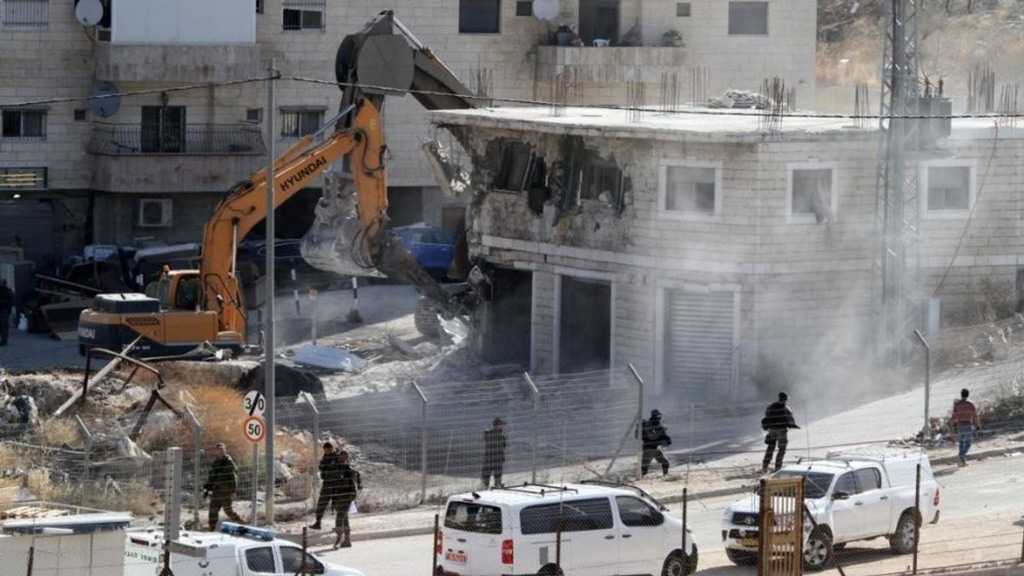
Uprooted Palestinians are at the heart of the conflict in the M.E Palestinians uprooted by force of arms. Yet faced immense difficulties have survived, kept alive their history and culture, passed keys of family homes in occupied Palestine from one generation to the next.
‘Israeli’ occupation forces this week confiscated the homes of 84 Palestinians in Ramallah Governorate and a structure accommodating a family of eight in the northern Jordan Valley, United Nations [UN] humanitarians said on Friday.
The Zionist military took at least 49 structures in the Ras al-Tin, Ramallah Governorate displacement on Wednesday, said the UN Office for the Coordination of Humanitarian Affairs [OCHA]. Citing initial assessments, the office said the structures include homes, animal shelters, solar power systems, water tanks and tractors with trailers and animal fodder.
The herding community moves to Ras al-Tin every summer for grazing but now is at heightened risk of forcible transfer from the area.
In the Thursday action in Humsa Al-Bqaia in the northern Jordan Valley, the occupation forces confiscated a recently installed structure used by a family, including six children, who lost their previous homes in another incident last week, OCHA’s ReliefWeb reported.
“The United Nations has repeatedly called on ‘Israel’ to halt its demolition and confiscation of Palestinian property and bring its conduct in line with its obligations as an occupying power under international humanitarian law,” OCHA said.
“The ‘Israeli’ authorities have demolished, seized or forced people to demolish at least 474 Palestinian-owned structures, including 150 donor-funded ones, displacing 656 people, including 359 children, across the West Bank” this year, OCHA said.
“This represents a near 70 percent increase in the number of people displaced, with a near 75 percent increase in children, compared with the equivalent period in 2020.”
The illegal demolition of the Palestinian Bedouin community of Humsa al-Baqai’a in the Jordan Valley by “Israeli” forces “raises serious risk of forcible transfer,” the UN warned, calling on Tel Aviv to immediately halt such measures.
“Attempts to force this or any other community to relocate to an alternative location raise a serious risk of forcible transfer. While the ‘Israeli’ authorities have tried to justify this citing their domestic designation of this area for military training, such measures by an occupying power are illegal under international law,” the Humanitarian Coordinator for the occupied Palestinian territory, Lynn Hastings, said in a statement on Friday.
He described the “Israeli” entity’s demolition of Humsa al-Baqai’a and confiscation of properties in the Palestinian community of Humsa al-Baqai’a in the northern West Bank as “disturbing”.
He urged the “Israeli” occupation forces to “immediately halt all further demolitions of Palestinian homes and possessions, allow the humanitarian community to provide shelter, food and water to this most vulnerable community and let these people rebuild their homes in their current location and stay there in safety and dignity.”
The UN official noted that “Israeli” forces blocked access of humanitarian personnel to the families throughout the demolished village.
Hastings said, “When they managed to access the community after the demolition, they found tents, food, water tanks and fodder had all been destroyed or confiscated, leaving people – including children – out in the open, in summer heat, with virtually no basic provisions; even milk, diapers, clothes and toys had been taken.”
According to assessments, he added “six families of 42 people, including 24 children have lost their homes, for the sixth time this year. Thirty-eight structures were demolished or confiscated, most alarmingly, water tanks.”
The United Nations Office for the Coordination of Humanitarian Affairs [OCHA] said in a statement that the so-called “Israeli” Civil Administration [ICA] has confiscated food consignments and detached structures, leaving the residents with no food and water following the demolitions.
The demolitions have also left the villagers with no baby milk powders, clothes as well as personal hygiene products. They also have no fodder and water for their livestock.
Palestinian homes in the Jordan Valley are subjected to demolitions by “Israeli” authorities who claim they lack building permits, despite the fact that the Tel Aviv regime does not provide such permits to Palestinians.
Moreover, the “Israeli” entity orders Palestinians to demolish their own homes or pay the demolition price to the municipality if they refuse to tear down their houses. Palestinians as well as the international community consider “Israeli” demolition politics in the occupied territories illegal.
A United Nations’ human rights investigator on Friday denounced “Israeli” settlements in the West Bank as a “war crime” and warned that Tel Aviv’s “illegal occupation” cannot be cost-free.
Michael Lynk, UN special rapporteur on human rights in the occupied Palestinian territories, was addressing a session of the world body’s Human Rights Council in Geneva.
“I conclude that the ‘Israeli’ settlements do amount to a war crime,” Lynk said.
“I submit to you that this finding compels the international community…to make it clear to ‘Israel’ that its illegal occupation, and its defiance of international law and international opinion, can and will no longer be cost-free,” the UN official added.
In its bi-weekly report on “Israeli” violations on July 2, the OCHA said Israeli forces had either demolished or seized two dozen Palestinian-owned structures in the occupied territories of the West Bank and al-Quds [Jerusalem] in a span of two weeks.
It added that the demolitions were carried out between March 15 and March 28 this year under the pretext that they lacked the necessary construction permits.
Throughout the years, the entity has frequently demolished Palestinian homes, claiming that the structures have been built without permits, which are nearly impossible to obtain.
IOF excessive use of force in the West Bank and occupied East Jerusalem: 23 Palestinians wounded, including 3 children and Palestinian minister
One Palestinian sustained wounds after an explosive device left by IOF detonated in the central Jordan valleys
Three IOF shootings reported at agricultural areas (east) and three others on fishing boats in Gaza sea
In 138 IOF incursions into the West Bank, including occupied East Jerusalem: 71 civilians arrested, including 12 children and 2 sisters
IOF arrest a child attempting to cross the Gaza border fence
IOF conducted limited incursion into eastern Central Gaza
5 commercial facilities and 4 houses demolished (2 self-demolished ) in occupied east Jerusalem
Israeli decision to confiscate 50 dunums in Bethlehem and demolish 15 tents in Khirbet Tana
Settler-attacks: attacks on civilians and attempts to confiscate lands in Salfit, Hebron and Nablus
IOF established 55 temporary military checkpoints in the West Bank and arrested 3 Palestinian civilians on said checkpoints
Summary
Israeli occupation forces (IOF) continued to commit crimes and multi-layered violations against Palestinian civilians and their properties, including raids into Palestinian cities that are characterized with excessive use of force, assault, abuse and attacks on civilians that are mostly conducted after midnight and in the early morning hours. Even more, IOF continued its demolition operations and delivery of cease-construction and demolition notices in the West Bank, including occupied East Jerusalem. PCHR documented 228 violations of international human rights law and international humanitarian law (IHL) by IOF and settlers in the oPt.
IOF shooting and violation of right to bodily integrity:
IOF shot and injured 23 civilians (including 3 children and a minister) in its excessive use of force against civilians in the West Bank: 11 were wounded in clashed during IOF demolition of buildings in Kafr ‘Aqab, occupied east Jerusalem; 3 during IOF incursion into Dheisha refugee camp, Bethlehem; 5, including Minister of Labor Nasri Abu-Jash (54) who sustained to bullets in the abdomen and back in IOF suppression of a peaceful protest in Nablus; another civilian was wounded in Nablus 2 children in al-Jalazone refugee camp, Ramallah; and another civilian was shot near he annexation wall in Qalqilya. Dozens of others suffocated due to tear gas inhalation. Also, one civilian was wounded after an explosive device left by IOF detonated in central Jordan valleys.
In the Gaza Strip, 5 IOF shootings were reported on agricultural lands eastern Gaza; and 3 at fishing boats in the Gaza sea.
IOF incursions and arrests of Palestinian civilians: IOF carried out 138 incursions into the West Bank, including occupied East Jerusalem. Those incursions included raids of civilian houses and shootings, enticing fear among civilians, and attacking many of them. During this week’s incursions, 71 Palestinians were arrested, including 12 children and 2 sisters.
In the Gaza Strip, IOF conducted one limited incursion into eastern Central Gaza and arrested a child attempting to cross the Gaza Border.
Demolitions:
PCHR documented 14 incidents:
East Jerusalem: house gate demolished in Isawiya; shop and two houses self-demolished in Silwan; 4 barracks dismantled (2 used as residences and 2 used as shops) in az-Za’ayyem; shop and warehouse demolished and several business owners received demolition notices in Kafr ‘Aqab.
Bethlehem: ratification of Israeli decision to confiscate 50 dunums from Husan and Nahalin villages; 4 agricultural rooms demolished in Beit Ta’mir; and 4 dunums razed in al-Makhrour area.
Hebron: room and barracks demolished eastern Halhul; and agricultural room dismantled eastern Yatta.
Nablus: 15 tents (residential and for sheep) demolished in Khirbet Tana.
Ramallah: n15 dunums razed in Ras Karkar.
Jericho: 4 residential barracks demolished.
Settler-attacks: PCHR fieldworkers reported and documented 5 attacks:
Salfit: rioting in Kifl Haris.
Hebron: civilians assaulted in Yatta and road constructed in a 25-dunum land in eastern Hebron in prelude to its confiscation.
Nablus: Palestinian lands assaulted in Jalud as well as an under-construction house in Burin.
Israeli closure policy and restrictions on freedom of movement:
The Gaza Strip still suffers the worst closure in the history of the Israeli occupation of the oPt as it has entered the 14th consecutive year, without any improvement to the movement of persons and goods, humanitarian conditions and bearing catastrophic consequences on all aspects of life. The United Nations confirmed that the Gaza conditions are worsening, with deteriorating health, power, and water services. The UN emphasized that the Gaza Strip requires immense efforts in the housing and education sectors and to create job opportunities.
Meanwhile, IOF continued to divide the West Bank into separate cantons with key roads blocked by the Israeli occupation since the Second Intifada and with temporary and permanent checkpoints, where civilian movement is restricted, and they are subject to arrest.
Shooting and other Violations of the Right to Life and Bodily Integrity
At approximately 04:00 on Thursday, 11 March 2021, an Israeli military force accompanied with dozens of Israeli soldiers and Special Forces Unit moved into Dheisheh refugee camp, south of Bethlehem. They raided and searched houses, blew up its doors, frightened its inhabitants, and arrested Khader ‘Abed al-Jabbar al-Hasanat (44). During which, a group of Palestinian young men gathered in the camp’s eastern neighborhood and threw stones and Molotov Cocktails at IOF, who attacked the protestors, chased them on the camp’s streets and fired live bullets and heavy sound bombs at them. As a result, 3 protestors were shot with live bullets.
At approximately 09:30, IOF stationed along the Gaza’s border fence with Israel, east of Deir al-Balah city in the center of the Gaza Strip, and east of Gaza Valley (Juhor al-Deek) village, southeast of Gaza City, opened fire at agricultural lands; no causalities were reported.
At approximately 11:00 on Friday, 12 March 2021, a peaceful protest took off in front of Beit Dajan village council, east of Nablus, north of the West Bank, at the call of the villagers and with the participation of the National Action Factions in Nablus, towards lands under the threat of confiscation, east of the village. The protestors raised Palestinian flags and chanted slogans against the Israeli occupation and settlers. When the protestors arrived at the area, they found a large number of Israeli soldiers awaiting them. The protestors chanted slogans again against the Israeli occupation and settlers. IOF immediately suppressed the protest and fired live and rubber bullets, sound bombs and tear gas canisters at the protestors. As a result, 5 civilians, including a child, were wounded. The wounded civilians were as follows:
A child was shot with a Two-Two bullet in his left foot.
Minister of Labor Nasri Khalil Saleem Abu Jash (54) was shot with 2 rubber bullets in his abdomen and back.
26-year-old male was shot with 2 live bullets in his feet.
60-year-old elderly was shot with 2 rubber bullets in his feet.
30-year-old male was shot with 2 rubber bullets in his feet.
All of the wounded civilians were taken to Rafidia hospital for treatment. Also, many protestors suffocated due to teargas inhalation and received treatment on the spot.
Following the Friday prayer, on 12 March 2021, IOF suppressed hundreds of Palestinian worshipers gathered in al-Ghazlay yard in al-Asbat Gate area. IOF beat and pushed the worshipers while they were getting out of al-Aqsa Mosque in occupied East Jerusalem’s Old City and fired sound bombs at them. During which, IOF arrested Omar Basem Zaghir (22) after severely beating him. It should be noted that IOF imposed a cordon on the Old City in the morning, established dozens of military checkpoints at al-Aqsa Mosque gates, checked Palestinian worshipers’ IDs, prevented 321 persons living in the West Bank from performing prayers at the mosque, and arrested 4 civilians under the pretext of entering Jerusalem without permits. Among the arrestees were: ‘Abed al-Raheem al-Sa’idi and Ahmed Abu ‘Asem, from Tulkarm.
At approximately 06:00 on Saturday. 13 March 2021, IOF stationed near the annexation wall, at Bereen Gate, southwest of Qalqilya, fired teargas canisters at Palestinian workers, who attempted to enter Israel for working. As a result, a 26-year-old male, from Beita village in southern Nablus, was hit with a teargas canister in his head and taken to a governmental hospital in the city for treatment. He was then referred to Istishari Arab Hospital.
At approximately 15:05 on Saturday, 13 March 2021, Israeli gunboats stationed off Waha Shore and off al-Soudaniyia Shore, northwest of Beit Lahia, north of the Gaza Strip, chased Palestinian fishing boats sailing within 3 nautical miles and fired live bullets and sound bombs around them, causing fear among the fishermen and forcing them to flee. No casualties were reported.
At approximately 16:10, settlers from “Givat Ronim” settlement outpost established in southeastern of Nablus, and under IOF protection, attacked Montaser Nafi’ Mansour’s under-construction house located in the eastern side of Burin village. The settlers demolished the house walls before the villagers’ arrival. Meanwhile, clashes erupted between the villagers and settlers and continued for an hour. During which, IOF fired live bullets, sound bombs and teargas canisters to disperse the villagers. As a result, a 19-year-old male was shot with a live bullet in his left thigh and below his abdomen and taken to Rafidia Governmental Hospital in Nablus.
At approximately 08:00 on Sunday, 14 March 2021, Israeli gunboats stationed off Waha Shore, northwest of Beit Lahia, north of the Gaza Strip, chased Palestinian fishing boats sailing within 3 nautical miles and opened heavy fire around them, causing fear among the fishermen and forcing them to flee. No casualties were reported.
At approximately 09:00, IOF attacked Nabil Saqer ‘Obad, from Kifl Haris village, north of Salfit, adjacent to “Ariel” settlement, north of the city. ‘Obaid said that while he was heading to his work and walking on the street, Israeli soldiers shouted at him, saboteur stop! They pointed their guns at him and ordered him to stop. He added that he stopped and Israeli soldiers stationed behind trees approached him. Meanwhile, the soldiers pushed him to the ground and an Israeli soldier kicked him at his head and asked him, where is the knife? ‘Obaid told the soldier that his is not a saboteur and he is a worker waiting his employer to go with him to work. IOF confiscated ‘Obaid’s cell phone and called his employer to make sure that he is really waiting him. They released him later.
At approximately 13:00, IOF stationed along the Gaza’s border fence with Israel, east of Khan Yunis, opened fire at agricultural lands, east of al-Qarara village, east of Khan Yunis; no casualties were reported.
At approximately 14:00, IOF stationed at military site no(16), north of Beit Hanoun, north of the Gaza Strip, opened heavy fire at Palestinian shepherds who approached the fence, causing fear among them and forcing them to flee. No casualties were reported.
At approximately 20:30, IOF moved into Qaryut village, southeast of Nablus, and fired heavy sound bombs and teargas canisters at residential houses. Meanwhile, 3 paramedics namely ‘Abed al-Raheem Mahmoud Falah Hamdan, Bashar Mu’amer Qaryuti and Mo’tasem Mefleh Ahmed Badawi drove a vehicle with Red Crescent plate and headed to help civilians, who suffocated due to teargas inhalation. The paramedics provided help for Kasab and ‘Awad Rateb families. When the paramedics got out of Rateb’s house, they found that IOF broke the vehicle’s rear window. The paramedic Bashar Mu’amer Qaryuti said to PCHR’s fieldworker that:
“At approximately 20:30 on Sunday, 14 March 2021, while I was at my duty in the Palestinian Red crescent office in the center of Qaryut village, southeast of Nablus, along with my colleagues ‘Abed al-Raheem Mahmoud Falah Hamdan and Mo’tasem Mefleh Ahmed Badawi, we knew that IOF moved into the village and they fired teargas canisters at residential houses. We immediately got into the PRCS vehicle and headed to Kasab family’s house, where we provided aid for 6 persons. After that, we headed to ‘Awad Rateb’s house and found 4 soldiers stood in front of the house. We managed to enter the house and provide help of its inhabitants. When we got out of the house, we found the vehicle’s rear window was broken. We asked neighbors and they told us that IOF broke the window and flee towards ‘Ali settlement. We phoned the Palestinian Liaison office and told them about what happened.”
At approximately 08:30 on Monday, 15 March 2021, IOF stationed along the Gaza’s border fence with Israel, east of Khan Yunis, opened fire at agricultural lands, east of Khuzaʽa village, east of Khan Yunis; no casualties were reported.
At approximately 10:35, Israeli gunboats stationed off Waha Shore, northwest of Beit Lahia, north of the Gaza Strip, chased Palestinian fishing boats sailing within 3 nautical miles and opened heavy fire around them, causing fear among the fishermen and forcing them to flee. No casualties were reported.
At approximately 20:30, IOF stationed at a military watchtower established near “Beit El” settlement, near Jalazone refugee camp, north of Ramallah, fired live bullets at two children, who were present near the entrance to al-Yasmin neighborhood, adjacent to the mentioned settlement, under the pretext of throwing stones. As a result, the 16-year-old child was shot with a rubber bullet in his leg and the 15-year-old child was shot with a rubber bullet in his foot. Both of them were taken to Palestine Medical Complex in Ramallah for treatment. This coincided with IOF incursion into the neighborhood, as they raided and searched houses and confiscated the recording device of the surveillance cameras.
At approximately 09:30 on Tuesday, 16 March 2021, IOF stationed along the Gaza’s border fence with Israel, east of Khan Yunis, opened fire at agricultural lands, east of Khuzaʽa village; no casualties were reported.
On the same day, 11 civilians were shot with rubber bullets, while 31 others suffocated due to teargas inhalation during the IOF incursion into al-Matar neighborhood in Kafr ‘Aqab village, north of occupied East Jerusalem. IOF also demolished a shop and a store, levelled plot of land and delivered several notices for shops’ owners.
At approximately 10:00 on Wednesday, 14 March 2021, ‘Ali Mousa Jahaleen Abu Dahok (18), from Deir Hajla village in eastern Jericho, sustained critical wounds due to the explosion of an object of Israeli military remnants. According to PCHR’s investigations, Abu Dahok was wounded while breeding sheep in central valley area, near the Jordanian border, east of the city. Abu Dahok sustained deep wounds in his feet and taken to Arab Society Hospital in Bethlehem.
Incursions and arrests
Thursday, 11 March 2021:
At approximately 01:00, IOF moved into Harmala village, east of Bethlehem. They raided and searched Na’eem Asakra’s house and handed his two sons, Emad (27) and Eyad (22), summonses to refer to the Israeli Intelligence Services in “Gush Etzion” settlement, south of the city.
At approximately 02:30, IOF moved into Azza refugee camp, north of Bethlehem. They raided and searched Nadeem al-Azza’s (25) house and arrested him.
At approximately 02:30, IOF moved into Dura, southwest of Hebron. They raided and searched Ahmed Moneef Qazzaz’s (24) house and arrested him.
Around the same time, IOF moved into Beit Ulla, west of Hebron. They raided and searched Hussam Hami Fawargha’s (26) house and arrested him.
At approximately 04:00, IOF moved into Sa’ir, north of Hebron. They raided and searched a house belonging to Jaradat family, and arrested Safa’ Hazem Jaradat (24), and her sister, Amany (21).
At approximately 09:00, IOF moved into al-Sawahira al-Sharqiya village, east of the occupied East Jerusalem. They raided and searched Izz al-Dein Mohammed Mashahera’s (23) house and arrested him.
At approximately 14:00, IOF stationed at Alsilsila Gate, one of the Aqsa Mosque’s Gates, and arrested Khaled Riyad al-Issawi (38), head of the preaching and guidance department at the Aqsa Mosque, after ending the Isra’ and Mi’raj prayers. IOF took him to one of the police centers in the city and released him on the next day on condition that banning his entry to the Aqsa Mosque for a week.
At approximately 21:00, Israeli Intelligence Services handed the Jerusalem Affairs Minister, Adnan Adel Tawfiq Ghaith (46), two military decisions after summonsing him to al-Maskobiya police center. First decision is renewing his ban from leaving his residence place in Silwan and preventing him from moving and being present inside the occupied Jerusalem. The other decision is banning any communication with dozens of officials and activists including the Palestinian President, Mahmoud Abbas.
It should be noted that Ghaith was arrested and interrogated several times since being issued as a governor, and several military decisions, renewable every 6-month, were issued against him, such as imposing the house arrested into his place of residence in Silwan; preventing him from communicating with specific figures; banning his entry to the West Bank; banning him from holding or presenting any activities or conferences inside Jerusalem; and providing financial aids for institutions.
IOF carried out an incursion in Kifl Haris, north of Salfit. No arrests were reported.
Friday, 12 March 2021:
At approximately 19:00, IOF arrested Abdul Rahim Rami al-Khaldi (17), from al-Bureij camp, while attempting to pass the border fence with Israel, east of the camp.
Abdul Rahim’s father, Rami al-Khaldi (born in 1974), said that at approximately 14:30, on Friday, his son got out of the house, so they noticed his absence and started asking their relatives about him. At approximately 12:30 on Saturday, Rami received a phone call from the Israeli police to inform him that his son is under arrest and he will be presented before the Court of Ashkelon.
At approximately 19:30, IOF arrested Ehab Abu Sneina (23) and Shadi ‘Amira (21), after getting out of the Aqsa Mosque, and took them to one of the police centers in the city. IOF released them on bail of 1000-NIS and banning their entry to the Aqsa Mosque for 15-days.
IOF carried out (4) incursions in Azzun, east of Qalqilya, Halhul, Yatta, and Beit ‘Amra villages in Hebron. No arrests were reported.
Saturday, 13 March 2021:
At approximately 03:00, IOF moved into Husan, west of Bethlehem. They raided and searched Mohammed Younis Hamamera’s (23) house and arrested him.
At approximately 03:30, IOF moved into Beit Furik village, northeast of Nablus. They raided and searched several houses and arrested Ahmed Tawfiq Nasasera (47).
At approximately 22:00, IOF moved into Zububa, west of Jenin, stationed at the entrance of the village, and arrested two high-school students; Mohammed Hasan Za’al (18) and Ahmed Mohammed Atatera (18).
IOF carried out an incursion in Silwad, northeast of Ramallah governorate. No arrests were reported.
Sunday, 14 March 2021:
At approximately 01:00, IOF moved into Silwan, south of the occupied East Jerusalem. They raided and searched Mohammed Mostafa Rweidy’s (21) house and arrested him.
At approximately 02:00, IOF moved into Isawiya village, northeast the occupied East Jerusalem. They raided and searched several houses and arrested (3) civilians, claiming that they attacked settlers’ vehicle and caused damages in the vehicle and the driver was injured. The arrestees are: Aziz Ghassan Alian (18), Lo’ay Abed Alian (20), and Mohammed Abed Alian (22).
At approximately 02:00, IOF moved into Yatta, south of Hebron governorate, and stationed in al-Karmel area. They raided and searched five house and arrested (5) civilians; Yehya Saleh al-‘Amro (37), who was released 15-days ago, Eisa Khaled al-‘Amour (33), Qusai Khaled al-‘Amour (32), Eisa Mohammed al-‘Amour (35), and Fadi Bader al-‘Amour (33).
At approximately 03:00, IOF moved into Beit Ummar, north of Hebron. They raided and searched two houses and arrested Majdi Mershed Za’aqiq (17), and Mohanad Yousef ‘Alqam (20).
At approximately 05:00, IOF moved into al-Tur neighborhood, east of the occupied East Jerusalem’s Old City. They raided and searched Ibrahim Khaled al-Haniti’s (18) house and arrested him.
At approximately 06:00, IOF moved into Teqoa, west of Bethlehem. They raided and searched Mohammed Ali Sabbah’s (23) house and handed him a summons to refer to the Israeli Intelligence Services.
At approximately 09:00, IOF moved into Silwan, south of the occupied East Jerusalem’s Old City. They raided and searched two houses belonging to Mohammed Ali al-Ghoul (17) and Qais Mahmoud Hassouna (17) and handed them summonses to refer to the Israeli Intelligence Services.
At approximately 11:00, IOF detained Nader Samer Ibdah (23), a driver from Marda village, north of Salfit, while driving to Salfit. IOF detained everyone in the vehicle, handcuffed Ibdah, and released them at approximately 23:30.
At approximately 12:00, Abdul Rahman al-Bashiti (16) surrendered himself to the Israeli occupation jail, to complete the legal measures against him. His family stated that their son is under house arrest and has been banned from entering his place of residence since January, and that Abdul Rahman was arrested and interrogated for 3 weeks, despite suffering from diabetes, and he was released on conditions that included the ban on returning to his home, which led him to stay in Beit Hanina away from his family.
It should be noted that al-Bashiti family frequently subjected to arrests and violence, as their old son, Hisham (20), was arrested when he was only 13, and he was arrested several months ago on charge of throwing stones at the Israeli soldiers. Hatem (18), was arrested and summonsed dozens of times with his brother Abdul Rahman (16), wo was arrested up to 20-times during 2020, despite suffering from diabetes and deteriorating his health condition inside detentions and during investigations.
At approximately 13:00, IOF moved into Hizma, northeast of the occupied East Jerusalem. They raided and searched Salah al-Dein Osama Salah al-Dein’s (15) house and arrested him.
At approximately 17:00, IOF moved into Batin al-Hawa neighborhood, south of the occupied East Jerusalem’s Old City. They raided and searched Yousef Rebhi al-Rajabi’s (24) house and arrested him.
At approximately 19:00, a big occupying force along with dozens of Israeli soldiers and Special Forces stormed Shu’afat refugee camp, east of the occupied East Jerusalem, and stationed at the main street. Dozens of young men gathered and threw stones, empty bottles and cocktail Molotov at the Israeli soldiers and vehicles, who indiscriminately responded with rubber bullets and teargas canisters, chased the prosecutors, and arrested (3) civilians; Mohammed Abed al-Haq (16), Mahmoud Hamdan (17), and Wael ‘Arrar (21).
At approximately 21:15, IOF stationed at Mevo Dotan military checkpoint, southwest of Jenin, arrested Ameen Ashab Zakarna (23), from Qabatiya, southeast of Jenin. IOF took him to an unknown destination.
IOF carried out (4) incursions in Aroub refugee camp, Halhul, Beit Awwa, and Taffuh villages in Hebron. No arrests were reported.
Monday, 15 March 2021:
At approximately 01:00, IOF moved into Aroub refugee camp, north of Hebron. They raided and searched two houses and arrested Emad Mahmoud al-Jondi (19), and Anas Yasser Abbad (20).
At approximately 01:10, IOF moved into Deir al-Ghusun village, north of Tulkarm. They raided and searched Fo’ad Mohammed Bani Saleh’s (22) house and arrested him.
At approximately 01:20, IOF moved into Tulkarm. They raided and searched two houses belonging to Fares Samer Fattouh (22) and Ahmed Issam ‘Ateiwi (28) and arrested them.
At approximately 02:20, IOF moved into Anabta village, east of Tulkarm. They raided and searched Ra’ed Adel Hammad’s (27) house and arrested him.
At approximately 05:10. IOF moved into Birzeit, north of Ramallah. They raided and searched several houses and arrested Mohammed Najeeb al-Shahbour (26).
At approximately 05:20, IOF moved into Jalazone refugee camp, north of Ramallah. They raided and searched ‘Ahed Riyad al-Tirawi’s (25) house and arrested him.
At approximately 12:00, IOF stationed at Kifl Haris, north of Salfit, arrested Palestine TV crew, while shooting a program about Ariel Rotary in Kifl Haris. IOF ordered them to delete they taken pictures, end shooting, and leave the location. IOF released them after an hour.
At approximately 19:30, IOF stationed at Huwwarah military checkpoint, south of Nablus, arrested Yousef Jihad Owda (35), from Kafr Thulth. IOF took him to an unknown destination.
IOF carried out (4) incursions in Kafr al-Dik, west of Salfit; Kafr Ni’ma, west of Ramallah governorate; Samu and Yatta, in Hebron. No arrests were reported.
Tuesday, 16 March 2021:
At approximately 02:30, IOF moved into Qabatiya, southeast of Jenin. They raided and searched several houses and arrested Ahmed Lo’ay Manasra (19).
At approximately 03:20, IOF moved into Kifl Haris, north of Salfit. They raided and searched several houses and arrested (3) civilians; Mohammed Ra’ed al-Qaq (17), Hamza Marwan Bouziya (22), and Hamad Abdul Aziz al-As’ad (24).
At approximately 03:30, IOF moved into Qarawat Bani Zeid, northwest of Ramallah. They raided and searched two houses belonging to Saoud Mohammed ‘Arrar (30) and Wajdi Shujei’ ‘Arrar (33) and arrested them.
At approximately 04:00, IOF moved into al-Khadir village, south of Bethlehem. They raided and searched Mahmoud Mohammed Salah’s (28) house and arrested him.
At approximately 06:00, IOF moved into Isawiya village, northeast the occupied East Jerusalem. They raided and searched several houses and arrested Ali Sufian Obaid (17), and Mohammed Mahran Dirbas (14).
At approximately 07:30, IOF and 6 military bulldozers moved 100-meters to the west of the border fence, east of al-Bureij, then to the south of the border fence, east of al-Maghazi. They leveled and combed lands and redeployed at approximately 15:40.
At approximately 13:00, Abdullah Amjad Obaid (16), from al-Isawiya, surrendered himself to the Israeli prisons to serve his sentence of 2-months. His family stated that the Israeli Authorities sentenced Abdullah of 2 months of the actual arrest, despite the fact that he was under the house arrest 4-months ago.
At approximately 16:00, IOF moved into al-Wad neighborhood, one of the occupied East Jerusalem’s Old City’s neighborhoods. They raided and searched Eisa al-Firawi’s (20) house and arrested him.
IOF carried out (5) incursions in Jenin, Awarta and Qaryut, southeast of Nablus; Ramin, south of Tulkarm; and Biddya, west of Salfit. No arrests were reported.
Wednesday, 17 March 2021:
At approximately 02:00, IOF moved into Jamma’in, southeast of Nablus. They raided and searched several houses and arrested Jamal Ibrahim Abu Amr (22).
Around the same time, IOF moved into Karkafeh area in Bethlehem. They raided and searched Abdullah Abdul Naser Salhab (31) and Abdul Rahim Faraj Salhab (39) and arrested them.
At approximately 03:30, IOF moved into Teqoa, east of Bethlehem. They raided and searched several houses and arrested (3) civilians, including a child; Ma’moun Ibrahim al-‘Amour (16), Ammar Yaser al-‘Amour (20), and Mo’taz Khader al-‘Amour (22).
At approximately 04:00, IOF moved into Ein al-Sultan refugee camp, west of Jericho. They raided and searched the house of the former prisoner, Hamza Ahmed Irmilah (28), and arrested him. IOF released him later.
At approximately 10:00, IOF moved into Isawiya village, northeast the occupied East Jerusalem. They raided and searched two houses belonging to Fadi Abdullah Mahmoud (32) and Anwar Sami Obaid (23) and arrested them.
IOF carried out (3) incursions in Beit Ummar, Beit Ulla, and Deir al-Asal al-Tahta in Hebron. No arrests were reported.
III. Settlement Expansion and settler violence in the West Bank, including occupied East Jerusalem
Demolition and Confiscation of Civilian Property
At approximately 11:00 on Thursday, 14 March 2021, IOF moved into al-‘Issawiya village, northeast of occupied East Jerusalem, to demolish the main gate and tin plates of what was left from the rubble of ‘Alian family houses that were demolished by IOF 3 weeks ago.
‘Alian Family said that they were surprised with IOF surrounding the land and starting to demolish the main gate which was left from their houses’ rubble. The Israeli Municipality vehicles removed the iron gate and tin plates from the land and left the area. They added that IOF handed their son Fadi a notice to remove the rubble of their building that was demolished by the Israeli Municipality bulldozers on 22 February, within 10 days or they family will be fined. It should be noted that IOF stormed the land many times; the last was on 04 March when they demolished a tent sheltering the family and established on their houses’ rubble for the second time within 10 days. ‘Alian Family previously stated that the decision to demolish the family building, which included 2 floors and sheltered 20 family members, including 12 children, under the pretext of unlicensed construction, was a political decision par excellence, especially since their son, Fadi, previously received several calls from the Israeli Intelligence threatening him to demolish his family building if he continued to work as the Head of the Guard Unit in the mosque. The family added that Fadi was arrested several times and teased him lately until they demolished the family’s 360-sqm building, which was established more than 10 years ago under the pretext of unlicensed construction.
On Thursday as well, Israel Supreme Council for Planning and Building of the Israeli Civil Administration ratified a decision to confiscate 50 dunums from Husan and Nahalin villages, western Bethlehem, and to change their agricultural nature for the expansion of “Beitar Illit” settlement, established on Palestinian lands western Bethlehem.
Hasan Brejiyeh, director of the Wall and Colonization Resistance office in Bethlehem, stated that the targeted lands are plots 3 and 4 in Nahalin and Husan. He added that the land to be confiscated will be used for opening settler-only roads and building new housing units for the Israeli settler population. Breijyeh stressed that this decision is extremely dangerous as it asserts the occupation authorities’ intent to confiscate additional Palestinian owned-lands for the above-mentioned settlement.
In the afternoon, Mohammed Hasan Ja’afrah self-demolished his commercial facility located in al-Jeser area between the Municipalities of Silwan and Jabal Mukaber, southeast of occupied East Jerusalem, pursuant to an Israeli Municipality’s decision under the pretext of unlicensed construction.
Mohammed Ja’afrah said that his commercial facility is a restaurant built 20 years ago on an area of 55 sqms. He added that he received the first demolition notice 3 years ago, and 3 hearings were held in the Israeli court in this regard under the pretext of unlicensed construction. He said that the court imposed on him in the third hearing in 2019 a construction fine of 40,000 shekels and he is still paying it. He pointed out that the court issued a decision last December to demolish the restaurant, but his lawyer could appeal the decision and postpone the demolition until the beginning of March. He said that he received a call today morning from the Israeli police to inform him to self-demolish the restaurant before 10:00 on Monday or they will bring the bulldozers to carry out the demolition and fine him with thousands of shekels. It should be noted that the Israeli Municipality forced Ja’afrah last August to self-demolish his under-construction 100-sqm house in al-Farouq neighborhood in Jabal Mukaber.
On the same afternoon as well, Ahmed ‘Issa Hijazi self-demolished his house in ‘Ein al-Lozeh neighborhood in Silwan village, south of occupied East Jerusalem’s Old City, pursuant to the Israeli Municipality’s decision, under the pretext of unlicensed construction. Ahmed Hijazi stated that the Israeli police raided his house this morning and ordered him to self-demolish his house before 10:00 on Monday or they fine him with demolition costs, between 100,000 to 150,000 shekels, forcing him to take the furniture out of the house and then self-demolished it. He added that he built his house in 2014 to make it wider so it could be enough for his big family of 14 members, including 3 children. He built 3 bedrooms, a living room and its facilities on an area of 90 sqms. Hijazi said that the Israeli Municipality imposed on him in 2019 a construction fine of 25,000 shekels. He added that the court issued a month ago a decision to demolish his house under the pretext of failing to fulfill the geometric requirements. His lawyer filed an appeal to the Magistrate and District Courts but in vain.
At approximately 09:00 on Monday, 15 March 2021, IOF, accompanied by several military vehicles and a civil administration vehicle, moved into Wad al-Shunaar, Halhul and commenced demolishing a 15sqm room and a 30sqm tin-plated barracks allegedly for unlicensed construction, both properties of Khairy A. Hirbawey. IOF had served Hirbawy military order no. 1779 on 08 February 2021, giving him 96 hours to conduct the demolition.
On Monday evening, IOF demolished 4 agricultural rooms in Beit Ta’mir, east Bethlehem, allegedly for non-licensing. Hasan Brejiyeh, director of the Wall and Colonization Resistance office in Bethlehem, stated that IOF demolished 4 agricultural room in Beit Ta’mir, owned by: Ibrahim A. Mubarak; Haroun I. Mahamid; Suliman A. al-Wahsh; and Hasem I. Mohammed. IOF confiscated their contents allegedly for non-licensing. It should be noted that the demolition was not preceded by any notice or warning.
Mubarak Az-Zawahreh, Head of Beit Ta’mir Village Council, added that dozens of Palestinian civilians gathered to stop the demolition and the confiscation of materials used for agricultural purposes. They demanded IOF provide them proof and a list of confiscated items, but they were only given the confirmation from the solider in charge that they will be given these papers after the removal and confiscation is done. It should be noted that Beit Ta’mir and the adjacent Jib a-Theeb villages are subject to constant IOF demolitions at the request of settlers who want to confiscate the lands.
On Tuesday, 16 March 2021, IOF dismantled 4 barracks (2 used for residence and 2 for commercial purposes) in in az-Za’ayyem, eastern occupied east Jerusalem, and confiscated two containers near the village’s intersection.
Abdul-qader Klaib, az-Za’ayyem village council chairman, said that this is the second time IOF dismantled Murad and Imran Mohammed Zar’ey’s barracks (80sqm/each). IOF also confiscated two containers for:
Mohammed Abu-Ghalia, equipped with photography equipment and surveillance devices; and
Mohammed Saa’di, used as a gas station.
On Tuesday evening, 11 Palestinians sustained rubber bullets and 31 suffocated due to inhalation of tear gas during an IOF raid into al-Matar neighborhood in Kafr Aqab, occupied east Jerusalem. IOF demolished a shop, a warehouse and a land, and served multiple business owners demolition notices.
According to PCHR’s investigations, at approximately 14:00 IOF raided al-Matar neighborhood through a hole dug by a military bulldozer in the annexation wall surrounding it and commenced demolishing Sadiq al-Hatawy’s shop and warehouse and his land. IOF served other business owners demolition notices; these demolitions are in prelude to the construction of a sports complex and park for settlers on Palestinian-owned lands, according to Raed Hamdan, Media Officer at Kafr ‘Aqab Municipality. A group of young Palestinians gathered in the are and threw stones at the Israeli forces and military vehicles. IOF immediately responded violently, firing rubber bullets and tear gas canisters at them causing clashes that lasted until late evening where dozens sustained rubber bullets and suffocated due to tear gas inhalation. The Palestinian Red Crescent Society stated that 31 Palestinians suffocated due to tear gas inhalation; and 11 sustained rubber-bullet wounds – one in the head – during the IOF incursion into Kafr ‘Aqab.
In the evening, IOF razed Ramzi N. Qaisyeh’s lands in al-Makhrur area, western Bethlehem. According to Hasan Brejiyeh, director of the Wall and Colonization Resistance office in Bethlehem, IOF raided al-Makhrur after closing the area and commenced razing Qaisyeh’s 4-dunum land, uprooting trees and confiscating equipment. It should be noted that Qaisyeh’s land was previously raided by IOF in April 2020 and August 2019.
In the evening, Saif Abdul-Latif self-demolished his house in Silwan in execution of the Israeli Municipality decision allegedly for non-licensing. Abdul-Latif said that he started building his house 3 months ago, as he intended to get married and move there in four months. He added that the 50sqm house is still under construction; yet, the Israeli Municipality in the city persecuted him and insisted on demolishing the house immediately, which forced him to demolish it himself before the municipal crews who watched him conclude the demolition.
At approximately 11:00 on Wednesday, IOF, accompanied by the Civil Administration, workers and several construction vehicles, moved into Kibet Tana, northeastern Nablus, and demolished 15 tents. The tents, 35-40 sqm/each used as residence and sheep barns, belonged to 7 Palestinian farmers: Ibrahim Hanni; Hakam Nasasra; Hamdi Mlitat; Mirwan Khatatba; Bassam Nasasra; Hamoudeh Hanni and his brother Kamal. IOF alleged the demolition was for illegal presence in Area C.
At approximately 09:00 on Wednesday, 17 March 2020, IOF, accompanied by several military vehicles and construction vehicles as well as the Civil Administration, moved into Ras a-Zaytoun area in Ras Karkar, northwestern Ramallah. The dozer razed a 5-dunum land, uprooted 15 olive trees (aged between 5-7 years). This is the third IOF attack on this land, owned by Ni’man A. Nofal, allegedly to improve services for “Talmon” settlement, which is established on Palestinian-owned lands.
Around the same time, IOF reinforced with several military vehicles, Civil Administration vehicle, JCB bulldozer and two trucks moved into Arab al-Zayed Bedouin Community in An-Nuway’imah village, north of Jericho. They completely demolished 4 barracks, 60 square meters for each, for being unlicensed and located in Area C. the demolishing decision came with no prior warning on the morning of the same day.
The three barracks belonging to Abu Kharabish brothers:
Nayef Salama Abu Kharabish, his 60-square meters barracks which is used as a shelter for 8 civilians; including 6 children and a woman, was demolished and confiscated.
Fadi Salama Abu Kharabish, his two barracks (60 square meters for each), which are used for sheltering 3 civilians including a woman and a child, and the other one is used for grazing sheep, were demolished and confiscated.
Ali Salama Abu Kharabish, his 60-square meters barracks which is used as a shelter for 8 civilians; including 6 children and a woman, was demolished and confiscated.
At approximately 10:00, IOF reinforced with several military vehicles and Civil Administration vehicle al-Fakhit area, east of Yatta, south of Hebron. The soldiers deployed in the area while the Civil Administration staff started demolishing agricultural tent owned by Fo’ad Fadel al-‘Amour (48), for being unlicensed.
Settler attacks on Palestinian civilians and their property
At approximately 01:00 on Thursday, 11 March 2021, a group of settlers raided Kifl Haris, northern Salfit, and started rioting in the streets, breaking properties and statues and trashing the streets.
At approximately 08:30, 13 March 2021, a group of settlers from “Mitzpe Yair” settlement outpost established on the Palestinian lands confiscated from eastern Yatta, south of Hebron, attacked Sa’id Mohammed ‘Alian ‘Awad (48) and his wife Reema ‘Awad (38) with stones and batons when the couple were with their 6 children and their relatives’ children in their plot of land in Sho’ab al-Butm, south of the settlement outpost. As a result, ‘Awad sustained fractures in the face and bruises all over his body while the windows of his car were smashed.
Reema Isma’il ‘Awad said to PCHR’s fieldworker that:
“At approximately 8:00, I went with my husband Sa’id ‘Awad (48) and my six children; the eldest is Sanad (15), along with other children of my in-laws, to picnic in our land in Sho’ab Al-Butm, where my husband, his brothers and his uncle own around 288 dunums overlooking “Mitzpe Yair” settlement from the northern side. The Israeli Supreme Court issued a decision that we own the land except for a small part, which is not settled yet. When we arrived at the land, there was a settler namely, Yusi, whom we know grazing his sheep amid the olive seedlings and winter crops. We went to tell the Israeli police, who asked us to take a video to prove that the settler is present in the land, so I started taking the video of the settler with his sheep, while my husband called the Israeli police and the popular committees in al-Masafer area in order to come to the land. A few minutes later, the settler made phone calls, and we saw a number of young settlers coming towards us from behind a caravan close to the settlement’s borders; a number of them were masked and carrying sticks. They approached us, and one of them hit me on my back with an iron bar in his hand and I fell on the ground. He tried to take my cell phone with which I was taking the video to capture what was going on. My son, Sanad, tried to defend me and take away the settler who had attacked my husband and hit him on the head with an iron bar on his head and body. My husband fell unconscious on the ground and the settler broke his cell phone. The rest of the settlers threw stones at us and our car; as a result, they broke the windshield and side windows. I started screaming at the settlers, who ran away. Few minutes later, three soldiers arrived, followed by Magen David Adom ambulances, which gave us first aid, while residents of the area arrived. We asked the soldiers to take my husband to an Israeli hospital, but they refused, claiming that the attack was by settlers and not by IOF. Around an hour later, the Israeli police arrived. The ambulances drove us to a place close to the “Susiya” settlement, where a Palestinian ambulance took us to the Hebron Governmental Hospital for treatment. At approximately 22:00, doctors there decided to refer my husband to Al-Ahli Hospital, where he underwent a surgery for his jaw. My husband is still receiving treatment due to bruises in his face and the rest of his body, in addition to a fracture in his left jaw.”
At approximately 08:30 on Tuesday, 16 March 2021, a group of settles from “Kiryat Arba” settlement raided lands belonging to Jaber family in eastern Hebron. The settlers commenced construction of a road in prelude to confiscating the 25-dunum land. This occurred under the protection of several Israeli military forces to deter landowners from reaching the settlers. After Palestinian civilians intercepted the construction vehicles and several arguments with soldiers and settlers, the settlers withdrew. It should be noted that almost two months ago, settlers built a room in the above-mentioned land that was later demolished by the landowners.
Early on Wednesday, 17 March 2021, a group of settlers from “Ehyaa” settlement – established on Jalud village’s lands in eastern Nablus, attacked Palestinian lands in Jabal Sheikh Bashar, Area (B), land plot no. 6 and removed 40 olive seedlings belonging to Rajeh M. S. Hamoud.
Closure policy and restrictions on freedom of movement of persons and goods:
The Gaza Strip still suffers the worst closure in the history of the Israeli occupation of the oPt as it has entered the 14th consecutive year, without any improvement to the movement of persons and goods, humanitarian conditions and bearing catastrophic consequences on all aspects of life.
The West Bank:
In addition to 108 permanent checkpoints and closed roads, this week witnessed the establishment of more temporary checkpoints that restrict the goods and individuals 55 temporary checkpoints, where they searched Palestinians’ vehicles, checked their IDs and arrested 3 of them. IOF closed many roads with cement cubes, metal detector gates and sand berms and tightened their measures against individuals’ movement at military permanent checkpoints.
Jerusalem:
On Monday, 15 March 2021, IOF established 2 checkpoints at the entrance to Rafat village and at the entrance to Biddu village’s tunnel.
On Tuesday,16 March 2021, IOF established 2 checkpoints near Jab’ village’s intersection.
Bethlehem:
On Thursday, 11 March 2021, IOF established a checkpoint near al-Nashnash intersection, south of the city.
On Saturday, 13 March 2021, IOF established 2 checkpoints at the eastern entrance to Beit Fajjar village and on Caritas Hospital Road, north of the city.
On Sunday, 14 March 2021, IOF established a checkpoint at the entrance to Beit Fajjar village, south of the city.
On Monday, 15 March 2021, IOF established a checkpoint at the entrance to Jannatah village.
On Tuesday, 16 March 2021, IOF established 3 checkpoints at the northern entrance to Tuqu village, near al-Khader Cemetery and near al-Nashnash intersection, south of the city.
On Wednesday, 17 March 2021, IOF established a checkpoint at the entrance to Al-Maniya village, southeast of the city.
Ramallah:
On Thursday, 11 March 2021, IOF established 2 checkpoints near ‘Atara village’s bridge and at the entrance to Nabi Salih village.
On Friday, 12 March 2021, IOF established a checkpoint at the main entrance to Nabi Salih village, northwest of the city.
On Saturday, 13 March 2021, IOF established 2 checkpoints near ‘Atara village’s bridge and at the eastern entrance to Al-Mughayyir village.
On Monday, 15 March 2021, IOF established 3 checkpoints at the entrances to Sinjil and ‘Aboud villages and at Rawabi city square, north of the city.
On Tuesday, 16 March 2021, IOF established 2 checkpoints near ‘Atara village’s bridge and at the entrance to Sinjil village.
Jericho:
On Thursday, 11 March 2021, IOF established a checkpoint at the southern entrance to Jericho.
On Sunday, 14 March 2021, IOF established 2 checkpoints at Al-Auja village’s intersection and at the southern entrance to Jericho.
On Monday, 15 March 2021, IOF established 2 checkpoints at the southern and northern entrances to Jericho.
Nablus:
On Tuesday, 16 March 2021, IOF established 2 checkpoints on Madama village’s bridge and near the intersection of Deir Sharaf village, west of the city.
Hebron:
On Thursday, 11 March 2021, IOF established 4 checkpoints at the entrance to Sa’ir village, at the western entrance to Hebron, at the northern entrance to Yatta city, and at the entrance to Fawwar refugee camp.
On Friday, 12 March 2021, IOF established 2 checkpoints at the northern entrance to Hebron and at the entrance to Idhna village.
At approximately 08:00, IOF closed with rocks and sand berms the entrance to Ma’een village, in order to prevent civilians’ access to bypass road 60 via their vehicles. The road closure came after notifying several houses to be demolished.
On Saturday, 13 March 2021, IOF established 2 checkpoints at the western entrance to Hebron and at the entrance to Idhna village.
On Sunday, 14 March 2021, IOF established 3 checkpoints at the southern entrance to Hebron, at the entrance to as-Samu village, and at the southern entrance to Bani Na’im village.
On Wednesday, 17 March 2021, IOF established 4 checkpoints at the entrance to Bani Na’im village, at the northern entrance to Hebron, at the northern entrance to Yatta city, and at the entrance to Al-Arroub refugee camp.
Qalqilya:
On Thursday, 11 March 2021, IOF established a checkpoint at the eastern entrance to the city.
On Friday, 12 March 2021, IOF established a checkpoint at the entrance to Azzun village, east of the city.
On Monday, 14 March 2021, IOF established 4 checkpoints at the entrances to Azzun, Jayyous, Izbat al-Tabib and Jit villages, north of the city.
Salfit:
On Thursday, 11 March 2021, IOF established 2 checkpoints at the northern entrance Salfit and at the entrance to Deir Ballut village, west of the city.
On Friday, 12 March 2021, IOF established a checkpoint at the western entrance to Deir Istiya village, north of Salfit.
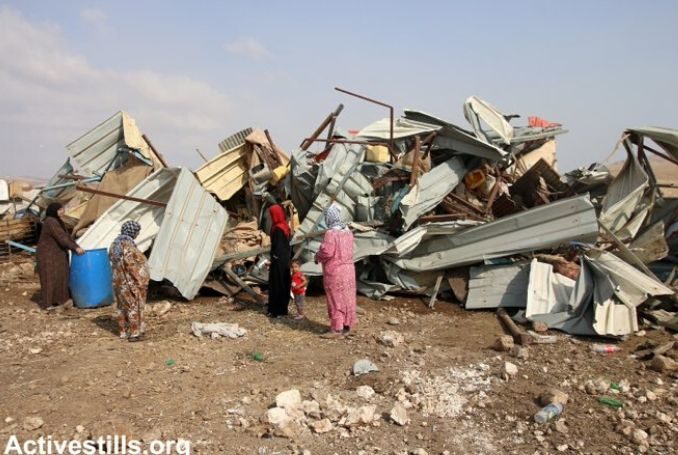
Palestinian women stand in front of their demolished house, in Jordan Valley. (Photo: via ActiveStills.org)
Israeli military bulldozers yesterday demolished 11 homes in the northeastern part of the occupied West Bank over “lack of construction permits”.
Moataz Bisharat, a Palestinian official responsible for monitoring Israeli settlement activity in the Jordan Valley, told Anadolu Agency that an Israeli force had raided “the Hamsa bedouin community in the east of Tubas town, and demolished Palestinian homes there.
Bisharat added that the community was inhabited by “23 Palestinian families living in corrugated iron houses.”
The head of the Ibziq village council in the Jordan Valley region, Abdul Majeed Khdeirat, told the agency that the Israeli army had seized agricultural tractors, solar cells, and water tanks from the village.
Palestinian residents in the Jordan Valley region are continuously subjected to the demolition of their homes, and seizure of their property by the Israeli army. The 1.6 million dunam region currently accommodates around 13,000 Israeli settlers in 38 illegal settlements, and some 65,000 Palestinians scattered across 34 communities.
Zionist forces in the occupied West Bank have razed a Palestinian village, leaving 73 people – including 41 children – homeless, in the largest forced displacement incident for years, the United Nations warned.
Excavators escorted by military vehicles were filmed approaching Khirbet Humsa and proceeding to flatten or smash up tents, shacks, animal shelters, toilets and solar panels.
“These are some of the most vulnerable communities in the West Bank,” said Yvonne Helle, the UN humanitarian coordinator for the ‘Israeli’-occupied Palestinian territory.
Three-quarters of the community lost their shelters during Tuesday’s attack, she said, making it the largest forced displacement incident in more than four years. However, by the number of destroyed structures, 76, the raid was the largest demolition in the past decade, she added.
On Wednesday, families from the village were seen rifling through their wrecked belongings in the wind, with some of the first rain of the year arriving the same day. The UN published a photo of a bed and a cot in the open desert.
The village is one of several Bedouin and sheepherding communities in the Jordan Valley area that is located within Zionist-declared army training “firing zones” where people there often face demolitions for a building without an alleged ‘permission’ from the occupying regime.
“Palestinians can almost never obtain such permits,” said Helle. “Demolitions are a key means of creating an environment designed to coerce Palestinians to leave their homes,” she said, accusing the Zionist entity of “grave breaches” of international law.
Nearly 700 structures have been demolished across the West Bank and occupied al-Quds in 2020 so far, she said, more than any year since 2016, leaving 869 Palestinians homeless.
July 1st came and went and Netanyahu made no formal statement regarding annexation. That left many journalists, politicians, activists, and others feeling abandoned to speculation. Declarations of support or opposition went forward accompanied by an air of uncertainty and the frustration of trying to second guess the objectives of those whose actions would determine the coming months.
Palestinians living in the occupied territories slated for absorption would have scoffed cynically at those seeking to imagine how this might affect their daily routines as well as the dynamics of regional politics. Israel’s purported intention is to annex 30% of the West Bank where Jewish population density and “security” considerations make this a “natural” consequence of the decades’ long illegal settlement strategy and a “necessity” for the “survival” of the geographically “besieged” Jewish State.
Muhammad, a young man from Hebron who gives virtual tours of Palestine, showed his viewers a debris-strewn street where hostilities had broken out a day earlier over the proposed annexation. His explanation for the urgency of these protests adds a layer of irony to the grim reality of occupied life. Israel retains ultimate control over the land and lives of the Palestinians living here after all. The Palestinian Authority (PA) is its willing subcontractor. It serves primarily as a buffer between the commands of its overlord and the will of its people. “We have to make it clear that annexation is illegal,” Muhammad says in earnest, though he understands – and his work underscores this – the critical value of US public opinion.
The Master’s voice will become louder and clearer with official annexation. Most Palestinians recognize this instinctively. Those who will be living peacefully within the latest official state boundaries will awaken to find the question of their residency looming ever nearer, a matter of whim; a gamble the state might act upon with relatively little risk based on the world’s record of indifference.
With or without a declaration of intent, annexation creeps over the lives of these people hour by hour. Across 43 villages, approximately 107,000 people – who will, in all likelihood, still be nominal subjects of the PA—will conceivably face another Nakba, this one orchestrated in silence and with discretion, aimed at fulfilling the Zionist myth of a “land without a people.”
A rise in the rate of Israeli abuses has already signaled the changes to come. In the Jordan Valley, for example, more land has been expropriated, more homes have been destroyed, more property damaged, and more olive trees uprooted, than has happened for some time. On June 8, a report noted that Israel has started implementing annexation plans by “sending electricity bills directly to municipal councils…and removing signs” that designated certain areas as Palestinian. A violent military campaign launched on June 1st “targeted water networks, confiscated equipment and destroyed and confiscated 15 vegetable stalls in Bardala in the northern Jordan Valley. It also destroyed 800 meters of water lines that supply water to citizens.”
…[P]olice notified several Bardala and Ain al-Baida inhabitants in the Jordan Valley on June 2nd to settle their legal situation as they would soon be under Israeli laws. Israeli authorities also removed banners they had set up at the entrances of some villages… or at the military Tayasir checkpoint that warned settlers not to enter because they were Palestinian areas. In a first of its kind incident, the Israeli Civil Administration delivered to some village councils in the Jordan Valley direct financial requests to increase the electric current feeding the village. [Ahmad Melhem; June 8, 2020]
Israeli journalist Gideon Levy documented the expulsion of a Bedouin family from its home behind the Greek Orthodox Monastery of Saint Gerasimos in the Jordan Valley. Abu Dahuq’s is not the first or only Bedouin family to suffer this fate. Residents of the now infamous Khan al-Ahmar community “have been living with the pervasive fear of demolition and expulsion for several years.” Its fate won enough media attention to become an issue in recent Israeli elections.
Abu Dahuq’s family lived relatively undisturbed for 17 years, Levy tells us. Then, at the beginning of June, Israeli troops demolished and confiscated all of Abu Dahuq’s possessions. “They took the water containers, his six coolers, the solar panels and the canvas that had covered the shacks. The rest was bulldozed. The heaps of ruins tell the whole story: Tin walls with insulation material in them, a crushed children’s bike, a torn painting, pipes rolling about, and so on.” Abu Dahuq was told to move to (Palestinian controlled) Area A from (Israeli controlled) Area C, but he claims there is no space there for him to live. His saga of arbitrary expulsion from territory Israel intends formally to annex would almost certainly have gone unnoticed without Levy’s article.
Why provoke a media and political relations’ storm by making public the controversial West Bank annexation plan when that process can be carried forward in a gradual, step by step manner, ‘in the dark’, far from the damning eye of international condemnation? Netanyahu could still, for whatever reasons, decide it is in his interest to create another political firestorm. It might, however, be more politically expedient to keep his audience guessing as facts on the ground roll forward like tank treads. Greater Israel has come a long way over the decades using this very technique. Like the proverbial frog in its pot on the stove, by the time the water is boiling it’ll be too late to hop out.
When God forges the destiny of a devout people, it is carried forth with zeal. Whether that god is a secular or religious deity, fervent believers will remove the obstacles impeding their progress even if they are people. They will be conveniently demoted from “human” to something like “merciless Indian savages” (US Declaration of Independence) those relics of the unsaved world who threatened to block the advance of civilization across the North American continent.
Palestinians may yet prove fortunate that their history is unfolding on such a public stage and under the often unblinking eyes of media and video surveillance. Native Americans had no such luck, a fact that cost them approximately one hundred million lives over a period of 400 years. The United States bloomed out of the bloody ground of genocide. Greater Israel has had to find more creative ways to eliminate a people without their collective physical death.
In 1845, calling for the annexation of Texas, a little known American columnist –John O’Sullivan—coined the phrase, “manifest destiny” giving voice to the subconscious shared belief that the white pioneers of America had a divine mission to colonize, civilize, and create a new world, “…to possess the whole of the continent which Providence has given us for the development of the great experiment of liberty and federated self-government entrusted to us.”
Israel’s manifest destiny derives both from a biblical and modern belief that the land of Zion belongs to the Jews. In its current incarnation, such a destiny contains within itself the insidious notion of organic and exclusive nationhood; the idea that only those bound by blood and a historic, quasi-religious bond to the land of their alleged origin can ever be a part of this whole. Contemporary Zionism absorbed the toxic nationalist beliefs of 19th and 20th century Europe and has applied them mercilessly in its quest for political and territorial supremacy.
This has not stopped people such as outgoing Israeli Ambassador to the United Nations, Danny Danon, from resorting to the Bible alone to justify Israel’s actions. According to him, “You cannot annex something that belongs to you” referring to the West Bank – or Judea and Samaria – bequeathed in the Bible by God to the Jewish People.
When Israel passed the Nation State Law of July 2018 it reinforced the defining principles of modern Zionism. These were not novel ideas; they were the codification of the national chauvinist beliefs at the core of its existence. Jews alone have the right to self-determination within the deliberately unspecified boundaries of the state, one of whose primary objectives is Jewish settlement of the land. Hebrew alone must be the official language. ‘Natural’, ‘religious’, and ‘historic’ qualifications promote Jewish status only and make expansion a national value.
The slated annexation of 30% of the West Bank will take place whether or not it is formally announced. It is taking place as I write. Equally so, it is neither the final nor the most serious step in the process of expansion that has defined Israel’s behavior since its creation.
On a sultry midsummer evening in August 1968 then Israeli Defense Minister Moshe Dayan told a group of kibbutzniks gathered around him that it was Israel’s fate “to live in a permanent state of fighting against the Arabs.” His words reflected the times he was living in, the post-1967 euphoria and confidence of the young Jewish State that had, in six days, crushed the combined forces of Arab nationalism as they attacked from Syria, Jordan, and Egypt. The 3-year-old Palestinian Liberation Organization (PLO) had barely begun its struggle to liberate Palestine; the nascent Palestinian National Movement scarcely underway.
Israel’s advance across the region, territorially and politically, represents an extension of American manifest destiny and its complement within Zionism. Dayan outlined Israel’s path to his listeners in his famous speech, “We Are Fated”:
For the hundred years of the Return to Zion we are working for two things: the building of the land and the building of the people. That is a process of expansion, of more Jews and more settlement. That is a process that has not reached the end. …It is not your duty to reach the end. Your duty is to add your layer to expand the settlement to the best of your ability, during your lifetime… [and] not to say: this is the end, up to here, we have finished. (Uri Avnery)
The process of settling the land and creating a Jewish nation is one that must never cease. To determine the final borders of the state would be sacrilegious; a sin against Israel’s destiny; its will to expand. “Before [the Palestinians’] very eyes we are possessing the land and the villages where they and their ancestors have lived,” Dayan explained. “We are a generation of settlers, and without the settle helmet and the gun barrel, we shall not be able to plant a tree or build a house.”
The military conquest, piecemeal annexation, killing with impunity, dispossession by decree and expulsion under Israeli law that has been underway for nearly a century, is continuing before our eyes today. There is no end in sight.Join the debate on FacebookMore articles by:JENNIFER LOEWENSTEIN
Jennifer Loewenstein is a human rights activist and member of Amnesty International’s Young Leadership Group, The Arms Control Association, the Arizona Palestine Solidarity Alliance, the Tucson Samaritans, & Palestine Chronicle. She is an independent researcher and freelance journalist who has lived and worked in cities across the Middle East. She is the former Associate Director of Middle Eastern Studies at the University of Wisconsin-Madison and Associate Lecturer in Middle Eastern and Native American Studies. Jennifer currently lives and works in Tucson, AZ & can be reached at sarinj111@gmail.com.
Global Research Daily: The News Behind the News
-
*Dangerous Crossroads: Beijing Reacts to US/NATO “Nuclear Sharing”
Expansion. China is Described as a “Threat”*
*By Drago Bosnic, August 07, 2026*
NATO ...
Kabbalistic Balance
-
Kabbalistic Balance August 6 2026 ___________________________________ More
Vids! +BN Vids Archive! HERE! ___________________________________ Support
The Br...
Report on Beth Israel vigil 07-04-26
-
*1A Rights under combined attack from local government plus media*
Ann Arbor City Council is at it again. Right before the long 4th of July
weekend, they ...
-
Hello all,
It is with great sadness that I share with you the passing of our beloved
sister, Mother, and Grandmother, the individual that you all knew ...
Best Horror Podcast
-
Best Horror Podcast Introduction: Horror podcasts […]
The post Best Horror Podcast appeared first on Copper Shock Horror Podcast.
Ikhras Endorses Muntadhar Al-Zaidi
-
“Oh parties of banditry and sectarianism and corruption, we have come and
our goal is to destroy you.” Ikhras formally endorses Muntadhar al-Zaidi,
Iraqi j...
Prince Charles: Foreign Jews behind bloodshed in ME
-
In May, 2017, British Crown Prince Charles declined an invitation from
Zionist entity’s president Reuven Rivlin‘s to attend the 100th anniversary
of the no...
Palestinian Women – One for All, All for One
-
Honouring All Palestinian Women by Honouring Three: Hanin Zoabi, Ahed
Tamimi, Samah Sabawi Vacy Vlazna “Palestinian women have always stood side
by side ...
US’s Saudi Oil Deal from Win-Win to Mega-Lose
-
By F. William Engdahl Who would’ve thought it would come to this? Certainly
not the Obama Administration, and their brilliant geo-political think-tank
neo-...
-
*Mordechai Vanunu wins human rights prize of Brazilian Press Association *
* http://www.alternativenews.org/english/index.php/features/updates/7038-mordechai...
Abdul Aziz Rantissi:
"My ultimate wish, my God, is to attain martyrdom,"...God granted him his wish on April 17, 2004, at the hands of Israeli assassins.