Uprooted Palestinians are at the heart of the conflict in the M.E Palestinians uprooted by force of arms. Yet faced immense difficulties have survived, kept alive their history and culture, passed keys of family homes in occupied Palestine from one generation to the next.
Armed Forces control the loading of the transport rocket-loading machine on a self-propelled launcher operational-tactical missile complex Iskander-M. Sergei Orlov/RIA Novosti
Late on March 5, a large-scale missile strike targeted oil traffickers’ facilities and equipment in Turkish-occupied areas in the northern countryside of Syria’s Aleppo.
At least two ballistic missiles hit the al-Himran crossing and a nearby oil market next to the town of Jarabulus near the border with Turkey. Traffickers smuggle oil illegally produced by the Syrian Democratic Forces (SDF) in northeastern Syria to Turkish-occupied areas through the crossing.
A few minutes later, two other ballistic missiles and several artillery rockets struck makeshift oil refineries and storage tanks in the village of Tarhin north of the town of al-Bab.
The missiles and rockets were reportedly launched from the Syrian coast, where Russia’s Hemimim Air Base is located, and from the outskirts of Aleppo city.
According to an initial report by the London-based Syrian Observatory for Human Right, a man was killed and at least ten others were injured as a result of the strikes.
Last week, a simllar missile strike targeted makeshift refineries and storage tanks in the village of Mazaalah southwest of the town of Jarabulus.
This was the largest missile strike on oil traffickers in Turkish-occupied Syrian areas yet. Russian forces and the Syrian Arab Army were clearly behind the strike. Moscow and Damascus are apparently determined to damge the illegal production and trafficking of Syrian oil by the SDF and Turkish proxies
Vladimir Platov Recently, you can very frequently see in the reports of the Middle Eastern media information that the United States is exporting military personnel and special equipment from Syria to Iraq.
In November alone the world saw several such reports:
– on November 29, the Syrian news agency SANA reported the advance of a military caravan consisting of 25 heavy weaponry vehicles from the Kharab al-Jir US military base in Syria to the Al-Walid checkpoint on the border with Iraq;
– On November 23, the United States transferred a convoy of 50 armored vehicles again through the Alwaleed border crossing;
– On November 16 and 20, 2 more American convoys with tanks and military trucks followed the border with Iraq from Syria;
– According to Syrian media, several dozen American servicemen have already left the US base in the village of Al-Malikiya.
An uninformed observer may be given the false impression that the Pentagon, in pursuance of repeated public statements by President Trump, is actively withdrawing its military presence from Syria. However, this fundamentally contradicts reality: there is a regular rotation of American troops in Syria and the strengthening of the US military presence in the country, including by increasing the presence of Washington-controlled private military campaigns (PMCs).
Media and eyewitness reports about dozens of American military convoys that were heading to Iraqi territory from Syria are primarily due to the need for a “combat escort” of oil stolen by the United States from Syria. Syrian media and many international observers have already repeatedly reported US caravans with illegally extracted Syrian oil crossing checkpoints permanently controlled by Washington bordering Iraq, evidence was clearly documented, including that obtained by the space reconnaissance of the Russian Aerospace Forces. SAR is sure that these minerals are mainly exported from the territories of oil fields in Deir ez-Zor and Hassek controlled by the American military and Kurdish formations. According to SANA, in November alone, more than 120 tanks with the stolen “black gold”, guarded by US troops and armored vehicles, crossed the Syrian border and headed towards Iraq …
Oil exports are carried out by the US-controlled Sadkab company, created under the so-called Autonomous Administration of Eastern Syria. The income from this smuggling, which even by rough estimates reaches $ 30 million a month, goes through the brokerage companies interacting with Sadcab to the accounts of American PMCs and the US intelligence services. When escorting caravans of oil stolen in Syria, US special forces units, heavy military equipment, and even combat aircraft are periodically used. Due to the fact that in this case “real money” is involved, amounting to tens of millions, which you do not need to report to anyone, either to Congress or to senators, US intelligence services actively engage in these operations to finance their so-called “gray” and black operations. And this practice is nothing new for the American special forces, which, in particular, can be confirmed by the famous Iran-Contra scandal or the CIA’s operations to transport drugs to the US and Europe from Asia during the Vietnam War, etc.
However, one must not forget that absolutely all hydrocarbon deposits and other minerals located on the Syrian territory do not belong to “American defenders against the terrorists of DAESH (prohibited in the Russian Federation – ed.)”, but solely to the Syrian Arab Republic. Therefore, what Washington is currently doing, namely, seizing and retaining oil fields in eastern Syria under its armed control is, simply put, international state banditry. Neither US law nor international law justify American troops protecting Syria’s hydrocarbon deposits from the Arab republic itself and its people. But the reason for Washington’s actions lies far from the ideals of freedom and slogans for the fight against terrorism it so loftily proclaims, from any legislative viewpoint.
However, in addition to stealing Syria’s national treasure – oil, the United States is also responsible for the policy of economic strangulation that harms the Syrian population. Due to unilateral US sanctions, the humanitarian crisis is aggravated in the SAR, which is a real economic genocide. By now, as a result of measures carried out by the Syrian government with the support of Russia, 2.5 million Syrians have already been able to return to their homeland. However, due to the package of anti-Syrian sanctions initiated by the United States under the general title of the “Caesar Act”, the restrictions affect almost all spheres of the economy and life of the Syrian Arab Republic. That is why it becomes obvious that the United States, in the face of the failure of its plans to forcefully remove the President of the SAR Bashar al-Assad, began to carry out an economic attack on the Middle Eastern state, staging an outright invasion using military force and economic leverage, and such actions should be served a clear international verdict.
The US has been in Syria for over six long years. During this time, the Americans captured a third of the country, controlling the situation on the ground through their junior allies in the person of the Kurdish people’s self-defense units. The only exception is Et-Tanf, where they often have to do all the dirty work themselves, including administrative, because there is now at least some stable opposition to Damascus, and besides, they have the largest and most effective military base.
However, the defeat of the terrorists means the inevitable expulsion of the Americans from Syria; it’s just a matter of time. Indeed, unlike even Afghanistan, where Washington has a controlled government, in Syria, US troops are in an extremely hostile environment. Do not forget that, along with the American military, there are many different Arab tribes in the Middle East, among most of which anti-American sentiments are constantly growing and, under certain conditions, they might attack to defend their soil. Even the Kurds, whom the United States has repeatedly insulted, betrayed, abandoned to be devoured by Ankara, are greatly offended at the United States and at some point may show Washington that it is not the boss in the region.
In addition to a possible armed confrontation, the cessation of US predatory activities and their military aggression in Syria can, of course, be facilitated by an intensification of the diplomatic offensive against Washington on this issue through various international forums and threats of court, where Russia, China, and other states friendly to Damascus will play the first fiddle.
Recent events clearly show the real goals of Washington’s policy in Syria, aimed not at finding a peaceful solution to the Syrian conflict and returning Syrian refugees to their homeland, but at continuing to plunder. The United States refused to participate in the International Conference in Damascus held by Moscow on November 11-12 to facilitate Syrian refugees and internally displaced persons and attempted to interfere with the event.
Simultaneously, the American military, in every possible way, protects and encourages the Kurdish militants. The US pumps oil in the northeast stealing Syria’s natural resources and national property and considers the Syrian Arab Republic a cheap resource. So, according to the Syrian Arab news agency SANA, the US armed forces, with the help of Kurdish militants of the Syrian Democratic Forces (SDF), on October 28, took another batch of Syrian oil from Syria to Iraq in 37 oil tankers from the settlement of As Suwayda to the north of Iraq through the Al Waleed border crossing. They were accompanied by a convoy of cars and armored personnel carriers from Kurdish SDF fighters. US troops, together with SDF fighters, control most of the oil fields in eastern Syria, where a large number of trucks with weapons have been transferred in recent months.
Earlier, the United States tried to unilaterally “legalize” SAR’s oil flow by creating a fictitious company called Delta Crescent Energy LLC. The fact that the American military’s actions in Syria are an “international state racketeering” and cannot be justified by their fight against the terrorist group DAESH (banned in the Russian Federation – ed.) has already been repeatedly stated from the official tribunes by the governments of Syria, Turkey, Iran, and Russia, including before the UN.
Not only outright robbery characterizes US policy in Syria. According to a report published by the Qatar-based Syrian Network for Human Rights (SNHR), attacks by the US-led “anti-terrorist coalition” have killed more than 3,000 Syrian civilians since 2014. The fate of 8,000 is unknown. Over six years of intervention, so-called “fighters against terrorism” have reportedly committed mass murder at least 172 times, bombed schools and markets, and put their allies, whose local core are Kurdish militants, in charge of the “liberated” regions.
It is necessary to pay special attention to the fact that, over the past year, the American administration, to implement its plan to fragment Syria, has been especially actively working to reconcile the Syrian Kurds’ political factions. In particular, Washington acted as an intermediary between the Kurdish national unity parties, the largest of which is the Democratic Union Party (PYD), which is the political arm of the People’s Self-Defense Forces (YPG), which are the backbone of the SDF and the Kurdish National Council in Syria (KNC). Washington’s primary goal is to create Kurdish “autonomy” while creating preconditions for a US military presence in the country. Especially in the oil-producing region of Syria, which, no doubt, the United States will attach particular importance to in any post-war agreements.
To further destabilize Syria’s situation and implement plans to divide this country, Kurdish militants of the Syrian Democratic Forces (SDF), on instructions from Washington, released from prisons more than 500 terrorists in eastern Syria in early November. As a result, the activity of terrorist cells has noticeably increased throughout Syria. For example, the London-based non-governmental organization Syrian Observatory for Human Rights (SOHR), citing Syrian sources, reported severe losses of government troops due to a large-scale attack by the terrorist group Daesh’s militants in the east of Hama province. Twenty-one Syrian soldiers were killed in the attack near the Abu Fayyad dam east of the city of Salamiyah in the countryside of Hama, and the terrorists themselves lost more than 40 people. After the failed attack, the militants fled south towards the desert area of Badiya al-Sham.
On November 12, a convoy of Turkish Armed Forces heading from Kafr Shil was blown up in the north Syrian province of Aleppo, in outskirts of Afrin.
Almost simultaneously, an incident occurred in the south of the country – in the region of Daraa. A convoy of Russian Armed Forces accompanied by Syrian security forces was heading from Izraa to Sahwat al-Qamh when an improvised explosive device was detonated near the settlement of Musseifra.
On November 13, militants of the DAESH terrorist group (banned in the Russian Federation – ed.) attacked a Syrian Arab Army unit near the city of Al Sukhnah in the province of Homs, killing eleven soldiers and capturing and subsequently executing one soldier. According to observers’ estimates, all three events may have common roots associated with the consolidation of the Kurdish militants and DAESH’s efforts after releasing 500 militants from the American occupation administration prisons. According to published Al-Monitor reports, many DAESH “sleeping cells” have been deployed in villages on the Euphrates River banks, such as Al-Shuhayl, Hajin, Al-Susa, and Al-Baguz, and the recent release of 500 terrorists by SDF has helped with recruitment.
The situation becomes more complicated because Kurdish militants do not want to fight the terrorist underground in Syria’s occupied territory. The SDF wants the region to remain volatile to continue to receive support from the United States, Al-Monitor emphasizes. Besides, judging by previous reports from sources, Kurdish groups continue to get a share in the theft and smuggling of Syrian oil – and need to at all costs maintain their presence in the oil-rich region by simulating the fight against DAESH, which, by the way, fully satisfies Washington’s plans.
Vladimir Platov, expert on the Middle East, especially for the online magazine “New Eastern Outlook”.
President Bashar Assad and First Lady Asmaa Assad visited an exhibition in Damascus dedicated to Aleppan industrialists, during his visit President Assad exposed a grand theft of Syrian money by Lebanon.
“At the minimum, the estimates at the lowest were 20 billion dollars, and at the maximum, it was 42 billion dollars. We do not have a real figure,” President Assad told the crowd that surrounded the first couple, he added: “This number for an economy like Syria is a frightening number.”
President Assad did not belittle the US and EU blockade coupled with the blockade of their followers around the world against the Syrian people, he drew the timeline of the current crisis with the main factors of the war of terror and war of attrition waged on the country by NATO and stooges which the country is going through for nearly a decade; the Syrian President emphasized on the coinciding of the beginning of the current severe crisis, ‘that Syria never lived through since it independence – in 1945’, with the blocking of depositors accounts by the Lebanese Central Bank starting a year ago.
The following is the English translation transcript of the above video:
First of all thanks to you, were it not for your steadfastness in Aleppo, and if it were not for you decided from the beginning to be positive, effective and have a challenge, which any person needs to succeed, especially in these circumstances, had it not been for all of this, we would not have reached this successful beginning.
When we meet with producers in these special circumstances, difficult circumstances, and harsh conditions that Syria has not lived through since the days of independence, this carries a special message and full of meanings.
3 and 4 years ago, Aleppo was besieged from all sides and the bombing on it did not stop and its production did not stop, so the issue is not the subject of a siege, so if a siege on Aleppo could not affect, the siege on Syria, which is not more severe than the siege on Aleppo, would not be the cause of the problem that we are going through. With it, there are issues that we are affected by, such as the issue of (the United States’ theft of oil), the issue of wheat supplies, the burning of wheat in the northeastern regions, there is no doubt that all of this has an impact, but the economic problem has another reason that no one is talking about, and that is the money that the Syrians withdrew (from Syria) and deposited in Lebanon, and the banks in Lebanon were closed, so we paid the price, this is the essence of the problem that nobody is talking about.
It is easy to always blame the state and the government, mistakes exist with every one and this is another issue, but the current crisis is not related to the blockade, the blockade has been imposed on us for years, this does not mean that the siege is good and the Americans are innocent, no, the blockade directly harms all aspects of life, but the current crisis that started several months ago, caused by this issue (the closure of banks in Lebanon) because the crisis began before the Caesar Act and began years after the blockade, so what coincided with it? It is the money that’s gone.
At the minimum, the estimates at the lowest were 20 billion dollars, and at the maximum, it was 42 billion dollars. We do not have a real figure. This number for an economy like Syria is a frightening number.
End of the transcript.
This is not the first time Lebanon worked efficiently as a pawn in the US-led war of terror against Syria, it was a stage where the killing of its former PM Rafic Hariri led to a fruitless international tribunal that lasted for 15 years and cost the Lebanese people about a billion dollars to reach nothing, in the course of its trials it started by a false accusation against the Syrian state for killing the former Lebanese PM which led to the withdrawal of the Syrian troops from Lebanon in 2005, the accusations were dropped after they exhausted their political and economic purpose.
During the current episode of the US-led war of terror on Syria, Lebanon through a number of its pro-Saudi officials was instrumental in smuggling weapons, terrorists, and drugs to contribute to the war against the Syrian people.
This latest theft of the Syrian depositors in the Lebanese banking system upon the US instructions in the last quarter of last year was meant to break the will of the Syrian people to give up to the USA of their sovereignty and freedom what they refused to give to the US-sponsored terrorist groups including Al Qaeda and its offshoots Nusra Front and ISIS for almost a decade.
To help us continue please visit the Donate page to donate or learn how you can help us with no cost on you. Follow us on Telegram: http://t.me/syupdates link will open Telegram app.
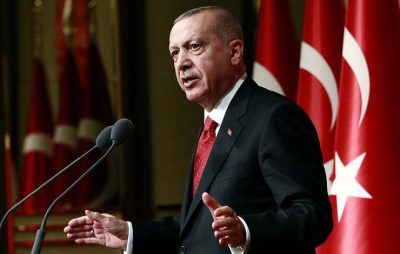
Like the US, Turkey’s Erdogan pursues interests at the expense of peace and stability.
He favors war for extending Turkey’s borders to further his neo-Ottoman aims.
He, his family members and regime profited earlier from stolen Syrian oil.
He gave ISIS and other terrorists safe haven in Turkish territory, providing them with weapons, other material support, and a launching pad for attacks on Syrian soldiers and civilians.
Turkey under Erdogan is a fascist police state — speech, media and academic freedoms they way they should be banned.
So is dissent. Anyone publicly criticizing or insulting him risks prosecution for terrorism, espionage or treason, including children.
As long as he doesn’t act against US interests, as a NATO member and in other ways, his tyrannical rule and regional destabilizing actions are tolerated — if only barely.
On Wednesday, his Vice President Fuat Oktay said Ankara is ready to send troops to back Azerbaijan’s war on Armenia in Nagorno-Karabakh (NK below).
In response to Turkey’s deployment of armed and directed jihadists to combat Armenian forces in NK, the country’s Prime Minister Nikol Pashinyan called on regional countries to unite against them and their Turkish paymaster.
“Regretably (they) have not responded to this reality seriously enough yet,” Pashinyan added.
“It is beyond doubt that the presence of foreign terrorists will pose a threat to the region in the future.”
“The region’s countries must deal with this issue more seriously.”
The Erdogan regime is also involved militarily in NK by providing Baku with command and control services, training of its military forces, and heavy weapons for warmaking.
He and hardliners surrounding him support war, not resolution in NK.
Pashinyan stressed it, saying “the Karabakh question…cannot have a diplomatic solution.”
“Everything that is diplomatically acceptable to the Armenian side…is not acceptable to Azerbaijan…”
Baku’s ruling authorities intend endless war until Armenian forces are driven from NK — no matter the human toll, according to comments from its leadership.Turkey’s Involvement in Nagorno-Karabakh
As Azeri forces advance, civilians in harm’s way are caught in the crossfire.
Unconfirmed reports suggest that they’ve taken control of areas bordering Iran and Armenia’s international border — increasing the risk of conflict spilling into both countries.
Armenia’s Defense Ministry spokesman Artsrun Hovhannisyan accused Azerbaijan of sending “small…subversive groups…into villages and towns, film(ing) themselves there, spread(ing) those images…to feed their society. But, unfortunately, this also affects us.”
While conflict continues, foreign ministers of both warring sides will meet with Trump regime’s Pompeo for talks in Washington on Friday.
Yet on Tuesday, Azeri President Ilham Aliyev said the following:
“We are fighting on our own land, giving martyrs and restoring our territorial integrity. These steps will continue to be taken.”
“Armenia must declare before it is too late that it is withdrawing from the occupied territories. After that the fighting may stop.”
From the above remarks and two failed Russian/Minsk Group arranged ceasefire, Aliyev is unwilling to compromise on his aims in NK.
With support from Turkey, including Erdogan’s willingness to send troops if asked, Aliyev rejects diplomacy while sending his foreign minister to discuss ceasefire with his Russian, French and US counterparts.
According to the Asia Times, Erdogan’s support for Azerbaijan is driven by energy interests in competition with Russia.
An unnamed Erdogan advisor said “Russia is neither an ally, nor an enemy, but we can’t negotiate if we are too dependent on them, especially when it comes to energy.”
“We have vital interests to protect,” including two pipelines from Azerbaijan to Europe, one for oil, the other for gas.
One runs close to NK, the other near northern Armenia, the unnamed advisor close to Erdogan adding:
“We can’t afford losing our sight on what’s going on around our pipelines in the Caucasus, especially in the Tavush region, where there have been several clashes (with Armenia) over the last years.”
The so-called BTC oil pipeline is owned by Azerbaijan, Turkey, and Britain’s BP.
The South Caucasus Pipeline runs from Azerbaijan’s Caspian Sea field to Turkey, and Georgia — soon as well to Italy, Greece and Bulgaria.
Earlier in October, Erdogan accused Armenia of endangering supplies of energy to Turkey and other European countries.
Oil and gas pipelines from Azerbaijan to Europe are only endangered by its preemptive war on Armenia in NK.
No danger would exist if conflict resolution ended weeks of fighting.
Russia also supplies gas to Turkey through Turkstream 1.
Turkstream 2 is under construction, completion expected around yearend.
Azerbaijan will compete with Russia for the European natural gas market.
Moscow prioritizes cooperation with other nations, confrontation with none.
Turkey’s Erdogan prioritizes the advancement of his neo-Ottoman interests.
*
Note to readers: please click the share buttons below. Forward this article to your email lists. Crosspost on your blog site, internet forums. etc.
Award-winning author Stephen Lendman lives in Chicago. He can be reached at lendmanstephen@sbcglobal.net. He is a Research Associate of the Centre for Research on Globalization (CRG)
His new book as editor and contributor is titled “Flashpoint in Ukraine: US Drive for Hegemony Risks WW III.”
A terror attack against a civilians bus killed three civilians and injured 12 others in the vicinity of Ras Al Ain, in the northwestern province of Hasakah, at the borders with Turkey.
A booby-trapped parked car was detonated in a road in the village of Tal Halaf next to a moving civilian passenger bus which immediately killed three of the passengers, injured 12 others, some of who sustained severe and life-threatening injuries.
The explosion of the parked vehicle left the passengers’ bus completely torched and large material damage in the area.
Terrorist groups loyal to the Turkish madman Erdogan infested the northern regions of Syria under the protection of the US forces and under false claims of ‘fighting terror’ referring to the other US and Israel-sponsored Kurdish separatists in the area. Turkey never fought ISIS or Nusra Front (al-Qaeda Levant) terrorist groups throughout the past 9.5 years, on the contrary, terrorists of these groups in their tens of thousands were hosted, trained, armed, and funded by and through the Turkish regime of Erdogan on Turkish territories then smuggled into Syria to kill and maim the Syrian people.
Neither Trump nor Erdogan, the two heads of criminality with forces operating in the northern regions of Syria, hide their ill intentions towards the Syrian people, Trump declares publicly he wants to steal the Syrian oil and Erdogan declares publicly he wants to be a leader in the ‘Greater Israel Project’ where he will steal more land and is dreaming of reviving the most-hated anti-Islamic Ottoman sultanate on the account of the people of the region of all religions. Both unindicted war criminals are depriving the Syrian people of their own riches in their country, especially the Syrian oil and Syrian wheat mainly coming from the Syrian northeastern provinces of Hasakah and Deir Ezzor.
The terrorist attacks as this one are meant to intimidate the local population to flee their homes after which Erdogan can Israelize the region with terrorists following his anti-Islamic Muslim Brotherhood doctrine.
To help us continue please visit the Donate page to donate or learn how you can help us with no cost on you. Follow us on Telegram: http://t.me/syupdates link will open Telegram app.
Years of US support to Al-Qaeda and ISIS and efforts to effect regime change in the country have culminated in the theft of Syria’s oil, but is that really America’s coup de gras in Syria?
Near the end of July, one of the most important recent developments in U.S. foreign policy was quietly disclosed during a U.S. Senate hearing. Not surprisingly, hardly anybody talked about it and most are still completely unaware that it happened.
Answering questions from Senator Lindsey Graham, Secretary of State Pompeo confirmed that the State Department had awarded an American company, Delta Crescent Energy, with a contract to begin extracting oil in northeast Syria. The area is nominally controlled by the Kurds, yet their military force, the Syrian Democratic Forces (SDF), was formed under U.S. auspices and relies on an American military presence to secure its territory. That military presence will now be charged with protecting an American firm from the government of the country that it is operating within.
Pompeo confirmed that the plans for implanting the firm into the U.S.-held territory are “now in implementation” and that they could potentially be “very powerful.” This is quite a momentous event given its nature as a blatant example of neocolonial extraction, or, as Stephen Kinzer puts it writing for the Boston Globe, “This is a vivid throwback to earlier imperial eras, when conquerors felt free to loot the resources of any territory they could capture and subdue.”
Indeed, the history of how the U.S. came to be in a position to “capture and subdue” these resources is a sordid, yet informative tale that by itself arguably even rivals other such colonial adventures.
To capture and subdue
When a legitimate protest movement developed organically in Syria in early 2011, the U.S. saw an opportunity to destabilize, and potentially overthrow, the government of a country that had long pushed back against its efforts for greater control in the region.
Syria had maintained itself outside of the orbit of U.S. influence and had frustratingly prevented American corporations from penetrating its economy to access its markets and resources.
As the foremost academic expert on Middle East affairs, Christopher Davidson, wrote in his seminal work, “Shadow Wars, The Secret Struggle for the Middle East,” discussing both Syria and Libya’s strategic importance, “the fact remained that these two regimes, sitting astride vast natural resources and in command of key ports, rivers, and borders, were still significant obstacles that had long frustrated the ambitions of Western governments and their constituent corporations to gain greater access.”
“With Syria,” Davidson wrote, “having long proven antagonistic to Western interests… a golden opportunity had presented itself in 2011 to oust [this] administration once and for all under the pretext of humanitarian and even democratic causes.”
US Senators John McCain and Joseph Lieberman meet with Syrians at the Yayladagi camp on the Turkish-Syrian border. April 10, 2012. Umit Bektas | Reuters.
The U.S., therefore, began organizing and overseeing a militarization of the uprising early on, and soon co-opted the movement along with allied states Turkey, Jordan, Saudi Arabia, the UAE, and Qatar. Writing at the end of 2011, Columbia University’s Joseph Massad explained how there was no longer any doubt that “the Syrian popular struggle for democracy [has] already been hijacked,” given that “the Arab League and imperial powers have taken over and assumed the leadership of their struggle.”
Soon, through the sponsoring of extremist elements, the insurgency was dominated by Salafists of the al-Qaeda variety.
According to the DIA and the Joint Chiefs of Staff, by 2013 “there was no viable ‘moderate’ opposition to Assad” and “the U.S. was arming extremists.” Investigative journalist Seymour Hersh revealed that “although many in the American intelligence community were aware that the Syrian opposition was dominated by extremists,” still “the CIA-sponsored weapons kept coming.”
When ISIS split off from al-Qaeda and formed its own Caliphate, the U.S. continued pumping money and weapons into the insurgency, even though it was known that this aid was going into the hands of ISIS and other jihadists. U.S. allies directly supported ISIS.
U.S. officials admitted that they saw the rise of ISIS as a beneficial development that could help pressure Syrian President Bashar al-Assad to give in to America’s demands.
Leaked audio of then-Secretary of State John Kerry revealed that “we were watching… and we know that this [ISIS] was growing… We saw that Daesh was growing in strength, and we thought Assad was threatened. We thought, however, we could probably manage — that Assad would then negotiate.” As ISIS was bearing down on the capital city of Damascus, the U.S. was pressing Assad to step down to a U.S.-approved government.
Then, however, Russia intervened with its air force to prevent an ISIS takeover of the country and shifted the balance of forces against the jihadist group. ISIS’ viability as a tool to pressure the government was spent.
The arsonist and the firefighter
So, a new strategy was implemented: instead of allowing Russia and Syria to take back the territories that ISIS captured throughout the war, the U.S. would use the ISIS threat as an excuse to take those territories before they were able to. Like an arsonist who comes to put out the fire, the U.S. would now charge itself with the task of stamping out the Islamist scourge and thereby legitimize its own seizure of Syrian land. The U.S. partnered with the Kurdish militias who acted as their “boots on the ground” in this endeavor and supported them with airstrikes.
The strategy of how these areas were taken was very specific. It was designed primarily to allow ISIS to escape and redirect itself back into the fight against Syria and Russia. This was done through leaving “an escape route for militants” or through deals that were made where ISIS voluntarily agreed to cede its territory. The militants were then able to escape and go wreak havoc against America’s enemies in Syria.
Interestingly, in terms of the oil fields now being handed off to an American corporation, the U.S. barely even fought ISIS to gain control over them; ISIS simply handed them over.
FILE – In this April 6, 2018 file photo, shows a former farmer working at a primitive refinery making crude oil into diesel and other products, in a village controlled by a U.S-backed Kurdish group, in Rmeilan, Hassakeh province, Syria. Syrians living in government-controlled areas have survived eight years of war now face a new scourge in the form of widespread fuel shortages. (AP Photo/Hussein Malla, File)
Syria and Russia were quickly closing in on the then-ISIS controlled oilfields, so the U.S. oversaw a deal between the Kurds and ISIS to give up control of the city. According to veteran Middle East war correspondent Elijah Magnier, “U.S.-backed forces advanced in north-eastern areas under ISIS control, with little or no military engagement: ISIS pulled out from more than 28 villages and oil and gas fields east of the Euphrates River, surrendering these to the Kurdish-U.S. forces following an understanding these reached with the terrorist group.”
A man works a primitive refinery making crude oil into diesel in a U.S-backed Kurdish village in Rmeilan, Syria, April 6, 2018. Hussein Malla | AP
Sources quoted by the Syrian Observatory for Human Rights claimed that ISIS preferred seeing the fields in the hands of the U.S. and the Kurds rather than the Syrian government.
The rationale behind this occupation was best described by Syria expert Joshua Landis, who wrote that the areas of northern Syria under control of the Kurds are the U.S.’ “main instrument in gaining leverage” over the government. By “denying Damascus access to North Syria” and “controlling half of Syria’s energy resources” “the U.S. will be able to keep Syria poor and under-resources.” So, by “promoting Kurdish nationalism in Syria” the U.S. “hopes to deny Iran and Russia the fruits of their victory,” while “keeping Damascus weak and divided,” this serving “no purpose other than to stop trade” and to “beggar Assad and keep Syria divided, weak and poor.”
Or, in the words of Jim Jeffrey, the Trump administrations special representative for Syria who is charged with overseeing U.S. policy, the intent is to “make life as miserable as possible for that flopping cadaver of a regime and let the Russians and Iranians, who made this mess, get out of it.”
Anchoring American troops in Syria
This is the history by which an American firm was able to secure a contract to extract oil in Syria. And while the actual resources gained will not be of much value (Syria has only 0.1% of the world’s oil reserves), the presence of an American company will likely serve as a justification to maintain a U.S. military presence in the region. “It is a fiendishly clever maneuver aimed at anchoring American troops in Syria for a long time,” Stephen Kinzer explains, one that will aid the policymakers who hold “the view that the United States must remain militarily dominant in the Middle East.”
This analysis corroborates the extensive scholarship of people like Mason Gaffney, professor of economics emeritus at the University of California, who, writing in the American Journal of Economics and Sociology, sums up his thesis that throughout its history “U.S. military spending has been largely devoted to protecting the overseas assets of multinational corporations that are based in the United States… The U.S. military provides its services by supporting compliant political leaders in developing countries and by punishing or deposing regimes that threaten the interests of U.S.-based corporations.”
In essence, by protecting this “global ‘sprawl’ of extractive companies” the U.S. Department of Defense “provides a giant subsidy to companies operating overseas,” one that is paid for by the taxpayer, not the corporate beneficiaries. It is hard to estimate the exact amount of money the U.S. has invested into the Syria effort, though it likely is near the trillion dollar figure. The U.S. taxpayer doesn’t get anything out of that, but companies that are awarded oil contracts do.
What is perhaps most important about this lesson however is that this is just a singular example of a common occurrence that happens all over the world. A primary function of U.S. foreign policy is to “make the world safe for American businesses,” and the upwards of a thousand military bases the U.S. has stationed across the globe are set up to help protect those corporate investments. While this history is unique to Syria, similar kinds of histories are responsible for U.S. corporation’s extractive activities in other global arenas.
So, next time you see headlines about Exxon being in some kind of legal dispute with, say, Venezuela, ask yourself how was it that those companies became involved with the resources of that part of the world? More often than not, the answer will be similar to how this U.S. company got involved in Syria.
Given all of this, it perhaps might seem to be too mild of a critique to simply say that this Syria enterprise harkens back to older imperial eras where conquerors simply took what they wished: the sophistication of colonialism has indeed improved by leaps and bounds since then.
Voltaire, actualité internationale, n°191
-
Outre ce site internet gratuit, nous publions une lettre confidentielle en
PDF, Voltaire, actualité internationale. Chaque jeudi soir ou vendredi
matin, vo...
A Jewish One World Government
-
A Jewish One World Government October 21 2026
___________________________________ More Vids! +BN Vids Archive! HERE!
___________________________________ Su...
The United States At A Crossroad
-
The United States At A Crossroad—An Analysis (16 Sept 2026) by Lawrence
Davidson Part I—Texas vs Minnesota Back in mid-May […]
Report on Beth Israel vigil 09-12-26
-
*Eat-a-Cheeseburger Day Approaches*
This year, EAC Day appears on Monday, September 21st. The date coincides
with the Jewish holiday called Yom Kippur. Cl...
-
Hello all,
It is with great sadness that I share with you the passing of our beloved
sister, Mother, and Grandmother, the individual that you all knew ...
Best Horror Podcast
-
Best Horror Podcast Introduction: Horror podcasts […]
The post Best Horror Podcast appeared first on Copper Shock Horror Podcast.
Ikhras Endorses Muntadhar Al-Zaidi
-
“Oh parties of banditry and sectarianism and corruption, we have come and
our goal is to destroy you.” Ikhras formally endorses Muntadhar al-Zaidi,
Iraqi j...
Prince Charles: Foreign Jews behind bloodshed in ME
-
In May, 2017, British Crown Prince Charles declined an invitation from
Zionist entity’s president Reuven Rivlin‘s to attend the 100th anniversary
of the no...
Palestinian Women – One for All, All for One
-
Honouring All Palestinian Women by Honouring Three: Hanin Zoabi, Ahed
Tamimi, Samah Sabawi Vacy Vlazna “Palestinian women have always stood side
by side ...
US’s Saudi Oil Deal from Win-Win to Mega-Lose
-
By F. William Engdahl Who would’ve thought it would come to this? Certainly
not the Obama Administration, and their brilliant geo-political think-tank
neo-...
-
*Mordechai Vanunu wins human rights prize of Brazilian Press Association *
* http://www.alternativenews.org/english/index.php/features/updates/7038-mordechai...
Abdul Aziz Rantissi:
"My ultimate wish, my God, is to attain martyrdom,"...God granted him his wish on April 17, 2004, at the hands of Israeli assassins.