Showing posts with label Gazprom. Show all posts

Friday, 19 November 2021

Frozen Deutschland

Frozen Deutschland

A “perfect storm of Russian aggression during the coming winter months” is all but inevitable. Watch it on your screens while you properly freeze.

By Pepe Escobar and extensively cross-posted

As much as with “brain dead” NATO (copyright Emmanuel Macron) no one ever lost precious assets betting on the incompetence, narrow-mindedness and cowardice of political “leaders” across the Atlanticist EU.

There are two main reasons for the latest German legalese gambit of suspending the certification of the Nord Stream 2 pipeline.

  1. Retaliation, directly against Belarus and Russia, “guilty” of the disgraceful refugee drama at the Poland-Belarus border.
  2. Politicking by the German Greens.

A high-ranking European energy executive told me, “this a game where Germany does not hold a winning hand. Gazprom is very professional. But imagine if Gazprom decided to deliberately slow down their deliveries of natural gas. It could go up tenfold, collapsing the entire EU. Russia has China. But Germany does not have a workable contingency plan.”

This ties up with a proposal that is sitting at a crucial desk in Moscow for approval for two years now, as I reported at the time: an offer by a reputable Western energy firm of $700 billion for Russia to divert their oil and gas exports to China and other Asian customers, away from the EU.

This proposal was actually the key reason for Berlin to resolutely counteract the U.S. drive to stop Nord Stream 2. Yet the torture never stops. Russia now faces an additional hurdle: a carbon tax on exports to the EU which include steel, cement and electricity. That may well be extended to oil and natural gas.

Every sentient being across the EU knows that Nord Stream 2 is the easiest path to lower natural gas prices across Europe, and not the EU’s blind neoliberal bet of buying short term in the spot market.

“They are going to freeze”

Seems like the Bundesnetzagentur, the German energy regulator, woke up from a deep slumber just to find out that the Swiss-based company Nord Stream 2 AG did not meet the conditions to be an “independent transmissions operator” and could be certified only if it was “organized in a legal form under German law.”

The fact that neither the Germans nor the Swiss company were aware of it during the long, previous, always turbulent stages is very hard to believe. So now it looks like Nord Stream 2 AG will have to establish a subsidiary under German law only for the German section of the gas pipeline.

As it stands, the company is not “in a position” to comment on details and especially “the timing of the start of the pipeline operations.”

Nord Stream 2 AG will have to transfer capital and personnel to this new subsidiary, which will then have to present a full set of documentation for certification all over again.

Translation: gas from Nord Stream 2 will be absent during the coming winter in Europe and the pipeline, at best, might start running only by mid-2022.

And that certainly ties in with the politicking angle, as the German regulators are de facto waiting for the new German ruling coalition to emerge, including the neoliberal Greens who are viscerally anti-Nord Stream and anti-Russia.

The European energy executive did not mince his words on a quite possible scenario: “If Germany does not obtain their oil and natural gas by land now they cannot fashion a fall back position, as there is not sufficient LNG capacity or oil for that matter to supply the EU this winter. They are going to freeze. Much of their economy will be forced to shut down. Unemployment will soar. It would take four years to build up LNG capacity for natural gas but who will build it for them?”

Germany has zero margin of maneuver to dictate conditions to Gazprom and Russia. The gas that Gazprom won’t sell to northern Europe will be sold to eastern and southern Europe via Turk Stream, and most of all to Asian clients, which do not engage in blackmail and pay much better than the Europeans.

What is also clear is that if by a misguided political decision Nord Stream 2 gas is eventually blocked, the fines to be collected by Gazprom from the European consortium that begged for the construction of the pipeline may exceed 200 billion euros. The consortium is made up of Engie, Shell, Uniper, Wintershall Dea and OMV.

It’s against this background that the offer on the table in Moscow becomes even more than a game-changer. The bold recommendation to the Kremlin – with financing already in place – is that Russia’s natural resources including oil and natural gas should be redirected to China, as part of the Russia-China strategic partnership.

The proposal argues that Russia needs no trade with the EU, as China is way ahead of them in most advanced technologies. That certainly provides Moscow with the upper hand in any negotiations with any German government. As I mentioned it to the European energy executive, his terse comment was, “I doubt they will desire to commit suicide.”

It’s all Putin’s fault

It would be too much to expect from German and EU politicians the clear-sightedness of the government of Serbia, which is considering importing 3 billion cubic meters of Russian natural gas annually for 10 years. Gazprom has been on the record for years demonstrating the practical, reliable and cost-conscious aspects of long-term contracts.

Russian Foreign Minister Sergey Lavrov, commenting on the migrant crisis at the Poland-Belarus border, noted how “Poland behaves outrageously, while the leadership in Brussels applies double standards that are so apparent and naked that they can’t fail to understand that they are embarrassing themselves.”

The case of Nord Stream 2 adds extra layers to EU self- embarrassment as it concerns the wellbeing of populations already living inside Fortress Europe. Let them freeze, indeed – or pay virtual fortunes for natural gas that should be readily available.

As we all know, Germany, Nord Stream 2, Ukraine, Belarus, it’s all interlinked. And according to a Ukrainian lunatic profiting from an Atlanticist platform, it’s all Putin’s fault – guilty of conducting hybrid war against the EU.

It will be up to the “resolve of Poland and Lithuania” to “counter the Kremlin threat”. The ideal framework in this case should be the Lublin Triangle – which unites Poland and Lithuania with Ukraine. These are the lineaments of the new Iron Curtain, erected by the Atlanticists, from the Baltic to the Black Sea, to “isolate” Russia. Predictably, German Atlanticists are a crucial part of the package.

Of course, to be successful, these actors should “also seek greater U.S. and UK engagement”, with every movement complementing “the role of NATO as the ultimate guarantor of peace in the region”.

So behold, EU mortals: a “perfect storm of Russian aggression during the coming winter months” is all but inevitable. Watch it on your screens while you properly freeze.


River to Sea Uprooted Palestinian   
The views expressed in this article are the sole responsibility of the author and do not necessarily reflect those of the Blog!

Saturday, 13 February 2021

China newsbrief and sitrep

 Source

February 09, 2021

By Godfree Roberts – selected from his extensive weekly newsletter : Here Comes China

You can get it here:  https://www.herecomeschina.com/#subscribe


Power of Siberia gas pipeline from Gazprom. com

Russia ramps up natural gas supplies to China via Power of Siberia mega-pipeline

“The export of gas to China through the Power of Siberia gas pipeline continues to grow. Supplies regularly exceed Gazprom’s daily contractual obligations,” the company said in a statement, adding that the volume of gas delivery last month “was 2.9 times higher than in January 2020.”


Next up, What the People say.

Says subscriber Frans Vandenbosch, “If I have to describe China in one word, then I would say ‘intense’. Western companies are sheltered workshops, they do not know what real competition is. They should benchmark China to know what real harsh competition looks like.”  Adds Josh Gardner, “Online retail in China is cut-throat. Comparing Taobao with Amazon is like comparing ballet to rugby.”

——————————-

This blog fairly reflects the stance of Chinese people on the long running trade war.  Although it contains some hubris, there is no question that the person in the street is convinced that China will be victorious.

China is establishing an invincible position in its trade war. It will switch many of its exports from the US to BRI countries and move the industries that produce goods for export to the US to the industrial parks in BRI countries to avoid US tariffs and reduce labor costs.

“In the long run, China’s Belt and Road initiative (BRI) will bring economic growth to developing countries and expand China’s market there. It will enable China to switch lots of its exports from the US to those countries. Moreover, BRI will enable China to move the industries that produce goods for export to the US to the industrial parks built by BRI in those countries to avoid US tariff hikes and reduce labor costs. China will thus establish its invincible position in its trade war with the US.”  Read more about the Plan for Long-term Victory


And where is Jack Ma? 

“Ant Group Co. is planning to turn itself into a financial holding company overseen by China’s central bank, responding to pressure to fall fully in line with financial regulations, according to people familiar with the matter.

Chinese regulators recently told Ant, which is controlled by billionaire Jack Ma, to become a financial holding company in its entirety, subjecting it to more stringent capital requirements, the people said. Ant, in response, has submitted to authorities an outline of a restructuring plan, they said.”

The video is worthwhile watching for background, even though it is from the Wall Street Journal.

Jack Ma made the unforgivable error of criticizing in public.  Rule one in China – don’t make the other guy lose face while there are methods to bring problems to the attention of the authorities.   In reality, he seemed to have been absolutely right, and Ant Group was immediately used as a case in point, where the financial regulators fixed their own errors.  This of course led to Ant Group having to disclose their real business as one of the biggest lenders in China, besides their vast technology footprint.  Given what happened in the US with behemoths such as Google and Twitter and large de-platforming, I do not blame the Chinese authorities one bit for having decided that no-one should have this much power.


Now that we’ve found Jack Ma who was busy restructuring his Ant Group, more on China’s credit market. 

China’s credit market got big fast because credit services fit traditional practices. Despite its reputation as a “nation of savers,” Chinese society has traditionally been heavily reliant on debt, facilitated through a long tradition of private and informal borrowing and lending. In this system, instead of concepts like “credit,” access to loans depended on renqing, “human sentiments.” Read full article $→


So, you want to join the CCP?  It is not that easy.

“Next year the Chinese Communist Party (CCP) turns 100. Since its founding in 1921, the CCP has grown from a small cabal of Marxist intellectuals into the world’s second-largest political party, behind only the Bharatiya Janata Party in India. One of the reasons for the CCP’s success has been its cultivation of human capital—any organization is only as good as its people.

Ahead of the Party’s centenary, understanding its longevity requires an understanding of its members. While the Party is frustratingly opaque about internal operations, its human resources division, known as the Organization Department, does publish annual data on membership. After the 2019 numbers were released in June 2020, MacroPolo scoured open source databases to compile the most complete public dataset on CCP membership.”    Read more …


Belt and Road

The Sinocentric bloc of Turkey, Iran and Pakistan could leave America’s ally India isolated and weak. The only three Muslim states with significant military capacity and economic potential participating in the $2 trillion BRI will promote Chinese influence from the Indian Ocean to the Black Sea.  Read full article $→

$10 billion for MENA (Middle-East & North Africa)’s Five BRI Projects): Egypt–Cairo’s New Administrative Capital & CBD; Turkey–The Hunutlu Thermal Power Plant; Jordan–Attarat Oil Shale Power Plant; UAE–Hassyan Clean Coal Power Plant; Lebanon–National Music Conservatory. MENA has 578 million people and 60% of world’s oil, 45% of its gas.Read full article $→


We end this week with some debunkery:

BUNK: Curbs on Mongolian Language Teaching Prompt Large Protests in China

DEBUNK: As a minority Chinese (Manchurian) with his mother side hailing from Hulun Buir, Inner Mongolia, I can say from my own experience that this is FAKE NEWS at its best. The truth is, in the Mongolian language primary education system, Mandarin has been taught and used since my mother can remember. The only change this time is to replace some locally created Mandarin language textbooks with national, official Mandarin language textbooks.

Yes, both of them are Mandarin textbooks. Yet New York Times and its FAKE journalists can’t wait to cook up new FAKE news completely distorting the truth. Shame on the New York Times and its FAKE news journalists! A bit of background for your information:

In Inner Mongolia, where half of my relatives are from, two primary education systems operate in parallel: one in Mandarin, one in Mongolian. Chinese Mongolians can opt for either one and most Chinese Mongolians so far opted for the one in Mandarin – the Mandarin system is of much better education quality due to better human recourse on teachers, and the kids won’t need another ‘prep-year’ before formal university when they attend a university program being taught in Mandarin. In contract, the ones who chose the Mongolian system, despite continuous government fundings to ensure it’s operational, still have to endure the less quality of education.

And this leads to life-long differences in career development and social mobility between two groups of students. There are law-required quota for these Mongolian-taught students in top Chinese universities, including THU and PKU. However, the truth is that these students often find their university coursework beyond their capability, and the fail rate is much higher than the Mongolian students taught in the Mandarin system.

So should the regulators allow those Mongolian-taught Chinese Mongolian students to rot and remain disadvantaged for life? Or should the regulators find ways to improve the education quality they receive? I know the US of A has chosen the former one for its Black, Latino, and Native American’ citizens’.

But this is the PEOPLE’S Republic of China. We agreed we shall advance together. Let’s never forget: Fabricating fake news to create hatred and conflicts between the native populations has always been a standard colonial conquest tactic and has been practiced by the western imperialists for centuries. Chang Wanyan

BUNK: British broadcasting regulator Ofcom has revoked China Global Television Network’s (CGTN) licence  because it is “controlled by the Chinese Communist Party and therefore disqualified from holding a broadcast licence under UK.” Ofcom criticized CGTN’s coverage of the Hong Kong protests as in “serious breach of fairness and privacy rules”. (Ofcom also banned Iran’s PressTV). Read full article →

All Posts

DEBUNK: CGTN says, “In early 2020, manipulated by extreme right-wing organizations and anti-China forces, Ofcom launched an investigation into CGTN’s broadcasting license in the UK. We provided detailed explanations to Ofcom in a proactive and cooperative manner, proposed transferring CGTN’s broadcasting license and sought a constructive solution. However, Ofcom disregarded CGTN’s reputation as a professional international media organization and its 18-year good record of broadcasting in the UK, and made a final ruling, based on the so-called political nature of CGTN and related Chinese media organizations, to refuse the transfer and to revoke CGTN’s broadcasting license.We believe that the continued broadcasting of CGTN’s television news service to a British audience is in the public interest of the UK. We comply with the laws and regulations of every country and provide news and information to an international audience with diverse and balanced perspectives, and will continue to promote understanding, communication, trust and cooperation”.  Read full article →


This represents but a fraction of what is included in the Here Comes China newsletter. If you want to learn about the Chinese world, get Godfree’s newsletter here: https://www.herecomeschina.com/#subscribe


River to Sea Uprooted Palestinian   
The views expressed in this article are the sole responsibility of the author and do not necessarily reflect those of the Blog!

Thursday, 14 January 2021

The Empire is losing the energy war

January 12, 2021
The Empire is losing the energy war

by The Ister for The Saker Blog

We can see the ongoing war against Russia’s energy industry as an act of revenge from the Empire – but a war which it is losing.

After Putin prevented the looting of the country’s energy reserves in the early 2000s, this economic war was launched, designed to cripple the nascent Russian Federation’s oil and gas industry and by extension the Russian economy as a whole.

This plan began with the planning of the Trans-Caspian, Nabucco, and Baku Tbisili Ceyhan (BTC) pipelines. The BTC pipeline was erected in 2005, pumping oil from Azerbaijan’s Caspian Sea fields through Georgia to Turkey. Next, the planned Nabucco pipeline would have brought Azeri gas from the BTC to the Baumgarten gas hub in Austria, where it would circumvent Europe’s need for Russian energy. As a final blow by NATO, the Trans-Caspian pipeline was intended to cross the Caspian Sea, bringing Turkmen gas and oil to Azerbaijan and eventually to Europe through the BTC and Nabucco routes, isolating Russia.

The Russo-Georgian war can also be understood through this lens. Two days before the outbreak of the conflict, the BTC pipeline suffered from a mysterious explosion. Putin’s victory in the war and subsequent occupation of South Ossetia and Abkhazia held the Nabucco and Trans-Caspian projects at risk, as Western energy corporations would no longer invest in such an expensive undertaking only miles from a conflict zone. The plans were scuttled. Russia’s oil giant Gazprom now signs deals to purchase Turkmen gas directly in order to disincentivize Turkmenistan from taking part in such a future project.

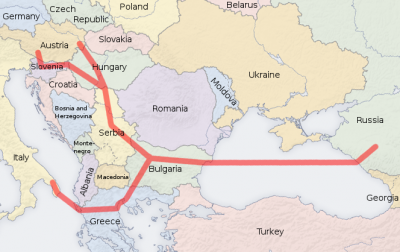
And while we see the reintegration of Crimea as the return of historically Russian territory, it was also a major victory in the energy war. In the Crimean conflict, Putin’s nightmare was that the overthrow of Yanukovych would be followed by the eventually weakening or removal of Russian military positions on the energy-rich Black Sea. A strengthened position in Crimea was leveraged in the creation of the TurkStream pipeline, which then allowed Russia to bypass Ukraine by shipping gas under the Black Sea to Europe.

Russia’s standing in the pipeline battle has been further cemented by recent events regarding the NordStream 2 pipeline, which will bring Russian gas through the Baltic Sea to Germany. Naturally, America is not a fan of this project and has sought to delay the construction by any means possible.

But even Germany, no friend of Putin or Russia, has pushed ahead with the project. Gazprom will now complete the pipeline alongside partners from British, Dutch, Austrian, and German energy companies. And while America may disapprove from afar, all America exports is its fiat dollar which can offer no substitute for the Russian gas and oil required to power Germany’s industrial clusters.

In December of 2020, Gazprom resumed construction on the pipeline despite America’s protestations. In fact, the German-Prussian state of Mecklenburg Vorpommern has recently voted to create a sanction-proof legal structure that would preempt future attempts by America to interrupt the project.

What a turn of fate: to see America’s omnipotence fade as the Empire’s geopolitical meddling is simply circumvented by peaceful trade

So while Russia’s victory in the pipeline battle has been unequivocal, the war has been fought in other domains. For the last 6 years the Empire has won the pricing battle, with its two primary weapons being the oil of Saudi Arabia and the natural gas produced by the shale revolution.

The oil price battle began when John Kerry and the Saudi King met in September of 2014. An arrangement was worked out where the Saudis would suppress crude prices to weaken the Russian economy in exchange for America’s military support in overthrowing Bashar al-Assad. Because Saudi Arabia has the lowest extraction costs of any major producer (3$ per barrel as of 2020), it can profit at prices much lower than its higher-cost oil-producing opponents such as Russia, Iran, and Syria. Under this new arrangement, crude prices fell to new lows as ISIS was spawned in Eastern Syria, and the Free Syrian Army was given American heavy weapons.

The Russian economy shrank almost 40% over the next two years. By comparison, America’s “Great Recession” almost crushed the entire financial system after a mere 2.5% drawdown in GDP. Russia was able to withstand the enormous contraction because under Putin the country’s monetary policy is focused on maintaining net-zero debt: a far cry from the 1990s when Saudi price-suppression (intended to punish Russia for fighting Islamists in Chechnya) hammered down crude prices and resulted in the 1998 Russian financial crisis. Now that Russia operates without external debt, these price tactics are harmful to the populace but no longer imperil the functioning of the state.

While 2020 has seen a renewal of price suppression by the Saudis, the Kingdom’s long-term prospects are plummeting. Below Saudi Arabia sits the state of Yemen. As the high birth rate outstrips the supply of natural resources, Yemen produces an excess of poor and radicalized young men. In response to Saudi and American airstrikes, the Houthi movement has united Shia and Sunni Muslims in Yemen under a common banner against their northern neighbor. Now Yemeni rebels are targeting Saudi oil facilities with increasingly frequent drone strikes, one of which spiked oil prices by almost 20% in Sep 2019.

Another problem for Saudi Arabia is resource depletion. The Saudis are systematically lying about the amount of oil that’s remaining. Leaked communications showed the former VP of Aramco warning the US that their oil reserves could actually be 40% lower than claimed. Consensus used to be that the Ghawar field had 5 million barrels per day capacity. The IPO filing for Aramco revealed a maximum capacity of 3.8 million barrels per day: and that’s their biggest field, producing a third of the nation’s oil output.

If their oil reserves are fine, why has the Kingdom been panickedly talking about economic diversification for the past 5 years? Why did Aramco even have to IPO? America’s vassal state in the crude oil battle seems to be drying up.

Another weapon in the energy price war has been the shale gas revolution. New advancements in horizontal drilling and hydraulic fracturing have allowed America to access previously hard to reach “tight” oil and gas reserves. As many small and mid-sized fracking operations rapidly set up shop in the mid 2010s this flooded the world with cheap natural gas and lowered Russia’s energy earnings. However, many of these firms were unprofitable and existed only due to the ultra-low interest rates available at the time, which enabled companies to operate at a loss for several years: meaning that the profitless shale revolution which hurt Russia was de facto financed by the Federal Reserve.

The fall of US shale seems to be on the horizon, as the industry showed signs of huge weakness in 2020. Oil and gas bankruptcies have quadrupled from 2019 to 2020, and production levels from America’s largest fields have dwindled. The Eagle Ford field is down 30% from 2019, Niobrara is down 35%, and Anadarko is down 40%! The best case for America is that these were voluntary production drawdowns due to cheap prices. The worst case is that these are symptoms of the end stage of depletion – the same fate befalling Saudi Arabia.

Even if the large American fields return to their previous production levels, this wave of bankruptcies will remove many small producers from the market who were essentially drilling at an operating loss for years.

There are other developments that suggest that the Empire is losing the energy war

1. Nikol Pashinian, who targeted Gazprom in Armenia with spurious lawsuits, has been given a black eye by Putin. By brokering the Armenian-Azeri peace deal the Russian military now permanently occupies the Caucasus. Anyone who seriously believes it is limited to 5 years should look to the “temporary peacekeeping operations” that have kept Russian troops stationed in the tiny nation of Transnistria for almost 3 decades. Russia’s position in the region – a crucial energy hub, is now stronger than at any other point since the Soviet Union.

2. In defiance of US sanctions, Iran has restarted its domestic shipbuilding industry by constructing new oil tankers with natively sourced parts. New Aframax size tankers have the capacity to hold 750,000 barrels of crude oil and will be used to surreptitiously deliver oil to Iran’s trading partners

3. Despite feeble efforts by Washington to install Juan Guaido in Venezuela – the only country with comparable energy reserves to Saudi Arabia, Maduro is still in power, and Russia and China are now collaborating to circumvent US sanctions. Throughout 2020, crude from Venezuela arrived at Chinese ports, having been snuck past American detection with the aid of Russian state oil company Rosneft, which made the oil appear as if its port of origin was Malaysia.

So what are the takeaways from these events?

First, we can see that Europe is waking up to the necessity of Russian energy. Despite all America’s bluster, it cannot provide a viable alternative even for the countries with which it aligns ideologically. Sure, there will be haphazard attempts like squirreling tight gas from cracks in the Mediterranean Sea, but those are at best partial solutions. Second, sanctions have backfired: the Russian economy is now fully resilient and profitable. There is no further way to wage economic warfare on a nation that has already been isolated from the global financial system. As far as oil trading is concerned, the willingness of America to impose restrictive sanctions has been matched by the creativity of those hoping to bypass them. Finally, the toughest period of the price war seems to be over and the pipeline battle has been won.

The Empire’s diminishing position in this conflict

Nikol Pashinian who targeted Gazprom is out – and Russia now occupies the Caucasus

Special Report: How China got shipments of Venezuelan oil despite U.S. sanctions | Reuters


The Ister is a researcher of financial markets and geopolitics. Author of The Ister: Escape America


River to Sea Uprooted Palestinian   
The views expressed in this article are the sole responsibility of the author and do not necessarily reflect those of the Blog!

Friday, 1 January 2021

Serbia Becomes Hub for Russia’s Gas Distribution in the Balkans

 By Paul Antonopoulos

Global Research, December 28, 2020

With the TurkStream gas pipeline now running through Serbia, the Balkan country will enjoy numerous benefits when exports begin, such as energy stability, the opportunity to get cheaper gas, and additional tax revenue. On December 25, Serbia successfully tested the TurkStream pipeline project that will connect Russian gas to consumers in Europe, especially in the Balkans. Serbian President Aleksandar Vučić revealed that the pipeline will be officially commissioned on December 30.

“The test run was successful. We did not publicize it too much but everything will start on December 30 as I promised. A small ceremony will be organized on that occasion because it is a huge deal for our country,” Vučić said.

The success of the test and Wednesday’s commissioning of the TurkStream brings an end to one of the most important projects in Serbian history. The gas pipeline strengthens the economic and geostrategic position of Serbia in the region as it can now become a hub to distribute Russian gas in the Balkans. The pipeline is 403 kilometers long and stretches from Zaječar on the border with Bulgaria to Horgoš on the border with Hungary.

There are numerous benefits that this gas pipeline will bring to Serbia, but the most important is energy stability. It is a two-way pipeline, meaning that gas can move between Bulgaria and Hungary in both directions. This is important because of energy security and, not only for Serbia, but for the entire Balkans network which can now be expanded.

The entire TurkStream pipeline within Serbian territory has not been built yet, but judging by the pace of the works so far, it will be completed without delay. Another compressor station remains to be completed in Serbia by June 2021.

The gas pressure on the TurkStream route is high enough that gas can pass from Bulgaria to Serbia. In fact, gas from Bulgaria can already be used in Pančevo, to the immediate east of Belgrade, for the needs of the gas power plant, such as generating electricity and heat. The extensive work for the gasification of Serbia, in full capacity, means that the TurkStream will allow Gazprom to export gas to the Republika Srpska, the Serbian-dominated entity that forms a part of Bosnia and Herzegovina, thus being able to deliver gas to the entirety of the country and perhaps even onwards to Croatia and Montenegro.

Five more gas power plants are planned to be constructed in Serbia in the near future. They will be built next to the largest industrial centers in Serbia. 4% of the total electricity produced in Serbia will come from Pančevo, in which thermal energy from the refinery and all its plants will be supplied. With the TurkStream at full capacity, it will be possible to build plants near Belgrade, Novi Sad, Niš and Kragujevac. When electricity is produced, thermal energy by-product will be used for large industrial plants, businesses and residential centers.

In addition to energy stability, Serbia will enjoy several other important benefits because of the passage of the TurkStream through its territory. Serbia will have minimum $40 cheaper gas per thousand cubic meters thanks to tax revenues that it will collect due to the transportation of gas through its territory to other countries. The Bulgarians negotiated with Gazprom a 27% lower price because imported gas from Ukraine passes through its territory to other countries. Serbia will be able to strike a similar deal so that Russian gas can reach Bosnia and Herzegovina, as well as Hungary, through its territory. It is also a benefit as servicing the gas pipeline and accompanying facilities has created job opportunities, and cheaper gas will inevitably lead to greater industrial output in other sectors.

The benefits of the TurkStream in Serbia will soon be realized as the most difficult part of the job was completed, laying pipes at the bottom of the Black Sea. It is for this reason that Russia prioritized finishing the TurkStream first, even though it has a much smaller capacity compared to Nord Stream 2. Nord Stream 2 has been continuously delayed due to Moscow’s anticipation that Washington would not only oppose the project, but pressure involved countries to withdraw and impose sanctions.

But with TurkStream to begin running in Serbia, it has not only consolidated Belgrade’s relations with Moscow, it gives hope to a country that was devastated by a decade-long NATO destruction in the 1990’s. Serbia has not been able to fully recover from the war, but cheap gas and job creation will transform the Balkan country, not only industrially, but also in terms of regional influence as it becomes a crucial energy hub for the entire region.

*

Note to readers: please click the share buttons above or below. Forward this article to your email lists. Crosspost on your blog site, internet forums. etc.

This article was originally published on InfoBrics.

Paul Antonopoulos is an independent geopolitical analyst.

Featured image is from InfoBrics

Will Azerbaijani Gas Compete with Russia in Southern Europe?

The original source of this article is Global ResearchCopyright © Paul Antonopoulos, Global Research, 2020

River to Sea Uprooted Palestinian   
The views expressed in this article are the sole responsibility of the author and do not necessarily reflect those of the Blog!

Monday, 5 October 2020

Navalny Incident – A Made-in-the-USA False Flag to Harm and Contain Russia?

Stephen Lendman | Author | Common Dreams

By Stephen Lendman

Source

The US has much to gain from Navalny’s illness.

Most obvious is its aim to block Nord Stream 2’s completion.

If Russia’s gas pipeline to Germany becomes operational next year, it will double what Gazprom can supply Germany and other Western countries.

If the project is suspended or halted altogether, it will advantage US LNG producers — despite the much higher cost of this energy supply.

Republicans and Dems have greater aims.

They want Russia harmed economically, geopolitically and strategically. 

They want the country marginalized, weakened, and isolated.

The above objectives have been US policy throughout the Cold 

War and after its aftermath to the present day — no matter which right wing of its one-party state runs things.

Post-WW II, containing Russia became official US policy. 

US diplomat/envoy to Soviet Russia/presidential advisor George Kennan (1904 – 2005) was “the father of containment.”

He was a core member of so-called foreign policy “wise men” in Washington. 

His 1946 “Long Telegram” from Moscow and 1947 “Sources of Soviet Conduct” claimed its government was inherently expansionist. 

In February 1948, his “Memo PPS23” said the following:

“(W)e have 50% of the world’s wealth but only 6.3% of its population. (It makes us) the object of envy and resentment. 

“Our real task in the coming period is to devise a pattern of relationships (to let us) maintain this position of disparity without positive detriment to our national society.” 

“We need not deceive ourselves that we can afford today the luxury of altruism and world benefaction…”

“We should dispense with the aspiration to ‘be liked’ or to be regarded as the repository of a high-minded international altruism.”

“We should (stop talking about) unreal objectives such as human rights, the raising of the living standards, and democratization.” 

“The day is not far off when we are going to have to deal in straight power concepts.” 

“The less we are hampered by idealistic slogans (ideas and practices), the better.”

In July 1947, his so-called “X” article on the “Sources of Soviet Conduct urged countering it “effectively.”

The US “can never be on Moscow’s side,” he stressed.

In March 1948, NSC 7 detailed “The Position of the United States with Respect to Soviet-Directed World Communism,” saying:

“(A) defensive policy cannot be considered an effective means of checking the momentum of Soviet expansion.”  

“Defeat(ing)” communism was considered “vital to the security of the United States.”

NSC 68 (April 1950 — issued weeks before Harry Truman’s preemptive war on nonbelligerent North Korea) officially inaugurated anti-Soviet Russia containment.

It called the country an enemy “unlike previous aspirants to hegemony…animated by a new fanatic faith, antithetical to our own (wishing to) impose its absolute authority over the rest of the world.” 

Ignored was the scourge of Nazi Germany and imperial Japan — or that WW II devastated Soviet Russia, requiring years of rebuilding.

Its government posed no threat to the US — not then, notably not now.

After Soviet Russia’s dissolution in December 1991, capitalism replaced its communist system.

It remains Russian Federation policy today. 

Because Moscow is independent of US control, made-in-the-USA adversarial relations continue.

No Russian threat to US/Western interests exists so it was invented, notably since Vladimir Putin became president.

Bipartisan hostility toward Russia in Washington is all about wanting the country transformed into a US vassal state.

It’s about gaining control over its vast resources and population, along with eliminating a strategic rival — whose overtures for normalized relations are consistently spurned.

The Trump regime is using the Navalny incident to further its strategic interests.

It’s pressuring Germany and the EU to punish Russia for an incident no evidence suggests it had anything to do with.

Last week, German Foreign Minister Heiko Mass said that if the chemical watchdog OPCW — an imperial lapdog serving Western interests — says Navalny was poisoned by novichok exposure, “I am convinced that (EU) sanctions will be unavoidable” on Russia, adding:

“(S)uch a grave violation of the International Chemical Weapons Convention cannot go unanswered.”

Earlier, a German military lab and facilities in France and Sweden claimed that the deadly nerve agent caused his illness.

Unmentioned by these countries was that exposure to novichok — the deadliest known toxin — causes death in minutes.

Navalny is very much alive over a month after falling ill. 

Discharged from hospitalization in Berlin, German doctors expect him to recovery fully or near-fully.

If poisoned by novichok, he’d have died before boarding a flight from Tomsk, Russia to Moscow.

What’s obvious is suppressed in the West by hostile-to-Moscow political officials and media.

Heroic efforts by Russian doctors in Omsk that saved Navalny’s life was erased from the EU’s historical record.

So was their biological analysis — finding no toxins in his blood, urine, liver, or elsewhere in his system.

According to former German diplomat Frank Elbe, Europe is “making a giant step backwards – back to the Cold War” by allying with US hostility toward Russia instead of normalizing relations, adding:

US policymakers are furious about an alliance by Germany and other EU countries with Russia to construct Nord Stream 2, “pursu(ing) their own independent policy.”

Elbe urged Europe to break from the US when their interests diverge — to uphold their sovereign independence.

Most often, European countries bend to Washington’s will — even  when harming their interests.

So far, opposing the Trump regime’s pressure to abandon the landmark JCPOA nuclear deal is an exception to the rule — if it sticks.

Will Nord Stream 2 be another? 

Will Germany support its completion or shoot itself in the foot by allying with US interests against its own?


River to Sea Uprooted Palestinian   
The views expressed in this article are the sole responsibility of the author and do not necessarily reflect those of the Blog!

Thursday, 30 July 2020

ASSISTING ‘INVISIBLE HAND OF MARKET’: U.S. THREATENS GERMAN COMPANIES OVER NORD STREAM 2


Assisting 'Invisible Hand Of Market': U.S. Threatens German Companies Over Nord Stream 2

In a last-ditch attempt to impede the Nord Stream 2, the Trump administration began to threaten German (and not only) companies who are involved in it with sanctions.
According to German media, this is a showing of a new, and incredible, “low point” in Transatlantic relations.
According to a report by German outlet Die Welt, the United States is increasing pressure on German and European companies involved in the construction of the Nord Stream 2 Baltic Sea pipeline.
In the past few days, US representatives had held video conference calls with contractors of the project to “point out the far-reaching consequences of continuing to work on the project,” the outlet reported.
The company representatives sometimes faced up to twelve representatives of the US government.
They “made it very clear in a friendly tone that they want to prevent the pipeline from being completed,” the newspaper quoted an unnamed observer of the talks:
“I think the threat is very, very serious.”
US Secretary of State Mike Pompeo announced that the controversial Baltic Sea pipeline to transport gas from Russia to Germany would now fall under a law that would allow punitive measures, among other things, against companies doing business with Russia or countries like Iran and North Korea.


In response, the German Federal Government declared that it rejected extraterritorial sanctions, since these were “contrary to international law”.
The German economy condemned the threats as an “incredibly low point in transatlantic relations”.
Nord Stream 2 is said to transport gas from Russia to Germany and is particularly controversial in Eastern Europe.
The main fear is a weakening of alternative pipelines and traditional transit countries, such as Ukraine. The US government argues that Europe is becoming energy-dependent on Russia.
The United States had previously tried to impose sanctions on Nord Stream 2. Sanctions put into effect by President Donald Trump at the end of 2019 are aimed at the operators of laying ships involved in the construction. The construction of the pipeline therefore had to be interrupted.
Russian President Vladimir Putin expressed optimism that the project would be completed by early 2021, with a delay of only a few months.
On July 16th, the US updated its sanctions regime against the Nord Stream 2.
Until July 15th, the scope of US sanctions legislation excluded direct investors, enhancing Russia’s ability to build export pipelines before August 2nd 2017. That cut-off date was removed, meaning contracts signed for Nord Stream 2 and the second line of TurkStream will be included.
“The US signals that sanctions could potentially be applied retroactively, including in respect of European companies that are Gazprom’s partners in Nord Stream 2. However, it is hard to see how this could be enforceable; this would be against the law and should it happen it would certainly be contested in international courts,” according to Katja Yafimava, researcher at the Oxford Institute for Energy Studies.
“The question is whether the state department has the right to independently enforce the provisions of this law. The state department is formally subordinate to the president, but no separate documents have been issued stating that the president gave the state department the right to impose sanctions from the [sanctions act] package,” according to Igor Yushkov, an expert of the National Energy Security Fund and the Financial University under the Government of the Russian Federation.
The proposed additional sanctions in the draft national defence act “are unacceptable and contrary to international law, and the EU firmly opposes them,” EU high representative for foreign affairs and security policy Josep Borrell said on June 25th.
The biggest issue is that the US is concerned that there are no buyers for its liquefied natural gas (LNG) that it wants to sell to Europe at prices, higher than those Russia offers Europe.
Sometimes, the invisible hand of the market requires a tangible attempt at a push for it to properly and “independently” settle the market on a desirable scenario.
MORE ON THE TOPIC:

River to Sea Uprooted Palestinian   
The views expressed in this article are the sole responsibility of the author and do not necessarily reflect those of the Blog!