Showing posts with label Nakba and ROR. Show all posts

Friday, 30 July 2021

The Right of the Palestinian People to Self-Determination under “Israel’s” Colonial Occupation

Visual search query image July 29, 2021

Source: Al Mayadeen

Afreen Rizvi


From Palestine and South Africa to the Americas and Australia, settler-colonists [have] violently fought to prevent the indigenous people, that were colonised, from fighting for liberation.


Visual search query image

This article explores Palestine’s right to self-determination under “Israel’s” illegal occupation. This paper seeks to demonstrate that since the Balfour Declaration that was issued by the British Government in 1917, there have been politically driven strategies deployed to gradually liquidate the Palestinian people. The indigenous people of Palestine have been faced with systematic persecution, apartheid policies and brutal occupation; as such, it is submitted that the Palestinian people must be able to exercise their right to self-determination. I will begin with a discussion on self-determination as a right before outlining the historical background of the “Israel”-Palestine issue, and the political allyship of each entity apart. 

Self-Determination in International Law

The principle of self-determination, as it is understood today, evolved from a principle to a right, triggering much debate over the years. It denotes the legal right to peoples to decide their own destiny in the context of international order.[1]There are two aspects to self-determination: internal and external. Internal self-determination is the right of the people to govern themselves without any other interference, this includes the independence to freely choose their own political, economic and social system.[2] External self-determination on the other hand is the right for peoples to determine their own status politically – this allows the establishment of an independent state. After the First World War, and specifically after his famous “Fourteen Points” speech, US President Woodrow Wilson declared that, “Peoples may not be dominated and governed only by their own consent. ‘Self-determination’ is not a mere phrase. It is an imperative principle of action, which statesmen will henceforth ignore at their peril.”[3] The right of self-determination was introduced to the UN Declaration on the Granting of Independence to Colonial Countries and Peoples in 1960, and subsequently adopted by the UN General Assembly Resolution 1514 in the same year. Additionally, the UN Charter stated that one of the purposes of the United Nations was “respect for the principle of equal rights and self-determination of peoples.”[4] Upon adopting the Declaration of Decolonisation, the UN underlined the necessity of ending colonialism and through this declared, inter alia, that the right to self-determination was not limited. 

It is important to note that the right of self-determination has been cited extensively by the UN assembly, Security Council, and is enshrined in various treaties as well as in decisions made by the International Court of Justice (ICJ). The following excerpt from the aforementioned declaration was subsequently introduced in Article 1 of the International Covenant on Civil and Political Rights (ICCPR) and Article 1 of the International Covenant on Economic, Social and Cultural Rights (ICESCR) providing a detailed legal definition of self-determination, and this definition is used in various international and national treaties and documents.[5]

“All peoples have the right to self-determination; by virtue of that right they freely determine their political status and freely pursue their economic, social, and cultural development.” 

It is widely accepted that the right of self-determination is applicable to “peoples” in colonial territories, as well as others who do not fall in the category of being colonised or oppressed, the only difference is they have to exercise their rights internally. The right of self-determination is no longer limited to the conventional colonial independence scenarios, such that various ethnic and cultural groups of people within different states effectively rely on the right of self-determination in order to declare their independence.[6] A common argument often presented against the right of self-determination is that the principle of territorial integrity in relation to states is challenged by the principle of self-determination – as it is the will of the people that fundamentally leads to the legitimacy of a state. This indicates that people are not only free to choose their state but also their territorial boundaries. However, in accordance with the Helsinki Final Act of 1975, the United Nations and International Court of Justice demonstrated that there is no contradiction between territorial integrity and the right of self-determination.[7] In that context, it is necessary to add that Koskenneimi argued that “It is doubtful whether the statement of principle was intended to be taken literally… its revolutionary potential was tempered by the Final Acts strong emphasis on territorial integrity.”[8]

In the context of Palestinian self-determination, I submit that “Israel” is a colonial entity that has occupied Palestinian territory; thus, the Palestinian people must be able to exercise this right. It is imperative to note that under international law, only groups categorized as “peoples” have the right to self-determination. The interpretation of “peoples”, however, continues to cause confusion. For example, one may question do all “peoples” need to share one ethnicity or location? If so, where would be the place that gathers people who are a part of multi-ethnic states? With regard to Palestinians, “Israel” has already officially accepted the existence of the “Palestinian peoples” in the Camp David Accords signed with Egypt in the year 1978.[9]

Moreover, it is argued that the right of self-determination can heavily disrupt the essence of peace, such that political communities may resort to force if their demands are not met.[10] Violence was also exhibited in the case of Nigeria after the British authorities recognized three main groups, Igbos, Hausa-Fulani and Yoruba. These groups were legally recognized after seeking independence. These minority groups were effectively excluded from the political sphere and the impact of this devolution caused further ethnic divide and political strife[11]. It is claimed that the violence that erupted between 1965-1967 with Nigerians and Biafrans signified that exercising the right of self-determination leads to political and ethnic turmoil.[12] 

In response to this argument, it is contended that despite self-determination struggles usually portrayed as violent and brutal measures, people should still have the freedom to exercise this fundamental right. It is important to understand that colonial settlers aggressively battled to preserve their right of conquest as their own right to self-determination. Till present day, “Israel” has committed war crimes, most notably in Gaza. From Palestine and South Africa to the Americas and Australia, settler-colonists [have] violently fought to prevent the indigenous people, that were colonised, from fighting for liberation, thus the argument that self-determination leads to violence and brutality does not hold much weight in this context considering it is no different to the measures taken by colonising entities.[13] Further to this, in the past, the UN has failed to sustain peace even with states that exercised their right to self-determination, as noticed with the case of Cyprus.[14] Conflicts among states exist irrespective of self-determination, therefore the premise of this argument is incorrect. It may be more suitable to look beyond the UN paradigm if we ought to find lasting solutions to such conflicts.

The Palestine-Israel Conflict

In order to better understand the Israel-Palestine conflict, it is necessary to present the issue within the historical framework of decolonisation struggles. Historically, the world has witnessed decolonisation struggles beginning with violence as a result of a people being denied independence and liberation by the colonising entity. The Palestinian struggle against the Zionist ethnonationalist entity has lasted since the 20th century; the story of Palestine is on political independence, liberation, and putting an end to the apartheid Israeli regime. Whilst Zionists argue that “Israel” has a historic right to Palestinian land, it is imperative to note that had it not been for the involvement of European imperial powers, most notably Britain, there would have not been any creation of “Israel”. In November 1917, Britain the de facto ruler of Palestine, issued the Balfour Declaration. The eighty-word statement by Foreign Secretary Arthur Balfour announced support for the establishment of a “national home for the Jewish people” in Palestine. 

In 1922, five years after the Balfour Declaration, the “League of Nations” approved the British Mandate for Palestine and the establishment of a “Jewish homeland.” The decision of the mandate did not consider the will of the Palestinian people or their fundamental rights. Between 1939 and 1949, there were a series of mass protests that took place against Jewish immigration to Palestine as well as armed Zionist groups launching attacks against the indigenous people of Palestine[15]. It is necessary to note that in 1947, the UN adopted Resolution 181, a partition plan for Palestine which was subsequently rejected by the Palestinians. The UN General Assemblies plan was to partition Palestine between the native Palestinians and the Jewish colonial settlers. Throughout 1948-1949, the Palestinians were attacked by Zionist forces. Villages and hotels were bombed near Haifa demonstrating early signs of ethnic cleansing. In April 1948, one month before the State of “Israel” was created, Zionist forces massacred over 100 250 Palestinians in the city of Deir Yassin[16] which is in close proximity to Jerusalem. In December of 1948[17], the UN General Assembly passed Resolution 194 which allowed the right of return of Palestinian refugees. This is a brief explanation of how the state of “Israel” came into existence. In 1974, Yasser Arafat, a Palestinian Political leader stated:

“The [UN] General Assembly partitioned what it had no right to divide – an indivisible homeland.”

“Israel” consistently and tactically made use of Occupation Law to further acquire Palestinian land whilst simultaneously arbitrarily arresting and targeting Palestinian people through the use of apartheid policies. It is argued that “Israel” has used UNSC Resolution 242 to justify and legitimate these actions through “political framework shaped by U.S intervention”[18] as mentioned by Noura Erakat, a human rights attorney and Palestinian activist. Erakat claims that the Occupation Law failing to regulate Palestinian territories effectively, is a result of a political, not a legal contest. It is asserted that “Israel’s” argument that the Palestinian territories are simply under their administration, would hold no weight were it not for the political powers involved in the region. 

Furthermore, it is also argued that the United States has favoured “Israel” to such an extent that the US dismisses “Israel’s” violation of international law and allows the state to carry out war crimes without facing any repercussions besides blanket statements. As a result of the Occupation Law that “Israel” takes advantage of, Palestinian territories remain occupied, Palestinian people are systematically being ethnically cleansed[19], and their fundamental rights such as the freedom of movement are infringed.

The Human Rights Watch published a report in April 2021, in which it was made very clear that for the past 54 years, Israeli authorities have transferred Jewish Israeli’s to the Occupied Palestinian Territories (OTP) and “granted them a superior status under the law as compared to Palestinians living in the same territory when it comes to civil rights, access to land, and freedom to move, build, and confer residency rights to close relatives.”[20] In 1970, the General Assembly Resolution 2625 added that “Every state has the duty to respect this right in accordance with the provision of the charter.” Therefore, “Israel” and the international community as a whole should not be denying the Palestinians their right to self-determination. Palestine should be able to manage its own affairs without the interference of external and colonial entities. It is important to understand that the Palestinian people have witnessed the occupation of their lands, forced expulsions to neighbouring lands, military bombardment, and erasure of their identity. As such, the struggle for independence and self-determination should be welcomed by all. 

Ali Abunimah, a policy adviser, argues that self-determination “must return to the center of the Palestinian struggle”[21]. To add, Abunimah asserts that the Palestinian right to self-determination can indeed be compatible with the coexistence of Jews. It is claimed that the United States has a long history of deciding the fate of the Palestinian people. For instance, as per the Clinton Parameters, “Israel” would get “Jewish neighbourhoods” and the Palestinians would get “Arab neighbourhoods”. In hindsight, this meant that “Israel” would be allowed to keep the land it has colonised and annexed since 1967, and the people of Palestine would be able to have what is left – which Israeli occupation forces and settlers continue to annex and occupy till today. America’s “peace process” has allowed “Israel” to aggressively maintain their illegal occupation of the Palestinian people.[22] 

Professor Noam Chomsky in his book ‘On Palestine’[23] highlights that “Israel’s” policies are directly connected to the Zionist ideology that “both aim to establish a Jewish state by taking over as much of historical Palestine as possible and leaving in it as few Palestinians as possible.” Chomsky, a Jewish historian and activist, further claims that the international community has “never condemned” the Israeli entity which led to the enormous expulsion of 750,000 people and the destruction of hundreds of villages and towns. In addition to this, Chomsky states that “ethnic cleansing has become the DNA of Israeli Jewish society.” Erasing the Palestinian land and people should be enough of a reason for the remaining people of Palestine to exercise their right to self-determination. There are distinct similarities between Palestine and the apartheid in South Africa. The Israeli Knesset authorises legislation that separates, segregates, and discriminates against the Palestinians. A recent report by Human Rights Watch also backs up this claim:

“Israeli authorities methodically privilege Jewish Israelis and discriminate against Palestinians. Laws, policies, and statements by leading Israeli officials make plain that the objective of maintaining Jewish Israeli control over demographics, political power, and land has long guided government policy.”[24]

The United States of America remains a close ally of “Israel”. The U.S provides financial and military support to “Israel” which has been used criticised by several human rights agencies as this funding is used to perpetrate human rights abuses against the Palestinians, particularly in the Gaza Strip. In the Ten-Year Memorandum of Understanding between the United States and “Israel”, $38 billion has been promised to “Israel” from the U.S beginning in 2016.[25] This includes $3.3 billion in Foreign Military financing and $500 million for missile defence programs. Several U.S politicians declare their support for “Israel” and do not shy away from mentioning “Israel has every right to defend itself” despite the fact that it is “Israel” that is committing heinous crimes against the Palestinian people. As mentioned by Chomsky, as a result of political power and close relationship with the U.S, “Israel” has been able to act with impunity since 1948. The U.S also has a history of blocking UN resolutions[26] against “Israel”. According to UN data, since 1972, the US has vetoed at least 53 United Nations Security Council resolutions that are critical of “Israel”[27]. 

Contrastingly, Palestine does not have such strong allies. Palestinian resistance leaders have announced receiving military and financial support from the Islamic Republic of Iran; however, I submit that as Iran is a sanctioned country, the support offered to Palestine may not be as much as the support offered by the U.S and the UK to “Israel”. The UK has consistently and repeatedly sold arms to “Israel” despite its illegal occupation of Palestine.[28]

In conclusion, the people of Palestine have every right to self-determination, and this can be understood just by investigating the crimes perpetrated by “Israel” against the Palestinians, and the systematic oppression they have faced as a people. Since 1969, the General Assembly has recognised the “inalienable rights of the people of Palestine”[29] In 1974, member states of the UN worked to restore the “Question of Palestine” on the General Assembly agenda, and as such Arab heads of states upheld the “right of the Arab Palestinian people to the return to its homeland and its right to self-determination.”[30] Some weeks later the General Assembly passed resolution 3236 which mentioned “Recognizing that the Palestinian people are entitled to self-determination in accordance with the Charter of the United Nations,” and (a) The right to self-determination without external interference”. It should be noted that the General Assembly condemned governments which failed to recognise the right to self-determination and independence of peoples under “colonial and foreign domination”. For the Palestinians to exercise this right, the Israeli entity must vacate from the occupied areas in order to establish an independent Palestinian state. The United Nations has again affirmed its commitment to the Palestinian right to self-determination. In November 2020, the UN General Assembly endorsed a draft resolution once again recognising “the right of the Palestinian people to self-determination, including their right to an independent State of Palestine.”[31] 163 states voted in favour of this resolution, whilst 5 states voted against this, namely: “Israel”, The United States of America, Micronesia, Nauru, and the Marshal Islands. Tomis Kapitan eloquently argues that legitimate residents of Palestine include all Palestinians irrespective of where they are located in Palestine, including Palestinian refugees outside of the country. He states that “expulsion does not remove ones right of residency… Palestinians also retain residency rights in those territories from which they were expelled.”[32] Kapitan asserts that the Palestinian people, as a collective, have the “entitlement to being self-determining in that region [historic Palestine]… not qua Palestinians, but qua legitimate residents. The force used against them has not erased the fact that they are, and are recognized as being; a legitimate unit entitled to participate in their own self-determination.”[33]

Whilst some may argue that the Palestinian right to self-determination is an anti-Semitic stance, it should be duly noted that a Palestinian state would include Jews, Muslims and Christians. It is in fact the Zionist entity that remains anti-Semitic by expulsing and rejecting Jewish natives from enjoying their rights in Occupied Palestine. It should be remembered that the Palestinian right to self-determination is legal and in accordance with international law. For the state of Palestine to be completely independent, colonial settlers will have to return to the European countries they entered from and respect international law. To end, a group of academics including Palestinians and Israelis issued a One State Declaration in 2007, inspired by the South African Freedom Charter and declared: “The historic land of Palestine belongs to all who live in it and to those who were expelled or exiled from it since 1948, regardless of religion, ethnicity, national origin or current citizenship status; Any system of government must be founded on the principle of equality in civil, political, social and cultural rights for all citizens. Power must be exercised with rigorous impartiality on behalf of all people in the diversity of their identities.[34]

sources

[1]https://www.law.cornell.edu/wex/self_determination_(international_law)#:~:text=Self%2Ddetermination%20denotes%20the%20legal,destiny%20in%20the%20international%20order.&text=For%20instance%2C%20self%2Ddetermination%20is,right%20of%20%E2%80%9Call%20peoples.%E2%80%9D

[2] Salvatore Senese, ‘External and Internal Self-Determination’ [1989] 16(1) Social Justice <https://www.jstor.org/stable/29766439?seq=1#metadata_info_tab_contents&gt; accessed 9 May 2021.
[3] Wilson, War Aims of Germany and Austria (1918).
[4] UN Charter, Art 1 (2).
[5] https://www.un.org/development/desa/indigenouspeoples/wp-content/uploads/sites/19/2018/11/UNDRIP_E_web.pdf

[6] Quane, Helen. 1998. “The United Nations and the Evolving Right to Self-Determination.” The International and Comparative Law Quarterly 47(3): 537–572.

[7] Johan D. Van der Vyer, ‘Self-Determination of the Peoples of Quebec under International Law’ [2012] 10(1) Journal of Transnational Law & Policy 38
[8] Martti Koskenniemi, ‘National Self-Determination Today: Problems of Legal Theory and Practice’ [1994] 43(2) The International and Comparative Law Quarterly <https://www.jstor.org/stable/761238&gt; accessed 10 May 2021.
[9] J Massad, ‘Against Self-Determination’ [2018] 9(2) Humanity 161-191
[10] M Evangelista, ‘Paradoxes of Violence and Self-determination’ [2015] 14(5) Formerly Global Review of Ethnopolitics <https://doi.org/10.1080/17449057.2015.1051811&gt; accessed 3 May 2021.
[11] B Ibhawoh, ‘Testing the Atlantic Charter: linking anticolonialism, self-determination and Universal Human Rights’ [2014] 18(7) International Journal of Human Rights 1-19

[12] Beardsley, Kevin, David E. Cunningham, and Peter B. White. 2015. “Resolving Civil Wars before They Start: The UN Security Council and Conflict Prevention in Self-Determination Disputes.” British Journal of Political Science 47(3): 675–697.
[13] https://www.independent.co.uk/news/world/middle-east/israel-gaza-latest-palestinian-happening-b1852170.html
[14] Tobias Nowak and Charis Van den berg, ‘Alternative Approaches to Self-Determination Applied to the Cyprus Conflict’ [2020] 15(5) Transboundary Legal Studies <https://research.rug.nl/nl/publications/alternative-approaches-to-self-determination-applied-to-the-cypru&gt; accessed 7 May 2021.
[15] https://www.jewishvirtuallibrary.org/the-role-of-jewish-defense-organizations-in-palestine-1903-1948
[16] M Hogan, ‘The 1948 Massacre at Deir Yassin Revisited’ [2001] 63(2) The Historian <https://www.jstor.org/stable/24450239&gt; accessed 10 May 2021.

[17] https://interactive.aljazeera.com/aje/palestineremix/timeline_main.html
[18] Noura Erakat, ‘Taking the Land without the People: The 1967 Story as Told by the Law’ [2017] 47(1) Journal of Palestine Studies 18-38 
[19] Lucy Garbett, ‘I live in Sheikh Jarrah for Palestinians, this is not a ‘real estate dispute’’ (The Guardian, 17 May 2021) <https://www.theguardian.com/commentisfree/2021/may/17/palestinians-sheikh-jarrah-jerusalem-city-identity&gt; accessed 17 May 2021.
[20] https://www.hrw.org/report/2021/04/27/threshold-crossed/israeli-authorities-and-crimes-apartheid-and-persecution
[21]Ali Abunimah, ‘Reclaiming Self-Determination’ ( Shabaka: The Palestinian Policy Network, 21 May) <https://al-shabaka.org/briefs/reclaiming-self-determination/&gt; accessed 10 May 2021.[22]https://www.washingtoninstitute.org/policy-analysis/us-role-peace-process-perspective
[23]Noam Chomsky, On Palestine (Penguin Books 2015)

[24] https://www.hrw.org/report/2021/04/27/threshold-crossed/israeli-authorities-and-crimes-apartheid-and-persecution
[25] https://il.usembassy.gov/ten-year-memorandum-of-understanding-between-the-united-states-and-israel/
[26] https://www.aljazeera.com/news/2021/5/19/a-history-of-the-us-blocking-un-resolutions-against-israel
[27] https://www.un.org/depts/dhl/resguide/scact_veto_table_en.htm
[28] https://caat.org.uk/resources/countries/israel/
[29] https://www.un.org/unispal/document/auto-insert-196558/
[30] United Nations
[31] https://prc.org.uk/en/news/3213/un-votes-overwhelmingly-in-support-of-palestinian-self-determination
[32] Tomis Kapitan, “Self-Determination,” in Tomis Kapitan and Raja Halwani, The Israeli-Palestinian Conflict: Philosophical Essays on Self-Determination, Terrorism and the One-State Solution (Palgrave Macmillan, 2008), pp. 13-71.
[33] Ibid.
[34] “The One State Declaration,” The Electronic Intifada, 29 November 2007

Related


River to Sea Uprooted Palestinian   
The views expressed in this article are the sole responsibility of the author and do not necessarily reflect those of the Blog!

Monday, 5 July 2021

The Nakba and the Polish Law

  BY GILAD ATZMON

1589885470.jpg

by Gilad Atzmon

Source: Almayadeen.net

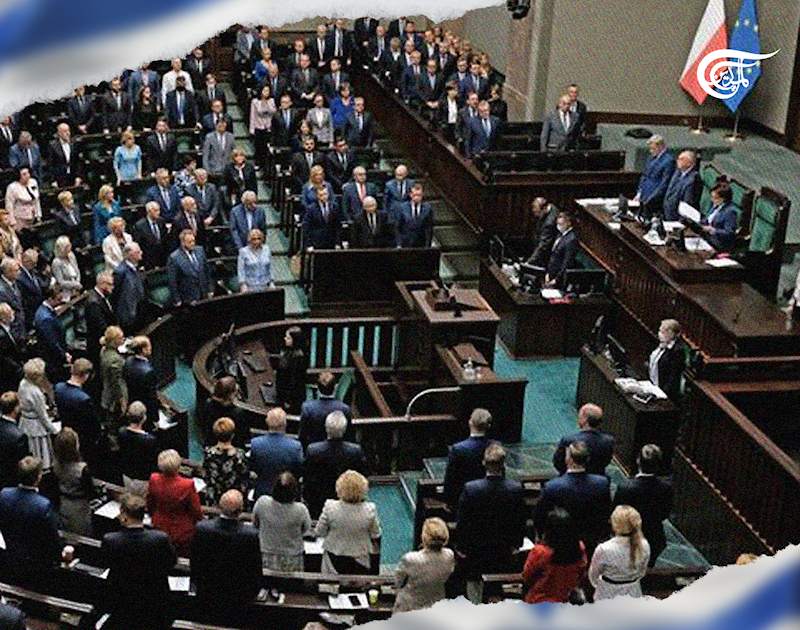
Israel seems upset by a new Polish law that sets a 30-year deadline for Jews to recover seized property. The legislation is yet to be approved by Poland’s senate, yet Israeli officials already refer to it as the “Holocaust law.” They insist that it is ‘immoral’ and ‘a disgrace.’

Last week Israeli Minister of Foreign Affairs Yair Lapid insisted that the bill “is a disgrace that will not erase the horrors or the memory of the Holocaust.”


The Nakba and the Polish Law

I fail to see which part of the legislation interferes with the memory and the horrors of the holocaust. I actually think that the crude attempt to squeeze billions of dollars from Poland in the name of a human tragedy may have a detrimental impact on this historical chapter and the way it is memorized.

The Poles didn’t approve of the Jewish ‘State’ interfering with their internal affairs. On Friday, Poland’s Prime Minister Mateusz Morawiecki hit back at Lapid, stressing, “I can only say that as long as I am the prime minister, Poland will not pay for German crimes: Neither zloty, nor euro, nor dollar.”

Poland’s Minister of Foreign Affairs echoed Morawiecki’s position, arguing that Lapid’s comments were misguided. “Poland is by no means responsible for the Holocaust, an atrocity committed by the German occupant also on Polish citizens of Jewish origin.”

During the weekend, the crisis seemed to escalate. On Sunday, Poland and Israel summoned the other’s ambassador for meetings as the rift between the two countries didn’t seem to subside.  

I am not in a position to judge what is right and who is wrong on restitution matters. Suppose the Polish new legislation is “a horrific injustice and disgrace that harms the rights of Holocaust survivors and their heirs,” as Lapid says. In that case, we should also expect Lapid to vividly support the Palestinians, their right of return, and their right to be compensated for the colossal crimes committed against them in 1948 and thereafter. 

In 1948, more than 700,000 Palestinians (the vast majority of indigenous Palestine) were ethnically cleansed by the newly born Jewish State. This catastrophic racially driven crime (that included a long list of massacres) is called the Nakba. It took place less than four years after the liberation of Auschwitz. 

During the 1948 war and shortly after, young Israel wiped out Palestinian cities and villages. It then used legislation to prevent Palestinians from returning to their homes and applied any possible means to plunder their properties, dispossessing those few Palestinians who clung to their land. Yet, Israel never admitted its original sin of ethnic cleansing. 

Applying to a moral cause, Israel claims to represent Jewish demands for restitution in Poland. I wonder, shouldn’t the same rule be applied to the Palestinians? Shouldn’t Israel put the same moral law into play and acknowledge the Palestinians’ right to their land, villages, cities, fields, and orchards?

While in Poland, it was Nazi Germany that brought a disaster on the county’s Jewry. In Palestine, young IDF and Jewish paramilitary groups committed colossal crimes against the indigenous population. While Nazi Germany ceased to exist in 1945, the IDF is still with us. The Labour party (which formed the first Israeli government directly) is still active and is even a member of the current governing coalition. The Likud Party, being the offspring of the Irgun and the Stern Gang (both complicit in some of the most brutal massacres in Palestine), is, by far, the biggest party in the Israeli Knesset. The Israeli and Zionist institutions that were responsible for the 1948 crime have never ceased to exist. They have never owned their crimes, let alone repented. 

Holocaust survivors have been compensated by different means for the crime that was committed against them by Europeans. Israel benefitted from a large reparations deal with the German government. The Palestinians, however, are still living in open-air prisons and refugee camps, subject to blockades and constant abuse.    

The time is ripe for Israel to own up to its horrendous past. By now, Israel should accept that the Palestinian cause is not fading away or evaporating into thin air. If Israel seeks to reconcile with the region, it must first apply to itself that moral code that it demands Poland to follow. 

Donate


River to Sea Uprooted Palestinian   
The views expressed in this article are the sole responsibility of the author and do not necessarily reflect those of the Blog!

Saturday, 29 May 2021

The Palestinian keffiyeh: All you need to know about its origins

 A closer look at the origins of Palestine’s iconic headscarf and how it transcended borders

Palestinian women masked with traditional keffiyeh near Ramallah in the occupied West Bank (AFP/Abbas Momani)

By Indlieb Farazi Saber

28 May 2021 13:53 UTC 

A distinctly Palestinian black-and-white chequered piece of cloth, the keffiyeh is described by some as the nation’s unofficial flag.

Long synonymous with the Palestinian cause, the simple square-metre fabric, traditionally folded diagonally into a triangle and worn draped over the head of rural Palestinian men, is today securely fashioned around the necks of human rights activists, anti-war protesters, sports stars and celebrities; transcending gender, religion and nationality.

Muhammad Walid, 49, from Jerusalem says he remembers seeing his father and uncles wear the keffiyeh in his earliest memories.

“The older generations would wear it on their heads,” he says. “I started wearing it as a teenager, but around my neck. For me, it represents the Palestinian struggle and cause.”

It’s a similar story for Riad Halak, 62, also from Jerusalem, who says: “It’s a tradition of Palestine. I started wearing one when I was 11 years old, and I still wear it today on special days like the Nakba. It’s part of my identity.”

While the keffiyeh’s status as an icon of Palestinian nationhood is undisputed, its origins lie further east, in what is now Iraq.

Keffiyeh Mural
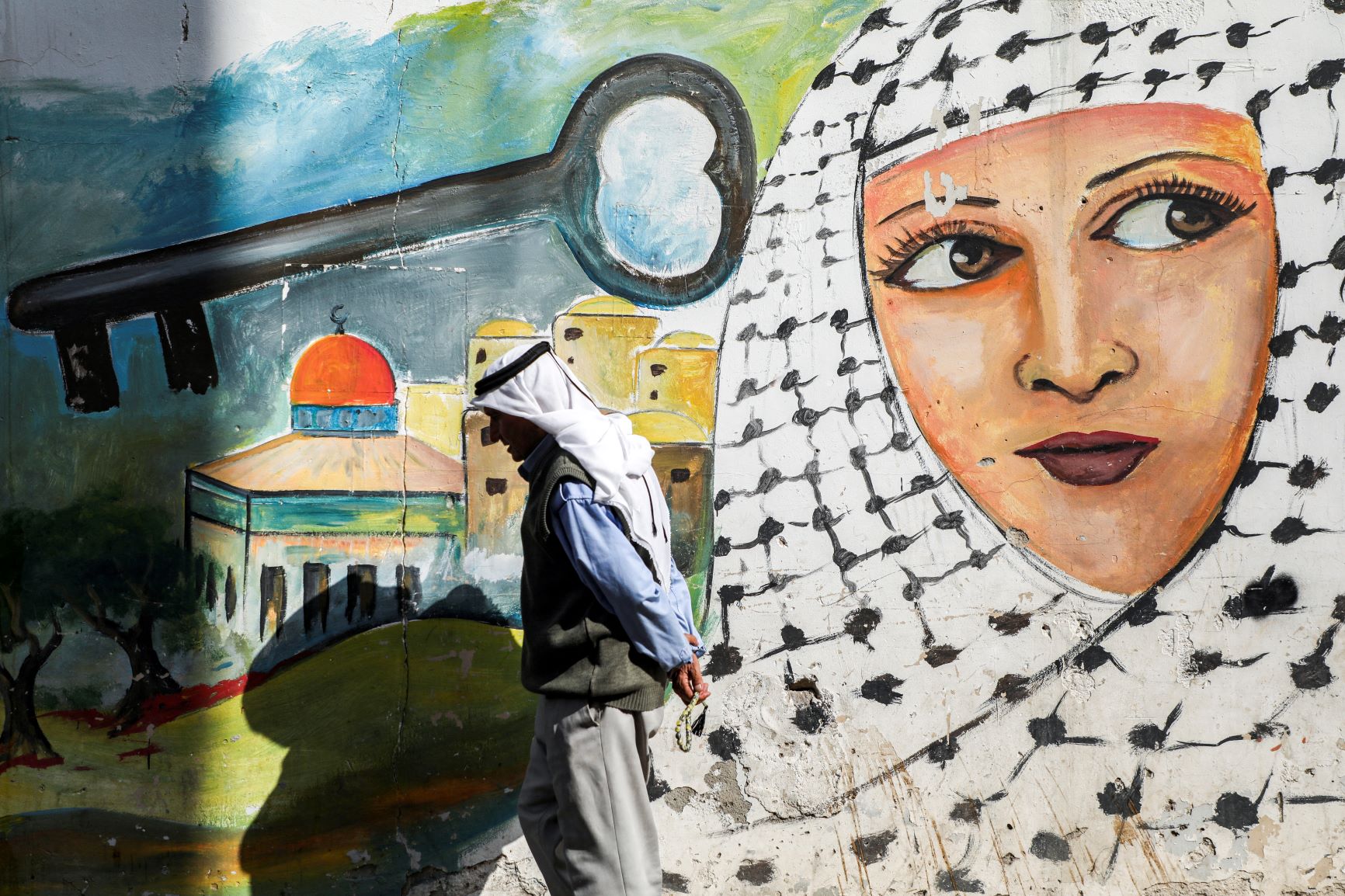
A mural depicts the Dome of the Rock and a woman wearing the keffiyeh (AFP/Jaafar Ashtiyeh)

The word itself means “relating to Kufa,” a reference to the Iraqi city south of Baghdad that sits along the Euphrates river, but little else is known about the roots of the keffiyeh. One account suggests it came about in the seventh century, during a battle between Arab and Persian forces near Kufa. The Arabs were said to have used cords made from camel hair to secure their headdresses and in order to recognise their comrades in the heat of battle. After their victory, the headgear was kept on as a reminder of their triumph. 

Others say the fabric, sometimes called the hata in the Levant, has origins that pre-date Islam and can be traced back to Mesopotamia, when it was worn by Sumerian and Babylonian priests around 5,000 years ago. 

“Its origins are open to speculation,” Anu Lingala, author of A Socio-political History of the Keffiyeh, tells Middle East Eye. “Until very recently, these types of designed objects were not taken seriously as subjects of academic research. The exception was for designed objects that were associated with elite status and wealth, whereas the keffiyeh was traditionally associated with working classes.”

Shorthand for the struggle

Although no longer linked to social status, the keffiyeh’s modern roots in Palestine are among the fellah, or rural workers, as well as the Bedouin. The two groups would wear the garment over their heads to cover the backs of their neck and protect themselves from the heat of the summer sun and the cold during the winter.

According to Lingala: “Covering one’s head was an important principle in traditional Palestinian culture.

Israel-Palestine: British media coverage ‘skewed’ and ‘biased’, report finds

“[The keffiyeh] afforded breathability through air pockets created by folds in the fabric,” she says.

The more educated, urban Palestinians, or effendi, would wear the fez or tarboush, a deep-red felt hat popularised by Ottoman ruler Mahmud II and adopted by locals as a standard form of dress. 

Cultural historian Jane Tynan has written about the scarf’s significance in the book Fashion and Politics. She says: “The Ottoman Empire’s dress codes had the effect of erasing ethno-religious identities, but would have been worn as a norm by urban dwellers.”

After the Turkish empire’s loss of its Near Eastern territories during the First World War, and the Arab Revolt against British colonial rule in 1936, Palestinian nationalists also used the keffiyeh as a means of covering their faces to hide their identity and avoid arrest, spurring unsuccessful calls among the British to ban the headscarves. Instead, in a “pivotal moment in Palestinian culture,” Palestinians united in adopting the fabric as a sign of solidarity. The symbol remained a staple icon of Palestinian nationhood after the Nakba and the establishment of the state of Israel.

“Palestinians of all social classes abandoned the fez and united around wearing the keffiyeh, making it difficult to identify the revolutionaries,” Maha Saca, head of the Palestinian Heritage Centre in Bethlehem, tells Middle East Eye.

Tynan, an assistant professor in design history and theory at Vrije Universiteit Amsterdam, says that “from its function in the revolt as a tool to disguise the identity of the wearer from British authorities, the keffiyeh became shorthand for the Palestinian struggle”. 

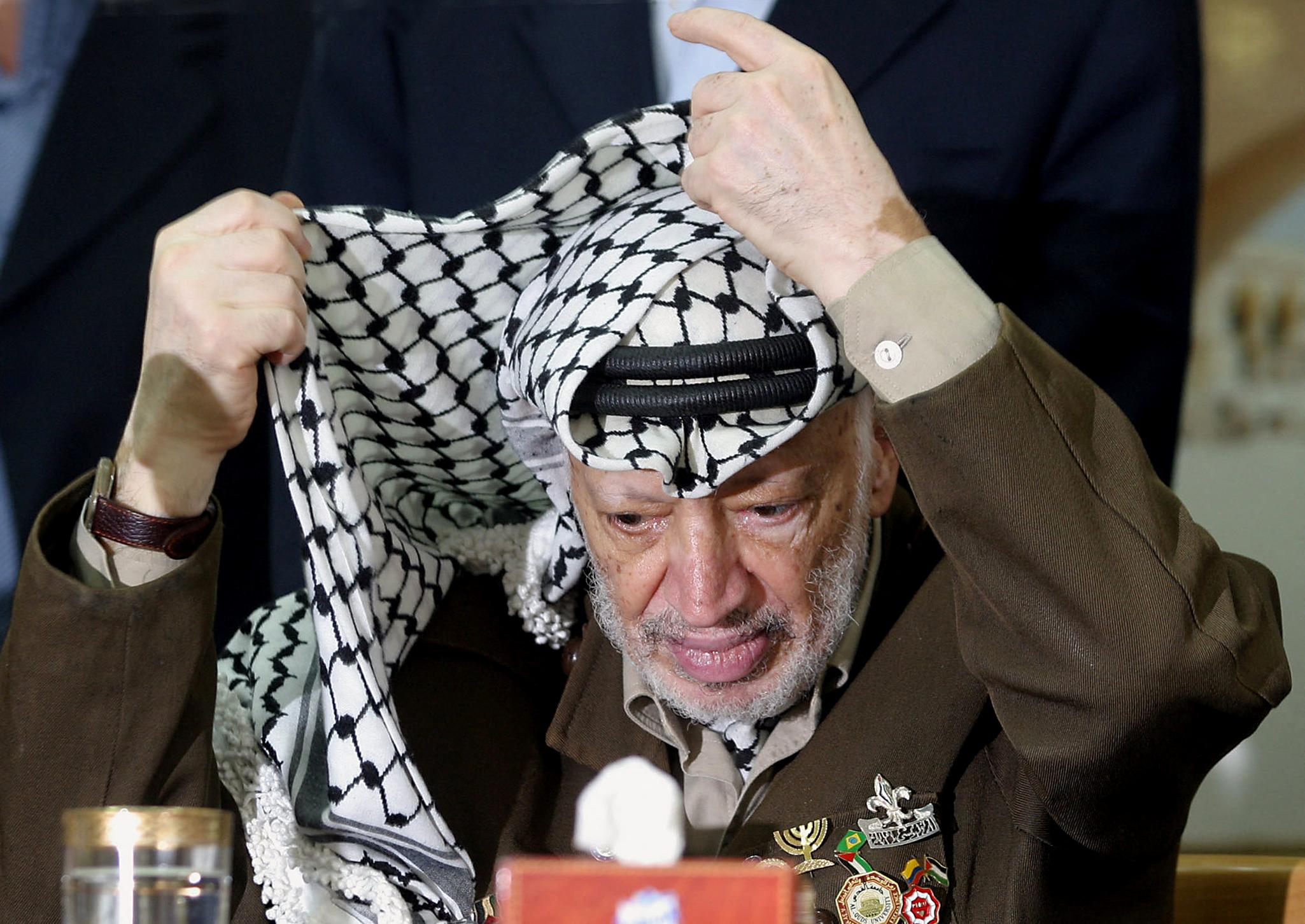
Yasser Arafat lead the Palestinian Liberation Organisation (PLO) from 1969 until his death in 2004 (AFP)
Yasser Arafat, the late leader of the Palestinian Liberation Organisation, is said to have arranged his keffiyeh to resemble the map of pre-1948 Palestine (AFP)

Lingala makes a similar point: “As Palestinians’ collective identity and right to the land continued to be increasingly threatened… they sought to hold onto items that represented ‘cultural continuity’.”

Years later, in the 1960s, the late Palestinian leader Yasser Arafat popularised the garment among a global audience. According to Saca: “Abu Ammar [Arafat] would never be seen at any event without it.”

His keffiyeh was always carefully positioned on his head, with the longer end of the fabric placed over his right shoulder – some say it was laid out to resemble a map of pre-1948 Palestine. 

Muhammad Walid says his keffiyeh represents the Palestinian struggle and cause (Muhammad Walid)
Muhammad Walid, from Jerusalem, says his keffiyeh represents the Palestinian struggle (Muhammad Walid)

When Israeli occupation authorities banned the Palestinian flag from 1967 until the Oslo Accords in 1993, the scarf took on a potent symbolism, according to Ted Swedenburg, professor of anthropology at Arkansas University.

“Portable and visible symbols” were important to Palestinians, Swedenburg says, adding that with the flag banned by the occupation for alomost 30 years, the keffiyeh, “to which so much rich symbolism and history was attached, served as an everyday, portable, visual expression of Palestinian identity”. 

Wheat, olives and honey

The distinct black stitching on the white cotton keffiyeh is said to have many symbolic meanings, and although none have been verified, Palestinians have no shortage of interpretations.

It has been described by some as “a fishing net, a honeycomb, the joining of hands, or the marks of dirt and sweat wiped off a worker’s brow”. Others suggest the design represents ears of wheat, in reference to Jericho, one of the first known cities to cultivate the grain.

Palestinian performance artist Fargo Tbakhi adds “barbed wire” to the list, explaining the pattern could depict “that ever-present symbol of the occupation,” although he relates most to the fishing net design, also called the fatha (opening).

“[I see it] as a symbol of our identity, a model for being Palestinian, it articulates one possible futurity for our people,” he writes in the Los Angeles Review of Books.

“A fishnet is an image of collectivism, of entanglement and dependence: in a net, singular strands become something larger, stronger. As one strand, I am always yearning to be knotted together with others, so that we are better able to hold, to catch.”

Palestinian author Susan Abulhawa tells Middle East Eye that the patterns on the keffiyeh “speak to Palestinian lifeblood, in the same way that the patterns of tatreez [Palestinian embroidery] is a language unto itself, telling stories of location, lineage, occasion, and historic significance”.

The black stitching is sometimes also referred to as a honeycomb design, in recognition of the region’s beekeepers; some rural Syrians (where the cloth is also worn) say the pattern symbolises the joining of hands and the marks of dirt and sweat wiped off a worker’s brow. 

A recent tweet included another interpretation of the design, a representation of Palestine’s olive trees, which show “strength and resilience”:

Share this post to educate people on our traditional Kuffieyeh 🇵🇸 pic.twitter.com/R3jvs0DWp1— mars | FREE PALESTINE (@peachesfrompali) May 17, 2021

Abulhawa agrees: “The ‘bird-like’ motifs along the border are interconnected olive leaves, referring to the significance of the olive tree in Palestinian life.” 

Olives, in all forms – olive oil, olive-oil products (such as soap), and olive wood – were hugely important aspects of Palestinian culinary, social and economic life, Abulhawa explains. 


River to Sea Uprooted Palestinian   
The views expressed in this article are the sole responsibility of the author and do not necessarily reflect those of the Blog!

Monday, 24 May 2021

Chris Hedges, Alan MacLeod on Media Bias and the Christian Right’s Obsession with Israel

 By Mnar Muhawesh Adley

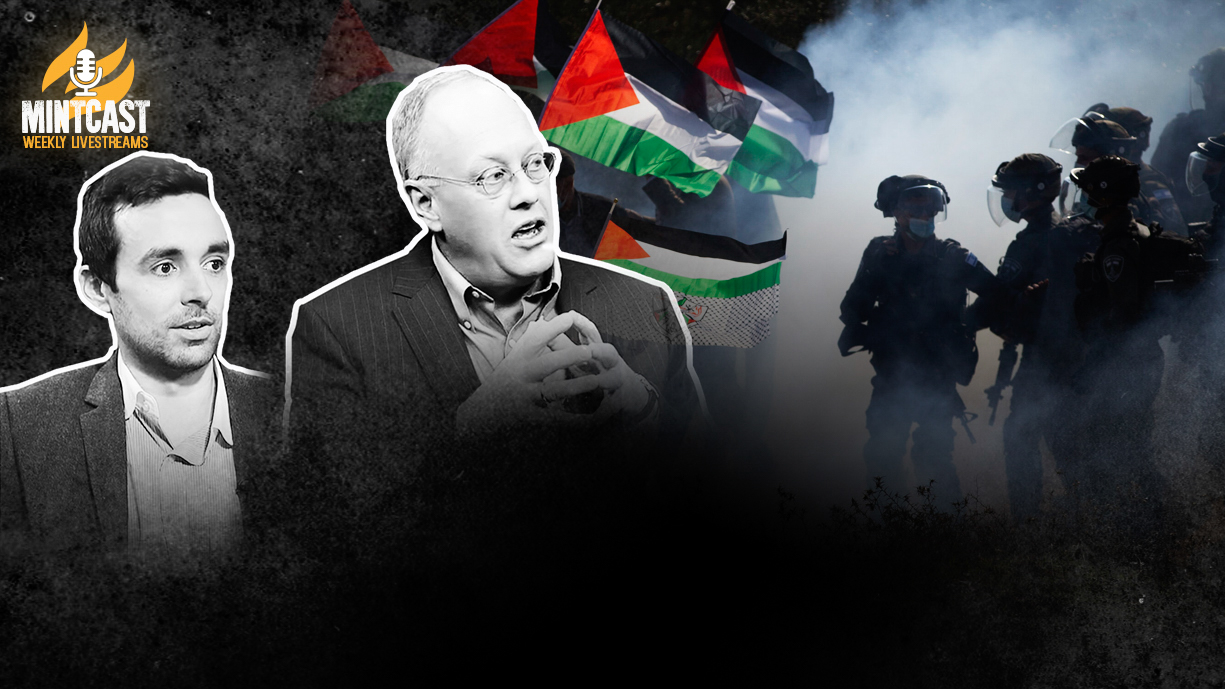
Chris Hedges and Alan Macloed join MintCast to talk about Israel, Christian Zionism, and media bias.


mages from the Israeli onslaught against Palestine have dominated both news broadcasts and social media as the world expresses its outrage over the bombing of civilian targets.

While the latest violence was triggered by an Israeli attack on the al-Aqsa Mosque, the conflict’s roots go back at least to the state’s creation in 1948, when Israeli forces ethnically cleansed nearly 800,000 Palestinians from their homeland, razing 500 towns and villages in order to make way for the construction of a Jewish state on top of an existing one. Year-on-year, Israel has progressively annexed more Palestinian land, leaving the indigenous population trapped in increasingly small pockets, often without the ability to leave.

Much of the strongest support for the creation of Israel comes from the Evangelical Christian community in the West, who see the construction of a Jewish state in the Holy Land as the fulfillment of an ancient Biblical prophecy bringing the world one step closer to the end times where the righteous will ascend to heaven, and non-believers (including Jews) will be cast into hell.

Today, Christian Zionism is a much larger force worldwide than Jewish Zionism, and with liberals increasingly turning their backs on Israel, Prime Minister Benjamin Netanyahu is directly appealing to that community to shore up support for his country.

While Democrats increasingly condemn Israel’s actions, the most vociferous support comes from right-wing pastors and religious leaders. Texas televangelist Pastor John Hagee, for instance, whitewashed the Israeli massacre, stating this week that:

It’s not Israel’s rockets that are killing the people in Gaza, it is the terrorists who are killing their own people because they don’t know how to fire these rockets. So the fake news will certainly not tell you that.”

For years, the religious right has been undermining faith in domestic media and building information systems of their own to create tightly controlled echo chambers across the United States. Likewise, Israel is prosecuting a campaign against journalists, albeit with far more deadly consequences. On Saturday, it destroyed the headquarters of Al-Jazeera and the Associated Press. Last night, The Times of Gaza confirmed that its reporter Yousif Abu Hussein had been killed in an Israeli airstrike on his house. Meanwhile, the Israeli government is blocking foreign journalists from entering Gaza to document the atrocities.

Yet even as Israel attacks the press, those very same outlets run cover for the Jewish state, sanitizing Israeli attacks on peaceful protestors as “clashes,” or both sidesing the conflict and presenting Hamas as aggressors and Israel as merely “responding” to provocations.

Here today to talk about the conflict and its origins are Chris Hedges and Alan MacLeod. Hedges is a writer and a Pulitzer Prize-winning reporter who spent nearly two decades as a foreign correspondent. He was Middle East Bureau Chief for the New York Times until the newspaper forced him out due to his stance against the Iraq War. A fluent Arabic speaker, Hedges has been an outspoken critic of both Israeli actions and American imperialism in the region. As a foreign correspondent, he saw the destruction caused by war, imperialism, and the disintegration of societies, from Iraq to Israel, Yugoslavia, and beyond.

A former speechwriter for presidential candidate Ralph Nader, Hedges has taught in the prison system for over a decade. In 2012, he sued the Obama administration over the National Defense Authorization Act, a law that unconstitutionally allowed the government to indefinitely detain U.S. citizens without trial.

Alan MacLeod is Senior Staff Writer at MintPress News. After completing his PhD in sociology and journalism studies in 2018, he published two books about the media: “Bad News From Venezuela: 20 Years of Fake News and Misreporting,” and “Propaganda in the Information Age: Still Manufacturing Consent.” He is an expert in global media.


River to Sea Uprooted Palestinian   
The views expressed in this article are the sole responsibility of the author and do not necessarily reflect those of the Blog!

Sunday, 16 May 2021

What makes the Palestinian catastrophe incomparable to any crime that has occurred for humanity?

May 15, 2021

By Batoul Sbeity

 Why is Palestine considered the core issue when it comes to human justice, such that Al-Quds Day- a day to raise awareness about the plight of all oppressed groups is done in the name and the sanctity of Al-Aqsa? 

1)  The perpetrating entities of the oppression:

The formation of Israel was a settler-colonial conspiracy project- the biggest of its kind in history that was founded by the hegemonic global ruling system solely to serve their interest. 

The reality is that the Zionists were hunters for sources of power in the world that could actualize their vision of a Jewish homeland, and wherever the imperialists place the Zionists, they will follow. 

During the beginning of the 20th century, imperial Britain was adamant about creating for itself an extension in the land of Palestine, which was specifically chosen due to the benefits of the strategic location and the history of the land that could be used as a justifying pretext to the world.

It is the responsibility of all of humanity to correct the biggest shame that have occurred. All nations need to apply pressure on their governments to sever ties with the occupying state and grant the right of return and compensation for all Palestinian citizens. The Zionists and their imperial masters weaponized the anti-semitism that existed within sections of the people and activated this into a slogan that was used to justify the containment of settler Jews in Palestine whilst blackmailing those resisting the ethnic cleansing of Palestinians into accepting this new reality.

The U.S.S.R was the first government to recognize the illegitimate establishment of Israel and sent a large number of settler Jews there, whilst the U.S. took over Britain’s role after rising to power in post-WWII, providing the bulk of financial, political, security, and military support to the occupying state- to the extent that its existence is purely dependent and linked to the U.S. 

Israel’s functional role is to act as a stick for the world superpower, namely the U.S., used in order to punish other entities in the region that fail to obey U.S. orders and for them to maintain a direct presence at the heart of the strategic Middle East (West Asia).

2)  The nature of the oppression: 

Israel is the only settler-colonial state existing today. This means the existence of the occupying Israeli settlers is predicated on the forced and violent removal of the land’s indigenous inhabitants prior to 1948.

During the 1948 Nakba, Israeli forces killed an estimated 13,000 Palestinians and forcibly evicted 700,000-1 million Palestinians from their homes and land. Five hundred and thirty-one (50%) of Palestinian villages were entirely depopulated and destroyed. 

The Nakba continues today. Palestinians are the largest and longest-suffering group of refugees in the world. One in three refugees worldwide is Palestinian and over 60% are registered for humanitarian assistance with the UN.
Within occupied Palestine, the occupying state has displayed no limits to their aggression in pursuit of their expansionist ideals while have not been held to any account for their crimes against humanity.  

3)  The magnitude of the oppression:

The perpetrators realize a great magnitude of direct force and violence is needed to prevent any rebellion movement since the thief understands the victim will resist with whatever they have, and they, therefore, seek to crush the spirit of this resistance. The occupying state has made it mandatory for every Israeli Jew to serve in the ‘IDF’, and they are indoctrinated from a young age to believe every Palestinian is a ‘terrorist’, whilst their survival is dependent on getting rid of the indigenous Palestinians. 

With over 2.5 million Palestinian’s living in the West Bank, an extremely densely populated region, Israel is not only seizing the best land and resources through annexing the territories and giving themselves false authority over the land, but they are striving to create an unbearable condition for the Palestinian’s living within, such that they become hopeless and would want to immigrate and abandon their own homeland. 

4)  Continuity of the oppression:

Since the financial and military existence of Israel is completely linked to the U.S., this oppression will continue until Israel loses its functional role due to the balance of powers that are increasingly not in the U.S.’s favor in the region.

Besides the axis of resistance and its proponents, all countries are turning a blind eye to the continuous oppression in Palestine, which is legitimized by the majority of the world since there is an overlap between their aims and they only account for what is in their interests. They seek to wipe the history of Palestine and grant legitimacy to Israel’s existence, although acknowledging its illegality should by any standards create an uprising.

It is the responsibility of all of humanity to correct the biggest shame that have occurred. All nations need to apply pressure on their governments to sever ties with the occupying state and grant the right of return and compensation for all Palestinian citizens. 


River to Sea Uprooted Palestinian   
The views expressed in this article are the sole responsibility of the author and do not necessarily reflect those of the Blog!

Monday, 10 May 2021

The rapid Zionist colonisation of Palestine


By: Dr. Ghulam Habib How did Palestine turn into a war-torn land after Palestinian Muslims, Christians, and Jews were living in harmony and peace among themselves? This visual documentary presents historical perspective to shed light on how the first Zionist colony was built in Palestine in 1878 to where we are today with continued illegal occupation, massacres, destruction, and expansion in oppressed Palestine.

Music in this video: ‘The Feeling Begins’ by Peter Gabriel Licensed to YouTube by: itspetergabriel, WMG (on behalf of Real World Records); LatinAutor – SonyATV, SOLAR Music Rights Management, LatinAutorPerf, CMRRA, BMI – Broadcast Music Inc., EMI Music Publishing, UNIAO BRASILEIRA DE EDITORAS DE MUSICA – UBEM, and 8 Music Rights Societies. Original post here: https://www.youtube.com/watch?v=bcKUx…


River to Sea Uprooted Palestinian   
The views expressed in this article are the sole responsibility of the author and do not necessarily reflect those of the Blog!