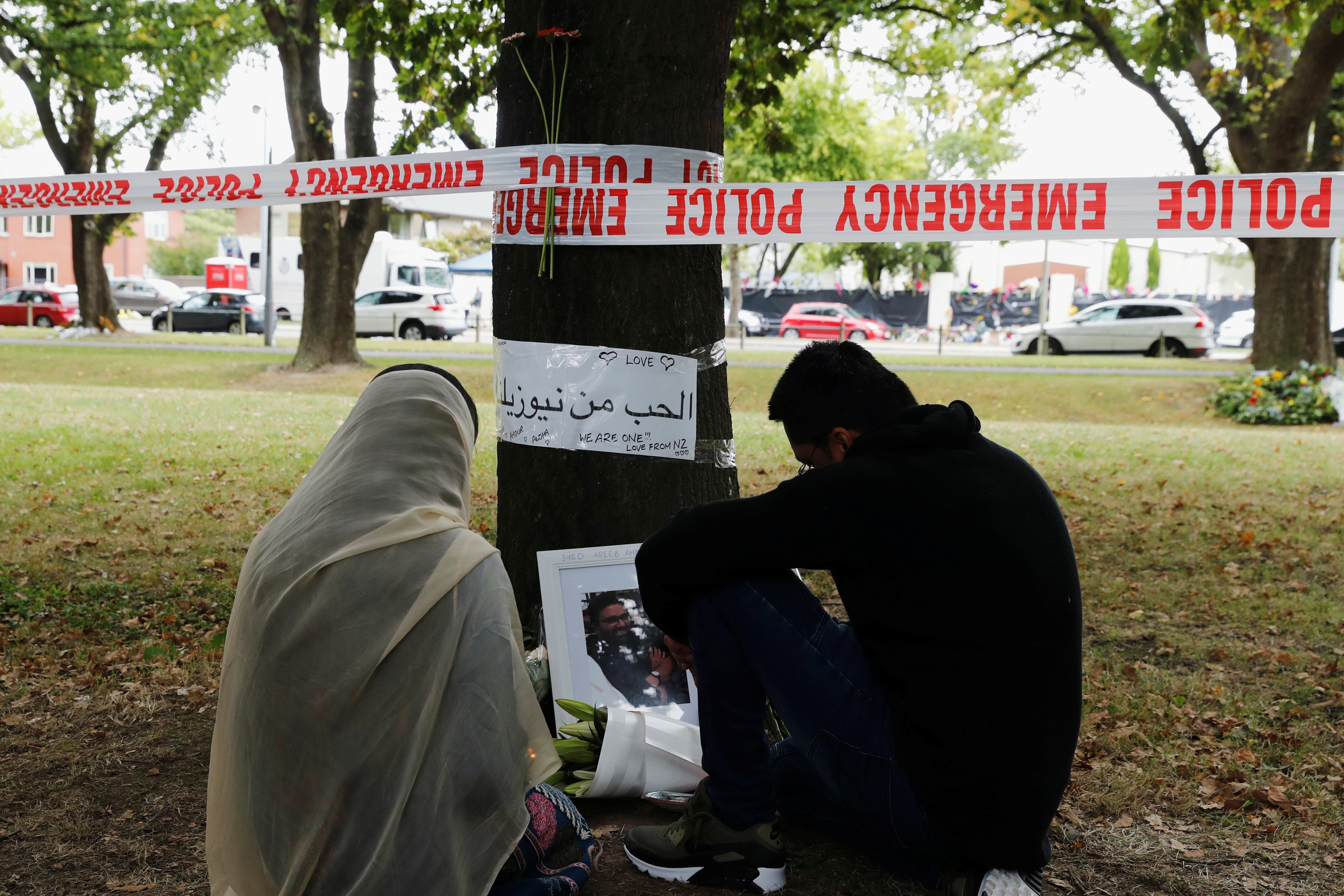
While mainstream media has been predictably eager to parade the tragedy as another chapter in the wave of rising Islamophobia and right-wing extremism globally, they have put equal effort into conscientiously avoiding any evidence that contradicts the ‘lone wolf’ theory they decided on in the initial hours following the first mass shooting in New Zealand since 1997.
Whenever terrorism is committed by Arabs or Muslims, the fourth estate is usually anxious to speculate whether or not the suspect is connected to a larger radical syndicate. However, the same scrutiny is seldom applied to white nationalists like Tarrant.

In fact, they are even hesitant to label it ‘terrorism’ at all, with everyone from The Daily Telegraph to the fanatical Zionist Rupert Murdoch’s Fox News settling for the choice words ‘mass shooting.’ While Tarrant denies being part of any group in his public declaration, he does hint that he is part of a broader extremist network:
I am not a direct member of any organization or group, though I have donated to many nationalist groups and have interacted with many more. No group ordered my attack, I make the decision myself. Though I did contact the reborn Knights Templar for a blessing in support of the attack, which was given.”
As many have noted, the “Knights Templar” is the name of an anti-Muslim militant group that another infamous right-wing terrorist, Anders Behring Breivik, claimed to belong to. During the 2011 Norway attacks, Breivik targeted a government building in the city of Oslo and a youth camp of the ruling Labour party on the island of Utøya in a sequential car bombing and mass shooting that killed a total of 77 people.
However, the media and prosecutors in Breivik’s trial were insistent that the group was fictional and the only possibility was that he was an ‘army of one’ while suffering from a psychiatric disorder, another trait that is apparently only applicable to white-skinned terrorists. There was no serious inquiry into whether he was part of a larger nexus, even though he had direct contact with groups like the English Defense League (EDL), the British far right Islamophobic group led by neo-fascist agitator Tommy Robinson.
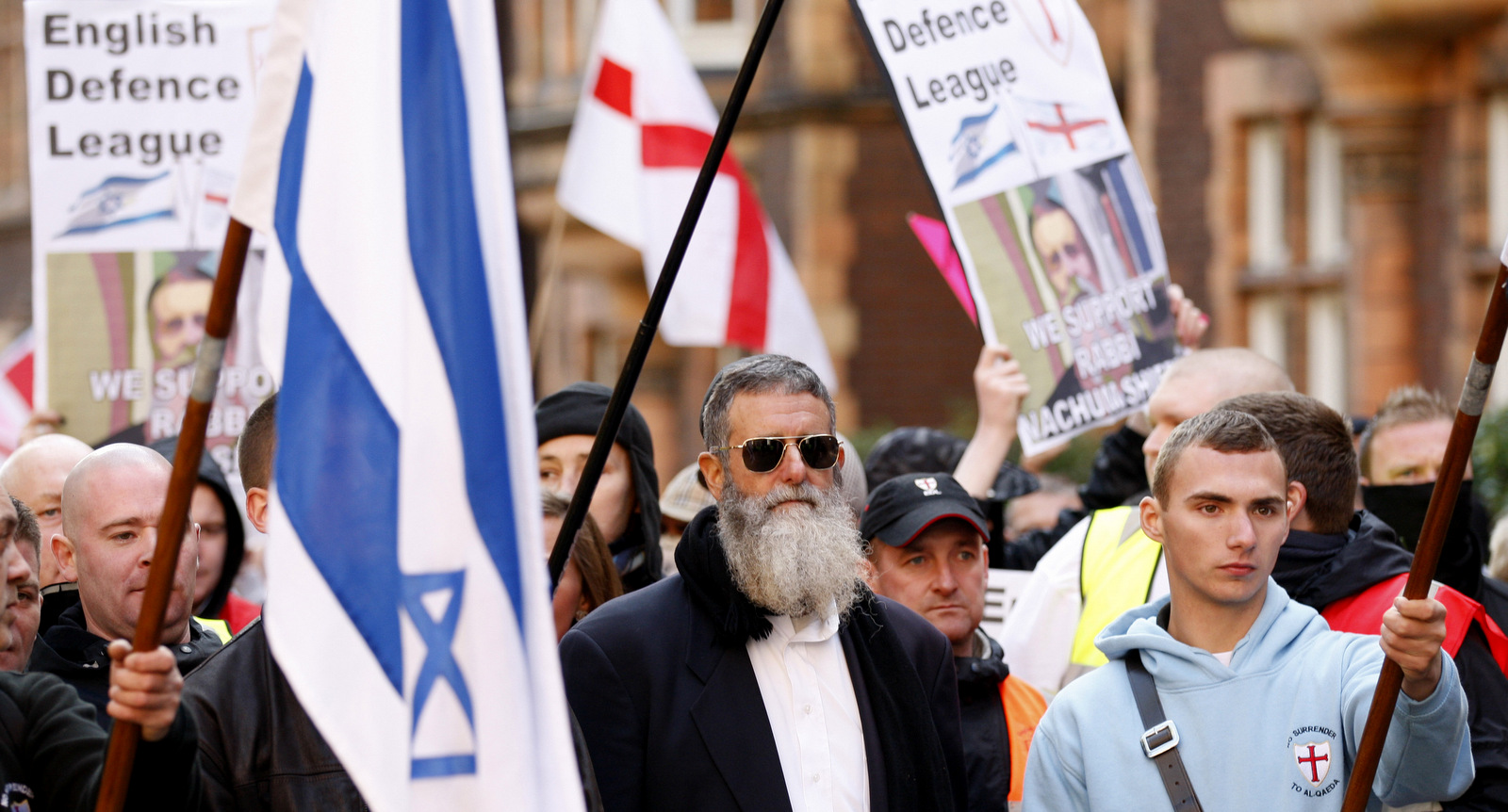
Rabbi Nachum Shifren, center, marches with white nationalist English Defence League (EDL) supporters to an EDL rally against what they claim is the Islamification of the UK and in support of Israel, outside the Israeli Embassy in London. Sang Tan | AP
Breivik was portrayed as a fundamentalist Christian but was curiously a member of the Norwegian Order of Freemasons, an organization with a history of ties to the espionage world and susceptible to infiltration because of its inherent secrecy. The original Knights Templar, or “Templars,” were a Christian army founded in the 10th century who initially shielded pilgrims voyaging to the Holy Land and later fought against Muslims during the Crusades while the name is drawn from the Temple Mount in Jerusalem.
What has been downplayed by the yellow press is the specific brand of Islamophobic extremism that was the basis of Tarrant’s attacks. His ideology is revealed in a 73-page manifesto, entitled “The Great Replacement” in reference to the ‘white genocide’ theory held by white nationalist identitarians, which he dispatched less than ten minutes prior to the ambush in emails to several media outlets and Prime Minister Jacinda Ardern’s office.
While the corporate press is correct that Tarrant and Breivik clearly follow the practices of the anti-Islam xenophobic movement on the rise in Europe, North America and now Oceania, the key element they have deliberately avoided mentioning is a strong collective affinity for the state of Israel.
The coverage of Christchurch has repeated the same pattern displayed following the 2011 Norway attacks where the distinguishing characteristic of the extremism both culprits adhere to is of a staunchly pro-Zionist variety which has been decidedly overlooked. In the eight years between the two attacks, the pro-Israel European right has only augmented in size.
In his manifesto, Brenton Tarrant even boasted the unverified claim to have had “brief contact with Knight Justiciar Breivik” while taking “true inspiration” from him. His Norwegian idol had his own 1,500 page manifesto where Israel was approvingly name-dropped nearly 400 times while he declared:
So let us fight together with Israel, with our Zionist brothers against all anti-Zionists, against all cultural Marxists/multiculturalists.”
The combination of far right nationalism and support for Israel may seem like an unlikely combination, but it is an ideology shared by most of the Islamophobic and anti-immigrant political parties throughout Europe that have performed impressively well in European Parliament elections. These include Hungary’s Fidesz, the Italian League and Five Star Movement, the Flemish Flaams Belang, Poland’s Law and Justice, Belgian People’s Party, the Progress Party of Norway (of which Breivik was a member), True Finns Party, France’s National Rally, Alternative for Deutschland, and many others.
It is likely that Tarrant, like Breivik, is not anti-semitic and actually views Jews as ‘allies’ in a civilizational crusade against Islam. Just as Israel has helped orchestrate the US wars in the Middle East against its enemies that has contributed to the mass influx of refugees seeking asylum in the West, it has fostered the Islamophobic backlash to it by supporting the growing far right movement that is ascendant.
Following the tragedy in Christchurch, it was revealed that 28-year old Tarrant had traveled extensively throughout Europe, the Middle East and Asia, including to Afghanistan, Pakistan and even North Korea. The year prior,
he also visited Israel for nine days, just as his fellow Christian Zionist Breivik had done several times prior to 2011. Tarrant’s journey in Europe included a stop in Ukraine, a hotbed of neo-Nazi activity and as it happens during the massacre he donned the SS wolf’s hook symbol used by the right wing paramilitary group Azov Battalion to which Israel has
provided weapons support in its fight against pro-Russian separatists.
The blend of such considerable travel activity while stockpiling a cache of semi-automatic firearms with a digital footprint espousing his extremist views online makes the likelihood that Tarrant managed to remain under the radar of the New Zealand Security Intelligence Service (SIS) difficult to believe. It is especially doubtful they would be unable to detect him considering he was reportedly
interviewed by New Zealand police prior to obtaining his firearms license in 2017.
Judging by the Facebook live-streamed video of the massacre shot by the suspect himself wearing a GoPro head-mounted camera that resembled a first-person shooter video game shows he was no amateur and possibly professionally trained as a militant. Given his extensive travel and the apparent expertise used to carry out the attacks, there are many legitimate questions about how his ventures were sponsored and whether he had accomplices.
Police found undetonated car bombs in addition to his arsenal and believe he was planning on carrying out a third attack with them. What was he doing in his travels? Was he really able to finance everything alone using crypto-currency investments as purported by the media? He could very well have been a patsy in a larger plot or received support from abroad. For instance, from a certain national intelligence service whose notorious motto is “for by cunning stratagems, you wage war.”
Mossad covert operations have been exposed several times over the years violating New Zealand’s sovereignty and international law which caused a series of diplomatic rows between the two countries. Most recently was in 2011 following a 6.2 magnitude earthquake in Christchurch which caused significant damage to the city and killed 185 people, coincidentally the very same week as the attacks in Norway by Anders Breivik.
Incredibly, a stone structure of a building collapsed onto a van during the earthquake which killed a man inside who turned out to be an Israeli national. His death
accidentally unearthed a ring of Mossad agents after the man was discovered with multiple fake passports and USB flash drives which contained confidential data believed to have been illegally downloaded from the New Zealand police’s national computer system.
The other agents in the Israeli sleeper cell were able to flee the country less than a day after his body was discovered, probably to avoid the fallout that occurred after an earlier incident in the country just a few years prior. In 2004,
two Israeli men who turned out to be Mossad agents were arrested trying to obtain fraudulent passports and travel documentation that included stealing the identity of a quadriplegic. The two men were subsequently jailed for six months for engaging in criminal enterprise.
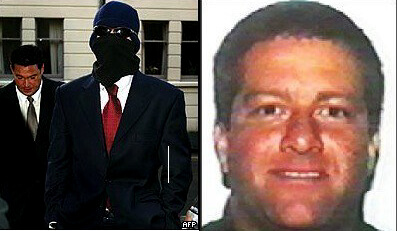
Pictured | Uriel Zosha Kelman, an Israeli spy, arrives in court in disguise in 2004, left/ Zev Barkan, another spy, right.
Mossad seemed to have developed a habit of revealing themselves in light of the infamous arrest of five of its agents in
Secaucus, New Jersey on the morning of September 11th, 2001 by the FBI who were tipped off that a group of men were observed suspiciously dancing and celebrating while watching the WTC towers ablaze and collapsing across the Hudson River.
The “dancing Israelis” were found with $5,000 in cash which raised suspicions while their vehicle was traced to a shady moving company called Urban Moving Systems that was suspected to be a front for an intelligence operation after their headquarters was abandoned and its owner, Dominick Suter, immediately fled to Israel following their apprehension. During their two month detention, the CIA intervened and halted the probe while the agents were subsequently deported in a deal with the Israeli government for overstaying their visas but not before it was confirmed that at least two of the men were intelligence officers and no ordinary moving company employees.
The world was briefly reminded of this mysterious case when Donald Trump as a presidential candidate in 2016 made the wild exaggeration that on 9/11 he had personally observed “thousands of Muslims” celebrating the destruction of the Twin Towers across the river in New Jersey. It is likely that Trump mixed up two different reports from 9/11, one of Reuters footage widely circulated by major networks of a small group of Arabs in East Jerusalem celebrating the attacks and the reports about the Israelis arrested in New Jersey who were initially believed to have been of “Middle Eastern appearance” and descent.
One wonders if Trump would accurately
recall his other observations that morning now that he is in the service of his Saudi and Israeli masters. Needless to say, this widely suppressed story which should have been front-page news led many to rightly suspect there was prior knowledge and even direct involvement among Israeli intelligence in the 9/11 attacks, along with a trove of other evidence.
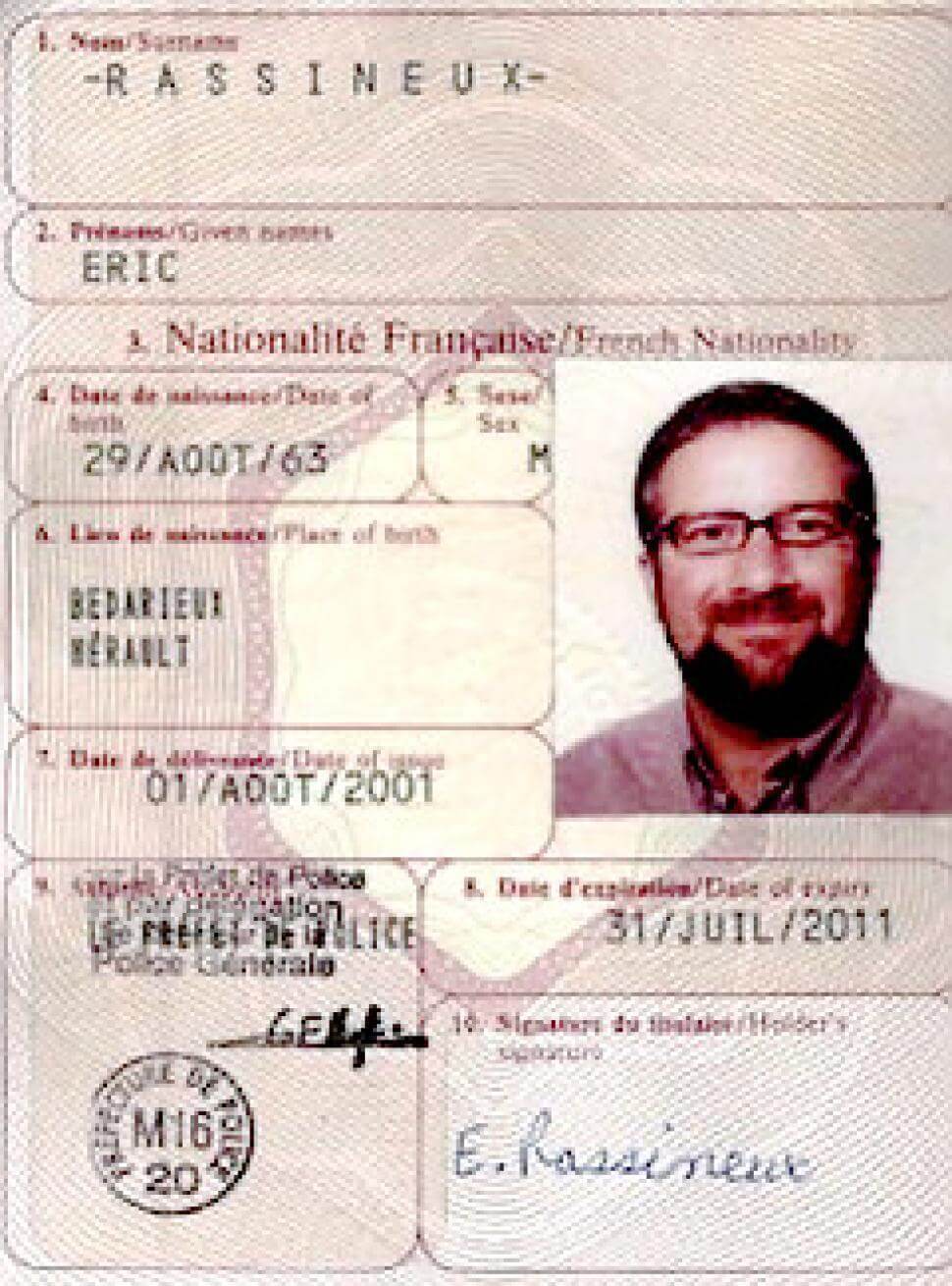
A fake French passport used by of Mossad hitman Zev Barkan.
The New Jersey cell was also in possession of foreign passports. Mossad has typically used fake passports, including that of Australians and Kiwis,
regularly for its clandestine operations and carrying out assassinations like the 2010 targeted killing of Hamas official Mahmoud al-Mabhouh in Dubai which one of the spies apprehended in New Zealand, Zev Barkan, was involved in. After the arrest of the two spooks in New Zealand in 2004, the government imposed diplomatic sanctions against Israel and temporarily severed high-level contacts between the two countries in what became a significant diplomatic rift. WikiLeaks diplomatic cables revealed that the U.S.
was not at all pleased.
Relations had returned to normal between the countries until December 2016 when along with Malaysia, Senegal, Venezuela and others, New Zealand co-sponsored the controversial United Nations Security Council Resolution 2334 which condemned Israeli settlements in occupied Palestinian territories during the last months of the Obama administration. The same motion briefly became mired in the Trump-Russia investigation when former National Security Advisor Michael Flynn pled guilty to lying to the FBI about lobbying activities related to the resolution during the transition between administrations on behalf of Israel.
The Trump White House has since proven to be the most fanatically Zionist presidency since the foundation of the Jewish state in 1948. Over the years, New Zealand has shown a willingness to stand up to Jerusalem and its brazen disregard for international law that other nations could learn from. Despite being a small nation, it has
played an important role in pro-Palestinian activism and the prospect of Palestinian statehood just as it did in protesting South African Apartheid in the 1980s.
In 2018, when New Zealand-born popular musician Lorde canceled a concert in Tel Aviv in solidarity with the Boycott, Divestment and Sanctions (BDS) movement, she became the target of vicious Zionist smear campaign which saw right-wing Trumpist Rabbi Schmuley Boteach take out a full-page ad in The Washington Post denouncing her as a bigot while a $13,000 lawsuit was filed by the Mossad-linked Shurat HaDin lawfare NGO. Meanwhile, unlike Australian Prime Minister Scott Morrison, Jacinda Ardern has been critical of the Trump administration’s move of the U.S. embassy from Tel Aviv to Jerusalem, stating it undermines the Israeli-Palestinian peace process.
New Zealand’s relatively even-handed foreign policy has likely rattled the Zionists and their far right Islamophobic counterparts in the West and it is possible that it is viewed as a threat to the interests of Israel and the U.S. The feasibly manufactured terrorist attack against New Zealand has greatly disrupted the small country, a state which in 2018 had its lowest homicide rate in 40 years and averages well below 100 murders per year, making this attack an extremely rare occurrence for the peaceful country.
In light of the attacks on the mosques in Christchurch, it could now end up acquiring the police state model of the U.S. and Israel as part of the global ‘War on Terror.’ The country immediately issued a ban on semiautomatic weapons following the tragedy in a disturbing rollback of civil liberties while engaging in an unprecedented censorship effort to criminalize sharing and possession of Tarrant’s manifesto and video. Prior to Breivik’s perpetration of the attacks in Norway, there had been significant political tensions between Oslo and Jerusalem in the months leading up to the violence due to Norway’s intent to recognize a Palestinian state and the circumstances in relations between New Zealand and Israel prior to Christchurch is eerily reminiscent.
Israel has a storied history of being a state sponsor of international terrorism as well as the use of ‘false flag’ operations to achieve its political objectives, most notably in the 1954 Lavon Affair, codenamed Operation Susannah, where the Aman branch of its military intelligence services recruited Egyptian nationals to commit bombings to be blamed on the Muslim Brotherhood in order to maintain desired British military presence in Egypt.
It continues such cloak-and-dagger tactics to this day with the use of terror proxies such as the Kurdistan Free Life Party (PJAK) and Mojahedin-e-Khalq (MEK) to undermine Iran, as well as the arming and funding of al-Qaeda affiliated Syrian jihadist groups against the Assad government. If it is willing to co-sponsor radical Islamists with its ally Saudi Arabia to attack their mutual regional enemies, now that the ruling Likud Party has made strange bedfellows with far right Islamophobes in the West it is within the realm of possibility it would continue to do the same especially when the victims are Arab or Muslim.
Regardless of whether or not there turns out to be any Mossad fingerprints discovered on the Christchurch shootings, if the world is serious about confronting the emerging far right internationally it must be willing to accurately diagnose the phenomenon. One of its most distinctive attributes is its Christian Zionism and a shared belief that the Bible gives Israel evidential right to Palestinian land and that Jews are inherently non-indigenous to Europe.
The ever-expanding colonization of the West Bank and Gaza has solidified Israel’s nationalist foundations, especially now that Arabic has been removed as a second official language and the passing of the 2018 Nationality Law defining Israel as an ethno-nationalist state with Arabs officially second-class citizens. If Israel did not directly participate in the 9/11 attacks by infiltrating the al-Qaeda cell in Hamburg, Germany and directing the airplane hijackings as many legitimately suspect, it has certainly facilitated the U.S. wars in the Middle East against its regional enemies and now it is nurturing the Islamophobic far right in the West hostile to the flood of displaced refugees fleeing them.
Israeli policy has principally benefited from all this but one can only expect the hasbaric retaliation of ‘anti-Semitism’ smears like those against UK Labour Party leader Jeremy Corbyn and U.S. Congresswoman Ilhan Omar of Minnesota for pointing this out. In the meantime, the Russiagate hoax has deflected attention away from Jerusalem toward Moscow in regards to foreign cultivation of the growing far right nationalist movement in the West. One hopes the recent bust of Special Counsel Robert Mueller’s report will put some of the distraction to rest and shift the speculation toward Israel where it belongs.
Finally, the political confusion of zealots like Tarrant needs to be addressed as entirely predictable instead of as unintended consequences of the War on Terror and the financial crisis. Recently, 2020 Democratic U.S. Presidential candidate Andrew Yang became the subject of establishment-led smears simply for acknowledging verifiable facts about declining birth-rates of white Americans where he was vilified as adjoining with the views of those like Tarrant. Yet these statistics designated by race that Yang recognized are expressions of the results of class conflict while genuine anger is being misdirected toward immigrants instead of capital and its never-ending changes in labor demands.
This is the cycle which must be broken if this holy war between the West and Islam stirred up by Zionists or what the orientialist Samuel Huntington called the ‘clash of civilizations’ is to end. If not, we cannot only expect the U.S. empire to continue its downward slide and its fear of a multipolar world to culminate in an internecine that will turn the whole world into a tragedy like Christchurch.
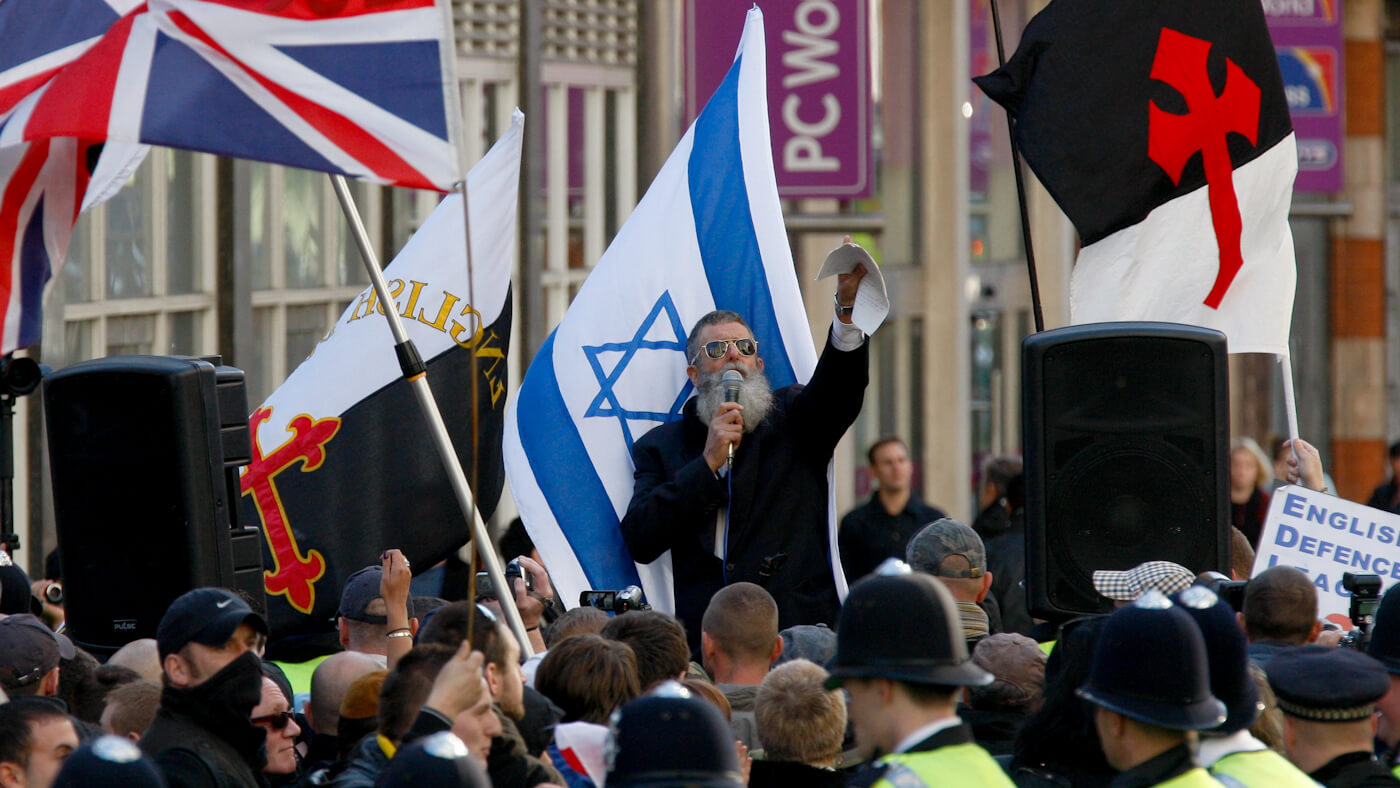
Top Photo | U.S. Californian politician Rabbi Nachum Shifren, top center, addresses English Defence League (EDL) supporters during an EDL against what they claim is the Islamification of the UK and in support of Israel, outside the Israeli Embassy in London, Oct. 24, 2010. Sang Tan | AP
Max Parry is an independent journalist and geopolitical analyst. His work has appeared in CounterPunch, Greanville Post, OffGuardian, Global Research, Dissident Voice, and more. Max may be reached at maxrparry@live.com
Stories published in our Daily Digests section are chosen based on the interest of our readers. They are republished from a number of sources, and are not produced by MintPress News. The views expressed in these articles are the author’s own and do not necessarily reflect MintPress News editorial policy.
The views expressed in this article are the author’s own and do not necessarily reflect MintPress News editorial policy.

 Uprooted Palestinian