Showing posts with label Serbia. Show all posts

Wednesday, 6 October 2021

Saudi Arabia Involved in Providing Weapons to Al-Qaeda, Daesh in Yemen – International Reports

 October 5, 2021

Saudi Arabia Involved in Providing Weapons to Al-Qaeda, Daesh in Yemen - International Reports

By Staff, Agencies

International reports revealed a resounding scandal involving Saudi princes, through private companies affiliated with them, in arms deals that reached from Serbia to the takfiri organization of Daesh [the Arabic acronym for terrorist ‘ISIS/ISIL’ group] in Yemen.

The report indicated that on September 1, 2020, Salman bin Abdulaziz issued a royal order relieving Fahd bin Turki bin Abdulaziz from his position as commander of the coalition forces in Yemen, in an attempt to evade the international scandal and blame Fahd bin Turki and a number of officers.

Among the names in the royal order were four Saudis who work at the Ministry of Defense, including Muhammad bin Abdul Karim Al-Hassan and Youssef bin Rakan bin Hindi Al-Otaibi.

The names of Al-Hassan and Al-Otaibi appeared with an American contractor named William Michael Somerendyke, and another Canadian, born in Tripoli in Lebanon, named Shadi Shaarani in leaked documents obtained by the International Center for Investigative Journalists [ICIJ], and shared in a project called “Pandora Papers.”

The documents indicate that Al-Hassan was registered as a manager of Larkmont Holdings Limited in the “British Virgin Islands” on December 13, 2016, less than one year after the coalition of aggression launched the war on Yemen.

One of the company’s activities was the purchase of weapons from the Serbian “GIM” company, owned by the father of the Serbian Defense Minister, Nebojsa Stefanovic, but a group of these weapons reached the hands of “Daesh” in Yemen.

The documents also indicate that Al-Hassan, when he registered as a director of Larkmont Holdings Limited, registered an address for him, which, upon verification, turned out to be the address of a Saudi military company called “Rinad Al Jazeera LLC”, headquartered in Riyadh. The company’s website was suspended during the investigation period.

A document from Larkmont Holdings Limited issued on March 1, 2017, stated that Al-Hassan was “authorized to represent the company in all ways with the Ministry of Defense of the Kingdom of Saudi Arabia.”

Through intermediary companies and American contractors, Saudi Arabia bought Serbian weapons, which later showed that they had reached the hands of Daesh terrorists in Yemen from the Saudi side.

Al-Hassan was not the only Saudi individual who was included in the Saudi King’s decision to investigate suspicions of corruption, and we found that he had established “offshore” companies linked to arms contracts in the Yemen war.

Another name is Yousef bin Rakan bin Hindi Al-Otaibi, who runs Milvards, which is co-managed by Larkmont Holdings Limited, and was incorporated on June 23, 2017, six months after Larkmont was founded. The company’s registration data does not show the identity of its owner.

The purchase of weapons was through intermediary companies and American contractors, and on the Saudi side was the “Larkemont” company and “Renad Al-Jazeera” company, and on the Serbian side was the GIM Company.

Pictures taken from video files published by Daesh from Al-Bayda province showed pictures of Serbian weapons that were among the deals purchased by the Saudi Ministry of Defense from the Serbian “Krusik” factory.

The images showed mortar shells, whose identification marks are clear, through the part number, compared to the purchase contracts signed by Saudi Arabia through the GIM intermediary company with the Serbian “Krusik” factory, where the letters KV indicate that these mortars were manufactured in the Serbian arms factory [K stands for Krusik]. The V stands for Valjevo, the city where the factory is located, and the numbers [04/18] indicate that the mortar is batch 4 produced in 2018.

The documents also revealed that the Saudi Ministry of Defense assigned contractors, whose addresses are in the United Arab Emirates, but whose nationalities were distributed among Romania, America, Saudi Arabia and Bulgaria, to purchase and transport Serbian weapons that it had purchased.

The reports indicated that the United States was the one who supplied Saudi Arabia with white phosphorous, while some of those reports stated that Saudi Arabia had used Serbia to supply it with phosphorous, in anticipation of media criticism aimed at stopping the United States’ supply of internationally prohibited weapons to Saudi Arabia.


River to Sea Uprooted Palestinian   
The views expressed in this article are the sole responsibility of the author and do not necessarily reflect those of the Blog!

Tuesday, 13 July 2021

Negative impact of NATO on Serbia & Montenegro and on the world

 July 12, 2021

Negative impact of NATO on Serbia & Montenegro and on the world

by Batko Milacic – Independent analyst – for The Saker Blog

After Yugoslavia’s (Serbia) President Slobodan Milosevic refused to accept the so-called Rambouillet Agreement in 1999, which in reality was NATO ultimatum that demanded from Serbia and Montenegro to allow NATO troops to occupy the province of Kosovo as well as that NATO can build bases in Serbia, and that all NATO personnel have diplomatic immunity, which means that they could not be held criminally responsible in Serbia and Montenegro, NATO aggression was launched without any authorization from the United Nations. The intervention was called humanitarian under the pretext of stopping the persecution of Albanians. Western media machine led against Serbs constantly negative media campaign. In media presentations by CNN and the BBC, the Serbs were the modern Nazis and Albanians the Jews. After they successfully presented the Serbs as the bad guys, NATO had a free hand to open aggression and excessive force. Western claims about tens of thousands of killed Albanians later turned out to be completely false. The real death toll in Kosovo before NATO aggression was revealed after the war and it was around 2,000 with the majority of the killings committed by the armed terrorist-separatist group, the Kosovo Liberation Army (KLA). The KLA, previously classified by Washington as a terrorist organization, was elevated in the run-up to the war as the sole legitimate representative of Kosovo’s Albanian population. The KLA, working in close collaboration with US sponsors, sought to create as much violence and death as possible in order to pave the way to Western intervention.

The war against Serbia and Montenego lasted for 78 days. Hospitals, factories and schools were destroyed, along with bridges, roads and military infrastructure. The airstrikes killed around 2,500 people and wounded another 12,500. The bombing destroyed and damaged 25,000 housing units, 470 km of roads and 595 kilometers of railroad were disabled. 14 airports, 19 hospitals, 20 health centers, 18 kindergartens, 69 schools, 176 cultural monuments and 44 bridges were damaged while 38 were destroyed, according to Serbian estimates.(1) During the bombing, 2, 300 air strikes were carried out on the 995 facilities across the country. NATO launched 1,300 cruise missiles, bombed Serbia and Montenegro with 37,000 “cluster bombs”, using prohibited ammunition with depleted uranium. The decision to bomb Serbia and Montenegro was made for the first time in history, without the approval of the UN Security Council. One of the NATO airstrikes used laser-guided bombs to take out railway bridge in southern Serbia, killing at least 10 people on a passenger train. A deliberate attack on the Serbian TV broadcaster RTS in Belgrade took lives of 16 civilian workers. This was the first case that the media house was declared a legitimate military goal. In one of the most provocative acts of the war, NATO carried out a strike on the Chinese embassy in Belgrade, killing three men. Washington claimed that the bombing was an “accident”.(2) The “humanitarian” intervention to halt “ethnic cleansing” has resulted in massive ethnic cleansing. After NATO arrived, 250,000 Serbs were expelled from Kosovo. (3)

Also, the 2004 unrest in Kosovo is the worst ethnic violence case in Kosovo since the end of the 1998–99 conflict. The violence erupted in the partitioned town of Mitrovica, leaving hundreds wounded and at least 14 people dead. The unrest was precipitated by misleading reports in the Kosovo Albanian media which falsely claimed that three Kosovo Albanian boys had drowned after being chased into the Ibar River by a group of Kosovo Serbs. That is why Albanians are embarking on a coordinated action against Serbs, in which they have committed numerous crimes. Given the magnitude of the action, it is clear that this ethnic cleansing was planned and not spontaneous. Here, too, the question must be asked whether it is possible that NATO intelligence services did not have operational information that Albanians were preparing attacks on Serbs, with the aim of ethnic cleansing of Kosovo. The answer is obvious, especially if we keep in mind that NATO forces have peacefully observed the ethnic cleansing of Serbs, even if their primary task in Kosovo is to maintain peace and order.

Years later, International courts in Pristina have prosecuted several people who attacked several Serbian Orthodox churches, handing down jail sentences ranging from 21 months to 16 years. However, these are extremely small numbers of people and with small penalties. The absolute majority of criminals were not punished. A part of the destroyed churches have since been rebuilt by the Government of Serbia and in cooperation with the Serbian Orthodox Church and the UN mission in Kosovo. However, almost none of the exiled Serbs returned to Kosovo. It is important to note that NATO forces have peacefully observed the ethnic cleansing of Serbs, even if their primary task in Kosovo is to maintain peace and order.

It is clear to every objective analyst that NATO carried out aggression in 1999 against Serbia and Montenegro. Everything that happened after 1999 proved that NATO’s primary goal was not the protection of human rights, but the abuse of this idea for classical geopolitical possession of strategic space, in this case, the southern Serbian province of Kosovo. The Serbian army fought heroically in Kosovo and it was not defeated on the battlefield. The withdrawal of the Serbian army from Kosovo was caused by an open threat from the West that it will exert over Serbia humanitarian destruction of the whole country. When the destruction of infrastructure did not gave results, NATO began hitting hospitals, trains full of passengers and throwing away so-called graphite bombs that destroyed the electrical network and left entire cities without electricity. Cluster bombs were thrown in the cities, and bombardment of depleted uranium kills Serbs even today.

NATO forces continued aggression on the rest of Serbia, by other means. Immediately after the bombing the regime change operation was supported, after which embassies of Western countries and international organizations that the West controlled began to “reform Serbia”. Shortly after the arrival of pro-Western authorities in Serbia, in October 2000, “the reform of the Serbian army” began. The majority of proven war officers were retired, while the number of soldiers was so low, to the level, at which the security of the country was seriously threatened. Through its agents of influence, the West played a major role in separating Montenegro from Serbia. High and primary education were, and still are literally destroyed, media has been dominated by foreign corporations. Yet again, two decades later, despite its propaganda and corruption of the elite, NATO is still undesirable among the ordinary people. Montenegro became a member of NATO by political violence, against the will of the citizens. Serbia and Republic of Srpska continue to resist. You can see more about NATO’s activities in the world in an excellent documentary


River to Sea Uprooted Palestinian   
The views expressed in this article are the sole responsibility of the author and do not necessarily reflect those of the Blog!

Thursday, 25 March 2021

US support for the project of Greater Albania

US support for the project of Greater Albania

March 24, 2021

By Ljubiša Malenica for the Saker Blog

The Greater Albania project has its roots in the nineteenth century and idea of ​​the Prizren League to unite in one territorial unit all areas that were allegedly originally inhabited by Albanians. The Prizren League itself can be seen as an extension of the Ottoman authorities, since it was founded in 1878, immediately after the end of the war between Russia, Serbia and Montenegro against Turkey.

Given that Turkey was defeated in the war, Istanbul had to look for other methods of protecting its own interests during the peace process. League was equipped with weapons and ammunition by the Porte, members of the organization were individuals well known for their loyalty to the Sultan, and Ottoman authorities took upon themselves the responsibility of paying for congress in Prizren. All these facts support the thesis claiming Prizren League was an organization created as expression of Ottoman interests in the Balkans.[1]

Turkey’s interests have been significantly undermined by the San Stefano Peace Treaty and the Berlin Congress, and, as might be expected, the Prizren League took a negative stance towards both peace conferences. Moreover, during the Berlin Congress, the League sent a memorandum to the major powers asking for recognition of the Albanian national identity, a very illustrative fact in itself, and the realization of autonomy within the Ottoman Empire for all territories that would compose the so-called “Greater Albania”.[2]

Simultaneously with these documents, an additional memorandum was sent to the Berlin Congress, called the Skadar Memorandum, requesting from Great Britain[3] to take upon itself the role of a guarantor for the creation of the Albanian state. Considering the role of London as a self-proclaimed balancer whose main goal was to maintain the status quo in continental Europe, the Albanian choice is not surprising.

In terms of political relations during the period in question, Romania, Bulgaria, Serbia and Montenegro have already been allies of Moscow on several occasions. The same could be expected if Greece became independent. The development of the situation at that moment was already, obviously, to the detriment of Istanbul, and any future conflict in the Balkans would mean a further liberation of the territories previously occupied by the Ottomans. The First and Second Balkan Wars are illustrative cases in point. Given that all Slavic countries in the Balkans, at that period, had an interest in preserving the alliance and cultural ties with Russia, the eventual withdrawal of Turkey from the Balkans and the re-establishment of Slavic statehood would create a situation in which most of the Balkan Peninsula would find itself within the Russian sphere of influence.

London could not afford such a development given the understandable, and on many previous occasions expressed, fear of a united continental Europe in whose presence the British Isles would be a negligible force, probably subordinated to cultural and political dictates of the continental center of power.

The realization of Albanian ambitions did not come with the Berlin Congress, but they did not have to wait long for creation of their own state, with the blessing of official London. After the end of the First Balkan War, the Ottoman Empire was completely expelled from the majority of Balkan Peninsula. Despite the fact that the Albanians did not play any role in liberation of the occupied territories from Ottoman rule, London Agreement of 1913 established the independent state of Albania.

In addition to earlier mentioned documents created by the Prizren League, Albanian pretensions towards the territories of the surrounding peoples can be seen in this period through the actions of Ismail Cemali. In the midst of the First Balkan War, Cemali gathers representatives of the Albanians in city of Vlora, where they proceed to adopt the declaration on independence of Albania.

If we take into account that representatives in question came from all parts of the four Ottoman provinces (vilayets), i.e. Kosovo, Skadar, Janjina and Bitola, back then inhabited by Albanians, it can be assumed that Albania, imagined by the present delegates, included the territorial totality of all four mentioned provinces. Claims on lands of others become clear when one realizes that Albanians represented a minority in a significant part of the four provinces. Representatives gathered in Vlora were not elected representatives, so it is unsurprising this declaration of independence was completely ignored by both the Ottoman Empire and the then great powers. The Albanian state established during the London Conference was defined within significantly more modest borders.

During the Second World War, Albania was known as Greater Albania in the period from 1939 until 1943, and had status of an Italian protectorate which incorporated, after the fall of the Kingdom of Yugoslavia, parts of Serbia. During their rule, the Italians found a natural ally in the irredentist aspirations of the Albanian elite towards the territories of the neighboring peoples where Albanians lived, regardless of the numerical ratio between them and the domicile population. It is a historical fact that period of Italian occupation was accompanied by a large number of crimes committed by Albanians against the local population in the occupied territories.

After the collapse of Italy and defeat of Germany, the short-lived state project of “Greater Albania” ended like the Independent State of Croatia, but the aspirations remained. After the fall of communist regime in the early 1990s, irredentist claims again occupied a significant part of the political and intellectual thought within Albania.

Considering the influence of United States in the Balkans during the last three decades, there can be no doubt that activities in question, intentionally or not, were in favor of the idea of Greater Albania. Both during the conflicts in Bosnia and Herzegovina and Croatia, and during war in Kosmet, Washington’s position was obviously in favor of Serbian enemies. The conduct of organizations under the influence or direct leadership of the United States, both during military operations and in peacetime, was undoubtedly directed against Serbian interest in any shape or form. This fact alone was enough to strengthen the position idea of Greater Albania had within Albanian population, given that over time its realization seemed to become more and more probable.

Ethnic cleansing of Serbs from the Federation of BiH and Croatia, carried out with silent blessing from the West, served as a pattern of behavior that Albanians could apply during the Kosovo conflict without fear of criticism or intervention. There was no trepidation Tirana could be bombed by NATO planes due to the ethnic cleansing of Kosmet by the KLA.

Revitalization of the idea of​​ Greater Albania, in its core, is not so much about the American relationship with the Albanians as it is about US perception of the Serbs.

The statement of George Kenney, a former Yugoslavia desk officer at the US state department, is an illustrative example how was Yugoslavia perceived as a state, and by extension, Serbs as a people who were most interested in its preservation. In a 2008 statement to the British Guardian, Kenney pointed out that “In post-cold war Europe no place remained for a large, independent-minded socialist state that resisted globalization”.[4]

In addition to American interests, the role of Germany, which immediately after its unification took a hostile attitude towards Yugoslavia and the Serbs, should not be forgotten. Considering the last one hundred and twenty years of European history, one gets the impression that the desire for domination of the continent by Germany is the main catalyst for a significant part of the misfortune which befell Europe.

In a world characterized by the hegemonic role of the United States, after the disappearance of the Soviet Union, it was inevitable that the ideological features of the victor, in this case capitalism, globalism, free trade, multiculturalism, and democracy, would become a model for transformation of other countries, regardless of their wishes and desires of the domicile population.

The characteristics of the victorious ideology were, of course, largely beneficial to the United States themselves, given that the system was established with the aim of reproducing, into infinity, American, and to a lesser extent West European, global dominance. It is not surprising that all serious forms of opposition to the imposed system were seen as a danger, given that at the same time they represented a departure from the propagandist illusion there were no alternatives to the new state of affairs, that the system represented the best way to regulate social relations and that everyone benefited from it.

The fact that the new system quickly took on the outlines of a neocolonial model of behavior, especially towards Eastern European countries, with pronounced demographic and economic parasitism embodied in legal structures and norms of both the European Union and other world organizations such as the IMF and World Bank, was supposed to remain hidden behind an appropriate smokescreen of consumer culture and a general degradation of cultural standards in behavior and action.

The geopolitical interests of Washington, and of the West in general, in conjunction with their economic interests, were not to be called into question by opposition, especially by a state such as Yugoslavia or a people such as Serbs. Allowing the general narrative of globalization and the norms and quality of the Western model to be questioned by small states and peoples was unthinkable, given that it would simultaneously point to the existence of imbalances and problems within the model itself and would further give the impression that the model itself was subject to change through dialogue and consensus. As we have already mentioned, the very purpose of the model was contrary to this development and force, both in legal and physical terms, remained the only way to protect interests of the original creators of an ideology that until recently was considered irreplaceable.

The easiest way to deal with Yugoslavia and the Serbs was to encourage internal divisions and recruit non-Serb local elites into implementation of American goals. One obvious example was the influence of Warren Zimmerman[5] on the beginning of war in Bosnia and Herzegovina. Gathering representatives of all three sides in Bosnia and Herzegovina, Portuguese Ambassador to Sarajevo at that time, Jose Cutileiro, and the British Lord Peter Carrington succeeded in creating a plan for the division and decentralization of Bosnia and Herzegovina that was, to an extent, satisfactory for all three sides.

The agreement, also known as the Lisbon Treaty, was signed by representatives of all three sides on March 18, 1992. Ten days later, US Ambassador Warren Zimmerman arrives in Sarajevo where he meets with Alija Izetbegovic. Soon after, Izetbegovic quickly withdraws his signature from the previously reached arrangement. Although there is no documentation, or other direct record, of what was said during this meeting between Zimmerman and Izetbegovic, sequence of events is far from accidental and indicates a high degree of connection between the encounter and the outbreak of war in BiH.

According to unofficial information, during the meeting, Zimmerman gave Izetbegovic a firm assurance that United States were ready to recognize Bosnia and Herzegovina as an independent country. The fact that Washington recognized BiH as an independent state only nine days after the meeting, on April 7, 1992, just as Zimmermann claimed, gives credence to the unofficial information about the nature of the Zimmerman-Izetbegovic meeting. Recognizing independence of a certain state, in itself as a process, is not something that happens spontaneously and quickly, especially due to the situation Bosnia and Herzegovina found itself in at that time. Given that it took the US administration less than ten days to make such a decision, implies that decision had already been made. US only awaited a suitable moment in order to make the decision public.

During a statement for Canadian CTVNews in 2012, former Canadian Ambassador to Bosnia and Herzegovina, James Bissett, gave additional weight to earlier claims regarding Zimmerman’s role in the beginning of the Bosnian civil war. Namely, during the conversation, Bissett pointed out without hesitation that “the trigger was really when the American ambassador persuaded Alija Izetbegovic, the Muslim leader in Bosnia, to renounce his signature and withdraw his signature from an agreement that had been reached earlier, negotiated by the Portuguese foreign minister…That meant that Bosnia could become independent, but there would be three autonomous regions. They all signed that, but my neighbor that lived across the street from me, Warren Zimmerman, the US ambassador convinced Alija Izetbegovic to renounce that agreement and declare unilateral independence, and that the United States would immediately recognize an independent Bosnia…”[6]

Events related to crisis in Kosmet followed a very similar pattern. Albanians in Kosovo served the interests of Washington in the same manner that Muslims did on the ground in Bosnia and Herzegovina. Just as Muslims were promised support and independence of a state which they saw exclusively as their own, so the Albanians were, in essence, offered the opportunity to realize the idea of ​​a Greater Albania.

The August 1993 New York Times article, surprisingly professionally written, conveys the opinion of most US officials, who largely agree that Washington made a mistake in insisting on an independent and multicultural Bosnia and Herzegovina despite domestic leaders agreeing to divide the country. This view of the situation recently reappeared on the scene with the texts of Timothy Less, who proposes supporting the unification of the Republic of Srpska and Serbia as compensation for the recognition of independent Kosovo by Belgrade.[7][8]

Of course, Less looks at things from perspective of interests of the United States and expects Serbs, after American blessing of unification, to approach the United States and turn their backs on Moscow. Whether American diplomacy will accept these suggestion remains to be seen, but the fact that this option is being discussed at all should serve as a lesson to Serbian neighbors that in the last three decades they have not fought against Serbs so much for their own interests as they did for American ones.

As author stated earlier in the text, the Balkan problem of Washington, from the perspective of the United States, comes down to the question of Serbs. An illustration of this can be found in the New York Times article mentioned above. Namely, part of the article is dedicated to the statement of Warren Zimmerman, who, defending the earlier American policy, pointed out that “our view was that we might be able to head off a Serbian power grab by internationalizing the problem…Our hope was the Serbs would hold off if it was clear Bosnia had the recognition of Western countries. It turned out we were wrong.”[9]

Although a short statement, it is very indicative and leads to several important questions. If we take into account the nature of the Lisbon Treaty, which Ambassador Warren torpedoed during his conversation with Izetbegovic, why was the power takeover by the Serbs a problem? Moreover, since the territorial units envisaged by the Carrington-Cutilier plan were based on the national principle, Serbs, by taking power in their areas, would do the same as the other two groups in Bosnia and Herzegovina. On the other hand, why was the internationalization of the problem necessary? The problem was already, in large part, nearing a solution that was accepted by all three parties. Why were Serbs expected, almost by some kind of automatism, to give up their interests and demands in a situation where West recognized Bosnia and Herzegovina declaration of independence?

All these questions make sense and their answers are relatively obvious if we accept position that the moves of American diplomacy were not aimed at defusing the situation or achieving solution to crisis in BiH, but against the interests of Serbs. The language used by Zimmerman implies Serbs are the destabilizing factor and threat to the situation within the country at the time, despite all the facts to the contrary. The American vision of BiH, interpreted through Zimmerman’s statement, implied complete political domination of Sarajevo and the Muslim political leadership, a unitary state structure accompanied, for the sake of US internal propaganda, with labels of multiethnicity and multiculturalism. Serbs, and partly Croats, were expected to give up upon their own interests.

The irony of history is reflected in fact that the Dayton Agreement itself, which achieved peace in Bosnia and Herzegovina, was relatively similar to the Lisbon Agreement.

For a better understanding of American policy towards Serbs during the 1990s and after conflict in the former Yugoslavia ended, it is necessary to pay attention to the previously mentioned victorious ideology which, after collapse of the USSR, gained status of a globally applicable template for shaping societies.

Due to the specifics of American history, a thread of racial relations between the inhabitants of the United States always ran through American society. Over time, this led to the development of complexes which were twisted by the political forces in United States, particularly the Democratic Party, into political and social power simultaneously encompassing both white and black population. Within the Hollywood dichotomy of guilt, whites in the US were assigned the role of malfeasants while blacks, along with other minorities, became victims. The former developed a guilt complex while in the latter, victim complex was encouraged. In both cases, the encouragement of these complexes took extreme forms and was from the very beginning completely divorced from historical facts. Resistance to these processes did exist in the United States, and still exists today, but the foundation of the future American society was laid.

Multiculturalism, as one element of the new world order, introduced a whole range of other minorities into the previously outlined social formula, which mostly referred to the American population of European and African descent. New minorities encompassed both minorities based on their nation and groups that became minorities because of a particular characteristic, such as sexual orientation or a specific view of one’s own gender. The artificial multiplication of minorities led to a specific development of the earlier abuser-victim relationship, and soon, in opposition to white “malfeasants”, a mass of “victims” appeared, diverse in their minority status but monolithic in their role of victims.

Globalism, as one of the key elements of American ideology, transferred the insane perception of racial relations within the United States to the global level, predefining “good and bad guys” without taking into account the local context events or their development.

The European left, by its very nature inclined to such ideological ramshackle, and itself without an original idea, accepted this view of history and society, thus providing support to the Americanization of European nations. In his book “Multiculturalism and the Politics of Guilt: Towards a Secular Theocracy”, Paul Gottfried points out that “for the Left, especially in Europe, the post-Cold War United States is the enforcer of “antifascist” and multicultural ideas that are triumphing in American society and among its human-rights allies. The long-demonized American capitalist empire no longer upsets the European Left as monolithically as it once did…For the Left, at least until the recent war against terrorism, the United States has become an indispensable partner in promoting its work, against obstinate European nationalists and antiglobalists.”[10]

In the early 1990s, America was seen by leftists as a utopia. The combination of leftist ideas and predatory capitalism, intertwined with the image of an “exceptional nation”, led Washington’s aggressive stance on the global field. Anyone opposed to the cultural and economic aggression in question eventually faced a military aggression.

American leftists, who managed by “long march through institutions” to install their cadres within a large number of important positions both in American society and American political structure, recognized Serbs as historical actors perfectly fitting the constructed stereotype of “bad guys”. As a white nation, the stigma of “white guilt” could be immediately applied to them, only in this case the “oppressed minority” were not the blacks or other minority populations within the United States, but the Muslim population in Bosnia and Herzegovina and Kosmet. As a nation aware of its history and national identity, and interested in preserving both, Serbs commit the additional sin of reflexive suspicion towards globalism and resistance to the processes associated with this phenomenon.

The desire of Serbian people for existence within a homogeneous nation-state, derived from historical experience which confirmed the unstable and violent tendencies of heterogeneous societies, was interpreted as a rejection of the multicultural framework for social organization and was thus branded as unwelcomed. From the perspective of the American administration, regardless of historical facts and specific circumstances of events in former Yugoslavia, a multicultural society had to be insisted on. If multiculturalism can work in the United States, then it can work in small Balkan countries. However, if there was to exist a place in the world where it is objectively quite clear that multiculturalism is neither possible nor desirable, it would be only a matter of time before someone within the US questioned why were American politicians, on the domestic scene, so insistent on multiculturalism and why does this phenomenon becomes a taboo subject when its more negative characteristics become apparent.

Lessons from disintegration of multicultural “brotherhood and unity” within Yugoslavia have not been learned by the creators of American policy, and events within the United States today are the fruits of those missed historical lessons.

Doug Bandow, a senior fellow of the well known Cato Institute, during his testimony before the congressional committee in March 1999, clearly points out that there are no objective reasons for NATO intervention in Kosmet against Serbs and in favor of Albanians. In a transcript of Bandow’s statement, he explains that “despite the administration’s best intentions, its proposal to bomb Serbia and initiate a long‐​term ground occupation of Kosovo is misguided in the extreme. The administration would attempt to impose an artificial settlement with little chance of genuine acceptance by either side. It would attempt to micromanage a guerrilla conflict, likely spreading nationalistic flames throughout the region. It would involve America in an undeclared war against a nation which has not threatened the U.S. or any U.S. ally. It would encourage permanent European dependence on America to defend European interests with little relevance to America. It would turn humanitarianism on its head, basing intervention on the ethnicity of the victims, allied status of the belligerents, relative strength of the contending political interests, and expansiveness of the media coverage. Most important, it would put U.S. troops at risk without any serious, let alone vital, American interest at stake”.[11]

During his testimony, Bandow pointed out that NATO supporting KLA would only give additional impetus to the advocates of Greater Albania. Probably one of few American analysts from that period, Bandow warned involvement in the Balkans carried a risk of losing a much more important game related to Russia. Bandow emphasized that “Moscow’s future development remains worrisome and uncertain. Yet NATO attacks on and occupation of Yugoslavia, which shares longstanding Slavic ties with Russia, would exacerbate tensions already inflamed by the expansion of NATO”.[12]

Twenty years after the events in Kosmet, we live in a world that Bandow partially predicted. The aggression on Yugoslavia represented one of the turning points in Russian-American relations and influenced the shaping of the world as we know it today.

Support for a unitary Bosnia and Herzegovina and the Greater Albania project is undoubtedly present within American politics, given that planners in Washington recognize these projects as useful for their own interests. This is perhaps the most important reason for support. Serbophobia, as a derivative of Russophobia, exists within the American administration, but the question is to what extent does the phenomenon in question influences the shaping of Washington’s policies towards the Serbian people. Albanian politicians should have learned lessons from the history of Yugoslavia itself in the early 1990s. For a certain time, ex-Yugoslavia suited Americans and they supported its existence. As soon as the American interest changed, the US did not hesitate to take an active part in encouraging its disintegration. Even in the event where Albanian project is realized, it would be a creation with a limited lifespan. Formed with American blessing, Greater Albania would depend on the goodwill of “friends” from Washington and their backing.

In the treatise that made him famous, Niccolo Machiavelli points out that “auxiliary troops—armies borrowed from a more powerful state—are as useless as mercenaries. Although they often fight well, a prince who calls on auxiliaries places himself in a no-win situation. If the auxiliaries fail, he is defenseless, whereas if the auxiliaries are successful, he still owes his victory to the power of another.”[13]

This seems to be a lesson that none of the Serbian neighbors have learned. Today, Bosnia and Herzegovina is an international protectorate and a dysfunctional country. Croatia is a reservoir of labor reduced to the tourist destination of richer European countries, and at the beginning of the 2020, through intervention of the American military commander in political life of “independent” Kosovo, one could perceive real distribution of power on Kosmet. While Croats, Albanians and Muslims in Bosnia spent themselves in wars against “evil” Serbs, Western states imperceptibly placed a noose of economic and political dependence around their necks, all the while helping cultivate their victimhood narrative.

At this moment, the Serbian political leadership can act simultaneously in three directions. The first involves regional action towards countries also threatened by the idea of ​​a Greater Albania. This raises the question whether there is political will among potential allies to take steps against the realization of the Albanian idea in the current conditions where the emergence of a larger Albanian state affects only Serbian interests. The political mood in the countries in question will most likely depend on the escalation of Albanian ambitions and actions.

The second course of action is to reject any recognition of Kosovo as an independent state and to insist on such a position within international institutions. The work of Serbian diplomacy has been somewhat successful in this regard in recent years, but the work of diplomats must be supported by efforts to strengthen Serbian institutions and influence in Kosmet itself.

The third set of activities concerns efforts to undo, within a seemingly increasingly multipolar world order, the Western-imposed status quo in the Balkans, almost entirely ranged against Serbian interests. This would entail an initiative for reconsideration of events which took place during the break-up of former Yugoslavia and to, furthermore, question the final results of those events, such as Kosovo’s self-proclaimed independence or the narrative of alleged Serbian guilt for various war crimes.

The idea and narrative of Greater Albania are a danger to Serbian statehood, but the very idea of Greater Albania bears the seeds of its disappearance. The full realization of Albania’s pretensions entails the creation of a hostile disposition within four neighboring states. The project of the Albanian irredentists was previously realized only in conditions of serious foreign support. As is usually the case with a hegemon that is slowly losing its status, the United States is facing growing challenges around the world, and support for Albanian interests by Washington is not assured. At the moment, it seems that time is working for Belgrade, which should use this opportunity to full extent and cease to react reservedly for the sake of EU membership, an illusion by this point.

  1. http://www.kosovo.net/sk/rastko-kosovo/istorija/knjiga_o_kosovu/bogdanovic-kosovo_2.html ↑
  2. http://www.rastko.rs/cms/files/books/474e828f5a0ad ↑
  3. http://www.rastko.rs/cms/files/books/474e828f5a0ad ↑
  4. https://www.theguardian.com/commentisfree/2008/jan/14/itstimetoendserbbashing ↑
  5. https://nationalinterest.org/print/article/obituary-alija-izetbegovic-1925-2003-2458 ↑
  6. https://www.youtube.com/watch?v=R1QL1M8zycE ↑
  7. http://demostat.rs/en/vesti/analize/timothy-less-re-ordering-the-balkans/763 ↑
  8. https://balkaninsight.com/2020/02/28/bosnias-second-collapse-is-starting-to-look-inevitable/ ↑
  9. https://www.nytimes.com/1993/08/29/world/us-policymakers-on-bosnia-admit-errors-in-opposing-partition-in-1992.html ↑
  10. https://books.google.ba/books?id=0XvR-aKybuQC&printsec=frontcover#v=onepage&q&f=false ↑
  11. https://www.cato.org/publications/congressional-testimony/us-role-kosovo ↑
  12. https://www.cato.org/publications/congressional-testimony/us-role-kosovo ↑
  13. https://www.sparknotes.com/philosophy/prince/section6/ ↑

River to Sea Uprooted Palestinian   
The views expressed in this article are the sole responsibility of the author and do not necessarily reflect those of the Blog!

Friday, 1 January 2021

Serbia Becomes Hub for Russia’s Gas Distribution in the Balkans

 By Paul Antonopoulos

Global Research, December 28, 2020

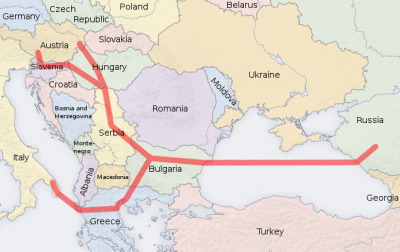
With the TurkStream gas pipeline now running through Serbia, the Balkan country will enjoy numerous benefits when exports begin, such as energy stability, the opportunity to get cheaper gas, and additional tax revenue. On December 25, Serbia successfully tested the TurkStream pipeline project that will connect Russian gas to consumers in Europe, especially in the Balkans. Serbian President Aleksandar Vučić revealed that the pipeline will be officially commissioned on December 30.

“The test run was successful. We did not publicize it too much but everything will start on December 30 as I promised. A small ceremony will be organized on that occasion because it is a huge deal for our country,” Vučić said.

The success of the test and Wednesday’s commissioning of the TurkStream brings an end to one of the most important projects in Serbian history. The gas pipeline strengthens the economic and geostrategic position of Serbia in the region as it can now become a hub to distribute Russian gas in the Balkans. The pipeline is 403 kilometers long and stretches from Zaječar on the border with Bulgaria to Horgoš on the border with Hungary.

There are numerous benefits that this gas pipeline will bring to Serbia, but the most important is energy stability. It is a two-way pipeline, meaning that gas can move between Bulgaria and Hungary in both directions. This is important because of energy security and, not only for Serbia, but for the entire Balkans network which can now be expanded.

The entire TurkStream pipeline within Serbian territory has not been built yet, but judging by the pace of the works so far, it will be completed without delay. Another compressor station remains to be completed in Serbia by June 2021.

The gas pressure on the TurkStream route is high enough that gas can pass from Bulgaria to Serbia. In fact, gas from Bulgaria can already be used in Pančevo, to the immediate east of Belgrade, for the needs of the gas power plant, such as generating electricity and heat. The extensive work for the gasification of Serbia, in full capacity, means that the TurkStream will allow Gazprom to export gas to the Republika Srpska, the Serbian-dominated entity that forms a part of Bosnia and Herzegovina, thus being able to deliver gas to the entirety of the country and perhaps even onwards to Croatia and Montenegro.

Five more gas power plants are planned to be constructed in Serbia in the near future. They will be built next to the largest industrial centers in Serbia. 4% of the total electricity produced in Serbia will come from Pančevo, in which thermal energy from the refinery and all its plants will be supplied. With the TurkStream at full capacity, it will be possible to build plants near Belgrade, Novi Sad, Niš and Kragujevac. When electricity is produced, thermal energy by-product will be used for large industrial plants, businesses and residential centers.

In addition to energy stability, Serbia will enjoy several other important benefits because of the passage of the TurkStream through its territory. Serbia will have minimum $40 cheaper gas per thousand cubic meters thanks to tax revenues that it will collect due to the transportation of gas through its territory to other countries. The Bulgarians negotiated with Gazprom a 27% lower price because imported gas from Ukraine passes through its territory to other countries. Serbia will be able to strike a similar deal so that Russian gas can reach Bosnia and Herzegovina, as well as Hungary, through its territory. It is also a benefit as servicing the gas pipeline and accompanying facilities has created job opportunities, and cheaper gas will inevitably lead to greater industrial output in other sectors.

The benefits of the TurkStream in Serbia will soon be realized as the most difficult part of the job was completed, laying pipes at the bottom of the Black Sea. It is for this reason that Russia prioritized finishing the TurkStream first, even though it has a much smaller capacity compared to Nord Stream 2. Nord Stream 2 has been continuously delayed due to Moscow’s anticipation that Washington would not only oppose the project, but pressure involved countries to withdraw and impose sanctions.

But with TurkStream to begin running in Serbia, it has not only consolidated Belgrade’s relations with Moscow, it gives hope to a country that was devastated by a decade-long NATO destruction in the 1990’s. Serbia has not been able to fully recover from the war, but cheap gas and job creation will transform the Balkan country, not only industrially, but also in terms of regional influence as it becomes a crucial energy hub for the entire region.

*

Note to readers: please click the share buttons above or below. Forward this article to your email lists. Crosspost on your blog site, internet forums. etc.

This article was originally published on InfoBrics.

Paul Antonopoulos is an independent geopolitical analyst.

Featured image is from InfoBrics

Will Azerbaijani Gas Compete with Russia in Southern Europe?

The original source of this article is Global ResearchCopyright © Paul Antonopoulos, Global Research, 2020

River to Sea Uprooted Palestinian   
The views expressed in this article are the sole responsibility of the author and do not necessarily reflect those of the Blog!

Sunday, 25 October 2020

Before the Bidens ‘Did’ Ukraine, There Was Iraq – and Serbia

 Before The Bidens “Did” Ukraine, There Was Iraq… And Serbia – Finanz.dk

Analyst, former U.S. diplomat and foreign policy adviser to the Senate GOP leadership

James George Jatras

October 16, 2020

The United States approaches the November 2020 election with growing apprehension, even dread.

Among the possibilities:

For those who have followed events outside the United States during the past few decades, much of this sounds familiar. We’ve seen it before – inflicted on other countries.

Now It’s Coming Home to the U.S.

As explained by Revolver News, what happens in America next to a great extent may be a form of blowback from a specific event: the U.S.-supported 2014 regime change operation in Ukraine:

‘A “Color Revolution” in this context refers to a specific type of coordinated attack that the United States government has been known to deploy against foreign regimes, particularly in Eastern Europe deemed to be “authoritarian” and hostile to American interests. Rather than using a direct military intervention to effect regime change as in Iraq, Color Revolutions attack a foreign regime by contesting its electoral legitimacy, organizing mass protests and acts of civil disobedience, and leveraging media contacts to ensure favorable coverage to their agenda in the Western press.

‘It would be disturbing enough to note a coordinated effort to use these exact same strategies and tactics domestically to undermine or overthrow President Trump. The ominous nature of what we see unfolding before us only truly hits home when one realizes that the people who specialize in these Color Revolution regime change operations overseas are, literally, the very same people attempting to overthrow Trump by using the very same playbook. Given that the most famous Color Revolution was the [2004] “Orange Revolution” in the Ukraine, and that Black Lives Matter is being used as a key component of the domestic Color Revolution against Trump, we can encapsulate our thesis at Revolver with the simple remark that “Black is the New Orange.”’

This hardly should come as a surprise. The same government agencies and their corporate, NGO, and think tank cronies that are now weaponizing Black Lives Matter, Antifa, other Wokesters, and military putsch plotters here at home to remove Trump have turned regime change abroad into an art form. Ukraine was one of their signal successes, featuring a cast of characters later key to the failed “Ukrainegate” impeachment.

Another consequence of regime change: corruption. As the old saying goes, any idiot can turn an aquarium into fish soup, but no one has yet figured out how to reverse the process. Once a country gets broken it tends to stay broken, whether the “breaking” is accomplished by military means (Serbia 1999, Iraq 2003, Libya 2011) or by a color revolution from the streets (Serbia 2000, Georgia 2003, Ukraine 2004-2005 and again in 2014, Kyrgyzstan 2005, Lebanon 2005, Armenia 2018, plus many others of varying degrees of success, and failures in Iran, Russia, Venezuela, China (Hong Kong), and Belarus). With the target nation’s institutions in shambles, the dregs take over – in Libya, for example, even to the point of reintroducing trade in sub-Saharan African slaves, whose black lives evidently don’t matter to anyone at all.

Iraq: Crush, Corrupt, Cash In

Finally, once regime change occurs and corruption is rampant, another shoe drops: foreign vultures descend on the carcass, profiteers who in many cases are the very same people that helped to create the chaos on which they are cashing in. Invariably, these carpetbaggers are well-connected individuals in the aggressor states and organizations positioned on the inside track both for the carve-up of the target country’s resources and (the word “hypocrisy” doesn’t begin to describe it) for funds to implement “reform” and “reconstruction” of the devastated target.

The showcase of this scam, pursuant to Colin Powell’s reported “Pottery Barn Rule” (You break it, you own it) was the money ostensibly spent on rebuilding Iraq, despite assurances from the war’s advocates that it would pay for itself. With the formal costs conservatively set at over $60 billion to $138 billion out of a tab for the war of over two trillion dollars, the lion’s share of it went to U.S. and other vendors, including the notorious $1.4 billion no-bid contract to Halliburton subsidiary KBR, of which then-Vice President Dick Cheney, a major proponent of the war, had been a top executive. (“Rand Paul Says Dick Cheney Pushed for the Iraq War So Halliburton Would Profit.”)

In Ukraine, Biden’s Son Also Rises

The predatory cronyism vignette most pertinent to the Black/Orange regime change op now unfolding before us with the intent of installing Joe Biden in the Oval Office is that of his son, Hunter, and a Ukrainian energy company with a sketchy reputation, Burisma Holdings. (Right at the outset, even some of Hunter’s associates though the gig with Burisma was too “toxic” and broke off ties with him.) Though ignored or dismissed as fake news and a conspiracy theory by Democrats and legacy media (or do I repeat myself?), the facts are well enough known and fit the Iraq pattern to a T: then-Vice President Joe Biden pushed for regime change in Ukraine, which succeeded in February 2014 with the ouster of the constitutionally elected president, Viktor Yanukovych. In April 2014, Joe Biden’s son, Hunter, was brought onto Burisma’s board (along with a fellow named Devon Archer, later convicted of unrelated fraud) at an exorbitant level of compensation that made little sense in light of Hunter’s nonexistent expertise in the energy business – but which made plenty of sense given that his dad was not only Veep but the Obama administration’s point man on policy toward Ukraine, including foreign assistance money. [NOTE: It now has come out that in 2015 Hunter put his dad, the U.S. Vice President, in direct contact with Burisma, news the giant tech firms sought to suppress on social media.]

When a troublesome Ukrainian prosecutor named Viktor Shokin seemed to be taking too much interest in Burisma, Papa Joe came to the rescue, openly threatening the western-dependent politicians installed after Ukraine’s 2014 color revolution with withholding of a billion dollars in U.S. aid until Shokin, whom Joe unironically alleged to be “corrupt,” got the heave-ho. As Tucker Carlson nails it, Shokin’s ouster followed a direct request from Burisma’s Clinton-connected PR firm, Blue Star Strategies, to Hunter to lobby his dad to get Shokin off their back. Joe did just what was asked. He later bragged: “I said, ‘You’re not getting the billion. I’m going to be leaving here [i.e., Kiev] in, I think it was about six hours.’ I looked at them and said, ‘I’m leaving in six hours. If the prosecutor is not fired, you’re not getting the money.’ Well, son of a bitch. He got fired.”

But First There Was Serbia

Today many people remember Iraq, some have a clue about Ukraine. But Serbia, which preceded them, is off the radar screen of most Americans. To recap:

As a Senator in the 1990s, Joe Biden was one of the most militant advocates of U.S. military action against Serbs during the breakup of the Yugoslav federation, first in Croatia (1991-95), then in Bosnia (1992-95), and then in Serbia’s province of Kosovo (1998- 1999). (As has been said about others like Hillary Clinton and the late John McCain, Biden evidently has never met a war he didn’t like. Along with Hillary, in 2003 Biden helped to whip Senate Democrat votes for the Bush-Cheney Iraq war.) Channeling his inner John McCain, Biden continually called for the U.S. to bomb, bomb, bomb bomb the Serbs while (in a foreshadowing of the Obama-Biden administration’s support for jihad terrorists in Libya and Syria, which ultimately resulted in the appearance of ISIS) pushed successfully for sending weapons to the Islamist regime in Bosnia and then for the U.S. to arm the Islamo-narco-terrorist group known as the “Kosovo Liberation Army” (KLA).

Joe Biden was the primary sponsor of the March 1999 Kosovo war authorization for military action against Serbia and Montenegro, S. Con. Res. 21. (As a little remembered historical note, Biden’s resolution might be seen as the last nail in the coffin of Congress’s constitutional war power. While S. Con. Res 21 passed the Senate, it failed in the House on a 213-213 tie vote, with Republicans overwhelmingly voting Nay. It didn’t matter. Bill Clinton, reeling from the Lewinsky scandal, went ahead with the bombing campaign anyway.) The ensuing 78-day NATO air operation had little impact on Serbia’s military but devastated the country’s infrastructure and took hundreds of civilian lives. (Even now, more than 20 years later, Serbia suffers from elevated cancer levels attributed to depleted uranium munitions.) But for Jihad Joe even that wasn’t punishment enough for people he collectively demonized as “illiterate degenerates, baby killers, butchers, and rapists.” In May 1999, at the height of the NATO air assault, he called for the introduction of U.S. ground troops (“we should announce there’s going to be American casualties”) followed by “a Japanese-German style occupation.”

Eventually the bombing stopped in June 1999 when then-Serbian strongman Slobodan Milošević acceded to temporary international occupation of Kosovo on the condition that the province would remain part of Serbia, as codified in United Nations Security Council Resolution 1244. It was a promise the U.S. and NATO, not to mention their European Union (EU) concubine, had no intention of keeping. Under the nose of the NATO occupation, ostensibly demobilized KLA thugs were given virtually free rein to terrorize the Serbian population, two-thirds of whom were driven out along with Jews and Roma, the rest sheltering in enclaves where they remain to this day. Orthodox Christian churches and monasteries, many of them centuries old, were particular targets for destruction and desecration. KLA commanders – who were also kingpins in the Kosovo Albanian mafia dealing in sex slaves, drugs, weapons, and even human organs – were handed local administration.

In 2007 Senator Biden praised the new order as a “victory for Muslim democracy” and “a much-needed example of a successful U.S.-Muslim partnership.” A year later, the Bush administration sought to complete the job by ramming through Kosovo’s independence in barefaced violation of UNSCR 1244 and despite strong Russian objections. But instead of resolving anything the result was a frozen conflict that persists today, with about half of the United Nations’ member states recognizing Kosovo and half not. Touting itself as the most pro-American “country” [sic] in the world, the Kosovo pseudo-state became a prime recruiting ground for ISIS.

But hey, business was good! Just as in Iraq, the politically well-connected, including former officials instrumental in the attack on Serbia and occupying Kosovo, flocked to the province fueled by lavish aid subsidies from the U.S. and the EU, which for a while made Kosovo one of the biggest per capita foreign assistance recipient “countries” in the world. One such vulture – sorry, entrepreneur – was former Secretary of State Madeleine we-think-a-half-million-dead-Iraqi-children-is-worth-it Albright, a prominent driver of the Clinton administration’s hostile policy on top of her personal Serb-hatred. Albright sought to cash in to the tune of hundreds of millions of dollars on sale of the mobile telephone company PTK, originally a Yugoslav state-owned firm that was “privatized” (i.e., stolen) in 2005 as a joint stock company, but who later dropped her bid when it attracted unwanted publicity. Also in the hunt for Kosovo riches was former NATO Supreme Commander and operational chief of the Kosovo war General Wesley Clark, who reportedly cornered a major share of the occupied province’s coal resources under a sweetheart deal that seems to have vanished from public scrutiny since first reported in 2016.

At the moment there seems to be no smoking gun of a direct Biden family payout, à la Ukraine, but there is a possible trail via Hunter’s Burisma-buddy Devon Archer and Archer’s fellow-defendant John “Yanni” Galanis, who in turn is connected to top Kosovo Albanian politicians. In any case, the Biden clan seems to have paid a lot of attention to Kosovo for not having skin in the game. Joe’s late son and Delaware Attorney General, Beau, worked in Kosovo following the war to train local prosecutors as part of an OSCE (Organisation for Security and Cooperation in Europe) “rule of law” mission (admittedly a big task in a mafia-run pseudo-state), for which a road was named after him near the massive U.S. base Camp Bondsteel. With Hunter on hand for the naming ceremony, Joe Biden took the opportunity to express his “condolences” to Serbian families who lost loved ones in the NATO air assault – of which he was a primary advocate.

A ‘Shokin’ Demand  

Perhaps the best parallel between Biden’s handiwork in Ukraine and his interest in Kosovo also relates to getting rid of an inconvenient individual. But in this case, the person in question wasn’t a state official like Burisma prosecutor Viktor Shokin but a hierarch of the Serbian Orthodox Church.

In May 2009 Vice President Biden insisted on visiting one of Kosovo’s most venerable Serbian Orthodox Christian sites, the Visoki Dečani monastery. Ruling Bishop Artemije of the Eparchy of Raška and Prizren, which includes Kosovo and Metohija, refused to give his blessing for the visit, in effect telling Biden he was not welcome. Bishop Artemije long had been a bane of Biden and others advocating detachment of Kosovo from Serbia, starting with his first mission to Washington in 1997 as war clouds gathered. In 2004 Bishop Artemije sued the NATO powers in the European Court of Human Rights in Strasbourg following their inaction to protect his flock during an anti-Serbian rampage by Muslim Albanian militants in March of that year. Then, in March 2006, as preparations were underway for a “final solution” to the Kosovo issue, Bishop Artemije launched an intensive multinational lobbying and public relations effort (in which Yours Truly was the lead professional) to try to derail the U.S. policy to which Biden had devoted so much attention. While the Bishop’s campaign was unsuccessful in reversing U.S. policy it was instrumental in delaying it for over a year – to howls of outrage from Biden’s associates in Washington. Thus, for Biden, the monastery visit snub by Bishop Artemije was adding insult to injury.

The end for Bishop Artemije came a few months later, at the beginning of 2010 at the time of two visits to Kosovo by U.S. Admiral Mark P. Fitzgerald, then Commander, U.S. Naval Forces Europe and Africa, and Commander, Allied Joint Force Command (JFC) Naples, (who retired later that year, becoming, unsurprisingly, a consultant “with numerous defense and commercial maritime and aviation contractors”). At that time, an unconfirmed report indicated that a high NATO officer (whether Admiral Fitzgerald or someone else is not specified) stated in the course of one of his local meetings (this is verbatim or a close paraphrase): “What we need here is a more cooperative bishop.” (More details are available here. Since that posting last year the NATO command in Naples seems to have scrubbed the items about Fitzgerald’s 2010 visits from their site.)

Shortly afterwards, Biden’s troublesome priest was forcibly removed by police and exiled from his see, without ecclesiastical trial, by Church authorities in Belgrade under pressure from compliant Serbian politicians installed after the October 2000 color revolution, in turn pressured by NATO. The pretext? Transparently baseless charges of financial wrongdoing. In other words, bogus accusations of “corruption” – like against Ukraine’s Shokin.

One could almost hear Joe Biden chortle: “Well, son of a bitch. He got fired.”

But Look at the Bright Side…

Back to the incipient coup facing the United States, there should be no illusion that what’s at stake in the unfolding scenario for the removal of Donald Trump is not just his presidency but the survival of the historic American ethnos of which he is seen as an avatar by both his supporters and detractors. Remember, we’re dealing with predators and scavengers who are happy to burn the old, evil America down as long as they can achieve total power and continue to feather their cushy nests. Short of a blowout Trump victory by a margin too big to hijack, we’re headed for a dystopian state of affairs.

If they do manage to remove Trump, “by any means necessary,” and Joe Biden takes the helm, we can anticipate a bevy of globalist warmonger appointees that make Trump’s team look like disciples of Mahatma Gandhi. Among the names floated like Nicholas Burns, Antony Blinken, Michele Flournoy, Evelyn Farkas, and Anne-Marie Slaughter, all were on board with Bosnia, Kosovo, Iraq, Libya, Ukraine, Syria … [NOTE: The Atlantic Council, known as NATO’s semi-official think tank in Washington and which will be instrumental in staffing a future Joe Biden administration, also has been the beneficiary of generous donations from Hunter Biden’s paymaster, Burisma.]

It’s a recipe for wars, regime changes, and color revolutions galore.

But to finish on a positive note, the potential future business opportunities will be endless!


River to Sea Uprooted Palestinian   
The views expressed in this article are the sole responsibility of the author and do not necessarily reflect those of the Blog!