Showing posts with label Israeli Elections. Show all posts

Sunday, 13 June 2021

June 12, 2021

By Stephen Lendman

Source

On Sunday Netanyahu’s tenure ends, Israeli apartheid tyranny will remain in power under new management — like always before in Jewish state history.

Ahead of a Friday evening deadline, a penultimate hurdle passed when all opposition parties submitted required signed coalition agreements to the Knesset secretary.

At this time, a final one is Sunday’s Knesset swearing-in ceremony to officially replace the Netanyahu regime with a new one.

At the same time, things are never over when they’re over as long as he’s around.

He’s not leaving quietly and when disempowered won’t operate as a loyal to the country opposition.

Continuing to cite nonexistent victimization, he claims a “deep state” conspiracy targeted him for removal (sic), adding:

“They are uprooting the good (sic) and replacing it with the bad and dangerous,” he roared.

“I fear for the destiny of the nation (sic).”

His inflammatory rhetoric has been around at least since the 1990s.

For him, opposition Jews are anti-Israeli leftists, Arab politicians considered fifth column threat terrorist sympathizers.

Delusions of grandeur define his self-crafted persona, falsely claiming he alone can lead the Jewish state at a time of invented barbarians at the gates.

Since becoming Israeli prime minister for the second time in early 2009 and remaining in office for 12 straight years, he’s on the cusp of being dethroned for being unable to form a majority coalition government after four elections since 2019 — a sign of weakness overtaking diminished strength.

His ravings don’t resonate like earlier.

According to Israeli political scientist Gayil Talshir:

When out of power, “(w)e’re going to see a very assertive and aggressive head of the opposition, meaning Netanyahu, determined to make sure that this coalition of change would be a short-lived one and that we will have another election as soon as possible,” adding:

“We don’t have even a memory of what normal politics looks like.”

On Thursday, the Times of Israel reported that members of Netanyahu’s inner circle know that although his time is up, he’ll combat the new government to “bring it down.”

Peaceful transition of power and respect for the rule of law was never his style, notably not after reigning as King Bibi for 12 straight years.

It’s unclear if he’ll attend Sunday’s swearing in session and traditional handover of power on Monday.

No joint briefing with incoming prime minister Naftali Bennett is scheduled.

On Friday, Ynet News noted even though a new government is set to replace him Sunday, he’s “not relenting for a second…”

He “sen(t) his messengers and sycophants to lash out at his opponents and continue nurturing the toxic discourse he has created.”

You’re either with him or against Israel, according to his mindset.

Because of his extremist rhetoric and toxic environment he created, many opposition coalition members require security for protection of themselves and family members.

In or out of power, he represents an unparalleled internal threat to political forces against him.

The harm he caused since taking power left permanent scars, defenseless Palestinians bearing the brunt of his viciousness.

Haaretz reported on recently surfacing video from Israel’s Ketziot Prison on Netanyahu’s watch, saying: 

It “should have set off an earthquake in the Israel Prison Service, police and the State Prosecutor’s Office.”

It showed dozens of Palestinian prisoners thrown to a concrete floor.

Shackled with their hands behind their back, guards beat them repeatedly with metal batons and by kicking.

Ordered not to move or speak, their ordeal continued for hours — the incident filmed by security cameras.

According to an unnamed prison official, it was one of the most violent unprovoked incidents ever inside an Israeli prison.

Only four guards were questioned briefly about what happened in March 2019, video of it now emerging for the first time.

It showed no rioting or other provocations.

About 15 Palestinian prisoners required hospitalization, at least two in serious condition from what happened at the time.

Recounting the incident, one affected Palestinian said the following:

“They put us in restraints and no one resisted, and then they simply began to beat us with (metal) batons,” adding: 

“They tossed us into the center of the wing like we were nothing, and beat us without us being able to defend ourselves.”

Despite prisoners knowing the guards and seeing them daily, “(t)hat didn’t keep them from beating us mercilessly.”

“We were sure they were going to kill us.”

“Everyone prayed to God. Only after seeing all the blood around me did one of the officers order that I be taken to the clinic.”

“They beat me along the way, too.”

Others described similar horror stories.

Restrained in pairs after beatings, they stayed that way overnight.

Stripped and not given mattresses, they were kept this way for three days “without anything.”

Told to keep heads down, “anyone who raised his head gotten beaten.”

Haaretz explained that four guards alone were “briefly questioned on suspicion of battery,” adding:

Few attempts were made to identify additional officers present that night.” 

“Although the prisoners declared they could identify the perpetrators, no lineup was conducted.”

After closure of the case with no accountability, the Hamoked human rights group appealed to Israel’s attorney general, saying:

“The incident at Ketziont is a case of brute, wholesale violence against tied, helpless people,” adding:

“The investigative authorities’ attempt to shirk responsibility, despite the security camera footage, is a badge of shame for the national unit for investigating corrections officers and investigative bodies in general.” 


River to Sea Uprooted Palestinian   
The views expressed in this article are the sole responsibility of the author and do not necessarily reflect those of the Blog!

Saturday, 12 June 2021

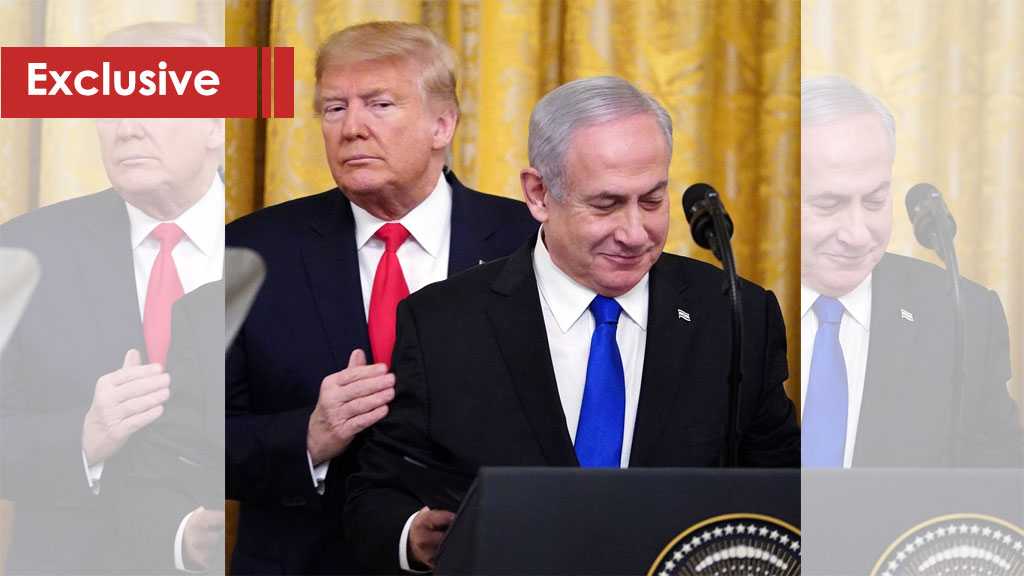
Netanyahu Follows Trump’s Footsteps: Political Downfall, Internal Crisis, and Attempt to Bridge the Gap

Netanyahu Follows Trump’s Footsteps: Political Downfall, Internal Crisis, and Attempt to Bridge the Gap

By Ali Abadi

The recent developments in the Zionist entity reopen the discussion regarding the extent to which this entity is influenced by the US policy as well as the changes inside the United States.

Since Trump’s failure in the US Presidential Elections, the countdown to Benjamin Netanyahu’s downfall has started -who represents the ‘Israeli’ version of Trump’s personality- even though the former was able to reproduce his leadership via three consecutive elections, and prepared to a fourth round to fortify his position against probes in cases of corruption, and to fight the possibility of moving him away from the political scene through a rival party coalition. However, Netanyahu’s ploys didn’t survive in front of the results of the recent war with Gaza, which turned the political atmosphere inside the occupation entity to the extent that Netanyahu’s government was found responsible or losing the deterrence with Gaza, not to mention his weakness to handle the resistance and its growing might.

Herein, we should notice the relative comparison between the American and the ‘Israeli’ arenas:

On the one hand, the extravagance of America’s right wing led to dangerous division that caused an intense desire among all of Trump’s opponents [including some of the Republican party members] to get rid of him via ballot boxes, so they voted majorly against the far-right policies [represented by Trump] more than to support his rival Biden and his electoral program. And in the ‘Israeli’ arena, the right policies led to attractions from within the Zionist society, not between the left and the right, but within the right itself. A dominant agreement emerged that Netanyahu is sticking to power at any price, even if it led to a ‘civil war’, and that he is using Zionist religious parties that exchange with him the electoral services and well as the governmental benefits.

On the other hand, it happened previously that the personalities of Trump and Netanyahu have been linked to each other, in the course of unprecedented similarity in political tendencies of both sides regarding several issues. Trump’s failure in the US has motivated many ‘Israeli’ politicians to think about a way to get rid of his closest ally, Netanyahu. However, they didn’t possess the required energy to unite. Then came the recent confrontation with the Palestinians to uncover the weak structure of the entity as well as the policies of Netanyahu’s government. The decision was among several political parties to scapegoat him based on the rule of preserving the rightist policies that are threatened with the strong Palestinian uprising on the one hand, and the harmony with the American policies as much as possible on the other hand. Hence, the Zionist right settlement scheme would be saved, while Netanyahu’s attempts to shake the alliance with the US due to his objection of its return to the nuclear deal with Iran would fail.

Separation

Both American and ‘Israeli’ societies suffer from not yet hidden political, ideological, and ethnic divisions. Both societies need to absorb the tension from time to time via changing the top of the pyramid. This is one issue. Another remarkable one is that ‘Israel’ didn’t succeed for long in staying away from the requirements of the American interests in the region. And without harboring hopes on a major separation between the two sides, we witness a sort of coldness in relations due to three main points over the past three decades.

First: With launching the Madrid Conference for settlement in the region in the beginning of the 1990s after the US-led war in Kuwait, when Isaac Shamir [Likud] government objected to the principle of establishing an independent Palestinian state, but the Zionist entity’s need for the US financial support to contain the Jewish migration from the Soviet Union and other places pushed ‘Israel’ to reduce its objections and conditions. Washington was able, through guaranteed loans worth billions of dollars, to tame the ‘Israeli’ policy in favor of its wider interests. Then, Shamir was displaced from the ‘Israeli’ scene, and was succeeded by Isaac Rabin [Labor Party] to lead the Oslo track which happened to become later the Palestinian Authority in Gaza and Ariha. However, after the assassination of Rabin in 1995, the abilities of the most harmonized Zionist parties with the US policy declined on the level of their potential to attract, and the base of the far-right parties, which reject the issue of ‘Two-state-solution’ or freezing the settlement activity grew, especially in the aftermaths of the major migration from the previously-known Soviet Union and other places. This led to a change inside the Zionist society, in addition to the structure of its successive governments.

Second: Netanyahu’s impediment of Barack Obama’s attempts to revive negotiations with the Palestinian Authority based on freezing the settlement activity in the West Bank, and then the US signing of a nuclear deal with Iran in 2015. Netanyahu objected to it publicly and inside the US congress in a famous speech. Meanwhile, the dispersion within Netanyahu’s rival ‘Israeli’ parties didn’t allow the formation of a change that suits the US regional policy.  Trump came to power in 2016 to revive Netanyahu’s hopes about change that he didn’t dream about from the part of the American orientation on other levels [such as moving the US embassy from Tel Aviv to al-Quds, recognizing the ‘Israeli’ sovereignty in the Golan, supporting the settlement activity in the West Bank, cutting funds of the Palestinian refugees’ UNRWA agency, shutting the office of the Palestine Liberation Organization in Washington, and encouraging the ‘Israeli’ normalization with Arab states regardless to the Palestinians.] A parallel US shift took place when Trump left the nuclear deal with Iran.

Third: Biden’s rising to power in Washington, which modified the ‘Israeli’ expectations. This is not limited to some differences regarding the traditional support of ‘Israel’ between America’s Republican and Democratic parties. The truth is that a change started to be witnessed in the public American mood in which a new political generation in the US, and inside the Democratic party is more liberal than its predecessors and doesn’t grant ‘Israel’ an ultimate support. It also cannot digest the rightist ‘Israeli’ thinking to ban the establishment of a Palestinian state, and the Palestinian people’s right to live on their land within internationally recognized borders. The ‘Israeli’ narrative, which has dominated the minds of the US elite over several decades regarding the right of Jews alone to establish their national Jewish state, has turned less tempting to many Americans. Additionally, the pro-Palestinian activism on social media platforms managed to breach the pro-‘Israel’ traditional media, in which Facebook and Twitter’s restrictions couldn’t curb this activism that was crystal-clear during the latest round of ‘Israeli’ aggression. It also scored important attractions in English and other foreign language.

Moreover, the Biden administration prioritizing of returning to the nuclear deal with Iran formed a separation from Netanyahu government’s orientations. He has started hinting to moving without an agreement from Washington, a matter that is not only underestimated in the US, but also among ‘Israeli’ milieus that are worried about losing the strategic alliance with the US.

Back to the house of obedience

After this third stop, ‘Israel’ returns to the so-called American ‘house of obedience’ or to adapting with the major US interests. This return is based upon avoiding confrontation with the US policies and their regional requirements to deal with the nuclear Iran in particular, reducing tension and difference with the American administration when dealing with the flaming Palestinian issue nowadays. However, it is not necessarily at the expense of the rightist tendencies regarding the settlement scheme that is the core of the Zionist project. The official US interest intersected with the internal ‘Israeli’ parties’ interests to remove Netanyahu from the scene. The US administration will take advantage of this shift in an attempt to revive negotiations between the Palestinian Authority and the occupation’s government to delegitimize the Palestinian resistance and the Axis that supports it in the region. Washington is to offer significant motivations to the future Zionist right government, led by Naftali Bennett, to allow progress in negotiations. Hereby, new obstacles will emerge from the side of Netanyahu’s successors who publicly adopt a hardline track regarding the rights of the Palestinian people, especially regarding the evacuation of some occupied land, freezing settlement, or establishing the Palestinian state. This will later turn things to the previous empty circle on the level of negotiations.

It is worth noting that Biden’s administration is not totally free to dictate its policies on ‘Israel’, especially amid the contradictions within the US political environment and inside the democratic party itself. However, ‘Israel’s’ dire need to the US support is an existential need to bear the pressures and preserve the qualitative military superiority. This will push the next ‘Israeli’ government to reduce the public contact with the US to overcome the challenges posed in this phase.

Finally, it is important to examine the extent to which the future Zionist government would succeed in:

– Managing the internal chaos along with threats of physical killing among the right affiliates

– Managing the military confrontation with the Gaza Strip

– Managing the variations with the US administration regarding the Palestinian issue and the Iran nuclear deal

On the American level, it is important to note the US administration’s ability to:

– Pass the nuclear deal with Iran without shockwaves inside the US congress and the circles of the conservatives who are more sticking to the ‘Israeli’ interests

– Dealing with the critical Palestinian issue, militarily and politically, based on the results of the recent confrontation that raised the voice of the Palestinian resistance


River to Sea Uprooted Palestinian   
The views expressed in this article are the sole responsibility of the author and do not necessarily reflect those of the Blog!

Friday, 4 June 2021

Netanyahu Urges Knesset Members to Oppose ‘Dangerous Left-Wing Gov’t’

 June 3, 2021


Israeli Prime Minister Benjamin Netanyahu

Israeli Prime Minister Benjamin Netanyahu has called on all of the right-wing members of the Knesset to oppose the new government presented by Knesset opposition leader Yair Lapid to President Reuven Rivlin late Wednesday.

In his first tweet since the announcement that could see Netanyahu unseated as prime minister, he lashed out at the “dangerous left-wing government”, accusing Naftali Bennett, Netanyahu’s potential successor, of “selling” the Negev Desert region to the United Arab List, an Arab political party known as Ra’am in the Zionist entity.

For the first time ever, the United Arab List has joined a coalition. According to the party, Bennett and Lapid promised to grant official status to Bedouin settlements in the Negev Desert.

Late on Wednesday, Yair Lapid, the leader of the Zionist entity’s largest opposition party Yesh Atid, notified President Reuven Rivlin of successfully managing to form a government coalition.

According to Israeli media, the head of the Yamina national conservative alliance, Naftali Bennett, will serve as Israel’s prime minister for two years before being replaced by Lapid as per a rotation basis.

Lapid was picked to form a new government by Israeli President Reuven Rivlin in May, after Netanyahu was unable to form a government in time following the 23 March vote.

Over the course of the past two years, the Zionist entity has held four parliamentary elections yet the winning parties proved unable to form a stable coalition.

Source: Agencies


River to Sea Uprooted Palestinian   
The views expressed in this article are the sole responsibility of the author and do not necessarily reflect those of the Blog!

Friday, 14 May 2021

The One State Reality

  BY GILAD ATZMON

one state finally .jpg

by Gilad Atzmon

There is a war in Jerusalem right now, a war that ends the Israeli illusion that the Palestinian cause has somehow faded away or evaporated.

Veteran Israeli General  Amos Yadlin, former commander of the IDF’s  intelligence and a chief Israeli National Security analyst, described the Israeli reality in the most brutal terms in his commentary on Israeli N12:   “The Israeli delusions are over. The Palestinian problem is Back. “

Yadlin believes that Israel’s lack of leadership has led to strategic paralysis, in which Israel and Palestine have practically morphed into ‘one state’ and it has only two options to choose from: either to ‘stop being a Jewish State’ or to be ‘undemocratic’! According to Yadlin, the “Palestinians are engaged in a different discourse today than in the past. After the failure of their three main strategies – terrorism, internationalization of the conflict and reliance on the Arab world, the Palestinians have greatly strengthened the discourse of rights. If they cannot achieve their own state, they seek equal rights as citizens of the Greater State of Israel – with the long-term hope of an Arab majority in one state. In the meantime, they hope to exhaust Israel’s economic benefits and gain points in the campaign for Israel’s delegitimization.”

I wouldn’t use Yadlin’s misguided terminology, as the Palestinians are already the majority of the people between the river and the sea. Yet, I believe that his dissection of the situation is largely accurate. It is also consistent with IDF intelligence’s reading of the Israeli Palestinian conflict since the early 1980s. IDF generals have been saying it for years: for the Palestinians to win, all they need to do is to survive. Mahmoud Abbas, whom many Palestine supporters tend to detest, also came to the same realization a while back. It is not war that will defeat Israel, it is actually peace which Israel fears the most.

As if the news is not bad enough for the Israelis and their future prospects in the region, the last election made it clear that the new Israeli kingmaker is no other than Mansour Abbas, the Leader of the Islamic party Ra’am.  Benjamin Netanyahu was ready to form a government with him just to sustain his primacy, with the hope that this may help him stay out of prison. But an alternative  centrist coalition also can’t be formed without the support of Abbas.

The hardcore right wing within the Israeli Knesset do understand that such political power in the hands of an Islamic party empowers their bitterest enemies. It is destined to bring many more Israeli Arabs to the polls in the next election and if Arabs in Israel enjoy the same political representation as the Jewish majority, they can easily become the biggest political force in Israel. Is Israel ready for an Arab PM, or Muslim minister of defence? I’ll let you ponder over that.

The most peculiar fact in all of that is that Jewish lobbies around the world are actually very successful in dominating different nations’ affairs that are relevant to Israel and Jewish interests. A lot has been written about AIPAC dominating American foreign affairs. A lot was said about the power of the Conservative Friends of Israel (CFI) and the Labour friends of Israel (LFI) in Britain. Yet in the USA Jews amount to less than 2% of the entire population. In the UK, Jews are less than 0.5% of the Brits. In Israel, on the other hand, Jews are 80% of the Israeli society and about 50% of the people who dwell between the Jordan river and the Mediterranean Sea.  One may draw a conclusion that Jews are doing far better for themselves as a marginal exilic identity than being a majority on the land. Zionism, for those who do not know, was born to refute that observation but it failed.    

Denote


River to Sea Uprooted Palestinian   
The views expressed in this article are the sole responsibility of the author and do not necessarily reflect those of the Blog!

Tuesday, 30 March 2021

NO TIME FOR ISRAEL TO CELEBRATE ELECTION “VICTORY”

South Front

Israel had no time to enjoy the successful election and Benjamin Netanyahu’s slim victory when Iran reportedly reminded Israel of itself.

On March 25th, while sailing from Tanzania to India, the Israeli-flagged ship “Lori” was allegedly struck by missiles in the Gulf of Oman.

Tehran was immediately accused, and the strike only caused material losses, but no casualties. Photographs of the damaged hull of the ship were shared on Twitter, but little else in the way of evidence.

This alleged incident is the third in a presumed exchange.It began on February 26th, when the Israeli-flagged MV HELIOS RAY suffered a number of explosions, in the Gulf of Oman. It was blamed on Iran.

Then, on March 11th, an explosion struck the Iranian-owned SHAHR E KORD off the coast of Syria. Tehran called it a terrorist attack, but not specifically blaming Tel Aviv.

On Syrian soil, approximately 15 unidentified gunmen attacked posts of the Syrian Arab Army’s 5th Corps and Iranian-backed forces in southern Raqqa, according to the Eye of the Euphrates. They infiltrated the government-controlled area in southern Raqqa with three trucks. The unknown militants abandoned their vehicles and attacked the position near the village of Maksar. At least 9 Syrian and Iranian-backed fighters were killed, and 6 others were captured.

In northern Syria, the situation is becoming increasingly chaotic. Despite a Russian-Turkish agreement to open humanitarian crossings in Idlib, but no such luck.

Ankara immediately denied agreeing to anything of the sort, and even if it didn’t, militants blocked the crossings.

Syrian authorities reopened the Saraqib and Abu Zindain crossings on March 25th. However, both remained blocked by the al-Qaeda-affiliated Hay’at Tahrir al-Sham (HTS).

Turkish Forces in the fashion of how they impose the ceasefire agreement in Greater Idlib undertook no action in assisting the opening of the crossings.

In Iraq, the situation is stacked even more against the U.S. and its allies. On March 25th, five US supply convoys were attacked in different parts of Iraq. Three of the attacks were carried out by pro-Iranian groups, while two are still unclaimed.

These attacks continue to be non-lethal and rather cause only material damage.

These groups, as well as all other Iranian allies are a part of the unofficial Axis of Resistance. Yemen’s Ansar Allah are as well a part of it.

In recent days, the Houthis (as Ansar Allah is more commonly known) were accused by Saudi Arabia of being cowards.

While that accusation was sinking in, Riyadh’s forces targeted al-Hudaydah with heavy artillery.

This is explicitly prohibited under a ceasefire agreement, and still violations take place almost hourly. The Saudi-led coalition continues its heavy airstrike activity, and is being steadily pushed back on the ground by the Houthis.

More retaliatory actions are likely expected by Israel, the U.S. and Saudi Arabia in the coming days and weeks, since the Iranian-aligned bloc seems to be making progress.


River to Sea Uprooted Palestinian   
The views expressed in this article are the sole responsibility of the author and do not necessarily reflect those of the Blog!

Saturday, 27 March 2021

Netanyahu May Reach End of His Political Life Soon: Israeli Opposition to Nominate Lapid for Premiership

  March 26, 2021

Zionist PM Benjamin Netanyahu

The Zionist prime minister, Benjamin Netanyahu, is facing a major challenge, which may lead him to the end of his political life, in light of the reslts of the public elections.

Netanyahu, whose coalition won 52 Knesset seats, is in need of allying with Yamina Party, represented by 7 MKs, and United Arab List (UAL), which includes 4 MKs. On the other hand, the opposition, which has secured 57 Knesset seats, is in need of allying with either Yamina Party or the Arab bloc.

Opposition Leader Yair Lapid, whose centrist Yesh Atid finishing as the second-largest party, is expected to be his coalition’s candidate for premiership.

Being the fourth public election, the Israeli vote indicates a major stalemate which is mainly attributed to the leadership crisis in the occupation entity.

Source: Al-Manar English Website

Zionist Circles: Political Deadlock May Last for Years

Zionist Circles: Political Deadlock May Last for Years

 March 25, 2021

Political circles pointed to long-term stalemate in the Zionist entity as Prime Minister Benjamin Netanyahu and his rivals are away from securing majority in the Knesset elections.

As vote counting nears its end in the occupation regime, preliminary results show that neither Netanyahu nor his rivals managed to 61 seats in the 120-seat parliament, the number needed to form a new government.

Netanyahu’s bloc has reportedly secured 59 seats in the parliament, while his rivals secured 57 seats, media reports said, noting that Mansour Abbas, leader of the United Arab List (UAL), has secured 4 seats.

Commenting on the initial results, Zionist analysts expected that the deadlock may last for a long time in the Zionist entity.

“The only way to ensure stability is Netanyahu’s success to form a government after securing the 61-seat majority needed in the Knesset. The new government must have a clear vision, and this requires other players in the political scene who are in Netanyahu’s rival bloc,” Daphna Liel, Israeli Channel 12’s political reporter said in a talk show broadcast on the Israeli TV network on Wednesday.

“Elsewhere, we are likely to stay in politically unstable situation,” the Israeli reported added, as cited by Al-Manar’s reporter of Hebrew affairs Ahmad Ammar.

“I think that the question now is whether Netanyahu will manage to form a government with 61-seat majority,” Yaron Dekel political commentator told the Israeli talk show.

“And the most important question here: Will this government withstand? Netanyahu couldn’t hold out with such formation in the past,” he noted.

Source: Al-Manar English Website


River to Sea Uprooted Palestinian   
The views expressed in this article are the sole responsibility of the author and do not necessarily reflect those of the Blog!

US, Israel, EU election farces or ‘Allies of sovereignty’

 Friday, 26 March 2021 2:02 PM  [ Last Update: Friday, 26 March 2021 2:02 PM ]

US Rep. Ilhan Omar (D-MN) (L) talks with Speaker of the House Nancy Pelosi (D-CA) during a rally with fellow Democrats before voting on H.R. 1, or the People Act, on the East Steps of the US Capitol on March 08, 2019 in Washington, DC. (AFP photo)
US, Israel & EU election farces or the ‘Allies of Sovereignty’ – Iran, China & Russia?
(Ramin Mazaheri is the chief correspondent in Paris for Press TV and has lived in France since 2009. He has been a daily newspaper reporter in the US, and has reported from Iran, Cuba, Egypt, Tunisia, South Korea and elsewhere. He is the author of ‘Socialism’s Ignored Success: Iranian Islamic Socialism’ as well as ‘I’ll Ruin Everything You Are: Ending Western Propaganda on Red China’, which is also available in simplified and traditional Chinese.)

By Ramin Mazaheri and cross-posted with PressTV

Mazaheri is the chief correspondent in Paris for Press TV.

Too bad the elections for European Parliament aren’t this year – we could have enjoyed all three tones of the chord of “liberal (aristocratic) democracy”.

The United States, the European Union and Israel – the triumvirate which dominates half the world and thinks it has the moral and intellectual right to rule the other half – obviously have incredibly flawed, domestically-denigrated and politically feckless elections. As time goes on the world can only be increasingly attracted to innovative alternative political models because this trio is so endemically dysfunctional.

In Israel voters just chose between the war criminal Benjamin Netanyahu or those who claim to be the colonizers who are the “sane” alternative. This election sham will likely need to be repeated for the fifth time in two years, but only a few thick Westerners ever claimed Israel is a democracy, anyway.

Thirty years after the United States penned the structures of the European Union – in a rush of Cold War euphoria and arrogance – there may not be elections which are as meaningless and uninteresting to the actual voting public as those for EU Parliament.

The United States’ recent election was as bad as anyone could have expected, and Americans themselves expected the worst more often than anyone. So I don’t know why France-raised US Secretary of State Antony Blinken thought the last months and years of American carnage and discontent would go unnoticed abroad?

When Blinken assumed a Parisian pose of oblivious nonchalance at the first China-US summit and tried to shame China for not being Western enough, China was ready: his counterpart, Yang Jiechi, delivered an impromptu, blistering, 17-minute critique of America which was redolent of Mao’s era.

In short, Yang’s rebuttal contained well-known and totally accurate critiques of America’s capitalist-imperialist and liberal democratic structures. From “massacring the people of other countries” to the obvious “slaughtering” of African-Americans and beyond, Yang listed a poisonous cornucopia of the inevitable social evils which arise from such outdated social structures.

China’s standing up to the new administration in Washington – and at the very first opportunity – will mark a sea change in geopolitical affairs. China knew it was going to be targeted – as a welcoming gift Biden placed sanctions on two dozen Chinese officials just prior to the landing of their diplomats – and they eagerly responded with, “Let’s fight – ideologically – because it’s clear you don’t have a solid leg to stand on anymore.”

Out with the ‘Axis of Evil’ and in with the ‘Allies of Sovereignty’

Yang’s speech clearly ends the era of the “Axis of Evil”, declared by George W. Bush in his 2002 state of the union address, which put Iran, Iraq and North Korea at the top of the list for allegedly being sponsors of terrorism. However, the actual policy of America was: whoever was not “with us” was an evil entity for being “against us”, and thus Bush II essentially declared at the point of a spear that it was now a unipolar world.

In a new column titled “Welcome to shocked & awed 21st century geopolitics” indispensable global journalist Pepe Escobar agreed that China’s hour-long diplomatic give-and-take meant that “21st century geopolitics will never be the same again”. He also noted that the unified, unbowed response to Yang’s speech by Iran, China and Russia amounted to an open “triple slap on the (US) hegemon” with a dueling glove.

So what is it which unifies this Asian triumvirate?

It’s a group whose essential demand is something which resonates universally, and which was the only logical and inevitable retort to those (the US, EU & Israel) who insist on a unipolar world: it’s an “alliance of sovereignty”, i.e. the right to resist a unipolar world where domestic affairs cannot be decided locally. The fundamental basis of this stance is anti-imperialism.

Sovereignty is what France denies to Africa, what the Monroe Doctrine still denies to Latin America, what Israel denies to the Middle East and what – it’s often poorly understood – Brussels denies to the southern and eastern members of its own bloc. Sovereignty is an essential demand in a world full of nations but it’s an illegitimate demand and even seditious blasphemy to assert, as Yang did, that, “Neither the United States itself nor the Western world represent international public opinion.”

Let the US and Israel continue to wave the bloody flag of World War II and perhaps dub Iran, Russia and China the “Axis of Evil II” all they want: As the Yellow Vests, Brexit and Trump illustrate, many of their own subjects are already painfully aware that national sovereignty is a human right which has become unbearably stifled in favor of 1%-er capitalist globalization.

The roles of the ‘Allies of Sovereignty’ get more and more openly declared

Obviously, once China gets involved militarily then it’s all over – there will be a global victory for sovereignty.

Russia got involved militarily in Syria — the US lacked the diplomatic credibility for a repeat of the Iraq & Afghanistan invasions, and they lacked the military supremacy, and they also blinked because they have lost faith in their own cause — and they were able to assure the sovereignty of Syria.

Iran is the most involved militarily: they take the most risks and remain the most at risk of assaults – this is perhaps the price to be paid for earning the partnership of those two much larger regions, both of which are big enough to be continents. Revolutionary Iran has won many regional countries if not outright sovereignty then at least temporary reprieves, measures of peace and, that most essential ingredient, hope. Iran deranges the West the most: there is no logical reason for Iran to be included with these two much larger powers except for the fact that Iran obviously punches way above its weight solely via decades of advanced political modernity, social merit and intelligent redistribution of its natural economic resources.

China and Russia are in a conundrum which was made clear in both Yang’s remarks and by Russia’s official response, which said that Moscow’s relationship with the EU, “has been destroyed by unilateral decisions made from Brussels”: China and Russia are trying to uphold a rights-based system of international law with a triumvirate who has no respect for it.

The United Nations – the fulcrum of this system – is totally irrelevant to Americans. Given the “you’re either with us or against us” worldview they openly declared – with all the subsequent violations of international law via illegal sanctions, via Guantanamo Bay, via pulling out of treaties like the JCPOA, etc. – Moscow and Beijing should have realized that “only unilateral decisions” has been the Western worldview for many years. The West will never say what China and Russia apparently want to hear: “You’re either with the United Nations or against us.”

Contrarily, Iran has far fewer expectations that the UN is an impartial body. Going back to the chemical weapons atrocities by Iraq more than three decades ago, Iran sees it is quite necessary to take risks because the “international community” – dominated by Western interests and democracy-gutting vetoes – so often don’t come to save the innocent until after the bullets have flown.

What is the “international community”? To many – like the US – it is nothing. To others – like China, Russia and France – it is worth saving and using, and largely because they can get enough of what they want. To many others – like Iran and countless other nations – it is not useful without major reforms first. But these analyses are all moot:

The concept of national “sovereignty” can and must exist before, during and after any discussion of how, what, who, where or when this “international community” is formally arranged – refusal to recognize this necessarily implies some sort of one-state/unipolar world. 

“Sovereignty” needs allies today, but the situation of “sovereignty” is not as dire as it was in 2002, (although a Yellow Vest will certainly disagree). In case the new Biden administration was wondering they now know: Beijing is not about to side with the Western triumvirate (or, more accurately, their 1% class) over their own sovereignty.

If pushed like Russia was in Syria, Beijing may even fight to protect the sovereignty of certain other nations, such as Iran. 

Geopolitics moves much slower than the average person may think, but for a plethora of enormous reasons which go far beyond a debate in Alaska – four years of the curtain-lifting outsider Donald Trump, the “no strings attached for bankers” fiscal policy disasters of QE and ZIRP, an unregulated private high finance sector, the disputed election of Joe Biden, the atrocious Great Lockdown decisions of the West, etc. – the unilateral world ordered by the West has wilted. What we now have is two camps which contain half the world.

What’s key to grasp is that what is truly “up for grabs” is the other half: Latin America and Africa. For centuries they have had no sovereignty – and the plunder of their wealth is what led to the West’s current success – and restoring it is the inevitable goal of the “Allies of Sovereignty”.

Were the Western triumvirate (and we can include a fourth note to that chord: many of the key members of the 54-nation English Commonwealth) not so bloody capitalist-imperialist they would be working to maintain the current status quo between China and the West which has been, ultimately, mutually-beneficial for both groups for several decades.

However, Beijing said the new administration of Joe Biden came to the first Sino-US summit to emit “a strong smell of gunpowder and drama” – China was clearly unimpressed, and they clearly know who their real allies are.

The views expressed in this article do not necessarily reflect those of Press TV.


Press TV’s website can also be accessed at the following alternate addresses:

www.presstv.ir

www.presstv.co.uk

www.presstv.tv


River to Sea Uprooted Palestinian   
The views expressed in this article are the sole responsibility of the author and do not necessarily reflect those of the Blog!

Thursday, 25 March 2021

Israel election: The triumph of Kahanism

 As Netanyahu looks to cobble together his farthest-right coalition yet, western democratic governments and diaspora Jewish leaders need to take a stand

An Israeli man walks past an electoral billboard bearing portraits of Netanyahu flanked by extreme-right politicians, including Itamar Ben-Gvir and Bezalel Smotrich, in Jerusalem in 2019 (AFP)
Richard Silverstein writes the Tikun Olam blog, devoted to exposing the excesses of the Israeli national security state. His work has appeared in Haaretz, the Forward, the Seattle Times and the Los Angeles Times. He contributed to the essay collection devoted to the 2006 Lebanon war, A Time to Speak Out (Verso) and has another essay in the collection, Israel and Palestine: Alternate Perspectives on Statehood (Rowman & Littlefield) Photo of RS by: (Erika Schultz/Seattle Times)

Richard Silverstein

24 March 2021 15:13 UTC |

The biggest winners in Tuesday’s Israeli election appear to be Prime Minister Benjamin Netanyahu and the little-known Religious Zionist Party. Behind the milquetoast name is an alliance of some of the most extreme Kahanist elements in Israeli politics.

According to the results announced so far, a race that had been predicted as a virtual tie between centrist and rightist parties may offer Netanyahu a narrow path to a renewed term as prime minister. Far-right and religious parties, likely coalition partners for Netanyahu, were victorious in the election.

At the time of publication, however, it remained unclear as to whether this coalition would be able to secure the needed 61-seat majority.

The question is: will the suspicion and hostility with which some of these party leaders, such as Gideon Saar and Naftali Bennett, view Netanyahu outweigh their desire for political power? If history is any judge, they will put aside their personal rancour and play the political game.

Collapse of Blue and White

Election turnout was 67 percent, down from the most recent election and the lowest percentage since 2013. The initial results would suggest that many of those who elected not to vote had previously supported the moderate parties that performed better in the last election.

There are two critical factors leading to this outcome. The first was the near-collapse of the centre-right Blue and White coalition, which won 33 seats in the last Knesset. The decision by its then-leader, Benny Gantz, to desert his partners and enter a coalition with Netanyahu led to a drastic decline in its vote share. With close to 90 percent of Tuesday’s vote counted, Blue and White picked up only eight seats, while Yesh Atid, which split from Blue and White last year, won 17. This fracture essentially destroyed the centre-right as a viable alternative to Netanyahu’s far-right Likud-led coalition.

Diaspora Jewish leaders could declare that Netanyahu has gone too far, and refuse to raise funds for Israel or to attend meetings with Israeli government officials

Voters who abandoned Gantz did not necessarily turn to his former partners in Yesh Atid, which represented a moderate option, nor to Likud, which lost several seats compared to the last election. They were likely disenchanted with Netanyahu and the multiple corruption charges he faces, so they turned to newly formed parties generally even farther to the right.

By fleeing to parties likely to join a governing coalition with Likud, however, they might have guaranteed an outcome they did not foresee. Postponed until after the election, Netanyahu’s corruption trial is scheduled to resume in early April, and Likud sources have pointed to legislative outcomes that could provide him immunity from conviction while in office, including passage of the “French Law”.

A more draconian and controversial method would be for a new justice minister to fire the current attorney general and appoint one who would dismiss the charges, eliminating the greatest threat to Netanyahu’s continuing on as leader.

Extreme nationalist views

Though there are regular protests against Netanyahu’s corruption, which would likely increase if charges were dropped, it is unlikely they would reach a tipping point and lead to Netanyahu stepping down. Even if he did, the rivals waiting in the wings are no less extreme in their nationalist views; the country would merely be swapping one Judeo-supremacist autocrat for another.

Voters who turned away from Blue and White appear to have favoured soft-right parties, such as Saar’s New Hope, and some even farther right than Likud, including Bennett’s Yamina and the Kahanist Religious Zionist Party, led by Bezalel Smotrich.   

Head of Israel's Jewish Power (Otzma Yehudit) party Itamar Ben Gvir (R) talks to supporters through Mahane Yehuda market in Jerusalem, on 19 March (AFP)
Head of Israel’s Jewish Power (Otzma Yehudit) party Itamar Ben Gvir (R) talks to supporters through Mahane Yehuda market in Jerusalem, on 19 March (AFP)

Smotrich was once apprehended by the Shin Bet for allegedly plotting a terror attack to protest Israel’s Gaza withdrawal, although charges were never laid. He once boldly claimed that Jews cannot be terrorists; in other words, one man’s terrorist is another’s freedom fighter.

In 2006, to protest the Gay Pride parade, he organised a “parade of beasts”, in which goats and donkeys were marched through the streets of Jerusalem. He has called himself a “proud homophobe”. He has served as an MK with the Yamina alliance and as minister of transportation.

Smotrich is allied with Itamar Ben-Gvir, whose political evolution as a youth led him into the arms of far-right Rabbi Meir Kahane. According to a Haaretz report: “First, he joined the youth movement affiliated with Moledet, a right-wing political party that advocated ‘transferring’ Israeli Arabs out of the country. But that turned out to be too tame for him. So not long thereafter, he defected to Kach, the eventually outlawed racist party founded by the American-born Rabbi Kahane. ‘I found in this movement a lot of love for the Jewish people, a lot of truth, and a lot of justice,’ says Ben-Gvir.”

Breaking with precedent

As a teenager, Ben-Gvir gained notoriety in 1995, when he vandalised then-Prime Minister Yitzhak Rabin’s vehicle and brandished its Cadillac hood ornament, boasting: “We got the car. We’ll get to Rabin too.” Rabin was murdered only weeks later by another Kahanist.

Ben-Gvir is now the go-to defence lawyer for settlers charged with terrorist attacks against Palestinians. He is the Israeli equivalent of US lawyer and politician Rudy Giuliani, except instead of representing sleazy crooks, he represents accused mass murderers. He lives in Hebron, among the most violent of settler enclaves, where Jews and Palestinians are separated by barbed wire, locked metal gates and thousands of Israeli soldiers, who protect the settlers from the wrath of the indigenous population.Israel election: Latest results show Netanyahu without clear path to power.

Despite several prior attempts, Ben-Gvir has never served in the Knesset. His alliance succeeded this time for one reason only: Netanyahu made clear to far-right voters that if they weren’t voting Likud, he preferred they vote for the Religious Zionists. He also said the party would be a coalition partner in his next government, a striking break with previous precedent.

In 1988, Kahane’s newly founded Kach Party was so far outside the mainstream that the government banned it, and both Israel and the US have declared Kach to be a terrorist organisation. No Israeli leader has ever promoted an explicitly Kahanist party, let alone agreed to include one in a governing coalition – meaning it’s likely the Religious Zionists will obtain at least one ministerial portfolio representing the interests of their settler constituency. This offers unprecedented access to Israeli protocols and power.

This should not be surprising to anyone aware of the history of the Zionist movement. At least two former Israeli prime ministers, Menachem Begin and Yitzhak Shamir, were accused terrorists, linked to the King David Hotel bombing, the Deir Yassin massacre and the assassination of UN peace negotiator Count Folke Bernadotte, among other crimes.

Flirting with terrorists

There is one powerful way in which the world could respond to Netanyahu’s flirtation with supporters of Jewish terrorism: the US government, UN and EU could declare this government persona non grata, and refuse to have any dealings with it. It would be a diplomatic version of boycott, divestment and sanctions (BDS).

Israel is united in its determination to pursue racist, apartheid policies. The world is not united in opposing them

Diaspora Jewish leaders could declare that Netanyahu has gone too far, and refuse to raise funds for Israel or to attend meetings with Israeli government officials.

Contrary to what some believe, international pressure works. While Israel may complain grievously about bias towards it, when push comes to shove, such pressure works in modifying Israeli behaviour – though usually not in significant ways, as Israel does the bare minimum to avoid international censure.

Regardless, a united front of western democratic governments and diaspora Jewish leaders would offer a powerful statement, defining a red line that Israel has crossed. And yet, the likelihood of this happening is almost nil. Israel is united in its determination to pursue racist, apartheid policies. The world is not united in opposing them. It dithers while Rome burns.

The views expressed in this article belong to the author and do not necessarily reflect the editorial policy of Middle East Eye.

Related Videos


Related News

River to Sea Uprooted Palestinian   
The views expressed in this article are the sole responsibility of the author and do not necessarily reflect those of the Blog!