Showing posts with label NATO. Show all posts

Wednesday, 1 December 2021

Inside Syrian Idlib

30 Nov 2021

Source: Al Mayadeen Net

Tim Anderson

For NATO, dismembering a country [Syria] is a second-best war aim, after the failure of complete ‘regime change’.


Idlib; where NATO-embedded media is exposed

The NATO-embedded media often speaks as though the HTS/Nusra/al-Qaeda held enclave in two-thirds of Idlib Province represents Syria and is a haven of ‘moderate rebels’. They also claim the enclave holds 4 million people, while the Syrian government says 1.3 million.

War propaganda themes have become dutifully reported ‘facts’: this is a ‘Syrian Civil War’ (even as Syria is occupied by NATO’s two largest armies plus Israel, plus thousands of foreign terrorists), the Syrian Government has repeatedly used ‘chemical weapons’ (i.e. WMDs, meriting NATO retaliation) and (for some unexplained reason: pure evil?) bombs its own schools and hospitals.

But there is another Idlib: that part liberated, at great cost, by Syria’s national army.

From August 2019 through to early 2020, the Syrian Arab Army (SAA) liberated the south-eastern third of Idlib province, including the towns of Khan Shaykhoun, Maarat al-Numan, and Saraqeb. That opened the M5 highway for all traffic from the south to Aleppo, through Hama and SE Idlib.

The SAA looked for further advances, but the NATO powers demanded an end to Syrian operations, in defense of the al-Qaeda enclave. That real threat of intervention led Russia to engage in further talks with Turkey and to stall further advances. 

Yet this development demonstrated that Syria, with its allies, could have freed the country from all terrorism were it not for repeated interventions from the NATO-led war coalition, which prefers to dismember and maintain occupied enclaves: NW Idlib, the NE ‘autonomous’ zone, the US occupied al Tanf zone and the Israeli occupied Golan.

In November 2021, I visited Syrian Idlib, authorized by the Syrian Army, just as most western journalists are authorized by US troops when they enter its various war zones. In one day, we traveled to Khan Sheykhoun in the south through Maarat al-Numan, the second-largest provincial city, to the strategic crossroads town of Saraqeb.

Khan Sheykhoun is the only Idlib town I saw with a significant civilian population. Mayor Mohammad Iskandar told us that 600 to 700 families have returned, about 10% of the pre-war population. Now far from the frontline, the town is peaceful with some rebuilding and small markets.

Most of those displaced moved to Turkey or north Idlib and some to other parts of Syria. The mayor is in touch with many and says most want to return, but the armed groups (HTS/Nusra) demand large sums of money for them to leave.

We also spoke with Mr. Iyad Sukheta, who runs a small grocery store, a small farm, and used to drive a bus. Like the Mayor, Iyad has also remained in Khan Sheykhoun throughout the conflict. 

He says the ‘musalaheen’ (armed groups) took many prisoners and killed many local people, including his 17-year-old son. They wanted him to use his bus to drive people north, but he refused. 

Asked about the chemical weapons incident of April 2017, Iyad said that the prisoners were not sacrificed (as they had been in East Ghouta in 2013) but rather, after a Syrian airstrike, the armed groups attacked the local people directly with chemicals. Many were killed. 

Back in 2017, the armed groups blamed the SAA, using their own false flag massacre to incite President Trump (who had campaigned against the war) to make his first missile strike on Syria.

Maarat al-Numan is a much bigger town, with an ancient history and sitting on the frontline between Syrian forces and the Turkish-backed Nusra/HTS gangs. Even though the SAA has pushed its effective frontline forward three times in the past two years, there are no civilians here. The frontline, about 4km north, is constantly tested by the armed groups.

I visited Maarat’s museum with its famous Roman and Byzantine mosaics, which have been protected for several years with sandbags. As with many mosques, schools, and hospitals throughout Syria, the HTS/Nusra terrorists had used it as a military headquarters, digging tunnels under the Museum.

Jabal Zeitoun (Olive Mountain) is now at the center of the frontline, as it occupies the high ground from which the SAA’s 9th Division has placed a substantial vanguard of soldiers, tanks, arms, and surveillance equipment. Yet the actual Maarat frontline extends over many kilometers.

Nusra/HTS had built barricades around the town’s hospital and placed a small mosque inside. We saw evidence of supplies (medicines and cars) from Qatar, Germany, Sweden, and France. The typical pattern of the armed groups’ takeover of Syrian hospitals (for example in Aleppo) has been that they first rob all existing supplies.

Despite nominal support at the UN for the ‘territorial integrity’ of Syria, the NATO states had backed a breakaway Idlib enclave called ‘North Syria’. In much the same way, and contrary to international law, they still support an ‘Autonomous Administration of North and East Syria’. Dismembering a country is a second-best war aim, after the failure of complete ‘regime change’.

Further on up the road, the crossroads town of Saraqeb is also at the frontline, with Nusra/HTS making daily small arms attacks on, and occasional shelling of, SAA positions. They hide behind, and sometimes in front of, the many Turkish bases which are all across northern and central Idlib. The aim of these attacks, according to General J, has been to provoke retaliation which might spark direct conflict between Syrian and Turkish forces. 

Captain Y took us to the frontline, looking out on the road to Ariha, and with a Turkish base 1.7 kilometers ahead. They know these distances quite precisely and are ready to liberate their country from foreign occupation and NATO-backed terrorism when the time is right.

Syria could have eliminated terrorism and restored its territorial integrity long ago, were it not for the NATO-led war coalition which prefers to fragment and occupy segments of the country, all along its land borders. In this way, they provide safe haven for internationally-proscribed terrorist groups.

The opinions mentioned in this article do not necessarily reflect the opinion of Al mayadeen, but rather express the opinion of its writer exclusively.


Related Videos


River to Sea Uprooted Palestinian   
The views expressed in this article are the sole responsibility of the author and do not necessarily reflect those of the Blog!

Tuesday, 30 November 2021

To see Putin and die

 November 29, 2021

by Rostislav Ischenko for Ukraina.ru
source: https://ukraina.ru/opinion/20211128/1032755065.html
Note: this machine translated text

Joseph Biden, the 46th president of the United States, has asked Russian President Vladimir Putin for a meeting for the second time in six months. This would not be surprising: in the end, international tensions have reached a limit, and not only the most alarmist of experts, but also the most cautious of politicians have already started talking about the high probability of war

In such circumstances, responsible leaders of great powers are simply obliged to meet and seek compromises.

But this is the same Biden, whose team cried all the tears over Russian interference in the American elections and twice tried to organize the impeachment of the 45th US President Donald Trump, accusing the latter of surrendering American interests to Russia and working for Putin. Meanwhile, Putin and Trump had only one full-format meeting (in Helsinki, July 16, 2018, a year and a half before the expiration of Trump’s powers), and the rest — about five short conversations “on the sidelines” of various summits.

Relations between Russia and the United States had sunk to the freezing point even before Trump. At the same time, the 45th American president, although he negotiated more harshly, was still much more constructive than the 46th. Trump was inclined to seek a compromise, despite all the contradictions, because only a mutually acceptable compromise can ensure a long and lasting peace.

Biden, in a typical American manner, is trying to deceive a partner in the negotiation process, seeking only a truce – a postponement of confrontation for some time, during which the United States will try to solve its problems in order to take up the old with renewed vigor later.

That is why Biden’s team is begging for meetings with Putin, as if their ancient boss is afraid to die without telling Vladimir Vladimirovich something important. Pay attention to the diplomatic activity of the American president who does not always adequately perceive reality during the first year of his term:

* spring – activation of the US-European Union, an attempt to force the EU to go to a sharp deterioration in relations with Russia and abandon the SP-2;
* summer – a sudden request for a meeting with Putin, insistence on its early organization, declared readiness to resolve the entire spectrum of controversial issues. In fact, absolutely empty and unacceptable hints for Russia about the readiness of the United States not to interfere if the Kremlin decides to restore its exclusive sphere of influence in the post-Soviet space by force, so that, as a reciprocal courtesy, Russia refuses an informal (but very problematic for the United States) alliance with China. The rest of the summer is devoted to spreading disinformation that Moscow is ready to negotiate with the United States at the expense of Beijing;
* autumn — the formation of an anti-Chinese alliance of US vassals in the Asia-Pacific region and part of the European powers, followed by a sharp and persistent desire to organize a personal meeting between Xi Jinping and Biden (the meeting took place, was in vain, after which the United States began spreading disinformation that Beijing is ready to negotiate with Washington at the expense of Moscow);
* winter — against the background of the sharp aggravation of the situation on the borders of Russia and Belarus that began in the autumn and an undisguised attempt to draw Russia into a war with the participation of Eastern European members of NATO and the EU, a new insistence on a personal meeting with Putin.

In my opinion, there is no need to have an outstanding intellect to see the “swing” on which the United States is trying to “rock” Russia and China in order to break their partnership (absolutely nullifying all attempts by the United States to regain the status of a global hegemon) and suppress Moscow and Beijing one by one and one by one. The United States offers everyone something unnecessary, but seriously binding their hands and requiring large resource costs, they try to link everyone with a regional war with their allies (who, however, are not in a hurry to drag chestnuts out of the fire for Washington), they inspire everyone that the partner has almost agreed to the American proposal and we must hurry to negotiate ourselves so as not to be made fools of.

The method is simple, has been used since ancient times and quite often led to success. The United States understands that neither Russia nor China want to win right now and annex the post-Soviet territories in Europe and Taiwan (respectively).

Moscow and Beijing would prefer to solve these problems peacefully and later. At this stage, the too clearly expressed intention to return the fallen imperial territories may not only limit the possibilities of cooperation between Russia and China to resist the military-political and financial-economic pressure of the United States, but also undermine the entire system of Eurasian unions built by them.

Therefore, the United States, in order to persuade Russia and China to make concessions in the negotiations, frighten both of them with an unnecessary regional war, while at the same time offering to negotiate and solve this problem. If someone gives up and starts at least discussing options, Washington will immediately provide a proof leak of information in order to persuade the second partner to make a concession, and then bargain with both from a favorable position to bring down the price.

Realizing all this, the Russian leadership is in no hurry to talk with Biden. Peskov, on behalf of the Kremlin, said that the exact date has not yet been determined. However, the Kremlin has agreed in principle to organize a videoconference before the end of the year. Why did they do that?

Every month (not to mention a year) without war, Russia and China strengthen and weaken the United States. If we hold out for two or three years, the war will become meaningless for the United States, because, by their own admission, after 2024 they do not see the possibility of defeating China militarily. Consequently, in two years, the opportunities for American blackmail will decrease sharply, and America’s allies, who are already unwilling to risk themselves because of the Washington games, will become even more thoughtful, it will be even more difficult to persuade them to demonstrative aggressive actions against Moscow and Beijing. A certain US deadline is approaching, we need to act already. Under these conditions, Washington, having lost hope of achieving its goal by peace, can really bet on provocation of war.

Any negotiations are a way to delay time. While they are preparing and while they are going, it is unprofitable for the United States to be unconstructive, which means they will try to keep their allies on a short leash. But vassal states are not trained dogs that can be set on an object or calmed down in one second, rocking the situation takes time (albeit a little). The solution suggests itself: as long as possible to delay the time in determining the date of negotiations, postponing them for later. As soon as it becomes impossible to pull further – to hold negotiations and try, without giving a single opportunity to interpret their outcome as a willingness to take seriously American proposals for the surrender of an ally, to involve the United States in the preparation of the next meeting by creating permanent expert groups in the areas.

Any diplomatic department is a complex bureaucratic machine that is extremely difficult to force to move simultaneously in two directions. If you give the task to begin diplomatic preparations for war, this apparatus will move in one direction, if you set the task of finding a compromise, then in another. At the same time, it will have a serious informational impact on both the international and domestic agenda. That is, even meaningless, but regular meetings of experts reduce (though not completely remove) the risk of fatal confrontation.

Russia’s actions indicate that the Kremlin clearly sees the threat and has chosen the right tactics. The agreement on the creation of expert groups was reached during the first meeting with Biden, with the organization of which they stretched out as much as they could. However, America countered this agreement by saying that the expert groups did not work. So, now Russian diplomats will point this out and demand more constructive.

The current meeting is also being delayed as much as they can, having already postponed it until the end of December. If it works out, then under the pretext of New Year’s holidays they will postpone it until the middle-end of January (however, this is unlikely, the United States is in a hurry). The current meeting will be held online: the coronavirus. Although he does not interfere with Putin and Biden’s meetings with other politicians, but in this case only online. And not because I don’t want to waste time on flights, knowing in advance that the negotiations will be in vain. The online mode does not allow the organization of fake leaks about the content of negotiations. This is not a face-to-face conversation (in the presence of only unknown and controlled translators, in an office protected from wiretapping) – everything is recorded, and by both sides.

Thus, Russia is trying to win one and a half to two months out of the 48 required. Will it be possible to win the world completely?

This question has no definite answer. On the one hand, time is running out, and with the approach of 2024, the United States has nothing to lose, and in the vassal countries designated by them for slaughter, there are their own war parties that (for personal gain) are ready to start even a losing war that destroys their states. On the other hand, the current authorities, who are now in charge of American consumables, are doing everything possible to get rid of the honorable mission of pointlessly dying for the interests of the United States. How strong will they have enough strength to continue maneuvering on the verge of a foul? How ready are Americans to increase pressure on the dependent elites of limitrophs? Where is the weak link ready to break: in Europe or in Asia and who is it (Ukraine, Taiwan, someone else)? We can only assume with more or less certainty.

Often the expected danger comes at all from where it is not expected or when they stopped waiting and relaxed.


River to Sea Uprooted Palestinian   
The views expressed in this article are the sole responsibility of the author and do not necessarily reflect those of the Blog!

Friday, 26 November 2021

Who Wants Some Ukraine?

 November 25, 2021

by Dmitry Orlov, posted with permission of the author

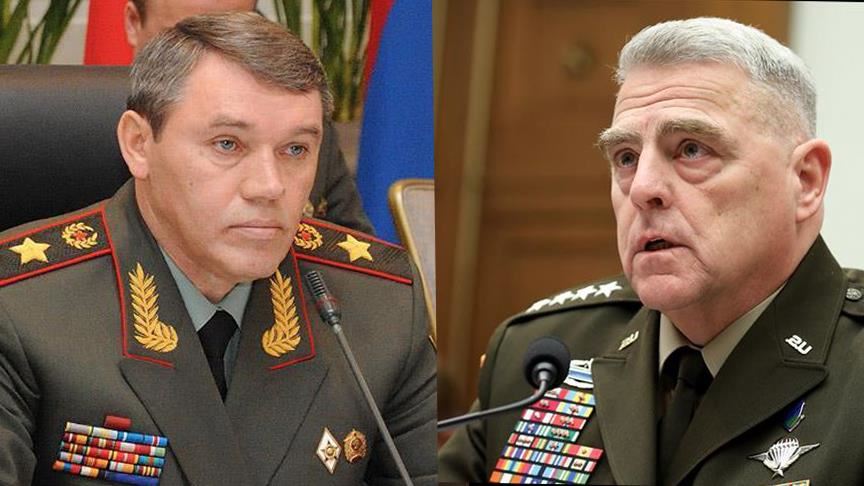
On Tuesday, 23 November, Russia’s most senior military general, Valery Gerasimov, had a “deconfliction” phone conference with US Chairman of the Joint Chiefs of Staff Mark Milley, in which the two discussed “pressing issues of international security.


US, Russia army chiefs talk recent skirmish in Syria

” Actual details of what they discussed are not available; what is available is Western media speculation, which in recent days has included false reports of Russian troops massing on the Ukrainian border and supposedly getting ready to invade. What Western media has studiously ignored is an actual massing of Ukrainian troops on the borders of the Donbass region—the industrialized temporarily Ukrainian region that has been de facto independent since the Kiev putsch of 2014.

Following that putsch, and the refusal of the Donbass (along with Crimea) to recognize the new US State Department-installed Ukrainian government, the Ukrainians made attempt to recapture the Donbass by force. This attempt failed, and Kiev managed to avoid all-out defeat by signing the Minsk agreements of February 2015, but has clearly had no intention of ever fulfilling them. Instead, ever since then, Ukrainian forces have been shelling the no man’s land between Ukrainian-held territory (which is mostly open prairie) and Donbass (which is urbanized and thickly settled), killing small numbers of civilians and local militia members and causing considerable property damage. Although Western press has continuously reported on “Russian forces” in the Donbass, they are yet to present any evidence of it. And although Western press likes to describe the Donbass using the hackneyed epithet “war-torn” it is actually more prosperous and stable than the rest of the Ukraine, integrated into the Russian economy and essentially functioning as a Russian region.

Turning down Western media noise, a Russian military effort to capture the Donbass, never mind the rest of the Ukraine, is exceedingly unlikely. Russia already has everything it wants. Unlike Crimea which in its 2014 referendum produced a 97% vote for integration of the region into the Russian Federation with an 83% voter turnout, in a similar referendum in the Donbass (held against Moscow’s wishes) only 27.5% of the 74.87% who turned out voted in favor of joining the Russian Federation. Based on this result, Moscow chose to soft-pedal the Donbass situation, providing humanitarian aid and diplomatic support, granting Russian citizenship to those who want it and gradually integrating the region socially and economically. In other Ukrainian regions, were similar referendums to be held there, the level of support for joining Russia would in all likelihood have been even lower, and now, seven years later, would be lower still. From this, a conclusion can be drawn: other than Crimea (which was part of an independent Ukraine for just 23 years), none of the Ukraine was or is a candidate for inclusion within the Russian Federation. The Russians living there will receive some amount of Russian support and are, of course, welcome to move to Russia, but that is really it.

Having ruled out that which is exceedingly unlikely, let us turn to that which is quite likely; and that is a provocation in the Donbass staged by the authorities in Kiev and by their State Department, Pentagon and CIA handlers, designed to deflect the blame from the truly disastrous economic situation that is unfolding there in the hopes of being able to maintain political control of the situation. In blundering into the Ukraine and converting it into a sort of anti-Russian bulwark, the US gained a brazenly corrupt and unruly dependency. Unable to stop its inexorable slide into failed-statedom and political and social disintegration, the US is faced with the prospect of another Afghanistan-style rout, with desperate left-behinds running after US transport planes hastily taking off from Kiev’s Borispol Airport, after which point even the mental laggards who run the European Union will be forced to admit that American security guarantees are an utter joke and will start getting ready to walk into the Kremlin on their knees to kiss the gem-encrusted felt slipper.

Given this unwelcome scenario, the US is quite eager to control the optics and to make it look like it is all Russia’s fault. Since merely jumping up and down and screaming “The Russians are coming! The Russians are coming!” is no longer doing the trick, they are looking for something—anything!—that will make the Russians show up and put up even a tiny bit of a fight so that CNN and MSNBC can broadcast staged photos of a bloodied baby blanket and US Congress can then harrumph-harrumph about “Russian aggression” and impose sanctions on Russian baby blanket manufacturers. That “anything” is called a provocation, and what better place to stage it than the Donbass, which is an existing bleeding sore they’ve been picking away at for seven years now. Of course, they will do this in great trepidation of an escalation they would be unable to control, hence the hasty “deconfliction” conference with General Gerasimov: “Look, we go pew-pew, then you go pew-pew, then we declare hostilities over and toast each other with vodka and caviar; OK?”

Given that a provocation of some sort appears to be very likely, it is worth pondering what it would look like and what the outcome of it might be.

First, here is some background. The Ukraine (which is Russian for “borderland”) has always been less a country than a heterogeneous, endlessly disputed territory, tossed back and forth between Russia, Turkey, Poland, Austria, Germany and even, very briefly, Sweden. It mostly borders Russia (Crimea, Krasnodar, Rostov, Voronezh, Belgorod, Кursk and Bryansk regions). It also borders Belarus (short for “White Russia”) which is a whole lot like Russia. It has smaller borders with Poland, Slovakia, Hungary, Romania, Moldova and the unrecognized, Russian-defended Transnistria. It also borders Donetsk and Lugansk regions, collectively known as the Donbass, which is short for “Donetsk Coal Basin,” and which was formerly part of the Ukraine but de facto independent for the last 7 years and economically integrated with Russia.

Of these, the Ukraine, Belarus and Moldova were quite recently part of the USSR while the rest were part of the Warsaw Pact allied with the USSR. For most of them, those were the good days; for reasons incomprehensible to rapacious Western imperialists, Russia lavished a great deal of attention and investment on its ethnically heterogeneous periphery, not only building a great deal of social and industrial infrastructure and enterprises there but also staffing it all with relocated Russians. This, most Russians now realize, was a poor choice. This lesson is continuously reinforced by observing just how poorly the former Soviet republics have performed since they gained their independence. The Ukraine is a case in point, losing as much as a third of its population (exact numbers are impossible to ascertain) and steadily degenerating from a prosperous, highly developed region to the poorest one in all of Europe.

The Ukraine aspires to NATO and EU membership, but this prospect appears exceedingly unlikely since it is much more of a liability than an asset: destitute, bankrupt, politically unstable and not in control of its own government or its own territory—a failed state, essentially. Plus, the EU and NATO are themselves perhaps not too long for this world, the EU having recently lost the United Kingdom and NATO having just fabulously failed in Afghanistan, and not really capable of accepting new members. Sensing their own weakness, and projecting onto Russia their own instincts to engulf and devour all that they can, they automatically assume that Russia will exploit this weakness and reconquer the Ukraine and perhaps some other parts of Eastern Europe as well. But this is all it is—a projection, because the contemporary Russian project is something else entirely. Russia does periodically move its troops around its own territory, thereby keeping the West in a constant state of nervous agitation bordering on outright panic, but from the Russian perspective that is just a pleasant side-effect of regularly scheduled training exercises. There was a recent hysterical outburst in Western press over Russian tanks massed on the Belorussian border, for instance. Russia is always “about to invade,” on Tuesdays especially, but somehow never gets around to it.

That is not because Russia lacks the means or the opportunity; but it does entirely lack the motive. Does it need more land? Certainly not! Does it need a restive, alienated population that will then demand to be fed, hospitalized as needed and kept safe and warm all the while resisting assimilation? Not at all! Does it need the reputational losses from unprovoked aggression? Again, no. Quite the opposite, Russia is most eager to draw the line somewhere—a notional Great Wall of Russia, with the stable, economically liberal and socially conservative Orthodox/Moslem/Buddhist Russian World on one side and an alien, increasingly bankrupt, culturally degenerate, sexually deviant and permanently hostile Europe on the other. This will give Russia the peace and stability it needs to continue developing. The problem is that, because of the messy way in which the USSR broke up, many Russians were left stranded on the wrong side of previously insignificant borders, and this Great Wall has to remain porous, allowing Russians to filter back in.

A point can be made that Russia’s romance with Western Europe was always destined to end in tears. Russia’s cooperative, egalitarian instincts have been developed and perfected over many centuries within the Eurasian context of a relatively small population controlling a vast but difficult land with almost infinite but rather diffuse resources. In this context, cooperation rather than competition are keys to survival. These instincts have been wasted on little Eastern European fiefdoms that have spent an eternity squabbling over their tiny plots of land. Their history has conditioned them to only understand and respect subservience and domination, causing them to see Russian largesse as a weakness to be exploited. When the USSR suddenly vanished, they swiftly switched allegiance, forgetting their Russian, learning English and eagerly welcoming American and Western European financial swindlers and thieves to come and pick them clean. And now that they’ve been picked clean and Americans are leaving, they would perhaps be happy for Russia to “reoccupy” them and resume feeding them (if it were not for their wounded pride), but Russia will have none of it.

Within this overall context, each Eastern European country has its own unique fate. Most of them—specifically, Estonia, Latvia, Lithuania and Moldova—are simply too small and inconsequential to matter and have been left to wither away slowly, being of little interest to the West or to Russia. Belarus stands out in that it quickly joined a union state with Russia, but this has not saved it from some fateful dalliances with the West which almost ended in disaster in the summer of 2020 when a foreign-instigated astroturf insurgency threatened to overthrow the elected government and install a Western stooge by the name of Svetlana Tikhanovskaya, nicknamed the cutlet fairy. Since then, Minsk and Moscow turbocharged their integration process, producing the odd situation where the Belorussians feel free to poke their fingers in the eyes of Western leaders while hiding behind Russia’s broad back.

And then there is the Ukraine. It is the second-largest country in Europe by area—second only to Russia—and strategically located to be rather consequential. Ever since its independence, which it was awarded against the wishes of the majority of its population when the USSR was dissolved by a tiny group of conspirators, it has been ruled by a succession of swindlers and thieves who have continuously looted and robbed it until now it is a mere shadow of its former self, broken and destitute. This has made it an easy mark for Western geopolitical engineers who sought to fashion into a sort of anti-Russia, with the idea of preventing Russia from becoming an empire based on some flawed reasoning by the rabidly Russophobic Pole Zbigniew Brzeziński. Grand plans hatched by fools tend to misfire grandly, and this one is no exception. Instead of somehow containing Russia, it gave Russia everything it could ever want:

1. The fantastic level of Ukrainian political dysfunction that resulted from endless Western political meddling reduced the Ukraine from one of Russia’s major regional competitors to а major regional basket case and supplier of qualified Russian-speaking labor. The Ukraine once had strategically important industries that were essential for Russia’s military and civilian production, including large marine diesels, helicopter engines, rocket engines, aircraft building, shipbuilding and much else. All of these industries have now been relocated to Russia, often together with all of the blueprints and the technical expertise, and produce great value for both domestic consumption and export.

2. The 2014 putsch allowed Russia to return Crimea by undoing two mistakes—by Khrushchev, who gave it to the Ukraine in 1954, and by Gorbachev, who failed to get it back in 1991. It also allowed Russia to partially undo an older mistake—by Lenin, who gave the Donbass to the Ukraine in 1920. While the Donbass is strategically not too consequential, the return of Crimea provided numerous benefits. Coupled with the western enclave of Kaliningrad on the Baltic and new Russian hypersonic rockets, Crimea has allowed Russia to keep all of NATO’s European territory within its sphere of military dominance, providing an effective treatment for Europe’s congenital defect which causes it to periodically march on Moscow. Western sanctions imposed in response to Russian annexation of Crimea allowed Russia to claw back all of the disadvantages it incurred by joining the World Trade Organization, including bringing back agriculture and key manufacturing sectors, to find new, friendlier trading partners around the world, and to find ways to thrive within conditions of limited autarky. Crimea has also provided a very useful litmus test for political participation: automatically excluding anyone who would claim that Crimea is Ukrainian made it possible to effectively purge the ranks of all internal enemies and foreign agents. There are numerous other benefits as well, too many to mention.

3. The civil war in the Donbass, which is ongoing, gave Russia the opportunity to force through the Minsk agreements, whose implementation is mandated by the UN Security Council Resolution 2202 (2015), and which require the Ukraine to federalize, granting a high level of autonomy to its regions. This, in the Ukrainian context, equates with the end of the Ukrainian unitary state. Beyond that point, the Ukraine becomes a set of disparate, disconnected, foreign-dominated fiefdoms, each with its own pathetic little oligarchy, with Kiev retained as a purely symbolic capital and an ancient Kievan Russia museum and tourist attraction. The government in Kiev has resisted the implementation of the Minsk agreements, realizing full well that this would spell its end, but this is merely a postponement. The civil war also simplified any future anti-Nazi mop-up operation and war crimes tribunal. Whereas before various Ukrainian nationalists and krypto-Nazis might have been difficult to identify, it has forced them to not only stand up and be counted but also to commit crimes for which there is no statue of limitations, making it easy to permanently take them out of circulation when the time comes to clean the place up.

This, then, is the background to the current situation, bringing us to the present, in which the US seems to be cooking up something in a big hurry. First, the US sends the message that Kiev must fulfill the terms of the Minsk agreements. Second, the US claims that Russia is massing troops on the Ukrainian border, getting ready to invade. The Ukrainian military denies this fact. The US repeats their claim and also sends some more weapons to the Ukraine. As the Ukrainian military is still unsure what’s going on, they are summoned and told exactly what to think. And so, there is going to be a provocation. But Russia is certainly not interested in any sort of attack or invasion, so what do you suppose is going to happen? A reasonable battle plan is for the Ukraine to attack first, to preempt the Russian invasion and to take up defensive positions within the Donbass territory. That’s a brilliant plan, if I say so myself!

The most the Ukrainian military can do is launch an attack on the Donbass. Attacking Crimea across the isthmus would be stupid and pathetic; attacking Crimea from the water would be stupid and absolutely hilarious to watch. And so Donbass it has to be, again. It won’t take long for the Russians to respond using unidentified long-range precision artillery and demolish the Ukrainians’ supply lines, trapping them in cauldrons where they will run out of ammunition, food and fuel and gradually bleed out. This is what transpired before, in 2015, leading Kiev to sign on to the Minsk agreements, because their other choice was to lose their entire army. Except now there will not be another set of Minsk agreements, no terms of surrender, no cease fires and no safe corridors for withdrawal. There will just be death. To the Russians, these people are terrorists, and terrorists get to meet God before the rest of us.

And that, perhaps, may be the entire point. The US wants to close out the entire sorry Ukrainian saga, cut its losses, pull an Afghanistan and leave in a hurry, because it has a long list of countries it has to pull out of before the fuel and the money run out, and it badly needs to pick up the pace. Okinawa is on that list; Guam; Puerto Rico; Alaska. California. Texas. The Ukraine has been refusing to even start fulfilling the Minsk agreements, which start with military deescalation along the line of contact. What seems to be the problem? Perhaps, as the US has finally figured out, it has to do with the fact that the Ukraine has a military; if it no longer had any military of any sort at all, there would be nothing to deescalate and the problem would not exist. And so that may be the clever plan for the Ukraine: suicide by Russia. As an added bonus, there will be Russia to blame because, no doubt at all, it will have all been Russia’s fault. Sanctions against Russian baby blanket manufacturers are being drafted as we speak. American TV viewers will watch it, and they will like it. They will think, “Bad Russkies! America strong!”

“But what about the Ukraine?” you might be tempted to ask. Well, the correct answer to that question seems to be, “Nobody cares.” Seriously, looking at recent Ukrainian history, that seems to be the only answer that makes sense. The Americans certainly never cared, the Russians once cared but care less and less with each passing day, and the Ukrainians themselves don’t care either and have been making that point by voting with their feet. The European Union and NATO may care a great deal about having a large failed state in the middle of Europe, and they should, because that is probably just the beginning, but a very good start.


River to Sea Uprooted Palestinian   
The views expressed in this article are the sole responsibility of the author and do not necessarily reflect those of the Blog!

Thursday, 25 November 2021

In Memory of JFK: The First U.S. President to be Declared a Terrorist and Threat to National Security

 November 22, 2021

By Cynthia Chung for the Saker Blog

In April 1954, Kennedy stood up on the Senate floor to challenge the Eisenhower Administration’s support for the doomed French imperial war in Vietnam, foreseeing that this would not be a short-lived war.[1]

In July 1957, Kennedy once more took a strong stand against French colonialism, this time France’s bloody war against Algeria’s independence movement, which again found the Eisenhower Administration on the wrong side of history. Rising on the Senate floor, two days before America’s own Independence Day, Kennedy declared:

“The most powerful single force in the world today is neither communism nor capitalism, neither the H-bomb nor the guided missile – it is man’s eternal desire to be free and independent. The great enemy of that tremendous force of freedom is called, for want of a more precise term, imperialism – and today that means Soviet imperialism and, whether we like it or not, and though they are not to be equated, Western imperialism. Thus, the single most important test of American foreign policy today is how we meet the challenge of imperialism, what we do to further man’s desire to be free. On this test more than any other, this nation shall be critically judged by the uncommitted millions in Asia and Africa, and anxiously watched by the still hopeful lovers of freedom behind the Iron Curtain. If we fail to meet the challenge of either Soviet or Western imperialism, then no amount of foreign aid, no aggrandizement of armaments, no new pacts or doctrines or high-level conferences can prevent further setbacks to our course and to our security.”[2]

In September 1960, the annual United Nations General Assembly was held in New York. Fidel Castro and a fifty-member delegation were among the attendees and had made a splash in the headlines when he decided to stay at the Hotel Theresa in Harlem after the midtown Shelburne Hotel demanded a $20,000 security deposit. He made an even bigger splash in the headlines when he made a speech at this hotel, discussing the issue of equality in the United States while in Harlem, one of the poorest boroughs in the country.

Kennedy would visit this very same hotel a short while later, and also made a speech:

Behind the fact of Castro coming to this hotel, [and] Khrushchev…there is another great traveler in the world, and that is the travel of a world revolution, a world in turmoil…We should be glad [that Castro and Khrushchev] came to the United States. We should not fear the twentieth century, for the worldwide revolution which we see all around us is part of the original American Revolution.”[3]

What did Kennedy mean by this? The American Revolution was fought for freedom, freedom from the rule of monarchy and imperialism in favour of national sovereignty. What Kennedy was stating, was that this was the very oppression that the rest of the world wished to shake the yoke off, and that the United States had an opportunity to be a leader in the cause for the independence of all nations.

On June 30th, 1960, marking the independence of the Republic of Congo from the colonial rule of Belgium, Patrice Lumumba, the first Congolese Prime Minister gave a speech that has become famous for its outspoken criticism of colonialism. Lumumba spoke of his people’s struggle against “the humiliating bondage that was forced upon us… [years that were] filled with tears, fire and blood,” and concluded vowing “We shall show the world what the black man can do when working in liberty, and we shall make the Congo the pride of Africa.”

Shortly after, Lumumba also made clear, “We want no part of the Cold War… We want Africa to remain African with a policy of neutralism.[4]

As a result, Lumumba was labeled a communist for his refusal to be a Cold War satellite for the western sphere. Rather, Lumumba was part of the Pan-African movement that was led by Ghanaian President Kwame Nkrumah (who later Kennedy would also work with), which sought national sovereignty and an end to colonialism in Africa.

Lumumba “would remain a grave danger,” Dulles said at an NSC meeting on September 21, 1960, “as long as he was not yet disposed of.”[5] Three days later, Dulles made it clear that he wanted Lumumba permanently removed, cabling the CIA’s Leopoldville station, “We wish give [sic] every possible support in eliminating Lumumba from any possibility resuming governmental position.”[6]

Lumumba was assassinated on Jan. 17th, 1961, just three days before Kennedy’s inauguration, during the fog of the transition period between presidents, when the CIA is most free to tie its loose ends, confident that they will not be reprimanded by a new administration that wants to avoid scandal on its first days in office.

Kennedy, who clearly meant to put a stop to the Murder Inc. that Dulles had created and was running, would declare to the world in his inaugural address on Jan. 20th, 1961, “The torch has been passed to a new generation of Americans.

La Resistance

Along with inheriting the responsibility of the welfare of the country and its people, Kennedy was to also inherit a secret war with communist Cuba run by the CIA.

The Bay of Pigs set-up would occur three months later. Prouty compares the Bay of Pigs incident to that of the Crusade for Peace; the Bay of Pigs being orchestrated by the CIA, and the Crusade for Peace sabotaged by the CIA, in both cases to ruin the U.S. president’s (Eisenhower and Kennedy) ability to form a peaceful dialogue with Khrushchev and decrease Cold War tensions. Both presidents’ took onus for the events respectively, despite the responsibility resting with the CIA. However, Eisenhower and Kennedy understood, if they did not take onus, it would be a public declaration that they did not have any control over their government agencies and military.

Further, the Bay of Pigs operation was in fact meant to fail. It was meant to stir up a public outcry for a direct military invasion of Cuba.

On public record is a meeting (or more aptly described as an intervention) with CIA Deputy Director for Plans Richard Bissell, Joint Chiefs Chairman Lyman Lemnitzer, and Navy Chief Admiral Burke basically trying to strong-arm President Kennedy into approving a direct military attack on Cuba. Admiral Burke had already taken the liberty of positioning two battalions of Marines on Navy destroyers off the coast of Cuba “anticipating that U.S. forces might be ordered into Cuba to salvage a botched invasion.”[7] (This incident is what inspired the Frankenheimer movie “Seven Days in May.”)

Kennedy stood his ground.

“They were sure I’d give in to them,” Kennedy later told Special Assistant to the President Dave Powers. “They couldn’t believe that a new president like me wouldn’t panic and try to save his own face. Well they had me figured all wrong.”[8]

Incredibly, not only did the young president stand his ground against the Washington war hawks just three months into his presidential term, but he also launched the Cuba Study Group which found the CIA to be responsible for the fiasco, leading to the humiliating forced resignation of Allen Dulles, Richard Bissell and Charles Cabell. (For more on this refer to my report.)

Unfortunately, it would not be that easy to dethrone Dulles, who continued to act as head of the CIA, and key members of the intelligence community such as Helms and Angleton regularly bypassed McCone (the new CIA Director) and briefed Dulles directly.[9]

But Kennedy was also serious about seeing it through all the way, and vowed to “splinter the CIA into a thousand pieces and scatter it to the winds.”

* * *

There is another rather significant incident that had occurred just days after the Bay of Pigs, and which has largely been overshadowed by the Cuban fiasco in the United States.

From April 21-26th, 1961, the Algiers putsch or Generals’ putsch, was a failed coup d’état intended to force President de Gaulle (1959-1969) not to abandon the colonial French Algeria. The organisers of the putsch were opposed to the secret negotiations that French Prime Minister Michel Debré had started with the anti-colonial National Liberation Front (FLN).

On January 26th, 1961, just three months before the attempted coup d’état, Dulles sent a report to Kennedy on the French situation that seemed to be hinting that de Gaulle would no longer be around, “A pre-revolutionary atmosphere reigns in France… The Army and the Air Force are staunchly opposed to de Gaulle…At least 80 percent of the officers are violently against him. They haven’t forgotten that in 1958, he had given his word of honor that he would never abandon Algeria. He is now reneging on his promise, and they hate him for that. de Gaulle surely won’t last if he tries to let go of Algeria. Everything will probably be over for him by the end of the year—he will be either deposed or assassinated.”[10]

The attempted coup was led by Maurice Challe, whom de Gaulle had reason to conclude was working with the support of U.S. intelligence, and Élysée officials began spreading this word to the press, which reported the CIA as a “reactionary state-within-a-state” that operated outside of Kennedy’s control.[11]

Shortly before Challe’s resignation from the French military, he had served as NATO commander in chief and had developed close relations with a number of high-ranking U.S. officers stationed in the military alliance’s Fontainebleau headquarters.[12]

In August 1962 the OAS (Secret Army Organization) made an assassination attempt against de Gaulle, believing he had betrayed France by giving up Algeria to Algerian nationalists. This would be the most notorious assassination attempt on de Gaulle (who would remarkably survive over thirty assassination attempts while President of France) when a dozen OAS snipers opened fire on the president’s car, which managed to escape the ambush despite all four tires being shot out.

After the failed coup d’état, de Gaulle launched a purge of his security forces and ousted General Paul Grossin, the chief of SDECE (the French secret service). Grossin was closely aligned with the CIA, and had told Frank Wisner over lunch that the return of de Gaulle to power was equivalent to the Communists taking over in Paris.[13]

In 1967, after a five-year enquête by the French Intelligence Bureau, it released its findings concerning the 1962 assassination attempt on de Gaulle. The report found that the 1962 assassination plot could be traced back to the NATO Brussels headquarters, and the remnants of the old Nazi intelligence apparatus. The report also found that Permindex had transferred $200,000 into an OAS bank account to finance the project.

As a result of the de Gaulle exposé, Permindex was forced to shut down its public operations in Western Europe and relocated its headquarters from Bern, Switzerland to Johannesburg, South Africa, it also had/has a base in Montreal, Canada where its founder Maj. Gen. Louis M. Bloomfield (former OSS) proudly had his name amongst its board members until the damning de Gaulle report. The relevance of this to Kennedy will be discussed shortly.

As a result of the SDECE’s ongoing investigation, de Gaulle made a vehement denunciation of the Anglo-American violation of the Atlantic Charter, followed by France’s withdrawal from the NATO military command in 1966. France would not return to NATO until April 2009 at the Strasbourg-Kehl Summit.

In addition to all of this, on Jan. 14th, 1963, de Gaulle declared at a press conference that he had vetoed British entry into the Common Market. This would be the first move towards France and West Germany’s formation of the European Monetary System, which excluded Great Britain, likely due to its imperialist tendencies and its infamous sin City of London.

Former Secretary of State Dean Acheson telegrammed West German Chancellor Konrad Adenauer directly, appealing to him to try to persuade de Gaulle to back track on the veto, stating “if anyone can affect Gen. de Gaulle’s decision, you are surely that person.”

Little did Acheson know that Adenauer was just days away from signing the Franco-German Treaty of Jan 22nd, 1963 (also known as the ÉlyséeTreaty), which had enormous implications. Franco-German relations, which had long been dominated by centuries of rivalry, had now agreed that their fates were aligned. (This close relationship was continued to a climactic point in the late 1970s, with the formation of the European Monetary System, and France and West Germany’s willingness in 1977 to work with OPEC countries trading oil for nuclear technology, which was sabotaged by the U.S.-Britain alliance.

The Élysée Treaty was a clear denunciation of the Anglo-American forceful overseeing that had overtaken Western Europe since the end of WWII.

On June 28th, 1961, Kennedy wrote NSAM #55. This document changed the responsibility of defense during the Cold War from the CIA to the Joint Chiefs of Staff and would have (if seen through) drastically changed the course of the war in Vietnam. It would also have effectively removed the CIA from Cold War military operations and limited the CIA to its sole lawful responsibility, the collecting and coordination of intelligence.

By Oct 11th, 1963, NSAM #263, closely overseen by Kennedy[14], was released and outlined a policy decision “to withdraw 1,000 military personnel [from Vietnam] by the end of 1963” and further stated that “It should be possible to withdraw the bulk of U.S. personnel by 1965.” The Armed Forces newspaper Stars and Stripes had the headline U.S. TROOPS SEEN OUT OF VIET BY ’65.

It would be the final nail in the coffin.

Treason in America

Treason doth never prosper; what is the reason? Why, if it prosper, none dare call it treason.”

– Sir John Harrington

By Germany supporting de Gaulle’s exposure of the international assassination ring, his adamant opposition to western imperialism and the role of NATO, and with a young Kennedy building his own resistance against the imperialist war of Vietnam, it was clear that the power elite were in big trouble.

On November 22nd, 1963 President Kennedy was brutally murdered in the streets of Dallas, Texas in broad daylight.

With the assassination of Ngo Dinh Diem, likely ordained by the CIA, on Nov. 2nd, 1963 and Kennedy just a few weeks later, de facto President Johnson signed NSAM #273 on Nov. 26th, 1963 to begin the reversal of Kennedy’s policy under #263. And on March 17th, 1964, Johnson signed NSAM #288 that marked the full escalation of the Vietnam War and involved 2,709,918 Americans directly serving in Vietnam, with 9,087,000 serving with the U.S. Armed Forces during this period.

The Vietnam War would continue for another 12 years after Kennedy’s death, lasting a total of 20 years for Americans, and 30 years if you count American covert action in Vietnam.

Two days before Kennedy’s assassination, a hate-Kennedy handbill was circulated in Dallas accusing the president of treasonous activities including being a communist sympathizer.

Text Description automatically generated

On November 29th, 1963 the Warren Commission was set up to investigate the murder of President Kennedy.

The old Congressman Hale Boggs of Louisiana was a member of that Warren Commission. Boggs became increasingly disturbed by the lack of transparency and rigour exhibited by the Commission and became convinced that many of the documents used to incriminate Oswald were in fact forgeries.

In 1965 Rep. Boggs told New Orleans District Attorney Jim Garrison that Oswald could not have been the one who killed Kennedy.[15] It was Boggs who encouraged Garrison to begin the only law enforcement prosecution of the President’s murder to this day.

Nixon was inaugurated as President of the United States on Jan 20th, 1969. Hale Boggs soon after called on Nixon’s Attorney General John Mitchell to have the courage to fire J. Edgar Hoover.[16]

It wasn’t long thereafter that the private airplane carrying Hale Boggs disappeared without a trace.

Jim Garrison was the District Attorney of New Orleans from 1962 to 1973 and was the only one to bring forth a trial concerning the assassination of President Kennedy. In Jim Garrison’s book “On the Trail of the Assassins”, J. Edgar Hoover comes up several times impeding or shutting down investigations into JFK’s murder, in particular concerning the evidence collected by the Dallas Police Department, such as the nitrate test Oswald was given and which exonerated him, proving that he never shot a rifle the day of Nov 22nd, 1963.

However, for reasons only known to the government and its investigators this fact was kept secret for 10 months.[17] It was finally revealed in the Warren Commission report, which inexplicably didn’t change their opinion that Oswald had shot Kennedy.

Another particularly damning incident was concerning the Zapruder film that was in the possession of the FBI and which they had sent a “copy” to the Warren Commission for their investigation. This film was one of the leading pieces of evidence used to support the “magic bullet theory” and showcase the direction of the headshot coming from behind, thus verifying that Oswald’s location was adequate for such a shot.

During Garrison’s trial on the Kennedy assassination (1967-1969) he subpoenaed the Zapruder film that for some peculiar reason had been locked up in some vault owned by Life magazine (the reader should note that Henry Luce the owner of Life magazine was in a very close relationship with the CIA). This was the first time in more than five years that the Zapruder film was made public. It turns out the FBI’s copy that was sent to the Warren Commission had two critical frames reversed to create a false impression that the rifle shot was from behind.

When Garrison got a hold of the original film it was discovered that the head shot had actually come from the front. In fact, what the whole film showed was that the President had been shot from multiple angles meaning there was more than one gunman.

When the FBI was questioned about how these two critical frames could have been reversed, they answered self-satisfactorily that it must have been a technical glitch…

There is also the matter of the original autopsy papers being destroyed by the chief autopsy physician, James Humes, to which he even testified to during the Warren Commission, apparently nobody bothered to ask why…

This would explain why the Assassination Records Review Board (ARRB), reported in a July 1998 staff report their concern for the number of shortcomings in the original autopsy, that “One of the many tragedies of the assassination of President Kennedy has been the incompleteness of the autopsy record and the suspicion caused by the shroud of secrecy that has surrounded the records that do exist.” [emphasis added]

The staff report for the Assassinations Records Review Board contended that brain photographs in the Kennedy records are not of Kennedy’s brain and show much less damage than Kennedy sustained.

There is a lot of spurious effort to try to ridicule anyone who challenges the Warren Commission’s official report as nothing but fringe conspiracy theory. And that we should not find it highly suspect that Allen Dulles, of all people, was a member and pretty much leader of said commission. The reader should keep in mind that much of this frothing opposition stems from the very agency that perpetrated crime after crime on the American people, as well as abroad. When has the CIA ever admitted guilt, unless caught red-handed? Even after the Church committee hearings, when the CIA was found guilty of planning out foreign assassinations, they claimed that they had failed in every single plot or that someone had beaten them to the punch, including in the case of Lumumba.

The American people need to realise that the CIA is not a respectable agency; we are not dealing with honorable men. It is a rogue force that believes that the ends justify the means, that they are the hands of the king so to speak, above government and above law. Those at the top such as Allen Dulles were just as adamant as Churchill about protecting the interests of the power elite, or as Churchill termed it, the “High Cabal.”

Interestingly, on Dec. 22nd, 1963, just one month after Kennedy’s assassination, Harry Truman published a scathing critique of the CIA in The Washington Post, even going so far as to state “There is something about the way the CIA has been functioning that is casting a shadow over our historic position [as a] free and open society, and I feel that we need to correct it.[18]

The timing of such a scathing quote cannot be stressed enough. Dulles, of course, told the public not to be distressed, that Truman was just in entering his twilight years.

In addition, Jim Garrison, New Orleans District Attorney at the time, who was charging Clay Shaw as a member of the conspiracy to kill Kennedy, besides uncovering his ties to David Ferrie who was found dead in his apartment days before he was scheduled to testify, also made a case that the New Orleans International Trade Mart (to which Clay Shaw was director), the U.S. subsidiary of Permindex, was linked to Kennedy’s murder. Col. Clay Shaw was an OSS officer during WWII, which provides a direct link to his knowing Allen Dulles.

Garrison did a remarkable job with the odds he was up against, and for the number of witnesses that turned up dead before the trial…

This Permindex link would not look so damning if we did not have the French intelligence SDECE report, but we do. And recall, in that report Permindex was caught transferring $200,000 directly to the bankroll of the OAS which attempted the 1962 assassination on de Gaulle.

Thus, Permindex’s implication in an international assassination ring is not up for debate. In addition, the CIA was found heavily involved in these assassination attempts against de Gaulle, thus we should not simply dismiss the possibility that Permindex was indeed a CIA front for an international hit crew.

In fact, among the strange and murderous characters who converged on Dallas in Nov. 1963 was a notorious French OAS commando named Jean Souetre, who was connected to the plots against President de Gaulle. Souetre was arrested in Dallas after the Kennedy assassination and expelled to Mexico, not even kept for questioning.[19]

What Does the Future Hold?

After returning from Kennedy’s Nov. 24th funeral in Washington, de Gaulle and his information minister Alain Peyrefitte had a candid discussion that was recorded in Peyrefitte’s memoire “C’était de Gaulle,” the great General was quoted saying:

What happened to Kennedy is what nearly happened to me… His story is the same as mine. … It looks like a cowboy story, but it’s only an OAS [Secret Army Organization] story. The security forces were in cahoots with the extremists.

…Security forces are all the same when they do this kind of dirty work. As soon as they succeed in wiping out the false assassin, they declare the justice system no longer need be concerned, that no further public action was needed now that the guilty perpetrator was dead. Better to assassinate an innocent man than to let a civil war break out. Better an injustice than disorder.

America is in danger of upheavals. But you’ll see. All of them together will observe the law of silence. They will close ranks. They’ll do everything to stifle any scandal. They will throw Noah’s cloak over these shameful deeds. In order to not lose face in front of the whole world. In order to not risk unleashing riots in the United States. In order to preserve the union and to avoid a new civil war. In order to not ask themselves questions. They don’t want to know. They don’t want to find out. They won’t allow themselves to find out.”

The American people would do well to remember that it was first John F. Kennedy, acting as the President to the United States, who was to be declared a terrorist and threat to his country’s national security.

Thus is it not natural that those who continue to defend the legacy of Kennedy should be regarded today as threat, not truly to the nation’s security, but a threat to the very same grouping responsible for Kennedy’s death and whom today have now declared open war on the American people.

This will be the greatest test the American people have ever been confronted with, and it will only be through an understanding of how the country came to where it is today that there can be sufficient clarity as to what the solutions are, which are not to be found in another civil war. To not fall for the trapping of further chaos and division, the American people will only be able to rise above this if they choose to ask those questions, if they choose to want to knowto want to find out the truth of things they dared not look at in the past for fear of what it would reveal.

Whenever the government of the United States shall break up, it will probably be in consequence of a false direction having been given to public opinion. This is the weak point of our defenses, and the part to which the enemies of the system will direct all their attacks. Opinion can be so perverted as to cause the false to seem true; the enemy, a friend, and the friend, an enemy; the best interests of the nation to appear insignificant, and the trifles of moment; in a word, the right the wrong, the wrong the right. In a country where opinion has sway, to seize upon it, is to seize upon power. As it is a rule of humanity that the upright and well-intentioned are comparatively passive, while the designing, dishonest, and selfish are the most untiring in their efforts, the danger of public opinion’s getting a false direction is four-fold, since few men think for themselves.”

-James Fenimore Cooper (1789-1851(

We must dare to be among the few who think for ourselves.


The author can be reached at https://cynthiachung.substack.com/

  1. David Talbot, “The Devil’s Chessboard,” pg 304 
  2. Ibid, pg 305 
  3. Ibid, pg 295 
  4. Ibid, pg 319 
  5. Ibid, pg 319 
  6. Ibid, pg 319 
  7. Ibid, pg 337 
  8. Ibid, pg 337 
  9. Ibid, pg 359 
  10. Ibid, pg 350 
  11. Ibid, pg 353 
  12. Ibid, pg 347 
  13. Ibid, pg 354 
  14. L. Fletcher Prouty, “The CIA, Vietnam, and the Plot to Assassinate John F. Kennedy,” pg xxxiv 
  15. Anton Chaitkin’s paper “Hoover’s FBI and Anglo-American Dictatorship” 
  16. New York Times, April 6, 1971, “Boggs Demands That Hoover Quit,” p. 1. 
  17. Jim Garrison’s “On the Trail of the Assassins” p. 116 
  18. David Talbot, “The Devil’s Chessboard,” pg 201 
  19. Ibid, pg 422 

River to Sea Uprooted Palestinian   
The views expressed in this article are the sole responsibility of the author and do not necessarily reflect those of the Blog!