Showing posts with label Pharaoh. Show all posts

Thursday, 1 July 2021

Top Rabbi: America is Collapsing, Israel must Step Up as new World Superpower

Rabbi Eliyahu

June 30, 2021

https://www.israel365news.com/164050/top-rabbi-america-is-collapsing-israel-must-step-up-as-new-world-superpower/

One of Israel’s most respected rabbis, Rabbi Shmuel Eliyahu, has released a statement on the status of America as a waning world superpower and a message of hope for Israel to fill the void. Rabbi Eliyahu is the Chief Rabbi of Safed and a member of the Chief Rabbinate Council

The big crisis that is currently happening in America

Regarding the outcome of the US elections, Rabbi Eliyahu explains that the schism is deeper than last week’s incident on Capitol Hill saying: “The big crisis that is currently happening in America didn’t start with the storming of Capitol Hill. It started with the Democratic party’s’ lack of confidence in Trump’s presidency expressed in fiery protests across the United States, and his being labeled in every possible derogatory manner.”

The rabbi added that the lack of Republican trust in America’s election process also contributes to the crisis.

“With tremendous sorrow we can recall this event as part of the process of the US descending from the stage of world history. It’s a sad moment, but it’s happening.”

Pharaoh fell too

Recalling the fall of ancient Egypt, the rabbi uses historic precedent to back up his claim saying: “This is not the first time a superpower fell because of a crisis of values and returns to being an ordinary country among other nations. That is what happened to Egypt and Rome in the old days. That is what happened to the Ottoman Empire approximately a century ago, all the way to the Russian Empire that collapsed 30 years ago, both of whom collapsed due to a failure of values that led to their demise as well as a decline in their great power as world leaders.”

Rabbi Eliyahu also recalled the collapse of France and Great Britain who were once “considered part of the four powers that rule the world,” He added that they collapsed just as Europe as a whole is collapsing because of values…or lack thereof.

Values of political correctness

“The values ​​of justice were replaced with those of political correctness. The family values have been replaced with those ​​of hedonism. The birthrate that fell below the red line caused European leaders to open the floodgates to mass Muslim migration that would fill the void, and Europe started to totally lose its character.”

Rabbi Eliyahu sees the developments unfolding as an opportunity for Israel to step up and take America’s place as the world superpower. He supports his proposition by calling Israel a world leader in family values saying: “We’ve been called upon to fill this vacuum. There are problems inside the State of Israel as well, but unlike Europe, Israel leads the world in the stability of family values. The average amount of children per Israeli woman is double the average of the Western world, and this is what propels Israel’s economy and creativity forward. Israel also leads the globe in the least amount of children from single mothers.”

Regarding a potential insurrection, Rabbi Eliyahu refers to the destruction of the second Temple as evidence that a similar situation cannot reoccur saying “As far as governmental stability is concerned, we are not similar in any way. There cannot be an antigovernmental revolution in Israel. With all the allegations we have regarding this and that corruption in the system of government, none of us have aspirations of a military revolt. We all recall the heavy price of the destruction of the 2nd Temple and it can’t be repeated.”

The rabbi also said that because Israel trails the western world in alcohol and drug consumption.

Not Pretentious, but Torah

Acknowledging that his proclamation could come across as condescending, the rabbi explains that it’s all part of God’s plan saying:  “Israel is stable and is called upon to take its place as a world leader in values. I realize that to many people this sounds very pretentious, but this is the template that G-d promised our forefather Abraham.”

And all the families of the earth Shall bless themselves by you (Genesis 12:3)

Reflecting on the Jewish people who he says don’t recognize the opportunity, the Rabbi notes: “The only ones who do not see this is us, and the time has come for us to recall our destiny. We need to prepare for it so that we can fulfill it with all the necessary responsibilities and not make the mistakes that they made.”


River to Sea Uprooted Palestinian   
The views expressed in this article are the sole responsibility of the author and do not necessarily reflect those of the Blog!

Tuesday, 27 November 2012

Morsi’s Power Grab Should Be No Surprise

Comment:


While reading the following article about Muslim Brotherhood's Pragmatism, I remembered my battle at deliberation with sectarian Khalid Hamayreh, a brotherhood mouth piece, who believe that Shea = LIARS because they practice Taqiyya

Taqiyya and Jihad are among many terms misunderstood by Muslims and non-Muslims alike. The Anti-Muslim and anti-shiites Muslims love to talk about the so called, rule that permits Muslims to lie to spread Islam or spread Shiism. They manipulate their meanings to their convenience.

Anti-Muslims presume Muslims are guilty, claiming innocence is an aditional evidence of their quilt, anti-shiites sunnis do the same, a shiite is a Liar while telling the truth 
 
In real life the whole mankind practice Taqiyya naturally, calling it other names like: “Kittman” `tolerance’, `diplomacy, ‘deception’ and `common sense’, pragmatism.
Deception is a daily bussiness praticed by leaders, states, spies, media..
It is the basis of international relations.

“In the Biblical account of Abraham, Sarah and Pharaoh we notice Abraham (and Sarah) concealed the fact Sarah was his wife as he feared death:

When the Egyptians see you, they will say, ‘This is his wife.’ Then they will kill me but will let you live.
Say you are my sister, so that I will be treated well for your sake and my life will be spared because of you.”
[Genesis 12:12-13 NIV"

In Quran we have the verses 16:106 about Ammar Ibn Yasser's famous case of Taqiyyah read by Brotherhood, without comprehending, millions of times.
 
مَن كَفَرَ بِاللّهِ مِن بَعْدِ إيمَانِهِ إِلاَّ مَنْ أُكْرِهَ وَقَلْبُهُ مُطْمَئِنٌّ بِالإِيمَانِ وَلَكِن مَّن شَرَحَ بِالْكُفْرِ صَدْرًا فَعَلَيْهِمْ غَضَبٌ مِّنَ اللّهِ وَلَهُمْ عَذَابٌ عَظِيمٌ (106)
Who so disbelieveth in Allah after his belief - save him who is forced thereto and whose heart is still content with the Faith - but whoso findeth ease in disbelief: On them is wrath from Allah. Theirs will be an awful doom. [Quran 16:106]
So, while reading the following article, replace Replace Pragmatism with Taqiyya, and note that Shea and all Muslims practiced  and conceal their faith when they were under threat.
 
In Egypt Muslim brotherhood used Taqiyya as a tool for deception, calling it Pragmatism
 
First: to highack the Egyptian Revolution,
Second: to cheat Egyptians and get elected.
Third: to Turn against the military junta
Fourth: to crown their Pharaoh
 
In Syria the brotherhood are comitting war crimes against humanity and call their crimes JIHAD
 

Morsi’s Power Grab Should Be No Surprise

Tahir Square Now

By:Nervana Mahmoud
 
Posted on Mon, Nov 26.

Following his recent edict granting himself unprecedented powers, President Mohammed Morsi addressed his supporters in front of the presidential palace — the place originally chosen by Mubarak to serve as the formal presidential building — declaring that he would “cure Egypt from the woodworms.” This particular remark sums up his attitude toward the current crisis: the president and his ruling party view their opponents as woodworm beetles in need of removal.

For anyone who is following closely and understands the history of the country and the ruling party, the Muslim Brotherhood, the recent events should not come as a huge surprise. It should be seen as an inevitable outcome in a country that is still seduced by selfish politics that aim for dominance rather than unity. Although the Brotherhood has undergone many changes to recast their image as “moderates” who support a democratic society, the group did not embrace any serious transformation of their way of thinking. The concept that “It is either me or them” is entrenched inside their mindset. There are some basic rules that have continued to govern its decision-making processes:

First, pragmatism is a tool that protects, rather than replaces, ideology. The pragmatism that Morsi has shown in negotiating the Gaza cease-fire between Israel and Hamas may have surprised many, particularly in the United States. This pragmatism is one of the Islamists’ tools to protect their beliefs when they sense that current conditions are not ripe to force a more preferable outcome. Their aim is rather to secure their basic foundation; pragmatism is the fleece that protects the ideology without compromising it.

Second, the Brotherhood is a monolithic entity. Many analysts argue passionately that the Brotherhood is not a monolithic group and that there are a variety of principles and beliefs among its members. That is true but with clear limits to this diversity. The group can accept differences in opinion but only within certain boundaries. Individualism is not allowed in a group founded on obedience. Those who express strong opinions may be forced to leave the group.

Third, ambiguity is a policy. Since the revolution, the Brotherhood has adopted an approach of deliberate ambiguity in their dealings with the general public and with other political parties. They are always clear about what they are against but are much more elusive as to what they endorse. The phrase “civil state” is one example: the choice of words clearly rejects secularism, yet it does not specifically invoke the notion of an Islamic state. Their ambiguity was reflected in the deliberations over the new constitution, which is precisely why many non-Islamists group who wanted clear protection of liberties and rights within the new constitution were forced to quit the constitutional assembly.

Fourth, and perhaps most importantly, is hidden insecurity. Years of oppression have earned the group tenacity, but also a chronic suspicion of the wider society. The group always boasts about their strength yet their actions reveal their insecurity. Their persistent claim of conspiracy — even by hints by Morsi in his last speech that some are plotting against the revolution and seeking outside help, and his hints of phone tapping of those alleged plotters — reflect a rattled party, utterly uneasy with their new position as rulers. Their desire for power grabs is, in fact, part of self-protection strategy against an outside world that, in their eyes, is full of enemies and non-friends.

Understanding the above points is essential in explaining the unfolding events in Egypt.

Morsi was pragmatic when pragmatism was needed. He happily made deals with other groups, like the Sixth of April Movement, to secure victory in the election. Deliberate ambiguity has helped him in abandoning that to which he never clearly commits. His united party allows him to consistently mobilize supporters and create an illusion of a majority by using what Egyptians now describes as “buses democracy” by mobilising crowds from various regions to fill the squares in a matter of hours. Now, his insecurity has tempted him to fast track his plan to cleanse the political sheet.

In his mind, Morsi views Egypt as a malfunctioning machine that must be restored back to its factory settings with Islamic instruction and an Islamist semi-monopoly that is geared to produce law-abiding citizens who agree rather than oppose, and worship rather than reject. An Islamic constitution and restoring a majority in the next parliament are musts, and for them, any path or actions are justified. Morsi’s desired transformation is aimed to achieve a made-to-measure democracy, with some elements autocracy that is deemed by him as necessary.

The problem with the “woodworms” approach to politics is that it was tried before in Egypt and failed drastically. Gamal Adbel Nasser, Egypt's president from 1956 till his 1970 death, treated them as Muslim Botherhood as a dangerous worm — yet despite his ruthless oppression, he failed to prevent their spread in the Egyptian society.

Regardless of the outcome of the current crisis, and whether the president choses to compromise or persevere, a serious transformation in the mindset of Morsi and the Muslim Brotherhood is much needed if they are seriously willing to move the country and break with old attitudes.

However, and to be honest, I am not holding my breath, Egypt has not had successful revolutions in two consecutive years, the Brotherhood seems to be firmly in control, while their opponent still have no clear plan for the day after, both are not willing to look back at the history books and learn from it.

Nervana Mahmoud is a blogger and writer on Middle East issues. You can follow her on Twitter: @Nervana_1

Mursi’s Declaration Provokes Unrest in Tahrir Square

River to Sea Uprooted Palestinian
The views expressed in this article are the sole responsibility of the author and do not necessarily reflect those of this Blog!

Sunday, 30 September 2012

Egypt's Morsi the New Mubarak

Is Egypt's Morsi the New Mubarak?

By:Alaa al-Aswani posted on Sunday, Sep 30, 2012

I did not vote for President Mohammed Morsi. Before the elections, I appealed to the Egyptians through As-Safir to boycott in protest of Ahmed Shafiq’s nomination for the presidency before the 35 corruption cases against him were investigated. The boycott failed.

Millions of Egyptians saw that they had no choice but to vote for Morsi, not because they agreed with his ideas or those of the Muslim Brotherhood, but simply to prevent the restoration of Mubarak's regime at the hands of Shafiq. So Morsi became president and I said that the will of the people must be respected. I thought it unfair to attack President Morsi before he was given a chance.

But three months after he took office his political orientation has become clear. Unfortunately, his actions and decisions have been disturbing, as exemplified by the following:

 1) One of the most important causes of the revolution was the Interior Ministry’s brutal repression. The people demanded that the state security apparatuses be eliminated, that the Interior Ministry be cleansed of Mubarak’s corrupt men and that those responsible for torture be held accountable.

However, the Supreme Council of the Armed Forces (SCAF) refused to make any changes to the Interior Ministry during the transitional period. Then, after Morsi became president, we were surprised that he too refused to cleanse the Interior Ministry. Instead, he made use of the old leadership, such as Interior Minister Ahmed Gamal al-Din.

It seemed as though a bargain had been struck between the Brotherhood and the Interior Ministry’s men whereby the latter would retain their posts and privileges and remain exempt from accountability for their crimes in exchange for them restoring security and protecting the interests of the Muslim Brotherhood.

Security was somewhat restored but acts of repression have also come back. Egyptians are again being humiliated in police stations.

Last week, an engineer named Mohammad Fahim was driving in Mansoura. A police officer stopped him and asked for his driver’s license. Mohammad noticed that he had forgotten it at home so he politely asked the officer to permit him to go home with a police officer to get the license.
The officer said: "That kind of conversation is more appropriate with your mother."

When Mohammad objected to this slight, the officer beat him, had his men lay Mohammad on the ground for a while, then took him to the police station, where they tortured him, fabricated a charge against him and transferred him to the prosecution. He was then remanded in custody pending further investigation.


There have been many similar incidents, which indicates that President Morsi — like President Mubarak — doesn't mind that citizens are being tortured and are having their dignity violated.
In fact, the dignity of the Egyptians abroad is not better than the ones at home. It is well known that the Saudi legal system does not conform to international standards of justice. But even though the Saudi legal system does not touch foreigners, hundreds of Egyptians are held in Saudi prisons either without trial or as a result of unfair trials.

Among them is Ms. Najla Wafa, who is being flogged every week because she had a fallout with one of the many princesses from the Saudi royal family.

There is also the case of Ahmed al-Gizawy. This lawyer is being tried on trumped-up charges because he dared to speak about human rights violations against Egyptians in Saudi Arabia.

During President Morsi's first visit there, he exchanged hugs and had his picture taken with Saudi officials. Yet he did nothing to help his citizens who are detained in Saudi Arabia. Moreover, in Egyptian military prison there are thousands who have been detained during protests on false charges.
The 8 April officers were arrested for taking part in a demonstration on 8 April 2011, to protest an attack on a sit-in.
There also the “April 8 officers” who joined the demonstrations in Tahrir Square. They were arrested and subjected to severe torture. They are still locked up. Before he was elected, President Morsi promised to release them as soon as he took office, but so far he has not done so.

2) When President Morsi formed the government, we were surprised to see that it included several ministers from the former regime. This indicates that Mubarak and Morsi’s policies are not very different.
egyptian, workers, demand, a, say, in, the, new, egypt, under, president, morsi,
 
President Mubarak was partial toward the rich, whom he tried to please and help increase their wealth, while he didn't care about the poor's suffering. Morsi is unfortunately no different than Mubarak in that regard. Morsi is now close to the businessmen who belonged to Mubarak's regime. When he visits foreign countries, he takes them with him aboard his plane.

As he tries to deal with the economic crisis, Morsi is not considering cutting state spending nor laying off advisers who are unduly being paid millions. He is not considering imposing a progressive tax on the rich nor stopping gas and electricity subsidies to factories that sell their goods at international rates. President Morsi is not considering making such moves because they threaten the interests of the rich.

He borrows like Mubarak: he requested $4.8 billion from the International Monetary Fund (IMF) without revealing the loan's terms to the public.

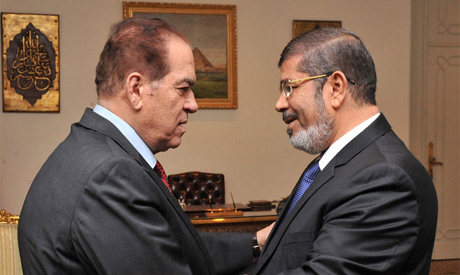
We should mention that former Prime Minister Kamal Ganzouri also wanted to borrow from the IMF but at the time the Brotherhood strongly objected, saying that borrowing would increase Egypt's debt and that paying interest is against Islamic law.

But now, here they are cheering president Morsi's loan request, which they suddenly discovered to be in conformity with Islamic law because “it is a necessity,” and the ends justify the means. It seems the Brotherhood has multiple doctrines from which it picks and chooses whatever suits its interests.
 
3) The Mubarak regime used to control the media and the national newspapers, which it utilized to spread lies and depict Mubarak as an inspiring and wise leader. Rather than make the newspapers independent and eliminate the Information Ministry, President Morsi appointed a Brotherhood member as Information Minister and the Brotherhood-dominated Shura Council appointed atop the national newspapers new editors who are well aware that they owe their positions to the Muslim Brotherhood.

Egypt’s Information Minister Salah Abdel Maqsood tells
Lebanese TV host
“I wish your questions are not as hot as you are,”

The Brotherhood's influence over the media is becoming clearer by the day. As it did with Mubarak, state television keeps broadcasting images of President Morsi.

Even the private channels want to solidify their relationship with the Brotherhood. They have started replacing journalists who oppose the Brotherhood with ones who are more friendly to it. Morsi’s recent television interview was an exact copy of Mubarak's:
 
The president sits majestically and full of confidence, and in front of him sits a TV announcer who is shuddering with fear because he knows that one wrong word could end his career or even his life.

The TV announcer asks the president softball questions and the latter answers with hollow and meaningless slogans. Then suddenly, the announcer looks at the president's face in wonderment and says:
“Your Excellency works tirelessly for the sake of Egypt. When do you get to rest?”
President Morsi has maintained Mubarak's corrupt media, which he is now using to his advantage.
 
4) The Constituent Assembly is now controlled by the Muslim Brotherhood. This means that no matter how many hearings and discussions they hold, the Brotherhood’s “supreme guide” will have the final say in determining Egypt's constitution.

Before he was elected, Morsi promised to make the Constituent Assembly representative of all parts of society. But as usual, he broke that promise and kept the assembly unchanged. The assembly is writing unacceptable articles that limit public freedoms, women's rights and the freedom of the press.
 
It is likely that the assembly will write a constitution that serves the interests of the Brotherhood and then call for a quick referendum whereby the Brotherhood's mighty political machine in the mosques would convince the ordinary people that they must approve the constitution to ensure their entry into heaven.

5) President Morsi promised that public freedoms would flourish under his reign. But the opposite has happened.
 
Newspapers were seized and al-Faraeen channel was closed. Regardless of how we felt about that channel, we do not accept that it be closed by an administrative order because then any channel that Morsi does not like can also be closed.

Islam Afifi is accused of insulting Prophet Mohammed .
SORRY, I mean President Mohammed Morsi
There is an Egyptian citizen named Bishwi al-Buhairi who will spend two years in prison for insulting President Morsi on Facebook. There are also senior journalists being tried on the same charge. The charge of "insulting the president" does not exist in a democracy, but president Morsi seems to want to put his opponents in prison. He refuses to decriminalize the so-called "publishing crimes."

Brotherhood official Mahmoud Ghozlan said that journalists will not be exempt from imprisonment because they are not better than others.
 
This statement betrays Ghozlan’s ignorance on what happens in civilized countries, where writers and journalists are not imprisoned because of their opinions or writings but are punished by paying a fine, if convicted.
Freedoms may not be better under Morsi than under Mubarak. In fact, they could get worse.

6) President Morsi was elected by the people but he also belongs to the Muslim Brotherhood, which is a secret organization and no one knows its rules, regulations or funding sources.
 
We have repeatedly demanded that the Brotherhood's status be codified and that its funding sources be placed under state supervision.

But it seems that President Morsi prefers to keep the Brotherhood a secret group that supports him from behind the scenes.

The president's connection with the group has resulted in behavior unacceptable in any democracy.
 
Brotherhood official Khairat Shater behaves as if he were the prime minister. He makes statements on government projects. He travels abroad and meets with foreign officials with which he negotiates and signs agreements. But under what capacity is he doing that?
 
We really don't know who rules Egypt: President Morsi or the Brotherhood’s supreme guide?

The situation has become worrisome. It seems that after the revolution nothing changed except the president. Mubarak was simply replaced with Morsi.
 
President Morsi moves around guarded by 3000 troops. When he prays at the mosque he prevents police officers from entering the mosque in order to keep the president secure.
When Morsi traveled to Rome he stayed at the same luxury hotel where Mubarak used to stay, costing the state thousands of pounds per night.

The revolution made a great achievement when it deposed Mubarak, tried him and threw him in prison with his followers. The revolution's task now should be to prevent the Muslim Brotherhood from controlling the state.

If the national forces do not immediately unite to prevent the Muslim Brotherhood from fully controlling the state then we and our children will pay a high price.
 
On the 42nd anniversary of Nasser's Death: 4 Nasserist Parties merge to stop selling out Egypt
 
The people who made this great revolution are capable of protecting it, God willing.

Democracy is the solution.

River to Sea Uprooted Palestinian
The views expressed in this article are the sole responsibility of the author and do not necessarily reflect those of this Blog

Monday, 27 August 2012

Gaza: Mursi Disappoints

“the situation of the crossing under Hosni Mubarak was better. The situation today is somewhat chaotic.” Iki is surprised by “Hamas’ silence regarding this decision.”

“Hamas does not want a tense relationship with Egypt’s rulers, the MB. It knows that if it loses its relationship with the MB, it will lose an ally and its situation would get worse." Political analyst, Ibrahim Abrash, told Al-Akhbar

 
Khalid Hamayreh who failed in turning deliberation into a sectarian mouth outlet, he returned to his PIC to spread is sectarian poison.
 
In his latest "Final ANAL-ysis" he called
"the Islamic movements should see to it that alternative and effective media outlets be founded in order to help shape an Islamic public opinion which can be mobilized when necessary. This is a paramount matter since the existing public-sector media in countries such as Egypt and Jordan is decidedly anti-Islamist if not anti-Islamic."

He urged Islamic movements
"to create as many new satellite TV stations as possible along with a large number of attractive and versatile internet sites in various languages in order to communicate the Islamic message and accurate information to the largest possible audience."
 
The Big Filthy mouth who ignored the inhuman siege on Gaza, the destruction of Gaza life lines ended his call saying:  
This is not to say, of course, that the Islamic movements should scale down its devotion to the Palestinian cause and confrontation with Zionism and Israel. 
In the final analysis, the Islamic movement's commitment to the Palestinian cause is the single most important factor contributing to Islamists' popularity among the masses.
Thus, revealing that his main concern is not the Palestinian cause, but the Isalamists popularity among the masses.
Alex.

Gaza: Mursi Disappoints


Palestinian men transport bags of cement through tunnels used for smuggling goods, including food, fuel and building materials, along the Gaza-Egypt border in Rafah, in the southern Gaza Strip, on 23 August 2012. (Photo: AFP - Mohammed Abed)
 
Published Sunday, August 26, 2012
 
When Mursi won the presidency in Egypt, Gazans were ecstatic and publicly celebrated their expectations of better times to come. Today, their disappointment is just as immense as their previous elation.

Palestinians were feeling frustrated with the Egyptian decision to only open the Rafah border crossing south of the Gaza Strip for three days a week. They had hoped that their situation would improve dramatically after Mohammed Mursi’s victory in the presidential election. After all, Mursi is a member of the Muslim Brotherhood (MB), Hamas’ ally.
 
Greetings in Egypt (MB Days VS Mubarak Days)

Al-Akhbar visited Gaza to speak to the residents about their situation. Amani Shnino said:
“I think it’s unfair to only allow three days for travel. The whole of Gaza is a humanitarian crisis and we were deceived by Mursi.”
Walid Iki (24 years old) expressed his wish that “the Rafah crossing would be open for longer, allowing any Gazan citizen to travel freely.” He pointed out that “the situation of the crossing under Hosni Mubarak was better. The situation today is somewhat chaotic.” Iki is surprised by “Hamas’ silence regarding this decision.”

After the Sinai incident in which 16 Egyptian soldiers were killed on August 6, the Egyptian authorities closed down the Rafah crossing. The Hamas government announced it would close the tunnels along Gaza’s southern borders, stopping citizens from leaving the country and stopping the entry of food items and fuel into Gaza.

As a result, people panicked and flocked to gas stations to store up on fuel and queues of cars were seen lining up. Closing the tunnels led to a gas shortage and a price hike and to scarcity in some items in Gaza’s markets.

Gazans were deeply disappointed after all their elation at Mursi’s victory.
The health sector was hit the worst by the repercussions of the crossing’s continued closing. Scores of patients have been unable to travel for operations and treatment outside Gaza.

The spokesperson of the Ministry of Health in the Gaza Strip Hamas government, Ashraf al-Qudra, said that
“each day the crossing is closed, the waiting lists of patients supposed to travel to Egypt increases by 40 patients. This requires the immediate opening of the crossing for a whole week so that patients can travel for treatment.”
He added: “Any delay in these cases exacerbates their medical conditions.” Qudra asked Egypt to “open the crossing all week long.”

Hamas has denied any relation to the incident in Sinai, accusing Israel of standing behind the attack. Its security agencies declared their willingness to cooperate fully with the Egyptian leadership to reveal the perpetrators and asked for the reopening of the crossing and the tunnels.

The deputy prime minister and foreign minister in the Gaza government, Muhammad Awad, told Al-Akhbar:
“We are hoping that the Egyptian decision will not be permanent or long-term. We need the Rafah crossing to be open at all times and to implement the agreement that was signed a month ago to open the crossing. Otherwise the Gaza Strip will face a real crisis and a health disaster.”
Political analyst, Ibrahim Abrash, told Al-Akhbar:
This Egyptian measure under the Mursi presidency is no different from previous measures under Hosni Mubarak. Egyptian national security takes priority regardless of the president or the party in charge. Egyptians give priority to their interests and their national security over any other ideological considerations. It appears that Egypt took this decision while awaiting the results of the Rafah investigations fearing that some Palestinians were involved in the Sinai incident.”
When asked about Hamas’ silence concerning this decision, Abrash said, “Hamas does not want a tense relationship with Egypt’s rulers, the MB. It knows that if it loses its relationship with the MB, it will lose an ally and its situation would get worse."
 
After all, Hamas is an offshoot of the MB.” Abrash pointed out that Hamas received assurances that opening the crossing is connected to closing the Rafah investigations.

In the meantime, the office of the prime minister of the Hamas government, Ismail Haniya, announced that the prime minister ended consultations regarding a cabinet reshuffle in his government, though no details were released. A statement said that: “Haniya ended his consultations after an adequate period of time,” and he is expected to present the new cabinet before the parliament soon for a vote of confidence.

Haniya’s expected decision is considered a new attempt at Palestinian reconciliation taking place with Egyptian sponsorship. The cabinet reshuffle comes as a response to a similar reshuffle in Salam Fayad’s government in the West Bank.

This article is an edited translation from the Arabic Edition.
River to Sea Uprooted Palestinian  
The views expressed in this article are the sole responsibility of the author and do not necessarily reflect those of this Blog!

Wednesday, 20 June 2012

هو انت ما بتموتش يا عم MUBARAK: Die, die!

Update: HE DID IT... DIED, Zionist channel 10 claimed

Update: Rough translation added

MUBARAK: Die, die!


A young Egyptian
narrating a poem (poetry written in the (colloquial language)
in which he is expressing his own feelings and the
feelings of the Egyptian nation towards
the Dictator, Hosni Mubarak.


Rough Translation

A dream, a dram dreamed by 60, 70, 80 million (Egyptians)
Suddenly, suddenly the Qur’an is heard being recited on the TV,
Followed by marches and an enormous variety of patriotic songs.
Titles in black ink filled today’s newspapers front pages;
Titles reading sad words,
But deeper underneath the blackness, there is glee.
The nation's become a pride wearing her bridal dress;
Her laughter concealed in her scream for your death.
Yes your death!
Provisions subsidy cards bear nothing but injustice, sadness and worries.
I hope one day I’ll attend on your funeral and I would not care if I die the next day.
I want to see anybody other than you sitting on the chair; be he black, white, educated or not …it won’t make a difference, be he even a son of a bitch.
Ah, since I grew out of my childhood, your image's always in front of my eyes.
The smile on your face's a sheet of ice,
Watching my dream, my homeland dream, the dream of my father, of my son and of his son….
Crumbles, buried in fire by your own hands.
Millions wished you ill in their death beds.
Million have suffered your injustice,
Are in hospitals, in funerals, in political prisons, in universities, in streets; students they be; journalists, housekeepers, engineers, workers, unemployed, teachers, lawyers, and even thieves.
They all wish you ill.
They hope they‘ll wake up one day to find you in your grave.
One last word, couldn’t you have helped themrealize their dream for once,
At least this time, this time


Just
get out of here, out of
my face

Posted by Aadel M Al-Mahdy at 8:31 PM
Labels: , ,

Saturday, 2 June 2012

Mubarak Sentenced to Life in Prison, Charged against Sons Dropped

Local Editor

Mubarak in courtAn Egyptian court sentenced former president Hosni Mubarak to life in prison on Saturday after convicting him of involvement in the murder of protesters during the 25th January revolution that ousted him last year.

Also given a life term for the killings was Mubarak's former interior minister Habib al-Adly, while six former police commanders were acquitted.

Corruption charges against Mubarak's sons, Alaa and Gamal, were dropped due to the expiry of a statute of limitations.

Chaos inside the courtroomMubarak was acquitted in one of the corruption cases.

Scuffles broke out soon after the verdicts were delivered, and chants of "Void, void" and "The people want the judiciary purged" could be heard.

Lawyers inside the courtroom were furious over the acquittals, expressing fears that Mubarak and Adly would be found innocent on appeal.

Alaa and Gamal Mubarak in behind the barsThe former strongman, wearing dark classes and a beige tracksuit, showed no emotion as Judge Ahmed Refaat read out the sentence. While his two sons, Alaa and Gamal, appeared close to tears on hearing the verdict.

Clashes erupted outside the court following the sentencing, as police used stun grenades to control the crowds.

Mubarak, the only autocrat toppled in the Arab Spring to be put in the dock, former interior minister Habib al-Adly and six others were on trial over their involvement in the deaths of some of the estimated 850 people killed during the revolution last year.

Mubarak, his sons Alaa and Gamal and business associate Hussein Salem, who fled to Spain, were also on trial over an alleged bribe.
River to Sea Uprooted Palestinian  
The views expressed in this article are the sole responsibility of the author and do not necessarily reflect those of this Blog!

Monday, 30 April 2012

Egypt just annulled Mubarak’s natural gas giveaway- Will Sadat’s Camp David and the Zionist Embassy be next?


Franklin Lamb


Egypt just annulledMubarak’s natural gas giveaway
the gas line to Israel was severed 14 times in 12 months
Will Sadat’s Camp David and the Zionist Embassy be next?
Milestone 1


Milestone 2

Milestone 3

During Mubarak’s presidency, billions were lost due to corruption,
Milestone 4


The Egyptian people are demanding the return of their sovereignty. According to recent opinion surveys they believe it was partially ceded to Israel by the two post-Nasser dictators, Anwar Sadat and Hosni Mubarak, at the behest of American administrations, from Nixon to Obama.

The removal of three humiliating shackles for Egyptians, the gas give-away scheme, the 1979 Camp David Accords and the US forced recognition of Israel, constitute a strategic national security objective for most of Egypt’s 82 million citizens. 
Egyptian hold pictures of Hassan Nasrallah
and Egyptian flags with Arabic writing
"No for gas deterioration, stop exporting Egyptian gas"
during a protest in Cairo on Feb. 2, 2009.
(AP file photo)

According to the results of an opinion poll, conducted for Press TV and published on October 3, 2011, 73 percent of the Egyptian respondents opposed the terms of the agreement. Today the figure is estimated at 90%.
For the past eight years, the 2004 gas deal has been widely unpopular, and one of the charges in the current indictment against Mubarak is that the deposed President sold Egypt’s gas as part of a sweetheart deal involving kickbacks to family members, associates and Israeli officials.

In the recent parliamentary elections and now during the presidential campaign, Egyptians have been debating relations with Israel publicly for the first time. Previously Mubarak was Israel’s protector and like some other Arab leaders still clinging to power, ignored his people’s demands for actively supporting for the liberation of Palestine.

In late January 2012, an Alexandria University student briefed this observer and a small group of Americans and Europeans sitting on benches opposite the wonderful ancient city’s majestic Great Library.  
A free Palestine
Free from the River to the Sea
 He explained, recalling the demands of the Tahrir Square protests on January 25, 2011,
“Our slogans at Tahrir Square were bread, freedom, dignity, and social justice. That was almost exactly one year ago. God willing, we will soon achieve the demands of our historic revolution which includecanceling Camp David and withdrawing recognition of the Zionist regime still occupying Palestine. Egypt must again lead the Arab Nation’s sacred obligation to liberate Jerusalem and all of Palestine from the river to the sea.”
A stunning hijabed female student continued the dialogue, giving us her opinion:


“The USA bought some of our leaders with billions in generous cash from your people but without any real benefit to ours. Camp David was essentially a private agreement by Sadat and then Mubarak. Our people had no say and were never asked whether we agreed. If we protested, we were jailed or worse. Now, the Egyptian people are gaining power despite a likely military coup by the SCAF military junta before the scheduled June elections.”
Israeli officials, in tandem with the US Zionist lobby are claiming that the abrogation of the gas agreement constitutes an “existential threat”. According to a researcher at the US Congressional Research Service in the Madison Building on Capitol Hill whose job includes keeping track of Israeli claims, it’s the 29th“existential threat” the Zionist colony has identified in its 64 year history.

These perceived existential threats range from the internationally recognized Right of Return for Palestinians ethnically cleansed from their homes during and since the 1948 Nakba, to various Palestinian groups, more than two dozen UN Resolutions including, 194 and 242, Hezbollah naturally, international solidarity movement projects, a Jewish academic or two, Iran for sure, the rise of internet blogs, and potentially virtually every Christian, Arab and Muslim on the planet, not to mention the claimed rise of global anti-Zionism which the US Zionist lobby has recently decreed was always just another form of virulent anti-Semitism.

Despite all these perceived “existential threats”including recently the so-called “Road Map”, Israeli leaders continue to eschew any substantive negotiations which could mean Arabs and Jews sharing Palestine as part of one democratic, secular state on the basis of one person one vote, minus any ‘chosen people’ lunacy.

Yuval Steinitz, Israel’s finance minister warned that Egypt’s questioning its relations with Israel was “a dangerous precedent that threatens the peace agreements between Israel and Egypt.”

Ampal, the Israeli company which buys the gas, said that it considers the termination of the contract "unlawful and in bad faith", and demanded its full restoration. Ampal, is planning to use international arbitration to attempt redress and is sending a corporate delegation to Washington to meet with AIPAC and administration officials to ask them to get the Egyptian action nullified and to force Egypt to keep selling its natural gas at below market prices. One congressional staffer joked in an email that Israeli companies get way better constituent services out of Congress than American companies, or even the voters who elect its members.

Israeli political analyst Israel Hayom wrote last weekend:


” The painful conclusion from the collapse of the gas agreement with Egypt is that we are regressing to the days before the peace agreement with Egypt and the horizon does not look rosy at all. Camp David is in mortal danger. The painful conclusion is, once again, that we have no genuine friends in the region. Certainly not for the long term.”

The ADL’s Abe Foxman lamented,

“Israel gave Egypt a great deal in exchange for the Camp David peace agreement, much more than we should have. Among other things, a free trade zone, in which we veritably pushed for the establishment of sewing workshops and an Egyptian textile industry so that they would be able to easily export cheap cotton and other goods to the United States as well as to Israel. We made the Egyptians a respectable people in the eyes of the American public. And this is how we are repaid what they owe us?”
Never idle for long, AIPAC began circulating a draft resolution this week to its key Congressional operatives aimed at having the US Congress condemn the cancellation of the gas giveaway and demanding its immediate renewal under threat of the US terminating aid to Egypt. The lobby has also begun to squeeze the Obama administration, threating a cut off of Jewish donors if nothing is done to convince Egypt “to get real” in the words of ultra Zionist Howard Berman, the ranking Democrat on the House Foreign Affairs Committee.

The political reality is that American diplomats, AIPAC, and Israeli officials, sometimes difficult to distinguish from one another, have been bracing for a breach in Egyptian-Israeli relations since last spring’s demonstration in Tahrir Square. They rightly fear that Camp David and the Israeli embassy in Cairo will be next on the chopping block as the Egyptian people stand up.

Regarding the expected closing of the Israeli embassy, according to the daily Yedioth Ahronoth:
“What we have at the moment is a swift deterioration in relations: Israelis can no longer set foot in Egypt, and the Egyptian consulate in Tel Aviv does not have a mandate to issue entry visas. Anyone who insists on going to Egypt from Israel even with a foreign passport can expect to get into trouble. His name could join the list of spiesandMossad agentsThey dont want us. It’s that simple and it is very dangerous now for Israelis to be in Egypt.”
According to Netanyahu spokesman Mark Regev,
There is also no one who will rent a building to the Israeli embassy in Cairo, for the small embassy staff headed by Ambassador Yaakov Amitai. Due to security considerations, we have cut drastically their work week. The staff lands every Monday afternoon and leaves early Thursday. Every time an address is found for the embassy (at an exorbitant price), the local security officials shoot down the deal. As far as the Egyptians are concerned, the Israeli diplomats can stay in Jerusalem until their next president is elected and then we will see what happens.”
Franklin LambFranklin Lamb is doing research in Lebanon. He is reachable c\o fplamb@gmail.com


He contribute to Uprooted Palestinians Blog
Please Sign http://www.petitiononline.com/ssfpcrc/petition.html

Beirut Mobile: +961-70-497-804
Office: +961-01-352-127

Shatila Palestinian Refugee Camp
River to Sea Uprooted Palestinian  

The views expressed in this article are the sole responsibility of the author and do not necessarily reflect those of this Blog!