Uprooted Palestinians are at the heart of the conflict in the M.E Palestinians uprooted by force of arms. Yet faced immense difficulties have survived, kept alive their history and culture, passed keys of family homes in occupied Palestine from one generation to the next.
There is an unmistakable shift in American politics regarding Palestine and Israel, a change that is inspired by the way in which many Americans, especially the youth, view the Palestinian struggle and the Israeli occupation. While this shift is yet to translate into tangibly diminishing Israel’s stronghold over the US Congress, it promises to be of great consequence in the coming years.
Recent events at the US House of Representatives clearly demonstrate this unprecedented reality. On September 21, Democratic lawmakers successfully rejected a caveat that proposes to give Israel $1 billion in military funding as part of a broader spending bill, after objections from several progressive Congress members. The money was specifically destined to fund the purchase of new batteries and interceptors for Israel’s Iron Dome missile defense system.
Two days later, the funding of the Iron Dome was reintroduced and, this time, it has successfully, and overwhelmingly, passed with a vote of 420 to 9, despite passionate pleas by Palestinian-American Representative, Rashida Tlaib.
In the second vote, only eight Democrats opposed the measure. The ninth opposing vote was cast by a member of the Republican party, Thomas Massie of Kentucky.
Though she was one of the voices that blocked the funding measure on September 21, Democratic Representative, Alexandria Ocasio Cortez, switched her vote at the very last minute to “present”, creating confusion and generating anger among her supporters.
As for Massie, his defiance of the Republican consensus generated him the title of “Antisemite of the Week” by a notorious pro-Israel organization called ‘Stop Antisemitism’.
Despite the outcome of the tussle, the fact that such an episode has even taken place in Congress was a historic event requiring much reflection. It means that speaking out against the Israeli occupation of Palestine is no longer taboo among elected US politicians.
Once upon a time, speaking out against Israel in Congress generated a massive and well-organized backlash from the pro-Israeli lobby, especially the American Israel Public Affairs Committee (AIPAC), that, in the past, ended promising political careers, even those of veteran politicians. A combination of media smear tactics, support of rivals and outright threats often sealed the fate of the few dissenting Congress members.
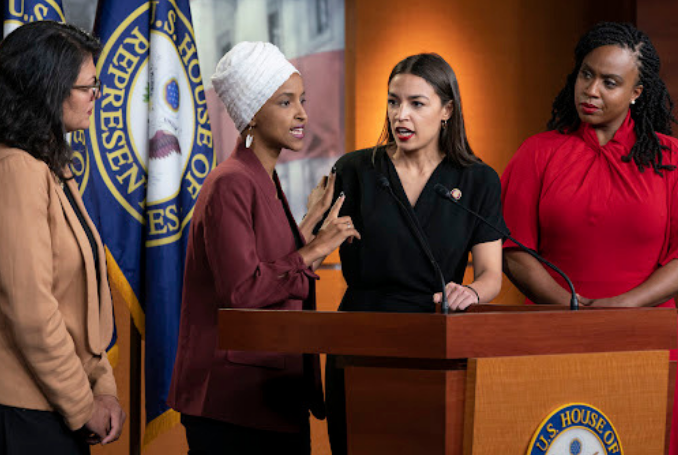
While AIPAC and its sister organizations continue to follow the same old tactic, the overall strategy is hardly as effective as it once was. Members of the Squad, young Representatives who often speak out against Israel and in support of Palestine, were introduced to the 2019 Congress. With a few exceptions, they remained largely consistent in their position in support of Palestinian rights and, despite intense efforts by the Israeli lobby, they were all reelected in 2020. The historic lesson here is that being critical of Israel in the US Congress is no longer a guarantor of a decisive electoral defeat; on the contrary, in some instances, it is quite the opposite.
The fact that 420 members of the House voted to provide Israel with additional funds – to be added to the annual funds of $3.8 billion – reflects the same unfortunate reality of old, that, thanks to the relentless biased corporate media coverage, most American constituencies continue to support Israel.
However, the loosening grip of the lobby over the US Congress offers unique opportunities for the pro-Palestinian constituencies to finally place pressure on their Representatives, demanding accountability and balance. These opportunities are not only created by new, youthful voices in America’s democratic institutions, but by the rapidly shifting public opinion, as well.
For decades, the vast majority of Americans supported Israel. The reasons behind this support varied, depending on the political framing as communicated by US officials and media. Prior to the collapse of the Soviet Union, for example, Tel Aviv was viewed as a stalwart ally of Washington against Communism. In later years, new narratives were fabricated to maintain Israel’s positive image in the eyes of ordinary Americans. The US so-called ‘war on terror’, declared in the aftermath of the September 11, 2001 attacks, for example, positioned Israel as an American ally against ‘Islamic extremism’, painting resisting Palestinians as ‘terrorists’, thus giving the Israeli occupation of Palestine a moral facade.
However, new factors have destabilized this paradigm. One is the fact that support for Israel has become a divisive issue in the US’ increasingly tumultuous and combative politics, where most Republicans support Israel and most Democrats don’t.
Moreover, as racial justice has grown to become one of the most defining and emotive subjects in American politics, many Americans began seeing the Palestinian struggle against the Israeli occupation from the prism of millions of Americans’ own fight for racial equality. The fact that the social media hashtag #PalestinianLivesMatter continues to trend daily alongside the hashtag #BlackLivesMatter speaks of a success story where communal solidarity and intersectionality have prevailed over selfish politics, where only money matters.
Millions of young Americans now see the struggle in Palestine as integral to the anti-racist fight in America; no amount of pro-Israeli lobbying in Congress can possibly shift this unmistakable trend. There are plenty of numbers that attest to these claims. One of many examples is the University of Maryland’s public opinion poll in July, which showed that more than half of polled Americans disapproved of President Joe Biden’s handling of the Israeli war on Gaza in May 2021, believing that he could have done more to stop the Israeli aggression.
Of course, courageous US politicians dared to speak out against Israel in the past. However, there is a marked difference between previous generations and the current one. In American politics today, there are politicians who are elected because of their strong stance for Palestine and, by deviating from their election promises, they risk the ire of the growing pro-Palestine constituency throughout the country. This changing reality is finally making it possible to nurture and sustain pro-Palestinian presence in US Congress.
In other words, speaking out for Palestine in America is no longer a charitable and rare occurrence. As the future will surely reveal, it is the “politically correct” thing to do.
– Ramzy Baroud is a journalist and the Editor of The Palestine Chronicle. He is the author of five books. His latest is “These Chains Will Be Broken: Palestinian Stories of Struggle and Defiance in Israeli Prisons” (Clarity Press). Dr. Baroud is a Non-resident Senior Research Fellow at the Center for Islam and Global Affairs (CIGA) and also at the Afro-Middle East Center (AMEC). His website is www.ramzybaroud.net
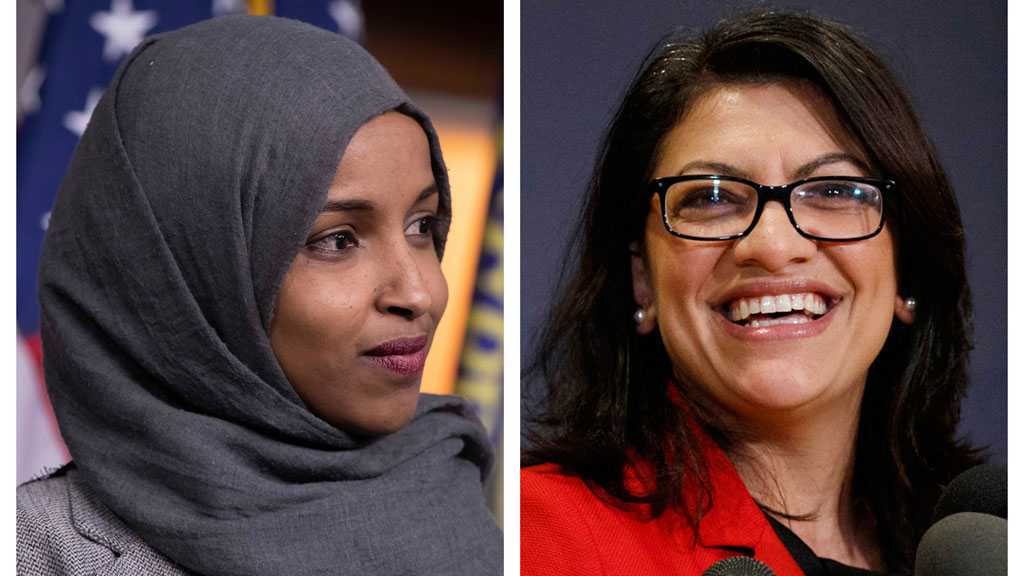
Muslim-American Democrats Rashida Tlaib and Ilhan Omar have won reelection to US House in the 13th District of Michigan and in Minnesota’s 5th Congressional District respectively.
According to The Associated Press, Omar 38, defeated her Republican challenger, Lacy Johnson, by 64.6 percent of the vote to 25.9 percent.
Elected as the first Muslim female to Congress in 2018, both politicians comfortably fended off primary challenges in August to secure a second term for their seats.
44 years old Rashida in a recent tweet said “It is an honor to stand against all forms of hate and oppression. Shukran [Thank you]!”
Earlier in an interview Tlaib vowed to push for Palestinian rights. She said Covid-19 relief will be her top priority for her second term in the House.
4 November 2020 08:01 UTC | Last update: 40 mins 51 secs ago
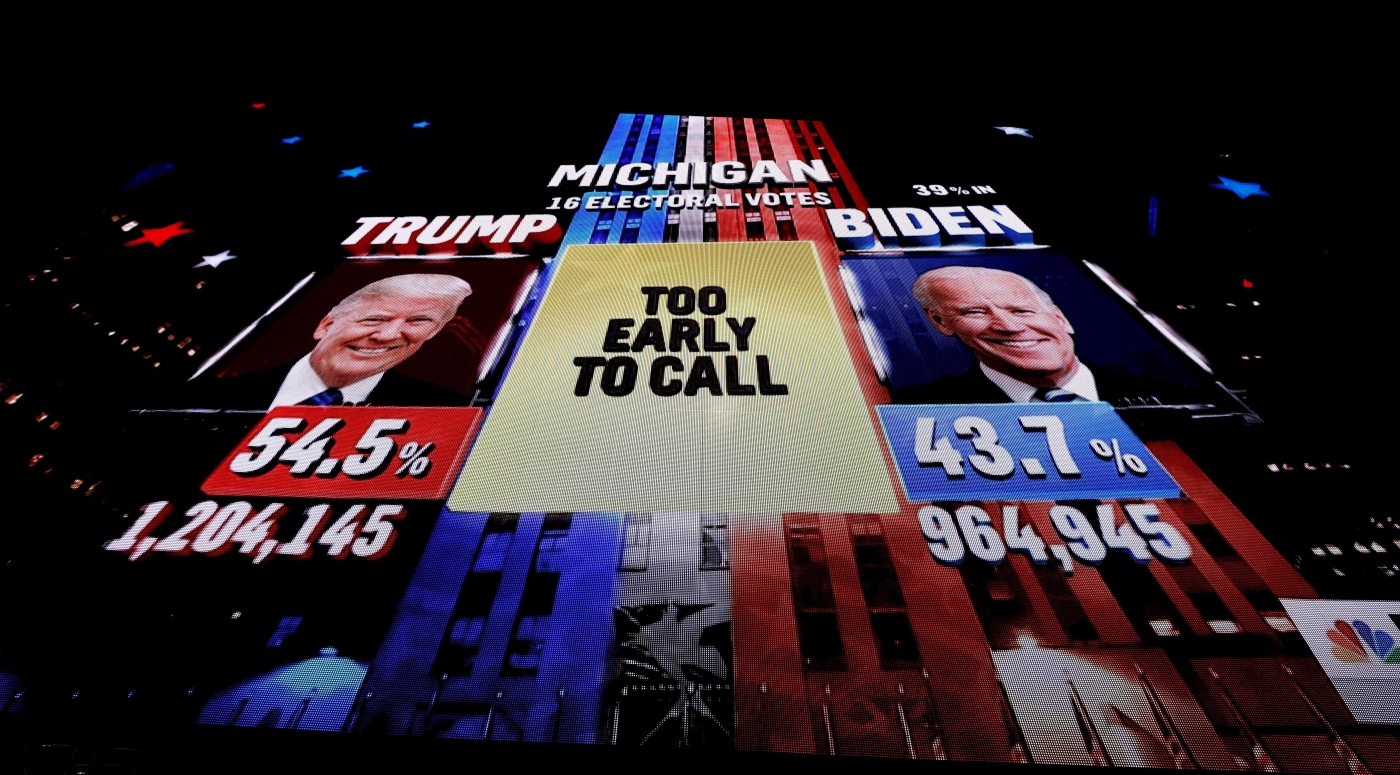
US President Donald Trump appeared to claim victory without a clear path to an electoral college majority early on Wednesday, despite millions of votes in key swing states remaining uncounted, and Democratic challenger Joe Biden currently leading in electoral votes.
With an influx of mail-in ballots slowing down the count, major swing states – including Pennsylvania, Wisconsin, Michigan and Arizona – were too close to call.
“We were getting ready to win this election. Frankly, we did win this election,” Trump told reporters at the White House. “This is a major fraud in our nation. We want the law to be used in a proper manner,” he said.
“We want all voting to stop. We don’t want them to find any ballots at four o’clock in the morning and add them to the list.”
In recent months leading up to the election, the president has made repeated claims – without evidence – that an increase of mail-in voting will lead to an increase in fraud. US election experts say that fraud is rare and postal ballots, which have increased at this election due to the coronavirus pandemic, are a long-standing feature of American elections.
Voting went largely smoothly on Tuesday. There were no large reports of voter obstruction as polling stations across the country worked to make sure everyone trying to vote was able to do so.
Trump had scored some major victories by the end of the night, retaining several states he had won in 2016 that Biden was looking to flip. The president held on to Florida and also crushed Democrats’ hopes of making inroads in Texas.
Biden, Trump in close race
Biden took the largely Democratic states of California and New York, along with Illinois, Virginia, and Minnesota.
Many polls just prior to the election had predicted a clear Biden victory, yet as results continue to trickle in, that remains to be seen.
In a final remark to his supporters early on Wednesday, Biden said that he was confident he would win when all votes had been counted.
“We feel good about where we are. We believe we are on track to win this election,” he told a drive-in rally in Wilmington, Delaware.
Biden’s hopes for a decisive early victory faded away after Trump took back the lead in North Carolina, Ohio, Georgia, and Texas.
The former vice president has also been looking to secure the states of Michigan, Wisconsin and Pennsylvania that Trump had previously won in 2016. Yet vote counting there could stretch out into days.
Arizona turned out to be a surprise, with Biden currently leading in what has previously been a red state.
Trump’s accusations of voter fraud
Trump invited hundreds of supporters to the White House to view the election results on Tuesday night, serving drinks, chicken fingers and cookies.
On Twitter, the president made accusations that there was an attempt to “steal the election”. The social media company was quick to flag the post as misleading.
Abed Ayoub, legal director of the American-Arab Anti-Discrimination Committee (ADC), said that Trump’s call for vote counting to stop is voter disenfranchisement.
“It’s massive voter disenfranchisement the likes we haven’t seen since the days of slavery and Jim Crow,” Ayoub told MEE of Trump’s speech. “Every single vote must be counted.”
Congresswoman Ilhan Omar, who was re-elected by a landslide to Minnesota’s 5th congressional district on Tuesday, wrote on Twitter: “Counting ALL ballots isn’t the same as voting. You can’t stop ballots from being counted. This isn’t a dictatorship.
“This man is dangerous.”
Senate Republicans seek to maintain majority
On the Senate side of the race, Republican incumbents mostly staved off Democratic challengers’ hopes to unseat them and give Democrats a majority in the chamber.
Republicans currently hold a majority of 53 seats in the 100-seat chamber, where senators hold six-year terms for office.
Democrats need to win four seats in order to secure the majority, or three if Biden wins the White House (if elected, Vice President Kamala Harris would have a tie-breaking vote in the legislature).
So far, Democratic incumbent Senator Doug Jones from Alabama has lost to Republican challenger Tommy Tuberville. Democratic challenger John Hickenlooper defeated incumbent Republican Senator Cory Gardner in the state of Colorado.
In South Carolina, Senator Lindsey Graham – a close Trump ally – held off a strong challenge from Democrat Jaime Harrison, who raised upwards of $57m in the last quarter.
In Texas, veteran Republican Senator John Cornyn held off a challenge from Democrat MJ Hegar. Senate races in Arizona, Michigan, and North Carolina are still too close to call.
AIPAC is a strong lobbying group that is perceived by the political parties to exert great influence on large Jewish donors and Jewish voters generally. The leadership of both parties competes for AIPAC approval, although as an organization it refrains from political endorsements at national levels. It does have a record of opposing Congressional candidates deemed critical of Israel, making inflammatory accusations that candidates critical of Israel are by that fact alone anti-Semitic. Such a campaign has been launched with at least implicit AIPAC support to defeat the candidacy of Ilhan Omer who is running for reelection in urban Minneapolis.
Part of the effectiveness of AIPAC is due to money and tight organizational discipline, and part of its influence is due to the absence of countervailing Jewish organizations that speak for liberal Zionism and progressive Jews. J-Street has attempted to provide a voice for liberal Zionism in Washington, and has limited success at legislative levels, but not in relation to party platforms or the selection of national candidates. Jewish Voice for Peace is an admirably balanced NGO, but its influence is mainly felt in civil society, where it has created growing support for a just outcome of this struggle that has gone on for a century, which includes supported the realization of the Palestinian right of self-determination whether in the form of a viable separate sovereign state or a single state whose foundational principle is ethnic equality.
Throughout its existence, AIPAC has been and remains subservient to the priorities of the Israeli leadership and consistently supportive of maximal Zionist goals, and hence an adherent of antagonistic attitudes on international law, the UN, and international morality. In my judgment, AIPAC has harmed the role of the U.S. in West Asia and at the UN by pushing American foreign policy in belligerent and regime-changing directions, focusing on heightening the confrontation with Iran, and secondarily, with Turkey, which has intensified regional tensions and dangers of war. The recent sanctions debate in the UN Security Council manifested both U.S. belligerence and its defiance of the views of even its normally close European allies.
Richard Anderson Falk is an American professor emeritus of international law at Princeton University. In 2008, the United Nations Human Rights Council (UNHRC) appointed Falk to a six-year term as a United Nations Special Rapporteur on “the situation of human rights in the Palestinian territories occupied since 1967”.
Amid a spreading COVID-19 pandemic, the United States government is continuing to ramp up aggression against Iran in lieu of responding to the true threat of disease. Earlier today, the U.S. military launched a number of strikes against five separate targets in Iraq, all of which it alleges are “pro-Iranian” groups. At least six deaths reported. Washington has described the move as retaliation for previous attacks on Western forces. “The United States will not tolerate attacks against our people, our interests, or our allies,” Defence Secretary Mark Esper said. “As we have demonstrated in recent months, we will take any action necessary to protect our forces in Iraq and the region.” The Iraqi government, which has formally requested the United States leave the country, condemned the action.
Iran is reeling from the coronavirus, with over 11,000 confirmed cases and 514 deaths – the most of any country outside of China and Italy. A host of government officials and 23 members of the Iranian parliament have been diagnosed. Yet the U.S. is using their misfortune to further punish and destroy the Islamic Republic.
Iran is suffering from huge shortages of medical supplies, including crucial virus detection kits, precisely because other sovereign nations refuse to sell them to Tehran, fearing reprisals from the Trump administration. Eventually, the World Health Organization was forced to step in and begin sending them directly. Iranian-American blogger Hoda Katebi revealed that her aunt, a doctor in Iran, is even forced to share facemasks with other hospital staff, highlighting the intense shortages the country faces. Because of the sanctions, it is a crime to donate money to Iranian organizations fighting the virus.
In January, MintPress reported that Silicon Valley tech firms had joined the Trump administration’s all-out war against Tehran. The Iranian government recently released an app intended to inform citizens and medical workers about the virus and protect the population from infection. Google, however, following United States law about aiding “terrorist” organizations, duly removed it, noting, “developer accounts from Iran are not allowed on Google Play.”
In January, Trump ordered the assassination of top Iranian general and statesman Qassem Soleimani while he was in Baghdad for peace talks. The U.S. has sent around 2,500 troops to Saudi Arabia and many thousands more to other nations in the region as the buildup of military might continues. Over the vehement protestations of locals, it has also begun to construct three new bases in Iraq, all very close to the Iranian border.
Anti-war group Code Pink are demanding that all sanctions be lifted, writing to the Treasury Department:
Health, hygiene, and access to medical care are fundamental human rights, regardless of race, religion and nationality. For the sake of the health and well-being of 80 million Iranians and their neighbors, we demand that you immediately lift all sanctions on Iran pertaining to healthcare products, medicine, medical laboratory kits, and equipment. In addition, we call on you to lift all the sanctions on Iran, ending the campaign of maximum pressure that is crippling the Iranian economy.
Meanwhile, Minnesota congresswoman Ilhan Omar introduced legislation attempting to rein in aggressive American foreign policy towards Iran.
Ilhan Omar
@IlhanMN
As hundreds of public schools close, *22 million* children who count on their schools for free or reduced-price meals don’t know when they’ll eat next.
House members are introducing today 3 proposals for meal assistance for schools closed or transitioned to remote learning due to the ongoing #coronavirus outbreak. An aide says the proposals are expected to pass the full House. http://ow.ly/LuGf50yJhva
While the government has found plenty of money to carry out wars around the globe (the Trump administration increased the military budget to $934 billion), when it comes to policies protecting public health, money is always apparently lacking. At the Democratic debates, moderators have asked candidates 21 questions about how to pay for social programs, but zero about paying for war.
Omar herself is a vocal proponent of emergency legislation to protect the United States from the worst economic and societal decline the coronavirus threatens to bring. On Wednesday, she introduced a provision of a bill that would introduce free virus testing for all Americans, two weeks’ emergency paid sick leave for all, increased funding for Medicaid and guarantee food for poor children during the crisis. “As the country responds to coronavirus, we cannot forget that many Americans could face hardship as a result of some of our preventative measures,” she said. “Twenty-two million children rely on federal subsidized meals. For many kids, it is the only meal they get each day. It is our responsibility to ensure that kids continue to get the meals they need.”
The deep inequalities in American society are harming the country’s ability to respond to the coronavirus effectively. Without universal healthcare, sick Americans face bills of up to $3,500 simply for being tested, while others face financial ruin or homelessness if they miss work self-quarantining. New York City announced it would only close its schools as a “last resort” on the basis that tens of thousands of homeless children have literally nowhere else to go. “History will judge us if we don’t pass [the legislation] immediately,” Omar added.
Although there is a seemingly bottomless pit of money to fund wars abroad or to bail out the rich (yesterday the Federal Reserve injected $1.5 trillion into the stock market, leading to a 15-minute surge), the government moves at a glacier-like pace when it comes to provisions that would help ordinary citizens. President Trump only recently agreed to make coronavirus testing free. Still, only 8,000 Americans have been tested in total, compared to nearly 20,000 per day in South Korea. The arrival of a worldwide pandemic puts into stark contrast what Washington’s priorities really are.
A mafia runs editors. Freedom of the press is dead. Journalists and ordinary people must stand up.
Introduction
Syria
Newsweek Suppression: A Timeline of Events
Editors at Fault
Is Rep. Ilhan Omar a Spy?
External Control of the Media Narrative
INTRODUCTION
Until several days ago, I was a journalist at Newsweek. I decided to hand my resignation in because, in essence, I was given a simple choice. On one hand, I could continue to be employed by the company, stay in their chic London offices and earn a steady salary—only if I adhered to what could or could not be reported and suppressed vital facts. Alternatively, I could leave the company and tell the truth.
In the end, that decision was rather simple, all be it I understand the cost to me will be undesirable. I will be unemployed, struggle to finance myself and will likely not find another position in the industry I care about so passionately. If I am a little lucky, I will be smeared as a conspiracy theorist, maybe an Assad apologist or even a Russian asset—the latest farcical slur of the day.
Although I am a British citizen, the irony is that I’m half Arabic and half Russian. (Bellingcat: I’m happy to answer any requests.)
It is a terribly sad state of affairs when perfectly loyal people who want nothing but the best for their countries are labelled with such preposterous accusations. Take Iraq war veteran and Hawaii congresswoman Tulsi Gabbard for example, who was the target of such mud slinging for opposing U.S. involvement in Syria and for simply standing up to the Democratic Party’s most corrupt politician, Hillary Clinton. These smears are immature for a democracy—but I, in fact, welcome such attacks.
When the facts presented are utterly ignored and the messengers themselves are crucified in this way, it signals to right-minded people who the true perpetrators of lies are and where the truth in fact lies.
That truth is what matters most to me. It is what first drove me to journalism while I was working in Jersey’s offshore finance industry after completing my degree from Binghamton University’s School of Management in upstate New York. I was so outraged when I grew to realize that this small idyllic island I love and had grown up on since the age of nine, a British Crown dependency fifteen miles off the coast of France, was in fact a hub for global tax evasion. This realization came to me while the British people were being told that austerity had to continue—public funding for schools, hospitals, policing and all matter of things were to be slashed—all while the government “recovered” after bailing out the banks following the 2008 crash. That austerity lie was one I could no longer stomach as soon as I came to understand that my fairly uninspiring administrative role was in fact a part of this global network of firms to help multinational companies, businessmen, politicians and members of various royal families in avoiding paying trillions in tax—all under a perfectly legal infrastructure that the government was fully aware of, but kept quiet about.
In my naivety, as I left that industry and began my journalism training, I wrote a piece that detailed some of this corruption in hopes of changing the public awareness around these issues and in hopes that they no longer continued—albeit I did so in a manner of writing and sophistication I would be embarrassed of presently—but to my disappointment at the time, the piece was hardly noticed and the system remains little changed to now. Nonetheless, since that moment, I have not once regretted speaking truthfully, most especially for my own mental wellbeing: I would not have been able to regard myself with a grain of self-respect had I continued to engage in something I knew was a lie. It is the very same force that compels me to write now.
There is also another, deeper force that compels me to write. In my years since that moment when I decided to become a journalist and a writer, although I suspect I have known it intrinsically long before, I have come to learn that truth is also the most fundamental pillar of this modern society we so often take for granted—a realisation that did not come to us easily and one that we should be extremely careful to neglect. That is why when journalistic institutions fail to remember this central pillar, we should all be outraged because our mutual destruction follows. It may sound like hyperbole, but I assure you it’s not. When our record of where we come from is flawed, or our truth to put it more simply, the new lies stack on top of the old until our connection to reality becomes so disjointed that our understanding of the world ultimately implodes. The failure of current journalism, among other factors, is undoubtedly linked to the current regression of the Western world. In consequence, we have become the biggest perpetrators of the crimes our democracies were created to prevent.
Of course, for those who pay attention, this failure of mainstream journalism I speak of is nothing new. It has been ongoing for decades and was all too obvious following the Iraq war fiasco. The U.S. and U.K. governments, headed by people who cared for little other than their own personal gain, told the people of their respective countries a slew of fabrications and the media establishment, other than a handful of exceptions, simply went along for the ride.
This was something that consumed my interest when I was training to be a journalist. How could hundreds of reputable, well-meaning journalists get it so wrong? I read numerous books on the issue—from Noam Chomsky’s Manufacturing Consent and Philip Knightley’s The First Casualty to work by Chris Hedges, the Pulitzer-prize-winning former foreign correspondent for the New York Times who was booted out for opposing that war (who I disagree with on some things, for the record)—but still, I believed that honest journalism could be done. Nothing I read however, came close to the dishonesty and deception I experienced while at Newsweek. Previously, I believed that not enough journalists questioned the government narrative sufficiently. I believed they failed to examine the facts with close enough attention and had not connected the dots as a handful of others had done.
No. The problem is far worse than that.
SYRIA
In the aftermath of the Iraq war and during my time studying this failure of the media since, I was of course extremely aware of the high likelihood that the U.S. government narrative on Syria was a deception. For starters, there were the statements made by the retired four-star general, General Wesley Clark, to Democracy Now’s Amy Goodman in 2007, four years prior to the beginning of the Syria conflict. The following is worth watching to in full.
Nonetheless, once I joined IBTimes UK in 2016, after training with the Press Association and working at the Hull Daily Mail (both of whom I am eternally indebted to for giving me an excellent foundation for starting my career) I solidly understood that journalism was not the profession of making unverifiable claims. I, or any journalist for that matter, could not out-right say that the nature of the Syrian conflict was based on a lie, no matter how strongly we suspected it. To do so, we would need unshakeable evidence that pointed to this.
Through the years, good journalists did document evidence. Roula Khalaf, who will soon take over from Lionel Barber as the editor of the Financial Times, wrote one such piece alongside Abigail Fielding-Smith in 2013. It documented how Qatar provided arms and funded the opposition of Bashar al-Assad’s legitimate government to the tune of somewhere between $1 and $3 billion from the outset of the conflict, rubbishing claims that it was a “people’s revolution” that turned violent. Footage captured by Syrian photographer Issa Touma—made into a short film titled 9 Days From My Window in Aleppo—similarly showed how Qatar-funded jihadists from the Al-Tawhid Brigade were present in the streets of Syria’s capital from the very outset of the war.
“Fighters re-enter my street,” Touma says as he films covertly out of his window. “They look different. They are heavily armed men with beards. I had only heard about them before. This is Liwa al-Tawhid. National television calls them terrorists. The international press calls them freedom fighters. I don’t care what they call it—I refuse to chose a side. But it’s a lie that the revolution started peacefully everywhere. At least in my street, Al Said Ali Street, it started with guns. It didn’t start peacefully at all.”
Veterans of the trade Seymour Hersh and Robert Fisk also poked holes in the U.S. government narrative, but their treatment by other journalists has been one of the most shameful episodes in the history of the press.
Hersh—who exposed the My Lai Massacre during the Vietnam War, the clandestine bombing of Cambodia, the torture at Abu Ghraib prison, in addition to telling the world the real story of how Osama Bin Laden died—was shunned from the industry for reporting a simple fact: Bashar al-Assad’s government is not the only actor with access to chemical weapons in Syria. After a sarin attack in the Damascus suburb of Ghouta in 2013, he was further smeared for reporting that Barack Obama withheld important military intelligence: samples examined in Britain’s Porton Down did not match the chemical signatures of sarin held in the Syrian government’s arsenals.
Fisk, writing days before the Syrian conflict escalated, in a piece that asked Americans to consider what they were really doing in the Middle East as the ten-year anniversary of 9/11 approached, also raised important questions, but he too was largely ignored.
The following year, after the alleged chemical weapons attack in Khan Sheikhoun, I documented the intriguing story of Shajul Islam, the British doctor who purported to have treated the alleged victims and appeared on several television networks including NBC to sell the case for retaliation. He gushed with heroism, but it was not reported he was previously charged with terror offences in the U.K. and was in fact considered a “committed jihadist” by MI6. He was imprisoned in 2013 in connection with the kidnapping of two Western photo-journalists in northern Syria and was struck off Britain’s General Medical Council in 2016. Why he was released without sentencing and was allowed to travel back to Syria remains a mystery to me.
I also refused to recycle the same sloppy language used, inadvertently or not, by a number of other publications. Al Qaeda and their affiliates had always been referred to as terrorists as far as I was aware—why the sudden change to “rebels” or “moderate rebels” for the purposes of Syria? Thankfully, the news editor I worked with most frequently at the time, Fiona Keating, trusted my reporting and had no problems with me using the more appropriate terms “anti-Assad fighters” or “insurgents”—though one could arguably say even that was not accurate enough.
When buses carrying civilian refugees hoping to escape the fighting in Idlib province were attacked with car bombs in April of 2017, killing over 100, most of them women and children, I was disappointed with the Guardian and the BBC for continuing with their use of this infantile word, but this was not the language I felt to be appropriate in my report.
At roughly the same time, in light of the Khan Sheikhoun attack, confronted with an ever-growing list of irregularities and obvious falsifications—such as increasing evidence that the White Helmets were not what they purported of being, or the ridiculousness that the Western world’s de facto authority on Syria had become 7-year-old Bana al-Abed—I wrote an opinion piece that came short of calling the narrative around the Syrian conflict a lie, but simply pleaded that independent investigations of the alleged chemical weapons attack were allowed to take place before we rushed head first into war. I still believed honesty would prevail.
That piece was ultimately declined by IBTimes—though I covertly published it in CounterPunch later—but the rejection email I received from the editor-in-chief at the time makes for interesting reading.
I was sad to hear that asking for an independent investigation into a chemical weapons attack was an “incendiary theory,” but I was forced to move on.
By that summer, I was let go alongside a number of other journalists from the publication after the Buzzfeed-style model of click-bait-aggregation journalism was heavily punished by a new Google algorithm and had largely failed: page views plummeted and editors couldn’t seem to understand it was because we weren’t doing any real journalism. Having felt frustrated with the industry, I decided to not pursue another position in reporting and decided to move to mainland Europe in hopes of pursuing my other passion—literature—with aspirations of being able to write more freely.
Fast forward to 2019, I decided to return to journalism as I was feeling the pressure to have “a grown-up job” and could not count on my ability to be a novelist as a means of long-term career stability. So when I joined Newsweek in September, I was extremely thankful for the opportunity and had no intention of being controversial—the number of jobs in the industry appeared to be shrinking and, besides, the Syrian conflict appeared to be dying down. As soon as I arrived, Newsweek editor-in-chief Nancy Cooper emphasised original reporting and I was even even more pleased. I wanted to come in, get my head down and start building my reputation as a journalist again.
Then on October 6, President Donald Trump and the military machine behind him threw my quiet hopes of staying well clear of Syria into disarray. He announced the decision to withdraw U.S. troops from the country and green-lit the Turkish invasion that followed in a matter of days. Given my understanding of the situation, I was asked by Newsweek editors to report on this.
Within days of the Turkish invasion into Syria beginning, Turkey was accused of using the incendiary chemical white phosphorus in an attack on Ras al-Ayn and, again, having pitched the story, I was asked to report on the allegations. This spurred a follow-up investigation on why the use of the substance—a self-igniting chemical that burns at upwards of 4,800 degrees Fahrenheit, causing devastating damage to its victims—was rarely considered a war crime under the relevant weapons conventions and I was commended by Nancy for doing excellent journalism.
It was while investigating this story that I started to come across growing evidence that the U.N.-backed body for investigating chemical weapons use, the Organisation for the Prohibition of Chemical Weapons (OPCW), issued a doctored report about an alleged chemical attack in Douma in April of 2018, much to the anger of OPCW investigators who visited the scene. Once Peter Hitchens of the Mail on Sunday published his story containing a leaked letter that was circulated internally from one of the disgruntled OPCW scientists, I believed there was more than enough evidence to publish the story in Newsweek. That case was made even stronger when the letter was confirmed by Reuters and had been corroborated by former OPCW director-general Dr. Jose Bustani.
Although I am no stranger to having story ideas rejected, or having to censor my language to not rock the ship, this was a truth that had to be told. I was not prepared to back down on this.
Let me be clear: there is evidence that a United Nations body—whose jurisdiction was established after the world agreed to never repeat the horrors of World War I and World War II, such as German forces firing more than 150 tons of chlorine gas at French colonial troops in Ypres—is being weaponized to sell the case for war.
After OPCW experts found trace levels of chlorine when they visited Douma—i.e. no different than the levels of chlorine normally present in the atmosphere—or raised concerns that the canisters may have been tampered with or placed, both of which were reflected in their original reports, they made protestations because this information was withheld from the final report that was released to the world’s media. Instead, the final wording said chlorine was “likely” used and the war machine continued.
This is not a “conspiracy theory” as Newsweek sadly said in a statement to Fox News—interestingly the only mainstream publication to cover my resignation. Real OPCW scientists have met with real journalists and explained the timeline of events. They provided internal documents that proved these allegations—documents that were then confirmed by Reuters. This is all I wanted to report.
Meanwhile, OPCW scientists were prevented from investigating Turkey’s alleged use of white phosphorus. This flagrant politicization of a neutral body is opening the world up to repeating the same horrors we experienced in those two devastating wars.
This is unacceptable and I resigned when I was forbidden from reporting on this.
NEWSWEEK SUPPRESSION: A TIMELINE OF EVENTS
I first became aware of the Mail on Sunday report on Monday, November 25, and this is when I raised it with Alfred Joyner, Newsweek’s global executive producer, who had been my main point of contact for pitching stories.
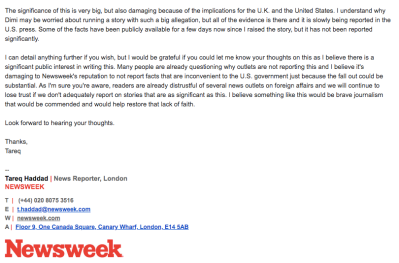
Following a conversation with Alfred, he asked me to write the pitch in a note to him and Newsweek’s foreign affairs editor, Dimi Reider, on the company’s internal messaging system. The following is a copy and paste of that pitch, alongside the conversation that followed in the next few days.
Once I returned to the office on Thursday, November 28, I proceeded to have a conversation with Dimi, but to my disappointment, he did not address any of my protestations against why the article could not be published. He made the famous joke about former Soviet politician Leonid Brezhnev irrelevantly, one he had already made to me a couple of weeks before, and after listening to my reasoning for wanting to have the story published for several minutes, all he had to say was: “I’m sorry, but I’m afraid it’s a no.”
The following morning, feeling incredibly frustrated, I wrote an email to Nancy and Newsweek’s digital director and London bureau chief, Laura Davis, to express my concerns.
Several stressful days passed where I did not hear from either Laura or Nancy, but in the meantime, as I tried to continue as best as I could with my every day reporting role, I noticed how an entertainment editor by the name of Tufayel Ahmed began to pick up most of the following stories I wrote.
In my experience of working with editors in the past, if an issue ever arose with a story, we would have a perfectly civil conversation, I would make the relevant adjustments where necessary and the article would be published without further problems. That was not my experience with Tufayel.
At first, when he sent me long, overly critical and often hostile criticisms on articles I wrote, I considered asking him to step into a meeting room in order to ask him whether I had inadvertently done something to offend him. Having come from a newspaper background where mistakes in articles required embarrassing apologies printed in the paper the next day, and having held the belief that editors were your best friend and should always be kept on side, I always prided myself in filing copy that was free of any errors and throughout my career, I was frequently commended for doing exactly this.
In my time at the Hull Daily Mail for example, regarded as one of the U.K.’s best regional newspapers, I do not recall a single correction being printed on any of the articles I wrote. That was the case despite covering murder trials, rape cases and numerous other sensitive stories.
On the eve of the Brexit referendum, despite still being a trainee reporter, I had built such a reputation for my accurate journalism and my attention-to-detail skills that I was even entrusted to single-handedly edit and publish copy from two politics reporters to the publication’s website, while managing the live blog, all social media channels and filing my own stories on national developments as the results came in. The following morning, following a short nap, the editor was so impressed with my efforts that I was asked to conduct the interviews with the local leaders of each political party, despite being one of the most junior reporters on the team.
Furthermore, in close to 1,000 published articles for IBTimes UK, I can only recall one incident where an article required a correction. An Israel lobby group—forgive me for being unable to recall which one—objected to my use of the word “settlements” and requested that it be replaced with “settlement units” instead. This was a reasonable request and the article was updated to reflect this without further incident.
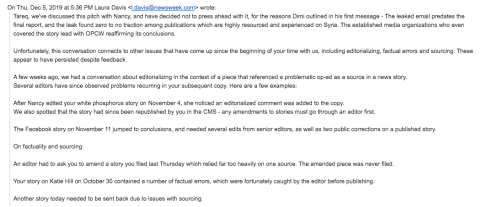
I do not say these things to be self-congratulatory. I say these things because I was deeply saddened and disturbed. Because when I finally received a response from Laura about the OPCW story on December 5, six days after my initial email and after repeated attempts to speak to her in person, only one paragraph was devoted to the leaked letter and the rest of the email attacked my capability as a journalist.
It listed all the instances that Tufayel had criticised me on, unfairly mischaracterising my actions, in addition to listing one genuine mistake I made in the course of everyday reporting—something not to be unexpected when every day I was expected to write four stories, often about complicated topics, sometimes with no prior experience in them. Nonetheless, even for this story, I had taken immediate action needed to resolve and had apologised to editors at the time, the characterisation of what took place in Laura’s email was deeply maligned.
That was the moment I knew beyond doubt what my gut had been telling me before: there was no valid reason for this OPCW story not to be published. It was simply being suppressed. I was being attacked for pushing back against this.
As I have nothing to hide, I will publish Laura’s response in full.
You will see my full response in due course, but first, some further comments about Laura’s criticisms must be addressed.
EDITORS AT FAULT
My first “indiscretion” is rather simple to address. I believe—however I must admit I am not certain, as the information was never published—that the article Laura is referring to this. Regardless of which piece it was, the following events took place.
In 2018, confirming the earlier reporting by Hersh, former Defense Secretary Jim Mattis announced that the Pentagon has no evidence to support the allegations that the Syrian government used sarin in Ghouta, as reported here by the Associated Press. As Newsweek did not report this fact (more evidence of suppression?) I linked to an opinion piece on our website that addressed that report. The first line of that piece links back to the AP story. When questioned by Tufayel why I did this, I explained that I was simply trying to link to references on our website, explaining to him the source was AP—ironically, I was trying to help Newsweek gather more clicks. The information which was ultimately removed from my article was not badly sourced.
The second point listed by Laura—the only occasion out of 156 stories written during my two-month stint at Newsweek where an article required a correction—raises another serious problem at the publication: editors tell journalists what to report.
This article was assigned to me by Alfred on Newsweek’s internal messaging system, as is commonplace for editors to do, and I felt obliged to report the story, although I had concerns and it is not one I personally would have chosen to do. I raised these concerns with Alfred—whose background is in video editing, not journalism—but instead of ditching the story, a new angle was suggested and a new headline was provided too. Feeling that I couldn’t challenge his authority any further without being rude, I proceeded as best as I could, but in the course of doing so, I made two mistakes: One, I neglected to reach out for comment on two of the five parties involved (thinking Facebook, who I contacted, would comment on behalf of the remaining). Two, I wrongly reported that some funds were donated by Mark Zuckerburg as opposed to the Chan Zuckerberg Initiative.
When the Facebook spokesperson returned my request, she simply pointed me in the direction of tweets made by the remaining individuals and asked if I could update accordingly. The tweets did not criticize our reporting, but of the original reporting done by Popular Information, the source assigned to me by Alfred to base my reporting on.
Once their statements came to my knowledge (which reflected the concerns I had about the article in the first place), I alerted Alfred immediately and did my best to redress. Laura’s criticism also neglected to mention that Newsweek’s chief sub-editor—whom I will not name as he has been among a handful of editors to treat me fairly—was the one to look over the article and he had no problems in publishing my piece.
This practice of editors telling journalists what to write, with what angle and with headlines already assigned is completely backwards and is the cause of numerous problems. How can journalists find genuine newsworthy developments if what to write has already been scripted for them?
I spoke to several Newsweek journalists about this very problem prior to my departure and they shared the same concerns. This was the very same problem that led to Jessica Kwong’s firing a week before my resignation.
Kwong, who I do not know, wrote a story titled “How is Trump Spending Thanksgiving? Tweeting, Golfing and More,” a day before the day in question—only for it to emerge that Trump made a surprise visit to Afghanistan. No proper journalist would have written that piece by their own volition—it was only done because editors were on their tireless crusade for clicks.
In the end, she was fired because she did not approach the White House for comment, although all the information came from the president’s public diary.
“Dear press office,” her email should have read supposedly. “I am writing a piece that is of no useful public information, but will be criticising the president for what he choses to do in his leisure time on Thanksgiving. Can you please provide a statement at your earliest convenience.”
For goodness sake, whatever your opinions are of President Trump, what were most of you doing on Thanksgiving Day?
Most appallingly, in a team meeting between the New York and London offices following the firing, where “lessons to be learned” were discussed at length, the editor in question tried to make a joke along the lines of: “Don’t worry guys! I’ve learned my lesson! I’ll happily edit the story ‘What’s Trump doing on Christmas Day?” Silence followed. You should have seen the faces of the journalists in the room.
A final note on the contents of Laura’s email, for the rest is addressed in my response.
Yes. I did make adjustments in the content management system and republished some articles. Journalists are permitted to do this if they spot small mistakes—such as in spelling or grammar, for example—but I did not editorialise as the email claims. And yes. On the white phosphorus story, I did question an editor’s judgement. It was Nancy’s in fact.
After the article had been published, she amended the headline so that it was more attention grabbing, but the grammar she used made it non-sensical and she also didn’t abide by Newsweek’s own house style in doing so. (She wrote “US” not “U.S.”) I didn’t want an article I spent three weeks working on to be ruined because of sloppiness. Is there something so wrong with that? For the record: I am still unhappy with the headline on the piece as it stands.
Now, before I return to my response and to my ultimate resignation, there were several other important things to note.
IS REP. ILHAN OMAR A QATARI SPY?
On Saturday, November 30, a day after I sent my initial email to Laura and Nancy, I was working a weekend shift and there had been a change in the rota: Tufayel was to be the news editor for the day. There was nothing demonstrably unusual about this, but what did strike me as odd is how I was immediately assigned a story about some relatively unknown congressional candidate who had been kicked off Twitter for tweeting something in relation to the Democratic Congresswoman of Minnesota, Ilhan Omar, and allegations that she was a spy.
The nature of the story was not odd in itself, but only seemed strange because of Dimi’s earlier refutation of my OPCW piece.
“It’s not just about Syria,” he wrote. “This was part of my reluctance to put take up this weird story going around since yesterday about Ilhan Omar being a Qatari spy. Not a single serious U.S. site picked it up, which confirms my hunch it’s BS.”
At the time, not knowing about the story, I thought that was fair enough—it seemed like a ridiculous claim. In fact, when I had seen that line written in Dimi’s refutation, it further enraged me: why was my provable story about the existence of this leaked letter (verified by Reuters!!!) being smeared by being placed next to this?
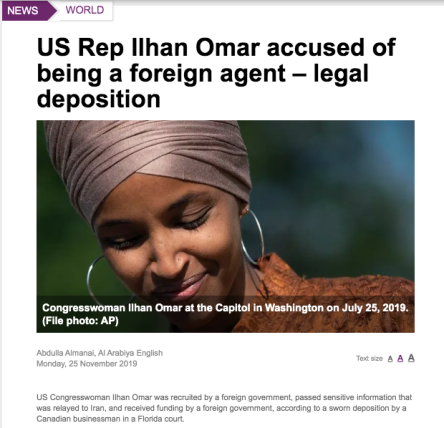
Regardless, when I was assigned the story by Tufayel, I did my best to be professional and I did what I always did: I pulled up as many resources as I could find on the matter at hand and began to research and fact-check. That was when I was shocked to discover this report in Al Arabiya about Ilhan.
The publication acquired a 233-page legal deposition, made to a U.S. district court, by a Kuwaiti-born Canadian businessman by the name of Alan Bender. He gave evidence against the Qatari emir’s brother, Sheikh Khalid bin Hamad al-Thani, after al-Thani was accused of ordering his American bodyguard to murder two people and after holding his hired American paramedic prisoner. In that deposition, Bender claimed to have high connections among Qatari officials—presumably why he was asked to testify—and it was there that he made the Ilhan spy allegations.
Now, I have no further evidence to support Alan Bender’s claims—I will be the first to admit I know very little about Qatari politics—but surely a well-connected businessman’s deposition in a U.S. court of law did not justify Dimi’s “hunch it’s BS” without providing further evidence. If Alan Bender’s claims are untrue and he is lying under oath, he has to answer for them. I suddenly realised that this was a test.
Would I get the hint and do my reporting in line with management orders? Or would I continue to report perfectly publishable details that are in the public interest?
Of course, there is the possibility I was assigned the article by mere happenstance, but what took place after I submitted my draft copy to Tufayel for editing was revealing. The draft I submitted was as follows.
All reasonable journalists, I hope, will not find anything wrong with my reporting here. Despite this, following the submission of my draft, all references to Alan Bender were scrubbed from my piece, and so too was the link to the Al Arabiya’s story. All that was left of the newsworthy information I provided on the matter were the words “baseless claims”.
How was Tufayel so certain that the claims were baseless? Did he have information to the contrary of what Alan Bender said? Or was there any other journalistic justification for removing information that was provided in a court of law, although I clearly stated there was no other evidence to currently support the claims? Was there any good reason at all? I suspect not, other than the fact that it could be deeply damaging if the allegations emerged to be true, and that management orders had been to suppress anything Alan Bender said, as was the same across most media organizations across the U.S.
Curiously, Nancy later amended the article again, this time changing the word “baseless” to “unverified”—softening the language, I imagine, in order to not draw unnecessary attention to it.
This is shown by the content management system (CMS) logs that capture all changes made.
EXTERNAL CONTROL OF THE MEDIA NARRATIVE
While all this was going on, and while I waited for a response from Laura, I started to have strong suspicions that something wasn’t quite right with Dimi, the so-called foreign affairs editor. For starters, he rarely did any foreign affairs editing. He rarely did any editing at all.
Newsweek has a system where reporters paste the relevant CMS link of draft articles ready to be edited into a “publishme” channel of the internal messaging system and editors make their way down the list, picking up stories that reporters had filed. Once they are looked over and published, editors dropped them in another channel called “published_stories” for all to see.
I made a habit of watching this list closely—it was useful to know what other reporters had filed in order to be able to link to their stories and also for ensuring articles were not repeated accidentally. In the two months I spent at Newsweek, I saw Dimi post in the “published_stories” channel only a handful of times. This is odd as most editors publish several stories a day. Instead, his most active contributions to the messaging system were with funny tweets or articles in the “general” thread. Sadly, I do not have physical evidence to support this, but the journalists I worked with will know this to be true.
The only times Dimi appeared to be involved is when a story had the potential to be controversial. He worked on my white phosphorus investigation, made the decision to not publish anything about the original Ilhan spy claims and rejected my attempts at publishing the OPCW leaks.
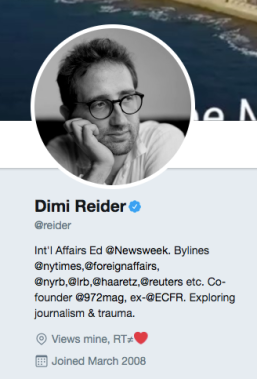
While working on that white phosphorus story, before I was fully aware of his background, he spoke to me of how he co-founded +972 Magazine—a liberal Israeli publication that started out by covering the 2008-2009 Gaza War. I glanced at his resume and was honored to be working with such an accomplished foreign affairs journalist. I had genuinely hoped to build a closer relationship to him.
That was why I was so bewildered when he flatly refused to publish the OPCW revelations. Surely any editor worth their salt would see this as big? Of course, I understood that the implications of such a piece would be substantial and not easy to report—it was the strongest evidence of lies about Syria to date—but surely most educated people could see this coming? Other evidence was growing by the day.
But no. As the earlier messages showed, there was no desire to report these revelations, regardless of how strong the evidence appeared to be. Dimi was simply happy to defer to Bellingcat—a clearly dubious organization as others have taken the time to address, such as here and here—instead of allowing journalists who are more than capable of doing their own research to do their job.
It was this realization that made me start to question Dimi. When I looked a little deeper, he was the missing piece.
Dimi worked at the European Council on Foreign Relations from 2013 and 2016—the sister organization to the more prevalent think-tank, the Council on Foreign Relations (CFR). Some may be asking why this matters, but the lobbying group—the largest and most powerful in the United States—is nicknamed “Wall Street’s think-tank” for a reason, as the book by Laurence H. Shoup with the same title explains.
To understand just how influential the body is, it is worth noting that 10 of George H. W. Bush’s top 11 foreign policymakers were members, as was the former president himself. Bill Clinton, also a member, hired 15 foreign policymakers with CFR membership from a total of 17. George W. Bush hired 14 CFR members as top foreign policymakers and Barack Obama had 12, with a further five working in domestic policy positions.
Its European sister act is also highly influential, as this graphic from its website about current members demonstrates.
It is also worth noting that the CFR’s current chairman is David Rubenstein, co-founder and executive chairman of the Carlyle Group—the same Carlyle Group which previously described itself as the “leading private equity investor in the aerospace and the defense industries,” until it probably decided it was not a good look to boast about its war profiteering, though its investments in those industries remain.
It is the same Carlyle Group that hosted Osama bin Laden’s brother as the guest of honor for the group’s annual investor meeting in Washington D.C. the same day the Twin Towers fell. George H. W. Bush, an informal advisor to Carlyle, was also present.
Furthermore, one of the CFR’s most notorious exports was former Secretary of State Henry Kissinger—a man famously described by Christopher Hitchens as America’s greatest ever war criminal. His long list of crimes against humanity cannot be summarized quickly.
Jeffrey Epstein was also a member from 1995 to 2009 and in a PR push, the CFR recently announced its decision to donate $350,000 to help fight sexual trafficking victims, equivalent in amount to the donations received from him. It may be obvious to state, but the Epstein story is another that’s not being investigated adequately by the media.
But what about the think tank’s influence on journalism?
I’m unaware if what I will report here is common knowledge to the rest of the industry, but what I discovered when researching this topic is unacceptable to me.
I learned that aside from a large number of prominent journalists holding membership, I discovered that the CFR offers fellowships for journalists to come work alongside its many State Department and Department of Defensive representatives. A list of historical fellows includes top reporters and editors from The New York Times, The Washington Post, The Wall Street Journal and CNN, among others—not forgetting journalists from Newsweek.
The most prominent CFR member to join Newsweek’s ranks was Fareed Zakaria. After stints at Yale and Harvard, at the age of 28, Zakaria became the managing editor of Foreign Affairs—the CFR’s own in-house publication. From there, he became the editor of Newsweek International in 2000, before moving on to edit Time Magazine in 2010.
When CIA intelligence analyst Kenneth Pollack wrote a book titled The Threatening Storm: The Case for Invading Iraq, Zakaria lauded the work and described Pollack as “One of the world’s leading experts on Iraq.”
Interestingly, once the war had started in 2003, Foreign Affairs—where Zakaria writes to this day—was ranked first by research firm Erdos and Morgan as the most successful in influencing in public opinion. It achieved the accolade in 2005 and again in 2006. Results for other years are not known.
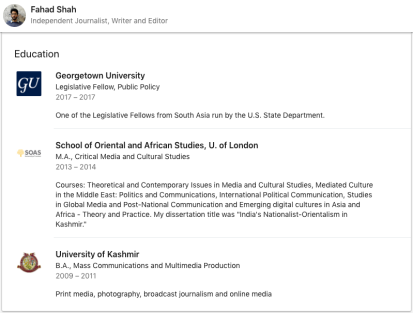
Scrolling through LinkedIn and Twitter, numerous individuals listed as journalists have taken the same path Zakaria has taken. They complete State Department-funded “diplomacy” degrees from prestigious universities—such as Harvard, Yale, Georgetown and Johns Hopkins, or at the School of Oriental and African Studies (SOAS) in London—before gritting their teeth at publications or think tanks funded by the CFR or Open Society Foundations. Once their unquestioning obedience is demonstrated, they slowly filter into mainstream organizations or Foreign Affairs.
It also emerged that this is the same path that Dimi has taken. +972 Magazine’s biggest funder is the Rockefeller Brother’s Fund, whose president and CEO, Stephen Heintz, is a CFR member. In addition to his work with the ECFR, Dimi is also listed as a research associate at SOAS.
This conflict of interests may be known to other journalists in the trade, but I will repeat: this is unacceptable to me.
The U.S. government, in an ugly alliance with those the profit the most from war, has its tentacles in every part of the media—imposters, with ties to the U.S. State Department, sit in newsrooms all over the world. Editors, with no apparent connections to the member’s club, have done nothing to resist. Together, they filter out what can or cannot be reported. Inconvenient stories are completely blocked. As a result, journalism is quickly dying. America is regressing because it lacks the truth.
The Afghanistan Papers, released this week by the Washington Post, showed further evidence of this. Misinformation, a trillion dollars wasted and two thousand Americans killed—and who knows how many more Afghanis. The newspapers ran countless stories on this utter failure, however, none will not tell you how they are to blame. The same mistakes are being repeated. The situation is becoming more grave. Real journalists and ordinary people need to take back journalism.
This was the letter I sent to Newsweek when I resigned.
Voltaire, actualité internationale, n°190
-
Outre ce site internet gratuit, nous publions une lettre confidentielle en
PDF, Voltaire, actualité internationale. Chaque jeudi soir ou vendredi
matin, vo...
Rabbi Jeff and Grok
-
JAKEGTV, banned on JewTube and Jew-owned Instagram, seems to be back on
X:POV: You Try Watching The Flydubai Hijacking But The Anchors Keep
Noticing https:...
The Legendary Golem
-
The Legendary Golem October 3 2026 ___________________________________ More
Vids! +BN Vids Archive! HERE! ___________________________________ Support
The B...
The United States At A Crossroad
-
The United States At A Crossroad—An Analysis (16 Sept 2026) by Lawrence
Davidson Part I—Texas vs Minnesota Back in mid-May […]
Report on Beth Israel vigil 09-12-26
-
*Eat-a-Cheeseburger Day Approaches*
This year, EAC Day appears on Monday, September 21st. The date coincides
with the Jewish holiday called Yom Kippur. Cl...
-
Hello all,
It is with great sadness that I share with you the passing of our beloved
sister, Mother, and Grandmother, the individual that you all knew ...
Best Horror Podcast
-
Best Horror Podcast Introduction: Horror podcasts […]
The post Best Horror Podcast appeared first on Copper Shock Horror Podcast.
Ikhras Endorses Muntadhar Al-Zaidi
-
“Oh parties of banditry and sectarianism and corruption, we have come and
our goal is to destroy you.” Ikhras formally endorses Muntadhar al-Zaidi,
Iraqi j...
Prince Charles: Foreign Jews behind bloodshed in ME
-
In May, 2017, British Crown Prince Charles declined an invitation from
Zionist entity’s president Reuven Rivlin‘s to attend the 100th anniversary
of the no...
Palestinian Women – One for All, All for One
-
Honouring All Palestinian Women by Honouring Three: Hanin Zoabi, Ahed
Tamimi, Samah Sabawi Vacy Vlazna “Palestinian women have always stood side
by side ...
US’s Saudi Oil Deal from Win-Win to Mega-Lose
-
By F. William Engdahl Who would’ve thought it would come to this? Certainly
not the Obama Administration, and their brilliant geo-political think-tank
neo-...
-
*Mordechai Vanunu wins human rights prize of Brazilian Press Association *
* http://www.alternativenews.org/english/index.php/features/updates/7038-mordechai...
Abdul Aziz Rantissi:
"My ultimate wish, my God, is to attain martyrdom,"...God granted him his wish on April 17, 2004, at the hands of Israeli assassins.




 I was sad to hear that asking for an independent investigation into a chemical weapons attack was an “incendiary theory,” but I was forced to move on.