Showing posts with label Mass media. Show all posts

Friday, 26 November 2021

Who Wants Some Ukraine?

 November 25, 2021

by Dmitry Orlov, posted with permission of the author

On Tuesday, 23 November, Russia’s most senior military general, Valery Gerasimov, had a “deconfliction” phone conference with US Chairman of the Joint Chiefs of Staff Mark Milley, in which the two discussed “pressing issues of international security.
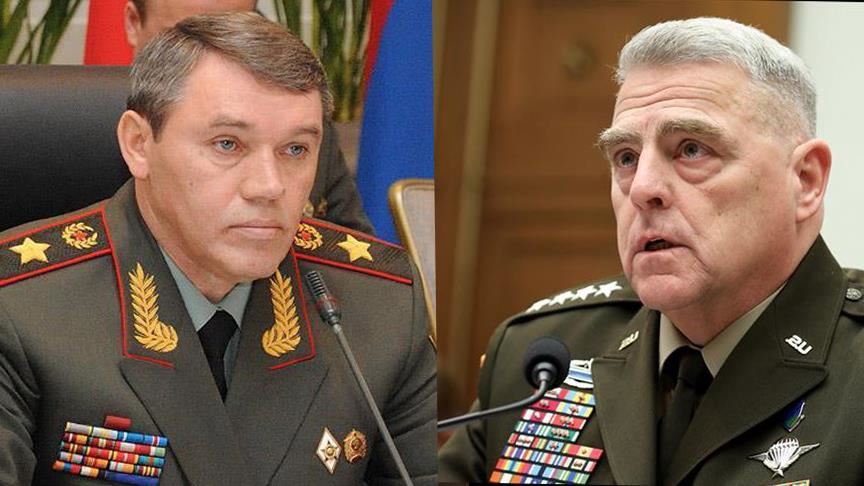

US, Russia army chiefs talk recent skirmish in Syria

” Actual details of what they discussed are not available; what is available is Western media speculation, which in recent days has included false reports of Russian troops massing on the Ukrainian border and supposedly getting ready to invade. What Western media has studiously ignored is an actual massing of Ukrainian troops on the borders of the Donbass region—the industrialized temporarily Ukrainian region that has been de facto independent since the Kiev putsch of 2014.

Following that putsch, and the refusal of the Donbass (along with Crimea) to recognize the new US State Department-installed Ukrainian government, the Ukrainians made attempt to recapture the Donbass by force. This attempt failed, and Kiev managed to avoid all-out defeat by signing the Minsk agreements of February 2015, but has clearly had no intention of ever fulfilling them. Instead, ever since then, Ukrainian forces have been shelling the no man’s land between Ukrainian-held territory (which is mostly open prairie) and Donbass (which is urbanized and thickly settled), killing small numbers of civilians and local militia members and causing considerable property damage. Although Western press has continuously reported on “Russian forces” in the Donbass, they are yet to present any evidence of it. And although Western press likes to describe the Donbass using the hackneyed epithet “war-torn” it is actually more prosperous and stable than the rest of the Ukraine, integrated into the Russian economy and essentially functioning as a Russian region.

Turning down Western media noise, a Russian military effort to capture the Donbass, never mind the rest of the Ukraine, is exceedingly unlikely. Russia already has everything it wants. Unlike Crimea which in its 2014 referendum produced a 97% vote for integration of the region into the Russian Federation with an 83% voter turnout, in a similar referendum in the Donbass (held against Moscow’s wishes) only 27.5% of the 74.87% who turned out voted in favor of joining the Russian Federation. Based on this result, Moscow chose to soft-pedal the Donbass situation, providing humanitarian aid and diplomatic support, granting Russian citizenship to those who want it and gradually integrating the region socially and economically. In other Ukrainian regions, were similar referendums to be held there, the level of support for joining Russia would in all likelihood have been even lower, and now, seven years later, would be lower still. From this, a conclusion can be drawn: other than Crimea (which was part of an independent Ukraine for just 23 years), none of the Ukraine was or is a candidate for inclusion within the Russian Federation. The Russians living there will receive some amount of Russian support and are, of course, welcome to move to Russia, but that is really it.

Having ruled out that which is exceedingly unlikely, let us turn to that which is quite likely; and that is a provocation in the Donbass staged by the authorities in Kiev and by their State Department, Pentagon and CIA handlers, designed to deflect the blame from the truly disastrous economic situation that is unfolding there in the hopes of being able to maintain political control of the situation. In blundering into the Ukraine and converting it into a sort of anti-Russian bulwark, the US gained a brazenly corrupt and unruly dependency. Unable to stop its inexorable slide into failed-statedom and political and social disintegration, the US is faced with the prospect of another Afghanistan-style rout, with desperate left-behinds running after US transport planes hastily taking off from Kiev’s Borispol Airport, after which point even the mental laggards who run the European Union will be forced to admit that American security guarantees are an utter joke and will start getting ready to walk into the Kremlin on their knees to kiss the gem-encrusted felt slipper.

Given this unwelcome scenario, the US is quite eager to control the optics and to make it look like it is all Russia’s fault. Since merely jumping up and down and screaming “The Russians are coming! The Russians are coming!” is no longer doing the trick, they are looking for something—anything!—that will make the Russians show up and put up even a tiny bit of a fight so that CNN and MSNBC can broadcast staged photos of a bloodied baby blanket and US Congress can then harrumph-harrumph about “Russian aggression” and impose sanctions on Russian baby blanket manufacturers. That “anything” is called a provocation, and what better place to stage it than the Donbass, which is an existing bleeding sore they’ve been picking away at for seven years now. Of course, they will do this in great trepidation of an escalation they would be unable to control, hence the hasty “deconfliction” conference with General Gerasimov: “Look, we go pew-pew, then you go pew-pew, then we declare hostilities over and toast each other with vodka and caviar; OK?”

Given that a provocation of some sort appears to be very likely, it is worth pondering what it would look like and what the outcome of it might be.

First, here is some background. The Ukraine (which is Russian for “borderland”) has always been less a country than a heterogeneous, endlessly disputed territory, tossed back and forth between Russia, Turkey, Poland, Austria, Germany and even, very briefly, Sweden. It mostly borders Russia (Crimea, Krasnodar, Rostov, Voronezh, Belgorod, Кursk and Bryansk regions). It also borders Belarus (short for “White Russia”) which is a whole lot like Russia. It has smaller borders with Poland, Slovakia, Hungary, Romania, Moldova and the unrecognized, Russian-defended Transnistria. It also borders Donetsk and Lugansk regions, collectively known as the Donbass, which is short for “Donetsk Coal Basin,” and which was formerly part of the Ukraine but de facto independent for the last 7 years and economically integrated with Russia.

Of these, the Ukraine, Belarus and Moldova were quite recently part of the USSR while the rest were part of the Warsaw Pact allied with the USSR. For most of them, those were the good days; for reasons incomprehensible to rapacious Western imperialists, Russia lavished a great deal of attention and investment on its ethnically heterogeneous periphery, not only building a great deal of social and industrial infrastructure and enterprises there but also staffing it all with relocated Russians. This, most Russians now realize, was a poor choice. This lesson is continuously reinforced by observing just how poorly the former Soviet republics have performed since they gained their independence. The Ukraine is a case in point, losing as much as a third of its population (exact numbers are impossible to ascertain) and steadily degenerating from a prosperous, highly developed region to the poorest one in all of Europe.

The Ukraine aspires to NATO and EU membership, but this prospect appears exceedingly unlikely since it is much more of a liability than an asset: destitute, bankrupt, politically unstable and not in control of its own government or its own territory—a failed state, essentially. Plus, the EU and NATO are themselves perhaps not too long for this world, the EU having recently lost the United Kingdom and NATO having just fabulously failed in Afghanistan, and not really capable of accepting new members. Sensing their own weakness, and projecting onto Russia their own instincts to engulf and devour all that they can, they automatically assume that Russia will exploit this weakness and reconquer the Ukraine and perhaps some other parts of Eastern Europe as well. But this is all it is—a projection, because the contemporary Russian project is something else entirely. Russia does periodically move its troops around its own territory, thereby keeping the West in a constant state of nervous agitation bordering on outright panic, but from the Russian perspective that is just a pleasant side-effect of regularly scheduled training exercises. There was a recent hysterical outburst in Western press over Russian tanks massed on the Belorussian border, for instance. Russia is always “about to invade,” on Tuesdays especially, but somehow never gets around to it.

That is not because Russia lacks the means or the opportunity; but it does entirely lack the motive. Does it need more land? Certainly not! Does it need a restive, alienated population that will then demand to be fed, hospitalized as needed and kept safe and warm all the while resisting assimilation? Not at all! Does it need the reputational losses from unprovoked aggression? Again, no. Quite the opposite, Russia is most eager to draw the line somewhere—a notional Great Wall of Russia, with the stable, economically liberal and socially conservative Orthodox/Moslem/Buddhist Russian World on one side and an alien, increasingly bankrupt, culturally degenerate, sexually deviant and permanently hostile Europe on the other. This will give Russia the peace and stability it needs to continue developing. The problem is that, because of the messy way in which the USSR broke up, many Russians were left stranded on the wrong side of previously insignificant borders, and this Great Wall has to remain porous, allowing Russians to filter back in.

A point can be made that Russia’s romance with Western Europe was always destined to end in tears. Russia’s cooperative, egalitarian instincts have been developed and perfected over many centuries within the Eurasian context of a relatively small population controlling a vast but difficult land with almost infinite but rather diffuse resources. In this context, cooperation rather than competition are keys to survival. These instincts have been wasted on little Eastern European fiefdoms that have spent an eternity squabbling over their tiny plots of land. Their history has conditioned them to only understand and respect subservience and domination, causing them to see Russian largesse as a weakness to be exploited. When the USSR suddenly vanished, they swiftly switched allegiance, forgetting their Russian, learning English and eagerly welcoming American and Western European financial swindlers and thieves to come and pick them clean. And now that they’ve been picked clean and Americans are leaving, they would perhaps be happy for Russia to “reoccupy” them and resume feeding them (if it were not for their wounded pride), but Russia will have none of it.

Within this overall context, each Eastern European country has its own unique fate. Most of them—specifically, Estonia, Latvia, Lithuania and Moldova—are simply too small and inconsequential to matter and have been left to wither away slowly, being of little interest to the West or to Russia. Belarus stands out in that it quickly joined a union state with Russia, but this has not saved it from some fateful dalliances with the West which almost ended in disaster in the summer of 2020 when a foreign-instigated astroturf insurgency threatened to overthrow the elected government and install a Western stooge by the name of Svetlana Tikhanovskaya, nicknamed the cutlet fairy. Since then, Minsk and Moscow turbocharged their integration process, producing the odd situation where the Belorussians feel free to poke their fingers in the eyes of Western leaders while hiding behind Russia’s broad back.

And then there is the Ukraine. It is the second-largest country in Europe by area—second only to Russia—and strategically located to be rather consequential. Ever since its independence, which it was awarded against the wishes of the majority of its population when the USSR was dissolved by a tiny group of conspirators, it has been ruled by a succession of swindlers and thieves who have continuously looted and robbed it until now it is a mere shadow of its former self, broken and destitute. This has made it an easy mark for Western geopolitical engineers who sought to fashion into a sort of anti-Russia, with the idea of preventing Russia from becoming an empire based on some flawed reasoning by the rabidly Russophobic Pole Zbigniew Brzeziński. Grand plans hatched by fools tend to misfire grandly, and this one is no exception. Instead of somehow containing Russia, it gave Russia everything it could ever want:

1. The fantastic level of Ukrainian political dysfunction that resulted from endless Western political meddling reduced the Ukraine from one of Russia’s major regional competitors to а major regional basket case and supplier of qualified Russian-speaking labor. The Ukraine once had strategically important industries that were essential for Russia’s military and civilian production, including large marine diesels, helicopter engines, rocket engines, aircraft building, shipbuilding and much else. All of these industries have now been relocated to Russia, often together with all of the blueprints and the technical expertise, and produce great value for both domestic consumption and export.

2. The 2014 putsch allowed Russia to return Crimea by undoing two mistakes—by Khrushchev, who gave it to the Ukraine in 1954, and by Gorbachev, who failed to get it back in 1991. It also allowed Russia to partially undo an older mistake—by Lenin, who gave the Donbass to the Ukraine in 1920. While the Donbass is strategically not too consequential, the return of Crimea provided numerous benefits. Coupled with the western enclave of Kaliningrad on the Baltic and new Russian hypersonic rockets, Crimea has allowed Russia to keep all of NATO’s European territory within its sphere of military dominance, providing an effective treatment for Europe’s congenital defect which causes it to periodically march on Moscow. Western sanctions imposed in response to Russian annexation of Crimea allowed Russia to claw back all of the disadvantages it incurred by joining the World Trade Organization, including bringing back agriculture and key manufacturing sectors, to find new, friendlier trading partners around the world, and to find ways to thrive within conditions of limited autarky. Crimea has also provided a very useful litmus test for political participation: automatically excluding anyone who would claim that Crimea is Ukrainian made it possible to effectively purge the ranks of all internal enemies and foreign agents. There are numerous other benefits as well, too many to mention.

3. The civil war in the Donbass, which is ongoing, gave Russia the opportunity to force through the Minsk agreements, whose implementation is mandated by the UN Security Council Resolution 2202 (2015), and which require the Ukraine to federalize, granting a high level of autonomy to its regions. This, in the Ukrainian context, equates with the end of the Ukrainian unitary state. Beyond that point, the Ukraine becomes a set of disparate, disconnected, foreign-dominated fiefdoms, each with its own pathetic little oligarchy, with Kiev retained as a purely symbolic capital and an ancient Kievan Russia museum and tourist attraction. The government in Kiev has resisted the implementation of the Minsk agreements, realizing full well that this would spell its end, but this is merely a postponement. The civil war also simplified any future anti-Nazi mop-up operation and war crimes tribunal. Whereas before various Ukrainian nationalists and krypto-Nazis might have been difficult to identify, it has forced them to not only stand up and be counted but also to commit crimes for which there is no statue of limitations, making it easy to permanently take them out of circulation when the time comes to clean the place up.

This, then, is the background to the current situation, bringing us to the present, in which the US seems to be cooking up something in a big hurry. First, the US sends the message that Kiev must fulfill the terms of the Minsk agreements. Second, the US claims that Russia is massing troops on the Ukrainian border, getting ready to invade. The Ukrainian military denies this fact. The US repeats their claim and also sends some more weapons to the Ukraine. As the Ukrainian military is still unsure what’s going on, they are summoned and told exactly what to think. And so, there is going to be a provocation. But Russia is certainly not interested in any sort of attack or invasion, so what do you suppose is going to happen? A reasonable battle plan is for the Ukraine to attack first, to preempt the Russian invasion and to take up defensive positions within the Donbass territory. That’s a brilliant plan, if I say so myself!

The most the Ukrainian military can do is launch an attack on the Donbass. Attacking Crimea across the isthmus would be stupid and pathetic; attacking Crimea from the water would be stupid and absolutely hilarious to watch. And so Donbass it has to be, again. It won’t take long for the Russians to respond using unidentified long-range precision artillery and demolish the Ukrainians’ supply lines, trapping them in cauldrons where they will run out of ammunition, food and fuel and gradually bleed out. This is what transpired before, in 2015, leading Kiev to sign on to the Minsk agreements, because their other choice was to lose their entire army. Except now there will not be another set of Minsk agreements, no terms of surrender, no cease fires and no safe corridors for withdrawal. There will just be death. To the Russians, these people are terrorists, and terrorists get to meet God before the rest of us.

And that, perhaps, may be the entire point. The US wants to close out the entire sorry Ukrainian saga, cut its losses, pull an Afghanistan and leave in a hurry, because it has a long list of countries it has to pull out of before the fuel and the money run out, and it badly needs to pick up the pace. Okinawa is on that list; Guam; Puerto Rico; Alaska. California. Texas. The Ukraine has been refusing to even start fulfilling the Minsk agreements, which start with military deescalation along the line of contact. What seems to be the problem? Perhaps, as the US has finally figured out, it has to do with the fact that the Ukraine has a military; if it no longer had any military of any sort at all, there would be nothing to deescalate and the problem would not exist. And so that may be the clever plan for the Ukraine: suicide by Russia. As an added bonus, there will be Russia to blame because, no doubt at all, it will have all been Russia’s fault. Sanctions against Russian baby blanket manufacturers are being drafted as we speak. American TV viewers will watch it, and they will like it. They will think, “Bad Russkies! America strong!”

“But what about the Ukraine?” you might be tempted to ask. Well, the correct answer to that question seems to be, “Nobody cares.” Seriously, looking at recent Ukrainian history, that seems to be the only answer that makes sense. The Americans certainly never cared, the Russians once cared but care less and less with each passing day, and the Ukrainians themselves don’t care either and have been making that point by voting with their feet. The European Union and NATO may care a great deal about having a large failed state in the middle of Europe, and they should, because that is probably just the beginning, but a very good start.


River to Sea Uprooted Palestinian   
The views expressed in this article are the sole responsibility of the author and do not necessarily reflect those of the Blog!

Friday, 12 November 2021

Censorship is the Last Gasp of the Liberal Class

November 11th, 2021
Truthful, honest, and independent journalism and analysis is anathema to a social order that has little else to offer humanity but endless war and austerity.

By Danny Haiphong

Source

On November 8, 2021, Twitter locked my account for a period of one day for responding to corporate media darling and Russiagate fanatic Keith Olbermann’s slanderous reply to journalist Wyatt Reed’s coverage of the Nicaraguan election. The flagged tweet simply restated Olbermann’s question, replacing “whore for a dictator” with “whoring for the American oligarchy.” Twitter demanded that I delete the tweet or send a time-consuming, lengthy appeal with no assurances as to if or when my sentence in “Twitter jail” would end. This prompted me to delete the tweet and wait for the 12-hour suspension to end. Keith Olbermann’s account went unscathed.

This isn’t Olbermann’s first go-round with censorship. Last July, Olbermann called progressive comedian and YouTube host Jimmy Dore a “feral succubus” and demanded Twitter “and other platforms” promptly ban him. Olbermann has justified censorship over the past several years as a necessary response to the thoroughly debunked allegation that Russia “meddled” in the 2016 election in favor of Donald Trump. He has publicly acknowledged his support for censorship as a righteous crusade to ban from platforms people who seek to “tear this country apart.”

Olbermann claims that his censorship crusade is exclusively directed at the right wing. Yet the sports analyst and corporate-media pundit is no friend to progressive or left-wing politics. The U.S. continues to lurch further to the right politically precisely because of elite-driven conspiracies such as Russiagate. Olbermann’s belief that “everything” about the Trump administration is connected to Russia has only further distracted from the progressive politics required to counter the destructive policies of the D.C. duopoly. Olbermann’s obsession with Russia is also racist in character, as evidenced by the admission that he feels immense shame living “with the stain of Russian heritage” in his family.

Hilary Clinton’s loss to Donald Trump in 2016 unveiled a deepening crisis of legitimacy for the American Empire that the ruling elite has desperately tried to conceal. Liberal class elites such as Olbermann have embraced censorship under the guise of Russiagate. The consequences have been devastating. The Democratic Party and corporate media have fully backed Julian Assange’s extradition and a host of other measures that have tightened the grip of corporate power over the media. Independent journalists have been demonetized or removed from YouTube, shadow-banned from Twitter, and suppressed in the algorithm on Google and YouTube’s search engines.

Silencing independent media serves a militarist agenda. International media outlets critical of U.S. wars, such as RT and CGTN, have faced intensifying repression within the U.S. and its allied nations in the West. RT and CGTN have been forced to register with the Department of Justice under the Foreign Agents Registration Act (FARA). Iran-based PressTV had its domain seized by the U.S. government in June 2021 after being removed from Facebook six months earlier. YouTube, Twitter, and Facebook have labeled all three outlets “state-affiliated media.” The BBC and CIA-linked outlets such as Radio Free Asia have yet to receive the same treatment.

The message is clear: media outlets from countries targeted as U.S. adversaries such as China, Russia, and Iran are worthy of censorship while U.S. outlets promoting propaganda against said countries are safe for consumption. The same could be said about Nicaragua, a nation that has received countless attacks from the United States in the form of economic sanctions and information warfare. In the week prior to Twitter’s locking of my account, hundreds of Facebook users supportive of the popular FSLN government in Nicaragua were removed from the platform in the lead-up to the presidential election in that country. This includes Canadian physician Timothy Bood, whose account was suspended for commenting on U.S. interference in the Nicaraguan election. U.K.-based Morning Star journalist Steve Sweeney was detained for three days in Mexico on his way to observe the Nicaraguan elections.

Censorship is the last gasp of liberal class elites who find themselves rapidly losing grip over the political narrative. In the midst of growing economic inequality and endless war, the liberal class has chosen information warfare as its principal tool for maintaining the consent of the governed. Social media and streaming platforms are not public utilities and have thus been directed as weapons of information warfare against the people. Government agencies and military contractors have secured thousands of contracts with big tech corporations to increase their spying powers and influence over the media. It should come as no surprise that alternatives to the existing order have been marked as necessary for removal from public visibility as a means of self-preservation for a self-interested ruling elite.

While elements of the so-called “rightwing” have been caught in the web of censorship, it is clear that the Left is the principal target. Right-wing politics and pundits continue to enjoy growth while outlets such as MintPress News and Black Agenda Report struggle to expand audiences within a suffocating environment of censorship. Truthful, honest, and independent journalism and analysis is anathema to a social order that has little else to offer humanity but endless war and austerity. The last gasp of the liberal class seeking to protect this social order is the suppression of the truth — the first commitment of anyone who claims to stand for peace and justice.


River to Sea Uprooted Palestinian   
The views expressed in this article are the sole responsibility of the author and do not necessarily reflect those of the Blog!

Friday, 27 August 2021

The Two-faced Nature of Our Communities

 August 26, 2021  

About me
Lawrence Davidson is a retired professor of history from West Chester University in West Chester PA. His academic research focused on the history of American foreign relations with the Middle East. He taught courses in Middle East history, the history of science and modern European intellectual history.

Posted by Lawrence Davidson 

Part I—What Motivates True Believers?

One of the alleged big mysteries of our day is why so many folks—and not just those in the United States—readily believe in demonstrable falsehoods. No reasoning creature ought to believe in the nonsense put out by QAnon, or for that matter, by someone as transparently psychopathic as Donald Trump—but many, numbering in the millions, really do. Why?

Here are some of the explanations offered by those supposedly in the know:

Stupidity and Laziness: The traditional narrative says that the cause is stupidity combined with laziness. As one researcher describes it, “if you believe false things, then you must be stupid. It must be because you haven’t really made an effort to actually figure out what is going on.” This is a superficial assessment. Most people indeed are not critical thinkers who consciously seek to “actually figure out what is going on” in an independent fashion. Essentially, they do not possess enough free will to do so. On the social level, they figure things out according to cultural, community, or group dictates. This is not “stupid” of them, nor is it a function of laziness. It stems from being born and raised as part of a society. And, some societies, particularly smaller ones, families, villages, tribes, and can exert considerable social pressure.

“Motivated reasoning” aka confirmation bias: This argument drops the “stupid” appellation and doesn’t speak to the particular history or situation of the true believers, but rather tells us that there is a natural “tendency to find arguments in favor of conclusions we want to believe to be stronger than arguments for conclusions we do not want to believe.” And indeed, there is plenty of evidence for this. It is why con artists make a good living. They rob us by telling us, convincingly, what we want to hear. Too many politicians are con artists who have figured out what their constituencies want to hear and feed it back to them without much regard for objective truth. Some of them, such as Donald Trump and his minions, do this in a way that breeds anger and even hatred for the unbelievers.

The Functional Evolution theory: There is a recent study out that adds a third line of explanation. It concentrates on falsehood as a vehicle for (1) establishing and maintaining group solidarity and (2) getting the upper hand in any struggle by destroying the reputation of the adversary. In this way, blatant lying and total suspension of reasoned thought become “functional.” Here are the study’s points:

By telling lies you “are in a better situation to mobilize and coordinate the attention of your own group.” For instance, the authors of this study assert that one of the ways fanatics signal group membership and loyalty is by believing
blatantly false notions. “The basic logic at work here is that anyone can believe the truth, but only loyal members of the group can believe something that is blatantly false.” This might seem a bit of a stretch, but the authors believe this tactic is used both by groups like QAnon and some successful religious movements.

Of course, it will not do to just believe crazy things about your group. You have to come to believe your adversary is evil. You must swallow the kind of beliefs—they are remarkably similar in every case—that have led to ethnic massacres and horrific episodes like the holocausts in Germany, Cambodia, Bosnia, and Rwanda.

Here the authors make a distinction between two types of belief: (a) “beliefs that we have as representations of reality,” that is, those that reflect the truth so we can successfully “navigate the world;” and (b) beliefs that allow us to rally the necessary emotions to fight an alleged enemy till they are essentially destroyed. These latter beliefs do not have to be tied to “representations of reality.” In fact, it is better if they do not: better if the Japanese become just “Japs,” the Germans, “Huns,” the Vietnamese, “gooks,” the Jews, “kykes,” the Arabs and Palestinians, “anti-Semites.”

In other words, there might be “functional reasons for spreading falsehoods”—lying as a selected evolutionary trait. The propensity for both self-deception and the false characterization of others can serve the end of your group’s survival.

Part II—The Social Power of Our Local Groups

A problem with the above explanations is they only address the consciousness of cult members or “true believers.” That is, they address the imbecility of someone running around the nation’s capital in a hat with buffalo horns claiming “QAnon sent me.” Such a person may well believe his group’s nonsense for the sake of signaling membership and loyalty. But such hypotheses, regardless of any vague evolutionary impulse, can’t explain why a broader out-group population, numbering in the millions, goes along with the falsehoods of Donald Trump and other con artist authoritarians—and have done so throughout history. Nor can we simply dismiss this vulnerability of millions with notions of stupidity and laziness.

Here are some additional considerations that may help fill in the gaps of our understanding:

—The social/geographical context can encourage a form of tribalism. Most of us are strongly shaped by our locality. This is the case despite world-ranging journalism and international travel. Most of us are, in fact, locally regimented to fit into the mindset of our families, our neighborhoods, our places of work, our schools, our religious centers, our class-based networks, and so forth. These are the environments in which we learn the power of group culture. And most of us learn to do what our group does, think what our community thinks.

—The United States (just like many other countries) are a collection of smaller regions cobbled together over the history of the nation. Regional differences which are set as insular subcultures can prevail despite shifting population trends. Thus, Republican cultism finds its warmest reception in those parts of the country where a stagnant form of traditional white culture prevails. The affected population may be relatively isolated and rural. It has inherited a frontier outlook of radical individualism. For such folks, the government is anathema on principle and is usually seen as the real source of false information. Communities unlike theirs, usually urban and allegedly associated with “liberals,” are also seen as threats to their local values.

On the other hand, one can find the Republican cultist mindset in the boardrooms of power where government is seen as a tool to shape society to one’s class benefit. Donald Trump himself is of this sub-culture.

—Collective thinking is what holds certain communities together, and if a strong and charismatic (secular or religious) leader comes along and shapes a message to echo aspects of a local social outlook (for instance gun “rights,” anti-abortion sentiments, racist or gender bias, etc.) while disparaging other orientations seen by the group as threateningly alien, he or she can win the support of whole regions.

Part III—Breaking Free

It is community and group pressures that can set up millions to accept lies. Such pressure essentially binds the individual’s will to what may be a suborned collective. When this happens, reasoned discussion with the believer will be of no avail. The only thing that might break the bind is a catastrophe that undermines the collective message. And even then, breaking loose can be traumatic.

A good example of this—how scary it can be to break free of the power of one’s local environment even in dire circumstances—was given in a 31 July 2021 report in the Kansas City Star.  According to Dr. Priscilla Frase, “a hospitalist and chief medical information officer” for Ozarks Healthcare, “People come in to get vaccinated who have tried to sort of disguise their appearance and even went so far as to say, ‘Please, please, please don’t let anybody know that I got this vaccine. I don’t want my friends to know but I don’t want to get COVID.’. . . But they’re very concerned about how the people that they love, within their family and within their friendship circles and work circles are going to react if they found out they got the vaccine.”

Part IV—Conclusion

One might say that those who believe in crazy ideas and claims are but a tiny minority. That only oddballs fall for improbable claims. However, this is historically inaccurate. A significant portion of the world’s population has always believed in the fantastical and improbable. Today’s examples of such beliefs range from faith in astrology, to the belief in aliens roaming our cities, to the existence of a real Sherlock Holmes. And, of course, most of the claims of religion, established or otherwise, are of a fantastic, untestable nature. Then there is the embarrassing case of Senator Susan Collins of Maine who, caught in the January 6 mass assault on the Capitol, said that her first thought was that the Iranians were attacking.

These random examples suggest that most folks do fine when all that is called for is getting through their usual daily routine. However, put anything new and unexpected in front of them and many become vulnerable to rumor mongering, propaganda, and the claims of con artists and charlatans.  

Today’s style of mass media (where every group with a grievance and access to the airways can create their own propaganda machine) combined with the present open-ended use of the First Amendment (free speech) makes this vulnerability worse. Keep in mind that free speech does not equate with truth and can be abused in the form of libel, inciting to riot—as occurred in Washington on January 6—or forms of propaganda that periodically turn democratic societies into barbaric dictatorships. 

Humans are social animals. Most of us are adrift apart from our various communities. It is a mixed blessing, for while group membership can make us feel secure and wanted, it can also lead us astray into racism, misogyny, and all manner of religious bias. The stagnant form of traditional white culture in the United States has edged closer to such a degenerated state of mind due to the pressures exerted upon it by several radical rightwing groups and the mendacious scheming of Donald Trump. So, if you are white, if you are American, and particularly if you live in one of those “red states”—or for that matter, if you are tied into any group with a hard-and-fast bias, regardless of color—beware of the two-faced nature of community.


River to Sea Uprooted Palestinian   
The views expressed in this article are the sole responsibility of the author and do not necessarily reflect those of the Blog!

Wednesday, 30 June 2021

Kinzer: “The great curse of our press in the West is willingness to accept the official narrative. So many people in the American press who write about the world are merely stenographers.”

moi

 EVA BARTLETT

Here is the video interview I did with award winning journalist & author Stephen Kinzer.

My article on it was published yesterday.


River to Sea Uprooted Palestinian   
The views expressed in this article are the sole responsibility of the author and do not necessarily reflect those of the Blog!

Tuesday, 29 June 2021

‘Many US commentators have never BEEN to countries they comment on, see entire world from Washington perspective’ – Stephen Kinzer

moi

June 27, 2021, RT.com

-by Eva K Bartlett

Much of Western media is a mixture of sensationalist accusations and fear mongering about ‘enemy’ states. It is difficult to find perspectives divorced from US foreign policy, American journalist Stephen Kinzer has told RT.

I asked the author and journalist Stephen Kinzer how the corporate media came to be so devoid of honest content and discussed the rise of censorship by Big Tech.

Kinzer is a Boston Globe columnist and formerly a correspondent for the New York Times. With over two decades of experience reporting from around the world, including areas being targeted by American imperialism, Kinzer can offer a much needed critique on the state of journalism today.

He started as an independent journalist in Central America in the mid-70s, when few journalists were going there, later reporting from Central Asia, Turkey, the Caucasus, and Europe.

“I’m sometimes asked why I developed a different perspective on the world than many other people who comment in the American press,” he told RT. “I always seem to be the skunk at the foreign policy garden party. Why is that?

“Upon reflection, I think it has to do with the way that I learned about the world. Many people who write about the world in the United States learned about the world the same way: they went to international relations schools, they went to work on congressional staffs, then they worked at think tanks. And they’re very steeped in this Washington-centric view of the world.”

Unlike such journalists and commentators, Kinzer learned journalism by going places and writing firsthand what he saw and heard.

“I learned about the world from the perspective of the people who were the victims of American foreign policy. I was in the places where people were getting bombed. I saw American foreign policy from the perspective of the rest of the world.”

Having myself learned journalism the same way, I appreciated his words. And I had a followup question about the concept of journalistic qualifications, something my detractors have claimed I lack.

According to Kinzer, there are many qualifications for being a journalist that are much more important than what school you went to or what you studied.

“The most important one is independent thinking. The great curse of our press in the West is willingness to accept the official narrative,” he said. 

In his view, many American journalists are merely stenographers. 

“They’re sitting down at a press conference, they write down what some government spokesman says, then they go and print that in a newspaper. You hardly even need to have a sentient human there, you can get an algorithm to probably put most of those stories together.

“And when you want to have a story that’s very well-sourced, they call the State Department, and the Defense Department, and several think tanks, and some congressmen. And they think, ‘Well I sure covered the landscape on this one!’”

But that, Kinzer argues, is not what covering the landscape is about. 

“The great qualification you need for a journalist is the confidence to go out and see for yourself, and believe that your eyes are actually telling you more than press releases from some other country.”

Indeed, much of the lies and war propaganda about Syria, for example, have come from journalists situated in Istanbul, Beirut, or North America, most who have never been to Syria, or if they have – not in the past decade.

“It’s amazing to see how many people have built reputations as commentators on foreign countries and world affairs who have never been there, have no idea, beyond vague tropes, of what those countries are,” Kinzer said. “It’s because they are seeing the entire world from Washington’s perspective, and don’t think there is any other perspective worth having,” he added.

“It’s truly amazing, I’ve seen the decline of this profession into such willing subservience. We don’t have any core of regular columnists or people trying to challenge established narratives. We do have voices that pop up periodically, but they’re so drowned out by the regular columnists who just voice the same tropes over and over again,” Kinzer said. 

“The intellectual laziness of the American press in covering the world has never been as extreme as it is now. It’s just as dangerous in most of what’s called NATO countries to be contradicting the narrative as it is in the United States.”

Tremendous desire of CIA to control news 

In 2014, German journalist and editor, Udo Ulfkotte, told RT he had been forced to publish works not written by him under his own name (or risk being fired), including things “written by agents of the CIA and other intelligence services, especially the German secret service.” 

According to Kinzer, the CIA “has had a massive, long-term effort to influence” the Western media dating back to the Cold War era. 

“The CIA has placed its own people, people who are on its payroll, in the offices of major news outlets over many decades. There was a large project the CIA called ‘Operation Mockingbird’ aimed specifically at trying to influence the US press, and particularly what the US press writes about the world,” he said. 

He recalled that in 1954, “when the CIA was planning to overthrow the government of Guatemala… because its president was ‘communist’, a New York Times reporter there started writing stories saying that actually the president is not communist and that land reform is only answering a desperate need of starving Guatemalans.” 

At CIA Director Allen Dulles’ request, the publisher agreed to keep the correspondent, Sydney Gruson, out of Guatemala. 

“Now that’s an extreme example. But, the motivation behind it is still there. There is a tremendous desire on the part of the CIA to control news.” 

While not surprised that the CIA would interfere in journalism, Kinzer was emphatic about his disgust that journalists toe the line.

“What I don’t like is that journalists go along with this! Power has so many levers, why should journalists become yet another one of them. We are the ones that are supposed to be questioning. It’s the job of reporters not to submit themselves to that.”

‘Press a button, and the narrative changes’

Kinzer also noted how media narratives can suddenly change, like a switch has been flipped. 

“It’s so interesting that when power decides to change the narrative, it happens right away.

“I can remember just six months ago turning on my PBS News Hour, in the US, and seeing a very longreport with General Dunford and Kelly Ayotte and a bunch of these right wingers who had come up with a big report about Afghanistan. And it was about why we can’t leave Afghanistan, we have to stay. It was a 10-minute report, and no other voices, nobody came on to say, ‘Wait a minute, that’s nonsense.’ Everybody was saying, ‘We have to stay in Afghanistan forever.’

“Suddenly, the president of the United States decides, OK, we’re gonna withdraw. And now, suddenly, it’s acceptable to say, ‘That whole Afghanistan thing was a disaster.’ Somebody just has to press a button, then the narrative changes, then everybody is allowed to say what the president said. But if you had said it one day before, you would have been in a lot of trouble.

“You have to wait for the general narrative to change, then you can change your narrative, but don’t do it until power tells you it is acceptable to change.”

Later in our conversation, he gave the example of writing about Israel, which he said was hard to do, until recently.

“Suddenly, in recent weeks even, it’s become a little more OK to be critical of Israeli policies, because some people in Washington are now a little more critical.”

Big Tech censorship on the rise

In the past several years, there has been an increase in social media giants deciding what content is acceptable and what “violates” so-called “community standards.” And as I wrote recently, it has gotten to the point where Twitter issues scary warnings about “unsafe” or “spammy” content from websites the social media platform deems dangerous, potentially scaring readers away. 

Commenting on the matter, Kinzer said that “the power of private companies to decide what people see and don’t see is greater now than ever.”

As for censorship by the outlets he has written for, Kinzer said he was lucky to be writing from places that editors really didn’t have the knowledge to tell him how to report. “Nobody called me and said ‘I know everything about Uzbekistan and this is wrong.’”

That said, he does maintain that in writing his columns, some subjects are either taboo or you would have to frame them in the usual anti-Russia manner common in Western media.

“It’s very hard to get a story in the American press about Russia that’s anything other than fitting into the cliches. I’ve had trouble writing about Russia, because the narrative that Putin is something other than a killer is not welcome in the United States. And I’ve had trouble writing about Syria. And of course, it’s very difficult to write about Israel.”

Lather, rinse, repeat

On the 10-year anniversary of the war on Syria, I wrote about how, mind-bogglingly, Western media and pundits continue to repeat the cliched and debunked rhetoric and lies that have been recycled year after year.

Kinzer addressed this technique, the repetition of narratives.

“I had an editor at the New York Times years ago who told me: A lot of journalism is about repetition. And boy does the American press do that. We have been told certain things about certain countries so many times over. And it just seems like the truth.

“‘The evils that have taken hold of Russia. The daily genocide that’s happening under the killers in Syria…’ You don’t need to go, you don’t need to check, it’s just like the air, it’s like an obvious fact.”

“I even see it in what’s happened to the Pulitzer Prize for International Journalism,” he said, adding that in 2020 it “predictably” went to a series of reports on “how evil Russia is” and this year – to a series of reports on “how evil China is.” 

The Pulitzer, he argued, is supposed to encourage original reporting, “not people that just scribble down what officials say, and then put it in nicer prose, and use phrases that are calculated to make people believe that government opinion is actual fact.”

“The job of journalists is to rebel against the narrative. We are out there as the eyes and ears of the world. If you don’t want to do it, fine, but don’t pretend that you’re doing it, and sit in your little cubicle and think of the stereotypes you’ve been fed and just regurgitate them. That is not journalism, it’s just public relations.”

In conclusion, Kinzer recalled a quote by Mark Twain: “The majority is always wrong. When you find yourself on the side of the majority, it is time to reform.”

Indeed, time and again when the majority has written about “weapons of mass destruction,” “chemical attacks,” Iraqi troops “killing babies in incubators,” and other Washington-contrived narratives, those courageous few who have stood up against those lies-based-narratives have proven to be honest journalists. 

If only more journalists would follow.  


River to Sea Uprooted Palestinian   
The views expressed in this article are the sole responsibility of the author and do not necessarily reflect those of the Blog!

Saturday, 19 June 2021

With Bezos at the Helm, Democracy Dies at the Washington Post Editorial Board

 June 18th, 2021

By Alan Macleod

Source

In the Soviet Union, everybody was aware that the media was controlled by the state. But in a corporate state like the U.S., a veneer of independence is still maintained, although trust in the media has been plummeting for years.

WASHINGTON — The Washington Post’s glaring conflicts of interest have of late once again been the subject of scrutiny online, thanks to a new article denouncing a supposed attempt to “soak” billionaires in taxes. Written by star columnist Megan McArdle — who previously argued that Walmart’s wages are too high, that there is nothing wrong with Google’s monopoly, and that the Grenfell Fire was a price worth paying for cheaper buildings — the article claimed that Americans have such class envy that the government would “destroy [billionaires’] fortunes so that the rest of us don’t have to look at them.” Notably, the Post chose to illustrate it with a picture of its owner, Jeff Bezos, making it seem as if it was directly defending his power and wealth, something they have been accused of on more than one occasion.

There was considerable speculation online as to whether Bezos himself wrote the piece, so blatantly in his interest it was. Unfortunately, this sort of speculation has raged ever since the Amazon CEO bought the newspaper in 2013 for $250 million.

Undue influence

Being owned by the world’s richest individual does not mean that The Washington Post and its employees are rolling in dough themselves. Far from it: Bezos’ revolution at the newspaper, which has led to both increased pageviews and company value, has been largely based on simply squeezing workers harder than before. In an interview with the Columbia Journalism Review, management acknowledged that Post reporters are pushed to produce almost four times as many stories as their peers at The New York Times. Furthermore, the Post writes and rewrites the same story but from slightly different angles and with different headlines in order to generate more clicks, and thus more revenue. Thanks to new technology, reporters’ every keystroke is monitored and they are under constant pressure from management not to fall behind. The technique of constant surveillance is not unlike what hyper-exploited Amazon warehouse workers who wear GPS devices or Fitbit watches have to endure.

Bezos is currently worth a shade under $200 billion, with his wealth nearly doubling since the beginning of the coronavirus pandemic in 2020. With such a fortune to protect, the obvious solution is to acquire media outlets to control the narrative in the face of rising public disenchantment with rampaging inequality. Omar Ocampo, a researcher for the Program on Inequality and the Common Good at the Institute for Policy Studies, said that this is a common tactic among the super wealthy. “Billionaire ownership of major news outlets is but another tool the billionaire class deploys for the purpose of wealth defense. It gives them the power to set the terms of the agenda and influence public opinion in their favor,” Ocampo told MintPress.

But Bezos is far from the only senior figure with questionable connections. The company’s CEO, Frederick Ryan, was a senior member of the Reagan White House, rising to become the 40th president’s assistant and later the chairman of the Ronald Reagan Presidential Foundation. He later became CEO of Politico. In the Post’s announcement of the hiring move, they themselves noted that among Ryan’s biggest achievements at their rival outlet was “helping the news organization win a lucrative advertising deal with Goldman Sachs and host presidential debates before the 2008 and 2012 Republican primaries.”

Another neoconservative in a key position is Editorial Page Editor Fred Hiatt. Under Hiatt’s tenure, anti-establishment columnists like Dan Froomkin were let go and warmongers like the late Charles Krauthammer, Paul Wolfowitz, and David Ignatius moved in. “After being so wrong on such a huge story as the invasion of Iraq, hawkish ideologue Fred Hiatt should have been terminated as editorial page editor,” Jeff Cohen, former Professor of Journalism at Ithaca College and founder of media watchdog group Fairness and Accuracy in Reporting, told MintPress, adding:

In a decent media system, someone who has been so inaccurate on so many issues as Hiatt would not be in a powerful media position two decades later. Powerful voices in U.S. media often argue that society should be a ‘meritocracy’ — with advancement based on ability or achievement. Hiatt proves that the U.S. corporate media system is just the opposite — a ‘kakistocracy’ — where the unqualified and unprincipled rise to the top.”

Other highly questionable hires include Jerusalem correspondent Ruth Eglash, who spent seven years putting out content that was often indistinguishable from Israeli government propaganda. At the time of her hire, activists highlighted the conflicts of interest she had, given her husband’s job as a PR rep for the country. In November 2020, Eglash quit the Post to become chief of communications for the Israeli ambassador to the United States and United Nations. “My experiences as a journalist have afforded me a great instinct of how to better tell Israel’s unique story,” she said, adding “a strong U.S.-Israel relationship and showcasing Israel’s successes to the world has [sic] always been a passion of mine.”

At the center of the news cosmos

The Washington Post is among the most powerful, influential, and widely-read media outlets in the United States. Its position as the dominant newspaper in the nation’s capital reinforces its place as a thought-leading, agenda-setting publication. Whatever appears in the Post will likely be in the rest of the nation’s media, so authoritative is its reputation.

There are no more important pages than its editorial section, where its board comes together to lay out the collective wisdom of its most senior journalists and editors. Through its editorial page, the senior staff lay out the newspaper’s line to others and broadcast what they see as the correct position on the most pressing issues of the day. Hence, editorials are essentially instructions to their well-heeled and influential readers in D.C. and around the country on what to think about any given subject.

This is particularly troublesome as, despite the fact the newspaper presents itself as a defender of liberty and a champion of the people (its tagline is “Democracy Dies in Darkness”), the editorial board has represented the interests of the powerful over ordinary Americans on issue after issue. The following editorials are examples of this in action.

Could we be any more pro-war?

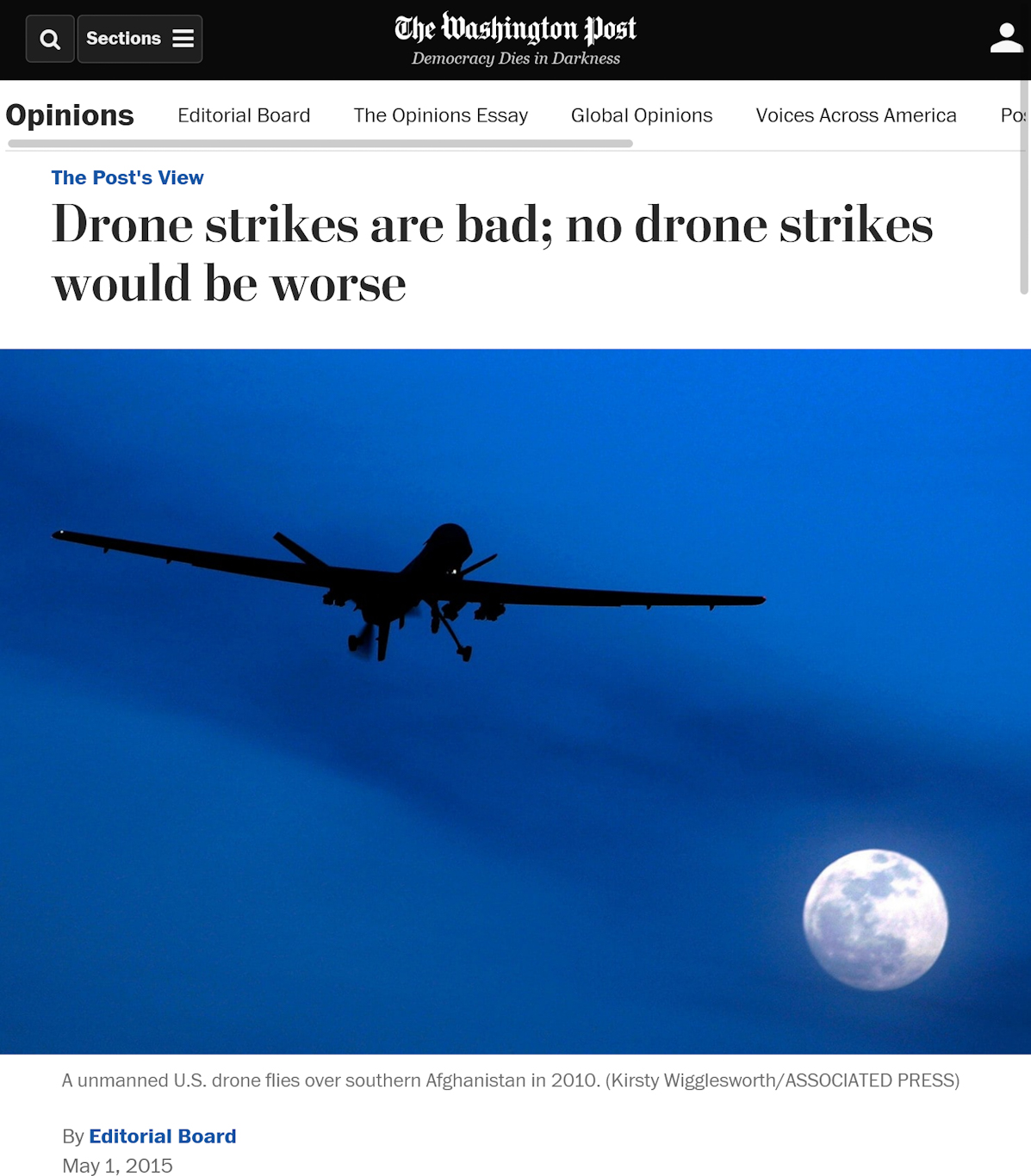
The Post’s editorial board has generally been extremely supportive of whatever conflicts the U.S. has started, and has consistently warned against ending the violence. In a 2015 editorial entitled “Drone strikes are bad; no drone strikes would be worse,” it balked at the idea of stopping the highly controversial bombing campaigns throughout the Middle East and North Africa. By that time, President Barack Obama was bombing seven countries simultaneously. Nevertheless, the Post argued that drones had successfully defeated Al-Qaeda and that the use of drone strikes “shouldn’t be up for review.”

In recent times, the rising newspaper of record has also been a driver of increased hostilities with China, describing Beijing’s military’s moves in the South China Sea as “provocations” against the U.S., spreading rumors about the COVID-19 virus’s origin, and demanding American companies like Apple “resist China’s tyranny” and begin to relocate their production facilities elsewhere to punish the Chinese government.

On Latin America too, the editorial board has proven to be extremely hawkish. It immediately endorsed a U.S.-backed far-right coup in Bolivia in 2019, insisting that “there could be little doubt who was ultimately responsible for the chaos: newly resigned President Evo Morales.” The Post condemned him for refusing to “cooperate” with “Bolivia’s more responsible leaders,” who were organizing his overthrow, and chastised him for using the word “coup” for what was going on. Morales, they concluded, was a victim of his own “insatiable appetite for power” and his inability to “accept that a majority of Bolivians wanted him to leave office.”

In 2002, the paper also supported a coup against Hugo Chavez, falsely claiming the Venezuelan president had ordered the shooting of thousands of demonstrators and absurdly asserting that “there’s been no suggestion that the United States had anything to do with [it].

The WaPo editorial board's less than subtle take
The WaPo editorial board’s less than subtle take on drone warfare

In more recent times, it has demanded more action to unseat Chavez’s successor, Nicolas Maduro, including supporting U.S. sanctions that have now killed over 100,000 people, according to a United Nations rapporteur. The Post’s justification in 2017 was that Maduro was on the verge of carrying out his own “coup,” “abolish[ing] the opposition-controlled legislature, cancel[ing] future elections and establish[ing] a regime resembling that of Cuba’s” — none of which has happened. In its efforts to oust the democratically-elected leader, the Post even aligned itself with Donald Trump and endorsed far-right coup leader Juan Guaidó as “Venezuela’s legitimate president,” a position some polls have suggested as little as 3% of Venezuelans hold.

The editorial board has expressed its desire to see regime change in leftist-controlled Nicaragua, too. President Daniel Ortega, it claims, is “taking a sledgehammer” to opposition against him, while it also demands that the U.S., which has done nothing but offer “mild verbal opposition” to his rule, do more. What happened to the U.S. of the 1980s, “which spent so much money and political capital to promote democracy in Nicaragua?” they ask sadly.

In reality, of course, the U.S. is currently trying to strangle Nicaragua’s economy through sanctions. And in the 1980s, Washington’s “democracy promotion” agenda included the funding, training and arming of fascist death squads who wrought havoc across Central America, killing hundreds of thousands in genocides from which the area may never recover. The architects of the violence were found guilty in U.S. courts, while the Reagan administration was tried and convicted by the International Court of Justice on 15 counts that amount to international terrorism. That the Post’s editorial board remembers that history as “promoting democracy” is particularly worrisome.

Fake news, fake newspapers

The Washington Post was the key supporter of fake news detection system “PropOrNot,” which was almost immediately exposed as a fake operation itself, forcing the newspaper to publicly distance itself from its own reporting. Yet it was the Post itself that perpetuated the most notorious and damaging fake news story of the 21st century: the Iraqi weapons of mass destruction hoax and Saddam Hussein’s fictional links to al-Qaeda.

In a highly influential editorial entitled “Irrefutable” the Post wrote that, after watching Secretary of State Colin Powell’s speech at the United Nations, “it is hard to imagine how anyone could doubt that Iraq possesses weapons of mass destruction… And [Powell] offered a powerful new case that Saddam Hussein’s regime is cooperating with a branch of the al-Qaeda organization that is trying to acquire chemical weapons and stage attacks in Europe.”

“No page was more crucial in propelling the disastrous U.S. invasion of Iraq than the Post‘s editorial page — which beat the drums for war in a couple dozen editorials in the six months leading up to the invasion,” Cohen told MintPress, adding:

The Post’s op-ed page was almost as cartoonishly wrong on Iraq, offering little dissent or corrective to the editorial page’s jingoism — especially in that pivotal media moment following Colin Powell’s error-filled U.N. speech. While the editorial page offered up its ‘Irrefutable’ verdict, the op-ed page’s liberal voice offered an embarrassing column, headlined ‘I’m Persuaded’.”

The Post played a major role in manufacturing consent for the deadliest war since Vietnam, publishing 27 editorials in support of an invasion. As with PropOrNot, it backtracked long after the dust had settled, apologizing for its role in amping the public up to accept that war. Yet to this day it continues to push for others.

Surveillance state champion

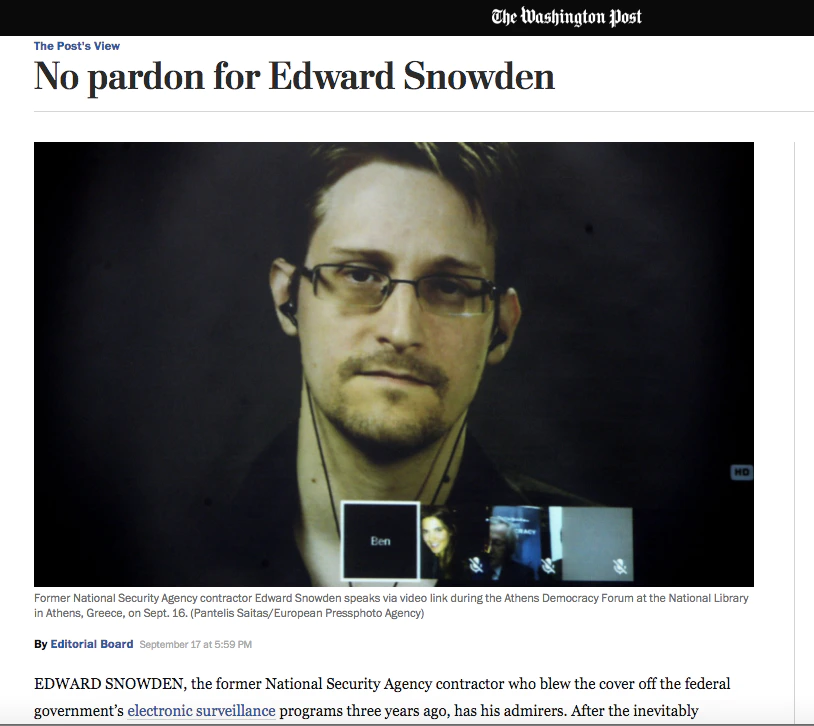
Despite telling its readers that “Democracy Dies in Darkness,” The Washington Post certainly has a negative opinion about those individuals who work to shine a light on illegal government activities. In 2016, its editorial board demanded “no pardon for Edward Snowden,” condemning his backers like filmmaker Oliver Stone and expressing outrage that Snowden had revealed that the U.S. was spying on Russia and carrying out cyberattacks against China. In its long denunciation, it insisted that the NSA’s massive surveillance operation against the American public resulted in “no specific harm, actual or attempted.” As such, the editorial board made history by becoming the first newspaper ever to call for the imprisonment of its own source, on whose back and information it won a Pulitzer Prize.

If Snowden was not worthy of defending, then it is no surprise that the Post’s editorial team expressed their delight when Julian Assange was dragged out of the Ecuadorian Embassy in London, declaring it a “victory for the rule of law.” “Julian Assange is not a free-press hero. And he is long overdue for personal accountability,” they wrote, spreading baseless conspiracy theories that the Australian publisher worked with Russia to hack American democracy.

WaPo Snowden
After relying on him as a source, the Post went after Snowden and any who dared to back him

The Ecuadorian government of Rafael Correa, which offered asylum to the Western dissidents, also came under fire. In 2013, the Post (falsely) labeled Correa an “autocrat” and “the hemisphere’s preeminent anti-U.S. demagogue.” They also directly threatened him, writing that, “If Mr. Correa welcomes Mr. Snowden, there will be an easy way to demonstrate that Yanqui-baiting has its price.”

Of course, the Post is now intimately linked with the national security state after Amazon signed a number of deals to provide intelligence and computing services to several three-letter agencies. In 2020, the Bezos-owned Amazon Web Services signed a new deal with the CIA worth tens of billions of dollars.

The editorial board has also gone up to bat for Immigration and Customs Enforcement (ICE) multiple times, insisting that it is “the wrong target for outrage,” presenting the agency as key in the battle against art theft and nuclear proliferation. “Abolishing ICE is not a serious policy proposal,” the board wrote in 2018, despite the fact that the U.S. survived without the agency perfectly well until its creation in 2003.

Attacking any pro-people policy

The Washington Post has aggressively attempted to beat back any new political movements challenging the establishment. Chief among them has been the one around Bernie Sanders, for whom the newspaper has reserved a special ire. In 2016, it famously ran 16 negative stories on Sanders in the space of 16 hours and has used its fact-checking page to relentlessly undermine him, sometimes to bizarre effect.

“Bernie Sanders keeps saying his average donation is $27, but his own numbers contradict that,” read the headline of one article, which detailed how his average donation was actually $27.89, not $27. It also gave his statement that six men (one of whom is Bezos) hold as much wealth as the bottom half of the world’s population “three Pinocchios” — the designation just below the most egregious lie. This was because, they argued, billionaires’ wealth is tied up in stocks, not money itself, and most people own essentially nothing. Why this disproved his assertion they did not explain. Going undisclosed is that both Bezos and the Post’s chief fact-checker Glen Kessler, who is the scion of a fossil fuel baron, would stand to lose a fortune if Sanders were elected.

Likewise, the Post’s editorial board did all it could to ensure Sanders was not elected in 2016, publishing editorials such as “Bernie Sanders’s fiction-filled campaign,” which defended big banks from Sanders’s attacks; “Mr. Sanders’s shocking ignorance on his core issue,” which presented Hillary Clinton as a more credible Wall Street reformer; and “Mr. Sanders peddles fiction on free trade,” which championed the long-discredited North American Free Trade Agreement as a jobs creator. Unsurprisingly, the editorial board was also a vociferous supporter of the Trans Pacific Partnership.

In 2020, the Post was no less hostile to Sanders, publishing an editorial headlined “We should pay more attention to the Democrats who pay attention to reality,” which stated that “Mr. Sanders promises unlimited free stuff to everyone; other candidates propose smarter, more targeted approaches.”

The Post’s higher-ups have been careful to oppose virtually every piece of progressive or pro-people policy proposals. Chief among them has been healthcare. The United States is alone in the developed world in not offering some kind of universal healthcare to its population. Its privatized system is multiple times more expensive than that of comparable countries and has the worst outcomes in the West. Yet the board has consistently scare-mongered its readers, claiming “Single-payer health care would have an astonishingly high price tag,” and attacking Medicare-For-All proponents running for office. “Why go to the trouble of running for president to promote ideas that can’t work?” it asked rhetorically, before going on to insist that moving towards a healthcare system like that of Canada, Japan or Western Europe does not meet a “baseline degree of factual plausibility.”

On education, it has been just as regressive. “There are consequences to making college free,” it warned readers. Chief among these would be that private universities would make less money, which, apparently should be a major concern. “Forgiving student loans the wrong way will only worsen inequality,” ran the headline of another editorial, in which the board pretended to be ultra-left elite-hating radicals, arguing that we should not make college free because Ivy League graduates would benefit the most (around one-third of the Post’s editorial team attended an Ivy League school). It also feigned a far-left position on charter schools, pretending that essentially privatizing schools and handing them over to businesses to run would solve racial inequality in America, and that anyone who opposed them (like teachers’ unions) was no progressive.

Perhaps the most blatant conflict of interest the Post has displayed is in their committed opposition to a wealth tax. “Elizabeth Warren wants a ‘wealth tax.’ It might backfire,” they wrote, making a series of bizarre and illogical arguments against the plan, such as immigrants will stop wanting to come to the U.S. if such a tax is imposed (the threshold for paying a wealth tax is $50 million). Five months later, the board reaffirmed their position: “A wealth tax isn’t the best way to tax the rich,” they wrote, claiming that rich people “can afford the best accountants and lawyers,” and so taxing them is presumably impossible.

Of course, the Post’s owner, Jeff Bezos, has every reason to go all out to prevent a wealth tax gaining traction. A CNBC study calculated that Bezos would be forced to pay $5.7 billion annually if Warren’s tax plans came to fruition.

The Post has also taken a firm stand against serious regulation of monopolies, decrying a supposed “antitrust onslaught” against Google, spearheaded by simplistic “break-them-up” rhetoric from dishonest actors. In 2016, it also lambasted Sanders for his “oversimplified,” “crowd-pleasing” demagoguery on Wall Street regulation, insisting that there has actually been widespread reform of the financial sector since 2008, making another crash unlikely.

Unsurprisingly for an outlet owned by a poverty-wage employer, the Post has also consistently opposed a national $15 minimum wage. In March, it categorically stated that “[a] $15 minimum wage won’t happen” and Democrats should stop trying to make it happen. Instead, they advised, they should “practice the art of the possible.” This, the board explained, meant falling in line behind Arkansas arch-Republican Senator Tom Cotton to support his proposals for a creeping state-by-state rise to $10.

On the climate, too, the Post has pushed extremely regressive positions, opposing a Green New Deal outright and suggesting the atmosphere be turned into a giant free market where polluters can trade credits and speculate. “The left’s opposition to a carbon tax shows there’s something deeply wrong with the left,” they wrote. They also endorsed the highly controversial process of fracking. Seeing as the Post’s editorial board is littered with former employees of the notorious climate-change denying Wall Street Journal, its stance is perhaps not surprising.

On COVID, the Post has consistently opposed teachers’ unions calls to keep schools closed, as well as standing against $2,000 checks. A universal payout is a “bad idea” they stated, but one “whose time has come because of politics, not economics.” So committed was the editorial team’s opposition to the idea of helping the poor that it presented Republican Majority Leader Mitch McConnell as a voice of sanity in Washington.

This does not mean that the Post was against direct payments to all people. In fact, all Post employees received a $2,021 bonus from management in January as a gesture of appreciation for their work during the pandemic. Two grand for me, not for thee.

Junk-food news

The point of a fourth estate is that it is supposed to shine a light on the powerful and hold them to account. But when corporate media are largely owned and sponsored by the super wealthy themselves, the claim that this is what they do is increasingly hard to maintain. In the Soviet Union, everybody was aware that the media was controlled by the state. But in a corporate state like the U.S., a veneer of independence is still maintained, although trust in the media has been plummeting for years.

While The Washington Post presents itself as an adversarial publication standing up to power, the fact that its senior staff constantly comes to such a hardline neoliberal elitist consensus on so many issues shows how little ideological diversity there is among its staff. Democracy dies at The Washington Post editorial board.


River to Sea Uprooted Palestinian   
The views expressed in this article are the sole responsibility of the author and do not necessarily reflect those of the Blog!