Showing posts with label America's Lost Wars. Show all posts

Monday, 15 November 2021

The Tripartite World Order and the Hybrid World War

 NOVEMBER 14, 2021

The Tripartite World Order and the Hybrid World War

by Dmitry Orlov, posted by permission of the author

General Mark Milley, America’s highest-ranking military officer, has recently gone public with a revelation of his: the world is no longer unilateral (with the US as the unquestioned world hegemon) or bilateral (as it was with the US and the SU symmetrically balancing each other out in an intimate tango of mutual assured destruction). It is now tripartite, with three major powers—the US, Russia and China—entering a “tripolar war.” That is the exact term he is reported to have used at the Aspen Security Forum on November 3, 2021.

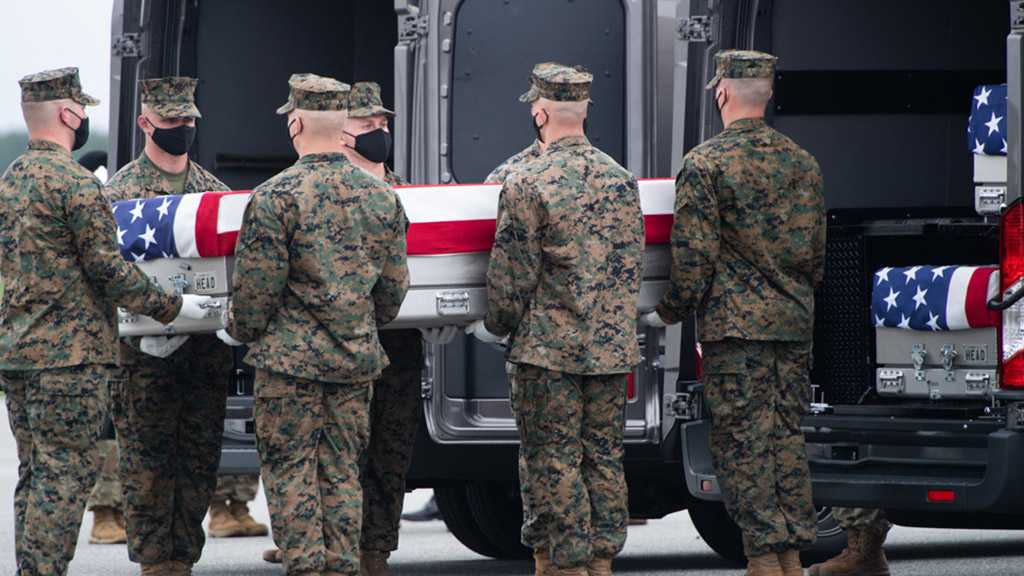
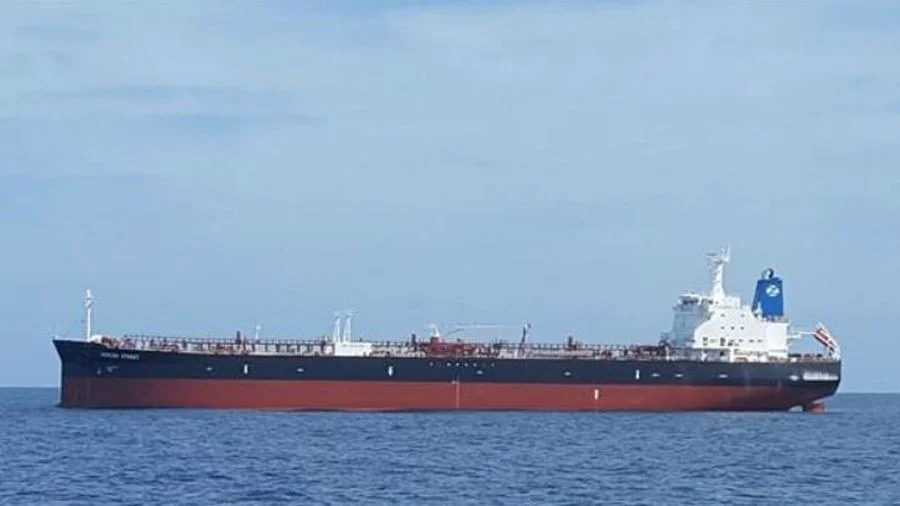
This seems strange, since neither Russia nor China is eager to attack the US while the US is in no condition to attack either of them. The US has just got defeated in a two-decade conflict against a fourth-rate adversary (Afghanistan, that is) in the most humiliating way possible, abandoning $80 billion of war materiel and forsaking thousands of its faithful servants in a hasty withdrawal that amounted to a rout. It is about to suffer a similar fate in Syria and Iraq. Its navy just got humiliated in a minor skirmish with the Iranians over an oil tanker. Clearly, the US is in no shape to attack anyone.

So what could Milley possibly mean? He may not sound smart, but he is the most powerful man at the Pentagon. Of course, Milley-Vanilley could just be lip-sinking to some stupid music coming out of the White House (which is currently stocked with some choice imbeciles). This would make sense, since throughout his career Milley carefully avoided anything that smacked of actual military action and therefore carried within it the possibility of defeat, instead choosing to concentrate on such things as producing a report on the impact of climate change on the U.S. military.

Here is Milley captured during one of his prouder moments, standing next to Russia’s General Valery Gerasimov, who saw combat—and victory—as commander during the Second Chechen War. Gerasimov then authored Russia’s hybrid war doctrine (the Gerasimov Doctrine), which allows strategic and political objectives to be achieved through nonmilitary means but with military support and military-style secrecy, discipline, coordination and control. In comparison, our General Milley is something of a cardboard cutout general, with a string that makes his lower jaw move up and down leading to some place within the Washington swamp of political think tanks and defense industry lobbyists.

The Gerasimov Doctrine bears an uncanny resemblance to the Chinese doctrine of unlimited war, indicating that Russia and China have harmonized in their defensive strategies. These doctrines are designed to amplify China’s and Russia’s natural advantages while placing the US at a maximum disadvantage. It is not immediately clear whether Milley is capable of understanding such matters; quite the opposite, it is likely that his job security and career path critically depended on his inability to understand anything above his pay grade. Nevertheless, since he happens to be the mouthpiece for the whole ungodly mess, we need to at least try to take his words at face value and try to think of what his “tripolar war” could possibly mean.

The Russian hybrid war doctrine and the Chinese unlimited war doctrine both give an advantage to countries with strict, centralized control structures (China and Russia, that is) while severely disadvantaging the US, which has a diffuse and internally conflicted power elite split up between two parties and among lots of competing government agencies and private entities with lots of opportunities for both internal and external espionage, infiltration and media leaks.

Russia’s advantages are in advanced weapons against which the US has no countermeasures, such as hypersonic missiles and radio warfare systems, and in a huge and only partially explored resource base, of energy resources especially. China’s advantage is in a huge and highly disciplined workforce that produces a vast array of products which the US must continuously import to prevent its entire economy from shutting down because of supply chain disruptions. On the other hand, both China and Russia find themselves at a disadvantage in facing the large and well-oiled machine the US has developed for its habitual meddling in the affairs of other nations and the undermining of their natural sovereignty. An array of mechanisms, from cultural exports to ad campaigns associated with popular brands to social media initiatives designed to corrupt the minds of the young, exists in order to exert US influence on other nations.

The Chinese and the Russian responses to this threat are almost diametrically different: whereas China builds firewalls and uses strict social controls to contain the threat, Russia’s strategy is to allow the foreign infection to run wild and to let their nation’s innate immune system create antibodies against it and neutralize it. Russia draws its red lines at outright bought-and-paid-for enemy propaganda, inciting armed rebellion, advocacy of terrorism, propaganda of sexual perversion among children, etc. In this way, Russia can not just compensate for this disadvantage but turn it to its own advantage: while the West is becoming increasingly undemocratic and authoritarian with its endless political correctness, social biodiversity requirements and the pursuit of better living through non-reproductive mating, hormone therapy and genital mutilation, Russia remains a free land with a wholesomely conservative social outlook that is quite attractive to people all over the world and is becoming increasingly attractive to many people in the West as they become painfully aware of the wages of sin.

Why concentrate on hybrid/unlimited war instead of an outright nuclear or conventional military conflict between the US and China and/or Russia? That is because both conventional and nuclear military conflict between any of these three nations is an insane, suicidal choice, while those in charge of defining military strategy are specifically not selected for their suicidal tendencies. Neither Russia nor China is known for their wars of aggression, and while the US is extremely well known for its homicidal, violent tendencies (having carried out 32 bombing campaigns on 24 countries since World War II), it is fundamentally a bully, only picking on weak countries that pose no threat. Based on publicly available information, both Russia and China are now quite far ahead of the US in weapons development, to a point where any possible direct US attack on either of them would be self-disarming at best and suicidal at worst.

In the best case scenario, the US launches an attack which is successfully repelled: bombers and rockets shot down, ships sunk, US military bases and port facilities destroyed, possibly US command and control centers also destroyed, as quite pointedly promised by Putin. The US then lays prostrate and at the mercy of its opponents. If its cooperation still leaves something to be desired, some combination of deplorables, despicables, imponderables and indecipherables will be organized just enough to make a bloody mess of what’s left of US government structures and power elites, which will then be replaced with an international peacekeeping force (as an optimistic case) or just left to persist in durable disorder, misery and international isolation.

The worst case scenario is the tired old mutual assured destruction, nuclear winter and end of life on Earth, but it is unlikely for a number of reasons. First, of the US nuclear deterrent triad only the submarine component remains viable, and even it is quite tired. None of the Minuteman missiles has been successfully tested in a long time, and these are ballistic missiles which, once the boost phase is over, follow a perfectly predictable inertial trajectory, making them easy targets for Russia’s new air defense systems. Of the Minutemen that manage to get out of their silos and launch in the general direction of Russia or China, it is unknown how many of their nuclear payloads would actually detonate since these are all quite old and haven’t been tested in a long time either. The US no longer has the ability to make new nuclear charges, having lost the recipe for making the high explosive needed to make them detonate. But that may be a moot point, since at this point no ICBM is likely to be able to penetrate Russian air defenses. As far as Chinese air defenses, it is notable that Russia and China have integrated their early warning systems and China now has four divisions of Russian S-400 Triumph air defense systems and is planning to add more.

Turning to the airborne part of the US nuclear triad, its mainstay is still the Boeing B-52 Stratofortress, the youngest of which is almost 60 years old. It cruises at 260 knots at an altitude of 34000 feet and is the opposite of stealthy, making it easy to shoot down at a stand-off distance of several hundred kilometers. Since this makes it perfectly useless for dropping bombs, all that remains is cruise missiles, which fly at a positively poky 0.65 Mach, again making them easy targets for modern air defenses. There are also some newer stealth bombers—very few and, it has turned out, not too stealthy, putting them essentially in the same category as the Stratofortress, and the cruise missiles they can launch are also those same old subsonic ones.

Lastly, there are the strategic nuclear submarines, which are the only part of the US nuclear triad that is still viable. They remain effective as a deterrent, and they do have the ability to get up close to launch a sneak attack with a good chance that at least a few of the missiles will get through the air defenses, but they can’t possibly hope to get around the inevitability of retaliation which will cause unacceptable, fatal damage to the continental US. This makes them useless as an offensive weapon.

Add to this Russia’s updated nuclear doctrine, according to which any attack against Russian sovereign territory or Russian sovereign interests, whether conventional or nuclear, would open the door to a nuclear retaliation, launched upon warning, and Putin’s solemn promise to counterattack not just against the locations from which a strike is launched but against the centers of decision-making. Considering that Russian missiles are hypersonic and will reach their targets before those of the US reach theirs, and that Russia has the means to shoot down US missiles while the US is unable to shoot down Russian ones, if the US were to launch an attack, those who launched it would be dead before they could find out whether their attack succeeded in causing any damage at all or whether they had just suicided themselves for nothing. All of this adds up to an inevitable conclusion: under no circumstances will the US attack either Russia or China, using either conventional or nuclear weapons.

There are experts who are of the opinion that a world war could spontaneously erupt at any moment without anyone wishing it to do so, just as the world slid into World War I due to a confluence of unhappy accidents. But there is a big difference: the military and civilian leaderships of the warring sides in World War I did not have hypersonic missiles pointed directly at their heads. They thought that the war would be fought far away from their palaces, headquarters and stately mansions. They were, in some cases, quite wrong, but that was their thought originally: why not test our industrial prowess while sacrificing the lives of several million useless peasants?

Now the situation is quite different: any substantial provocation is an automatic self-destruct trigger and all sides know this. Of course, there will be minor provocations such as the US Navy steaming around in the Taiwan Strait or the Black Sea close to the shores of Crimea, but then they do have to earn their keep somehow. In turn, the Russians and the Chinese will periodically up the ante a little bit by shooing them away with a harshly worded radio message or a few shots fired across their bows. But both sides know just how careful they have to be because any serious error will require immediate deescalation and may entail major loss of face. And that, as the saying goes, would be worse than a crime: it would be a mistake.

The provocations of which the US is still capable are likely to grow more and more feeble over time. The US has lost the arms race against both Russia and China and is unlikely to ever catch up. On the other hand, neither Russia nor China is the least bit likely to attack the US. There is no reason to do so, given that they can get what they want—a gradual fading out of US influence—without resorting to large-scale military action. Maintaining a strong defensive posture while projecting power within their expanding spheres of interest would be quite enough for either of them. Thus, all that’s left for the US is hybrid warfare: financial warfare in the form of sanctions, aggressive dollar-printing and large-scale legalized money laundering, informational warfare played out on the internet, medical warfare using novel pathogens, drugs and vaccines, cultural warfare in the form of promoting and defending conflicting systems of values and so on, with military activities limited to the use of proxies, fomenting putsches and civil wars, actions of private military companies and so on.

If Milley is pinning his hopes on being able to provoke a conflict between China and Russia, he is likely to be disappointed. These two very large neighboring countries are synergistic. China has tremendous productive capacity for producing all manner of finished goods but has limited natural resources, is insular and has limited capacity for interacting with the rest of the world except through trade and commerce. Russia, on the other hand, has virtually limitless natural resources but, with a smaller though highly educated population spread out across a vast and somewhat inhospitable terrain, is forced to concentrate its efforts on certain strategically important sectors such as energy and food exports, high-tech weapons systems, nuclear energy, vaccines and energy-intensive products such as fertilizers, plastics and metals where their access to cheap energy provides them with a competitive advantage.

One of Russia’s major strengths is a culturally ingrained ability to understand people from other cultures and to maintain cordial relations even across great cultural divides and enemy lines. Russia has a unique ability to offer stability and security, both through careful diplomacy and by offering advanced defensive weapons systems. The Chinese have been aggressively buying into economies around the world, investing in major infrastructure projects to further their trade, but are sometimes found lacking in diplomatic finesse and in their understanding of local sensibilities, alienating their partners by directly demanding a controlling share in their investments. The Russians, on the other hand, understand that you have to at least kiss a girl before offering to pay her college tuition.

Such finesse tends to be interpreted as weakness by certain Westerners who, over the course of many centuries of fratricidal warfare and genocidal colonialism, have been conditioned to only respect brute force and to understand relationships only in terms of dominance or submission. With the sudden departure of the US from the world stage, many smaller European nations are now actively looking for a new master to lord over them. Both the Chinese and the Russians are likely to leave them disappointed; while Chinese commerce and Russian security (including energy security) will be on offer, they will be on their own and forced to earn their own keep and their oaths of fealty will fall on deaf ears. The Eastern Europeans especially might find it impossible to ingratiate themselves back into the Russian world; the Russians have had their fill of them and their duplicitousness. Their other option will be to go to work for the Chinese.

Russia and China complement each other and are more likely to work with each other rather than against each other in their dealings with each other and with the rest of the world. This is certainly not the case with the US, vis-à-vis either China or Russia. During the 1990s and the naughts, while China was rapidly transforming into the world’s manufacturing hub while Russia was recovering from the setback it had been dealt by the Soviet collapse, the US was able to position itself as the world’s indispensable consuming nation, redirecting a lion’s share of the world’s resources and manufactured products to feed its appetites in exchange for printed dollars (continuously expropriating the world’s savings while exporting inflation) and using the threat of military action against anyone who would challenge this arrangement. But now the situation is different: most of China’s trade is now not with the US but with the rest of the world, Russia is fully recovered and developing slowly but surely, the share of the US in the world’s economy has shrunk, the appetite for printed dollars in the form of US government debt has declined greatly, and as to its former full-spectrum military dominance, see above.

And yet General Milley wishes to fight a tripolar war against two poles that won’t fight each other and aren’t spoiling for a fight with the US either; they just want the US to pack up, go home and no longer darken the horizons around Eurasia. As I took pains to explain above, the US is in no position to challenge either or both of them in an all-out military conflict, or to risk engaging them in a way that runs a major risk of provoking one. What can a giant, sprawling, lavishly funded, corrupt and dysfunctional bureaucracy do under such circumstances in order to justify its existence? The answer is, I believe, obvious: engage in petty mischief, a.k.a. hybrid warfare, but in doing so it finds itself, as I have already explained, at a disadvantage.

The list of petty mischief is long and makes for tedious reading. The best that can be done with it is to make comedy with it. Take, for instance, the imbroglio, worthy of Boccaccio’s Decameron, of Tikhanovskaya the cutlet fairy and phantom president of Belarus, who recently joined the club of bogus replacement leaders, alongside Juan Random Guaidó, phantom president of Venezuela, having failed to seize power from deeply entrenched Byelorussian president Lukashenko, and who is now cooling her heels in neighboring Lithuania. Having recognized the abject failure of Tikhanovskaya’s power grab, the Petty Mischef Department attempted to organize a scandal around a Byelorussian sprinter during the Tokyo Olympics, whose name is… Timanovskaya! You see, they thought that nobody would notice the single-character substitution. The ploy failed, and Timanovskaya is now cooling her heels in neighboring Poland.

There have been other, much larger-scale attempts at petty mischief, similarly ham-handed and similarly spectacular in their failure.

1. There was the attempt to force the entire world to submit to a relentless inoculation campaign (in the works since 2009) in the course of which an interplay between genetically engineered pathogens and genetically engineered vaccines against them would be used to make fabulous profits for Big Pharma while simultaneously selectively genociding the population of certain unfriendly or otherwise undesirable countries. End result: China has largely fought off the pathogen and has produced its own vaccine while Russia has produced several vaccines, the most popular of which has been proven safe and effective and has been turned into a major profit center by being exported to 71 countries and earning Russia more export revenue than arms exports.

Meanwhile, not only are Western vaccines proving less than 50% effective (much less than that for Johnson & Johnson) but thousands of people are actually dropping dead or becoming severely ill from them. Most alarmingly, young, freshly vaccinated athletes are dropping dead from heart attacks right in the middle of a game—dozens of them! The only possible response to this by the authorities—the only one they are capable of—is to double down, requiring everyone to get vaccinated again and again. The marketing strategy of “if our product makes you sick, we’ll give you more of it” is hardly ever effective and, in due course, it is producing open rebellion in many places, shutting down entire industries and generally playing havoc with societies and economies. Mission accomplished!

2. There is an ongoing attempt to force countries around the world to pay a carbon tax for their carbon emissions while those nations that engage in the cargo cult of building solar and wind generation capacity are exempted from it. Lots of expensive climate models kept supercomputers humming and international climate conferences were convened, at which people could wring their hands and wallow in maudlin self-pity over the ever-looming imaginary climate catastrophe. But then came a major complication: both Russia and China managed to turn the situation to their advantage. In the case of China, the case is simple: what allows China to manufacture and export products which the rest of the world loves to import is its use of coal and just a temporary reduction in the use of coal was sufficient to demonstrate that any such constraints would hurt the US through supply chain disruptions more than they would hurt China.

In the case of Russia, the situation is even simpler: from the point of view of carbon dioxide emissions, Russia is the greenest country on earth, deriving the largest share of its electricity from carbon-free nuclear and hydro and low-carbon natural gas. It also has 20% of the world’s forests which, in case of global warming and increased atmospheric carbon dioxide concentrations, would spread rapidly north across the tundra toward the Arctic circle, soaking up prodigious amounts of carbon dioxide. Thus, the US, and the rest of the West with it, have negotiated themselves into a cul de sac of their own creation, being forced to cause damage to their economies by pursuing misguided decarbonization policies which nobody would have asked them to pursue otherwise. Again, mission accomplished!

3. Yet another attempt at petty mischief is in the area of human rights and democracy. The notion of individual human rights was rather successfully deployed against the USSR, warping the minds of several generations of Russian intelligentsia into being ashamed of their own country (and almost completely unaware of much ghastlier crimes against humanity carried out by the collective West). The Chinese, on the other hand, were barely swayed from their traditional (be it Confucian or Communist) perspective that balances privileges against responsibilities and leaves very little room for such frivolous notions as individual universal rights. But in recent decades the Russians have managed to claw their way back to a more balanced understanding of their own history and a greater awareness of the multiple atrocities perpetuated by those who would criticize them. The rank hypocrisy of those who would use such tactics has also become glaringly obvious through such outrages as the illegal imprisonment of Julian Assange and the exile of Edward Snowden.

The story of Maria Butina, a spectacular individual who is now a member of the Russian parliament, has also made an impression. She was falsely accused of being a foreign agent based on the now discredited Steele Dossier which Hillary Clinton’s camp had concocted in order to slander Donald Trump. Butina was imprisoned for 18 months, spending much of that time in solitary confinement (a treatment that equates to torture). She was forced to plead guilty to a bogus charge before a kangaroo court judge before being released and allowed to return to Russia. She described her ordeal in a best-selling book and anybody who has read it has absorbed, along the way, an important message: there is simply no such thing as the American justice system. A major reason why Butina had been singled out for such treatment had to do with her last name, which differs by just one character from Putin’s: there’s that single-character substitution again! With a name so similar to that of that horrible dictator Putin, of course she’d be found guilty! I wouldn’t be surprised if there is a certain dim-witted miscreant ensconced in the bowels of the CIA or the State Department who comes up with these harebrained ideas by actually scanning documents for similar-sounding names.

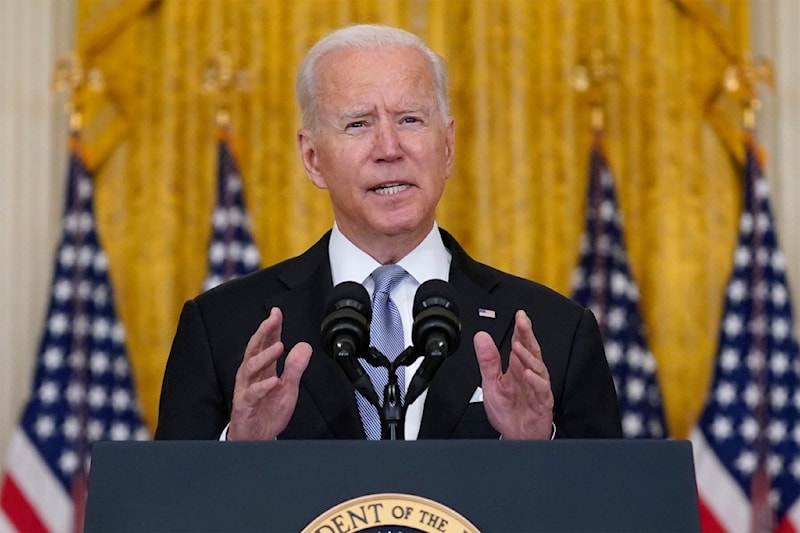
As far as democracy, the concept is valuable but applies differently to each nation, based on its unique values and traditions, but the image of it served up in the US, where about half the electorate feels that they were cheated during the last presidential election, or the EU, which is lorded over by unelected pompous nobodies at the European Commission, or the way it was misapplied in Afghanistan, Iraq and other nations invaded and destroyed by the West, has done much to discredit the concept. Joe Biden, who is now working on convening a virtual assemblage of nations he deems democratic, making a list and checking it twice, making sure to exclude anyone he doesn’t deem sufficiently democratic, is too senile to grasp the simple fact that he has lost any right to appeal to the concept of democracy given the way he got elected and what he’s done to Afghanistan.

The image I will leave you with is of a transport plane piloted by the demented Joe Biden and co-piloted by that giggling twit Kamala Harris, with some number of leaders from supposedly democratic nations (who have failed to absorb the lesson of Afghanistan) clinging to its landing gear, and with General Millie-Vanillie sitting in the cargo hold cleaning his gun, getting ready to fight World War III against both Russia and China.


River to Sea Uprooted Palestinian   
The views expressed in this article are the sole responsibility of the author and do not necessarily reflect those of the Blog!

Friday, 3 September 2021

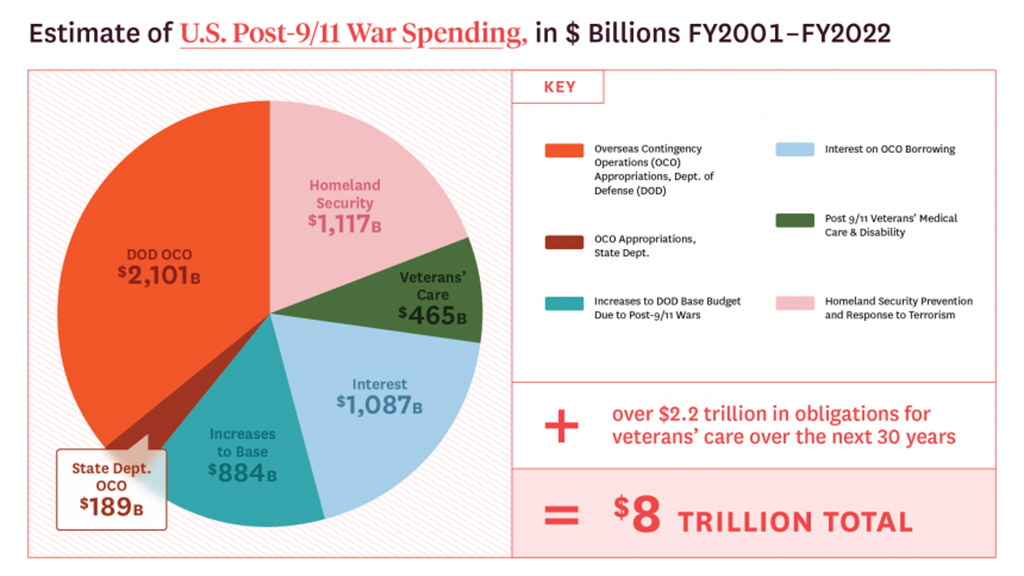
US Global Wars Cost 900k Lives, $8 Trillion Over Two Decades

  September 2, 2021

US Global Wars Cost 900k Lives, $8 Trillion Over Two Decades

By Staff, Agencies

The US so-called war on terror has taken almost one million lives across the globe and cost the country $8 trillion, over the past two decades, says a new report.

A report issued by Costs of War Project at Brown University, at end of the disastrous US withdrawal from Afghanistan, estimated 897,000 to 929,000 people have lost their lives as a direct result of war, whether by bombs, bullets or fire, in some 80 countries.

“The war has been long and complex and horrific and unsuccessful… and the war continues in over 80 countries,” said co-director of Costs of War, Catherine Lutz on Wednesday.

The death toll, includes US military members, allied fighters, opposition fighters, civilians, journalists and humanitarian aid workers, the report said.

The figure, however, does not include the many indirect deaths the war has caused by way of disease, displacement and loss of access to food or clean drinking water.

“The deaths we tallied are likely a vast undercount of the true toll these wars have taken on human life,” said Neta Crawford, another co-founder of the project.

The project also revealed that the wars have cost the US an estimated $8 trillion in Afghanistan, Iraq, Pakistan and Syria.

Of the $8 trillion, $2.3 trillion is attributed to the Afghanistan/Pakistan war zone.

“The Pentagon and the US military have now absorbed the great majority of the federal discretionary budget, and most people don’t know that,” said Lutz.

“Our task, now and in future years, is to educate the public on the ways in which we fund those wars and the scale of that funding,” she added.

Another researcher of the project, Stephanie Savell said, “Twenty years from now, we’ll still be reckoning with the high societal costs of the Afghanistan and Iraq wars – long after US forces are gone.”

US Global Wars Cost 900k Lives, $8 Trillion Over Two Decades
Source: Costs of War Project – Brown University

The United States and its allies invaded Afghanistan in October 2001 as part of the so-called war on terror. While the invasion ended the Taliban’s rule in the country back then, it is now ended with the return of the group to power.

On August 31, the picture of US Army general Chris Donahue appeared on the news as the last US soldier to leave Afghanistan. US media outlets had headlines indicating that the US war in Afghanistan was finally over.

US President Joe Biden also addressed the nation, and defended his decision to withdraw, saying, “I was not going to extend this forever war, and I was not extending a forever exit” and “It’s time to end the war in Afghanistan.”

For the first time in 20 years now, there is no US military presence in Afghanistan, but observers say no troops on the ground does not mean that the US war in the country is over.

They said the withdrawal simply means that one method of waging war in Afghanistan is no longer occurring.


River to Sea Uprooted Palestinian   
The views expressed in this article are the sole responsibility of the author and do not necessarily reflect those of the Blog!

Thursday, 19 August 2021

THE RETURN OF THE TALIBAN 20 YEARS LATER


Taliban co-founder Mullah Abdul Ghani Baradar leaves after signing an agreement with the United States during a ceremony in the Qatari capital Doha on February 29, 2020.
TALIBAN CO-FOUNDER MULLAH ABDUL GHANI BARADAR LEAVES AFTER SIGNING AN AGREEMENT WITH THE UNITED STATES DURING A CEREMONY IN THE QATARI CAPITAL DOHA ON FEBRUARY 29, 2020. (AFP PHOTO)

August 18, 2021

By Vijay Prashad,

Peoples Dispatch.

Vijay Prashad explains the Taliban’s defeat of the US-backed government in Afghanistan following the US troop withdrawal.

On August 15, the Taliban arrived in Kabul. The Taliban’s leadership entered the presidential palace, which Afghan President Ashraf Ghani had vacated when he fled into exile abroad hours before. The country’s borders shut down and Kabul’s main international airport lay silent, except for the cries of those Afghans who had worked for the US and NATO; they knew that their lives would now be at serious risk. The Taliban’s leadership, meanwhile, tried to reassure the public of a “peaceful transition” by saying in several statements that they would not seek retribution, but would go after corruption and lawlessness.

The Taliban’s Entry in Kabul Is a Defeat for the United States

In recent years, the United States has failed to accomplish any of the objectives of its wars. The US entered Afghanistan with horrendous bombing and a lawless campaign of extraordinary rendition in October 2001 with the objective of ejecting the Taliban from the country; now, 20 years later, the Taliban is back. In 2003, two years after the US unleashed a war in Afghanistan, it opened an illegal war against Iraq, which ultimately resulted in an unconditional withdrawal of the United States in 2011 after the refusal by the Iraqi parliament to allow US troops extralegal protections. As the US withdrew from Iraq, it opened a terrible war against Libya in 2011, which resulted in the creation of chaos in the region.

Not one of these wars—Afghanistan, Iraq, Libya—resulted in the creation of a pro-US government. Each of these wars created needless suffering for the civilian populations. Millions of people had their lives disrupted, while hundreds of thousands of people lost their lives in these senseless wars. What faith in humanity can now be expected from a young person in Jalalabad or in Sirte? Will they now turn inward, fearing that any possibility of change has been seized from them by the barbaric wars inflicted upon them and other residents of their countries?

There is no question that the United States continues to have the world’s largest military and that by using its base structure and its aerial and naval power, the US can strike any country at any time. But what is the point of bombing a country if that violence attains no political ends? The US used its advanced drones to assassinate the Taliban leaders, but for each leader that it killed, another half a dozen have emerged. Besides, the men in charge of the Taliban now—including the co-founder of the Taliban and head of its political commission, Mullah Abdul Ghani Baradar—were there from the start; it would never have been possible to decapitate the entire Taliban leadership. More than $2 trillion has been spent by the United States on a war that it knew could not be won.

Corruption Was the Trojan Horse

In early statements, Mullah Baradar said that his government will focus its attention on the endemic corruption in Afghanistan. Meanwhile, stories spread across Kabul about ministers of Ashraf Ghani’s government attempting to leave the country in cars filled with dollar bills, which was supposed to be the money that was provided by the US to Afghanistan for aid and infrastructure. The drain of wealth from the aid given to the country has been significant. In a 2016 report by the US government’s Special Inspector General for Afghanistan Reconstruction (SIGAR) relating to the “Lessons Learned from the US Experience with Corruption in Afghanistan,” the investigators write, “Corruption significantly undermined the US mission in Afghanistan by damaging the legitimacy of the Afghan government, strengthening popular support for the insurgency, and channeling material resources to insurgent groups.” SIGAR created a “gallery of greed,” which listed US contractors who siphoned aid money and pocketed it through fraud. More than $2 trillion has been spent on the US occupation of Afghanistan, but it went neither to provide relief nor to build the country’s infrastructure. The money fattened the rich in the United States, Pakistan, and Afghanistan.

Corruption at the very top of the government depleted morale below. The US pinned its hopes on the training of 300,000 soldiers of the Afghan National Army (ANA), spending $88 billion on this pursuit. In 2019, a purge of “ghost soldiers” in the rolls—soldiers who did not exist—led to the loss of 42,000 troops; it is likely that the number might have been higher. Morale in the ANA has plunged over the past few years, with defections from the army to other forces escalating. Defense of the provincial capitals was also weak, with Kabul falling to the Taliban almost without a fight.

To this end, the recently appointed defense minister to the Ghani government, General Bismillah Mohammadi, commented on Twitter about the governments that have been in power in Afghanistan since late 2001, “They tied our hands behind our backs and sold the homeland. Damn the rich man [Ghani] and his people.” This captures the popular mood in Afghanistan right now.

Afghanistan and Its Neighbors

Hours after taking power, a spokesperson for the Taliban’s political office, Dr. M. Naeem, said that all embassies will be protected, while another spokesperson for the Taliban, Zabihullah Mujahid, said that all former government officials did not need to fear for their lives. These are reassuring messages for now.

It has also been reassuring that the Taliban has said that it is not averse to a government of national unity, although there should be no doubt that such a government would be a rubber stamp for the Taliban’s own political agenda. So far, the Taliban has not articulated a plan for Afghanistan, which is something that the country has needed for at least a generation.

On July 28, Taliban leader Mullah Baradar met with Chinese Foreign Minister Wang Yi in Tianjin, China. The outlines of the discussion have not been fully revealed, but what is known is that the Chinese extracted a promise from the Taliban not to allow attacks on China from Afghanistan and not to allow attacks on the Belt and Road Initiative (BRI) infrastructure in Central Asia. In return, China would continue its BRI investments in the region, including in Pakistan, which is a key Taliban supporter.

Whether or not the Taliban will be able to control extremist groups is not clear, but what is abundantly clear—in the absence of any credible Afghan opposition to the Taliban—is that the regional powers will have to exert their influence on Kabul to ameliorate the harsh program of the Taliban and its history of support for extremist groups. For instance, the Shanghai Cooperation Organization (set up in 2001) revived in 2017 its Afghanistan Contact Group, which held a meeting in Dushanbe in July 2021, and called for a national unity government.

At that meeting, India’s External Affairs Minister Dr. S. Jaishankar laid out a three-point plan, which achieved near consensus among the fractious neighbors:

“1. An independent, neutral, unified, peaceful, democratic and prosperous nation.

“2. Ceasing violence and terrorist attacks against civilians and state representatives, settle conflict through political dialogue, and respect interests of all ethnic groups, and

“3. Ensure that neighbors are not threatened by terrorism, separatism and extremism.”

That’s the most that can be expected at this moment. The plan promises peace, which is a great advance from what the people of Afghanistan have experienced over the past decades. But what kind of peace? This “peace” does not include the rights of women and children to a world of possibilities. During 20 years of the US occupation, that “peace” was not in evidence either. This peace has no real political power behind it, but there are social movements beneath the surface that might emerge to put such a definition of “peace” on the table. Hope lies there.

Vijay Prashad is an Indian historian, editor and journalist. He is a writing fellow and chief correspondent at Globetrotter. He is the chief editor of LeftWord Books and the director of Tricontinental: Institute for Social Research. He is a senior non-resident fellow at Chongyang Institute for Financial Studies, Renmin University of China. He has written more than 20 books, including The Darker Nations and The Poorer Nations. His latest book is Washington Bullets, with an introduction by Evo Morales Ayma.


River to Sea Uprooted Palestinian   
The views expressed in this article are the sole responsibility of the author and do not necessarily reflect those of the Blog!

Tuesday, 17 August 2021

US Mission in Afghanistan Was Never Nation Building, Says Biden

August 17, 2021

Source: Al Mayadeen

By Al Mayadeen

Following the great amount of criticism he was subjected to, Biden makes a speech from the White House in which he said ending US military involvement in Afghanistan now was the right decision.


United States President Joe Biden
Joe Biden addresses rumors

As the situation in Afghanistan escalates following the Taliban takeover, in addition to the harsh criticism he is being subjected to over the way his Administration handled the Afghan crisis, Joe Biden makes a speech from the White House.

“Our mission in Afghanistan was never supposed to have been nation building. It was never supposed to be creating a unified centralized democracy,” Biden said. He noted that the only vital US interest in Afghanistan today is “preventing terrorist attacks on American homeland.”

“We went to Afghanistan almost 20 years ago with clear goals; get those who attacked us on September 11th, 2001,” he added.

The American President expressed his belief that what is currently happening in Afghanistan, “Could just as easily happened 5 years ago or 15 years in the future,” saying he had to make a choice to either follow through on former President Donald Trump’s agreement with the Taliban or to go back to fighting with them.

The Democrat said this situation unfolded faster than the administration anticipated, however asserting that he doesn’t “regret [his] decision to end America’s war fighting in Afghanistan.”

Biden stated that his administration made it clear to the Taliban that upon any attack on US personnel or disruption of their operation, “The US presence will be swift and the response will be swift and forceful.”

Additionally, Biden declared that his country gave the Afghan forces everything they needed and every chance to determine their own future; however, as he said, they had no will to fight for their future.

The US President followed up by saying if Afghanistan could not resist the Taliban now, “There is no change that one more year, five more years, or twenty more years of US military boots on the ground would have made any difference.”

“American troops cannot and should not be fighting in a war, and dying in a war that Afghan forces are not willing to fight for themselves,” he added.

President “assured” that the United States would continue supporting the people of Afghanistan through their diplomacy, international influence, and humanitarian aid.

The 46th United States President clarified that he made several propositions to Afghan President Ashraf Ghani regarding a political settlement with the Taliban, advising him to take the diplomatic path. However, as Biden declared, those propositions and advice were “flatly refused” by President Ghani.

Biden accused Russia and China of having interest in a destabilized Afghanistan, saying, “China and Russia, would love nothing more than the United States to continue to funnel billions of dollars in resources and attention into stabilizing Afghanistan indefinitely.”

US President Biden interrupted Monday his holiday at Camp David and returned to the White House following the fall of Kabul that took the world by surprise.

Previously, in his latest statement on the developments in Afghanistan, Biden said he has no regrets. “I do not regret my decision,” he asserted when asked if the Biden administration’s withdrawal plans have changed, taking the Taliban’s latest offenses and advances into account.

Earlier today, US Department of Defense spokesman John Kirby stated that the Afghan government had collapsed due to a lack of leadership.

In reference to the Doha Agreement signed in February of 2020, US Department of State spokesperson Ned Price accused former President Donald Trump and his administration of striking a deal with the Taliban that was not in the US’s best interests.

President Joe Biden is facing harsh criticism from his opponents, who believe he mismanaged the US withdrawal from Afghanistan, prompting the US to rush to evacuate its embassy and citizens, blaming Biden for underestimating fears of the Afghan government collapsing quickly last month.  

Amos Yaldin, the former head of the IOF Military Intelligence Directorate, touched on the scenes of the US withdrawal from Afghanistan. He said the United States’ withdrawal from Afghanistan, especially as it was depicted, was insulting.

The Israeli media, commenting on the US withdrawal from Afghanistan, said: “With the United States withdrawing its last nationals, it is, in reality, fleeing from Afghanistan, and it is not a withdrawal as the current administration is trying to portray it.”

On Monday, the United Nations Security Council urged an immediate end to hostilities and human rights violations in Afghanistan, as well as the formation of a new government through negotiations that is unified, inclusive, and represents all parties, as well as ensuring full and equal participation of women.

Antonio Guterres, the UN Secretary-General, urged the international community to work together to eliminate the terrorist danger in Afghanistan, particularly after the Taliban took control of Kabul.

During the 20-year US occupation of Afghanistan, the US has lost around 2500 soldiers and spent more than two trillion dollars.

Earlier, the Taliban announced capturing most of the provinces following Afghan President Ashraf Ghani’s departure from Afghanistan toward Tajikistan after resigning.

After capturing the Afghan Presidential palace and Ashraf Ghani’s resignation, a Taliban official says the movement will soon declare the Islamic Emirate of Afghanistan in Kabul.

The Kabul Assembly committee stated today that the Taliban Forces will be in charge of security and stability in the city.


River to Sea Uprooted Palestinian   
The views expressed in this article are the sole responsibility of the author and do not necessarily reflect those of the Blog!

The Axis of Resistance’s Road from Tehran to Beirut is Open and Secure

https://media.thecradle.co/wp-content/uploads/2021/08/12101423/Unknown-2-3.jpeg


Elijah J. Magnier

From the Levant to the Persian Gulf, a land route is now open, and the Axis of Resistance controls those borders crossings.
Photo credit: The Cradle

Many wars have been waged in Iraq, Syria, Lebanon, and Palestine to defeat the “Axis of Resistance” or to at least deplete its logistics and supply lines. In all wars, tons of ammunition, bombs, and missiles are expended on both sides, often exhausting supplies. Each belligerent, therefore, needs to replenish its arsenal for the next confrontation, or at the very minimum, to demonstrate to the enemy its growing military capabilities, preparedness, and access to vital supplies. Most of the time, this is a valuable deterrent strategy used to avoid wars. However, because the 2006 Israeli war on Lebanon and the subsequent US occupation of Iraq and eastern Syria failed to achieve the desired US-Israeli objectives, the goal shifted heavily toward obstructing their supply lines: to cut off the Axis of Resistance road.

The aim was to stop Resistance Axis members (Iran, Syria, Hezbollah, Hamas, and Iraqi resistance groups) from re-arming themselves, and to prevent their access to weapons upgrades in advance of the next military confrontation. There began a race between the US-Israeli alliance and the Resistance Axis to control the accessibility of the vital Tehran-Beirut landline. This objective was reached first by the Resistance Axis, who liberated the Albu Kamal-al Qaem crossing on the Syrian-Iraqi border and placed it firmly under their control. Ever since, this crossing has also become a hub for critical commercial and consumer supplies whose flow the US has tried to halt by imposing harsh sanctions on Iran and Syria to prevent Iraq from providing any support. Rather, the US tried, but failed.

This significant American defeat, however, was not blared from rooftops, either by the US or by its adversaries. It is sufficient for the Resistance Axis that anything and everything they wish to transport via Iran, Iraq, Syria and Lebanon, reaches its destination, unhindered.

Traveling from the Syrian town of Qusayr, on Lebanon’s border, to Palmyra (Tadmur) is safe despite the dozens of checkpoints along the road. The Syrian Army controls the area and prevents anyone from traveling between provinces without valid documentation. Many Syrians from these provinces fled to secure areas to escape ISIS rule, and have since been trickling back to inspect their abandoned homes and resettle. Syria’s Badiyah has also become relatively safe following months of indiscriminate attacks by ISIS remnants against travelers. According to security officers, most of the ISIS militants were inhabitants of the area and its surroundings, and fled when ISIS was defeated by Syrian allied forces in 2017 and 2018.

Since then, special security brigades have been deployed from Palmyra to Deir Ezzor, while others continue to patrol the Syrian steppe to hunt down ISIS militants. However, it is still unsafe to travel through the Badiyah, and the main road used is via Sukhnah, Kabajeb, Asholah, and Deir Ezzor. From Deir Ezzor to the Iraqi border, the route via al Mayadeen, al Salehiya, and Albu Kamal is safe and well protected.

When the decision was made to clear the road and eliminate ISIS in the cities east of the Euphrates River, the Syrian Army and its allies attempted to free the al-Tanf border region with Iraq. US jets intervened, attacked the brigades, causing more than 50 casualties to prevent the defeat of ISIS targets. The Resistance Axis’ joint military operating room understood that the US plan was to cut off Syria from its neighbors, since its borders with Jordan were already closed.

Brigadier General Qassem Suleimani, head of the Iranian Revolutionary Guards Corps’ Quds Brigade – later, assassinated by US drones near Baghdad airport in 2020 – personally took part in the assault on al Mayadeen and Albu Kamal, even before the liberation of Deir Ezzor. Soleimani wanted to reach and control the Syrian-Iraqi borders before the Americans, fearing the US establishment of a “no man’s land” to prevent free passage between Iraq and Syria.

Syrian Druze General Issam Zahreddine – later, killed by a mine after defeating ISIS in Deir Ezzor – was fighting alongside Hezbollah’s al-Radwan Special Forces, and managed to prevent an ISIS takeover of Deir Ezzor airport and part of the city, notwithstanding intervening US airstrikes that unsuccessfully aimed to enable the ISIS airport breach and killed and wounded over 200 Syrian officers. When the decision was taken to liberate the entire province, Suleimani was not very concerned about the city because Russian-supported Syrian Special Forces (Tiger Brigade) were already crushing ISIS positions there.

Suleimani coordinated his efforts with the Iraqi resistance, hunting down ISIS along the borders between Syria and Iraq’s al Qaem, in order to corner and eliminate the terrorist group on both sides. Following fierce battles, Albu Kamal and al Qaem were liberated – becoming the only border crossing to fall into the hands of the Syrian Army and its allies. Syria was no longer isolated from its surrounding neighbors. The road between Tehran, Baghdad, Damascus, and Beirut was open, and for the first time since the era of Saddam Hussein, in the hands of the Resistance Axis. A sea route is insufficient to transport all the needs of the Axis. This is why it was vital to open the land route at all costs. The US and Israel were aware of the plan but were in no position to stop it.

Driving from Deir Ezzor to Albu Kamal, the Euphrates River offers the sight of rare birds who migrate to this area now that it is no longer heavily frequented. The many abandoned and shell-pocked houses along the route remind passerbys of the ferocity of the battles. Syrian Army checkpoints are strict about preventing visits from anyone who doesn’t live in the province. The Americans control the other side of the river, and the oil and gas wells can be seen from afar with the naked eye.

In the main, ISIS militants were inhabitants of this area too, with foreign jihadists representing only a tiny percentage of the fighters. This is another reason why it is not safe to travel by night. With nightfall, it becomes clear that electricity has not been restored. The sound of only a few private generators can be heard from time to time. During the daytime hours, however, the generator count spikes, as farmers switch them on to pump water for their fields. The area is rich in its agriculture, and despite the US occupation of Syria’s strategic foodbelt province of Hasaka, provides enough wheat to be distributed to provinces beyond Deir Ezzor.

At the gate of Albu Kamal, a large billboard welcomes visitors with the name of the city, a portrait of President Bashar al Assad, and the Syrian national flag. Though incomparable with the old souk markets of Damascus or Aleppo, the local vegetable and fruit market still flourishes and bustles during the day.

Houses are one or two floors high, many with shops underneath. Several private villas adorn the border city. It is impossible to miss a large portrait of Iran’s Brigadier General Qassem Suleimani and Iraq’s PMU Deputy Commander Abu Mahdi al Muhandes, both assassinated by the US in Baghdad in January 2020. The two men contributed to the liberation of Iraq and Syria from ISIS, indeed, mainly Albu Kamal city. Soleimani used one of the private villas as his headquarters when in town, and left a hand-written note to the owner asking him forgiveness for using his house, and leaving his phone number to be contacted in case of need.

Eight kilometers separate Albu Kamal from Al Qaem on the Iraqi borders. The road is crowded with trucks crossing mainly from Iraq, and a few from Syria. Iraq established a border position to allow the flow of goods to Syria, though essentially follows the guidelines of the severe EU-US embargo on Damascus. Not far from the main road controlled by both the Syrian and the Iraqi customs authorities, there is another road where trucks transit between Iran-Iraq into Syria and Lebanon. These trucks are sealed so they won’t be opened on the road, and are verified by the Syrian authorities before they cross into Lebanon. After many years in the making, and dangerous challenges along the way, the Axis of the Resistance has managed to secure its logistic supply route.

Israeli and US forces have targeted the area dozens of times. Warehouses, military bases, and large isolated shops were destroyed last year by Israeli jets, but without managing to slow down the flow of supplies, or the replenishing of goods and structures destroyed by the enemy’s air force. Israel also bombed thousands of cars, trucks, and refrigerators stocked by Iranian donors for the province’s inhabitants to distribute. Iran is earning the loyalty and hearts of the local population by offering another behavior, contrasting starkly with what ISIS made these inhabitants endure through fear and punishment.

It is no secret that the people of Albu Kamal notice the withdrawal of many of the forces stationed in the city. There is no longer a need for a considerable power to be permanently based in Albu Kamal. The Axis of Resistance supply line is still secure. Iran has opened several pathways: Tikrit-Haditha-al Qaem, Baghdad-Ramadi-al Qaem, and Diwaniyeh-Hilla-Fallujah-al Qaem. This means, despite more than a thousand Israeli attacks, neither the commercial exchange between Syria and Iraq-Iran nor the Resistance Axis’ supply line has never once stopped since ISIS’s defeat.

The American military presence at al Tanf border between Iraq and Syria serves no US national interest and represents no danger to Washington, yet it persists to placate a desperate Israel (despite its constant bombing of Syria) that fears being left alone to face the Axis of Resistance. The US is indeed acting only to serve Israeli interests by keeping hundreds of its servicemen occupying and inciting Levant conflict zones.

How long can Israel hang on to this American security blanket? Take note of the sudden US mass exit in Afghanistan. Two decades and a trillion dollars wore Washington down, achieving nothing of the initial objectives it set in 2001. America’s global political and economic clout has shrunk considerably since then. There is reason to believe the same scenario will happen sooner or later in Syria.

Israeli air bombing has never stopped the Axis of Resistance from arming itself and being prepared for Tel Aviv when it decides to wage the next war. Hezbollah managed to stockpile hundreds of precision missiles under the searching eyes of the Israelis without them being able to alter the outcome. The Axis of Resistance has won the battle and cleared its path: the road from Tehran to Beirut is open and secure.


River to Sea Uprooted Palestinian   
The views expressed in this article are the sole responsibility of the author and do not necessarily reflect those of the Blog!

Wednesday, 11 August 2021

Was the Tanker Attack an Israeli False Flag?

AUGUST 10, 202121

An incident that could lead to a much bigger war

PHILIP GIRALDI 

Source: The Unz Review

In the United States we now live under a government that largely operates in secret, headed by an executive that ignores the constitutional separation of powers and backed by a legislature that is more interested in social engineering than in benefitting the American people. The US, together with its best friend and faux ally Israel, has become the ultimate rogue nation, asserting its right to attack anyone at any time who refuses to recognize Washington’s leadership. America is a country in decline, its influence having been eroded by a string of foreign policy and military disasters starting with Vietnam and more recently including Iraq, Afghanistan, Libya, Syria, Yemen and the Ukraine. As a result, respect for the United States has plummeted most particularly over the past twenty years since the War on Terror was declared and the country has become a debtor nation as it prints money to sustain a pointless policy of global hegemony which no one else either desires or respects.

It has been argued in some circles that the hopelessly ignorant Donald Trump and the dementia plagued Joe Biden have done one positive thing, and that has been to keep us out of an actual shooting war with anyone able to retaliate in kind, which means in practice Russia and possibly China. Even if that were so, one might question a clumsy foreign policy devoid of any genuine national interest that is a train wreck waiting to happen. It has no off switch and has pushed America’s two principal rivals into becoming willy-nilly de facto enemies, something which neither Moscow nor Beijing wished to see develop.

Contrary to the claims that Trump and Biden are war-shy, both men have in fact committed war crimes by carrying out attacks on targets in both Syria and Iraq, to include the assassination of senior Iranian general Qasim Soleimani in January 2020. Though it was claimed at the time that the attacks were retaliatory, evidence supporting that view was either non-existent or deliberately fabricated.

Part of the problem for Washington is that the US had inextricably tied itself to worthless so-called allies in the Middle East, most notably Israel and Saudi Arabia. The real danger is not that Joe Biden or Kamala Harris will do something really stupid but rather that Riyadh or Jerusalem will get involved in something over their heads and demand, as “allies,” that they be bailed out by Uncle Sam. Biden will be unable to resist, particularly if it is the Israel Lobby that is doing the pushing.

Perhaps one of the more interesting news plus analysis articles along those lines that I have read in a while appeared last week in the Business Insider, written by one Mitchell Plitnick, who is described as president of ReThinking Foreign Policy. The article bears the headline “Russia and Israel may be on a collision course in Syria” and it argues that Russia’s commitment to Syria and Israel’s interest in actively deterring Iran and its proxies are irreconcilable, with the US ending up in an extremely difficult position which could easily lead to its involvement in what could become a new shooting war. The White House would have to tread very carefully as it would likely want to avoid sending the wrong signals either to Moscow or Jerusalem, but that realization may be beyond the thinking of the warhawks on the National Security Council.

To place the Plitnick article in its current context of rumors of wars, one might cite yet another piece in Business Insider about the July 30th explosive drone attack on an oil tanker off the coast of Oman in the northern Indian Ocean, which killed two crewmen, a Briton and a Romanian. The bombing was immediately attributed to Iran by both Israel and Washington, though the only proof presented was that the fragments of the drone appeared to demonstrate that it was Iranian made, which means little as the device is available to and used by various players throughout the Middle East and in central Asia.

The tanker in question was the MT Mercer Street, sailing under a Liberian flag but Japanese-owned and managed by Zodiac Maritime, an international ship management company headquartered in London and owned by Israeli shipping magnate Eyal Ofer. It was empty, sailing to pick up a cargo, and had a mixed international crew. Inevitably, initial media reporting depended on analysis by the US and Israel, which saw the attack as a warning or retaliatory strike executed or ordered by the newly elected government currently assuming control in Tehran.

US Secretary of State Tony Blinken, who could not possibly have known who carried out the attack, was not shy about expressing his “authoritative” viewpoint, asserting that “We are confident that Iran conducted this attack. We are working with our partners to consider our next steps and consulting with governments inside the region and beyond on an appropriate response, which will be forthcoming.”

The US Central Command (CENTCOM) also all too quickly pointed to Iran, stating that “The use of Iranian designed and produced one way attack ‘kamikaze’ UAVs is a growing trend in the region. They are actively used by Iran and their proxies against coalition forces in the region, to include targets in Saudi Arabia and Iraq.”

Tehran denied that it had carried out the attack but the Israeli Defense Minister Benny Gantz was not accepting that and threatened to attack Iran, saying predictably that “We are at a point where we need to take military action against Iran. The world needs to take action against Iran now… Now is the time for deeds — words are not enough. … It is time for diplomatic, economic and even military deeds. Otherwise the attacks will continue.” Gantz also confirmed that “Israel is ready to attack Iran, yes…”

New Israeli Prime Minister Naftali Bennett also made the same demand, saying Israel could “…act alone. They can’t sit calmly in Tehran while igniting the entire Middle East — that’s over. We are working to enlist the whole world, but when the time comes, we know how to act alone.” If the level of verbal vituperation coming out of Israel is anything to go by, an attack on Iran would appear to be imminent.

After the attack on the MT Mercer Street, there soon followed the panicked account the panicked account of an alleged hijacking of a second tanker by personnel initially reported to be wearing “Iranian military uniforms.” The “…hijacking incident in international waters in the Gulf of Oman” ended peacefully however. The US State Department subsequently reported that “We can confirm that personnel have left the Panama-flagged Asphalt Princess… We believe that these personnel were Iranian, but we’re not in a position to confirm this at this time.”

So, the United States government does not actually know who did what to whom but is evidently willing to indict Iran and look the other way if Israel should choose to start a war. Conservative columnist Pat Buchanan is right to compare the drone attack on the Mercer Street to the alleged Gulf of Tonkin Incident in 1964, which was deliberately distorted by the Lyndon B. Johnson Administration and used to justify rapid escalation of US involvement in the Vietnam War. Buchanan observes that it is by no means clear that Iran was behind the Mercer Street attack and there are a number of good reasons to doubt it, including Iranian hopes to have sanctions against its economy lifted which will require best behavior. Also, Iran would have known that it would be blamed for such an incident in any event, so why should it risk going to war with Israel and the US, a war that it knows it cannot win?

Buchanan observes that whoever attacked the tanker wants war and also to derail any negotiations to de-sanction Iran, but he stops short of suggesting who that might be. The answer is of course Israel, engaging in a false flag operation employing an Iranian produced drone. And I would add to Buchanan’s comments that there is in any event a terrible stink of hypocrisy over the threat of war to avenge the tanker incident. Israel has attacked Iranian ships in the past and has been regularly bombing Syria in often successful attempts to kill Iranians who are, by the way, in the country at the invitation of its legitimate government. Zionist Joe Biden has yet to condemn those war crimes, nor has the suddenly aroused Tony Blinken. And Joe, who surely knows that neither Syria nor Iran threatens the United States, also continues to keep American troops in Syria, occupying a large part of the country, which directly confront the Kremlin’s forces. Israel wants a war that will inevitably involve the United States and maybe also Russia to some degree as collateral damage. Will it get that or will Biden have the courage to say “No!”

Philip M. Giraldi, Ph.D., is Executive Director of the Council for the National Interest, a 501(c)3 tax deductible educational foundation (Federal ID Number #52-1739023) that seeks a more interests-based U.S. foreign policy in the Middle East. Website is https://councilforthenationalinterest.org address is P.O. Box 2157, Purcellville VA 20134 and its email is inform@cnionline.org

River to Sea Uprooted Palestinian   
The views expressed in this article are the sole responsibility of the author and do not necessarily reflect those of the Blog!