Showing posts with label Tajikistan. Show all posts

Wednesday, 11 August 2021

All roads lead to the Battle for Kabul

August 10, 2021

All roads lead to the Battle for Kabul

City after city have fallen from government to Taliban control but Afghanistan’s end-game is still unclear

by Pepe Escobar, posted with permission and first posted at Asia Times

The ever-elusive Afghan “peace” process negotiations re-start this Wednesday in Doha via the extended troika – the US, Russia, China and Pakistan. The contrast with the accumulated facts on the ground could not be starker.

In a coordinated blitzkrieg, the Taliban have subdued no less than six Afghan provincial capitals in only four days. The central administration in Kabul will have a hard time defending its stability in Doha.

It gets worse. Ominously, Afghan President Ashraf Ghani has all but buried the Doha process. He’s already betting on civil war – from the weaponization of civilians in the main cities to widespread bribing of regional warlords, with the intent of building a “coalition of the willing” to fight the Taliban.

The capture of Zaranj, the capital of Nimruz province, was a major Taliban coup. Zaranj is the gateway for India’s access to Afghanistan and further on to Central Asia via the International North-South Transportation Corridor (INSTC).

India paid for the construction of the highway linking the port of Chabahar in Iran – the key hub of India’s faltering version of the New Silk Roads – to Zaranj.

At stake here is a vital Iran-Afghanistan border crossing cum Southwest/Central Asia transportation corridor. Yet now the Taliban control trade on the Afghan side. And Tehran has just closed the Iranian side. No one knows what happens next.

The Taliban are meticulously implementing a strategic master plan. There’s no smoking gun, yet – but highly informed outside help – Pakistani ISI intel? – is plausible.

First, they conquer the countryside – a virtually done deal in at least 85% of the territory. Then they control the key border checkpoints, as with Tajikistan, Turkmenistan, Iran and Spin Boldak with Balochistan in Pakistan. Finally, it’s all about encircling and methodically taking provincial capitals – that’s where we are now.

Taliban posing with military garb stolen from Dostum’s palace in Sheberghan. Photo: Supplied

The final act will be the Battle for Kabul. This may plausibly happen as early as September, in a warped “celebration” of the 20 years of 9/11 and the American bombing of 1996-2001 Talibanistan.

That strategic blitzkrieg

What’s going on across the north is even more astonishing than in the southwest.

The Taliban have conquered Sheberghan, a heavily Uzbek-influenced area, and took no time to spread images of fighters in stolen garb posing in front of the now-occupied Dostum Palace. Notoriously vicious warlord Abdul Rashid Dostum happens to be the current Afghan vice-president.

The Taliban’s big splash was to enter Kunduz, which is still not completely subdued. Kunduz is very important strategically. With 370,000 people and quite close to the Tajik border, it’s the main hub of northeast Afghanistan.

Kabul government forces have simply fled. All prisoners were released from local jails. Roads are blocked. That’s significant because Kunduz is at the crossroads of two important corridors – to Kabul and Mazar-i-Sharif. And crucially, it’s also a crossroads of corridors used to export opium and heroin.

The Bundeswehr used to occupy a military base near Kunduz airport, now housing the 217th Afghan Army corps. That’s where the few remaining Afghan government forces have retreated.

The Taliban are now bent on besieging the historically legendary Mazar-i-Sharif, the big northern city, even more important than Kunduz. Mazar-i-Sharif is the capital of Balkh province. The top local warlord, for decades, has been Atta Mohammad Noor, who I met 20 years ago.

He’s now vowing to defend “his” city “until the last drop of my blood.” That, in itself, spells out a major civil war scenario.

The Taliban endgame here is to establish a west-east axis from Sheberghan to Kunduz and the also captured Taloqan, the capital of Takhar province, via Mazar-i-Sharif in Balkh province, and parallel to the northern borders with Turkmenistan, Uzbekistan and Tajikistan.

If that happens, we’re talking about an irreversible, logistical game-changer, with virtually the whole north escaping from the control of Kabul. No way the Taliban will “negotiate” this win – in Doha or anywhere else.

An extra astonishing fact is that all these areas do not feature a Pashtun majority, unlike Kandahar in the south and Lashkar Gah in the southwest, where the Taliban are still fighting to establish complete control.

The Taliban’s control over almost all international border crossings yielding customs revenue leads to serious questions about what happens next to the drug business.

Will the Taliban again interdict opium production – like the late Mullah Omar did in the early 2000s? A strong possibility is that distribution will not be allowed inside Afghanistan.

After all, export profits can only benefit Taliban weaponization – against future American and NATO “interference.” And Afghan farmers may earn much more with opium poppy cultivation than with other crops.

NATO’s abject failure in Afghanistan is visible in every aspect. In the past, Americans used military bases in Uzbekistan and Kyrgyzstan. The Bundeswehr used the base in Termez, Uzbekistan, for years.

Termez is now used for Russian and Uzbek joint maneuvers. And the Russians left their base in Kyrgzstan to conduct joint maneuvers in Tajikistan. The whole security apparatus in the neighboring Central Asian “stans” is being coordinated by Russia.

China’s main security priority, meanwhile, is to prevent future jihadi incursions in Xinjiang, which involve extremely hard mountain crossings from Afghanistan to Tajikistan and then to a no man’s land in the Wakhan corridor. Beijing’s electronic surveillance is tracking anything that moves in this part of the roof of the world.

This Chinese think tank analysis shows how the moving chessboard is being tracked. The Chinese are perfectly aware of the “military pressure on Kabul” running in parallel to the Taliban diplomatic offensive, but prefer to stress their “posing as an aggressive force ready to take over the regime.”

Chinese realpolitik also recognizes that “the United States and other countries will not easily give up the operation in Afghanistan for many years, and will not be willing to let Afghanistan become the sphere of influence of other countries.”

This leads to characteristic Chinese foreign policy caution, with practically an advice for the Taliban not to “be too big,” and try “to replace the Ghani government in one fell swoop.”

How to prevent a civil war

So is Doha DOA? Extended troika players are doing what they can to salvage it. There are rumors of feverish “consultations” with the members of the Taliban political office based in Qatar and with the Kabul negotiators.

The starter will be a meeting this Tuesday of the US, Russia, Afghanistan’s neighbors and the UN. Yet even before that, the Taliban political office spokesman, Naeem Wardak, has accused Washington of interfering in internal Afghan affairs.

Pakistan is part of the extended troika. Pakistani media is all-out involved in stressing how Islamabad’s leverage over the Taliban “is now limited.” An example is made of how the Taliban shut the key border crossing in Spin Boldak – actually a smuggling haven – demanding Pakistan ease visa restrictions for Afghans.

Now that is a real nest of vipers issue. Most old school Taliban leaders are based in Pakistan’s Balochistan and supervise what goes in and out of the border from a safe distance, in Quetta.

Extra trouble for the extended troika is the absence of Iran and India at the negotiating table. Both have key interests in Afghanistan, especially when it comes to its hopefully new peaceful role as a transit hub for Central-South Asia connectivity.

Moscow from the start wanted Tehran and New Delhi to be part of the extended troika. Impossible. Iran never sits on the same table with the US, and vice-versa. That’s the case now in Vienna, during the JCPOA negotiations, where they “communicate” via the Europeans.

New Delhi for its part refuses to sit on the same table with the Taliban, which it sees as a terrorist Pakistani proxy.

There’s a possibility that Iran and India may be getting their act together, and that would include even a closely connected position on the Afghan drama.

When Indian External Affairs Minister Subrahmanyam Jaishankar attended President Ebrahim Raisi’s inauguration last week in Tehran, they insisted on “close cooperation and coordination” also on Afghanistan.

What this would imply in the near future is increased Indian investment in the INSTC and the India-Iran-Afghanistan New Silk Road corridor. Yet that’s not going to happen with the Taliban controlling Zaranj.

Beijing for its part is focused on increasing its connectivity with Iran via what could be described as a Persian-colored corridor incorporating Tajikistan and Afghanistan. That will depend, once again, on the degree of Taliban control.

But Beijing can count on an embarrassment of riches: Plan A, after all, is an extended China-Pakistan Economic Corridor (CPEC), with Afghanistan annexed, whoever is in power in Kabul.

What’s clear is that the extended troika will not be shaping the most intricate details of the future of Eurasia integration. That will be up to the Shanghai Cooperation Organization (SCO), which includes Russia, China, Pakistan, India, the Central Asian “stans” and Iran and Afghanistan as current observers and future full-members.

So the time has come for the SCO’s ultimate test: how to pull off a near-impossible power-sharing deal in Kabul and prevent a devastating civil war, complete with imperial B-52 bombing.

Related Videos

River to Sea Uprooted Palestinian   
The views expressed in this article are the sole responsibility of the author and do not necessarily reflect those of the Blog!

Saturday, 7 August 2021

Has the US begun its “great retreat”?

 AUGUST 06, 2021

THE SAKER • AUGUST 5, 2021


I have to begin this column by admitting that “Biden” (note: when in quotation marks, I refer to the “collective Biden”, not the clearly senile man) surprised me: it appears that my personal rule-of-thumb about US Presidents (each one is even worse than his predecessor) might not necessarily apply in “Biden’s” case. That is not to say that “Biden” won’t end up proving my rule of thumb as still applicable, just that what I am seeing right now is not what I feared or expected.

Initially, I felt my the rule still held. The total US faceplant in Alaska when Blinken apparently mistook the Chinese for woke-neutered serfs and quickly found out how mistaken he was.

But then there was the meeting with Putin which surprised many, including myself. Initially, most Russian observers joined one of two groups about the prospects for this summit:

  1. This summit will never happen, there is nothing to discuss, Biden is senile, his Admin is filled wall to wall with harcore russophobes and, besides, the (US) Americans are “not agreement capable” (недоговороспособные) anyway, so what is the point?
  2. If the summit takes place, it will be a comprehensive failure. At best a shouting match or exchange of insults.

Neither of these happened. Truth be told, we still do not really know what happened. All we have are some vague declarations of intent and worded pious intentions. And even those were minimalistic! In fact, after the summit most Russian observers, again, broke into two main camps:

  1. “Biden” threw in the towel and gave up. Russian won this round. Hurray!
  2. “Biden” only changed tactics, and now the new US posture might well become even more aggressive and hostile. Russia is about to see a major surge in anti-Russian provocations. Alarm!

I think that both of these grossly oversimplify a probably much more complex and nuanced reality. In other words, “Biden” surprised many, if not most, Russians. That is very interesting by itself (neither Bush, nor Obama nor Trump ever surprised the Russians – who knew the score about all of them – in any meaningful way).

My strictly personal guess is that there is some very serious infighting currently taking place inside the US ruling class. Furthermore, that serious infighting is not about core principles or even strategy – it is a dispute over tactics only.

We have to keep in mind an old truism about outcomes: John F. Kennedy once said that “victory has a hundred fathers, but defeat is an orphan” and he was right. When any group seizes power and effectively controls its interests, all is well, and everybody is busy consuming the proverbial milk and honey. But when this group suffers a series of humiliating defeats, a typical cascade of events begins:

  • Finger pointing: everybody blames everybody else (but never himself/herself)
  • Hindsight wisdom: “if I had been in charge, this would not have happened!
  • Infighting over quickly shrinking spoils of war
  • A collapse of the centralized center of authority/decision-making centers
  • Generation of subgroups, fighting each other over their sub-interests

In other words, following many years of extremely weak presidential administrations (since Clinton, imho), it is hardly a surprise that infighting would take place (in both parties, by the way). In fact, an apparently chaotic set of uncoordinated, or even contradictory, policies is what one should expect. And that is exactly what we have been observing since 1993 and this dynamic has been getting worse and worse with each passing year).

Needless to say, the main outcome of such defeat-induced infighting is to weaken all the groups involved, regardless of their objectives and policies. Some might believe that this is a positive development, but I am not so sure at all (see below).

That being said, there are some observations which might be helpful when trying to at least (indirectly) identify who are the main groups fighting each other.

The hardcore, really nutty, russophobes are still here, especially in the US media which seems to be serving not so much “Biden” as much as some “crazies in the basement” kind of cabal. Next to the legacy ziomedia, there is an increasing number of US/NATO/UK military officials who are foaming at the mouth with threats, warnings, complaints and insults, all against Putin and Russia. This is important because:

  • The “Zone A” media has comprehensively and very effectively concealed the very real risks of war with Russia, China and Iran. And if this was mentioned, the presstitutes always stressed that the US has the “best military in the history of the galaxy” and that Uncle Sam will “kickass” anybody he chooses to. If the people of the USA were informed of the truth of the matter, they would freak out and demand that this path to war be immediately abandoned and replaced with a meaningful dialog.
  • US/NATO/UK authorities have talked themselves into a corner where they have only two outcomes left: they can do what the US always does, that is to “declare victory and leave”, or they can force Russia to protect her borders on land, air and sea and, thereby, face a major military humiliation delivered by Russia.

Truth be told, during the recent naval exercises UK and US officials made a lot of threats and promises to ignore Russian warnings, but in the end, they quietly packed and left. Smart choice, but it must have been painfully humiliating for them, which is very dangerous by itself.

How much of these statements/threats actually were done with “Biden’s” approval? I don’t know. But I am unaware of any reprimands, demotions or any other action taken against the crazies who are calling for a war against Russia, China or Iran. That does not mean that it did not happen, only that it was not publicized. My feeling is, however, that even if “Biden” did object to this kind of dangerous sabre rattling, “he” is too weak to do anything about it. It is quite possible that “Biden” is gradually losing control of his own administration.

I recently had a good laugh hearing NATO naval personnel saying that Russians made “imitation attacks” on NATO ships by overflying them several times. Apparently, these folks sincerely think that gravity bombs are the main/only threat from the Russian Aerospace Forces and coastal defenses which, in reality, can sink US/UK/NATO ships without ever approaching them or even getting in their radar range. Not to mention 6-7 extremely quiet and heavily armed advanced diesel-electric subs of the Black Sea Fleet. While I don’t doubt the “diversity” of these NATO naval crews, I am now having major doubts about even their basic competence.

There will be many more NATO exercises in the Black Sea in the future. Ditto for USN operations off the Chinese, Iranian or DPRK coasts. This (always explosive) combo of ignorance, arrogance and incompetence could result in a major war.

Another option is the terminally delusional UK government (supported by those Brits who still have phantom pains about their lost empire and, of course, by the largely irrelevant 3B+PU gang) might do something really stupid (say, like this) and trigger a war with the DPRK, Russia, China or Iran and then the US would have to move to defend/save a British Navy which is mostly a joke (at least by Russian or Chinese standards). The main problem here being that the USN is also in a terrible shape and cannot compete against Russian and Chinese standoff weapons (I mean that literally, there are currently no defenses against maneuvering hypersonic missiles! The only exception would be the Russian S-500). The latter two nations, by the way, have joined into an informal and unofficial military alliance for many years already; check out this article and video or this one for a recent update).

But opposite, de-escalatory developments are also taking place. First and foremost, “Biden” seemed to have “farmed out” the “Ukrainian dossier” to the Germans and washed Uncle Shmuel’s hands from it. If so, that was a very slick and smart move (which is something we have not witnessed from any administration in decades!). I highly recommend this translation of a most interesting article by arguably the best Ukraine specialist out there, Rostislav Ishchenko.

Ishchenko goes into a lot of interesting details and explains what “Biden” apparently just did. Frankly, the Germans richly deserve this full-spectrum mess and they will be dealing with the consequences of this disaster for a long time, possibly decades. In fact, the Germans are stuck: they want to be the Big European Leader? Let them. After all, the EU politicians, led by Germany, did all they could to create what is now often called “country 404” – a black hole in the heart of the European continent. Germany is the biggest economic power of the EU? Good, then let the Germans (and the rest of the EU) pay for the eventual reconstruction of the Ukraine (or of the successor-states resulting from the breakup of the country)! Russia simply cannot foot that bill, China most definitely won’t (especially after being cheated several times by the Ukies) and the USA has absolutely no reasons whatsoever to do so. I would even argue that chaos (social, economic, political, cultural. etc.) in Europe is probably seen by the US ruling class as highly desirable since it 1) weakens the EU as a competitor 2) justifies, however hypocritically and mistakenly, a “strong US presence” in Europe and 3) gives NATO a reason (however mistaken, misguided and even immoral) to exist

The US is protected from the fallout (immigrants, violence, extremism, etc.) of the Ukrainian disaster by distance, the Atlantic, a much stronger military (at least compared to anybody else in NATO). The US can print money in any way it wants and has no interests whatsoever in the (dying) Ukraine. If Ishchenko is right, and I agree with him, then there is somebody (possibly a group of somebodies) who is a lot smarter than anybody in the Trump Admin and who figured out that the Nazi-occuppied Ukraine should be an German/EU problem, not one for the US.

There is, of course, also the pessimistic analysis: the US is on the retreat everywhere, but only for the following reasons:

  • Regroup, reorganize, buy time to develop some kind of coherent strategy
  • Focus on each adversary separately and prioritize (divide et impera at least!)
  • Re-analyze, re-plan, re-design, re-develop, re-train, re-equip and re-test pretty much everything in the US armed forces (which have not been shaped by any rational force planning in decades)

Those who believe the strategic retreat theory (I am not personally discounting this version, but I do not see enough evidence – yet – to endorse it either) typically add that “the US only left Afghanistan to hand it over to the Taliban/al-Qaeda and unleash them against “soft underbelly of Russia”. Now, that is utter nonsense, if only because Russia does not have a common border with Afghanistan.

Yes, sure, what is currently taking place in Afghanistan greatly worries all the leaders of the region, including the leaders of Tajikistan, Uzbekistan, Turkmenistan and Iran. But it just so happens that the Russians have been in intense consultations with all these regional powers. Not only that, but Russia already has forces deployed in the region (including the 201st base in Tajikistan) and she has been substantially reinforcing them with no protests from the Empire (at least so far). Finally, all of Central Asia, the Caucasus and even the Middle-East is well within reach of numerous types of Russian long-range standoff weapons. Apparently, the Taliban know that, because they went to great lengths to promise all their neighbors that the (now inevitable) regime-change in Kabul will not represent a threat for anybody. Can we trust them? Nope, of course not. But can we trust them to be smart enough to realize that while they are currently the biggest force in Afghanistan, they don’t even come close to having what it takes to fight a war against any of Afghanistan’s neighbors? Yes, I think we can. After many years of fighting, and the Taliban already in control of part of Kabul, the Taliban will finally achieve their goals and become the true, official, leaders of Afghanistan. Should they try to attack or destabilize any of their neighbors, the very first thing they would lose would be Kabul and any chance to be accepted as the legitimate government of Afghanistan. Remember that, like the US, neither Russia nor Iran need to invade Afghanistan to strike at the Taliban, they can use proxies and they have the kind of weapon systems and launch platforms from which the Taliban cannot protect themselves. Last, but certainly not least, the Taliban know how the Russians and the Iranians fought in Syria, and they will not want to trigger anything similar in Afghanistan.

Furthermore, Russia’s “soft underbelly” is a 19th century concept. In the 21st century only the least informed and least competent people would ever use such a concept. Furthermore, only somebody with zero knowledge of actual military capabilities of the Southern and Central Military Districts of Russia could mention such a silly and outdated notion with a straight face. Besides, while the Afghans can be superb guerillas (but not always, contrary to the popular myth!), they cannot conduct combined arms offensive operations, while Russia and Iran can. Again, I will never say never, especially with Takfiris in the loop, but I don’t see the Taliban attacking anybody, least of all Russian or Iranian allies in the region

Coming back to “Biden’s” great retreat: if “Biden” is smart enough to hang the Ukraine on Germany, “he” is probably too smart to predicate the US foreign policy towards Russia predicated around the “soft underbelly” thingie. As for all the “fire and brimstone” threats of war against Russia, they are not impressing anybody as the Russians, the Chinese and the Iranians know that a confident and powerful country does not need to threaten anybody, if only because the actual capabilities of these country are a very telling “threat” by themselves. But when a former superpower is weak, confused and frightened, it will make many roaring statements about how it can defeat the entire planet if needed (after all, the US military is “the best military in the history of the galaxy”! If you doubt that, just listen to Toby Keith!). In other words, while in the West threats are an instrument of foreign policy, in Russia, and in the rest of Asia, they are inevitably seen as a sign of weakness, doubts and even fear.

Then there seems to be a long list of weapons systems, procurement plans and “defense” monies which have been pulled back, including the (truly awful) LCS and F-35. While it is true that the US is gradually phasing out fantastically expensive weapons systems and platforms which were also more or less useless, this show the ability to at least admit that all that talk about super-dooper US superweapons was just that, talk, and that in reality the US MIC is incapable of producing the kind of superb high quality systems which it used to produce in large quantities in the past (Arleigh Burke, F-15, Jumbo 747, the Willys Jeep, F-16, A-10, Los Angeles SSN, KH satellites, etc.). This is why the F-15X is designed to “augment” the F-35 feet (by itself a very smart move!).

Such an admission, even if indirect and only logically implied, might show a level of maturity, or courage, by “Biden” which his predecessors did not have.

Could it be that the folks at the Pentagon, who do know the reality of the situation (see here for a very good Moon of Alabama article about this), figured out that Clinton, Bush, Obama and Trump vastly over extended the Empire and now they need to regroup and “re-everything” to achieve a more sustainable “defense” posture?

Could it be that “Biden” will deliver what Trump promised, i.e. to end the useless (and unwinnable!) wars, stop caring too much about the agonizing EU, silently accept that Russia has no intentions (and no need!) whatsoever to attack anyone and focus on the biggest non-military threat out there: China. Maybe.

As far as I know, many (all?) simulations – by RAND and the US military – and command staff exercises have shown that the US would lose badly to both Russia or China. Could it be that “Biden” wants to put Russia and China on the backburner and “deal” with Iran first? The latest news on the US/Israel vs Iran front is not good, to say the least.

I still believe that following the murder of General Suleimani and the retaliatory Iranian missile strikes the US seems to have given up on the idea of a direct attack on Iran. After all, not only did Trump let the “most powerful military in the history of the galaxy” be humiliated and seriously scared – for good reason – by the extremely accurate Iranian missile strikes, but the entire world witnessed this humiliation. After that disaster, why would “Biden” decide to attack?

Could “Biden” be even dumber than Trump? I very much doubt it. Besides, both Trump and Biden were equally subservient to the Israel Lobby anyway, so I would never say never, especially since all Israel has to do to force the US to attack Iran, is to attack first, then present any Iranian response as a planned “genocide of 6 million Jews” (what else?), but this time in Israel and by the Iranians (who might even use gas, who knows?). At these words, both the GOP and the Dems will snap to attention and immediately rush to save America’s most precious and beloved “ally” (in reality, its colonial master and overlord, of course). About Israel, we can only sadly conclude that it really makes no difference whatsoever whether the Demolicans or the Republicrats (mostly RINOs anyway) happens to be in the White House.

So what are we left with?

Frankly, I am not sure.

I think that there is very strong, even if only indirect, evidence which there is some very serious in-fighting taking place in the “Biden” administration and there is also strong, but also indirect, evidence that the military posture of the United States is undergoing what might end up being a major overhaul of the US armed forces.

If true, and that is a big “if”, this is neither good news nor bad news.

But this might be big news.

Why?

Because, objectively, the current US retreat on most fronts might be the “soft landing” (transition from Empire to “normal” country) many Trump voters were hoping for. Or it might not. If it is not, this might be a chaos-induced retreat, indicating that the US state is crumbling and has to urgently “simplify” things to try to survive, thereby generating a lot of factional infighting (at least one Russian observer specialized in “US studies”, Dmitrii Drobnitskii, believes to be the case: see the original article here, and its machine translation here). Finally, the state of decay of the US state might already be so advanced that we can consider it as profoundly dysfunctional and basically collapsing/collapsed. The first option (soft landing) is unlikely, yet highly desirable. The second option (chaos-induced retreat) is more likely, but much less desirable as it is only a single step back to then make several steps forward again. The last option (profoundly dysfunctional and basically collapsing/collapsed) is, alas, the most likely, and it is also, by far, the most perilous one.

For one thing, options #2 and #3 will make US actions very unpredictable and, therefore, potentially extremely dangerous. Unpredictable chaos can also quickly morph into a major war, or even several major ones, so the potential danger here is very real (even if totally unreported in Zone A). This, in turn, means that Russia, China, Iran, the DPRK, Venezuela or Cuba all have to keep their guard up and be ready for anything, even the unthinkable (which is often what total chaos generates).

Right now, the fact that the US has initiated a “great retreat” is undeniable. But the true reasons behind it, and its implications, remain quite obscure, at least to me.

I will conclude by asking you, the readers, for your opinion: do you think that the US is currently in a “contraction phase”? If yes, do you believe that this is a short-term only phenomenon, or will this retreat continue and, if yes, how far?


River to Sea Uprooted Palestinian   
The views expressed in this article are the sole responsibility of the author and do not necessarily reflect those of the Blog!

Thursday, 22 July 2021

Graveyard of Empires

Global Research, July 21, 2021

EricMargolis.com 19 July 2021


All Global Research articles can be read in 51 languages by activating the “Translate Website” drop down menu on the top banner of our home page (Desktop version). 

Visit and follow us on Instagram at @crg_globalresearch.

***

The US-led war in Afghanistan looks to be ending, and not a day too soon. America’s father, Benjamin Franklin, wisely wrote: ‘No good war; no bad peace.’

Yet for 20 years, the United States waged all-out war against this small, remote, impoverished state whose only weapons were old AK47 rifles and the boundless courage of its fierce people.

In my first book about Afghanistan, ‘War at the Top of the World,’ written after being in the field with the anti-Soviet ‘mujahidin’ warriors, I called them ‘the bravest men on earth.’ Now, some 21 years later, I repeat this title.

For the past two decades, the Afghan nationalist mujahidin have faced the full might of the US empire: waves of B-1 and B-52 heavy bombers; fleets of killer drones, constant air strikes from US airbases in Afghanistan, Central Asia and the Gulf; 300,000 US-financed Afghan mercenary troops; up to 120,000 US and NATO troops and other US-paid mercenaries; the brutal Communist-run Afghan secret police, regular government police, Tajik, Hazara and Uzbek militias, hit squads sent by the US and Britain, plus famine and disease. Use of torture by western forces was rampant.

All this to defend the US-installed Afghan puppet governments whose main business was protecting the nation’s growing opium trade which made Afghanistan the world’s largest exporter of opium/morphine that was processed into heroin. Another proud moment for Washington which, in the 1970’s had been up to its ears in Indochina’s opium trade, and later in Central America’s cocaine business.

Afghanistan was a war of lies, sustained by the powerful US and British media. President George W. Bush, a man of deep ignorance, launched this war to cover being caught sleeping by the 9/11 attacks. Bush blamed Osama bin Laden, former US ally, and Afghanistan’s Taliban government for 9/11, though the Afghans were likely not involved with it.

The only proof of bin Laden’s involvement was a number of fake videos that I believe were made by Afghanistan’s Communist-run intelligence service or its former KGB bosses. When I pointed out these videos were fakes, CNN blacklisted me from further broadcasting. So too did Canada’s CBC TV and the Sun chain after I warned Canadian troops were being sent to Afghanistan under false pretenses.

Officially, the US lost 31,376 dead and seriously wounded in Afghanistan; Canada lost 158 dead; Britain 456 dead; the Afghans god knows how many. Estimates range from, 100,000 to one million. Two million Afghans reportedly died during the decade-long Soviet occupation. Almost anything that moved was bombed.

The known cost for this useless war was 2 trillion US dollars, plus hundreds of millions in secret payments to hire ‘volunteers’ from US allies to fight in Afghanistan. This was almost all borrowed money hidden in the US federal debt.

What next? The US is trying to find a way to stay engaged in Afghanistan via air attacks from its bases in the Gulf and possibly new ones in Central Asia. The world’s premier military power simply cannot endure the humiliation of defeat in Afghanistan, particularly so by a bunch of Muslim mountain warriors. All those US and British ‘experts’ who championed the Afghan war are now hiding their faces, as they did after the Iraq debacle.

America’s war party is trying to find ways to keep the conflict going by raising phony alarms about girl’s schooling, translators and woman’s rights. But we hear nothing at all from these pro-war hypocrites about the murder, rape and dowry killing of thousands of women in India each year. How many misinformed Americans know that Taliban was a religious movement formed to stop the rape of Afghan women and brigandage during the bitter 1990’s civil war? I was there and saw it.

What next? As US power wanes, CIA will try to bolster separatist movements among Afghanistan’s Tajik and Uzbek minorities. Iran will arm and finance the Shia Hazara minority. Still Communist dominated Tajikistan and Uzbekistan will support their ethnic brethren in Afghanistan. Most important, India will intensify intrigues in Afghanistan where its powerful intelligence agency, RAW, is increasingly active.

Meanwhile Pakistan quietly supports Taliban which, like a quarter of Pakistanis, is of Pashtun ethnicity. China for once does not know what to do in Afghanistan: it wants to block expansion of Indian influence in the subcontinent but deeply fears militant Islam and its rising influence in Chinese-ruled Xinjiang, formerly Turkistan.

So, Americans may have not seen the last of Afghanistan, one of the greatest follies of US foreign policy. To paraphrase the great Talleyrand, the US war in Afghanistan ‘was worse than a crime, it was a mistake.’

*

Note to readers: Please click the share buttons above or below. Follow us on Instagram, @crg_globalresearch. Forward this article to your email lists. Crosspost on your blog site, internet forums. etc.

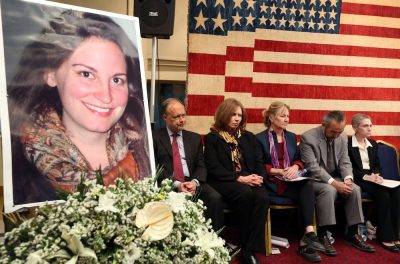
Featured image: An April 8, 2013 memorial service for Anne Smedinghoff at the U.S. Embassy in Kabul, Afghanistan. Anne was killed in an insurgent attack on Saturday April, 6. 2013 while traveling to donate books to a school in Qalat, Zabul province. (Photo by Musadeq Sadeq/U.S. State Department)


River to Sea Uprooted Palestinian   
The views expressed in this article are the sole responsibility of the author and do not necessarily reflect those of the Blog!

Friday, 16 July 2021

Russia-China advance Asian roadmap for Afghanistan


Kazakhstan’s Foreign Minister Mukhtar Tileuberdi, Russian Foreign Minister Sergey Lavrov, Tajik Foreign Minister Sirojiddin Muhriddin and Chinese Foreign Minister Wang Yi pose for a family photo before a meeting of Shanghai Cooperation Organization (SCO) Contact Group on Afghanistan, in Dushanbe, Tajikistan. Photo: Russian Foreign Ministry / Sputnik via AFP
Russia-China advance Asian roadmap for Afghanistan

July 15, 2021

Shanghai Cooperation Organization’s ‘facilitate, not mediate’ role could be the key to solving the Afghan imbroglio

By Pepe Escobar, with permission and first posted at Asia Times

Shanghai Cooperation Organization meeting of Foreign Ministers on Wednesday in Dushanbe, the Tajik capital, may have been an under-the-radar affair, but it did reveal the contours of the big picture ahead when it comes to Afghanistan.

So let’s see what Russia and China – the SCO’s heavyweights – have been up to.

Chinese Foreign Minister Wang Yi laid out the basic road map to his Afghan counterpart Mohammad Haneef Atmar. While stressing the Chinese foreign policy gold standard – no interference in internal affairs of friendly nations – Wang established three priorities:

1. Real inter-Afghan negotiations towards national reconciliation and a durable political solution, thus preventing all-out civil war. Beijing is ready to “facilitate” dialogue.

2. Fighting terror – which means, in practice, al-Qaeda remnants, ISIS-Khorasan and the Eastern Turkestan Islamic Movement (ETIM). Afghanistan should not be a haven for terrorist outfits – again.

3. The Taliban, for their part, should pledge a clean break with every terrorist outfit.

Atmar, according to diplomatic sources, fully agreed with Wang. And so did Tajik Foreign Minister Sirojiddin Muhriddin. Atmar even promised to work with Beijing to crack down on ETIM, a Uighur terror group founded in China’s western Xinjiang. Overall, the official Beijing stance is that all negotiations should be “Afghan-owned and Afghan-led.”

There is no sign yet that the Taliban will enter a power-sharing arrangement with President Ashraf Ghani’s government. Photo: AFP/Wali Sabawoon/NurPhoto

It was up to Russian presidential envoy Zamir Kabulov to offer a more detailed appraisal of the Dushanbe discussions.

The main Russian point is that Kabul and the Taliban should try to form a provisional coalition government for the next 2-3 years while they negotiate a permanent agreement. Talk about a Sisyphean task – and that’s an understatement. The Russians know very well that both sides won’t restart negotiations before September.

Moscow is very precise about the role of the extended troika – Russia, China, Pakistan and the US – in the excruciatingly slow Doha peace process talks: the troika should “facilitate” (also Wang’s terminology), not mediate the proceedings.

Another very important point is that once “substantive” intra-Afghan negotiations resume, a mechanism should be launched to clear the Taliban of UN Security Council sanctions.

This will mean the normalization of the Taliban as a political movement. Considering their current diplomatic drive, the Taliban do have their eyes on the ball. So the Russian warning that they should not become a security threat to any of the Central Asian “stans” or there will be “consequences” has been fully understood.

Four of the five “stans” (Turkmenistan is the exception) are SCO members. By the way, the Taliban have sent a diplomatic mission to Turkmenistan to ease its fears.

Break for the border

In Dushanbe, a special meeting of the SCO-Afghanistan Contact Group, established in 2005, for the first time was held at the foreign minister level.

This shows that the SCO as a whole is engaged in making its “facilitate, not mediate” role the prime mechanism to solve the Afghan drama. It’s always crucial to remember that no fewer than six SCO member-nations are Afghanistan’s neighbors.

During the main event in Dushanbe – the SCO Foreign Ministers Council – the Russians once again framed Washington’s Indo-Pacific strategy as an attempt to deter China and isolate Russia.

Following recent analyses by President Vladimir Putin and Foreign Minister Sergey Lavrov, the Russian delegation explained to its SCO counterparts its view counterposing Moscow and Beijing’s effort to develop a polycentric world system based on international law, on the one hand, with the Western concept of the so-called “rules-based world order.”

The Western approach, they said, puts pressure on countries that pursue independent foreign policy courses, ultimately legitimizing the West’s “neocolonial policy.”

On the ground

While the SCO was discussing the drive towards a polycentric world system, the Taliban, on the ground, kept doing what they’ve been doing for the past few weeks: capturing strategic crossroads.

The Taliban already controlled border crossings with Tajikistan, Uzbekistan, Iran and Turkmenistan. Now they have taken over ultra-strategic Spin Boldak, bordering Balochistan in Pakistan, which in trade terms is even more important than the Torkham border crossing near the Khyber Pass.

Taliban in Spin Boldak, the very busy commercial border between Afghanistan and Balochistan in Pakistan. Photo: AFP

According to Taliban spokesman Suhail Shaheen, “the Spin Boldak district in Kandahar province has been cleared of the enemy” – Kabul’s forces – “and the district is now under the control of the mujahideen.” The term “mujahideen” in the Afghan context means indigenous forces fighting foreign invaders or proxies.

To have an idea of the importance of Spin Boldak for the Taliban economy during their years in power, see the third chapter of a series I published in Asia Times in 2010, here and here. Eleven years ago, I noted that “the Afghan-Pakistan border is still porous, and the Taliban seem to believe they may even get their Talibanistan back.” They believe that now, more than ever.

Meanwhile, in the northeast, in Badakhshan province, the Taliban are getting closer and closer to the border with Xinjiang – which has led to some hysteria about “terrorism” infiltrating China via the Wakhan corridor.

The Wakhan corridor in Afghanistan, seen from the Tajik side. Photo: Pepe Escobar, November 2019

Nonsense. The actual Afghanistan-China border in the Wakhan is roughly 90 kilometers. Beijing can exercise full electronic surveillance on everything that moves.

I crossed part of the Wakhan on the Tajik side, bordering Afghanistan, during my Central Asian loop in late 2019, and on some stretches of the Pamir Highway I was as close to Xinjiang as 30 kilometers or so through no man’s land. The only people I saw along the geologically spectacular, desolate landscape were a few nomad caravans. The terrain can be even more forbidding than the Hindu Kush.

If any terror outfits try to get to Xinjiang, they won’t dare cross the Wakhan; they will try to infiltrate via Kyrgyzstan. I met a lot of Uighurs in Bishkek, the Kyrgyz capital: mostly businessman, legally going back and forth. On the Kyrgyz-Xinjiang border, there was a steady flow of cargo trucks. ETIM was dismissed as a bunch of nutcases.

What’s way more relevant is that the Ministry of Public Works in Kabul is actually building a 50-kilometer road – for the moment unpaved –  between Badakhshan province and Xinjiang, all the way to the end of the Wakhan corridor. They will call it the Wakhan Route.

No imperial graveyard ahead

SCO member Pakistan remains arguably the key to solve the Afghan drama. The Pakistani ISI remains closely linked to every Taliban faction: never forget the Taliban are a creation of legendary General Hamid Gul in the early 1990s.

At the same time, for any jihadi outfit it’s easier to hide and lie low deep in the Pakistani tribal areas than anywhere else – and they can buy protection, irrespective of what the Taliban are doing in Afghanistan. Prime Minister Imran Khan and his circle are very much aware of it – as much as Beijing. That will be the ultimate test for the SCO in its anti-terror front.

China needs an eminently stable Pakistan for all the long-term Belt and Road/China-Pakistan Economic Corridor projects and to fulfill its goal of incorporating Afghanistan. Kabul would be bound to benefit not only from increased connectivity and infrastructure development but also from future mineral including rare earth exploration projects.

Meanwhile, Hindu nationalists would love to outflank Pakistan and extend their influence in Kabul, encouraged by Washington. For the Empire of Chaos, the ideal agenda is – what else? – chaos: disrupting Belt and Road and the Russia-China road map for Eurasian integration, Afghanistan included.

Added hysteria depicting Russia and China involved in Afghan reconstruction as but a new chapter in the never-ending “graveyard of empires” saga does not even qualify as nonsense. The talks in Dushanbe made clear that the Russia-China strategic partnership approach to Afghanistan is cautiously realistic.

Taliban negotiators Abdul Latif Mansoor (right), Shahabuddin Delawar (center) and Suhail Shaheen (left) walk to attend a press conference in Moscow on July 9, 2021. Photo: AFP / Dimitar Dilkoff

It’s all about national reconciliation, economic development and Eurasian integration. Not included are a military component, hubs for an Empire of Bases, foreign interference. Moscow and Beijing also recognize, pragmatically, that fulfilling those dreams will not be possible in an Afghanistan hostage to ethno-sectarianism.

The Taliban for their part seem to have recognized their own limits, hence their current inter-regional diplomatic drive. They seem to be paying close attention to the inevitable heavyweights – Russia and China – as well as the Central Asian “stans” plus Pakistan and Iran.

Whether all this interconnection dance will herald the beginning of a post-war Afghanistan as a real functioning state, all we can say is insha Allah.


River to Sea Uprooted Palestinian   
The views expressed in this article are the sole responsibility of the author and do not necessarily reflect those of the Blog!

Sunday, 11 July 2021

Turkey and Russia.. Central Asia after Afghanistan?

  ARABI SOURI 

Turkey and Russia Central Asia after Afghanistan

Ankara sees the American withdrawal from Afghanistan as its valuable opportunity to gain several footholds in this country neighboring the Central Asian republics of Turkish origin.

The following is the English translation from Arabic of the latest article by Turkish career journalist Husni Mahali he published in the Lebanese Al-Mayadeen news site Al-Mayadeen Net:

With the approach of the complete American withdrawal from Afghanistan, the competition intensified between Turkey and each of Russia, Iran, and other countries, with the aim of gaining more positions, not only in this country but through it in Central Asia in general as well. With the “Taliban” movement controlling more areas, and the Afghan forces fleeing en masse, Russian President Vladimir Putin called the President of Tajikistan, Emomali Rahman, and assured him of his country’s support for him in the face of possible developments in the Afghan crisis, after thousands of Afghan soldiers sought refuge in this neighboring country.

Last Tuesday, the Russian army announced the readiness of the S-300 anti-aircraft missile systems at the Russian base in Tajikistan, which in turn does not hide its concern about the possibility of an explosion in the security situation in Afghanistan, which may be exploited by the various jihadist groups, which some of them are present in Idlib and other areas of Syria, under the protection of Turkey, which prevents President Putin from any action that directly targets these groups.

President Putin also made a second phone call to his Uzbek counterpart Shaukat Mir Daif and discussed with him the details of coordination and joint cooperation to confront possible developments in Afghanistan.

In turn, Foreign Minister Lavrov said, “The main problem is the growing threat of terrorist attacks because the Taliban is behaving more aggressively. Also, the terrorist organization ISIS is strengthening its presence in the northern parts of Afghanistan near the border with Russia’s allies.”

And the Russian security announced the thwarting of many terrorist attacks planned by the militants of the Islamist “Tahrir Party”, which is mainly active in the autonomous republics within the borders of the Russian Federation, whose population is mostly Muslims, and their number exceeds 20 million.

Iran – which has a common border with Afghanistan with a length of 936 km, Pakistan with a length of 909 km, and Turkmenistan with a length of 992 km – are closely watching the Afghan developments, given the direct relationship of the matter to Iran’s national security. Last Tuesday, Tehran hosted a meeting between representatives of the “Taliban” and the Afghan government, in an attempt to achieve peaceful reconciliation between the two parties after the US withdrawal at the end of next month.

In turn, Ankara sees this withdrawal as its valuable opportunity to gain several footholds in this country neighboring the Central Asian republics of Turkish origin, namely Kazakhstan, Turkmenistan, Kyrgyzstan, and Uzbekistan. Defense Minister Hulusi Akar visited Tajikistan and Kyrgyzstan at the end of last month, in a new attempt by Ankara to develop military relations with these two countries, and later with Turkmenistan, Uzbekistan, and Kazakhstan, all of which constitute the backyard of Russia, which President Erdogan has previously challenged in Ukraine, Azerbaijan, and Lithuania.

He also challenged it by lighting the green light for Atlantic maneuvers which included the British and Dutch provocations in the Black Sea, which Washington, with the support of Ankara, wants to turn into an Atlantic basin after the annexation of Georgia and Ukraine to the alliance. NATO membership mainly includes Turkey, Romania, and Bulgaria, which overlook the Black Sea, while Turkey controls the Bosphorus and Dardanelles straits, which connect the Black Sea to both the Sea of Marmara and the Aegean.

Ankara signed several military cooperation agreements with Bulgaria and Romania and then sold its drones to Lithuania, Ukraine, Albania, and Azerbaijan, which achieved quick victories in their war with the Armenians in the Nagorno-Karabakh region thanks to Turkish support.

The information then spoke of Turkey’s efforts to establish several military bases in Azerbaijan, including a base near the Caspian Sea (also overlooked by Iran), which is rich in oil and gas. This may constitute a new and dangerous crisis between Ankara and Moscow, which previously expressed its dismay and rejection of Turkish bases in Azerbaijan in general, which President Erdogan will not care about, who did not care about Russian threats in Syria and Libya, and continued to implement what he had previously planned on the road back to the dreams of the Ottoman Empire.

This (Ottoman) empire had many reasons for entering into 16 fierce wars with the Russian Empire, of which it was defeated in 11. Many see President Putin as the heir of this empire, as Erdogan sees himself as the heir to the Ottoman Empire and its Islamist caliphate, which may make the possible Turkish dialogue, coordination, and cooperation with Kabul after the Taliban control it much easier, even if Turkey is the only Muslim country within NATO that has occupied Afghanistan under the leadership of the United States in 2001. After his meeting with President Biden, on the 14th of last month in Brussels, Erdogan announced that Turkey is ready to send additional forces to Afghanistan to protect the security of Kabul Airport and international facilities, which will be contributed by his ally, Sheikh Tamim, Emir of Qatar, who played and still is, an important role in the American reconciliation with the “Taliban”.

Al-Jazeera was the mouthpiece of the Taliban during its war with the “Great Satan” America, at a time when Osama bin Laden sent his tapes exclusively to the aforementioned channel before and after the American occupation and until his death in May 2011, that is, after the emergence of ISIS, and “Al-Nusra” in Syria and Iraq, which are the arenas for America and its new allies to settle scores with the resistance countries and for “Israel”.

All this explains the new US military position in Jordan, adjacent to Syria, Iraq, and “Israel”, after Washington transferred some of its forces from Qatar, where the Al-Udeid base is still located, which is the most important US base in the region. This base was and will remain, the headquarters of the Central Command of the US Air Force in the Middle East, and it houses 100 warplanes used by US forces against Afghanistan, Iraq, and Syria.

In all cases, and whatever the result of the Turkish moves in Afghanistan, through it in the Black Sea and the Caspian Sea and all the countries that overlook them or close to them, it has become clear that the Turkish President was, and will remain, a source of concern for President Putin, especially if Ankara succeeds in its relationship with the Taliban. Everyone was surprised by its (Taliban) agreement with President Erdogan, who declared himself “the protector of Islam and Muslims.”

In turn, the Taliban leaders, with Qatari mediation, might consider cooperating with him, especially if he proves his authority in the Central Asian republics of Turkish origin, an authority that the late President Turgut Ozal sought after fall and disintegration of the Soviet Union. Erdogan sees himself as Ozal’s successor and before him Adnan Menderes, who made Turkey “a fish on American hook” for the period 1950-1960.

Erdogan and others did not ignore the strategic location of Afghanistan, which is rich in gold, iron, cobalt, copper, uranium, and rare minerals, including niobium and molybdenum, which are invested by Chinese companies that control the extraction and export of most of the world’s rare minerals everyone needs in sensitive industries, including warplanes and missiles.

In the end, the bet remains on the possible policies of the Taliban. If they remain on their approach as they were 20 years ago, history will repeat itself, and everyone will return to their interests in the extremist Islamist movements that have become more famous for their brutality after the so-called “Arab Spring,” especially in Syria. Libya, Iraq, Somalia, Yemen, and the extension of these countries in Africa, the Middle East, Bahrain, the Red Sea and the Mediterranean, and the Gulf region.

Erdogan has proven that he has a long experience in all of them after he succeeded in establishing and developing distinguished relations with all Islamist movements, both political and armed, many of whose leaders had previously been present and fought in Afghanistan. These leaders had a relationship with “Al-Qaeda”, and later “Taliban”, which seems clear that, with its next actions, it will decide the fate and future of Afghanistan, and all its neighboring countries as well, most of which are within the borders of Russia’s backyard.

This may be the “hidden satanic” reason for Washington’s decision to withdraw, which wants Russia to afflict Afghanistan again as it afflicted it during the Soviet occupation, and Turkey was at the time on the neutral, but this time it will be a direct party, as is the case on many fronts, which it proved with the transfer of mercenaries from Syria to Libya and Nagorno-Karabakh. Now, some expect it to transfer their likes to Afghanistan, which is what America might do by transferring what it has of ISIS detainees in Syria and Iraq to Afghanistan!

To help us continue please visit the Donate page to donate or learn how you can help us with no cost to you.
Follow us on Telegram: http://t.me/syupdates link will open the Telegram app.


River to Sea Uprooted Palestinian   
The views expressed in this article are the sole responsibility of the author and do not necessarily reflect those of the Blog!

Friday, 9 July 2021

A Saigon moment in the Hindu Kush

A Saigon moment in the Hindu Kush

July 07, 2021

By Pepe Escobar with permission and first posted at Asia Times

And it’s all over

For the unknown soldier

It’s all over

For the unknown soldier

The Doors, The Unknown Soldier

Let’s start with some stunning facts on the ground.

The Taliban are on a roll. Earlier this week their P.R. arm was claiming they hold 218 Afghan districts out of 421 – capturing new ones every day. Tens of districts are contested. Entire Afghan provinces are basically lost to the government in Kabul – de facto reduced to administer a few scattered cities under siege.

Afghanistan in Badakhshan province, seen from the Pamir highway in Tajikistan during my November 2019 Central Asian loop. This district, not far from Ishkashim, is now under Taliban control. Photo: Pepe Escobar

Already on July 1st the Taliban announced they controlled 80% of Afghan territory. That’s close to the situation 20 years ago, only a few weeks before 9/11, when Commander Masoud told me in the Panjshir valley , as he prepared a counter-offensive, that the Taliban were 85% dominant.

Their new tactical approach works like a dream. First there’s a direct appeal to soldiers of the Afghan National Army (ANA) to surrender. Negotiations are smooth – and deals fulfilled. Soldiers in the low thousands have already joined the Taliban without a single shot fired.

Mapmakers cannot upload updates fast enough. This is fast becoming a textbook case on the collapse of a 21st century central government.

The Taliban are fast advancing in western Vardak, easily capturing ANA bases. That is the prequel for an assault on Maidan Shar, the provincial capital. If they get control of Vardak they will be literally at the gates of Kabul.

After capturing Panjwaj district, the Taliban are also a stone’s throw away from Kandahar, founded by Alexander The Great in 330 B.C. and the city where a certain mullah Omar – with a little help from his Pakistani ISI friends – started the Taliban adventure in 1994, leading to their Kabul power takeover in 1996.

The overwhelming majority of Badakhshan province – Tajik majority, not Pashtun – fell after only 4 days of negotiations, with a few skirmishes thrown in. The Taliban even captured a hilltop outpost very close to Faizabad, Badakhshan’s capital.

I tracked the Tajik-Afghan border in detail when I traveled the Pamir highway in late 2019. The Taliban, following mountain tracks on the Afghan side, could soon reach the legendary, desolate border with Xinjiang in the Wakhan corridor.

The Taliban are also about to make a move on Hairaton, in Balkh province. Hairaton is at the Afghan-Uzbek border, the site of the historically important Friendship Bridge over the Amu Darya, through which the Red Army departed Afghanistan in 1989.

ANA commanders swear the city is now protected from all sides by a five-kilometer security zone. Hairaton has already attracted tens of thousands of refugees. Tashkent does not want them to cross the border.

And it’s not only Central Asia; the Taliban have already advanced to the city limits of Islam Qilla, which borders Iran, in Herat province, and is the key checkpoint in the busy Mashhad to Herat corridor.

The Tajik puzzle

The extremely porous, geologically stunning Tajik-Afghan mountain borders remain the most sensitive case. Tajik President Emomali Rahmon, after a serious phone call with Vladimir Putin, ordered the mobilization of 20,000 reservists and sent them to the border. Rahmon also promised humanitarian and financial support to the Kabul government.

The Taliban, for their part, officially declared that the border is safe and they have no intention of invading Tajik territory. Earlier this week even the Kremlin cryptically announced that Moscow does not plan to send troops to Afghanistan.

A cliffhanger is set for the end of July, as the Taliban announced they will submit a written peace proposal to Kabul. A strong possibility is that it may amount to an intimation for Kabul to surrender – and transfer full control of the country.

The Taliban seem to be riding an irresistible momentum – especially when Afghans themselves were stunned to see how the imperial “protector”, after nearly two decades of de facto occupation,

left Bagram air base in the middle of the night , scurrying away like rats.

Compare it to the evaluation of serious analysts such as Lester Grau, explaining the Soviet departure over three decades ago:

When the Soviets left Afghanistan in 1989, they did so in a coordinated, deliberate, professional manner, leaving behind a functioning government, an improved military and an advisory and economic effort insuring the continued viability of the government. The withdrawal was based on a coordinated diplomatic, economic and military plan permitting Soviet forces to withdraw in good order and the Afghan government to survive. The Democratic Republic of Afghanistan (DRA) managed to hold on despite the collapse of the Soviet Union in 1991. Only then, with the loss of Soviet support and the increased efforts by the Mujahideen (holy warriors) and Pakistan, did the DRA slide toward defeat in April 1992. The Soviet effort to withdraw in good order was well executed and can serve as a model for other disengagements from similar nations.

When it comes to the American empire, Tacitus once again applies: “They have plundered the world, stripping naked the land in their hunger… they are driven by greed, if their enemy be rich; by ambition, if poor… They ravage, they slaughter, they seize by false pretenses, and all of this they hail as the construction of empire. And when in their wake nothing remains but a desert, they call that peace.”

In the wake of the Hegemon, deserts called peace, in varying degrees, include Iraq, Libya, Syria – which happen to, geologically, harbor deserts – as well as the deserts and mountains of Afghanistan.

That Afghan heroin rat line

It looks like Think Tank Row in D.C., between Dupont and Thomas Circle alongside Massachussets Avenue, have not really done their homework on pashtunwali – the Pashtun honor code – or the ignominious British empire retreat from Kabul.

Still, it’s too early to tell whether what is being spun as the US “retreat” from Afghanistan reflects the definitive unraveling of the Empire of Chaos. Especially because this is not a “retreat” at all: it’s a repositioning – with added elements of privatization.

At least 650 “U.S. forces” will be protecting the sprawling embassy in Kabul. Add to it possibly 500 Turkish troops – which means NATO – to protect the airport, plus an undeclared number of “contractors” a.k.a mercenaries, and an unspecified number of Special Forces.

Pentagon head Lloyd Austin has come up with the new deal. The militarized embassy is referred to as Forces Afghanistan-Forward. These forces will be “supported” by a new, special Afghan office in Qatar.

The key provision is that the special privilege to bomb Afghanistan whenever the Hegemon feels like it remains intact. The difference is in the chain of command. Instead of Gen. Scott Miller, so far the top U.S. commander in Afghanistan, the Bomber-in-Chief will be Gen. Frank McKenzie, the head of CENTCOM.

So future bombing will come essentially from the Persian Gulf – what the Pentagon lovingly describes as “over the horizon capability”. Crucially, Pakistan has officially refused to be part of it, although in the case of drone attacks, they will have to overfly Pakistani territory in Balochistan. Tajikistan and Kyrgyzstan also refused to host American bases.

The Taliban, for their part, are unfazed. Spokesman Suhail Shaheen was adamant that any foreign troops that are not out by the 9/11 deadline will be regarded as – what else – occupiers.

Whether the Taliban will be able to establish dominance is not an issue; it’s just a matter of when. And that leads us to the two really important questions:

1.  Will the CIA be able to maintain what Seymour Hersh initially, and later myself, described as the Afghan heroin rat line that finances their black ops?

2.  And if the CIA cannot continue to supervise opium poppy field production in Afghanistan as well as coordinate the subsequent stages of the heroin business, where will it move to?

Every thinking mind across Central/South Asia knows that the Empire of Chaos, for two long decades, was never interested in defeating the Taliban or fighting for “the freedom of the Afghan people”.

The key motives were to keep a crucial, strategic forward base in the underbelly of “existential threats” China and Russia as well as intractable Iran – all part of the New Great Game; to be conveniently positioned to later exploit Afghanistan’s enormous mineral wealth; and to process opium into heroin to fund CIA ops. Opium was a major factor in the rise of the British empire, and heroin remains one of the world’s top dirty businesses funding shady intel ops.

What China and the SCO want

Now compare all of the above with the Chinese approach.

Unlike Think Tank Row in D.C., Chinese counterparts seem to have done their homework. They understood that the USSR did not invade Afghanistan in 1979 to impose “popular democracy” – the jargon then – but was in fact invited by the quite progressive UN-recognized Kabul government at the time, which essentially wanted roads, electricity, medical care, telecommunications, education.

As these staples of modernity would not be provided by Western institutions, the solution would have to come from Soviet socialism. That would imply a social revolution – a convoluted affair in a deeply pious Islamic nation – and, crucially, the end of feudalism.

“Grand Chessboard” Brzezinski’s imperial counterpunch worked because it manipulated Afghan feudal lords and their regimentation capacity – bolstered by immense funds (CIA, Saudis, Pakistani intel) – to give the USSR its Vietnam. None of these feudal lords were interested in the abolition of poverty and economic development in Afghanistan.

China is now picking up where the USSR left. Beijing, in close contact with the Taliban since early 2020, essentially wants to extend the $62 billion China-Pakistan Economic Corridor (CPEC) – one of the Belt and Road Initiative (BRI) flagship projects – to Afghanistan.

The first, crucial step will be the construction of the Kabul-Peshawar motorway – through the Khyber pass and the current border at Torkham. That will mean Afghanistan de facto becoming part of CPEC.

It’s all about regional integration at work. Kabul-Peshawar will be one extra CPEC node that already includes the construction of the ultra-strategic Tashkurgan airport in the Karakoram highway in Xinjiang, only 50 km away from the Pakistani border and also close to Afghanistan, as well as Gwadar harbor in Balochistan.

In early June, a trilateral China-Afghanistan-Pakistan meeting led the Chinese Foreign Ministry to unmistakably bet on the “peaceful recovery of Afghanistan”, with the joint statement welcoming “the early return of the Taliban to the political life of Afghanistan” and a pledge to “expand economic and trade ties”.

So there’s no way a dominant Taliban will refuse the Chinese drive to build infrastructure and energy projects geared towards regional economic integration, as long as they keep the country pacified and not subject to jihadi turbulence of the ISIS-Khorasan variety – capable of spilling over to Xinjiang.

The Chinese game play is clear: the Americans should not be able to exert influence over the new Kabul arrangement. It’s all about the strategic Afghan importance for BRI – and that is intertwined with discussions inside the Shanghai Cooperation Organization (SCO), incidentally founded 20 years ago, and which for years has advocated for an “Asian solution” for the Afghan drama.

The discussions inside the SCO regard the NATO projection of the new Afghanistan as a jihadi paradise controlled by Islamabad as not more than wishful thinking nonsense.

It will be fascinating to watch how China, Pakistan, Iran, Russia and even India will fill the vacuum in the post-Forever Wars era in Afghanistan. It’s very important to remember that all these actors, plus the Central Asians, are full SCO members (or observers, in the case of Iran).

Tehran plausibly might interfere with potential imperial plans to bomb Afghanistan from the outside – whatever the motive. On another front, it’s unclear whether Islamabad or Moscow, for instance, would help the Taliban to take Bagram air base. What’s certain is that Russia will take the Taliban off its list of terrorist outfits.

Considering that the empire and NATO – via Turkey – will not be really leaving, a distinct future possibility is a SCO push, allied with the Taliban (Afghanistan is also a SCO observer) to secure the nation in their terms and concentrate on CPEC development projects. But the first step seems to be the hardest: how to form a real, solid, national coalition government in Kabul.

History may rule that Washington wanted Afghanistan to be the USSR’s Vietnam; decades later, it ended up getting its own second Vietnam, repeated as – what else – farce. A remixed Saigon moment is fast approaching. Yet another stage of the New Great Game in Eurasia is at hand.


River to Sea Uprooted Palestinian   
The views expressed in this article are the sole responsibility of the author and do not necessarily reflect those of the Blog!