Showing posts with label Kushner. Show all posts

Saturday, 17 April 2021

The Myth of Peace in the Middle East: Deconstructing the Naturalization Narrative

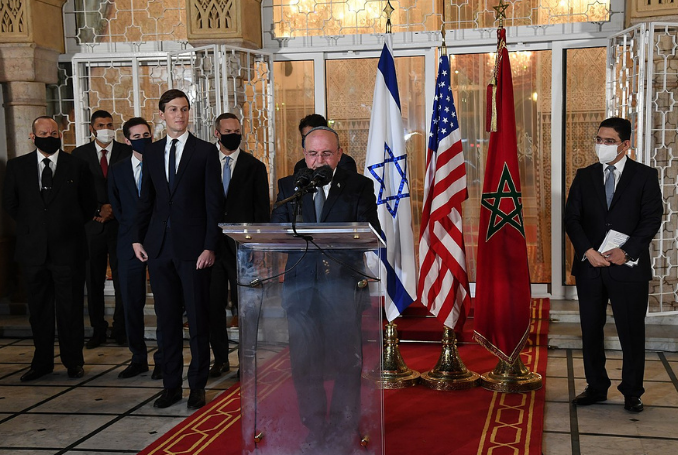
American-Israeli delegation visit to Morocco in December 2020. (Photo: US Embassy Jerusalem, via Wikimedia Commons)

By Mohamed El Metmari

This critical essay deconstructs the political narrative surrounding the naturalization agreements that have occurred between some Arab countries and Israel formally known as the Abrahamic Accords or Jared Kushner’s plan for peace in the Middle East. It offers unique perspectives and analysis of these accords and their true geopolitical intentions. Primarily, it argues how the peace promised by these newly established ties remains just a myth as it explores the true objectives behind them. Interestingly enough, it also highlights the true goals behind the U.S’ mediations in these Accords.

The Palestinian-Israeli conflict is one of the hottest yet unresolved political issues of today. Whereas this conflict is not heading towards any resolutions soon, the recent naturalization agreements that have occurred between some Arab regimes and the apartheid state of Israel may mark a future shift in Middle East’s political scene.

Earlier to these agreements, boycotting Israel was these Arab nations’ approach to show support for Palestinians and their claims. Before 2020, only two bordering countries have had diplomatic ties with Israel; that is, Egypt and Jordan. This number has risen to six as the United Arab Emirates (UAE), Bahrain, Sudan and Morocco have set full diplomatic and economic relations with Israel as part of Jared Kushner’s plan for peace in the Middle East known formally as the Abrahamic Accords.

Celebrating the first occurrence of the Abrahamic Accords, Trump hosted a signing ceremony in the White House and had the following rash statement to announce: “We’re here this afternoon to change the course of history. After decades of division and conflict, we mark the dawn of a new Middle East.” By this politically immature statement, Trump seemed as if he had finally found a solution to the conflict in the region.

As for peace in the region is concerned, Jared Kushner’s peace plans do not make any sense. Apart from Sudan, none of the countries involved with these accords are in conflict with Israel. On the opposite, Morocco and so the Gulf States have retained very healthy diplomatic relations with Israel, even if they were undeclared publicly. For instance, Morocco has had a fair share of intelligence-sharing with Israel since the mid-sixties. On top of that, the two countries had liaison offices in Tel Aviv and Rabat from Sept. 1, 1994, to Oct. 23, 2000. Not to mention Morocco’s contribution in populating Israel by handing over its Jewish population to the newly established Jewish state during the reign of the Moroccan king Hassan II.

Granted, Israel supports the totalitarian regimes of the region mainly because these totalitarianisms do not demand accountability for its human rights and international law violations. Hence, most Arab dictatorships have been dealing with Israel on political and security levels; especially after the outbreak of the Arab spring where these regimes had to obtain the latest spying and security tech to topple every dissident in their population who desires regime change. Whereas the case of the Washington Post’s correspondent Jamal Khashoggi remains the most covered case, Amnesty International has reported that Moroccan journalist Omar Radi’s phone has also been infected with the Israeli Pegasus spyware.

The Myth of Peace: Deception, Expansion and Dispossession.

Each time an Arab country initiates full diplomatic relations with Israel, its local propaganda machine makes it look as a major historical event that has occurred in the country. Some media outlets have gone far with this. For example, they take the religious tolerance preached in the Muslim faith as a pretext for setting these normalization agreements with this ‘Jewish’ nation. Other media platforms, however, have beautified the image of Israel’s apartheid regime via elaborate historical descriptions of Jewish culture and heritage. This is not wrong at all, but what is wrong is to evoke this history only at this particular event ignoring Israel’s present violations of International Law and Human rights and most of all occupation of Palestinian lands. This is why it is easy to deconstruct the naturalization narrative and prove that it is just a myth.

First of all, the context of these agreements was preceded and controlled by the 2020 US elections. Trump’s administration had tried to convince the American public that it will be the first administration that ends the conflict in the Middle East and thus planning on gaining a potential leverage in the election race. But despite the occurrence of the Abrahamic Accords last year and even Trump’s administration’s decision to recognize Jerusalem as Israel’s capital on December 6, 2017, it still was not enough to win Trump the approval of the devastated American public. This is mainly because Americans wanted Trump out of the White House at any cost; even if it meant choosing the lesser evil of the two candidates in the elections.

Meanwhile, these events come as a perfect opportunity to boost the reputation of the Likud party and more specifically the reputation of Israel’s Prime Minister Benjamin Netanyahu whose image has been stained by his corruption and monopoly of the Israeli political scene. Unlike Trump, the chances of him getting replaced in the upcoming Israeli elections are relatively low because of his firm grip on power and the lack of his equal in the Israeli political arena. Furthermore, with the massive press coverage that comes with such events, Netanyahu, similarly to Trump, wanted the spotlights on him to distract the public from his administration’s terrible handling of Covid-19 and thus gaining significant leverage in the elections.

Second, the biggest gain for Israel from these new ties with the Arab States and Morocco is that it reinforces its political influence in the Middle East. Not only this, but unlocking Israel’s geo-political isolation in the region as well. And since this newly granted influence to Israel is an approved one, it gives it freedom to expand and occupy more without any opposition. Of course, if Israel is gaining a legitimate influence in the region, this means that Palestine’s position will exacerbate. And thus the Palestinian cause will no longer have the leverage it has on the Middle Eastern political scene.

Furthermore, Israel’s decision to create ties with the Gulf countries in specific is not arbitrary. This move was motivated by economic reasons. As it is known, the Khaleeji people are the biggest consumers in the region. Hence the khaleeji market becomes a perfect destination for Israeli goods. Israeli products, foods in specific, can even replace other products coming from other countries because of the close distance and the low shipping costs. Additionally, Sudan may not offer much as markets are concerned, but it is definitely a great source of agricultural imports for Israel. Being the mediator between Israel and its “new” allies, the US benefits from these agreements as well since it is Israel’s biggest ally. After all, any ongoing political conflict between Israel and any of the Middle Eastern countries is primarily endangering US’ political and economic interests in the region. In other words, the mediation of the US in these so-called Peace agreements is not out of a sort of altruism because the US is only after its share of the pie.

Third, to say that these newly established ties will bring “peace” to the region is ludicrous and rash but not totally wrong. But for whom this peace is served; for Palestine, for the Arab States, or for Israel? To give a rather simple and short answer, it is apt to say it remains just a myth for the Palestinians in specific, but it means more security and power for the Israeli side in particular. To put it differently, with Israel having full diplomatic ties with these Arab countries and Morocco, it becomes easy for it to carry its annexation plans and dispossession of Palestinian lands without being held accountable. And the Palestinians are likely to be displaced gradually and implicitly to one of these countries. Apparently, Morocco and the rich Gulf states are the biggest fish that Israel could ever come to terms with. Since they provide financial comfort and political stability, some Palestinians may choose these destinations over their currently Israeli-occupied and war-inflected homes.

However, it is worth mentioning that the Emiratis as well as the Saudis despise the Palestinians. Hence, the Palestinians will never accept the reality of being displaced to one of these two countries. Meanwhile, this does not apply to either Kuwait or Oman in which do not have a strong political influence in the region. Apart from Morocco, they maybe the desired destination Israel is looking for to displace the Palestinians to after annexing their lands. Whether the two countries agree to normalize relations with Israel in the future or not, it does not really matter as long they are subservient to UAE and Saudi Arabia. Apparently, the Palestinians are likely to resist as they usually do.

Concurrently, Israel is likely to pressure them to accept this bitter reality as it has been doing for the last decades. Hence, Israel will possibly seek not only to increase its siege and pressure on the borders and checkpoints, but it may also instigate a war with Hamas as a pretext for a military escalation. Hamas, on the other hand, will be, as always, scapegoated for the whole thing especially that it is classified as a terrorist organization. Therefore, the peace that Israel is seeking is a peace with the Palestinians out of Palestine.

However, Israel is not the only benefactor from these agreements. Clearly, the Gulf States have paid for US military protection by signing these accords. But UAE in specific have had further arms deals and gained even more political protection against the Iranian influence in the Arab peninsula. Nonetheless, when a country signs a peace deal, it does not instantly demand acquirement of advanced F-35 stealth Jet, which is what this Gulf State did, because the two are paradoxical. Therefore, in opposition to the classic definitions of peace treaties, the brokered peace from these agreements is a purchased one like many peace agreements that have been signed before it in the region. After all, Sudan agreed to normalize relations with Israel so it is de-listed from the state-sponsors of terror, the Gulf States signed them as a payment for US military protection and Morocco got support for its sovereignty over Western Sahara.

Therefore, as all the purchased peace agreements the Middle East has witnessed over modern history- whether it is peace for land, peace in exchange of monopoly or what have you- this one is also doomed to be broken by conflict since it is not based on a balanced compromise where two equal parties meet in the middle. Rather, it is a political move towards accumulation of power where the main side of this conflict, meaning the Palestinians, is not even included in these agreements.

The US, Morocco, and Israel: A Geopolitical Chess Game over Africa

The fact that Israel has pursued diplomatic relations with Morocco- a country so far away from the Middle East’s political discourse- is by no means for peace as it is claimed by any of the Accords’ orchestrators. The moment it was announced that Morocco was to resume relations with Israel, Moroccan propaganda machines overshadowed the controversies that come with this event by preaching to the public about the Moroccan Jewish heritage and the coexistence of the Abrahamic religions in this homogeneous sphere. This normalization was depicted as a win-win situation for Morocco especially that Trump has rewarded Morocco’s approval of its resumption of relations with the apartheid regime by signing a presidential proclamation that recognizes Morocco’s sovereignty over Western Sahara.

The celebrations following this recognition covered up totally for the naturalization. This proclamation has even become an independent narrative of its own. The official discourse in Moroccan media has asserted that this recognition is the fruit of long-lasting diplomatic ties between Morocco and the US and not as a part of the Abrahamic Accords. Moreover, many factors influence politics, but altruism is not one of them. Taking the fact that Morocco was the first country to recognize the independence of the US in 1777, and the two countries long diplomatic relations, it stands as a surprise that it took so much time for the US to recognize Morocco’s sovereignty over Western Sahara or at least support its claim diplomatically.

Meanwhile, political terminology is important here because Moroccan media had it intentionally mixed up to alleviate the Moroccan public’s rage. Trump’s presidential proclamation does not recognize the Western Sahara region as a Moroccan entity as they have claimed, but it only recognizes Moroccan sovereignty over it. These are two different things, because Morocco has already been practicing sovereignty over the region although with some difficulties mainly caused by intense altercations with the Algerian-backed Polisario Front. The only thing that Morocco has needed is legitimacy and this proclamation happens to be it. Obviously, this is a simple treat from the US for Morocco’s acceptance of the resumption of relations with Israel.

Nevertheless, the majority of the Moroccan public welcomed Trump’s move, but they abhorred Morocco’s establishment of ties with Israel. Nasser Bourita, the Moroccan Minister of Foreign Affairs, has refused to call this an act of “naturalization” of relations. For him, normalization is a Middle Eastern term that does not apply to Morocco which is not a neighboring country to Israel. Indeed, Morocco’s North African location and its large indigenous Amazigh population make it hard to proclaim the country as purely Arab.

Bourita has preferred using the term “resumption” of relations instead. As mentioned earlier, Morocco and Israel had Liaison offices in Tel Aviv and Rabat before Morocco had to close their office in response to Israeli repression of the second Palestinian Intifada in 2000. Not to mention, there is a number of almost 800.000 Jews of Moroccan decent living in Israel right now.

Obviously, Israel remains the biggest benefactor from these naturalization agreements. However, the US did not take part in them without purpose. The existence of Israel in the Middle East protects American interests in the region. That is why Zionist lobbies in the US always do their best to empower this regime. And this is what AIPAC is doing and what Christians United for Israel and other Zionist lobbies are doing. As a result, this support for the apartheid regime enables the US to retain its firm grip on Middle East’s political and economic affairs. These are all facts now. But the case of Morocco is still a uniquely dubious one. Pressing Morocco – a country so far away from The Middle East’s frenzy and even terminology to sign these deals seems confusing to say the least; especially that Morocco is not a rich country like the Gulf States.

However, ever since Morocco’s rejoining the African Union in 2017, many countries and the US particularly have started to look for ways to intensify their relations with this African country more than before. To illustrate, Morocco’s main weapon supplies come from the US. Granted, the influence of the US embassy in Rabat has surpassed diplomatic lines to influencing Moroccan cultural context and even influencing Moroccan academia via its grants and many programs and English learning courses. This soft pressure changes the structure of Moroccan society with time. As of now, although French is the official second language in Morocco, the majority of Moroccan youth, many of whom have benefited from US grants and programs, speak English. This is not bad at all, but again, politics is the game of interests and not altruisms. Implemented in these courses and grants are soft ideologies that create sympathy and acceptance of US values and democracy in the Moroccan community. In the long run, acceptance of the US image rises even if its intentions in the region are not necessarily benevolent.

To connect this to the question at hand, Morocco remains the US’ key holder to the African Union and African countries. This strategic move to invest in Morocco politically and economically and then support its sovereignty over its full territorial land comes as the price for infiltrating a fertile network of rising African economies. Hence, these countries become perfect investment destinations for the US. And although China is the biggest player in Africa as economy is involved, not counting the previous colonial powers of Africa, the US is doing the best it can to take this role in the near future. After its degrading failure to do so under pretexts of humanitarian aid and war on terror, the UShas finally chosen this diplomatic direction to overtake Russian and Chinese influences in Africa. It is hence a perfectly played chess game over geopolitical expansion and power. Peace and human rights preached in these agreements however, are turned into industries that are used to further their dominance and hegemony.

Additionally, what makes Morocco exceptional is its officials’ diplomatic maturity and its political stability in comparison to the Middle East and other African countries. Also, Morocco’s ability to repay its debts boosts foreign investors’ confidence to embark on the Moroccan market. Not to mention, Morocco itself needs this kind of political and economic partnership and support as it seeks to take the lead as an African power. However, this pursuit remains far-fetched without having full sovereignty over its lands or without having strong allies.

Meanwhile, Moroccan King Mohamed VI has confirmed that Morocco’s position on Palestine remains unchanged. He has also affirmed that he places his country’s territorial issue and the Palestinian cause at the same level, and that the kingdom will use its new position to push for a conflict resolution in the region. Thus, Morocco is playing it as safe as it could as it is placing itself neither with the current, nor against it.

All in all, Morocco and the Arab regimes’ decision to normalize relations with Israel is not promising of any lasting peace between Palestine and Israel simply because Israel’s occupation of the Palestinian territories will gain significant legitimacy from the establishment of these diplomatic ties. Especially that these Arab States are not democratic themselves so they can account it for its infringement of international law and human rights. Granted, since the Palestinian question, the right of self-determination and the right of return are not included in the official discourse of these peace agreements, a resolution for the Palestinian- Israeli conflict remains just a myth that appears to be tangible with propaganda and exclusionary media narratives.

– Mohamed El Metmari is an independent writer and researcher affiliated with the faculty of Letters and Humanities of Abdelmalek Essaadi University, Martil, Morocco. He is an Open Hands Initiative’s Conflict Resolution alumnus. Currently, he is conducting a Master’s thesis centered on the Palestinian-Israeli conflict. His articles have appeared on Aljazeera Arabic, SasaPost, and Countercurrents. He contributed this essay to The Palestine Chronicle.


River to Sea Uprooted Palestinian   
The views expressed in this article are the sole responsibility of the author and do not necessarily reflect those of the Blog!

Wednesday, 6 January 2021

A Pardoning Time of Year

 By Philip Giraldi

Source

Will the president do the right thing?
Julian Assange Pardon 89b36

The resistance to the apparent election of Joe Biden as President of the United States is continuing to play out. Current President Donald Trump is continuing to fight against the presumed results of the November national election with his final card appearing to be a vote in Congress when it reconvenes on January 6th to throw out the results due to fraud in certain key states. Many have noted how the registration and electoral processes in the United States, varying as they do from state to state, were and are vulnerable to fraud. That, plus some eyewitness testimony and technical analysis, suggests that possibly systematic fraud did take place but it is far from clear whether it was decisive. This is particularly true of the vote by mail option, which was promoted by leading Democrats and which empowered literally millions of new voters with only limited attempts made to validate whether citizens or even real people were voting.

Vote by mail is now one of several options that are appearing to be weaponized by the cash-rich Democrats in the state of Georgia, where two Senate races will be up for grabs in runoff elections on January 5th. If the Democrats obtain both, they will control the Senate through the Vice President’s role in presiding over the upper chamber where she has the tie breaking vote. That will mean that we the voters can expect some dramatic changes as the Democrats respond to their various constituencies with their well enunciated grievances.

In what may be its last weeks in office, the Trump Administration is also exploiting its executive power to pardon to reverse perceived injustices and to protect remaining allies, to include some family members. Trump is already on track to pardon more individuals than any preceding president with 90 pardons issued as of Christmas Eve and many more expected. One of his initial pardons was a notable example of a miscarriage of justice in the case of presidential national security advisor designate Michael Flynn, who was wrongly accused of collaborating with Russia. If anything, he was actually cooperating with a request that came from Israel, which Congress and the media apparently do not regard as wrongdoing.

Trump’s pardon of his daughter Ivanka’s father-in-law Charles Kushner is particularly controversial, as Kushner was a multimillionaire real estate developer and a leading Democratic Party donor when he was convicted in 2005 to two years in federal prison after he pleaded guilty to 18 counts, which included both tax evasion and making illegal campaign contributions. The tale of Charles Kushner is particularly unsavory because he reportedly sought revenge after he learned that his brother-in-law and former business partner was aiding federal authorities. Charles hired a prostitute to seduce his brother-in-law in a New Jersey motel room, making a recording of the encounter using a hidden camera that he then showed to his brother-in-law’s wife, who was, of course, Kushner’s own sister.

Kushner’s prosecution was directed by then-U.S. Attorney Chris Christie, who afterwards became a prominent Trump supporter and head of his transition team before being fired in 2016, apparently per orders originating with Jared Kushner. In a 2019 interview Christie explained “Mr. Kushner pled guilty. He admitted the crimes. And so what am I supposed to do as a prosecutor? I mean, if a guy hires a prostitute to seduce his brother-in-law, and videotapes it, and then sends the videotape to his sister to attempt to intimidate her from testifying before a grand jury, do I really need any more justification than that? I mean, it’s one of the most loathsome, disgusting crimes that I prosecuted. And I was U.S. attorney in New Jersey, so we had some loathsome and disgusting crime going on there.”

Charles Kushner is also a close friend and supporter of Israeli Prime Minister Benjamin Netanyahu, which might also be relevant to his pardon and I will leave any assessment of the ethics of the Kushner clan up to the reader. Nevertheless, the consequence of Jared’s ability to influence the president could be politically damaging as he reportedly has been responsible for many of the pardons that have already taken place and is now the conduit for new petitioners.

Another highly criticized Trump pardon has involved the four Blackwater mercenaries who massacred 19 Iraqis including 2 children firing from a helicopter into a crowded Nisour Square Baghdad in 2007. The president is reportedly very friendly with Blackwater founder and former president Erik Prince, whose sister Betsy DeVos is Education Secretary and also close to the president. But in any event Trump’s pardon record is different only in terms of magnitude from those of some of his predecessors as there have been some highly questionable pardons in the past, to include Marc Rich under Bill Clinton and Elliot Abrams under George W. Bush.

There remains a long list of possible candidates for Trump to sign off on, to include a possible self-pardon, and more pardons for family members Ivanka, Jared and two of his sons as well as his lawyer Rudy Giuliani. Other current and impending pardon recipients have been individuals who were involved in the Trump campaigns, to include Paul Manafort and Roger Stone. Pardons are a particularly attractive pre-emptive option currently as a number of leading Democrats have been calling for “truth commissions” and other forms of punishment of Trump supporters and officials.

The process of issuing presidential pardons will undoubtedly continue up until Inauguration Day on January 20th, but sources are uncertain whether Trump will be courageous enough to pardon the two individuals whose freedom would most definitely be sending a powerful message for integrity in government. They are Julian Assange and Edward Snowden. Both men’s names have been coming up frequently in the alternative media, together with the development of active lobbying groups that are seeking their freedom.

Assange, a journalist and founder of WikiLeaks, is currently languishing in a British prison, where he has been for twenty-one months, awaiting a decision on whether he will be extradited to the United States or not which will reportedly be decided on January 4th. The Department of Justice has claimed that he violated the Espionage Act of 1917 by receiving classified information from Chelsea Manning. Reportedly, Assange’s mental and physical health have deteriorated sharply as he is being held in solitary confinement with only short periods of exercise and without access to reading or writing material to occupy his time. The British judge appears to be completely unsympathetic to Assange and it is generally believed that she will order his extradition if he does not fortuitously die in prison before that could take place.

Snowden, meanwhile, is living in Russia and has been granted citizenship, a country to which he fled by way of Hong Kong in 2013, after revealing to journalists details of a vast and illegal surveillance program run by the National Security Agency (NSA) against American citizens, something he discovered while he was employed as a NSA contractor. He had attempted to raise his concerns with supervisors but was rebuffed and he eventually became a self-declared whistleblower and fled the country. He has repeatedly offered to return to the United States to face trial, but has also insisted that a fair hearing would be impossible under the current circumstances.

It should be observed that Snowden is absolutely correct to assume that he would be convicted both on grounds of espionage and of compromise of classified information. The federal court in Alexandria, where national security cases are usually tried, always finds for the government even if evidence is questionable or even non-existent. A recent conviction involved ex-CIA officer Jeffrey Sterling, who was sent to prison for 42 months even though it could not be demonstrated that he had actually done anything. The court concluded that “it had to be him.”

To be sure, revealing classified information is a serious matter, even though many former government employees would agree that much material that is classified does not actually damage national security if it is revealed. Frequently, classification is used to keep the government from being embarrassed or to shut down any revelation that it has acted illegally. Both Assange and Snowden would argue that they had acted appropriately in revealing war crimes, illegal acts and even violations of the Constitution as consequences of the so-called “global war on terror.” Assange, who regards himself as a journalist, published details of the Blackwater massacre of civilians committed by the crew of a helicopter gunship in Iraq and also was involved in the exposure of the Hillary Clinton emails. Snowden, as noted above, claims to be a whistle-blower and has sought protection under relevant laws in the United States, so far to no avail.

The illegal and otherwise unconscionable acts by various elements in the U.S. government that were exposed by Assange and Snowden include war crimes, so they are not trivial. Trump, having already done a “favor” to Blackwater, might be disinclined to pardon someone who exposed its mercenaries’ crimes. But there is nevertheless, as is often the case, an interesting aspect to the story that is worth paying attention to. Trump, as is widely conceded even by some Democrats, was targeted by the Deep State even before he was nominated, an effort to destroy his presidency that persisted for years through the completely contrived mechanism of Russiagate. Given that, it would behoove Trump to strike back in his waning days in office. Both Assange and Snowden exposed illegal activities and cover-ups by the Deep State, almost certainly to include the active participation of some of the very people who have sought to bring the president down. And they both may have more to say. If Donald Trump seriously seeks to strike a blow against his enemies, it would be both fitting and just to pardon both men on that basis alone. Let us hope that President Trump has both the wisdom and fortitude to take that step in his last days in office.


River to Sea Uprooted Palestinian   
The views expressed in this article are the sole responsibility of the author and do not necessarily reflect those of the Blog!

Saturday, 26 December 2020

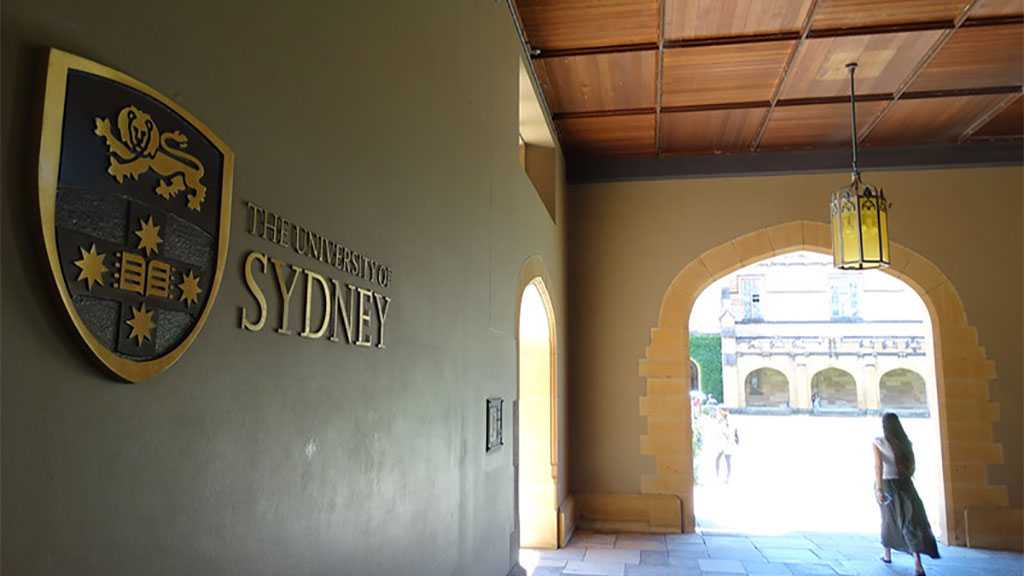
The ‘Israel’ Lobby at the University of Sydney

The ‘Israel’ Lobby at the University of Sydney

By Tim Anderson – The American Herald Tribune

Documents released under freedom of information law show that an ‘Israeli’ organization has, over many years, privately contributed millions of dollars to the University of Sydney’s Faculty of Arts and Social Sciences [FASS]. A sub-branch of the ‘Israeli’ World Zionist Organization [the Fund for Jewish Higher Education] contributes around half a million dollars to FASS each year, with contributions peaking at $819,000 in 2019. The WZO is committed to the ‘Israeli’ colony in Palestine, where more than half the population is denied full citizenship rights.

These amounts are way out of proportion to the nominal beneficiaries at the University: Hebrew, Biblical, Jewish and Holocaust Studies, and give the ‘Israeli’ lobby influence with University of Sydney management. This ‘Israeli’ funding is sustained while federal ‘foreign influence’ laws are trumpeted against China, and form part of a much larger private fund pool – one billion dollar plus, announced with pride in the University’s 2019 Annual Report  – at the University, for which there is little public accountability. The door is wide open for corruption, alongside secret foreign influence.

2020 data on the WZO confirms documents provided to me by a whistle-blower within the administration, back in 2018, which showed that the ‘Committee for Jewish Higher Education’ had been the largest single donor [by far] to FASS, with combined donations of $571,000 [in eight separate donations] in the first five months of 2012, all tagged for the Department of Hebrew, Biblical and Jewish Studies, including its specialty in Holocaust Studies.  With about 10 academics staff [not all full time] that department represents less than 2% of the 700 or so academic staff in the Faculty.

With all senior managers eligible for performance bonuses, at least in part based on their fund raising, these large undisclosed sums indicate a great potential for corruption, all the more so now that the Federal Court of Australia [in the case brought by the NTEU and myself] has rubber stamped management gag orders, even when they concern public academic work.

The ‘Israel’ lobby, acting through the tabloid media, pressured University of Sydney managers to expel me from my academic position in 2018-2019. The final issue was my graphic linking of one of ‘Israel’s’ Gaza massacres with the racial massacres of Nazi Germany; and my refusal to submit to secret gag orders, effectively made under pressure from the ‘Israel’ lobby. In late 2020 the Federal Court ruled that academics must follow management orders, even when it concerns their research and teaching. I have published some detail on this case and its implications; showing the vulnerability of the corporate university to outside pressures.

‘Israel’ lobby influence on the wider phenomenon of academic ‘cancel culture’ deserves attention. A recent Guardian article cites several British academics on the problem of university managers trying to “silence academics on social media.” This was said to be part of a tension between the corporate university and social media, where “on the one hand unis are pushing their staff to be more active online … but when that individual voice is in conflict with the official brand it creates a tension … it is about brand protection.” The corporate media has discovered that it can use this tension to goad management to move against certain academics.

The ‘Israel’ lobby has spent time and effort in this territory, in particular by trying to vilify as ‘racist’ public figures who criticize ‘Israel.’ The International Holocaust Remembrance Alliance [IHRA] has had some success in its attempts to extend the definition of anti-Semitism “to criticism of ‘Israel’ and support for Palestinian rights.” But I am one of many who have written that there is no legitimate basis for conflating criticism of a state or government with inciting hatred against a people.

An ‘Israel’ lobby group in the USA, under the guise of ‘protecting Jewish students’ branded as ‘biased’ more than 200 academics who supported the boycott against ‘Israel.’ Academics and teachers have been hounded from their positions in the USA, the UK, Australia and New Zealand because of their comments on ‘Israel,’ including those who have raised legitimate academic questions about ethno-nationalist settler colonialism” and of “victims becoming perpetrators.”

Jewish writers have not been immune from these attacks. Some have hit back, saying that “unfounded allegations of anti-Semitism [are used to] cover up ‘Israeli’ apartheid.” Last year sixty Jewish and ‘Israeli’ academics condemned the German parliament for its attempts to equate the Boycott, Divestment and Sanctions movement with anti-Semitism.

A 2017 letter signed by more than 200 British academics complained of the ‘Israel’ lobby’s repeated attempts to link academic criticism of ‘Israel,’ and support for the Palestinian people, with anti-Semitism. These moves were “outrageous interferences with free expression” and “direct attacks on academic freedom.” The group said “we wish to express our dismay at this attempt to silence campus discussion about ‘Israel,’ including its violation of the rights of Palestinians for more than 50 years. It is with disbelief that we witness explicit political interference in university affairs in the interests of ‘Israel’ under the thin disguise of concern about anti-Semitism.”

In the USA, President Donald Trump in 2019 signed an executive order to withhold funds from universities which did not do enough to stop “anti-Semitic practices,” which includes criticism of ‘Israel.’ Defense of the ‘Israeli’ colony in Palestine is taken seriously.

‘Israel’ and academic freedom became an issue at the University of Sydney in March 2015, after students shut down a talk by former British Army Colonel Richard Kemp, who had been invited on campus to defend the ‘Israeli’ military’s slaughter of more 2,000 Palestinian civilians in Gaza in 2014. According to the Times of ‘Israel,’ Kemp was to give a lecture about “ethical dilemmas of military tactics and dealing with non-state armed groups.” The ‘Israel’ lobby claimed the protest and student behavior was an attempt to intimidate Jews. A wider debate over the intellectual freedom afforded to visitors like Richard Kemp ensued.

At around this time I looked into the reporting of the slaughter in Gaza, preparing a graphic which showed – from relatively independent sources – that ‘Israeli’ forces had slaughtered more than 1,000 Palestinians [the final count was more than 2,000] of whom, according to UN sources, more than 75% were civilians.

The person who invited Colonel Kemp was former University of Sydney academic Dr. Suzanne Rutland. At her retirement a few months later Provost Stephen Garton praised Suzanne as a person of “moral courage” who had made “an effort to bridge the cultural and political divide, to promote tolerance and understanding … [and] we owe her a debt of gratitude.” Stephen used the occasion to backhand the students who had confronted Kemp, saying that some on campus “confuse academic freedom with the right to disrupt.”

Dr. Rutland had a high profile from her academic and community work. In 2008 she received the Order of Australia for her services to Higher Jewish Education and “interfaith dialogue.” She was also active in campaigns against anti-Semitism and Holocaust Denial. However her response to the students who confronted Colonel Kemp was not so tolerant. She denounced them as vicious racists, saying “when they stand there chanting, ‘free Palestine’ what they mean is the dismantling of the Zionist entity which means genocide against ‘Israel’s’ Jewish population.” This is an extreme view.

In fact, the better view is that ‘Israel,’ by its repeated massacres and ethnic cleansing, is engaged in a form of genocide. The US Centre for Constitutional Rights, noting a controversy over this question, wrote that:

“Prominent scholars of the international law [on the] crime of genocide and human rights authorities take the position that ‘Israel’s’ policies towards the Palestinian people could constitute a form of genocide. Those policies range from the 1948 mass killing and displacement of Palestinians to a half century of military occupation and, correspondingly, the discriminatory legal regime governing Palestinians, repeated military assaults on Gaza, and official ‘Israeli’ statements expressly favoring the elimination of Palestinians.”

Attacks on the critics of ‘Israel’ are often aimed at deflecting attention from this.

The now Emeritus Professor Suzanne Rutland was not just an academic, she was a conduit of ‘Israeli’ finance to the university.  Her online CV [now redacted online] listed her as ‘Chair of the National Advisory Committee on Jewish Education for Australia, for the World Zionist Organization.’ The WZO was founded in 1897 with the aim of creating a Jewish ‘state’ and, since the creation of ‘Israel,’ it has become an umbrella group for a range of ‘Israel’ lobbies. The WZO declares its commitment to “‘Israel’ education.”

At the political level the ‘Israel’ lobby remains influential. A 2018 study by the Australian Strategic Policy Institute [APRI] found that an ‘Israeli’ lobby group in Australia [AIJAC] was the biggest single foreign funder of Australian MPs’ overseas travel. MPs from both major parties were beneficiaries of these ‘study tours’. While the public focus of foreign influence in Australia has become China, with special new laws to criminalize ‘foreign influence,’ the APRI study showed that influence peddling from ‘Israel’ has been greater than that from China or the USA. While Australian MPs had been funded for nearly 60 trips to China and 45 to the US, AIJAC had sponsored around 100 visits to ‘Israel,’ “nearly evenly split between Labor and Liberal.”


River to Sea Uprooted Palestinian   
The views expressed in this article are the sole responsibility of the author and do not necessarily reflect those of the Blog!

Trump’s final month in office could be his most dangerous one – update

 Update: Washington has sent Nuclear Submarines to the Persian Gulf, in a move to “deter” Iran. This combined with Mike Pompeo laying the blame on “Iranian-backes forces” for the alleged “attacks” on the US embassy in Baghdad, leaves us in a very dangerous situation.

Trump’s final month in office could be his most dangerous one – update

December 22, 2020

By Aram Mirzaei for the Saker blog

Only one month remains of Donald Trump’s presidency. It seems inevitable that the Biden administration will take over the White House come January 20th. While the Trump administration has been very aggressive against the Islamic Republic during the past four years, it has nonetheless refrained from starting a full-fledged war. This could all change as he is about to leave office.

A few days after the election in November, reports emerged that Trump had “asked his advisers last week about the options he could have to attack Iran’s nuclear sites.”

However, “a range of senior advisers dissuaded the president from moving ahead with a military strike,” The New York Times reported. According to the report, Vice president Mike Pence, Secretary of State Mike Pompeo and others reportedly told the outgoing president that such action could spiral out of control.

Despite the NYT being notorious liars, I could imagine this report being true. I’ve for long maintained that Trump is an imbecile surrounded by war hawks and Zionist extremists. Nonetheless, those extremists and hawks still understand the consequences of a direct attack on Iran. Trump on the other hand does not. Zionist chieftain Benjamin Netanyahu knows that Trump is an imbecile and has done his utmost to take advantage of it. Netanyahu has for long dreamed of a US-Iranian war as it would do a lot of harm to his main enemy Iran, while it would cost Israel nothing when US soldiers are the ones being sacrificed to save the supremacist Zionist regime. Knowing that Joe Biden would be far more reserved in his approach towards Iran compared to the belligerent “maximum pressure” policy of the Trump regime, it is no coincidence that Netanyahu chose to assassinate Iranian scientist Dr Mohsen Fakhrizadeh only weeks after the US election.

Much like when Iran responded to Martyr Soleimani’s murder, Netanyahu and the Zionists had hoped that Iran would somehow retaliate again and enter the Zionist trap- to drag Iran into a war.

During these past four years, Trump has offered Israel a lot of “gifts” to prove his loyalty to the Empire. It is no coincidence that his administration has been very generous to Netanyahu and his friends since Trump has chosen to surround himself with the most extreme Zionists around, including his son in-law Jared Kushner. The relocation of the US embassy to Jerusalem, the recognition of the occupied Golan Heights as “Israeli territory”, and the recent “peace deals” between certain Arab states and Israel have all been very important moves for the Empire. Being wary that Trump, in his last month in charge could offer Israel a final gift in the form of an attack on Iran, Tehran has been preparing itself for any possible scenario.

Any attack by the US on Iranian soil will lead to war. That war will quickly become a regional war unless they expect Hezbollah, Hashd Al-Shaabi, the Houthis and many more to just sit idly by while the leader of their alliance is being attacked. Despite the risk of starting a regional war, Trump could make such a move in order for Biden to “inherit” the war, thus giving Israel the ultimate gift.

These are just speculations of course, but the sudden “attacks” on the US embassy in Baghdad, General Frank McKenzie, saying that the US is “ready to respond” if Iran attacks it on the first anniversary of the assassination of the Quds Force commander Major General Qassem Soleimani, and Mike Pompeo’s increasing obsession with Iran, are all causes for concern.

Trump’s policy of absolute subservience to Israel has only made Zionist hawks like Netanyahu much bolder and more audacious. It will also leave its mark for years after his exit from the White House as Bibi will now demand the same level of subservience from the Biden administration. Netanyahu has taken upon himself to show the former Vice President who is calling the shots, before Biden has even had the chance to take office.

In an obvious message to Biden, Netanyahu told him that “There can be no going back to the previous nuclear agreement. We must stick to an uncompromising policy of ensuring that Iran will not develop nuclear weapons.”

The fact that Biden has remained rather coy about how he intends to “return the US to the JCPOA”, makes me believe that he has readily agreed to continue the policy of the Trump administration in one way or another.

“I will offer Tehran a credible path back to diplomacy. If Iran returns to strict compliance with the nuclear deal, the United States would rejoin the agreement as a starting point for follow-on negotiations. With our allies, we will work to strengthen and extend the nuclear deal’s provisions, while also addressing other issues of concern,” he wrote in an article for the CNN website.

“Strengthening” the deal’s provisions and “addressing other issues of concern” sounds a lot like someone who is hoping to alter the deal in some form. This was something that Trump also hoped to achieve with his “maximum pressure” campaign. It is no coincidence that German Foreign Minister Heiko Maas all of a sudden is calling for a “nuclear deal plus” either. They all want to include Iran’s missile program into the deal because it has started to become a concern for the Zionist Empire and its vassals. So you can see that going back to the original JCPOA seems impossible at this point.

There is also the matter of how the JCPOA is viewed in Iran these days. Many Iranians had huge hopes for the JCPOA. They were hoping to finally be able to enjoy the benefits of an economic recovery after decades of sanctions and blacklisting. Most of them now consider the JCPOA to be evidence of the failure of diplomacy with the US. To them, despite long negotiations and concessions, Iran is still suffering from sanctions and is in no better position economically than it was before the JCPOA. This is why the Iranian “conservative bloc” emerged victorious in the parliamentary elections earlier this year, and it is also why I believe they’ll win the presidency next year.

With the “conservatives” in power, Iran will not so easily want to return to the stipulations of the JCPOA either. Last year Iran began scaling down on its commitment to the JCPOA agreements, in response to Washington’s withdrawal and Europe’s inability to stand up to the US. Iran has since lost billions of dollars worth of trade revenue due to the sanctions that Washington reimposed- why would Iran want to just return to the JCPOA without compensation for the damage done to its economy?

The Islamic Republic will be facing the 8th President since its birth when Biden assumes power. Nobody is expecting Biden to change anything in US policies towards Iran and the rest of the world for that matter. Trump is really hated in Iran, to the point where he is regarded as a terrorist. Iranian president Hassan Rouhani recently said: “We are by no means excited about [Joe] Biden coming to power, but we are happy with Trump leaving as a terrorist and a person who even blocked Iran’s access to [COVID-19] vaccines; we are happy because he failed to adhere to basic moral and human principles,”

Personally, I understand the hatred towards Trump, it is easy to dislike such an imbecile who has no self-control. But in anger, it is also easy to lose sight of the bigger picture; Trump was in many ways a preferable enemy. Assad said it several times too, noting how the imbecile openly bragged about stealing Syrian oil. Trump was a clumsy and irrational enemy, the Europeans and many liberals realized this too, hence the great animosity towards him and his rule. His maximum pressure policy has left Washington rather desperate and pathetic, whereas his predecessor managed to portray Washington as a serious negotiator when the JCPOA was first announced.

Unfortunately, there’s also the other side to his irrationality. Trump’s irrational behaviour after what he perceives to be electoral fraud, could cost many people their lives if and when he decides to give his friend Bibi Netanyahu his final gift.


River to Sea Uprooted Palestinian   
The views expressed in this article are the sole responsibility of the author and do not necessarily reflect those of the Blog!

Sunday, 20 December 2020

Persian Gulf in the US and Israel’s Sights

 By Viktor Mikhin

Source: New Eastern Outlook

SLM

After more than three years of diplomatic tensions and a hostile media campaign against each other, it seems that Saudi Arabia and Qatar finally decided to settle their relations. Political scientists and experts around the world are now wondering what finally motivated the two rivals to put their differences behind them and start a policy of rapprochement.

In this regard, it should be noted that in June 2017, Saudi Arabia, Bahrain, Egypt and the United Arab Emirates — commonly known as the “Arab Quartet” — severed diplomatic relations with Qatar and imposed a complete blockade on the tiny emirate of the Persian Gulf. These countries, led by Riyadh, closed their airspace, land and sea routes to Qatari planes, cars and ships, prompting Doha to use Iranian airspace. Kuwait, a country stuck in the middle of a dispute between its neighbors, tried diligently to reconcile the opposing sides, and even the “great peacemaker of the Persian Gulf” — now deceased Sheikh Sabah Al-Ahmad Al-Jaber Al Sabah — entered the case, but to no avail.

In the end, however, Kuwaiti mediation efforts seem to have brought fruit. Kuwaiti Foreign Affairs Minister Sheikh Ahmed Nasser Al-Mohammad Al Sabah spoke on Kuwaiti State Television to read a statement about the split between Qatar and the Arab Quartet:  “Recently, fruitful discussions took place. All parties expressed their interest in unity and stability in the Persian Gulf and Arab countries, as well as in reaching a final agreement that will ensure lasting solidarity”.

Qatar and Saudi Arabia welcomed Kuwait’s efforts, while Bahrain, Egypt and the UAE, which boycotted the emirate along with the Saudis, remain silent. Some news reports suggest that Riyadh has broken off the ranks of these allies to normalize relations with Qatar under US pressure. Bahrain, Egypt, and the UAE are not members of the normalization agreement that the Saudis intend to sign with Qatar. Some Arab media reported that normalization would begin with a bilateral agreement between Riyadh and Doha, followed by Manama and Cairo. The UAE’s stance is still unclear, even if they tend to be reluctant to pursue this issue in the waterway of Saudi Arabia.

Deputy Prime Minister and Foreign Affairs Minister Sheikh Mohammed bin Abdulrahman Al-Thani expressed the Qatari optimism regarding the solution of the Persian Gulf crisis, adding that the Emirate has a strong positive attitude towards any initiative that brings peace to the region.  Moreover, Saudi Arabia also expressed optimism that the three-year crisis would soon be resolved. Saudi Foreign Affairs Minister Prince Faisal bin Farhan said at a conference of the International Institute for Security Studies in Manama, Bahrain, that “significant progress” has been made in resolving the crisis that began in 2017.

Although the details of the deal between Qatar and Saudi Arabia have not yet been made public, political analysts and experts in the region have rightly placed the event in the broader context of “boiling tensions” between Iran, on the one hand, and the United States and Israel, on the other. It should be recognized that the current US president Donald Trump is still defending his advantages to the very last, resorting to all visible and invisible methods. Initially, a plan to launch a military strike on the alleged nuclear facilities of Iran was revealed. In this connection, there was even a secret meeting in the White House, where Trump asked his military and advisers about such a possibility. However, the military, accustomed to a quiet and peaceful life, with the situation with Iran, which has modern air defense equipment and missiles, which can easily cover all US bases in the region with a barrage of fire, has somewhat cooled the fervor of the belligerent president. But, nevertheless, the American President’s advisors, among which is the senior advisor of the White House Hasid Jared Kushner, Trump’s favorite brother-in-law, constantly keep buzzing in the President’s ears about the impending threat to America from “bearded Iranian ayatollahs”.

Finally, a solution was reached – Jared Kushner and his team rushed to Saudi Arabia and Qatar to negotiate in a region bubbling with tension and hatred towards Israel and the United States after the despicable assassination of Iranian scientist Mohsen Fakhrizadeh, who had recently worked on the COVID-19 issue.   The delegation included Ambassadors for the Middle East Avi Berkowitz, Brian Hook and Adam Boler, Executive Director of the American International Development Finance Corporation.  Incidentally, the senior advisor and his team have recently been actively involved in negotiations to normalize relations between Israel and Bahrain, the United Arab Emirates and Sudan. Officials said in public speeches that they would like to promote and sign more such agreements before President Donald Trump transfers power to President-elect Joe Biden on January 20.

American officials believe, and the US media sometimes write, that Saudi Arabia’s involvement in the deal with Israel will encourage other Arab countries to follow their example. But the Saudis don’t seem to have reached such a milestone deal, and officials in recent weeks have focused on other countries concerned about Iran’s regional influence as a unifying factor.

Kushner’s trip took place shortly after the assassination of Mohsen Fakhrizadeh by unknown attackers, whose hand was allegedly pointed by the Israeli Mossad and the American CIA. In fact, a few days before the murder, Israeli Prime Minister Benjamin Netanyahu visited Saudi Arabia and met with Mohammed bin Salman, joined by US Secretary of State Mike Pompeo. Given that Joe Biden has repeatedly announced his intention to join an international nuclear pact with Iran, Mohammed bin Salman and Benjamin Netanyahu fear that the future White House master will pursue a policy toward Iran similar to that adopted during Barack Obama’s presidency, which has sharpened Washington’s ties with its traditional regional allies and, in particular, with Israel.

Therefore, there is no doubt that the deal between Qatar and Saudi Arabia will be directed against Iran, although it is not yet clear how it will affect the Iranian-Qatari relationships. Both parties to the deal — Qatar and Saudi Arabia — have not yet gone into detail and, for example, the Qatar embassy in Tehran has refused to comment on any details of the agreement. Yet this deal may not be sufficient to safeguard Qatar’s national interests, especially if it pushes the emirate away from Iran, which has opened its airspace and sea routes to Doha over the past three years. This new arrangement between Riyadh and Doha is obviously of direct relevance to the US, but it is most likely related to Iran, because the situation in the region has not only not changed as a result of thoughtless policies of Washington, but has further strained the situation.

Qatar and Saudi Arabia are still in a state of competition in many countries, such as Libya and Syria. When Qatar was under blockade, it sought support from other countries, including the Islamic Republic of Iran, and therefore, if the Qataris damaged their previous relations by getting closer to the Saudis, there would be very high risks for Doha, the Tehran Times stressed. The newspaper also noted that the establishment of relations between Doha and Riyadh can never be in Qatar’s favor, as Saudi Arabia still does not recognize the role of Doha in regional issues and both countries are fiercely competing in Egypt.

Iran welcomed Kuwait’s mediation efforts to end the three-year crisis between Qatar and the Arab Quartet. But Tehran seems to be closely monitoring the situation in the region in light of US and Israeli efforts to increase pressure on the Islamic Republic.  Iran seeks to strengthen ties with Qatar and other Arab states in the region, but it also seeks to make it clear to those states that it does not accept any restructuring aimed at harming its interests.  “We welcome understandings in the Persian Gulf announced by Kuwait. Iran’s longstanding policy is diplomacy, good neighborly relations & regional dialogue. We hope reconciliation contributes to stability and political & economic development for all peoples of our region,” Iranian Foreign Affairs Minister Mohammad Javad Zarif tweeted a few hours after Kuwait issued a statement saying that ”fruitful negotiations“ had been held between all parties to the conflict.

Undoubtedly, the situation in the Persian Gulf is far from any settlement. And even if Riyadh’s Doha settles its difficult relations, the most important question remains — the relations of the United States and Israel with Iran and their futile efforts to change the state system in this Islamic Republic.

Viktor Mikhin, corresponding member of RANS, exclusively for the online magazine “New Eastern Outlook”.

River to Sea Uprooted Palestinian   
The views expressed in this article are the sole responsibility of the author and do not necessarily reflect those of the Blog!

Monday, 14 December 2020

Israel and Morocco to normalise ties as US recognises Rabat’s claim to Western Sahara

North African kingdom the fourth Arab state to build full diplomatic relations with Israel in four months

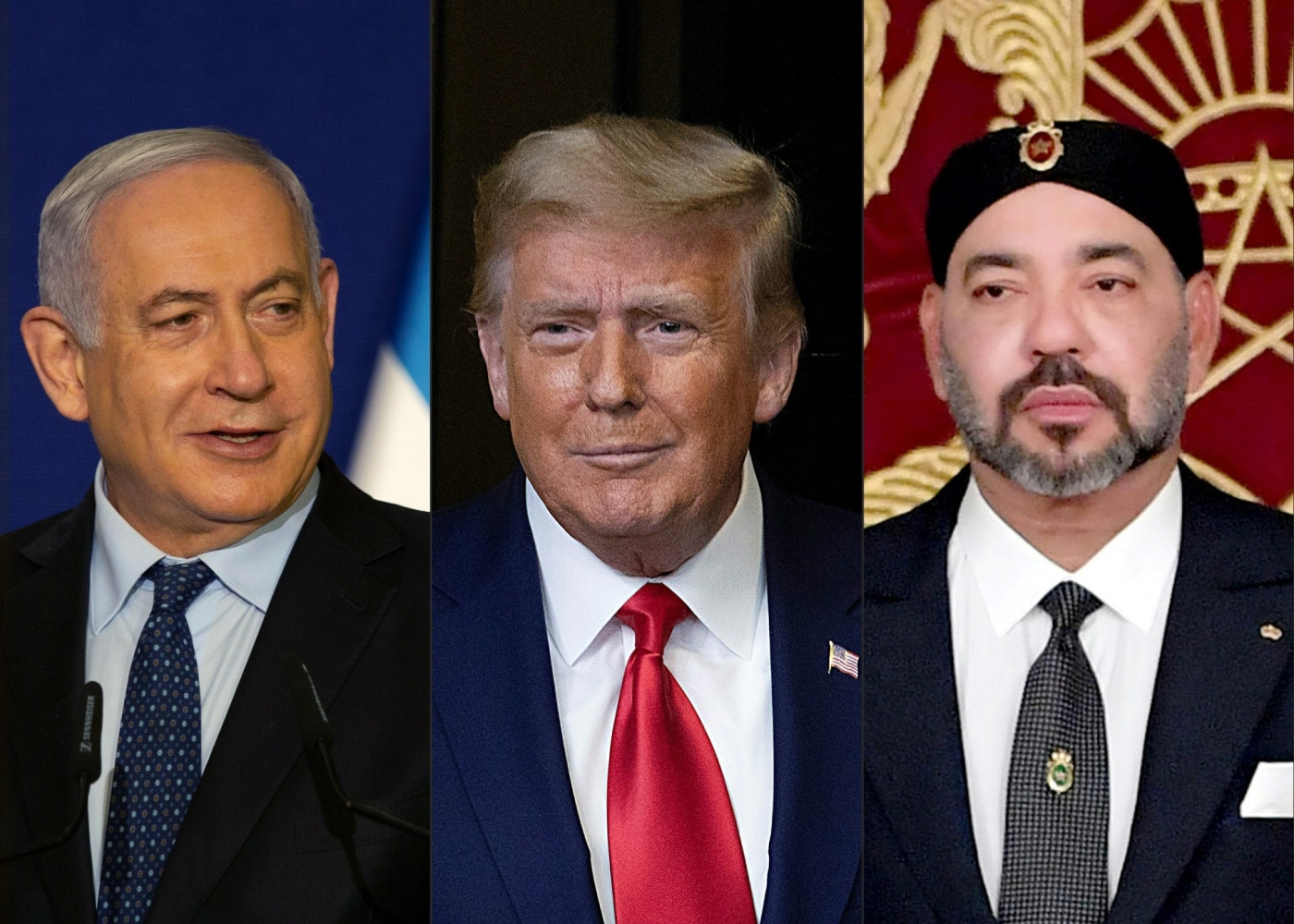
Israeli Prime Minister Benjamin Netanyahu, US President Donald Trump and Morocco’s King Mohammed VI (AFP)

By Oscar RickettDaniel Hilton

Published date: 10 December 2020 16:22 UTC

Israel and Morocco will normalise ties and the United States is to recognise Western Sahara as part of the North African kingdom, US President Donald Trump announced on Thursday.

Morocco becomes the fourth Arab country to establish full diplomatic ties with Israel in four months, following the UAE, Bahrain and Sudan.

“Today, I signed a proclamation recognizing Moroccan sovereignty over the Western Sahara. Morocco’s serious, credible, and realistic autonomy proposal is the ONLY basis for a just and lasting solution for enduring peace and prosperity!” Trump tweeted.

In a separate tweet, the president then added: “Our two GREAT friends Israel and the Kingdom of Morocco have agreed to full diplomatic relations – a massive breakthrough for peace in the Middle East!”

Israeli Prime Minister Benjamin Netanyahu described the deal as “another great light of peace”.

The Polisario Front, an independence movement from Western Sahara, a disputed desert territory, said it “regrets highly” Trump’s decision but will continue its struggle.

Morocco’s Royal Court said King Mohammed VI had called Palestinian President Mahmoud Abbas and reiterated his commitment to the two-state solution to the Israel-Palestine conflict.

Previous relations

Though Israel and Morocco have not had full diplomatic ties since the former’s founding in 1948, they have nonetheless shared relations and intelligence.

Morocco and Israel began low-level ties in 1993 after the latter reached a peace agreement with the Palestinian Liberation Organisation as part of the Oslo Accords. But Rabat suspended relations with Israel after the outbreak of the Second Palestinian Intifada in 2000.

Morocco described Thursday’s announcement as the “resumption” of diplomatic relations with Israel.The open secret of Israeli-Moroccan business is growing

Read More »

Around half a million Moroccan Jews live in Israel, and Israelis are known to occasionally visit the kingdom, and Netanyahu said he expects direct flights to begin soon.

In recent years, King Mohammed VI has encouraged the restoration and preservation of his country’s Jewish heritage, which Moroccan Jewish Israelis have participated in.

Moroccan activists have highlighted frequent steps towards the normalisation of relations with Israel, which the government has denied or remained silent about.

In February, Israeli media reported that Netanyahu had lobbied the United States to recognise Moroccan sovereignty over the Western Sahara in exchange for Rabat taking steps to normalise ties with Israel. 

A few months later, Amnesty International revealed that Israeli spyware was used to target Moroccan activists. 

Territorial claims

Jared Kushner, Trump’s son-in-law and senior adviser, confirmed that recognition of Moroccan sovereignty over the Western Sahara is linked to kingdom’s normalisation with Israel.

“It also could possibly break the logjam to help advance the issues in the Western Sahara where we want the Polisario people to have a better opportunity to live a better life,” Kushner told reporters on Thursday.

“The president felt like this conflict was holding them back as opposed to bring it forward. This recognition will strengthen America’s relationship with Morocco.”

Western Sahara, a former Spanish colony, was claimed by Morocco in 1957 and is believed to have significant offshore oil reserves and mineral resources. Western Sahara: A decades-long sovereignty battle for ‘Africa’s last colony’

Read More »

Its indigenous population has fiercely rejected Moroccan control, however, and between 1975 and 1991 the Polisario Front fought an insurgency against Rabat’s presence.

Polisario estimates the indigenous population of Western Sahara to be between 350,000 and 500,000 and has long called for their right to a referendum on independence, something that has also been promised by UN resolutions. 

Polisario has repeatedly accused Morocco of exploiting the region’s natural resources while half of its population await a referendum in camps and in exile. 

Last month, Moroccan forces and Polisario fighters clashed over a protest blocking a highway into Mauritania, with the Sahrawi movement declaring the 1991 ceasefire over.

Morocco’s Royal Court said the US will open a consulate in the Western Sahara. Last month, Bahrain, which normalised ties with Israel in September, also said it was opening a consulate in the territory.

Trump’s announcement was denounced by Sahrawis.

“The Polisario and Sahrawi government condemn in the strongest terms the fact that outgoing American President Donald Trump attributes to Morocco something which does not belong” to the country, said the Sahrawi information ministry in a statement to AFP.

Ahmed Ettanji, a journalist and activist in Western Sahara’s Laayoune, told Middle East Eye that the move was a blatant tit-for-tat strategy. 

“It’s like an exchange: supporting the so-called Moroccan sovereignty over Western Sahara in exchange for political recognition of Israel,” Ettanji said.  

‘We were shocked when we saw Trump’s tweet. At the same time, it’s not something new. As a Sahrawi, I’ve seen the US back Morocco for many decades’

– Ahmed Ettanji, Sahrawi journalist and activist

“We were shocked when we saw Trump’s tweet. At the same time, it’s not something new. As a Sahrawi, I’ve seen the US back Morocco for many decades. But there is some hope that the next administration will be different.”

Sahrawi activist Mohamed Elbaikam said the announcement had been anticipated.

“We believe that this position is an attempt to bypass international law and all its principles,” he told MEE.

“We believe that the next US administration led by [Joe] Biden will correct the American position, just as the American people will not accept it.”

Mahmoud Lemaadel, a Sahrawi citizen journalist, told MEE Trump’s announcement was like “the blind leading the blind”.

US Congresswoman Betty McCollum, an outspoken advocate for Palestinian human rights, also denounced Trump’s move to recognise Morocco’s claim over Western Sahara.

“I condemn Trump’s unilateral recognition of Moroccan sovereignty over the Western Sahara in exchange for Morocco’s diplomatic recognition of Israel,” McCollum wrote on Twitter on Thursday. “The Sahrawi people have an internationally recognized right to self-determination that must be respected.”

Jim Inhofe, a senior Republican Senator who supports the people of Western Sahara’s push for self-determination, accused Trump of “trading the rights of a voiceless people” to secure the Morocco-Israel deal.

“Today’s White House announcement alleging Morocco’s sovereignty over Western Sahara is shocking and deeply disappointing. I am saddened that the rights of the Western Saharan people have been traded away,” Inhofe said in a statement.

War on Want, an anti-poverty charity based in London, warned that the move was “not about peacebuilding”. 

“It’s a cynical attempt to rally repressive regimes around some of their most egregious policies: military occupation and human rights abuse,” Ryvka Barnard, the group’s senior campaigner, said in a statement on Thursday. 

“President Trump calls this announcement a ‘breakthrough’, but it comes on the back of the recent Moroccan breach of a decades-old ceasefire in occupied Western Sahara, as well as Israel’s ongoing expansion of illegal settlements, destruction of Palestinian homes and structures, and lethal violence against Palestinian civilians, including children,” Barnard said. 

“This move smacks of the colonial mindset that carved up the world at the expense of its inhabitants & seeks to normalise injustice.”

Related Videos

‏المناضل الفلسطيني الراحل جورج حبش زيارته للصحراء الغربية سنة 1979
حكيم الثورة الفلسطينية جورج حبش اثناء زيارته لمخيمات اللأجئين الصحراويين سنة 1979
River to Sea Uprooted Palestinian   
The views expressed in this article are the sole responsibility of the author and do not necessarily reflect those of the Blog!