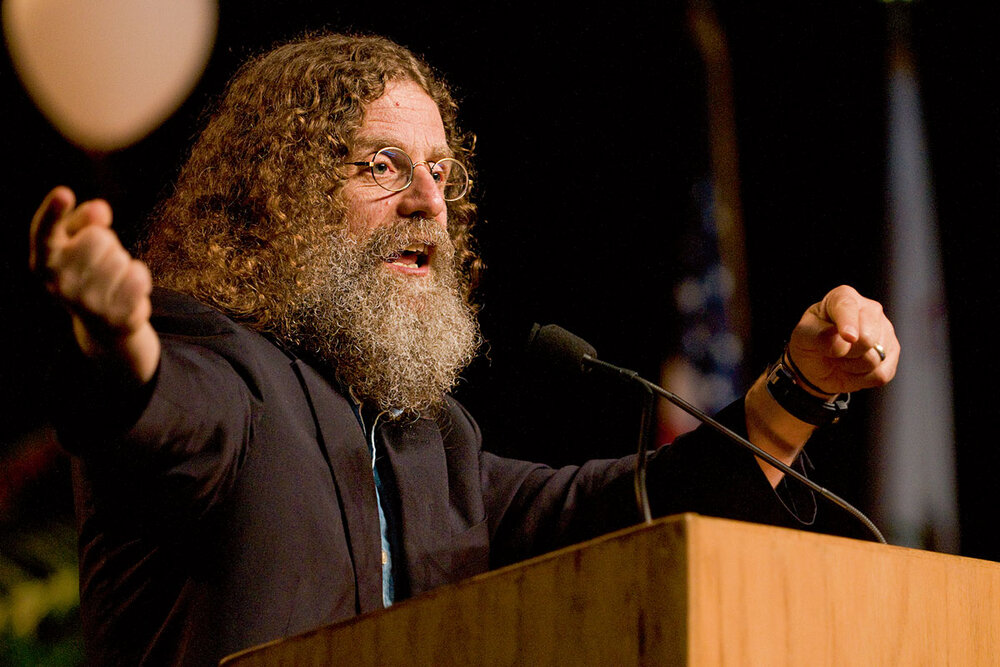
Earlier this month, I conducted an interview with Dr. Robert Sapolsky, a professor of biological sciences at Stanford University, to discuss different issues such as racism, economic inequality, and partisan polarization. He was very generous with his time and provided us with in-depth analyses of such fundamental issues.
Dr. Robert Sapolsky is John A. and Cynthia Fry Gunn Professor of Biological Sciences at Stanford University, Professor of Neurology and Neurosurgery at Stanford’s School of Medicine, and a research associate at the Institute of Primate Research of the National Museums of Kenya. He is a recipient of a MacArthur genius fellowship and the author of several books, including Why Zebras Don’t Get Ulcers: A Guide to Stress-Related Diseases and Coping (1995) and Behave: The Biology of Humans at Our Best and Worst (2017).
Our conversation, edited for length and clarity, is below.
The only difference between the George Floyd case and so many others is that somebody videotaped it this time, not that the police actions are new. This has been happening for more than a hundred years or so. All that is happening is people are being able to document it to prove what is actually occurring. All of that said, we’ve now had videotapes of numerous African-American men being killed by the police in the last few years, and each time it causes some protests. This is the first time it has caused protests this big, and maybe this is going to cause meaningful changes, but I’m not optimistic about that. People have short memories in this country.
A: Well, in so far as I think the science shows, race is not a particularly strong innate category in our heads, and racism can be changed as an unconscious category surprisingly easily. We are not looking at biology here. It’s cultural, but it is very deeply cultural.
“I think basically racism is the single biggest historical problem in the United States,” says Dr. Robert Sapolsky.
In some ways, the most depressing version of it was a study in the 1950s by a husband-and-wife pair of psychologists that horrified anyone who thought about it. It was this famous first study where they took black kids and gave them a choice of playing with a white doll or a black doll and asked them which one they wanted to play with and why. It showed that black kids in America, even at age seven, were already saying the white doll “is prettier”, the white doll “is nicer”, and the white doll “isn’t scary”. Seven-year-old black kids have already been taught to think about themselves that way!
When there was this famous case in the 1950s in the Supreme Court, where they finally ruled that you cannot have racial segregation, that you cannot be like South Africa, and that you cannot have separate schools for black kids and schools for white kids, that study was one of the most cited reasons behind the court’s decision.
Researchers are STILL finding the exact same thing. Your average black kid today still prefers to play with white dolls, because they’re “nicer” and they’re “less likely to hurt you”. So, racism is such a deep, deep phenomenon here, and few things say that more clearly than when people have been conditioned to have negative, racist feelings about themselves.
Q: As a neurobiologist, what do you regard as viable solutions to the issue of racism?
A: Well, there are slight hints of things to be optimistic about from the standpoint of neurobiology. For instance, if you put a white American in a brain scanner, and you quickly flash up a series of pictures of faces on a screen, and you flash up the face of an African-American person, in approximately seventy-five percent of white people, there’s an activation of the amygdala, which is a part of the brain that has to do with fear and anxiety and aggression. Oh, my god! This is fascinating and so depressing at the same time.
Also, the part of the brain that processes “faces” (called the fusiform cortex) does not activate as much in those seventy-five percent of white people looking at a black face, because it doesn’t count as “a face” as much. It’s not as much of a person. So, oh my God, this is so depressing and so horrible!
But wait a second, what about the twenty-five percent of the people where that does not happen? The answer is those are white people who grew up with close friends who are African-American. Those are people who had a romantic relationship with an African-American somewhere along the way. In another word, it is not inevitable but some of the best solutions for that start when you’re two years old.
Current racial segregation in schools in the U.S. is not because of laws, but because of economic inequality and cultural factors, the professor remarks.
However, in many parts of the United States in the big cities, the level of racial segregation – the extent to which if you’re black you are likely to be going to a public school, where 95 percent of the other kids are black, and if you’re white, the same thing in that direction – is as bad as it was in the 1950s. It’s not because of laws, but because of economics and cultural factors.
So, it is the massive issues that need to be changed starting early in life. Although it is possible to take an adult who was a racist – even on the most implicit, unconscious level – and change him or her, but it’s hard work and it’s a lot harder than preventing a three-year-old from becoming a racist in the first place. But the other issue is just such enormous economic inequality in this country by race. It’s so deeply structured in the economic and educational system here that all it does is find ways to become stronger each generation.
Q: You mentioned economic inequality and how being poor or rich leads to some kind of economic segregation. Now, I want to know what the findings show about being poor, especially with regard to children who are born into poverty.
A: I spent years studying what stress and stress hormones and poverty can do to the hippocampus – the part of the brain relevant to memory and learning. That’s so important and so interesting. However, I now think I spent thirty years of my life wasted because I was studying the wrong part of the brain. Much more interesting is studying that a stressor such as poverty not only makes you have less of a memory, but it also makes you more prone to depression. Even more importantly, it makes you more prone to fear and anxiety. Even more importantly, it makes you prone to making bad decisions when you have to make them quickly. And what I’m now starting to think is the most important one, it makes you less empathic toward other people.
Everyone focused on how poverty makes people less healthy. Poverty also makes for a more violent world, and it makes for a less kind and less humane world. That last part I think is the most important one. Even today, we know a little bit about what’s going on in the brain, in a world in which people are stressed and their brains have changed in response to stress from the time they were a fetus because stress hormone levels in pregnant women vary as a function of poverty levels. In other words, higher stress hormone levels in pregnant women are already affecting the brain of the fetus. Even at that stage, you are already changing aspects of the brain that could be for your entire life, that are going to make for people who make a society that is less kind and less safe and less healthy and less intelligent in every possible way that could go wrong. That’s just enormously depressing.
Q: You have spoken and written extensively about how economic inequality affects an individual and a society. Could you explain how that works?
A: When you look at poverty, you see that it is a predictor of poor health, more violence, less kindness, and all of those things. But even more important than poverty is inequality, which is not so much about being poor, rather, it’s about being reminded every day of what you don’t have and what others have. It’s the comparison.
Researchers have spent a lot of time showing that when inequality increases, the health of the poor gets worse, their crime rates go up and all of those bad things happen. But something that is even more interesting in some ways is that when inequality goes up, the health of the WEALTHY gets worse too. Of course, not as much as the poor, but it gets worse for them as well.
It’s not that if you are in the right part of society you can selfishly say that it’s their problem, because even if you’re wealthy and you don’t care about anyone else, living in an unequal society is even bad for your health, because it stresses you. For example, you have to spend more of your income on your house alarm system. You have to spend more of your income sending your children to private schools because the public schools are “too dangerous”.
It’s very stressful to try to construct a world in which nothing stressful can happen to you. In other words, it’s every level of society that pays for it and I think we see that in the United States. That’s why most of the wealthy vote for Donald Trump. Because they suffer too.
The voting patterns show that the wealthy in the cities are more in the direction of supporting the Democrats and are a little more liberal, in contrast to the wealthy in the suburbs and in rural areas. If you’re wealthy in a city, for example, if you’re going to the opera and you’re paying a crazy amount of money for it and you’re wearing a tuxedo and your life is wonderful, even just getting out of your limousine and going to the opera, you’re gonna have to step over somebody who is sleeping on the sidewalk because he is homeless. Even on the level of selfishness, you would say, “We have to do something about the homeless because it’s really very uncomfortable to go to the opera and have to see homeless people.”
But if you live in the rural areas and you’re a billionaire and you go to a rodeo of cowboys steer roping, if that’s your idea of fun, you’re not gonna have to step over homeless people – it’s a different world than that. But even the wealthy here pay a price for inequality.
Q: So, inequality is generally another category to divide the world into Us-es and Thems, which in turn would lead to more public anxiety.
A: Absolutely. And as a measure of how fast that could happen, you do studies where university students play an economic game, and then you introduce inequality to the game. For instance, half of the subjects start the game with ten units of money, and the other half start with a hundred units. Two minutes ago, the students were economically roughly equal and they were from the same dormitory. But now, even within minutes of artificially introducing inequality to the game, you already begin to see some of those behaviors.
According to Dr. Sapolsky, when there’s rampant economic inequality in a society, even the wealthy are negatively impacted by it.
It is so fast and it is so strong. To see one of the reasons why kindness and empathy go down, suppose you have a world where everybody gets one of two different incomes: Fifty percent of people get ten units of money a year, and fifty percent get a hundred units a year. That’s so unequal! But even with that, at any given point, half of the people in your world at least have the same income that you do. At least economically they are somewhat equal to you.
But if instead, only one percent of people in the country are getting the same income you’re getting, the inequality spreads out enormously. There will be fewer people who are your peers. A greater percentage of the people around you are either poorer or richer than you. If they’re poorer than you, you are afraid of them, or you want to keep them away, or you’re disgusted by them. And if they’re richer than you, you resent them and you envy them. So, you don’t have equals. The more inequality there is, the more of a hierarchy there is, and the more of a hierarchy, the fewer peers you have whom you are more likely to be kind to, and who are more likely to be kind to you. It makes for a more awful world by definition.
Q: Like the U.S., my own country, Iran, has turned into a very divided nation in recent years. However, when I follow the U.S. news, I feel that the level of polarization in the United States is perhaps much worse than that of Iran. What are the roots of such polarization? And what do you think is the solution?
A: Well, to begin with, Donald Trump is not the cause of it. Donald Trump is a symptom of it. He is the complete logical outcome of what the issues are here. I think basically what has happened is inequality has gone up, employment has gotten worse, and poverty levels have gotten worse, because so many jobs have been sent to poorer countries by the corporations here that don’t care or because so many more jobs are being automated.
And what happens as people get more stressed and more angry and more worried is, whether you are a rat or a baboon or a human, the basic neurobiology is to turn on somebody else and to have a very hard time realizing that it’s the fault of the people up on top, instead of the person who’s standing right next to you hoping for the same job.
The people in power are brilliant at making you turn on the person standing next to you instead of on them. And all it does is make things worse. If you are in the most dangerous part of the population in the United States, which is if you are an older white guy who never got much education and has now spent thirty years getting less proportionate income each year, and thirty years watching more and more people competing for your job, especially people who do not look like you, and seeing more and more of the teachers at your children’s schools not looking like you, and the people on television not looking like you, and the people getting elected not looking like you, and all of that is unconsciously telling you over and over that it is not your culture anymore, that you do not rule this place anymore.
Q: So, in this context, the idea of bringing people of different backgrounds together doesn’t resolve that issue, right?
A: No, because you have to do it the right way. People used to say “Ooh, if you could take people from two different groups who don’t like each other, if you could bring individuals together and let them spend time together, they will learn to see each other as individuals and they will learn that there are more similarities than differences and it would be wonderful, etc.” However, sixty years’ worth of research on contact theory has shown that most of the time it does not work, because it has not been done in the correct way. And if you do it the really wrong way, you will make things worse.
It takes a lot for it to work correctly. You can’t do it for a weekend or even a week. It takes contact lasting for months. It has to be on equal grounds. It has to be in settings where you are not seeing the other group’s symbols, which are a constant reminder to you.
“What happens as people get more stressed and more angry and more worried is … they turn on somebody else and have a very hard time realizing that it’s the fault of the people up on top, instead of the person who’s standing right next to you hoping for the same job,” says the professor.
This past summer, my family and I went to Northern Ireland, where Catholics and Protestants have been killing each other forever, and in the 1990s, they amazingly worked out a treaty and it has become much more peaceful. Nevertheless, the capital, Belfast, is still a completely divided city. There’s a Catholic half and a Protestant half, and there’s a wall in-between. We took a tour where, for the first half of the day a seventy-five-year-old man who used to be a fighter for the Catholic groups takes you on a tour through the Catholic area, and then around twelve o’clock, you go to the gate and he hands you off to a protestant guy, who was a gunman for the Protestant group for years when he was a young man but now runs the tour of his side. Both of those men had been in jail. Both of those men killed people.
Now, you go to one side, and it has nothing but Irish flags on every single house, and the other side has nothing but British flags on every house and pictures of Queen Elizabeth, and how wonderful she is, and so on. The point is, you know, you can’t do it where you are being reminded every minute what they [pointing to the right] did to your ancestors 200 years ago, or what they [pointing to the left] did to your ancestors in the seventh century.
So, it takes a lot of work to do it right. One of the areas where it has been most studied is in summer camp programs for Palestinian and Israeli teenagers, where you bring them together and you try to do it right. You get them in a neutral setting, and you give them something they all have as a shared goal. For instance, they’re brought to a place where they have no symbols – they cannot have flags or anything like that – then you show them this field full of boulders and rocks and weeds, and you say, “Okay, if you guys wanna work together like crazy for the next week to turn this into a football field, go for it. There you go. That’s the only way you’re gonna have a football field.” And then they work like crazy, and they work in teams together, which is the sort of thing that actually helps, and you show that when they leave at the end of these two weeks, some of them have had a change in their attitudes.
They’ve been doing that for twenty years, and despite that occasional good news, what the studies have also shown is that no person who ever went to one of those groups on either side has become a leader of a peace group; next to no person on either side has stayed in touch with the person they became friends with; no person has caused other people to change their opinions. What you get instead is that the researchers come back to them one year later to ask them about the other side, and they say, “Oh, those people? They’re terrible! They’ve stolen our land,” or “They’re terrorists. They’re terrible, rotten people.” But then they say, “Oh, I knew this one guy though… He was a good guy. You know, they’re not all that way. You know, but there was this guy… I should email him to see how he’s doing,” and then they never do that. But the overall prejudice does not go away, and whatever changes there have been in your attitudes, you do not spread them to anybody else. So, it takes so much work. It takes years.
Q: And goodwill on both sides.
A: And goodwill! You have to want the change to occur. You have to actually accept that the current situation is not good. People here often say, “Oh, what’s the cause of Islamic rage against the West? It’s history. They used to be the Ottoman Empire. They used to be the Moorish Empire. They used to be amazing and now look at them. They’re just upset at what they lost in history.” So, what’s Donald Trump about? “Make America great AGAIN!” AGAIN! And what does that mean? As a secret sign to the people who support him, make it a country again where, if you are a man, you rule your home. If you are white, you rule your country. If you are Christian, you are in charge of the religious culture in your country. It’s “Make America great AGAIN!” And you are saying, “I am part of the people who feel like history has left me behind, and this used to be my place to rule, and it’s no longer like that, and we need to go back.” It’s the same historicism.
Q: Now, I also want to talk about your book, “Behave: The Biology of Humans at Our Best and Worst”. In your book, you argue that “knowing a judge’s opinions about Plato, Nietzsche, Rawls,” and other philosophers “gives you less predictive power about her judicial decisions than knowing if she’s hungry.” Could you elaborate what that means?
A: Yeah, it’s wonderful! I love that finding – that finding and the finding that if you put someone in a room that smells bad, people become more politically conservative about social issues. I tell those findings to an audience and you could hear people say, “Whoa!” Or whenever I’m speaking to law students and I tell that one about judges, you can just hear people laughing a little bit in the audience and saying, “Oh, my God! What is wrong with us?”
Q: So, would you explain what happens in the study?
A: Okay. In this study, the researchers looked at parole boards. A parole board is a panel of people who decide whether a prisoner has behaved well enough that they should be released early. So, it was a study looking at parole board judges’ decisions, and it showed that the single biggest predictor of whether a prisoner was paroled or sent back to jail was how many hours it has been since the parole board judges had a MEAL. If you appeared before a judge right after they had a meal, you had a sixty-percent chance of being paroled. By three hours later, it was down to a zero-percent chance.
And then you ask the judge afterward, “Wow! That’s interesting! You let this guy [pointing to the right] free two hours ago, but now you sent this guy [pointing to the left] back to jail. How come?” And they will talk to you about Aristotle and Plato. They’re not gonna say because I’m hungry. But the biology of it shows that that’s the case. When their blood sugar levels are low, people become less generous, they become less empathic, and they become likely to cheat when they’re playing an economic game. And why is this? Because the parts of your brain that have to make you do the harder thing when it is the right thing to do have a higher metabolic rate than other parts of your brain. In other words, they demand more energy.
It takes energy to think twice about someone instead of just saying, “They’re rotten! Throw them back to jail.” Stopping and saying, “Well, let’s see. They grew up in a world that I never experienced. What was the world like for them? What is…” That takes more work! And that takes more brainpower in a very literal way. The frontal cortex, which is central for making you do the harder thing when the harder thing is the more difficult thing, needs more energy. Literally, your brain needs more energy to think about somebody else’s perspective on the world than thinking about your own.
After the study was published, everybody came up with what they thought was a confound, saying, “Here’s why they did the statistics wrong.” However, it has completely held up as a finding.
Q: That’s really interesting. You said that the finding has held up against criticisms. So, has it been replicated?
A: I do not know if it’s been replicated. But there were a number of responses to it. For instance, the critics said those who conducted the study had brought the prisoners from the less dangerous prisons early in the day and brought the more dangerous prisoners later in the day, and that’s why later in the day you’re more likely to send them back to jail. However, they controlled for that, and they showed a whole bunch of possible controls that ruled that out. Basically, all of the confounds that people have pointed out were found not to be real problems.
Also, another version of this same idea is one I just mentioned, which is you put someone in an economic game, and if they’re hungry, they cheat more, they’re less generous, and they’re less kind to other players. Now, showing what it’s all about, you either give them a drink of fruit juice that is full of sugar, or as an experimental control, a drink which is full of artificial sugar, which does not do anything to brain metabolism. So, give somebody actual sugar afterward and they will now become more generous. It’s the biology [laughing]. It’s not because of having a great meal. It’s literally the biology of it. And we’re biological machines. Big surprise!
Q: Let’s also talk about the roots of conservatism and liberalism and the studies with regard to this subject, which I believe are crucial in understanding the roots of conservatism and liberalism.
A: Sure. If you’re trying to understand why someone becomes a liberal or a conservative, or what their attitudes are about economic systems, causes of poverty, causes of violence, etc., I think there are two critical factors that no political scientist thinks of. The first thing is to find out how easily disgusted someone is. Because if they have a low threshold for feeling disgusted, they’re going to more easily be disgusted by people who need their help, instead of feeling empathy for them. The second thing is do they feel excited or scared by something that is new or uncertain to them? If it’s exciting, you’re likely to be a liberal. New people, new ideas, new facial appearances, new foods, new beliefs, etc. are exciting to liberals. But if those things are scary to you and cause you to have an anxiety response, you’re gonna be a conservative. Because it’s always gonna be the case that the past is more comfortable for you than the future.
Look at somebody’s heart rate in a circumstance like that and that is a predictor of what their attitudes are going to be about issues that split conservatives and liberals. Show people pictures of something like a wound that is infected and full of flies, and see how much their stomach lurches – and people whose stomachs lurch a lot are more likely to be social conservatives.
Take a five-year-old child and their mother in a room where there are some new toys to play with. The kid is excited to be playing with them, but after a certain amount of time the mother leaves the room and you measure how much time it takes for the kid to look around and see that mom is not there anymore and to begin to cry, versus continuing to play with the toys. How easily five-year-olds have an anxiety response to novelty is predictive of their voting patterns twenty years later.
This has been shown in different studies by now. Five-year-olds do not sit there and think, “Well, is a Marxist model or a free market model better for solving inequality?” Five-year-olds sit there and feel whether the world is a scary place or is it an exciting place. And that’s the most fundamental difference in terms of the novelty-anxiety connection.
Back to the finding about conservatives and liberals tending to differ on their thresholds for disgust – on average, conservatives have more different kinds of soap in their bathrooms. They have more cleaning products! If you are a conservative, the world is a place where you need to spend more time and money on cleaning than if you are a liberal. These findings tell you that political differences are about unconscious emotional issues, rather than you thinking about whether you can trust Vladimir Putin or not.
Q: I suppose people also move to the extremes on both sides based on the circumstances. What do you think about that?
A: Well, that’s certainly the polarization that has gone on in the United States. Traditionally, liberals and progressives are more tolerant of other opinions than conservatives are. They are more in favor of the freedom of the press. They’re more in favor of pluralistic societies. So, by definition, they are more open to other viewpoints. That’s always been the case. But even liberals have become less open over the last four years. Now, they’re now spending more time attacking other liberals for not being quite as perfect of liberals as they are. When the left – at least in a place like the United States – turns ugly, what they do is they write terrible, mean essays about other people on the left. When the right turns ugly, they kill black people, or gay people, or Jews, or immigrants. But when liberals become really scared, what they’re mostly good at is deciding that other liberals are not as good of liberals as they are!
As another example, when somebody asks people, “Would you be upset if your child married someone from the opposite end of the political spectrum?” even liberals are now more upset than they were four years ago at the prospects of that. Of course, they’re less upset than a conservative would be. But even they have become less tolerant. So, yeah, people move to the extremes.
Q: Dr. Sapolsky, this was such a fascinating conversation, and it was great to hear your thoughts on these issues. Thank you very much for your time.
A: Well, thanks. It was good to talk to you.
Photo: Linda A. Cicero / Stanford News Service