Showing posts with label PKK. Show all posts

Sunday, 21 November 2021

Why Russia Protects the YPG in Syria

 November 16, 2021

Moscow regards the legitimate Syrian opposition as a bigger threat than the YPG.
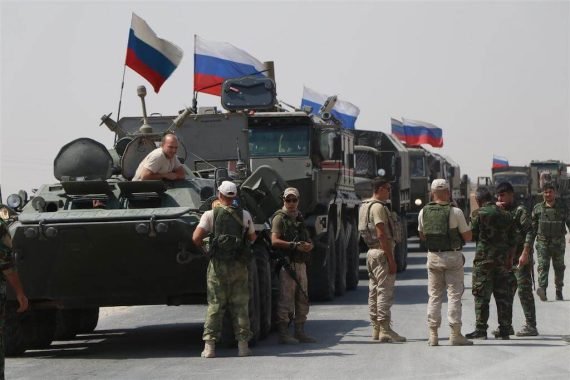

Russian military vehicles drive on the road as Russia makes a new military and logistic reinforcement of 30 vehicles to its military points in Kamisli occupied by YPG, Syrian branch of the PKK terrorist organization on September 14, 2020 Photo by Samer Uveyd, Anadolu Images


F
or years, the Turkish public criticized the U.S. administrations for their support of the YPG, the Syrian branch of the PKK terrorist organization, which poses a threat to Syria’s territorial integrity and a national security threat to Turkey. At the same time, Russia also tried to use the YPG as a card against Turkey in 2015 and early 2016, but later changed its position and declared its support for the territorial integrity of Syria, and acknowledged the threat the group poses against Turkey. However, in the end of 2019, Russia viewed the partial American withdrawal as an opportunity and re-changed its position again.

In this manner, in 2018, Russia withdrew from the Afrin region and opened the way for the joint Turkish-Syrian military operation of the Syrian National Army (SNA), the former Free Syrian Army (FSA), and the Turkish Armed Forces (TAF) against the YPG.

Moreover, Russia accepted to exclude YPG figures from the Syrian constitutional committee and signed several Astana resolutions which define the YPG as a threat to Syria’s territorial integrity. However, Russia changed its approach to the YPG following Turkey’s Operation Peace Spring and became – along with the U.S. – the new military protector of the YPG in Syria.

Read: The Only Way Out for Russia Is to Let Turkey Weaken the YPG

Why did Russia change its attitude towards the YPG? In order to understand this policy change, one should first analyze Russia’s overall Syria policy before Operation Peace Spring. No doubt, for Moscow, autonomy and federal governments or other forms of decentralized government are not a threat to the territorial integrity of a state since Russia itself is a federation. Nobody should expect Russia to oppose a federal system in Syria.

Therefore, Russia does not recognize the PKK and its Syrian branch, the YPG, as terror groups, and, in principle, does not oppose the YPG per se; however, Russia opposes the YPG’s current policies. For Moscow, the YPG’s partnership with the United States has been the main source of its distrust toward the organization. Moscow wants the YPG to quit working with the U.S. and cooperate with the Russia-backed Assad regime. Until Operation Peace Spring, all Russian charm efforts failed and the YPG remained loyal to the United States.

With Trump’s decision to withdraw from Syria, the YPG felt the urgent need to invite the Assad regime and Russia to provide military protection against Turkey and the Syrian Interim Government. The YPG’s request was seen by Moscow as a golden opportunity to gain extensive leverage. Russia wanted to fill the void and was further encouraged when U.S. CENTCOM officials decided to hand over their bases to the Russian military rather than seeing a further push by the Turkey-backed Syrian National Army.

Read: The YPG Myth Downplays a Danger For the West

With this momentum, Russia deployed its troops to Manbij, Ayn al-Arab (Kobane), Ayn Issa, Tal Tamr, Dirbasiyah, and Amudah along the front lines or the border region, and entered the towns of Tabqah and Raqqa. As Russia had troops in the YPG-held Tal Rifaat pocket since 2016, with this development, the YPG was on the verge of coming under full Russian military protection.

Moscow was expecting to enter the far east of Syria at the Iraqi border and the oil-rich region of Deir Ezzor in the southeast, but Trump’s decision to protect the oil hindered Russia from doing so. U.S. soldiers stayed in a strip in the east of the country and prevented Russia from entering. Since then, the YPG militants maintained a balancing act between Moscow and Washington as demonstrated by the visit of the PKK veteran and head of the political supreme body of the YPG, Elham Ahmad, to Moscow before heading to Washington.

Following the partial U.S. withdrawal and the new Russian protection of the YPG, Turkey signed two separate deals with the U.S. and Russia. The deal with the U.S. stopped the SNA-TAF advancement and canceled U.S. sanctions against Turkey in return.

Read: Why Turkey Is Dismantling the YPG from Northern Syria

The deal with Russia was more comprehensive. After Operation Peace Spring, the YPG invited the Assad regime and Russia to protect the front lines against a further push by the joint Turkish-Syrian forces, and Russia obligated itself under the terms of the deal to enforce a full withdrawal of all YPG forces from Tal Rifaat, Manbij, and an area extending 32 km from the Turkish border in the east of the Euphrates to the border with Iraq. The deal also foresaw joint Turkish-Russian patrols in a 10-kilometer-wide strip across the Turkish-Syrian border. Except for the joint patrols, Russia failed to deliver on any of the terms of the agreement.

Let alone keeping their promise, Russians have done the opposite and supported the YPG in its terror campaign against the Syrian Interim Government and Turkey. The YPG engaged in several attacks with various weapon systems against civilian-populated areas of the Syrian Interim Government such as Afrin, Azaz, Al-Bab, Jarablus, Tal Abyad, and Rasulayn.

The YPG used new models of Russian-supplied anti-tank guided missiles to target Turkish soldiers

The YPG used new models of Russian-supplied anti-tank guided missiles to target Turkish soldiers, infiltrated the front lines to kill SNA soldiers, and operated a network of cells in the areas of the Syrian Interim Government located in northern Syria. With these cells, the YPG could plant IEDs and attempt assassinations against the SNA, Syrian local politicians, and Turkish soldiers.

Read: The YPG Has a Bloody History in Syria, But the West Turns a Blind Eye

The YPG used the Russian-protected areas as a safe zone to conduct ranged artillery attacks against hospitals and civilian infrastructure. Yet, the most brutal of the YPG attacks were the constant car bomb attacks carried out in urban areas which randomly killed innocent civilians.

The YPG tries to maintain plausible deniability and rejects responsibility. However, car bombs intercepted at crossing points from YPG-held areas to the areas of the Syrian Interim Government, and the logic behind the attacks leave no doubt about who the perpetrators are. The YPG’s foreign backers, like the U.S., condemn the attacks without naming any suspect or culprit, or turn a blind eye to them entirely, like Russia.

For Moscow, the YPG’s systematic use of terror is a preferred tool to prevent the Syrian Interim Government from establishing a sustainable alternative to the Assad regime without getting into a confrontation with Turkey. The attacks are not conducted directly by Russia, but by the YPG, and the U.S. support and protection of the YPG shields Russia from Turkish criticism.  The Turkish public focuses on the U.S. support of the YPG rather than the military protection Russia provides the YPG and its pragmatic attitude to the YPG’s terror campaign.

In fact, Russian policy shows that Moscow regards the legitimate Syrian opposition as a bigger threat than the YPG. For Russia, the Syrian Interim Government is a direct alternative to the Assad regime, and the YPG represents only a territorially limited pursuit of autonomy. Therefore, Russia prefers to protect the YPG in order to disrupt the Syrian Interim Government rather than implementing its obligations stemming from the Turkish-Russian agreement of 2019.

In fairness, it should be underlined that the Russian position regarding the YPG’s demand to establish an autonomous region in northeast Syria has changed in line with the Astana accords. In the negotiations between the Assad regime and the YPG, Moscow puts its weight behind the regime’s categorical rejection of autonomy. In line with the Astana agreements, Russia rejects the separatist agenda of the YPG on paper. While the U.S. actively supports the political ambitions of the YPG in Syria, Russia supports the military presence of the YPG only as a temporary tool.

VIDEO: Exploiting the Female Body: The YPG Case


River to Sea Uprooted Palestinian   
The views expressed in this article are the sole responsibility of the author and do not necessarily reflect those of the Blog!

Thursday, 30 September 2021

Israeli Aggressions Against Iraq: From Subversions to Normalization Attempts

 September 30, 2021

Source: Al Mayadeen

By Ali Jezzini

The Israeli occupation has attempted to destabilize Iraq since the sixties. How is the Israeli Occupation trying to infiltrate Iraqi society?


Visual search query image
Iraqi Society has been a target for pro-normalization Propaganda in Past years

On the 24th of the current month, a conference was held in Erbil, the capital city of the Iraqi Kurdistan region. The conference of “Peace and Reclamation,” called for the normalization of relations with the Israeli occupation under the shady slogans of peace and establishing civil society organizations.  

The conference, organized by the New York-based Center for Peace Communications (CPC), was called “an illegal gathering” by the Iraqi government. The CPC is an organization that openly calls for the normalization of relations between the Arab states and “Israel”.

For a foreign observer, the story might look like it started here, and one might think, isolating the Iraqis from their national and cultural context, that this reaction is just a mere prejudice from the Iraqis in the face of something they ignore or never have experienced. But is it the case? 

A History of Sabotage 

Despite Iraq not sharing a direct border with Occupied Palestine, the country was a target for countless Israeli aggressions during the last century. Even before the foundation of the Israeli entity in 1948, contact has been made as early as the thirties through the Jewish agency with some Kurdish groups in northern Iraq. In the forties and fifties, simple contact was transformed into real military espionage committed by Kumran Ali Bedir-Khan a Kurdish leader with close ties to “Israel”.

These espionage attempts continued throughout the sixties as well until the rebellion started in autumn 1961 in northern Iraqi regions. Eventually, a larger scale training and supply operation to the insurgents in the north was launched following Kurdish leaders from the Kurdish democratic party (KDP) meeting with Israeli officials during that year. 

Israeli attempts to destabilize the country go back to at least the sixties when the Israelis intervened with the help of the SAVAK, the former Shah of Iran intelligence Agency, to assist the militants of the KDP led by Moustafa Barazani. The insurgents agreed on this supply training Israeli operation in 1963 following their initial hesitation. There were reports about unidentified arms cache in the region, and  Mossad agents never found any difficulty accessing the northern zones in Iraq to fuel the insurgency.

In August 1965, the Israelis provided a training course code-named Marvad (carpet) for Peshmerga (the military force of Barazani at that time). Israeli-backed militias not only destabilized the region and attacked Iraqi military personnel and installations, but also civilian infrastructures. Attacking the Kirkuk oil field which produced a large portion of Iraq’s Oil at that time was one of these attacks.

Visual search query image
  • Mustafa Barzani accompanied by Israeli Occupation President Zalman Shazar in the Occupied Lands,1968
  • Following the Shah of Iran signing the 1975 Algier agreement with Iraq, Israelis objected to the Shah and called it a “betrayal to the Kurds.” This abandonment led to the KDP’s demise and a subsequent de-escalation of the violence in the north, although contacts with “Israel” were maintained afterward.  

    The first official acknowledgment of the Israeli occupation’s aid to the insurgency dates to September 29 1980 when Prime Minister Menachem Begin disclosed that “Israel” had supported the Kurds (KDP) “during their uprising against the Iraqis in 1965–1975.” Begin added that “Israel” had sent instructors and arms but not military units.

    Visual search query image
    Israeli Field Hospital Helping the insurgency in Northern Iraq between 1963-1973

    In 2004, the Israeli media reported on meetings between Masud Barzani (who would become president of the KRG in 2005 ), Jalal Talabani (who would become president of Iraq in 2005 and serve in that office until 2014), and Israeli Prime Minister Ariel Sharon. Relations continued to flourish as the PUK became entangled with this illegal normalization according to Iraqi Legal code 111 of 1969 in its 201st article.

    Such actions reached their peak after the Iraqi president and head of the PUK Jalal Talabani, shook hands with Ehud Barak, the Israeli Defence Minister, in 2008. In 2015, “Israel” reportedly imported as much as three-quarters of its oil from the Kurdistan region in Iraq, providing a vital source of funds as Kurdish Peshmerga to finance its militia.

    Normalization as a division method

    As a part of its “Peripherical alliance” strategy, the Israeli occupation tried to sow division in the societies surrounding it. It tried to ally itself with every ethnic or religious minority in the Arab world as well as surrounding states like Turkey or the Shah’s Persia. The objective of this article is not to bash Kurds as ethnicity in any way. For instance, many Kurdish factions resisted colonialism and Zionism such as the PKK who fought the Israeli occupation in 1982. Kurdish factions in general, have been a target of Israeli subversive actions, due to the complexity of the Kurdish national cause that the Israelis tried to exploit.

    For the first time, this time publically at least, the normalization efforts have been extended to wider sectors of the Iraqi society outside of the “Periphery doctrine.” These efforts have intensified with the recent normalization wave that included UAE, Bahrain, and other countries like Morocco. New faces have appeared on the scene in parallel with such normalization such as Wisam al-Hardan’s The head of the Awakening Groups and Sahar al-Tai, among having called to normalize with “Isreal” following the previously mentioned states’ model. “The UAE and Saudi Arabia are backing these efforts” according to Iraqi Popular Mobilisation forces. 

    Haaretz Israeli newspaper mentioned another level of normalization that is happening mainly on social media. Besides the older Facebook and Twitter page “Israel in Arabic” that was launched in 2011, another Facebook page was created in 2018 called “Isreal Speaks in Iraqi (dialect)” to target Iraqi society specifically. The article says that many operate under the cover of linking Iraqi jews to their heritage and introducing “Israel” to the Iraqis.

    The article mentions the page admin stating that the 2003 war opened up new channels of communication with Iraqis, this communication has been made easier with the signing of the normalization deals with UAE and other countries. Iraqis with second passports are being brought to Israel with the pretext of “tourism” since 2018, which the organizer claims to be independently done from her work for the occupation government as an administrator of the page. The page publically calls for normalization and launches polls to investigate the views of the general audience.

    The stumbling project

    The Iraqi government and various political parties expressed their firm rejection of the “illegal” meetings that were held by some tribal figures in the city of Erbil in the Kurdistan Region, which called for the normalization with “Israel.” Arrest warrants have been issued against the participants of the “Peace and Reclamation” conference in Erbil. One of the main speakers of the conference Wissam al-Hardan has been suspended from his post as the head of the “awakening movement”.

    In the light of these reactions, a general popular rage is engulfing Iraqi Streets while activists on social media called for all participants to be held accountable for the crimes committed according to Iraqi law. Iraqis haven’t forgotten not only the injustice of the Israeli occupation against their Palestinian and Arab brethren but the role Israelis played in insinuating and calling for both major wars launched by the US against their country in 2003. A war whose devastating effects are still evident today.


    River to Sea Uprooted Palestinian   
    The views expressed in this article are the sole responsibility of the author and do not necessarily reflect those of the Blog!

    Wednesday, 31 March 2021

    U.S. A FRIEND WITH WHEAT IS A FRIEND INDEED

    29.03.2021 

    The current state of affairs in northeastern Syria is bordering on the absurd.

    In an unexpected twist, US-backed militants seized a shipment of US-made missiles that were en route to other militants also supported by America. The shipment included 2 TOW anti-tank guided missiles, 24 AK-type assault rifles, a designated marksman’s rifle, two gun tubes and ammo.

    On March 28th, the Syrian Task Force, a joint force of the Turkish Police, Counterterrorism Unit and the National Syrian Army (SNA) took the weapons shipment.

    Most SNA factions were once backed by the US, which supplied them with TOW ATGMs until late 2017. They are also currently and continually supported by Turkey.

    Turkey said that the weapons consignment was seized because it was heading towards the Syrian Democratic Forces (SDF).  The SDF is the most important US ally in Syria, but it is comprised of the PKK and YPG, whom Ankara deems as terrorist organizations.

    US forces in Syria need all the support they can get, and as such they are delivering supplies to its presumed allies.

    On March 27th, in addition to smuggling oil, a large US convoy smuggled 38 trucks of Syrian wheat from the Hasaka governorate into northern Iraq. Just days earlier, on March 25th, 18 more trucks with wheat were taken out of Syria.

    In Hasaka, the SDF is carrying out its expansionist work, displacing home-owners in the vicinity of a helipad. The positions are to be used to counter the attacks and movements of Turkish-backed militants coming from Ras al-Ayn and Afrin.

    And sure enough, Turkish forces, as well as militants backed by Ankara, renewed shelling on the Hasaka countryside. They shelled the two villages of al-Khashma and al-Dardara to the north of the town Tal Tamer on March 27th.

    In response to Turkey’s shelling and attacks, the SDF carried out an operation towards Raqqa. As a result, eight Turkish-backed militants were either killed or wounded. According to the Syrian Observatory for Human Rights, SDF fighters blew up a militant position near the town of Umm al-Manajir in the northern outskirts of the town of Ain Issa.

    Still, even without the SDF attacking any positions, in Afrin the Turkish-backed militants continue fighting even amongst themselves. On March 27th, militants of the Hamza Division clashed with a group which recently defected from the division and joined the al-Sham Corps. At least 11 were either killed or injured.

    Northern Syria appears to be in a perpetual state of chaos, with several sides attempting to steal away resources to forward their own interests. Turkey, the US, and the militants that they back are taking the chance to do so, since the Damascus government and Russian support are more focused on Greater Idlib, and the ISIS-infested central region.

    Related


    River to Sea Uprooted Palestinian   
    The views expressed in this article are the sole responsibility of the author and do not necessarily reflect those of the Blog!

    Wednesday, 24 March 2021

    Threat to close pro-Kurdish party echoes long tradition in Turkey's politics.

     HDP may be added to long list of left-wing and Islamist parties shut down over the decades by the Turkish state

    Supporters of the pro-Kurdish Democratic Society Party (DTP) demonstrate against the party’s closure in front of the Turkish parliament on 8 December 2009 (AFP)

    By Alex MacDonald

    Published date: 20 March 2021 10:41 UTC

    In 1998, the Constitutional Court of Turkey closed down the Welfare Party, at the time the largest in parliament, with chief justice Ahmet Necdet Sezer citing the party’s “actions against the principles of the secular republic”.

    The move was condemned internationally, including by Washington, which called on its Nato ally to “enhance democracy” and allow a wider spectrum of political participation.

    The party’s leader, Necmettin Erbakan, a stalwart of Turkey’s religious conservatives who had previously held the position of prime minister, said the closure would rebound on its opponents, only spurring on their supporters’ determination.

    ‘As a political entity we may not be able to survive this onslaught on our party, but definitely as a people, as a movement, we are going to survive’

    – Hisyar Ozsoy, HDP

    “Whenever they put obstacles in our path, our support only increases,” he said at the time.

    Twenty-three years later, his protege Recep Tayyip Erdogan – once the Welfare Party mayor of Istanbul and now president – is facing criticism from the other side of the fence, as his hand-picked chief public prosecutor applies to close down the left-wing, pro-Kurdish Peoples’ Democracy Party (HDP).

    The Welfare Party and the HDP are far from the only parties shut down by the state in Turkey’s history.

    Since the founding of the republic in 1923, the country’s constitutions have always limited political pluralism to one degree or another.

    Left-wing parties, Communist ones, those supporting various minority groups, and Islamist movements, have all been subject to closures and bans over the past century. Just since the adoption of the 1982 constitution, almost 20 parties have been forcibly closed.

    ‘Onslaught on our party’

    The indictment being levelled against the HDP this time, however, is somewhat different: it calls not only for the closure of the party but for the banning of 687 political figures associated with it.

    Hisyar Ozsoy is an HDP MP in the party’s core base of Diyarbakir, and his name is one of those listed in the indictment to be banned from political office.

    He told Middle East Eye that the party’s central board was examining a number of options for the upcoming parliamentary elections – set for 2023, but possibly occurring earlier – should the application to the Constitutional Court be successful.

    “It may be another political party, it may be independents, using the list of an already existing party,” he said, via phone.

    “These are all options, but they may even try to prevent the HDP from running as a different political party.”

    Noting the repeated obstacles that have been thrown in the way of progressive political parties in Turkey in the past, he said that, regardless of what happened, the HDP as a movement would not disappear.

    “The HDP is not just some headquarters, some building, some people. We do have a powerful historical tradition of diverse struggles in Turkey,” he said.

    “So they may shut down the HDP as a political entity, but the political struggles that we represent are going to stay there and will be impacting Turkish and Kurdish politics in the country.

    “As a political entity we may not be able to survive this onslaught on our party, but definitely as a people, as a movement we are going to survive.”

    A history of closures

    When the ruling Justice and Development Party (AKP) came to power under Abdullah Gul in 2001 (due to Erdogan still being banned from political office), it pledged that there would be an end to the era of forced party closures, not least because of its own roots in the forcibly closed Welfare Party and the enduring fear it might be subjected to similar treatment.

    Mustafa Akyol, a writer and senior fellow at the Cato Institute, said he had once been optimistic about the AKP as a force for ending the authoritarian practices of the Turkish state.

    “In its early years in power, Erdogan’s AKP was boldly against all the illiberal and anti-democratic features of the regime of ‘Old Turkey’,” he told MEE.

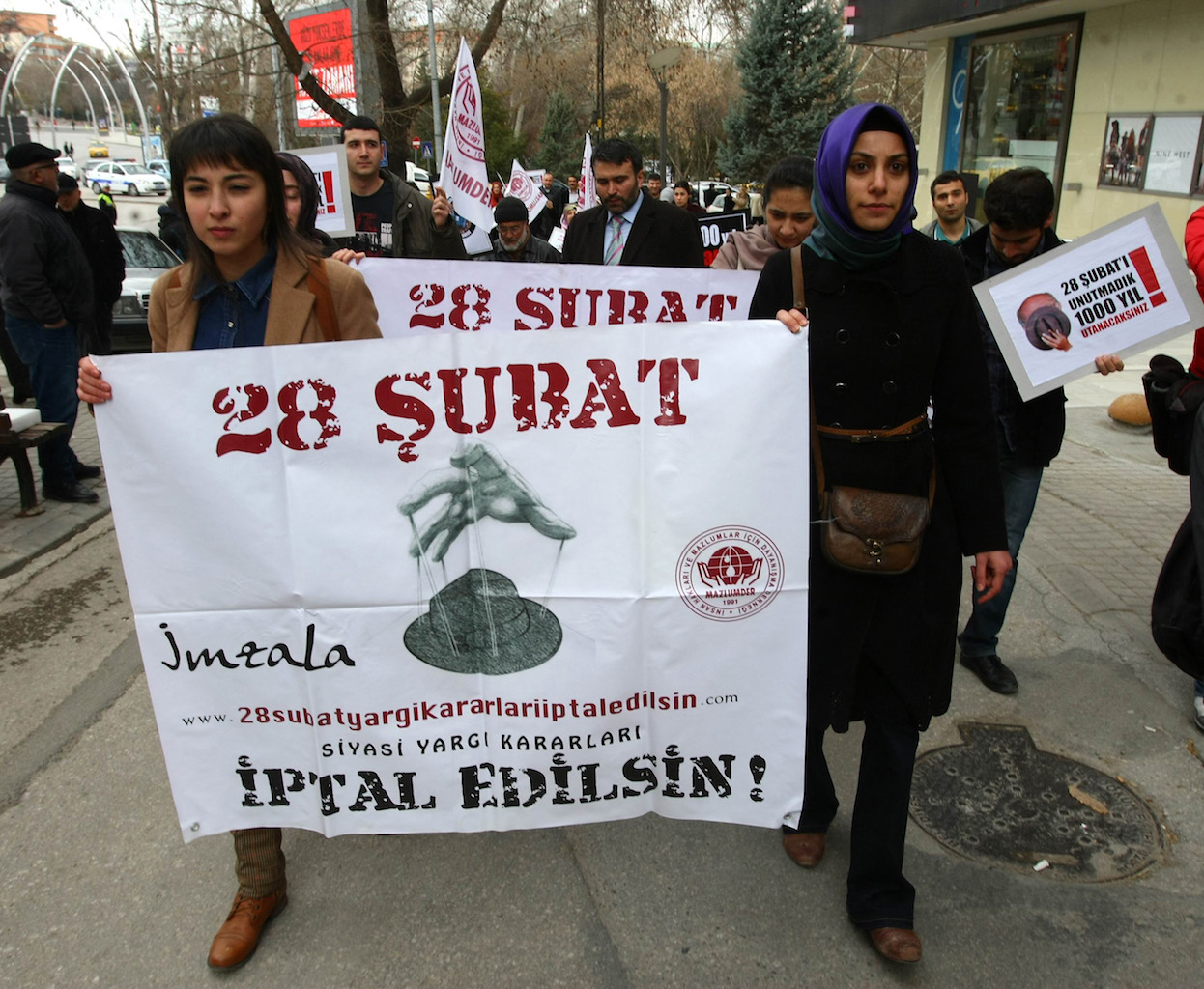
    Demonstrators commemorating the 28 February 1997 ousting of the Welfare Party government in 2013 with posters reading: "We have not forgotten February 28" (AFP)
    Demonstrators commemorating the 28 February 1997 ousting of the Welfare Party government in 2013 with posters reading: “We have not forgotten February 28” (AFP)

    “But in a mind-boggling turn, once they consolidated power, their ‘New Turkey’ began repeating – in fact, often doubling – all the authoritarian habits of the past.”

    The forcible closure of political parties in Turkey has a history dating right back to the early years of the republic.

    The Communist Party of Turkey (TKP) was one of the first victims in 1925, despite the crucial role the Bolsheviks had played in helping establish the republic. Semyon Ivanovich Aralov, Soviet ambassador to Turkey, is among those displayed on the victim monument in Istanbul’s Taksim Square.

    Until the 21st century, political parties with the word “Communist” in their name were effectively banned in Turkey, though many operated illegally or used alternative monikers.

    Further right on the political spectrum, the Liberal Republican Party was founded in August 1930 as an early attempt at multi-party democracy at the insistence of republic founder Mustafa Kemal Ataturk, but was swiftly closed in November that same year after it drew too many elements opposed to Ataturk’s secular-nationalist reforms.

    Unlike later closures, the party was shut down by its founder rather than forcibly closed, but it left the country as a one-party state under the Republican People’s Party (CHP) at the end of the Second World War.

    Since that period, the Turkish state has repeatedly banned parties from across the political spectrum: on the one hand, Communists over their internationalism, atheism, anti-capitalism and opposition to US influence in Turkey; on the other hand, Islamists, whose desire for religion-based rule undermined the secular underpinnings of the republic.

    Kurdish parties closed

    One of Ataturk’s founding principles for the republic was a belief that ethnic and cultural homogeneity would promote stability and peace.

    As such, there have long been strict bans on political parties that promote the rights of minorities, which are regularly shut down on the accusation of threatening the territorial integrity of the country.

    Parties promoting the interest of Kurds, the country’s largest ethnic minority, have been most regularly subjected to closure, often over accusations of links to the Kurdistan Workers’ Party (PKK) militant group.

    Not even counting illegal or extra-parliamentary groups, the list of pro-Kurdish parties closed since the beginning of multi-party democracy is extensive.

    In the past 30 years alone, after the first overtly pro-Kurdish politicians began being elected to parliament, the list includes the People’s Labour Party and the Freedom and Democracy Party (DEP) in 1993, the Democracy Party in 1994, the original People’s Democracy Party in  2003 and the Democratic Society Party (DTP) in 2009.

    Many of the same people were involved in each party, which were often just re-constituted versions of each other. Many are also members of the HDP, which was founded in 2012 as an alliance between the Kurdish movement and other left-wing parties.

    Layla Zana, later an HDP politician, scandalised the country in 1991 when, after taking her oath to be sworn into parliament (and in spite of attempts to drown her out), spoke the line: “I take this oath for the brotherhood between the Turkish people and the Kurdish people” in Kurdish, which was effectively illegal at the time.

    She would later be stripped of her parliamentary immunity after the party she was then a member of, the DEP, was banned, and would spend many years in prison.

    Zana, who was an HDP MP between 2011 and 2018, is also named among the 687 politicians to be banned from office in the most recent indictment.

    The later banning of the DTP – after the Constitutional Court declared it had become the “focal point of activities against the indivisible unity of the state, the country and the nation” – came the same year as the court ended a similar investigation into the AKP, which declared the party had become “a centre for anti-secular activities” but only cut its state funding, rather than banning it outright.

    “Closing down pro-Kurdish parties with implicit ties to the PKK was one such habit of ‘Old Turkey’ that the AKP used to criticize,” said Akyol.

    “But first they began purging the elected mayors of the HDP, to replace them with their own loyalists.

    “Now they are taking the ultimate step, completing the full circle in going back to the ‘Old Turkey’ – or its new version which now they dominate.

    “Every fair political observer knows that closing down a party that gets 10 percent of the national vote will not bring any good to Turkey, but it may help boost the ultra-nationalist coalition that Erdogan has built.”

    ‘Indivisible integrity’ of Turkey

    The application made by Bekir Sahin to the Constitutional Court on Wednesday accuses the HDP of threatening the “indivisible integrity” of Turkey and of having an “active role in providing personnel” to the PKK.

    The court now has to make a decision on the indictment, but few believe it will issue a decision that goes against the government’s wishes, though it is also possible the eventual decision could stop short of a full closure.

    The EU condemned the move on Thursday.Turkey: Erdogan’s human rights initiative raises eyebrows of beleaguered activistsRead More »

    “Closing the second-largest opposition party would violate the rights of millions of voters in Turkey,” EU foreign policy chief Josep Borrell and enlargement commissioner Oliver Varhelyi said in a statement, adding that it “undermines the credibility of the Turkish authorities’ stated commitment to reforms”.

    In response, the Turkish foreign ministry told those who “dare to meddle in our domestic affairs to respect the judicial process led by independent courts”.

    Regardless of the eventual outcome, Ozsoy said, it was just one more incident in the long struggle for pluralism and representation in Turkey.

    “[The government] don’t have anything to offer to the Turkish people as a positive agenda, to resolve the economic crisis or other issues,” he said.

    “They are cooking the same dish and trying to serve it to people. Whenever there is a crisis or an unstable situation in the country they consolidate their power base by attacking the HDP.

    “Even if Erdogan totally wipes out the HDP, the HDP people are not going to vote for him in the presidential elections… if Erdogan shuts down the HDP, he will totally lose the Kurdish vote.”


    River to Sea Uprooted Palestinian   
    The views expressed in this article are the sole responsibility of the author and do not necessarily reflect those of the Blog!

    Tuesday, 9 February 2021

    After Idlib and the Kurds… What about the Euphrates and the Tigris? بعد إدلب والكرد.. ماذا عن الفرات ودجلة؟

      ARABI SOURI 

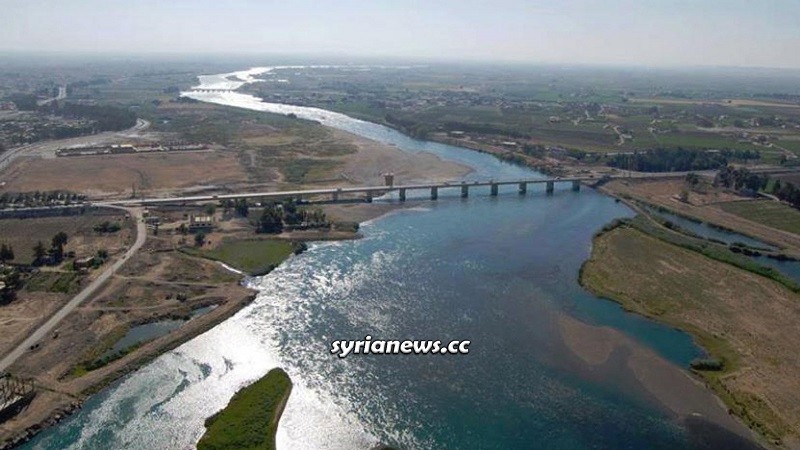
    Euphrates River - Syria and Iraq Water - Turkey
    حسني محلي
    International relations researcher and specialist in Turkish affairs

    The following is the English translation from Arabic of the latest article by Turkish career journalist Husni Mahali he published in the Lebanese Al-Mayadeen news site Al-Mayadeen Net:

    After Turkey has become a main party in the overall developments of the Syrian file with the years of the so-called ‘Arab Spring’, Ankara has developed many scenarios and calculations for its future relations with Damascus, and through it with the rest of the region, especially Iraq which is bordering Turkey, Syria, and Iran.

    The waters of the Euphrates, Tigris and other small rivers (about 12 rivers with Syria and 3 with Iraq) come within these calculations, especially with the continuing dry seasons, which seem to be reflected in one way or another on Ankara’s water policies in the future with the two mentioned countries.

    The water of the Euphrates has always been an important material in Turkish bargaining with Syria and Iraq, together or separately since Turkey began building dams on the Euphrates River, the first of which was the Kaban Dam which was inaugurated in 1974, and then the Karakaya Dam in 1987. The Ataturk Dam, which was inaugurated in 1991 was the most important in the water crisis between Turkey and both Syria and Iraq, especially after Prime Minister Suleiman Demirel said in 1991 ‘The Arab countries sell their oil, so why we do not sell our water also?’.

    Ankara has insisted from the beginning on building dams after it refused to sign the international agreement (1997) that regulates the joint use of shared international water, including the Nile, the Euphrates and the Tigris, and it says that the last two are Turkish rivers crossing the border and they are not two shared rivers and that it has the right to dispose of its waters as it wishes, taking into account the interests of the downstream countries.

    The roots of the Turkish water crisis with Syria and Iraq go back to the year 1920 when ‘tripartite and bilateral’ agreements were signed between Turkey and both Syria (a French colony) and Iraq (a British colony) to divide the water according to international standards followed at the time. The ‘Lausanne’ agreement (1923) by which Western countries recognized the modern Turkish republic, the heir to the Ottoman Empire, included a clause regarding the Tigris and Euphrates rivers, stating: “No country from these three countries has the right to build a dam or a reservoir or divert a river course without coordinating with other countries to ensure that their interests are not harmed.’

    With the independence of Syria and Iraq, water remained a fundamental problem hindering the establishment of lasting friendly relations between the three countries, which has enough other problems that prevented them from developing relations between them, with the Syrian and Iraqi doubts always regarding the possibility that the Turkish side would use water as a weapon against them.

    The documents of the US embassy in Tehran (November 4, 1979) indicated that “the CIA proposed to the Director General of the National Water Corporation, Suleiman Demirel in the year 1955-1956, to build large dams on the Euphrates, to be a weapon in Ankara’s hand against Syria, whose relations were bad at that time with Turkey.’

    This explains the failure of the agreement signed by President Turgut Ozal in 1987 with the late President Hafez al-Assad, after it was affected by the tensions in the relations between the two countries, due to Ankara’s accusation of Damascus of supporting the PKK, if we ignore the psychological-influencing issue of the Iskenderun Strip.

    According to the 1987 agreement, the Turkish side pledged to leave 500 cubic meters per second of the Euphrates water for Syria (42%) and Iraq (58%), provided that this amount would increase to reach 650 cubic meters after 5 years, in exchange for Damascus giving up this support, without this agreement preventing Ankara from building the dams of Perajik (50 km from the border with Syria) and Qaraqamish (3 km from the Syrian border) and two dams on the Tigris River, while the National Water Corporation plans to build a total of 22 dams on the two mentioned rivers, to reach the amount of the water that will be stored in these dams amounts to about 140 billion cubic meters.

    Ankara plans to irrigate 1.8 million hectares of agricultural land with this water, and it also aims to generate 27 billion kilowatt hours of electricity (23% of Turkey’s consumption) from these dams, in addition to about 750 dams of various sizes (550 of which are large dams) built by Turkey on dozens of small and large rivers, the length of which exceeds 20 thousand km inside the Turkish borders.

    President Erdogan’s statements last week in which when he said, “Turkey is not rich in water, as some believe,” raised many questions about the possibilities of using water as a weapon in Ankara’s potential bargains with Syria and Iraq, and most importantly with the “SDF” and the Kurdish People’s Protection Units that control the East of the Euphrates with the support of Washington, which Ankara fears that it seeks to establish an independent Kurdish entity in the region as is the case in northern Iraq.

    Official Turkish circles develop many scenarios regarding water policies that include serious studies about water sources, including rain and groundwater, in addition to the mentioned rivers, which number more than 100.

    These studies estimate the total capacity of surface (rain) and groundwater that can be utilized at about 115 billion cubic meters, of which about 60 billion cubic meters are used annually. These figures prompted Ankara to implement many projects to build underground dams, a new technology that contributes to storing groundwater as is the case in the rivers on which Ankara builds its dams.

    These accounts did not prevent Ankara from continuing to build hundreds of dams on dozens of rivers that flow into its lands and flow into the seas (Aegean, Mediterranean, Marmara and Black), or leave it to other neighboring countries, including Iran, Georgia, Armenia, Bulgaria and Greece, or come from these countries, in. At the time when Turkey succeeded in laying the pipeline (80 km) that carries water under the sea (75 million cubic meters annually) to Turkish northern Cyprus with plans to sell this water to the Greek Cypriots, and even to ‘Israel’, the late President Turgut Ozal failed in his water pipeline project to ‘Israel’ through Syria and Lebanon, and another pipeline extending to the Gulf countries via Jordan to sell the water of the Saihan and Caihan rivers to these countries.

    Many academic studies in the West see the Turkish datum as a sufficient reason for both Iraq and Syria to fear about the possible repercussions of Ankara’s policies with the two countries mentioned with the Kurdish element in them, everyone knows that Ankara’s implementation of its projects on the Euphrates, Tigris and other small rivers will put Iraq and Syria in front of serious challenges that will be cause serious implications for agriculture, food security, drinking water and energy generation, especially with the environmental fluctuations that threaten of drought years, according to all scientific studies worldwide.

    As Ankara continues its current policies in Syria and Iraq, it has become clear that sooner or later it will use water as an influential card in its bargaining with Damascus, Baghdad and the Kurds, who are the primary beneficiaries of the waters of the Euphrates, the Tigris and other small rivers, given that the Syrian dams are in the “SDF”. This explains the presence of Ankara in Afrin (Afrin River) west of the Euphrates in general, in addition to the area extending from Ras al-Ain to Tal Abyad, where many of the small Turkish rivers enter Syria, without ignoring their presence in Jarablus, the entrance to the Euphrates into Syria, and its attempt to control Ayn al-Arab (Kobane), which is on the eastern bank of the river, similarly is the case in northern Iraq, as Turkey succeeded in establishing many military bases in the strategic mountains overlooking or near the waterways, including the Tigris and the Great Zab.

    The bet or hope remains in the possibilities of returning to friendly relations between Ankara and each of Damascus and Baghdad, and even Iran, which is also a party to the water issue, especially with Iraq, after Ankara succeeded after 2003 in establishing friendly relations with Syria, Iraq, Iran and the rest of the countries of the region; President Erdogan, and before him President Abdullah Gul, announced more than once that “there is no longer a so-called water problem with the two aforementioned neighbors so that Mesopotamia will return again as the cradle of the civilizations that lived in it thousands of years ago.” This is what has been blown in the wind and the feelings of brotherhood and friendship between Ankara and both Baghdad and Damascus have become forgotten, after the policies of “zeroing problems with neighbors” succeeded in “zeroing the neighbors”, and water will soon be their most difficult concern!

    To help us continue please visit the Donate page to donate or learn how you can help us with no cost on you.
    Follow us on Telegram: http://t.me/syupdates link will open Telegram app.

    بعد إدلب والكرد.. ماذا عن الفرات ودجلة؟

    حسني محلي
    باحث علاقات دولية ومختصص بالشأن التركي

    حسني محلي 

    المصدر: الميادين نت

    4 شباط

    تضع الأوساط التركية الرسمية العديد من السيناريوهات في ما يتعلق بالسياسات المائية التي تتضمّن دراسات جدية حول مصادر المياه، ومنها الأمطار والمياه الجوفية، إضافةً إلى الأنهار المذكورة التي يزيد عددها على 100 نهر. 

    بعد إدلب والكرد.. ماذا عن الفرات ودجلة؟

    بعد أن أصبحت تركيا طرفاً أساسياً في مجمل تطورات الملف السوري مع سنوات ما يسمى بـ”الربيع العربي”، وضعت أنقرة العديد من السيناريوهات والحسابات لعلاقاتها المستقبلية مع دمشق، وعبرها مع باقي دول المنطقة، وفي مقدمتها العراق المجاور لتركيا وسوريا وإيران. 

    وتأتي مياه الفرات ودجلة والأنهار الصغيرة الأخرى (حوالى 12 نهراً مع سوريا و3 مع العراق) ضمن هذه الحسابات، وخصوصاً مع استمرار مواسم الجفاف التي يبدو أنها ستنعكس بشكل أو بآخر على سياسات أنقرة المائية مستقبلاً مع الدولتين المذكورتين. 

    وكانت مياه الفرات دائماً مادة مهمة في المساومات التركية مع سوريا والعراق معاً أو على انفراد، منذ أن بدأت تركيا ببناء السّدود على نهر الفرات، وأولها سدّ كابان الذي تمّ افتتاحه في العام 1974، ثم سدّ كاراكايا في العام 1987. وكان سدّ أتاتورك الذي تمّ افتتاحه في العام 1991 هو الأهم في أزمة المياه بين تركيا وكل من سوريا والعراق، وخصوصاً بعد أن قال رئيس الوزراء سليمان ديمريل في العام 1991 “إن الدول العربية تبيع نفطها، فلماذا لا نبيع أيضاً مياهنا؟”. 

    وقد أصرّت أنقرة منذ البداية على بناء السّدود بعد أن رفضت التوقيع على الاتفاقية الدولية (1997) التي تنظم عملية الاستخدام المشترك لمياه المجاري الدولية المشتركة، ومنها النيل والفرات ودجلة، وهي تقول إنّ الأخيرين نهران تركيان عابران للحدود، وليسا نهرين مشتركين، ومن حقّها التصرف بمياهها كما تشاء، مع مراعاة مصالح دول المصب. 

    تعود جذور أزمة المياه التركية مع سوريا والعراق إلى العام 1920، عندما تم التوقيع على اتفاقيات “ثلاثية وثنائية” بين وتركيا وكل من سوريا (مستعمرة فرنسية) والعراق (مستعمرة بريطانية) لتقسيم المياه وفق المعايير الدولية المتبعة آنذاك. وتضمّنت اتفاقية “لوزان” (1923) التي اعترفت الدّول الغربية بموجبها بالجمهورية التركية الحديثة، وريثة الدولة العثمانية، بنداً خاصاً بنهري دجلة والفرات جاء فيه: “لا يحق لأية دولة من هذه الدول الثلاث إقامة سد أو خزان أو تحويل مجرى نهر من دون أن تنسق مع الدول الأخرى لضمان عدم إلحاق الأذى بمصالحها”. 

    ومع استقلال سوريا والعراق، بقيت المياه مشكلة أساسية تعرقل إقامة علاقات ودية دائمة بين الدول الثلاث التي لديها ما يكفيها من المشاكل الأخرى التي منعتها من تطوير العلاقات في ما بينها، مع استمرار الشكوك السورية والعراقية دائماً باحتمالات أن يستخدم الجانب التركي المياه كسلاح ضدها.

    وقد بيّنت وثائق السفارة الأميركية في طهران (4 تشرين الثاني/نوفمبر 1979) “أن المخابرات الأميركية CIA اقترحت على مدير عام مؤسسة المياه الوطنية سليمان ديميريل في العام 1955-1956 بناء سدود كبيرة على الفرات، لتكون سلاحاً بيد أنقرة ضد سوريا التي كانت علاقاتها سيئة آنذاك مع تركيا”.

    ويفسر ذلك فشل الاتفاقية التي وقع عليها الرئيس تورغوت أوزال في العام 1987 مع الرئيس الراحل حافظ الأسد، بعد أن تأثرت بالتوترات التي شهدتها العلاقات بين البلدين، بسبب اتهام أنقرة لدمشق بدعم حزب العمال الكردستاني، إذا ما تجاهلنا قضية لواء الإسكندرون ذات التأثير النفسيّ.

    وقد تعهّد الجانب التركي وفق اتفاقيّة 1987 بترك 500 متر مكعب في الثانية من مياه الفرات لكل من سوريا (42%) والعراق (58%)، على أن تزداد هذه الكمية لتصل بعد 5 سنوات إلى 650 متراً مكعباً، مقابل تخلي دمشق عن هذا الدعم، من دون أن تمنع هذه الاتفاقية أنقرة من بناء سدي بيراجيك (50 كم عن الحدود مع سوريا) وقرقميش (على بعد 3 كم من الحدود السورية) وسدين على نهر دجلة، فيما تخطط مؤسسة المياه الوطنية لبناء ما مجموعه 22 سداً على النهرين المذكورين، لتصل كمية المياه التي سيتم تخزينها في هذه السدود إلى حوالى 140 مليار متر مكعب.

    وتخطّط أنقرة لريّ 1.8 مليون هكتار من الأراضي الزراعية بهذه المياه، كما تهدف إلى توليد 27 مليار كيلو واط /ساعة من الكهرباء (23% من استهلاك تركيا) من هذه السدود، إضافةً إلى حوالى 750 سداً بمختلف الأحجام (550 منها سد كبير) بنتها تركيا على عشرات الأنهار الصغيرة والكبيرة، ويزيد طولها داخل الحدود التركية على 20 ألف كم. 

    وجاءت أقوال الرئيس إردوغان الأسبوع الماضي، إذ قال “إن تركيا ليست غنية بالمياه، كما يعتقد البعض”، لتثير العديد من التساؤلات حول احتمالات استخدام المياه كسلاح في مساومات أنقرة المحتملة مع سوريا والعراق، والأهمّ مع “قسد” ووحدات حماية الشعب الكردية التي تسيطر على شرق الفرات بدعم من واشنطن، التي تتخوّف أنقرة من أن تسعى إلى إقامة كيان كردي مستقل في المنطقة، كما هو الحال في الشمال العراقي. 

    وتضع الأوساط التركية الرسمية العديد من السيناريوهات في ما يتعلق بالسياسات المائية التي تتضمّن دراسات جدية حول مصادر المياه، ومنها الأمطار والمياه الجوفية، إضافةً إلى الأنهار المذكورة التي يزيد عددها على 100 نهر. 

    وتقدّر هذه الدراسات الطاقة الإجمالية للمياه السطحية (الأمطار) والجوفية التي يمكن الاستفادة منها بحوالى 115 مليار متر مكعب، يتم استغلال حوالى 60 مليار متر مكعب منها سنوياً. ودفعت هذه الأرقام أنقرة إلى تنفيذ العديد من المشاريع لبناء السدود الجوفية، وهي تقنية جديدة تساهم في تخزين المياه الجوفية، كما هو الحال في الأنهار التي تبني عليها أنقرة سدودها. 

    ولم تمنع هذه الحسابات أنقرة من الاستمرار في بناء مئات السدود على عشرات الأنهار التي تنبع في أراضيها وتصب في البحار (إيجة والأبيض المتوسط ومرمرة والأسود)، أو تغادرها إلى دول مجاورة أخرى، ومنها إيران وجورجيا وأرمينيا وبلغاريا واليونان، أو تأتيها من هذه الدول، في الوقت الذي نجحت تركيا في مد الأنبوب (80 كم) الذي ينقل المياه تحت البحر (75 مليون متر مكعب سنوياً) إلى شمال قبرص التركية مع حسابات لبيع هذه المياه للقبارصة اليونانيين، وحتى “إسرائيل”، فقد فشل الرئيس الراحل تورغوت أوزال في مشروعه لمد أنابيب المياه إلى “إسرائيل” مروراً بسوريا ولبنان، وأنبوب آخر يمتد إلى دول الخليج عبر الأردن لبيع مياه نهري سايهان وجايهان لهذه الدول.

    وترى العديد من الدراسات الأكاديمية في الغرب في المعطيات التركية سبباً كافياً لتخوّف كل من العراق وسوريا من الانعكاسات المحتملة لسياسات أنقرة مع الدولتين المذكورتين بالعنصر الكردي فيهما، فالجميع يعرف أن تنفيذ أنقرة مشاريعها على نهري الفرات ودجلة والأنهار الصغيرة الأخرى سيضع العراق وسوريا أمام تحديات جدية ستكون لها انعكاسات خطيرة على الزراعة والأمن الغذائي ومياه الشرب وتوليد الطاقة، وخصوصاً مع التقلبات البيئية التي تهدد بسنوات الجفاف، وفق كل الدراسات العلمية عالمياً. 

    ومع استمرار أنقرة في سياساتها الحالية في سوريا والعراق، بات واضحاً أنها، عاجلاً أم آجلاً، ستستخدم المياه كورقة مؤثرة في مساوماتها مع دمشق وبغداد والكرد، المستفيد الأول من مياه الفرات ودجلة وباقي الأنهار الصغيرة، باعتبار أن السدود السورية في “قسد”. ويفسر ذلك تواجد أنقرة في عفرين (نهر عفرين) غرب الفرات عموماً، إضافةً إلى المنطقة الممتدة من رأس العين إلى تل أبيض، حيث العديد من الأنهار التركية الصغيرة التي تدخل منها إلى سوريا، من دون أن نتجاهل تواجدها في جرابلس، مدخل الفرات إلى سوريا، ومحاولتها السيطرة على عين العرب (كوباني)، وهي على الضفة الشرقية للنهر، وهو الحال في شمال العراق، إذ نجحت تركيا في إقامة العديد من القواعد العسكرية في الجبال الاستراتيجية المطلة أو القريبة من المجاري المائية، ومنها دجلة والزاب الكبير. 

    ويبقى الرهان أو الأمل في احتمالات العودة إلى علاقات الصداقة بين أنقرة وكل من دمشق وبغداد، وحتى إيران، وهي أيضاً طرف في قضية المياه، وخصوصاً مع العراق، فبعد أن نجحت أنقرة بعد العام 2003 في إقامات علاقات ودية مع سوريا والعراق وإيران وباقي دول المنطقة، أعلن الرئيس إردوغان، وقبله الرئيس عبد الله جول، أكثر من مرة، أنه “لم تعد هناك ما يسمى بمشكلة المياه مع الجارتين المذكورتين، ليعود ما بين النهرين من جديد مهداً للحضارات التي عاشت فيها قبل آلاف السنين”، وهو الكلام الذي أصبح في مهب الريح، كما أصبحت مشاعر الأخوة والصداقة بين أنقرة وكل من بغداد ودمشق في ذاكرة النسيان، بعد أن نجحت سياسات “تصفير المشاكل مع الجيران” في “تصفير الجيران”، وستكون المياه قريباً همها الأصعب!


    فيديوات ذات صلة


    مقالات ذات صلة


    River to Sea Uprooted Palestinian   
    The views expressed in this article are the sole responsibility of the author and do not necessarily reflect those of the Blog!